




Abstract
Mediterranean welfare states have generally been treated as a homogeneous group; a ‘family of sinners’ that requires structural reforms to tackle persistent problems. While this applied until the Great Recession, new evidence suggests significant departures from this trajectory. Why did Mediterranean countries move from dualization and retrenchment to more generous measures in 2020, especially in outsiders’ protection? Taking the pandemic as a symmetric shock, we investigate welfare state responses in three Mediterranean regimes - Spain, Portugal and Italy. We find that, while all three departed from past austerity logics, Spain adopted a more encompassing response, entailing generous support towards both core and peripheral workers. Italy and Portugal, instead, persisted in a dual model of core segment protection with transfers for the most vulnerable. Drawing on interview and documentary data, we explain this divergence with the interplay between policy learning on the Left and patterns of ‘crisis corporatism’.
Introduction
The Covid-19 pandemic was the ultimate ‘stress test’ for Southern European welfare states – traditionally stratified, incomplete welfare regimes biased in favor of core workers (Ferrera, 1996). At the onset of the crisis, governments’ objective was to reduce income loss for employees and ensure that businesses remained open. This colossal task was even more difficult as Mediterranean countries were recovering from a decade of cuts and labor market liberalization following the Great Recession (Branco et al., 2024; Clegg et al., 2024; Natili et al., 2023). With limited resources and under time pressure, center-left (coalition) governments had to innovate, experiment, and devise policy solutions to protect diverse socio-occupational groups.
The first period of the pandemic is an ideal moment to understand why similar welfare states may depart from previous legacies in response to labor market shocks. The literature suggests that Southern European welfare systems broadly share common characteristics. Most importantly, they strongly discriminate the ‘outsiders’ (atypical categories such as agency, on-call, self-employed workers) vis-à-vis the more privileged ‘insiders’, i.e., full-time permanent workers (Schwander and Häusermann, 2013). When confronted with the pandemic, however, Mediterranean countries significantly expanded automatic stabilizers and experimented with new policy instruments (Eurofound, 2020). Furthermore, although the shock was broadly similar, their reaction was far from uniform: insiders and outsiders were covered in different degrees both across and within countries (Branco et al., 2024; Moreira et al., 2021). How did Southern European welfare states manage the Covid-19 shock in labor markets? Under which conditions do they provide a balanced response towards insiders and outsiders?
In this paper, we compare policy responses to Covid-19 in Southern Europe, focusing on how learning and political dynamics among actors on the left shaped variation in crisis management. We understand learning as a deeply political process, that is influenced by organizational threats such as electoral losses, competition from radical actors, and membership decline. A combination of these factors may encourage left-leaning elites (including both party leaders and trade unionists) to change course, and adjust their policy perceptions to new socio-economic realities. After suffering electoral setbacks in the 2010s, in year 2020 center-left parties in government were eager to compensate their traditional voter base. Similarly, trade unions, who had experienced a drastic decline in power resources over the previous decade, adopted outsider-oriented strategies to restore their legitimacy in the eyes of the broader workforce. Nevertheless, only in Spain were unions involved in the policy-making process; this contingency explains, in our view, a more inclusive and generous welfare reaction which departed from traditional insider-biased responses.
Overall, the paper makes three contributions. First, we propose an innovative approach to empirically assess levels of generosity attached to policies for outsiders and insiders, and compare protection patterns both within and across countries. According to our results, Italy and Portugal combined generous income protection for the insiders with residual assistance for the ‘precariat’ (in line with their institutional trajectory). Spain, on the other hand, showed signs of a path departure, with the creation of universal social protection floors. Second, marshalling evidence from policy reports, newspapers and elite interviews, we explain different degrees of generosity in Covid-19 responses by showing learning effects within established left-wing actors (social democratic parties and trade unions). Our findings suggest that policy lessons often have a partisan dimension: actors do not simply learn through trial and error, but calculate political costs and opportunities in the learning process (Gilardi, 2010). Finally, we add to the literature on unions’ ‘outsider turn’ in social policy and suggest that these actors favored a more encompassing response when they were included in crisis policy-making.
The rest of the paper is structured as follows. We start by surveying the literatures of Mediterranean welfare states, policy learning, and trade unionism in times of crisis. After that, we propose a novel approach to quantitatively map income support schemes in three Southern European countries. The subsequent part traces the roots of these policy outcomes by assessing divergence in terms of crisis framing and patterns of union involvement. Lastly, we discuss our conclusions and outline avenues for further research.
Mediterranean welfare states after the Great Recession
Italy, Spain, and Portugal have traditionally been presented as an ‘extreme’ version of Continental welfare states, combining poor coverage of new risk groups with generous protection for certain segments (such as public sector employees, industry workers and pensioners). Building upon Esping-Andersen’s seminal work (1990), Ferrera (1996) differentiated the Southern-European variant within the Continental model. These countries are characterized by a highly fragmented and ‘corporatist’ income maintenance system, with peaks of generosity for certain groups, accompanied by macroscopic protection gaps; the establishment of National Health Services based on universalistic principles; a low degree of state penetration; the persistence of clientelism and, in some cases, of fairly elaborate ‘patronage machines’ for the selective distribution of cash subsidies (for a more recent assessment, see Burroni et al., 2022).
During the Eurozone crisis, Mediterranean countries were treated by European policy-makers as one homogeneous group plagued by similar problems. As economies of the periphery saw their public and private debts spiral out of control, welfare retrenchment and labor market flexibilization were portrayed as a necessity (Sandbu, 2017). Pressure for reform came primarily from the European Commission in the form of country-specific recommendations (CSRs) to facilitate job creation, enhance system sustainability (e.g., on ‘budget heavy’ items such as pensions), and strengthen income security at the margins. The objective was prima facie noble, but the outcome was far from optimal (Perez and Matsaganis, 2018). While Portugal and Spain had made timid steps toward welfare recalibration in the first decade of the Euro, and others (such as Italy) lagged behind (Kazepov and Ranci, 2017), austerity reforms acted again as a ‘great equalizer’ in Southern Europe, reversing some of these modernization efforts (León and Pavolini, 2014; Natili and Jessoula, 2019). Regarding insider-outsider divides, research points at a trend of ‘downward de-dualization’ in the 2010s, where a reduction in labor market and welfare protections for the insiders toned down earlier differentials with the outsiders (Alvariño et al., 2024).
While reforms in the Eurozone crisis left a greater mark on the insiders and their entitlements, at the end of the 2010s Mediterranean welfare systems still featured original flaws – most notably, a patchwork system providing limited income security for the outsiders. At the onset of the 2020 pandemic, traditional shock absorbers such as Short Time Work (STW) schemes were primarily designed to shelter the core workforce, leaving substantial gaps at the periphery (Clegg et al., 2024; Natili et al., 2023). When the pandemic ensued, however, Southern European governments significantly expanded their shock absorbers (with the help of loans granted on favorable terms from the EU under the SURE mechanism) to counter the rise of income insecurity. Furthermore, they diverged starkly in their adopted policy mixes, catering to insiders and outsiders in different extents across the region. In the next two sections, we unpack the role of ‘learning effects’ within social democratic parties and trade unions, and how they may explain variation in crisis responses.
Learning from past crises: Social democrats confront Covid-19
Crises rarely present ready-made solutions. While political leaders may appeal to notions of ‘protecting national interests’, in reality, shocks like the Covid-19 pandemic open multiple paths of interpretation: about what is at stake, who needs protection, and how state resources should be deployed (Hall, 1993). The pandemic’s unprecedented character - requiring isolation, social distancing, and the deliberate slowing of economic life - posed unfamiliar policy dilemmas. Incumbent leaders, often under acute time pressure, were forced to ‘puzzle on society’s behalf’ (Heclo, 1974), navigating trade-offs between public health and economic stability. At the same time, collective memories of past crises served as a compass in the pandemic’s uncertain phase.
For social democratic elites in Southern Europe, the Eurozone crisis loomed large as a recent and painful precedent. After succumbing to austerity policies and welfare retrenchment in the Great Recession, social democrats faced significant electoral losses, as well as competition from radical left actors (Hübscher et al., 2021). Recent literature has also shown social democrats’ efforts in reversing prior liberalization policies, and compensating their constituencies in the second part of the decade (Afonso and Bulfone, 2019; Branco et al., 2019). In the wake of Covid-19, an electoral coincidence brought the center-left and radical left ‘populist’ parties again to the helm of many governments across Europe. We conjecture that social democratic parties in government, punished for imposing austerity in the 2010s and in competition with new left-wing actors, reacted to the pandemic by compensating their traditional base (insiders), while marginally seeking to gain back the trust of segments who abstained or migrated to other political families (the outsiders). Social democrats with a ‘poor policy record’ in Spain, Portugal and Italy sought to distance themselves from past ‘mistakes’ (both programmatic and electoral) in 2020, and claim back alienated voters by adopting a more generous response to the crisis.
Building on the ideational political economy and public policy literatures, we define policy learning as comparing past strategies and adjusting one’s understandings, beliefs and preferences to (seemingly) ‘optimal’ public policies (Dunlop and Radaelli, 2013; Hall, 1993; Scharpf, 1997). Political elites absorb information from the socio-political environment, adjusting their strategies to what is seen as the most appropriate behavior in certain contexts (Hall, 1993). Shifts in cognitive orientations (that is, perceptions of how the world works) inevitably interact with their normative orientations (how the world should look like), as both inform the desirable course of action in a crisis (Scharpf, 1997). Policy learning, however, shall not be seen as a sterilized, technocratic process of trial and error; policy-makers often learn ‘the hard way’, factoring in the (electoral) repercussions of their policies (Gilardi, 2010). Two main factors may have triggered learning effects among social democrats from the 2010s to 2020: (previous) electoral losses following the austerity years; and potential (prospective) losses emerging from competition with radical-left challengers and social movements. We review both mechanisms in turn.
For one, Southern Europe has been on a rollercoaster of welfare reform and retrenchment in the early 2010s (Sandbu, 2017). As these countries overspent before the financial crisis and comfortably grew dependent on cheap capital from the Eurozone core, the cost had to be repaid with structural reforms liberalizing the labor market and rendering welfare states more efficient (Sacchi and Roh, 2016). In Spain and Portugal, social democratic-led governments were the first to dismantle welfare provisions and trim down public expenses to receive bailout funds. Italy followed similar developments a few years later, as the center-left Democratic Party (PD) in government in 2011 to 2014 (and to lesser extent in 2014–2016) conformed with fiscal austerity and cuts to the social budget. When in government, social democratic leaders had to ‘own’ painful structural reforms, portrayed as the optimal course of action out of the crisis in order to convince frustrated voters. But once ousted from government, social democratic elites realized a misfit between their traditional goals (i.e., defending the interests of voters/workers) and the misguided course of action, thereby triggering a process of ‘soul searching’ and programmatic recalibration (Häusermann and Kitschelt, 2024). In sum, center-left elites cognitively updated their perceptions, and attempted to resolve tensions between ideological priors and programmatic agendas (Dunlop and Radaelli, 2013).
Secondly, during the Great Recession, social democratic parties were no longer alone in claiming representation for the working class. Radical left parties and social movements increasingly challenged them for consenting to austerity (Marques and Fonseca, 2022; Natili and Puricelli, 2021). From 2011 onwards, new actors claimed space in the left camp, capitalizing the frustration of voters with austerity programs. Social democrats competed with Podemos (Spain), the Left Bloc (Portugal) and the Five Stars Movement (Italy) – parties with a firm anti-austerity stance that carried significant blows to the legitimacy and popularity of mainstream social democracy. From 2015 and on, radical and center-left parties gradually entered a phase of ‘competitive symbiosis’, where coalition governments tried to gradually revert austerity measures (Afonso and Bulfone, 2019; Balampanidis et al., 2021). This existential electoral competition on who is the legitimate representative of the ‘working class’ facilitated a learning process within social democratic elites, that crystallized in the Covid-19 crisis.
At the EU level, an ideational shift accompanied the political mobilization of center-left leaders who supported a forceful fiscal and social response to the pandemic. Within the European Union’s policy-making circles, the consensus moved away from the structural reform orthodoxy of the Great Recession toward a more flexible and investment-oriented approach (Bokhorst and Schreurs, 2023; Hemerijck and Huguenot-Noel, 2022). The activation of the general escape clause in the Stability and Growth Pact enabled governments to increase spending. At the same time, the Commission put forward an emergency program to mitigate unemployment risks through cheap loans up to 100 billion EUR to member states (Corti and Huguenot-Noël, 2024). While changing conditions in Brussels did mirror a shift in national party elites, we still deem it relevant to explore learning effects among national-level elites, for two reasons. First, recent literature has identified significant variation between (Southern) European countries. Despite the European Commission’s blank check, national governments catered to insiders and outsiders in different ways (Clegg et al., 2024; Moreira et al., 2021; Natili et al., 2023). Secondly, Mediterranean center-left leaders themselves exploited the window of opportunity, demanding a more ambitious European response based on a common safe asset to fund welfare and investments (Johnson, 2025).
Trade unions’ manifested u-turn from dualism to solidarity under Covid-19
As discussed in the previous section, the pandemic provided center-left leaders with an opportunity to change course, and reduce the mismatch between failed strategies and normative or electoral considerations. As representatives of workers’ interests, one may reasonably argue that trade unions face similar incentives to adapt over time. In recent years, rising precariousness has questioned unions’ capacity to promote the socio-economic rights of the broader workforce, alimenting a prolonged decline in membership, legitimacy, and collective power resources (Cigna, 2024; Natili and Puricelli, 2021). This might be expected to favor a reconfiguration of their agenda, from insider-oriented positions to inclusive protections for all (Durazzi et al., 2018). Do unions also ‘learn’ from experience? And if so, how did learning inform their strategies during the Covid-19 crisis?
Scholars have long been interested in the cognitive and ideational determinants of unions’ behavior - that is, how unions as organizations make sense of their own needs, interests, and relevant conflicts they take part in (Carstensen et al., 2022; Hyman, 2001). Taking the cue from Hyman (2007), we understand trade unions as essentially ‘reflexive’ organizations, whose actions result from ‘the capacity of those within them collectively to learn appropriate responses to new challenges’ (p. 200). In conditions of uncertainty, unions’ preference formation process hinges on underlying structural factors (such as the deterioration of material conditions or failure to address workers’ needs) as much as union leaders’ effort of interpreting those changes. The rise of the precariat has represented a critical test for unions, faced with the need to reconfigure established practices and strategies (Cigna and Fabris, 2024; Doellgast et al., 2018).
An influential stream of literature has identified unions as prime drivers of ‘dualization’ (Palier and Thelen, 2010). According to this view, a decline in structural power has pushed unions towards the defense of (mostly contributory) schemes for insiders, while neglecting the particularly dire conditions at the workforce periphery. Between the end of the 1990s and the early 2010s, Southern European unions have indeed consented to the segmentation of labor markets and welfare states, mostly as a ‘second-order preference’ to preserve their organizations (Davidsson and Emmenegger, 2013). Immediately after the Great Recession, they similarly prioritized benefits for their core membership, such as the roll-out of STW schemes, while atypical workers often lacked basic protections (Branco et al., 2024; Lehndorff et al., 2018; Tassinari and Sacchi, 2021). Nonetheless, it is by now accepted that the growing labor market periphery has also undermined unions in different ways, for instance via reservation-wage pressures, declines in membership and finances, and ideological misfits (Cigna, 2024; Durazzi et al., 2018; Marques and Fonseca, 2022; Natili and Puricelli, 2021). In sum, while Mediterranean unions have mostly focused on their core membership until the Great Recession, this move has increasingly turned costly and counterproductive.
A core contention of this paper is that – similarly to social democratic parties – unions are not passive ‘takers’ of these challenges; instead, once facing failure (i.e., a loss in organizational, structural and institutional power), they take stock of new labor market realities, and reconfigure their strategies accordingly (Carstensen et al., 2022; Hyman, 2007). In the years preceding the pandemic, unions already showed some interest in extending labor market protections for atypical segments, and expanding welfare provisions in a universal direction (Cigna, 2024; Durazzi et al., 2018). Competition with radical and grassroots unions similarly spurred general confederations towards addressing vulnerable workers (Natili and Puricelli, 2021). Therefore, in line with recent literature (Cigna, 2024; Durazzi et al., 2018; Marques and Fonseca, 2022; Natili and Puricelli, 2021), we expect that the negative effects of dualization have, over time, challenged unions’ organizational and ideological blueprint, triggering a cognitive reaction (a true ‘outsider turn’) among their elites. Facing the threat of organizational decline, union leaders have repurposed their agendas to accommodate a more diverse set of labor interests. As an immediate shock impacting the labor market periphery, Covid-19 offered trade unions with an opportunity to make up for previous insider-oriented strategies, and demonstrate their willingness to protect broader groups in the labor market.
While we expect unions to develop inclusive preferences across the board, we also contend that their influence on policy responses hinges on levels of institutional resources, such as the degree of peak-level coordination, party-political leverage and access to policy-making (Gumbrell-McCormick and Hyman, 2013). Whereas unions are interested in protecting outsiders in general, their positive impact is likely to bifurcate across countries based on whether they are (not) involved in crisis management (Meardi and Tassinari, 2022). When unions are identified as sought-after partners by social democratic governments, they might have more opportunities to influence the policy mix, and further steer it in an inclusive direction (as we show in the Spanish case). When unions have limited access to policy-making, instead, they may not be able to push for more inclusive protection across different segments. As we discuss later, this is the case in Portugal and Italy, where low institutional access and/or intra-union divisions prevent these actors from playing an influential de-dualizing role.
Mapping income protection schemes across groups during Covid-19
In this section, we present descriptive evidence of income protection policies in Spain, Portugal, and Italy during the Covid-19 pandemic. For this analysis and following calculations, we define as insiders or standard workers people in a standard contractual relationship (full-time permanent job) or provisionally entitled to short-time work schemes (e.g., including workers on a fixed-term contract). Conversely, we define as outsiders or non-standard workers the temporary, seasonal, domestic workers and the (solo) self-employed, who mostly fall outside of the scope of STW schemes. The period considered roughly corresponds to the first two waves of the pandemic (March 2020–December 2020). Our mapping exercise highlights two trends in crisis response: Spain in a universalistic, encompassing direction; Italy and Portugal in a generous, but segmented direction.
Main measures for standard- and non-standard workers, and synthetic evaluation on generosity levels (detailed assessment in the appendix).
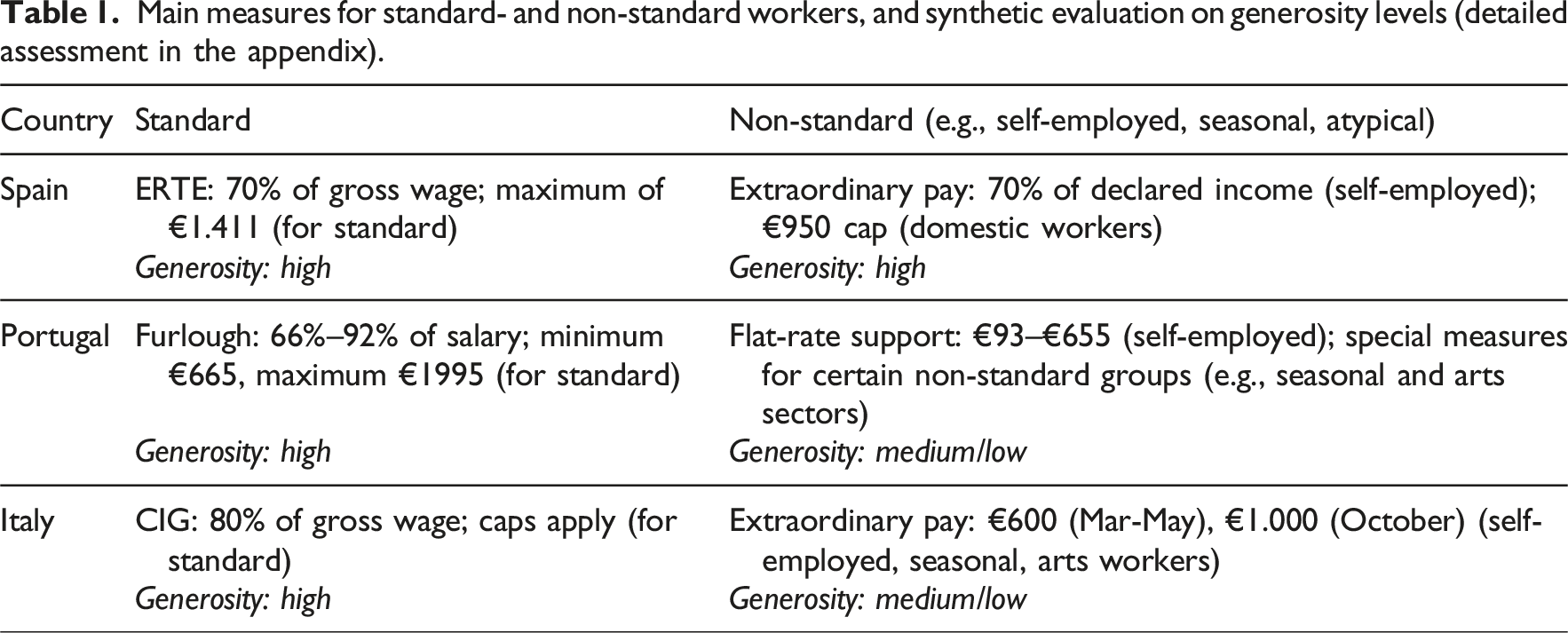
In this section, we explore variation in terms of generosity, that is, the sum of monetary transfers given to a certain group for a defined period of time. Despite hitting the whole economy, the pandemic had a disparate impact on low-end, labor-intensive sectors which see an overrepresentation of seasonal and self-employed work (e.g., tourism, transport, arts, entertainment, transport, sports; Cigna, 2020; Natili et al., 2023). Hence, in year 2020 all three countries in the analysis expanded income protections to grant at least some form of compensation to workers traditionally outside the social security network – on top of conventional STW, social assistance and unemployment benefit schemes. For this reason, we expect policy divergence to emerge more clearly in terms of ‘depth’ or ‘how much’ (generosity), than of ‘breadth’ or ‘to whom’ (group coverage), which justifies our choice to look at how much each macro-group benefited from emergency measures.
In order to gauge policy generosity in Southern Europe, we develop a score system based on each measure’s replacement rate or flat-rate payment amount in comparison to the average wage, maximum compensation caps and duration of support. This method allows us compare governments’ efforts both within (cross-group) and between countries, in a relatively simple and parsimonious way. More details on calculation are provided in appendices II and III.
After computing the generosity scores for each scheme, we cluster the different policies based on whether they target standard or non-standard workers, and average the generosity scores for each of these groups within country (appendices II and III). By doing so, we can plot the different levels of generosity for these two groups across the four countries in analysis (Figure 1). Given that in all countries fixed-term workers (despite being usually classified as atypical workers) were eligible under some form of STW or furlough scheme, we include them in the same group as permanent (sheltered) workers. Generosity scores for standard and non-standard workers, by country. Own calculations.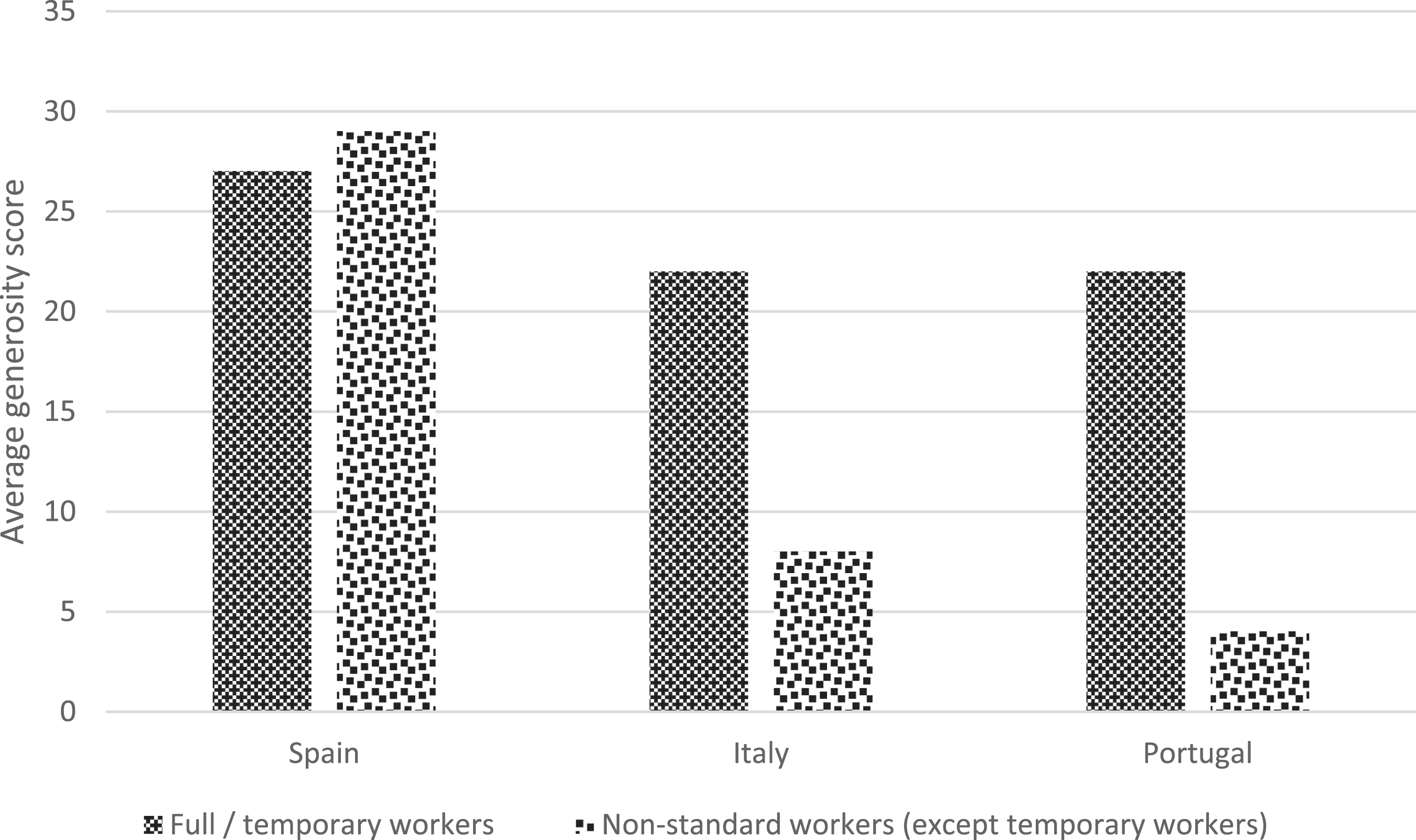
Figure 1 illustrates two groups: Spain, on the one hand, where the generosity gap between STW and self-employed compensation is relatively small; and Italy and Portugal, where the self-employed and other atypical categories receive significantly less generous provisions than full-time employees under furlough or STW schemes. Spain provides high income support to both groups (70% of previous income). In Portugal and Italy, the difference between the support granted to insiders (usually generous replacement rates based on previous wages) and self-employed, domestic or seasonal workers is significant, with the latter generally being attributed payments either for a very short duration (as in Italy) or of a very limited amount. Overall, this suggests that Spain offered generous protection to both insiders and outsiders; whereas Italy and Portugal kept with the traditional path of segmented protection (generous for the insiders, limited for the outsiders).
STW and one-off schemes often built upon pre-existing measures, such as unemployment benefits and social assistance safety nets (Clegg et al., 2024; Moreira et al., 2021; Natili et al., 2023). To corroborate the analysis, we use an equivalent approach to assess ‘how much’ countries provided for unemployment benefits just before the start of the crisis, i.e. in January 2020. Our calculation, based on the same generosity score formula (Appendix IV), suggests a major effort for sheltering workers from unemployment in Portugal and Italy, compared to Spain (which follows closely). Considering that unemployment benefits generally target insiders and penalize atypical workers with short or fragmented contribution histories, 2 this supports the idea of a more insider-oriented policy mix in the first two (Portugal and Italy), and a less segmented distribution in the other one (Spain). Unemployment benefit systems did not experience major breakthroughs in Portugal and Italy during the pandemic, who merely guaranteed extra monthly payments to retain claimants in the system (Moreira et al., 2021). By contrast, the Spanish government took a starkly different approach, using the unemployment insurance system itself as a functional equivalent of STW: with the relaxation of eligibility and application requirements, so-called ERTEs were expanded to include certain atypical categories such as interns, seasonal and self-employed workers (Clegg et al., 2024).
Finally, social assistance floors played a relatively minor role during the first wave, due to structural flaws and belated interventions (Clegg et al., 2024). Minimum income benefits were automatically extended in some countries, such as the Social Integration Income in Portugal (Appendix V; Moreira et al., 2021). The Italian Citizens’ Income, characterized by strict eligibility and conditionality requirements, was complemented by a new ad hoc measure – the Emergency Income – which was however less generous and suffered from similar flaws (Natili et al., 2023). Finally, Spain took the opportunity to introduce a ‘Minimum Living Income’, which replaced the previous regional minimum incomes system in June 2020. While some scholars consider the measure as ‘a key element in the policy response to the crisis’ (Moreira et al., 2021: 351), the first payments came only after the end of the first lockdown (Natili et al., 2023).
Overall, the broader policy mix portrays a clear divergence across countries. Spain reacted with a generous and encompassing response, expanding ERTEs universally while deploying a wide range of transfers to cover those excluded. The government also accelerated the introduction of a minimum income for people below the poverty line. Italian and Portuguese responses were less balanced: whereas the investment in STW was significant, the same cannot be said for measures addressing the workforce periphery, such as one-off payments and means-tested income guarantees (e.g., Emergency Income in Italy). Overall, this suggests a path of protracted dualization in the two countries.
Why do we observe variation in crisis responses? Based on newspaper evidence, official documents and five interviews, we explain social policy divergence under Covid-19 through policy learning by party and union leaders, and patterns of crisis corporatism during the pandemic. In terms of observable implications, we expect that in all three countries where social democrats were in government (Spain, Portugal and Italy), center-left cabinets showed a primary interest in compensating their core constituencies (i.e., ‘traditional’ middle and working classes). Likewise, compared to the previous decades and especially the early 2010s (Cigna, 2024; Lehndorff et al., 2018; Tassinari and Sacchi, 2021), we expect unions to show a more inclusive posture towards outsiders (the ‘precariat’), that is reflected in their policy-making strategies during the pandemic. By consequence, patterns of trade union involvement may explain a more encompassing response in Spain, where (outsider-oriented) unions were key in crafting in the policy response; than Italy and Portugal – where these organizations played a less influential role.
Social democrats’ policy learning during Covid-19
Welfare retrenchment during the Great Recession was inextricably linked with the decline of social democratic parties (Hübscher et al., 2021). In the early 2010s, social-democratic governments were the first to implement austerity programs. Incumbents were held responsible by the electorates not only because they drastically cut public spending, but also because they failed to put in place efficient safety nets (Bojar et al., 2022; Jacques and Haffert, 2021). From 2008 to 2018, mainstream left parties experienced significant drops in their electoral vote share (appendix VI). In Italy, Spain and Portugal, incumbent social democratic parties were kicked out of the government and faced backlash. This experience – we argue – encouraged a more generous response during the pandemic crisis.
In Italy, the declining parabola of the Democratic Party (PD) over the 2010s was parallel to the rise of the Five Stars Movement (M5S), which from 2013 rose to prominence with a staunch anti-austerity, pro-welfare agenda. While the M5S had already introduced a new social assistance scheme (Citizenship Income) in 2018, the 2020 pandemic created a window of opportunity for PD to prove itself different, and compensate disillusioned voters (especially the ‘old’ working class) for the losses inflicted in the previous decade. Right before Covid-19, the Democratic Party and the M5S formed a coalition government. When the pandemic ensued, the PD-M5S cabinet immediately provided for generous income compensation with the expansion of the main STW scheme (Cassa Integrazione Guadagni), and the creation of new payments for self-employed workers and poor households via so-called ‘Relaunch’ and ‘Heal Italy’ Decrees (Clegg et al., 2024; Figure 1). Discursively, the crisis was regularly presented as an opportunity to mend the wounds left from the Great Recession. Intervening at a business association meeting, Prime Minister Giuseppe Conte recalled that ‘Already before Covid-19, our country was living in a period of substantial stagnation’, deriving from ‘consolidated economic paradigms and canons’ whose legitimacy had long eroded (Conte, 2020a). In a parliamentary address shortly after, the Italian PM reiterated that ‘we have the chance to make a true turn that has been lacking in the precedent crises’ (Conte, 2020b).
In line with Conte’s predicament, primary evidence from newspaper articles and elite interviews confirms that, at the onset of the 2020 pandemic, center-left Italian leaders were eager to turn the page and compensate workers. Drawing from the experience of the Great Recession, in 2020 Italian policy-makers were aware that austerity made things worse, impoverishing middle and lower-middle classes. Former Prime Minister and PD Secretary Enrico Letta commented that the crisis provided ‘[…] an opportunity to forget the mistakes made 10 years ago when, in response to the financial crisis, European countries did not realize the disaster it would cause, intervened too late, and did so poorly. We still bear the scars of that today’ (ANSA, 2020a). For Minister of Labor and Social Affairs Nunzia Catalfo, the strategic response to Covid-19 was ‘in clear discontinuity with the past crisis, as it should have been done since the beginning […]; we had to turn the tide’ (ITA4 interview). Similarly, PD Regional Affairs minister Francesco Boccia stated that ‘we need to be able to completely change paradigm […] it will not be sufficient to use recipes from the past’ (La Stampa, 2020). Likewise, in June 2020 Finance Minister Roberto Gualtieri (PD) drew a clear parallel between the two shocks: ‘This political crisis is teaching everyone that together in Europe we are stronger; that past policies must be overcome, and Europe choosing not to respond as it did to the other crisis with austerity policies; that universal public welfare is a fundamental resource.’ (ANSA, 2020b)
Similar ideational shifts came to surface in Spain, where social democratic leaders signaled a clear willingness to make up for the negative impact of austerity. Following the implementation of structural reforms, in the legislative elections of 2011 PSOE lost about a third of its votes, which migrated especially to the radical left. Ousted from government for most of the decade, in 2020 the party returned to the Moncloa to form a progressive coalition with its left-wing competitor, Podemos. When the effect of closures and disruptions hit the economy, the PSOE-Podemos alliance opted for a decisive response: it combined a universal layoff ban with generous and encompassing unemployment protection (ERTEs). On top of that, it offered a wide range of one-off payments and accelerated the introduction of a minimum income (Clegg et al., 2024; Natili et al., 2023; Soler-Buades, 2025; Figure 1).
The rationale for the Spanish social democratic response seems consistent with that of Italian elites. According to prominent politicians, ‘there [was] enough consent not to reproduce recipes of 2008 […] Spain took 10 years to exit the financial crisis due to austerity policies’ (Minister of Labor and Social Affairs Yolanda Diaz, La Vanguardia, 2020). In April 2020, the Spanish PM Antonio Sanchez underscored that ‘the United States responded to the 2008 recession with stimuli, while Europe responded with austerity. The results are well known’; and that ‘it is time to break old national dogmas […] We are in a novel time and we need new answers’. While warning Europe not to make the same mistakes again, the PSOE leader also hinted at the idea of reviving the old working-class coalition, in line with the ideological roots of the party: ‘We will preserve our positive values, and will reinvent the rest’ (Sánchez, 2020).
Social democrats in Portugal followed a similar trajectory. The experience of the Eurozone debt crisis was tough, but formative, for the Socialist Party, who lost votes especially to its radical challengers (Left Bloc). From 2008 to 2011, social democrats suffered a 15% points drop in their vote share. They returned to power only in 2015, leading a progressive governmental alliance with a bold anti-austerity agenda. Already in the second half of the 2010s, Portuguese center-left elites shared an understanding that some policies implemented in the previous years were misguided and had to be reversed (Afonso and Bulfone, 2019; Branco et al., 2019).
This cognitive shift manifested more distinctly during the pandemic. In the midst of Covid-19, PM Antonio Costa stated that ‘wanting to apply the same recipe that has already proven to be wrong 10 years ago would be doubly wrong’ (Lusa, 2020). In April 2020, its ‘number two’ and Economy Minister Pedro Siza Vieira warned the public that it would be unwise to go through ‘austerity policies’ in response to the socio-economic shock, as these are ‘pro-cyclical policies which worsen the recession […] this is clear and unequivocal’ (Público, 2020a). For Ana Catarina Mendes, leader of the Socialists’ parliamentary group, the response of ‘austerity was wrong, and cannot be repeated […] those who devalued the welfare state had proof of how wrong they were’ (Público, 2020b). Likewise, according to Mario Centeno (Socialist Party president of the Eurogroup), ‘Portugal showed that imposing austerity wasn’t the right recipe, and was able to offer a holistic and moderate perspective in which it’s not enough to look at just two or three budgetary variables’ (Público, 2020c).
Ruling parties do not exercise power in a void, but in a ‘strategic context’ that is informed by previous failures and conditioned by partisan competition. In Spain, Portugal, and Italy, social democrats appealed to their core constituencies to vindicate themselves from the attributed legacy of austerity. In the next section, we look at the nexus between social democratic responses and crisis corporatism to understand policy divergence across the three countries: Spain in a universalistic direction; Italy and Portugal in a persistently segmented direction.
From inward-looking to inclusive unionism
Evidence at hand suggests that Spanish unions manifested inclusive preferences to address uncovered categories such as temporary, atypical and domestic workers; and that, once given access to policy-making, they were able to influence the government’s policy response in an inclusive direction. The ‘PSOE-UP government’ not only ‘systematically involved social partners in the policymaking process’, but also ‘prioritized the position of trade unions’ over business associations (Branco et al., 2024: 652). Unsurprisingly, Spanish unions expressed ‘satisfaction’ with crisis management, perceiving that ‘most of the policies enacted were in line with trade union proposals and approaches, as laid down in the document containing joint policy proposals to face the economic and labour emergency created by the COVID-19 crisis’ (Eurofound, 2021: 21; TUAC, 2020).
Since the onset of the crisis, union leaders showed preoccupation not only with standard, but also with marginal and precarious workers. For instance, in March already CCOO union leader Unai Sordo worried that social security membership may drop by one million workers, and that 75% of temporary contracts would not be renewed (El Pais, 2020). This motivated the leader of UGT, Pepe Alvarez, to demand more ‘protection for people’, namely, extraordinary aid for those excluded from unemployment protection, and the creation of a benefit ‘that ensures citizens who are not entitled to benefits are not left with nothing’ - especially categories such as domestic workers who are not covered by social security or temporary workers who do not meet contributory requirements (ibid.). In line with this position, Mr Alvarez also demanded that ‘temporary workers dismissed under coronavirus should receive an equivalent to unemployment protection’ (InfoLibre, 2020), similarly to CCOO, who claimed ‘additional benefits for workers who have been victims of these layoffs and have no access to any scheme or subsidy’ (CCOO, 2020).
In a succession of six agreements with the unions and employers within the year 2020, the government substantially accommodated unions’ demands for more vulnerable groups, including expanding the ERTEs, creating a special unemployment benefit for fixed-term workers, and rolling out extraordinary subsidies for autonomous and domestic employees (Brandl, 2023; Eurofound, 2021, TUAC, 2020). On 11 May 2020, for instance, UGT signed the ‘social agreement for the defense of employment’, motivating this position with the fact that it ‘expands the social and labor safety net’: ‘to combat poverty and inequality […] it is essential to guarantee income for households in need through social benefits’ (UGT, 2020). Spanish unions also strongly contributed to the introduction of the Minimum Vital Income in May 2020 - which had explicitly advocated since 2015, and that, upon its creation, they celebrated as ‘a step towards a more just and equal society’ (Barrera, 2020). In all, while Spain’s inclusive and egalitarian response certainly reflects the preferences of the Sanchez government (and its union-friendly culture), it also underscores a deeper cognitive shift within the two main union confederations. Sordo did not spare words on the fact that, besides extending ERTEs to preserve jobs, it was equally important to compensate the ones who ‘carried the pandemic through, sometimes with very low wages, without protective equipment’ (EFE, 2021). In a joint declaration at the end of the period, the two union leaders explicitly addressed the need to ‘finally end the dualistic nature of the labor market, that is, the temporary and precarious nature of employment that has become prevalent in vast sections of the working class, particularly affecting women and young people’ (Alvarez and Sordo, 2021; emphasis added).
Portuguese unions also showed an interest in bridging labor market divides. From the start of the pandemic, trade unions understood that ‘the crisis […] has revealed the many precarious jobs existing and hidden under various guises in the labor world, clearly demonstrating the great fragility of the situation of these precarious workers’, and that in previous decades ‘nothing really adequate was done to solve the serious problem of labor precariousness and the lack of social protection of these workers’ (POR1 interview). In several occasions, the leader of the left-wing union CGTP Isabel Camarinha stressed that ‘workers with precarious contracts were the first to be fired from their workplaces’ (Jornal ECO, 2020), making clear that ‘we are not all in the same boat’ (Correio da Manhã, 2020). According to Camarinha, this would require a ‘break with the model we have in our country: low wages, precariousness, labor legislation that favors the boycott of collective bargaining’ (RTP, 2020). Similarly, Carlos Silva from the (more moderate) UGT envisaged ‘a social response that leaves no one behind’, and to avoid segmented responses that in the previous decades proved to be ‘a wrong recipe’ (Diário De Notícias, 2020).
While converging on the need to protect precarious workers, differently from the Spanish organizations, Portuguese unions did not enjoy substantial involvement in policy-making, and often disagreed on the response to be adopted (Eurofound, 2021). During the first wave, the government formally consulted unions for the expansion of both standard and exceptional STW schemes, and on the reformulation of income guarantees and unemployment benefits to make them more accessible (Brandl, 2023). However, social partners reported a lack of real engagement in policy formulation (Eurofound, 2021). Furthermore, diverging views were recorded between the two main confederations (Jornal ECO, 2020). While the left-wing CGTP advocated for a swift revision of the labor law and prohibition on all dismissals, UGT took a somewhat more accommodating stance, primarily encouraging the expansion of traditional shock absorbers. Lack of substantive involvement in policy-making, and divisions on the strategic path to take, prevented Portuguese unions from influencing the government in an inclusive response comparable to the Spanish one.
Similarly to their Portuguese colleagues, Italian unions showed generally inclusive preferences – yet, they did not enjoy substantive involvement in policy-making. In line with all previous executives since 2008, the PD-M5S government in Italy followed a trend of dis-intermediation and unilateralism (Meardi and Tassinari, 2022; Tassinari and Sacchi, 2021). Our union interviewees draw a neat distinction between issues on which unions were regularly involved, and those in which they were excluded or merely consulted afterwards. Negotiations were held on some topics, for instance, the emergency activation of short-time work and health protocols (ITA3 interview). Yet, on social policy, bilateral dialogue was mostly activated after policy design and/or adoption (Brandl, 2023; Eurofound, 2021). On key income protection measures, including STW expansion and a universal layoff ban, unions were only ‘heard’ ex post (ITA2 interview), and decisions were just ‘shared’ with them, rather than being the outcome of active negotiations (ITA3 interview; Meardi and Tassinari, 2022).
While marginalized from crisis management, unions confederations (especially the traditionally communist and most representative CGIL) painstakingly insisted on the need to extend protections to the ‘excluded ones’ in the labor market (Collettiva, 2021). Since the beginning of the crisis, CGIL secretary Landini stressed the need to protect everyone ‘regardless of contractual type’, especially those ‘left out’ of the traditional social protection system: ‘we hope that this emergence demonstrates that the austerity model adopted in Europe has run its course […] we need social shock absorbers for everyone, including the self-employed’ (il Manifesto, 2020). This manifested pro-outsider cognitive turn resonates with key declarations from our interviewees: union leaders report that the Covid-19 crisis laid bare the ‘weakness of our traditional system of protections’ (ITA1 interview), pointing at the need to ‘build an overarching framework of securities’ for all workers (ITA2 interview).
Evidence gathered in this section confirms that – in contrast to prior insider-biased preferences as identified in the literature - Southern European unions were keen to protect the outsiders during the Covid-19 pandemic. When unions had access to social policy-making, their contribution went in the direction of expanding protections to the most vulnerable – especially unemployed, self-employed and other people in precarious jobs. In Spain, unions advocated for (and, in certain cases, obtained) the extension of STW schemes to segments of non-standard work, the creation of ad-hoc measures for independent workers and employees in the domestic sector, and the introduction of last-resort schemes against poverty. In Italy, unions’ lobbying and communication efforts equally emphasized the need to cover the most vulnerable; nevertheless, they were marginalized from social policy management, following a long trend of interest disintermediation. In Portugal, divides in the union movement and weak grip on policy-making made unions scarcely influential, thus consolidating segmentation in the crisis response.
Discussion and conclusion
The Covid-19 pandemic was not only a health crisis, but a multidimensional challenge for European welfare states. This was especially true in Southern Europe, where social protection systems were still recovering from the austerity of the previous decade. In adverse conditions, national executives had to buffer an unprecedented shock in the labor market and prevent another protracted recession. Despite the spending ‘blank check’ coming from Brussels, the decision of whom to protect, for how long, and how much was a deeply normative question, that policymakers faced in tandem with the health emergency. Policymakers operated looking backward to previous crisis-management experiences and forward to the electoral repercussions of their policies. As always, crisis management does not occur in a vacuum; the past and the future condition government choice.
In this paper, we mapped emergency policies addressing both workers in the labor market core and others in more precarious conditions. After identifying the main measures adopted from March to December 2020, we assessed the generosity of each set of policies to see whether welfare states reacted according to what we know. Contrary to expectations of prolonged austerity and uniform responses across similarly structured welfare regimes, our analysis reveals divergence in how Mediterranean countries reacted to the new crisis, and catered to different segments of the workforce. While Portugal and Italy largely followed a path-dependent trajectory privileging insiders, Spain began to experiment with more inclusive protection schemes towards both groups (thanks to the inclusive ERTEs, the introduction of a minimum income, and a wide set of one-off payments).
We explain this variation by highlighting two critical factors: learning processes within left-wing elites (including both social democrats and trade unionists), and degrees of union incorporation. Social democrats were punished by voters during the Great Recession for the implementation of austerity policies and the deterioration of labor conditions in Southern Europe. Ideological misfits and electoral failures spurred center-left elites to think that ‘next time’ had to be different. The presence of radical left parties, competitors and coalition partners, was also an important condition for learning to take place, favoring more generous income protection responses in 2020. The second decisive factor was engagement with (increasingly pro-outsider) trade unions. While traditionally focusing on insiders (including during the Eurozone crisis), the negative effects of an expanding periphery favored a cognitive turn among trade unions in Southern Europe, shifting their attention from traditional constituencies towards broader groups in the workforce. In countries where inclusive unions were more deeply embedded in the policy process - most notably Spain - crisis responses emerged as inclusive and oriented toward outsider protection. In contrast, where concertation was weak and fragmented (as in Italy and Portugal), policy mixes remained ‘narrow’ and generally inadequate towards the outsiders.
Our findings suggest that crisis moments can offer opportunities for recalibrating welfare institutions — but only under certain political and organizational conditions. Learning and institutional experimentation are not automatic outcomes of crises; they are mediated by actors’ strategic choices and by pre-existing structures of interest representation. Future research could expand this comparative framework beyond Southern Europe, exploring long-term institutional legacies of pandemic-era reforms and examining how these crisis responses have shaped public trust and electoral outcomes. As we move into an age of recurring shocks — from climate change to geopolitical instability — understanding how states build inclusive protection systems under pressure will remain a central question for scholars and policymakers alike.
Supplemental material
Supplemental material - Learning under pressure: Welfare state responses to Covid-19 in Southern Europe
Supplemental material for Learning under pressure: Welfare state responses to Covid-19 in Southern Europe by Luca Cigna, Odysseas Konstantinakos, Luís Russo in Journal of European Social Policy.
Footnotes
Acknowledgements
We are deeply grateful to Professor Anton Hemerijck for his inspiring supervision and intellectual guidance over our PhD years. We also thank David Bokhorst, Donato Di Carlo, Robin Huguenot-Noel, and Kati Kuitto for their invaluable comments and exchanges. Earlier versions of this paper benefited from feedback received at the panel “Welfare State Politics in Europe” at the 2022 CES Conference in Lisbon. Finally, we thank the editors and the anonymous reviewers for their constructive and insightful comments, which significantly improved the quality and clarity of the article.

Ethical considerations
This research was conducted in accordance with the ethical standards of the journal editor and the home institution.
Consent to participate
All participants were informed about the aims of the study, and informed consent was obtained prior to participation.
Funding
The authors received no financial support for the research, authorship, and/or publication of this article.
Declaration of conflicting interests
The authors declared no potential conflicts of interest with respect to the research, authorship, and/or publication of this article.
Supplemental material
Supplemental material for this article is available online.