




Abstract
This paper explores trade union strategies to protect wages in the face of EU migration after the enlargement of the European Union. We argue that unions have three instruments at their disposal to deal with the risks linked to downward wage pressure: closure through immigration control, equalisation through collective bargaining and minimum wages, and the organisation of migrant workers. Using comparative case studies of Sweden, Germany and the UK, we show how different types of power resources shape union strategies: unions with substantial organisational resources (in Sweden) relied on a large membership to pursue an equalisation strategy and expected to be able to ‘afford’ openness. German unions with low membership but access to the political system pushed for a mix of closure and equality drawing on political intervention (e.g. minimum wages). British unions, unable to pursue either, focused their efforts on organisation.
Introduction
Immigration has been a major challenge for labour movements since the advent of industrial capitalism. While unions have historically been committed to the ideals of international solidarity, in practice their members often fear competition by immigrants on labour markets. Marx, while famously calling for workers of all countries to unite, also acknowledged that the animosity between native and immigrant workers was ‘the secret by which the capitalist class maintains its power’ (Marx, 1870). Similar concerns subsist to this day. In the United Kingdom, the general secretary of Unite, one of the largest trade unions, declared on the brink of the Brexit referendum that ‘the elite’s use of immigration [. . .] is all part of the flexible labour market model, ensuring a plentiful supply of cheap labour’ (McCluskey, 2016).
How can trade unions respond to this dilemma? In this article, we argue that trade unions can opt for one or a combination of the following instruments to mitigate against risks of immigration-related wage depression: closure, equalisation or organisation. We show how the power resources that unions have affect their choice of instrument: while a large membership (primary or organisational resources) is expedient to achieve autonomous equalisation within the labour market through collective bargaining, power derived from access to the political system (secondary or political resources) is more amenable to closure via immigration control or equalisation through state regulation. From a position of relative weakness in both domains, organisation may be the most viable option. We consider union strategy to be a function of union preferences as well as institutional constraints (Hall, 2016: 36–7).
The contributions of this article are twofold. First, drawing on work on the political economy of immigration (Afonso and Devitt, 2016; Caviedes, 2010; Menz, 2005), we look at the complementarities between immigration control and labour market policies. Second, we provide a theoretical argument linking power resources with trade unions’ strategies in the immigration domain. In doing this, the paper complements Boräng et al. (2020) in this issue assessing the effect of organisational factors on trade union strategies, rather than immigration policy outputs. We focus on EU immigration in particular as it combines significant wage differentials and different regulations of welfare and industrial relations within an integrated economic area (Dolvik and Visser, 2009). The EU context also helps tease out the changing dynamics of power relations between social partners.
The paper is structured as follows. First, it outlines the dilemma posed by international labour mobility for trade unions. Second, it assesses the relationship between available tools and specific power resources. Theoretical propositions are tested in a comparative case study of Sweden, Germany and the United Kingdom in the context of the EU enlargements of 2004 and 2007. We conclude by discussing limits and avenues for further research.
Closure, equality and organisation: Three trade union instruments
International labour mobility presents a challenge for organised labour. Even if the evidence on the impact of immigration on native workers’ wages is mixed, migrants tend to be overrepresented in the secondary segment of the labour market, where wages are lower and working conditions less advantageous (Careja and Emmenegger, 2013). Immigration therefore risks creating a form of ‘dualisation’ that employers can instrumentalise to pressure/squeeze the working class (Emmenegger et al., 2012; Piore, 1979).
How can organised labour respond? Drawing on earlier work (Adler et al., 2014; Hardy et al., 2012; Marino et al., 2015; Penninx and Roosblad, 2000), we argue that organised labour has different instruments at its disposal: closure (via immigration control), equalisation (via minimum wages and collective bargaining) and organisation (through recruitment and providing migrant-specific services).
Closure
The first instrument that unions may employ is closure via immigration control. Restrictive immigration rules limit the labour supply, theoretically protecting against wage depression. In this article, we consider any measure to limit the entry of labour migrants into the labour market as closure.
While immigration restriction has been a demand of organised labour in periods of high unemployment and economic crises, globalisation weakened the viability of this tool (Alberti et al., 2014: 113). Within the EU, this constraint is most acute given the freedom of movement for workers enshrined in EU legislation. The 2004 enlargement of the EU added 74.1 million individuals from eight Central Eastern European countries plus Cyprus and Malta to the internal market, while 29.5 million Bulgarian and Romanian citizens joined in 2007 (Kahanec et al., 2016: 4). The decreasing viability of closure has led some to conclude that most European trade unions have ‘formally abandoned their restrictive stances of the past’ (Marino et al., 2015: 8). However, in 2004 there was one form of closure available to EU member states wishing to restrict entry to NMS, albeit temporarily: a 2–7-year ‘transitional period’ during which old member states could temporarily deny NMS migrants the right to work (Krings, 2009).
Closure can be controversial. Immigration restriction may create undocumented labour which may threaten working conditions even more than immigration itself. This is why Watts (2002) argues that trade unions have been moving away from immigration control and turning to ‘unlikely alliances’ with employers over immigration openness. Drawing on the elements above, we can also expect different preferences from unions representing different economic sectors (Caviedes, 2010).
Equalisation
The second instrument that unions may use is equalisation, through either autonomous regulation (collective bargaining) or state regulation (e.g. minimum wages). This involves reducing the exploitability of the migrant workforce and constraining employer discretion (Baccaro and Howell, 2017).
Collective bargaining agreements negotiated between unions and employers are a prime instrument of equalisation, but require high levels of unionisation. Where this condition is absent, statutory erga omnes extension can declare outcomes of collective bargaining compulsory for all firms in an economic sector (Paster et al., 2019). If coverage is incomplete and/or extension infeasible, unions may want to call on the state to intervene and set a statutory minimum wage (SMW). This tool is clearly a second choice for two reasons. First, it only affects wages at the bottom end of the labour market. Minimum wages cannot prevent foreign workers from being paid less than native workers in upper tiers of the labour market. Second, minimum wages reduce the autonomy of trade unions, making them dependent on political intervention. Still, unions may see this as a lesser evil compared to segmentation which could undermine the maintenance of wage standards as a whole, as shown recently by the German experience (Mabbett, 2016).
Organisation
A third tool available to unions is the organisation of migrant workers. As with equalisation, unions that pursue organisation are minimising the exploitability of migrant workers, but instead of focusing on the institutional or legal level, unions turn to migrants themselves. Excluding them runs the risk of further dualising the labour market and splitting the labour movement, thereby weakening its bargaining position (Penninx and Roosblad, 2000). Unions already struggling with low or declining membership, or operating in sectors where employment agencies dominate might find this particularly expedient.
Migrant recruitment comes with challenges, however. Many migrants are concentrated in sectors such as the care sector where employment is fragmented into a large number of small workplaces that are difficult to organise (Hardy et al., 2012). Language barriers may prevent migrants from understanding and abiding by collective agreements (Yalcin, 2010: 180). Undocumented migrants may be reticent about contesting their working conditions. Furthermore, much of today’s mobility in the EU internal market is temporary, making organisations’ efforts more difficult (Marino et al., 2015: 9). Another form that inclusion can take is the provision of special, migrant-specific services. These can meet workplace needs such as language training, as well as community-building, regularising residence and facilitating access to housing and public services (Marino et al., 2015).
Trade union power resources and strategies
How can these different tools be combined? When will labour unions privilege one tool rather than another? Existing literature draws attention to a plethora of factors that influence union decision-making as regards migrant integration (Marino, 2012: 6). We argue that one key factor is union power resources. Following Traxler et al. (2001), we see these as consisting of both primary (organisational) and secondary (political) resources. Organisational resources refer to strength acquired through union density, on the assumption that high membership rates increase unions’ ability to autonomously influence labour market conditions, control a large portion of the workforce and possibly sanction employers through strikes or lockdowns. Political power resources relate to strength acquired through privileged access to policymaking arenas, for instance through organisational links with political parties or participation in advisory institutions and consultation procedures (Bryson et al., 2011: 104). These resources are connected but not fully aligned: while it is difficult to ignore unions commanding a large part of the workforce, governments routinely involve unions in policymaking in spite of their low membership (Afonso, 2013).
The link between power resources, on the one hand, and the substance and direction of union strategy towards immigrants, on the other hand, is still unclear in the literature (see, e.g. Penninx and Roosblad, 2000 and Wrench, 2004). In this paper, we argue that the types of power resources at the disposal of unions influence their approach. As outlined in Table 1, some instruments that unions can use to guard against migration-related wage depression can be employed autonomously within the sphere of industrial relations through direct negotiations with employers, for instance through a commitment by firms to apply equal wages across the workforce. Others, such as the establishment of statutory minimum wages and immigration control, depend on political intervention. Consequently, we expect that unions commanding substantial organisational power in the labour market will seek to regulate employment conditions without resorting to the state, that is, through a strategy of equalisation via collective bargaining. These unions can ‘afford’ open immigration policies because they exert enough equalisation power in the labour market to prevent the emergence of a second-tier labour market. This strategy of ‘openness with equality’ can be considered the first choice for unions because it keeps internationalist ideals intact without harming their membership. It may be difficult, however, to pursue in light of eroding union membership and the general trend towards the liberalisation of industrial relations in Europe (Baccaro and Howell, 2017).
Trade union resources and strategies vis-à-vis migrant workers.
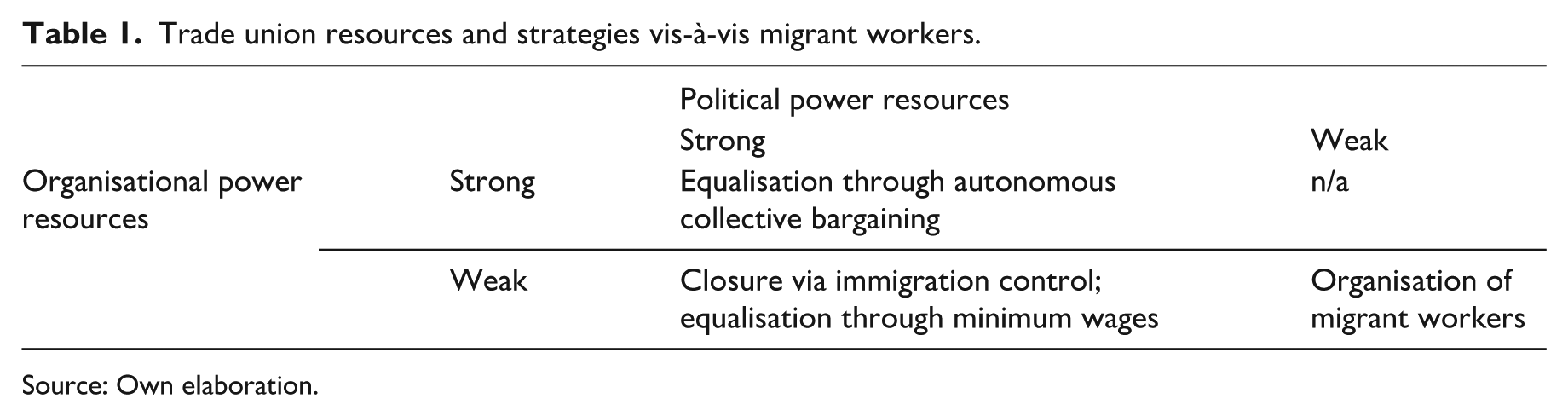
Source: Own elaboration.
If their power resources within the labour market are weak, labour unions may harness the regulatory power of the state. Unions with political resources can be expected to find this a more tenable strategy. They may push for immigration control, state regulation through minimum wages, or strengthening the enforcement of existing labour regulations through erga omnes collective bargaining extensions. However, resorting to the state also puts unions at the mercy of possibly changing government coalitions. External constraints (such as EU legislation) may also impede this option. Moreover, delegating authority to the state in these matters may remove incentives to join unions in the first place. This is why unions in a number of countries have long been sceptical about statutory minimum wages.
Finally, conditions of low membership and low political influence may increase the likelihood that unions will adopt a more inclusive strategy towards migrants (see Marino et al., 2015; Roosblad, 2013; and Wrench, 2004;). Lacking political power resources increases the need to rely on organisational power and membership, while weak power resources within the sphere of industrial relations increase the need to turn to hitherto underrepresented groups in the labour force.
The relationship between power resources and strategies is not mechanistic. First, unions act in a context of bounded rationality. They may misperceive their own ability to control the labour market or influence the political process. Second, other factors may influence union strategy. EU regulations may limit the margin of manoeuvre of trade unions. Labour market and economic conditions more broadly can also matter (Penninx and Roosblad, 2000: 14). When unemployment is low, closure will be less viable for unions. Unions in less organised sectors or occupations in which migrants are concentrated, such as in cleaning or care services, may find inclusion more urgent (Milkman, 2006; Marino et al., 2015). Finally, individual trade union characteristics play a role: union identity, for example, or ‘inherited patterns of ideology, discourse and programmatic commitment’ (Hyman, 2001: 223). Unions with greater presence in the workplace (as opposed to highly centralised, top-down structures) may be more inclusive towards migrant workers (Marino, 2012: 15). Much of the existing literature, however, explores the impact of these factors only on a union’s propensity towards inclusion of migrant workers. This paper holds up these explanatory variables against a union’s stance towards all three instruments outlined above.
Methods and cases
This paper uses comparative case studies. We focus on three West European countries displaying variation in the power resources of trade unions, but which underwent a similar process of labour market opening, namely the 2004 and 2007 accession of 10 mostly Central and Eastern European (CEE) member states into the EU (‘A-10’). The focus on this specific historical moment can be justified for two reasons. First, because intra-EU migration is mostly economic and driven by substantial wage differentials, it touches directly on issues of primary importance to unions. Second, the focus offers insights into how unions prioritise strategies when faced with a similar constrained choice set. An indefinite closure strategy was not possible due to the freedom of movement principle enshrined in EU law.
We employ a diverse case strategy (Gerring, 2007: 97–9) and compare union strategies towards EU labour migration in three countries with differing levels of union power resources: Germany, Sweden and the United Kingdom. All have been receiving countries for labour migration flows. Figure 1 shows how the three cases vary along two indicators capturing power resources drawn from Jelle Visser’s (2019) ICTWSS (Institutional Characteristics of Trade Unions, Wage Setting, State Intervention and Social Pacts) database: union density (the share of the workforce who are members of a trade union) and the routine involvement of trade unions (and employers) in public policymaking (Afonso, 2013; Visser, 2019). The routine involvement of trade unions and employers is measured on an ordinal scale coded as 0 (no concertation, involvement is rare or absent), 1 (partial concertation, irregular and infrequent involvement) and 2 (full concertation, regular and frequent involvement). We applied a fractional-polynomial fit to capture trends in the graph.
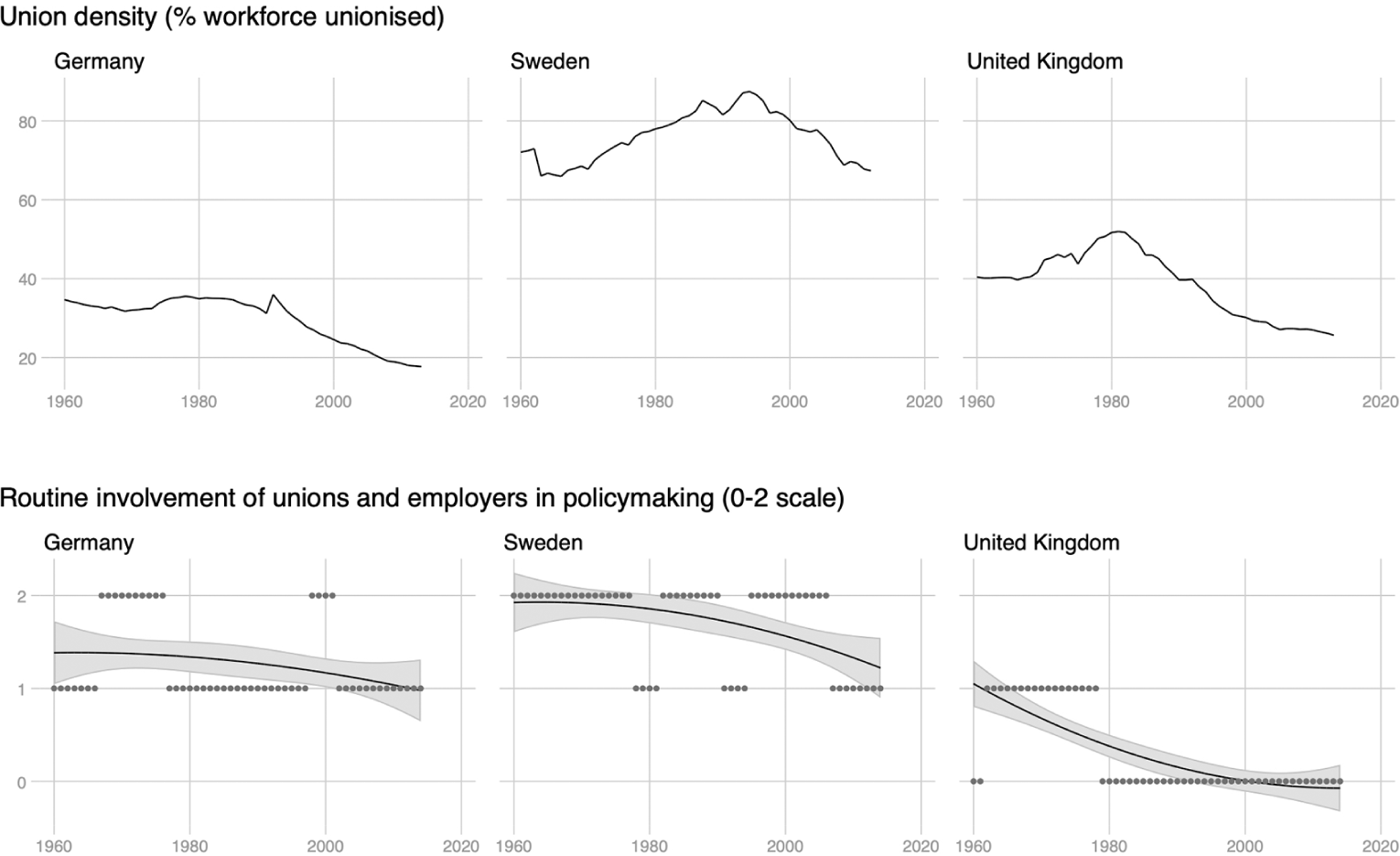
Trade union power resources in Germany, Sweden and the United Kingdom.
There is a clear continuum with Sweden at the top (with high union density and a high involvement in policymaking, albeit both declining) and the United Kingdom at the bottom. While union density in the UK is higher than in Germany, there has not been any substantial involvement of trade unions in policymaking since the 1970s. Germany is an intermediate case, where union density is low, but unions have been able to enjoy significant access to the political system. In all countries, there has been a declining trend in both measures.
Our analysis relies on process-tracing based on official documents, news reports and eight expert interviews. For each case, we outline the labour market and political context capturing power resources in each country, and proceed with a narrative analysis of trade union strategies towards EU labour migration. We focus on the national level as our unit of analysis. Hardy et al. (2012) highlight the differences in union strategies across economic sectors. For reasons of space we cannot address these in this article, but highlight avenues for future research in this vein in the discussion.
Sweden: The challenge of openness with equality
Background
There are three main trade union confederations in Sweden. The largest and oldest, LO (Landsorgan-isationen i Sverige), unites blue collar unions. Of the two white-collar organisations, the second biggest, TCO (Tjänstemännens Centralorganisation), organises unions of qualified employees while Saco (Sveriges Akademikers Centralorganisation) represents unions of academics or graduate professionals (such as engineers). In 2004, LO, TCO and Saco accounted for 49 percent, 34 percent and 15 percent of total union membership respectively (Visser, 2019). Although the early 2000s saw annual decreases in membership rates for LO in particular, it was only at a modest pace (<1% per year).
Historically, LO enjoyed an exceptionally strong partnership with the Social Democratic Party (SAP). Trade unions benefited from a highly corporatist industrial relations system, dominated by peak-level wage bargaining between social partners. By the 1990s, however, collective bargaining was decentralised: agreements would only be negotiated at the branch level and employers abandoned their posts on public agencies. However, in 2004 trade unions still enjoyed a privileged seat at the policymaking table (Magnusson, 2018: 144). Institutional links between LO and SAP are intact at senior levels (Anthonsen et al., 2011). Unions are consulted even when the centre-right is in power (Dinkenspiel in Bieler, 2000: 93). Moreover, until 2008, unions enjoyed gatekeeping authority over migrant admissions, sectoral distribution and permit extensions (Boräng and Cerna, 2019; Bucken-Knapp, 2009).
EU enlargement and labour market opening
Sweden held the presidency of the European Council when the rules regarding a transitional period for A-10 migrants were brokered (Wall Street Journal, 2001). Initially adamant that it would not make use of these rules themselves, the Social Democratic minority government changed course in April 2004 following a report presenting risks to the welfare system, and in light of existing member states such as Germany signalling their intent to implement transitional rules (Yalcin, 2010: 360). However, the government’s proposal for transitional rules met resistance from the Left Party and the Greens, and was defeated in parliament (Bucken-Knapp, 2009: 125; Wadensjö, 2007).
All three union confederations opposed the government’s proposal (Svenska Dagbladet, 2003). There were some variations across confederations and indeed among affiliated unions (Bucken-Knapp, 2009: 130). LO has been traditionally more Eurosceptic than the other federations (Bengtsson et al., 2017: 162). Leading up to accession, Saco consistently expressed more open views towards labour migration than LO or TCO (Dagens Industri, 2002; Svenska Dagbladet, 2004a). A Saco official offered normative and economic justifications for their stance, explaining that ‘academics have always been international’ – and citing labour shortages in certain professions (such as doctors) (SE4, interview, 12 June 2019).
However, officially neither TCO nor LO requested closure. Indeed, their positions were described as ‘careful’ but ‘not entirely dismissive’ (Svenska Dagbladet, 2001). Looking back, an LO official explained: ‘We put in a lot of effort to avoid the position where we asked to postpone [access to the labour market for EU migrants]. We tried to take a European-positive stance. . . We did not ask for transitional rules. I am surprised how clearly we expressed that we were not against foreigners.’ (Interview SE3)
A TCO official summarised the emphasis on equality rather than closure as follows: ‘In Sweden, we have a quite open view on migration in the sense that both employers and trade unions are positive to [it]. But what is always heavily discussed at the national level is “On what terms?”’ (Interview SE1)
The terms with which union officials were concerned is aptly captured in the notion of ordning och reda, or ‘order in the labour market’ (Dagens Industri, 2002). Orderly conditions were understood as those where employees are not subjected to a ‘race to the bottom’ in wages or employment conditions and where employers abide by collective agreements and labour law (LO, 2004: 3). Central to this notion was union autonomy. An LO official stressed that ‘politicians should make sure that they stay away from the labour market’ (Interview SE2). A TCO official concurred: ‘we are very happy that we do not have a [statutory] minimum wage in legislation. We want to be able to negotiate that ourselves’ (Interview SE1).
As accession approached, there was a collective sense that closure would not further this goal. In May 2003, LO’s vice chair noted that ‘these problems [of ordning och reda] can’t be prevented with some sort of transitional arrangements’ (cited in Bucken-Knapp, 2009: 130). Hence, the primary tool employed by Swedish unions in the wake of EU enlargement was to push for strengthened compliance with collective agreements. In a January 2004 op-ed, two members of LO leadership argued that the Swedish Labour Market Board (Arbetsmarknadsstyrelsen [AMS]) should have greater oversight over employers hiring foreign labour, but did not advocate closure: ‘the question is not whether foreigners should come to Sweden, but how (Andersson and Mårtensson, Dagens Nyheter, 2004; SE3, interview, 5 June 2019).
Neither economic nor social conditions seem responsible here. Unemployment was on the rise at the time, increasing in 2003 from 4 percent to almost 6 percent in 2004 (Holmlund, 2009: 109). Moreover, according to ‘the elite opinion. . . it was backwards to be asking for transitional rules’ (SE3 Interview). Instead union presence mattered. In the run-up to accession, LO was invited to cooperate with the Greens in a joint working group to develop a package of equalising labour market reforms, including union oversight over collective agreement compliance by foreign firms (Yalcin, 2010: 357). These reforms ended up as the only legislation passed prior to A-10 accession (Svenska Dagbladet, 2004b).
The Laval case shows that unions’ assessment of their power shaped their strategy. In the autumn of 2004, Byggnads, an LO-affiliated union, exercised its newly granted monitoring rights by blockading Laval, a Latvian company who had posted construction workers in Sweden. The case was brought to the European Court of Justice (ECJ) who eventually ruled the blockades unlawful (Yalcin, 2010: 360; Ruhs, 2013). In response national law regulating posted workers was amended (‘Lex Laval’, 2010), which curtailed unions’ ability to take industrial action against foreign companies (Jonsson and Larsson, 2013: 7).
The judgment caught unions unawares and undermined their power resources in the labour market: ‘That the right to strike, a fundamental right, could be circumvented with the freedom of services. . .was really a shock. That we could not enforce our Swedish collective agreement on these foreign workers. . .the European Court of Justice took something from us, and they didn’t take anything from the employers. So the balance on the labour market became unbalanced.’ (Interview SE1)
The ruling and others like it threw into sharp relief that the power resources unions possessed at the national level did not transfer seamlessly to the EU level, at least when it came to freedom of services. One official explained that LO radically reconsidered their original ‘liberal, European-positive’ stance: ‘I misjudged. We didn’t know [access to the labour market for EU migrants] was this dangerous. . .the state didn’t prepare themselves for what was going to happen. This was a big mistake. I am a bit angry that I wasn’t more outspoken then.’ (Interview SE3)
In this new context, unions doubled down on their efforts at equalisation, this time turning to the state to enforce legislation. LO spokesperson Lundby-Wedin demanded that the government respond with legislation to protect against social dumping, ‘give us [unions] the right we thought we had’ (Yalcin, 2010: 369). LO proposed legislative changes modifying rules regarding the registration and taxation of foreign companies, requiring them to have authorised legal representatives and supply documentation (Jonsson and Larsson, 2013: 6). While unions did not go as far as demanding the introduction of an SMW, the turn to the state can be understood as a consequence of weakening power resources within the sphere of industrial relations.
Additionally, there has been increasing recourse to inclusion. This is particularly relevant for TCO and Saco, who have ‘transformed themselves from central organisations with a corporatist mission to more of service and lobby organisations’ (Magnusson, 2018: 144). At least one TCO-affiliated union introduced special guest memberships for posted workers (Interview SE1). However, all three unions became increasingly concerned with integration, as a tripartite, cross-union body devoted to the same was transformed into a long-term organisation in 2007 (Syrén, 2007: 25).
Germany: Between closure and equality
Context
The Deutscher Gewerkschaftsbund (DGB) is the main confederation of unions in Germany, representing 79 percent of total union membership in 2004 (Visser, 2019). Of the eight sectoral trade unions that make up the DGB, the metalworkers association (IG Metall), and the service employees union (Ver.di) are the largest (Streeck, 2010: 51). The DGB is formally politically unaffiliated but maintains contacts with the two largest political parties, the Social Democratic Party (SPD) and the Christian Democratic Union (CDU–CSU). German unions’ influence is largely a product of informal lobbying and representation in the workplace. The Bundesvereinigung der Deutschen Arbeitgeberverbände (BDA) is the umbrella organisation of German employer associations (Zahn, 2018: 35–36).
In 2004, German unions fit squarely in the middle on a continuum of power resources. On the one hand, union density was low, having fallen sharply since the early 1990s (Figure 1). On the other hand, unions had access to policymakers through formal hearings during legislative deliberation and through informal lobbying efforts (Menz, 2005: 538). Collective bargaining extension mechanisms helped unions achieve a collective bargaining coverage rate of around 62 percent in 2004 (Visser, 2019). To regulate the posting of workers in construction, the government introduced The Posted Workers Act (PWA), 1996. This made it possible to declare collective agreements universally applicable to all firms in a sector, even to firms not part of the collective bargaining agreement, that can set minimum wages applicable to posted workers (Menz, 2005).
EU enlargement and labour market opening
German unions have historically consented to the recruitment of migrant workers on the condition that they are employed under equal conditions as domestic workers (Zahn, 2018: 128). Collective agreements have typically been the instrument of choice for German trade unions to accommodate labour migration, notably by declaring their universal applicability within specific economic sectors. Social partners also applied this approach to posted workers (Mabbett, 2016: 1244). Collective agreements, however, had weakened since the heyday of the 1980s. This diminished their efficacy to regulate the labour market and secure minimum standards, especially in the low-wage and service sector (Palier and Thelen, 2010: 122). The decline of these tools to enforce equalisation shaped union strategies on the eastern enlargement of 2004. Pre-enlargement, the DGB (1999) considered extending the scope of the PWA to all sectors. German unions deemed this to be insufficient, and adopted a closure strategy for the A-8 enlargements. In the run-up to eastern enlargement, the DGB (2002: 2) warned against opening the labour market prematurely, as many sectors lacked minimum wages and equal work conditions could not be guaranteed. For them, opening the labour market was only acceptable if there was enough evidence of convergence of wage levels between the A-10 and Germany (DGB, 2002).
EU migration posed a significant challenge, most notably for the expected size of migratory movements. Studies forecast sizeable increases in migration to Germany and indicated that enlargement could result in upwards of millions of new immigrants from the NMS (Sinn and Hänlein, 2001). Another sticking point for the unions was the high unemployment rate at the time. The DGB and SPD weighed domestic employment levels when deciding their posture. Both stressed that immigrant labour had to be complementary and not a substitute for domestic labour (Martin, 2014: 23). Germany was perhaps most ‘vulnerable’ to price and wage competition with the NMS, owing to its geographic proximity.
Views on how to secure minimum standards diverged within the union movement. The union representing hospitality sector workers, the NGG, called for an SMW in 2002. In 2004 Ver.di followed suit in supporting an SMW (Bsirske et al., 2011: 2). An SMW could also secure wages above subsistence levels, which was particularly urgent in Germany’s emergent low-wage sector (Marx and Starke, 2017). Unsurprisingly, the first unions to back the SMW represented workers with deficient coverage of collective agreements. IG Bau favoured extending the scope of the PWA to cover all sectors. Meanwhile, IG Metall opposed both options (Marx and Starke, 2017: 570). These positions reflected their sector’s experience with the PWA and their assessment of collective agreements as instruments of equalisation. IG Metall’s members were less vulnerable to the posting of workers and their members tended to be covered by collective agreements (Marx and Starke, 2017). Ver.di and NGG represented sectors where posted workers could result in displacement. In IG Bau’s case, the PWA had – thus far – succeeded in helping the sector adapt to posted workers.
In the past, German unions opposed an SMW. Relinquishing their monopoly in setting wages was an unattractive prospect for social partners in Germany, having traditionally enjoyed high degrees of autonomy. The principle of Tarifautonomie was considered sacrosanct across the political spectrum (Mabbett, 2016: 1241). Most unions feared that state intervention might undermine their organisational strength and diminish their importance for wage-setting (Marx and Starke, 2017: 570). Unions in sectors where a sectoral minimum wage was in place had only consented to it on the condition that it wouldn’t undermine existing collective agreements.
‘The question was always if we have a statutory minimum wage, if this will lead to construction companies to say that we don’t need the sectoral construction minimum wage anymore [. . .]. But in the end we came to the agreement that this is only applicable in sectors where there are no sectoral minimum wages.’ (Interview DE2)
By 2008, all German unions had come out in favour of an SMW (DGB, 2015). Unions in less vulnerable sectors consented to the SMW out of solidarity with employees in the precarious sectors (Marx and Starke, 2017: 577). For others, accepting state involvement in industrial relations required a re-conceptualisation of their role: ‘The trade unions define their new task to go beyond these minimum wages [. . .]. They say this is an advantage for them to go into negotiations because they know they will start from this low point, which is now around 9 euros. And they will trade on, this is the basis and they go beyond that.’ (Interview DE1)
The SMW featured prominently in public discussions about enlargement (Zahn, 2018: 185). However, at the time the transition periods were slated to end, the unions had yet to secure it. The end of the transition arrangements did provide for a sense of urgency for an SMW – and equalisation more broadly (Bug, 2011). Additionally, the unions requested measures to inspect adherence to labour standards, including additional inspections to control underpayment, or outsourcing constructions (IG Bau, 2011). With the end of the transition arrangements in sight, some unions – such as Ver.di – became more proactive and attempted to organise and recruit migrants (Zahn, 2018: 184).
The SPD-CSU government announced plans for an SMW in 2013 and with its subsequent passage in 2014, the closure strategy became less relevant. The DGB (2014: 7) welcomed the plans as a step in guaranteeing a wage floor in all sectors. The DGB set up other instruments to attain equalisation. The centrepiece of this was the programme Faire Mobilität, created with funding from the Ministry of Labour. Faire Mobilität engages in cross-national cooperation with trade unions in the NMS on issues pertaining to migration. Moreover, they provide migrant workers with information and legal support. This was supposed to give migrant workers an avenue to turn to when faced with underpayment or poor work conditions (DGB, 2014; Zahn, 2018: 182–3).
United Kingdom: Openness without equality
Context
There is only one union confederation in the UK – the TUC – whose biggest affiliated unions are all general unions with members in a number of industries. The TUC organises 88 percent of total union members (Visser, 2019). A central characteristic of British industrial relations is the weakness of organised labour both in the area of labour market regulation through collective bargaining and in policymaking (Visser, 2019). While trade union density has been somewhat higher than in the German case, there has been no meaningful participation of trade unions in the elaboration of public policies since the late 1970s (Baccaro and Simoni, 2008: 1333). The UK embodies a strong pluralist paradigm in the area of social concertation – unions do not enjoy a privileged seat at the table when governments make policy – and a voluntarist model in the area of industrial relations (collective regulation is based on voluntary compliance by firms, without the ‘forced’ compliance via extension mechanisms found in Continental Europe). As a result, collective bargaining coverage has hovered around 33 percent after 2000, and the risks of dualisation linked to immigration could be perceived as greater.
At the time of EU enlargement, although in a clearly weaker position compared to their Swedish and German counterparts, British trade unions had regained some footing after 18 years of Conservative rule (1979–1997). When initially discussed in the 1980s, the idea of using a national minimum wage to regulate the lower segments of the labour market was not popular among trade unions, who feared that state legislation would ultimately undermine trade union organisation (Institute of Government, 2012: 62). Despite this, in the 1990s, an SMW made its way into the 1992 Labour manifesto, and would ultimately become a reality under Tony Blair’s Premiership. The National Minimum Wage Act passed in 1998 did not establish a set rate, but gave a legal footing to the Low Pay Commission instead to decide it. This was a rare case of tripartite concertation where both employers and trade unions were represented (Institute of Government, 2012: 64). This is the background against which the opening of the British labour market took place: while it was less regulated and more unequal than in other countries, there had been substantial efforts towards equalisation under New Labour, with the important caveat that it was reluctant to give power back to the unions, preferring to improve individual rights without really restoring union power (Interview UK2).
EU enlargement and labour market opening
The political process leading to the opening of the labour market for new EU member states has been well documented (Krings, 2009; Watt and Wintour, 2015). The United Kingdom, like Sweden, was one of the three countries (the other being Ireland) which did not implement any restrictions on labour migration. What is interesting is that they opted for full openness from totally different labour market backgrounds: while Sweden could rely on strong – albeit weakening – equalising institutions, the UK could not rely on a similar level of wage protection: ‘you've got only a few ways of influencing the price of labour, one of them is to control access to the labour market. It’s long since gone. [. . .] Trade unions were only organizing a minority, particularly in the private sector. The second option is through regulation. Okay [. . .] we had the minimum wage, but it was really at that stage even less enforced than it is now. And the consequences of not paying them minimum wage was pretty minor for employers.’ (Interview UK1)
On the side of government and trade unions, existing accounts highlight misperceptions about the actual size and challenges of EU immigration. First, the projected labour migration flows towards Britain coming from Eastern European were largely underestimated. While a report produced by the Home Office forecast an average of 5000 to 13,000 per year, between 2004 and 2013 the inflow had reached 423,000, so 47,000 per year (Watt and Wintour, 2015). The main reason for this discrepancy was that projections assumed that all European countries, and especially Germany, would also open their labour markets. Trade unions, for their part, were presented as broadly supportive of labour market opening. A TUC official argued that legal migration was better than illegal migration: ‘restricting access to certain labour markets, we argued, was a recipe for creating lots of undocumented workers in the EU especially because transitional measures could not be applied to self-employed people. We didn’t want undocumented workers because they are vulnerable to exploitation and can have the effect of undercutting existing members.’ (Cited in Zahn, 2018: 230)
Moreover, there was a strong anti-racist norm within the trade union movement inherited from domestic political developments, making it more difficult to support closure: ‘the organisation against the far right during the 1970s and 1980s in particular, against the national front and then the BNP, had established a position that to be an active trade unionist was to be anti-racist.’ (Interview UK1)
For Wrench (2004: 21), this focus on anti-racism within British unions can be related to declining power resources: as influence in the labour market and public policy declined, trade unions realised that a focus on membership, including marginalised groups, was necessary to secure their survival. Embracing migration and diversity came to be a core element of their identity. Trade union statistics provide some support for these statements: for instance, in 2018, trade union density was higher among black or black British employees (27.1%) than among whites (23.8%). However, there was a large gap between the level of unionisation of British nationals (24.7%) and foreign citizens (12.6%) (BEIS, 2019).
Despite the massive surge in migration following enlargement, the TUC and Unison also opposed the transitional measures that the government adopted for workers from Romania and Bulgaria. British trade unions backed opening the labour market, as well as the Remain vote in the 2016 Brexit referendum. Most criticism against immigration came from right-wing outlets and the Conservative party. Meanwhile, efforts to achieve equalisation on the labour market was difficult within the British system of industrial relations. Labour market governance has stayed adversarial, and there have been few attempts to establish the type of instruments of equalisation found elsewhere. New Labour also showed little determination in re-establishing the institutional anchoring of trade unions that had been dismantled under Thatcher: ‘It wasn’t that he [Blair] was hostile to unions, but he certainly wasn’t warm to unions. So the two things that the unions got from Labour, were the minimum wage, and a law that if the workforce wanted union recognition, they could have a vote for it [. . .] Tony was certainly not somebody who wanted to wind the clock back to the 1970s. The very reverse of that.’ (Interview UK2)
Without substantial organisational resources, some unions hoped for a reinforcement of collective bargaining which could complement the minimum wage. However, these hopes were frustrated: ‘Labour-affiliated unions have had discussions with the Labour party in the run-up to one of the general elections in which they claim to have got assurances on giving more strength to the posted workers regulations. Which also implied that the agreements would be made generally applicable. [. . .] It was so loosely worded, it was obvious that was not going to happen. But the unions at that time had no other strategy except to hope for a Labour government again, which they got. But what they didn’t get was the applicability of the agreements. So in other words, it was completely let down.’ (Interview UK1)
In this domain, an emphasis has been on enforcing existing labour regulations rather than developing new ones. Perhaps one of the most significant efforts in this area has been the creation of a directorate for labour market enforcement. This office determines the strategy for three labour enforcement agencies, creating an information hub on employment rights, and reporting on the enforcement of these rights by the said agencies (Interview UK2). As its name indicates, its main focus is enforcing existing laws instead of changing the regulatory framework. The actual resources of this office, and of labour inspection in general, are low: the UK had the second smallest number of labour inspectors per worker among the countries studied (about 20,000 workers per inspector, vs 13,000 in Germany) (EPSU, 2012). Taken together, British trade unions were either unwilling or unable to deliver closure through transitional arrangements or equalisation through changes in the regulatory framework. In this context, trade union strategies focused on the organisation of migrant workers (see Unison, 2013).
Conclusion
The case study evidence we present supports the idea that the power resources of unions shape their choice of strategy vis-à-vis migrant workers. From a position of strength, Swedish trade unions centred the discussion on equalising working conditions without championing labour market closure. In Germany, where union density is low, but where unions enjoy political influence, unions were more amenable towards labour market closure and equalisation via state intervention. In the UK, unions lacking either type of power resource proved unwilling to pursue a closure strategy, and were unable to pursue any meaningful equalisation strategy, thereby focusing on the organisation of migrant workers – a ‘weapon of the weak’. However, power resources do not operate in mechanical ways. Trade unions can and did misperceive their power or the problems they may want to solve.
We found that power resources were dynamic and subject to flux and contestation, not just nationally but at the European level. The evidence presented suggests that the power resources of trade unions relative to employers and political actors at the national level is juxtaposed against their being beholden to an EU market logic at the supranational level. Trade unions in Sweden experienced the 2007 Laval ruling as a heavy blow to their institutional power. This affirms that EU membership not only involves sacrificing control over external borders, but also potentially modifies the balance of industrial relations and, as such, the prospects for achieving equalisation by traditional means.
Our case study findings open a number of avenues for future research. First, our theory could be further tested by assessing the relationship between power resources and labour market protection strategies in a broader sample of countries using quantitative methods, notably by counterposing the interaction between ‘closure’, ‘equalisation’ and ‘organisation’ instruments, on the one hand, and union strength, on the other hand. Second, our case studies highlight the difficulties of identifying one single strategy at the peak or confederation level given stark differences in union stakes across different sectors. Further disaggregating organised labour into sectors could provide fruitful insights. Third, our study has focused on EU migration, where the choice set of unions regarding closure is more constrained because of EU Single Market rules. A wider analysis of trade union strategies vis-à-vis migration from outside the European Union could yield different results. Finally, in this article we have explored strategies to deal with the labour market consequences of labour migration. However, a fourth strategy exists on which the literature on globalisation and the welfare state has focused, namely the ‘compensation’ of labour market risks through social protection. Empirical research has found evidence for this sort of mechanism at the individual level (Brady and Finnigan, 2014).
Supplemental Material
sj-pdf-1-esp-10.1177_0958928720950607 – Supplemental material for Closure, equality or organisation: Trade union responses to EU labour migration
Supplemental material, sj-pdf-1-esp-10.1177_0958928720950607 for Closure, equality or organisation: Trade union responses to EU labour migration by Alexandre Afonso, Samir Negash and Emily Wolff in Journal of European Social Policy
Footnotes
Funding
The author(s) disclosed receipt of the following financial support for the research, authorship, and/or publication of this article: The authors acknowledge financial support from the Dutch Science Organisation NWO (Grant 016.Vidi.185.159.6289).
Supplemental material
Supplemental material for this article is available online.
References
Supplementary Material
Please find the following supplemental material available below.
For Open Access articles published under a Creative Commons License, all supplemental material carries the same license as the article it is associated with.
For non-Open Access articles published, all supplemental material carries a non-exclusive license, and permission requests for re-use of supplemental material or any part of supplemental material shall be sent directly to the copyright owner as specified in the copyright notice associated with the article.
