




Abstract
Finland subsidizes caring for young children at home by several cash-for-care schemes. In 2001, it adopted a tax credit for domestic services, including care. This article adopts an everyday perspective to social policies to analyse how Finnish cash-for-care policies produce local care loops using a time-economy approach. It examines the increase in private services alongside public ones through an analysis of the organization of childcare in time and space, paying attention to the micro-mobilities and daily choreographies of care. Drawing on interviews with Finnish employers of privately employed childcarers, our results demonstrate that childcare policies and tax credits are central means through which childcare is increasingly being privatized. We argue that the notion of time as a scarce resource and the organization of care loops in a way that maximizes time available for wage labour and ‘quality time’ point towards the emergence of a classed time discipline. Time becomes a commodity with not only monetary value but also another inherent value, captured in the notion of ‘quality time with children’. Significantly, this quality time does not include time used for other reproductive labour tasks, such as cleaning or cooking.
Keywords
Introduction
In the 1970s, domestic service was considered a premodern occupation and, as such, contradictory to the egalitarianism of modern societies. It was predicted to become obsolete (Coser, 1973). However, as a substantial international research literature demonstrates, paid domestic and care work in private households is by no means disappearing, but thriving across Europe and globally (see, for example, Anderson, 2000; Cox, 2004; Jokela, 2015; Lutz, 2008, 2011; Näre, 2011, 2012; Palenga-Möllenbeck, 2013; Triandafyllidou and Marchetti, 2015), even in the Nordic countries with a long-standing commitment to egalitarianism (Bikova, 2017; Gavanas, 2010; Gullikstad and Annfelt, 2016; Isaksen, 2010; Kristensen, 2016; Näre, 2016).
The use of private household services has become an increasingly popular option in the Nordic countries as a means to cover for shortages in eldercare services, to provide ‘flexibility’ in childcare for dual-earner families or as a means to pay for more free time with the family by transferring the burden of domestic work to other people (e.g. Bikova, 2017; Fjell, 2010; Gavanas, 2010, 2013; Kristensen, 2016; Näre, 2016; Platzer, 2006). Simultaneously, however, Nordic countries continue to have well-subsidized public provision for childcare, as well as relatively good public options for eldercare. In order to understand why private services are increasing alongside public services, we need to understand these developments at the local level and focus on the everyday practices of paid care.
In this article, we analyse the daily practices of outsourcing childcare to migrant workers. We examine how childcare policies structure and enable a certain organization of paid childcare in time and space. Inspired by Dorothy E. Smith’s (1987) classic work, we adopt an everyday perspective to social policies. Accordingly, investigating everyday life is a means to study emerging forms of social organization or social structures as they present themselves in individuals’ lives. The everyday-life perspective on social policies allows us to analyse why parents and families are increasingly relying on paid care in a relatively extensive welfare state such as Finland. Drawing on interviews with employers of paid domestic and care workers, we analyse how employers are partly outsourcing childcare to migrant workers, what are the everyday practices and local care loops that emerge from this outsourcing and, finally, what kind of classed time discipline is enabled by current childcare policies in Finland.
Those who employ domestic and care workers are special in that they rarely have previous experience as employers. The affective and emotional nature of the services purchased is another important aspect which sets this form of employment apart (Triandafyllidou and Marchetti, 2015: 1). Research on employers of paid domestic workers has emphasized the importance of ethnic, racial and class inequalities between employers and workers as well as the particular nature of this kind of employment, as it takes place in the privacy of the home (Anderson, 2000, 2007; Näre, 2013). Moreover, research has also demonstrated that employing domestic and care workers is no longer limited to the upper classes but that employers today constitute a heterogeneous group (Marchetti and Triandafyllidou, 2015). While individuals from the middle classes nowadays also employ care and domestic workers, for them it rarely is a luxury, rather a necessity (Marchetti and Triandafyllidou, 2015: 231).
In what follows, we first present the context of our research, followed by a discussion of the theoretical concepts that have guided our analysis, that is, the time-economy perspective to the daily patchwork of care and local care loops. Then, we discuss our empirical data and methods followed by the presentation of our findings and conclusions.
The political economy of childcare and household services
In recent years, there has been an expansion in the domestic and care sector across the ‘old’ European Union (EU15) countries. Although domestic service is more prevalent in Southern European familistic welfare regimes, the sector has expanded also in the Northern and Continental European countries characterized by universal and conservative welfare state models. According to the European Union Labour Force Survey, employment in domestic and care work increased in most EU15 countries in 2000 to 2010 (Abrantes, 2014). 1 The countries with the highest growth rates at more than 100 percent were Sweden and Belgium for domestic work, and Austria, Finland, Luxembourg, Spain and Ireland for personal care, partly explained by the low starting level in these countries (Abrantes, 2014).
These figures suggest that a social change in terms of a recommodification of labour is taking place in Europe. There has also been a significant expansion in household employment in the Nordic countries where the comparatively strong welfare state model has meant that labour was, for a substantial period, at least in part, decommodified. Historically, the development of the ‘Nordic’ welfare state model encouraged women’s labour market participation by creating public services and welfare benefits. Those allowed women to combine wage labour and family life without having to pay for private care. Research suggests that rather than relying on public services only, families and individuals also have to outsource care and domestic work to privately employed women – and sometimes men (e.g. Bikova, 2017; Fjell, 2010; Gavanas, 2010; Gullikstad and Annfelt, 2016; Kristensen, 2016; Näre, 2016). These domestic and care workers are in most cases from poorer backgrounds, and many are migrants (Gavanas, 2010; Näre, 2013; Wrede and Näre, 2013). Being a cleaner is a common occupation among migrant-background workers in Finland (Official Statistics of Finland (OSF), 2013). In 2016, there were 15,236 migrant workers in this sector, compared to 9975 migrant workers in 2010 (OSF, 2018). Our research indicates that Finnish employers prefer to hire workers with migration histories because of their lower salary requirements. The employment of household workers is thus a classed phenomenon. Even though the practice of employing household workers has expanded to the middle classes, it is not an option available to families with low income. Thus, new class divisions based on the possibility of outsourcing some parts of care and domestic work to privately employed workers are emerging (see also Eldén and Anving, 2019).
The expansion of the paid domestic and care sector is part of a wider macro-level transformation taking place in the Nordic countries, namely, the increasing marketization of care. The marketization of care signifies a reorganization of the boundaries between the public and private sectors, and a transformation of the internal structures and practices of the public sector itself (Anttonen and Meagher, 2013). The increasing marketization of care refers to the various government measures that authorize, support or enforce the introduction of markets; the creation of relationships between buyers and sellers; and the use of market mechanisms to allocate care (Brennan et al., 2012: 379). The marketization of care transforms users of public services into consumers or customers who are thought to have more choice in the organizing of care. This changes the relationship between citizens and the state as well as between different groups of citizens (Anttonen and Meagher, 2013). The relationship between the state and the citizen is transformed towards a contract – rather than a rights-based relationship – which can be termed as a form of neoliberal citizenship (Näre, 2016). From the perspective of individuals and households, the marketization of care is visible especially in cash-for-care solutions and tax credits. At the municipal level, marketization takes place especially through the outsourcing of care to private providers through various procurement processes. Outsourcing has occurred more rapidly within the eldercare sector than within education or childcare in Finland (Karsio and Anttonen, 2013). Currently, the healthcare sector is following suit, especially in smaller municipalities that are struggling to fulfil their legal obligations. Our research demonstrates that childcare is no longer external to the marketization processes, either.
Municipal daycare centres continue to be the main providers of childcare for 3- to 6-year-old children in Finland. 2 However, Finland is an outlier with respect to other Nordic countries, as a large number of 1- to 3-year-old children are cared for at home. Only 27.9 percent of under 3-year-olds were in formal daycare in Finland in 2014, compared to 65.2 percent in Denmark, 54.7 percent in Norway and 46.9 percent in Sweden (Organisation for Economic Co-operation and Development (OECD), 2018). 3 There is a strong cultural emphasis on home care for children under the age of 3, which is reflected in lower Finnish maternal labour participation rates. The employment rate of mothers of children aged under 6 years old is 63.6 percent, compared to 81.5 percent in Sweden and 76.1 percent in Denmark (Eurostat, 2018). In this regard, Finland resembles Eastern European countries, such as Slovakia (Sekerákova Búriková, 2019) and the Czech Republic (Souralová, 2019) rather than the other Nordic countries.
Caring for young children at home is subsidized through various cash-for-care schemes in Finland (see Figure 1). The schemes include paid maternity leave of 105 days, followed by paid parental leave of 158 days available to either parent. In addition to maternal and parental leave, fathers can take leave for a maximum of 54 days before the child turns 2. After maternity leave, the child is entitled to full-time public daycare. Before 2016, Finland was the only country in the world to have a universal, subjective right to publicly provided childcare. This child’s subjective right to care was restricted in 2016, when the centre-right government allowed municipalities to limit children’s access to full-time public daycare for those children whose parents are not in full-time employment or studying. Children whose parents were not in full-time employment are now allowed care for only 20 hours per week (although several large municipalities chose not to impose this limitation).
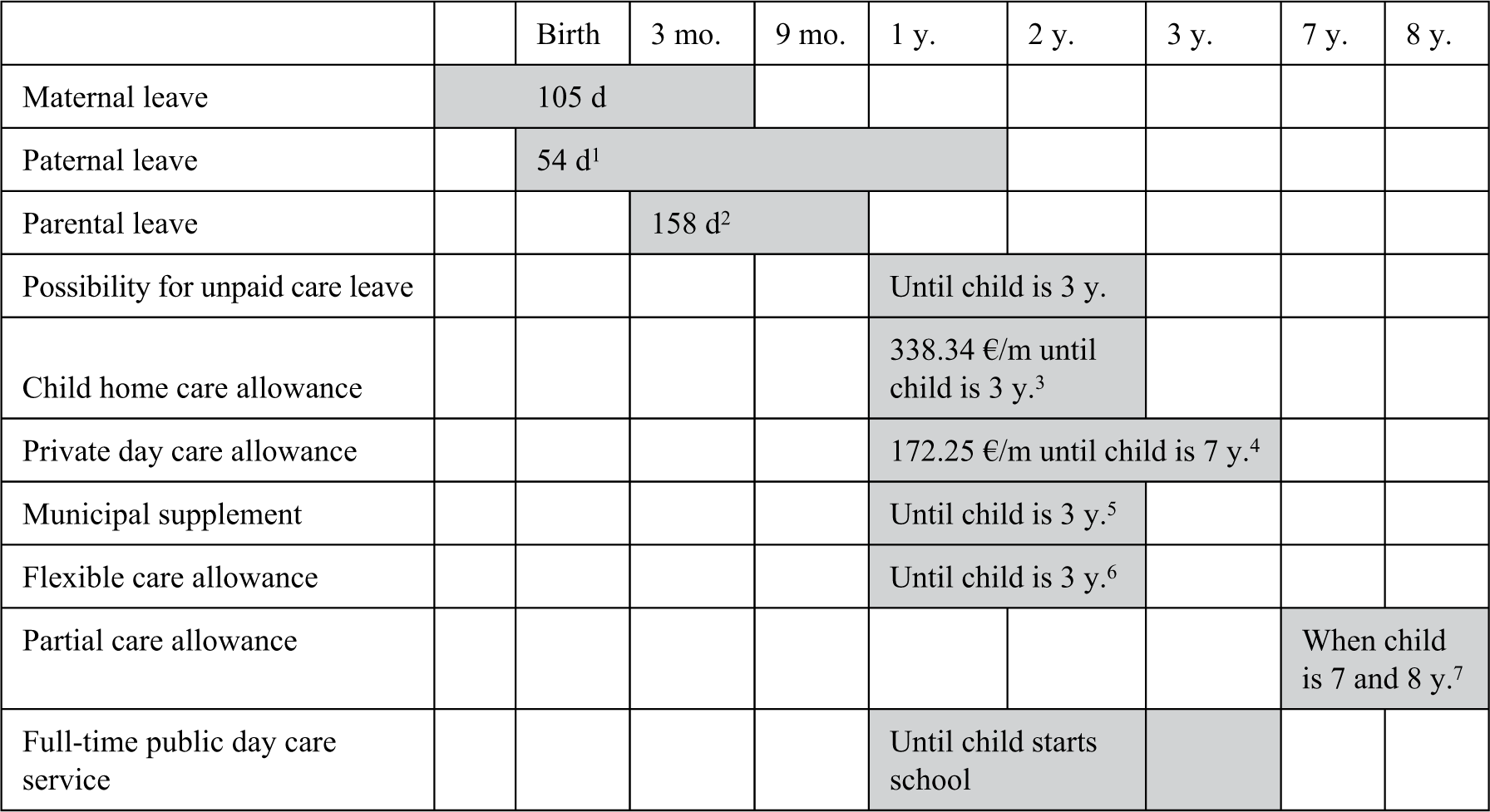
Childcare provision in Finland.
Parents can opt for other than public daycare for their child. In this case, they are entitled to a private daycare allowance while the child is under the school age of 7 (see Figure 1). Some municipalities supplement the private daycare allowance with a municipal supplement. The private daycare allowance can be used to employ a private care worker at home, but it can also be used towards paying for a place in a private daycare facility. A family can receive it even if a grandparent is caring for the child at home for free. While the private daycare allowance is granted to those children under school age who are not in public care services, the municipal allowance is granted only to children under the age of 3.
Another cash-for-care scheme, which is relatively new, is the flexible care allowance which is intended for parents who are working no more than 30 hours a week and caring for their child aged under 3 years during the remaining time (Kela, 2018).
In addition to the above-mentioned cash-for-care policies, children’s home care is subsidized by a tax credit for household work. The adaptation of the tax credit for household work in 2001 was influenced by the EU’s promotion of member countries’ domestic service sectors, a policy stance taken in the early 1990s (Morel, 2015). Consequently, not only Finland but also a number of countries in Continental and Northern Europe have adopted national policies that encourage the employment of domestic and care workers. 4 As Morel (2015) notes, the decision to subsidize the demand rather than the supply of services in a sector where work takes place in the privacy of the home and where there are fewer possibilities for work regulations signifies that the state is actively supporting the privatization of domestic and care services as well as deregulating the labour market.
Compared to the other European countries where similar schemes have been introduced, Finland has included a wider range of services within the tax credit system – for example, household repair and maintenance jobs, and even Information and Communication Technology (ICT) services provided in the household. In practice, the tax deduction means that individual taxpayers can deduct a proportion of the costs of domestic services from their personal income taxes. The minimum deductible cost is €100 and the maximum amount that can be deducted annually has varied from €2000 to €3000 per taxpayer. The tax deduction can also be used for services purchased that are delivered to the taxpayers’ parents or grandparents.
There has been a steady increase in the popularity of the tax credit. The use of the tax credit has increased from €32 million in 2001, when it became nationally available (Häkkinen Skans, 2011), to over €444 million in 2017 (Finnish Tax Administration, 2019b). The tax deduction for household services is most frequently used among the elderly (those between 65- and 69-year-olds), entrepreneurs, two-parent households and highly educated people (Finnish Tax Administration, 2019b; Häkkinen Skans, 2011). In 2017, the most recent available figures, over 420,000 individuals or 9.3 percent of taxpayers, used it (Finnish Tax Administration, 2019a). According to a survey commissioned by the Finnish Ministry of Economic Affairs and Employment, tax deductions have contributed to the creation of a private cleaning service industry (Niilola et al., 2005).
However, even more significant is the change in attitudes that the tax deduction has brought about. According to survey findings, purchasing household services is now considered a normal part of daily life (Aalto and Varjonen, 2010; Varjonen et al., 2007; see also Anttila, 2016), while previously it was considered morally unacceptable to employ a ‘maid’ in the household (Näre, 2016). While older people are purchasing services because of reduced capabilities to perform domestic tasks themselves, in middle-class families, the tax credit is seen as a way to pay for more free time and decrease tensions over the division of domestic work between spouses (Aalto and Varjonen, 2010; Varjonen et al., 2007) as well as to provide more flexibility in childcare, as our research demonstrates. As the income level rises, so does the probability of buying domestic services (Tuovinen, 2007). The benefit is not even available to those individuals whose yearly income is below the minimum income that can be used as the basis for tax credit, for instance, poor pensioners (Grönberg and Rauhanen, 2015). The state subsidizes middle-class lifestyles through the tax credits and thus encourages families to opt for a privately employed childcarer (see also Näre, 2016). Tax credits are instrumental in creating a private market for care and domestic workers and au pairs (see also Eldén and Anving, 2019). Indeed, Mankki (2012: 68) argues that the tax credit simultaneously intersects with work life, family policy and tax policy, which should be taken into account when analysing its consequences. Finally, the different cash-for-care schemes demonstrate that time is a crucial dimension when analysing childcare policies from an everyday perspective. It is to this temporal dimension that we turn next.
A time-economy perspective on everyday childcare practices
Childcare practices can be analysed with the metaphor of choreography, which refers to the temporal and spatial aspects of care patchworking (see Widding Isaksen and Näre in the introduction to this issue). The daily choreographies of care require a certain sequence of steps or a routine that is repeated daily or that is altering because of changing care arrangements (see also Näre, 2009). These choreographies then form local care loops which take place between the home and the playground, the home and the public or private daycare centre, between the home and the house of the private caretaker or the house of the retired grandparents. Even though these local care loops leave no visible signs, through them reproductive labour is performed. As defined by Laslett and Brenner (1989), social reproduction entails the activities and attitudes, behaviours and emotions, responsibilities and relationships directly involved in the maintenance of life on a daily basis, and intergenerationally. Among other things, social reproduction includes how food, clothing, and shelter are made available for immediate consumption, the ways in which the care and socialization of children are provided, the care of the infirm and elderly, and the social organization of sexuality. (pp. 382–383)
The metaphor of choreography of care does not suggest that daily care would somehow be a mundane or insignificant matter of individuals’ private concerns. The social reproduction takes place in the everyday lives of individuals, and the spatiotemporal logic of it links to questions of contemporary capitalism. Temporalities, or the organizing of time, is a fundamental feature of contemporary capitalism (Harvey, 2010: 138). According to David Harvey (2010: 143), the daily practices that organize time are part of the political economy of contemporary societies. Hence, local care loops follow a certain spatiotemporal discipline (Harvey, 2010: 149) relevant to capitalism.
In order to analyse this spatiotemporal discipline, we apply the notion of time economy developed by Barbara Adam (1993). Drawing on E.P. Thompson, Adam (1993) summarizes the transformation in our relationship to time brought by industrial capitalism as a move from task-oriented to clock-orientated work. This signalled a move from ‘working in time to working with time’ (Adam, 1993: 165). Adam (1993: 165) identifies a tendency to understand time as a precious resource. Time understood as a resource needs to be carefully allocated in the organization of work and care. She argues that a ‘multiple complexity of times’ simultaneously affects our lives (Adam, 1993: 169).
Also feminist economists have argued for a time-economy perspective in the analysis of care work. Nancy Folbre’s (2004, 2008) work on care economies and economies of time use is useful for understanding the key role that time has in the everyday practices of care. According to Becker’s (1965) theory of time allocation, individuals choose time allocations to maximize their utility. This ends up producing an efficient outcome both for the individuals and for society as a whole. We draw on the critique of the theory, developed by Folbre (2004), who argues that as the theory exclusively focuses on optimal choice for the individual, it overlooks other factors influencing decision making (Folbre, 2004: 7–8). The theory of time allocation proposes a definition of work as an activity for which market substitutes are available. This ‘third-party criterion’ means that you can pay someone else to do the task for you (Folbre, 2004: 12). However, according to Folbre, it is relevant to understand why a person would choose to purchase a substitute at a particular point in time, which Folbre points out is not directly observable (Folbre, 2004: 12). Following Folbre’s insights, we analyse why a person chooses to purchase a substitute at a particular point in time and in space, which we argue is central to the framing of the local care loops.
In the Anglo-American research literature, the relationship between care and time has mainly been studied through two different perspectives. On one hand, it is argued that care as reproductive labour does not easily fit the capitalist economy of time (Bettio and Prechal, 1998: 43; Geissler and Pfau-Effinger, 2005: 6). On the other hand, research on time and family policy demonstrates a prevalent concern over time and time allocation when it comes to household work (e.g. Bianchi, 2000; Budig and Folbre, 2004; Daly, 1996; Doucet, 2015; Folbre and Bittman, 2004; Jacobs and Gerson, 2005; Morgan, 2013). Bianchi (2000) notes that increased income inequality may have led to increased inequality in time devoted to children. Jacobs and Gerson (2005) argue that time has become a form of social inequality that is dividing Americans in new ways, while Budig and Folbre (2004) point to the need for a more precise definition and measurement of parental childcare time. According to Budig and Folbre (2004: 63–64), parental activities and responsibilities are particularly demanding for children under the age of 3. They argue that future research should focus more carefully on time devoted to children under this age.
This concern over time in the United States stems from the difficulty of combining work and family life partly due to lacking affordable childcare services. Our data demonstrate that a similar concern over time is also emerging in the Nordic context, at least in Finland. Tammelin (2009), exploring aspects of time in the work–family interface, argues that work tempo, work scheduling and predicting time use are increasingly important in combining work with family life for dual-earner families in Finland. Families use different strategies for the coordination and allocation of time (Tammelin, 2009). Karjalainen et al. (2017) analyse how work and leisure time are becoming increasingly diffused among knowledge workers in Finland – a finding made 20 years earlier by Arlie Hochschild (1997) in the United States. Our data also demonstrate a highly detailed awareness of time, and the importance of temporal and spatial factors in combining care and work.
Previous research has argued that lack of leisure time is a new social problem (Garhammer, 1995). We argue that concern over (work) time has since the early years of industrialism been a social problem, as discussed by Marx (1990 [1867]) in the Capital (Vol. 1, Ch. 10). With industrialism, time and the lack of time is a problem that affects social classes differently. For instance, those who are employed in the service sector are affected by the increasing flexibilization of opening hours and the move towards a 24/7 society, while those employed in the knowledge sector are affected by increasing efficiency and flexibility pressures, the lack of clear boundaries between work and leisure and the consequent diffusion of work and leisure time.
Data and methods
Our data are based on statistical data on the use of private childcare and domestic services in Finland which we complement with qualitative data. The qualitative data were collected in two research projects in Helsinki, Finland, in 2011–2012 and in 2016–2018 during which we conducted interviews with Finnish employers of migrant care and/or domestic workers (N = 20) and Filipino nannies and/or domestic workers (N = 12). In this article, we focus on the interviews with the Finnish employers.
The interviewed employers were between 31 and 63 years old, and 18 of them were women. They all had at least one child; 17 of them were living together with a partner, and 3 were separated and living with their children. They have all been born in or brought up in Finland and were working full-time in occupations that are often referred to as ‘highly qualified’ or ‘expert positions’, such as working in leading positions in companies or at universities or being entrepreneurs. All of the interviewed employers hired their employees formally, that is, the workers have an employment contract during which they have access to public healthcare. A formal work contract is required for the employers to receive the tax credit.
Of the 12 interviewed workers, 11 are women, 1 a man. At the time of the interview, they were between 24 and 53 years old. The informants had moved to Finland in 2009 to 2017. They had diverse migration trajectories; some had previously worked as au pairs in other European countries, while others had worked as care and domestic workers in other Asian countries. Eight of the informants have at least one child, and three of them have managed to bring their children to Finland. All of the informants send money to their families in the Philippines monthly. They all had full-time employment contracts, which is a requirement for being granted a work permit in Finland. Their monthly salaries varied between €1100 and €2000. For live-in care and domestic workers, the salary was approximately €700 monthly after the deduction for rent and food. While some of the workers work for only one family, others have multiple employers and work in different homes each day.
We used different methods for finding employers. Finding informants who employ childcarers is not easy as there are no obvious access points to the informants. Hence, we used various means of recruitment through personal contacts and social media groups. We also applied a snowball method in our recruitment, asking interviewees to indicate other potential research participants. Most of the interviews were conducted in the metropolitan region of Finland, either in Finnish or in Swedish (the second official language in Finland). The interviews lasted for 45 to 90 minutes. The interviews were done following a semi-structured thematic method, structuring the interviews around work (both inside and outside of the home), care responsibilities and relationships. The interviews were analysed using theory-driven content analysis. We categorized the material according to themes relevant for our theory and research questions. The experience of time as scarce and the importance of time in the organization of the everyday care puzzle emerged as a key theme in the data. In order to protect our informants’ integrity, we have anonymized all the data and use only a letter to refer to different interviewees.
Temporal choreographies of daily care
What emerges from the interviewees is the difficulty of combining demanding work careers and childcare – a difficulty which is resolved by employing nannies. A common practice was to divide the day into work and care time and divide care tasks between the two primary carers, the nanny and the mother. Childcare and domestic work continue to be gendered work. While men might participate in these tasks, it is women who have the role of project manager at home and who divide the responsibility for childcare with the nanny (Marchetti and Triandafyllidou, 2015).
Our interviewees develop strict, temporal choreographies in order to combine childcare and careers. Consider the following example of a female employer of a live-in care and domestic worker who works from home: When [the caregiver] starts at 9:45 then you know she’s there at 9:40 and ready to go out, she goes out [with the child] and comes back with the child. And then at 12.30 I take the reins again for a while and then [the caregiver] eats and is by herself, she might do her laundry. And then between 3 and 5 [pm] she can go out, can be inside, but is with the child until 5–7 [pm] . . ., then we are at home together. Then I usually help the kids with their homework and she cleans and does laundry and we eat. And at 7 [pm] latest she has usually returned to her own room or gone out somewhere, and at 7.30 [pm] I put the kids to sleep. And 8–11 [pm] is usually my most effective work time. (Interviewee B)
This quote demonstrates well how in knowledge-intensive jobs, work is not confined to a specific place or time: work can be done from home and extend late into the night. Knowledge work also requires maximal flexibility as it becomes clear from the following account of a male employer of a live-in nanny: The closest option would have been to go to a daycare centre or then a private daycare circle, but then that would be separate and the cleaner would be separate. And then we would have to employ a cleaner from a cleaning company and take care of both of them, plus have to make food for the private daycarers when they come, while [the live-in nanny] makes the food for us. Because she lives with us and can do different overlapping tasks. She gets so much more done and it is so much easier to organize the whole thing than . . . if we would employ separate people to do this . . . this is so much more flexible. When my partner went to work, she basically always went to the nearest café [to work] and came home to breastfeed, things that would otherwise be impossible to do. (Interviewee A)
The interviewee emphasizes the benefits of employing a live-in nanny who also does domestic work. This maximizes the flexibility needed in combining care of an infant and the mother’s career. The mother can continue breastfeeding her child even after she has returned to work because of the flexibility offered by a live-in nanny and the flexibility of knowledge-intensive work that can be done from a café. A live-in employee can combine cleaning and care work during the day in a way that does not need ‘separate’ timetables for different persons. As the research literature from Southern Europe has demonstrated (e.g. Colombo, 2007; Näre, 2013), ‘doing everything’ in the household typically characterizes live-in domestic and care work.
It is worth noting that although in our data there are employers who hire live-in nannies, this is less common than employing full-time but live-out workers. Also, the private care allowance is only granted to employ care and domestic workers who are not living with their employers. A combination of different allowances with the tax credit produces incentives for economically privileged individuals to employ a full-time or part-time care and domestic worker.
The employment of full-time nannies allows employers not only to do work without working hours but also to maximize ‘quality time’ with children while outsourcing less important tasks to domestic workers. This is how a female employer of a full-time nanny explains why she and her husband decided to employ a nanny: It’s always the situation in an entrepreneurial family that there are no working hours. We work whenever we have the possibility to do it and we do a lot, . . . and on the other hand both of us wanted to be present in the children’s everyday life so it was like making a puzzle before we had a care worker . . . What we expected was probably precisely that that it wouldn’t always be like, we wouldn’t have to compete over the same time with my husband so much, that we would have a third person, a stabilising factor there. (Interviewee G)
The quote tellingly describes the scarcity of time in middle-class families who seek to combine intensive work with childcare. The metaphor ‘puzzle’ was commonly used by the interviewees. In the above quote, it is the role of the employee to be the person who has to fit the pieces together. Before employing a nanny, the interviewee felt she was competing over the same time with her husband. This competition over the same time refers to time spent with children, time that allows parents to be present in the lives of their children, as the informant put it. According to her, without a third person, the daily patchwork of care and its temporal choreographies create tension over time between the spouses.
The notion of time as a scarce resource and the organization of care loops in a way that maximizes time-use points towards the emergence of a classed time discipline. The employers need to find flexible care arrangements because for them, working time can extend to very late in the evening, even into the night. Tammelin (2009) finds that working-time practices have changed since the 1970s among dual-earning families in Finland. Increasingly, dual-earners work long or short hours, compared to the standard 35 to 40 hours a week. There is more shift work and work is carried out at a higher tempo, but with greater working-time autonomy. The predictability of work hours has diminished because of frequent contacts outside office hours. The joint family working time of Finnish dual-earners is among the highest in the EU15 (Tammelin, 2009).
However, temporal flexibility demands differ depending on the work sector. Individuals employed in shift work in service sectors also have demands for flexible childcare, but unlike those working in knowledge-intensive jobs, they cannot bring their work home. For shift-workers, there are municipal daycare centres that are open 24/7, also during bank holidays. But their choices are limited. Out of the 320 municipal daycare centres in the city of Helsinki, 6 daycare centres are open 24/7 and 5 have evening opening hours (until 21:00 or 22:00) (City of Helsinki, 2018).
These examples illustrate how the patchwork of care demands a daily organization of childcare following a temporal and spatial discipline. As time is experienced as a scarce resource, the employers buy someone else’s time in order to maximize the efficiency of everyday care practices and to gain more ‘quality time’ to spend with the children. In the interviews, the employers stated that they are buying time when they employ a caregiver and domestic workers. Time then becomes a commodity with value that is not only monetary but has more inherent value relating to the notion of spending ‘quality time’ with children (see also Eldén and Anving, 2019).
Weekly patchwork of care: how policies structure care loops
The temporal analysis reveals the importance of Finnish cash-for-care policies and tax credit in structuring the weekly organization of care loops. As the private daycare allowance only covers the costs of employing a care worker for 4 days a week, many informants only employ a worker for those 4 days. Hence, the fifth day needs to be somehow resolved by the employers. Some interviewees decided to cut their work time by working only 4 days a week. Significantly, it was the women who reduced their work time in order to resolve the weekly patchwork of care, so the gender hierarchy according to which women’s paid work is less valuable than men’s remains intact among our interviewees.
F employs a caregiver for 4 full-time days and stays at home the fifth day to care for her children. By doing this, F has shortened her workweek to 4 days, which entitles her to another care allowance, the flexible care allowance. Thus, F receives a combination of two allowances: I wouldn’t be able to hire (without the private care allowance), it’s kind of expensive . . . this is why it is the most rational thing for me to do the four-day work week. Of course I lose part of my salary but I get the flexible care money. (Interviewee F)
Care policies structure the local care loops in at least two ways. Care policies have an impact on the temporal organization of everyday care loops, but they also produce an understanding of temporality as connected to value. Families are required to calculate the most profitable way of organizing childcare across the week. Those interviewees who could not reduce their working time had to find alternative ways to organize the care on the fifth day. C, for instance, still goes to work on the fifth day while her retired mother comes to care for the child: the comical side is that the private care allowance for employing a private care worker, when the child is under 3, is so incredibly big because of this Helsinki supplement, we paid under €200 per month. Compared to putting the child in a private daycare centre, the fee is over €500, so that’s absurd. A care worker comes home to you and takes care of your children. But the thing is of course that it’s only four days per week, so this pattern largely depended on my mother being able to take care of my child the one day. (Interviewee C)
In this case, the solution is to use retired parents, the children’s grandmother, to fill in the extra day (see also Souralová, 2019).
Both social policies and the absence of (sufficient) social policies structure care loops. Research has identified a transfer of cleaners’ jobs from the public sector to private cleaning companies and finally to private households in Germany, a process which is named the ‘double privatisation’ (Mayer-Ahuja, 2004: 117). In Finland, Mankki (2012) argues that public domestic services have been privatized to private companies. Our study suggests that austerity measures and cuts in public childcare provision have led to a lack of available places in public daycare centres. Those families who can afford to can opt for a private option, as analysed well by one of our informants: I’m so pissed off, I feel angry on grounds of principal when I think about this, there’s this risk that this will cause inequalities between our children little by little so that they who [can afford to have private solutions, will], because private daycare it is not terribly more expensive after that the child turns three, before that, it’s a lot more expensive than the public one . . . So I have a bad conscience because I think that my child should be in a public daycare but it would simply make our life too inconvenient. I have talked on the phone about this with the manager of the daycare area many times . . . and they agreed with me and they regretted that this situation has been the same for ten years in this area. Every time that I have applied for a place there has been zero opening places. In the whole area, there are quite many daycare centres but it’s only possible to get to them through a transfer or a sibling place. (Interviewee C)
Interviewee C explains that in the neighbourhood where she lives there are no open places in public daycare. Those with economic resources, middle-class families, can choose either private care workers or private daycare centres. In the same way as the tax deduction compensates for cuts in public domestic services (Mankki, 2012: 68), we argue that cash-for-care allowances function to compensate for the austerity cuts done in the public childcare sector in Finland, lowering the price and thus constructing private daycare as a feasible option. This is one mechanism through which the public sector is effectively withdrawing from providing sufficient childcare services and opening ways for increasing marketization of childcare in Finland.
In the metropolitan region, when faced with a lack of available places in public daycare, middle-class women hire other women to care for their children at home or put their children into private daycare centres, while less affluent women end up transporting their children to a public daycare centre located far away from home. Working-class families spend more time in the local care loops and in organizing the daily patchwork of care, while middle-class families can pay for convenience and flexibility. They are able to do this, however, only because there are social policies in place in the form of cash-for-care allowances, municipal allowances and tax deductions that make employing private workers possible. Thus, cash-for-care policies combined with cuts in public services produce specific local care loops that are divided along class, gender and ethnicity. Time economy has a clear class dimension.
Conclusion
While there is strong evidence of rapid marketization of eldercare in Finland (e.g. Karsio and Anttonen, 2013), much less is known about the marketization of the childcare sector. The trend of outsourcing part of domestic and childcare to privately employed workers occurs in tandem with the use of public daycare services, which is why these developments are not visible in statistics. Nevertheless, they are visible, for instance, in the number of private cleaning and childcare companies that have appeared especially in the Helsinki metropolitan region.
In order to analyse this partly hidden and previously unexplored field, we have applied what we term an everyday perspective to social policies, referring to the analysis of how social policies structure individuals’ daily lives by focusing on micro-level practices. Time emerges as a key dimension in analysing childcare policies in Finland. Childcare policies structure the availability of care allowances for parents not only according to the age of the child but also according to the employment status of the parent, their use of public services and their working hours. Moreover, the organization of public childcare, such as the opening hours of the facilities (8:00–17:00 in general) or the lack of conveniently located public childcare facilities, conflicts with the temporalities of current working life, especially in so-called knowledge work, and also in the service sector that is increasingly moving towards 24/7 opening hours. In this situation, families with sufficient economic resources can use diverse cash-for-care solutions and the tax credit to buy flexible childcare. This means that they are able to maximize time spent for wage work and also to maximize quality time spent with children. This quality time includes being present in children’s lives and taking part in their everyday activities rather than spending it on domestic work. These emerging trends of privatization of childcare are creating new social hierarchies. While gender hierarchies remain intact in the families we interviewed, in that women bore the main responsibility for childcare and their paid work was less valued than that of the men, class and ethnic divisions are also (re-)emerging. These trends are worrying examples that the egalitarian principle of de-commodification of labour is eroding and paving the way to increasing inequalities among families with children.
Footnotes
Acknowledgements
We would like to thank Zuzana Sekeráková Búriková, Mariya Bikova and the anonymous reviewers for their valuable comments on the previous versions of this manuscript.
Funding
The author(s) disclosed receipt of the following financial support for the research, authorship, and/or publication of this article: Elisabeth Wide has been funded by the Doctoral Programme in Gender, Culture, and Society at the University of Helsinki, Finland.