




Abstract
This article analyses childcare services in six countries, assessing this policy instrument’s potential to facilitate parents’ capabilities for arranging childcare in a way they have reason to value. It draws on Sen’s capability approach to conceptualize and assess childcare policy design across five key aspects of childcare provision (accessibility, availability, affordability, quality and flexibility) in a country-comparative perspective. The conceptualization of the multifaceted nature of childcare provides compelling insights into the complexity of comparing childcare services across countries. The ensuing analysis and comprehensive overview of national policies challenges the idea of a defamilialization policy cluster, which masks key distinctions between public and market service provision. The more nuanced conceptualization and operationalization of childcare policy design through the capability approach reveals parents’ real opportunities for arranging childcare and the varying effects of policy design across gender and class. In addition, it goes beyond implicit commodification assumptions and opens up space for parents’ potential desire for multiple care arrangement possibilities.
Introduction
Childcare policies are undergoing rapid changes throughout Europe and beyond as work–care reconciliation needs persist (Allen and Eby, 2015) and countries pursue ambitious goals of child-centred investment (Pavolini and Van Lancker, 2018). The legal landscape is also shifting: while legislation may keep individuals in work longer, equality rights cases are emerging that oblige employers to accommodate workers’ care obligations (Chan, 2013). Such recognition has led to substantial advancements and improvements in childcare policies, even in countries historically lacking public childcare services (Fleckenstein, 2011; Knijn and Saraceno, 2010; Morgan, 2012; Oliver and Mätzke, 2014; Plantenga, 2012).
Despite important comparative work on childcare policies, serious conceptual problems remain, as the definitions and measurement of key aspects of policy design, including availability, accessibility, affordability, quality and flexibility, vary (Keck et al., 2009; Knijn and Saraceno, 2010; Morgan, 2012; Oliver and Mätzke, 2014; Plantenga and Remery, 2013). While varying definitions are partially attributable to differentiation in (and lack of) comparable data, a commonly accepted conceptualization of these key aspects is missing. In addition, extant comparative childcare literature insufficiently disentangles the numerous aspects of childcare policy design while considering the implications for various groups of parents. Childcare policy design and ensuing services frame the choices parents can make following childbirth (Javornik, 2014; Yerkes and den Dulk, 2015); that is, their design significantly affects parents’ capabilities for arranging childcare in a way that allows for pluralist interpretations of what individuals have reason to value in life (hereafter referred to as childcare capability).
Capabilities, or what individuals are effectively able to do and be (Sen, 1992), are increasingly acknowledged as an evaluative perspective in work–family scholarship (Annink, 2016; Hobson, 2011, 2014; Javornik and Kurowska, 2017; Koslowski and Kadar-Satat, 2018; Yerkes and Den Dulk, 2015). However, this perspective has yet to be applied to compare childcare policies. We build on the important work by comparative childcare scholars (Bonoli and Reber, 2010; Ciccia and Bleijenbergh, 2014; Daguerre, 2006; Eydal and Rostgaard, 2011; Gislason and Eydal, 2011; Gornick et al., 1998; Gornick and Meyers, 2003; Knijn and Saraceno, 2010; Korpi et al., 2013; Plantenga and Remery, 2005, 2009) by taking a capability approach (hereafter CA) to conceptualize and assess childcare policy design in a country-comparative perspective. This new approach does not allow us to fully resolve the problems associated with existing comparative data or lack thereof. However, by unpacking some of the issues underlying comparative childcare analysis, we highlight the conceptual and empirical limitations while suggesting avenues for moving the field forward.
We start by drawing on defamilialism, a dominant comparative paradigm in childcare policy research (e.g. Javornik, 2014; Leitner, 2003; Saraceno and Keck, 2011; Van Lancker and Ghysels, 2016) in the context of six countries: Australia, Iceland, the Netherlands, Slovenia, Sweden and the United Kingdom. This illustration allows us to highlight the limitations of the defamilialism approach and the need to situate comparative childcare research in a capabilities framework. Such analytical perspective is particularly apt because all six countries belong to the defamilialism cluster in terms of childcare policies and are, apart from Australia, considered ‘leaders’ in meeting Barcelona childcare targets (Mills et al., 2014). That notwithstanding, they differ in one salient aspect – while three rely on a supply-led system (i.e. a public provision mechanism for childcare services), others use the demand-priming approach through cash transfers and subsidies for parents (i.e. marketized childcare). This, we argue, has significant ramifications for parents’ childcare capabilities. Historically, Iceland, Slovenia and Sweden designed childcare through public service provision to support gender equality (Gornick and Meyers, 2003; Javornik, 2010). Service affordability, accessibility and public oversight, characteristic of this approach, theoretically offer parents space to realize childcare capabilities. In contrast, the Netherlands, Australia and the United Kingdom have explicitly designed childcare policies via the market; this affects service affordability and accessibility and may fail to provide parents with childcare capabilities.
Defamilialism and the CA: analytical potential
Defamilialization refers to the extent to which the state takes on individual or family care responsibilities, thereby reducing family dependency (Lister, 1997). The defamilialization literature argues that public childcare reduces family care responsibilities (Javornik, 2014; Leitner, 2003; Saraceno and Keck, 2010). Higher levels of defamilialization thus correspond with reduced gender and class inequalities in work–family reconciliation (Korpi et al., 2013), supporting parents across socio-economic groups. In contrast, countries in the familialistic cluster support family care either implicitly through the absence of public alternatives or explicitly through tax incentives or paid family care through cash-for-care (compare Leitner, 2003; Saraceno and Keck, 2010). In familialistic countries, inequalities between parents’ childcare capabilities may arise because not all families can absorb care responsibilities or outsource those when publicly provided care services are not available (Künemund, 2008; Leitner, 2003).
Based on this literature, our six defamilialistic countries should offer parents the greatest opportunities to find childcare outside the family. Herein lie two conceptual limitations of defamilialism. First, it does not sufficiently differentiate between direct public provision versus market mechanisms. While the difference between the two is mentioned (see Javornik, 2014; Leitner, 2003; Saraceno, 2016), defamilialism does not fully operationalize ramifications of their operating systems. Reasoning from a capabilities perspective, the difference between public and market provision (with strong gender and class elements, respectively) becomes crucial. Second, defamilialism rests on the assumption that a reduction of family care is required for commodification of labour, thus focusing on reconciling work and care rather than a plurality of purposeful activities.
The limitations imposed by these underlying assumptions become obvious when considering our countries. Childcare policy in Iceland, Slovenia and Sweden is designed around state investment in familial care while attempting to challenge gendered parenting via the design of parental leave. Thereafter, state investment shifts to public childcare, with the crossover point around a child’s first birthday (Koslowski et al., 2016). While exemplifying supported defamilialization (Gislason and Eydal, 2011; Javornik, 2014; Javornik and Kurowska, 2017), such conceptualization is limited in recognizing the temporary recourse to market mechanisms. Such a scenario, while providing parents with capabilities to reconcile work and care, does not recognize that they may value other care arrangements or ways of contributing to society, failing to address the question of choice. In Australia, the Netherlands and the United Kingdom, reliant on market-mechanisms, parents’ capabilities are mediated by income and informal care availability (Knijn and Saraceno, 2010; Lewis and Campbell, 2007; Plantenga, 2012). Although the past decade has – to varying degrees – brought about rapid change to work–family arrangements in all three countries (for Australia, see Martin et al., 2011; for the Netherlands, Den Dulk, 2016; for the United Kingdom, Lewis and West, 2017), family payments are invested in familial care, supporting women’s role as carers (Brennan, 2009). Childcare is often not available as a continuous entitlement from birth to school.
In short, from a defamilialism perspective, we would argue that both public and market provision support parents. However, the general focus on public support has rendered hidden the types of opportunity imbalances likely to impact various groups of parents differently (Javornik and Kurowska, 2017; Warren, 2015). As explained below, we see the CA as accommodating a wider range of policy scenarios and socio-economic contexts, allowing for a better conceptualization of the implications of childcare policy designs in a comparative perspective.
CA as an evaluative tool
Originally developed by Sen (1992, 1999), and elaborated on by, among others, Nussbaum (1995, 2011) and Robeyns (2005), the CA is well suited for assessing work–family arrangements (e.g. Annink, 2016; Hobson, 2011, 2014; Javornik and Kurowska, 2017; Yerkes and Den Dulk, 2015). Drawing on Marx and Aristotle, it grew out of a concern for social justice, with two underpinnings: the philosophical (a concern for social justice and human good) and the economical (seeking ways to measure life quality, promoting autonomy and individual life choices). Advanced through the disability literature, the CA values pluralism in ways of living and promotes the notion of the human being as ‘in need of a totality of life activities’ and opportunities for such activities (Nussbaum, 1987). Thus, it argues for assessing what individuals are effectively able to achieve in their pursuit of the life they have reason to value rather than focusing on a particular outcome (e.g. work–family reconciliation).
While the CA has proven effective for conceptualizing and assessing gender equality (Robeyns, 2003), agency (Hobson, 2014), work–care reconciliation policies (Annink, 2016; Yerkes and Den Dulk, 2015) and parental leave (Javornik and Kurowska, 2017; Koslowski and Kadar-Satat, 2018), a conceptualization and assessment of childcare policies has yet to be undertaken. We do so by building on Sen’s approach because it is broader and clearly emphasizes the role of situated agency in producing inequality in capabilities.
Sen’s CA (1992, 1999) centres around five main concepts: means, capabilities, achieved functionings, conversion factors and agency. Means are the various resources (e.g. economic, social) individuals have access to, including childcare or other policy instruments. Even when individuals have equal access to means, they may not achieve the same outcomes, or achieved functionings (Sen, 1992) because of variation in an individual’s situated agency (Hobson, 2014). The real choices individuals have – known as agency – can vary depending on conversion factors, or ‘the conditions allowing for the translation of formal rights and social support into real rights and resources’ (Annink, 2016: 4). Conversion factors are unique to individuals, reflecting their relational embeddedness in community and social contexts; their interaction results in a capability set, that is, the options and perceived alternatives from which an individual chooses. By addressing parents’ situated agency (Hobson, 2016), the CA offers an evaluative space for understanding childcare policy – that is, how childcare arrangements are a reflection of both agency and choice.
In Hobson’s (2014) capabilities framework centred on work–life balance, childcare policies have been treated as a part of the social context: parents’ policy use is seen to differ based on one’s perceived set of alternatives and the sense of entitlement (Hobson, 2016). However, policies are also an important resource (means) for parents to arrange childcare in a valued way (Javornik and Kurowska, 2017; Kurowska, 2018). Thereby, access to childcare services differs between parents, affecting their childcare capabilities (Yerkes and den Dulk, 2015). We argue that public childcare creates the means to better reconcile work and care for some parents (Gornick and Meyers, 2003; Grönlund and Javornik, 2014); for others, it creates the means to use childcare as an aspect of children’s development needs and socialization (Organization for Economic Co-operation and Development (OECD), 2017b; Saraceno, 2011; Van Huizen and Plantenga, 2015). Equally, it reduces family care to enable meaningful contributions to society (e.g. education, training, job search or volunteering; Javornik and Ingold, 2015).
How policy designs translate to childcare capabilities depends on multiple conversion factors. We recognize the role of cultural, societal, organizational and community conversion factors in childcare capabilities, but focus here on gender and class, two key individual-level conversion factors operating in intersectional ways (e.g. Hook, 2015; Korpi et al., 2013). High childcare costs constrain childcare capabilities for parents from lower socio-economic classes, limiting them to choose childcare of lower quality or opt for family care (Morgan, 2005). Similarly, low accessibility or availability make childcare exclusive, maintaining gendered patterns of care (Kreyenfeld and Hank, 2000). Given educational homogamy among couples (Steiber and Haas, 2009), childcare capabilities relate to the intersection of class and gender. With education as a proxy for class in work–family arrangements (Hook, 2015), mothers with higher levels of education have more opportunities to arrange childcare, relative to mothers constrained by economic need (Steiber and Haas, 2009). In contrast, highly educated mothers generally have stronger labour market attachment and higher opportunity costs when staying home to provide care (Hook, 2015). Our approach allows us to highlight variation in childcare design and how it may affect parents in relation to gender and class.
Operationalizing and evaluating childcare capabilities
To evaluate childcare capabilities, we examine the potential effects of public versus (mixed) market approaches, evaluating policy resources (means) available to parents. Thereby, we assess parents’ capabilities to access childcare services in pursuit of the life they have reason to value. We also investigate whether public and mixed-market settings affect parents’ capabilities to arrange for childcare differently. Based on previous research in this area, we argue that direct public service provision offers parents across socio-economic groups the best opportunities to arrange for childcare in ways they have reason to value because it provides real choices (Leitner, 2003; Lister, 1997; Saraceno and Keck, 2010). We analyse childcare services across five most salient features: availability, accessibility, affordability, quality and flexibility (Bonoli and Reber, 2010; Ciccia and Bleijenbergh, 2014; Daguerre, 2006; Eydal and Rostgaard, 2011; Gislason and Eydal, 2011; Gornick et al., 1998; Gornick and Meyers, 2003; Plantenga and Remery, 2005, 2009; Saraceno, 2011). Availability, accessibility and affordability provide the foundation for childcare capabilities; quality only becomes an issue once childcare is available and accessible, and is often a reflection of affordability (Kreyenfeld and Hank, 2000; Morgan, 2005). Similarly, flexibility matters when childcare is available and accessible (Verhoef et al., 2016).
Most childcare policy scholars agree that available data have several shortcomings, such as a focus on the public sector, expenditure levels covering multiple services and programmes and variation in what is measured (Fagan and Hebson, 2005; Keck et al., 2009; Lambert, 2008; Mätzke et al., 2017; OECD, 2018; Plantenga and Remery, 2005). Considering these issues, we use multiple sources and single-country reports to provide a comprehensive comparative analysis (Eurostat, 2017; Eurydice, 2018; Multilinks, 2011; OECD, 2017a, 2017b, 2018; Plantenga and Remery, 2005, 2009, 2013, 2015). Arguably, better data will, in the future, enable better analyses, and we discuss the limitations below in the absence of more nuanced databases. 1
Availability
Childcare availability is often viewed as integral to parents’ employment, particularly mothers, reducing economic dependency and poverty among families and children, but childcare can also play a key role in child development (OECD, 2017b; Plantenga and Remery, 2009; Saraceno, 2011; Van Huizen and Plantenga, 2015). Analysing availability is complicated by multiple types of care provision across countries: formal care services, semi-formal arrangements (e.g. ‘guest parents’ (the Netherlands); subsidized arrangements (Slovenia); registered playgroups (United Kingdom)).
In much extant research, availability is operationalized using enrolment rates; this is problematic because it conflates structural differences in care provisions by focusing on a single outcome (Javornik, 2014). Alternatively, Brennan et al. (2012) distinguish logics of care provision, including three logics of non-familial care: market provision (for profit), state provision, and a logic of associations, whereby childcare is provided through formal private or non-profit organizations. In line with our critique of existing distinctions of care availability, we argue that public and market provision mechanisms have different consequences for parents’ capabilities, and address conceptualization issues by combining data on the most widely accepted measure for availability (enrolment rates for 0–2 year-olds and 3–6 year-olds) while classifying countries by their prevailing provision mechanism.
Accessibility
In existing studies, capacity (the number of places available) is seen as a good proxy for service accessibility (Plantenga and Remery, 2015). But key for evaluating social inclusion/exclusion are admission criteria or the construction of a right to childcare (Jensen, 2009). First, selective practices (i.e. preferential criteria) and autonomy of providers may create tensions/diminish childcare capabilities (Javornik, 2014), and national-level capacity planning reduces disparities (OECD, 2018; Plantenga and Remery, 2005: 35). Second, childcare should be accessible as a right attached to children rather than conditional (Saraceno, 2011). Namely, childcare subsidies tied to eligibility criteria (e.g. parents’ employment) create an opportunity gap for those not meeting eligibility criteria but who may want or need to use childcare. When childcare is provided as a child’s right, this ‘stresses societal responsibility to grant all children adequate family care and time, as well as non-family resources for the full development of their capabilities’ (Saraceno, 2011: 92). This, in turn, improves parents’ childcare capabilities, particularly across class. We thereby analyse admission requirements, focusing on the allocation of places and admission age. Drawing on Gornick and Meyers (2003) and Javornik (2014), policy that guarantees a place to all children (child’s right) without gaps between paid leave and childcare improves childcare capabilities. When a child can be refused a place based on preferential criteria (e.g. family composition, siblings, income, parental employment status), service provision can vary (Fagan and Hebson, 2005), hindering access to public service. Furthermore, policy that enhances childcare capabilities, opens care service before the end of paid leave or at least coordinates the two (Javornik and Kurowska, 2017).
Affordability
Ability to pay is another key determinant of childcare capabilities. Childcare costs are the equivalent of a regressive tax on mothers’ labour supply and reduce financial returns from employment (Esping-Andersen, 2009). Because free services practically do not exist, the distinction in funding mechanisms becomes crucial. In earlier studies, affordability is measured by the level of public-sector involvement. However, public spending data reflect national funding streams to finance childcare services (OECD, 2016a). This is not captured in international data on spending, especially when local governments do not report on childcare spending (e.g. Gornick and Meyers, 2003; Javornik, 2014; Lambert, 2008) or when childcare services are funded through collective bargaining agreements (Yerkes and Tijdens, 2010). Attempts to measure affordability using the cost of childcare as a percentage of net family income (e.g. Keck et al., 2009; OECD, 2017b) are similarly problematic. Tax allowances presuppose a taxable income (e.g. Immervoll and Barber, 2006; Jaumotte, 2003) and are thus not available to parents not in employment.
A salient aspect of affordability is whether a country focuses on direct funding streams to providers, and/or uses means-testing and caps parental fees based on a sliding-fee scale (Immervoll and Barber, 2006; Javornik, 2014). A ‘supply-led system’ opens space for parents across socio-economic groups to access childcare via direct funding (Javornik, 2014; Leitner, 2003). In contrast, the demand-priming approach, where parents receive financial help directly, and operating rules are set by providers to maximize profitability, creates childcare capabilities gaps (Brennan et al., 2012). This increases costs for parents, and the level of household income and/or childcare subsidy, tax allowance and employers’ assistance become crucial (Blackburn, 2012; Mamolo et al., 2011; Morgan, 2005). Furthermore, child-related tax deductions are not available at the time when parents incur childcare expenses, but, conventionally, in the following fiscal year (Immervoll and Barber, 2006). Affordability is therefore particularly relevant for low-income parents (Capizzano and Adams, 2004) and single mothers (Kreyenfeld and Hank, 2000) with limited earning prospects. We address some of these issues by combining established data on childcare costs with an analysis of funding rules.
Quality
Quality is a measure of inclusive experience but can be seen as subsidiary to service availability, accessibility and affordability – unless childcare is accessible and affordable, quality is less important. Moreover, when there are issues with service quality, parents may not easily switch between providers or an exit could be too costly (OECD, 2018). We know little about these interrelationships but high-quality service generates incentives for using non-familial childcare (Plantenga and Remery, 2005).
Measuring childcare quality is problematic because a standard definition is lacking (Janta et al., 2012; Keck et al., 2009; OECD, 2018). Typically, researchers distinguish between structural quality (e.g. maximum group size, child-to-staff ratios and the educational level of childcare staff (Penn, 2013)) and process quality at the organizational/staff level (e.g. what happens in the setting: the play and learning environment, child–teacher and child–child interaction (Janta et al., 2012; OECD, 2018)). Until recently, little to no comparative data on process quality were available (Janta et al., 2012; OECD, 2018). Recent reports from the OECD (2017b, 2018) offer some insights on conceptualizing process quality and its effects on children’s development. However, comparable indicators remain unavailable, with fragmented research and inconsistent results, limiting the possibilities for cross-country research on process quality (OECD, 2018). We evaluate quality by comparing structural quality through maximum group size, child-to-staff ratios, and the educational level of childcare staff; information on process quality is provided when possible using recent meta-analysis data from the OECD (2018).
Flexibility
While flexibility may seem a familiar concept and essential for childcare capability, it is difficult to evaluate because of both issues with operationalization and a lack of standardized data. Interested in parents’ capabilities, we evaluate service flexibility from parents’ perspective, which may not always address the child’s needs. Opening hours determine the extent to which childcare services can be used (Gornick and Meyers, 2003: 227) and cope with the constraints of time and distance (Emlen, 2010). Few providers offer non-standard hours, making parents reliant on informal care. This affects parents working non-standard or variable work hours, in education, or looking for jobs (Grönlund and Javornik, 2014; Javornik and Ingold, 2015; Verhoef et al., 2016) or low-income parents (Singler, 2011). To enable childcare capabilities, service should be available on a full-time basis for at least 30 hours per week (Mills et al., 2014) all year round, but allow parents freedom to choose the hours (OECD, 2007; Plantenga and Remery, 2005: 38–42). Given its complexity, the ideal indicator would be parents’ self reports. As these are unavailable, we analyse guidelines and statutory frameworks regarding the structure of the annual timetable and opening hours, using Eurydice (2018) and single-country data.
Results
Our countries differ significantly on a number of aspects of childcare policy design when viewed from a capability lens (see Table 1). On the one hand, some patterns are visible between the public provision group of countries (Iceland, Sweden, Slovenia) and the marketized group of countries (Australia, the Netherlands, the United Kingdom). On the other hand, country anomalies are present, with considerable consequences for childcare capability.
Comparative data on all five indicators.
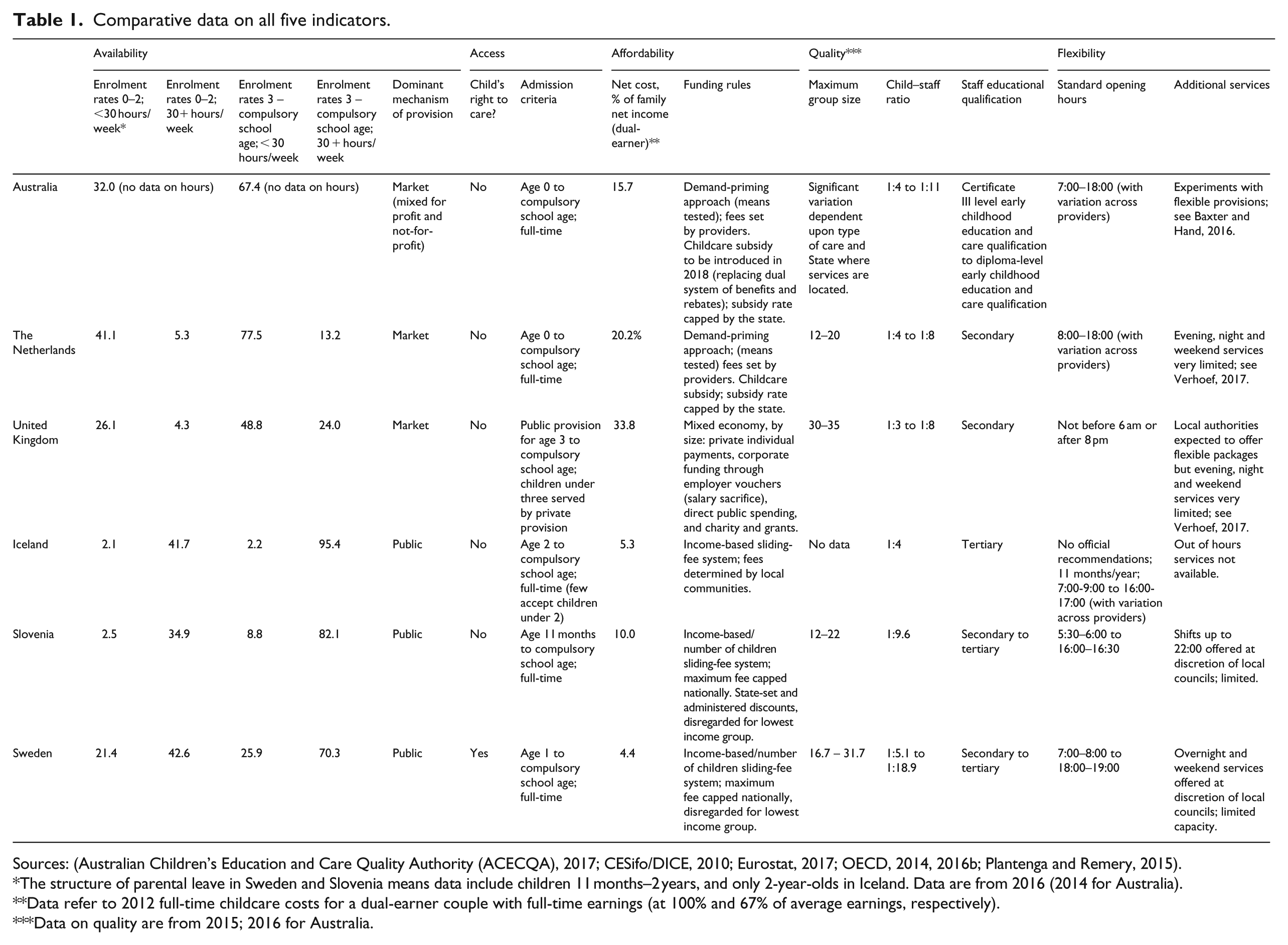
Sources: (Australian Children’s Education and Care Quality Authority (ACECQA), 2017; CESifo/DICE, 2010; Eurostat, 2017; OECD, 2014, 2016b; Plantenga and Remery, 2015).
The structure of parental leave in Sweden and Slovenia means data include children 11 months–2 years, and only 2-year-olds in Iceland. Data are from 2016 (2014 for Australia).
Data refer to 2012 full-time childcare costs for a dual-earner couple with full-time earnings (at 100% and 67% of average earnings, respectively).
Data on quality are from 2015; 2016 for Australia.
Availability
The availability of childcare shows a relatively clear pattern. In the public provision group, childcare is decentralized as a legal responsibility of local municipalities but is nationally regulated, coordinated and monitored (Gislason and Eydal, 2011; Javornik, 2014). This includes admission criteria and central capacity planning, which ensures uniformity and coherence across settings and municipalities. In Sweden, Iceland and Slovenia, children are most likely to be enrolled in full-time childcare (30+ hours a week), regardless of age. Nearly all children aged 3 to compulsory school age attend formal care in Slovenia (90.9%) and Sweden (96.2%).
Full-time childcare is less prevalent in the marketized group. For the 0–2 year-olds, enrolment is often low and part-time. The Netherlands is the only country in this group to mimic the enrolment rates of public provision countries, with 90.7 percent of 3–5 year-olds in formal care, although this is partially attributable to the low age at which children start school (4 years). The part-time enrolment of children in formal care services takes place against a backdrop of care provided either through market provision (the Netherlands and the United Kingdom: Penn, 2013; Yerkes, 2014) or mixed-market and non-profit provision (Australia, which historically relied heavily on non-profit care until the early 1990s; see Brennan et al., 2012). As a result, the responsibility for childcare services is divided at the level of central and local governments, dependent upon the age group concerned (Gislason and Eydal, 2011: 73). Given the focus on market operation, there is an array of actors operating across sectors (private, voluntary and non-for-profit organizations and local council services; Lloyd, 2015). The dominance of a market mechanism can lead to inequality in capabilities. For example, the introduction of market mechanisms in Australia in the 1990s shifted the focus from a supply of non-profit childcare services embedded in local communities to a smaller number of commercial centres (Brennan et al., 2012). The lack of coherence across settings can reduce childcare capabilities because private businesses are focused on profitability (OECD, 2018), which diminishes childcare capabilities of low-income parents.
Accessibility
No clear country pattern emerges in relation to accessibility; only Sweden offers childcare as a child’s right and with a guarantee (without reasonable delay). It is a legal duty to provide childcare in Slovenia and Iceland, however, their municipalities cannot always meet demand (Eydal and Rostgaard, 2011; Grönlund and Javornik, 2014). Both Sweden and Slovenia offer services to children aged 1 to compulsory school age on a full-time basis. With paid leave and public childcare in Sweden and Slovenia being contiguous in principle, in practice most places become available in September, when older children go to school (Grönlund and Javornik, 2014; Javornik, 2014; Javornik and Kurowska, 2017). In Iceland, no legal entitlement to public childcare for the under-2s creates a 1-year gap between familial care and publicly funded care.
None of the marketized countries offers childcare as a child’s right. In the Netherlands, full-time childcare is accessible to children aged 0–4, with before- and after-school services offered to children aged 4–12. From the age of 2.5 years, some targeted programmes offer free childcare to children from disadvantaged backgrounds (OECD, 2015), but their availability differs across municipalities. In Australia, childcare is accessible to children aged 0–5, including outside-school hours care. While services are offered full-time, parents generally choose informal care (e.g. grandparents) during the first year (Baxter, 2015). In the United Kingdom, childcare is essentially available for children aged 0–14, and up to age 18 for disabled children (OECD, 2015). Children under 2 are not entitled to public childcare and children aged 3–4 have the right to 15 hours of free childcare a week but only for 38 weeks a year (Javornik and Ingold, 2015), which expanded to 30 hours for 38 weeks/year in 2018.
The variation in accessibility across countries can create inequalities in childcare capabilities. For example, the design of childcare policy in Iceland could disrupt childcare capabilities, especially when commercial childcare, which parents resort to during the 1-year gap, is unaffordable (Javornik and Kurowska, 2017); this is pertinent for low-income parents. Similarly, the absence of well-paid parental leave in the marketized countries (the Netherlands, the United Kingdom, Australia) can lead to reduced childcare capabilities across gender and/or class. In the Netherlands, where mothers have 10–12 weeks’ maternity leave following birth and paid parental leave is often absent, parents opt for part-time formal care, relying on informal care (e.g. grandparents) and mothers’ willingness to reduce work hours, leading to gender inequality in paid and care work, thus limiting parents’ capabilities.
Affordability
This dimension differs significantly across countries (OECD, 2017a). On average, parents in OECD countries pay 12.6 percent of family net income for out-of-pocket childcare expenses. Among our countries, childcare is most affordable in Sweden and Iceland, where dual-earner couples spend a marginal share of net family income on childcare services. In Slovenia, another country with public provision, dual-earner couples spend nearly twice as much; this could be largely explained by higher costs of childcare for the first age group. The public provision group uses an income-based sliding-fee system; the maximum fees are generally set by the state, with a lower payment ceiling and discounts for certain groups (e.g. low-income parents, single parents and large families). In all three countries, municipalities are allowed to introduce additional discounts and charge differently but within the national guidelines; this diminishes parents’ childcare capability across municipalities. The system seems to disadvantage middle-income families in particular: while high-income families benefit from the ceiling, low-income families can have fees waived completely (not in Iceland).
In the marketized group, childcare services are considerably more expensive, with the United Kingdom running the most expensive childcare market. Childcare is seemingly most affordable in Australia, where dual-earner parents pay 15.7 percent in out-of-pocket childcare expenses, although childcare costs vary greatly (ABC, 2017). Dutch parents spend one-fifth of the net family income, and British parents an astounding one-third of net family income on out-of-pocket childcare expenses. In the United Kingdom and Australia, childcare is offered by a mix of for-profit and not-for-profit childcare businesses, operating within a mixed-market economy (Whiteford, 2015). All three use the demand-priming approach, and complex and expensive funding mechanisms with fees set by the providers to maximize profitability. Behind such provision lies the expectation that the market creates incentives for providers to offer more choice and competitive pricing, leading to a better balance between supply and demand (Brennan et al., 2012). While parents are reimbursed through the tax and benefit systems for services purchased in the open market, support to parents is limited (Lloyd, 2015). Prohibitive childcare costs hinder capabilities across social class and gender, when low-income families opt for family care (usually taken up by mothers).
Quality
In all six countries, regulatory systems specify quality regulations and standards. This generally includes requirements for health and safety, space, staff training, staff–child ratios and curricula, although these vary significantly across our case countries. Creating high-quality childcare has been particularly difficult in the marketized countries, with an uncomfortable relationship between market provision and quality (Brennan et al., 2012; Lloyd, 2015). In the Netherlands, only 12 percent of 0–4 childcare was rated to be of ‘good’ quality in 2012 (Fukkink et al., 2013) and comprehensive measures of process quality are low (OECD, 2018). Quality issues are also evident in Australia (Brennan et al., 2012), with some improvements since 2009, including the introduction of standardized quality indicators in 2012. Variation remains in terms of structural (mid-to-good quality ratings) and process (good to high) quality (Whiteford, 2015). In the United Kingdom, businesses compete in a fragmented way (Blackburn, 2012; Penn, 2013), performing below OECD average on quality, particularly staff skills and parental involvement (Taguma et al., 2012). Childcare quality has been consistently higher in the public provision cluster, where communal obligations and social citizenship are more pronounced. In this group, the state or local authorities are responsible for delivering reliable, high-quality childcare, with equity more pronounced than choice (Penn, 2013).
In relation to structural quality, there is a clear division between public provision and marketized countries. On the one hand, the market provision countries have smaller group sizes and staff–child ratios than most of the public provision countries. On the other hand, staff qualifications are distinctly lower in the marketized countries: in the United Kingdom, Australia and the Netherlands, not all childcare staff are required to have secondary or tertiary education, with no mandatory requirements for in-service training (Penn, 2013). For-profit childcare providers are motivated to minimize costs; if child–staff ratios are regulated, this can be achieved by employing a less qualified workforce (Brennan et al., 2012; Penn, 2013). The focus on profitability and childcare as an employment instrument (rather than a pedagogical service centred on children like in the public provision countries) leads to lower qualification standards, resulting – in the Netherlands and in the United Kingdom at least – in quality issues. When childcare is of lower quality, parents’ childcare capabilities are reduced across gender and class. Attitudes towards the use of formal childcare – influenced by perceptions of quality – are less positive across lower socio-economic groups, leading to gendered patterns of care, and thus inequality in capabilities. In addition, low-income parents may have fewer skills needed to ‘navigate the system’ in assessing differences in quality and ultimately lack the financial resources to purchase higher quality childcare (Brennan et al., 2012).
Flexibility
Limited service flexibility affects childcare capabilities across all case countries, with notable differences. Childcare in the public provision cluster is generally typified and standardized, that is, largely compatible with national standard work hours (Grönlund and Javornik, 2014). Although statutory frameworks set no requirements about opening hours, these are set by municipalities (Sweden) in consultation with employed parents (Iceland and Slovenia). Childcare centres run on a full or part-time basis; they run 6–12 hours a day on weekdays throughout the year. In Slovenia and Sweden, providers can run weekend services at the discretion of local councils, can operate in shifts up to 10 pm (Slovenia) and run (experimental) services overnight (Sweden).
Opening hours in the marketized cluster are not part of statutory frameworks and are left to providers; in the Netherlands, they must consult parents. Services rarely open before 8 am and childcare outside standard hours is limited (Baxter and Hand, 2016; Singler, 2011; Verhoef, 2017). In the United Kingdom, statutory guidance supports flexibility and local authorities are expected to offer flexible packages of free hours but not more than 10 hours (no minimum session length). Childcare must be available for at least 8 hours in Australia, with recent experiments with flexible provisions highlighting the complexities of non-standard care service: despite parents’ need for flexible options, few used extended hours or weekend care (Baxter and Hand, 2016). Similar issues plague attempts in the Netherlands, where the demand for non-standard formal care during evenings, nights and weekends is low, making service expensive and unprofitable.
The absence of childcare outside standard hours limits parents’ capabilities, especially in non-urban areas, where out-of-hours care is most limited (Baxter and Hand, 2016; Grönlund and Javornik, 2014; Javornik and Ingold, 2015). Parents working in lower class occupations with few flexibility opportunities are particularly affected (Yerkes and Den Dulk, 2015).
Discussion and conclusion
This article conceptualized and assessed key aspects of childcare provision within the country contexts in which parents’ real opportunities to arrange care are embedded. We did so using six countries: three with public provision and three with market childcare provision. Applying the CA, we built on the rich comparative literature to conceptualize childcare in terms of accessibility, availability, affordability, quality and flexibility. We unpacked policy designs and showed how these shaped parents’ capabilities in distinct ways: in Iceland, Slovenia and Sweden, three public provision countries, a combination of high service accessibility, availability, affordability and quality generally underpins childcare provision, although variation is evident. In Australia, the Netherlands and the United Kingdom, three market provision countries, service provision is more problematic in terms of service accessibility, availability, affordability and quality. Limited flexibility seems an overarching problem across all countries, particularly problematic for parents in non-standard jobs (Verhoef, 2017), in training or education, or seeking jobs.
Distinct approaches to service provision, with variation within and across public and market-mechanism countries, have different gender and class consequences, which the CA is particularly apt to conceptualize. In the market-driven cluster, opportunity gaps embedded in childcare provision put equitable service delivery in jeopardy (Lloyd, 2015). Because financial hardship limits price elasticity of demand, affordability seems a salient feature that either marginalizes or remedies class and gender inequalities. However, we know little about the demand across class; it would be prudent to investigate this further. In the United Kingdom and Australia, use of formal childcare is becoming increasingly accepted, with the exception of the under 1-year-olds in Australia (Baxter, 2015; Fagan and Norman, 2012). By contrast, parents in the Netherlands prefer formal childcare of only a few days a week (Merens and Van den Brakel, 2014; Yerkes and den Dulk, 2015). The public provision cluster supports equity, with parents favouring the existing model over private provision (Grönlund and Javornik, 2014).
While our study offers important insights into comparative childcare and family policy analysis, a number of challenges remain. We focused on childcare services in relation to gender and class (conversion factors; Sen, 1992), but other factors such as socio-cultural norms (Hobson, 2014) are integral to understanding parents’ capabilities. Our proposed approach also leaves untouched the problem of before- and after-school and holiday childcare, childcare for disabled children and geographical variation. To fully operationalize a capabilities model of opportunity structures (real opportunities and valued functionings), we should further explore ways of incorporating meso-(local-) level provisions for diverse groups of parents. This is important given the way in which readily available policy data (e.g. number of hours in childcare) can lead to erroneous conclusions about service provision. Moreover, while we unpack the salient aspects of childcare policy design for the purposes of comparative analysis, in reality, these features are interdependent: childcare might be offered but a mix of public and market provision mechanisms can lead to variation in affordability. Similarly, without available, accessible and affordable care, quality and flexibility are less relevant. Our unpacking of these aspects was necessary but artificial and future research needs to conceptualize the linkages between these.
Despite challenges, the CA provides a valuable analytical instrument. It highlights the need to move beyond existing approaches, such as defamilialism, which mask key distinctions between public and market service provision. A more nuanced conceptualization and operationalization of childcare policy design reveals parents’ real opportunities for arranging childcare and the varying effects of policy design across gender and class. In addition, it goes beyond implicit commodification assumptions and opens up space for parents’ potential desire for multiple care arrangements.
We would argue that, conceptually, the CA provides a promising way forward in comparative childcare research. Empirically, challenges remain. Comparative measures such as those outlined here are not equally available, which limits our ability to conduct meaningful cross-national policy analysis. As countries continue to invest more in childcare services (Pavolini and Van Lancker, 2018), it is necessary to also invest in measuring the effects of childcare, both in terms of outcomes (i.e. child development) and capabilities.
Footnotes
Acknowledgements
We would like to thank two anonymous reviewers, the editors, the participants of the International workshop Investing in Children: politics, policies, and outcomes, and Manuela Naldini, Chiara Saraceno, and Cristina Solera for their valuable comments on earlier drafts.
Funding
The author(s) received no financial support for the research, authorship and/or publication of this article.