




Abstract
An accepted framework for ‘gendering’ the analysis of welfare regimes compares countries by degrees of ‘defamilialization’ or how far their family policies support or undermine women’s employment participation. This article develops an alternative framework that explicitly spotlights women’s labour market outcomes rather than policies. Using hierarchical clustering on principal components, it groups 24 industrialized countries by their simultaneous performance across multiple gendered employment outcomes spanning segregation and inequalities in employment participation, intensity, and pay, with further differences by class. The three core ‘worlds’ of welfare (social-democratic, corporatist, liberal) each displays a distinctive pattern of gendered employment outcomes. Only France diverges from expectations, as large gender pay gaps across the educational divide – likely due to fragmented wage-bargaining – place it with Anglophone countries. Nevertheless, the outcome-based clustering fails to support the idea of a homogeneous Mediterranean grouping or a singular Eastern European cluster. Furthermore, results underscore the complexity and idiosyncrasy of gender inequality: while certain groups of countries are ‘better’ overall performers, all have their flaws. Even the Nordics fall behind on some measures of segregation, despite narrow participatory and pay gaps for lower- and high-skilled groups. Accordingly, separately monitoring multiple measures of gender inequality, rather than relying on ‘headline’ indicators or gender equality indices, matters.
Keywords
Introduction
A common approach to analysing and comparing welfare states involves grouping them into ‘welfare regimes’ based on the similarities and differences in their policy ‘logics’ – that is, the intentions, origins, and general direction of their social policies (Lewis, 1997; Zimmerman, 2013) – and the relative role of the state versus the family or market in welfare provision. Esping-Andersen’s (1990) welfare regime typology, which distinguished a ‘social-democratic’ regime, a ‘liberal’ regime, and a ‘corporatist’ regime, continues to dominate and guide this literature. However, building on early research on gender and the welfare state (for example, Land, 1971), feminist scholars have highlighted the gender-blindness of Esping-Andersen’s analysis and other ‘mainstream’ welfare regime analyses. Mainstream research underplays women’s unpaid care work within the family and the role of welfare provision in reducing gender as well as class inequality. Additionally, the overriding focus on decommodification – reducing citizens’ dependence on paid work for achieving a socially acceptable standard of living – understates the value of having a paid job in the first place, especially for women by increasing their financial independence from male partners. It also skims over gender differences in the capacity for employment due to women’s disproportionate care and domestic labour (for example, Daly, 1994; Lewis, 1992, 1997; O’Connor, 1993; Orloff, 1993; Sainsbury, 1999).
Feminists have extended Esping-Andersen’s framework by adding in gender-sensitive dimensions. Most notably, defamilialization is the ability to uphold an acceptable standard of living independently of personal relationships through state benefits and/or paid employment (Lister, 1994; Saraceno, 1997). Other feminists have sought to replace Esping-Andersen’s framework altogether: for example, Lewis’s (1992) male-breadwinner typology differentiates ‘strong’ (UK up to the 1980s/1990s), ‘modified’ (France), and ‘weak’ (Sweden) variants (see also Lewis and Ostner, 1995). Ultimately, feminist scholars have highlighted the importance of childcare services, parental leaves, and other family policies designed to support women’s employment and autonomy and transform men’s domestic roles for analyses of welfare states and regimes (for example, Lewis, 1992; O’Connor, 1993; Orloff, 1993).
Subsequently, there has been an explosion of studies that group countries into different family policy regimes or ‘constellations’. Family policy regimes mostly overlap with Esping-Andersen’s (1990) three-fold welfare regime typology, albeit imperfectly. In the social-democratic welfare regime, resembled by Scandinavian countries, comprehensive state social provision helps to foster greater equality between men and women in the division of paid employment and, more recently, unpaid care work. By contrast, the liberal welfare regime, approximated by Anglophone countries, relies on market-based services with limited intervention in the family. Meanwhile, the corporatist welfare regime, seen in certain Continental European countries, actively promotes the family’s (read: women’s) care role (for example, Esping-Andersen, 1999; Korpi, 2000; Korpi et al., 2013; Leitner, 2003; Thévenon, 2011). Differently from Esping-Andersen (1990), though, some analysts identify France (and sometimes Belgium, too) as embodying a fourth regime type, which supports women to ‘choose’ between working for pay or staying at home (Misra et al., 2007). In addition, many scholars recognize a distinctive Mediterranean welfare regime: here, a residual welfare state, amid strong inter-generational and gendered caregiving norms, leaves care work to the family (women) ‘by default’ (Saraceno and Keck, 2010). Finally, some studies add an (albeit heterogeneous) post-Soviet regime characterized by market provision and traditionalism (for example, Saraceno and Keck, 2010; Thévenon, 2011).
This article presents an alternative framework. It compares 24 high-income countries by their effective gendered employment outcomes using hierarchical clustering on principal components. It analyses countries strictly by their gendered outcomes in the domain of paid work1 rather than by the institutional design of their policies or a conflation of policies and outcomes.2 Policies represent aims, whereas outcomes are the welfare ‘reality’ or tangible consequences of policies, intended or not (Ferragina et al., 2015). Of course, the outcomes observed here are not solely a product of social policies, but of myriad circumstances with which welfare state institutions interact (for example, macroeconomic conditions or cultural norms). Furthermore, the analysis is strictly descriptive. Nevertheless, if the outcome-based typology maps perfectly onto established family policy typologies, then it seems reasonable to conclude that family policies matter for gendered employment outcomes even if other factors are also at play. Conversely, a poor fit between the outcome-based groupings and institutional typologies would suggest that other factors are more significant.
A sizeable literature has examined the gendered employment outcomes associated with different family policies, regimes, and approaches (for example, Gornick and Jacobs, 1998; Mandel, 2012; Misra et al., 2007; Stier et al., 2001; Thévenon, 2016; Valentova, 2016); yet studies usually analyse one or just a few outcomes at a time, which ‘shrinks’ down and restricts the meaning of gender inequality (Lombardo et al., 2009). Even when studies do consider multiple gendered employment outcomes, they typically examine different outcomes sequentially and separately from each other, thereby masking potential interrelations between them (although see Mandel, 2009).
Alternatively, some studies and international organizations use indices for a ‘holistic’ measure of gender inequality. Examples include the World Economic Forum’s Global Gender Gap Index and the European Institute for Gender Equality’s Index. Again, though, in bundling together multiple, distinct outcomes for women’s employment into a single number, indices gloss over the interrelationships between different ‘types’ of inequality (Van der Vleuten and Verloo, 2012). Added to this, a strong performance on certain indicators that feed into the overall index can ‘compensate’ for and mask a poor performance on other indicators, making it hard to judge and rank countries’ performance in a comprehensive way. Indeed, workshops with experts suggest that policymakers typically find data on individual indicators more engaging and useful than aggregated index scores (Schmid et al., 2022).
This article instead takes a configurational approach. It analyses countries as multidimensional patterns of gender inequality based on their simultaneous performance across 10 indicators of women’s economic labour market outcomes, which cover participation, intensity, segregation, and pay. In turn, it determines constellations and associations that cannot always be established when comparing countries by a single indicator at a time or measuring relationships between policies and outcomes, which usually involves stripping out the broader context. I treat the outcomes analysed as comprising an inextricable ‘package’ of gender in/equality, whose meaning derives from the interrelationships between the different outcomes that comprise it and whose whole is greater than the sum of its parts. I call this the gendered employment pattern to denote the macro-level pattern of gender stratification in paid labour that characterizes a society. I also consider employment outcomes for women from different educational groups to give insight into classed dimensions (Cooke, 2011).
The period of analysis is 2010–19. Although cross-sectional analyses cannot capture change over time and are always prone to distortion by outliers, pooling annual data from multiple years helps to reduce the influence of year-by-year volatility and measurement errors (Ferragina et al., 2015; Kuitto, 2011). Arguably, the 2010s were a critical decade for women’s employment given the gendered effects of the 2008 financial crisis, austerity, and the subsequent economic recovery (for example, Karamessini and Rubery, 2013). Despite this, reducing gender inequalities in employment fell down the list of policymakers’ priorities, at least at the European level: for example, the Employment Strategy’s 2010–20 revision dropped any gender-disaggregated data and targets (Fagan and Rubery, 2018; Smith and Villa, 2010). Additionally, marking ‘how things were’ in the decade leading up to the COVID-19 pandemic is crucial, since the impacts of the pandemic on women’s employment outcomes depend partly on the state of pre-pandemic inequalities.
The results reveal that each of the three core ‘worlds’ of welfare is reflected in a specific and distinct gendered employment pattern. Only France deviates from expectations by sitting in the same cluster as Anglophone countries. This mainly reflects France’s wide gender pay gaps, which are arguably linked to its fragmented wage-bargaining system, especially when compared to Belgium. However, the outcome-based clustering fails to support the idea of a homogeneous Mediterranean grouping or a singular Eastern European cluster, thereby highlighting the inadequacy of welfare regime theory for understanding women’s employment beyond the three core ‘worlds’. What is more, the analysis underscores the complex and idiosyncratic meaning of gender inequality in comparative perspective. Each group of countries has its respective strengths and weaknesses, and the interrelationships between the different dimensions of inequality are not always replicated or predictable across borders. Notably, greater inclusion of lower-skilled and other women in the labour market can coexist with both worse and better performances on other gendered labour market outcomes, including for high-skilled women.
Background
Family policy typologies and women’s employment participation
An accepted framework for analysing the gendered character of welfare regimes is based on the design and logics of family policies – most often, parental leaves and/or childcare policies. Table S1 in the Supplemental Material summarises some major family policy typologies and groupings, as well as their placements of the 24 countries analysed here. These labels should not be seen as fixed descriptions of countries, since welfare states are dynamic and often display characteristics of more than one regime type – as exemplified by the divergent placements of certain countries across different typologies (for example, Finland, Switzerland; Table S1). Regardless, the regime approach offers value in providing a general guide to important institutional differences (for example, Hopkin and Wincott, 2006; Maître et al., 2005). Table S2 presents descriptive statistics for the main indicators used in these typologies.
To begin, the ‘earner–carer’ strategy exhibits generous childcare services and parental leaves, including incentives for men’s caregiving (for example, Korpi et al., 2013; Misra et al., 2007). Nordic countries are usually in this grouping, although not always Finland, where certain policies are more typical of familialism – that is, state support for care within the family (for example, Leitner, 2003). The Nordics have historically had high female employment rates, including for low-skilled women, with most women employed full-time or ‘long’ part-time hours (30 + per week) (Korpi et al., 2013). Accordingly, comparative social-science researchers and commentators often hail Scandinavian societies as a gender equality ‘paradise’ and as role models for others (for example, Esping-Andersen, 2016).
By contrast, the ‘market-oriented’ (Korpi, 2000) regime type, of which the United States and other Anglophone countries are the best examples, offers limited state support for the family’s care role. As the label suggests, care is provided mainly through the market. Consequently, there is intra-national variation in the provision, quality, and costs of services (for example, Korpi et al., 2013; Mandel, 2009). Employment among low- and medium-skilled women is also lower than in the dual-earner regime (for example, Anxo et al., 2007; Ferragina, 2019; Hook, 2015). Even so, low-level, means-tested benefits mean that many women have to work for pay (for example, Mandel, 2009), although in Australia, the UK, and, to a lesser extent, Canada, mothers are often part-time employed (for example, Sayer and Gornick, 2012). Note that some studies include Switzerland in this regime type due to its similar reliance on marketized care services (Korpi et al., 2013).
In the ‘traditional-family’ regime (Korpi et al., 2013), familialism is more ‘explicit’, as evidenced by such measures as cash-for-care benefits and derived social rights for non-employed partners (Leitner, 2003). In turn, women’s employment rates are low to medium by comparative standards (for example, Anxo et al., 2007; Ferragina, 2019); and, when they are employed, women often have part-time or ‘mini’ jobs (for example, Anxo et al., 2007; Korpi et al., 2013). Even high-skilled women have lower labour force participation than elsewhere, as flatter wage structures have impeded the growth of market-based alternatives to the lack of state care services (Cooke, 2011). Despite declining policy supports for the traditional male-breadwinner family model, especially in Germany, Continental European countries continue to approximate this regime type (for example, Leitner, 2014).
Within Continental Europe, family policy typologies often single out France (and sometimes Belgium) as representing a separate regime type, labelled the ‘choice strategy’ (Misra et al., 2007) or ‘optional familialism’ (Leitner, 2003). Policies are intended to provide a ‘choice’ between staying at home versus being employed, as well as between different care providers (Klammer and Letablier, 2007; Leitner, 2003; Misra et al., 2007). In reality, though, the low-level, flat-rate nature of the benefit available to stay-at-home parents encourages low-income women to trade off a low-paying job for what is essentially a caring allowance. Meanwhile, allowances for hiring in-home private nannies or childminders give choice only to high-income individuals (Klammer and Letablier, 2007; Leitner, 2014). Indeed, in France, low-skilled women’s employment rates lag behind those of high-skilled women (Anxo et al., 2007; Hook, 2015).
Many scholars identify Southern European countries as representing a distinct regime, where support for women’s care work is more ‘implicit’ (Leitner, 2003). Underdeveloped care services, amid strong inter-generational, gendered caregiving norms but with inadequate state benefits to financially support the family's care function, leave care work to the family (women) ‘by default' (Saraceno and Keck, 2010). Furthermore, part-time employment is rarely an option for ‘reconciling’ employment and care due to the dearth of part-time jobs (for example, Anxo et al., 2007; Hook, 2015; Thévenon, 2011). Thus, Southern European countries have among the lowest employment rates for lower-skilled women (for example, Anxo et al., 2007; Hook, 2015; Thévenon, 2011). The exception is Portugal, where support for and rates of women’s (full-time) employment have been high ever since the exodus of men to fight in the colonial wars in the 1960s and early 1970s (for example, Tavora, 2012).
Finally, family policy regime typologies that incorporate post-Soviet countries often place them in a single group even while acknowledging intra-regional diversity (for example, Thévenon, 2011). Yet, region-specific studies suggest that Eastern European countries are too heterogeneous to be considered representative of a single regime type, despite disagreement about the labelling of countries. For instance, Szelewa and Polakowski (2008) argue that leave and childcare provisions are implicitly familialist in Czechia, Slovakia, and Slovenia, explicitly familialist in Poland, supportive of optional familialism in Hungary and Lithuania, and defamilializing in Estonia and Latvia. Focusing on the Baltics, Aidukaite (2021) instead differentiates Latvia as more traditional than Estonia and Lithuania. Javornik (2014) broadly agrees that Lithuanian family policies are employment-enabling while policies in Czechia and Poland support women’s caregiving; yet Javornik also argues that Estonia, Latvia, and Hungary promote women’s caregiving, whereas Slovenia incentivizes maternal employment and active fatherhood. Slovenia does indeed boast high female labour force participation (Javornik, 2014); and, despite their differences, Baltic countries share medium-high (full-time) employment rates for women. By contrast, the Visegrád states of Czechia, Hungary, Slovakia, and Poland fall far behind (for example, Thévenon, 2011).
A welfare state paradox?
Another relevant literature forwards the idea of a welfare state ‘paradox’ (Mandel and Semyonov, 2006) or gendered ‘trade-offs’ (Cooke, 2011; Pettit and Hook, 2009). According to these arguments, although large welfare states bring more women into the workforce – including women with low earnings potential – they can have adverse consequences for women’s career and earnings progression, with high-skilled women suffering the largest penalties. So, while the leaner liberal welfare regime is less inclusive, it does a better job than its social-democratic counterpart of promoting women’s access to male-dominated sectors and occupations, including the top jobs and wages (Mandel and Semyonov, 2006). Added to this, the liberal tenets of non-intervention in markets and treating women ‘the same’ as men have underpinned extensive anti-discrimination and equal-opportunity legislation in Anglophone countries, which further supports high-skilled women’s career development (Mandel, 2009).
Part of this ‘paradox’ reflects a selection effect. It is plausible that under more generous, employment-supportive family policies, labour force participation is higher among women with low earnings potential – who may otherwise be unable to afford market-based care services – and women who would prefer to stay at home if policies supported the homemaker role. Yet, these women are potentially more inclined to select into less competitive, less lucrative, and female-dominated occupations and sectors that fit around their family responsibilities and allow them to work alongside others with similar employment behaviours (Hegewisch and Gornick, 2011; Janus, 2013; Korpi et al., 2013; Pettit and Hook, 2009). The oversupply of women’s labour to a limited range of occupations further depresses wages (Bergmann, 1974). By contrast, in contexts where fewer women are in paid work, those women and mothers who are employed potentially signal strong commitment and career-drive to employers, resulting in better career and pay rewards than where women’s employment continuity is the norm (Evertsson and Grunow, 2012).
Enlarged welfare states also offer more opportunities for women in feminine-typed public-sector jobs (Mandel and Semyonov, 2006). High public-sector wage floors and a higher reservation wage from more generous social benefits mean that lower-educated women usually earn more than their peers in less generous contexts. In the latter, leaner social provision, weaker unions, and labour market deregulation have given rise to a large private service sector, in which wages are far lower (for example, Mandel and Shalev, 2009; Shalev, 2008). Nevertheless, limits on deviations from uniform pay scales for public employees and the dominance of a single employer (that is, the state) mean that high-level public-sector jobs typically offer lower salaries than their private-sector equivalents. Thus, gender pay gaps at the top of the labour market should be larger under more versus less generous welfare arrangements (Mandel, 2012; Rubery, 2015; Shalev, 2008).
Institutionalized rights to employment interruptions for motherhood and caregiving are also relevant. Moderate-length leaves (<2 years) promote mothers’ job retention and return, especially if well-paid (for example, Nieuwenhuis et al., 2017; Thévenon and Solaz, 2013); but leaves can also harm women’s long-run earnings and career mobility, particularly when they exceed 12–16 months and are taken multiple times (Boeckmann et al., 2015; Evertsson and Duvander, 2011). It becomes harder to accumulate human capital and experience, maintain skills and networks, and access opportunities and training (for example, Boeckmann et al., 2015). Long leaves are also associated with mothers performing more housework (Schober, 2013). Relatedly, Gangl and Ziefle (2015) find that exposure to the full-time caregiver role can trigger a shift in women’s priorities away from their careers.
On the demand side, rights to family-related leave, reduced employment hours, and flexible working risk increasing employer discrimination against women in hiring, promotion, and pay decisions (Mandel and Semyonov, 2006). Employers may view users of leaves and other work–family policies as less motivated and committed, potentially amplifying status-based discrimination against mothers (for example, Petts et al., 2022). Moreover, such policies risk intensifying statistical discrimination against mothers if employers generalize from previous negative experiences with leave-users to all leave-users. In turn, managers may favour employees who do not take advantage of work–family policies – that is, men – irrespective of actual productivity (Glass, 2004). Even childless women may experience statistical discrimination if employers presume that they might in the future have children and make use of leave and other work–family policies (Jessen et al., 2019).
High-skilled women may experience more policy-induced discrimination, since these workers are harder and often more expensive to replace (for example, Estévez-Abe, 2006; Mandel, 2012; Shalev, 2008). Furthermore, expectations of commitment are generally greater for high-skilled jobs (England et al., 2016). High-skilled women in Northern and Continental Europe may be particularly adversely affected, where stronger employment protection legislation makes it harder to hire and fire workers and there is greater emphasis on on-the-job training. Therefore, the costs associated with training staff – and losing said staff, even if only temporarily – are greater (Estévez-Abe, 2006). On top of this, while more equal wage structures and higher union density and collective-bargaining coverage in Continental and Northern European countries improve pay for low-earning women, these features may limit the wages that high-skilled educated women can attain (for example, Mandel and Shalev, 2009; Soskice, 2005). Conversely, weaker trade unions and more deregulated labour markets in Anglophone countries – and, to a lesser extent, Mediterranean and Eastern European countries – mean that individual-level traits should matter more for determining pay (for example, Mandel and Shalev, 2009).
It should be noted that the welfare state paradox and trade-off arguments are based on findings using data from the 1990s. Certain studies using more recent data suggest limited evidence for trade-off arguments (for example, Brady et al., 2020; Grönlund and Magnusson, 2016; Korpi et al., 2013). For example, Korpi et al. (2013) find that women’s chances of reaching the top jobs and wages are no different in Nordic countries than elsewhere. An additional problem with existing literature is its implicit bias towards Western welfare states. Patterns for Southern European countries are often based on a single representative. Likewise, those (few) studies that include Eastern European countries usually generalize patterns to this region based on a sample of two to four post-Socialist countries – most often, the Visegrád states – with the Baltics and Slovenia underrepresented (for example, Mandel, 2012; Mandel and Semyonov, 2006).
Accordingly, as Hook and Li (2020) argue: ‘We need more research that considers multiple labour market outcomes, which is at the crux of the welfare state paradox or trade-off arguments… Studies should engage both employment [participation] and other labour market outcomes’ (p.260). This article seeks to do just that. It examines how 24 countries – representing different family policy approaches and including three Mediterranean and eight post-Soviet states – ‘fit’ together based on their simultaneous performance across multiple gendered labour market outcomes.
Measures and approach
The cluster analysis takes Mandel’s (2009) similar analysis as its starting point. Mandel clusters 14 countries by various dimensions of gender inequality through a cross-sectional analysis of data covering a single year within the period of 1990–2002, depending on the indicator. Mandel’s results largely align with institutional typologies, identifying a social-democratic, a liberal, and a conservative cluster, the latter of which includes Italy and Spain. The results also reflect the tensions highlighted in the welfare state paradox literature.
In contrast to Mandel’s (2009) analysis, the present study incorporates more countries (24 versus 14) with data on all indicators for all countries (an unacknowledged problem with Mandel’s analysis is the absence of data on occupational segregation in Denmark; Mandel ‘estimates’ Danish levels based on those for Sweden, with no information provided on the bases of this estimation). I use data from 2010–19, taking the means of all 10 years (or for as many years for which data are available). The selection of clustering variables is also more conceptually relevant and robust. Mandel (2009) conceives of gender inequality broadly within society and includes such (albeit important) variables as the lone parent poverty rate and share of male-breadwinner couples. By contrast, the present article is delimited to gender inequalities in economic employment outcomes. It is based on five key constructs that reflect theoretically relevant dimensions of women’s relative economic employment position across advanced economies, as identified in prior research (for a review, see Ferragina, 2020). To tap into the classed dimensions, variables include those relevant to both low-/medium- and high-skilled women.
Table S3 in the Supplemental Material summarizes the key constructs and data sources. To avoid giving undue weight to certain constructs over others, I measure each construct strictly by two variables and only include variables that are not significantly and strongly correlated with each other (note that Mandel did not check for multicollinearity). As Table S4 (Supplemental Material) illustrates, variables are either not significantly associated with each other or only weakly to moderately associated (r < 0.70).
The first construct concerns women’s participation in employment. Variable (a) is women’s employment rate relative to that of men for those with below university education, while (b) considers this gap for tertiary-educated persons. The second construct covers gender gaps in employment intensity for (c) part-time employment (1–29 hours per week) and (d) long-hours employment (40 + hours per week). The third construct, ‘vertical segregation’, concerns women’s under-representation and men’s over-representation in more ‘desirable’ top-level occupations, namely, (e) managerial occupations and (f) corporate board positions. The fourth construct, ‘horizontal segregation’, is women’s under-/over-representation in certain occupations or sectors that are not ordered by any criterion; hence, it is more a measure of ‘difference’ than ‘inequality’ (Meulders et al., 2010). Variable (g) is women’s private-sector under-representation, while (h) is women’s concentration in service jobs. Finally, the fifth construct concerns gender pay gaps for full-time employees with (i) low/medium education levels and (j) high education levels.
Where appropriate, clustering variables are based on ratios to capture women’s position relative to men and limit the influence of cross-national variation in economic conditions (Cho, 2014). Odds ratios are less intuitive and more liable to producing extreme values that exaggerate gender differences (Davies et al., 1998). Similarly, segregation indices cannot indicate whether ‘pockets’ of high or low segregation are skewing the overall index score, or whether these pockets are concentrated in low-paying, low-status occupations versus high-paying, high-status ones (Chang, 2000). Of course, ratios are relative measures that are squeezed or expanded from two sides, meaning a smaller ratio may reflect a poor situation for women and men (Jones et al., 2018). Therefore, I pay attention to the broader context of the ratios when interpreting the results.
I clustered countries using standardized data and hierarchical clustering on principal components. This approach combines three methods to obtain a better cluster solution: first, a principal component analysis reduces the data to a smaller set of dimensions for a more reliable clustering solution later; second, a hierarchical agglomerative cluster analysis (Ward’s method) is performed on the principal components; and third, k-means clustering improves the previous partition (Otero et al., 2021).
Results
The factor map (Figure 1A) shows each country’s positioning on the principal components and their spatial clustering. The dendrogram (Figure 1B) gives the results of the hierarchical cluster analysis. Table 1 summarizes the final five clusters. Analysis of variance tests verify the robustness of these five clusters, as differences between them are statistically significant on all variables. The only exception is the gender pay gap for low- and medium-educated persons. This reflects Estonia’s much wider gap compared with all other countries and even its own cluster; thus, Table 1 presents the analysis of variance results with this caveat in mind. Gendered employment patterns across 24 high-income countries (2010–19). Based on the following variables: gender gaps in employment participation for (a) low and medium educated and (b) highly educated; gender gaps in (c) part-time (1–29 hours per week) and (d) long-hours employment (40+ per week); shares of women in (e) management and (f) board positions; gender gaps in (g) private-sector and (h) service employment; gender pay gaps for (i) low and medium educated and (j) highly educated. Profile characteristics (unstandardized data) of the gendered employment patterns and significance of differences between them based on a hierarchical clustering on principal components of 24 high-income countries (2010–19). Notes: *The figure in brackets is for Estonia only to reflect its difference from the Visegrád countries on this indicator; in addition, the ANOVA test in this row is based on treating Estonia as an outlier. If Estonia were not treated as an outlier, the ANOVA F-test value would be 1.330 (p > 0.50). For variables a-d, g, and h, <1 means there are fewer women than men, 1 indicates equal numbers, and >1 indicates that women outnumber men; for example, a value of 2.65 means that for every male employee, there are 2.65 female employees. (a) Share of all lower and medium-educated (ISCED 0–4) persons in the workforce, ratio of women to men. (b) Share of all highly educated (ISCED 5–8) persons in the workforce, ratio of women to men. (c) Share of employed persons working part time (1–30 hours per week), ratio of women to men. (d) Share of employed persons working 40+ hours per week, ratio of women to men. (e) Share of managerial positions filled by women. (f) Share of board positions filled by women. (g) Ratio of employed women to employed men in private-sector jobs. (h) Ratio of employed women to employed men in service jobs. (i) Difference in men’s and women’s average pay as a percentage of men’s pay for lower and medium educated (ISCED 0–4) full-time employees. (j) Difference in men’s and women’s average pay as a percentage of men’s pay for highly educated (ISCED 5–8) full-time employees. ‘Additional variables’ are those that were not included in the cluster analysis, but on which differences between the clusters are statistically significant. *p < 0.5; **p < 0.001. Sources: Own calculations using the OECD’s family Database, gender data portal, employment Database, and education at a glance Database, the international labour Organisation’s modelled estimates, the international social survey programme work orientations module, and Eurostat.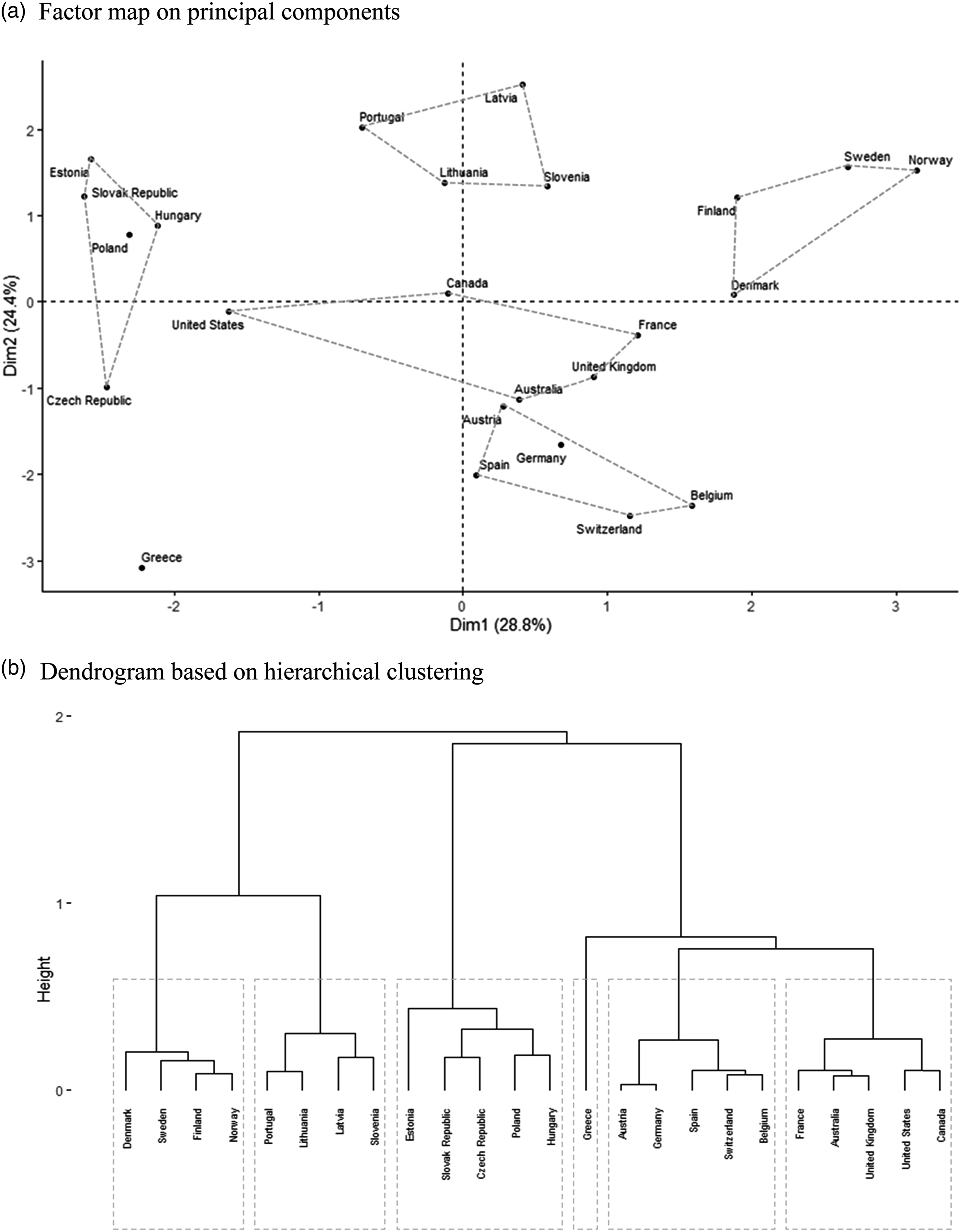
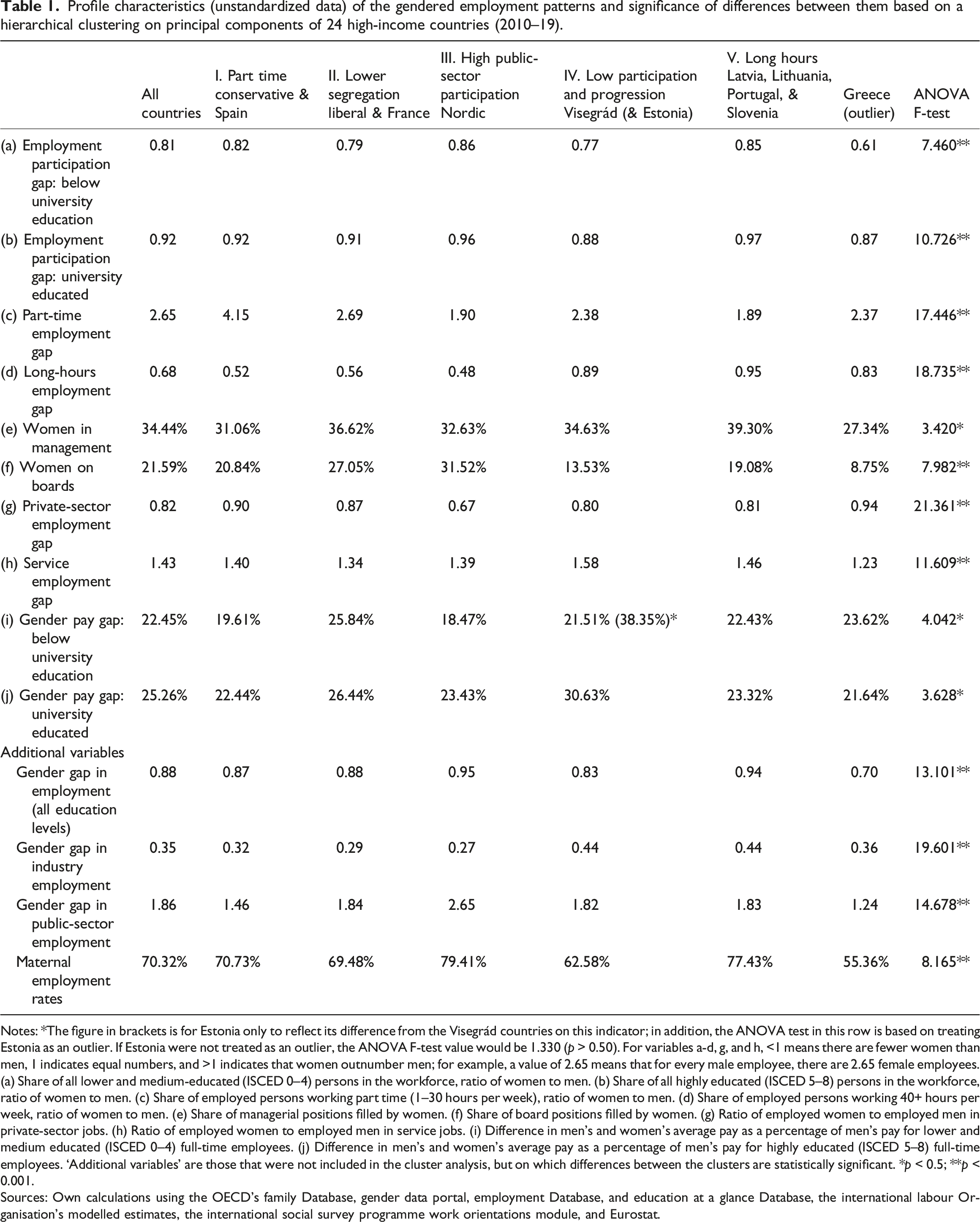
Note that wide gender employment participation gaps mark Greece out as an outlier. As prior research has shown, these gaps – which were large pre-2008 crisis and only preserved by severe austerity – persist throughout the life course. In Greece, young women face difficulties in integrating into a first job, especially low-skilled women due to a lack of labour demand. Thereafter, mothers receive little structural support to keep their jobs, while a low retirement age promotes women’s early exit from employment (Karamessini, 2013).
The first gendered employment pattern, labelled part time, contains the Continental European countries (except France) (Figure 1 and Table 1). Women’s outnumbering of men in part-time jobs by more than 4:1 may help to explain high vertical segregation in this cluster. Research indicates that part-time workers must often take jobs for which they are overqualified, since there are fewer part-time opportunities in higher-level occupations (for example, Connolly and Gregory, 2008). What is important, though, is that previous research has highlighted class distinctions in women’s experiences of part-time employment: ‘good’ part-time jobs are typically undertaken (temporarily) by middle-class professionals, whereas working-class women are more often in precarious and poorly paid part-time jobs (Stovell and Besamusca, 2022). In Germany, for instance, the odds of having a ‘mini-job’ are 80% higher for low-skilled versus high-skilled women; yet mini-jobs are associated with lower pay and social security (Pfau-Effinger and Reimer, 2019). Furthermore, for low-educated women, part-time employment is rarely a ‘steppingstone’ to full-time employment (Fagan et al., 2014). Potentially, then, this cluster is less advantageous for lower-educated than for high-skilled women.
For full-timers, gender pay gaps in the part time cluster are narrower than in most others (Table 1). Given that reduced-hours employment is widely a tool for employment–family reconciliation in Continental Europe (Matteazzi et al., 2018), it is plausible that those women who select into full-time employment are less likely to have care responsibilities and/or conform more closely with the ‘ideal’ (male) unencumbered worker norm (Acker, 1990). Mothers and women who are full-time employed in a context of high female part-time employment rates also signal strong commitment to their employer, which may underpin better career and pay rewards (Evertsson and Grunow, 2012).
Spain slots into the part time cluster, too (Figure 1), although its similarities with the Continental European countries are likely underpinned by different processes and carry different meaning. In Spain, employers have expanded part-time jobs mainly to increase labour flexibility since 2008, particularly in marginal, service-sector occupations. Indeed, research suggests that women’s concentration in part-time employment in Spain is less reflective of its use as a tool for work–family reconciliation, and more symptomatic of involuntary underemployment – especially given the low quality of part-time jobs in Spain by European standards (for example, Buddelmeyer et al., 2005).
The Anglophone countries consist of a second group labelled lower segregation. Countries in this cluster share below-average levels of gender employment segregation but are more diverse when it comes to gender gaps in participation and pay. Despite similar gaps at high education levels, the average gender employment participation gap at lower education levels is larger in the US than in Australia, Canada, and the UK. These differences may reflect lower demand for part-time employees and a relatively less generous mix of family policies and social support in the US (for example, Sayer and Gornick, 2012). Additionally, Canada and the US have larger gender pay gaps among full-time workers than Australia and the UK. Again, this may reflect more widespread part-time employment in Australia and the UK, as well as lower wage dispersion (Gornick and Jacobs, 1996). Even so, all four Anglophone countries have in common narrow class differences in gendered pay penalties, i.e., the gender pay gap varies minimally by education level.
An unexpected finding is the placement of France in this same group (Figure 1). Compared with other Continental European countries, gender gaps in employment intensity are smaller in France; yet France also has lower representation of women in services and private-sector employment. Most significantly, large gender pay gaps in France, despite lower vertical segregation, push it into the lower segregation cluster.
The Nordic countries fall into the high public-sector participation cluster (Figure 1 and Table 1). This cluster is characterized by a highly inclusive labour market (although Finland’s positioning may be unduly influenced by comparatively low male employment: for instance, the employment rate for low-skilled men was, on average, 60% over 2010–19 versus 68–73% for the other Nordic countries). However, such inclusivity is at the price of women’s reliance on the public sector for employment and underrepresentation in private-sector employment. In addition, while women in the Nordic cluster are less concentrated in part-time employment than in other clusters, the long-hours gender gap is the largest, with men around 2.5 times more likely to be employed 40 + hours per week than women (except in Sweden, where the ratio is 1.5).
Still, the Nordic group is a relatively high performer on most outcomes (Table 1). Despite evidence of a ‘glass ceiling’ effect in this group – that is, a larger gender wage gap at higher versus lower educational levels – the high-skilled gender pay gap is still smaller than in the lower segregation (Anglophone) cluster and only marginally wider than in the part time (Continental European) cluster. The high public-sector participation group also has the highest share of women on boards and a similar share of women in management as the part time cluster, even if female directors and managers in Nordic countries are possibly more concentrated in the public sector, where maximum pay is usually lower.
Finally, the eight Eastern European countries bifurcate into two distinct gendered employment clusters (Figure 1 and Table 1). The low participation and progression cluster comprises the Visegrád countries plus Estonia and is generally an all-round poor performer. By contrast, Latvia, Lithuania, and Slovenia are in the long hours group, which features high female labour force participation rates and less intense gender inequalities and segregation. As the name suggests, most (85%) employed women are in 40-hour jobs or longer (versus 90% of employed men). Although both clusters display similar gender pay gaps for lower-skilled groups, the long hours cluster has a narrower high-skilled gender pay gap. Again, though, context matters: it is plausible that part of the explanation for the long hours cluster’s better performance is the asymmetric effects of the 2008 global financial crisis on male-dominated sectors and wages, which hit this group of countries particularly hard, rather than ‘true’ equality per se (Perugini and Selezneva, 2015).
Portugal also sits in the long hours cluster (Figure 1). Its positioning here likely reflects the aforementioned cultural and policy legacies that have underpinned high female (full-time) employment in Portugal since the latter half of the twentieth century (for example, Tavora, 2012). Once more, though, these narrower gender gaps should be interpreted within their context. Low wages and limited part-time jobs create strong financial imperatives for women in Portugal to take full-time jobs, despite stark inequality in the division of labour within the home (Tavora, 2012; Table S2 in the Supplemental Material) and low job quality (for example, Esser and Olsen, 2011). What is more, although Portugal (slightly) outperforms Spain on women’s managerial representation (34% versus 31%), Portugal lags behind Spain on other measures, namely, women’s representation in board positions (13% versus 17%) and private-sector employment (0.78 versus 0.93) as well as the high-skilled gender pay gap (29% versus 17%).
Discussion
Women are disadvantaged relative to men across all employment outcomes in the 24 countries considered here. Still, the analysis has highlighted nuances across borders. By and large, the patterning of gendered employment outcomes across Nordic, Anglophone, and Continental European countries mirrors the three-fold institutional typology identified by Esping-Andersen (1990). This suggests that women’s employment outcomes are a relatively good proxy of welfare state and family policy approaches and logics in these contexts.
Against existing institutional typologies, though, this article suggests that France is more similar to Anglophone countries than to other Continental countries or Belgium when it comes to gendered employment outcomes. This result mainly reflects large gender pay gaps across the educational divide in France. Although gender pay disparities are shaped by a multitude of circumstances, one institutional feature that stands out is collective bargaining. In France, wage bargaining happens primarily at the industry and company levels and so is less centralized than in other Continental European countries, especially Belgium (for example, Berson and Jousselin, 2018). It is often argued that high-skilled women benefit from the tighter link between individual human capital endowments and pay under decentralisation, even if low-skilled women do not (for example, Soskice, 2005). Equally, though, an absence of transparent and fair systems in decentralized wage-bargaining contexts may allow for increased managerial discretion and discrimination in pay-setting under the guise of market forces; hence, even high-skilled women can face difficulties in attaining similar wages as men versus if wage determination is centralized (Rubery and Johnson, 2019). These differences may help to understand why gender pay gaps in France exceed those in Belgium among both the university educated (22% versus 16%) and below university educated (28% versus 18%), despite these two countries’ similar family policy logics.
In addition, the results indicate that institutional typologies are less instructive for understanding gendered employment outcomes across Mediterranean and Eastern European countries. While Spain is in the part time cluster with Continental European countries, Portugal’s legacy of high employment among women but limited part-time opportunities place it in the long hours group alongside Latvia, Lithuania, and Slovenia. Meanwhile, gaping employment participation gaps plus high segregation mark Greece out as an outlier. These diverse patterns likely reflect certain shared particularities of the Mediterranean context, such as low wages, high (and gendered) labour market segmentation, and traditional gender roles in the household (Tavora, 2012). Still, grouping Southern European nations together would clearly obfuscate significant differences in women’s employment, thereby weakening empirical research and theory-building. The same holds for the eight Eastern European countries analysed here, which bifurcate into a low participation and progression cluster (Visegrád plus Estonia) versus a long hours, somewhat better-performing cluster (Latvia, Lithuania, Slovenia). Mainstream comparative analyses of gender, welfare states, and employment commonly draw generalizations about the Eastern European region based on a small sample of post-Soviet countries – most often, the Visegrád states. Yet, the patterns presented here suggest this approach may mislead.
Of course, some of these differences from institutional typologies may be because certain countries have adapted their policies and experienced labour market changes since many policy typologies were devised. Still, in bringing to light marked differences in gendered employment outcomes across countries with similar institutional and cultural contexts, this study offers a framework for the comparative analysis of gender and employment that is conducive to hypothesis-testing and theory construction.
In addition to highlighting certain shortcomings of institutional typologies for analysing women’s employment outcomes, the results cast doubt on welfare state paradox arguments. Comparatively stronger scores on measures of women’s labour market inclusion do not always coincide with comparatively worse scores on other labour market outcomes, including for high-skilled women. The high public-sector participation group, comprising Nordic countries, is more inclusive with narrower pay gaps among low- and medium-educated groups than the part time cluster comprising Continental European countries; however, the former performs similarly to if not better than the latter on women’s share of managerial and board positions and high-skilled gender pay gaps. The high public-sector participation group also has narrower gender employment participation gaps than the lower segregation group, to which the Anglophone countries and France belong, while still displaying narrower gender pay gaps at tertiary education levels. True, women’s managerial representation in the high public-sector participation cluster falls behind that of the lower segregation one; even so, women’s share of board seats is higher in the former, reflecting more decisive legislation to correct for women’s historic absence from the boardroom (Kowalewska, 2021).
Gendered employment patterns across Eastern Europe cast further doubt on welfare state paradox arguments. The long hours cluster (Latvia, Lithuania, Slovenia) is more inclusive of lower-educated women and has higher representation of women in top jobs as well as narrower gender pay gaps among the high-skilled than the low participation and progression cluster (Visegrád plus Estonia). Additionally, women in the long hours group are less concentrated in services or reduced-hours employment than in the low participation and progression cluster. By illustrating how the interrelationships between the different indicators in one cluster of countries are not necessarily replicated in others, these results support calls for more studies that illuminate the context-dependence of women’s employment outcomes (Hook and Li, 2020).
The results also underline the value of separately ‘counting’ a range of dimensions and measures of gender inequality. Clearly, boiling gender equality down to labour force participation rates or another single measure or index has the potential to misrepresent a country’s performance. Relatedly, the results suggest that it does not always make sense to talk of certain countries or regime types as more or less ‘women-friendly’, since it depends on which indicator(s) of gender equality we are consulting and for whom. For instance, even in the high-participation Nordic group, women are significantly underrepresented in private-sector and long-hours positions, which may underpin their low presence in certain careers carrying high pay and influence (for example, lawyer in private practice, Chief Executive of an investment firm). This insight additionally underscores the need to always be explicit, transparent, and reflective about how we are conceptualizing and operationalizing gender inequality. Precision facilitates meaningful analysis and the accumulation of debate and knowledge-building by helping to make sure we are not reaching conflicting conclusions based simply on our different underlying research choices (Kantola and Verloo, 2018). It can also aid more targeted policymaking.
Overall, the results give a picture of pre-COVID-19 gender inequalities in employment, which can provide a reference point for research on the longer-term gendered employment impacts of the pandemic as they continue to unfurl and new data emerge. Nevertheless, cross-national data that break down employment outcomes by gender intersected with other factors are required to account for the heterogeneity of women. This is important for better understanding how employment outcomes are shaped not only by gender, but simultaneously by its intersection with other dimensions beyond those that could be explored here, such as ethnicity, migration status, and sexual orientation.
Supplemental Material
Supplemental Material - Gendered employment patterns: Women’s labour market outcomes across 24 countries
Supplemental Material for Gendered employment patterns: Women’s labour market outcomes across 24 countries by Helen Kowalewska in Journal of European Social Policy
ORCID iD
Helen Kowalewska https://orcid.org/0000-0002-7991-5371
Footnotes
Acknowledgements
The author is grateful to two anonymous referees, the journal editors, and colleagues from the Department of Social Policy and Intervention at the University of Oxford for their invaluable comments on earlier versions of this work.
Declaration of conflicting interests
The author(s) declared no potential conflicts of interest with respect to the research, authorship, and/or publication of this article.
Funding
The author(s) disclosed receipt of the following financial support for the research, authorship, and/or publication of this article: This research was supported by the Economic and Social Research Council (grant no. ES/S016058/1).
Supplemental Material
Supplementary material for this article is available online.
Notes
References
Supplementary Material
Please find the following supplemental material available below.
For Open Access articles published under a Creative Commons License, all supplemental material carries the same license as the article it is associated with.
For non-Open Access articles published, all supplemental material carries a non-exclusive license, and permission requests for re-use of supplemental material or any part of supplemental material shall be sent directly to the copyright owner as specified in the copyright notice associated with the article.
