



Abstract
This study examines how public policies affect parents’ preferences for a more egalitarian division of paid and unpaid work. Based on the assumption that individuals develop their preferences within a specific policy context, we examine how changes in three policies affect mothers’ and fathers’ work–family preferences: the availability of high-quality, affordable childcare; the right to return to a full-time job after having reduced hours to part-time and an increase in the number of ‘partner months’ in parental leave schemes. Analysing a unique probability sample of parents with young children in Germany from 2015 (N = 1756), we find that fathers would want to work slightly fewer hours if they had the right to return to a full-time position after working part-time, and mothers would want to work slightly more hours if childcare opportunities were improved. Full-time working parents, moreover, are found to prefer fewer hours independent of the policy setting, while non-employed parents would like to work at least some hours. Last but not least, our analyses show that increasing the number of partner months in the parental leave scheme considerably increases fathers’ preferences for longer and mothers’ preferences for shorter leave. Increasing the number of partner months in parental schemes hence has the greatest potential to increase gender equality.
Keywords
Introduction
Despite major progress in women’s educational attainment and labour force participation over the course of the last few decades, the gender revolution has been ‘stalled’ (Gerson, 2010; Hochschild and Machung, 2012). In the industrialized world, women earn less than men (Budig et al., 2016; Cooke, 2014; Gangl and Ziefle, 2009), are more likely to work part-time and are more likely to interrupt their employment for family reasons (Dieckhoff et al., 2016; Kreyenfeld, 2015). In consequence, they tend to have lower lifetime earnings than men and are more likely to suffer from poverty in old age (Allmendinger and von den Driesch, 2021).
One reason for these persistent labour market inequalities is women’s and men’s unequal involvement in unpaid work (for example, Treas and Drobnič, 2010). It is typically the birth of a child that exacerbates the unequal distribution of paid and unpaid work between fathers and mothers. While mothers tend to spend more time doing unpaid and less time doing paid work, having children does not seem to substantially alter men’s time in either paid or unpaid work (Kühhirt, 2012; Schober, 2011). Even though the pursuit of care work can be a hindrance for professional advancement, it also brings ‘positive emotional and relational rewards’ (Lewis and Giullari, 2005; see also, Laruffa, 2019). It is, therefore, not surprising that men today increasingly want to be more involved in family life (Abendroth and Pausch, 2018; Bernhardt et al., 2016, for Germany; Pedulla and Thebaud, 2015, for the United States).
While abundant literature has shown that gender inequalities vary with the existence of work–family policies (for example, Boeckmann et al., 2014; Gornick and Meyers, 2009; Steiber and Haas, 2012), research so far has struggled to establish a causal link between work–family policies and the division of labour within couples. Cross-national studies have been unable to identify the explanatory power of specific policies, since policies tend to coincide with other country characteristics. Even with longitudinal data, it is difficult to establish a causal effect of work–family policies on parents’ division of labour as policies may either induce or respond to changes in couples’ behaviours (Blome, 2017).
To examine the causal effect of work–family policies on gender equality in paid and unpaid work, we implemented three vignettes with different policy scenarios in a nationally representative survey of different-sex couples with young children in Germany conducted in 2015. Respondents were asked about their ideal working hours and division of parental leave before and after being presented with three hypothetical policy scenarios. In the first scenario, affordable and high-quality childcare was available; in the second, there was a guaranteed right to return to full-time employment after a period of working part-time and in the third, the number of ‘partner months’ 1 in the parental leave scheme was increased. These three policies were proposed by Gornick and Meyers (2009) to effectively support dual-earner/dual-carer models that provide both mothers and fathers with ‘realistic opportunities to combine waged work with the direct provision of care for their children’.
Drawing on Sen’s capabilities framework (Sen, 1985, 1999), which postulates that ‘true’ preferences can only develop in the absence of constraints in material resources, policies and cultural norms, we examine the degree to which the policy context affects how parents want to divide paid and unpaid work. Preferences play a key role in initiating behavioural changes (for example, Fishbein and Ajzen, 2011). Cross-country comparative research, moreover, indicates that policies supporting working parents are positively associated with parents’ actual as well as preferred working hours (see for instance, Pollmann-Schult, 2016; Boeckmann et al., 2014 on the provision of public childcare). For policymakers, it is of paramount importance to know whether and how potential changes in the policy context would affect parents’ work–family preferences.
Persistent gender inequalities in the division of paid and unpaid work
Numerous studies have shown that the division of paid and unpaid work in couples becomes more unequal after the birth of a child (for example, Kühhirt, 2012; Schober, 2011). Women with children not only pursue paid employment at a lower rate than childless women but also work fewer hours (for example, Boeckmann et al., 2014). Men, by contrast, tend to make few changes in their working hours after the birth of a child (Bünning and Pollmann-Schult, 2016; Smith-Koslowski, 2011). Moreover, fathers are still less likely than mothers to take parental leave, and, when they do, they interrupt their paid employment for much shorter periods of time (O’Brien, 2009).
The unequal involvement of mothers and fathers in paid and unpaid work does not necessarily correspond to men’s and women’s preferences, however. In fact, large proportions of the workforce report a mismatch between their preferred and actual working hours. Those who work long hours (mostly fathers, but also mothers employed full-time) would prefer to work fewer hours, whereas those who do not work at all or only work part-time (predominantly mothers) would prefer to increase their working hours (Clarkberg and Moen, 2001; Reynolds, 2005, for the United States).
A capabilities approach to work–family preferences
According to Sen’s capabilities approach, societal welfare can only be achieved when one has ‘substantive freedom to choose the life one has reason to value’ (1999). The approach remains neutral with respect to what people value; both paid and unpaid work, for instance, are equally relevant and desirable components of a flourishing life. The capabilities approach, moreover, conceptualizes people’s preferences not as exogenously given but as shaped by individual-level resources and contextual characteristics. The boundedness and the context-specificity of preferences hence generate inequalities in the degree to which individuals may fully develop their capabilities.
Individuals’ work–family preferences, for instance, are shaped by characteristics of their family and household, the policy context and the normative cultural setting (Hobson, 2011; 2014; Hobson and Fahlén, 2009a; 2009b; see also Gornick and Meyers, 2009: 48, who argue that ‘women’s intrinsic preferences cannot be identified until gendered expectations and institutional constraints erode’). Mothers’ and fathers’ preferences for both family time and working time are therefore constrained by what they perceive to be possible within the status quo. For instance, a father’s preferences regarding parental leave and working hours may be contingent on the couple’s financial resources. A mother’s preferences may be constrained if she feels responsible for performing the majority of unpaid work at home and if the couple lacks adequate childcare. Policy reforms that seek to increase parents’ capabilities may therefore also decrease variation in the structure of preferences by gender and social class.
Policies and parents’ work–family preferences
Work–family policies shape individuals’ preferences both directly, through material opportunities, and indirectly, through the cultural scripts embedded within them (Hobson and Fahlén, 2009a; Hobson, 2014). They affect parents’ cost–benefit analyses of how much time to devote to paid and unpaid work. Policies also shape normative beliefs about how work and family responsibilities ought to be divided and signal which behaviours are socially desirable for mothers and fathers.
Regarding the question of how parents divide paid and unpaid work and how they would prefer to divide it, three types of policies seem to be particularly relevant. First, the availability of high-quality, affordable childcare matters for parents’ working time capabilities. Childcare needs are one reason why parents, in particular mothers, work part-time or not at all (for example, see Steiber and Haas, 2012). The availability of high-quality, affordable childcare makes the pursuit of paid work by both parents more attractive since the financial gains from paid employment are not offset either by childcare costs or by concerns about child well-being. This is likely to be particularly relevant for families in need of additional income. Moreover, the availability of childcare signals that it is socially acceptable to have children looked after outside the home.
Second, working time regulations also affect both parents’ working time capabilities. Even if parents want to spend more time with their families, they may not be able to reduce their hours for financial reasons or because they fear ending up in a dead-end job. These reasonable concerns may not only discourage parents from reducing their working hours from full-time to part-time but may even stop parents from expressing the desire to work less. Providing workers with the legal right to return to a full-time job after having reduced their working hours increases the legitimacy of part-time work and makes part-time work no longer an irreversible economic risk. Such policies signal that it is ‘normal’ to work reduced hours in certain periods of life and that choosing to work part-time does not mean giving up on your career. However, this type of policy might mainly benefit families that can afford a loss of income due to a reduction in working hours.
A third important policy factor for parents’ (preferred) division of labour is the design of parental leave schemes. Parental leave schemes differ, for instance, with regard to whether the second parent is entitled to a certain amount of leave that cannot be transferred to the first parent (O’Brien, 2009). Increasing the number of such ‘partner months’ in paid parental leave schemes gives parents economic incentives to share leave more equally. It is mainly fathers who are the main breadwinners in their families who have been found to only take the amount of leave that would otherwise be lost (if any) as they cannot afford to take longer periods of leave (Geisler and Kreyenfeld, 2018). Furthermore, increasing the number of partner months sends a normative signal that it is socially acceptable for fathers to take parental leave and that children need care from both of their parents (Brandth and Kvande, 2009).
The German context
Germany has long been characterized as a conservative welfare state with a strong adherence to the male breadwinner model (for example, Blome, 2017). Despite the country’s legacy of conservative family values (for example, Charles and Cech, 2010), however, public opinion and public policies in Germany have become increasingly supportive of dual-earner arrangements (Blome 2017; Charles and Cech, 2010). Due to government investments in early-age childcare, the percentage of one- to two-year-olds in childcare increased from 10% in 2006 to more than 30% by 2015 (BMFSFJ, 2016). Yet there is wide regional variation in childcare availability, costs and quality (Schober and Spiess, 2015). Moreover, employees in organizations with 15 or more employees have the legal right to work part-time if there are no major organizational objections (BMAS, 2016). At the time of our survey, employees did not have the right to return to a full-time position later on and often became trapped in the part-time track (Kelle et al., 2017). The parental leave scheme grants parents earnings-related parental leave benefits (€300 to €1800 per month) for up to 14 months. Two of these 14 months are only paid if the second parent – typically the father – takes at least 2 months of leave. In addition, parents can take up to 24 months of unpaid leave (BMFSFJ, 2014).
Currently, mothers in Germany with children under the age of six have an almost 30 percentage point lower employment rate than fathers (65% versus 92%, Statistisches Bundesamt, 2017), with even larger differences in full-time employment rates (25% versus 94%, Hipp et al., 2017). Whereas 96% of the mothers of children born in 2014 took paid leave with an average duration of almost 12 months, only 34% of the fathers took paid leave, and out of these, almost 80% limited their paid parental leave period to the two partner months (Statistisches Bundesamt, 2016). 2
Research question and empirical predictions
The stark discrepancy between mothers’ and fathers’ uptake of parental leave and part-time work raises the question of what parents’ work–family preferences would look like under the condition of a changed policy setting. Would an increase in affordable and high-quality childcare pull more non-working or part-time working parents, particularly mothers, into (full-time) employment? Would the legal right to return to a full-time job after a temporary reduction of working hours help fathers – as well as full-time working mothers – to reduce their working hours during the child-rearing years? Would fathers be more likely to take more parental leave if there were more than two partner months available?
Based on the theoretical considerations of the capabilities framework and the empirical findings from previous research on work–family policies, we test whether mothers and fathers would prefer a more equal division of paid work and parental leave if public policies aimed at more equality. Given the gendered division of labour in Germany, we test whether the overall effect of the different policy scenarios varies between mothers and fathers. As gender tends to be confounded with working hours, we distinguish between couples’ working arrangements rather than between men and women in our hypotheses. We do so to account for the fact that the preferences of fathers working part-time, for example, are more likely to resemble those of mothers working part-time than of fathers working full-time. Hypothesis 1. Parents who work part-time or who are currently not in paid employment would prefer to work more hours if affordable and high-quality childcare were available. Hypothesis 2. Parents who work full-time (or more than full-time) would prefer to work fewer hours if they had the right to return to a full-time job after temporarily reducing their working hours. Hypothesis 3. Parents who took 12 months or more of parental leave would want to take shorter leave if the number of partner months were increased. Hypothesis 4. Parents who took two months of parental leave or less would want to take longer leave if the number of partner months were increased.
According to the capabilities framework, individual preferences and choices are also shaped by the availability of resources (Hobson, 2011). We therefore expect all of the hypothesized effects to vary by social class and within-couple earning differences. In particular, we expect affordable childcare to matter most for couples with limited financial resources, whereas a right to return to full-time employment helps only those parents who can afford to reduce their working hours. Two additional partner months should be most relevant for those mothers and fathers who out-earn their partners, as they may leave the shared months to their partner for financial reasons.
Data and methods
Data and sample
To test these hypotheses, we draw on original survey data from a nationally representative sample of 878 different-sex couples in Germany (N = 1756) who live together with at least one child under the age of 13 in the same household, and with at least one of the two partners in paid employment. The data were collected in separate telephone interviews with both partners in 2015 as an add-on to the German AID:A II survey (‘Growing Up in Germany’). In order to analyse couples with ‘atypical’ employment constellations, we oversampled, for instance, couples in which the fathers were employed part-time or were not employed at that time (see Bernhardt et al., 2016, for further details). 3
All of the respondents, including those who were not employed at the time of the interview, were asked what they considered the ideal number of working hours for themselves and their partner as well as the ideal length of parental leave. Towards the end of the survey, all respondents were given information about three policy reforms. After hearing about each policy scenario, the respondents were asked again about their ideal working hours and ideal length of parental leave if the respective policy were in place. By asking the respondents to state their ideal working hours for themselves as well as their partner, we ensured that respondents’ working hour preferences were not constrained by their partners’ current working hours. The policy reforms in the three vignettes were: first, the provision of high-quality, affordable childcare for children of all ages: second, the right to return to a full-time job after having worked reduced hours and third, an increased number of partner months from the current two to a total of four months within the existing parental leave scheme. 4 This approach allows us to assess whether the proposed policies enhance parents’ capabilities and whether they reduce the extent to which preferences are structured by gender and class.
Variables
The dependent variables used in this study are as follows: (a) the ideal weekly working hours, which are operationalized as a continuous variable, and (b) the ideal duration of parental leave, which is operationalized into three categories: 0–2 months, 3–11 months and 12 or more months of leave. These categories distinguish the predominant leave-taking behaviours of mothers (12 or more months) and fathers (2 months maximum) from a more gender-egalitarian middle category (3–11 months). Both variables are measured under the status quo and under the policy scenario.
The main independent variables in the analysis of ideal working hours are dummy variables for the availability of high-quality and affordable childcare for all children (‘1’ yes, ‘0’ current situation) and the right to return to a full-time job after a period of part-time employment (‘1’ yes, ‘0’ current situation). The main independent variable concerning the ideal duration of parental leave is a dummy variable for the extension of partner months within the current parental leave scheme (‘1’ 4 months, ‘0’ current situation).
The analyses of parents’ ideal working hours include both their own and their partners’ employment category (distinguishing between being not employed, working part-time (<35 hours/week), regular full-time (35–45 hours/week) and long full-time (more than 45 hours/week)). The analyses of parents’ ideal duration of parental leave include respondents’ and their partners’ length of leave taken. Since the uptake of parental leave is highly gendered, that is, the large majority of mothers take 12 or more months of leave and the large majority of fathers take two months of leave or less, we distinguish between fathers who took up to two months of leave versus three months or more and between mothers who took up to 11 months of leave versus 12 months or more. To approximate social class, we distinguish four educational levels: couples in which neither partner holds a tertiary degree, only the male partner holds a tertiary degree, only the female partner holds a tertiary degree and both partners hold a tertiary degree (see Geisler and Kreyenfeld, 2018). In addition, we included the following covariates in all models: age (continuous), marital status (dummy), number of children (categorical), age of the youngest child (continuous), self-employment/currently in education (dummy), place of residence (dummy: East versus West Germany) and a measure of gender role attitudes (factor score of two items). Supplementary Table A1 in the Appendix provides an overview of all study variables.
The analytic sample for the respondents’ working hours includes all respondents with non-missing information on the dependent and independent variables (N = 863). Regarding the ideal duration of parental leave, we had to restrict the sample to couples whose youngest child was born after the parental leave reform of 2007 (N = 575).
Analytical strategy
We used OLS regression to assess the policy effects on working hour preferences and multinomial logistic regression to assess the policy effect on parental leave duration. We performed separate analyses for mothers and fathers and estimated two models per policy reform. In the first model, we estimated the main effect of each policy reform. In the second model, we interacted each policy reform with parents’ employment category/parental leave use and parents’ educational levels. We used sampling weights to take the sample stratification into account and cluster-robust standard errors to account for the clustering of our observations (preferences under the status quo and preferences in the described policy scenario are nested within respondents).
Results
Weighted descriptive statistics of parents’ actual and preferred working hours and leave durations.
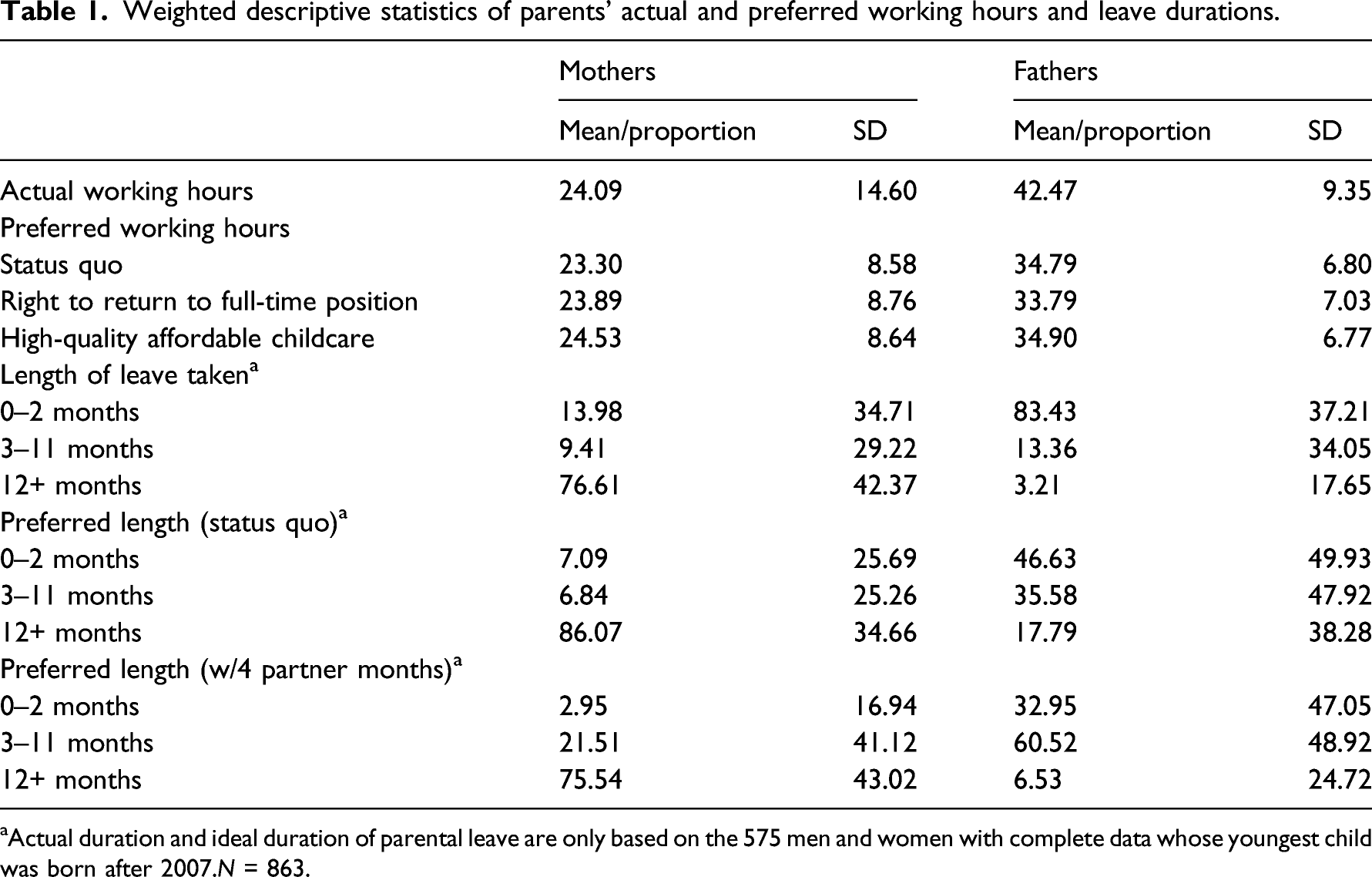
aActual duration and ideal duration of parental leave are only based on the 575 men and women with complete data whose youngest child was born after 2007.N = 863.
Table 1, moreover, shows parents’ working time and parental leave preferences under the conditions of the three policy changes. While there were only slight differences in both mothers’ and fathers’ working hour preferences under the condition of affordable, high-quality childcare and a guaranteed right to return to a full-time job after having worked reduced hours, parents’ preferences for the length of leave varied considerably between the status quo and the scenario with four partner months. The proportion of mothers who would ideally take 3–11 months of leave in the context of such a policy was 15 percentage points higher (22% versus 7%), and the proportion of fathers was almost 30 percentage points higher (61% versus 36%). Supplementary Table A2 and Supplementary Table A3 in the Appendix additionally show descriptive statistics by level of education.
We now turn to the results of the multivariable analyses. We present our main results graphically and provide the full models in Supplementary Table A3–Supplementary Table A5 in the Appendix. Figure 1 displays the predicted working hour preferences of parents under the status quo and their predicted preferences under the condition of high-quality, affordable childcare (the first two rows) and under the condition of a right to return to full-time employment after having worked part-time (the third and fourth row). The first plot on the left in each row presents the average preferences (predicted means and 95% confidence intervals), while the following plots differentiate by the respondents’ current employment category. In each plot, the left-hand bar displays the working hour preferences under the status quo, and the right-hand bar shows the preferences under the respective policy scenario. The horizontal line indicates the actual working hours. Parents’ ideal working hours under the status quo; under the condition of high-quality, affordable childcare and under a right to return to a full-time job after having worked reduced hours. Note: The predicted ideal working hours presented above (marginal effects and 95% confidence intervals) are based on OLS regressions, accounting for each respondent’s own and their partner’s employment category, their own and their partner’s level of education, self-employment/current enrolment in education, age, marital status, number of children, age of the youngest child, gender role attitudes and region. N = 863.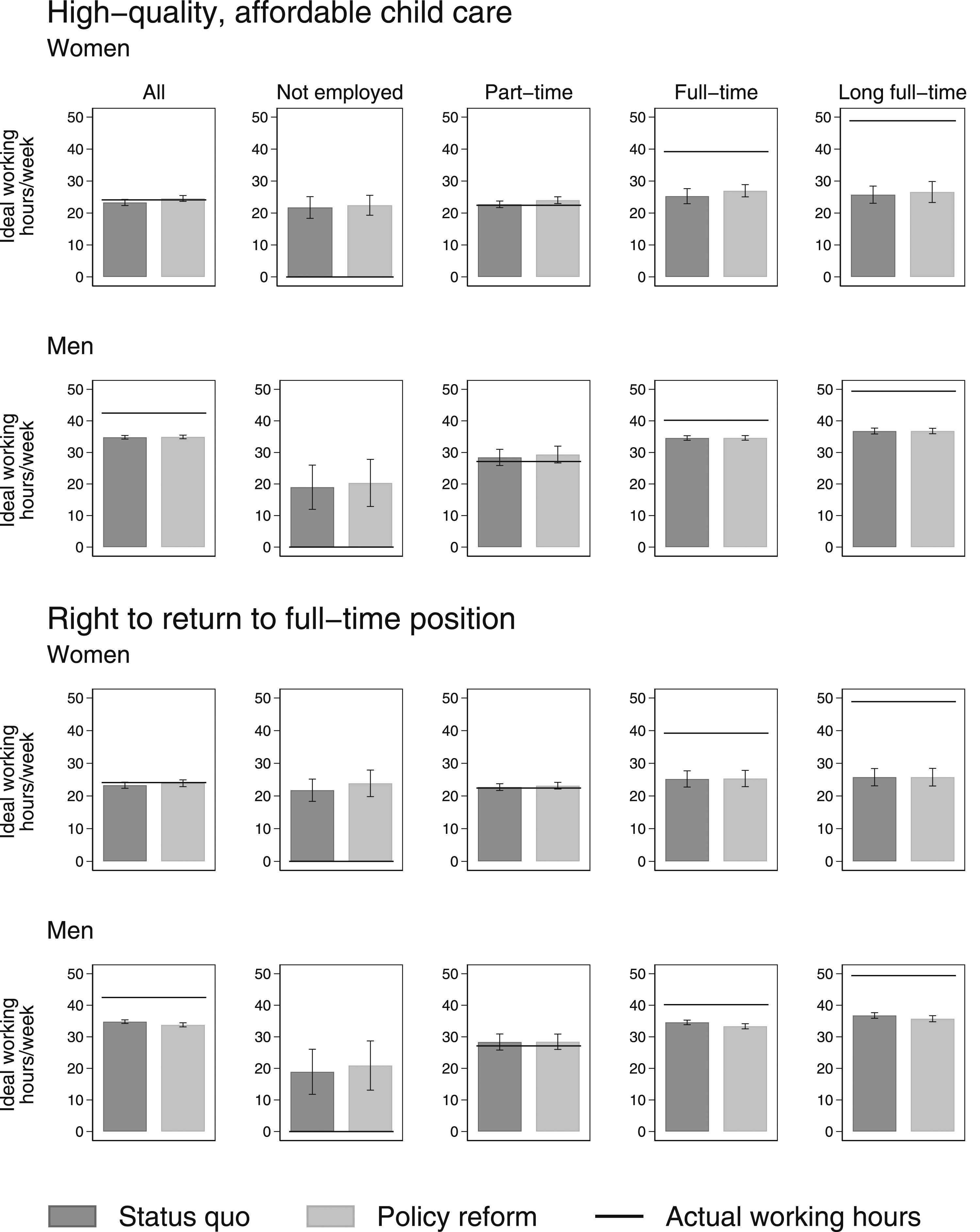
The upper left plot shows that mothers of young children in Germany would currently like to work 23 h per week on average, which is slightly less than they actually do (24.8 h). However, if better childcare was available, their average preferred working hours would increase by 1.3 h per week compared to their current working hour preferences. This difference, albeit small, is statistically significant, and the magnitude of the effect is similar across all employment categories (plots to the right). Note also that women’s preferred working hours varied much less across employment categories than their actual working hours. Additional analyses (Supplementary Figure A1 in the Appendix), moreover, show that the increase in preferred working hours was largest among mothers in couples where neither partner holds a tertiary degree. This may indicate that the financial gains from working longer hours are particularly valuable for these couples.
Meanwhile, fathers would like to work 35 h per week on average, which is considerably below their actual average working hours (42.5 h). This would not change if high-quality, affordable childcare was available and holds irrespective of the fathers’ current employment category (the second row in Figure 1) and the two partners’ educational levels (Supplementary Figure A1 in the Appendix). In sum, we found no support for Hypothesis 1 for fathers and only partial support for mothers. Moreover, we found that even in the absence of policy changes, full-time employed mothers and fathers would like to work considerably less than they actually do, whereas non-employed mothers and fathers would like to work 20 hours per week on average.
Next, we turn to the effects of a guaranteed right to return to a full-time job after having worked reduced hours. The third row in Figure 1 shows that mothers would not adapt their working hour preferences in light of this policy reform, irrespective of their current employment category and the two partners’ educational levels (Supplementary Figure A1 in the Appendix). We, hence, find no support for Hypothesis 2. Already in the current context, mothers who work regular full-time or long full-time (45+ hours/week) expressed a preference for working part-time, that is, 25 hours on average. Mothers seem to have a strong preference for working less than full-time, independent of the policy context.
Fathers would prefer to work one hour less on average (that is, only 34 hours per week) if they had a guaranteed right to return to a full-time position compared to their preferred working hours without such a guarantee (fourth row in Figure 1). This difference is small but statistically significant. When distinguishing fathers by employment category, we found that only fathers who work full-time would change their working hour preferences in light of the proposed policy reform. Fathers who work regular full-time would like to work 1.2 hours less on average, and fathers with long full-time would want to work one hour less if the policy reform came into place. As expected, fathers in part-time employment or non-employed fathers would not alter their working hour preferences. While these results support Hypothesis 2 for fathers, the effect of the policy is small in substantive terms. When comparing couples with different educational levels, we found that particularly those fathers whose partner holds a tertiary degree would adapt their preferences (Supplementary Figure A1 in the Appendix). This may indicate that when mothers have the potential to earn a high income, this may increase the capabilities of fathers to consider working fewer hours.
The results for parental leave preferences are displayed in Figure 2. The first row displays mothers’ preferences, the second row fathers’ preferences. The left-hand bar in each plot displays the desired length of leave under the status quo, and the right-hand bar displays the desired length of leave if the partner months were increased from the currently available two to four months. The horizontal line indicates the actual length of leave taken (unadjusted for any covariates). Under the current parental leave system, the vast majority of mothers (86%) would prefer to take at least 12 months of leave (and 76% actually did). Around 7% would consider taking 3–11 months and 8% regard less than 3 months as ideal. If the partner months were increased from two to four, only 75% of mothers would still prefer to take 12 or more months of leave, whereas the proportion of mothers who consider 3–11 months of leave as ideal would triple to 21%. Distinguishing between mothers who took less than 12 months of leave for their youngest child and those who took 12 months or more reveals that both groups were more likely to prefer 3–11 months of leave under the proposed policy change compared to the current situation (Supplementary Figure A2 in the Appendix). We hence find support for Hypothesis 3. Parents’ ideal parental leave duration under the status quo and under the condition of four partner months. Note: The average marginal effects presented above are based on multinomial regressions, accounting for each respondent’s own and their partner’s actual parental leave use for their youngest child, their own and their partner’s level of education, self-employment/current enrolment in education, age, marital status, number of children, age of the youngest child, gender role attitudes and region. N = 575.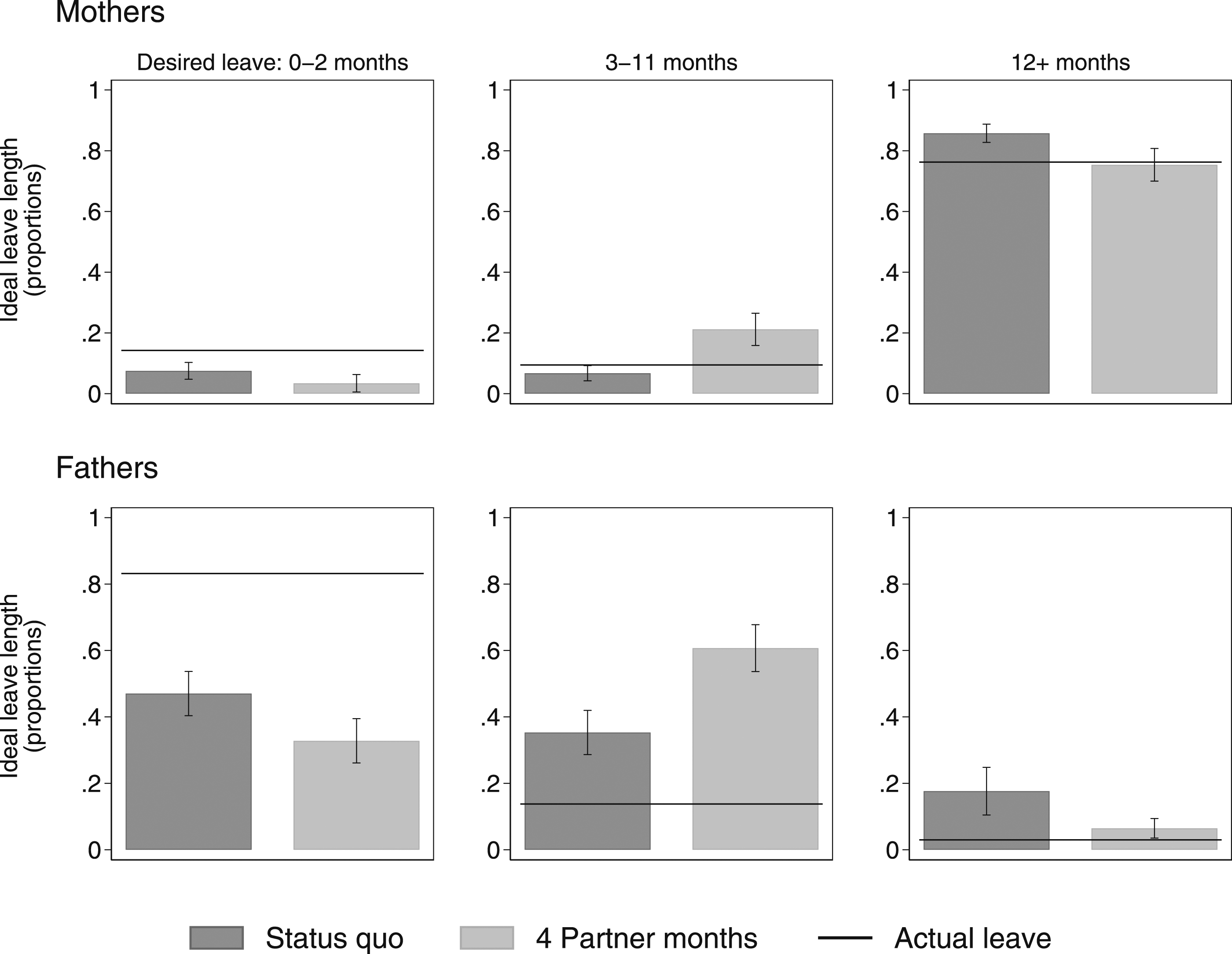
Among fathers, almost half (47%) preferred two months or less of parental leave under the current legislation (and 84% actually took two months of leave or less). One-third considered 3–11 months ideal and one-sixth preferred 12 or more months of leave. If the number of partner months were increased from two to four, only one-third of fathers would prefer to take less than three months of leave. By contrast, the proportion of those who would consider 3–11 months ideal would almost double to 61%. As predicted by Hypothesis 4, these patterns are driven by the fathers who had taken less than three months of leave for their youngest child (Supplementary Figure A2 in the Appendix).
Under the increased partner month scenario, mothers’ and fathers’ preferences for 3–11 months of leave increased across all educational levels (Supplementary Figure A3 and Supplementary Figure A4 in the Appendix). Looking at fathers, changes in preferences were most pronounced among those who had a tertiary degree but whose partner did not and least pronounced when only the mother had a tertiary degree. These results, hence, extend Geisler and Kreyenfeld’s (2018) finding that fathers with higher education than their partners are most responsive to parental leave reforms that reduce their responsibilities as the main breadwinner.
Given that the category of 3–11 months is rather broad, we also conducted a sensitivity analysis dividing this group in two (3–6 months and 7–11 months). Among fathers, only preferences for 3–6 months of leave increased if the partner months were increased, whereas the proportion of fathers who considered 7–11 months of leave to be ideal did not change. Among mothers, preferences for both 3–6 months of leave and 7–11 months of leave increased (Supplementary Figure A5 in the Appendix).
Discussion and conclusion
In our study, we used Sen’s capabilities framework to examine how public policies shape parents’ work–family preferences. Psychological research has shown that preferences are an important precondition for initiating behavioural change (Fishbein and Ajzen, 2011). Meanwhile, research in the capabilities tradition has shown that individuals’ preferences are context-dependent (Hobson, 2011; Hobson and Fahlén, 2009a, 2009b). Our study built on these two streams of literature and assessed the effects of changes in the policy context on parents’ work–family preferences. In particular, we examined how the availability of high-quality, affordable childcare, a right to return to a full-time job after having worked part-time and an increase in the number of partner months in parental leave schemes affect mothers’ and fathers’ preferred working hours and preferred duration of parental leave.
In our study, we analysed the effects of different policy vignettes that were implemented in a national probability survey of coupled parents with young children in Germany. We asked the same individuals about their preferences under the status quo and under different policy scenarios. This approach made it possible to isolate the policy effect and to estimate the impact of new policy proposals that have not been implemented yet. While causal effects can also be assessed by quasi-experiments, they cannot be identified by comparing policies in cross-sectional studies. However, neither of these designs can assess the potential outcomes of policies that are not yet in place. Even though we cannot be entirely sure that people would indeed act according to their preferences after policy reforms were enacted, the analyses of policy effects on preferences are highly useful for identifying which policy alternatives have the greatest potential to achieve desired outcomes.
The main findings of our study can be summarized as follows: both mothers and fathers develop preferences for a more egalitarian division of labour if the policy context is supportive – even if they do not prefer a completely equal division of paid and unpaid work. In particular, we found that increasing the number of partner months in parental leave schemes has the potential to foster greater gender equality. If four instead of two partner months were available, twice as many fathers and three times as many mothers would prefer a more egalitarian division of parental leave than in the current situation. Three-quarters of mothers, however, would still prefer 12 or more months of leave, and fathers would only prefer up to six months of leave. This is in line with previous research, which showed that mothers usually take all the paid leave available to them and often also some unpaid leave, whereas fathers tend to only take the paid leave specifically reserved for them and that would be lost if they did not take it (O'Brien, 2009; Hegewisch and Gornick, 2011).
Moreover, we found that mothers (but not fathers) would want to work slightly more hours if high-quality, affordable childcare were available, which is in line with findings from previous cross-national research (Boeckmann et al., 2014; Bünning and Pollmann-Schult, 2016; Pollmann-Schult, 2016). Given similar results, our study hence lends credibility to the findings of cross-sectional studies on the role of policies for parents’ division of labour. Our analyses also show that fathers (but not mothers) would prefer to work slightly less if they had the right to return to full-time employment after a period of part-time work. Another important finding of our study was that parents who work full-time prefer shorter hours, and non-employed parents prefer to work at least some hours independent of the policy setting. The lack of a possibility to pursue paid work is thus seen by non-employed people as a greater impediment than unsupportive work–family policies.
Overall, our results support Gornick’s and Meyers’ (2009) claim that these three policies improve gender equality in paid and unpaid work, but we also find that considerable gender gaps in preferences would remain even if such policies existed. Hence, instead of fully eliminating gender differences, they might just attenuate them; analyses of motherhood wage penalties, for instance, came to similar conclusions (for example, Budig et al., 2016, who found that motherhood wage penalties were lower in countries that provide publicly funded childcare, leaves of moderate length for mothers, and that support paternal involvement after childbirth). Even under the condition of a more favourable policy context, two-parent families with young children in Germany do not, on average, exhibit an explicit preference for a gender-equal division of paid and unpaid work.
We therefore also examined variations among groups of parents. The capabilities framework posits that in addition to policies, household resources and societal norms shape individuals’ preferences. Regarding household resources, our results show that it was primarily fathers whose partners were highly educated who considered reducing their working hours under the right to return to full-time employment. By contrast, the fathers who were more highly educated than their partners were most responsive to an increase in partner months, which increases the financial incentives to share parental leave more equally. An increase in working hours under the condition of high-quality, affordable childcare, by contrast, was primarily considered by mothers in the couples in which neither partner had a tertiary degree, that is, presumably low-income couples. Financial constraints may thus be one restriction that prevents policies from unfolding their positive effects and that explain the relatively small effect size of policies guaranteeing a right to return to a full-time job on fathers’ preferred working hours (see also Van Breeschoten et al., 2018, for a similar finding). While two-thirds of foregone income is replaced during parental leave, there is no wage replacement for those working part-time. This may limit fathers’ desire to work reduced hours even if they had the right to return to full-time employment.
While it may very well be that these minor effects reflect parents’ ‘true’ preferences, it may also be that societal norms and traditions – and hence informal, normative barriers – are responsible for the small effect sizes we found for parents’ working hour preferences. Policies only achieve their intended effects if they are accompanied by changes in what is perceived to be normal and legitimate within a society.
Policy changes have the potential to change social norms and cultural expectations, however. Hence, although we did not find substantial policy effects, this does not necessarily mean that the policy scenarios outlined above are ineffective. Implementing the outlined policy changes may potentially change social norms by signalling how work and family responsibilities ought to be divided, and what behaviours are socially desirable for mothers and fathers. The changes in norms, however, take time and cannot be manipulated realistically through study design.
There are several policy implications that arise from our study. First of all, both partners working full-time is not something that parents with young children in Germany consider to be desirable in general. Second, to benefit parents across different income and educational strata, work–family policies should take into account the amount of financial resources that parents need to be able to work reduced hours and take (longer) parental leave. Third, the finding that fathers tended to be more responsive to changes in the policy context than mothers suggests that work–family policies should take the family context into account. Men may feel restricted with regard to what their ‘desirable working hours’ can be as they are often responsible for the family income. Women, in turn, may feel restricted in their ‘real’ working hour preferences as they are primarily responsible for childcare. Working longer hours – even in the presence of high-quality, affordable childcare – may not be a viable alternative for many women as long as their partners work full-time or even more than full-time. When seeking to enable parents to realize their working hour preferences, it is hence important for policies to address both partners (also see the discussion on ‘Familienzeit’ (‘family time’) in Germany, Müller et al., 2013). Last but not least, it is important to note that policies only achieve their aims if societal norms change as well. The fact that the number of fathers in Germany who take parental leave is constantly rising, years after the partner months were introduced in 2007, is one indication that such a cultural change is indeed a precondition for policies to be effective. Policymakers should therefore bear in mind that the positive effects of such policies may take time to emerge, and that their effectiveness is contingent on ‘soft’ factors, such as workplace culture and gender norms.
Supplemental Material
sj-pdf-1-esp-10.1177_09589287211035701 – Supplemental Material for How can we become more equal? Public policies and parents’ work–family preferences in Germany
Supplemental Material, sj-pdf-1-esp-10.1177_09589287211035701 for How can we become more equal? Public policies and parents’ work–family preferences in Germany by Mareike Bünning and Lena Hipp in Journal of European Social Policy
Footnotes
Declaration of conflicting interests
The author(s) declared no potential conflicts of interest with respect to the research, authorship, and/or publication of this article.
Funding
The author(s) disclosed receipt of the following financial support for the research, authorship, and/or publication of this article: Lena Hipp, WZB Berlin Social Science Center, Reichpietschufer 50, DE-10785 Germany

Notes
References
Supplementary Material
Please find the following supplemental material available below.
For Open Access articles published under a Creative Commons License, all supplemental material carries the same license as the article it is associated with.
For non-Open Access articles published, all supplemental material carries a non-exclusive license, and permission requests for re-use of supplemental material or any part of supplemental material shall be sent directly to the copyright owner as specified in the copyright notice associated with the article.
