




Abstract
In the context of large-scale migration within and into Europe, the question of whether and under which conditions immigrants should be granted access to social benefits in the country of destination is of high political relevance. A large body of research has studied natives’ attitudes towards giving immigrants access to the welfare state, while research on attitudes of immigrants themselves is scarce. Focusing on the impact of self-interest, we compare immigrants and native citizens in their attitudes towards granting immigrants access to the welfare state. We identify three mechanisms through which self-interest can influence these attitudes: immigrant origin, socio-economic status and – for first-generation immigrants only – incorporation into the host society. We test our expectations using cross-national data from the European Social Survey round 2008. The findings suggest that self-interest is indeed one of the factors that motivate attitudes towards welfare state restrictiveness among natives and immigrants, but also point at relevant exceptions to this pattern.
Keywords
Introduction
Immigration has become an increasingly politicized topic that figures prominently in public debates across Europe. Especially the question of whether and under which conditions immigrants should be granted access to social benefits in the country of destination is of high political relevance (Römer, 2017). Extant research has presented explanations and empirical findings of what natives 1 think about whether and under which conditions immigrants should be granted access to social benefits (see, for instance, Kootstra, 2016; Mau and Burkhardt, 2009; Reeskens and Van Oorschot, 2012; Van der Waal et al., 2013). However, little is known about the opinion of immigrants themselves.
While some contributions have assessed immigrants’ attitudes towards the welfare state more broadly (Reeskens and Van Oorschot, 2015; Schmidt-Catran and Careja, 2017; Seibel and Hedegaard, 2017), the work by Kolbe and Crepaz (2016) is – to our knowledge – the only one that studied what immigrants think themselves about whether and under which conditions (other) immigrants should be granted access to social benefits. Their findings show that acquiring citizenship has a strong impact on individual restrictiveness. In other words, immigrants who have acquired citizenship in the country of destination hold more restrictive attitudes than those who are not (yet) citizens of the country of destination. The authors’ explanation for the effect of citizenship is partially legal and partially a question of collective identity. In legal terms, immigrants obtain more rights by acquiring citizenship and in psychological terms, they are expected to identify more with the values of the country of destination.
While Kolbe and Crepaz (2016) rightfully highlight the importance of citizenship, we argue in this article that self-interest also matters and analyse different mechanisms through which self-interest affects immigrants’ preferred welfare state restrictiveness. Self-interest is an important predictor of support for the welfare state (Andreß and Heien, 2001; Busemeyer and Neimanns, 2017; Jaeger, 2006; Svallfors, 2012; Van Oorschot, 2006), especially when citizens are personally affected by policy changes (Chong et al., 2001). According to Reeskens and Van Oorschot (2015), self-interest also structures immigrants’ attitudes towards redistribution. We expect this association between self-interest and attitudes to become even stronger when it comes to limiting welfare state access to natives, since immigrants are directly affected by such restrictions. Theoretically, we therefore expect self-interest to partially shape their opinion about welfare state access of immigrants.
It is not clear, however, how exactly self-interest operates in influencing support for welfare state restrictiveness. Following the suggestion of Gerber et al. (2017) to broaden the understanding and operationalizations of self-interest, we propose three different ways in which self-interest can influence support for welfare state restrictiveness: immigrant status, socio-economic status and immigrants’ incorporation into the host society.
We test our hypotheses in an analysis of cross-national survey data from the European Social Survey (ESS 2008). This survey allows us to differentiate between natives, first- and second-generation immigrants and to study various mechanisms through which self-interest can influence support for granting immigrants access to the welfare state. While not all of our hypotheses are supported, the results suggest that the attitudes of natives as well as immigrants towards giving immigrants access to the welfare state are indeed partially driven by self-interest.
The article is structured as follows. We first develop our theoretical framework by examining how self-interested natives and immigrants are expected to evaluate welfare state access for non-natives. We then present our data and operationalizations before discussing our empirical results. We wrap up the article by considering its implications for research and policymaking.
Theoretical framework
While existing research has provided us with insights into natives’ attitudes towards granting immigrants access to the welfare state (Ford and Kootstra, 2017; Kootstra, 2016; Mau and Burkhardt, 2009; Reeskens and Van Oorschot, 2012; Van der Waal et al., 2013), little is known about immigrants’ own views on these matters. One notable exception is the study by Kolbe and Crepaz (2016) that analyses the impact of acquiring citizenship in the country of destination on immigrants’ attitudes towards welfare state restrictiveness. Kolbe and Crepaz (2016) argue that through legally joining the new country as a citizen, immigrants will be more concerned about the well-being of the country. This is supposed to be the case since citizenship gives immigrants access to opportunities, rights and resources. The authors furthermore argue that by becoming a citizen, immigrants change their collective identities and approximate the attitudes of the host society. Kolbe and Crepaz (2016) find support for these expectations in a cross-country analysis of ESS survey data.
We agree with Kolbe and Crepaz (2016) that naturalization leads to increasing support for welfare state restrictiveness. However, we argue that self-interest could also be one of the mechanisms driving support for welfare state access, and self-interest operates not only through naturalization, but also in several other ways. While other processes, such as acculturation, affect welfare state restrictiveness as well, we focus here specifically on the role of self-interest. One of the reasons is that self-interest has been shown to be a prominent explanation of related attitudes, in particular attitudes towards redistribution and support for the welfare state (Andreß and Heien, 2001; Busemeyer and Neimanns, 2017; Chong et al., 2001; Jaeger, 2006; Svallfors, 2004; 2012; Van Oorschot, 2006). 2 The underlying assumption is that individuals aim at maximizing their outcome and hence consider their personal gains and losses when forming an opinion on the welfare state. From a self-interest perspective, citizens are expected to support the welfare state if they expect to get more out of it than they contribute to it. In other words, citizens who are net-contributors to the social welfare system by paying (more) taxes should be less in favour of a generous welfare state than citizens who rely on welfare state services. While other factors, such as political left–right ideology (Fraile and Ferrer, 2005), egalitarianism (Achterberg et al., 2011; Blekesaune and Quadagno, 2003; Emmenegger and Klemmensen, 2013), multiculturalism (Calzada et al., 2014) and national identity (Sumino, 2014) also play an important role in shaping attitudes towards the welfare state, a large body of evidence suggests that support for redistributive policies is indeed guided by self-interest (Andreß and Heien, 2001; Busemeyer and Neimanns, 2017; Chong et al., 2001; Goerres and Tepe, 2010).
We expect that this relationship also holds for immigrants. From a self-interest perspective, immigrants should not favour a welfare system that excludes them from benefitting from welfare state services. In contrast, natives have an interest in limiting the scope of potential welfare beneficiaries so as not to overburden the welfare state. This is even more the case as immigrants are more vulnerable than the majority population: immigrants are more likely to be occupied in lower-status jobs, are at a higher risk of being unemployed and have worse returns of education compared to the native population (see, for instance, Heath and Cheung, 2007; Reyneri and Fullin, 2011). Most empirical studies show a higher percentage of immigrants receiving welfare services than natives (for an overview, see Barrett and McCarthy, 2008). There is a contention that immigrants have migrated to a certain country because they were attracted by its generous welfare system (Borjas, 1999). Second-generation immigrants tend to have a higher socio-economic status than their parents (Algan et al., 2010; Hammarstedt, 2009), however, results show mixed outcomes dependent on the country of residence and the country of origin (Demireva and Kesler, 2011; Heath and Cheung, 2007). Hence, from a self-interest perspective, immigrants should be more supportive of opening up the welfare state to immigrants than natives. Due to an improved socio-economic position, on average second-generation immigrants should hold more restrictive welfare attitudes than the first generation
This makes us expect that there is a clear order with natives being most restrictive, followed by second-generation immigrants. Hence, we expect:
H1: Second-generation immigrants are less restrictive than natives, but more restrictive than first-generation immigrants in granting immigrants access to social benefits.
To be sure, while support for this particular hypothesis would be in line with the ‘self-interest thesis’, it certainly does not rule out that acculturation is the underlying mechanism (Breidahl and Larsen, 2016; Schmidt-Catran and Careja, 2017): in a panel analysis of immigrants’ attitudes in Germany, Schmidt-Catran and Careja (2017) found that immigrants preferences over welfare spending became increasingly similar to those of native Germans. The authors explain this by the power of welfare institutions: as immigrants move to a new country, they are exposed to new values and institutions and consequently adapt their own values and attitudes towards the new context. Hence, hypothesis 1 could also refer to acculturation. However, this is not the case for the hypotheses that we develop below.
Extant research has shown that immigrants are generally more supportive of generous welfare systems than natives. However, these differences between immigrants and natives disappear once accounting for individual socio-economic background. In a study of 18 West European countries, Reeskens and Van Oorschot (2015) find that immigrants are on average more pro-welfare than natives, but this difference is largely explained by their more vulnerable socio-economic position. Equally, Dancygier and Saunders (2006) find that immigrants in Germany and Great Britain do not differ in their preference for redistribution and social spending once economic differences and political preferences are controlled for.
Self-interest is often operationalized as the socio-economic advantage or disadvantage of an individual, because individuals in a more vulnerable position are expected to gain more from an extensive welfare state than less vulnerable individuals. The latter are more likely to pay (higher) taxes and are less likely to depend on welfare services. Hence, we expect that the poor are more pro-welfare than those who are financially better off (e.g. Mau and Burkhardt, 2009). However, while generally supporting a strong welfare state, natives with lower socio-economic status have an interest in limiting the number of potential welfare recipients as this decreases the competition for welfare state services (Helbling and Kriesi, 2014). Indeed, studies have shown that welfare chauvinism prevails especially among those who are lower educated (Mewes and Mau, 2013).
Hence, if we consider a native in a vulnerable position, excluding immigrants increases their share of benefits. An immigrant in the same position would favour less restrictive attitudes since they could be the target of a more restrictive system. Thus, a low socio-economic position should cause immigrants to be less restrictive. So, our next two hypotheses are:
H2a: Natives are more restrictive when their position is more vulnerable.
H2b: Immigrants are less restrictive when their position is more vulnerable.
We expect H2b to apply more to first-generation immigrants than to members of the second generation. A welfare regime that is very restrictive is most likely to exclude first-generation immigrants from the welfare state. Yet, people in the second generation may also see their family income affected by restrictive measures, when it restricts access to the welfare state of spouses (parents or husbands/wives).
When first-generation immigrants assess their potential gains and losses of extending the welfare state towards non-natives, they might not only look at their own socio-economic vulnerability but they might also take their own level of incorporation as a benchmark for eligibility. Immigrants maximize their benefits if the welfare regime includes them while excluding as many other immigrants as possible from welfare, as this reduces the burden on taxpayers and welfare institutions. So, for example, an immigrant who has been paying taxes for more than a year should see tax paying as a relevant inclusion criterion. In line with this argument, Busemeyer and Neimanns (2017) find that different groups of welfare recipients react negatively towards the expansion of welfare services that do not benefit them directly.
We therefore expect the following:
H3a: Immigrants who have been living in the country of destination for more than a year are more likely to favour ‘living at least for a year’ in the country of destination as the entrance criterion to the welfare state compared to those immigrants who have not yet been living in the respective country for a year.
H3b: Immigrants who have worked and paid taxes in the country of destination for at least a year are more likely to favour ‘working and tax paying for at least a year’ in the country of destination as the entrance criterion to the welfare state compared to those immigrants who have not worked and paid taxes for at least a year in the respective country.
H3c: Immigrants who have acquired the citizenship of the country of destination are more likely to favour ‘citizenship’ as the entrance criterion to the welfare state compared to those immigrants who have not acquired the citizenship in the respective country.
The above hypotheses have aimed at opening up the black box of what self-interest entails for immigrants’ attitudes towards welfare state by distinguishing their immigrant origin, socio-economic status and incorporation status. Needless to say, there are also plausible differences with respect to their country of origin, which is likely to be correlated with these variables. While we do not formulate any hypotheses regarding the differences between countries of origin, we did distinguish between immigrants from Western and non-Western countries in additional analyses. The results remain largely the same throughout the models and can be found in the Appendix.
Data and operationalization
We use data from the ESS 2008 (round 4) to test our hypotheses. It is worth noting that the ESS has not been designed to include or oversample immigrants. This leads to relatively small numbers of immigrants, which makes it difficult to find statistically significant effects and increases the potential for bias. The sample is drawn among registered residents of a country aged 15 and older, and the hour-long face-to-face interviews are held in the official language(s) of the country. This means that the sample is biased towards immigrant groups who have been in the country longer and are well integrated.
Respondents who were younger than 18 and older than 100 years were excluded from the sample. This leads to an overall sample size of 45,085 observations from 30 different countries. 3 Respondents are identified as first-generation immigrants if they migrated themselves and do not have a parent who was born in the country of residence. Second-generation immigrants are respondents who were born in the country of residence and have at least one parent who migrated from another country. Natives are identified as people who were born in the country of residence, have both parents born in the country of residence and hold the country’s citizenship. Our sample consists of 2729 first-generation, 2734 second-generation immigrants and 39,626 natives. We used listwise deletion to deal with missing values.
To measure individual welfare state restrictiveness, we use the following question: ‘Thinking of people coming to live in [country] from other countries, when do you think they should obtain the same rights to social benefits and services as citizens already living here?’ The respondents were given five possible answers to choose from: (1) immediately on arrival; (2) after living in [country] for a year, whether they have worked or not; (3) only after they have worked and paid taxes for at least a year; (4) once they have become a [country] citizen; (5) they should never get the same rights.
We measure socio-economic status on the basis of a categorization of occupational groups, developed by Oesch (2006). Oesch proposes three types of categorizations: one with 5 categories, one with 8 and another one with 16 categories. Because of the limited sample size, we decided to present the results for the more crude categorization (five groups) in the main text. The Appendix also contains the results for the more refined categorization (eight groups), which does not produce different substantive conclusions. Another measure of socio-economic status is education (see, e.g. Reeskens and Van Oorschot, 2012; Van der Waal et al., 2010; 2013), which was measured using the ISCED scale. 4 We furthermore account for individual dependence on welfare state benefits by using a dummy variable referring to the main source of income. ‘Pensions’, ‘Unemployment/redundancy benefit’ and ‘Other social benefits or grants’ are coded as dependency on social benefits. 5 Since more general attitudes towards redistribution might interfere with our central variables, we include an item indicating whether the state should increase taxes and spend more on social benefits and services, or decrease taxes and spend less on social benefits and services. 6
Hypotheses H3a–c predict that first-generation immigrants consider their own incorporation status when evaluating the desired level of welfare state restrictiveness. To test these hypotheses, we thus need to classify first-generation immigrants in such a way that the classification matches the categories of the dependent variable (see Appendix, Table A1). The first two categories on the dependent variable are ‘immediate access to the welfare state upon arrival’ and ‘having been in the country for at least a year’. The data set contains only 52 respondents who arrived less than a year before the interview was conducted. We expect them to be most likely to choose these categories, but the test has little power. The next category of the dependent variable is ‘having paid taxes for at least a year’. We do not know how long our respondents have been paying taxes, but we assume that those who have been in the country for more than a year and who are employed would fit this criterion. These are 1575 first-generation immigrants. Many of them, as well as two respondents who arrived in the previous year have citizenship and having ‘citizenship’ is another and even more restrictive criterion. So, we selected those without citizenship, leaving us with 50 respondents in the category ‘arrived last year’ and 845 in the category ‘paying taxes and being in the country for more than a year’. We expect the latter group to be most likely to choose ‘having paid taxes for a year’ as the criterion for being granted access to welfare state provisions. Finally, those with citizenship (N = 1269) are expected to choose ‘having citizenship’ as an access criterion.
In sum, 50 respondents arrived in the past year, 503 respondents lived in the country of destination for more than a year, 845 have worked and paid taxes for at least a year and 1269 first-generation immigrants have the citizenship of the country of destination. The categories are designed to be exclusive so no respondent could end up being in two categories. To test our hypotheses, we decided to use those who have lived for more than a year in the country of destination as the reference category.
The descriptive statistics (Table A2 in the Appendix) show that the average age in our sample is 48 years, while the sex-ratio is quite balanced (53% female). Most respondents have a medium level of education and around 30 percent are dependent on social benefits. People tend to state rather centred attitudes towards redistribution (not in favour nor against tax increases/redistribution).
Empirical strategy
We use a country fixed-effects model by adding country dummies to the regression model to take care of any between-country variation. The dependent variable is not ordinal as citizenship reflects a legal status while the other categories reflect contribution and time. We therefore estimate multinomial logit models. A test for the proportional odds assumption indicates that this is indeed an appropriate research strategy.
Results
Looking at the distribution of the individual welfare state restrictiveness for each of the three groups (see Table 1), we identify differences between natives, first-generation and second-generation immigrants. Of first-generation immigrants, 16 percent favour immediate access to social benefits. Of the second generation, 9 percent also think this way, while 6 percent of the natives favour this option. This order – a higher share of first-generation immigrants favouring this option compared to second-generation immigrants and natives – remains the same for individuals favouring access after 1 year of residence and for those opting for contribution in terms of at least 1 year of taxpaying as the initial criterion. When it comes to citizenship as the access criterion the order shifts and only 21 percent of first-generation immigrants agree, while nearly 38 percent of the natives favour this option (33% of the second generation). In all, 9 percent of the natives and 6 percent of second-generation immigrants do not want immigrants to enter the welfare system at all. Note that 2 percent of first-generation immigrants would still exclude every immigrant, therefore themselves, from welfare. It is also noteworthy that the most popular category in all three groups is ‘having paid taxes for one year’. Apparently, natives and immigrants agree that a crucial access criterion for receiving welfare is a contribution in terms of paying taxes. Citizenship is the second-favourite choice of the respondents in each of the three groups.
Cross tabulation response group and restrictiveness (row percentages).
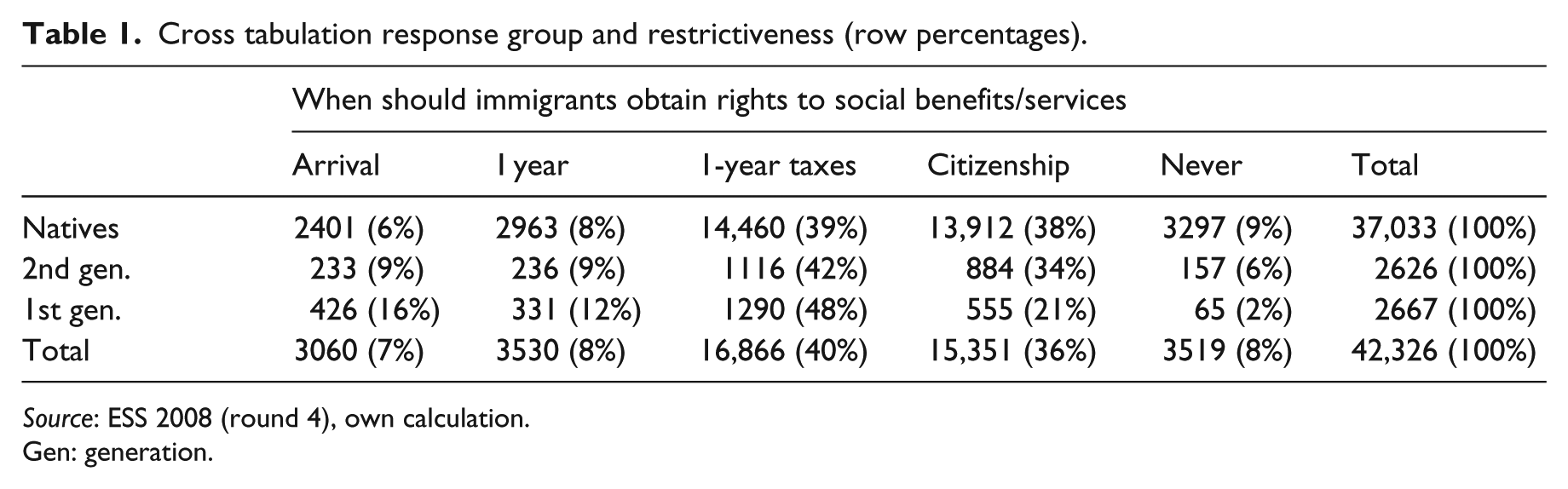
Source: ESS 2008 (round 4), own calculation.
Gen: generation.
We now turn to the multinomial models. As Table 2 indicates, the differences between natives, first- and second-generation immigrants remain after controlling for socio-demographic factors. Natives tend to be the most restrictive group, followed by the second generation. The first generation is the least restrictive group: they are less likely to favour a more restrictive option over the immediate access, compared to all other groups. This provides empirical support for the first hypothesis (H1).
Multinomial logit model: welfare state restrictiveness with covariates.
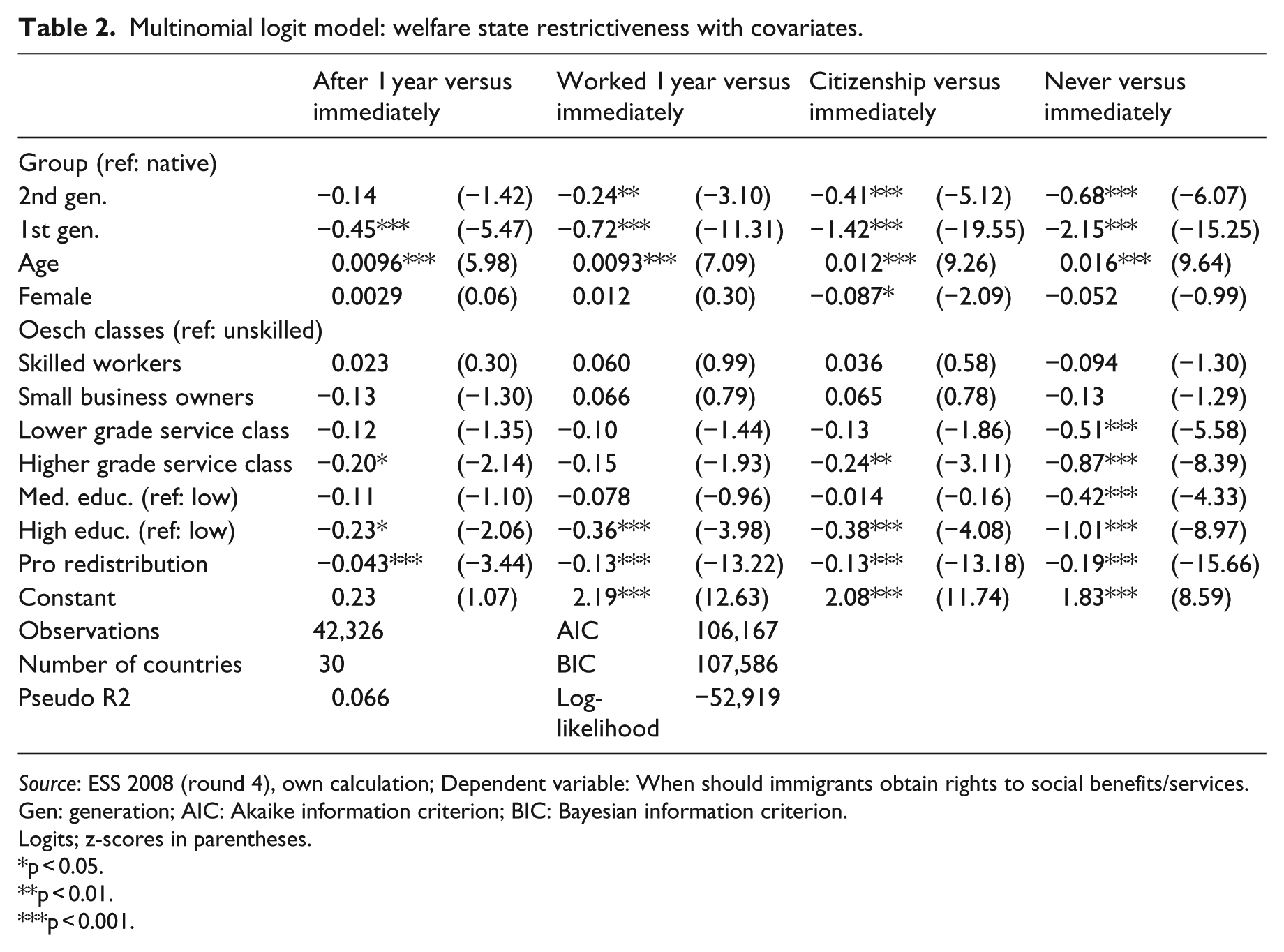
Source: ESS 2008 (round 4), own calculation; Dependent variable: When should immigrants obtain rights to social benefits/services.
Gen: generation; AIC: Akaike information criterion; BIC: Bayesian information criterion.
Logits; z-scores in parentheses.
p < 0.05.
p < 0.01.
p < 0.001.
According to hypotheses H2a and H2b, a higher vulnerability should increase welfare state restrictiveness among natives and decrease it among immigrants. Indeed, we observe such a pattern. Although we are not able to directly compare the coefficients between the models in a statistical test, we can get a clearer picture of the main influences for each group. Tables A3–A5 in the Appendix show the full multinomial logit estimations for natives, first- and second-generation immigrants. 7 The main results are depicted in Figure 1. For natives, we see that citizens with higher incomes and higher levels of education tend to have less restrictive attitudes. Although not all coefficients are significant, natives tend to be more generous the higher their socio-economic status. This is especially true for education. Moreover, those who are dependent on benefits are by tendency also more likely to favour a more restrictive answer, thus providing support for H2a.
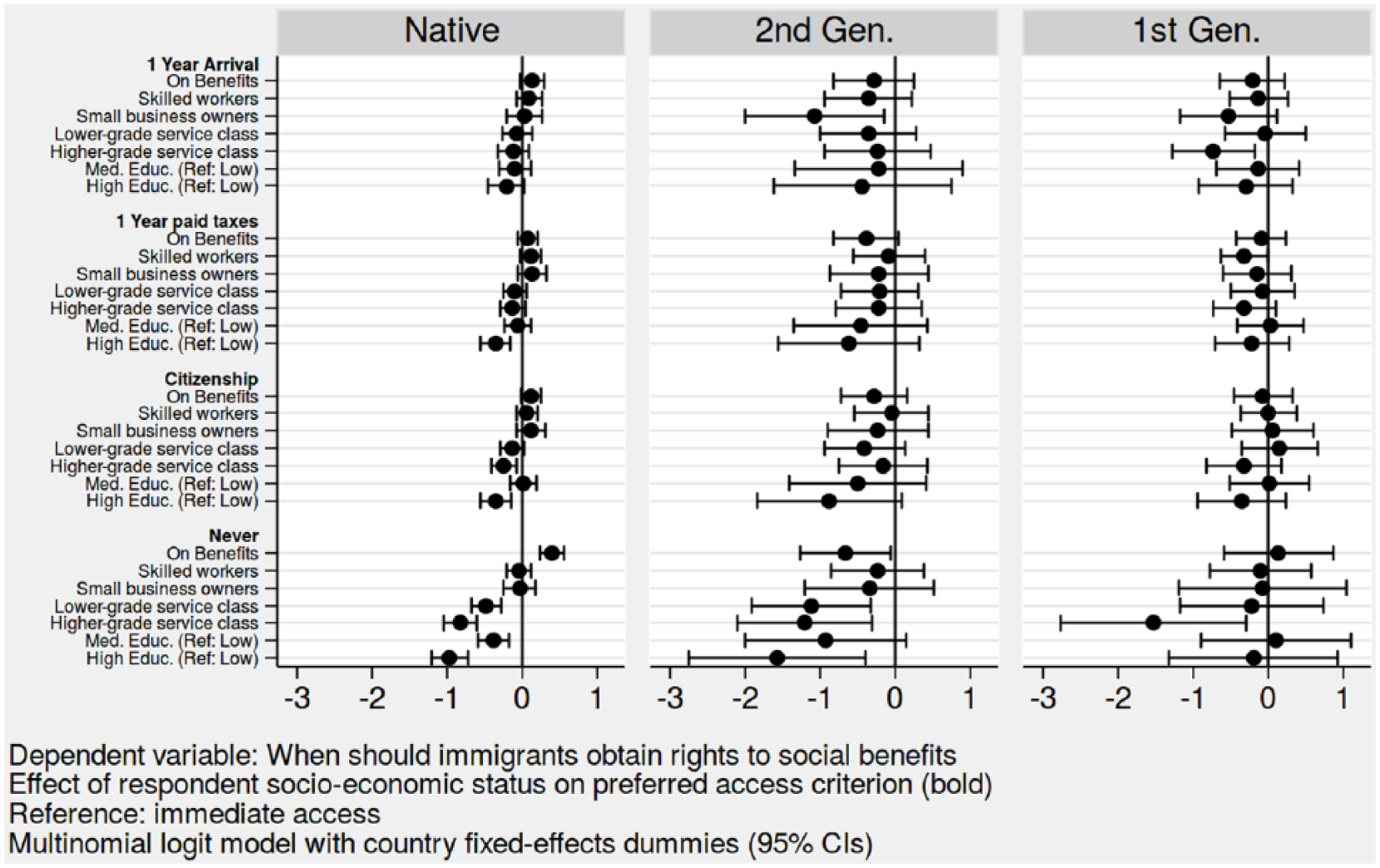
Effects of socio-economic status on welfare state restrictiveness.
Contrary to our expectations, the relationships obtained for first- and second-generation immigrants are in many cases quite similar to those among natives. Since the sample sizes are smaller, the confidence intervals are larger, so that some of the effects that are significant in the group of natives are insignificant in the immigrant groups. Still, immigrants with higher levels of education and working in higher occupational sectors tend to favour less restrictive welfare state access for immigrants than immigrants in more vulnerable positions. This is especially the case among second-generation immigrants, who do in this respect resemble natives. These findings are more in line with acculturation than with self-interest.
The main difference between natives and immigrants is that natives who are on welfare tend to favour restrictions, while immigrants on welfare tend to favour a less restrictive regime. These findings are in line with H2a and H2b, as well as with findings by Reeskens and Van Oorschot (2015), who show that the pattern of immigrants preferring a higher level of redistribution than natives can be explained by socio-economic differences. However, contrary to our expectations, the pattern is more clearly visible among the second-generation immigrants than among immigrants from the first generation. If these attitudes were fully driven by self-interest, we would expect these patterns to be more visible among first-generation immigrants as they are most likely to be affected by restrictive measures.
To further evaluate the role of self-interest for the immigrant population, we mimic the response categories of the dependent variable when categorizing first-generation immigrants. From a self-interest perspective, we expect that immigrants favour a welfare system that is just generous enough to include themselves while excluding as many other immigrants as possible. The main model can be found in the Appendix (Table A6). Figure 2 provides a more compact presentation.
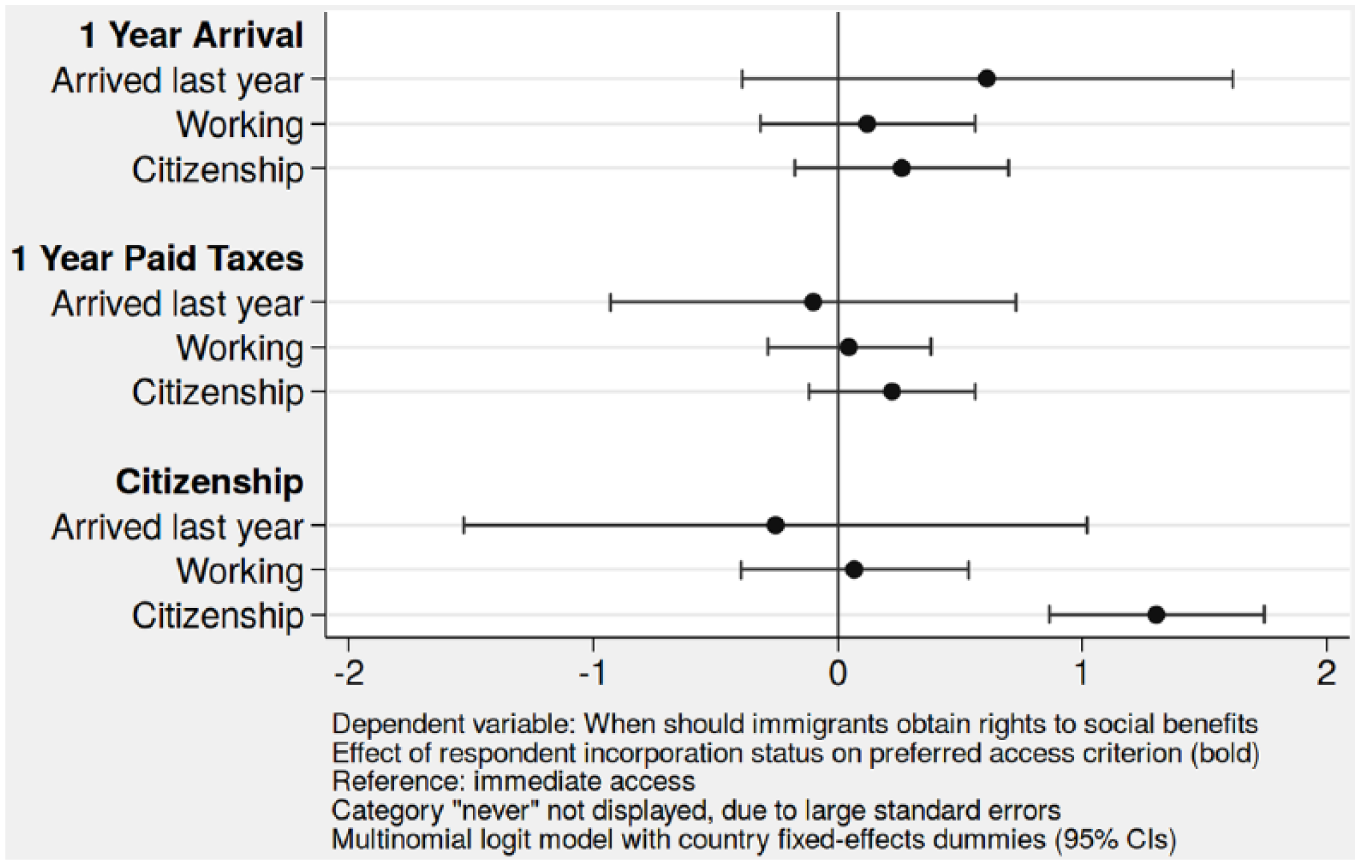
Effects of incorporation status on welfare state restrictiveness (first generation only).
Figure 2 reports the effect of respondents’ own incorporation status on the preferred access criterion. Indicated in bold are the response categories a respondent could choose. Below that we show the effect of the incorporation status on choosing the category over the reference, which is the immediate access after arrival. According to hypotheses H3a–H3c, we would, for instance, expect those immigrants who have obtained citizenship in the country of destination to be more likely to choose citizenship as the access criterion. The findings provide only limited support for the hypothesis that the individual status matters for the preferred level of restrictiveness. Those who arrived less than a year ago favour less restrictive options. Yet partially as a result of the small sample size, none of the effects is statistically significant. Also, no significant effects are found for the group of people who are working, having been in the country for more than a year, but not having obtained citizenship. Pure self-interest would have led them to choose ‘working and paying taxes for at least a year’ as a criterion. So, our analyses provide no support for H3a and H3b. However, immigrants who have acquired citizenship prefer citizenship as the crucial criterion (H3c). This latter finding suggests that self-interest is a relevant factor.
We argue that these findings are not the result of a simple integration mechanism that affects immigrants to be more restrictive (Reeskens and Van Oorschot, 2015). If integration was the main driver of these attitudes, we would expect immigrants to become more restrictive in general, favouring every option over immediate access. The findings highlighted in Figure 2 show that there is no general tendency to become more restrictive. Yet, our prediction that immigrants are favouring the option that excludes as many others as possible without excluding themselves, is only clearly supported for immigrants with citizenship.
As a robustness check, we also conducted additional analyses where we distinguished between Western and non-Western countries. Results show that this distinction has no substantial impact. The results and coding scheme for Western and non-Western immigrants can be found in the Appendix (Tables A8–A12). Moreover, we also tested interactions between the incorporation status of first-generation immigrants (the variables presented in Figure 2) and their socio-economic positions (variables presented in Figure 1). Only 1 out of 20 of these interactions were significant (at the p < 0.05 level), which is what we would expect on the basis of chance. This is why we decided not to present these results here.
Conclusion
While many studies focus on welfare chauvinism among the majority population, little research to date has examined how immigrants themselves view the question of granting welfare state access to immigrants (for an exception, see Kolbe and Crepaz, 2016). In this article, we examined how self-interest influences support for welfare state restrictiveness among natives and immigrants. We argued that self-interest should operate through immigrant status, socio-economic status and immigrants’ incorporation into the host society.
In line with hypothesis 1, we find that natives are on average more restrictive than second-generation immigrants and second-generation immigrants are more restrictive than first-generation immigrants. Furthermore, we expected that self-interest operates through socio-economic status for both immigrants and natives, albeit in different directions (hypothesis 2): vulnerable natives should be against an open welfare state as this would imply more competition over scarce resources. In contrast, vulnerable immigrants should favour an accessible welfare state as this would allow them to benefit from it themselves. Contrary to our expectation, the relationship between socio-economic status and support for restrictive policies among immigrants is very similar to those among natives. There is one exception: native citizens who receive welfare are more likely to exclude immigrants, whereas immigrants on welfare are less likely to exclude immigrants.
We further argued that to fully understand how self-interest structures support for an open welfare state among immigrants, one has to take into consideration their own incorporation status. Self-interested immigrants will choose a level of restrictiveness that excludes as many others as possible while just not excluding themselves. Hence, immigrants should choose their own status as the criterion to exclude others. Indeed, immigrants who have acquired citizenship in the new society prefer the welfare state to be limited to those who have acquired citizenship. Yet, those who contributed to society in terms of taxpaying are not significantly more likely to consider this a crucial criterion for granting immigrants access.
Our article contributes to the current debates surrounding immigration and the welfare state by showing that not all immigrants have a uniformly less restrictive view on welfare state access. Self-interest, an important predictor of support for the welfare state among the majority population, also plays a role in structuring attitudes among immigrants. However, the evidence in support of our hypotheses is more limited than could be expected, on the basis of the fact that people are themselves directly affected by restrictiveness of welfare state arrangements. From this perspective, the most surprising finding is perhaps that patterns among the second-generation immigrants are so similar to those among the natives. This seems in line with acculturation more than self-interest.
When comparing the three mechanisms of self-interest analysed in this article, it appears that the incorporation status helps explain more than the immigration status or socio-economic status. This last finding suggests that socio-economic status, which is often used to measure self-interest, might not be the best way to assess whether cost–benefit considerations structure public opinion. Rather, it makes sense to think exactly how individuals connect their own costs and benefits to policy outcomes.
There are some limitations to this article. The ESS is not designed as an immigrant survey and is potentially biased towards better integrated immigrants who master the language in the country of destination. Less integrated immigrants are therefore less likely to be included in the survey. This might help explain why we see that second-generation immigrants are very similar to natives in their support for the welfare state. Another interesting question that should be addressed by further research is to what extent home-country socialization plays a role in structuring immigrants’ opinion on welfare state access. It is plausible that immigrants coming from a very open welfare state expect their country of destination’s welfare services to be equally accessible. Surveys that are designed to address various immigrant groups, such as the MIFARE survey on immigrants’ attitudes towards the welfare state (Lubbers et al., 2018), will be essential in furthering our knowledge of immigrants’ attitudes towards the welfare state.
Supplemental Material
ESP781293_Supplementary_Material_REV2 – Supplemental material for Granting immigrants access to social benefits? How self-interest influences support for welfare state restrictiveness
Supplemental material, ESP781293_Supplementary_Material_REV2 for Granting immigrants access to social benefits? How self-interest influences support for welfare state restrictiveness by Daniel Degen, Theresa Kuhn and Wouter van der Brug in Journal of European Social Policy
Footnotes
Appendix: Granting immigrants access to social benefits? How self-interest influences support for welfare state restrictiveness
Acknowledgements
Previous versions of this article have been presented at the 6th Annual General Conference of the European Political Science Association (EPSA, 2016) in Brussels and the 10th General Conference of the European Consortium for Political Research (ECPR, 2016) in Prague. The authors would like to thank Tim Reeskens, Claudia Diehl, Martin Seeleib-Kaiser as well as two anonymous reviewers for very useful feedback that helped to improve the paper. All remaining errors are our own.
Declaration of conflicting interests
The author(s) declared no potential conflicts of interest with respect to the research, authorship and/or publication of this article.
Funding
The authors disclosed receipt of the following financial support for the research, authorship and/or publication of this article: D.D. received funding from the NORFACE (New Opportunities for Research Funding Agency Cooperation in Europe) Welfare State Futures programme for working for the Migrants’ Welfare State Attitudes (MIFARE) project (Grant No. 462-14-020). T.K. gratefully acknowledges funding from the Netherlands Organization for Scientific Research (VENI Grant No. 451–13-029).
Notes
References
Supplementary Material
Please find the following supplemental material available below.
For Open Access articles published under a Creative Commons License, all supplemental material carries the same license as the article it is associated with.
For non-Open Access articles published, all supplemental material carries a non-exclusive license, and permission requests for re-use of supplemental material or any part of supplemental material shall be sent directly to the copyright owner as specified in the copyright notice associated with the article.
