




Abstract
Wind energy development can be polarizing with opposition coming from rural regions that are most affected by new wind farms. Local opposition can become further entrenched through political ideologies, where one's perspective on wind turbines becomes a litmus test for one's political position. With these concerns in mind, we utilize results from a survey of large-scale agricultural landowners in Alberta, Canada, to answer the following question. To what extent are self-declared political positions consistent with views on wind energy development? Results indicate that wind energy acceptance is not politically polarized nor even polarized among Alberta's rural landowners. Instead, the sample reveals fragmented, moderate, and likely malleable opinions about wind energy. Within a jurisdiction that is politically conservative and fossil fuel dependent, these results have largely positive implications for future wind energy development in the province.
Keywords
Introduction
Energy production in Alberta, Canada, is an impassioned and often polarizing topic. 1 In an era of polarized views on energy systems, the possibilities of advancing renewable energy development are often compromised by deep conflicts about future energy pathways. 2 Wind turbines, in particular, often garner animosities due to their towering size, which makes them highly visible and subject to scrutiny within rural landscapes. By extension, rural landowners are one demographic that is “unavoidably entangled” in energy transitions and new wind energy projects. 3 Rural agricultural landowners are prime candidates for hosting or living near wind installations with benefits to landowners and their communities. For example, long-term lease payments from hosting turbines can help stabilize farm incomes 4 and can support rural municipalities by increasing tax revenue, sparking ecotourism, diversifying local economies, and creating employment 5 —all while supporting collective efforts to reduce greenhouse gas emissions. Yet, the drawbacks of nearby wind farms include visual, auditory, and wildlife impacts, along with concerns about technical financial feasibility, and community conflict that is often sparked by the prospects of local winners and losers from new wind farm developments. 6
Amid these wind energy animosities, research indicates that politics can play a role in influencing wind energy acceptance, 7 but sometimes not in ways that one might expect. 8 Particularly in a jurisdiction like Alberta, Canada, with a politically conservative citizenry and a large fossil fuel industry, politics could play a key role in influencing wind energy acceptance. Yet, there is limited research in the province on the topic of political polarization and how these polarities could shape preferences for wind power in relation to other social factors.
This study explores the potential for polarized views on energy to affect support for wind energy development among rural agricultural landowners in Alberta, Canada (n = 401). Understanding the views of this particular demographic is vital because they own and manage large rural areas that could be prime locations for new wind farms. To meet future energy needs, one study estimates Alberta will need a tenfold increase in land for energy generation to establish a cost-effective, low-emissions grid by 2060. 9 If rural landowners oppose the development of wind projects, the province will be limited in accessing the private land needed for an energy transition.
Given this jurisdictional context, we ask two questions. First, are political factors shaping how rural agricultural landowners perceive wind energy? To answer this, we draw from published literature on the social acceptance of wind energy and reflect Aguirre et al.'s 10 approach to detecting political polarization in cross-sectional data. Second, what other factors are influencing landowners’ general dispositions toward wind development in the province? We account for the impacts of fossil fuel preferences, climate change concerns, trust, and social norms.
Literature review
The social acceptance of wind energy
The reasons for the social acceptance of wind energy have been thoroughly studied. Across North America, the general public positively regards wind energy, but contention commonly occurs within rural communities that host or could host wind farms. 5 There are some well-established factors that are vital for successful wind energy development in rural communities. In the Canadian context, this includes aspects of trust, 11 procedural fairness, 12 distributive fairness, 13 and ownership arrangements. 14 Yet, acceptance by rural communities remains dependent on local context—especially on the historic and cultural ties a community has to its energy system. 15 Although there is considerable literature on the social acceptance of wind energy in Europe 16 and across North America, 17 there is limited research in Alberta, Canada—a jurisdiction well-entrenched in the political economy of fossil fuels 18 and with considerable potential for wind energy expansion. 19
Economic, environmental and social concerns
How an energy technology is perceived is often driven by perceptions about its environmental impacts and economic benefits, 20 which holds true for wind energy. 5 Economic benefits have been found to outweigh and even diminish perceived negative externalities, 21 but the importance of economic benefits cannot be assumed as a top priority for all communities. 22 For example, in a study from Nova Scotia, Chappell et al. 23 found economic factors to be less significant than the intrinsic values of wind energy as a commodity for export and a reminder of local energy use.
Favor toward wind projects can also be shaped by beliefs about their environmental harms 24 and benefits. 12 Rural communities may perceive the local harms (e.g., ecosystem impacts) of wind development to outweigh the global benefits (e.g., emissions reductions), phenomena referred to as ‘green on green’ debates. 25 In particular, avian mortality has been one of the most ‘vociferous’ claims used against local wind development even though technological changes and strategic placement have made bird–turbine collisions negligible relative to other human-caused impacts. 26 In addition to these environmental dimensions, the literature identifies enduring concerns including noise 27 and flicker impacts, 28 technical aspects such as intermittency, 29 and enduring preferences for incumbent energy systems, such as fossil fuels. 30
Political polarization and energy development
There is good reason to suspect that views on wind energy development could be politically divisive in Alberta. Alberta is an energy-intensive jurisdiction, home to one of the largest crude oil reserves in the world (known as the oil sands) and extensive oil and gas production throughout the province. The electricity system also remains almost 90% dependant on fossil fuels, with an installed capacity of wind energy at approximately 1500 MW in 2019. 31 Given the centrality of fossil fuels to the regional economy, energy opinions in Alberta often diverge from the rest of Canada. 32 Polls reveal Alberta to be the most polarized province on climate change and energy development. 33 Albertans also express diverse, strong views on transitioning the energy industry, where opinions are divided by climate beliefs, occupations, regions, and political factors. 1 A recent opinion poll speaks to how energy is at the core of political divisions in Alberta. 34 The survey of 900 Albertans found significant overlap between those who are right-oriented, conservative-affiliated, holding stronger economic values, identifying as Albertans, and opposed to an energy transition. This group of respondents contrasted sharply with another group that aligned with the left of the political spectrum, did not vote conservative, held progressive beliefs, were on board with a renewable energy transition, and identified as Canadian more than Albertan. 34
As energy development is commonly heated and polarizing in Alberta, it is vital to determine whether and how political ideology is interacting with wind energy views. Rigid and extreme beliefs about renewable energy, if held by a sizable portion of the population, could limit Alberta's low-carbon pathway options.
Conceptualizing and measuring political polarization
To conceptualize political polarization, we draw on McCoy et al. 35 who view political polarization as a process occurring on an aggregate level (i.e., across a society). Akin to how Albertans are growing more divided on energy topics along political lines, 34 for McCoy et al., 35 political polarization is when a society finds itself splitting into (usually) two groups. Intragroup opinions grow more aligned across multiple policy issues. Simultaneously, the opinions held between the groups become increasingly contested. These opposing opinions (commonly manifesting as dichotomous pro versus anti camps) when stacked up, foster a sense of group identity by demarcating the “other” and masking in-group differences. By extension, society cleaves into “us versus them” as “political identities become social identities,” and this can challenge the democratic process necessary for arriving at constructive policy outcomes. 35 In this sense, with polarization, views about renewable energy (and wind energy in particular) can become a kind of litmus test for one's political position, with consequences for those who stray from so-called ideological anchoring points. In large measure, the notion of wind energy as a political anchoring point is what we seek to test in this study. To what extent are self-declared political positions consistent with views on wind energy development?
Political polarization is often conceptualized and measured as a process that takes place over time, 35 but with cross-sectional data we can only assess political polarization as a state or a single observation in time. Therefore, we mirror Aguirre et al.'s 10 approach to assessing political polarization. They assessed polarization in cross-sectional data by identifying three opinion patterns: polarized (where opinions cluster around extremes), fragmented (where views are diverse, usually dispersed across middle options, and often not held deeply), and aligning toward agreement. Using this approach, political polarization is observed if people of different political positions assemble into opposing, extreme stances.
Political polarization also requires some understanding of what constitutes political ideology. Political ideologies represent a bundle of values, beliefs, and attitudes shared by a group of people. 36 In addition to values and attitudes, beliefs are conceptualized as distinct components within political ideologies. Beliefs can be regarded as attitudes about how the world should be and about what is true. To measure political polarization in this study, we utilized three indicators of political ideology. First, we use five statements as indicators of conservative beliefs. Next, political orientation refers to where one's ideological beliefs sit relative to the beliefs of others, usually using the notion of a left–right spectrum. 37 The “left” colloquially is known to reflect valuing change and equity, while the “right” prefers tradition and acceptance with current levels of inequity. 36 Last, political affiliation captures a sense of group membership and speaks to how ideologies help us meet our relational needs to belong and to have a shared sense of identity. 36
Research methods
To answer these questions, an online survey was delivered via Kynetec, an agricultural research polling firm, and completed by 401 landowning Alberta farmers between December 2018 and March 2019. While online panels have certain advantages for surveying geographically distant and hard-to-reach populations, they also have shortcomings, including difficulties in calculating a response rate, as a proportion of all potential panelists. We do know, however, that our survey completion rate was 83%, where 401 questionnaires were completed out of 485. Respondents were eligible to participate if they self-identified as a resident of Alberta, were 18 years or older, and owned five or more acres of land in Alberta. To ensure the participants were proportionally distributed across the rural population of Alberta, Kynetec applied sample quotas based on self-reported postal codes. Accordingly, most respondents were from the southeastern area of the province, which is more densely populated than the northern areas. 38 The eligible panel members were offered $20 for completing the 20-min survey (estimated length). To assess the representativeness of the sample, the survey collected demographic and farm-level characteristics, including age, gender, farm size, and status as a primary farm decisionmaker. The full questionnaire and dataset from this study are accessible within a permanent online repository. 39
The analytical approach to our regression analysis follows Fullerton, 40 where there are two main decisions required for selecting appropriate ordered regression models. First, the approach for comparing across dependent variable categories (cut-points), and second, where to relax or constrain the parallel odds assumption. Within this approach, analytical results suggest the dependent variable (wind acceptance) has three statistically meaningful categories that are inherently ordered (as demonstrated in the results). We use cumulative cut points for the dependent variable based on a conceptual assumption that wind acceptance could represent an underlying continuous variable that is being represented by ordered categories. Secondly, we use partial proportional odds models (when needed) for balancing model parsimony and accuracy. 40
Dependent variable: Wind energy acceptance
The dependent variable in the analysis is wind energy acceptance. Respondents were asked if they agree or disagree that “there should be more wind energy in Alberta,” with answers recorded on a 5-point Likert-item scale (1 = strongly disagree, 5 = strongly agree). This question elicits general, passive “acceptance” of wind energy rather than support for local projects, and we know from Bell et al. 41 that surveys often indicate high levels of support for wind in contrast with low support for local projects (known as the social gap in wind energy acceptance). Nonetheless, general levels of support within this specific population of large-scale rural landowners may be an important indicator of future constraints and opportunities for the development of renewable energy infrastructure among those who are in a position to host such infrastructure on their land. For the regression models, the respondents are sorted into three ordered levels of wind acceptance (oppose, neutral, and support).
Five beliefs about wind energy
The same Likert item scale collected beliefs about five negative externalities commonly associated with wind energy. 5 The survey asked for agreement or disagreement that wind turbines “spoil the beauty of natural landscapes” (unaesthetic) and are “too noisy” (noisy). Respondents were asked “since the wind is not always blowing, we should not waste our time putting up turbines” to assess whether they view intermittent energy generation as inherently flawed (unreliable). The next two statements were reverse coded and indicate beliefs that wind energy is not economical or not environmental. The survey asked if “a wind farm would be a good thing for [their] county's local economy.” Last, the statement, “wind turbines are an environmentally friendly technology,” is intentionally broad to elicit the landowner's overall assessment of how wind energy relates to (global or local) environments.
Political variables
Conservativism beliefs: The survey asked for agreement or disagreement with five belief statements, with responses on Likert items ranging from strongly disagree (1) to strongly agree (5). Although factors underlying conservativism are not consistent across cultures, 42 we selected five components that are often associated with conservatism in Alberta.
The survey elicited beliefs about government spending and industry regulation as an indicator of neoliberalism, which became a facet of Canadian conservativism in the 1990s. 43 Respondents expressed anti-public spending beliefs through agreement on whether “less spending of public money in the energy sector will be better.” Anti-regulation beliefs were indicated by opinions on whether “government regulations should be kept to a minimum in the energy industry.” In a similar vein to neoliberal preferences, we also measured individualism as it is a defining feature of Alberta's political ethos. 44 We ask whether respondents prefer policies that improve collective well-being, even if that means they “get a slightly worse deal” themselves. Next, we broadly assess beliefs about land rights, personal freedoms, and autonomy through the pro-property rights statement: “People should always have the right to refuse nearby energy projects, especially if it could impact them.” Fifth, anti-change beliefs were measured through the disapproval of “big, fast changes to Alberta's energy system,” which speaks to the traditionalism that is a near-consistent component of conservativism across all cultures. 42
Political orientation: As another indicator of political ideology, respondents reported their political orientation. They reported their orientation on an 11-point, left–right spectrum, ranging from “very left-wing” (−5) to “very right-wing” (+5) with a neutral center (neither left nor right). According to Kroh, 37 this scale is ideal for measuring political orientation because the left–right concept is commonly used and well understood by survey respondents, while the simplicity of the scale minimizes participant error. Also, the scale's zero midpoint allows respondents to self-identify as neutral, indifferent, centrist, or being outside of the left–right spectrum. 37
Political affiliation: To assess affiliation, the respondents were asked to select the political party that “best represents their views, whether or not [they] vote.” The options were NDP, Liberal, Conservative, Green, Other, Prefer not to say, or Don't know. Although these parties are different at provincial and federal levels, the question was intentionally vague. This openness would allow respondents to refer to, for example, conservative parties in general or a particular conservative party.
Control variables: Energy sources, climate change concern, trust and norms
We included other variables in this analysis as they are well-established predictors of wind energy acceptance. Given the link between support for other types of energy technologies and renewable energy, 42 respondents were asked whether they “support or oppose further development of the following energy sources in Canada,” where responses were collected on 5-point Likert scales from strongly oppose (1) to strongly support (5). For the regression analysis, to assess the effects of support for incumbent energy systems on wind power support, a fossil fuel support scale was derived from three variables (support for coal, oil and gas) (α = .659). Using the same Likert scale, we measured climate change concern by agreement with being “very concerned about climate change” as other studies have linked climate concern and climate beliefs to renewable energy support.45,46
Trust stems from believing in someone else's competencies and perceiving their values align with yours. 47 Community attitudes toward local wind development may be swayed by their trust or distrust for different energy stakeholders, including large corporations 48 and government bodies. 49 Respondents rated their trust for different energy sector agents on a scale from 1 (fully distrust) to 10 (fully trust). An indicator for social norms about wind farms was also included in the study to further understand what others might think and do—injunctive and descriptive norms, respectfully. 50 On a Likert scale from 1 (strongly disagree) to 5 (strongly agree), respondents expressed their subjective (i.e., perceived) social norms about wind energy support through agreement about whether their “local community would be excited about a wind farm.” Finally, although 18% of respondents reported wind turbines near their farm, this measure of experience with wind projects did not have a significant effect on acceptance, and was not included in the analysis below.
Results
Sample characteristics
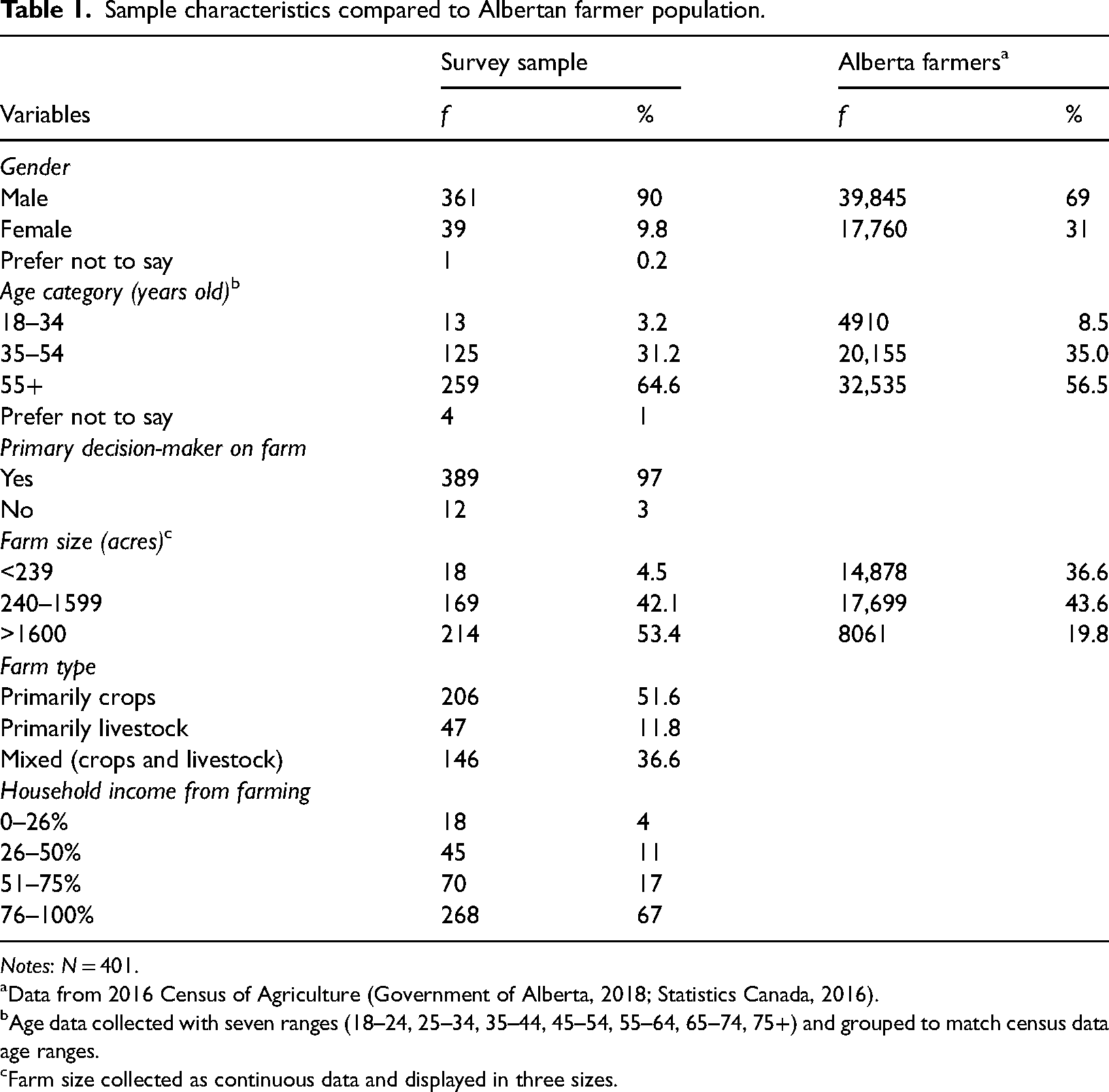
To assess the representativeness of the sample, farm characteristics and demographics measures were compared against the 2016 Census of Agriculture.51,52 The overwhelming majority of the sample self-identified as a primary decision-maker on their farm (97%). Farming was the main source of household income. The majority of respondents (85%) generated over half of their household income from farming, while 67% made over three-quarters of their income on-farm. The sample was comprised of farmers who primarily grew crops (52%), raised livestock (12%), or had a mixed operation (37%). Farm sizes ranged from 13 acres to 30,500 acres. The sample's average farm size (M = 2983 acres) doubled the average Albertan farm (M = 1237 acres). However, the sample had large outliers due to a heavily right-skewed distribution. The median farm size (1672 acres) of the sample was more similar to the Albertan average.
Regarding farmer demographics, the sample's median age range (55–64 years) is in line with the average age of Albertan farm operators (56 years). In Alberta, in 2016, 69% of farm operators were male and 31% female. The sample has a higher proportion of male respondents at 90%, stemming from the higher likelihood of an Albertan farm being run by a solo male operator. Overall, some elements of the sample are representative of rural Albertan farmers in terms of age and farm size, but we caution that other aspects of the sample are less representative, such as gender and the higher proportion of larger farms. Demographic factors are not included in final regressions as these factors are rarely important in the wind acceptance literature (Table 1). 5
Sample characteristics compared to Albertan farmer population.
Notes: N = 401.
Data from 2016 Census of Agriculture (Government of Alberta, 2018; Statistics Canada, 2016).
Age data collected with seven ranges (18–24, 25–34, 35–44, 45–54, 55–64, 65–74, 75+) and grouped to match census data age ranges.
Farm size collected as continuous data and displayed in three sizes.
Wind energy views
Figure 1 indicates survey respondents’ level of support for and beliefs about wind energy. The sample held diverse, fragmented positions on whether there should be further wind energy development in Alberta. Sensory impacts (unaesthetic and noisy) were most frequently identified as problematic. Over half of the sample (53%) disliked the appearance of wind turbines. Auditory disturbance was the next top issue with over a third (39%) expressing that wind turbines were “too noisy.” Compared to the other four questions, auditory impacts elicited the most uncertainty, where nearly half of the respondents (45%) stayed neutral or opted out. The other wind energy aspects were slightly less contentious than the sensory impacts. About a third of respondents perceived wind turbines as not environmental (33%), unlikely to offer local economic benefits (30%), and flawed due to intermittency (30%). While over a third of the sample was accepting of wind development, many respondents saw wind energy having many downsides.
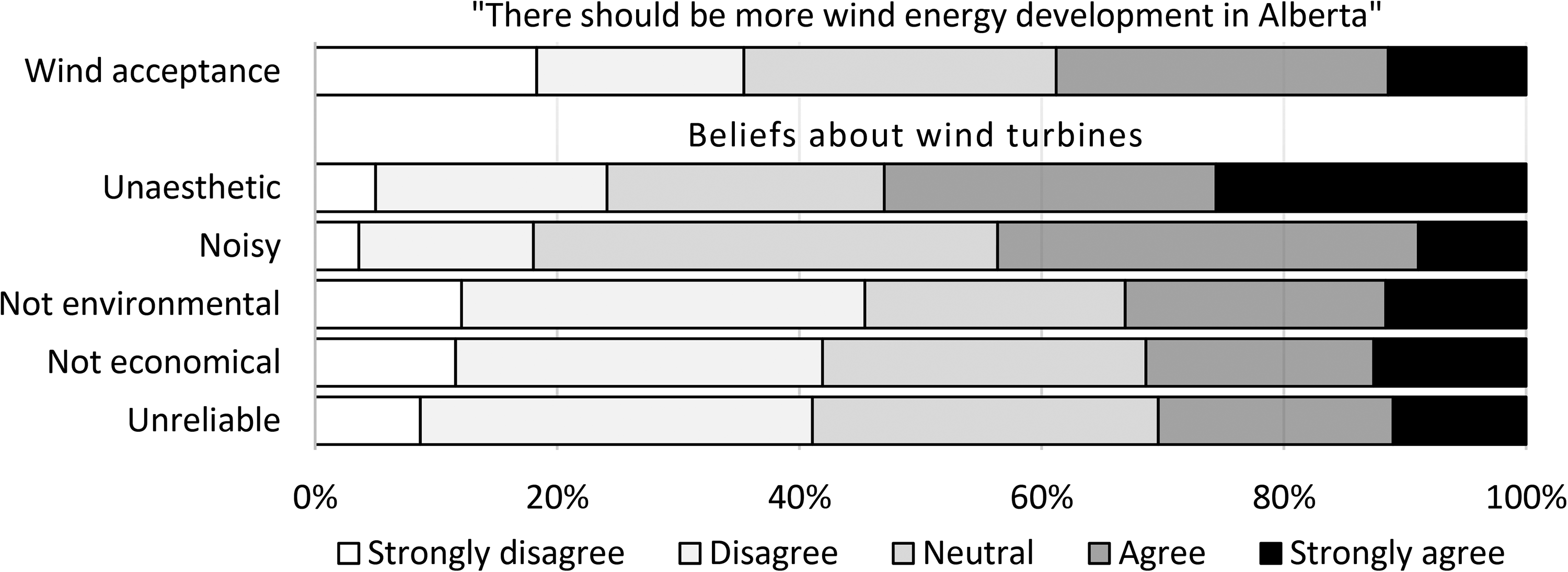
Wind energy acceptance and beliefs.
Political affiliation and orientation
Figure 2 visualizes how most of the sample agreed with conservative belief statements, with the individualism statement being an exception (with only a third in agreement). These five belief variables did not load into a conservative belief scale (α = .38). Therefore, in further analysis, the five belief variables are used separately.
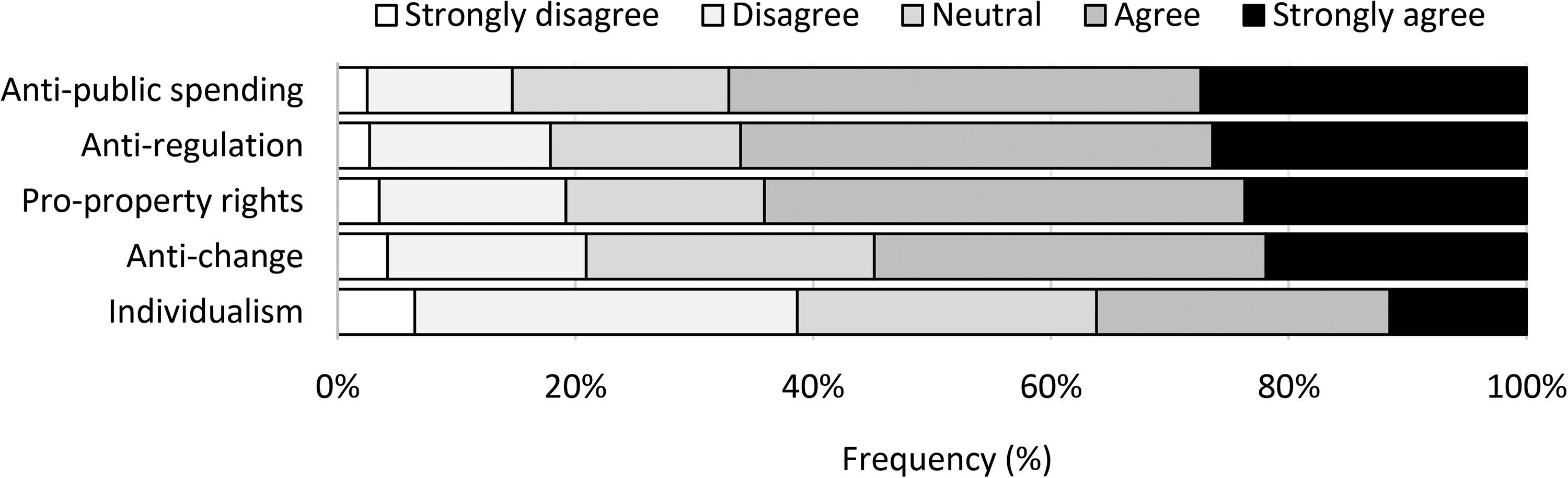
Agreement with conservativism beliefs.
For political affiliation, the majority of respondents expressed an association with a conservative political party (n = 281). Few indicated affiliation with other political parties: NDP (n = 17), Liberal (n = 12), Green (n = 4), or Other (n = 13). The opt-out rate was high for this question. Nearly one out of five respondents did not offer a party affiliation as they opted out via the following two options: prefer not to say (n = 52) and I don’t know (n = 22). When placing themselves on a left–right spectrum, 53% of respondents placed themselves as right-wing, 26% used the middle option, and 7% selected left-wing. The remaining 14% preferred to opt-out.
Given the uneven distribution of both affiliation and orientation responses, both variables are transformed into dichotomous indicators. Affiliation was divided into two groups—respondents who explicitly expressed conservative affiliation (n = 281) and respondents who did not (n = 68). Political orientation was divided into a right-oriented group for those who placed themselves on the right side of the spectrum (n = 212) and a left–neutral group for those who gave a neutral, left, or uncertain answer (n = 133). For both orientation and affiliation, “prefer not to say” was treated as missing.
Assessing political polarization
Following Aguirre et al.'s 10 approach, for political polarization to be evident in this sample, opinions need to vary across political divisions insofar that one group frequently expresses “extreme” negative opinions about wind energy (strongly disagree) and the other group frequently expresses “extreme” positive views (strongly agree).
Figure 3 displays the diversity of views held by different political groups in the sample. With attention to political orientation, the right-oriented group displayed fragmented levels of support with, for example, 33% of respondents agreeing there should be more wind energy development in Alberta and 40% in disagreement. The left–neutral group aligned toward a slight agreement with 50% agreeing with further wind energy development and 24% opposed. Moving to the five wind energy beliefs, the right group aligned toward a strong agreement that wind turbines are unaesthetic with 60% of respondents in agreement. These views were less strongly held by the left-neutral group. In terms of noise, the two groups aligned in their views on whether turbines were an auditory disturbance. For the last three variables (not environmental, not economical, and unreliable), the two groups displayed similar patterns, but the right group displayed more fragmentation with more equal proportions of agreement and disagreement on these attributions of wind energy development. The patterns are similar for political affiliation where those who align with the conservative party are compared to other political affiliations. For example, respondents who are affiliated with the conservative party are split roughly by thirds in terms of their level of agreement, neutrality or disagreement with wanting more wind energy development. Overall, when segmented by political orientation or affiliation, results presented in Figure 3 do not indicate political polarization.
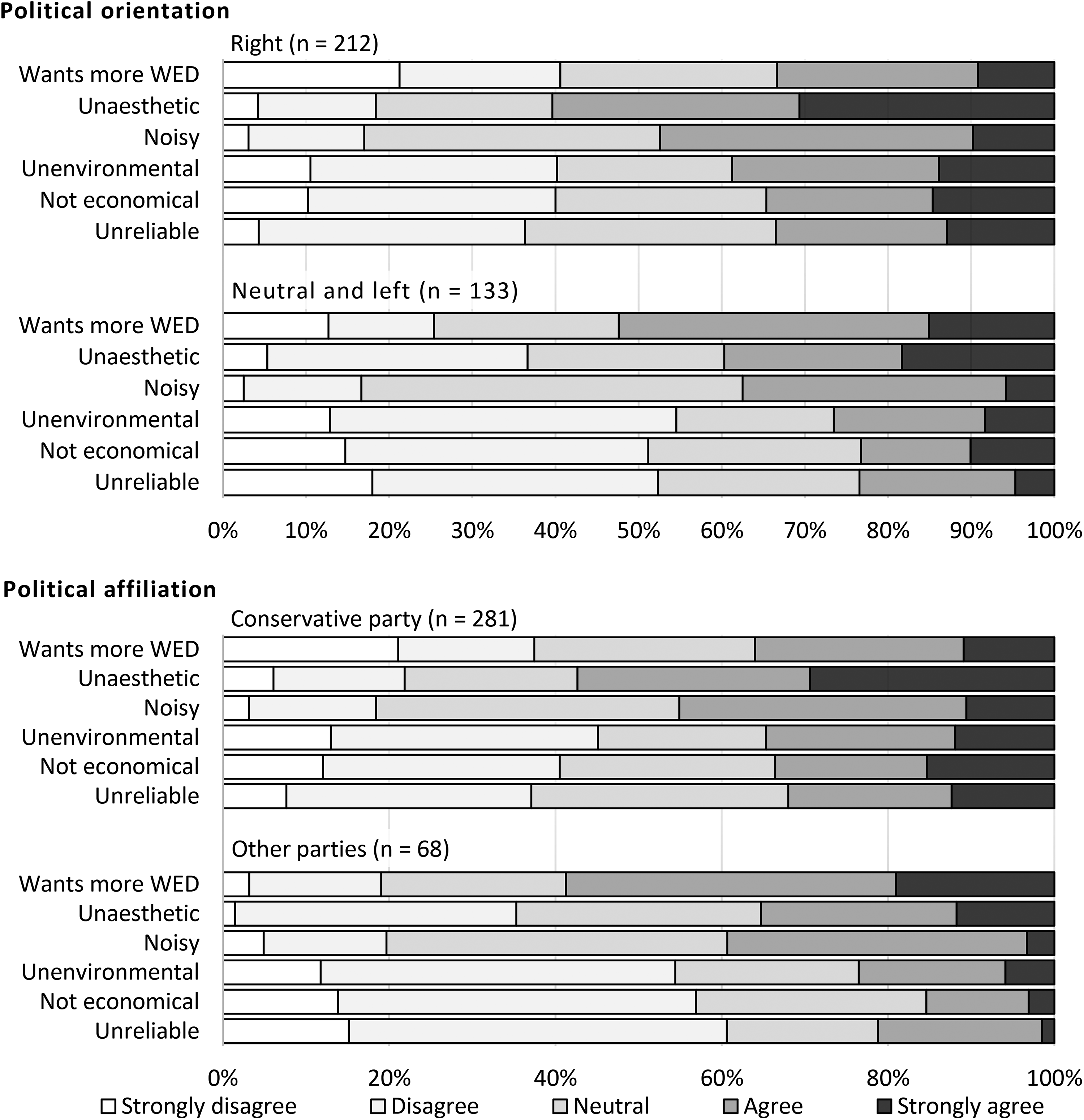
Wind energy views across political orientation and affiliation groups. Note: WED = wind energy development. For political orientation, neutral–left includes responses from −5 to 0 (very left to neither left nor right). Right scores ranged from +1 to +5, with +5 as very right. For affiliation, other party affiliation included NDP, Liberal, Green, and Other. Prefer not to say responses were excluded for both orientation (n = 56) and affiliation (n = 52).
For the regression analysis, Table 2 utilizes three indicators of political ideology (orientation, affiliation, and beliefs). Equations 1 and 2 are equal as no variables violated the parallel odds assumption. Right-oriented respondents were more likely to have lower support for wind, but in Model 4 political orientation dropped in significance. Similarly, conservative affiliation predicted lower support but lost significance with the addition of the wind energy belief variables. In the subsequent regression model (Table 3), the orientation and affiliation indicators were not significant and did not improve the models, warranting their exclusion from further analysis.
Ordered logistic regressions of political indicators predicting wind acceptance.
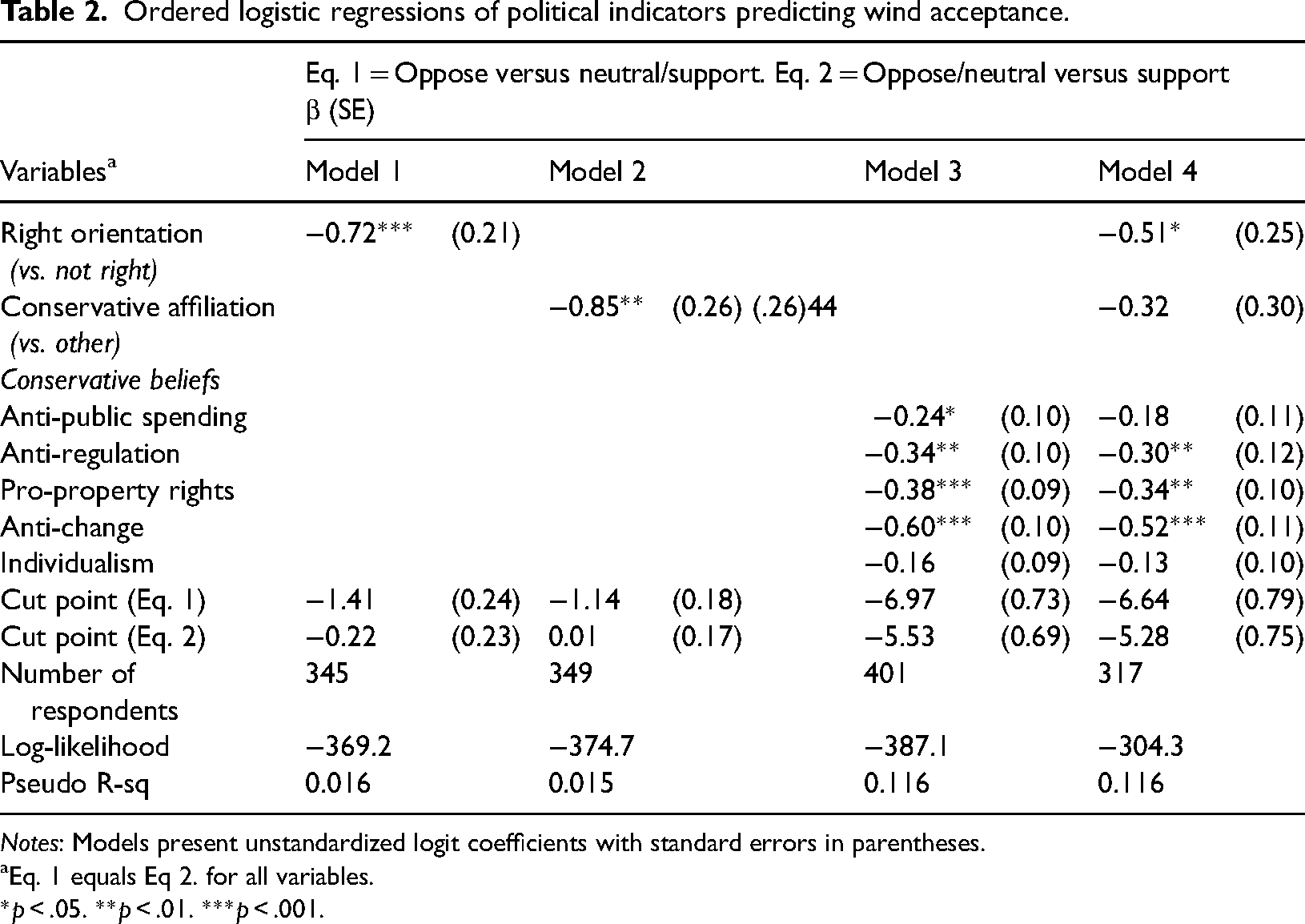
Notes: Models present unstandardized logit coefficients with standard errors in parentheses.
Eq. 1 equals Eq 2. for all variables.
*p < .05. **p < .01. ***p < .001.
Ordered logistic models with partial proportional odds predicting wind acceptance.
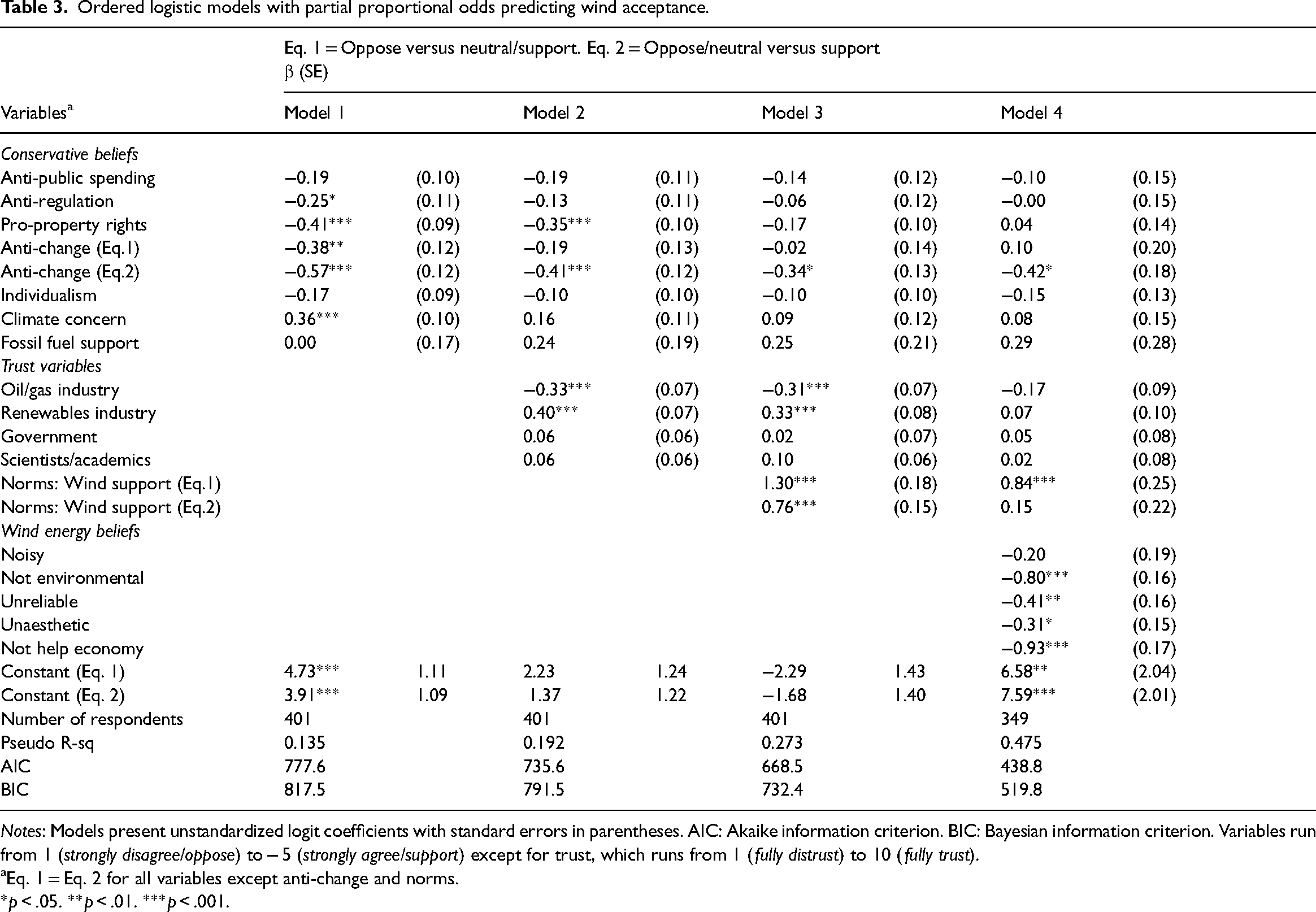
Notes: Models present unstandardized logit coefficients with standard errors in parentheses. AIC: Akaike information criterion. BIC: Bayesian information criterion. Variables run from 1 (strongly disagree/oppose) to − 5 (strongly agree/support) except for trust, which runs from 1 (fully distrust) to 10 (fully trust).
Eq. 1 = Eq. 2 for all variables except anti-change and norms.
*p < .05. **p < .01. ***p < .001.
In Table 3, the models were loaded sequentially with other independent variables of interest: climate concern (1–5), fossil fuel support (1–5), trust for energy stakeholders (1–10), exposure to social norms of wind support (1–5), and beliefs about wind energy (1–5). Brant's test (p < .05) revealed two variables in violation of the parallel odds assumption: the anti-change belief and norms of wind support. Accordingly, Table 3 uses partial proportional odds models to relax the parallel odds assumption for only those two variables (Eq. 1 ≠ Eq. 2). All other variables are constrained across dependent variable cut points (Eq. 1 = Eq. 2).
Table 3 speaks to the final research question: what might be shaping landowners’ general acceptance of wind energy? The five conservativism beliefs are significant in the first model. All variables had an inverse relationship with wind energy support. Respondents were more likely to have a higher level of wind acceptance (e.g., being in support or neutral) if they ranked lower in the conservativism beliefs. However, the significance of the conservativism beliefs diminished as other predictors were included. By Model 4, the only statistically significant (albeit not strongly significant) variable was the anti-change belief and only for Equation 2 (β = –.42, p < .020). This finding is interesting because it suggests having a higher preference for the status quo does not specifically predict negative dispositions toward wind energy (Eq. 1) but does predict not being in support (Eq. 2).
For climate concern, in the first model, the likelihood of a respondent having a higher level of wind acceptance increased as their concern score increased (β = .36, p < .001), which is not surprising. However, climate concern was only predicted in the first model, which suggests that Albertan landowners’ general dispositions toward wind energy are not driven by their risk assessment of climate change.
Fossil fuel support was not significant in any of the models. It is possible the measurement or construction of this variable is not accurately reflecting energy preferences. More likely though, fossil fuel support and wind acceptance may have lacked a relationship because this demographic is so overwhelmingly in favor of fossil fuels. Had this been a general population survey (with diverse views), an inverse relationship between fossil fuel and wind preferences may have been found.
In Models 2 and 3, industry trust variables were significant predictors (p < .001). In Model 3, intuitively, as trust in the fossil fuel sector decreased (β = –.31) or as trust in the renewable sector increased (β = .33), a respondent was more likely to have a higher level of wind acceptance. However, trust factors lost predictive power in the final model when wind energy beliefs were added. These results suggest wind energy beliefs have, in part, already been shaped by the respondent's trust or distrust of energy industries. The models did not reveal strongly significant relationships between wind acceptance and trust for the government or for scientists and academics.
At first glance, there appears to be an interesting relationship between social norms of wind opinions and wind acceptance. In Model 3, when respondents were exposed to more positive views of wind energy, they were significantly more likely to sort into higher levels of wind acceptance themselves—as indicated by strongly significant (p < .001) positive coefficients in both equation 1 (β = 1.30) and 2 (β = .76). Yet, in Model 4, higher social norm scores did increase the likelihood of not opposing wind (β = .84, p = .001) but did not specifically increase the likelihood of respondents taking the highest level (support) of wind acceptance (β = .15, p = .489). However, this relationship is likely due to the distribution of the social norms scores as few respondents agreed (18%) or strongly agreed (2%) their community would want a local wind farm.
The five wind beliefs were included in the fourth model, which had the best balance between model complexity and explanatory power (with the lowest AIC and BIC scores). Compared to the other predictor variables, wind energy beliefs appear most impactful or most directly related to landowners’ wind energy acceptance. Negative economic (β = –.93, p < .001) and environmental assessments (β = –.80, p < .001) were strongly significant. Beliefs about wind energy being unreliable (β = –.41, p = .009) and unaesthetic (β = –.31, p = .039) were also significant, although at a lower significance level. For these four variables, as their scores increased (i.e., assessments were more negative), as expected, respondents were more likely to sort into a lower wind acceptance level. Negative beliefs about auditory impacts do not evidently play a role in shaping wind acceptance (β = –.20, p = .281), but this result is likely a function of the large distances between homes and turbines in Alberta, with the concentration of existing wind farms in the southeast corner of the province.
Discussion
As our key point of inquiry, this study explores whether wind energy is a politically polarized topic among Alberta rural landowners. We do not find evidence of political polarization most simply because the respondents overwhelmingly expressed moderate views about wind energy. Given our chosen approach for detecting political polarities, a higher proportion of “extreme” views would need to be present. Furthermore, the sample is highly conservative-affiliated, but respondents still take diverse stances on wind energy. If wind views were politically polarized in the broader Albertan population, we might expect such a conservative-leaning sample to express more unified opinions. By extension, the results then (cautiously) support a conclusion that wind energy has not been swept up into the province's partisan tensions around energy topics.
These findings are important for several reasons. When a population becomes polarized on a topic, opinions harden. Beliefs can cement in the face of conflict and can become enduring through reaffirming norms. 53 Contrary to this situation, since our results from these rural landowners indicate fragmented and moderate views about wind energy, it is possible that through enhanced regulations and policies, their general disposition toward wind energy may be changeable. Since Bell et al. 41 remind us that the acceptance of more wind energy in Alberta is not the same as support for a local project, we recognize the need for ongoing efforts to address local challenges in siting new wind projects.
Another aim of this study was to document the beliefs that rural landowners have about wind energy. The sample represented diverse beliefs about wind energy regarding its sensory impacts, inherent intermittency, environmental qualities, and economic potential—and again generally leaned toward nonextreme opinions. Over half of the respondents agreed wind turbines “spoiled” the rural landscape, and shy half thought turbines were too loud. These findings are not unexpected as visual and auditory impacts are common points of contention with wind turbines. 5 However, for this demographic, our analysis suggests these sensory qualms are not as important in shaping overall acceptance of wind energy relative to economic and environmental assessments.
Aligned with other Canadian research, 13 economic benefits appear to be a key driver of positive perceptions of wind development. With economic assessments strongly significant in our analysis, wind development in Alberta may hinge on whether landowners perceive leasing their land for wind development as a financial opportunity. Province-wide polarization may then be circumvented if landowners are better informed about how these developments can relieve their own financial burdens while generating tax revenue for their local communities. However, only four out of 10 respondents agreed that a nearby wind farm would benefit their regional economy. This common perception might stem from a lack of public information about compensation rates. 54 It could also arise from conventional approaches to wind project development, where wind farms are owned by large private corporations and their distant shareholders. If there was more public information about lease payment contracts and options for local ownership structures (e.g., cooperatives or municipal ownership), Alberta landowners might view wind projects as more beneficial and, subsequently, more valuable to rural residents and communities within Alberta.
As another key finding, landowners’ wind acceptance may hinge on their assessments of the environmental benefits and harms of the technology—a finding in alignment with other Canadian studies. 12 Landowners were significantly more likely to be in favor of wind expansion in Alberta the more they viewed the technology as “environmentally friendly”; however, only one out of every 10 farmers strongly agreed with that statement. Future research is needed to understand how and why landowners are forming this assessment. Based on our own research, results from in-depth interviews with Alberta landowners suggest talking points from specific media sources have portrayed wind turbines as inefficient, wasteful, and hence un-environmental. 6
We also investigated whether five conservative beliefs predicted wind views. Out of these, only one predicted wind energy opposition: the anti-change belief. Respondents who had stronger preferences for maintaining the status quo were more likely to oppose the wind. The notion of fast, large-scale changes to the energy system may be seen as a threat to Albertans as they are culturally and economically tied to the conventional energy system.
Conclusion and implications
This study explored wind energy views and energy development preferences held by rural Albertan landowners and looked for evidence of political polarization. The findings bring some encouraging insights. Wind energy acceptance is not evidently politically polarized nor even polarized among Alberta's rural landowners. Our results reveal fragmented, moderate, and likely malleable opinions about wind energy. However, political ideology does matter. Landowners opposed to further wind development in Alberta are more frequently conservative, highlighting how wind energy could be vulnerable to polarization. Consequently, the successful siting of upcoming wind developments in Alberta is critical because, at worst, poorly executed projects could trigger rigid, province-wide division on renewable energy topics.
A summary of policy considerations from this study includes cautious optimism that fragmented views on wind energy reflect nascent and flexible positions on future energy systems. Sustained policy development through planning efforts and financial incentives can support a shift in views among rural landowners toward renewable energy technologies such as wind power. This support hinges on a continued policy focus that reduces local environmental impacts and demonstrates financial benefits to landowners and communities who host wind projects. Future studies can build on this baseline assessment of political polarization to gauge ongoing public responses to wind energy development within the province. This longitudinal approach to measuring polarization can also extend to general population surveys and other technologies, such as solar power, that will likely become more common within rural and urban landscapes in the decades to come.
Footnotes
Acknowledgements
We thank our collaborators, Sven Anders and Jürgen Meyerhoff for their assistance with the design of the questionnaire and our survey participants for their time and insights into wind power development in Alberta.
Declaration of conflicting interests
The authors declared no potential conflicts of interest with respect to the research, authorship, and/or publication of this article.
Funding
The authors disclosed receipt of the following financial support for the research, authorship, and/or publication of this article: This work was supported by the Social Sciences and Humanities Research Council of Canada (grant number 435-2017-0281).
