




Abstract
This paper provides an interdisciplinary, corpus-based study of naming practices for disabled people in a collection of Australian newspaper articles spanning 20 years. We analyse head nouns, modifiers, and coordinating structures for both person-first and identity-first language, drawing on social actor analysis as well as previously-identified models of media representation. Overall, we find similar usage of both naming practices with respect to the types of social actors that occur, the categorisations of disabilities that are referenced, and the associations that are established, with only minor differences. Additionally, both naming practices are strongly associated with the medical and social pathology models of media representation, which emphasise disadvantage, with almost a total absence of ‘progressive’ models, which represent people as multifaceted agents. We conclude by emphasising the need for the news media to incorporate the voices and preferences of disabled people themselves.
Keywords
Introduction
In this article, we present a critical linguistic study of representations of disabled people in the three most widely-read Australian newspapers over a period of 20 years. The study aims to contribute to the vibrant ‘emergent’ field of disability and media research (Ellis et al., 2020) and to address the relative neglect of disability as a topic for discourse analysis (Grue, 2011, 2015). Media representations of disabled people have traditionally been problematic, stereotyped and often stigmatising or Othering. Generally, foundational works in disability studies have experienced a tension between exploring depictions of ‘what’s wrong with people with disabilities’ and attempting to shift the focus to a social lens, to ‘the social forces that determine people with disabilities’ chances in life’ (Bogdan and Biklen, 2013: 1) or ‘the ways in which society creates disability by allowing barriers to be built, whether social, economic or architectural’ (Grue, 2011: 535, italics in original). The role of cultural representation in Othering, scapegoating and projecting negative attributes onto disabled people has also been recognised (Shakespeare, 1994).
In the Australian context, previous studies of news media representations of disabled people have largely examined framings of disability, whether negative (usual) or positive and progressive (very occasional). This body of Australian-focused research suggests that under-representation, misrepresentation, stigmatising, and pejorative language continue to perpetuate negative framings in the media. Disabled people/parents are depicted as inherently unfit in ‘mad, bad or sad’ narratives (Fraser and Llewellyn, 2015: 326). The ‘stigma power’ of mass media is highlighted, alongside the conflation of disability support with welfare fraud (Martin et al., 2022). A small-scale study of South Australian newspaper The Advertiser in 2007 found both under-representation as well as negativity in language, attitudes, tone and stereotypes (Green and Tanner, 2008).
In studies on specific impairments, neurological differences, disability schemes or events, Jones and Harwood’s (2009) analysis of media accounts of autism found a dualistic stereotype of ‘autistic people’ as either dangerous or as unloved and desperately seeking a cure. Life post-spinal cord injury was represented as tragedy for individuals and families, financial burden on society and families, or over-achievement (Rees et al., 2021). Intimations that it is better to be dead than disabled were noted in reporting on the Beaconsfield mine disaster (Newell, 2006). Progressive framings in articles on the National Disability Insurance Scheme up to 2015 were limited to only 26% of media articles (Burns and Haller, 2015: 270), whilst Mellifont (2017) identified widespread under-reporting of the disability rights movement and activism. Similarly, there was very limited media coverage of the Australian Special Olympics event in 2002, although there was some progressive coverage, undertaken ‘with authority and understanding’ (Tanner et al., 2003: 123). A few journalists solicited and represented the voices of the athletes rather than parents, coaches and officials. Rees et al. (2021) also noted a slight increase in positive framings over 70 years (in a single newspaper), but caution that media reports have yet to shift to a social lens in disability reporting.
Attempts have been made to improve this coverage: thus, Media Diversity Australia (2021) recently published a Disability Reporting Handbook to help journalists to ‘reflect, connect with and include all people’ (p. 4), comprising guidelines on linguistic, image and audio representations, with special sections on intersectionality and violence against disabled people. Included are what Critical Discourse Analysis understands as referential strategies or naming practices. The two main categories indicated in the handbook are person-first (e.g. person/people with . . .) or identity-first (e.g. ADJ + person/people) naming practices; if it is not possible to ask the person their preference, Media Diversity Australia advises to follow the person-first approach (2021: 26). Advocating for such language has a long history: Halmari (2011: 828) mentions US proposals in the early 1990s for person-first language, while as early as 1960,
1
the psychologist Beatrice Wright argued that
the designation “a physically disabled person” is a short cut to the more involved but psychologically sounder expression “a person with a physical disability”. Such a reformulation is far reaching, for it connotes that a person with a disability is first a person with many unspecified characteristics in addition to a particular disability. (Wright, 1960: 7).
On the other hand, the identity-first term disabled people is commonly used in Western disability movements (Soldatic and Johnson, 2020: 4).
In this article, we use this difference between person-first and identity-first nominal phrases as a way into the analysis of media representation. 2 As Grue (2015) puts it, ‘That choice may appear trivial to outsiders, whereas people with extensive experience and investment in the disability field may ascribe considerable importance to the choice between labels’ (p. 27). More specifically, person-first/people-first language refers to a naming practice where the person precedes a given diagnosis/designation rather than the identity/condition preceding the person reference (e.g. Price, 2022: 159). In relation to disability, a canonical example for a person-first naming practice is person with a disability, and a canonical example for an identity-first/condition-first naming practice is disabled person. This linguistic difference is relevant to a range of categories, not just general disability (e.g. Collier, 2012; Dunn and Andrews, 2015; Halmari, 2011) but also mental illness (e.g. Price, 2022), diabetes (e.g. Bednarek and Carr, 2021; Speight et al., 2021), obesity (e.g. Brookes and Baker, 2021: 121–123), autism (Botha et al., 2021; Brown, 2011; Shakes and Cashin, 2020) and visual impairment (Bickford, 2004).
Guidelines by disability organisations often recommend person-first language (e.g. People with Disability Australia, 2021: 6), although the linguistic underpinnings of such recommendations have been critiqued (e.g. Halmari, 2011). In addition, individuals have their own naming preferences and will not always prefer person-first language (e.g. Endeavour Foundation, 2020; Sharif et al., 2022; Young, 2022). Some may prefer disabled to indicate that they are disabled by society, highlighting ableism and disabling social processes. Distinctions between impairment (as bodily function or biophysical phenomenon) and disability (as intersubjective or socially-imposed) are also made (Grue, 2015: 11; Hallahan, 2013: 231; Smith et al., 2015: 61). There may also be specific preferences (e.g. in the realm of neurodiversity), and differences between national varieties of English. Further, both naming practices can be used strategically – and interchangeably – for alignment with particular campaigns (Soldatic and Johnson, 2020: 4). As Mellifont puts it, ‘Language around disability is constantly evolving, and the way people identify with it are diverse and individualised’ (cited in Young, 2022). Both the lived experience and the research of Annmaree Watharow (who herself uses identity-first language) affirms the complexity of nomenclature and identities in this space. The best approach is often to ASK (Acquire Specific Knowledge) – how do people identify and what do they want to be called (Media Diversity Australia, 2021; Watharow, 2022; Young, 2022). In this article, we therefore do not offer any prescriptive advice or intervene in this debate. However, given that attention to person/identity-first language has a long history, our data collection and analysis is centrally informed by it.
Beyond this novel way into the analysis, we aim to contribute to the critical interdisciplinary analysis of news media discourses by bringing together large-scale empirical corpus data with analysis of linguistic structures and models of media representation (see below). By considering the usage of naming practices referring to disabled people, we hope to come to empirical, evidence-based, and linguistically-informed conclusions regarding the state-of-play in how disabled people feature in Australian newspapers. Below, we present our analytical framework and describe the corpus, before discussing our findings.
Analytical framework
While our discourse analytical framework is interdisciplinary and one of the authors is a lived experience researcher, it is centrally informed by Linguistics. As mentioned, our starting point is the analysis of identity-first and person-first nominal phrases. From a linguistic perspective, an identity-first nominal phrase (e.g. disabled people) consists of a head noun that is pre-modified through an adjectival phrase. In contrast, a person-first nominal phrase (e.g. people with disabilities) consists of a head noun that is postmodified through a prepositional phrase. Other structures of (dis)preferred language (e.g. use of a nominal adjectival form like the disabled or post-modification through a relative clause) are beyond the scope of this study (see further Halmari, 2011; Price, 2022).
The syntactic structure of the two different nominal phrases determines the focus of our analysis. We start by analysing the head nouns, which enables us to identify the types of human referents that occur in each phrase by classifying them using van Leeuwen’s (2008) Social Actor framework, which we introduce below. We then analyse any modifiers of the identity-related element that occur in the data, that is pre-modifiers of disabled (e.g. intellectually/severely/permanently disabled) and of disability (e.g. intellectual/severe/permanent disability). These may relate to aspects such as type of impairment, hierarchy, and duration. Additionally, we focus on coordinating structures to identify co-occurring adjectives (e.g. disabled and/or elderly) and nouns (e.g. disability and/or illness).
Together, these analyses show which kinds of social actors occur, which categorisations of impairments/disabilities are referenced, and which conditions/qualities are associated with disability in the analysed newspapers. Since our focus is on syntactic structure, we use the word sketch feature in SketchEngine 3 (Kilgarriff et al., 2004) to process collocates and other word combinations of disabled and with disability/ies. This facilitates the identification of the relevant structures and subsequent qualitative analysis through concordances where appropriate. Unless otherwise noted, default SketchEngine settings were used.
As mentioned, this study takes an interdisciplinary approach. To do so, we combine linguistically-informed discourse analysis with previously-identified models of newspaper representation of disabled people (Clogston, 1990):
1.
2.
3.
It is worth noting here that emphasis on the medical aspects of injury and illness can lead to inspiring newsworthy ‘overcoming’ narratives, but these may be driven by prejudice and pity, and focus on ‘fixing’ disabilities, and ‘normalising’ people who have them (Riley, 2005). Supercrip representation ‘appears to be positive to most people who are not actually disability scholars, disability activists, or . . . disabled’ (Grue, 2015: 111). However, these stories are stereotyping and can be offensive to disabled people (Riley, 2005; Young, 2012).
Two ‘progressive’ models may also appear in media representations:
4.
5.
We use these media models to interpret the results from our linguistic analysis, allowing us to go beyond purely descriptive patterns to see how person- and identity-first language might represent common media representations. While we refer to these as models throughout, we also consider them as discourses, a perspective which ‘allows for more variation – a [. . .] text does not have to adhere very closely to a particular model in order to be counted as part of a discourse’ (Grue, 2015: 76).
It is worth highlighting that the term model is also used for models of disability that are used, adapted, and debated in disability research, activism and policy, each coming with their own limitations (for a discourse-oriented overview, see Grue, 2011, 2015). For instance, social-relational or bio-psychosocial models of disability are adopted in contemporary disability studies, guide Australian legislation/policies, and underpin the UN Convention for the Rights of Persons with Disabilities. Essentially, these models take into account both restrictions that are purely socially imposed, as well as accepting as self-evident that some restrictions may arise from the impairments themselves (see e.g. Shakespeare, 2001, 2013; Thomas, 2004).
Data collection and description
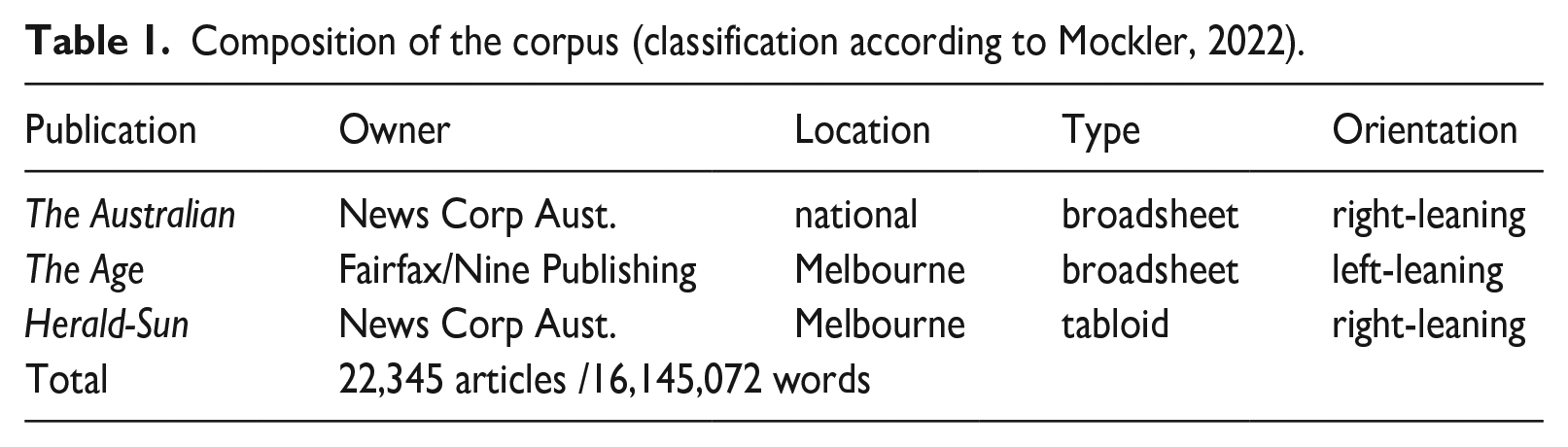
Our corpus consists of 22,345 articles or 16,145,072 words (see Table 1) from January 2000 to December 2019. It includes print content from the only generalist national newspaper in Australia as well as the metropolitan broadsheet and the tabloid newspaper with the highest average readership level (see Mockler, 2022: 35). We thus used a reception-based criterion, focussing on newspapers with the highest readership, rather than aiming to capture all newspaper content. The corpus also reflects the Australian media landscape, which is dominated by right-leaning newspapers and publications from two main owners, with News Corp newspapers having the larger market share (Mockler, 2022: 31–35).
Composition of the corpus (classification according to Mockler, 2022).
To collect texts, we used Nexis to retrieve articles with at least one mention of one of the items in our search syntax: 4 ‘disabled’ OR ‘with disability’ OR ‘with disabilities’ OR ‘with a disability’ OR ‘with a mental disability’ OR ‘with mental disabilities’ OR ‘with a physical disability’ OR ‘with physical disabilities’
This search syntax targets representation of human actors, and allows us to capture both person- and identity-first language. Singular and plural forms are included, as are broad categories of mental and physical disabilities. We acknowledge that specific forms of disability (for instance person with cerebral palsy) are likely to be used in newspapers; however, we do not intend our search string to be exhaustive, but rather to capture broad trends in general naming practices. The corpus includes a variety of genres beyond news stories, and the included items are not necessarily ‘about’ disability as a topic.
Before we present our findings, it is worth showing the frequency of articles and naming practices over time. As mentioned above, the corpus captures a timeframe of 20 years. The data capture deliberately ended before the covid-19 pandemic, to avoid any shift in discourse that might arise from this global health crisis. The dates include important milestones in sport (e.g. 2000 Paralympics, 2018 Invictus Games in Sydney) and legislature (e.g. 2008 adoption and ratification by the Australian Government of the UN Convention for the Rights of Persons with Disabilities), as well as subsequent strategies, reports and reforms (e.g. 2013 National Disability Insurance Scheme).
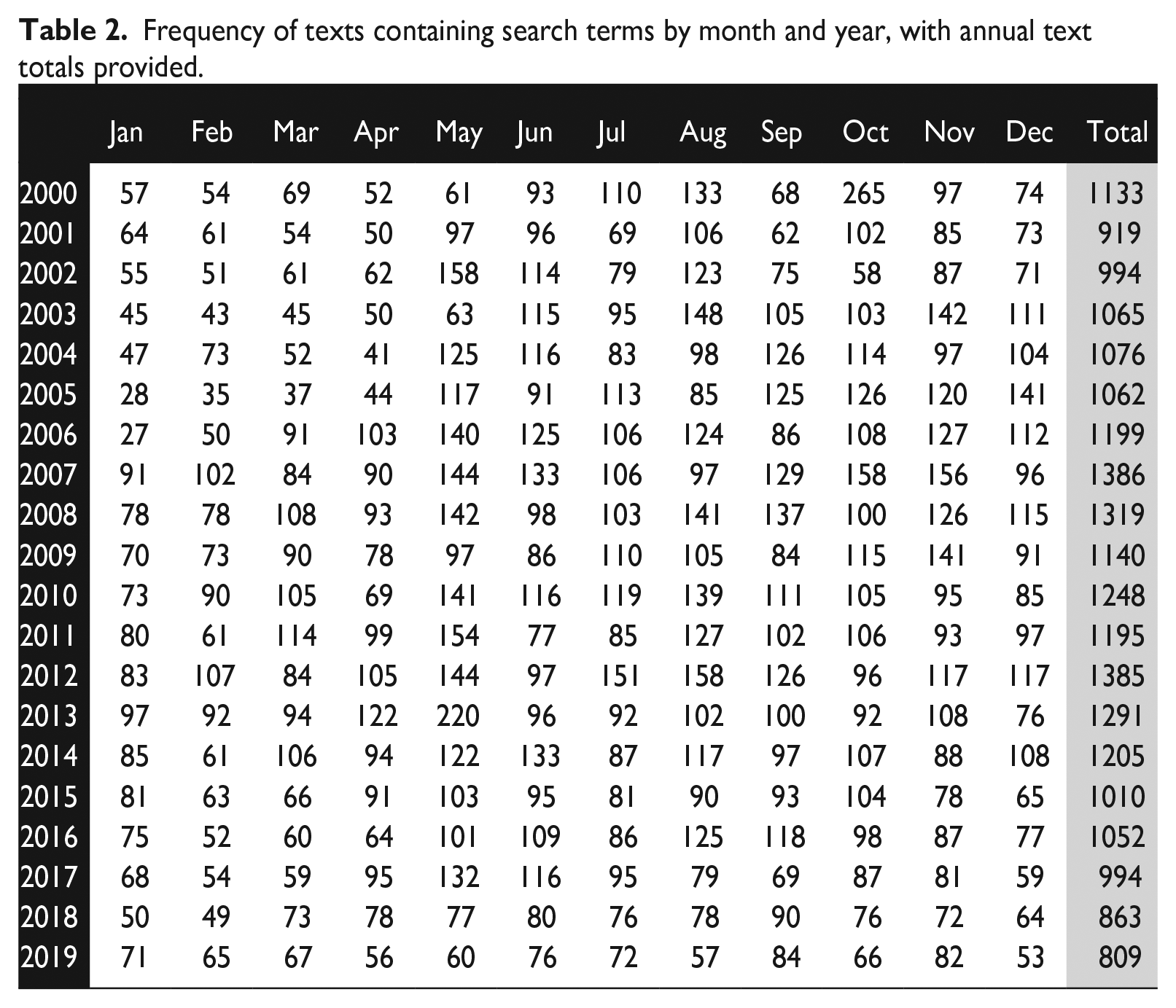
The frequency of articles per month can be found in Table 2, with a mean number of texts/month of 93.10 and a median of 92, with a standard deviation of 30.87. It is also visualised in Figure 1, where the linear trendline shows an overall decline over time in the number of articles retrieved through our search syntax. Figure 1 shows that the years 2007 (1386 texts), 2008 (1319 texts) and 2012 (1385 texts) feature the most articles, and identifies two monthly spikes (October 2000; May 2013). The reasons for the yearly/monthly peaks are worthy of future investigation, but could be related to external happenings such as the Paralympics – ‘one of the rare moments when the media spotlight is on people with disabilities’ (Wedgwood, 2014: 136, italics in original).
Frequency of texts containing search terms by month and year, with annual text totals provided.
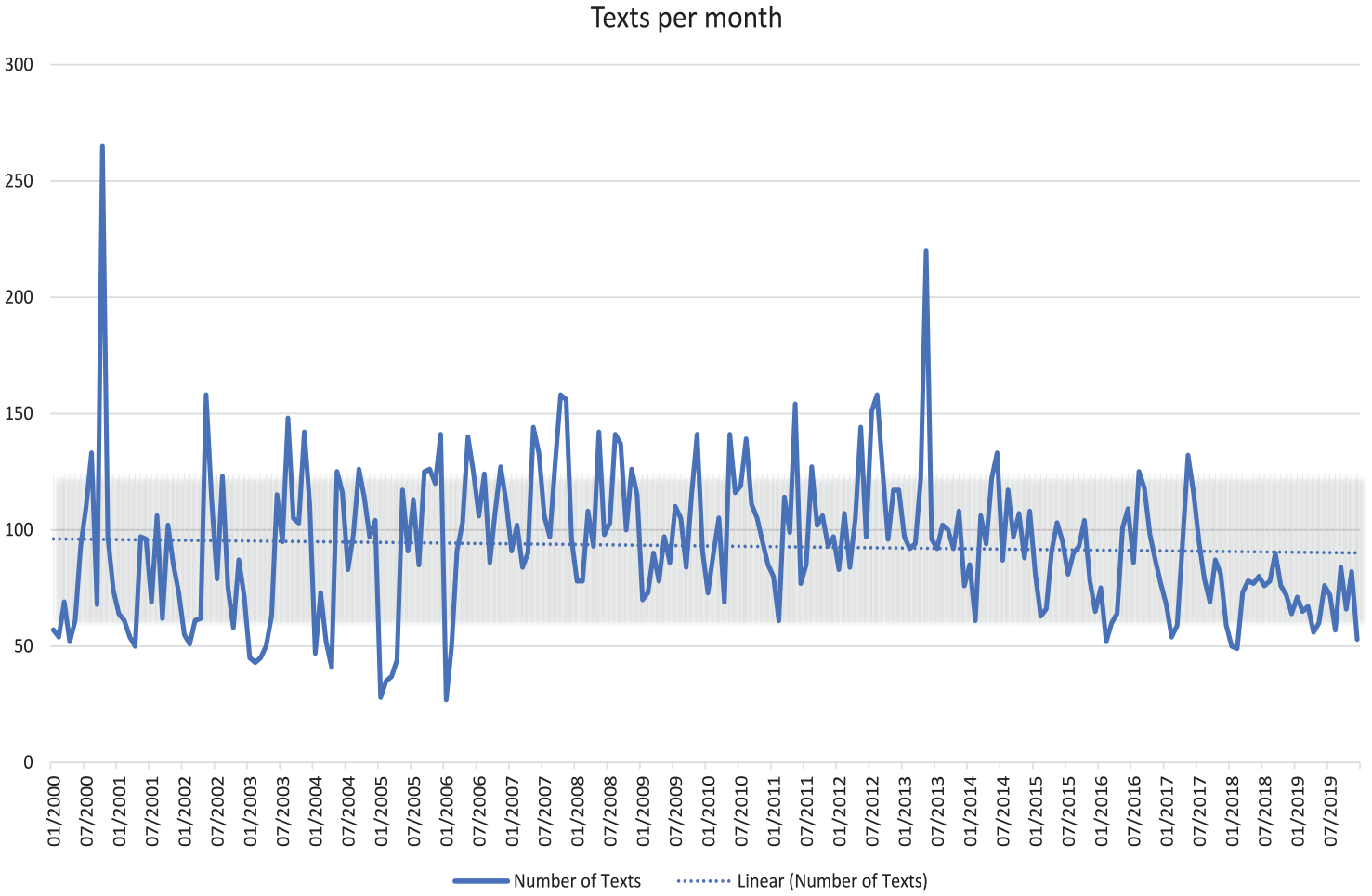
Number of texts per month with monthly values plotted against a linear trendline and superimposed over one standard deviation from the mean.
Keeping this uneven distribution in mind, Figure 2 shows the normalised frequencies (per million words per year) of potential identity-first and person-first naming practices. Figure 2 appears to indicate that the frequency disparity between the two practices that is apparent in the year 2000 (66.91 ppm vs 19.37 ppm) lessens over time until with *disability/ies overtakes disabled. However, these frequencies include instances that do not relate to human actors, with a qualitative concordance analysis of 1268 instances in the year 2000 identifying 3.3% of the prepositional uses and 10.3% of the adjectival uses as nonhuman (e.g. the disabled nuclear attack submarine; disabled car parks). This means that any future analysis of diachronic change needs to incorporate qualitative analysis rather than relying on the form-based results, especially where the differences between the two practices are small. In our linguistic analyses below, we do not integrate diachronic change (for reasons of scope); rather, we treat the corpus holistically.
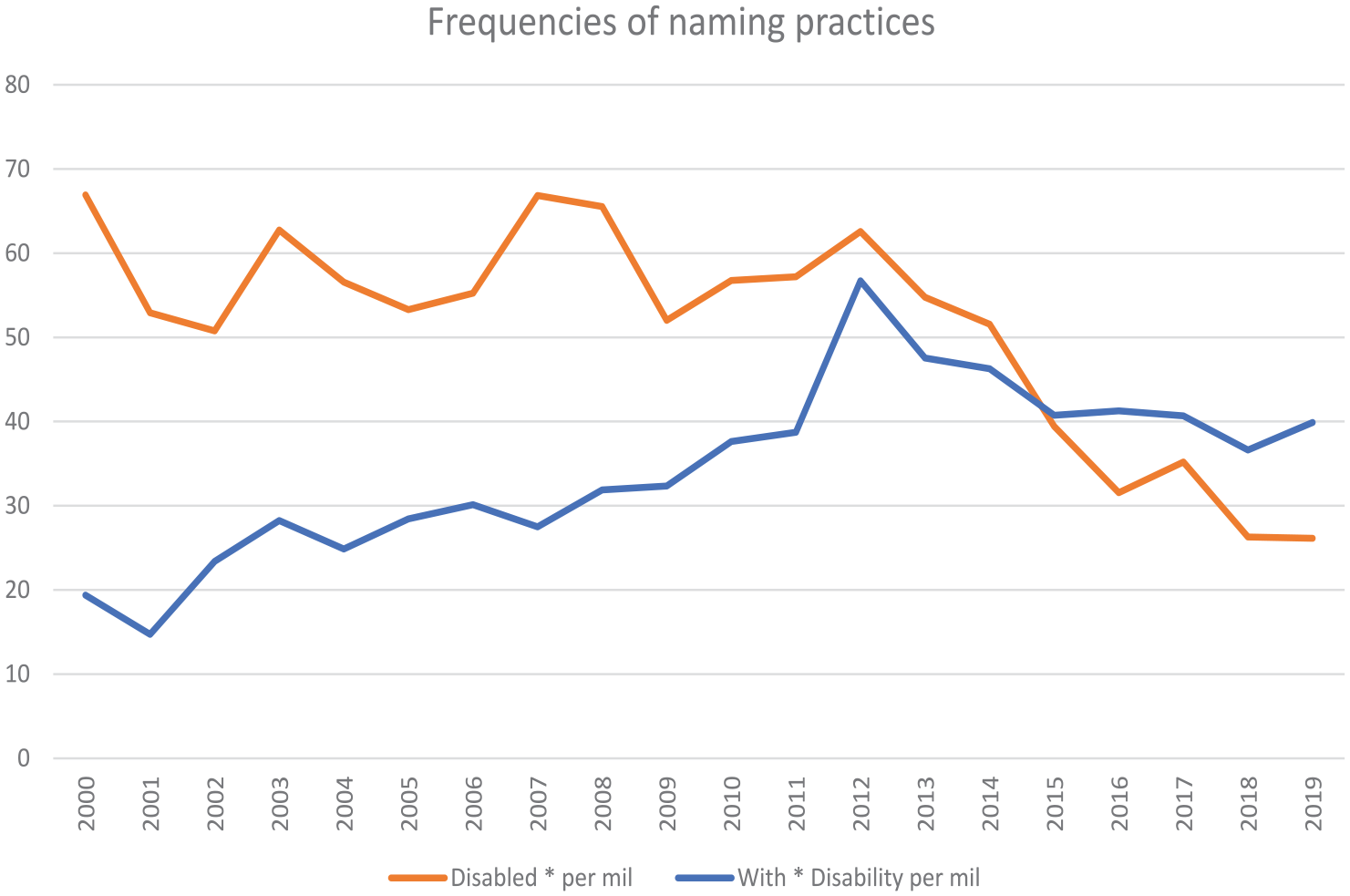
Frequencies of ‘disabled’ and variations of ‘with * disability’ in the corpus, shown as frequencies per million words per year.
Analysis
Head nouns: Social actors
As mentioned above, we analyse the head nouns to identify the types of human referents that occur in each naming practice. To do so, a word sketch was created with SketchEngine for disabled as an adjective, resulting in 124 types with 9375 tokens, with many types having very low frequency. In order to present the most salient results, we took the ‘top’ collocates (where collocation frequency exceeds 70 and LogDice (Rychlý, 2008) exceeds 7). This narrows the results to those found in Table 3: 22 types and 7626 tokens, giving us 81.3% overall token coverage, or a strong indication of the most frequent nominal collocates.
Most salient nouns modified by ‘disabled’ and ‘with disability/ies’ (where frequency exceeds 70 and LogDice exceeds 7), categorised according to van Leeuwen (2008) and sorted in descending order of tokens modified. Underlined collocates are unique to one of the two naming practices.
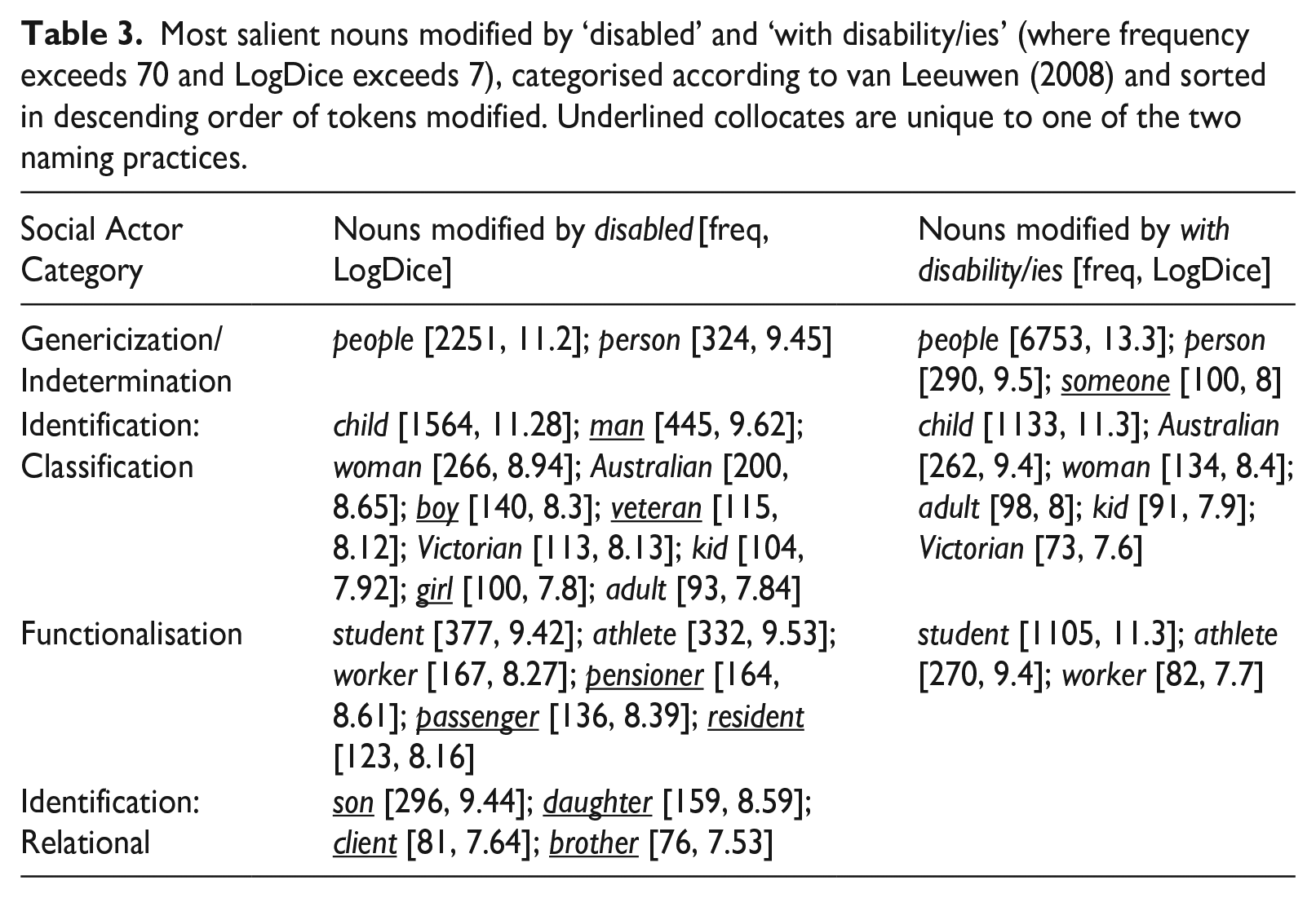
As word sketches cannot contain n-grams over a single word, a slightly different method was used to derive results for with disability/ies. A word sketch was created for the lemma disability and restricted to results within the prepositional phrase with (which represent 42.4% of all occurrences of the lemma). Collocates were then generated, retrieving 170 types with 12,251 tokens. Applying the same thresholds, this was narrowed to 12 types (see Table 3) representing 10,391 tokens (84.82% coverage).
Table 3 shows the categorisation of collocates according to van Leeuwen’s (2008) social actor framework. Genericization is the use of generic or mass nouns that conflate large groups of social actors (e.g. people) (p. 35), whereas Indetermination occurs when social actors are represented as ‘anonymous’ individuals or groups (e.g. someone) (p. 52). In this study, we are predominantly interested in Determination, or naming practices which specify one or more aspects of identity (p. 39). Functionalisation ‘occurs when social actors are referred to in terms of an activity, in terms of something they do, for instance an occupation or role’ in contrast to Identification, ‘which occurs when social actors are defined, not in terms of what they do, but in terms of what they, more or less permanently, or unavoidably, are’ (van Leeuwen, 2008: 42). Identification may be further distinguished via: classification (major societal categories, e.g. age, gender, ethnicity, sexuality); relational classification (personal, familial, organisational relationships); and physical identification (i.e. on the basis of physical/visual characteristics and attributes).
As demonstrated in Table 3, most of the social actor categories and many of the individual collocates are in fact common to both naming practices. The most frequent category of nominal collocates overall is Genericization/Indetermination. This is primarily driven by the large frequency of people collocating with disability/ies (see line 1 for an example). 5 A unique collocate also occurs here (someone with a disability). The resulting Indetermination allows for overarching arguments to be made in the news without specific examples or incorporation of lived experiences. This may have a distancing effect on readership; as in line 2, both the perpetrators of discomfort (too many people) and the recipients of this behaviour (someone with a disability) are Genericized and Indeterminate.
1. Cluster housing continues to segregate people
2. Rather too many people still experience some level of discomfort when they encounter someone
The second most frequent category is Identification: Classification, or identity constructions in terms of age, gender, nationality, etc. This is due in very large part to the lemma child, the most frequent collocate (except for the genericised people) and the one with the highest LogDice score. 6 The items in this category demonstrate a concern with the (young) age of disabled people, in both naming practices. As demonstrated in line 3, naming practices under Identification: Classification to do with young age (i.e. child, boy, kid, girl) could be seen to fall under the social pathology model: children are considered as vulnerable and represented as being in need of social care and support (e.g. early intervention).
3. Steve Bracks must stop cutting early intervention services for profoundly
Other items in this category – namely veteran and Australian – also highlight social care and support. The identity veterans indicates previous military service to the country, and implies disability acquired through this service. In line 4, the presence of an in-group is clear in the use of the plural we and possessive our. An even exchange of social provision for veterans who have, themselves, served (i.e. in contrast to those without acquired disabilities) is an important facet of this representation, indicating ‘deserving’ beneficiaries of care (the support is given in recognition of service to the country). The use of the naming practice Australian also contributes to an in-group identity, and appears in concordance lines which support the social pathology model. However, in lines 5 and 6, we also see the presence of the minority/civil rights model, in a reference to the royal commission launched to investigate treatment of the group (and the associated commissioner’s data).
4. The way we treat our
5. It came on the same day Mr Morrison launched a $527 million royal commission into the treatment of
6. The commissioner’s own data shows immigrant and refugee women, women
Highly frequent and statistically high-scoring noun collocates also sometimes fall under the Functionalisation category, and represent social actors by what they ‘do’. Of the six collocates in this category, the most frequent three can be understood as comprising a sense of agency: worker, student and athlete, and can be understood as directly performing or undertaking work, study, and athletics, respectively. Disabled worker functionalises people who have disabilities and also relies upon the social pathology model to demonstrate the ways in which gaining assistance to meaningfully enter the workforce can create a symbiotic and positive relationship between people and society (line 7). Likewise, disabled students are represented in line 8 as having the right (civil rights model) to access educational opportunities and choices for mutual benefit.
7. AS a
8. The Victorian Charter of Human Rights and Responsibilities, together with state and federal anti-discrimination laws, gives students
An alternative representation that appears with Functionalising naming practices is that of the so-called ‘supercrips’, which ‘tend to form points of contention and conflict between the mainstream media and scholars of Disability Studies and activists’ (Grue, 2015: 110). In line 9, the accomplishment of disabled students in collecting tokens ‘astonishes’ a teacher. In line 10, we see the sporting supercrip representation, to do with remarkable and impressive physical achievement (Grue, 2015: 110). Athletes themselves may not necessarily consider the supercrip representation as negative, while disability activists do (Wedgwood, 2014: 137). The supercrip representations positively evaluate disabled people, but this is against a background of amazement over achievement ‘in spite of’ disability. In addition, they do not represent impairments as examples of human variation but rather presuppose that these should be the source of exceptional achievement (Grue, 2015: 12). This achievement is still sometimes contrasted against the achievements of those without disabilities (line 11). In line 10, however, the achievement is presented in relation to other disabled sportspeople. For further discussion of the complex phenomenon of sports and disability, see for example Smith et al. (2015) or Wedgwood (2014), who also presents an overview of international news coverage of the Paralympics.
9. With each of its 49 students collecting an average 85 tokens, the school has more than 4200 tokens. Merriang teacher Edith Gray said everyone at the school, which teaches
10. He won this year’s Laureus Sports award in Monaco for the most outstanding
11. But while the king of the track has indicated he will retire after the 2017 London world championships, Holt has in mind the 2018 Gold Coast Commonwealth Games, where events for athletes
The remaining three nominal collocates in this category – pensioner, passenger, resident – are arguably more ‘passive’ in nature. These people collect a pension, ride (as opposed to operate) vehicles, and reside in homes. Concordance lines associated with these collocations correspond to the social pathology model, but indicate perpetual failures of social support, creating an overall pattern of vulnerability. In the case of disabled passengers, the absence of proper equipment or the breakdown of accessible transportation options (e.g. trains, taxicabs, or lifts, as in line 12) stops free movement. The overlapping vulnerabilities of age and impairment indicated by 76-year-old disabled pensioner leads to criminal scenarios where financial and physical harm befalls the social actors (e.g. line 13). 7 Resident is somewhat polysemous – in the corpus, disabled resident may refer to general residency in a geographical area or to more specialised residency in care homes. The former sense leads to discourses around local budgeting and finance, whereas the latter sense occurs in nearly all cases with reporting on physical, emotional, and sexual assault taking place in residence (see line 14).
12. Stations built under the previous government, such as Laverton, did not have pedestrian ramps – leaving
13. Police yesterday revealed a 76-year-old
14. Kumar also escaped sacking after he was caught twisting the nipple of a
The sole social actor category (within the most frequent/salient results) that was only found with one naming practice (adjectival disabled) is Identification: Relational. Results here lean strongly towards familial relation (son, daughter, and brother collocate 531 times combined) with a minority pattern showing a business or service arrangement (client collocates 81 times). It is noteworthy that parent, husband, wife, or partner do not appear in Table 3, indicating a relative neglect of such roles in media texts, which may align with stereotypes about the presumed capabilities of disabled people. A number of other patterns can be determined upon further examination. First: the presence of Identification: Relational naming practices indicates that the lived experiences of disabled people are being reported and reflected through the lenses of their family members and others rather than with their own voices; for instance, a parent may speak out against poor working conditions (line 15). In an expansion of the supercrip model, we see direct evidence of ‘strength’ being drawn from disabled relatives (line 16). The social pathology model may also be extended by reporting on the lived experiences of the social care workers, for example indicating overwork and underpay (line 17).
It can also be noted that gendered representations are disproportionally present: son has a collocational frequency of 296 [LogDice 9.44], whereas daughter has a collocational frequency of 159 [LogDice 8.59]; brother has a collocational frequency of 76 [LogDice 7.53] whereas sister has about half this frequency and falls below our cut-off thresholds for consideration. This may reflect the gender imbalance within some highly-reported upon impairments/neurological differences (e.g. autism in boys and men) or the greater media attention paid to male athletes (Kemble, 2020). It might also replicate the higher frequency of boys/men than girls/women in a patriarchal society overall – that is ‘male bias’ (Baker, 2014: 73). Where daughter does occur, this is much more frequently invoked to indicate extreme vulnerability, that is the overlap between age, gender, disability and potential attacks from relatives (line 18).
15. June Herron, whose intellectually
16. Manly enforcer Steve Matai stood in the middle of Brookvale Oval yesterday and spoke about the strength he draws from his
17. Melbourne City Mission worker Lisa Reidy said the prospect of more pay was a relief. She spent shifts of up to 12 hours looking after
18. Officials are investigating allegations that a man locked up his two mentally
In sum, the analysis of nominal collocates showed that such nouns commonly contribute to the social pathology model and that representation is gendered. Some collocates lend themselves more to the supercrip model, although the stress appears equally placed upon those being ‘inspired’ (e.g. readers, family members) than those doing the ‘inspiring’ (i.e. disabled people). No strong differences were identified between the two naming practices.
Modifiers: ‘kinds’ of disability
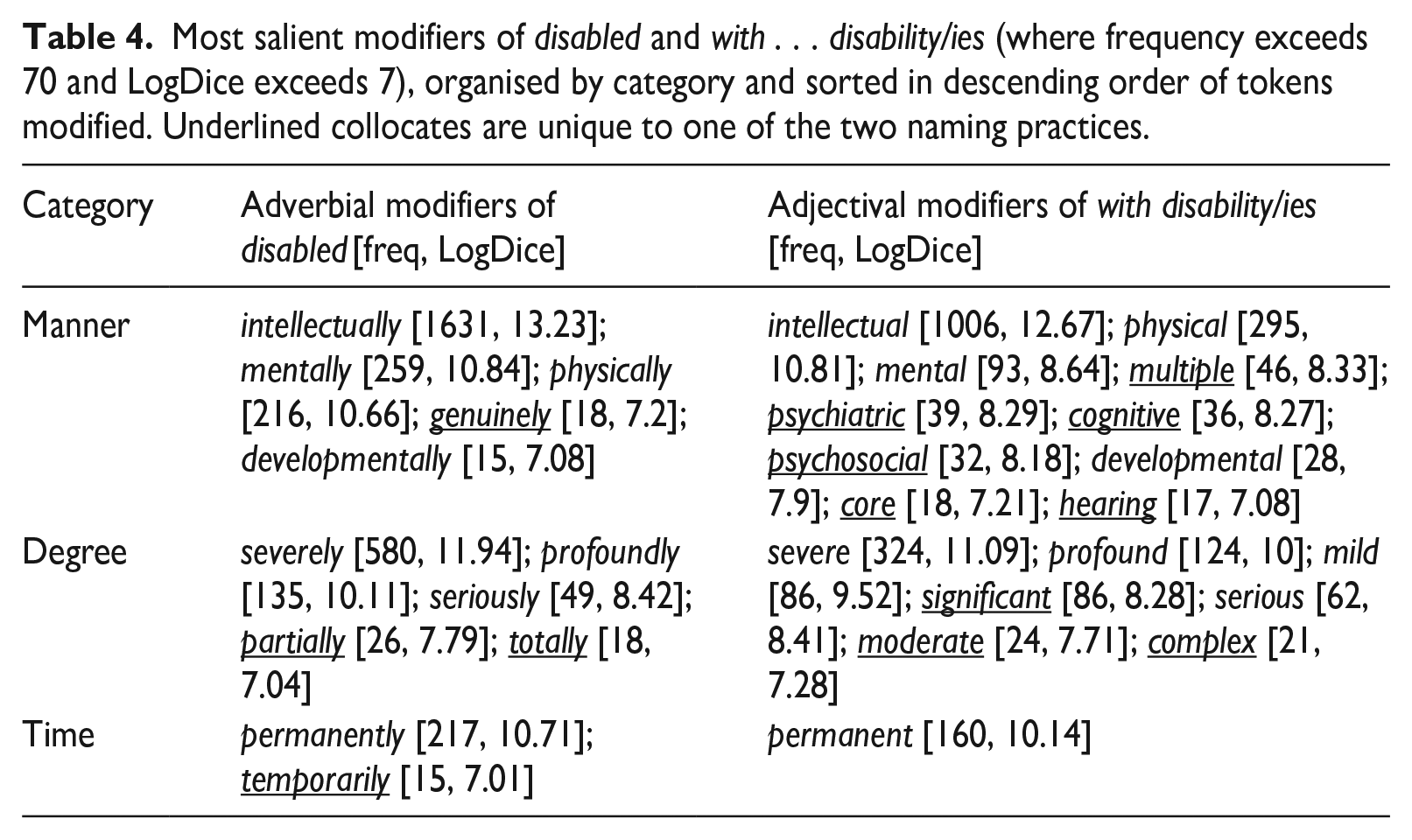
Above, we have focussed on types of social actors by examining head nouns. In contrast, modifiers of the identity element provide additional information about the disability that is referenced. Due to the differing grammatical classes of the identity element, these modifiers are adverbs in the case of disabled and adjectives in the case of with disability/ies. 8 These were categorised into general categories associated with modification (e.g. manner, degree, time, place). Table 4 demonstrates that the most frequent type of modifiers for both naming practices are those which indicate manner [frequency 3767], followed by degree [1675], then time [451]. It must be noted that some adjectives (mental and physical in combination with with. . . disability/ies) are part of the search string for retrieving corpus files. However, their counterparts mentally and physically do appear as modifiers of disabled, uninfluenced by search syntax. Removing tokens of mental and physical from with disability/ies maintains the overall symmetry and proportionate frequency of patterns in modifier category preference between the two naming practices.
Most salient modifiers of disabled and with . . . disability/ies (where frequency exceeds 70 and LogDice exceeds 7), organised by category and sorted in descending order of tokens modified. Underlined collocates are unique to one of the two naming practices.
Manner
Modifiers of manner indicate categorisations of disability (i.e. intellectually, mentally, physically, developmentally); and there seems to be a greater variety of collocates associated with disabilities. We first discuss those items which are shared across both naming practices. Concordances containing collocates intellectual/ly, mental/ly, and developmental/ly fall under the social pathology model (e.g. lines 19 and 20), indicating social care needs or highlighting shortcomings in provisions. By contrast, collocation with physical/ly adheres more frequently to the supercrip model (e.g. line 21). This indicates that people living with physical disabilities are more likely to be represented as ‘inspirational’, overcoming their disabilities to perform amazing feats. This contrasts with those living with intellectual, mental, and developmental disabilities, who are more likely to be represented as in need.
19. A total of 3184 intellectually
20. Like thousands of other mentally
21. In a fortnight’s time, the cream of Australia’s finest physically
Unique modifiers of disability are much more specific than those shared between the two naming practices, that is psychiatric, psychosocial and cognitive, compared to the more general umbrella terms intellectually and mentally. Further specifications also appear uniquely here, as people with core disabilities are represented (meaning they require assistance with self-care, communication and/or mobility). It is also the only place where we see a construal of precise sensory impairment (hearing) and associated issues with access (in the absence of captioning). With collocates of disability, we also see a unique pattern of living with multiple disabilities (line 22), and the particular experience that this represents. As above, the social pathology model is the most prevalent in relevant concordance lines.
22. David Green, a former public advocate, said the process of deinstitutionalising patients had created new problems and had not worked well for people with dual or multiple
A further connotation of the social pathology model emerges when analysing the sole unique manner modifier of disabled, namely genuinely. This collocate demonstrates a construction of disability wherein only some people who would qualify for access to benefits are seen as deserving recipients – in line 23 in a subjective claim presented in first person but linked to the wider community of ‘decent people’.
23. Like all decent people, I want to support the genuinely
Degree
Modifiers of degree are the second-most frequent category of collocates, spanning the full range from profoun/dly to partial/ly. Collocation with profoundly tends towards the medical model, intersecting with criminal/legal discourses (line 24). The social pathology model is also highly present; care for people living with profound disabilities is constructed as the (failed) responsibility of the government or conveyed through the voices of caregivers. The only instances where first-person narratives can be seen are cases of partially disabled (e.g. line 25, but see footnote 7 in relation to the ambiguous identity of the referent); in these concordance lines, people describe their own experiences and struggles, usually within the social pathology model.
24. Another newborn boy was left profoundly
25. I am an 80-year-old, partially
Time
The least frequent (but still statistically significant) pattern is that of modifications construing time. The concept of permanence appears in both naming practices. In the case of permanently + disabled, concordance lines show two main patterns. The first is a reconstruction of how a person came to be living with a disability (see line 26). While all cases within the Time subcategory draw from the medical model of disability, concordance lines giving a narrative of disability are more social in texture and would lead to reader engagement with the subjects. However, the more frequent pattern in permanent/ly is a more clinical or legal definition of ‘total and permanent disability’ related to access to services, for instance government resources (line 27) and particularly insurance (line 28). These cases show straightforward constructions within the social pathology model. Such language may originate in the relevant legislation at place in different moments of Australian history, but to ascertain this, one would have to follow ‘the textual trail’ of these phrases (Grue, 2015: 77).
26. Nine-year-old Melissa Wilson suffered a severe brain injury and is now permanently
27. Since 1983, the state Government has paid 50% of taxi fares up to $25 a trip for people
28. Total and permanent disability insurance pays a lump sum if you’re totally and permanently
Disabled has one unique modifier of time: temporarily, but of the 15 concordance lines which include this collocation, only five relate to disabled people. Notably, eight instances reference the disabling of nonhuman entities (see line 29). This points to the preponderance of such usage occurring with the form disabled, confirming our claim above about the importance of qualitative analysis.
29. The patient information that was hacked and temporarily
In sum, the analysis of modifiers shows no strong differences in broad categories of modification (manner, degree, time), but unique modifiers do occur and depend on the form of the lemma (e.g. specific modifiers with plural disabilities). Many relevant concordance lines adhere to the social pathology model, although physical disability is also associated with the supercrip model. First-person narratives and reconstructions of how a person came to be living with a disability appear to be rare.
Coordinating structures: Associations with disability
A final perspective of disability representation is provided by examining coordination. The use of the coordinating conjunctions/coordinators and and or link together linguistic items (conjuncts), indicating similarities to newspaper readers. By creating word sketches of disabled + and/or and disability + and/or, we come to a better understanding of the associations of this group/category. As above, we applied cut-off points to arrive at the most frequent and statistically significant items (frequency ⩾15 and LogDice ⩾ 7). Table 5 contains the results of this down-sampling (excluding count/comparison with other, many, first). All relevant words in the table are ‘unique’, given the different word classes involved, but the semantic categories for the conjuncts can be compared.
Most salient conjuncts of disabled + and/or and disability and/or (where frequency exceeds 15 and LogDice exceeds 7), categorised by semantic domain and sorted in descending order of coordinating tokens.
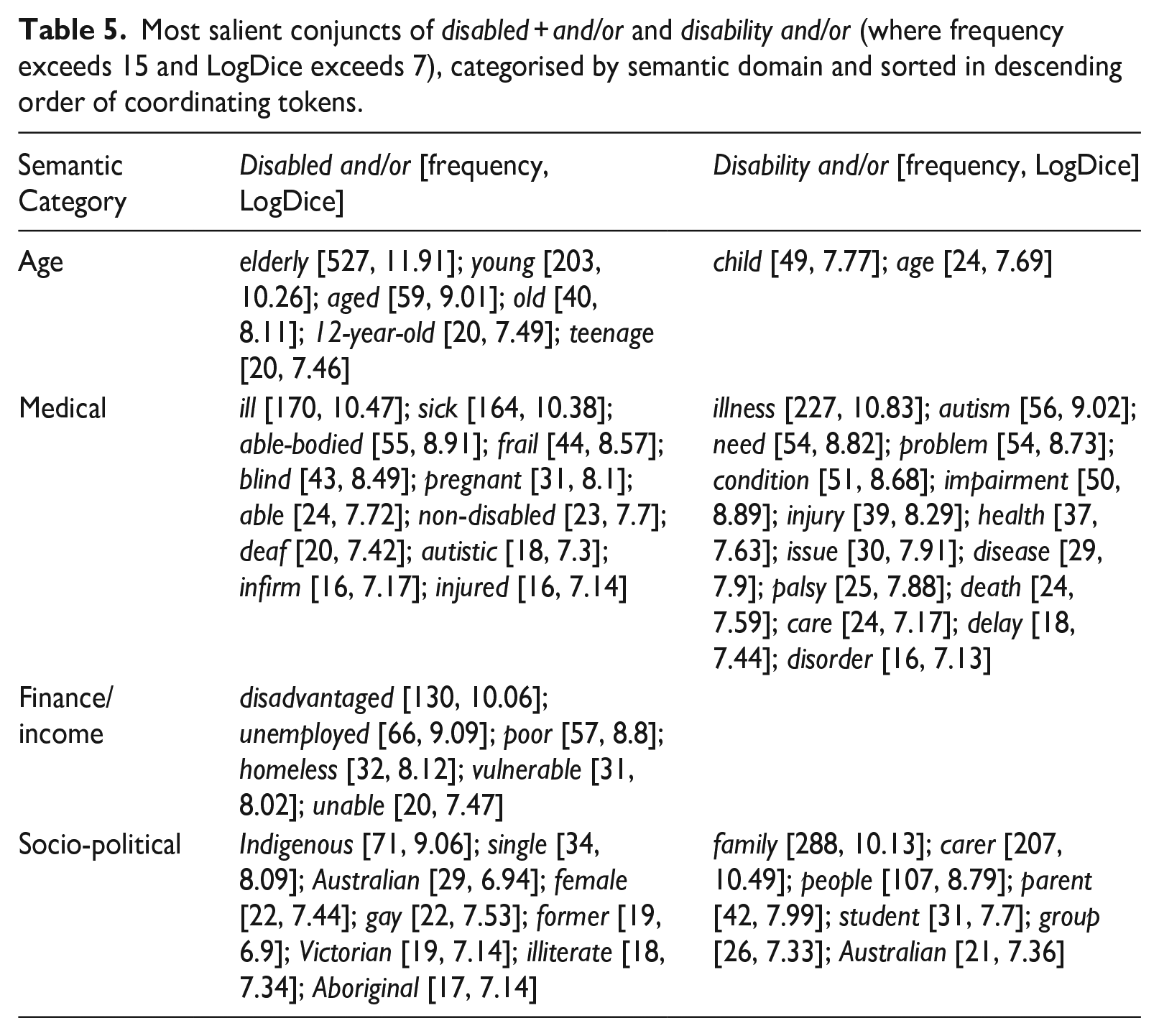
As can be seen, there is overlap in three of the four categories, concerning associations with age (e.g. elderly; child), medical condition (e.g. ill; injury) and socio-political group/status (e.g. gay; carer) that occur for both naming practices. Space does not permit a full analysis of concordance lines here, but what is clearly evident across all three shared categories are associations with vulnerability, inability, and/or negativity. Medical associations are also strong, with many different words identified for both practices. The category unique to disabled – finance/income – is similarly associated with vulnerability, with adjectives such as disadvantaged, poor, and homeless. Future work is needed to consider in more detail how these categories occur in specific contexts, and their relationships to models of media representation. However, it seems safe to hypothesise that the social pathology and medical models are clearly relevant.
Conclusion
Researchers have identified deeply embedded ableist assumptions in contemporary Australian society (Johnson and West, 2021: 302), while the Royal Commission into Violence, Abuse, Neglect and Exploitation of People with Disability is uncovering widespread and systemic discrimination and negative attitudes across individuals and institutions (Johnson and West, 2020). Recognising the important role of mass media for disability experience and associated audience ideas and beliefs (Ellis et al., 2020: 1–2), this article has presented an interdisciplinary study of disability in Australian newspapers, contributing to bringing together the fields of discourse analysis and Disability Studies (Grue, 2015: x). We have shown how one can combine corpus linguistic techniques (e.g. word sketches) with Critical Discourse Analysis of noteworthy elements—in particular linguistic structures (e.g. head nouns, modifiers, conjoints)—and with models of news media representation (e.g. supercrip model). This combination of approaches is effective for large-scale insights into ‘the ways in which disability [. . .] is constructed, administrated, and policed through the socially and bureaucratically embedded use of language’ (Grue, 2015: 5). The starting point of our analyses was a widely-recognised distinction with a long history, namely that between identity- and people-first language. Given the narrow focus of this analysis, further research is clearly necessary – for example in relation to Critical Disability Studies’ contemporary understandings, models, and definitions of disability, ableism, 9 and disablist processes (e.g. Johnson and West, 2021; Thorneycroft and Asquith, 2021). This could include analysis of longer stretches of text to study discourses that constitute or reproduce disability as ‘oppressive’ or ‘pathological’ identity/category (Grue, 2011: 535; Thorneycroft and Asquith, 2021: 142) or analysis of discourses of disability formation, that is, of the locus of disability and its interactions with various causative factors (social, cultural, economic, political, biophysical, etc). For a fuller picture of newspaper representation, analysis of news photography is also required.
Overall, we found many similarities between the two naming practices, in relation to all three types of analyses: the types of social actors that occur, the categorisations of impairments/disabilities that are referenced, and the associations that are established with disability. This could indicate that the syntactic structure used in the naming practice is less important than the elements that fill the slots in the structure and the wider co-text in which the structure is used. At the same time, some linguistic differences likely derive from the naming practice used. For example, the form disabled can be associated with nonhuman referents, which is not the case for with disability/ies. The form disabilities also appears to enable a range of specific modifiers such as multiple. Overall, the qualitative discourse analysis of concordance lines identified many negative usages, including the prevalence of the social pathology model. Other models (medical, supercrip) were less apparent in the concordance lines analysed. The ‘progressive’ cultural pluralism model was not identified at all, while the minority/civil rights model was very rare.
Although we did not analyse full-text articles, these results suggest a highly conventionalised disability representation, with a focus on social disadvantage. It is likely that the journalistic context constrains the use of particular models in news stories and opinion texts. At least some news professionals believe that ‘disability topics tend not to make for exciting news, and that structural analysis does not make for good copy’ (Grue, 2015: 101). News stories may use references to vulnerability to discursively establish newsworthiness (Bednarek and Caple, 2017), while opinion texts may use vulnerability to emotionally engage readers or for advocacy for better services. Further, to capture media attention it may be necessary to appeal to common journalistic narratives/figures such as the ‘supercrip’ (Grue, 2015: 109–110). At the same time, results also appear to align with the underlying negative connotation of the word disability and with a common discourse that constructs disabled people as a negative group identity (a marginalised minority or oppressed class), and a general correlation of disability with disadvantage due to how the category is defined (Grue, 2015: 55, 89, 94, 95). In general, it is important to point out that there is a need for balance and diversity regarding the use of different models and that social-relational or bio-psychosocial approaches to disability are often preferred (as discussed earlier). 10
Moreover, both person- and identity-first language can be used to differentiate disabled from nondisabled people, and dichotomies such as these are used for Othering (e.g. Thorneycroft and Asquith, 2021: 147) and perpetuate ableism (Johnson and West, 2021: 289), 11 even as such categorisation may be necessary to determine what we need to do to best serve and protect all people (Vehmas and Watson, 2014). In addition to which naming practices are used, context also matters, including not just how the phrase is used in its co-text, but also who uses it and for what purpose.
To conclude, this article has demonstrated that corpus linguistic analysis can offer valuable insights and can make a novel contribution to disability and media research. Language use in public contexts such as the media will likely grow in relevance, as the covid-19 pandemic has not only brought disproportionate physical and symbolic violence to disabled people, but is also creating more disabled people (Thorneycroft and Asquith, 2021). We therefore end with the recommendations from Media Diversity Australia (2021), which emphasises that the social mode – wherein disability is considered a part of human diversity – ‘identifies several barriers to the collection of data from reporting tools; for example, people with disability may communicate differently, have barriers to accessing mainstream emergency services (such as the police), and face discrimination when giving evidence or telling their story’ (p. 21). They present ‘golden rules’ to assist in overcoming rather than magnifying these barriers; the primary two are: to include the voice of a relevant person (‘nothing about us without us’); 12 and to ask for any clarifications or for personal preferences (Media Diversity Australia, 2021: 24). We leave the last words to Shakespeare (1994), who notes the importance of analysing language and representation: ‘People with impairment are disabled, not just by material discrimination, but also by prejudice. This prejudice is not just interpersonal it is also implicit in cultural representation, in language and in socialization’ (p. 296).
Footnotes
Declaration of conflicting interests
The author(s) declared no potential conflicts of interest with respect to the research, authorship, and/or publication of this article.
Funding and Acknowledgments
The author(s) disclosed receipt of the following financial support for the research, authorship, and/or publication of this article: The authors acknowledge the technical assistance of Chao Sun of the Sydney Informatics Hub, a Core Research Facility of the University of Sydney. We are grateful to Cardiff University and to the School of Literature, Art and Media at the University of Sydney for funding Amanda Potts’ 2022 research visit at the Sydney Corpus Lab ( ). We thank the School of Humanities at the University of Sydney for their financial support for this study and Georgia Fagan and Susannah McNally for accessibility assistance. We would also like to thank Gwynnyth Llewellyn and Gerard Goggin for reading and commenting upon an earlier version of this article.