




Abstract
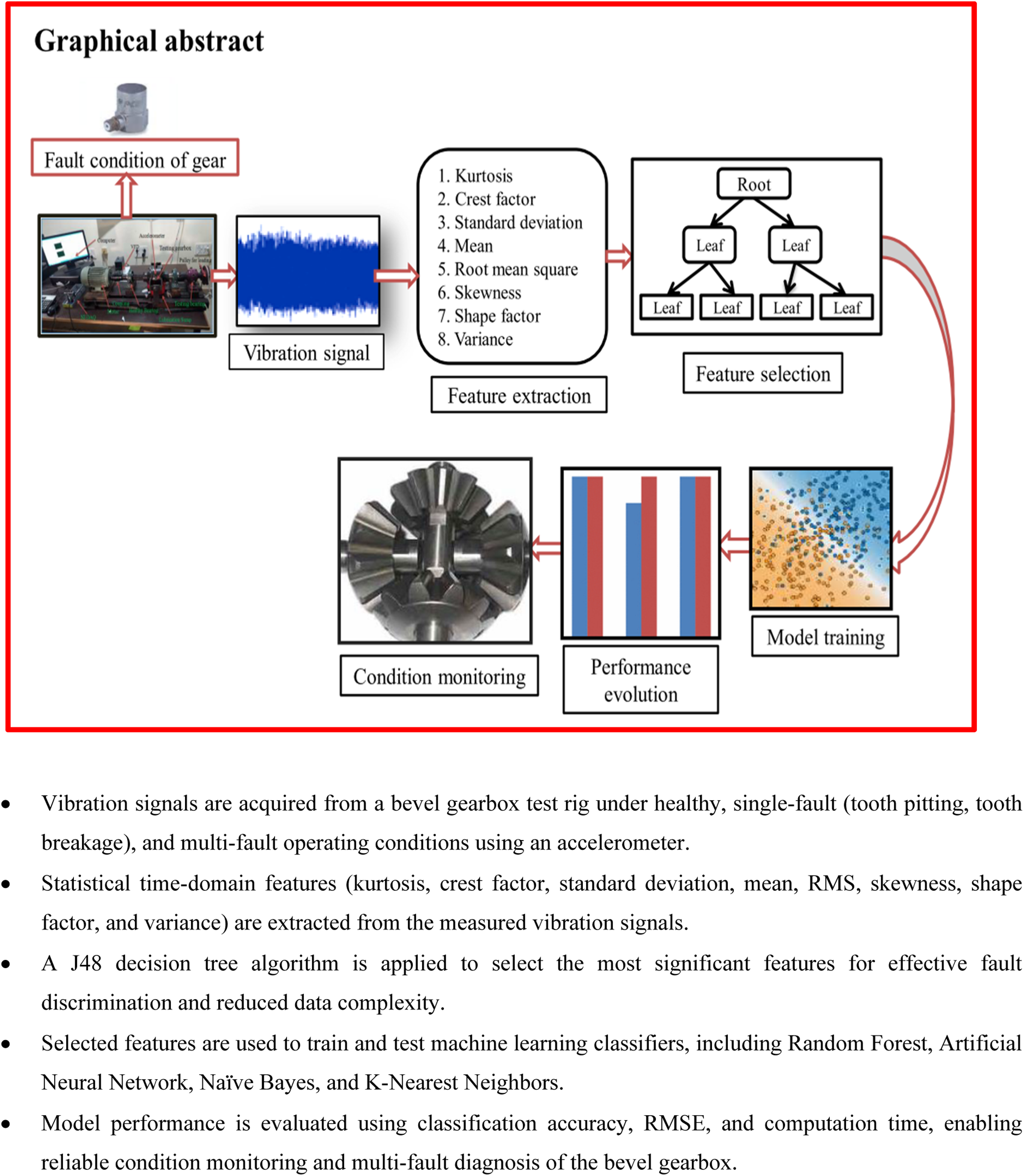
Accurate diagnosis of multi-fault conditions in gearboxes is critical for ensuring the reliability and safety of rotating machinery operating under complex industrial environments. However, overlapping vibration signatures associated with simultaneous faults pose significant challenges to conventional condition monitoring approaches. Unlike existing studies that focus mainly on single-fault scenarios, this work provides a practical and experimentally validated machine learning framework for accurate multi-fault diagnosis of bevel gearboxes. This study presents a vibration-based machine learning framework for effective multi-fault diagnosis of a Bevel gearbox using decision tree feature selection. Vibration signals were acquired from an experimental bevel gearbox test rig under healthy, single-fault (tooth pitting and tooth breakage), and combined multi-fault conditions. Statistical time-domain features were extracted from the measured signals, and the most discriminative features were selected using a J48 decision tree algorithm to reduce data redundancy and improve classification efficiency. The selected features were subsequently used to train and evaluate machine learning classifiers. Model performance was assessed using classification accuracy, root mean squared error, and model construction time. Among the evaluated classifiers, the Random Forest model achieved the highest diagnostic accuracy of 96.95% with the lowest root mean squared error of 0.0382, demonstrating superior robustness in distinguishing multi-fault gearbox conditions. The results confirm that decision tree–assisted feature selection combined with ensemble learning provides a reliable and computationally efficient approach for bevel gearbox condition monitoring and multi-fault fault diagnosis.
Keywords
Get full access to this article
View all access options for this article.