




Abstract
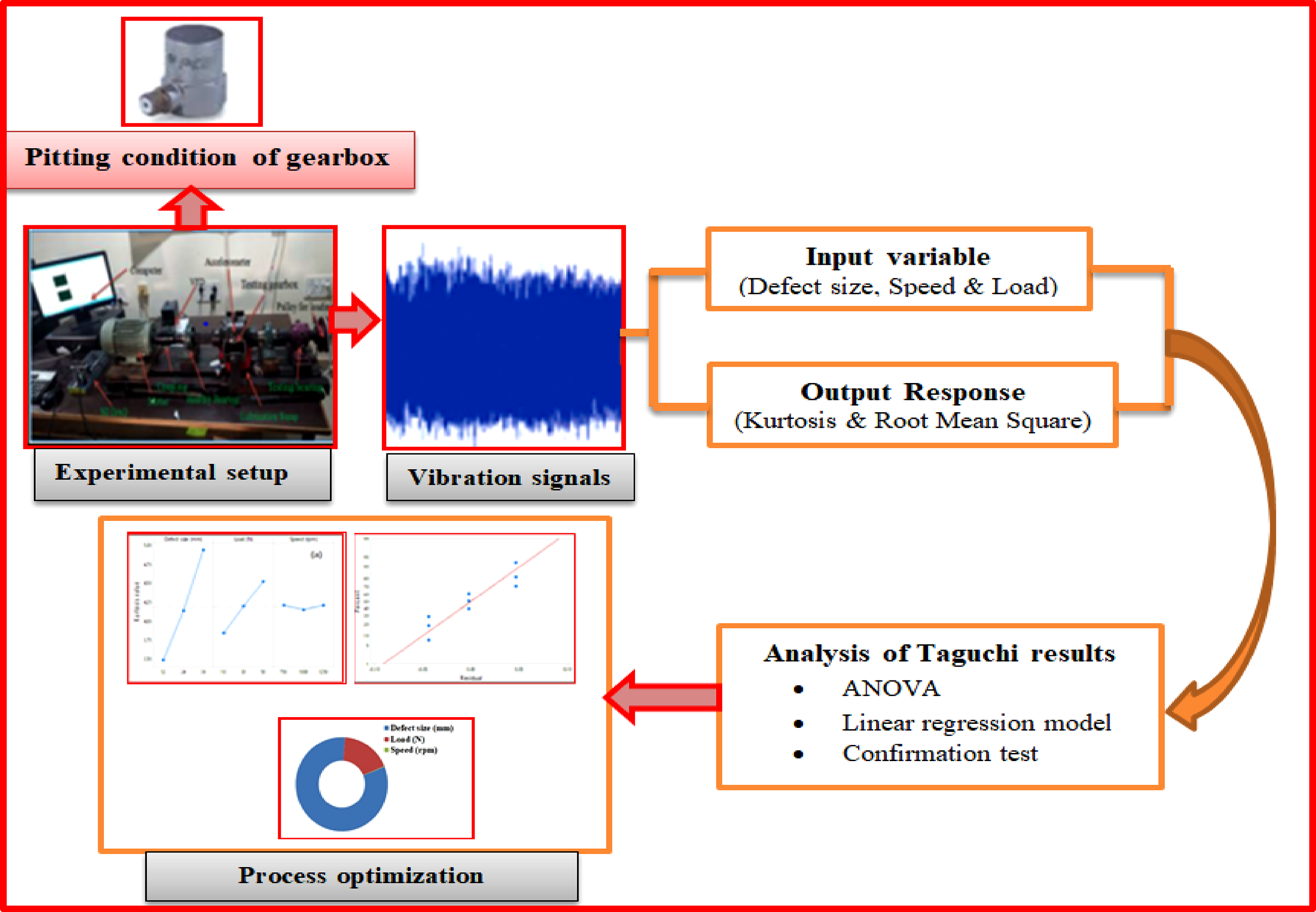
The gearbox system faults are the main causes of the failure of the rotating components, therefore dynamic gearbox features are necessary. The article attempts to clarify the gearbox’s dynamic characteristics as the consequence of the preliminary pitting circumstance. Three operating variables such as shaft loading, shaft speed and defect size were selected to observe the parametric effect and the experiment was conducted according to Taguchi L9 orthogonal arrays (OA). A dedicated experimental test rig has been developed for experiments with different speeds and loading conditions to implement and simulate industrial-based applications. The accelerometer was used to record the vibration signals while simulating faults. The response parameters used to monitor the gearbox conditions comprise time-domain indices notably kurtosis and root mean square. Investigating the impact of defects on vibrations is made easier by the interplay of defect size, load, and speed. To determine the relationship between the inputs and outputs of a physical system, statistical analytic approaches have been employed. Analysis of variance has been shown to be a dependable technique for assessing the key elements connected to the gearbox’s vibration. It was revealed from the Analysis of variance table that dynamic characteristics in terms of response performance were significantly influenced by defect size. To mitigate the dynamic features and prolong the life of rotational systems, it is recommended that these optimal input parameter conditions might be applied to gearbox fault diagnosis.
Get full access to this article
View all access options for this article.