



Abstract
The article examines the formal and thematic manifestations of seriality in the Netflix series La Révolution, which justifies the revolutionary outbreak in a counterfactual plot with a viral outbreak that turns the nobles into zombie-like monsters. While, on a macrostructural level, the generic frame of alternate history promotes the serial character through the varying repetition of the historical event, the microstructural level of the narration evokes seriality by exponential contagion and spread of the disease as well as an increasing spiral of violence. First, the focus is on the representation of the aristocrat as a monster in pamphlets and caricatures of the revolutionary era. Subsequent to a contextualization of seriality in the age of streaming platforms, the analysis then discusses the medium-specific implementation of the epidemic discourse based on selected sequences of the series. Finally, it gives a hypothetical outlook on the implied motivations regarding the fictional development of the revolutionary event: through its contrasting exaggeration, the alternate-historical narrative can shed new light on the real historical events.
Keywords
Prologue: post-/transhumanism in series
Philosophical discussions on the essence of being human have always been one of the most prominent areas of interest of humankind. Concepts of the posthuman and transhuman have repeatedly contributed to these discussions in a concentrated form, and they have stimulated controversial debates since the 1980s (Braidotti, 2019; Hottois, 2017; Litwa, 2021; MacCormack, 2012). Within the current film and series landscape, productions with protagonists beyond the human – be they vampires, cyborgs or mutants – have a firm place (Falkenhayner et al., 2018: 1–16; Hoquet, 2014: 99–118); productions inspired by post- and transhumanism are currently booming on the streaming platform Netflix as well, ranging from free adaptations of old myths, such as the British miniseries Dracula (2020), to original science fiction innovations, such as the US-American serial Altered Carbon (2018–2020) (Blanchemain-Faucon, 2020: 46–72; Ferreira, 2020: 90–104). The theme of hybridity, which is centrally connected to posthumanism and transhumanism, seems to enter into a fruitful symbiosis with the theme of a virus outbreak in serial releases of the last 10 years and the most recent period marked by the corona pandemic. This observation is evidenced by pay-TV and video-on-demand productions such as the American zombie series The Walking Dead (2010–) and Z Nation (2014–2018) or the Danish post-apocalyptic dystopia The Rain (2018–2020).
This group of recent productions also includes the progressive French Netflix serial La Révolution (2020), which transposes posthuman existence and outbreak event into the late 18th century and combines both themes with an alternate-historical version of the ‘true’ origins of the French Revolution of 1789: according to the fictional narrative basis, the conspiratorially veiled trigger of the revolutionary events, which is remembered differently or not at all today, is in reality to be found in a viral contagion of ever larger parts of the aristocracy, which, in epidemic spread, transforms the nobles into truly blue-blooded, ‘super’-human beings with zombie- and vampire-like traits, who subsequently feed on the people in the truest sense of the word: accordingly, the series takes the historical metaphor of the nobleman as a parasitic being and monster on the eve of the revolution literally and transposes this monstrosity, in accordance with the Latin etymology of the word (according to the Petit Robert, a monster is a ‘prodige qui avertit de la volonté des dieux, qui la montre’ [emphasis by the author] Robert, 2007: 1629), to the visible sphere by demonstrating it in the audiovisual medium in a way that is clearly recognizable for the series audience.
The following analysis of the series focuses on the connections between epidemic discourse and serial narration. In this context, the central motif of virus infection and transmission functions as a link between the levels of discours and histoire. On a formal level, it will be shown that the narrative structure in the special case of La Révolution – unlike other pandemic or epidemic narratives (Völkl et al., 2020: 321–344) – corresponds less to the closed form of the classical drama, but rather follows the open, potentially infinite seriality of the chosen medium. On the content level, it will be demonstrated how violence and irrationality under the sign of the posthuman-monstrous aristocrat spread epidemically and culminate, as the series anticipates the course of history, in the ‘uprising of the people’ and, eventually, in the Terreur. In the world of the series, both driving forces of the noblemen are veritable antipodes to and in the so-called Siècle des Lumières, in which Joseph Guillotin as a young doctor forms the rational part.
The analysis is divided into five main parts: First, as a cultural–historical background for its portrayal of the aristocrat as a monster, the series is contextualized on the basis of contemporary text and image documents from the revolutionary period, primarily from the polemical and propagandistic pamphlet and caricature production. Second, the concept of seriality, which is fundamental to every (television) series, is discussed in its switch from the predetermined periodic transmission of traditional broadcasters to the self-determined streaming consumption on platforms such as Netflix, and its affinities to posthuman issues are revealed. Third, the narrative macrostructure of La Révolution is defined under the generic aspect of alternate history and counterfactual narratives. Fourth, these insights form the basis for medium-specific and microstructural discussions on the complex of the viral spread of the blue blood, including the monstrous manifestations within the degenerate French aristocracy and the counter-reactions of the medical staff as well as the resistance fighters from the Third Estate. Fifth, in accordance with the speculative impulses of the genre, a brief outlook will eventually be given on the possible revaluations and reinterpretations of the historical course of the French Revolution beyond the action of the series, which, with the end of the first season – and therefore of the entire series – refrains from narrating the events after 1789, but has clearly prepared them in terms of perspective.
The aristocrat as a monster in pamphlets and caricatures in (pre-)revolutionary France
The last months before and those directly after the outbreak of the French Revolution are marked by increasing antipathies in large parts of the population against the high aristocratic circles in Versailles as well as the nobility in the provinces. This hostile public atmosphere manifests itself, for example, as the famous historian of the French Revolution Georges Lefèbvre (1874–1959) has shown in detail (Lefèbvre, 1932: 69–158), in the violent reactions occurring in some places due to the rumour of a ‘complot aristocratique’ in connection with the Grande Peur (from 22 July to 6 August 1789). This circulating assumption maintains that the nobility has deliberately commissioned roving hordes of crooks and bandits to destroy the peasant harvests to take revenge for the revolt that had broken out and thus suppress it. Although recent studies have convincingly shown that the conspiracy theory was only launched shortly after the events as an explanation for the excesses and that in reality, the immediate motive for the Grande Peur is to be found in the tangible fear of anarchic conditions in the future (Tackett, 2004: 1–17), the (delayed) circulation of the persistent rumour nonetheless attests to the deep-rooted mistrust and the fundamental animosity of large parts of the Third Estate towards the aristocracy.
As early as the enlightenment period, the philosophes intellectually prepare the ground for criticism and rejection of the nobility. In his usual biting manner, Voltaire, for example, pillories the wealthy elites in his Dictionnaire philosophique as early as 1764 as ‘bloodsuckers’ in the figurative sense and thus provides an early textual testimony to the connection between the privileged classes and monsters. Under the often cited lemma ‘Vampires’, he writes: Ces vampires étaient des morts qui sortaient la nuit de leurs cimetières pour venir sucer le sang des vivants, soit à la gorge ou au ventre, après quoi ils allaient se remettre dans leurs fosses. Les vivants sucés maigrissaient, pâlissaient, tombaient en consumption; et les morts suceurs engraissent, prenaient des couleurs vermeilles, étaient tout à fait appétissants. C’était en Pologne, en Hongrie, en Silésie, en Moravie, en Autriche, en Lorraine, que les morts faisaient cette bonne chère. On n’entendait point parler de vampires à Londres, ni même à Paris. J’avoue que dans ces deux villes il y eut des agioteurs, des traitants, des gens d’affaires, qui sucèrent en plein jour le sang du peuple; mais ils n’étaient point morts, quoique corrompus. Ces suceurs véritables ne demeuraient pas dans des cimetières, mais dans des palais fort agréables (Voltaire, 1879: 547–548).
On the one hand, the article serves the enlightenment goal of exposing superstition, of revealing the allegedly real vampire as a mere product of the imagination; on the other hand, it represents an equally enlightenment critique of existing social conditions, insofar as it relentlessly exposes the misconduct of the powerful and the propertied. Although it is true that the parallel between the latter and the vampiric monster is based on purely behavioural and not (yet) on external features, a vague transfer to the (London and) Parisian ‘bloodsuckers’ is already implicit in the description of the Eastern European supposed vampires: just as the latter get more and more corpulent bodies and rosier complexions from the blood of their victims, the local ‘monsters’ also feed on the people and lead a physically prosperous life in abundance at their expense.
As the year of the revolution draws nearer, this anti-aristocratic stance falls on the fertile ground especially in the overflowing, quantitatively still unmanageable pamphlet production (Birn, 1991: 59–70; Rétat, 1991: 71–82), which is also difficult to grasp in terms of generic qualities. As a subgenre of casual literature of relative brevity and often with a decidedly polemical function (Chisick, 1993: 149), the pamphlet – to a much greater extent than its revolutionary neighbouring genres of the political journaux and the cahiers de doléances – represents a targeted, openly defamatory instrument in the struggle against the ruling class. The denigrating portrayals of the aristocrat as a monster are omnipresent in the pamphlets from the pro-revolutionary side around 1789 and are probably so frequent because the intrinsic hybridity of the monster is reflected by the hybrid form of the genre (De Baecque, 1989: 235–246). The aristocratic monstrous imagination is advanced particularly vigorously by the radical revolutionary and co-founder of the club des cordeliers Camille Desmoulins (1760–1794). In his influential 75-page pamphlet La France libre, for example, which was distributed in the summer of 1789 (more precisely from 18 July onwards) and aims to strengthen the rights of the Third Estate, one can read about the nobility he hated: ‘Ses aristocrates, les vampires de l’état esperent dans les troupes, & j’en ai entendu se vanter publiquement que les soldats se baigneroient dans notre sang avec plaisir’ (Desmoulins, 1789: 4). And in his Fragment de l’Histoire secrète de la Révolution (1793), which nourishes the conspiracy theory and, through this approach, provides early arguments for later counterfactual tendencies in the historiography of the revolution, Desmoulins blatantly repeats his accusations, this time with specific reference to the closest royal circles: ‘Gouvernement insensé qui croyoit que nous pouvions nous enthousiasmer pour les pères de la patrie, du capitole, sans prendre en horreur les mangeurs d’hommes, de Versailles, et admirer le passé sans condamner le présent, ulteriora mirari, prœsentia secuturos’ (Desmoulins, 1793: 11).
Not only in the capital Paris, the centre of the revolution, but also and especially in the provinces, similar examples can be found that denounce aristocratic corruptness and exaggerate the nobility with vampire- and monster-like features. An excerpt from the Confession de la Sentinelle (1788/89), a pamphlet circulating in the provincial capital of Rennes in Brittany, is cited here as an example: Quels sont les Citoyens auxquels le régime actuel est véritablement profitable? Aux Nobles. Ils font en petit en Bretagne, ce que font à la Cour d’autres Nobles plus accrédités qu’eux: ils attirent tout le suc de l’arbre nourricier; ils ne nous laissent que des feuilles desséchées. Calculez le déficit énorme; il est occasionné par les Vampires de la Cour. Voyez nos villes et nos campagnes; elles contiennent une infinité de malheureux, obligés de se priver d’une partie de leur subsistance, pour acquitter les charges publiques, tandis que le Noble n’en supporte presqu’aucune (Dupuy, 2001: 53).
Most of the defamations, however, are directed against three of the highest representatives of the French court, who stand paradigmatically for the high aristocracy's addiction to pleasure and waste: against Queen Marie-Antoinette, her close confidante, the Duchesse de Polignac, and the Comte d’Artois, brother of Louis XVI (and later King Charles X during the Restoration) (De Baecque, 1989: 238), who are accused of all kinds of monetary and sexual aberrations. The anonymous pamphlet Rêve d’un membre du clergé (1789) comes down hard on the latter, with one passage being of particular interest for the subsequent investigation of the series La Révolution because here the idea of a virus spreading through his blood is already propagated: Selon le docteur le sang du comte est entièrement brûlé par des exercices violens; & épuisé de tous les principes vitaux par une dissipation trop prompte de ses moyens […]. Par les suites des traitemens auxquels il s’étoit soumis, son sang, à en croire le docteur, s’est changé en un virus si subtil & si contagieux, que si on le répandoit par terre, il la séconderoit infailliblement & en feroit naître des serpens appellés aristocrates (Anonymous, 1789).
The aristocrat as a monster not only appears in revolutionary text documents, but is also to be found particularly often in contemporary visual media (De Baecque, 1988: 129–143). The three aristocratic representatives mentioned above in the pamphlet context also play a prominent role in caricatures. A drawing entitled Le Géant Iscariotte, Aristocrate from the summer of 1789, which has been reproduced many times, can be regarded as exemplary. The picture shows a hybrid creature, only vaguely reminiscent of a human being, in side view with greenish-blue snake hair, pointed teeth and sharp claws on hands and feet, with a dagger in its raised left hand against the backdrop of the Bastille in the lower right half of the picture. The explanatory legend attached at the foot of the figure reads as follows: ‘Ce monstre represente la Figure d’un Enfant furieux ayant une chevelure de Serpente surmontée d’une Couronne de piques, il tient un poignard prêt à frapper ceux qui s’opposent a sa tirannie, il est vêtu d’un Corçelet brassard et Cuissard de Fer, il a les pieds et les mains Armées de griffes de Tigre’.
The historian de Baecque (1992: 323–332) has examined the real-historical allusions along with the pictorial and intertextual references in detail: essential for our interpretive context is the play on words between ‘Iscariotte’ – the epithet of the biblical traitor Judas – and ‘Aristocrat’, of which the former is an incomplete anagram. Furthermore, according to de Baecque (1992), by referring to its status as a child, the monstrous figure can be interpreted as the degenerate fruit of an illegitimate relationship between the queen, the ‘Austrian Medusa’, and the predatory Comte d’Artois. In summary, the foregoing has shown that the diverse polemical text and image production of the revolutionary period represents a historical basis of inspiration for the alternate-historical, genuinely monstrous exaggeration of the aristocratic representatives in La Révolution (Figure 1).
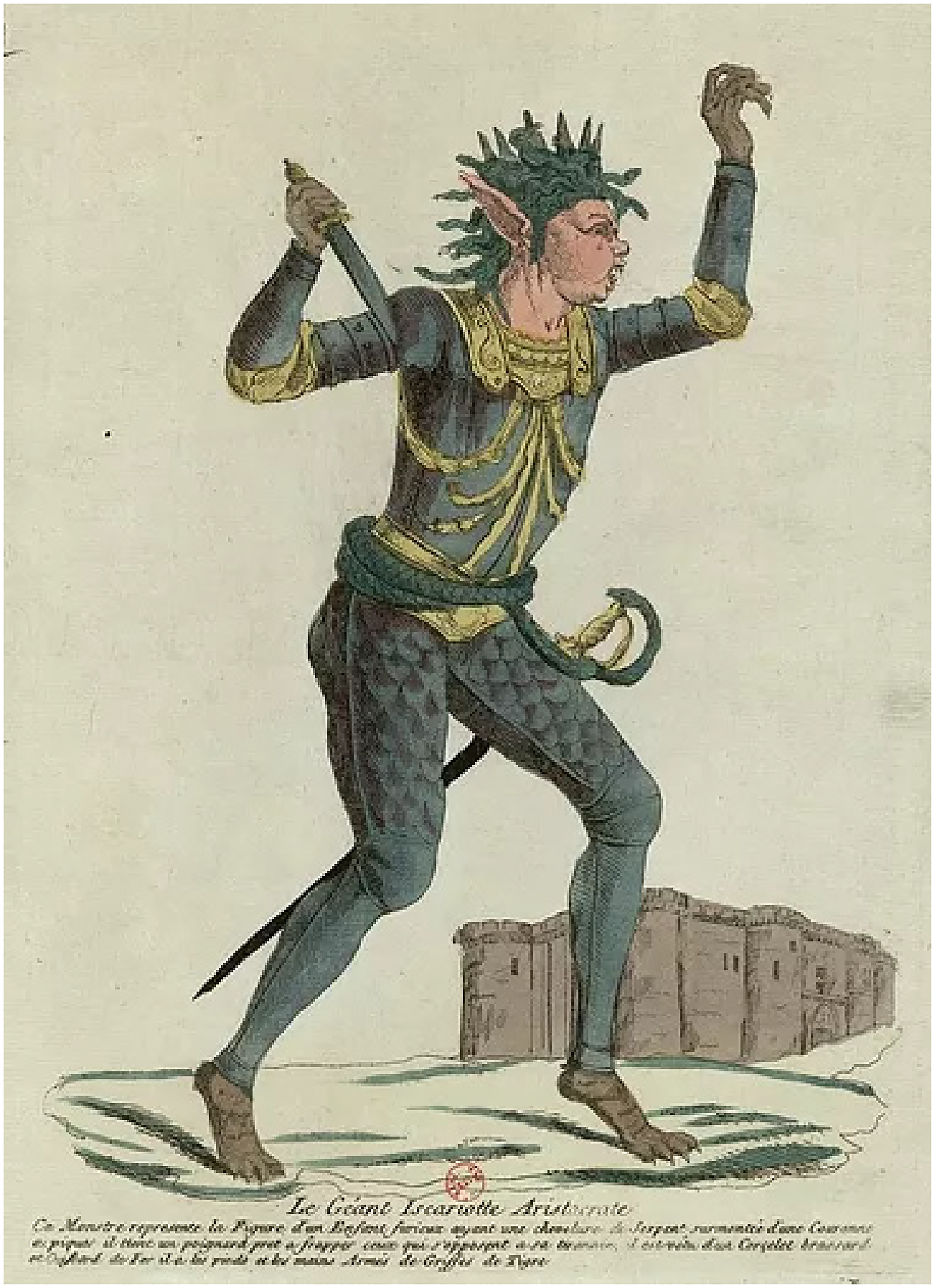
Le Géant Iscariotte, Aristocrate. Anonymous, 29 × 21 cm, Paris 1789.
TV and streaming serialities and the posthuman
The decisive characteristic of every series is its fragmentation (O’Sullivan, 2010: 59–77). Therefore, each individual episode is integrated into the whole of the serial continuum through an interplay of elements that repeat the preceding and advance the plot. This genuine seriality of fictional products is supported and promoted by the traditional distribution medium, the television stations, insofar as the entire TV program is organized in series: the various programs recur in a daily or weekly rhythm. In relation to the television series, different subtypes have developed between the two poles of the status quo series (such as The Simpsons) and the progressive series (such as Game of Thrones), which have produced various hybrid formats, each with its own serial narratives. While at the turn of the millennium, serial-periodic broadcasting was still considered the predominant mode of reception of series (Allrat et al., 2005: 1–43), consumer behaviour has changed fundamentally with the establishment of streaming services such as Netflix, which has not left serial structures untouched.
Netflix started as a DVD rental company in 1998, but after its reorganization in 2007 as a video-on-demand platform on which subscribers can stream films and, above all, series online at any time, the US company has rapidly grown into a globally active media group (Lobato and Lotz, 2020: 132–136) in currently over 190 countries with a total of over 209 million users. As a media producer and internet archive, home entertainment service, and content distributor (Buck and Plothe, 2020: 3), Netflix not only transcends previously rigid boundaries of the media landscape but is also revolutionizing familiar serial structures and narratives. The detachment from the linear television schedule and the promotion of binge-watching as the top commercial priority are accompanied by changes in terms of formal serialities (Jenner, 2018): for example, the episode duration is no longer tied to the (uniform) 21- or 42-min formats common on TV, because Netflix does not have commercial breaks, and typologically, there is a focus on the progressive serial as is the case with La Révolution. This serial type approaches film structures and aesthetics and increasingly dispenses with repetitive elements – such as recaps at the beginning of an episode or expository conversations – or integrates others only as optional – such as the intro for recognition – and increases the consumer's viewing speed through the possibility of skipping (Warhol, 2014: 149). Nonetheless, macrostructural organizational units such as season and episode divisions are (so far) maintained; also, release rhythms – usually annual, even in the same calendar week – are (still) organized in a cyclical or serial manner (Richter, 2020: 173). However, the overall trend towards the withdrawal of seriality in the formal series structure is offset by the development of new serialities on other levels – especially on that of reception: the replacement of the externally determined periodization with an individual time management represents Netflix's successful attempt to serialize reception (Zündel, 2020: 24), which aims at the addictive ritualization of viewing habits by binge-watching not a single series, but a series of preferably in-house productions. The changed, no longer simultaneous, but time-delayed and asynchronous reception of a series, in which the users, in the context of convergence, resort to additional (social) media such as Twitter (Plothe and Buck, 2020), in turn, forms the starting point for new, varying-repeated fan-generated serialities, which on a transmedia level can increase to the creation of original content by the prosumers.
In addition, the dwindling of seriality in the outward appearance of a series (cyclical-serial consumption of its episodes, repetitive structural elements) ensures that inherent elements of the action increase the seriality at the content level; in this context, a special affinity for posthuman issues can be ascertained. While human existence is characterized by a unique cycle of life, posthuman forms of existence are set in perpetuity through reproduction and/or immortality – and are thus (potentially) serially open-ended. It is therefore no coincidence that, for its foreign markets, Netflix provides particularly those science fiction or post-apocalyptic series successful in US free or pay-TV that are – serially – staging posthuman existence over many seasons: in the Canadian and US-American production Orphan Black (2013–2017, five seasons), the serial element on the content level consists in the identical reproductivity of the mostly female clones (Bonnevier, 2019: 58–76), whose living conditions vary serially depending on their social origin and integration. The hit series The Walking Dead (2010–2022, 11 seasons) in turn, which is based on a comic strip – and thus also constitutes a series (Cortiel, 2015: 187–204) – develops the epidemic spread of a virus that is being transmitted exponentially turns people into zombies (just as in La Révolution), thus ensuring that the plot continues serially with ever more struggles for survival in ever new constellations.
La Révolution as an alternate history series: counterfactual and serial narratives
The Netflix series La Révolution (Molas, 2020), which was released on 16 October 2020 with eight episodes, can be assigned in terms of form (genre) and subject (content) to the category of alternate history, which in turn forms a subcategory of science fiction. The history of alternate history as a literary genre (as opposed to counterfactual history [Gallagher, 2018: 16–47] as an object of the academic discipline of history), which currently arouses almost exclusively the interest of anglophone research (Hellekson, 2013a: 13–31; Morgan and Palmer-Patel, 2019a; Thiess, 2014), begins in a narrower sense at the turn of the 18th to the 19th century with a French founding text: Louis-Napoléon Geoffroy-Château's Napoléon et la conquête du monde, 1812 à 1832. Histoire de la monarchie universelle (1836), or Napoléon apogryphe for short – a text whose plot, similar to that of the Netflix series, is directly related to the events of the French Revolution and, in this case, results directly from them (Roberts, 2019: 31–45). The basic characteristic of alternate history is the changing repetition or retrieval of history, so that – from a macrostructural perspective – this narrative technique, which both varies and repeats the respective content, corresponds to the serial character of La Révolution on the formal level.
With regard to the detailed characterization of its alternative representation of history, La Révolution (like most alternate history stories) is based on a genetic model of history that – unlike eschatological, entropic or teleological models – focuses on the genesis of historical processes and the interaction of cause and effect (Hellekson, 2013b: 2). The series is also a nexus story (Hellekson, 2013b: 5) that highlights precisely that moment in history (not always historically outstanding, often seemingly insignificant) from which the fictional action takes a different direction than the historical process we know: in La Révolution, this key moment consists in the existence of the virus with which King Louis XVI pursues a ‘grand plan’. Among the nexus stories, the series falls more precisely into the subcategory of battle stories (Hellekson, 2013b: 7), as the historical revolutionary events can be understood as a situation similar to a civil war within the French nation, in which in this case the posthuman transformation of large sections of the nobility represents one or the counterfactual or subjunctive conditional game changer. The fact that the series generally treats historical facts very freely and that, even beyond the nexus point, the viewer should not expect a realistic representation can also be seen from a look at two of the main characters: the historical Joseph-Ignace Guillotin (1738–1814), aged 51 years at the outbreak of the revolution, is played by 31-year-old Amir El Kacem, who grew up in an orphanage in the series – a fact that shapes all of his actions. He is not, as in reality, a descendant of a family of lawyers who has purposefully pursued his career as a doctor (Pigaillem, 2004a: 9–19). The female heroine, the fictitious Élise de Montargis (Marilou Aussilloux), represents democratic and feminist ideals that go beyond what is conceivable and verifiable in the contemporary context, even for an enlightened aristocrat of her time. She is a progressive pioneer avant la lettre who fights for human rights and female self-determination, acts anachronistically and thus constitutes primarily a figure of identification for the modern (also female) target audience of the series.
The special discursive representation of La Révolution within the alternate history narrative also allows the series to be classified as secret history or apocryphal history (Morgan and Palmer-Patel, 2019b: 20; Thiess, 2014; n. pag.): like Dan Brown's The Da Vinci Code (2003), this variant is characterized by the fact that it combines the genre-constitutive ‘what if’ - question with a conspiracy theory, so that a cover-up around the nexus point event does not affect our actual understanding of history. The goal of the narrative is then to bring the ‘real’ story to light. La Révolution integrates this perspective through the narrative element of a homodiegetic first-person narrator who, through off-screen comments (i.e. in an extradiegetic and retrospective mode), introduces the viewer to the events represented on the intradiegetic level, takes a stand on them and generates suspense by (mysterious) insinuations or foreshadowing. This narrator is Élise's supposed little sister (in reality her daughter), Madeleine de Montargis (Amélia Lacquemant), who is 12 years old at the time of the events, deaf and dumb and endowed with a visionary gift. It remains unclear over the entire season how she could obtain the ability to speak on the extradiegetic level. After the fade-in of the famous Napoleon alleged quote (after the lost Battle of Waterloo on 18 June 1815) ‘L’histoire est une suite de mensonges sur lesquels on est d’accord’ (I, 00:09–00:15), it is thus Madeleine's repetitive and explanatory off-screen comment that opens the series in the first episode ‘Les origines’ and that directs the reception of what is shown into the context of alternate history from the very beginning. Above the opening sequence, which shows the fight between an aristocrat and a young, hooded female revolutionary in 1789 against the backdrop of a wintry castle scenery marked by armed conflicts, in the course of which she beheads the ‘blue-blooded’ enemy, whose spilled blood, together with the red blood of another dead person, depicts the French national flag in the snow (I, 00:16–03:05), Madeleine's whispered words resound, casting doubt on the canonically remembered course of the French Revolution: she argues that, as is well known, history is made by the victors, adding that, the further back events lie, the more historical memories are susceptible to change and reinvention by later generations. At the same time, Madeleine establishes herself in her function as the ‘voice of the narrative’ as a trustworthy authority and, as an eyewitness, affirms the true, but objectively almost unbelievable content of the ‘real’ story, namely that there has been a contagious disease and that the dead have returned to life. She also repeats her report, understood as a highly personal ‘testament’ to the following generations, in the eighth and last episode ‘La révolte’, in which the rebels pathetically and patriotically march to Paris in the penultimate sequence with a blue-white-red flag dyed by the blood of the enemies and victims (VIII, 39: 15–40: 00). Embedding her own agenda regarding the politics of memory in the sound channel of communication, Madeleine pursues a targeted strategy of authenticating the counterfactual events in the two years leading up to 1789 with her comments that recur serially in each episode. For La Révolution, this already suggests what Karen Hellekson (2019: 170–185) recently noted for most audiovisual alternate history versions: that series in particular are more concerned with the development of the individual in a historical context and that the historical events themselves function as a mere backdrop. Thus, the virus in La Révolution also opens up the possibility of extensive characterization – of the ‘good’ as well as the ‘evil’ protagonists.
The outbreak narrative: epidemic contagion, aristocratic ‘serial killers’ and revolutionary solutions originating from the enlightenment
At the beginning of the series – and the virus epidemic of 1787 in the county of Montargis, about 120 km south of Paris – there is the mysterious death of a young peasant woman, 16-year-old Rebecca, which in the course of the investigations by prison doctor Joseph Guillotin and his assistant Katell (Isabel Aimé Gonzalez Sola) turns out to be the serial murder of a truly sick killer. The serial moment not only results from the number of missing persons and later murder victims, whose notices are piling up on the city's bulletin board, but also lies in the cause of the act of killing itself: as Joseph and Katell soon find out through medical experiments, the unknown slayer is infested by a parasite that colours the blood blue, or rather infected with a new type of disease whose symptoms are similar to rabies (the historical Guillotin wrote a Mémoire sur la rage [Pigaillem, 2004a: 17–19]) and which reproduces itself through viral transmission – and thus spreads serially.
The two make this decisive discovery through an animal experiment on a rat in Joseph's sleeping cell, which is equipped with all kinds of medical instruments. Using the visuality of the medium, the process of cognition is realized by means of the close-up of a magnified microscope view (II, 34:34–34:39), as is common with outbreak narratives (Schweitzer, 2018: 50–54). In contrast, the observation of the viral effect after the intentional infection of the rat is realized without its direct visualization in the image channel of communication and therefore increases suspense: only the upper part of the cage shaking from the shocks inside can be seen as well as the horrified faces of Joseph and Katell accompanied by swelling, threatening music and the increasingly violent screams of the animal dying in agony under cramps (II, 38:12–38:41). Trying to shed light on the mysterious case by dissecting the dead body, the medical practitioner Joseph proves to be a typical representative of the Siècle des Lumières, who relies on logic and rational science. The fact that supernatural forces are at work, however, emerges from a later shot from Joseph's room, when the captain of the guard Pérouse (Dimitri Storoge) finds the dissected rat with an open abdominal wall, resuscitated and with a pounding heart (II, 44:37–45:12). He gives the animal the coup de grâce, through which its now blue blood splatters on the wall effectively.
While in the investigation of the virus outbreak, Joseph thus embodies the representative of reason, the African-American main suspect Oka (Doudou Masta), who is imprisoned all too quickly, insulted as ‘le cannibale’ in a racist manner and sacrificed as a kind of pawn of the corrupt justice system, represents those positions that break the rational limits of this inquiry: he wants to stop the epidemic as well, but in his function as voodoo-priest, he additionally knows about the exact origins of the virus from the New World, from Nouvelle-Orléans. La Révolution thus also adopts the ambivalent attitude towards globalization as a form of social progress that is typical of outbreak narratives (Schweitzer, 2018: 54–60). At Oka's side is Joseph's brother, Albert Guillotin (Lionel Erdogan), long believed to be dead, who – also infected with the virus, but controlling the desire to kill – represents the eponymous ‘revenant’ of the second episode. Therefore, he not only stands for the supernatural side, but because of his (multiple) returns – from America and from death – he also reinforces the serial character of the series.
In the first episodes of La Révolution, the epidemic initially spreads unnoticed within aristocratic society. While patient zero of the county is Count Guy de Montargis himself, Élise's father and one of the 12 pairs of France, who has been infected by the king himself, but struggles with his new being, the actual spread only starts with his brother's son, Donatien de Montargis (Julien Frison). Even before contracting the disease, Donatien was a degenerate and weak offspring of his once venerable family. Like his chronically ill mother, who took her own life at an early age, he suffers from gangrene, and his cries of pain (II, 06:04–06:23) can be heard all over the property before the viewer sees the pale young man with a large open wound reaching to the bone on his left leg for the first time. Another short shot shows the breaking of Donatien's leg (II, 24:00), the amputation of which his father (Laurent Lucas) had strictly forbidden shortly before because of the shame this might cause to the family.
For a class-conscious aristocratic dynasty like the Montargis, for whom (in particular for the father) succession, that is a serial continuation, is of essential importance, Donatien symbolically represents a ‘sick branch’ in the family tree. Such a tree constitutes the ultimate reference object of memory often used in a ritualistic manner in noble families of the so-called status-centred memory type (Coenen-Huther, 1994: 182–187; 205–207), which the Montargis even use as a heraldic sign in their coat of arms, as can be seen several times (II, 07:05; VI, 22:05). What is more, the concrete ‘family tree’, the tree that the ancestor of the Montargis, a contemporary of Saint-Louis (1214–1270), planted (VI, 28:04–28:24), possesses the highest status of familial reference as an object of ideal value and a visible sign of continuity. However, after his posthuman initiation conducted at that tree of all places (IV, 00:02–12:17), the increasingly cruel Donatien reactivates its function as an instrument of torture for his chained victims. When his father finally realizes that the virus has not turned his weak son into a worthy heir, that his blood has failed all along the line and thus his plan for a successor as well (VII, 11:47–12:17), it is long too late: Donatien has replaced the (serial) biological family genealogy with a viral seriality and reproduces an entire ‘army’ (in the double sense of the word) of posthuman aristocrats by transferring his now blue blood.
The narrative of virus contagion follows a serial growth; the intervals between episodes in which the number of infected people multiplies exponentially become smaller and smaller: with Guy de Montargis, there is only one single (unknown) carrier of the virus in the county in the first episode, whereas, with Donatien, another infected person is added at the end of episode 2 as a cliffhanger or in the course of episodes 3 and 4, respectively. In the course of the sixth episode, he transforms four people at once, three of his closest friends and his sister Marie, and in the seventh episode, he finally orders that the virus be injected into the assembled representatives of the provincial nobility, a total of 12 men. This course of events only allows a sinister prognosis for the further action – especially as it has been clear since the fourth episode at the latest that with Versailles, there is a second source of the outbreak – deliberately brought about by the highest royal circles.
As the starting point of the viral epidemic in the county of Montargis, Donatien turns out to be the prototype of the posthuman nobleman who combines the depravity of his class with the features of the monster. After the death of the count, whom he brutally murdered himself, he takes over his position. While he used to be a despised, chronically ailing weakling before his transformation, he lives the dissolute life of a smug, amoral aristocrat in his new existence and leadership role. This already becomes clear at the end of the fourth episode ‘Les bourreaux’, when his father announces to the funeral guests in a shock-like revelation that it is not himself but his son who will succeed the count: Donatien's appearance is tantamount to a staging that can hardly be surpassed in terms of extravagance (IV, 43:48–45:31): in the assembly hall, the echoing trot of the white horse with which the new count enters the vestibule can already be heard; this is followed by his shadowy outline on horseback, which can be seen several times through the windows of the hall. As the eyes of those gathered turn towards the door, the camera slowly pans upwards from the newcomer's feet to reveal Donatien, dressed entirely in a bright floral pattern – from his shoes to his knee-breeches to his tricorn hat. The father finally pins the dead count's heraldic ring to his son as a symbol of his new authority as head of the family (Figure 2).
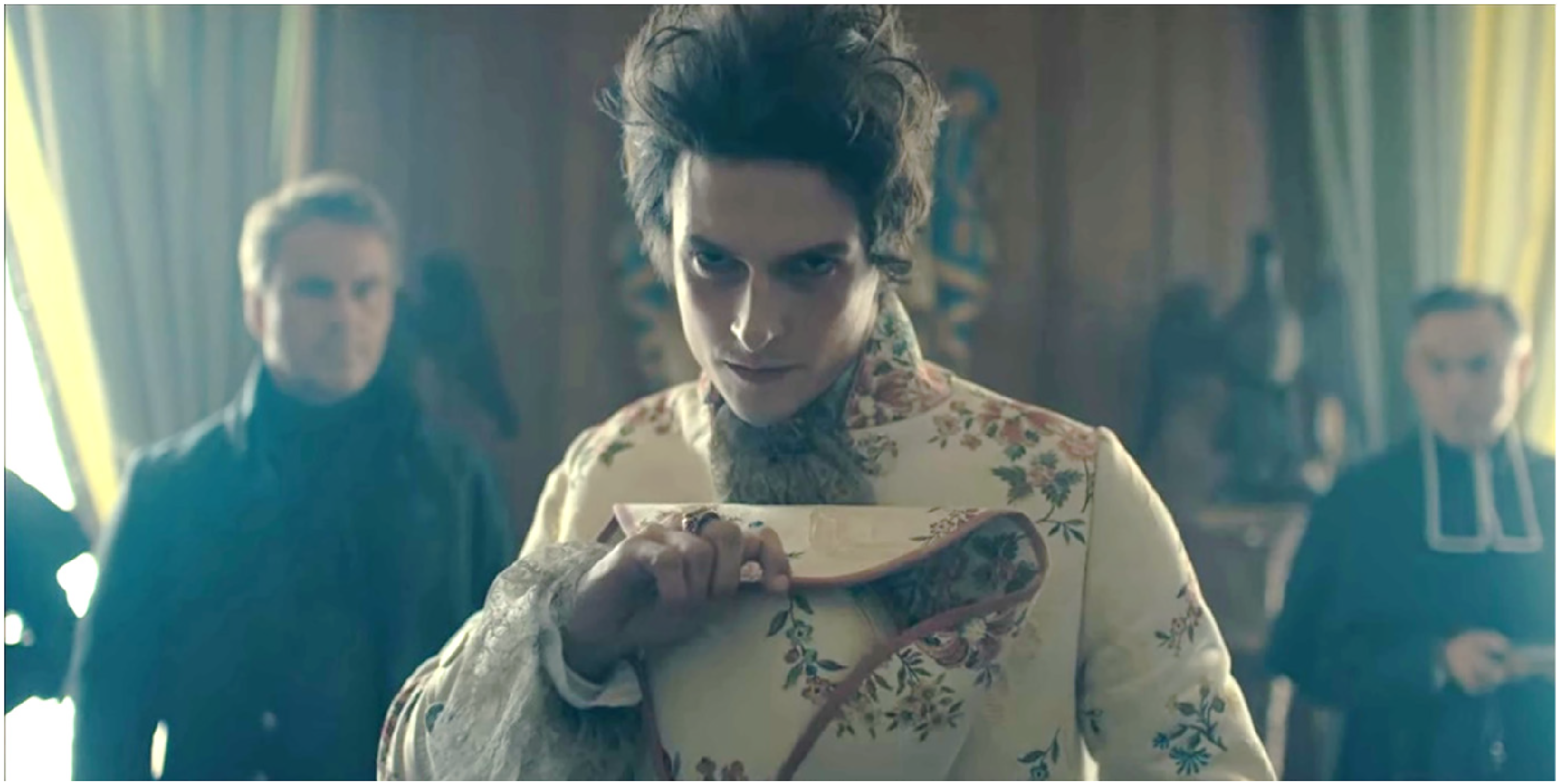
Donatien as the new count. Chapter 4 ‘Les bourreaux’, 45:30.
The fifth episode ‘Le sang bleu’ provides further examples of Donatien's degeneracy: it starts with a summarizing overview sequence of the reactions to the preceding announcement: with regard to Donatien, who looks lustfully at a female servant while emptying a crystal glass of milk that he lasciviously runs down his throat, the further the camera zooms out, the more it becomes clear that he is holding a candlelit feast with his friends, at which numerous naked women are present (V, 00:12–00:53). After a cut, this same female servant is seen lying dead, half-naked and covered in blood on Donatien's bed, while he is smearing her blood on his lips and posing narcissistically in the mirror (V, 01:26–02:05) – a visual topos in the representation of the posthuman (Smelik, 2017: 111–113). The ultimate and, for many others, agonizing or fatal plaisir becomes his new purpose in life. The fact that Donatien is developing more and more into a sadistic count (with the notorious Marquis de Sade [1740–1814], who was his contemporary in extra-fictional reality, he shares not only many of his characteristics but also his first name) becomes evident above all from his treatment of the captain of the guard, Pérouse. In the further course of the episode, he meets him during a brutal interrogation of a witness in the local tavern (V, 25:38–28:17). Donatien, who places himself at the top of the pyramid of violence, is after Pérouse's severed hand, which the latter has kept preserved in a jar since he lost it in battle. During his demonstration of power, Donatien first humiliates his counterpart with words, then bites off the thumb of the hand (thus depriving Pérouse of any hope of transplantation) – only to spit it out on the floor in a contemptuous and inhuman way. The repulsive scene demonstrates all the bestiality that determines Donatien's new being – and that also defines his other posthuman followers from then on.
At this point, the question arises as to how the nature of the newly created monsters can be precisely defined. With regard to his subordinates and victims, Donatien himself repeatedly makes cynical and ambiguous statements from the semantic field of nutrition: ‘Pourquoi nous cacher? Le peuple a été toujours là pour nous nourrir’ (V, 17:44–17:49), he replies to his father who criticizes his behaviour, and when he dresses up like his brave ancestor on a painting for the direct confrontation with the rebels, the climax of the season, – Donatien loves the spectacular appearance – he sounds pathetic: ‘Ce jour restera dans les mémoires comme le rappel flamboyant de l’ordre des choses. Le peuple doit se rappeler à quoi il est destiné: se soumettre, obéir… et nous nourrir’ (VIII, 08:51–09:21). In fact, the infected nobles are visualized as bloodsuckers and cannibals – just as in the historical documents of the revolutionary era. After Marie's transformation, her blood-smeared mouth can be seen in a close-up after the bite of her first victim (VI, 38:04) and, when the group of transformed noblemen enters the tavern, the initially cheerful background noise gives way to screams of death and the windows turn blood-red shortly afterwards (VII, 32:57).
Nevertheless, these posthuman monsters do not seem to correspond – as traditionally associated with the aristocrat – to the typical elitist vampire (Jarrot, 1999: 111). These hybrid beings possess much more the monstrous properties of zombies, as they populate the large and small screens from the turn of the millennium (Dendle, 2011: 175–186). The zombie association is also undeniable because the virus arrives in France from the southern states of the USA, where the voodoo cult, a belief system closely related to zombification (Schroder, 2016: 421–431), is widespread due to the influence of African slaves – a direction that the series consciously takes with the characters of Oka and the mysterious Naïce. In addition, cannibalism, which is repeatedly associated with the voodoo cult, becomes the central aspect of the aristocratic zombies: the shots of the last episode in which the infected aristocrats cower over the corpses and eat their flesh in the dirty streets after the revolutionaries have withdrawn behind the barricades during the first battle can be described as iconic (Figure 3).
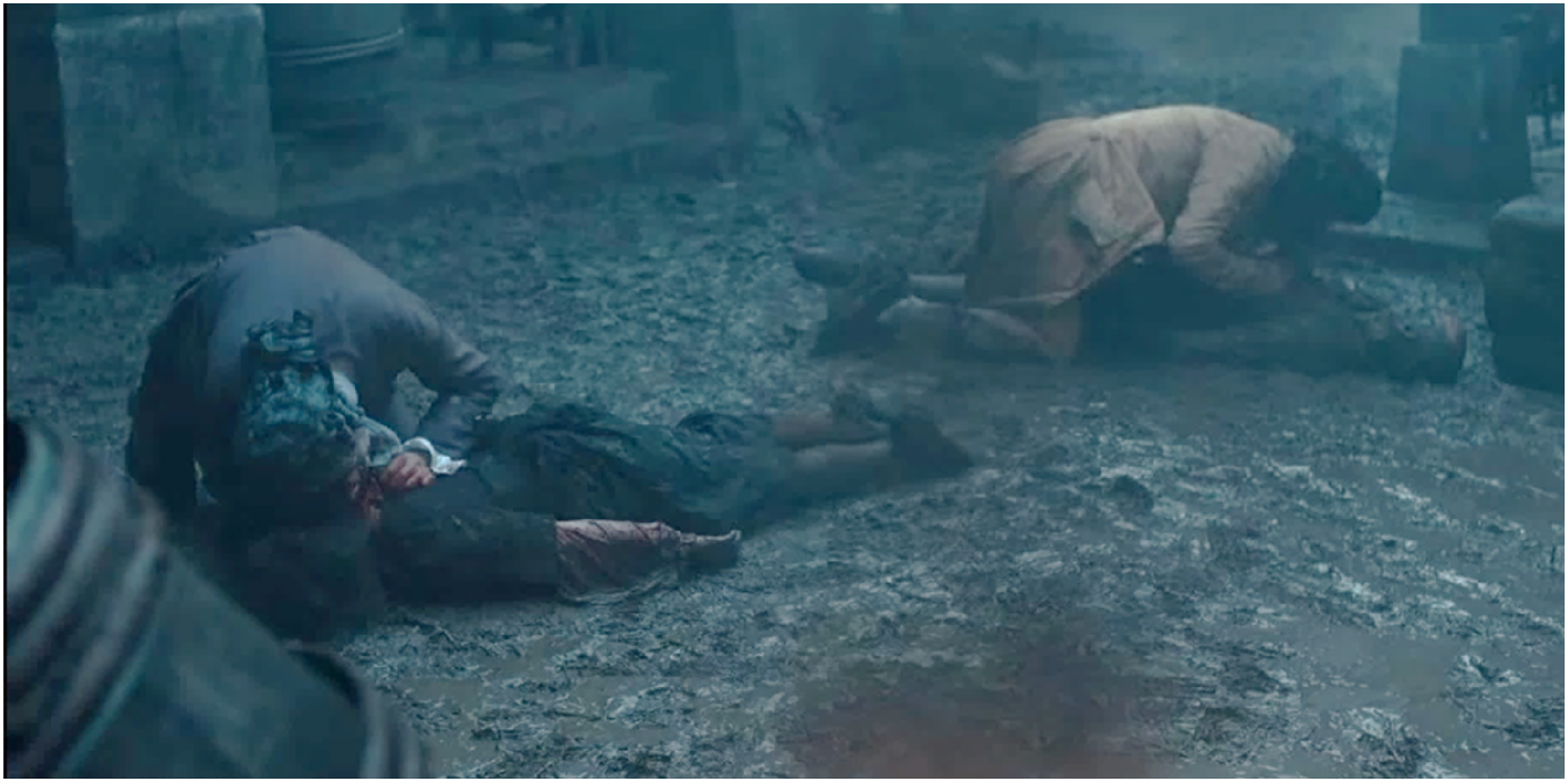
Nobles eat corpses of people from the Third Estate. Chapter 8 ‘La révolte’, 30:07.
The monster-like representation, however, culminates in the final appearance of Louis XVI in Versailles, to whom Donatien flees after the rebels have finally won the day. The staging of this sequence (VIII, 36:20–38:10) is remarkable for several reasons: similar to Donatien's first appearance as the new count, at first only the monarch's golden shoes decorated with a fleur de lys are visible from several angles – including Donatien's humble posture, which the camera assumes. Even after the following cut and the change to a side view (which is followed by a bird's-eye view at the end), the face of Louis XVI remains hidden from the viewer throughout the entire sequence. Thus, even the framing deprives him of any humanity (Figure 4).
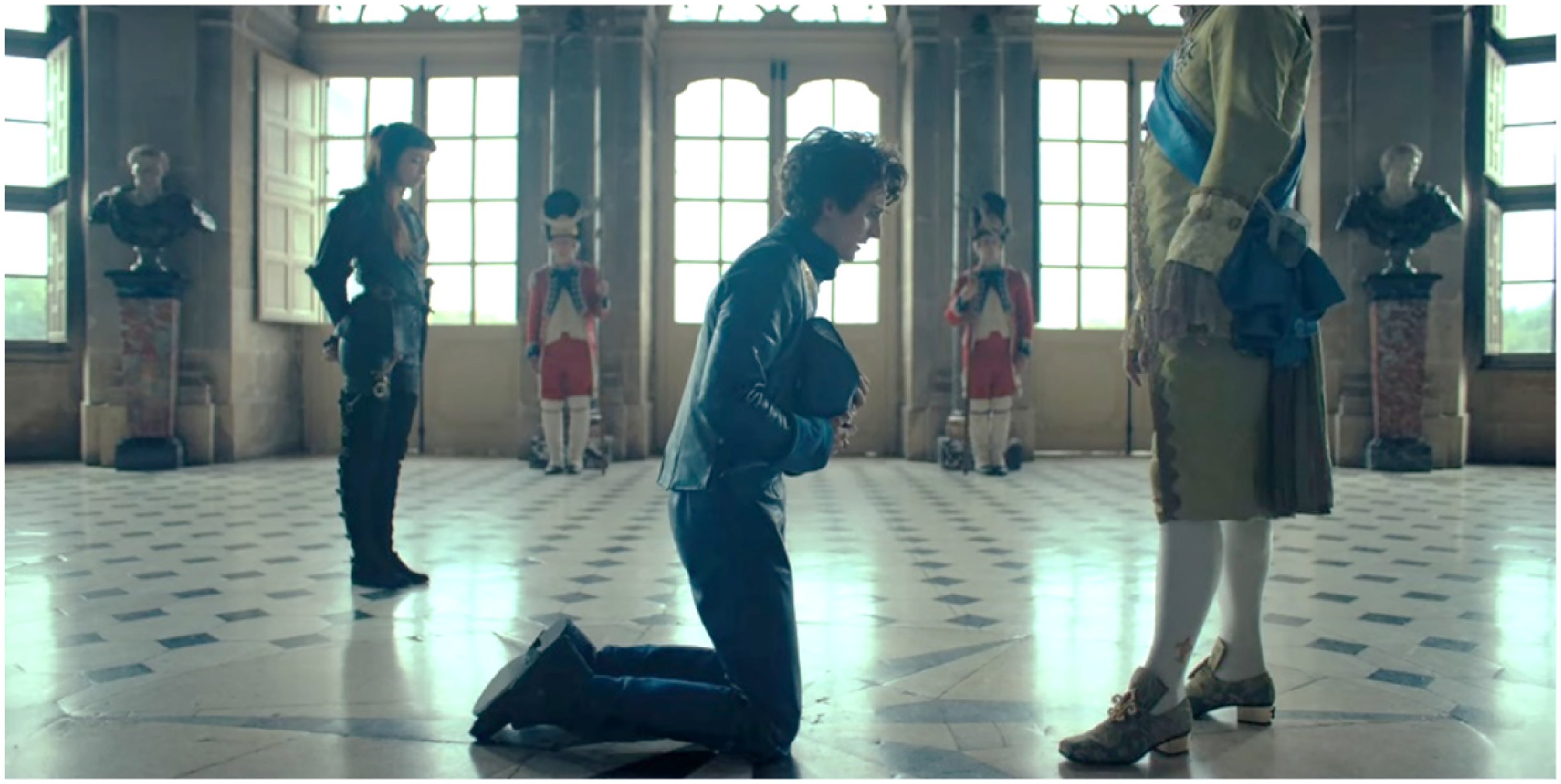
Donatien with Louis XVI in Versailles. Chapter 8 ‘La révolte’, 37:07.
His monster-like nature is further played out in both the sound and image channels of communication: the first thing one hears from him is heavy (dehumanizing) breathing. His voice, which then resounds, alternates between animalistic growling and hissing. When he asks Donatien if he knows why everyone calls him ‘godlike’, and the latter replies that the reason is that he is so cruel, an affirmative demonic laugh is heard. His monstrosity is further visualized by his long, pointed fingernails, which look like claws, as he strokes Donatien's cheek menacingly. The series leaves no doubt that this king poses a great threat to the French people.
In the face of this monstrous threat, the protagonists from the Third Estate develop various strategies to fight it, which can be related to the enlightenment and revolutionary moods of the time. As already shown, Joseph, who has been searching for information in books since the discovery of the novel disease, who experimentally strives for a cure, and who examines the members of the so-called brotherhood, the group of resistance which he joins, for possible immunities, takes on the ‘enlightening’ role. Joseph's motivation is thus to break the viral and violent seriality by means of knowledge acquisition and medical-scientific research. The rebels from the people, who in the course of the series join forces with the rational, uninfected section of the nobility represented by Elise de Montargis, all united by a sense of solidarity (Schweitzer, 2018: 49–50) against the degenerate, zombie-like aristocrats, choose another, namely violent, path after the peaceful negotiation of their demands has failed. They rise from their miserable conditions, which have repeatedly been staged in striking contrast to the living conditions of the elites from the first episode onwards – for example by showing the opulent nocturnal festivities at the Montargis’ Castle (I, 05:28–06:13) and the sheer poverty on the streets (I, 11:20–12:03), especially in the city's orphanage (I, 17:20–18:27) – and rebel against the tyrannical rule with revolutionary intent. Their concern to redress the grievances, which Katell announces early on in a confidential conversation with Joseph (II, 35:52–36:23) in free reference to Sieyès’ Qu’est ce que le Tiers Etat?, and their striving for the implementation of the revolutionary triad of ‘liberté, égalité – and with a double sense – fraternité’ (VIII, 39: 52–39:59), is given an additional dimension, or rather, a deeper meaning by the alternate-historical ‘real’ monstrosity of the enemy: the ideals of the enlightenment are thus conflated with the fight against the virus and the contagious disease, which in a fictional and counterfactual way exacerbates the crisis situation in pre-revolutionary France and ultimately triggers the uprising of the people and the French Revolution.
An alternate-historical outlook on the further course of the revolution
La Révolution ends after eight episodes. But even though the series was finally not extended for a second season, some perspectives for a continuation of the re-telling of the revolutionary events, which was still being considered during the filming, can be derived from the far-reaching implications and the inherent setting of the broadcast plot, which we will now examine briefly: the series closes with a sequence in the Bastille in which an unknown person can be seen filling the blue blood obtained en masse from a female victim of African-American descent into phials (VIII, 40:36–42:57): the serum enriched with the virus thus goes into serial production.
Against the backdrop of the alternate history direction taken, the subsequent events of the French Revolution appear, as can be speculated, in a new light; they receive a further or different motivation through the virus theme. Thus, according to a consideration arising from a thought experiment that continues the open strands of the narrative, it can be considered very likely that, for example, the two emblems of the French Revolution – the Bastille and the guillotine – are given a changed meaning in the further hypothetical plot of La Révolution: if the suspicion of viral multiplication in the Bastille is confirmed among the revolutionaries in the fictional world of the series, the storming of the state prison, the symbol of despotism par excellence, on 14 July 1789 results not (only) from the intention of freeing prisoners and procuring weapons, but also (and above all) from the necessity to put an end to the serial spread of the disease and the reduplication of the aristocratic monstrous enemies. The guillotine, which bears Guillotin's name due to his commitment to a more humane practice of execution (Pigaillem, 2004b: 114–127; 142–151), becomes an effective instrument to destroy the undead zombie aristocrats in the series’ internal logic of action: although the guillotine still retains its fundamentally terrible aura through the serial killing as in historical reality, it loses a large part of its ethically questionable status through its clear use for the good – namely in the fight against the epidemic and against those who definitely cannot be cured.
And finally, the other major stages of the French Revolution are also given new accents in terms of alternate history: the transition from a moderate to a radical phase of the revolution, to the Terreur, in which the revolutionaries – hypothetically – become bloodthirsty monsters themselves, could be motivated by the infection and spread of the virus also on the part of the resistance fighters (more precisely: of the fanatical jacobins). However, the historical reign of terror (from 5 September 1793 to 28 July 1794) under Maximilien de Robespierre might be shaped in detail, one thing is certain: in the politically delicate phase of the revolution, in which the French nation threatens to descend into chaos, the zombie commonly appearing in revolutionary hordes represents the exemplary protagonist due to its affinity to the political state of anarchy (Hoquet, 2014: 112–113).
Epilogue: thinking epidemic alternate history
The preceding analysis has revealed the productive interweaving of history and seriality, monstrosity and mediality in the Netflix series La Révolution. As demonstrated at the outset, generally altered serialities due to the shift from traditional TV broadcasting to streaming availability in the current media landscape, that is, post- and trans-televisual tendencies of series consumption through online platforms, also favour an increased thematic engagement with the post- and transhuman in recent years. Via the connecting link of the viral zombie mutation of the aristocracy, it was possible to further show, specifically for La Révolution, how Netflix – by recourse to real-historical defamations of the Second Estate at the time of the French Revolution – creates a science-fictional, alternate-historical fictional work that questions historical certainties through monstrous exaggeration and, shedding new light on these, stimulates renewed critical engagement with them. In this process, the serial organization of the medium and the media-specific design of the posthuman theme in the image and sound channels of communication support the power of the plot of La Révolution, which is rich in acts of violence. In this way, the serial narration, which is potentially infinite on the level of the fictional world, only reaches its limits due to external circumstances – the prescription of the historical reality depicted as a measure of its development and the modern commercial production decisions of the Netflix company.
