



Abstract
Of all the images generated by the French Revolution it is the guillotine that is the most notorious. From the beginning the apparatus constituted an elaborate visual spectacle, one that not only efficiently dispensed justice but also offered up a form of popular entertainment and ritualised collective vengeance. The paper seeks to shed fresh light on one of the most perplexing mysteries of the revolutionary era. How did enlightened individuals who had helped create the most democratic and egalitarian society yet seen in the world, descend into a totalitarian regime in which many thousands were arrested, tried without appeal and executed? Why did revolutionaries begin to kill one another, and how did the guillotine come to represent an ideal of Revolution? To answer these questions, the paper begins by looking more closely at the relationships between popular violence and state violence in the Revolution, before describing the invention of the guillotine and how audiences had to adjust to a new kind of spectacle, where terror emerges as a principle of government.
Of all the images generated by the French Revolution it is the guillotine that is the most notorious. From the beginning the apparatus constituted an elaborate visual spectacle, one that not only efficiently dispensed justice but also offered up a form of popular entertainment and ritualised collective vengeance. To critics of the Revolution, the guillotine is a sinister manifestation of how radical ideals quickly spiral into persecution, repression and fanatical bloodlust – foreshadowing the gas chambers of the Holocaust, the killing fields of Cambodia, the massacres of Mao’s cultural revolution and the use of terror as a political weapon in the Soviet Union and elsewhere. Yet such analogies and comparisons are ultimately misleading. Not least since they downplay the complexity of the historical situation, which is not to ‘diminish the awfulness of what did take place, but it should distinguish it from a pattern of mythology and demonization that began, extraordinarily, even before the Terror itself’ (Andress, 2013: 293). It is the complexity of meanings condensed in the guillotine that this paper seeks to unravel, which speak to the macabre theatricality of the event, its transformation of the social and political body and the reconfiguration of legitimate violence in the new regime.
There is no more disputed subject in French history than that period of the French Revolution known as ‘the Terror’ and the dividing lines follow four distinct approaches: terror as an inherent feature of the revolution; terror as a reaction to dire circumstances; terror resulting from an ideological power struggle; and terror as a political development closely tied to an obsession with conspiracy. Historians have clearly disagreed over why a revolutionary government embarked on such a programme of brutal repression, with some seeing the measures a response to a national security emergency (Aulard, 1910), while others stress an inescapable drive towards violence (Schama, 1989). More revisionist positions have highlighted structural weaknesses in democratic ideology (Furet, 1981), an idea also rejected for insisting that the revolution was radical and terrorist-prone from the start. Instead, terror is situated in the changing politics of the revolution, where an all-consuming fear of conspiracy plots gripped the regime (Tackett, 2000). Although there are opposing camps in the debate, it does not follow that all the arguments carry equal weight, and we should always be wary of easy answers to complex problems. The focus in this paper is on the terror’s defining image – the guillotine – and it seeks to shed fresh light on one of the most perplexing mysteries of the revolutionary era. How did enlightened individuals who had helped create the Declaration of the Rights of Man and the Citizen, a vision of liberal reform, descend into a totalitarian regime in which many thousands were arrested, tried before ‘Revolutionary Tribunals’ without appeal and executed? Why did revolutionaries begin to kill one another, and how did the guillotine come to represent an ideal of Revolution? To answer these questions, the paper begins by looking more closely at the relationships between popular violence and state violence in the Revolution, before describing the invention of the guillotine and how audiences had to adjust to a new kind of spectacle, where terror emerges as a principle of government.
During the revolutionary decade it became compulsory to take political sides and make these allegiances both seen and heard. All manner of objects were mobilised, as successive revolutionary governments sought to make a new society. As such the familiar public spectacle of execution was reconfigured by the guillotine’s distinctive visual economy, which extended from the event itself to the uncanny ability of the apparatus to signify ‘many kinds of rupture, not the least of which was the symbolic destruction of the body of the king’ (O’Rourke, 2017: 34). This paper will explore the politics of visibility in revolutionary France, and by focussing on the visual culture of the guillotine the intention is to move beyond what it represented into questions of how it represented. This involves attending to the dynamic ‘social context of both the ‘seeing’ and the ‘seen’ but also. . .the intentionality of the practices that relate these two moments’ (Jenks, 1995: 16).
The tensions between the disciplines of history, art history, cultural, literature and film studies have been well documented in accounts of visual culture scholarship. Contemporary historians remain, for the most part, logocentric – regarding ‘images as supplemental in the sense that they augment a method of inquiry firmly grounded in language’ (Wilson, 2004: 29, emphasis in original). Of course, images have been used in chronicles of cultural and social change ever since the Renaissance, though their function has largely been peripheral (often relegated to ‘illustrated histories’) and the dangers of ‘too visual an approach to the past’ have been frequently espoused (Haskell, 1993: 5). Even Peter Burke (2001: 184), who has long urged historians to take pictorial evidence seriously, concludes that ‘the testimonies about the past offered by images are of real value, supplementing as well as supporting the evidence of written documents’. The danger here is that pictorial sources will remain too trivial to count in serious historical analysis, but if we consider the term ‘supplementary’ in light of Jacques Derrida’s understanding of the ‘supplement’ to a work then other approaches become possible. Although Derrida (1978) mainly concentrated on philosophical and literary texts, he also deconstructed works of art – most notably in his The Truth in Painting to explore the importance of the decorative, marginal elements that accompany the main theme of the picture. Here Derrida challenged the conventional assumptions about the marginal status of the ‘mere’ supplement, emphasising mutual dependency rather than strict hierarchy. Consequently, the disputes between historians and visual culture scholarship are not immutable, and no matter how uneven the exchange the two fields have much to offer one another. Nevertheless, we must never forget that in taking seriously the pictorial traces of the past we are always interpreting an interpretation. This paper concentrates on images conceived in response to political events and while the discussion cannot cover every aspect of the sources, the ambition is to show how visual media played a key role in delineating zones of visibility and invisibility.
The guillotine was one of the defining symbols of revolutionary ideology and while earlier public executions had derived much of their ritual drama from the prolonged suffering of victims, the guillotine decapitated the condemned so quickly that death was effectively hidden from the gatherered crowd. Yet the speed of the guillotine did not disqualify it as a form of popular entertainment, rather this ‘effect aligned the instrument with a class of spectacles found on the fairgrounds and Boulevards of Paris’ (O’Rourke, 2017: 27) and so successful was the theatrical nature of the event that an elaborate choreography emerged around this ‘more ‘productive’ version of the immortal reaper’s scythe’ (Arasse, 1989: 36). To understand how the guillotine so closely merged forms of political and visual representation it is necessary to combine historiography of the Revolution with a close analysis of images produced in the wake of the spectacle. The paper begins begins by looking at the place of violence in the Revolution, before describing the invention of the guillotine and how audiences had to adjust to a new kind of spectacle, where terror emerges as a principle of government.
Violence and representation
The French Revolution was to a large degree a struggle over representation, and ‘violence was one of the most prominent – and unstable – loci of that struggle’ (Graybill, 2016: 25). The disturbing place of violence in the revolutionary project was a problem well understood by the revolutionaries themselves. How they grappled with their own exceptional present and uncertain efforts to anchor themselves in history is revealed in the images and objects through which revolutionary authority was depicted (Taws, 2013). The struggle for power in the new regime was a struggle over the meaning of violence, which had helped launch the Revolution in 1789 and it was popular violence which also threatened to extinguish the new, fragile social order.
Revolutionary violence itself depended upon a ‘sharp separation between good People and criminal Other’ (Lucas, 1994: 74). In this regard a broad range of printed material, intersected with other media, such as songs and images, and assorted ephemera produced by the press, ranging from almanacs, calendars, playing cards, board games, passports, caricatures, posters, engravings through to the newly invented paper currency (assignats) all ‘carried revolutionary messages into the sphere of everyday life’ (Darnton, 1989: xv). Describing this material as ‘ephemera’ underplays their significance, especially since their fleeting temporality enabled them to respond to fast moving events in ways that slower and more permanent media such as painting, sculpture and architecture could not. As these images were sometimes produced in tens of thousands of copies, they also reached large audiences who were unable to read newspapers, pamphlets or books (Leith, 1989). Indeed, the royal family’s ill-fated attempt to flee Paris in 1791, known as the ‘flight to Varennes’, was ultimately thwarted by a postmaster recognising the King’s portrait from an assignat he had in his pocket (Tackett, 2003: 72).
Images did more than simply convey information; they actively shaped the way in which events were understood at the time. They were ‘historical agents’ and this role of ‘image as agent’ is especially important in the case of revolutions, often helping to make ‘ordinary people politically conscious’, especially when much of the populace is illiterate (Burke, 2001: 145–146). It has been estimated that one-half to two thirds of the population could not, or could only barely, read and that they lived in a ‘traditional world of oral communication’ then the full significance of pictorial representation becomes clear (Reichardt, 1989: 224). The downfall of Louis XVI can be read through engravings, which before 1789 had been full of majesty, emphasising the sovereign’s divine authority, power and glory. During the initial, ‘liberal’ period (1789–1991) revolutionaries depicted the monarch in his new, constitutional role, which the dynasty regarded as a humiliating step down. Yet, after the doomed flight to Varennes, the ‘caricatures turned hostile; artists depicted the monarch as a drunkard or barnyard animal’ (Censer and Hunt, 2001: 83). Ridiculing the king and queen through printed images helped prepare the way for their eventual executions in 1793. Though the fact that Marie Antoinette should have been the subject of an extensive pornographic literature both before and during the revolutionary era says much about the ‘larger body politic’ (Hunt, 1991/1998: 279). The sexual sensationalism of the Old Regime, targeted by the obscene libelles in this material, has been read as a form of anti-Establishment critique – where the court, church, aristocracy, academies, salons and the monarchy itself are attacked – communicating ‘a sense of total opposition to an élite so corrupt as to deserve annihilation’ (Darnton, 1971: 111).
Although this thesis continues to be influential, the links between this forbidden literature and the origins of revolutionary ideas remains problematic. The ‘low-life’, aggressive journalism may have been ‘radically destructive’, yet it offered up ‘no real alternative to the status quo’ (Maza, 2013: 43). Others suggest that the obscene imagery only appears ‘radical’ as the ‘shocking images work with restrictive and even repressive allusions that constantly appeal to popular mentalités that are easily mistaken for revolutionary attitudes’ (Wagner, 1995: 139–140). The shifting meanings are an indication of the dynamic, contradictory processes at the heart of revolutionary visual practice. Indeed, it has been argued that visual ‘representation captured the semiotic instability, produced it and, rather than resolve it, opened the door to a new conceptualization of society itself’ (Hunt, 2009: 678).
It is impossible to know how many prints have survived. Aside from the images archived at the Bibliothèque nationale de France, there are numerous ‘trophies, playing cards, cockades, calendars, maps, costumes, uniforms, crockery, snuffboxes and letterheads, not to mention paintings that are held in various museums’ (Censer and Hunt, 2005: 40). All of which points to a rich and prolific visual culture at work, though one which has not received the attention it should. As the former director of the Museum of the French Revolution put it, there have long been: dismissive attitudes toward the visual traces of the Revolutionary period, a corpus of artifacts perceived as rudimentary and an embarrassment for the artisan trades, vulgar caricatures whose meaning had become obscure and irrelevant, and lifeless paintings and sculpture that slavishly imitated classical models.
Of course, the situation has begun to change in the last thirty years or so, with the publication of important scholarship on visual representation and the development of online resources (such as French Revolution Images – Spotlight at Stanford). Much of this scholarship will be discussed in what follows, though the focus will be on how the guillotine condenses an array of historical ruptures and visual effects that constructed a new social order, where terror becomes a defining feature of government.
There are opposing understandings of why the Terror happened. For some it was embedded in the popular uprisings of 1789, so that in ‘some depressingly unavoidable sense, violence was the Revolution itself’ (Schama, 1989: xvii, emphasis in original). In this reading, the Terror was inevitable, and violence was a necessary expression of French Revolutionary political culture, beginning with violent rebellious crowds, then systematic state violence, and finally civil war. Revolutions, so the argument runs, ‘are opened – and closed – by violence’ (Cobb, 1970: 85). From the beginning the question of whether violence was necessary at all was one of the main ways of distinguishing between reformers and revolutionaries, and efforts to manage popular violence was a core problem confronting the authorities. In the early years of the Revolution, the most frequent response was to downplay the significance of violence by symbolically shifting the meaning of it, to make it disappear as quickly as possible.
The key question was how to distinguish between the heroic violence of the people from the criminal violence of the mob. The preoccupation with symbolically transforming the meaning of violence hinged on efforts to define the difference between revolutionary violence and criminal violence. Such distinctions were slow to take shape, and at every successive stage in the revolution, ‘those in authority attempted to recover a monopoly on punitive violence for the state, only to find themselves outmanoeuvred by opposing politicians who endorsed and even organised popular violence for their own ends’ (Schama, 1989: 526). It is in this context that the introduction of the guillotine should be understood. The guillotine was designed as an enlightened killing machine, and it was installed by revolutionary government as the sanctioned mode of capital punishment in 1792.
Although the gruesome, protracted execution of Damiens the regicide, which took place in 1757, is today regarded as a turning point, it should not be regarded as the standard form of penal practice in the ancien regime (and Foucault later acknowledges that the occasion was deliberately anachronistic). It was a landmark case, as the assassination attempt and its aftermath, revealed the political and religious fractures in monarchical government. Although the king and the parlement were engaged in what now seems a highly technical theological dispute, the efforts to associate Damiens with either the Jansenists or the Jesuits had significant ramifications, which would locate him in part of a broader, devout conspiracy. The controversy also showed that the parlementary magistrates were becoming more confident in asserting their constitutional powers, claiming to now speak for ‘the people’ and their ‘liberty’ (in Censer and Hunt, 2001: 11). Indeed, it has been convincingly argued that the Damiens affair was a crucial step in the desacralisation of kingship and the conflict highlighted ways of expressing volatile popular resentments (Van Kley, 1984). The controversy was not only a catalyst for a reconsideration of how France should be governed, it also prompted some sympathy for the plight of the low born Damiens (a domestic servant). Paul Friedland (2012) has traced back to the 1750s the emergence of the initially aristocratic pleasure of ‘compassion’ and how it spread through all classes, so that it became fashionable for the enlightened to express ‘horror’ at the sight of human suffering, especially when witnessing executions. Ultimately, what was considered shocking in the twilight years of the old regime was that ‘people were still broken on the wheel and tortured at the stake’ in the 1780s (Arasse, 1989: 13). This sense of embarrassment at the spectacle of capital punishment can be seen in the deliberations of the new, Revolutionary political body, the National Assembly, when it debated the future of punishment in France and establish a new penal code.
Enlightened punishment
For 2 years after July 1789 the deputies of the National Assembly strove to create a constitutional monarchy that would exemplify Enlightenment principles and reconfigure the relationship between individuals and the state. Rural unrest prompted sweeping reforms, including the abolition of what the deputies called ‘the feudal regime’, the confiscation of church land and property, the transformation of the French nobility into a closed caste, and the passing of the Declaration of the Rights of Man and Citizen, crucial to which was the rule of law. It is specifically referred to in 9 of the 17 articles (see Doyle, 2018: 118–119) and legal issues were frequently at the centre of heated debates. In one such debate, over the reform of the penal code, Dr Joseph-Ignace Guillotin, a physician and freemason, advocated a standardised mode of punishment for the same crimes irrespective of the rank and estate of the guilty. He drew a graphic picture of the cruelty of 18th-century France and the myriad forms of execution, which were as degrading for the spectators as they were for the condemned. These barbaric practices also resulted in vast differences in suffering – where highwaymen were broken on the wheel, witches burnt at the stake and thieves hung. In contrast, on those rare occasions when a noble was to be executed, they were usually beheaded through the ‘dignity of the block’. The aristocratic privilege of beheading by a sword, was not extended to most commoners who were decapitated by an unwieldy ‘heading axe’ that bludgeoned its way through the neck, often requiring several attempts, which was all part of the punishment (Doel, 2017: 67). Instead, he wanted to alleviate gratuitous suffering – not only for the condemned, but also for those performing and witnessing executions. He proposed a single humane and more reliable mode of execution, by a yet to be invented decapitation machine. The idea was met with ‘uproarious laughter’ in December 1789, with him becoming an ‘instant celebrity’, while the ‘still-imaginary device was christened ‘guillotine’, and typically Parisian jokes, songs, and puns were fashioned on his name’ (Gerould, 1992: 13).
Although Guillotin’s full speech has not survived, we do know that the six articles of the penal reform bill bear his imprint and ‘revolutionized the system’ (Arasse, 1989: 11). Standardising punishment offered a powerful way of emphasising the equality of all citizens before the law. The reforms also removed the stigma of guilt by association from the family of the condemned and protected their property from confiscation, which was traditional practice in the old regime. Perhaps stung by the criticism Dr Guillotin abandoned the machine idea, but others took the proposition of a humane beheading apparatus seriously. It was not until May and June 1791 that the assembly held its next passion-filled debate on the death penalty, which encapsulated late Enlightenment thinking on the topic. Not unsurprisingly, Cesare Beccaria’s (1764) On Crimes and Punishments provided them ‘with both the logic and the language for redefining justice’ (Graybill, 2016: 27–28), while influential writers like Montesquieu, Rousseau and Mably were cited in the debates – an indication of the optimism that existing practices could be radically changed. Ironically, it was Maximilien Robespierre who delivered the most eloquent speech in favour of abolition: When the news came to Athens that the citizens were condemned to death in the city of Argos, people ran to the temples and entreated the gods to make the Athenians abandon such cruel and deadly thoughts. I come to beg not the gods, but the legislators who must be the organs and interpreters of eternal laws which divinity has dictated to mankind, to erase from the Code of the French the blood laws which call for juridical murders.
Ultimately, it was decided despite this formidable opposition to retain the death penalty, but in a form that spoke to the new, egalitarian spirit of the age.
The revival of Dr Guillotin’s 1789 proposal ‘was probably motivated by the ignominy traditionally attached to the alternative “easy” death, hanging’ (Arasse, 1989: 20). Naturally, a committee was formed, and it rescued the project, providing ‘a description of such a machine “already known in England”’ (cited in Gerould, 1992: 14). Contrary to popular wisdom decapitating machines were nothing new, the mannaia had been widely used in Renaissance Italy and a device known as the ‘Scottish Maiden’ was introduced in 1561, which had been modelled on an earlier instrument, the ‘Halifax Gibbet’ and is said to have been in use in the town since ancient times. The issue was really one of identifying the most modern and efficient model. Figure 1 is an image produced to illustrate the enlightened humanity of Dr Guillotin’s device in 1791. The setting is pastoral, and the overall impression is one of sombre serenity, which is emphasised by the accompanying text: Executions will take place outside the city in a place set aside for this use; the machine will be surrounded by barrriers to prevent the people approaching; the area within the barriers will be guarded by soldiers with arms ‘at the order’, and at the moment of absolution the signal for death shall be given by the confessor to the executioner. The executioner will look away and, with a stroke of his sword, cut the cord from which is hung a drop-hammer armed with an axe.
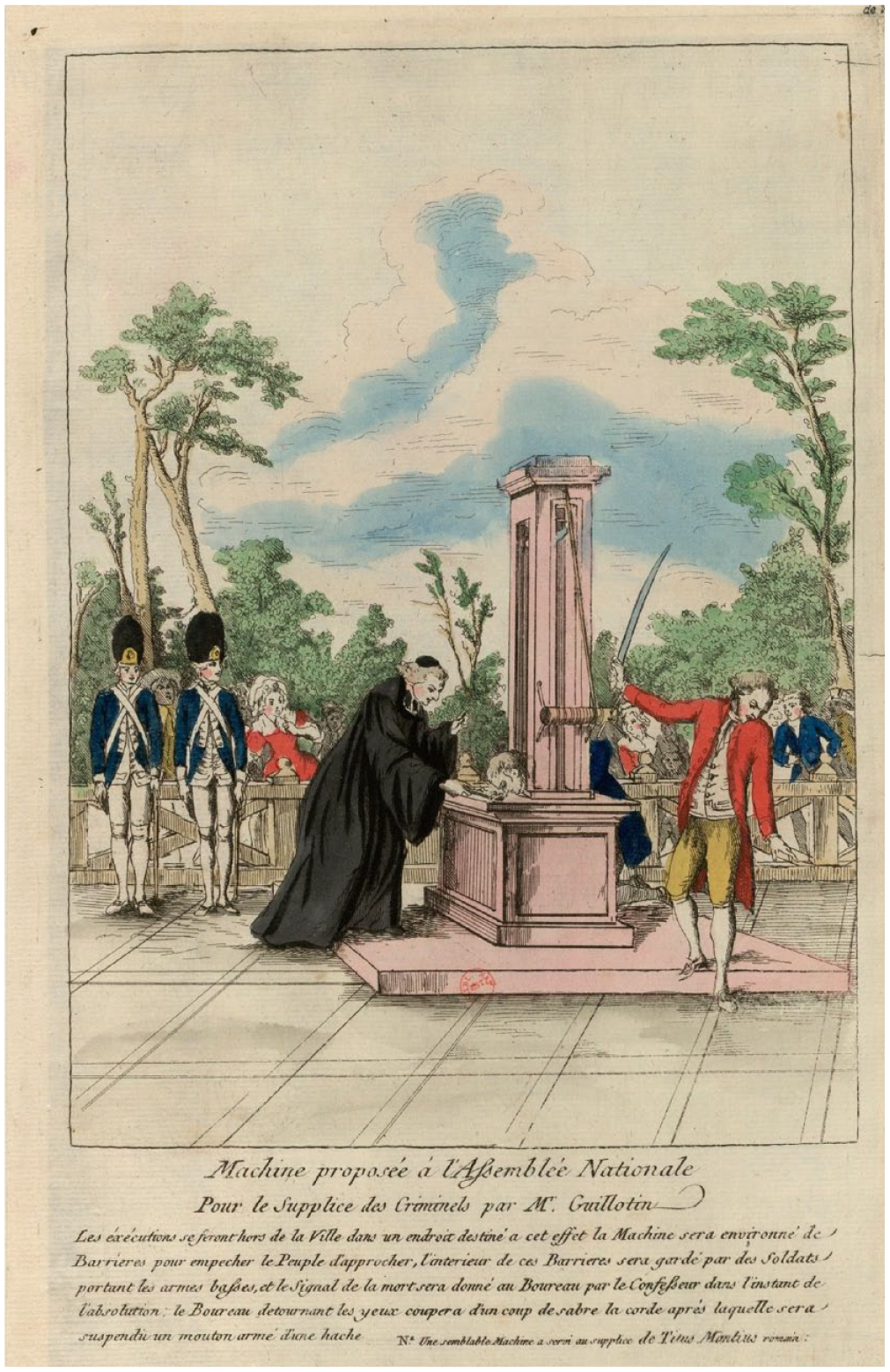
Machine proposed to the national assembly by Monsieur Guillotin for the execution of criminals, 33 × 22.5 cm, etching on paper, 1791, Bibliothèque nationale de France, Paris.
It is a remarkable document, not least since it specifies the ceremonial arrangements involved in the proposed mode of execution, which is a telling indication of the gulf between the imagined and the actual effects of the machine. Moreover, it is notable that the viewing context of the event is emphasised over the technical details, which here ‘exhibits refined architectural embellishments, moldings that suggest classical solemnity and permanence’ (Graybill, 2016: 29). The image and text are framing the experience as a spectacle, which was reinforced by the look of the guillotine itself and its very design had a representative function.
What is revealed in the image is not only the disparity between social reality and representation, but an articulation of the competing desires for a form of execution that was both ‘public and discreet’, where the executioner becomes ‘almost a personification of the state, kills without looking’ (Friedland, 2012: 244). Indeed, the executioner’s gaze is not merely looking away, but is actively directed at the floor and this hanging of the head is sombre, striking a melancholic disposition. 1 Gilman (1982: 12) has explained how close associations were drawn between the icons of melancholy with those of grief in religious art since the late Middle Ages, and that later depictions of melancholia (such as those by Van Gogh) in the 19th century represent ‘individuals driven to the brink by society’s inhumanity’ (Gilman, 1988: 115). The reworking of these classic themes of melancholy, as expressed by the pensive executioner, offers both social commentary and a sense of mourning. Although spectators gather and strain to see anything, some look at one another, while others dutifully recoil from the scene, the picture itself is ultimately downplaying the violence of the occasion. From the deliberately obscured blade of the guillotine to the delicate turning away of the of the executioner, the image distils how the revolutionary mode of punishment would operate. It retained the exemplary function of public justice, while purging the ritual of the atrocity associated with the Old Regime and emphasising that under the new laws every condemned soul would die in exactly the same, egalitarian way. In the transformation of executions from a prolonged, artisanal process to an efficient, mechanised product the executioner gradually disappears from the picture. It is striking that in the illustration accompanying the official guillotine ‘manual’ sent to all départements across France, depicting what the machine should look like when properly assembled there is no executioner (or witness) in sight, it is as if the ‘machine could perform the task without any help’ (Friedland, 2012: 262).
Indeed, the ideological significance of the guillotine’s design has been described as a ‘triumph of geometric form’ where the ‘dynamic tension between formal grace and lethal power, high ideals and murderous reality, gave the guillotine its highly charged symbolic resonance’ (Gerould, 1992: 5). The symbolic ‘merit’ of the guillotine is further conveyed in the following description: the very shape of the guillotine gave substance to the principle of justice it represented – a justice humane enough, no doubt, but as inexorable as a universal axiom. The simplicity of the aesthetic impressed itself upon the visual imagination. It exhibited the three basic geometrical forms: square (in the form of a rectangle); circle; triangle. Unlike instruments of torture, which were generally more complex and meticulously designed to inflict a certain quota of pain via a specific part of the body, the guillotine had something of the simplicity and austerity of a diagram: its abstract shape was a declaration of the universal laws of geometry and gravity. The decapitating machine made public exhibition a celebration of the mechanical and geometrical, and so ensured the spectacular triumph of these forms of ‘just’ and ‘reasonable’ thought.
This passage makes it clear that the device was so closely aligned with forms of political and visual representation that it gave rise to a new aesthetics of terror. It also reminds us that the guillotine’s use during the revolution constituted an elaborate theatrical production, which quickly became a form of popular entertainment, and it is to such matters that we now turn.
Festive spectacle
From the beginning, the revolutionary guillotine was associated with illusionism and theatre. As Stephanie O’Rourke (2017: 26) argues, this was ‘evident in both how it was staged as a visual display and the terms used by its spectators to describe their experiences of it’. The very speed of the guillotine’s mechanical slaughter stood in marked contrast to the extended drama of torment associated with the old regime. Initially spectators were confused and disappointed by the occasion, which offered a spectacle that was practically impossible to see. After centuries of witnessing the ‘penal equivalent of a three-act play, it was as if they had been invited to attend a new kind of performance, one that was finished almost at the same time as it began’ (Friedland, 2012: 248). It was a void that produced considerable uncertainty. As historians have pointed out the ‘horrifying effects of the guillotine emerged less from its overt spectacle than from its lack thereof’ (Graybill, 2016: 48). The horror of the event was really an effect of the imagination, expressing a fundamental anxiety over the process of death, including growing confusion as to exactly when it occurred. As we will see, many anecdotes and stories circulated about the persistence of life in severed heads and bodies in the early 1790s, culminating in a public controversy over the moral legitimacy of the guillotine in 1795. Indeed, contemporary spectators introduced new terms to describe the sensation of attending the event, where it was regarded as ‘“a deception” or “a dream,” defined by a sense of unreality and illusion’ (O’Rourke, 2017: 27). To compensate for the invisibility of the actual moment of death an elaborate choreography emerged. The staging involved the procession, with prisoners arriving in the square in an open cart, the mounting of the scaffold, the horizontal binding of the condemned to the plank, the vertical drop of the blade, the brandishing of the newly separated head and the final fate of the victim’s remains.
Across Europe a flourishing print market depicting the guillotine and its victims confirms the impossibility of representing the moment of death, or rather it was left unrepresented in all these sources. Royalist prints tended to show the victim just before the execution displaying exceptional courage in the face of adversity and ‘often portray the “martyr” as making oratorical gestures which there was in truth no time to make’ (Arasse, 1989: 151). Figure 2 is one such illustration, which is of the most symbolically and politically charged execution of the Revolutionary period, that of Louis XVI (now Louis Capet), where a crowd of 20,000 had packed into the square to watch the execution. Yet here it is as if he is ‘going to his death to preserve his nation’s dignity’ (Bindman, 1989: 49) and dignity is the only possible compromise in an impossible situation. In contrast, the revolutionary engravings focus on the moments after the execution, typically the executioner presenting the head to the crowd. It has been argued that an image like Figure 3 brought a new meaning to the ‘notion of a “profile portrait”’ that now ‘functioned simultaneously to denote an emblem and to display a body violated’ (Graybill, 2016: 39). The inscription at the bottom is taken from Robespierre’s letter to his constituents and declares: The tyrant has fallen beneath the sword of laws. This great act of justice has dismayed the aristocracy, annihilated royal superstition, and created the Republic. It imprints a great characteristic on the National Convention and makes it worthy of the confidence of the French people.
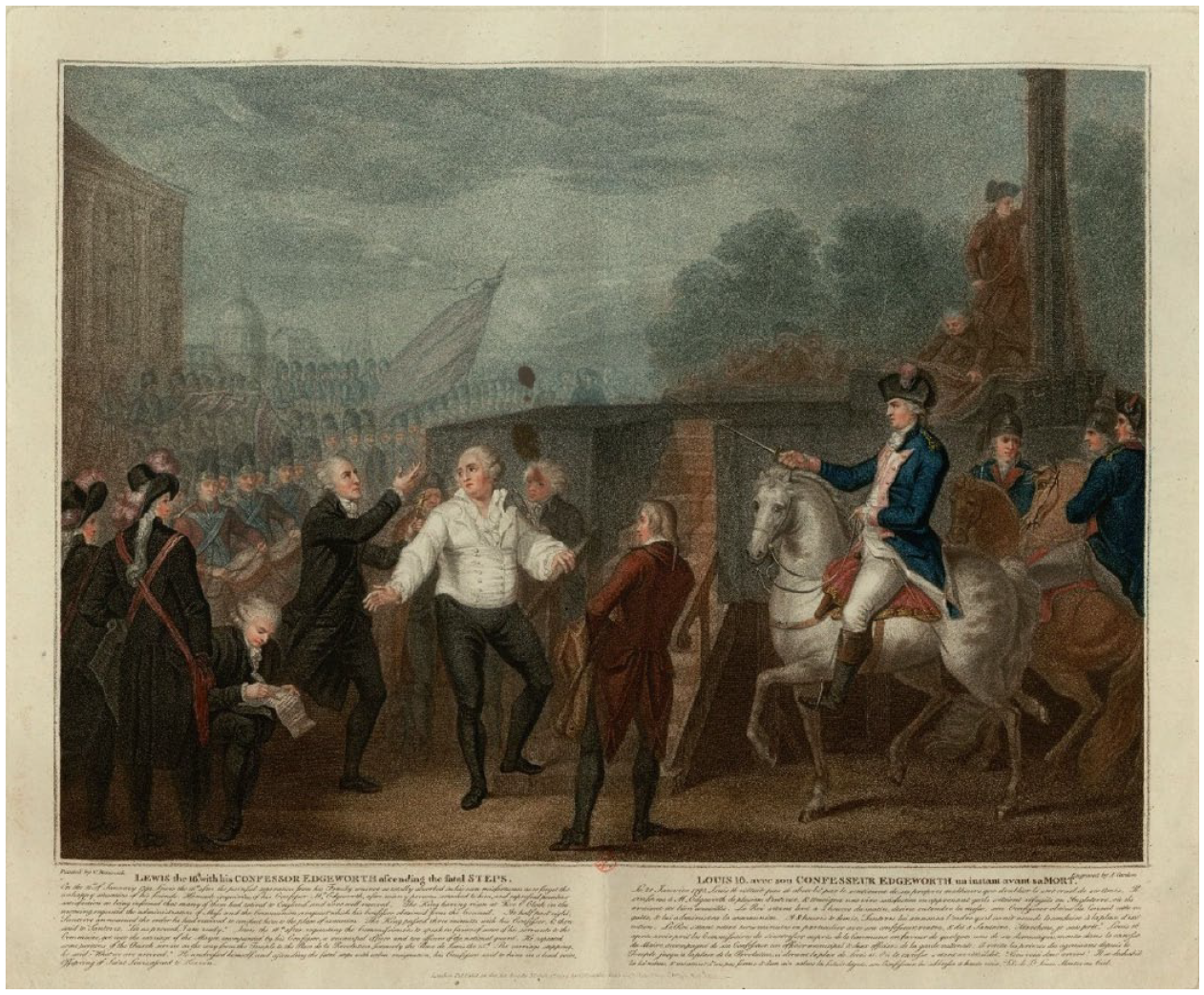
Louis the 16th with his Confessor Edgeworth ascending the fatal Steps, Charles Benazech, engraved by A. Cardon, 40 × 48 cm, 1797, Bibliothèque nationale de France, Paris.
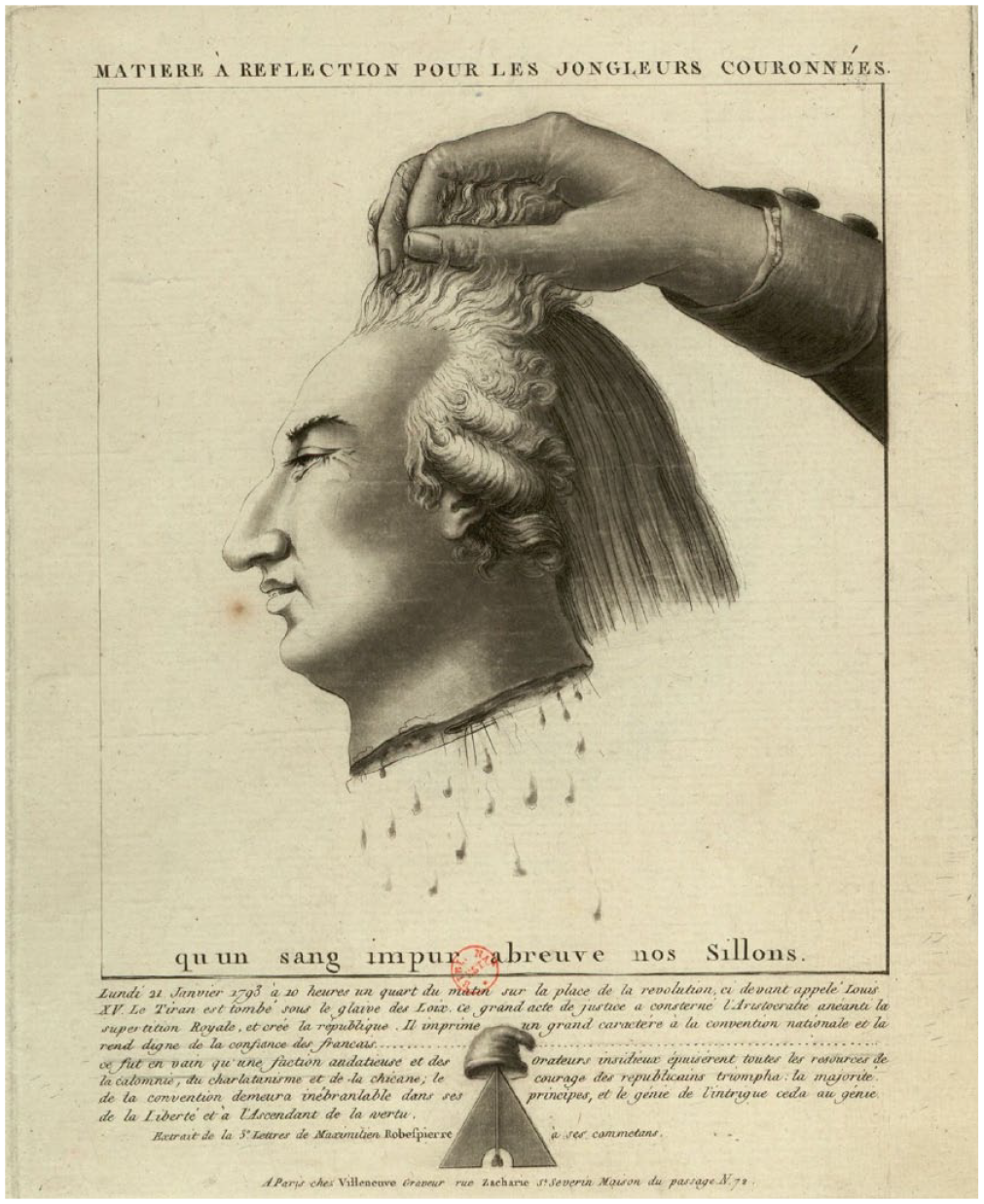
A Matter for Reflection for the Crowned Jugglers, 21.5 × 17 cm, engraving, 1793, Villeneuve, Bibliothèque nationale de France, Paris.
If the head of the king was the most recognisable old regime symbol, then the demise of that despised system is now complete and irrevocable. The engraving speaks to a rich iconographic tradition, that of Perseus turning Polydectes to stone by showing him the severed head of Medusa. As for the blood that drips from the neck, it seems to fortify the words inscribed beneath the image. While in a ghoulish parody of the Eucharist, numerous accounts describe spectators rushing forward to dip their handkerchiefs in the royal blood, which suggests the baptismal role of the birth of the Republic. ‘The blood of Louis Capet’, wrote Révolutions de Paris newspaper, ‘cleanses us of a stigma of 1,300 years’ of monarchy (in Hunt and Censer, 2022: 100). The two contrasting images are indicative of how the event is represented in two distinctive ways: the royalist treatments emphasise the moments before the execution, portraying the ‘martyr’ facing adversity with exceptional heroism, while the revolutionary prints concentrate on the immediate aftermath, repeating the same gesture of the executioner presenting the severed head to the people. Death itself remained invisible, and the difficulty of representing the moment of death under the guillotine was further compounded by considerable uncertainty over when it exactly occurred, as we shall see later in the paper.
The guillotine was officially known as the ‘sword of liberty’ and was intended to not only replace the arbitrary, corrupt and irrational modes of punishment associated with the old regime, but as a direct contrast to ‘popular justice’, which in practice involved spontaneous and summary lynching, fatal beatings and indiscriminate stabbings. Such street murder involved ‘fashioning impromptu gallows out of lamp posts – those ghastly symbols of state power that had facilitated the extension of both police surveillance and the working day into the night’ (Doel, 2017: 69). The establishment of the Extraordinary Criminal Tribunal (soon called ‘Revolutionary’) was set up to deter the people from conducting justice themselves, so that it gave ‘revolutionary justice’ a procedure and a form. By this point, the guillotine was no longer ‘an auxiliary of justice, but actually represented justice in all its moral and political glory’ (Arasse, 1989: 75, emphasis in original). The guillotine was put to its first political use in executing several participants in the violent events of 10 August 1792, after the sacking of the Tuileries palace, and the massacre of some 600 Swiss Guards. Figure 4 is a depiction of the event, and the guillotine is placed at the centre of the composition, its geometric shape reinforced by the surrounding classical architecture in the backdrop. Crowding around the execution are citizens reacting to the scene ‘with equal parts surprise, enthusiasm and civic gravity’ while figures on both sides direct ‘our attention to the executioner, who holds a victim’s head aloft’ (Graybill, 2016: 37). The political significance of this theatrical flourish, aside from giving the audience something to see, was one confirming the ‘monstrousness of the monster’ (Arasse, 1989: 114). Revolutionary prints repeatedly show this gesture, and such edifying imagery provided a suitably petrifying conclusion to the performance. In this carefully crafted image, the ‘window’ of the guillotine acts as if it is a mirror (note the positioning of the two men standing on either side of it, in almost identical poses). Mirrors have long been a source of fascination and were suspected of having magical powers, ‘allowing one to access the spirit world as if through a mystic portal’ (Edgerton, 2009: 24). Although such superstitious beliefs were relics from earlier times, the mirror remained a metaphysically charged object and something of that potency is captured in the picture.
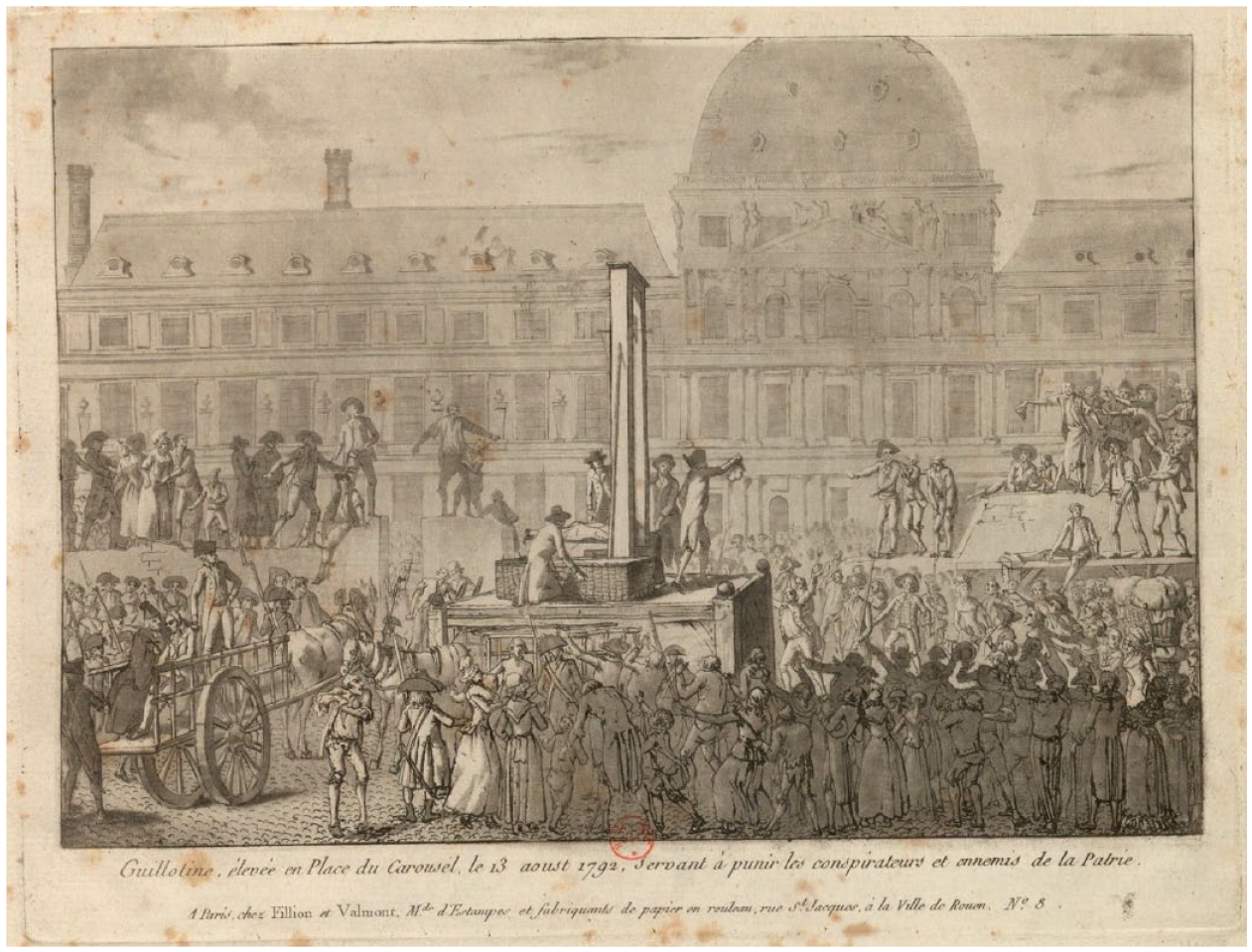
The Guillotine, erected in the Place du Carrousel, 13 August 1792, being used to punish conspirators and enemies of the homeland, 17.5 × 23.5 cm, etching on paper, 1792, Bibliothèque nationale de France, Paris.
Executions were the most frequent and popular of revolutionary festivals, and the guillotine was at the centre of entertainment celebrating the Republic. A sense of the fairground spectacle and amusing novelty is conveyed in the following passage: Around the scaffold people sold mementos and lists of the scheduled executions. There were restaurants and cabarets de la Guillotine, where the latest victims were lists as “catch of the day” and satirical songs and poems were performed. The crowds were especially dense near the Jardin des Tuileries where, it was commonly known, one had the best view of the proceedings. The demand for related ephemera far exceeded the geographical site of the Place. Many fashionable drawing rooms in Paris had novelty miniature guillotines that were used to slice bread or fruit at dinner parties, and toy replicas were popular. . .Wax molds of the severed heads were also available to a paying audience at the wax museum run by Dr. Philippe Curtis in Paris, where Madame Tussaud apprenticed.
Taken together these various practices suggest the guillotine was experienced in the realm of artifice, carnival and folklore, suggesting there was something fundamentally illusory about it. As Mona Ozouf (1991: 176–177) has noted, even the execution of the king was often referred to euphemistically, as if he had been made to disappear rather than executed.
The terror
In the years after 1789 French revolutionaries sought to remake their society according to the principles of liberty and equality, yet popular sovereignty led to government by terror and the ruthless crushing of internal opposition, which resulted in catastrophic civil wars causing the deaths of hundreds of thousands of French citizens. For some contemporary commentators all this was inevitable. As early as 1790, the Anglo-Irish conservative politician Edmund Burke was describing the situation in France ‘in tones which suggested that massacre and mob rule were already the norm, and total anarchy shortly to arrive’ (Andress, 2013: 294), predicting that it would take a military dictatorship to end it all – several years before the eventual triumph of a general. Napoleon Bonaparte made himself emperor and through military conquest ruled much of Europe up to 1815, revolutionising warfare and pioneering ‘total war’ (Bell, 2007). How the most democratic and egalitarian regime yet seen in the world became so aggressively expansionist and politically repressive is a question that focusses attention on the troubled relationships between revolution and violence. It is important to note that what is called ‘the Terror’ emerges, in part, because of the positive associations attached to the words terreur and terrible, where the idea was ‘to purge and save’ (Kelly, 1980: 18).
The most immediate threat was counter-revolution and religion was the life-blood of it. As a new ‘revolutionary calendar’ replaced the old Christian one, even the measures of space and time were revolutionised, so that every aspect of daily life became politicised. The ambition was to eradicate all forms of Catholicism through de-Christianisation campaigns. Local ‘revolutionary armies’ marched through towns destroying ‘all the signs of feudalism and “superstition”’ (Hunt and Censer, 2022: 117). By the spring of 1794 virtually every church had been closed, sold off and many converted into stables or warehouses, while those priests that escaped the guillotine were in exile or hiding. Convinced that they faced an international threat France went to war with Austria at the beginning of 1792 and with Prussia soon after, as there was an understandable belief that these foreign powers wanted to halt the Revolution, return the clock back to 1788 and reinstate the monarchy. After the execution of the king in January 1793 the war was expanded to encompass Britain, Holland, Spain and the Italian states. When the Convention sought to augment its armies through the systematic conscription of 300,000 men in February this sparked the Vendée revolt and met with widespread resistance throughout the west of France. Although republican forces eventually gained the upper hand, histories of the ‘Vendéan revolt’ remain controversial and partisan, with estimates of the rebel death toll ranging from 20,000 to 250,000 and even more. The insurrection spread to other regions, and in response the National Convention set about drafting an array of new repressive decrees and emergency measures. On 6 April 1793 the Convention established a Committee of Public Safety to provide direction to the regime. It met in secret and before long gained nearly complete control of the war effort and the repression of political enemies. Robespierre was the chief spokesman of the committee, and he remains one of the most contested figures in world history, but he never acted alone. In a speech on political morality to the Convention on 5 February 1794 he insisted that ‘the mainspring of popular government in revolution is both virtue and terror. . .Terror is nothing other than prompt, severe, inflexible justice; it is, therefore an emanation of virtue’ (Robespierre, cited in Arasse, 1989: 77). The revolutionary government was on a war footing and sought to defend the aspiring Republic, achieving some of its greatest successes on the battlefield.
With the threat of foreign invasion looming, foreigners were required to carry passports and kept under surveillance; while the civil war in the Vendée and other uprisings prompted the introduction of ‘surveillance committees’ in every municipality, and their responsibilities included the denunciation of any suspicious behaviour as well as the arrest of suspicious individuals. On to them fell the responsibility of implementing the Law of Suspects (passed in September 1793) which drastically widened the definition of ‘suspect’ and effectively transformed the penal system into the coercive arm of the revolutionary government. Any former aristocrat, royalist, federalist, anyone taking a stand against the Jacobins, any administrator who had been dismissed since 1789 and anyone who criticised the revolution could now be arrested. The legislation also transformed the Revolutionary Tribunal into four courts, so that proceedings could continue around the clock (Gough, 2010: 39). Several ‘show trials’ were staged involving high profile victims, including Marie-Antoinette, who was executed on 16 October 1793, accused of treason and incest with her 8-year-old son. No other trial ‘attracted the same attention or aired the same range of issues as that of the ill-fated queen’ (Hunt, 1991/1998: 280). Shortly after, the Duke of Orleans, a nephew of Louis XVI and enthusiastic supporter of the revolution was guillotined on 6 December. Louis XV’s last mistress, Madame du Barry, who was then in her seventies, was executed in early December. Her abject struggles on the scaffold ‘drew attention to the reality of her terror and destroyed the theatrical illusion’ (Gerould, 1992: 30) for many spectators.
Overall, it has been estimated that up to half a million people may have been imprisoned as suspects of one kind or another in France, with perhaps 10,000 dying in custody. Suspects were ‘crowded into prisons never intended for such numbers, and more often into makeshift quarters no better equipped’ (Doyle, 2018: 259). Political crimes were now so broadly defined that nobody could feel safe. Indeed, in a portentous decision ‘the deputies voted to abandon parliamentary immunity, making themselves subject to arrest by their colleagues’ (Hunt and Censer, 2022: 104). No less than ninety-two deputies to the National Convention (over 10 percent of the total) would be executed or die in prison through to 1794, this included ‘nearly one in twenty of all deputies from the Third Estate, one in fourteen from the Clergy, and one in eight from the Nobility’ (Tackett, 1994: 39). Among the dead were some of the most prominent speakers and leaders of factions, all now regarded as enemies of the people.
In the debate over the creation of a Revolutionary Tribunal (to judge counter-revolutionary crimes) the influential orator Georges-Jacques Danton raised the spectre of the Terror by proclaiming, ‘Let us be terrible, so that the people does not have to be’ (cited in Andress, 2013: 296). Here he was not only referring to popular justice, but also attempting to distinguish between what might be termed good violence, that which is legitimated by state authority, and bad violence, which is dangerously uncontrollable and threatens the stability of the new order. Rather than aristocrats, most victims of the guillotine were drawn from the ‘same classes as the revolutionaries themselves, since the Terror primarily consumed those citizens suspected of being counter-revolutionaries’ such that a ‘lack of revolutionary zeal, plain indifference, or even incompetence and ineffectiveness were sufficient for someone to become suspect and deserving of swift and inflexible revolutionary justice – decapitation’ (Doel, 2017: 69). A French caricature from 1794 (see Figure 5) conveys the rising public disgust at constant bloodshed, in this image Robespierre has guillotined the entire French population and has only the executioner left to dispatch. Robespierre stands on the constitutions of 1791 and 1793, as if trampling on them, while behind rises a funereal monument for all of France, topped with an inverted liberty cap. It is certainly a prophetic image, as a group of deputies who feared they were his next target began to plot against him.
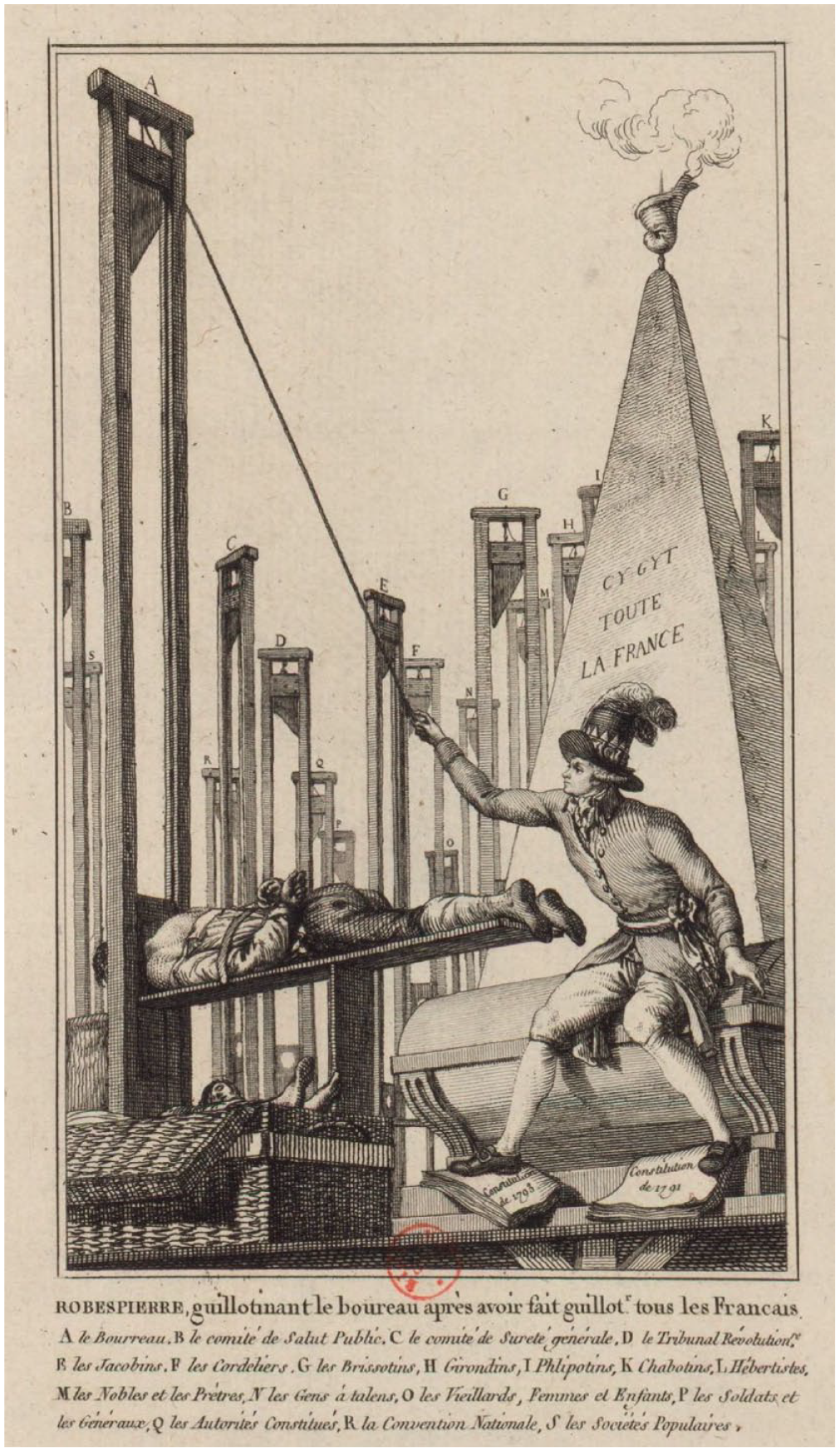
Hercy, Robespierre guillotinant le boureau (1794). Engraving, 23.5 cm × 15 cm.
Several factors combined to seal Robespierre’s fate, as it was becoming clear that terror was no longer required to win the war and many deputies feared that he aspired to personal dictatorship. These suspicions seemed more credible than ever, and Robespierre was declared an outlaw, which dispensed with the need for a trial. He was guillotined on 28 July 1794, along with his closest supporters. As soon as he fell from power, his opponents were quick to make him responsible for all the violence and terror of the preceding 2 years, while exonerating themselves in their efforts to characterise and explain the Terror as a distinct form of government and separate from the Revolution.
Uncanny legacies
Although the Terror had ended, the Revolution continued. Between 1795 and 1799 new legal and political rights were introduced, but ‘the Directory government directed a war effort abroad that would ultimately bring to power the man who would dismantle the Republic itself’ (Censer and Hunt, 2001: 105). By choosing territorial expansion over social welfare at home, the regime established a bureaucratic structure modelled on military professionalism that laid the groundwork for a ‘new security state’ where ‘political legitimacy came increasingly from institutions that offered security, rather than those that embodied democracy’ (Brown, 2013: 343). Military conquest was essential to the regime’s survival, whereby French armies learned to finance themselves by stripping assets from every vanquished city, while sending back to Paris art treasures, hard cash and church silver. The first anniversary of Robespierre’s fall was marked by a decree that the Place de la Révolution would no longer be the site of executions, and subsequent beheadings were moved to the outskirts of the city. Arasse (1989: 84–85) notes that ‘the democratization of death did not end with the death of Robespierre, but in 1797, when a military commission was set up to try to émigrés who had returned to soon, and the death that awaited them was no longer the guillotine but a firing squad’. By reintroducing such a distinction in the methods of political execution the Directory sought to end the symbolic functioning of this ‘apparatus’ of government. Over this time the guillotine came to play an ‘increasingly marginal role in public life in the Napoleonic era’, though what ‘remained of the revolutionary guillotine was something more abstract and pervasive: the concept of corporeal violence as something mediated, illusionistic and theatricalised – an experience not fully locatable within the horizon of one’s individual perceptual capacities’ (O’Rourke, 2017: 35–36). Indeed, it has been argued that ‘the mechanical instant of the guillotine’s violence generated a crisis of visibility’ (Graybill, 2016: 50). Such profound uncertainty can be seen in the medical disputes surrounding the relative humanity or barbarity of the guillotine’s operations.
In her analysis of the heated debates about the guillotine in 1795 (shortly after censorship of the press had been relaxed) Jordanova (1989) found that all commentators agreed that pain and suffering should be kept to the minimum, but their controversies centred on how the persistent movement of bodies and heads, after decapitation, should be interpreted. Medical practitioners occupied a central position in these exchanges, and it was not the mutilated body but the understanding of an aware mind that commanded attention, pressuring notions of the integrity of the physical and the mental. As she explains, the conceptual challenge lay in answering the following questions: what levels of life remained after the blade fell, and how did the guillotine separate out the different organic levels? What appeared on the surface as a dramatic, instantaneous event forced people to think about its hidden complexity, not least because of the historical context in which the guillotine was used. In the distorted, uncoordinated movements of severed bodies and heads, and in the levels of life thereby revealed, biological and social dissolution, and chaotic, disordered life – both physiological and social – were put before the imagination of the people. Savants and medical practitioners, no less than other social groups, came to recognise that such disorder had, if possible, to be accommodated within their cognitive frameworks, which were rooted in their commitments to natural law and cosmic order.
Observers were obliged to decide whether the bodily movements following decapitation indicated consciousness, and as such should be regarded as evidence of the victim’s awareness of pain, or instead are best seen as involuntary convulsions, automatic reflexes that bore no relation to sentience or cognition. Despite their best efforts, such arguments could never settle the dispute definitively. Each position condensed hidden themes, as the above passage suggests, unsettling how spectators processed what they saw happen before their eyes. Indeed, it has been argued that the very public nature of the scene of execution ‘produces a form of theatricality that is irreducibly spectral and uncanny’ (Marder, 2018: 176). It is significant that Elissa Marder develops these insights in response to a series of lectures Derrida (2014) gave on capital punishment between 1999 and 2001, which inimitably deconstruct the authority that the state holds over life and death.
Part of Derrida’s goal in the series is to disrupt the fantasy of instantaneous death and to dwell on that moment outside and in between time, hovering indecisively between life and death. In doing so, he poses the crucial question: ‘What must be that which is called man so that at a moment of his history he comes to consider the guillotine as an advance in human progress, an advance in man’s appropriation of his essence?’ (Derrida, 2014: 192). The gendered language is deliberate, and he notes that death machines are typically feminised, but then refrains from offering any discussion of this phenomenon, aside from an oblique gesture to psychoanalysis as an approach that might be able to account for the sexualisation of the death machine – how the horror inspired by the death penalty masks a fear of castration. Marder’s (2018: 180) work picks up the invitation and offers a psychoanalytical interpretation of ‘why the death machine becomes incarnated by a phallic feminine figure’ characterise how ‘the ‘nickname’ or the ‘joke’ attached to the death machine (the ‘widow’ or the ‘maiden’) provides the male subject with a defense mechanism that enables him to ward off his anxiety about impending death by means of anthropomorphism, feminization, and humor’. Her reading explains how the guillotine, as a machine designed to embody the virile attributes of rational justice, soon became associated with feminine bloody vengeance. Although Derrida’s mediations do not amount to a fully formed philosophical argument against the death penalty, what they do instead is ‘lay the groundwork for future critiques of any and all forms of state-sanctioned killing’ (Straub, 2018: 8). They also suggest new directions for what has been called the ‘woman question’ in revolutionary historiography to explore, especially over the issues of ‘male virtue’ and ‘republican motherhood’ (Hunt, 1994).
Conclusion
There is no more contested subject in French history and the Terror has haunted the modern world ever since, and it is to these dividing lines that we return. The historiography can be characterised as veering, ‘sometimes wildly, sometimes with a view towards synthesis, between (1) an explanation (usually ‘progressive’) that the terror was a result of circumstances, and thus derailing of what was an assertion of the rights of the people and (2) an explanation (usually ‘conservative’) that the Terror was always already contained in the logic of the violent overthrow of the ancien regime’ (Reed, 2018: 64, emphasis in original). As such, the terror needs to be situated in the context of the dynamic and changing politics of the revolution, where arguments about ‘eventness’ introduce a sense of ‘profound uncertainty’ into the study of the crises that occurred (Sewell, 1996: 846). Such an approach can be seen in Tackett’s (2015: 4) examination of the political culture of violence where much emphasis is placed on unfolding process, and he cites Lazare Carnot’s observation that ‘A man does not begin as a revolutionary; he becomes one’. Carnot had been a member of the Committee of Public Safety during the Terror, and the insight serves to remind us that it was not the revolutionary that made the revolution, but the revolution that made the revolutionary. Especially this one, where there was no model, precedent or inevitable path. This approach has inspired French historians to study how the threat of popular violence was diverted into legitimate forms of retribution. Politicians responded to violence by constructing an apparatus of state control which directed ‘punishment and revenge through legal channels and away from the street’ (Gough, 2010: 11).
If the Terror is seen ‘as an extreme expression of the problem of securing sovereignty (essentially, the legitimate monopolisation of violence) within a revolutionary situation’ (Baker, 1994: xvii), then it was a system of repression characterised by its own exceptional dynamism, which came to see all criticism or dissent as counter-revolution. There is no doubt that the Terror was the result of many factors, but in its consequences death was the most profound, making the guillotine it’s most defining image. In this paper I have sought to understand how the guillotine acquired this iconic status and interpret how it was a device capable of producing many kinds of rupture: philosophical, theatrical, medical and, of course, political. What makes the guillotine a spectacle is not just its highly visual nature, rather ‘it is the break it produces within the realm of visibility – a structural, historical and spectacular rupture’ (O’Rourke, 2017: 34, emphasis in original). As such it constitutes a key site for examining the visual culture of violence that emerged in the Revolutionary decade and the guillotine produced a fundamental uncertainty, suggesting an irreconcilable split between seeing and believing. Although Foucault (1977: 13) only devoted a couple of paragraphs to the guillotine in the memorable opening chapter of Discipline and Punish his remark that it ‘takes life almost without touching the body’ has been developed by Arasse (1989) and others to suggest that death by guillotine took place so swiftly that it barely seemed like death at all. In some respects, this crisis of visibility was short-lived, yet in others it was more enduring. By dispatching groups of thirty to forty victims in each performance the guillotine seemed ‘as if it were repeatedly opening and shutting a window onto the hereafter’ and in doing so it routinised death and ‘essentially allowed for its mass production’ (Friedland, 2012: 250). That sense of mechanical slaughter is depicted in Figure 5, capturing how the very swiftness of the guillotine lent itself to rapid acceleration: where the clear aim is not to punish, but to terrorise. The political and social conditions in which such an image was created help to explain the work, but the power of it resides in how it illuminates forces that were shaping France at the height of the Terror, but also beyond it – foreshadowing how totalitarian violence would be set to work in the future.
Footnotes
Funding
The author received no financial support for the research, authorship, and/or publication of this article.
