




Abstract
Fundamental frequency ( fo) is the most perceptually salient vocal acoustic parameter, yet little is known about how its perceptual influence varies across societies. We examined how fo affects key social perceptions and how socioecological variables modulate these effects in 2,647 adult listeners sampled from 44 locations across 22 nations. Low male fo increased men’s perceptions of formidability and prestige, especially in societies with higher homicide rates and greater relational mobility in which male intrasexual competition may be more intense and rapid identification of high-status competitors may be exigent. High female fo increased women’s perceptions of flirtatiousness where relational mobility was lower and threats to mating relationships may be greater. These results indicate that the influence of fo on social perceptions depends on socioecological variables, including those related to competition for status and mates.
Keywords
Pitch is the most perceptually salient acoustic feature of the human voice (Titze, 2000), and understanding how listeners perceive pitch is central to deciphering vocal communication (Aung & Puts, 2020). Pitch is determined primarily by fundamental frequency ( fo), the rate of vocal fold vibration during phonation, with higher fo perceived as higher pitch. fo increases with muscular tension in the vocal folds and decreases as a function of vocal fold length (Titze, 2000). In human males, fo drops approximately 50% at sexual maturity with the pubertal surge in testosterone and hypertrophic growth of the vocal folds (Markova et al., 2016). Thus, humans, along with many nonhuman primates, exhibit a pronounced adult sex difference in fo that likely arose in the common ancestor of the catarrhines after their divergence from the platyrrhines approximately 43.5 million years ago (Puts et al., 2016). Comparative evidence indicates that sex differences in fo may have subsequently been elaborated or reduced in each taxon depending on the form and degree of male mating competition (Puts et al., 2016).
A growing body of research has investigated relationships between fo and perceptions relevant to human mating competition. Previous research suggests that lower male fo increases perceptions of formidability, and perhaps prestige, among men (Cheng et al., 2016; Puts et al., 2006; Rosenfield et al., 2020), as well as men’s attractiveness to women (Feinberg et al., 2005; Puts, 2005). In women, a higher fo may be more attractive to men, and women may perceive female voices high in fo as indicating greater threat in competition for mates (Puts et al., 2011). The ubiquity of sexual dimorphism in fo across human populations and their closest living primate relatives suggests that the effects of fo on competition-relevant perceptions may be robust and consistent across populations. However, existing data and theory also suggest that the magnitude of these effects may be context-dependent (i.e., sensitive to individual and environmental variables relevant to ancestral fitness). Social evaluations of sexually differentiated traits such as faces and voices have been found to depend on the perceiver’s own formidability (Zhang & Reid, 2017), exposure to images depicting male-on-female aggression (Y. Li et al., 2014), and perceived domestic-violence risk (Borras-Guevara et al., 2017). Social and ecological contexts may likewise affect perceptions of masculine traits, but few studies have systematically identified and tested these effects, and thus little is known about how the influence of fo on social perceptions varies across individuals and societies (Aung, Conard, et al., 2023; Pisanski & Feinberg, 2013).
Working from evidence that sexual dimorphism in fo was shaped ancestrally by male status competition (Aung & Puts, 2020; Puts et al., 2016; Rosenfield et al., 2020), we focus here on two variables: intensity of male rivalry and relational mobility. Given the relevance of male intrasexual rivalry over human evolution (Puts et al., 2023) and associations between fo and measures of threat potential (Aung, Goetz, et al., 2021; Aung & Puts, 2020), men may benefit by more strongly attending to the fo of their rivals in environments with more intense male intrasexual competition, such as societies with higher homicide rates. Women’s preferences for masculine traits may also be stronger in societies with higher homicide rates, in which male status may be more strongly tied to aggression (Brooks et al., 2011).
Statement of Relevance
Pitch is the most perceptually important feature of our voices, but we know little about how its influence on our impressions of speakers varies across cultures. To study this, we manipulated the pitch of voice recordings and examined its effects on social perceptions in 2,647 adult listeners across 44 locations in 22 societies. We found that low male pitch increased men’s perceptions of male fighting ability and prestige, especially in societies with higher relational mobility and homicide rates in which rapidly identifying high-status and formidable competitors may be most critical. Low male pitch also increased women’s perceptions of male attractiveness. High female pitch increased women’s perceptions of female flirtatiousness where relational mobility was lower and thus where infidelity may threaten both women’s romantic and platonic relationships. Our findings suggest that the influence of voice pitch on human perceptions varies with socioecological variables related to competition for status and mates.
Assessing rivals through conspicuous, sexually differentiated traits may also be more important in large, complex social environments in which social knowledge is limited. Comparative research suggests that visually conspicuous male status badges (Grueter et al., 2015) and relatively lower male fo (Aung, Hill, et al., 2023) evolve in anthropoid primate species with larger group sizes. In humans, conspicuous status signals may be particularly salient in societies characterized by higher relational mobility, a socioecological measure that represents freedom and opportunity to form interpersonal relationships based on personal preferences (Thomson et al., 2018). In such environments, rapid, stereotyped characteristic attribution may help individuals manage the large volume of social information generated by interactions with numerous unknown conspecifics (Grueter et al., 2015; Scott et al., 2014). Residents from higher relational-mobility environments have been reported to more frequently display and prefer displays of value as a partner such as strength, generosity, and resources, whereas those from lower relational-mobility societies may suppress such behaviors and preferences to avoid reputational damage and jeopardizing current relationships (Yuki & Schug, 2020). Vocal fo may therefore influence the assessment of rivals more strongly in societies with higher relational mobility.
Despite substantial theoretical work predicting such moderation, little is known about whether and how individual and socioecological variables alter the influence of fo on social perceptions. Thus, we investigated how effects of fo on perceptions relevant to mate choice and mating competition are moderated by socioecological and individual factors among individuals from diverse community and student samples (n = 2,647) across 22 nations (Fig. 1 and Table 1). Participants listened to pairs of voice recordings differing only in fo and selected one voice from each pair in response to four prompts thought to be most relevant to intrasexual mating competition and mate choice in each sex. To account for specific and shared cultural norms and practices, which likely shape mate-choice-relevant and mating competition-relevant perceptions, we considered nation as a random factor and statistically controlled for linguistic and geographic relatedness among nations in our analyses. Our results identified relational mobility and homicide rates as socioecological predictors of cross-cultural variation in the influence of fo on social perceptions.
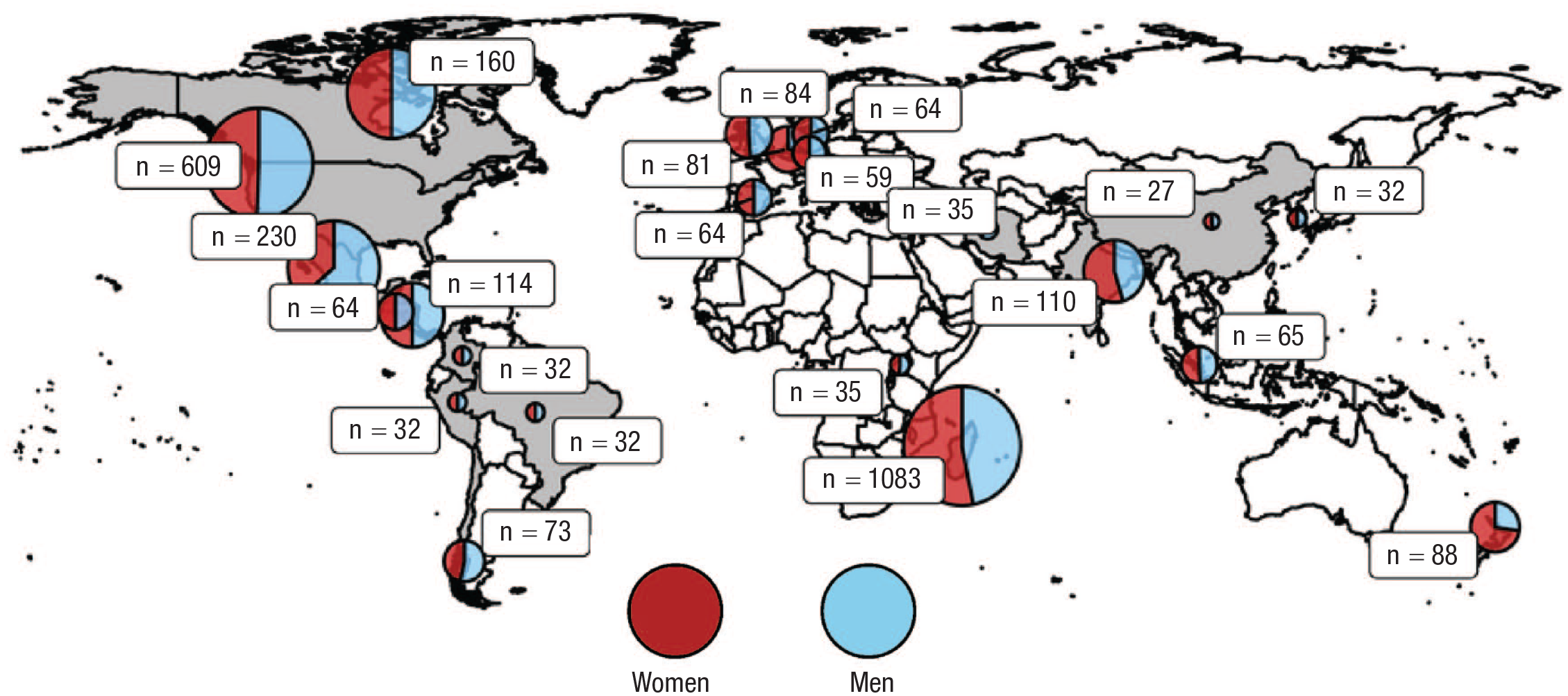
Locations of in-person data collection. Each centroid represents relative sample size by sex.
Hypotheses and Their Predictions Regarding Effects of fo on Social Perceptions and Moderation of These Effects by Individual and Socioecological Variables
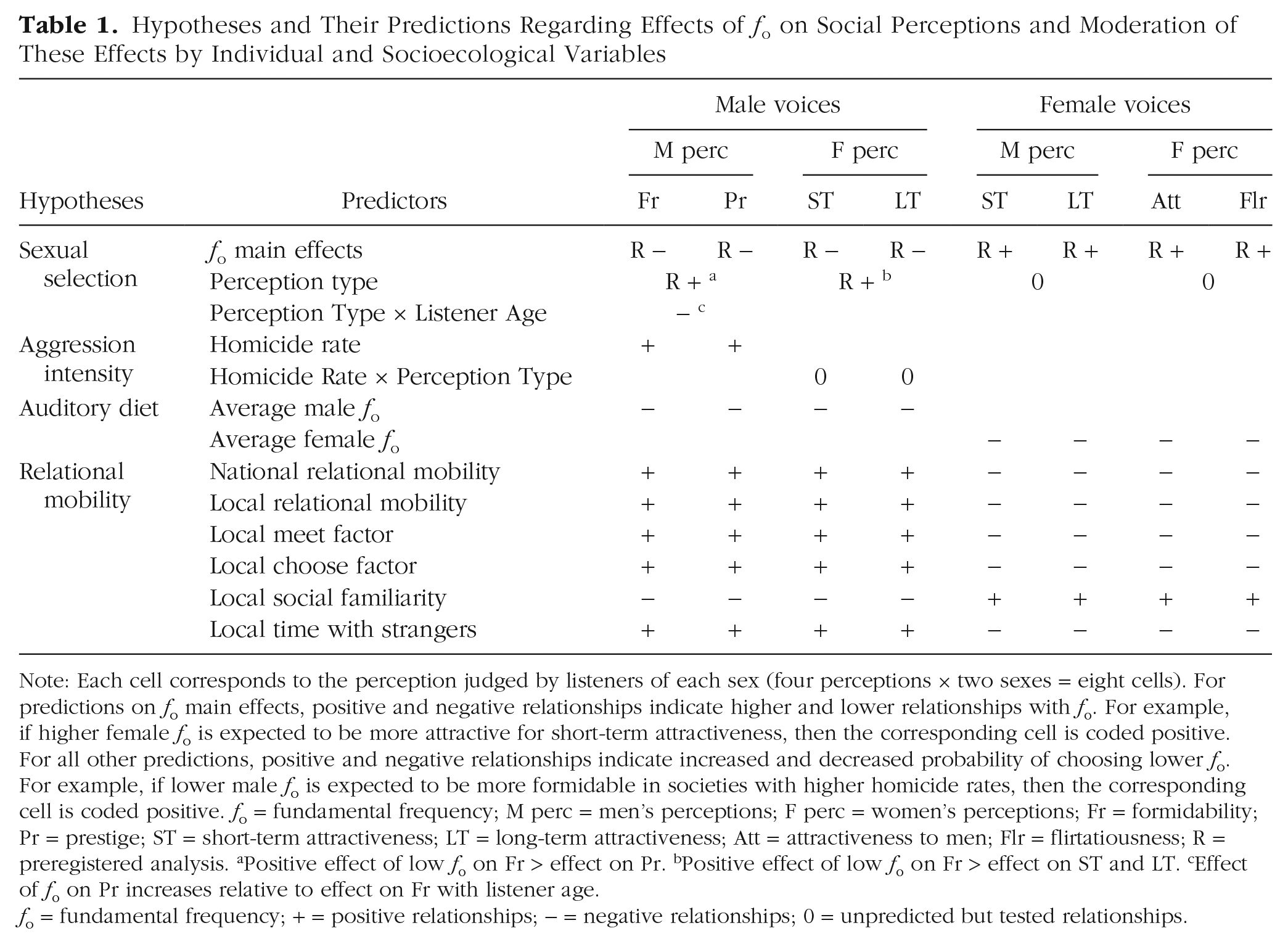
Note: Each cell corresponds to the perception judged by listeners of each sex (four perceptions × two sexes = eight cells). For predictions on fo main effects, positive and negative relationships indicate higher and lower relationships with fo. For example, if higher female fo is expected to be more attractive for short-term attractiveness, then the corresponding cell is coded positive. For all other predictions, positive and negative relationships indicate increased and decreased probability of choosing lower fo. For example, if lower male fo is expected to be more formidable in societies with higher homicide rates, then the corresponding cell is coded positive. fo = fundamental frequency; M perc = men’s perceptions; F perc = women’s perceptions; Fr = formidability; Pr = prestige; ST = short-term attractiveness; LT = long-term attractiveness; Att = attractiveness to men; Flr = flirtatiousness; R = preregistered analysis. aPositive effect of low fo on Fr > effect on Pr. bPositive effect of low fo on Fr > effect on ST and LT. cEffect of fo on Pr increases relative to effect on Fr with listener age.
fo = fundamental frequency; + = positive relationships; - = negative relationships; 0 = unpredicted but tested relationships.
Open Practices Statement
Preregistration, data, code, and fitted models can be found on the OSF at https://osf.io/tnygr. Analyses that deviated from the preregistration are also reported in Table 1. Study materials are available on reasonable request.
Method
Stimulus selection, manipulation, and pairing
To increase ecological validity by capturing some of the prosody of spoken language, we used a short segment from the emotionally neutral “rainbow passage” (Fairbanks, 1940): “They act as a prism and form a rainbow.” We used the same stimuli for all raters regardless of sampling location to increase internal validity and avoid confounding cultural factors with stimulus language when investigating possible effects on social perceptions.
We used relatively few voice stimuli to avoid listener fatigue and minimize its potential to influence results across individuals and societies that may differ widely in experience with behavioral testing. Twelve voice stimuli were produced (two sexes × two voices per sex × three manipulation pairings), and each stimulus was presented to each listener twice for a total of 24 choices per listener. Stimulus pairs were always different pitch manipulations of the same recording. Because we aimed to collect data across various societies, including among participants who may be unfamiliar with rating scales, we presented pairs of vocal stimuli and asked participants to identify which was greater on each perceptual dimension.
Representative voice recordings that were close to the average on key variables (pitch and formants) were selected for use as stimuli from a large initial set of recordings. Two male and two female voice clips were selected from a sample of 619 voice recordings collected at a university in the Northeastern United States (Puts et al., 2016). These clips were chosen using the following criteria: the mean fo and Pf (the average standardized formant value) were within 1 SD of the sample means, there were no speech errors, the speaker reported not taking hormonal contraception (women only), and the acoustic manipulations described below sounded natural to the experimenters.
We produced five fo manipulations of each voice clip. Using Praat software (Version 5.3.22) and means from the full sample of voice recordings, each voice was manipulated to the within-sex mean fo—females: 5.881 equivalent rectangular bandwidth (ERB); males: 3.687 ERB—to 1 SD below and above the mean fo (females: 0.339 ERB; males: 0.280 ERB) and to 2 SDs below and above the mean fo (females: 0.678 ERB; males: 0.559 ERB). Manipulation by ERB produces shifts of the same perceptual magnitude regardless of the starting pitch. Manipulations were centered around within-sex means to better estimate average effects of manipulations across voices and hence produce more generalizable results using fewer stimuli. Unmanipulated voice clips were used as the starting point for each manipulation so that each stimulus was the result of exactly one manipulation. Voice clips were cut to the stimulus phrase using Audacity (Version 2.0.1). Stimuli from each voice were combined into three types of pairs such that all stimulus pairs were 2 SDs apart: 2 SDs raised fo paired with mean fo, 2 SDs lowered fo paired with mean fo, and 1 SD raised fo paired with 1 SD lowered fo. These stimulus pairs allowed us to assess the linear and curvilinear effects of fo on perceptions.
Participants
Data were obtained from 3,173 (1,625 female) participants in 44 locations across 22 nations (Table S12 in the Supplemental Material available online) in this study approved by the Pennsylvania State University Institutional Review Board. Because online sampling may provide a distorted perspective (Harms & DeSimone, 2015), perhaps especially in developing nations, data were collected in person one participant at a time. Participants (mean age = 28.09 years, SD = 11.22 years, range = 12–96 years) were sampled from both university populations (n = 1,551) and local communities (n = 1,662). Participants were recruited by collaborators through universities (e.g., subject pools) or local community convenience samples (e.g., by approaching people in public spaces) with no specific exclusion criteria. Collaborators attempted to collect at least 32 males and 32 females from each study location to ensure that each stimulus order was represented at least twice per sample location; otherwise, sample sizes were determined by available time and resources. Participants volunteered or received course credit, except in Nicaragua (Bosawás), where participants completed this study after an interview for a different study and were compensated for the full length of their participation, and in Madagascar, where participants received a small payment of approximately US$0.56 for an abbreviated version of the study (see below) following local collaborators’ recommendations. Participants completed demographic information and other questions after participating in the voice-perception experiment. Participants reported their relationship status; number of living children (M = 1.53, SD = 2.49, range = 0–20); sexual orientation (5-point scale); primary language; and whether they could hear the recordings clearly, understand the recordings, and hear a difference between the two voices, which were controlled in our robustness tests.
Procedure
Participants listened to pairs of voices and were asked to choose one voice from each pair (first or second) in response to specific questions. Men were asked to indicate which male voice in each pair sounded more respected, admired, talented, and successful (“prestige”) and which male voice in each pair sounded more likely to win a physical fight (“formidability”). Men were also asked to indicate which female voice in each pair sounded more attractive for a short-term, uncommitted romantic relationship (“short term”) and which female voice in each pair was more attractive for a long-term, committed relationship such as steady dating or marriage (“long term”). Women were asked to indicate which female voice in each pair would be more attractive to men (“attractive”) and which female voice in each pair sounded more interested in attracting men (“flirtatious”). Women were also asked to indicate which male voice in each pair sounded more attractive for a short-term, uncommitted romantic relationship (“short term”) and which male voice in each pair was more attractive for a long-term, committed relationship such as steady dating or marriage (“long term”). The dependent variables were coded as either 0 (higher voice chosen) or 1 (lower voice chosen). Each question of the four sex-specific questions was asked six times (two voices × three manipulation pairs), and thus each participant rated 24 pairs of voices. Because of miscommunication, Madagascan participants listened to only one randomly assigned pair of voices per question, and thus each participant rated four pairs of voices in total.
Voice stimuli were presented using an iPod and Sennheiser HD280 Pro headphones in all locations except Denmark (iPhone 6 and Sennheiser HD280), South Korea (Sony Walkman NWZ-E436F and Sennheiser HD280), the Netherlands (iPod and Sennheiser HD201), and Singapore (Samsung Galaxy S8, iPhone 8 Plus, iPhone X, JBL E45BT, and Apple AirPods). Some participants in Singapore also used their own earphones because of concerns about hygiene. Stimuli were counterbalanced via two iTunes playlists for each sex. Each playlist featured six pairs of voices, with three pairs from each stimulus voice. Two pairs presented the mean pitch first, two pairs presented the lowered pitch first, and two pairs presented the raised pitch first. The two playlists for each sex featured reversed pairs; if the 1-SD lowered version of a voice was presented before the 1-SD raised version in the first playlist, then the raised version would be presented first in the second playlist. The order of pairs for each playlist was randomized using the shuffle function. Approximately half of the participants listened to the first playlist of each sex, and half of the participants listened to the second playlist of each sex.
In addition to counterbalancing pairs of voices with the use of multiple playlists, we also counterbalanced male and female playlists and the order of questions about the stimuli. The exception was that male and female playlists were always alternated to reduce rater fatigue and provide greater independence between responses to the two questions per sex of speaker. That is, no participant answered questions about one sex’s voices twice in a row—participants heard playlists in the order of either male-female-male-female or female-male-female-male. This created a total of 16 different respondent sheets for each sex in addition to the randomized order of stimulus presentation.
Data analysis
Binary logistic Bayesian mixed-effects models were fit to the data using RStan via the brms package (RStan Version 2.21.2; brms Version 2.14.0; Bürkner, 2017). Predictions regarding the main effects of fo and interactions with perception type were preregistered, as were some socioecological variables not examined in this article. Because mating competition is likely to be most relevant for individuals between 16 and 40 years, preregistered analyses were limited to this range (n = 2,647), and hence, so were exploratory analyses. To test whether participants’ preferences for lowered or raised fo voices vary across contexts, we used vocalizer sex, question type, and stimulus pair as predictors. A separate robust model was constructed to test whether participants’ demographic characteristics influence participants’ preferences. To test whether environmental variables shape fo preferences, socioecological variables were used to predict preferences across each question. Additional information on how socioecological variables were obtained and computed is available in the Supplemental Material. In all models, the potential nonindependence of observations made by the same participant, participants in the same country, and the same stimuli across participants were accounted for by including participants, nations, and speaker ID as random intercepts. Geographic region was included as an additional random effect to account for potential nonindependence between nations (e.g., similar climate, shared cultural history). In addition, geographic relatedness between nations was controlled using major linguistic and geographic distance matrices (see https://osf.io/tnygr). Maximal random slopes and a random slope that allows perceptual question variances at the nation level were initially specified; however, the models crashed before convergence. The issue was resolved when we included only random intercepts with the use of within-chain parallelization. All models included weakly informative priors for all predictors (a normal prior with a mean of 0 and SD of 0.5), and variance parameters (a half Student’s t prior with three degrees of freedom). Model convergence was assessed via Rˆ scores. Ten thousand Markov-chain Monte-Carlo iterations (including the beginning 2,000 burn-in iterations) were performed using two chains in parallel and two threads per chain. Model results represent the posterior median and 89% high-density predictive intervals and the percentage of the posterior distribution above or below zero computed via the hypothesis function in brms. A post hoc test for differences in factor levels was performed with the emmeans package (Version 1.5.2; Lenth, 2020). Pearson correlations (Tables S13 and S14) are reported to show correlations among perceptions for listeners of each sex in each nation (Figs. S9 and S10) and across nations (Fig. S11). An overview of the results for relationships that were tested in this study can be found in Figure S12. The model coefficients and post hoc comparisons are reported in odds and odds ratios (ORs; i.e., the ratio of two sets of odds).
Results
Male voices
Men’s perceptions of male voices
Men tended to choose male voices lower in fo when evaluating formidability, b = 2.03, 89% credible interval (CrI) = [1.55, 2.66], and prestige, b = 1.93, 89% CrI = [1.48, 2.56]. Overall, fo influenced formidability and prestige similarly, OR = 0.95, 89% CrI = [0.89, 1.01], but tended to be more important to perceptions of formidability in younger male participants and to perceptions of prestige in older male participants—Status Type × Age: b = 0.99, 89% CrI = [0.98, 1.01], Bayes factor (BF) = 9.81 (Fig. S1). As predicted, male fo also more strongly influenced men’s perceptions of formidability than women’s perceptions of short-term attractiveness, OR = 0.77, 89% CrI = [0.71, 0.83], and long-term attractiveness, OR = 0.91, 89% CrI = [0.84, 0.98].
A lower fo more strongly increased perceptions of male social status in nations with greater relational mobility—formidability: b = 1.57, 89% CrI = [1.11, 2.29], BF = 27.78 (Fig. 2a); prestige: b = 1.49, 89% CrI = [1.20, 1.88], BF = 114.94 (Fig. 2b and Table S1)—and where homicide rates, but not other correlated socioecological variables such as gender inequality or human developmental indexes (Table S2), were higher—formidability: b = 1.49, 89% CrI = [1.12, 1.97], BF = 49.63 (Fig. 2d); prestige: b = 1.35, 89% CrI = [1.07, 1.68], BF = 41.11 (Fig. 2e).
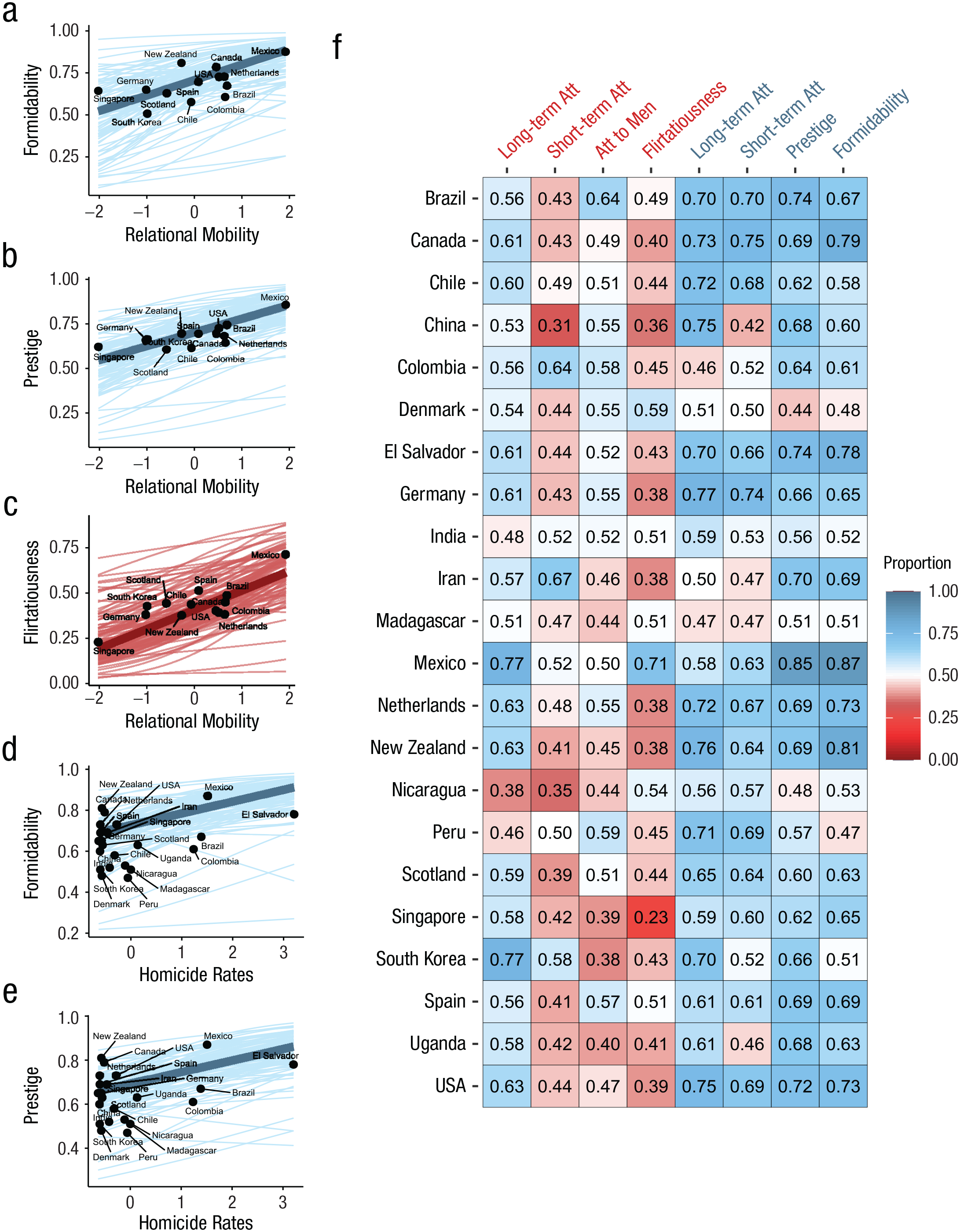
Influence of fo on perceptions of formidability, prestige, short-term attractiveness, and flirtatiousness. Higher relational mobility predicted an increased probability of choosing lower fo voices for formidability (a) and prestige (males judging male voices; b) and flirtatiousness (females judging female voices; c). Higher homicide rates predicted an increased probability of choosing lower fo voices for formidability (d) and prestige (e). Lines in spaghetti plots represent 100 draws of conditional effects of the model with the mean regression line superimposed (red = female voices; blue = male voices). Panel (f) shows the average fo preferences for each perceptual question (σ2 ≈ 0.01) across nations. The value represents the proportion of lower fo choices, with darker blue indicating a relatively greater proportion of lower fo choices and darker red indicating a relatively greater proportion of raised fo choices. fo = fundamental frequency; Att = attractiveness.
Women’s perceptions of male voices
Women chose lower fo voices when evaluating men’s attractiveness—long term: b = 1.86, 89% CrI = [1.39, 2.39]; short term: b = 1.57, 89% CrI = [1.17, 2.03]. Preferences for a lower fo were stronger in long-term than short-term contexts, OR = 1.18, 89% CrI = [1.10, 1.26]; however, the influence of fo further depended on the interaction of mating context with homicide rate, b = 1.13, 89% CrI = [1.04, 1.21], BF = 132.33 (Fig. S1). In a follow-up test comparing linear trends of homicide-rate effects on fo perceptions, we found relatively higher fo choices for long-term attractiveness, b = 0.95, 89% CrI = [0.81, 1.12], and relatively lower fo choices for short-term attractiveness, b = 1.07, 89% CrI = [0.90, 1.26], with a robust difference in slopes, b = 0.89, 89% CrI = [0.83, 0.96], suggesting that fo more strongly influenced perceptions of long-term attractiveness where homicide rates were low and short-term attractiveness where homicide rates were high.
Female voices
Men’s perceptions of female voices
Men tended to choose higher fo voices when evaluating short-term attractiveness, b = 0.78, 89% CrI = [0.59, 1.03], and lower fo voices when evaluating long-term attractiveness, b = 1.51, 89% CrI = [1.16, 2.01]. A post hoc comparison suggests higher fo voices were almost twice as likely to be chosen when evaluating short-term attractiveness than when evaluating long-term attractiveness, OR = 1.94, 89% CrI = [1.83, 2.06]. Relational mobility did not predict men’s perceptions of female voices on either short-term or long-term attractiveness (Table S1).
Women’s perceptions of female voices
Women tended to choose higher fo voices when evaluating other women on flirtatiousness, b = 0.73, 89% CrI = [0.57, 0.98], but not when evaluating women on attractiveness to men, b = 0.90, 89% CrI = [0.69, 1.20]. Effects of fo on perceptions of flirtatiousness were greater in nations with higher relational mobility, b = 1.55, 89% CrI = [1.16, 2.03], BF = 57.39 (Fig. 2c).
Post hoc comparisons and robustness tests
In addition to estimated marginal means (Figs. 3a–c), post hoc comparisons between each perceptual question (Fig. S2), vocalizer sex, and stimulus pair are reported in Table S3. Lower fo male voices were more often chosen when they were compared with voices raised in fo (as opposed to average fo), whereas higher fo female voices were more often chosen when they were compared with voices lowered in fo (Fig. 3d). Given the influence of stimulus pairs, we report estimated marginal means of stimulus pairs on voice choice for each perceptual question (Table S4). Given the possible influence of demographic variables on the effect of voice pitch on social perceptions, we added covariates (e.g., age, number of children) to the model, obtaining similar results (Table S5). We found no consistent difference in masculine-voice choice as a function of first language or reported ability to understand, hear clearly, or differentiate between pairs of voice stimuli (Figs. S3 and S4). We also reported additional robustness tests that demonstrate the generalizability of the findings (Tables S6–S10 and Figs. S5–S8).
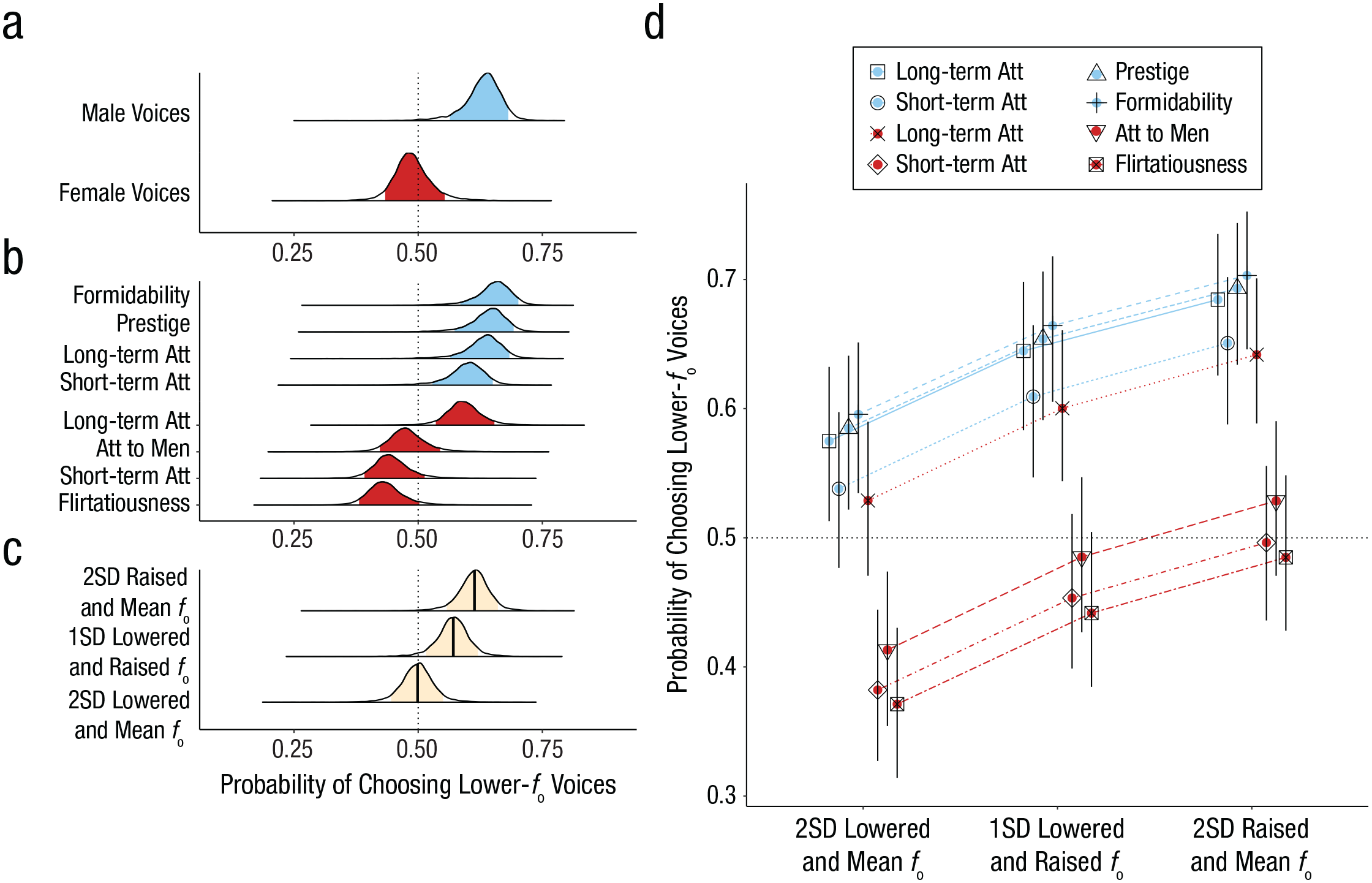
Results of Bayesian multilevel models predicting fo choices. Marginal effects were separated according to (a) vocalizer sex, (b) perceptual questions, and (c) stimulus pairs. Each panel shows random-effects-adjusted posterior interval estimates with 89% highest posterior density intervals. Panel (d) shows the estimated marginal means of stimulus pairs for each perceptual question for male (blue lines and symbols) and female (red lines and symbols) stimuli.
Discussion
Prior research demonstrates the relevance of voice pitch to social perceptions, particularly in the context of human mating competition, but little is known about how these perceptions vary across societies. To address this gap, we conducted a cross-cultural experiment that examined the effects of manipulated pitch on mating competition-related perceptions. Our findings reveal both consistency and cross-cultural variability, shedding light on the psychological mechanisms that undergird social perceptions. We found that lower male fo consistently increased men’s perceptions of other men’s formidability and prestige, as in some previous research (Aung, Rosenfield, & Puts, 2021; Feinberg et al., 2006; Mayew et al., 2013; Rosenfield et al., 2020), with linguistic and geographic differences accounting for a small proportion of the variance (intraclass correlation coefficient ≈ 1.9%). The regularity with which lower fo voices were chosen as more formidable and prestigious across societies (Fig. 2f) suggests a universal psychology linking lower male fo to status perceptions. The stronger influence of male fo on perceptions of formidability in younger men and prestige in older men may point to age differences in the forms of competition and basis for status (see Fig. S1); physical fighting ability is likely to be more relevant among younger men (Wilson & Daly, 1985). Given its stronger influence on men’s perceptions of formidability than on women’s perceptions of attractiveness, low male fo may have evolved primarily via male intrasexual competition rather than female mate choice (Aung & Puts, 2020).
Our findings also reveal the importance of environmental factors in shaping voice pitch perceptions, especially among male listeners, and align with the notion that some behaviors are outputs of shared psychological mechanisms designed by selection to respond to local environmental cues (evoked culture; Gangestad et al., 2006). Across samples, fo was more important to men’s status assessments where homicide rates were higher. This is consistent with evidence that aggressive competition was important to the fitness of ancestral males (Puts et al., 2023) and with the hypothesis that signals of status and formability are more relevant in environments in which male fitness is more strongly linked with engaging in or avoiding costly aggression.
Male fo was also more important to men’s status assessments where relational mobility is greater, and these results were robust across analyses that used national and local relational-mobility measures. The adaptive logic of this pattern becomes apparent when one considers group sizes and the scales of social networks among foragers. Ethnographic, archeological, and paleontological data indicate that, within a given mobile forager culture, community size varies by as much as an order of magnitude from a few dozen to hundreds of individuals, and multiple mobile groups periodically aggregate (e.g., seasonally) into large, sedentary settlements, sometimes of thousands of individuals (Singh & Glowacki, 2022). Moreover, mobile foragers are ensconced in large-scale cooperative networks of hundreds or thousands of individuals (Bird et al., 2019; Boyd & Richerson, 2022; Singh & Glowacki, 2022), and large-scale cooperation may extend back before the evolution of Homo sapiens (Rodríguez-Hidalgo et al., 2017). Finally, archeological and ethnographic data indicate that mobility patterns are highly variable between and within forager groups and that low-mobility, hierarchical hunter-gatherers with group sizes sometimes exceeding 1,000 individuals are common across the globe and may extend back into the Pleistocene (Singh & Glowacki, 2022). The high variability in group sizes and the scales of social networks among foragers, coupled with evidence of interpersonal violence (Dunbar, 2022) and coercive leadership even among “egalitarian” foragers (Singh & Glowacki, 2022), provide a set of conditions to which patterns of human-status assessment seem to be adapted. Where relational mobility is higher, individuals are less able to utilize direct social knowledge in evaluating competitors’ status and must rely more strongly on conspicuous status “badges” and displays. Across cultures, men were likewise more likely to display beards, another putative status badge, rather than shaving under crowded conditions with high anonymity (Dixson et al., 2017). Moreover, cross-species analyses indicate that conspicuous visual (Grueter et al., 2015) and acoustic (Aung, Hill, et al., 2023) status signals evolve in primates with larger group sizes, again suggesting that status signals are more important where individuals have less direct social knowledge of other group members.
The general preference for lower male fo among women, particularly in long-term mating contexts, supports the relevance of both male status competition and female mate choice in shaping this preference because females may prefer high-status males especially in long-term contexts (Buss & Schmitt, 1993). However, our results are inconsistent with the hypotheses that women’s masculinity preferences are stronger in short-term mating contexts to recruit heritable fitness benefits for offspring (e.g., Puts, 2005) or in violent environments because of an increased need for protection (Brooks et al., 2011).
We also found evidence that women’s sensitivity to raised fo in competitors is amplified in contexts of lower relational mobility in which threats from flirtatious behavior by familiar acquaintances are likely more pronounced. This is because infidelity is more common with familiar others, such as coworkers (Wiggins & Lederer, 1984), and when a woman’s mate is unfaithful with someone to whom the woman is close platonically, the infidelity threatens both the romantic and platonic relationships.
Men’s preferences for higher female fo in short-term mating contexts and lower fo in long-term mating contexts align with previous research (Puts et al., 2011) and may reflect the variable importance of perceived availability and fidelity across mating contexts (Hughes & Puts, 2021). Specifically, raised female fo may signal sexual interest (consistent with observed effects on female perceptions of flirtatiousness) and hence be more strongly preferred in short-term mating contexts in which sexual availability is desired and avoided in long-term contexts in which fidelity is more valued.
We found no support for the “diet” hypothesis that exposure to certain fo levels leads to stronger preferences for those levels (Table S11). Our exploration of stimulus pairings also revealed aversions to feminized stimuli when masculinized stimuli were preferred and vice versa (Fig. 3d), highlighting the significance of avoiding low-quality mates as well as selecting high-quality partners (Gomes & Cardoso, 2018).
Although the current results shed light on putative psychological adaptations that adjust status and other social assessments across socioenvironmental contexts, our study has limitations. The use of standardized English speech samples enhances internal validity but may limit external validity because of linguistic differences or unaccounted articulatory variations across regions (Karthikeyan et al., 2023). Furthermore, socioecological variables were not measured directly from participants, and socioecological variables assessed at the national level may not accurately represent communities in which data were collected, although relational mobility assessed at the local level produced similar results for male voices (Table S1). In addition, relational mobility was not manipulated experimentally (L. M. W. Li et al., 2016). Future research should aim for larger scale studies involving diverse vocal stimuli and representative samples from various societies, considering a wider array of socioecological measures.
Relational mobility has been associated with a wide variety of societal differences in interpersonal behaviors and thinking styles (Yuki & Schug, 2020). Male voices with lower fo have been found to sound less trustworthy (O’Connor & Barclay, 2017) and cooperative (Knowles & Little, 2016), and lower relational mobility has been associated with decreased general trust (Thomson et al., 2018) and increased motivation to punish defective cooperators (Arai et al., 2022). Thus, participants in societies with lower relational mobility may be especially attentive to fo in evaluating male cooperativeness and trustworthiness. Likewise, the extent to which perceptions become canalized or remain sensitive to individual and socioecological variables over the life span (Hlay et al., 2021; Y. Li et al., 2014) awaits future investigation.
Supplemental Material
sj-docx-1-pss-10.1177_09567976231222288 – Supplemental material for Effects of Voice Pitch on Social Perceptions Vary With Relational Mobility and Homicide Rate
Supplemental material, sj-docx-1-pss-10.1177_09567976231222288 for Effects of Voice Pitch on Social Perceptions Vary With Relational Mobility and Homicide Rate by Toe Aung, Alexander K. Hill, Jessica K. Hlay, Catherine Hess, Michael Hess, Janie Johnson, Leslie Doll, Sara M. Carlson, Caroline Magdinec, Isaac G-Santoyo, Robert S. Walker, Drew Bailey, Steven Arnocky, Shanmukh Kamble, Tom Vardy, Thanos Kyritsis, Quentin Atkinson, Benedict Jones, Jessica Burns, Jeremy Koster, Gonzalo Palomo-Vélez, Joshua M. Tybur, José Muñoz-Reyes, Bryan K. C. Choy, Norman P. Li, Verena Klar, Carlota Batres, Patricia Bascheck, Christoph Schild, Lars Penke, Farid Pazhoohi, Karen Kemirembe, Jaroslava Varella Valentova, Marco Antonio Correa Varella, Caio Santos Alves da Silva, Martha Borras-Guevara, Carolyn Hodges-Simeon, Moritz Ernst, Collin Garr, Bin-Bin Chen and David Puts in Psychological Science
Footnotes
Acknowledgements
We thank the undergraduate research assistants and communities, especially Kristina Douglass and the communities of Commune de Befandefa in southwest Madagascar, for their contributions toward this project. C. Batres thanks Nicole Paetz, María Erlinda Ávalos, and Ricardo Machado Schmidt for help organizing data collection. T. Aung is now at the Psychology and Counseling Department, Immaculata University; A. K. Hill is now at the Department of Anthropology, University of Washington; J. K. Hlay is now at the Department of Anthropology, Boston University; J. Burns is now at the Department of Anthropology, University of Utah; J. Koster is now at the Max Planck Institute for Evolutionary Anthropology, Leipzig, Germany; G. Palomo-Vélez is now at the Institute of Social Sciences, University of O’Higgins; J. Muñoz-Reyes is now at Centro de Investigación en Complejidad Social, Facultad de Gobierno, Universidad del Desarrollo; V. Klar is now at the Department of Experimental Psychology, University of Oxford; F. Pazhoohi is now at the School of Psychology, University of Plymouth; and M. Borras-Guevara is now at Goldsmiths, University of London.
Transparency
Action Editor: Martie Haselton
Editor: Patricia J. Bauer
Author Contributions
ORCID iDs

References
Supplementary Material
Please find the following supplemental material available below.
For Open Access articles published under a Creative Commons License, all supplemental material carries the same license as the article it is associated with.
For non-Open Access articles published, all supplemental material carries a non-exclusive license, and permission requests for re-use of supplemental material or any part of supplemental material shall be sent directly to the copyright owner as specified in the copyright notice associated with the article.
