




Abstract
Among the most consistent sex differences to emerge from personality research is that women score higher than men on the Big Five personality trait Neuroticism. However, there are few functionally coherent explanations for this sex difference. The current studies tested whether this sex difference is due, in part, to variation in physical capital. Two preregistered studies (total N = 878 U.S. students) found that sex differences in the anxiety facet of Neuroticism were mediated by variation in physical strength and self-perceived formidability. Study 1 (N = 374) did not find a predicted mediation effect for overall Neuroticism but found a mediation effect for anxiety (the facet of Neuroticism most strongly associated with grip strength). Study 2 (N = 504) predicted and replicated this mediation effect. Further, sex differences in anxiety were serially mediated by grip strength and self-perceived formidability. These findings add to a nascent literature suggesting that differences in physical attributes may partially explain sex differences in personality.
Keywords
The Big Five personality trait Neuroticism is characterized by worrying, anxiety, and emotional instability and is an important predictor of real-life outcomes, including mental health, divorce, substance abuse, and chronic illness (e.g., Roberts et al., 2007; Soldz & Vaillant, 1999; Weston et al., 2015). Sex differences in Neuroticism—women scoring higher than men—represent the most robust sex difference in any Big Five trait (e.g., Costa et al., 2001; Schmitt et al., 2008). Although this sex difference is well established, the reasons for its existence are less clear: It has often been attributed to distal explanations, such as the social roles taken on by men and women, or ascribed to underlying afunctional biological differences. However, there have been notably few rigorous empirical attempts to explain sex differences in Neuroticism (e.g., Chapman et al., 2007; Costa et al., 2001). The present studies focused on whether differences in physical strength can, in part, account for sex differences in Neuroticism.
Research suggests that many personality traits are functionally calibrated to the challenges or constraints of one’s local physical and social ecologies (Lukaszewski & Roney, 2011; Petersen et al., 2010; Schaller & Murray, 2008; von Rueden et al., 2015). Similarly, traits may be adaptively calibrated to the physical properties of the individual (Petersen et al., 2010; von Rueden et al., 2015). Physical strength has been important throughout much of human history—stronger people have greater bargaining power because they can impose their will on others, and more formidable individuals tend to be allocated higher status (Lukaszewski et al., 2016; Petersen et al., 2010). Formidability thus changes the cost-benefit ratio of different behaviors. Consistent with this hypothesis, findings have shown that proxies of formidability (such as strength and height) predict aggressive behavior both cross-sectionally and longitudinally (Farrington, 1989; Gallup et al., 2007).
Similar cost-benefit logic can be applied to characteristics of Neuroticism. Dispositional vigilance toward potential social and environmental threats may be more adaptive for people who are less able to defend themselves against these threats. Thus, given that Neuroticism—and especially its facet, anxiety—is characterized by worry about future events and potential dangers, calibration-based logic implies that greater physical strength may be associated with lower Neuroticism. Indeed, preliminary studies suggest that both grip strength and self-perceived formidability predict lower Neuroticism in Western samples (Fink et al., 2016; Kerry & Murray, 2018). In one study, post hoc analyses suggested that this relationship largely accounted for sex differences in Neuroticism (Kerry & Murray, 2018). However, no research has rigorously tested this latter finding. Therefore, in two preregistered studies, we examined whether physical strength mediates sex differences in Neuroticism and its constituent facets. Both studies reported here were approved by the Tulane University Institutional Review Board. Data, materials, and syntax for Studies 1 and 2 are available on OSF at https://osf.io/9jaf6.
Study 1
Method
The preregistered sample size for Study 1 was 350 participants. This sample size was chosen to give 80% power to detect a small effect size (r) of .15. We preregistered predictions that (a) grip strength would negatively predict Neuroticism, (b) women would score higher on Neuroticism than men, and (c) differences in grip strength would significantly mediate sex differences in Neuroticism (https://aspredicted.org/z97us.pdf).
To account for potential exclusions, we recruited a total of 374 undergraduate students from Tulane University, a private institution in the southern United States (227 women; age: range 18–62 years, M = 18.96, SD = 2.43). This sample was selected for convenience. The additional 24 participants did not meaningfully affect the findings, and no participants were excluded.
Grip strength
Grip strength is a well-established indicator of upper-body strength that is associated with a wide range of abilities, including fighting prowess and tool use, and increased bone density (see Gallup & Fink, 2018). Grip strength was assessed using handheld dynamometers that measured kilograms of pressure. Participants were asked to grip the dynamometer as hard as possible for up to 2 s using their dominant hand. This process was repeated after a short rest, and the higher of the two scores was recorded.
Statement of Relevance
Previous research has found that, on average, women consistently score higher on measures of anxiety than men. This is of special importance given that anxiety is associated with negative outcomes in terms of physical health, mental health, relationship and career success, and subjective well-being. In two studies, with a total of 878 participants, we examined whether differences in physical strength might help explain this sex difference in anxiety. We found evidence that physically stronger people of both sexes—and also people who perceive themselves to be more formidable—score lower on anxiety. Further, we found that strength (both actual and perceived) partially accounted for the sex difference in anxiety. These findings suggest that differences in physical attributes such as strength can help to explain some sex differences in personality, and they may also offer insight into why individual differences in traits such as anxiety exist in the first place.
Personality measures
The 60-item Big Five Inventory–2 (BFI-2; Soto & John, 2017) was used to measure personality. The focus of this study was on Neuroticism (called “Negative Emotionality” in the BFI-2, but here we retain the term “Neuroticism” for consistency with previous work), so we report other traits here only summarily. Exploratory analyses of the other traits, as well as details of sex differences across measures, are included in the Supplemental Material available online.
Neuroticism was measured by rating agreement with 12 statements on a 5-point scale. All statements started, “I see myself as someone who . . .” (Cronbach’s α = .89). These 12 items capture three lower-level facets: anxiety (e.g., “worries a lot”; Cronbach’s α = .80), depression (e.g., “tends to feel depressed, blue”; Cronbach’s α = .81), and emotional volatility (e.g., “is temperamental, gets emotional easily”; Cronbach’s α = .83).
Reliability for all of the Big Five traits was good: Extraversion (Cronbach’s α = .86), Neuroticism (Cronbach’s α = .89), Openness (Cronbach’s α = .80), Conscientiousness (Cronbach’s α = .87), and Agreeableness (Cronbach’s α = .79).
Self-perceived formidability
As in previous work (Kerry & Murray, 2018), we calculated self-perceived formidability as the average of the standardized scores for two items asking participants to separately rate their physical strength and their fighting ability on a scale from 1 to 100, using a moving slider. These two items were strongly correlated, r(371) = .61, p < .001.
Sex
Participants were asked to report their biological sex by choosing “male,” “female,” or “intersex.” The choice was unforced, so the question could be skipped (although no participants did so). All participants answered either “male” or “female.” Sex was coded as 0 (male) or 1 (female).
Results
As predicted, men scored higher than women on grip strength (41.21 kg vs. 25.31 kg, respectively), t(372) = 20.27, p < .001, d = 2.15, 95% confidence interval [CI] = [1.87, 2.43], but women scored higher than men on Neuroticism (3.07 vs. 2.60, respectively), t(372) = 5.79, p < .001, d = 0.61, 95% CI = [0.39, 0.83]. There was an overall negative association between grip strength and Neuroticism, r(374) = −.25, p < .001. However, this relationship became nonsignificant when analyses controlled for sex (β = −0.10, p = .184; sex: β = −0.22, p = .003). Further, the association was nonsignificant when men, r(145) = −.01, p = .879, and women, r(225) = −.12, p = .071, were analyzed separately. A bootstrapped moderation analysis (10,000 iterations) found that the effect of grip strength on Neuroticism was not significantly moderated by sex, b = −0.01, SE = 0.01, 95% CI = [−0.04, 0.01].
Analyses of the facet scores of Neuroticism revealed that grip strength was most strongly associated with anxiety, r(372) = −.31, p < .001 (correlations of grip strength and self-perceived formidability with facet scores are presented in Table 1). A multiple regression revealed that this relationship remained significant when controlling for sex, β = −0.15, p = .036, and sex was also a significant unique predictor, β = 0.22, p = .002. Further regression analyses found that the magnitude of the association between grip strength and anxiety (after controlling for sex) remained similar when controlling for multiple potential post hoc confounds, including age, body mass index, self-perceived mate value, Extraversion, and Conscientiousness (see the Supplemental Material). A split analysis revealed that the relationship between grip strength and anxiety was significant within women, r(225) = −.20, p = .003, but not within men, r(145) = −.02, p = .855. This negative association in women remained significant after even the most stringent family-wise correction (the Bonferroni threshold for six comparisons—three facets each for both men and women—would be p = .0083).
Bivariate Correlations Between Formidability Measures and Neuroticism Facets in Studies 1 and 2
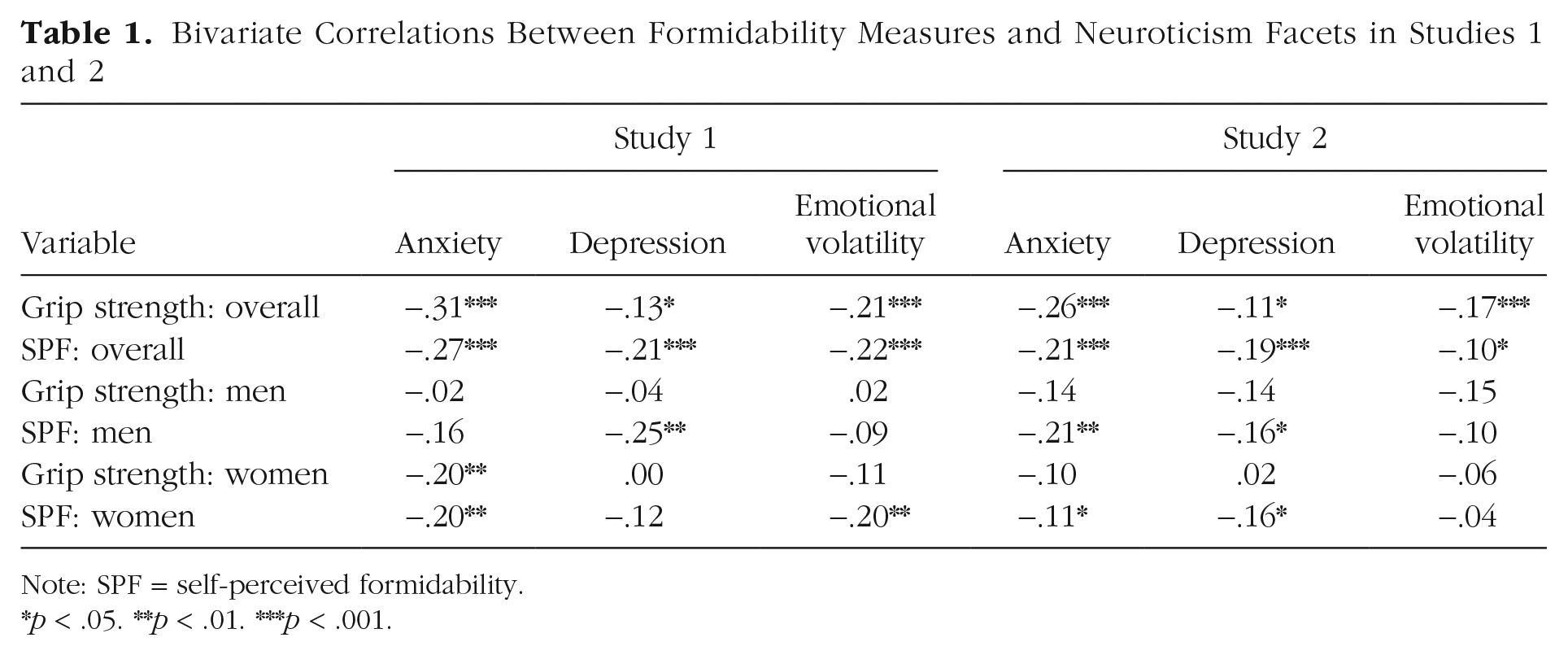
Note: SPF = self-perceived formidability.
p < .05. **p < .01. ***p < .001.
Perceived formidability was also negatively correlated with overall Neuroticism, r(371) = −.28, p < .001, and most strongly with the anxiety facet, r(371) = −.27, p < .001. The association between perceived formidability and Neuroticism was comparable within men, r(144) = −.20, p = .018, and women, r(225) = −.21, p = .002. Similarly, perceived formidability was negatively associated with anxiety at a similar magnitude in men, r(144) = −.16, p = .052, and women, r(225) = −.20, p = .003.
A bootstrapped analysis (10,000 iterations) revealed that the predicted indirect effect of sex on Neuroticism through grip strength was not significant, b = 0.11, SE = 0.09, 95% CI = [−0.06, 0.28]. However, because grip strength most strongly predicted the anxiety facet of Neuroticism, an exploratory analysis was conducted to test whether sex differences in this facet were mediated by grip strength. This analysis found an indirect effect of sex on anxiety via grip strength, b = 0.21, SE = 0.10, 95% CI = [0.01, 0.41]. The same model retained a direct effect of sex, b = 0.43, SE = 0.14, 95% CI = [0.16, 0.69].
An exploratory serial mediation model with grip as the first mediator and perceived formidability as the second mediator revealed an indirect effect through both mediators, b = 0.09, SE = 0.03, 95% CI = [0.03, 0.17]. In this model, the two single-mediator indirect effects were nonsignificant, but there was a significant direct effect of sex, b = 0.39, SE = 0.13, 95% CI = [0.13, 0.66]. This serial mediation effect was not present when the order of the mediator variables in the model was reversed.
Full results for associations of formidability variables with other Big Five traits, as well as with other Neuroticism facets, are reported in the Supplemental Material. Grip strength was significantly associated with Openness in men, r(145) = .20, p = .015, and with none of the Big Five traits in women. This association with Openness was not predicted, has not been found in previous studies (e.g., Fink et al., 2016; Kerry & Murray, 2018), and did not remain significant after family-wise correction. Descriptive statistics and distribution plots for key variables are also included in the Supplemental Material. Further, the Supplemental Material includes exploratory, item-level analyses, which revealed tentative evidence that fear-relevant items within the anxiety facet were more strongly related to both grip strength and self-perceived formidability than items that gauged feelings of tension.
Thus, Study 1 did not find the predicted mediation of sex differences in Neuroticism by grip strength. However, post hoc analyses revealed that the anxiety facet of Neuroticism was negatively associated with grip strength and that grip strength significantly mediated sex differences in anxiety.
Study 2
In Study 2, we aimed to replicate the key findings of Study 1 and test the hypothesis that sex differences in anxiety can be partly explained by differences in physical strength.
Method
Our central preregistered prediction was that differences in grip strength would significantly mediate sex differences in the anxiety facet of Neuroticism. Consistent with this conceptual framework, an additional prediction was that grip strength would negatively predict anxiety and that women would score higher on anxiety (and lower on grip strength) than men (https://aspredicted.org/h9xm3.pdf).
We preregistered a sample size of 400. This sample size was chosen to improve statistical power relative to Study 1 and would give 85% power to detect an effect (r) of .15. Given that laboratory space and participant-pool demand remained available, in order to maximize power, we oversampled after this goal was reached. This deviation did not affect any key findings (a data file with only the first 400 participants is included in this study’s OSF project; as would be expected with true effects, magnitudes of effects are nearly identical for both sample sizes). Participants were 509 undergraduate students from Tulane University. As in Study 1, this sample was selected for convenience. To avoid repeat participation, we categorically excluded participants in Study 1 from participating in Study 2. Data from five participants were excluded because the individuals were under 18 and their consent was thus invalid. This left 504 participants for analysis (355 women; age: range 18–35 years, M = 18.93, SD = 1.40).
Grip strength
As in Study 1, grip strength was assessed using handheld dynamometers. Participants were asked to grip the dynamometer as hard as possible for up to 2 s using their dominant hand. This process was repeated after a short rest, and the higher of the two scores was recorded.
Personality measures
The same 60-item BFI-2 scale was used as in Study 1. As in Study 1, we report results here only for Neuroticism (Cronbach’s α = .88) and its facets anxiety (Cronbach’s α = .79), depression (Cronbach’s α = .77), and emotional volatility (Cronbach’s α = .82). We also included measures of the other Big Five traits, Extraversion (Cronbach’s α = .85), Agreeableness (Cronbach’s α = .79), Openness (Cronbach’s α = .81), and Conscientiousness (Cronbach’s α = .87). Associations for these other personality factors are reported more fully in the Supplemental Material.
Perceived formidability
As in Study 1, perceived formidability was calculated as the average of the standardized scores for two items that asked participants to rate both their physical strength and their fighting ability. These two measures were strongly correlated, r(502) = .69, p < .001.
Sex
As in Study 1, participants were asked to report their biological sex by choosing “male,” “female,” or “intersex.” As in Study 1, all participants answered either “male” or “female.” Values were then dummy coded as 0 (male) or 1 (female).
Results
Preregistered analyses
Consistent with our preregistered predictions, our results showed that grip strength was negatively associated with anxiety, r(502) = −.26, p < .001, and women scored higher on anxiety than men (3.65 vs. 3.15, respectively), t(502) = 5.35, p < .001, d = 0.55, 95% CI = [0.35, 0.55], but lower on grip strength (26.04 kg vs. 41.63 kg, respectively), t(501) = 20.03, p < .001, d = 2.40, 95% CI = [2.06, 2.73].
Most importantly, a bootstrapped regression analysis of indirect effects (10,000 iterations) found support for our central preregistered prediction: Grip strength mediated sex differences in anxiety, indirect effect: b = 0.26, SE = 0.09, 95% CI = [0.08, 0.43]. The direct effect of sex in this model was nonsignificant, b = 0.24, SE = 0.13, 95% CI = [−0.02, 0.49].
Further analyses
As in Study 1, a serial mediation model (10,000 iterations) with grip strength as the first mediator and self-perceived formidability as the second revealed an indirect effect through both mediators, b = 0.10, SE = 0.04, 95% CI = [0.02, 0.18]. In this model, all other effects were nonsignificant, including the direct effect of sex, b = 0.25, SE = 0.13, 95% CI = [−0.003, 0.51]. This model is shown in Figure 1.
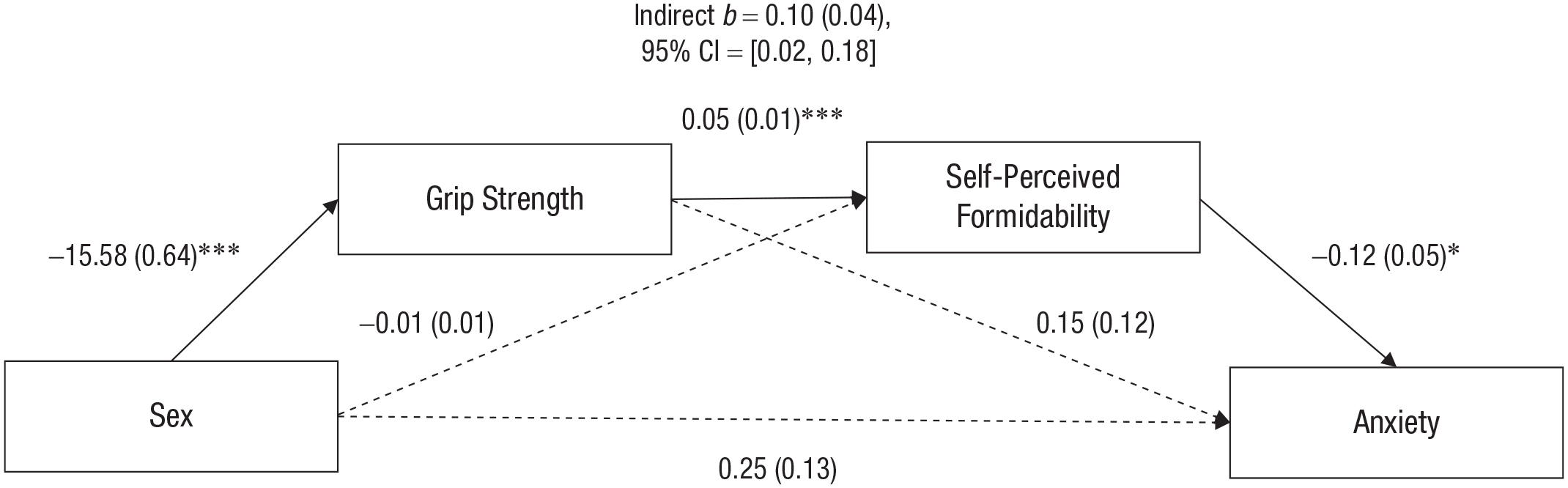
Serial mediation model showing the effect of sex on anxiety, as mediated by grip strength and self-perceived formidability in Study 2. Solid arrows represent significant paths (*p < .05, ***p < .001), and dotted arrows represent nonsignificant paths. The indirect effect through both mediators is shown above the model. Unstandardized coefficients are given outside parentheses, and standard errors are given in parentheses. CI = confidence interval.
A similar model also showed an indirect effect (through both mediators) on overall Neuroticism, b = 0.09, SE = 0.03, 95% CI = [0.02, 0.17]. No other mediation effects were significant, nor was the direct effect of sex, b = 0.16, SE = 0.11, 95% CI = [−0.06, 0.38].
Bivariate correlations among grip strength, self-perceived formidability, and three facets of Neuroticism can be seen in Table 1. A multiple regression with grip strength and sex as predictors of anxiety revealed a negative effect of grip (β = −0.17, p = .008) and a positive, but nonsignificant, effect of being female (β = 0.12, p = .070). A series of further post hoc multiple-regression analyses controlling for age, body mass index, self-perceived mate value, Extraversion, and Conscientiousness in addition to sex yielded similar or only slightly diminished effects of grip strength on anxiety (all grip-strength βs ≤ −0.14; see the Supplemental Material). Grip strength was negatively associated with anxiety in both men, r(147) = −.14, p = .082, and women, r(352) = −.10, p = .051, although these relationships did not individually reach significance. Grip strength was negatively associated with overall Neuroticism in the full sample, r(501) = −.21, p < .001. Analyzing men and women separately revealed a significant association in men, r(147) = −.17, p = .038, but not in women, r(352) = −.06, p = .274.
Self-perceived formidability (an average of the z scores for perceived strength and fighting ability) was also correlated with Neuroticism, r(501) = −.20, p < .001, and with anxiety, r(501) = −.21, p < .001. This included a negative relationship between self-perceived formidability and anxiety in both men, r(147) = −.21, p = .010, and women, r(353) = −.11, p = .047.
Correlations for the other Big Five factors are presented in the Supplemental Material, along with descriptive statistics for all key variables. The only significant correlation that emerged was a positive correlation between grip strength and Extraversion in males, r(147) = .18, p = .026. This is similar in magnitude to the nonsignificant association in Study 1 and is consistent with relationships found in some—but not all—previous work (e.g., Fink et al., 2016; von Borell et al., 2019). Perceived formidability was also positively associated with Extraversion in both men, r(147) = .27, p < .001, and women, r(353) = .29, p < .001.
General Discussion
In two studies, grip strength negatively predicted anxiety, and sex differences in anxiety were serially mediated by grip strength and self-perceived formidability. These findings suggest that some sex-based variation in personality may be partly attributable to variation in physical attributes.
These results suggest the testable hypothesis that other psychological and behavioral sex differences could be partly explained by differences in physical attributes. For example, there is evidence that social dominance and aggression—both of which tend to be higher in men—also covary intrasexually with physical strength (Farrington, 1989; Gallup et al., 2007; Price et al., 2011). Future research might investigate whether these and other psychological sex differences can be partly explained by differences in strength or stature.
Important limitations of this work should be noted. First, within-sex associations between strength and anxiety were small and somewhat inconsistent, and sex still accounted for some variance in anxiety beyond that explained by physical strength. Imperfect measurement of the key variables may have contributed to the small effects observed (see the Supplemental Material). Another possible explanation for the small within-sex effects is that the measures of strength and formidability employed here acted as a proxy for another variable, such as health or attractiveness (which both covary with grip strength; see Gallup & Fink, 2018). Although we cannot rule out this explanation, analyses reported in the Supplemental Material found relationships to be robust when controlling for several potential confounds, including body mass index, age, and a measure of self-perceived attractiveness. Similarly, though, these effects could be explained by a common underlying physiological factor, such as developmental testosterone levels (testosterone levels correlate negatively with anxiety in both sexes; see McHenry et al., 2014). Finally, a key limitation relating to the causal interpretation of these findings is that the mediational models presented here use cross-sectional data and cannot alone demonstrate causality. Thus, although the data here are consistent with the hypothesis that lower physical strength leads to higher anxiety, we cannot rule out alternative causal explanations.
Further, several additional questions remain unanswered. Is the association between strength and anxiety best explained by developmental calibration (i.e., people adapting behaviors to their strengths and weaknesses), genetic pleiotropy (i.e., genes associated with physical formidability also being associated with lower dispositional anxiety; see Lukaszewski & Roney, 2011), or facultative epigenetic processes whereby methylation of genes associated with strength also has consequences for anxiety? And, importantly, will these relationships generalize to other cultures, and would effects be larger for cultures and populations in which formidability is a more functional part of social life? Although these and other questions must be addressed in future research, the studies presented here support the hypothesis that sex differences in anxiety can be partly explained by differences in physical strength and self-perceived formidability. These findings suggest that further work on sex differences in personality may benefit from an increased focus on the role of physical attributes.
Supplemental Material
sj-docx-1-pss-10.1177_0956797620971298 – Supplemental material for Physical Strength Partly Explains Sex Differences in Trait Anxiety in Young Americans
Supplemental material, sj-docx-1-pss-10.1177_0956797620971298 for Physical Strength Partly Explains Sex Differences in Trait Anxiety in Young Americans by Nicholas Kerry and Damian R. Murray in Psychological Science
Footnotes
Transparency
Action Editor: Steven W. Gangestad
Editor: Patricia J. Bauer
Author Contributions
N. Kerry and D. R. Murray created and developed the plan for these studies. N. Kerry collected data under the supervision of D. R. Murray. N. Kerry analyzed the data and drafted the manuscript; D. R. Murray made critical revisions to the manuscript. Both of the authors approved the final manuscript for submission.

References
Supplementary Material
Please find the following supplemental material available below.
For Open Access articles published under a Creative Commons License, all supplemental material carries the same license as the article it is associated with.
For non-Open Access articles published, all supplemental material carries a non-exclusive license, and permission requests for re-use of supplemental material or any part of supplemental material shall be sent directly to the copyright owner as specified in the copyright notice associated with the article.
