




Abstract
In three experimental studies, we investigated whether badges for open-science practices have the potential to affect trust in scientists and topic-specific epistemic beliefs by student teachers (n = 270), social scientists (n = 250), or the public (n = 257), all of whom were at least 16 years old. Furthermore, we analyzed the moderating role of epistemic beliefs for badges and trust. Each participant was randomly assigned to two of three conditions: badges awarded, badges not awarded, and no badges (control). In all samples, our Bayesian analyses indicated that badges influence trust as expected, with one exception in the public sample: An additional positive effect of awarded badges (compared with no badges) was not supported. For students and scientists, we found evidence for the relation of badges and epistemic beliefs as well as epistemic beliefs and trust. Further, we found evidence for the absence of moderation by epistemic beliefs.
In recent times, struggles to replicate empirical findings have been acknowledged in several scientific disciplines (Camerer et al., 2018; Open Science Collaboration, 2015). Recent studies support the assumption of a detrimental effect of this so-called replication crisis on perceived trustworthiness (Anvari & Lakens, 2018; Wingen et al., 2020). A primary reaction to this was the call for scientists to increase the transparency and reproducibility of the entire research process (Lindsay, 2015; Vazire, 2018). To signal awareness regarding open-science practices, a number of academic journals have adopted open-science badges. Because the authors’ open-science badge disclosures are quality checked, readers can use badges to quickly determine whether a study has implemented open-science practices—an important indicator for gauging its transparency and trustworthiness. However, apart from some preliminary indications of their effectiveness in fostering the implementation of open-science practices (Kidwell et al., 2016), not much is known about the effects of badges on perception at an individual level. Therefore, we investigated in three studies how trustworthy scientists are perceived to be by student teachers, scientists, or the public, depending on the inclusion of badges in their articles. Furthermore, considering the crucial role of beliefs about science in information processing, we explore the potential role of epistemic beliefs in moderating the effectiveness of badges and indirectly predicting trust itself.
Epistemic Trust
In our closely connected world, which is characterized by the division of cognitive labor, we are dependent on other people’s knowledge (Bromme et al., 2010). However, we cannot evaluate the truthfulness of all information from sources we interact with, particularly when we are lacking resources for judgment such as knowledge, time, and financial capital (Stadtler & Bromme, 2014; Zimmermann & Jucks, 2018). Recipients of scientific claims usually have limited access to first-hand information (e.g., the concrete research process) because they are not involved in the research process itself (Bromme & Goldman, 2014; Hendriks & Kienhues, 2019). Journal articles mostly summarize the underlying research process, and press releases or translational abstracts (“plain-language summaries”) often provide only overviews. Consequently, readers of scientific claims cannot evaluate the truthfulness of such claims by themselves but have to rely (to various degrees) on so-called secondhand evaluations (i.e., evaluations of the trustworthiness of an information source instead of the information itself; Bromme et al., 2010). Therefore, when people are acquiring and evaluating information, trust plays a pivotal role, as shown in studies on decision making (Isen, 2008; Liu et al., 2013) and learning (Landrum et al., 2015). This is equally true for different population groups, each interacting with scientific claims from their specific perspectives: scientists in their daily work, student teachers in their professional development (Munthe & Rogne, 2015), and the public through science communication (e.g., public health recommendations during a pandemic; Andrews Fearon et al., 2020).
On a conceptual level, we define trust as beliefs about the trustee’s characteristics that make him or her favorable toward the trustor and consequently vulnerable to actions of the trustee (McCraw, 2015). Research syntheses on the topic of trust (e.g., Mayer et al., 1995) particularly highlight benevolence, integrity, and expertise as dimensions of trust (or, closely related, competence and warmth; Fiske et al., 2007). More specifically, epistemic trust addresses the development and justification of knowledge (Origgi, 2014), as is the case with research reports on evidence generated by scientists.
Open-Science Practices and Epistemic Trust
Alongside goals of research quality and development (Fecher & Friesike, 2014), researchers who expose themselves to scrutiny by disclosing their scientific practices may help to rebuild trust in scientists (Grand et al., 2012), as it signals integrity on the part of the trusted researcher (Lyon, 2016). In line with these assumptions, a recent U.S. survey revealed that adults would trust scientific research findings more if the corresponding data were openly available (Funk et al., 2019). Recently, these findings were corroborated for the German context by Rosman et al. (2022). Furthermore, Soderberg et al. (2020) reported similar results on credibility judgments by scientists about preprints: Participants indicated the availability of research materials, data, and data-analysis scripts as the most relevant factor for their judgments.
Statement of Relevance
Open-science practices (such as open data, open materials, or open code) are increasingly being called for, not only in psychological science but also in all disciplines involving empirical methods. Several journals currently use badges as a first indication of the authors’ awareness of open-science practices. To our knowledge, our study is the first to investigate how these badges affect individual perceptions such as trust and epistemic beliefs. We found that badges increase trust in scientists and reduce multiplistic epistemic beliefs of student teachers and scientists. Given the current practice of authors self-reporting on their use of open-science practices, this result is a call to action concerning the accreditation process of badges. Furthermore, our results on epistemic beliefs indicate that badges may help to promote an idea of science that is not just an “opinion.” Further results on the relation of trust and epistemic beliefs underscore their significance in information processing.
In our view, badges are a tangible and contextualized way to signal adherence to or violation of standards concerning certain aspects of open-science practices (Bauer, 2020). Academic journals have increasingly adopted the practice of awarding open-science badges in recent years (for a listing of practicing journals, see https://www.cos.io/our-services/badges). Initial investigations indicate that badges are related to a higher frequency of open-science practices and a better adherence to open-science standards, particularly concerning data sharing (Kidwell et al., 2016).
Badges may suggest the certification of truthfully and responsibly implemented open-science practices, and we know from a study by Chang et al. (2013) that individual trust is particularly fostered by the mechanism of third-party certifications. However, practice in badge accreditation so far relies on authors to self-report which open-science practices they have implemented. With few exceptions, neither the journal nor the peer reviewers currently perform quality checks. Because we aimed in the present work to investigate the potential effect of badges on trust, the badges had to be credibly associated with a responsible open-science practices implementation. In our study materials, we therefore vouched for a truthful and responsible open-science practices implementation by using additional explanations that explicitly describe how open-science practices were implemented in the fictitious studies (see Fig. 1).
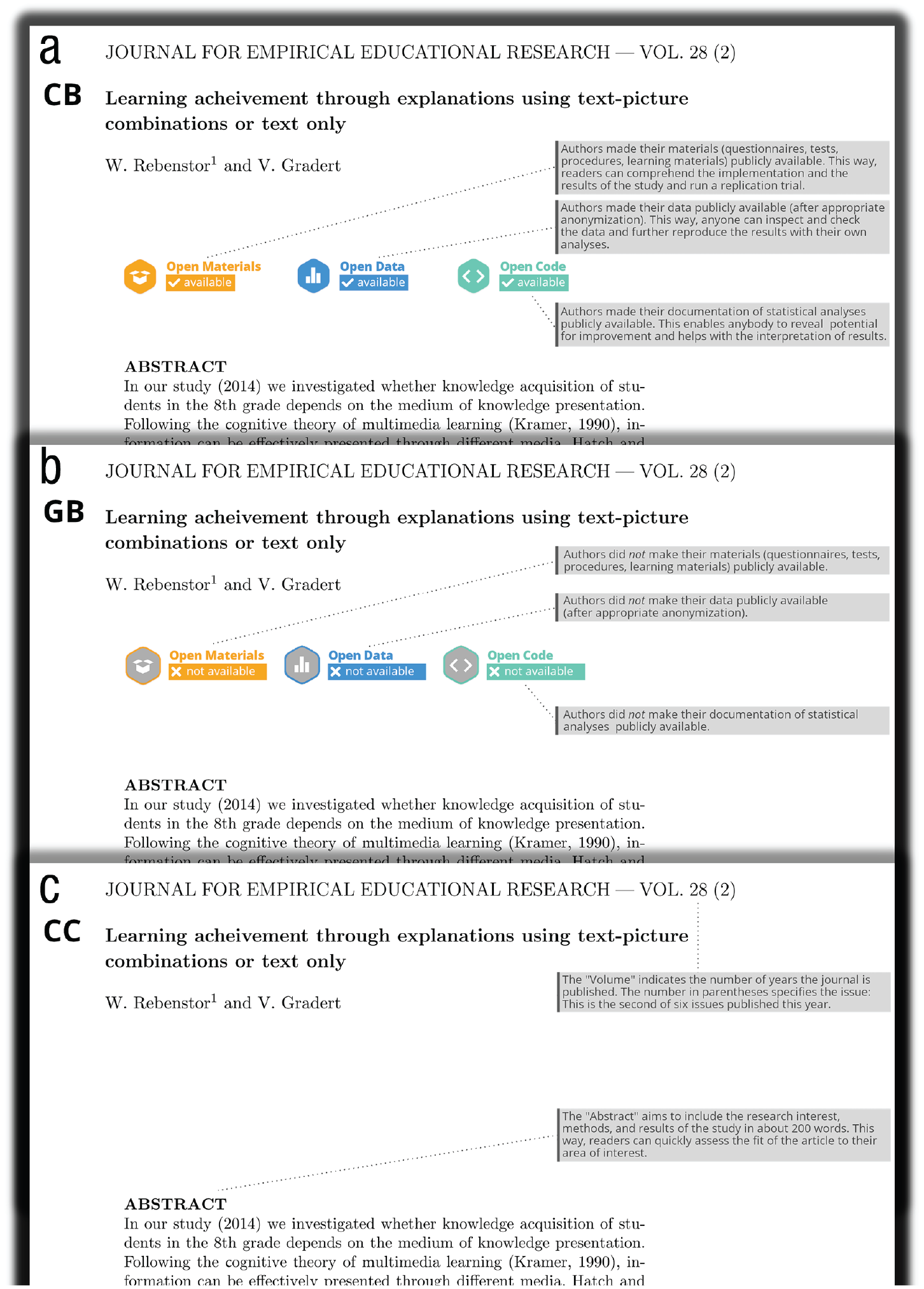
Illustrations from the three experimental conditions: (a) colored badges (CB), (b) grayed-out badges (GB), and (c) control condition (CC). (Only the upper part of the title pages is shown here; for the full page, see the Supplemental Material available online.)
We therefore argue that the badges displayed on scientists’ publications or translational abstracts influence the perceived trustworthiness of the authors. Colored badges signal adherence to qualitative standards, increasing trust, and grayed-out badges signal violation of qualitative standards, decreasing trust compared with no badges. This prediction led to Hypothesis 1 (H1): Visible compliance to open-science practices (colored badges) leads to higher perceived trustworthiness of scientists compared with no information about open-science practices (control condition) or visible noncompliance to open-science practices (grayed-out badges), with visible noncompliance to open-science practices receiving the lowest ratings of trustworthiness.
Epistemic Beliefs and Epistemic Trust
Epistemic beliefs—individual beliefs about the nature of knowledge and knowing (Hofer & Pintrich, 1997)—are known to influence information processing when people deal with textual information (Bråten et al., 2011; Franco et al., 2012). Developmental conceptualizations of epistemic beliefs distinguish between the consecutive stages of absolutism (knowledge as dualistic, i.e., right or wrong), multiplism (knowledge as subjective opinions), and evaluativism (knowledge as weighed evidence). Because of their focus on personal opinions over facts and evidence, multiplistic beliefs (Kuhn & Weinstock, 2002) seem to impair information processing in particular—as evidenced by their negative effects on learning (Rosman et al., 2018) and negative relationships with judgments of text trustworthiness (Strømsø et al., 2011). This led to Hypothesis 2 (H2): the higher the multiplistic beliefs, the lower the perceived trustworthiness of scientists.
Furthermore, multiplistic beliefs depict the source of knowledge as something that lies within a knowing subject in the form of individual opinions. Individuals with high levels of multiplistic beliefs thus perceive external sources of knowledge (e.g., researchers) and knowledge evaluation (e.g., through badges) as irrelevant because they consider all knowledge claims to be equally true (Kuhn & Weinstock, 2002). For these individuals, the question of how knowledge from external sources is created or displayed may therefore be unrelated to their perceptions of trustworthiness. Consequently, we assume that for individuals with high levels of multiplistic beliefs, badges will not play a role regarding their epistemic trust. This led to Hypothesis 3 (H3): Multiplistic epistemic beliefs moderate the effect of badges on perceived trustworthiness. However, because no corresponding empirical evidence exists to date, we label this hypothesis as exploratory.
Moreover, badges might indicate that science is not just opinion because they make the underlying empirical and fact-based approach more tangible, thus reducing multiplistic beliefs. This led to Hypothesis 4 (H4): Visible compliance to open-science practices (colored badges) leads to lower multiplistic epistemic beliefs compared with no information about open-science practices (control condition) or visible noncompliance with open-science practices (grayed-out badges). We concede, however, that this interpretation is somewhat speculative, which is why we again label this hypothesis as exploratory.
Study 1: Student Teachers
In the first study, we investigated our research questions in a sample of student teachers. Participants from this population regularly access scientific papers in the course of their professional development, as evidence-based practice plays a central role in German teacher-education curricula (Cochran-Smith & Boston College Evidence Team, 2009).
Method
Given that we did not use methods that might have potentially harmed our participants (e.g., induction of fear, deception, or false feedback) and because all study data were collected anonymously, consistent with standard university procedure, no ethical clearance was sought. Before beginning the study, participants were required to sign an informed consent form informing them about their rights, data protection, and the study’s methods and purposes.
Sample
Following our preregistration, we started recruiting the sample by advertising in social media groups and newsletters for student teachers from German universities. Our stopping rule was to cease data collection once a sample size of 270 was reached. We exceeded the stopping rule by 20 participants because the survey had to be deactivated manually after periodic sample-size checks. Thirteen participants skipped the repeated measurement, and four participants did not complete the demographic questions at the end of the questionnaire. On average, participants were 22.89 years old (SD = 2.95) and in their sixth semester (M = 5.86, SD = 3.68). Of all the participants, 176 indicated that they were female.
Design
Hypotheses were tested in an experiment with three conditions. Students were presented with two title pages of fictitious empirical journal articles (topics: dual-channel theory, learning by means of worked-out examples). These title pages contained either three colored badges with legends (colored-badges condition), three grayed-out badges with legends (grayed-out-badges condition), or no badges (control condition). These materials also included legends that explained other terms on the title page (see Fig. 1). The three colored badges indicated that the authors implemented the open-science practices (open data, open materials, and open code), and the grayed-out badges signaled nonadherence with these practices (data not available, materials not available, and code not available). Because we expected participants to be unfamiliar with badges, we included explanations of the badges in gray text boxes (see Fig. 1). These were explicitly labeled as additional information that was not part of the journal article itself. In the condition without badges, participants did not receive information about the implementation of open-science practices. To prevent experimental leakage, but at the same time increase test power, we used a planned-missing design (Graham et al., 2003; Silvia et al., 2014): Each participant completed two of the three conditions. A balanced experimental plan was used to randomize the assignment and sequence of conditions, as well as the topics and sequence of topics.
Procedure
After participants gave their informed consent, they were introduced to the survey procedure and informed about its structure. They were told that they would be given the title page of a regular journal article with explanations annotated in gray text boxes. Participants were asked to read the title page thoroughly and then answer the questions below the text. On the next survey page, participants read the title page of the first journal article and were prompted to respond to a topic-specific multiplism (TSM) scale (see below; Merk et al., 2018). Subsequently, they completed the Muenster Epistemic Trustworthiness Inventory (METI; Hendriks et al., 2015), and the treatment check was conducted. This sequence of events was repeated for the second title page. Finally, at the end of the questionnaire, participants responded to several demographic questions. The survey took approximately 15 min to complete (for a demo version of the survey with all three conditions, visit https://undergrad-demo.formr.org).
Statistical analyses
For data analyses, we used approximated adjusted fractional Bayes factors (BFs; Gu et al., 2018; Hoijtink, Mulder, et al., 2019) for informative hypotheses, as they are especially suitable to test hypotheses with order restrictions (Hoijtink, 2012) such as ours. To ensure a strictly confirmatory approach (Wagenmakers et al., 2012), we preregistered our hypotheses https://doi.org/10.17605/OSF.IO/YBS7F. Within this preregistration, we specified a data-analysis plan which served as a basis for our simulation-based sample-size determination (BF design analysis; see Schönbrodt & Wagenmakers, 2018). This data-analysis strategy and the results of the sample-size determination are described below.
BFs, in general, provide relative evidence as they quantify the increased likelihood that the current data are observed under a specific hypothesis in contrast to a different hypothesis. Therefore, a central challenge is choosing which hypotheses to compare in order to gain the most compelling evidence. Our first hypothesis stated that student teachers would ascribe, on average, less integrity to the authors of studies if these title pages contained grayed-out badges compared with title pages that contained no information about the use of open-science practices, which, in turn, would be ascribed less integrity than authors of title pages containing colored badges. In our preregistration, we specified comparing this hypothesis H11: μ(integrity)GB < μ(integrity)CC < μ(integrity)CB with the corresponding point null hypothesis H1
0
: μ(integrity)GB = μ(integrity)CC = μ(integrity)GB and a hypothesis that assumes that only the visible adherence to open-science practices has an effect on integrity—H12: μ(integrity)GB = μ(integrity)CC < μ(integrity)CB. (Note that throughout this article, the subscripts CB, GB, and CC refer to the colored-badges, grayed-out badges, and control conditions, respectively.) Furthermore, in our preregistration, we specified that if the data were to provide evidence for one of these hypotheses against the other two (Bayes factors: BF > 3 respective < 1/3) and the corresponding hypothesis without constraints H1
u
: μ(integrity)GB; μ(integrity)CC; μ(integrity)CB, we would compare this hypothesis with its complement
We computed these BFs using the routines implemented in the R package bain (Gu et al., 2019). This statistical package uses an adjusted and approximated version of the fractional BF, which uses a fraction of the information in the data to specify the implicit prior (for details, see Gu et al., 2018). This framework is especially useful for our analyses, as it provides a routine for computing BFs using multiple-imputation data (Hoijtink, Gu, et al., 2019). We then imputed our (planned as well as unplanned) missing data using chained equations (Azur et al., 2011; van Buuren, 2012). Next, parameters of a repeated measures analysis of variance (ANOVA) were estimated on each of the resulting (1,000) complete data sets and combined using the rules derived by Hoijtink, Gu, et al. (2019).
To determine our preregistered sample size, we ran simulation studies that used the decision procedure described above and assumed a Cohen’s d of .3 if μ(integrity)
x
≠ μ(integrity)
y
. The simulations suggested that a sample size of 250 would be sufficient, because in the worst case (true hypothesis is
Instruments
All studies were conducted using the Web-based survey tool formr (Arslan et al., 2020).
Integrity
The METI (Hendriks et al., 2015) was used to assess the degree of integrity participants ascribed to the authors of the respective title page. This instrument contains 14 antonym pairs that are rated on a 7-point scale and are mapped to three subscales (expertise: well educated–poorly educated; integrity: honest–dishonest; benevolence: considerate–inconsiderate). Even though we were interested only in one dimension of the inventory (see the preregistration), participants completed all three dimensions because we wanted to gain some additional insights on the instrument’s construct validity and to use the additional information as covariates to impute the planned missing data. Therefore, we first performed a confirmatory factor analysis (CFA) with τ-congeneric measurement models for each measurement, which resulted in good fit indices (see Table 1) after freeing two residual covariances. In a next step, we further investigated the factorial structure using a two-level CFA, and its good model fit corroborated the assumption of three dimensions at the within-person level as well as at the between-person level (see Table 1 and the reproducible documentation of the analysis for details). Furthermore, all three-dimensional models significantly outperformed corresponding one-dimensional models ( p values of χ2 difference tests all < .0001). Because we specified τ-congeneric measurement models, McDonald’s ω was used to assess internal consistency (Dunn et al., 2014), and this yielded good results, with a minimum score of ω = .83 (integrity in the first measurement).
Results and Fit Indices for the Confirmatory Factor Analyses (CFAs) in Study 1
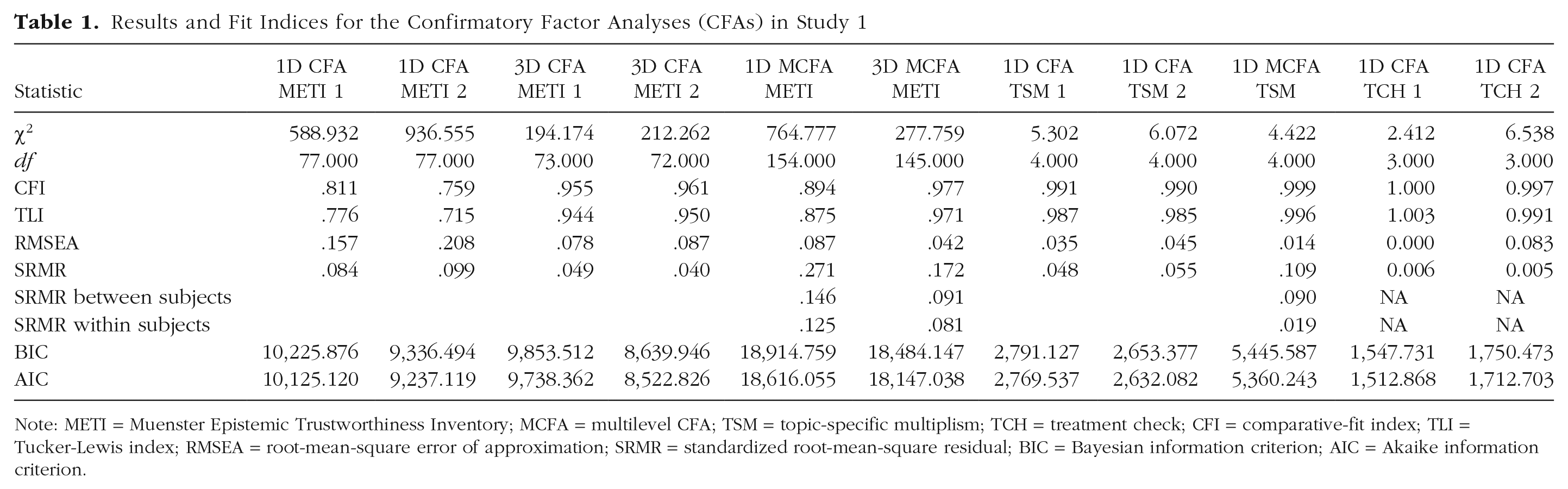
Note: METI = Muenster Epistemic Trustworthiness Inventory; MCFA = multilevel CFA; TSM = topic-specific multiplism; TCH = treatment check; CFI = comparative-fit index; TLI = Tucker-Lewis index; RMSEA = root-mean-square error of approximation; SRMR = standardized root-mean-square residual; BIC = Bayesian information criterion; AIC = Akaike information criterion.
Topic-specific multiplism
To assess TSM, we used a 4-point Likert-type scale by Merk et al. (2018; sample item: “The insights from the text are arbitrary”). Consecutive as well as two-level CFAs provided evidence for the assumption of one-dimensionality (see Table 1), and the scale’s internal consistency was acceptable considering its length (four items; ω = .65 and ω = .53 for the topics, respectively).
Treatment check
To investigate the effectiveness of our treatment, we examined whether participants recognized and understood the presented badges. To do so, we, directly and indirectly, asked them about their perceptions of the researchers’ open-science practices (using five 4-point Likert-type items with a “don’t know” option, e.g., “Materials used in the study and the data collected are openly accessible”; 1 = I do not agree at all, 4 = fully agree). A corresponding CFA yielded excellent results (see Table 1), and the internal consistency of the treatment check was also very good (ω = .95 and ω = .90).
Results
Treatment check
Figure 2 depicts a fluctuation diagram (also known as a product plot; Wickham & Hofmann, 2011) of the results of the treatment check. We consider these results as evidence for strong compliance with our treatment, as, for example, comparing the conditions with grayed-out badges and colored badges reveals that there were large effect sizes for ordinal measures (e.g., Varha & Delaney’s A = .84 for Item 1). In the control condition, a high proportion of participants reported not knowing about the researchers’ open-science practices, or their judgments showed high variation.
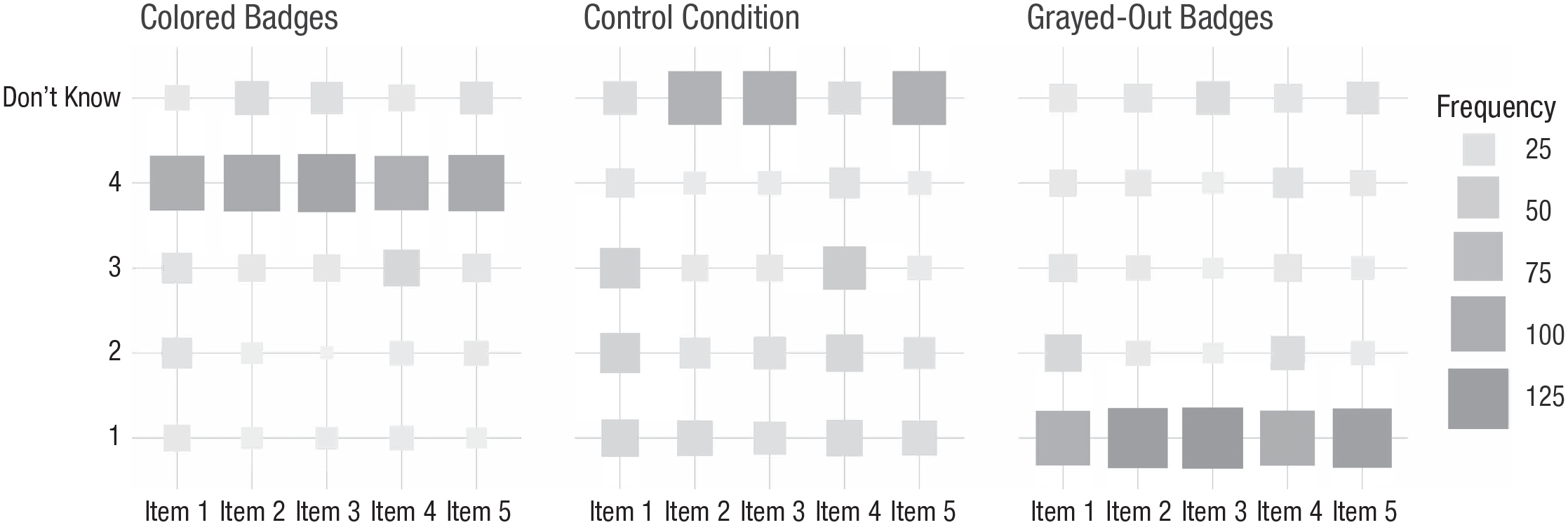
Fluctuation diagram showing the frequency with which participants responded to each of the five items from the treatment check in Study 1. Results are shown separately for each experimental condition.
Hypothesis 1
H1 was that the colored-badges condition would induce higher perceived integrity of the authors than the control condition, which, in turn, would induce higher perceived integrity than the grayed-out-badges condition. To test H1, we applied the preregistered equation to compute the approximated adjusted fractional BFs for the corresponding Hypothesis H11: μ(integrity)GB < μ(integrity)CC < μ(integrity)CB, the point null hypothesis H10: μ(integrity)GB = μ(integrity)CC = μ(integrity)CB, and a hypothesis that postulated only an effect of the visible utilization on integrity, H1
2
: μ(integrity)GB = μ(integrity)CC < μ(integrity)CB, in which μ(integrity)
X
describes the mean of integrity in the group X (see the Statistical Analyses section). Because the underlying ANOVA model for such hypotheses assumes normality of the dependent variable, we first checked to see whether the data satisfied this assumption regarding skewness, kurtosis, and outliers. Because the data showed no strong violations of these criteria, we continued by multiply imputing the planned and unplanned missing data using the procedures implemented in the mice package for R (van Buuren & Groothuis-Oudshoorn, 2011). Using this data, we followed the preregistered decision procedures previously described in the Statistical Analyses section. This resulted in substantial relative evidence for H11 (BF against H10 = 3.5 × 10⁷, BF against H12 = 4.5 × 101, BF against
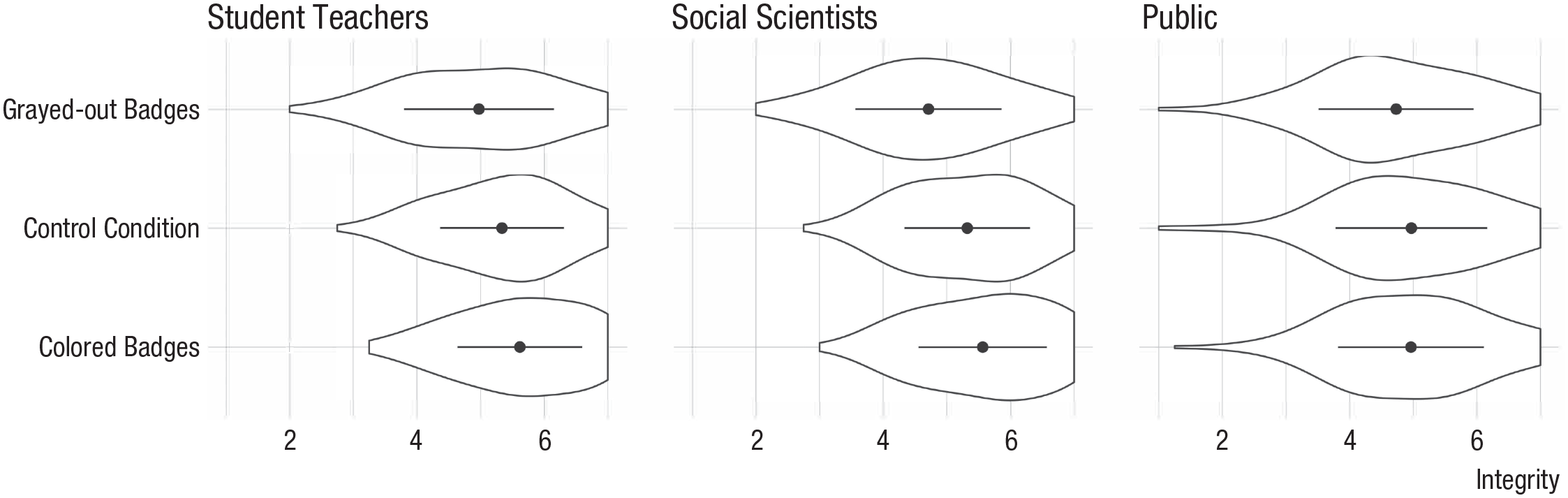
Integrity ratings made by student teachers (Study 1), social scientists (Study 2), and the general public (Study 3) in each experimental condition. Violin plots show the density of the data, circles represent means, and error bars represent ±1 SD.
Hypothesis 2
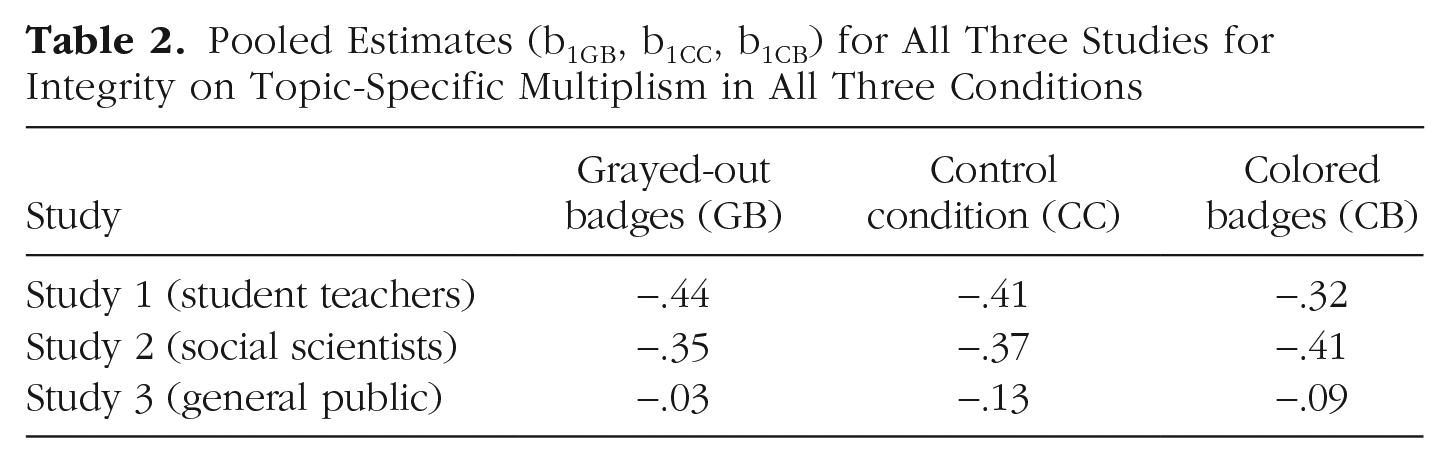
H2 predicted a negative association between TSM and integrity. To test this hypothesis, we specified a path model with three regression paths—one for each condition of TSM on integrity. Subsequently, we tested the hypothesis H21: b1CB > 0 and b1CC > 0 and b1GB > 0 against H20: b1CB = 0 and b1CC = 0 and b1GB = 0, again using the approximated adjusted fractional BF, which resulted in strong evidence for H21 (BF against H20 = 6.0 × 10²¹, BF against
Pooled Estimates (b1GB, b1CC, b1CB) for All Three Studies for Integrity on Topic-Specific Multiplism in All Three Conditions
Hypothesis 3 (exploratory)
Table 2 also shows the results obtained for H3, which was that the association between TSM and integrity may be moderated by the condition, resulting in the following order of H31: b1GB > b1CC > b1CB. We tested this hypothesis against the corresponding null hypothesis H30: b1GB = b1CC = b1CB = 0 and a hypothesis that H32: (b1GB, b1CC) > b1CB, meaning that the association is smaller when participants were informed about the use of open-science practices, but every configuration between the other coefficients is allowed. The BFs clearly provided relative evidence for the null hypothesis (BF against H31 = 6.0, BF against H32 = 7.4, BF against
Hypothesis 4 (exploratory)
Finally, we tested whether the condition also had an effect on TSM. The violin plots depicted in Figure 4 indicate that there might be small to medium effects. This is underpinned by the effect-size estimates (dGB/CC = −0.26, dCC/CB = 0.01, dGB/CB = −0.25) and the BFs that favor H41: μ(TSM)GB > μ(TSM)CC > μ(TSM)CB against a corresponding null hypothesis H40: μ(TSM)GB = μ(TSM)CC = μ(TSM)CB, and a less specific hypothesis H42: (μ(TSM)GB, μ(TSM)CC) > μ(TSM)CB, which show that TSM was smaller only when participants were confronted with open-science-practices badges (BF against H40 = 6.2, BF against H42 = 1.9, BF against
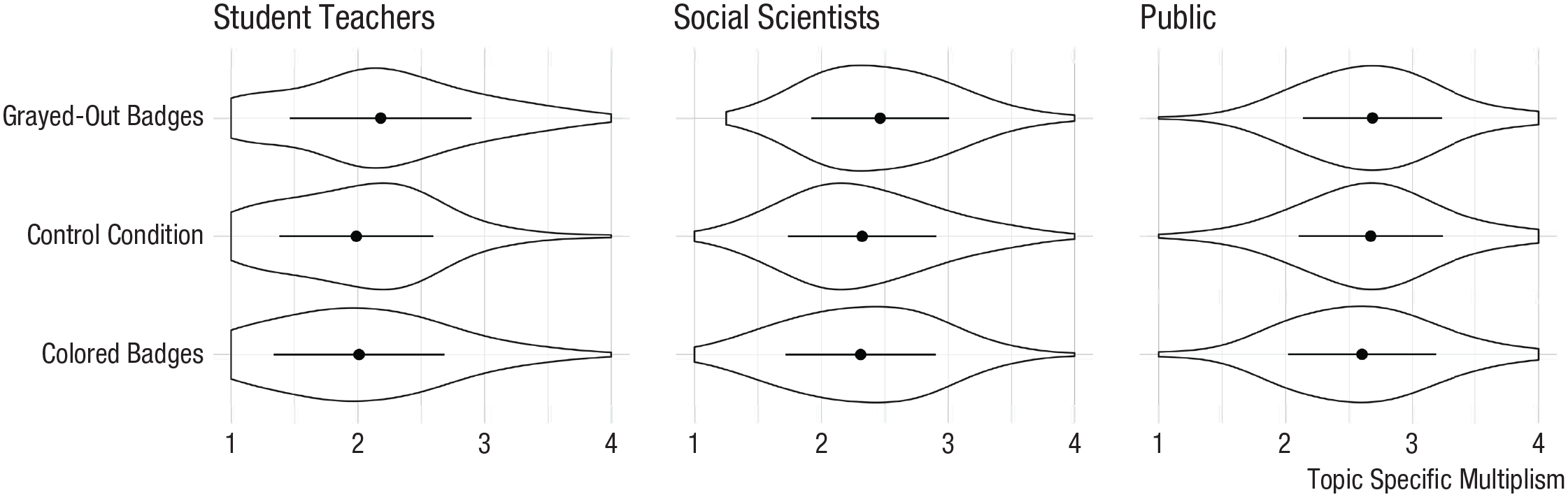
Topic-specific multiplism ratings made by student teachers (Study 1), social scientists (Study 2), and the general public (Study 3) in each experimental condition. Violin plots show the density of the data, circles represent means, and error bars represent ±1 SD.
Study 2: Social Scientists
In a second study, we aimed to replicate the findings from the first study in a sample of social scientists. This sample was expected to be more practiced in working with publications and might possibly have more knowledge of open-science badges.
Method
Sample
As the social sciences predominantly utilize empirical methods in research, we opted for a social-scientist sample. International participants were recruited via the online-access panel-provider prolific.co, filtering for social scientists with English as a first or fluent language. Following our stopping rule, we terminated data collection after 250 participants had passed the implemented quality check. No participant skipped the repeated measurement or demographic questions at the end of the questionnaire. Ninety-one participants were younger than 35 years old, 37 participants were between the ages of 35 and 49 years, and 20 were older than 50 years. Most participants described their current position as a graduate research assistant or postgraduate researcher (n = 91); 170 participants identified as female.
Design
The design of the conditions was the same as in Study 1. To avoid potential bias in the participants’ judgments because of topic familiarity (Tversky & Kahneman, 1973), we used abstracts of fictional studies (see the Supplemental Material available online). In a small-scale pilot study (N = 39), we tested and confirmed the authenticity of these abstracts. We implemented the abstracts in the design of the title pages from Study 1. Again, the same three experimental conditions were utilized. We also used the same planned-missing design and assigned participants randomly to the different conditions using a balanced experimental plan.
Procedure and statistical analyses
All procedures and statistical analyses were the same as in Study 1. For a demo version of the survey with all three conditions, visit https://sci-demo.formr.org.
Instruments
Participants completed the same instruments as in Study 1. Internal consistency was very good for integrity (ω = .91 and ω = .92), acceptable for TSM (ω = .69 and .64), and very good for the treatment check (ω = .87 and .91; see Table 3).
Results and Fit Indices for the Confirmatory Factor Analyses (CFAs) in Study 2
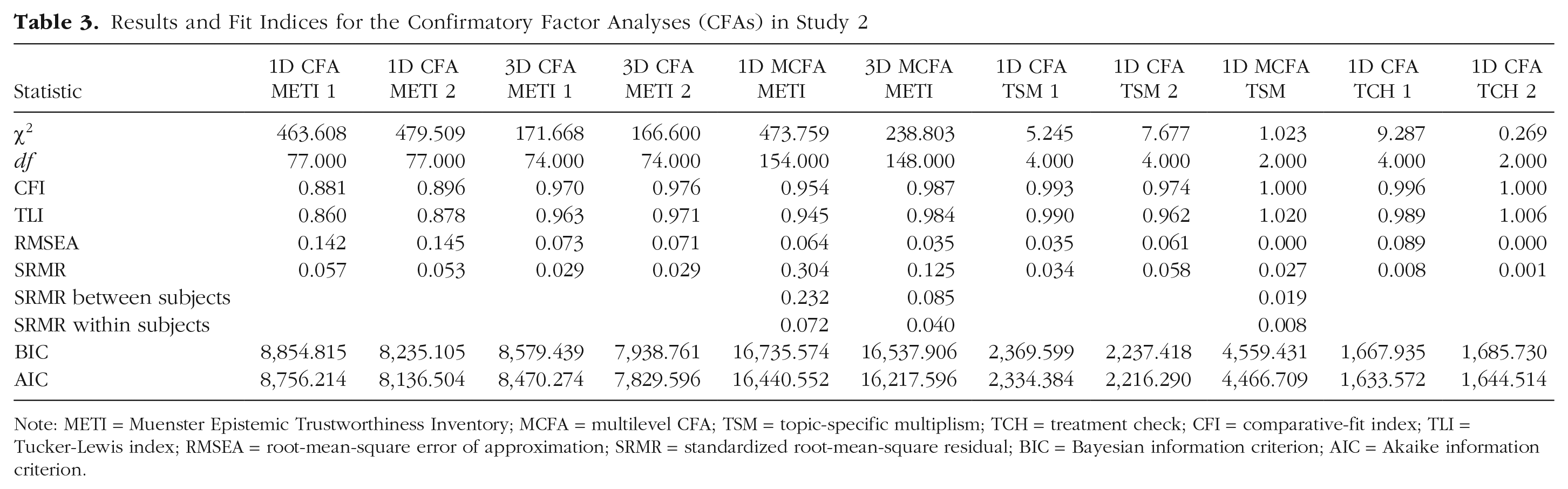
Note: METI = Muenster Epistemic Trustworthiness Inventory; MCFA = multilevel CFA; TSM = topic-specific multiplism; TCH = treatment check; CFI = comparative-fit index; TLI = Tucker-Lewis index; RMSEA = root-mean-square error of approximation; SRMR = standardized root-mean-square residual; BIC = Bayesian information criterion; AIC = Akaike information criterion.
Results
Treatment check
As shown in Figure 5, Study 2 participants also complied very well with the treatment. The effect size for the first item comparing the colored-badges condition and the grayed-out-badges condition was even larger than in Study 1 (Varga & Delaney’s A = .94).
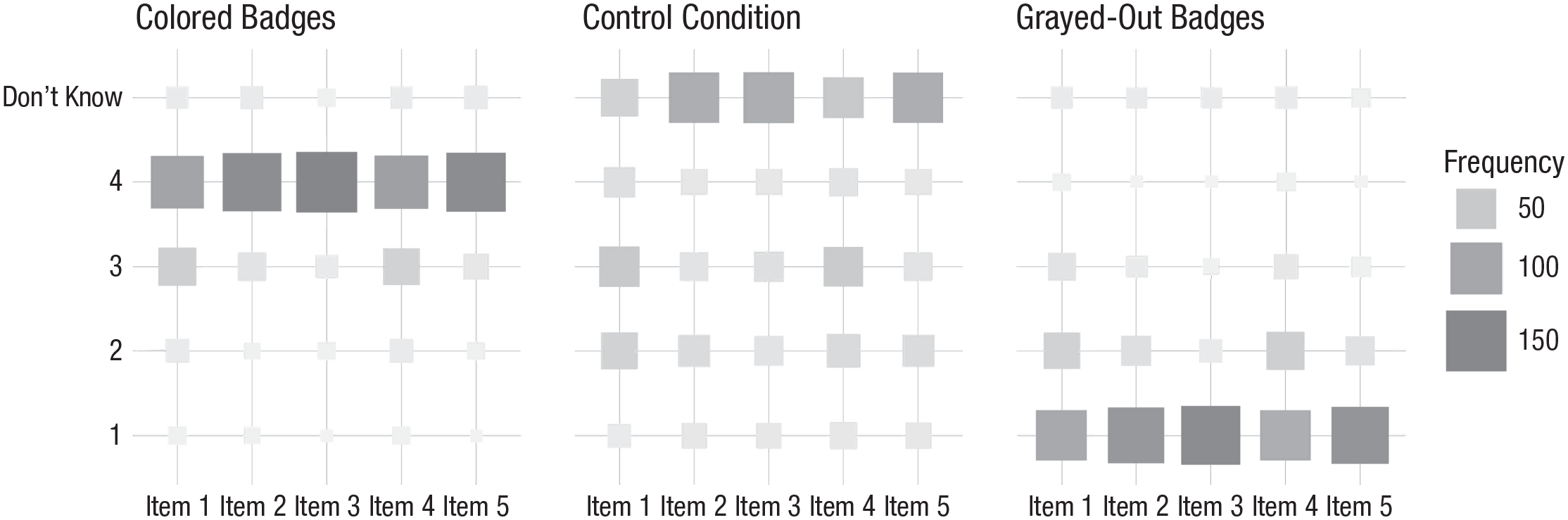
Fluctuation diagram showing the frequency with which participants responded to each of the five items from the treatment check in Study 2. Results are shown separately for each experimental condition.
Hypothesis 1
Figure 3 has already provided some insights with regard to H11: μ(integrity)GB < μ(integrity)CC < μ(integrity)CB. Following the same (preregistered) procedure as in Study 1, we again obtained substantial relative evidence for H11 (BF against H10 = 1.6 × 10¹¹, BF against H12 = 7.5, BF against
Hypothesis 2
In Study 2, the results regarding H2 were also replicated: Testing the hypothesis H21: b1CB > 0 and b1CC > 0 and b1GB > 0 against H20: b1CB = 0 and b1CC = 0 and b1GB = 0 revealed strong evidence for H21 (BF against H20 = 2.6 × 10¹⁶, BF against
Hypothesis 3 (exploratory)
As in Study 1, the BFs found for H3 provided strong relative evidence for the null hypothesis (BF against H31 = 1.3 × 10², BF against H32 = 1.2 × 10², BF against
Hypothesis 4 (exploratory)
Finally, Study 2 revealed very similar results to Study 1 with regard to H4, showing moderately higher means in TSM for the condition with grayed-out badges (dGB/CC = −0.27, dCC/CB = 0.02, dGB/CB = −0.24), which is reflected by BFs clearly favoring H41: μ(TSM)GB > μ(TSM)CC > μ(TSM)CB against a corresponding null hypothesis H40: μ(TSM)GB = μ(TSM)CC = μ(TSM)CB (BF = 22.4), but not conclusively against the less specific alternative hypothesis H42: (μ(TSM)GB, μ(TSM)CC) > μ(TSM)CB (BF = 2.0).
Study 3: General Public
Scientific findings also reach larger target groups, such as the general public, through science communication and science journalism. In the third study, we therefore aimed to replicate the findings from the two preceding studies in a sample of the general public.
Method
Sample
Participants were recruited from the UK general population via the online-access panel-provider respondi (https://www.respondi.com/EN/). Relying on the latest UK census data (Office for National Statistics et al., 2016), we generated cross quotas of three variables—sex, age, and qualification. In the survey, we used filter questions to achieve the same cross quota within our sample. By doing so, we exceeded the stopping rule from our preregistration by seven participants, as cross-quota cells closed only after the last participant from that cell finished the survey; further participants from that cell were still able to begin the survey until that point.
Design
The experimental conditions were identical to those of Studies 1 and 2. Additionally, the abstracts implemented on the title pages were adapted to the public’s needs and levels of expertise. In the context of science communication, authors are increasingly being asked to meet these needs and to promote the comprehension of research findings by laypeople (Kerwer et al., 2021; Stricker et al., 2020). Preparing translational abstracts is one approach endorsed by the American Psychological Association (APA; Kaslow, 2015). In addition to the scientific abstract accompanying scientific papers, the authors also prepare a translational abstract that is directed toward a public audience and is free of technical language and scientific jargon. To illustrate the content and preparation of translational abstracts, the APA provides two practical examples from actual publications (APA, 2018). We utilized these established examples of translational abstracts in the redesign of the title pages from Study 1 and Study 2. Once again, we assessed the same experimental conditions (colored badges, control condition, grayed-out badges) as in the first two studies. We also used the same planned-missing design and randomly assigned participants to the conditions using a balanced experimental plan.
Procedure and statistical analyses
The procedure was equivalent to the procedure followed in Studies 1 and 2. For a demo version of the survey with all three conditions, visit https://pub-demo.formr.org.
Instruments
We used the same instruments as in Studies 1 and 2 and tested factorial validity with the same series of CFA and multilevel CFA (MCFA) models (see Table 4). Again, internal consistencies were good for integrity (ω = .88 and .90), acceptable for the four-item TSM (ω = .69 and .60) scale, and very good for the treatment check (ω = .84 and .94).
Results and Fit Indices for the Confirmatory Factor Analyses (CFAs) in Study 3
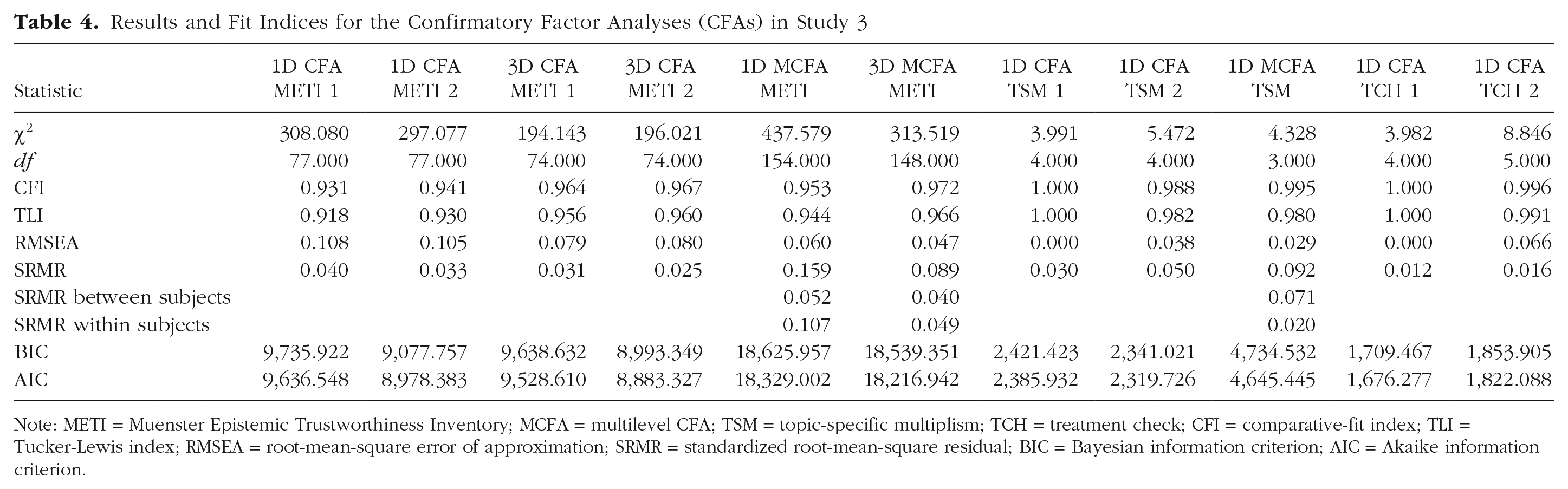
Note: METI = Muenster Epistemic Trustworthiness Inventory; MCFA = multilevel CFA; TSM = topic-specific multiplism; TCH = treatment check; CFI = comparative-fit index; TLI = Tucker-Lewis index; RMSEA = root-mean-square error of approximation; SRMR = standardized root-mean-square residual; BIC = Bayesian information criterion; AIC = Akaike information criterion.
Results
Treatment check
Descriptively, the results of the treatment check (Fig. 6) indicated that the participants read the explanations of the badges carefully and gave corresponding answers. Deviating from Study 1 and Study 2, results showed that participants more often assumed that open-science practices were used in the control condition even though no explicit information was given there about data, code, and materials sharing.
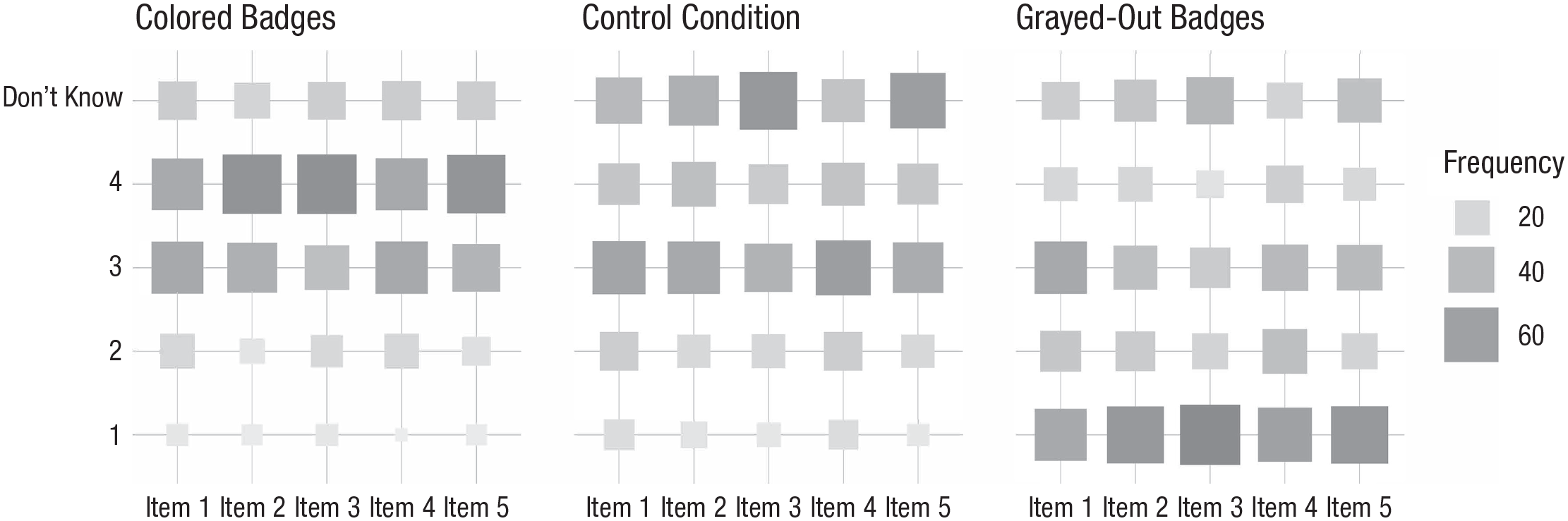
Fluctuation diagram showing the frequency with which participants responded to each of the five items from the treatment check in Study 3. Results are shown separately for each experimental condition.
Hypothesis 1
Deviating from Studies 1 and 2, our data was more likely under H12 (μ(integrity)GB < μ(integrity)CC = μ(integrity)CB) than under H11 (μ(integrity)GB = μ(integrity)CC = μ(integrity)CB), which was reflected in the corresponding BFs (BF against H10 = 3.2, BF against H11 = 5.8, BF against
Hypothesis 2
Regarding H2, we found strong evidence for the absence of an association between TSM and integrity in all three conditions (H20: b1CB = 0 and b1CC = 0 and b1GB = 0; BF against H21 = 9.58, BF against
Hypothesis 3 (exploratory)
Consistently, we found no evidence for the differences in associations between TSM and integrity proposed by H3. Instead, the likelihood of the data was clearly greater for H30: b1GB = b1CC = b1CB = 0 compared with the alternatives stating an interaction (BF against H31 = 105.6, BF against H32 = 41.6, BF against
Hypothesis 4 (exploratory)
Finally, Study 3 also provided strong evidence for H40: μ(TSM)GB = μ(TSM)CC = μ(TSM)CB, meaning that the participants did, on average, report the same amount of TSM in all three experimental conditions (dGB/CC = −0.02, dCC/CB = −0.13, dGB/CB = −0.15; BF against H41 = 6.3, BF against H42 = 9.5, BF against
Discussion
Our findings in two of the samples substantiate the assumption that open-science badges have considerable potential to influence trust in scientists as measured by perceived integrity as well as topic-specific multiplistic beliefs. For student teachers and scientists, we were able to corroborate findings on the negative relationship between multiplistic epistemic beliefs and epistemic trust. Moreover, we found evidence for the absence of a moderating effect of epistemic beliefs on the effects of badges on trust.
These results shed new light on the effects of badges on perception. Beyond initial investigations of badges’ effectiveness in fostering data sharing and adherence to open-science standards (Kidwell et al., 2016), we now have evidence that badges have the potential to increase trust in scientists by their target audiences (scientists and student teachers).
In the public sample, we were able to support this claim for visible noncompliance to open-science practices (grayed-out-badges condition), but not for visible compliance to open-science practices (colored-badges condition). One explanation (also proposed by Anvari & Lakens, 2018) may be that nonscientists believe that transparency is already fully ingrained in the scientific process. Our data is in line with this assumption. In fact, the treatment check revealed different perceptions of the researchers’ open-science practices for the public sample versus the student teachers or scientists: Participants in the public sample more often assumed the adherence to open-science practices in the control condition compared with the two other samples. When the public has reason to believe that scientific practices are less transparent than they had assumed, perceived trust decreases accordingly. This potential “transparency assumption effect” still needs further investigation. Another question is the one regarding the evaluation of this potential effect: Should we avoid grayed-out badges in order to avoid decreasing trust in science? What speaks for avoiding grayed-out badges is that a lack of badges does not necessarily imply untrustworthy or low-quality scientific practice. Encouragingly, the participants in our public sample did not feel this way either: Even when trust decreased, trust scores remained in the upper range of the scale and did not turn into perceived untrustworthiness. However, it seems justified to assert that the public’s perception changes on the basis of the transparency in research projects.
If badges are indeed related to trust, then this is an alarming call to action regarding the accreditation process. There is empirical evidence from the example of preregistrations that scientists often do not fully disclose deviations from their preregistrations (Claesen et al., 2021). Hence, badges may lull readers into a false sense of trust if they do not reflect reality. Should members of the public learn that the scientific community does not deliver what they expect of it, public trust in future research (Wingen et al., 2020) and past research (Anvari & Lakens, 2018) could be severely affected beyond immediate repair. Therefore, if journals or websites adopt a badge system, it is crucial to implement third-party quality checks to ascertain that badges have been awarded for the right reasons.
Further, our studies contribute to research on epistemic beliefs. Our results are in line with previous research on the detrimental effect of multiplistic beliefs on trustworthiness among undergraduate students (Strømsø et al., 2011), and we expanded these findings to a sample of scientists. Particularly with respect to scientists, there have been few results on the correlates and structure of epistemic beliefs. More specifically, the medium to large negative effect of multiplism on perceived trustworthiness underpins the problematic nature of multiplistic beliefs in the context of information processing. Interestingly, these findings were not evident in the public sample. Could they, then, merely be an academic phenomenon? This would imply that epistemic-belief researchers might have to rethink whether epistemic beliefs are truly associated with trust or whether this is population specific. As a side effect, utilizing badges to indicate that science is not just opinion triggered small decreases in topic-specific multiplistic beliefs. Important questions to clarify include determining the sustainability of these effects and whether they spill over onto domain-specific or general-academic epistemic beliefs when individuals repeatedly perceive badges on publications (Merk et al., 2018). Also, concerning construct validity, we were able to further confirm the factor structure of epistemic beliefs with its subscales absolutism, multiplicism, and evaluativism, measured with Hendriks et al.’s (2015) survey instrument.
Our results should be qualified by the fact that we provided explanations of open-science practices in the texts that were situated in close proximity to the badges. These text-based specifications are also present in journals using badges (e.g., in Psychological Science) but in a less directly integrated format (e.g., at the end of the page). This might limit the generalizability of our findings; research on different types of explanations or on alternatives to badges (e.g., using textual statements as in PLOS ONE) will give further insights into this matter. Furthermore, in two of our studies, we recruited subjects from online panel providers. Evidence suggests that participants recruited in this manner may sometimes score lower on attention and honesty variables compared with traditional samples (Peer et al., 2021). In a comparative study by Peer et al. (2021), however, Prolific yielded the best scores in this regard. In addition, inattentive participants would have been filtered out by the attention checks used in our studies (Agley et al., 2022).
In sum, our results further substantiate the assumption that badges influence individual perceptions, particularly within their target audiences. This is good news under the assumption that open-science badges are “a simple, low-cost, effective method for increasing transparency” (Kidwell et al., 2016). Nevertheless, it should be considered that the meaning and perception of badges are closely tied to the quality standards (and transparency) that determine whether to award such a badge—an aspect that is also related to the question of who invests the resources to check the adherence to the standards and then awards the badge. Falsely awarded badges can turn the effect on trust into the opposite and cause lasting damage—a problem that can be solved only by rigorous quality control. Given the promising findings in our study, we conclude that badges on open-science practices hold much potential, which is why we are excited about their further development and implementation.
Supplemental Material
sj-docx-1-pss-10.1177_09567976221097499 – Supplemental material for Do Open-Science Badges Increase Trust in Scientists Among Undergraduates, Scientists, and the Public?
Supplemental material, sj-docx-1-pss-10.1177_09567976221097499 for Do Open-Science Badges Increase Trust in Scientists Among Undergraduates, Scientists, and the Public? by Jürgen Schneider, Tom Rosman, Augustin Kelava and Samuel Merk in Psychological Science
Footnotes
Acknowledgements
We thank the Leibniz Institute for Psychology Information (ZPID) for support with data collection.
Transparency
Action Editor: Kate Ratliff
Editor: Patricia J. Bauer
Author Contributions
J. Schneider and S. Merk developed the study concept. J. Schneider, S. Merk, and T. Rosman designed the study. T. Rosman and J. Schneider conducted the testing and data collection. S. Merk analyzed and interpreted the data under the supervision of A. Kelava. J. Schneider and S. Merk drafted the manuscript, and T. Rosman and A. Kelava made critical revisions. All the authors approved the final version of the manuscript for submission.

References
Supplementary Material
Please find the following supplemental material available below.
For Open Access articles published under a Creative Commons License, all supplemental material carries the same license as the article it is associated with.
For non-Open Access articles published, all supplemental material carries a non-exclusive license, and permission requests for re-use of supplemental material or any part of supplemental material shall be sent directly to the copyright owner as specified in the copyright notice associated with the article.
