




Abstract
Climate change is acknowledged as the largest threat to our societies in the coming decades, potentially affecting large and diverse groups of urban residents in this century of urbanization. As urban areas house highly diverse people with differing vulnerabilities, intensifying climate change is likely to shift the focus of discussions from a general urban perspective to who in cities will be affected by climate change, and how. This brings the urban equity question to the forefront. Here we assess how climate change events may amplify urban inequity. We find that heatwaves, but also flooding, landslides, and even mitigation and adaptation measures, affect specific population groups more than others. As underlying sensitivity factors we consistently identify socioeconomic status and gender. We synthesize the findings with regard to equity types – meaning outcome-based, process-oriented and context-related equity – and suggest solutions for avoiding increased equity and justice concerns as a result of climate change impacts, adaptation and mitigation.
Keywords
I. Introduction
Cities are melting pots of people with diverse backgrounds, cultures and positions within social and economic networks. In addition to these intra-city diversities, cities differ with respect to their political and economic functions, development stages, locations and climates. As climate change becomes an increasingly pressing issue, the question of how these urban diversities interact and cities react to climate change becomes an increasingly important issue demanding systematic investigations.(1) Arguably, the most important issue deals with the question of who will be impacted by climate change, and how to address related injustices and underlying equity concerns.
Who: There are two main distributional categories of climate change and cities. First, a number of climate hazards (heatwaves, flooding, landslides, droughts) impact urban populations differently, depending on a number of economic, social and individual factors. Second, while high-income cities, mostly in the North, have contributed most to climate change, it will be cities in low-income countries, mostly in the South, that might be impacted most.
How: Climate change-related impacts and risks affect urban populations differently, and so do measures of mitigation and adaptation to climate change. This is especially pronounced in cities, where people of different abilities, resources and coping capacities concentrate. Adaptation and mitigation policies may disproportionately affect vulnerable populations if they are not properly designed, and therefore manifest inequities and inequalities in cities. However, if properly designed – addressing the concerns of the most vulnerable urban populations – policy measures can alleviate burdens and reduce equity concerns of climate change.
Addressing equity and equality issues has reached overarching global importance, documented not only by the recent advancements of the United Nations Framework Convention on Climate Change (UNFCCC) negotiations towards a post-Kyoto Agreement in Paris, but also by the Sustainable Development Goals (SDGs). Substantial progress towards a number of the Millennium Development Goals (MDGs) was not universal, nor the benefits evenly shared.(2) It was documented that extreme poverty and gender inequality persist.(3) Moreover, wide gaps in women’s access to paid work still remain in at least half of all world regions.(4)
It is the interface of climate change and cities with equity and equality that we examine. To do so we review the impact of climate change and related adaptation and mitigation policy measures on equity concerns in cities, focusing on people in poverty and on women. We first provide crucial background by disentangling various equity perspectives and introducing climate change and equity concerns in cities (Section II). We then explain the type of research and assessment done (Section III). Afterwards, we systematically summarize differential impacts of a number of climate hazards on urban populations, as well as the differential outcomes of mitigation and adaptation policies for certain groups, particularly women and the poor (Section IV). Finally, we summarize our findings and highlight policy implications for addressing climate change in cities equitably (Section V).
II. Background
In this section we explain the main types, domains and principles of equity as distinguished in the climate change literature. The main types are used as a framework to conclude the main findings of the article.
a. Equity types, domains, and principles
Promoting equity is an implicit (and sometimes explicit) goal of many local and regional climate initiatives,(5) aiming at current and future generations. However, it is often unclear which type of equity concern is being referred to. Three types are commonly identified:
Outcome-based/distributive/consequential equity, relating to the consequences of a policy, action or developmental trend, e.g. equity in the distribution of costs and benefits or in privileges and burdens between women and men, between households, between urban districts (including peri-urban districts), or between generations of urban residents;
Process-oriented/procedural equity, referring to impartiality and fairness in the process of delivering and administering justice, such as access to decision-making processes;(6) and
Contextual equity, linking the first two dimensions by taking into account pre-existing political, economic and social conditions.(7)
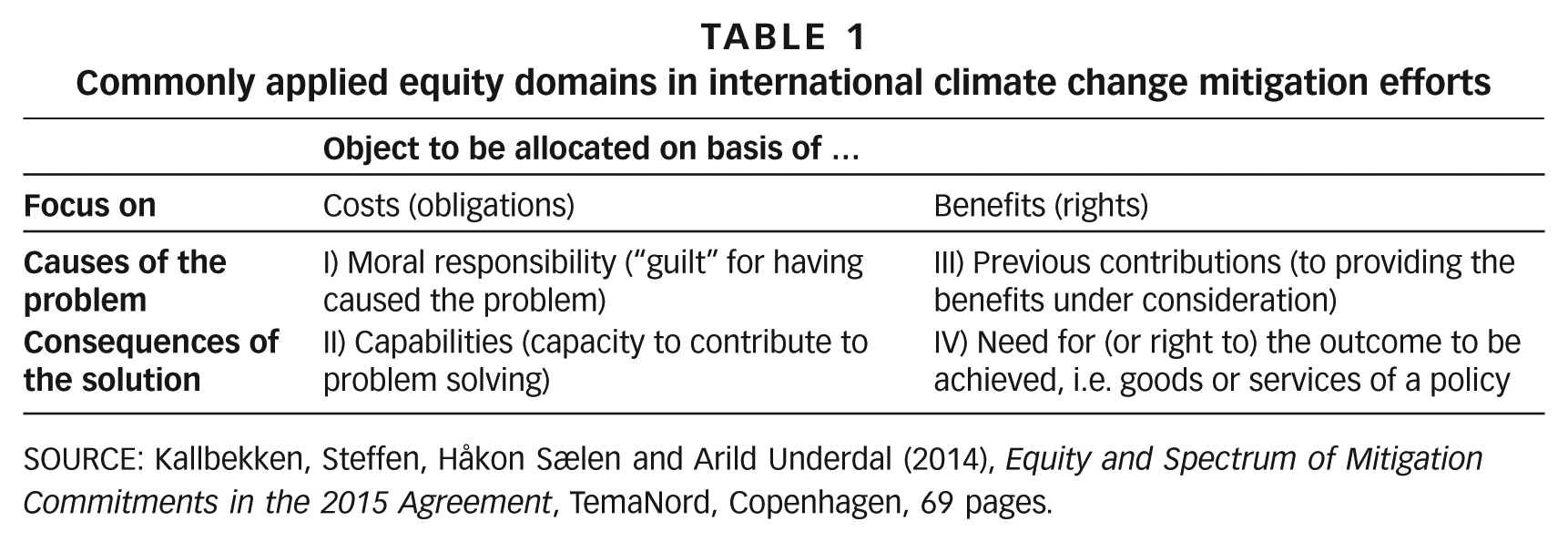
To operationalize equity concerns, McDermott, Mahanty and Schreckenberg(8) relate the three types to three parameters: the targets (and scale) of equity, the goals of equity, and the process of setting targets and goals. Operationalization is further based on principles and indicators, of which a large number have been proposed.(9) The large number of principles converge onto a limited set of equity domains (Table 1, based on Kallbekken, Sælen, and Underdal (10)).
Commonly applied equity domains in international climate change mitigation efforts
SOURCE: Kallbekken, Steffen, Håkon Sælen and Arild Underdal (2014), Equity and Spectrum of Mitigation Commitments in the 2015 Agreement, TemaNord, Copenhagen, 69 pages.
Support for equity domains, principles and indicators differ between countries(11) and potentially even more between regions, such as rural or urban areas – underlining the need for consideration of procedural and contextual equity. For example, among delegates to the UNFCCC climate change negotiations, the “polluter pays” principle (example of I in Table 1) had the most support in a short-term perspective, i.e. ≤ 20 years. This was followed by “the exemption of the poorest” (II) and “ability to pay” (II). An “egalitarian” principle (equal mitigation pledges) was not supported by many, and even more objected to the “sovereignty” principle, i.e. the full right and power of countries to decide on their own mitigation pledges.(12)
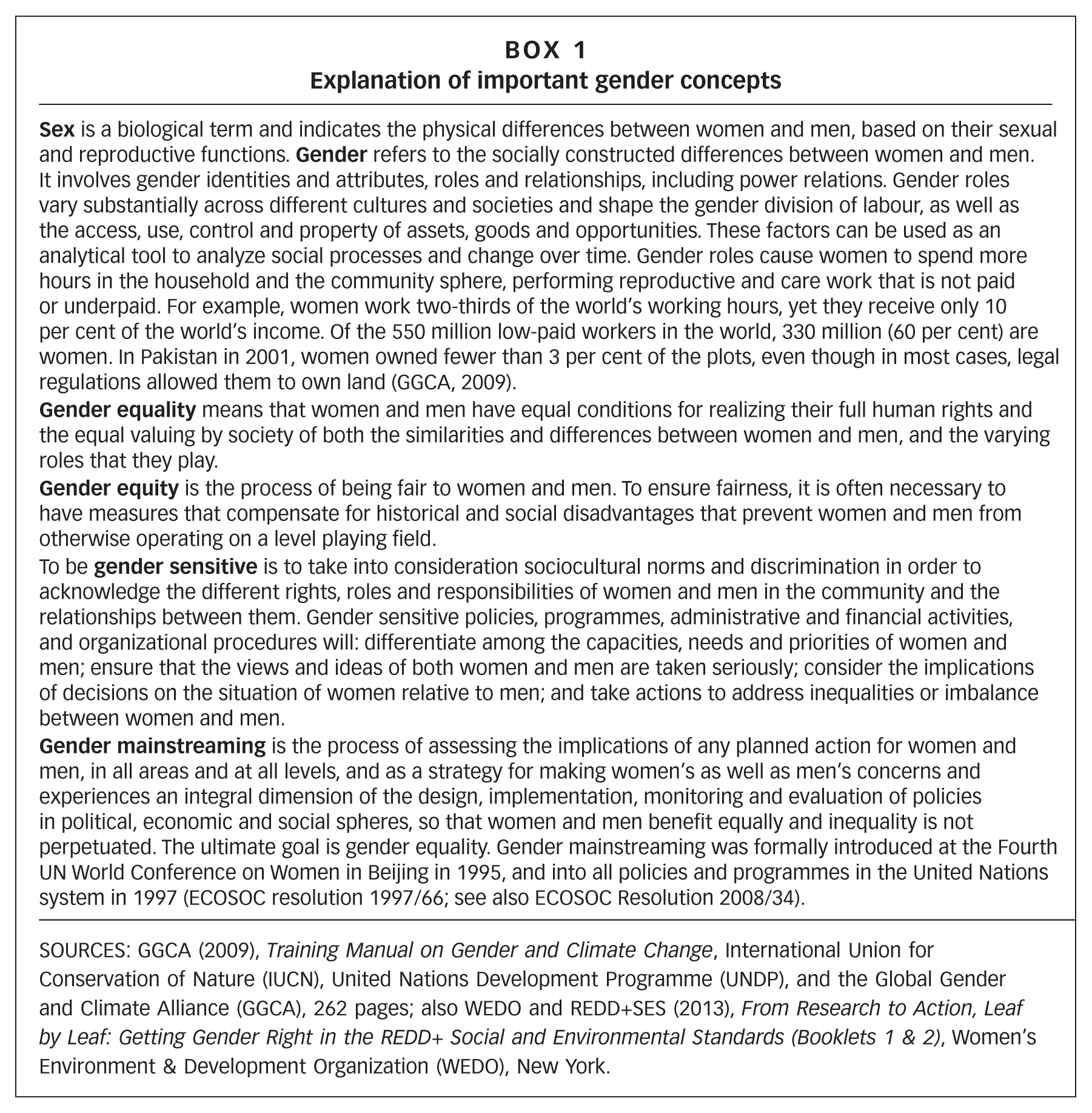
In terms of the need for consideration of process-related equity and inclusion of related stakeholders, for example, gender balance and women’s participation on boards and bodies is highly unequal even within the UNFCCC. Women’s rights groups have made important contributions to the UNFCCC, including several decisions stating the need for women’s participation in UNFCCC thematic areas and their right to decide on mitigation, adaptation, climate change finance, technology and capacity-building. However, so far only resolutions regarding adaptation have included robust gender-sensitive language (see Box 1). Few decisions on mitigation refer to gender, with no guiding mandate for gender-sensitive mitigation actions.(13)
Explanation of important gender concepts
SOURCES: GGCA (2009), Training Manual on Gender and Climate Change, International Union for Conservation of Nature (IUCN), United Nations Development Programme (UNDP), and the Global Gender and Climate Alliance (GGCA), 262 pages; also WEDO and REDD+SES (2013), From Research to Action, Leaf by Leaf: Getting Gender Right in the REDD+ Social and Environmental Standards (Booklets 1 & 2), Women’s Environment & Development Organization (WEDO), New York.
Equity, equality and environmental justice issues first entered the debate on climate change when it was recognized that countries that historically have contributed least to climate change might be impacted the most by it in the future.(14) Consequently, initial discussions revolved around mitigation responsibility. It is now recognized that impacts are also increasing in high-income countries due to, for example, supply chain interdependencies.(15) Consequently, Metz(16) stresses that the climate change equity discussions should not only consider mitigation, but also impact and adaptation. This is of particular importance for urban areas, as it is at local and regional scales where differential impacts and adaptation needs will unfold. Considerations of equity need to be central to all three domains –impacts and risks, adaptation, and mitigation– of the contemporary urban climate change debate.
III. Methods
This study is a review of the current scientific literature on climate change impacts, mitigation and adaptation in urban areas, and their relation to equity and environmental justice issues. Data included in the review comprise scientific publications controlled by commercial publishers, such as scientific journal papers, but also a limited amount of grey literature, such as reports or working papers. We try to maintain a balance in looking at cities in low-, medium- and high-income countries.
The main part of the review draws from an international assessment exercise on climate change and cities –the Assessment Report for Climate Change in Cities 2 (ARC3.2)– and its chapter “Equity, Environmental Justice, and Urban Climate Change”.(17) Here, we extend the mentioned research by focusing on the relation of climate change impacts, adaptation and mitigation policies, and gender equality (see Box 1 for gender-related terms), as well as the distribution of poverty in cities. For the full description of findings, including other aspects of climate change and equity in cities, see Reckien et al. (2017).
IV. Findings
a. Equity in relation to urban climate change impacts
Common equity concerns related to climate change impacts
Impacts and risks of gradual changes in climate and of extreme weather events differ across and within cities(18) by way of the following factors:
physical exposure determined by the location of a community;
the social, economic and demographic (intrinsic, person-specific and extrinsic, socioeconomic) characteristics of urban populations;(19)
a number of institutional, power and governance aspects at play;(20) and
urban development processes that “construct risk”.(21)
Most of these factors are closely related, and play out in low-, middle- and high-income nations, as well as large, medium and small cities.(22)
There is evidence that impacts of both gradual climate change and extreme weather events disproportionately affect people with low incomes and low social status,(23) especially women.(24) Evidence shows that in cities such as Cairo, Alexandria,(25) Rio de Janeiro(26) and Dhaka,(27) residents with low social status and low incomes characteristically inhabit areas more exposed to climate risk. The risks of low-income residents are also related to high population densities(28) and poor-quality buildings,(29) the lack of risk-reducing infrastructure and services,(30) and the failure to draw or implement lessons from previous disasters.(31) Together with governance and management shortfalls, this has resulted in the accumulation of risk over time,(32) documented by records of increasing disaster losses in cities from mega-debris flows, floods, earthquakes, tsunamis and, in the last two decades, tropical storms.(33) However, regularly occurring events like droughts and floods have also gradually undermined the resource base of better-off groups.(34)
It is also important to note that gender and poverty status critically intersect with other social vulnerability markers. For example, while women are on average more vulnerable to climate impacts than men, upper-class women may be less vulnerable than low-income men living in informal settlements, and healthy adult women are often less vulnerable than disabled men or children.
Heat-related equity concerns
Heat-related impacts are one of the main hazards associated with climate change in cities. Two dynamics converge: 1) the global increase in average temperature; and 2) the urban heat island effect, i.e. the temperature gradient between densely built-up, urban areas and rural surroundings. These dynamics can be beneficial when reducing the mortality and morbidity risks of cold temperatures, but result in heightened morbidity and mortality during periods of excessive heat or heatwaves.(35) Heatwaves pose a major climate-related risk: more fatalities –one measure of impact– occur as a result of heatwaves than other climate hazards such as floods and hurricanes.(36)
Heatwaves can cause increased morbidity and mortality rates in cities(37) as a result of direct heat stress and other indirect effects. Direct heat stress is particularly harmful when night-time temperatures are high, which prevents the human body from resting, repose and regeneration.(38) Indirect effects on health arise principally through the interaction of heat and other environmental factors, particularly air and water pollution.(39)
Heat-related risk is stratified across the population and linked to both “intrinsic” and “extrinsic” factors. Intrinsic factors include various physiological attributes, of which age, female sex, and pre-existing medical condition have been identified as main factors(40) in a meta-analysis of 18 recent studies. A study probing the age factors suggests that physical fitness is the underlying variable explaining the age effect.(41) Referring to aspects of sex, women may be more heat intolerant than men due to potential physiological and thermoregulatory differences.(42) However, women may also typically experience more exposure to heat than male residents, due to the time spent in interior spaces that do not have adequate air flow or air-conditioning, e.g. for undertaking reproductive labour such as cooking in informal settlements (an aspects of gender).(43) In terms of medical status, vulnerability to heatwaves is higher in people who are less mobile and confined to bed.(44) People suffering from cardiovascular diseases are also at higher risk.(45)
For the extrinsic factors, lower socioeconomic status (based on a deprivation index comprising factors such as education, occupation, unemployment, number of household members, overcrowding and household ownership) and lower education levels increase relative vulnerability to heat stress. Heat also disproportionately impacts socioeconomically disadvantaged households because of their residence in areas with less access to urban green infrastructure and their reduced ability to fund, maintain and develop private green space. Open spaces and waters are risk-reducing environments, as they cool their immediate surroundings. Unsurprisingly, people living in inner cities are therefore generally more at risk than those living in suburbs.
Precipitation-related equity concerns
Precipitation-induced hazards may occur as a result of a surplus of rain in short timeframes, such as those connected to inland flooding and landslides, and to a lack of sufficient precipitation causing drought.Inland flooding can occur on a massive scale, e.g. of watersheds – as in Pakistan in 2010,(46) Australia in 2011,(47) and Thailand in 2011.(48) But localized flash floods can also cause substantial damage and threaten health, lives and livelihoods, as was the case in Kampala, Uganda, in 2012.(49) In many cities, informal settlements have been developed on floodplains that experience frequent flooding or on steep slopes affected by landslides.(50)
Inland flood risk in cities of low- and middle-income countries stems from a number of factors: impermeable surfaces that lead to rapid run-off; the scarcity of parks and other green spaces to absorb water flows; inadequate drainage systems that are quickly overwhelmed by the amount of water; and/or the (ill-advised) development of housing on marshlands and other natural buffers.(51)
The urban poor are highly affected due to living in these environmentally riskier areas and the lack of risk-reducing measures in their neighbourhoods. However, the exposure to flood risks associated with living close to urban rivers and canals is in many instances a consequence of the ongoing pressure for land in fast-growing cities and can be attributed to a lack of tenure security for the urban poor. The poor in Asian cities deserve particular attention, if simply as a matter of scale: Asia is the most populated continent; and an estimated 29.7 per cent or 505 million people in Asia live in substandard housing or informal settlements,(52) which are often found along a city’s rivers and canals.(53) The percentage of urban residents living in substandard housing in Africa is higher (37.5 per cent; sub-Saharan Africa 61.7 per cent), but in total this affects a smaller number (211 million and 200 million people, respectively).(54)
Given the proximity to waterways, the urban poor risk the loss of their homes to flooding and are often displaced, leading to disruption of livelihoods and social support networks.(55) Other indirect effects of flooding relate to unsanitary conditions and health risk, e.g. when hazardous materials contaminate floodwaters and spill into open wells, elevating the risks of water-borne, respiratory, and skin diseases.(56) Outbreaks of cholera, dysentery and diarrhoeal diseases, acute respiratory infections, dengue and malaria are all reported to occur largely in cities with dense low-income neighbourhoods(57) following intense and excessive rainfall. In turn, diseases may increase the amount of care work and number of unpaid hours women have to spend taking care of sick children and elderly. On many occasions women have to quit their paid jobs to cope with these sanitary and health emergencies.(58)
Excessive rainfall is a crucial risk factor and has also been associated with triggering landslides. However, “landslides are usually not separated from other natural hazard triggers, such as extreme precipitation, earthquakes or floods in the natural disaster databases. This underestimation contributes to reducing the awareness and concern of both authorities and general public about landslide risk”.(59) Yet in many countries and cities, landslides (individually and in combination) present significant threats to human wellbeing. In general, rainfall-triggered landslides are the product of a combination of geo-hydrological and locational factors in mostly mountainous cities.(60) However, whether landslide risk affects mostly low-income or other groups also depends on other factors, as seen in El Salvador, Nepal and Sri Lanka.(61) After civil conflict in these countries, rapid, uncontrolled migration from rural to urban centres also led well-off residents to move to hazardous (and unoccupied) urban areas, with consequences for landslide impacts.
Men and women may experience migration and displacement in different ways. After periods of excessive rain and damage to the house and property, evidence suggests that women migrate to urban centres, starting a new life but also facing security risks, lack of skills to access the labour market or lack of linguistic skills related to the dominant language, e.g. in Colombia. After periods of drought, men have been documented to leave in the quest to make money in urban or more prosperous areas, while women stay put to look after the property, facing challenges of food security and water scarcity.(62)
Finally, insufficient or delayed precipitation severely impacts populations by way of water shortages, generating crop failures and subsequent food price increases, in turn potentially affecting low-income populations stronger than others.
Equity concerns related to storm surges and coastal flooding
Storm-related hazards (hurricanes and storm surges) are associated with precipitation-related hazards and constitute a major risk to urban populations. In affected coastal regions, storms lead to inundation of low-elevation coastal zones with differential impacts. Poor settlements are often impacted severely due to inadequate infrastructure protecting the neighbourhoods. Women are often affected because they are present in greater numbers in the urban informal economic sector and home-based businesses. As a result extreme weather may impact the living space and income source of women at the same time. The loss of small productive assets such as sewing machines may permanently affect their livelihoods.(63) Coastal flooding can also be caused by excessive rainfall inland, with subsequent flooding in river deltas downstream. In the Ganges-Brahmaputra and Zambezi deltas, multiple risks of storm surges and inland river flooding severely affect the cities and settlements within the deltas.(64)
Moreover, global warming-induced sea level rise, combined in places with subsidence of coastal land and increasing storm intensity, has put large and growing coastal populations at risk from the rise in sea levels as well as storm surges. Recent examples of coastal flood disasters include the flooding caused by Hurricane Katrina in 2005 in New Orleans, Cyclone Nargis in 2008 in southern Myanmar, Hurricane Sandy in 2012 in New York, and Super Typhoon Haiyan in 2013 in the Philippines.(65) Wave heights reached up to 10 metres during Hurricane Katrina(66) and almost 4 metres above normal tide levels during Hurricane Sandy.(67)
Compared to rural villagers, urban dwellers are highly exposed to the risks of sea level rise, heavy (e.g. monsoon-related) rainfall or cyclones leading to storm surges and flooding, because urbanites are more likely to live on or near the coast. Cities and towns account for nearly two of every three residents of coastal areas worldwide.(68) In Asia, 18 per cent of the urban population lives in the low-elevation coastal zone – the highest percentage across all world regions; 12 per cent of the urban land in Asia is at low elevation near the coast.(69) Mumbai saw massive floods in 2005, as did Karachi in 2007.(70) Flooding and storm surges also threaten coastal African cities, such as Port Harcourt and Lagos in Nigeria.(71) Similar vulnerabilities affect Mombasa in Kenya(72) and various cities in Latin America.(73)
b. Equity in urban climate change adaptation
Equity and environmental justice issues related to climate change adaptation include inequalities in the capacity to cope and adapt,(74) mainly arising from 1) the failure to adapt (no adaptation), 2) inadequate adaptation, or 3) maladaptation to climate change among and within urban centres.
Differentials in the scale and nature of risks among settlements relate to the quality, location and access of and to infrastructure (piped water, sanitation, effective drains, all-weather roads and paths), service provision (including health care and emergency services and facilities), housing options available for low-income groups,(75) and opportunities and access to education.(76) In that respect it is important to recognize the limited capacity of many cities in low- and middle-income nations and their inhabitants to adapt to a changing climate.(77) The lack of risk-reducing infrastructure is often underpinned by a lack of capacity within urban governments to address the large infrastructure and service deficits,(78) deficiencies with respect to the effectiveness of planning systems, and low levels of community adaptive capacity. In low-income and many middle-income nations, most urban authorities have very small budgets and even less investment capacity.(79) At the other end of the spectrum are urban centres with universal provision for risk-reducing infrastructure (such as piped treated water and adequate drainage) and services (like enforcement of building standards for structural safety), along with active climate change adaptation policies, but these cover a very small proportion of the world’s urban population. In these cities in high-income countries, development has greatly reduced risk from extreme weather – though the infrastructure, services, important institutions and financial systems(80) are not provided as a response to climate change and are therefore not “adaptation” per se. This, however, is not to claim that all inequalities in risk are addressed – as work on environmental justice in high-income nations and their cities has shown.(81)
Within cities in low- and most middle-income countries, differentials in risk also arise from inadequate or no infrastructure and services in certain urban areas, mostly evident and documented in informal settlements.(82) Risks from extreme weather in many informal settlements are further magnified by their location on dangerous sites – floodplains, steep slopes, alongside rivers.(83) Housing development on dangerous sites is nurtured by a range of factors, including inappropriate building regulations and land use/zoning practices that increase the cost and restrict the supply of affordable housing plots.(84) Unclear property rights and land tenure also contribute,(85) as documented in cities like Nairobi, Dar es Salaam, Dhaka, Dakar, Maputo, Manila and Kolkata.(86)
It is not only the lack of government capacity that underpins lack of attention to climate change adaptation, but also deliberate choices by city or national governments,(87) as documented by Thailand’s flood crisis in 2011. Mitigating flood damage in the central districts by diverting floodwaters to other areas heightened the disproportionate impact on communities outside the defences.(88) The refusal to address risks to poor and politically under-represented groups in urban areas is often also related to the low priority that national governments and international agencies have previously given to such equity issues.
Risk differentials within cities also emerge in relation to age, sex/gender and health status,(89) which can be socially constructed, as in the case of discrimination. For example, with regard to gender discrimination,(90) an analysis of the impacts of floods in Lagos in 2011 revealed the differentials in vulnerability among low-income women created by the intersection of gender relations and gender roles in household structure, occupation, and access to health care.(91) Focusing on process-oriented equity, differentials in risk also arise from the lack of voice for particular groups (for instance those living in informal settlements) and the lack of accountability to them by government agencies.(92) It is thus relevant to consider the extent to which adaptation measures acknowledge these differentials and take action to reduce them.
There is growing awareness of the need for gender-sensitive adaptation processes and intersectional analyses in order to develop inclusive, contextually specific interventions and policies.(93) Differentiated gender needs and roles are often missed out in displacement or relocation plans, which usually lack planning for access to community services and childcare facilities. Another aspect relates to women’s lack of access to secure land tenure in many low- and medium-income countries. Secure land tenure determines the eligibility for financial credits or subsidies, which is needed to increase adaptive capacity during post-disaster recovery stages. Moreover, in post-disaster camps and temporary accommodations, women often face serious risks of sexual harassment and violence.(94)
Changes in land use planning and regulatory frameworks are an important part of adaptation to climate change, as are fiscal incentives and infrastructure investments. Land use planning and management play critical roles in ensuring there is sufficient land for housing that avoids dangerous sites, in providing key network infrastructure (e.g., water abstraction and wastewater treatment plants, water, sewer, and drainage mains), and in protecting key ecological services and systems. Those who live in settlements on dangerous sites without risk-reducing infrastructure and services often take measures to reduce risk to their households, homes and assets,(97) but depend on sufficient network infrastructure that they cannot provide. By that, adaptive capacity can be eroded over time through repeated coping and “risk accumulation processes”,(95) with knock-on effects for chronic poverty.(96) However, the adaptive capacity, resilience and bounce-back capacity of communities can also be sustainably increased by providing appropriate support for community-based initiatives. Support should preferably include economic incentives for residents – framing adaptation measures as economic opportunities for low- and middle-income households. It is further important that women are part of community efforts, since women are key agents of change.(98)
Adaptation practices should also align with mitigation to prevent maladaptation. Another form of maladaptation can be seen in the choices made in the flood management in and around Bangkok, as it protected the wealthy and placed an increasing burden on the more vulnerable in society.(99) Other maladaptive practices relate to constraining land supplies, forcibly resettling people in areas far from their employment – or evicting people with no compensation – and pushing up land and housing costs. Forced evictions constitute gross violations of human rights as they indirectly and directly violate the full spectrum of civil, cultural, economic, political and social rights – and will not equally reduce vulnerabilities. Maladaptation leads to further impoverishment of vulnerable groups, often in the name of “development”, e.g. expansion of roads and highways and other measures to reduce infrastructure deficits.
c. Equity in urban climate change mitigation
Mitigation issues are a concern of contemporary urban planning, too, as the contribution of greenhouse gas (GHG) emissions of urban areas to the global total is estimated at between 37 and 49 per cent(100) – principally from cities in middle- and high-income nations. Some cities in high-income countries have shown farsighted leadership in setting targets to reduce GHG emissions,(101) while, cities in low- and middle-income countries face very different challenges.(102) Spatial planning policies in cities of low- and middle-income countries are often outpaced by rapid population growth and constrained by city budgets inadequate to meet the ensuing need for expanded infrastructure and service provision.(103) Few cities in low-income countries include mitigation actions in city plans. We here focus on the sectors most relevant to urban mitigation, including spatial planning, accessibility and transport, waste management and renewable energy, evaluating existing policy measures with respect to the distribution of benefits and burdens.
In cities of high-income countries, urban mitigation strategies are often based on anti-sprawl policies aiming at changing low-density development, the conservation of open spaces, the enhancement of mixed land use, walkable neighbourhoods, and low-carbon construction standards.(104) These measures have been implemented to make services based on economy of scale profitable, thereby securing the services for households of all income levels, while reducing related GHG emissions. However, these principles can have negative side effects for low-income households if not properly designed. Anti-sprawl policies are criticized for pushing up housing prices, with subsequent displacement of low-income residents,(105) a process referred to as “environmental gentrification”.(106) Densification may also curtail access to (well-maintained) public facilities, or reduce open and green space. As access to green space is often already low in communities with a large share of low-income groups and racial/ethnic minorities, a further reduction of green space in these areas may exacerbate existing inequalities.(107) There is no consensus on the burden shifts of fiscal anti-sprawl policies,(108) but taxing new developments to cover infrastructure-related costs seems to imply a lower burden for low-income groups than other instruments that mandate which areas can be developed and under which conditions.(109)
The enhancement of public and private transportation is also a frequent mitigation strategy in cities, which typically brings good to all and particularly to low-income households. To optimize the equity outcomes of such investments, special attention should be given to the changes of affordability of housing and transportation. Similarly, transit-oriented development (TOD), i.e. the improvement of access to public transportation, has positive socioeconomic effects for residents and communities, as it brings a larger fraction of the population into the employment catchment area.(110) However, it can also have negative effects on low-income groups via decreased housing affordability,(111) for example, if people are forced to migrate to other locations with limited access to transportation but more affordable housing.(112) Another aspect relates to the access to discount transportation fares, which usually require high up-front costs, e.g. through the purchase of a periodic transit pass. This may oblige low-income households to purchase short-term passes, which are sometimes up to three times more expensive than longer-term ones.(113) Increases in the costs of transfers or the removal of unlimited-use passes also affect lower-income riders, women, youth and minorities, as these groups generally make more trips and transfer more frequently than others.(114) Gender-based violence, harassment, and crime in public transport are also sources of concern and should be addressed through gender-sensitive transportation-based mitigation actions – but not by reducing public transportation.(115) In cities like Vienna, Berlin and Malmö, transit-planning interventions are designed from a gender-sensitive perspective. General improvements to safety are achieved by participatory planning with focus groups, wider pavements, pedestrian-friendly traffic lights, and safe crossings, among other things.(116)
Mitigation actions targeting private transportation show contradictory equity outcomes, mainly due to the range of policy options available.(117) Registration fees based on emission rates typically affect low-income drivers more than fees based on distance travelled, because low-income drivers often possess vehicles that pollute more per mile than those owned by wealthier groups of the society.(118) High Occupancy Toll (HOT) lanes tend to be progressive, especially when alleviating congestion in the unpriced lanes,(119) but they may also pose barriers to affordable mobility, depending on the transit provision.(120) Area-based schemes tend to perform better in terms of equity effects than speed limit- or cordon-based schemes.(121) In middle- and low-income countries, congestion charges are mostly progressive, as car drivers tend to belong to the more affluent half of the population.
Another strategy to avoid substantial GHG emissions, particularly in many low- and middle-income countries, is the re-use and recycling business, i.e. waste picking.(122) While being sustainable and inclusive, it may face strong opposition from authorities.(123) When improved waste collection becomes a public priority, pickers are often displaced,(124) regardless of the positive environmental contribution of their business or the social impacts of displacement.(125) However, some progressive cities have devised contractual arrangements for waste pickers to support waste management services, such as in Kampala, Uganda.(126)
Finally, regarding broad-scale renewable energy schemes, these may increase inequality when the burden of investments is placed on the consumer, because low-income households often contribute a larger fraction of their disposable income to energy and other housing costs, compared to higher-income households.(127) Curbing GHG emissions should be central for high-income residents, whereas greater, sustained and affordable access to energy and electricity is often of key importance for low-income residents. Renewable energy schemes should be implemented with caution regarding this effect.
V. Conclusions and Policy Recommendations
In this paper we reviewed the interactions of climate change with equity and equality in urban areas, drawing on the evidence base of how climate change impacts, adaptation and mitigation affect low-income residents and women. We find that responding to climate change in urban areas by way of poverty- and gender-sensitive adaptation and mitigation actions will be a promising pathway to simultaneously contribute to meeting multiple SDGs.
As we have seen, climate change interacts with differential exposure to risk, preparedness, coping and recovery capabilities from climate change impacts. Low-income residents and women are often particularly affected by climate change, but also by adaptation and mitigation policies.(128) Moreover, studies have impressively shown that poverty and gender are related,(129) not only in low- but also in high-income countries, as documented for affluent democracies since the middle of the last century.(130) It has further been shown that reducing the feminization of poverty will not naturally result from reducing overall poverty. Studies therefore suggest that extensive welfare measures, i.e. large social security transfers, are needed in order to reduce female poverty.(131) In order for climate change impacts, adaptation and mitigation policies not to increase inequalities in urban areas, our study suggests focusing on the impacts on and needs of the most vulnerable, and particularly on women and women living in poverty. Poor women in particular are disproportionately affected by climate change impacts, while too few adaptation measures are directly benefitting them and too few mitigation measures respect their concerns.
For adaptation this means foremost addressing infrastructure and service insufficiencies in low-income neighbourhoods, and to build up institutions and governance options, including financing to do so. It also means granting women full access to decision-making processes, thereby making them active parts of climate change governance.
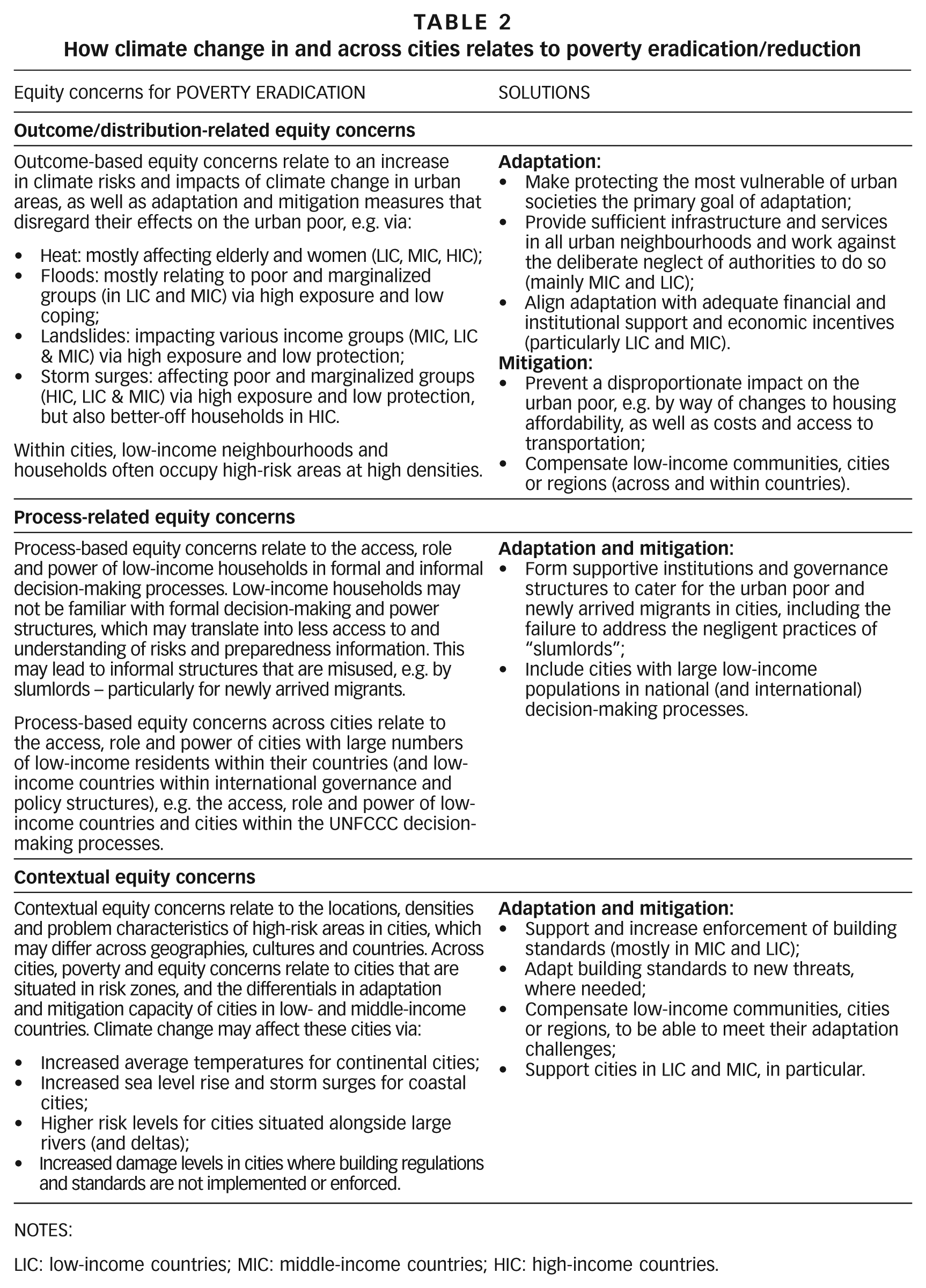
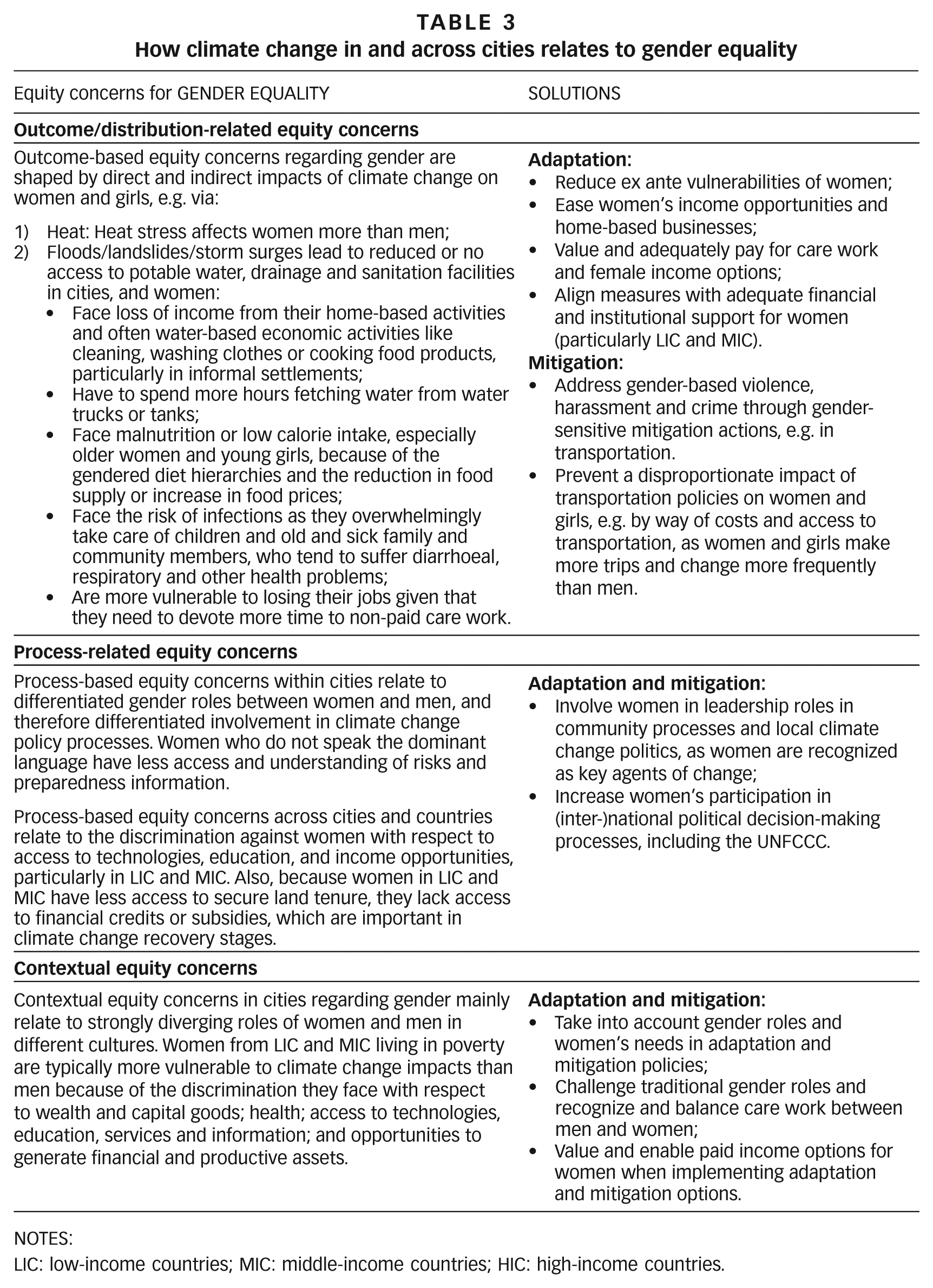
For mitigation, spatial planners should be aware of and attempt to lower possible negative side effects of compact city spatial planning models on low-income neighbourhoods and ethnic communities, e.g. by using social policy to cap accommodation prices and rents for households in need. Related to public transport, it seems important to reduce out-of-pocket fees, provide unlimited-use passes for public transportation, and prioritize women’s perspectives in public transport schemes. Tables 2 and 3 summarize our policy recommendations to foster poverty reduction and gender equality through climate change adaptation and mitigation actions in cities.
How climate change in and across cities relates to poverty eradication/reduction
NOTES:
LIC: low-income countries; MIC: middle-income countries; HIC: high-income countries.
How climate change in and across cities relates to gender equality
NOTES:
LIC: low-income countries; MIC: middle-income countries; HIC: high-income countries.
Footnotes
Acknowledgements
We would like to thank two anonymous reviewers for the constructive comments on a previous version of the paper. We also thank our collaborators on the Second Assessment Report for Climate Change and Cities (ARC3.2, Cambridge University Press), on which this paper is partly based. Thanks go to Deborah Balk (CUNY), Oana Baloi (UN-HABITAT), Eddie Bautista (NY-EJA), Donald Brown (IIED), Alex de Sherbinin (Columbia University), Wim Feringa (University of Twente), Faderr Johm (UN-HABITAT), Iqbal Khan (Independent), Marcus Mayr (UN-HABITAT), Sabrina McCormick, Mark Montgomery (Population Council), Abhishek Nair (University of Twente), Jayne Nduta Kimani (UN-HABITAT), Juan Camilo Osorio (NY-EJA), Emma Porio (Ateneo de Manila University), Daniel Schensul (UNFPA) and Alice Sverdlik (University of California, Berkeley) (in alphabetical order).
14.
18.
21.
24.
27.
Fuchs (2010);  .
.
33.
Allen (2006); .
34.
35.
36.
42.
45.
50.
58.
63.
70.
74.
75.
For example, Krishna, Sriram and Prakash (2014).
76.
84.
85.
86.
94.
95.
Rodin (2014); .
98.
102.
105.
Addison, Zhang and Coomes (2013); Bradshaw et al. (2005); Burton (2000); Cox (2008); Ewing et al. (2014); ; Wendell (2011).