



Abstract
This paper explores the extent to which participatory budgeting (PB) contributes to climate change adaptation and mitigation, based on an analysis of initiatives from 15 cities and regions in the global South and North. PB contributions are far from marginal, with significant investments decided by local people. The paper highlights some of the numerous innovations introduced to integrate PB into climate adaptation and mitigation efforts. Through a scrutiny of 4,400 PB projects, the research identified six categories of climate-related projects encompassing hardware as well as software approaches, such as awareness-raising activities, community-based early warning projects and research. The paper advocates for solidarity PBs for climate justice, and raises awareness of the huge (and as yet largely untapped) potential for this to help address the dramatic impacts that climate change has on millions of people’s lives. It also points to questions for future research.
Keywords
I. Introduction, Objectives, Methods and Limits
This paper explores the extent to which participatory budgeting (PB) contributes to climate change adaptation and mitigation.(1) PB is defined as a mechanism or a process through which citizens are actively involved in decisions about the spending of public resources, or otherwise associated with the decision-making process.
So far, little research has explored the link between PB and responses to climate change.(2) But a significant amount of literature over recent decades has explored the relationship of PB with Agenda 21 and sustainable environments,(3) including accounts of the iconic case of Porto Alegre, Brazil.(4) Multi-city or comparative approaches on the subject are much less common, and these have mostly been carried out in a national context, as for instance the 2017 analysis of PB in three Polish cities.(5) In relevant recent discussions, PB and climate change have been a topic at two international events. A 2019 conference convened by the International Observatory on Participatory Democracy (IOPD) hosted a session on the direct, multiple and evolving contributions that PB is making to address the difficult challenges of climate adaptation and mitigation.(6) And at the World Urban Forum in 2020, a networking session on the contribution of PB to climate change adaptation and mitigation was co-organized by various organizations led by the NGO Kota Kita.
This paper, which draws from and synthesizes a much longer paper,(7) seeks to bring to the fore what is currently happening in some selected cities. Based on the collection of sound data, and on reflection with the actors involved, it explores the contribution of PB to climate change adaptation and mitigation, and identifies the challenges that are being faced.
The PB initiatives focusing on climate and environmental projects are usually driven by municipalities but also by quite a large number of other actors, including such international organizations as the climate consultancy South Pole, the climate innovation initiative EIT Climate-KIC, the World Bank, a number of national and international NGOs such as Kota Kita, FMDV and ENDA Ecopop, and national networks of cities such as the Portuguese Network of Participatory Municipalities (RAP) or the National Association of Municipalities of Mozambique (ANAMM). This diversity of actors offers fertile ground for learning about their comparative advantages and shortfalls, but also about the associated deepening of democracy and the impact on climate change.
The paper’s first objective is to understand what is actually happening in the field. It describes the engagement of 15 cities or regions of quite different sizes and types from both the global North and South (Figure 1) that are implementing PB in ways that address climate change adaptation and mitigation. It also builds on the abstracts and exchanges associated with the two international events mentioned above, the first convened by the International Observatory on Participatory Democracy, the second at the World Urban Forum in 2020.
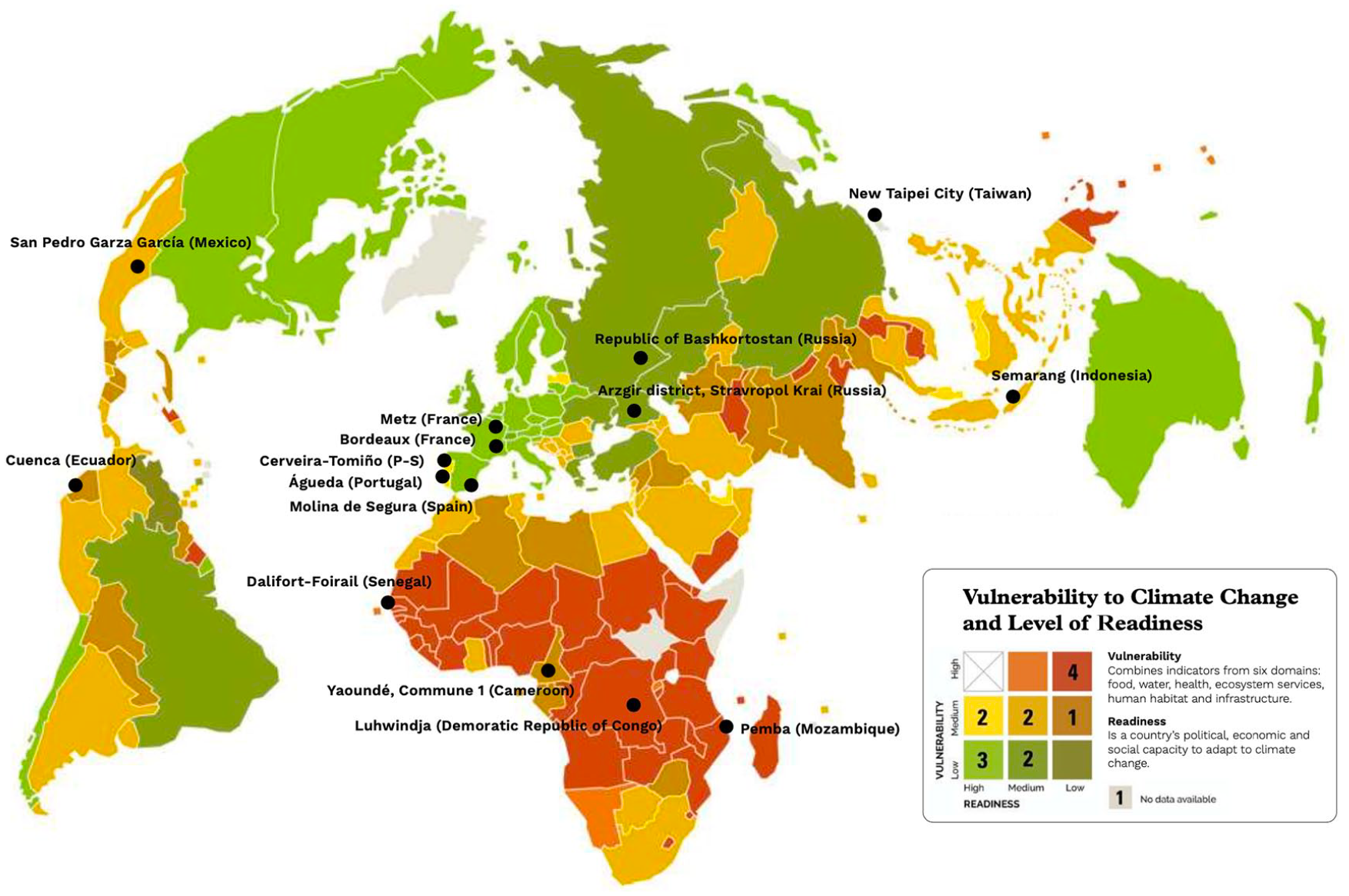
Locations of reference cities and cases
The second objective is to assess the nature and the importance of these contributions: Are they marginal or influential? How many projects are implemented per year? What is their cost and where do the resources come from? Which climate change effects are they actually addressing or intending to address? Are projects more related to adaptation or mitigation, or to both? Answering these questions required the case-by-case examination of the projects proposed by the citizens, those put to a vote after being screened, those voted for, and those that were actually implemented. How do these numbers relate to one another?
A third objective is to highlight the innovations that have been introduced in the course of the PB process by local, regional or national actors. When PB started 30 years ago in a couple of municipalities in Brazil, climate change issues were not high on the agenda, even though the environment was. The innovations that have started to illuminate how to shift towards what we are calling “climate change-sensitive PB” are analysed here along multiple dimensions.
A fourth objective is to generate and strengthen a community of practice, so that the knowledge and techniques it produces can more easily be exchanged in a decentralized form in each locale.
The final objective is to advocate for climate change-related PB and to raise awareness of its still limited, but potentially huge, contribution to climate change adaptation and mitigation. One approach is to identify what is “special” about climate-related PB initiatives as compared to other forms of adaptation and mitigation.
Methods, tools and research process
The 15 cities and regions included in the study cannot truly represent the breadth and depth of the PB experiences that have introduced a climate change focus. Although they are not a representative sample, they can be considered reference cities in terms of their innovations, not only within their own countries but worldwide. All of the locales demonstrated a clear willingness to be involved in international exchange and experience sharing.
In order to systematize the documentation of each local experience and to allow for comparison, the same two main tools were used in every case:
A questionnaire on PB and climate change focused on the most striking effects of extreme weather or other changes likely to be associated with climate change in the city or province involved, as well as the perceived level of vulnerability. Various questions focused on quantitative indicators, such as the number and value of projects approved over the last three years that have an impact on climate change adaptation and mitigation, and the proportion actually implemented.
PB profiles of 15 cities. The extended survey used to establish PB profiles was the same one used in earlier comparative research projects. In the early 2000s, it was used in 30 cities of the URBAL network in a study on PB and municipal finance, coordinated by Porto Alegre.(8) Ten years later it was used in 20 cities, in a study to assess the PB contribution to provision and management of public services.(9) Using the same profile has made it possible to develop a long-term perspective on the evolution of PB. The questionnaire is organized into four dimensions: financial and fiscal; participatory; governance and legal framework; spatial/territorial.
Both city profiles and questionnaires were filled in by local teams whose composition varied by city, but which generally included civil servants, elected mayors and councillors, city advisors, and representatives of NGOs and research centres (see the list of contributors at the end of the paper). In most cases email exchanges helped to consolidate data and fully capture the local context. Data drawn from the questionnaires and profiles were supplemented with grey literature, institutional publications, and pictures provided locally.
II. The 15 PB Reference Cities
a. Size, type and location
PB with a climate change perspective occurs in subnational governments of quite different sizes, and in a wide range of latitudes, ecosystems and climates from different subcontinents. These reference locales offer an interesting perspective from which to observe and understand the specific climate change effects that people face, and the projects they select to address them. These 15 experiences also mirror the different administrative and political levels at which PB currently takes place worldwide.
Municipality-based PBs, the most common type, are represented here by nine of the 15 locales.(10) Five are at the sub-municipal level,(11) and just one each at the metropolitan level(12) and regional level.(13) There are none at the national level. Including these multiple administrative and political levels indicates that climate-sensitive PBs are and can be implemented at all levels, potentially “leaving no space behind” (Figure 1).
b. PB climate-sensitive experiences over time
The various cities and regions participating in the study illustrate various phases of PB’s expansion beyond Brazil (Figure 2). Cuenca (Ecuador) has practised PB continuously for 20 years now, at first in the municipality’s 21 rural districts, expanding more recently to the urban districts. This remarkably sustainable case illustrates the third phase of PB expansion(14) at the turn of the century: that of diversification, when the original Brazilian model was being adapted. The experiences in San Pedro Garza García (also known simply as San Pedro), Mexico; Semarang, Indonesia; Arzgir, Russia; and Dalifort-Foirail, Senegal, starting in the 2000s and continuing for more than 10 years, are also illustrative of this expansion phase. Semarang and the Azgir District illustrate a paradigm shift, as their emergence was the result of central government initiatives.
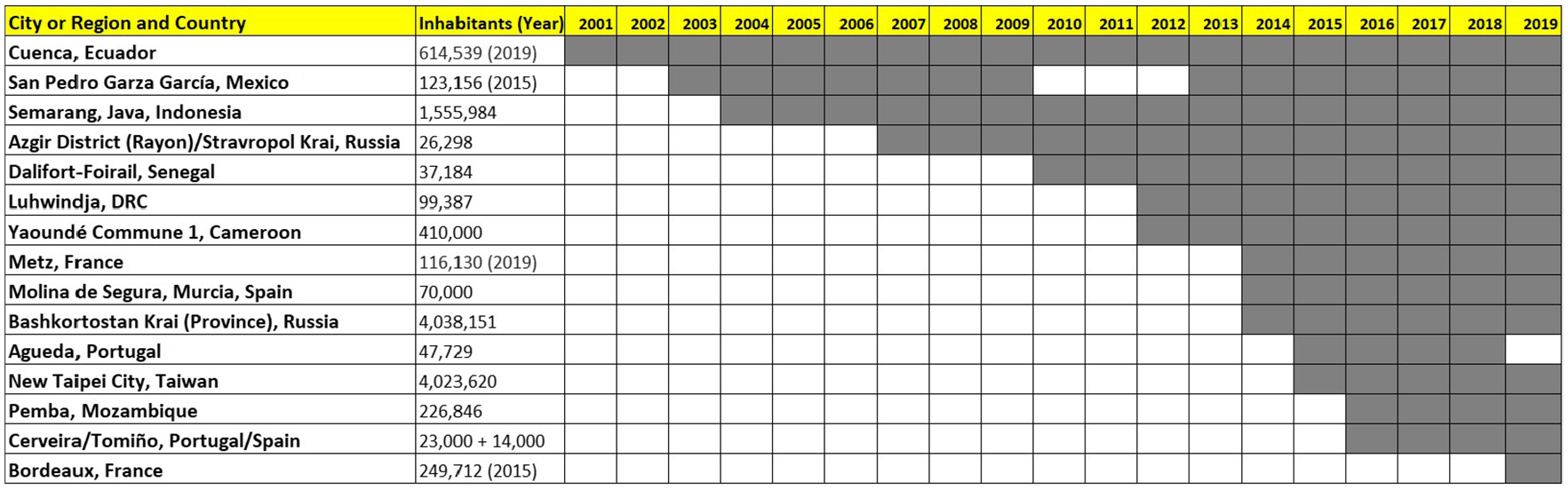
Timeframe of PB in the 15 studied cities and regions
Most of the cases have emerged at the municipal or sub-municipal level since 2010, and represent a fourth phase of worldwide consolidation and universalization. During this phase, PB activities expanded in all regions of the world, with especially noticeable spread in Asian and Russian local and regional governments. Arab, North American and Pacific cities are the latest newcomers to the fold. Within this sample, a violence and security crisis in the Monterrey metropolitan area in Mexico led to a three-year hiatus in PB activities in San Pedro from 2010 to 2012, when the mayor cancelled PB and transferred the funds to the police department. PB activities in Agueda were also suspended in 2019 while new operating rules were developed, taking account of lessons learned from the first three cycles. But certainly, the constant emergence of new PB experiences sensitive to climate change needs to be highlighted as encouraging.
c. Number of PB funded projects analysed
The processing of the data happened in most cases over a three-year period, sometimes longer and sometimes exceptionally shorter (the Bordeaux PB, for instance, was launched in 2019). In total, around 4,400 PB funded projects (Figure 3) were scrutinized to identify and assess those focused on climate change adaptation and mitigation.
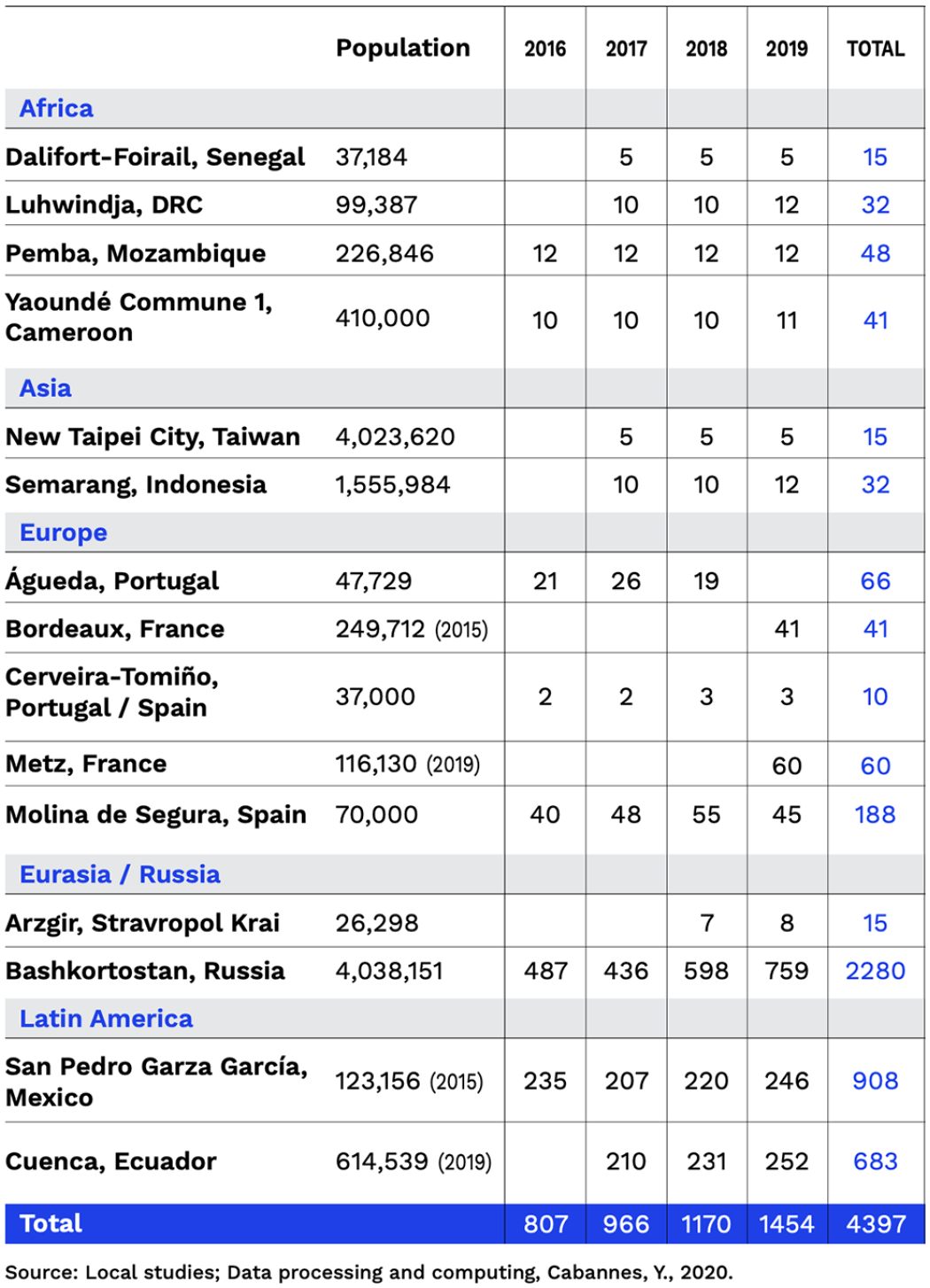
Number of PB projects approved per year in participating cities, districts and regions
The number of projects varies greatly from city to city, depending on the maximum funding authorized for each of them, and the total amount being debated through PB. Most cases had 10 to 100 PB projects funded per year, as shown in Figure 3, but a few reached the hundreds over the reference period. Bashkortostan registered over 2,000.
One should differentiate between different types of PB as this affects the capacity of a particular city to contribute to climate change adaptation and mitigation. Three basic types can be identified: territorial or place-based, thematic or sector-based, and actor-based. There are also the various combinations of these three.
Three cases, however, can be considered as combined actor-based/thematic PBs. They constitute a real and quite recent innovation in the PB field, and are among the initiatives that contribute the most, relatively speaking, to climate change adaptation and mitigation. New Taipei City’s energy-saving PB earmarked its resources for private companies to use PB with employees to identify small energy-saving initiatives. Molina de Segura (Spain) went further in terms of climate change, and launched the first-ever youth PB for climate change. One of its sources of inspiration was Lisbon’s green PB for schools,(16) launched in 2019, as a pilot in four public schools in Lisbon; it should be expanded to all public schools in the future.
III. Climate Change Impacts and Vulnerabilities
This section provides a synthesis of responses to the following questions by contributors in the various PB locales: What are the most striking effects of climate change in your city (or province)? And what is the level of vulnerability there? Instead of predefining analytical categories for climate change effects and vulnerability, each city or region used its own, and described the local situation in its own words (Figure 4).
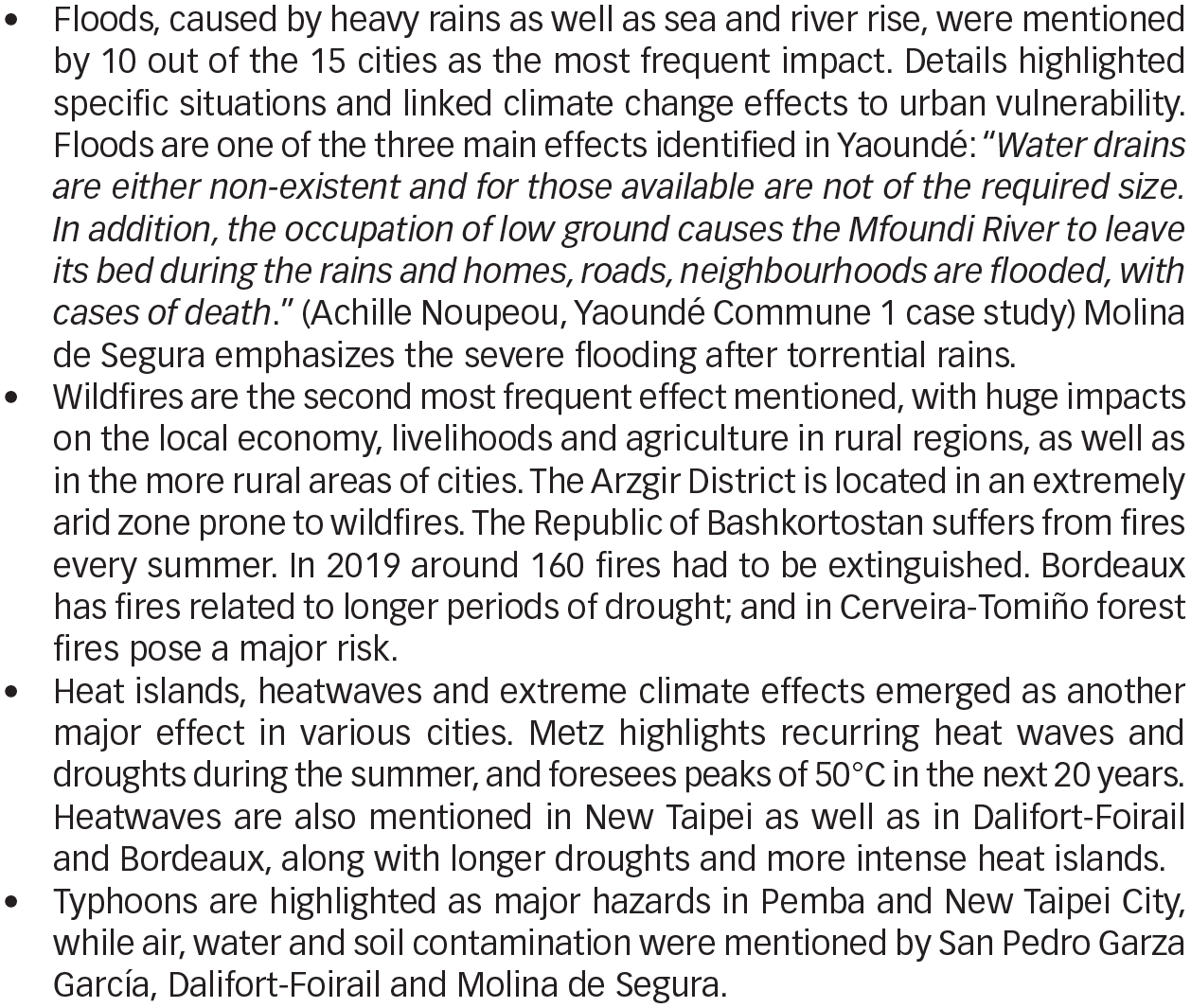
Examples of extreme weather events in the 15 cases include floods, wildfires, heatwaves and heat islands
Most cities face more than one problem that is likely to be associated with climate change – for instance in Agueda (Portugal), there are fires in summer and floods in winter. Pemba (Mozambique) sees heavy rainfall causing flooding, rising sea levels causing flooding and coastal erosion, and strong winds or cyclones. The multiple impacts mentioned for Luhwindja (DRC) were probably the most dramatic in this sample and relate to the extreme vulnerability of the region to soil erosion, landslides, heavy winds, and the destruction of aquatic biodiversity and ecosystems.
Semarang is one of the Indonesian cities most vulnerable to climate change. Coastal areas are exposed to tidal floods, sea-level rise and land subsidence; settlement areas on riverbanks are exposed to flash flooding, hilly areas to high winds, slope areas to landslides, and residential areas on the outskirts to water scarcity.
IV. Assessment of Pb’s Contribution to Climate Change Adaptation and Mitigation
The assessment considered the following:
The number of approved PB projects that have responded to climate change adaptation and mitigation
The types of projects that fall under these categories
The estimated value of these projects
The number of these projects as a percentage of all approved PB projects
The value of these projects as a percentage of the total value of PB projects
The percentage of approved projects (through PB decisions) that are actually implemented
a. The number of PB projects
The projects with an impact on climate change adaptation and mitigation could be counted in only 11 of the 15 cases, for different reasons: municipal data management does not always disaggregate PB projects by sector; the investment per type of project could be obtained but not the number of projects; or only an illustrative list was provided. Despite these limitations, a major finding is that in 11 cities and regions, 923 projects were identified as contributing to climate change adaptation or mitigation, clearly demonstrating the important role PB is playing on this front. The number of projects varies from city to city, from over 100 over the period to fewer than 10:
b. What kind of projects are prioritized by citizens?
One of the most interesting findings was the sheer variety of projects voted for and their capacity to address very specific problems felt by the population. They can be divided into six categories: three physical “hardware” (sometimes called “physical”, “bricks and mortar” or “tangible” projects), and three “software” projects (sometimes called “intangible”).
(i) Physical climate change adaptation PB projects
In Dalifort-Foirail, various projects introduced rainwater drainage combined with road improvement. In Cuenca, there were many water-related projects, representing millions of US$ in investments. In Luhwindja, South Kivu, various infrastructure works were built (or rebuilt following destruction), including seven bridges.
(ii) Physical climate change mitigation PB projects
A large portion of the 923 projects identified contribute to reducing greenhouse gas emissions, including the following examples, which illustrate their diversity and the capacity of PB to adjust to local specificity:
Reforesting in Luhwindja, Kivu, DRC.
Greening urban space with community gardens in Metz, France.
Transforming an urban car park into a community garden in San Pedro Garza García, Mexico. Turning car parks into open green spaces to mitigate heat impacts is gaining votes in different cities, including recently in Lisbon.
Support for local food chains, short agroecology circuits and native species in Cuenca. This goes beyond mitigation, to bring benefits for livelihoods and food security.
(iii) Physical PB projects that combine adaptation and mitigation
Bordeaux indicated that some of the projects selected as part of its sustainable development PB, such as city-wide tree planting and open spaces greening, are addressing both climate change adaptation and mitigation, as well as specific aspects of the city’s long-identified vulnerability.(17)
(iv) Raising awareness and training in the field of climate change
Some projects are “soft” or intangible, falling broadly into awareness raising and education on climate change. Sometimes they focus on a younger population, as for instance in the art campaigns for youth in Arzgir and two projects in Cerveira-Tomiño: a visit to an educational farm and a one-day art workshop with recyclable material.
(v) Community-based early warning projects
Projects focused on early warning for extreme weather events are especially important. A project in San Pedro provides real-time information on air quality below acceptable standards. Arzgir in the Stravroprol Region used PB funding to improve its emergency information system for wildfires.
(vi) Climate change studies and information systems
Although studies related to environment and climate change might be eligible as PB projects, they remain rare, despite huge interest. Molina de Segura’s citizens voted for a study on public electrical consumption as a first step in defining solutions based on renewable energy.
c. Resources for climate change-related PB projects
The survey asked about the total value of climate change-related PB projects. In the 10 cities where this information was made available, close to US$ 22 million was voted for by citizens for allocation to climate change adaptation and/or mitigation projects. This significant figure clearly demonstrates the contribution that PB has been making to climate change resilience, basically drawing on endogenous resources in cities that are neither particularly rich nor very large.
d. The proportion of PB projects related to climate change in relation to the total number of projects
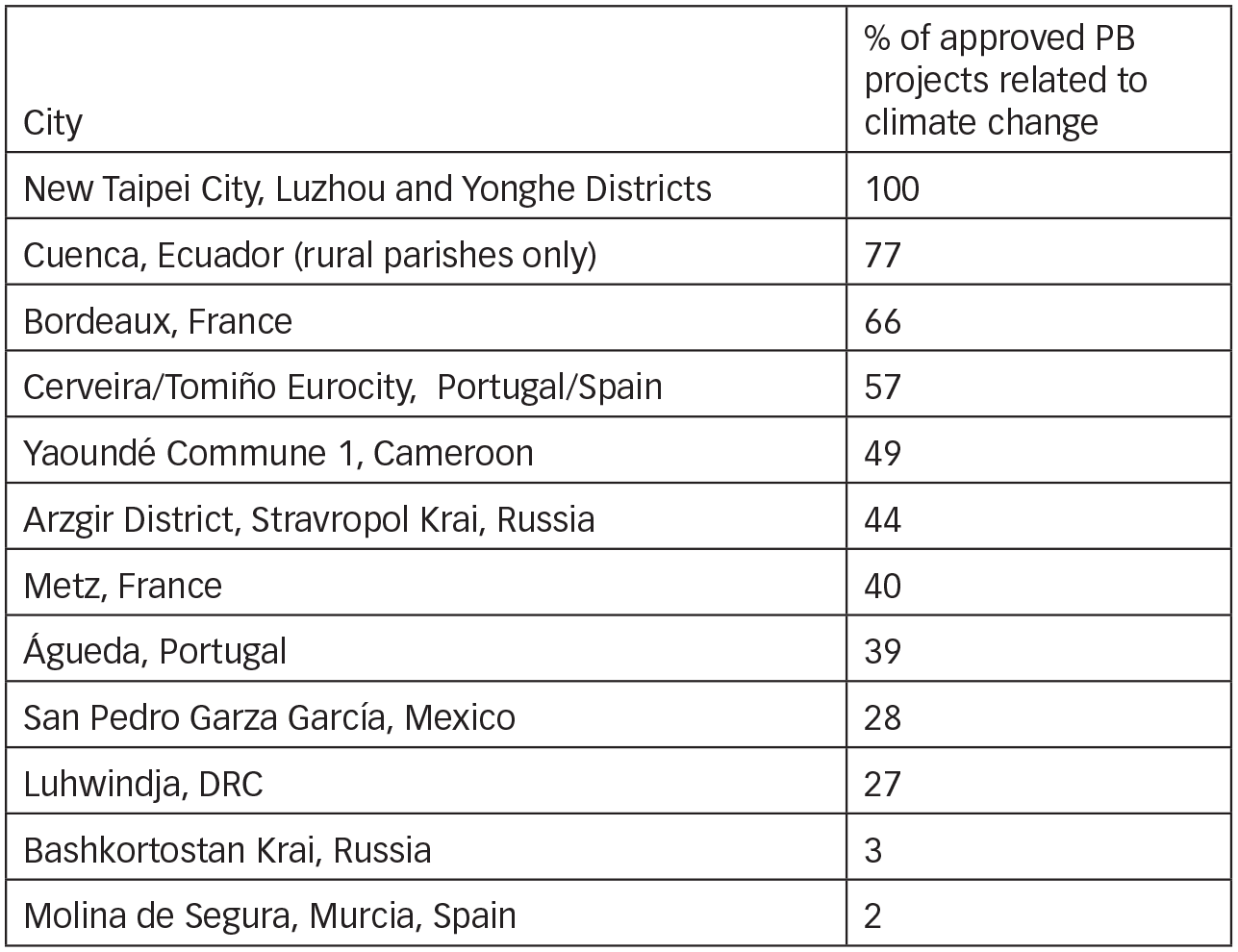
The representation of climate change-related PB projects adds another perspective on their importance (Figure 5). Data could be obtained for 12 of the 15 cases, and the proportion varies from around 30 per cent in San Pedro and Luhwindja, to 100 per cent spent on energy saving in New Taipei City. In Molina de Segura, various climate change-related projects were proposed by citizens but did not got enough votes to be selected. This led the municipalities and neighbourhood associations to introduce proactive measures in the 2020 edition (see the next section on innovations).
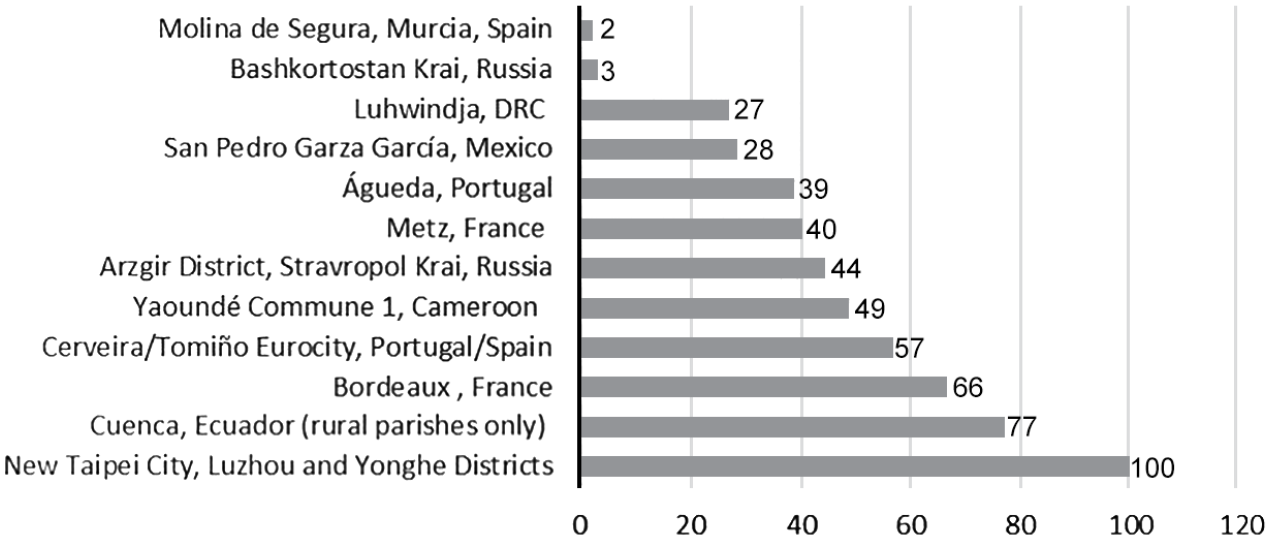
Percentage of climate change projects approved in relation to the total number of projects
Some cities differentiated between their adaptation and mitigation PB projects, while others did not provide such detail. In Metz, mitigation projects are the majority (73 per cent of the total), while in Cuenca and Yaoundé adaptation projects are the vast majority – in Cuenca most notably (87 per cent). Despite the limited size of the sample and the fact that each city used its own definition of adaptation and mitigation, these preliminary results tend to suggest a global North and South distinction, with European cities prioritizing mitigation while those in the South focus more on adaptation. This hypothesis deserves further research.
e. Projects voted for vs. projects implemented
The last question of the survey explored the extent to which climate change-related PB projects were effectively implemented. This points also to the current capacity of cities to implement projects that, in most cases, are quite new to local authorities and sometimes challenging. Results from nine cities, demonstrate that in most cases (seven) they reached quite high rates of implementation. This is particularly the case for the district-level PB in New Taipei City, San Pedro in Mexico, Cerveira-Tomiño (in Portugal/Spain) and Metz in France. Cuenca is also very high, considering how challenging the situation is, as projects number in the thousands and are located in rural and sometimes quite remote areas.
Percentage of climate change PB projects approved vs. total PB projects per year
One reason for high rates of implementation might be that small, “soft” projects are simpler and take less time than large investment and infrastructure projects. This is the case, for instance, in New Taipei and Cerveira-Tomiño. A second reason relates to the extremely high level of dedication of local government staff and the strong support of politicians in office at the time.
V. Highlighting Innovation
This section highlights innovations along four broad dimensions:
a) participation on the part of both citizens and local governments
b) budgetary and fiscal aspects
c) normative and institutional dimensions, including various technical and legal aspects and the very architecture of local PB
d) spatial innovations, with a focus on understanding whether PB contributions function as a tool for climate spatial justice
a. The participatory dimension
Innovative PB projects, including those addressing climate change, depend largely on the innovative capacities of both citizens, organized or not, and local governments, and the creative links between them during the PB process.
Various of the cities demonstrate
Training and information on climate change projects. San Pedro’s PB staff insists on the importance of generating training material and focusing on a democratic pedagogy, which should provide both communities and civil servants with material that will facilitate decision making.
Evaluation and feedback, as highlighted by Bordeaux, not only at the end of the process but throughout the PB cycle, with tools such as an online satisfaction questionnaire and regular meetings with inhabitants and elected officials. These kinds of tools make adjustments possible during the process and in subsequent PB cycles. San Pedro’s online evaluation process is also valuable. In both cases, though, PB norms remain in the hands of local government, rather than being determined by the citizens, as occurs in Molina de Segura and in Brazilian cities.
PB staff within the administration.
External public support institutions.
Specialized external consulting firms for specific tasks, such as communication campaigns on climate change, or organizing local meetings.
Active local NGOs, combining different sources of revenue, and mobilizing varying voluntary work. NGOs such as ENDA Ecopop in Dalifort-Foirail, or Kota Kita in Semarang and other Indonesian cities, have appeared to be essential in facilitating communication on climate change-related issues and projects. The quality of the relationship between NGOs and the grassroots is also important.
The notion of co-construction, or co-building, is exemplified in Metz as part of its eco-citizen PB. A key dimension is the transfer of power from elected officials to the population with the support of PB staff. Typical statements include: “Elected officials are not involved in the process at any of the stages” and “PB as a whole is co-constructed and co-evaluated by inhabitants”.
b. Financial dimensions
Four elements must be considered to understand how the current PB contribution to addressing climate change could be increased: the overall municipal budget; the percentage of the budget available for capital investment (in most cases PB is debated for just a portion of the budget); the percentage of the investment budget earmarked for PB; and finally, the percentage of the PB budget that goes to climate change adaptation and mitigation.
Municipal budgets when divided by the number of inhabitants vary hugely from one city to another, reflecting the inequalities of resources available (Figure 7). If considering the overall municipal budget it varies from US$ 2,500 per inhabitant in Bordeaux (the average for 2018–2019), to US$ 2.60 per inhabitant in Luhwindja (the average for 2017–2019). African municipalities, while the most vulnerable to climate change, all have resources below US$ 20 per inhabitant per year. This extreme variation clearly suggests the inequity among cities in their public resource capacity to face climate change challenges.
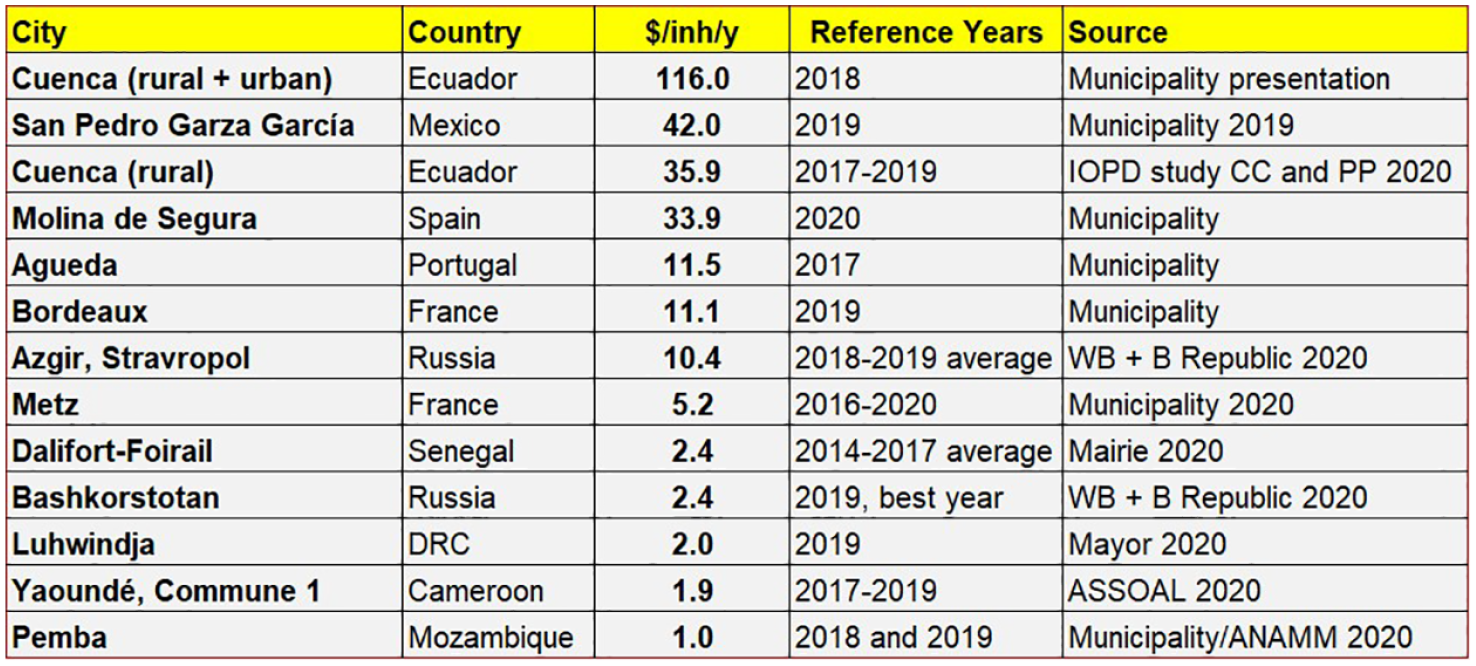
Value of the municipal budget decided through participatory budgeting (in US$/inhabitant/year)
An important aspect revealed by the study is the very limited correlation between the overall municipal budget and the budget available for PB. For instance, the city of Cuenca has a very high figure of US$ 116 per inhabitant for urban and rural PB (2018), and US$ 35.9 per inhabitant for its rural PB alone (the average for 2017–2019), out of an overall executed budget of US$ 322 per inhabitant for those years. Metz, meanwhile, allocates only US$ 5.20 out of US$ 1,959 per inhabitant (2016–2020). Some of the poorest cities assign a greater share of their budgets to PB than the richer ones. Luhwindja, for instance, dedicated US$ 2 per inhabitant in 2019, out of its meagre total of US$ 2.60 per inhabitant.
Beyond the extremely high variation in resources debated through PB, some cities earmark a significant amount per inhabitant. At international standards, 6 out of 12 are above the threshold of US$ 10 per inhabitant per year. Another important and promising finding that needs further examination in the future is the global growth in these numbers from year to year. One explanation, yet to be verified, is that climate change effects are increasingly being felt by citizens. This positive financial trend points to the huge potential for citizens to prioritize climate change projects when they are the most pressing. At the other end of the spectrum, however (under US$ 3 per inhabitant each year), even very needy and exposed cities, such as Luhwindja, have been able to mobilize part of their meagre resources to be debated through PB.
Mobilizing and leveraging resources for more climate change-related PB projects
Cities have been successful in mobilizing additional resources for climate change-related PB projects, through different mechanisms: mobilizing international aid (i.e. Dalifort-Foirail, Senegal) and establishing national and international partnerships for mobilizing resources (i.e. Yaoundé 1, Cameroon); generating additional support through volunteerism, for instance in Agueda, Portugal, where PB staff agree to work overtime without pay to foster PB; and involving community labour for project implementation, primarily in rural areas such as Cuenca, Ecuador or Luhwindja, Kivu, DRC, where communities are heavily involved in PB projects such as tree planting to face erosion.
These and other examples (for instance the Russian experiences) demonstrate once again that PB is able to leverage resources, an issue that is insufficiently studied, despite its huge potential for expanding its contribution – in this case for climate change mitigation and adaptation projects, but more broadly as well.
The complex issue of responsibility for maintenance and running/operating costs
Over recent decades, in a growing number of cities, proposals that entail running or maintenance costs have not been PB-eligible, the rationale being that over time, this would drain PB resources. Such measures have unfortunately meant that many innovative proposals are sidelined. This is particularly the case for climate change-related projects, many of which do in fact involve maintenance and running costs.
Challenges related to the massive expansion of resources for PB, opening up new possibilities for addressing climate change-related projects
In most PB cases, resources are insufficient to fund all otherwise viable proposals and projects, despite creative measures to leverage additional funds. However, there are examples of places where resources have been increasing significantly. Indonesia is one of the most interesting. In 2021, in Semarang alone, the government will allocate one billion rupiahs (approximately US$ 65,000) to each of 177 neighbourhoods, aiming to boost their development. These additional resources represent a huge increase in the Indonesian PB context (about US$ 11.5 million), although they remain modest when the value per inhabitant is considered (approx. US$ 6.50). Upscaling resources for climate-sensitive PBs raises new issues related to their implementation; to their specific added value in relation to large-scale climate change investments that are taking place; to the role of actors, including NGOs, that are limited in size and outreach; and to maintaining transparency and people’s trust in a mainstreamed process.
c. Institutionalization and norms/PB design and architecture
Climate PBs are part of wider innovative climate change strategies, policies and programmes
One common thread linking most of these 15 PB practices, beyond their diversity and singularity, is that climate-sensitive PBs do not appear by chance, but rather are a part of broader innovative climate change adaptation and mitigation strategies, policies or programmes.
For an understanding of the existing and potential roles as well as the contribution of PB to climate change, it is necessary to take into account this wider picture and the nature of the powerful investments and programmes planned by the cities, as has happened in Pemba(20) in Mozambique or Semarang(21) in Indonesia.
Proactive measures for mainstreaming climate change into PB
Various cities are taking proactive measures to introduce, mainstream and widen the attention to climate change as part of the PB process. For instance, Molina de Segura decided to include a climate change perspective in the 2020 PB cycle, following the disastrous 2019 rains and floods that turned climate change into a city-wide hot issue. Lisbon received the European Green Capital award for 2020,(22) which increased its responsibility to become a more sustainable city. One of its projects for its 12th PB round in 2020 was to shift to a thematic PB, “dedicated exclusively to proposals that contribute to a more sustainable, resilient and environmentally friendly city”.(23)
d. The spatial dimension: introducing a climate justice index for the spatial allocation of PB resources
The allocation of PB resources in order to reverse existing social and spatial disparities by channelling resources to the people, territories and spaces most in need was at the core of “historical PBs” and has remained so in some cases. Many cities, though, are now dividing PB resources evenly among the different districts, which essentially maintains the social and socioenvironmental status quo.
However, some cities are using different criteria to take into account various indicators of inequity, for instance the number of inhabitants, the level of services, the family income, etc.(24) Appropriate criteria and PB designs can also be used to channel more resources to the areas that are most vulnerable to climate change and less prepared to deal with it (Figure 1). This is the case in Cuenca with its territorial equity index, which includes vulnerability to drought, floods, landslides and frost.(25)
VI. Challenges and Proposals for The Future
a. Advocating for more support to PB with a climate change perspective
As illustrated by the string of cities that participated in this study, some participatory budgeting processes do contribute significantly to climate change adaptation and mitigation. They give people a voice to introduce innovative ideas and solutions, highlighting what should be done and where, in order to face the dramatic effects of climate alterations. They also draw attention to the critical roles of local governments, PB staff and communities in making these projects possible and increasing their level of readiness.
A lot still remains to be done, and three quite different situations can be identified:
The vast majority of cities have not implemented any kind of PB; they need to be better informed of the immediate and potential benefits for both their citizens and their environment.
Of the thousands of regions, cities and districts that currently practise PB, some have an environmental perspective, but little is known about them. While the overwhelming majority of environment-friendly PBs are carried out in non-English-speaking places, most of the information available on the web is in English. As a consequence, the limited information available is not accessible to PB-practising cities.
Finally, the handful of cities that are contributing to climate change adaptation and mitigation through their diverse PB practices still need support to continue innovating and documenting their experiences. To be realistic, they need massive financial support if they are ever to fund the thousands of ideas that currently cannot be implemented.
What is to be done
It is clear that support from multilateral and bilateral agencies and international NGOs needs to be significantly increased. For instance, the Green Climate Fund should take very seriously the immense potential here, and respond with massive support. Support should also come from the UN agencies dealing with cities and the environment. This support should help to develop, consolidate and document the learning from the experiences of climate-focused and green PBs, with city-based research including and strengthening local institutions.
It is also critical to strengthen the capacity of local governments to implement climate-sensitive PB. This can happen primarily through their networks, as local and subnational governments can benefit most from working with cities and regions already involved in relevant PB practices.
b. Advocating for climate justice and solidarity PB
One question that needs to be addressed is the extent to which local PB could address more general climate injustice. Many of the countries most exposed to climate change effects are the least developed, with the lowest greenhouse gas emissions. As highlighted by B Kanouté (Dakar, Senegal), “Africa is responsible for less than 4 per cent of greenhouse gas emissions. However, out of the 24 most vulnerable countries, 15 are in Africa.” Some cities have highlighted the importance of solidarity for addressing sustainable environments through PB, including Bordeaux and Metz, and a question arises: What could the role of PB be in addressing these climate injustices?
One proposal that emerged during the study highlighted that PBs in cities and regions with high CO2 emissions per inhabitant might actively engage in solidarity around climate justice by channelling a small portion of their PB resources to cities, villages or regions from poor countries that are practising PB.
c. What to do with climate change-related PB projects that have not been selected?
The number of initial ideas proposed by people in the PB process is much larger than the number of projects that end up being implemented. In Lisbon, 6,204 projects have been proposed since PB was launched in 2008; 1,957 of these were put to the vote, and 120 of these won and have either been implemented or are under completion, with a cumulative value of 33.8 million euros (approx. US$ 43 million).(26)
San Pedro in Mexico has played an innovative role in this regard, through its municipal Secretariat for Innovation and Participation and PB staff. The secretariat considers for the municipal agenda some of the proposals that were not actually chosen by citizens in the course of the PB process. In Molina de Segura and Bordeaux, care is taken to update citizens who made subsequently rejected proposals, and to explain why their project was rejected and what could be done to present it again with greater chances of success during the next PB cycle.
d. Future research agenda
Results from this comparative and largely novel study raise multiple research questions that need further exploration:
The roles of various actors and the interplay among citizens, communities and authorities; who are the key players with regard to shifting PB towards climate change approaches?
What are the limits and the challenges of climate-sensitive PB and what are the conditions of success?
To what extent have these PB projects been able to reduce climate spatial injustice, and what are the conditions that would allow them to go further?
Why are some cities implementing PB with a climate change perspective, while their neighbours are not?
As observed in Section I, the contribution of PB to addressing climate change effects is nothing new. As the 15 cases indicate, this has been happening for over 20 years. The situation invites us to explore further what the cumulative effects have been in relation to climate change adaptation and mitigation.
Given that climate-sensitive PB initiatives have occurred at multiple administrative and political levels, another important field of research that emerges is to explore the comparative advantages of PB at these different tiers of government, to optimize their contribution to climate change adaptation and mitigation. Which relationships might exist between PB activities at each of these levels with a view to strengthening democracy and applying the principle of subsidiarity?
The Indonesia case is interesting in this regard. Because PB is mandatory here, one could productively explore whether the rise in climate-focused PB in Indonesia mirrors the rise of climate change-related state spending more generally. Does PB encourage greater prioritization of climate change-related expenditures and responses? Or, conversely, does a greater attentiveness to environmental and climate-related concerns encourage innovative responses such as PB?
Another issue still to be explored systematically is the actual and specific roles that climate-sensitive PBs are playing, and their multiple comparative advantages in relation to larger programmes and climate change policies. Over the last 30 years, PB has been a planning school and an opportunity for citizens to gain greater voice and a greater capacity to influence the planning of the city they need. This is of particular importance when developing responses to climate change.
VII. Concluding Remarks and Lessons
One lesson, based on the experiences of the 15 participating cities from different regions of the world, is that PB initiatives sensitive to climate change did not really emerge as an international agenda imperative or in response to international priorities. They tended to appear instead as a citizen and local government response to very precise and immediate climatic effects. This largely explains their capacity to adapt to local constraints and vulnerabilities.
A second lesson relates to the effects perceived by citizens at a point in time. Climate PBs, primarily in the global South, tend to address effects of climate change, and these effects change and evolve through time. This leads to a two-fold argument: the first consideration is the need to understand better how the risks are perceived by people and by local governments, as they will be determining project proposals and choices. The second is that PB seems a good instrument for responding with some immediacy to climate change effects that are constantly evolving – in other words, to adapt. It is important, therefore, to deepen the analysis of how these citizen-based proposals differ from priorities set internationally.
PB as a thermometer and a barometer
In order to increase the already significant contribution that PB is making to climate adaptation and mitigation, all interested parties – from grassroots organizations to local and national governments and international agencies – should focus on the immense reservoir of ideas, and small and large projects of all sorts that result from PB processes. As a whole they constitute a gold mine for localized solutions, tailored to both immediate and longer-term needs. At the same time, they are precious inputs not only for given cities, but for climate change strategies, policies and plans more generally. However, more evidence is needed on how projects funded by climate-sensitive PB processes differ positively from those conventional approaches.
PB’s most precious contribution is its capacity to unleash imaginative and creative solutions chosen through participatory processes. They can, and often do, provide valuable inputs for designing climate change mitigation programmes and policies, locally grounded but with global impact. So why on earth should we overlook such an opportunity, and remain blind to PB as a real resource for the planet and for the people most exposed to climate change alterations?