



Abstract
This paper critically examines the dominant role of concrete in the modernization of Asian cities since the mid twentieth century. While builders, architects, planners and citizens have long praised the advantages of concrete, we argue that concrete can no longer be seen as socially and environmentally neutral in the Anthropocene. When concrete cracks, it does so literally and metaphorically. The cracks manifest not only in the actual material but as socioecological concerns. We employ the concept of “shadow places” to explore the underside of concrete production where those cracks emerge. Using case studies at the edges of Metro Manila, Philippines, we shed light on the precarious livelihoods of workers in an unregulated aggregate quarry and the dust pollution affecting neighbourhoods near cement plants. These two cases offer insights not only into specific socioecological issues but also into how communities negotiate them. We expose concrete’s entanglements and their implications for urban development.
I. Introduction
This paper critically examines the role of concrete as a building material that has dominated the modernization of cities in Asia since the mid twentieth century. Concrete buildings are now a common feature of contemporary cities worldwide, and concrete is the second most consumed substance in the world, next only to water.(1) The use of concrete has largely replaced that of renewable plant-based materials such as bamboo, nipa, cogon grass, palm leaves, wood and other plant fibres that are widely used in traditional structures. Architects and builders admire concrete’s versatility, as it can easily be moulded into different forms.(2) In a competitive construction industry that experiences volatile demand, concrete supply can respond quickly. Its main component, cement, is readily available and the process of manufacturing cement is relatively simple.(3) The other main ingredients, gravel and water, are ubiquitous. Concrete buildings appeal to people from many levels of society. Builders and homeowners in the Philippines, for example, prefer concrete, believing it to be strong, durable and cost-effective.(4) For many Filipinos, concrete houses are a symbol of the “good life”, representing a Western modernist promise of economic and status improvement.(5)
Despite its popular appeal, however, cracks in concrete emerge. Concrete must be reinforced for use in heavy structures, and the iron in the steel reinforcements can corrode. As the popular builder’s saying goes, “If it ain’t cracked, it ain’t concrete”.(6) Actual cracks in concrete undermine the overblown promises of stability, durability and reliability. Without appropriate repair and maintenance, rusting steel reinforcements significantly reduce the lifespan of concrete structures.(7) Cracks, however, appear not only in the physical structures. They also manifest within the socioecological relations that emerge around concrete production and use, creating oppressive and environmentally degrading conditions in and beyond concrete cities. The widespread concretization of buildings and other structures generates a host of issues that threaten the well-being of humans and the planet. The speed at which concrete is being poured globally has greatly accelerated anthropogenic climate change.(8) Concrete products, together with aluminium and plastics, are among the deposits that physically mark a new epoch called the Anthropocene in which the human species has significantly altered the Earth’s systems.(9)
Concrete, by way of the cement industry, is among the top global carbon emitters.(10) The concretization of built-up areas has produced the urban heat island effect.(11) Urban surfaces, lined with impervious concrete, are vulnerable to flooding and prevent rainfall from recharging aquifers.(12) The unregulated extraction of concrete’s raw materials results, moreover, in environmental degradation, dwindling non-renewable stocks and the transformation of local livelihoods in mining areas. Relentless sand extraction, particularly in sand-exporting countries such as Cambodia and Bangladesh, has led to such environmental impacts as beach erosion, increased flood risk, loss of vegetation and declining fish stocks and agricultural production, which are externalized without direct consequences for sand-importing countries like Singapore.(13) Calls for climate justice via decarbonization also foreground the perils of the diverse mining economies that underpin the concrete construction sector.(14) The growing demand for building materials burdens existing mines, resulting in their expansion and further contributing to the vulnerability of affected environments.
From the critical perspective of the Anthropocene, we argue that concrete and its entanglements can no longer be seen as socially and environmentally advantageous, or even neutral in impact. The ecological crisis is not simply about human control over nature but a co-production between the human and non-human worlds.(15) This perspective helps us understand the complexity of the socioecological changes catalysed by widespread concrete use, and to recognize that human–non-human encounters are relational and mutually constitutive.(16) Concrete cannot simply be viewed as an inert material with fixed qualities. It is a product and an embodiment of various socioeconomic practices and ecological relations that are realized through its production and application. The social and ecological impacts of those entanglements vary depending on location. We are interested in what they look like in specific settings and how they are negotiated in concrete production’s “shadow places”, or what feminist philosopher Val Plumwood defines as “multiple disregarded places of economic and ecological support”.(17) The production of concrete, for example, depends on the co-presence of places where raw materials are produced and of people whose livelihoods are entwined in their production. The concept is in line with the relational approach in urban geography that recognizes the co-constitution of places near and far.(18) Shedding light on these shadow places exposes the often-hidden entanglements of concrete and identifies strategic locations where collective action and policy intervention can be activated.
We argue that concrete and its multiple entanglements have played an active role in enacting a modernist promise, but in the process have become problematic and have produced social and ecological concerns. In the next section we unpack our conceptual framework. We suggest that understanding concrete as a set of diverse socioecological entanglements helps draw attention to the various places, materials, peoples and situations that make up the shadow places of concrete production. We then present a brief history of concrete as the main material that has transformed the Philippine built environment, especially in Metro Manila and its surroundings. We argue that the benefits of concrete construction are now overshadowed by their uneven impacts on the environment and on social inequality. We then contrast two case studies of shadow places at the edges of Metro Manila, unpacking the concerns that challenge people’s everyday lives. These examples offer insights into both the socioecological challenges and the varied ways that communities negotiate the shadow places that entangle resources, livelihoods and health, both human and environmental. Through this examination, we aim to deepen awareness of the implications of concrete’s entanglements in shaping cities.
II. Unpacking concrete and the shadow places of its production
We approach concrete, along with its component parts and by-products, not as an inert material, but as a troublesome substance in shaping built environments and as a source of livelihood. Concrete can be considered a “lively matter” that can demand society’s utmost attention, as described by Bennett,(19) and its care for what Latour identifies as “Critical Zones” or the thin interface between the living Earth’s ground and atmosphere.(20) Our paper builds on earlier studies in this journal looking at the complexity of human–non-human entanglements and the lively materiality of wetland ecology,(21) housing in social processes(22) and building materials in community-based stormwater management.(23) In particular, we broaden the range of actants, to use a Latourian term, that participate in the urbanization process but are often left unacknowledged (e.g. aggregates that give volume to concrete, informal quarry workers manually digging and crushing aggregates, noise pollution from quarry activities, dust from cement production).(24)
We employ Plumwood’s concept of shadow places to explore locally specific entanglements of concrete and its impacts. According to Plumwood, the interconnection of places highlights the interdependence in various economic transactions around goods.(25) Unfortunately, the commodification of goods obscures these connections, concealing the involvement of people and the non-human world in these exchanges and masking instances of environmental and social injustice.
We suggest that making visible the shadow places of concrete production entails excavating its complex underside. Within the concrete industry, the presence of capitalist corporations is just the surface manifestation of a much larger economic system, the “tip of the iceberg” in a complex, diverse ecology of economic practices, as Gibson-Graham underlines.(26) Beneath this surface are hidden commodity chains and illicit production processes that are also crucial to the concrete economy. Aside from being produced by large multinational corporations, concrete is also made in smaller privately owned factories or mixed in small batches by individual housebuilders. According to another paper by the first author, for example, the extraction of concrete’s raw materials in the Philippines involves unregulated quarries where informal sand and gravel miners make a living by manually digging and crushing stones for the local building industry.(27) By raising awareness of these shadow places in a landscape of economic plurality, previously marginalized and concealed economic practices and political activities can be taken more seriously as legitimate objects of policy and activism.
In each shadow place of concrete production, particular environmental and social concerns emerge. The cement industry, for example, propagates a necessity narrative, presenting consumers with limited options that push them towards concrete.(28) This discourse, as Fry points out, “fosters path dependency, prevents sustainability transitions, and locks society into the dilemma of ‘needing’ a product that is a major contributor to rising atmospheric CO2 concentrations”.(29) A cement manufacturer in the Philippines, using a well-known actor and television host to advertise its products as Bossing sa Tibay (boss in durability), sells the idea that concrete houses are built to last and can serve as a pamana (heirloom) to hand to the next generation.(30) The concrete industry suggests that there is no viable alternative and that the ecological costs are inescapable if governments and businesses push modern development imperatives.(31)
By tracing concrete production’s shadow places, we illustrate that urbanization is not confined to individual cities but forms part of a planetary phenomenon that encompasses diverse locations and resource flows both within and beyond built-up areas. Brenner and Schmid call this process “planetary urbanization” and suggest that comprehending the interconnectedness of urbanization need not privilege cities as the empirical focus of urban research.(32) Hence, our conceptualization of shadow places sheds light on the entanglements formed by provisioning materials for the city. Raw materials for concrete are often sourced from rural and peri-urban hinterlands, leaving behind mineral extraction sites and badly managed environments.(33) This problematization resonates with the concept of the resource frontier in urban political ecology(34) which sheds light on the environmental impacts, social inequalities and conflicts that emerge as cities expand and require new areas to provide them with resources. Raw materials like sand and gravel that go into the production of concrete (including externalities like dust) flow between cities and their hinterlands and within cities themselves. Film-maker Denis Delestrac’s documentary Sand Wars reveals the detrimental consequences of the increasing demand for construction sand in major cities (e.g. Dubai, Singapore), including its illegal mining and smuggling from foreign locations (e.g. Maldives, Indonesia, India) and the resulting environmental degradation of local river and coastal ecosystems.(35) Jonathan Rigg argues that the “shadows of success” of Singapore are built on the back of riparian villages in Cambodia.(36) Drawing on this insight, our study helps unveil the relationality between concrete and the spaces and communities along its supply chain.
Our notion of shadow places is not limited to illustrating the cracks in concrete as socioecological concerns. A common line of argumentation in mainstream political ecology and environmental justice studies portrays the plight of communities living in polluted spaces as an outcome of capitalist dominance over exploited landscapes.(37) By contrast, we consider communities along the concrete supply chain not just as victims of an exploitative and polluting production system but also as having the agency to push back against injustices and negotiate their situations on their own terms. The victim-as-agent perspective allows for a more nuanced acknowledgement of the daily hardships of these communities.
Thus, shadow places exemplify both challenges and opportunities for rethinking the multiple entanglements of people, environments and things with concrete. In Thailand, for instance, the construction of excessive concrete infrastructure that intrudes upon river ecologies has provoked local communities to discuss the wastefulness of such projects and their impacts on local habitats.(38) Furthermore, megaprojects that have been abandoned or left idle, as well as deteriorating concrete structures exhibiting signs of substandard construction quality, may prompt the general public to consider the association of those projects with illicit and corrupt construction practices.(39) The visible physical and socioecological damage caused by concrete structures provides an opportunity for activist groups to take legal action against those responsible for questionable projects. Drawing graffiti on concrete structures is another creative use by activists to express their dissent.(40) In Indonesia, some peasant women used cement as a medium of indignation by burying their feet in solidifying concrete for more than a day to protest against the environmental degradation attributed to a cement factory.(41) We draw attention to concrete production’s shadow places as sites of struggle. It is there that local economic and political practices open the cracks in concrete by negotiating the role of building materials and their entanglements in shaping local livelihoods and environments. Before making visible those complex entanglements in shadow places, we excavate the history of concrete uptake in the Philippines.
III. The uptake of concrete as the main building material in the philippines
Drawing on the experience of the Philippines, this paper considers how concrete is understood as integral to local modernization while its production and use contribute to growing social inequality. We offer an overview of the geographic setting, underscoring public and private economic interests over concrete and linking historical and contemporary social concerns around this material.
a. Concrete and the expansion of public goods
Before concrete, plant-based materials, including bamboo, nipa, cogon grass, palm leaves and wood, were generally used for structures in the Philippines’ vernacular landscape, including such traditional houses as the bahay kubo (house hut).(42) These plant-based materials, sourced from the widely accessible and previously lush forest and agricultural landscapes, were attuned to the physical environment at that time. Those landscapes were sometimes non-commodified commons before being undermined by colonial governments, state control and regulations.(43) Centuries of colonization would soon displace, though not totally end, the existence of plant-based structures in the everyday landscape. Over the course of their control of the Philippines (1565–1898), Spanish colonizers established private ownership of common resources. They also introduced the bahay na bato (stone house) architecture, with upper and lower portions of houses made from heavy stone materials in the belief that light plant-based materials were highly flammable and had weak structural performance.(44) Later they had to reconsider their bias since the stone structures could not withstand the archipelago’s regular earthquakes. A hybrid house, with wooden upper floor, stone solid lower ground and large windows providing good ventilation, was then built for wealthy foreign and local elites. Many of these durable buildings still stand today. When the Spanish colonizers were replaced by their American counterparts, a new building material regime began.
In the American colonial years (1899–1946), concrete became a technology of “benevolent assimilationist” colonial governance.(45) The Americans built new roads, bridges, drainage systems and electricity supply networks to connect hinterlands with core areas and prepare the archipelago for military exploitation and capital accumulation, as well as modern sewage systems, public hospitals and sanitation facilities to help control disease outbreaks.(46) Concrete was particularly used in building these structures since experts at the time deemed concrete surfaces to be more hygienic and easier to decontaminate.(47)
The Americans used concrete architecture as a tool to replicate an image of the modern city along with the democratic governance imported to the colony. The grand and stylish institutional architecture and government bureaucracy were designed to become a physical symbol for the emerging “shared national identity as interpreted by government”, as Shatkin describes it.(48) Many large government buildings(49) were built in neoclassical style using concrete. Concrete’s versatile capacity to be moulded into different shapes and sizes allowed for tall columns, wide staircases, large windows and grandiose entrances to evoke awe and inspiration among the Philippine populace. Modern public schools were built using concrete, wood and windowpane oysters (capiz shell).(50) These governmental and educational buildings became concrete sites (literally and figuratively) of American political and institutional reform in the Philippines. The Americans colluded with local elites to help build a bureaucracy with civil servants trained to efficiently deliver government services to the local population. They also introduced the English language into the public education system.
The American colonial period concluded when the country was occupied by the Japanese during the Second World War. Many of the concrete buildings from the American occupation were destroyed in the war. The city of Manila, in particular, was reduced to ash and rubble. In the post-war period, concrete construction did not immediately resurface due to the scarcity of building materials, the lack of new building technology and equipment, and the limited funding related to government austerity measures; as a result, the housing shortage worsened.(51) Government-led reconstruction gave way to more privately initiated projects. The early rebuilding period was, as described by Smith, “uncontrolled and too hasty . . . dominated by fly-by-night contractors, builders, and mediocre designers”.(52) Manila’s reconstruction highlighted the social inequality of that time. Shantytowns, built with improvised building materials and scraps, began appearing around the city. Residents living in informal squatter settlements were criminalized and displaced by the government, without adequate relocation sites or livelihood programmes.(53) The formal reconstruction of war-torn areas only commenced when foreign funding stimulated a construction boom in the 1950s.(54) Concrete, glass and steel were employed to create a modernist architecture that the independent Philippine government believed symbolized renewed aspirations for nation-building and a rejection of the country’s long colonial past.
b. Concrete and its entanglement with private interests and corruption
Beginning in the post-war years, concrete construction became entangled with the corrupt practices of local politicians and elites. Under the authoritarian regime of President Ferdinand Marcos (1965–1986) and his wife Imelda, the Philippine government constructed many massive and controversial concrete projects, many of them on reclaimed land in Manila Bay.(55) The Marcoses used the visuality of architecture, materialized through concrete, to project a spectacular representation of the country to international observers. They aimed to display the superiority of their regime, political and material, and to mobilize public support.(56) These controversial projects were erected at the height of many social ills, including deeply uneven rural to urban development, continuous communist insurgency in the countryside, increasing public debts, the opulent Marcos lifestyle and growing human rights violations involving military and police brutality.
The construction of these grandiose concrete edifices was notoriously entangled with tragedy. For instance, around 160 construction workers died when the allegedly rushed, haphazard construction of the Manila Film Center in November 1981(57) resulted in a fatal scaffolding collapse. The retrieval of bodies was also hasty, with allegations that some remained buried in the concrete in order to meet the deadline for an upcoming film festival.(58) Concrete was used not only to help materialize the grand dreams of those in power but also to bury the misfortune of the construction workers.(59)
The Marcos family were not the only ones deploying concrete buildings as a symbol of power. Cement production and crony capitalism had been widely entangled before and during their regime. The dynastic Durano clan from Danao, Cebu Province, for example, owned the company formerly called Universal Cement in the 1960s. In 1986, after the Duranos failed to fulfil financial obligations to government banks, the plant was seized by elite families from Manila – the Araneta and Zobel de Ayala families.(60) The plant closed in 1998 but was reopened by Lafarge Republic Inc. in 2013.(61) With this company’s political backing and financial support, the Duranos also acquired ownership over major enterprises centred on coal, cement and land through personal deals with the government.(62) As in other countries, the construction sector in the Philippines has been implicated in questionable government transactions.(63)
The controversies and atrocities of the Marcos years were ended by the 1986 EDSA People Power Revolution. However, the restoration of democracy and Corazon Aquino’s government (1986–1992) did not dramatically improve the country’s many socioeconomic issues. State-supported, elite-initiated and market-oriented interventions for economic development continued, materialized through concrete in the housing sector. For example, the National Housing Authority used private-sector concrete to construct its national government-led housing projects.(64) The government also helped elite families to consolidate land and capital for real estate developments.(65) The major expansion of concrete use for the residential sector coincided with a rise in inequality and the formation of squatter settlements, not only in Metro Manila but also in the surrounding Southern Tagalog region. In the early 1990s, the government of President Fidel V Ramos (1992–1998) embarked on a massive spatial transformation of Southern Tagalog through the Calabarzon Project. This transformation – associated with private sector-led real estate development – expanded the use of concrete in successive regimes (Estrada [1998–2001], Arroyo [2001–2010] and Aquino [2010–2016]). More recently, the Rodrigo Duterte administration’s (2016–2022) “Build, Build, Build” programme has relied on concrete to construct foreign-funded mega-infrastructure intended to generate jobs and accelerate economic growth.
Concrete has been poured over large tracts of agricultural lands, legally and illegally converting them into industrial, commercial and residential estates, each with its own ecological footprint.(66) This trend has also had social impacts. Privatized and market-oriented housing construction projects, for example, have not addressed the need for affordable housing.(67) New concrete buildings, erected by real estate companies, serve as investment strategies for Filipino citizens abroad and Overseas Filipino Workers. These transformations also deepened inequality in agrarian communities by displacing farming families and circumventing agrarian policies. Concrete is also used to control contested lands like squatter settlements. In Manila, for example, developers build tall concrete walls to ensure that gated communities are protected from encroachment. However, urban poor communities seeking to reclaim their rights to the city also use concrete to make their own self-built housing on contested lands. The use of concrete, in other words, is a means for both marginalized and dominant actors to establish themselves and lay claim to their sometimes-disputed properties.
This brief historical review has traced the shifting role of concrete from public improvement to private interests. American colonizers deployed concrete projects to improve public health and sanitation and replicate an image of modern cities found back home. Concrete was enlisted as a medium of progressivist ideologies within an extractive, frontier-expanding regime, a form of public good that arguably benefited a majority of the population. Later, the concrete industry was tied to the wealth-accumulating interests of private capitalist corporations and individual families. For the burgeoning middle class, concrete residences brought comfort and gated privileges. Private housing remains largely inaccessible for urban low-income communities, despite concrete’s growing uptake for residential use. However, the urban low-income communities have nonetheless been entangled in these elite and middle-class concrete projects, which have often literally paved the way in displacing them. This account has hinted at historical “shadow places” which will be further explored below.
IV. Concrete Production’s Shadow Places
This section analyses two shadow places at the edges of Metro Manila as representing particular socioecological entanglements. Our case studies were extracted from the dissertation of the first author who drew them from field and online ethnographic research in and around Metro Manila, Philippines between 2016 and 2017. The first study site was chosen due to its relative proximity to Metro Manila, about an hour one-way travel via local public transportation. The first author conducted semi-structured interviews there with 12 informal miners and did casual catch-up conversations whenever he saw them at the quarry over the duration of his fieldwork. The second case study site was included because it was prominently featured in the media in the Philippines back in 2016. The first author joined the Facebook group of the protesting residents and did content analysis of the messages, stories and photos posted on that site. When the doctoral research ended, he received regular updates from the online group and local media news stories. With intermittent breaks, he has lived in Metro Manila for the last 18 years and has directly experienced the megacity’s physical and social transformations. He has observed concrete construction developments in various parts of the country, some of which are described in other related papers.(68)
a. Shadow place in an unregulated quarry: livelihood insecurity and environmental health hazards
One of concrete’s shadow places in the Philippines is in the extractive sector that weaves together unregulated mining, land destruction and precarious living conditions. This case study examines informal aggregate quarrying in a village in Rodriguez Municipality in Rizal Province, about 30 kilometres north-east of Manila. Rodriguez is host to diverse aggregate (sand and gravel) mining economies, including corporate large-scale mining, unregulated mechanized small-scale mining, and informal or self-employed mining. The municipality is well connected to major urban areas and road networks in the Southern Tagalog region, making it an accessible source of aggregate.
At the quarry, self-employed miners make a living by manually digging and crushing stones for the local building and construction industry. The crushed rocks and sand are sold to local contractors who build government-funded roads and buildings. Local building yards also regularly purchase crushed stone from informal miners to sell to building contractors and individual homeowners. On a good day, miners can earn about PHP 425 (US$ 9) per truckload of 3/4" gravel.(69) It takes them two or three days to prepare enough material to fill an elf truck (a commonly used medium-duty truck) and three weekly orders (totalling US$ 27) cannot support the daily expenses of a mining family with four members. They must partake in a range of other economic activities to survive.(70)
Working and living at the stone quarry is not ideal, but the miners appreciate not needing to spend money travelling to work; they also have limited prospects for other paid jobs. While they are precariously self-employed, they do maintain significant control over their time. Miners try to start their work before sunrise, pausing to avoid the unbearable midday heat and only resuming work for a few hours in the late afternoon. This control over their time and activities makes self-employed quarrying more bearable than, for example, working as labourers in a building yard, where a supervisor is always watching for slacking employees. However, manual quarrying is difficult work requiring strength and skill. Miners must learn how to strategically place their picks and chisels on a stone’s weaker joints before pounding.(71)
After working at the quarry for several years, the informal miners had developed their own ways to protect themselves from the harsh environmental and labour conditions.(72) They said they did not use protective gear such as goggles, masks or gloves. One miner, Liza, believed that wearing such gear is abala pa, an inconvenience, and that she would feel uncomfortable using it as other miners might think she is maarte, overly fussy.(73) Other informal conversations, however, revealed that the decision was primarily economic, an attempt to avoid additional expenses. The miners try to be extra careful and are not complacent about their own safety.(74)
There is nothing romantic about quarry work.(75) Without industry-standard protective gear, miners are vulnerable to bodily harm. Falling rocks during hauling or mishandled quarry tools like hammers, chisels and picks can injure a miner’s feet. The smashing of boulders creates sharp shards of rock which can fly out in different directions and potentially hit another miner. Minor cuts and bruises are common, but miners try to prevent them by becoming familiar with the materiality of rocks they crush on a daily basis.(76) Being self-employed, they have no access to adequate health care. To prevent serious injuries, they try to wear long trousers and long-sleeved t-shirts, although often they wear just regular shorts and t-shirts. They also wrap t-shirts around their faces to make improvised dust masks and face shields, exposing only their eyes through the garment’s neckline.
Informal mining families reside in self-built housing in a squatter settlement directly across the quarry. Most live in houses built, ironically, from bamboo, plywood and tarpaulins, with walls and roofs made from galvanized iron sheets. Many of these houses are poorly constructed and can easily be damaged by strong typhoons. A few miners were able to build their houses incrementally with reinforced concrete walls and galvanized iron roofs as extra income became available.
Residing near the quarry poses environmental and health hazards for both mining and non-mining households. During the rainy season, the quarry village is prone to muddy overflow. The miners attribute this to the loss of vegetated areas that could absorb excessive rainfall. While acknowledging that their quarry practices are not licensed and contribute to this degradation, they primarily blame the mechanized quarry operator which also mines the mountain. This mechanized operation is presented as a government slope stabilization project.(77) However, the villagers allege that it is an illegal quarry tolerated by local government officials with direct or indirect stakes in the project. The mechanized quarrying has transformed the mountain ecology. Natural drainage channels have been haphazardly disturbed, and a small waterfall now appears during rainy months. The quarry has thus become more prone to landslides and flooding (Figure 1). In August 2016, the quarry was flooded with ankle-deep water, which washed away the informal miners’ crushed stones and days of work.
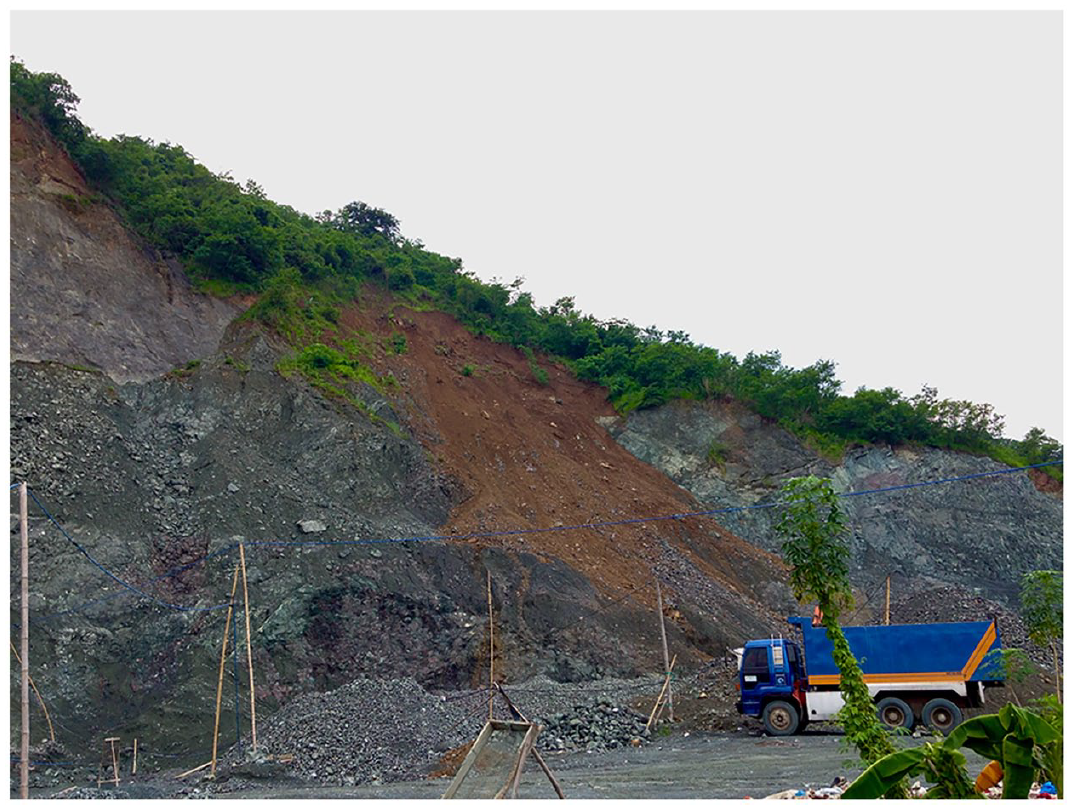
The site of a 2016 landslide in the quarry that happened during a typhoon. During heavy rains, a small waterfall forms in this area.
Other concerns are the quantity of dust and noise produced by the nearby mechanized quarry operation. Especially during dry months, miners are exposed to daily dust inhalation. Families deplore the dust-filled air they breathe, which they believe causes many residents, especially children, to suffer from pulmonary illnesses like persistent coughing and asthma.(78) The miner Liza shared that residents first self-medicate with over-the-counter medicines(79) but sometimes go to the added expense of consulting a general practitioner if their sickness becomes unbearable. The breaker machines used by the mechanized quarry operator are also intolerably loud, and the informal miners, working directly across from the machines, often complain about the noise.
Both mining and non-mining households in the quarry village bear the environmental and health risks. Liza joked that they are sanay na, or used to the noise, but lamented the times when they have to stay inside with their windows and doors shut because of the dust and sound pollution. One miner quipped that they are nakakulong sa bahay, or prisoners in their own homes.(80) Miner Terry is thankful for the trees around her residence(81) because they act as a barrier against dust and noise pollution. Some residents sprinkle water at their crushing site and around their homes to temporarily minimize the dust. During rainy months, some miners line sandbags around their stone piles to protect them from flooding. Residents also asked the village chair to require the mechanized quarry operator to improvise a dyke to help slow the flash flooding.
The quarrying of gravel for concrete has long helped informal mining families survive, but it also creates various risks to health and the environment. These struggles are common among poor informal miners operating illegally within the global artisanal and small-scale mining sector.(82) This section has exposed the struggles at the upstream end of concrete production. The next section considers the downstream end – urban areas near cement plants.
b. Shadow place in cement production: dust pollution as the subject of protest
In 2016, the first author of this paper encountered a TV news report on cement dust pollution linked to an unregulated privately owned cement plant in Caloocan City, about 15 kilometres north of Manila. He followed up on the story and soon discovered a Facebook group created by affected residents in March 2016 called “Anti-Cement Pollution – Sta Quiteria Communities”.(83) Members of this online group allege that cement dust pollution has affected air quality in their neighbourhood, and caused some residents to experience respiratory ailments and skin allergies. They also suggest that other neighbourhood concerns are linked to the cement plants, including the worsening traffic along major roads leading to the cement factories. Residents blame the heavy cement mixer trucks for the frequent potholes and damage to asphalt and concrete roads. The poorly maintained mixer trucks often stall in the street, causing bottlenecks and road accidents on pavements made slippery by spilled freshly mixed concrete. The residents also complain that the mixer trucks’ plate numbers are usually obscured by dried cement. They want these identification details visible for easy reference when vehicular accidents occur.
To ensure that their cement-related struggles reach the broader public, the affected residents regularly post photos and videos of the pollution situation on Facebook and tag major television, radio and print media outlets. The online group has become a repository of different materials (e.g. snapshots, news clippings and videos) documenting the environmental and social concerns surrounding local dust pollution. The Facebook group also serves as a platform for residents to critique various government officials’ environmental politics. One post alleged that the city mayor’s office renewed a factory’s permit to operate even though their permit had been refused at the village level first. Such allegations compel residents to enter into dialogue with the city mayor and to ask government authorities for swift investigation and action on the concerns of affected communities. The protesters also organize signature drives to petition for the closure and/or eviction of cement plants in their area. Some members post the experiences of other communities in the country which are facing similar problems. The broad-based awareness thus created supports their questions as to why immediate action is taken in other locations (i.e. authorities ordering swift closure of erring factories) while their local officials act with no apparent urgency.
The residents attribute their ordeal to ineffective land-use zoning. In a shared post, one resident used a screenshot of Google Maps to illustrate the proximity of concrete plants to residential areas, indicating the lack of land-use planning. The illustration suggests that the buffer zone is insufficient, so dust pollution is highly likely. The affected resident also suggested that the company should build its own roads so that their trucks do not damage the highway. The suggestion is itself a paradox since creating a new road would further the same process that has caused residents distress in the first place. However, people are understandably frustrated with their daily ordeal and open to anything that could offer relief.
The affected residents use a diversity of communication tools to express their indignation. For example, they printed the text “Stop Cement Pollution – nagkakasakit na po ang mga tao” (people are already getting sick) onto tarpaulins to make their protest visible. Protest banners are also distributed to families to hang outside their houses, and to tricycle drivers to post on their vehicles so as to communicate the message to passengers and pedestrians. In one photo posted online, affected residents posed with their banner in front of a dust-covered car. Cleverly, they traced into the dirt a message about halting cement pollution, making the dust the medium of their protest and a participant in this socioecological struggle. The dust associated with cement production became simultaneously the subject and the medium of their indignation.
The protesters have had their victories. In one post in 2021, the Facebook group administrator claimed that the collective voice of affected residents and supporters had reached the Department of Environmental and Natural Resources (DENR), which then ordered the closure of one of the erring cement factories. In comments to the post, a few group members welcomed the news, but others shared their reservations. One member encouraged more affected residents and sympathizers to “continue bringing their grievances to government agencies” while another felt sceptical that the closure would last. A similar closure of the factory had happened in 2016 but it was reopened two weeks after the elections. The Facebook group members alleged that the cement factory owners had connections to the newly elected local officials. The protesters continue their collective struggle both online and offline to prevent those scenarios from happening again.
V. Discussion
The environmental impact of concrete ranges widely from urban flooding to heat islands. This paper takes a modest step in illuminating dust as a narrow band of the spectrum of concerns raised by concrete. We argue that something as minor as dust illuminates something much larger than itself. Going beyond a narrow view of concrete as inert matter, this paper exposes its broader entanglements in the regional geography of Metro Manila. Rather than approach concrete-related pollution as an economic “externality” to be corrected only through economic measures (e.g. taxes and incentives),(84) the paper adopts a relational methodology to understand the intersection between concrete and its socioecological environments. In particular, it argues that what is at stake is not simply an issue of environmental pollution, but also one of environmental justice. To this end, we theorize three forms of entanglement that necessarily accompany the manufacture and consumption of concrete.
The first is the entanglement between concrete’s past and present. Since concrete’s uptake in the Philippines, it has continued to be the foundation of modernization with many social inequalities hardened into it. The fateful building collapse in 1981 that buried construction workers in concrete due to poor labour standards resonates with contemporary concerns over the precarious situation of informal miners in Rodriguez. Since the post-war years, concrete has remained the material expression of the wide economic gap between private residential buildings and squatter settlements in Metro Manila. The housing sector is a key consumer of concrete. A home is reduced to a house, a “commodity” to be traded through the demand and supply, buyer and seller, owner and builder. These transactionist notions eclipse the many shadow places along the journey. One such shadow is the construction of durable concrete houses that often goes hand in hand with, and is built off the back of, diverse economic practices and communities – informal miners, makeshift squatters and worker camps. The sectoral entanglement across time and space calls into question the idea (and ideal) of housing itself. All forms of houses, be they concrete or timber, should evoke a larger ecological consciousness of the hinterland from which they hail.
The second is the socioecological entanglement. Our findings reveal concrete’s shadow places that extend beyond its immediate confines. While concrete’s sites – quarries, construction sites, mixing trucks – may be defined and confined, its geographies are much larger, less apparent, and harder to deal with. Concrete particulate matter flows freely across boundaries, defying human attempts to control it and ending up on people’s dusty windshields, in their foods and in their lungs, regardless of masks, protective gear, land-use zoning or jurisdictional boundaries.
Third, and perhaps most important, is the entanglement of social classes. Concrete entangles the natural and built environments, the rural and the urban, the upstream and downstream in the larger supply chain of its production. In an urbanizing Asian metropolis long sold on the rhetoric of urbanization, the sources in the upstream are extracted to fuel the development of the downstream. This extractive relation has entangled the fates of working-class miners and middle-class urbanites. Once a symbol of progress, concrete-based urbanization has become a problem, particularly in light of worsening climate change. As the seeming beneficiary of urbanization, the middle class now winds up being the victim of concrete-related pollution, not unlike the quarry miners who spend their days hunched over boulders, cracking away at stones.
However, our analysis shows that disparate social groups with their uneven levels of resources are differently equipped to cope with the pollution. The tech-savvy city residents voice their frustration through online media and render their cause publicly visible. They raise their complaints to government agencies so that public officials can swiftly act on them. They continue to protest when government officials become complacent and cement factories remain irresponsible. While some dismiss such middle-class environmentalism as classic nimbyism, the health concern is indeed legitimate. But what is more crucial here, and is thus far overshadowed, is the cross-class entanglement. While suffering from their respective plights, the upstream miners and the downstream urbanites are, in fact, tied together by the same machinery of concrete-based urbanization. We suggest that a broader-based solidarity is essential to ensure that activism amplifies the interconnected concerns of different class groups and to compel government agencies to effectively address them systematically and not as isolated cases.
VI. Conclusion
This paper foregrounds concrete’s relational entanglements by unearthing its shadow places across time and space. The relational methodology has allowed us to see the broader life of concrete not simply as physical matter, but as sociomaterial co-production. The promises of concrete – durability, stability and progress – have long overshadowed its uneven impacts on environmental and social inequality. Concrete is a paradoxical matter, for it both enables and disables. The go-to building material in the Philippines, concrete has helped materialize colonial, modernist and crony interests through the modern history of urban development. Concrete is used by the state and business elites to facilitate land grabs and consolidate economic and political power. The middle class, for its part, celebrates concrete’s material and symbolic affordances. Concrete makes for a durable home and, in turn, becomes a symbol of class mobility. Similarly, informal settlements use concrete to improve their makeshift shanties as part of the culture of resilience and make-do. Concrete structures are also fertile ground for graffiti activism and other acts of resistance. Yet, the concretization of built environments has sheltered some, while pushing others to the margin. A territorial marker of class security, concrete walls and gates fortify the separation between wealthy neighbourhoods and informal settlements. Aiming first and foremost to provide homes, the concretization of housing ironically supports an enclave urbanism that serves a growing middle class, even as squatter settlements proliferate.(85)
The paper contributes to the scholarly debate by shedding light on the creative, generative resistance of those who live and work around the diverse economies of concrete. Concrete’s environmental ills (e.g. environmental degradation, increased carbon footprint, land degradation and air pollution) are well documented by the existing literature. The attention to its social ills, however, is less evident. The recalcitrant materiality of concrete requires a rethinking of concretization as a deeply political process. Through the two cases, the paper shows the asymmetric ways that different class groups cope with their respective concrete environments. The informal miners quarry raw materials for concrete production. Although they reap economic benefits, they also suffer livelihood insecurity and risks to health, environment and occupation. From this shadow place, creative tactics emerge. The villages become more vigilant, more protective of their lookout and outlook, more adept at their bargaining. The urban residents, too often buried in the grandeur of the concrete hardscape, find themselves entangled in concrete-induced dust and noise pollution. Similarly to the miners, they respond, self-organizing and exploiting social media to gain attention from the city officials and the larger public. Their entangled fates necessitate collective action. To move class-based concerns towards cross-class solidarity, we propose viewing the sites of concrete production and consumption as one and the same strategic location where collective action can and must take place. Pro-poor rights groups might engage directly with environmental groups who monitor dust pollution, recognizing that these seemingly disparate sites are, after all, part of the same commodity chain.
Drawing upon theories of diverse economies, urban political ecology and relational geography, the paper has reframed concrete as a set of socioecological entanglements. While much research and practical action has gone towards developing greener and more socially responsible alternatives to concrete,(86) our paper has clarified and expanded on the reasons why alternative futures, material and social, need to be reimagined. Our point of departure is Val Plumwood’s shadow places and now, in concluding, we seek to further develop her ideas to offer a humble way forward. In making visible the shadow places that surround concrete, we discern the possibility of what Plumwood terms an “ecological form of consciousness”(87) to recognize the various places, materials and human relationships along concrete’s supply chain. The end goal is to establish what Plumwood calls an “environmental justice principle of place”(88) so that quarrying, building and demolishing in one place do not perpetuate the destruction of shadow places elsewhere.
Long dismissed as sheer nuisance, the contestations and collective actions make visible the cracks of modernization, the imperfect concrete. What would a future building look like if it were imagined not as a hardening of sand and gravel, but as an ecological form of consciousness fraught with rippling shadow places, as local building industries more transparently involve commodity chains and reconsider Indigenous building practices?(89) Current research re-evaluating technical properties, embodied energy, carbon emissions and socioecological entanglements of the innovative use of plant-based building products(90) can serve as an inspiration.(91)
Footnotes
Acknowledgements
Thanks to Piyasuda Pangsapa for her administrative assistance as secondary adviser to the first author’s postdoctoral project. We are grateful to Katherine Gibson for her valuable comments on previous drafts and to Jacob Henry for proofreading an early version of the article. Thanks to the journal editors and the two anonymous reviewers for their helpful comments and suggestions.
Funding
This research was supported by a Thammasat Postdoctoral Fellowship Fund at Thammasat University.
