




Abstract
Mining settlements are typically portrayed as either consisting of purpose-built housing constructed by mining companies to house their workers, or as temporary makeshift shelters built by miners working informally and inhabited by male migrants who live dangerously and develop little attachment to these places. This paper contributes to these debates on the social and material dynamics occurring in mining settlements, focusing on those with urban rather than rural characteristics, by highlighting how misconceived these archetypal portrayals are in the Ghanaian context. Drawing on qualitative data collected in three mining settlements, we explore who is moving to and living in the mining towns, who is building houses, and how attachments to place develop socio-temporally. Through doing so, the paper provides original insights on the heterogeneous nature of mining settlements, which are found to be home to a wide range of people engaged in diverse activities. Mining settlements and their attendant social dynamics are shown to evolve in differing ways, depending on the type of mining taking place and the length of time the mines have been in operation. Significantly, we illustrate how, contrary to popular understandings of incomers to mining settlements as nomadic opportunists, migrants often aspire to build their own houses and establish a family, which promotes their attachment to these settlements and their desire to remain. These insights further scholarship on the social and material configuration of mining settlements and feed into the revival of interest in small and intermediate urban settlements.
Introduction
As mining and urban research tend to be conducted by separate cohorts of researchers, there has been relatively little research on the growth of mining settlements (Bryceson and MacKinnon, 2012; Gough and Yankson, 2012). Such settlements are typically portrayed as either consisting of purpose-built housing constructed by mining companies to house their workers, referred to as company towns (Marais et al., 2018), or as temporary makeshift shelters built by miners working informally and inhabited by male migrants who live dangerously and quickly move on to new mining sites, so called rush sites (Jønsson and Bryceson, 2017). Whilst such settlement types clearly exist, they are far from the full picture and little is known about who is moving into and settling in mining settlements and whether they develop an attachment to these places.
This paper contributes to filling this gap by drawing on the case of gold mining in Ghana to explore the changing demography of mining settlements and the process of house building within these urban centres, generating novel insights on attachment. Whether and how residents develop an attachment to these places, and how this impacts on their future plans, is discussed. The paper thus feeds into the revival of interest in small and intermediate urban settlements, taking it in a new direction. As Satterthwaite (2016) claims, this growing interest is a reflection of the recognition that a large proportion of urban populations live in urban centres other than large cities, a concern regarding the ability of local governments in small and intermediate urban centres to adequately cater for their inhabitants, and a desire to stem the flow of migrants to the major cities.
Ghana presents an interesting case for exploring small and intermediate urban mining settlements as the country is endowed with significant mineral wealth (Cuba et al., 2014) and has a long history of migration and urban settlement (Coe, 2011; Van der Geest, 2011). Although minerals including manganese, diamonds, bauxite, limestone, silica and salt have all long been exploited in commercial quantities, gold is by far the most important mineral mined (Akabzaa, 2009; Bloch and Owusu, 2012). The history of gold mining in Ghana is far from smooth, however, and the production of gold has waxed and waned in line with changing government policy and world market prices (Hilson, 2002; Teschner, 2012). As elsewhere in sub-Saharan Africa (Hashim and Thorsen, 2011), Ghana has a long history of population movements of varying duration, distance and frequency, often closely associated with the search for improved livelihoods. The dominant trend, however, has been from the poorer north to the wealthier south of Ghana (Awumbila et al., 2011; Yaro et al., 2011). One consequence of this migration is the increasing level of urbanisation resulting in Ghana having just over half (51%) of the population living in urban areas 1 (Government of Ghana, 2010), making it one of the most urbanised countries in sub-Saharan Africa. Although many urban residents are tenants (Arku et al., 2012), the dream of owning a house is shared by all Ghanaians, and becoming a homeowner is considered a key measure of success and social standing (Gough and Yankson, 2011; Yeboah, 2003).
The paper starts by setting the scene, presenting the origins of the three study settlements and an account of the methodology employed. The role that mining and migration have played in instigating demographic changes in the towns is then examined, followed by an analysis of changes in the nature of housing provision over time, highlighting the similarities and differences between the three settlements. The attachment to place experienced by residents of the mining settlements, including the role housing plays in this, is then explored. The paper makes an important contribution to the literature by revealing new insight into the growth and nature of mining settlements, and furthering discussions regarding the complex links between migration, housing and attachment to place.
Setting the scene
Gold mining in Ghana is typically characterised as having two sectors: large-scale mining conducted by multi-national companies and small-scale mining, referred to locally as galamsey, which is a corrupted form of the English expression ‘gather and sell.’ Most of these miners, called galamseyors, work informally without permits as they do not have mining concessions and operate from sites they do not have titles to. Galamsey is widely viewed in Ghana as being illegal, which, as Hilson (2013) claims, is partly a result of government policy and is detrimental to those working in the sector. The increasing informality of galamsey is due largely to barriers associated with galamseyors’ obtaining land and licences (McQuilken and Hilson, 2016). In early 2017, the government introduced a country-wide ban on all small-scale mining in Ghana, which was still in place in mid-2018, in an attempt to bring order into the sector. Formalisation of the operations of small-scale mining operations in many mineral-rich countries, however, has not been successful and there has been the tendency for informality to persist (Verbrugge, 2015). Three mining settlements – Obuasi, Prestea and Kenyasi (Figure 1) – were selected for this study because of their differing characteristics in relation to size of population, mining types and length of time mining has been conducted.
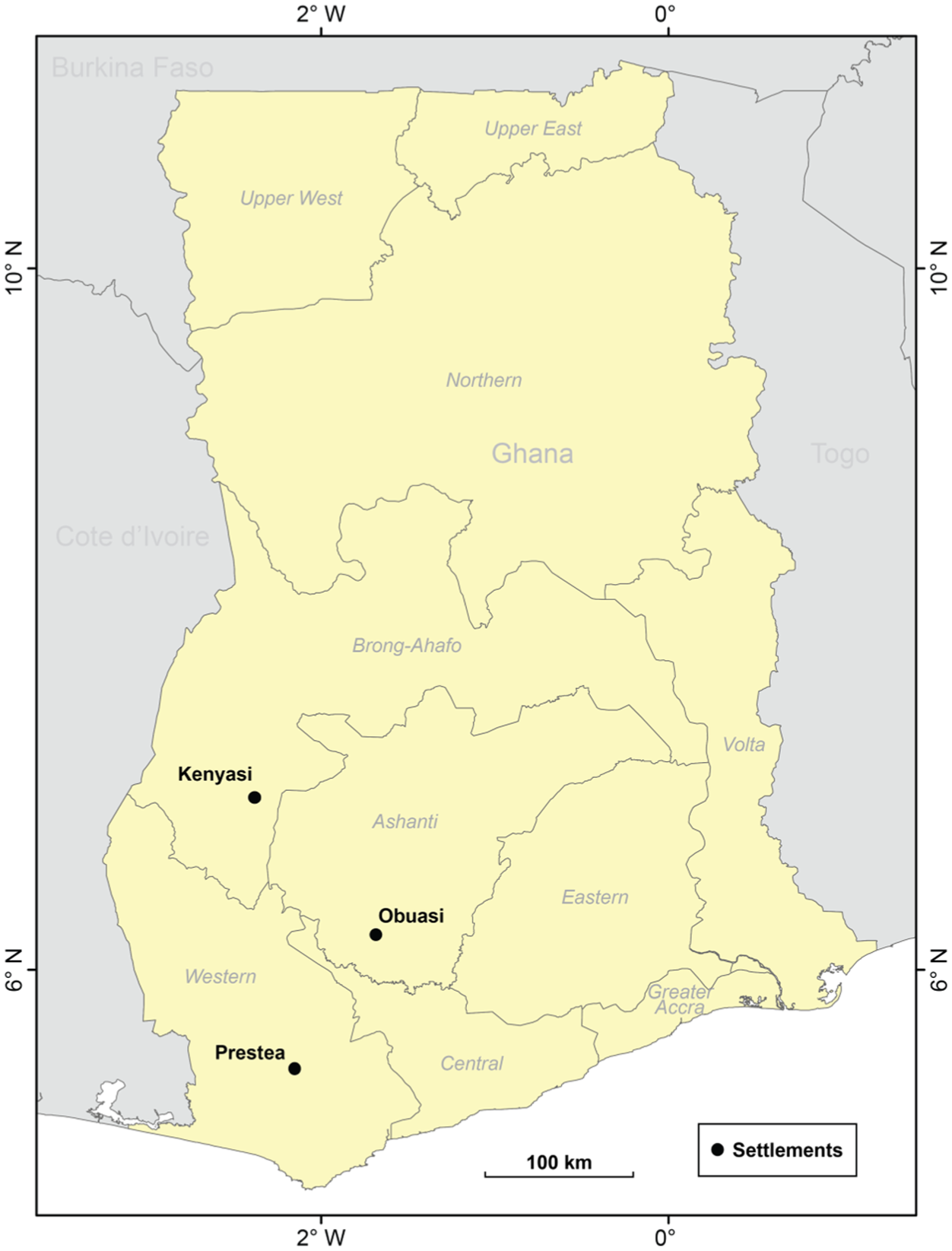
Map of Ghana showing study settlements.
Obuasi was selected to represent an old mining centre dominated by large-scale mining but where small-scale mining is becoming increasingly important. Located in the Ashanti Region, Obuasi is the principal gold mining settlement in Ghana, with a current population of almost 150,000 (Government of Ghana 2010 census). Although gold mining has been carried out in Obuasi for centuries (Hilson, 2002), the growth of Obuasi as a mining settlement stems from the late 19th century when the British colonial powers opened a series of gold mines, the most important being operated by the Ashanti Goldfields Company (AGC).
Prestea was selected to represent an old mining centre now dominated by small-scale mining but where large-scale surface mining is taking place. Located in the Western Region, Prestea is the creation of mining companies that worked the Prestea concession starting in the 1920s with the British Ariston Gold Mining Company, which established underground mining in the area. Production deteriorated during the 1980s and was halted in 1998. Employees then formed Prestea Gold Resources to run the operation, though the underground mine closed down a few years later because of unprofitability (Hilson and Yakovleva, 2007). Today surface mining is carried out by the Canadian multi-national company, Golden Star Resources (GSR), and the town’s population is almost 27,000 (Government of Ghana 2010 census).
Kenyasi was selected as a new mining settlement dominated by small-scale mining but where a large-scale mine has been established close by. The settlement is located in the Brong-Ahafo Region and consists of two separate towns named Kenyasi I and Kenyasi II. According to oral testimonies, some residents moved out of Kenyasi I to establish Kenyasi II following a disagreement. This study focuses on Kenyasi II (hereafter just referred to as Kenyasi), which is the larger and more rapidly growing of the two, with a population of around 11,500 (Government of Ghana 2010 census). Since the discovery of gold in the area in 2004, the multi-national company Newmont has established large-scale open cast mining in the district and many small-scale mining operations have also begun operating (Kala, 2016).
This paper is based on qualitative data collected in all three mining settlements using in-depth interviews, semi-structured interviews and focus group discussions, supplemented by cultural events and observations. All of these data were collected by the authors, with the language of communication being either English or Twi depending on the preference of the interviewee. Most interviews were recorded and subsequently transcribed, though where this was not possible either because of a noisy location or the interviewee preferring not to be recorded, detailed notes were taken.
In each settlement, the initial in-depth interviews were with elderly male and female residents to obtain an overview of how the settlements and mining activities have changed over time. These individuals were typically located by asking a local assembly member (elected local government representative) to select suitable long-term residents. The snowballing method was then used to locate further interviewees, who included residents engaged in a range of income-generating activities including: galamseyor in all three settlements; miners working for a large-scale mining company in Obuasi and Prestea; and male and female business owners, in particular, shop keepers. In all of these in-depth interviews, the respondents were asked about their life histories, focusing on their residential, household, housing, occupational and financial histories. Discussions also revolved around their investments, building and feeling at home, advantages and disadvantages of living in a mining settlement, and their future plans. A total of 30 interviews were conducted with residents of the mining settlements, equally divided between the three settlements.
Semi-structured interviews were conducted with service providers in education, health and local government, as well as a range of officials in local government units (Municipal/District Assemblies), in particular Town Planning Officers and Environmental Health Officers. In each case the informants were asked generally about changes in the mining settlements but also more specific questions relating to their occupation, for example, teachers were asked how mining had impacted on school attendance and facilities, and health officials on how mining had affected the health of the population. In addition, officials from national government ministries, departments and agencies, along with the relevant Member of Parliament representing the electoral constituencies of the three study towns, were interviewed. In all, interviews were held with 22 policy makers from national and local levels.
In order to gain the perspective of young people growing up in mining settlements, focus group discussions (one per settlement, i.e. three in total) were conducted with a mixed group of between seven and twelve males and females aged between 17 and 34 in suitable locations within the settlements, such as an empty classroom. Both interview types were taped and subsequently transcribed verbatim. They were then analysed using in vivo coding to identify categories and trends within the text material, and to build themes that connect the empirical findings to broader literature and concepts. ‘Digging deeper’ cultural events were also held in one school in each of the three study towns. Pupils participated through producing plays, paintings and poems about growing up in a mining town. Furthermore, while staying in the study towns to conduct the fieldwork, detailed observation of the range of neighbourhoods within the settlements, the galamsey mining sites and the open cast mining was undertaken. These extensive qualitative data are drawn on in the following analysis of migration, housing and attachment to place in gold mining settlements, supplemented with secondary data extracted from the Government of Ghana census surveys.
Migration and changing demography of mining settlements
Migration into gold mining settlements typically starts as soon as word spreads that gold has been found (Dickson, 1969; Nyame et al., 2009). Initial migration into Obuasi and Prestea was primarily by men looking for work in the large-scale underground mining operations. This included both unskilled and skilled miners as well as white-collar workers. Consequently, not only poorer migrants moved to the mining towns but also higher-income individuals attracted to the mining sector moved from larger cities. Salaries and associated benefits in large-scale mining were very attractive, resulting in people relocating, for example, from the capital city Accra to Obuasi. This type of population movement from larger to smaller urban settlements is unusual, indicating how the growth of mining settlements can differ from that of other urban centres that do not have a similar resource base. As the Municipal Chief Executive
2
of Obuasi explained in relation to miners in the early days: What they were taking home at that time, compared to the average Ghanaian worker, was far better. Then there were so many privileges attached to the fact that you work for AGC. Every month they were given food rations, provisions and a whole lot of things that were the envy of people around.
This statement highlights both the financial and additional benefits that used to be associated with working for a large-scale mining company and why this stimulated migration into the mining settlements. Unlike many mining towns elsewhere, mining and the urban settlement are intertwined in Obuasi and Prestea as a result of the two developing concurrently.
The arrival of a multi-national mining company does not necessarily, however, result in a major influx of population, as the inhabitants of Kenyasi have discovered. Despite Kenyasi being the closest settlement to the mine operated by Newmont, the mine employees are housed in the larger settlement of Sunyani and bussed to the mine on a daily basis. Consequently, to the frustration of the locals, the establishment of a large-scale mine a short distance away from Kenyasi has not resulted in an influx of formal sector employees who have relatively high spending power.
The most recent surge in migration into the mining settlements is primarily due to the expansion of opportunities to work in galamsey in all three cases. As an assemblyman (elected local government representative) in Obuasi explained: For the past ten, fifteen years the population has shot up because of the gold and galamsey operations here. We have people from the Volta and the north – they dominate – and all parts of the country. You get all the tribes here and the population is now increasing day in and day out. … People come here every day never to return again. The only time they go back is maybe Christmas, just to visit their relatives in their hometowns for about one week and then they come back here. So gradually the population is rising up.
This quote touches several issues: how many people are migrating, where they are migrating from, and whether they remain in the settlements. Table 1 shows the changing population of Obuasi, Prestea and Kenyasi. As these data show, and our interviews confirmed, all three towns have experienced quite dramatic changes in their populations linked to opportunities in mining. As the mining operations expanded in Obuasi, the population grew rapidly and it is now one of the most important intermediate sized towns in Ghana, with the country’s most important gold mine. Prestea’s population growth has been closely linked to the varying fortune of mining in the town, experiencing especially rapid population growth up to the 1960s, then slow growth into the 1980s, accelerating once again as small-scale mining expanded from the mid-1990s. Kenyasi was a small agriculture-based settlement of just over 5000 inhabitants in 1984. During the first decade of the new millennium, following the discovery of gold, Kenyasi’s population increased by more than 50% to become a small town (Table 1).
Changing population of mining settlements studied.
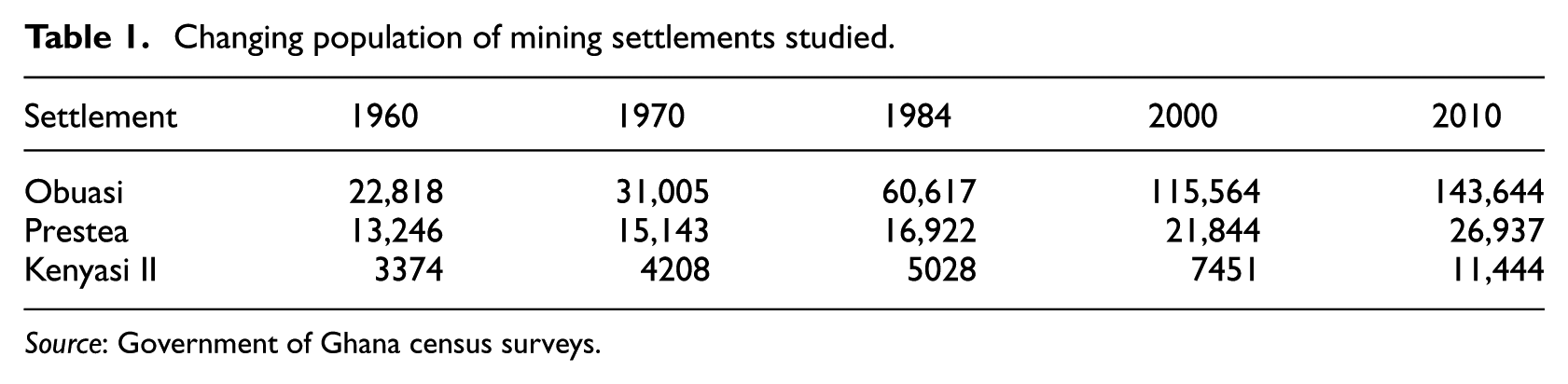
Source: Government of Ghana census surveys.
As interviewees reported, and the census data confirm, those migrating to the mining settlements came from all over Ghana. The largest groups came from: the Central, Western and Upper West Regions in the case of Obuasi; Central, Ashanti and Volta Regions to Prestea; and Ashanti, Upper East and Northern Regions in Kenyasi (Government of Ghana census data, 2010). The contribution of in-migration to the growth of Prestea and Obuasi, however, has fallen over the years as natural growth has become increasingly important (Table 2), showing how migrants’ in situ family formation serves to quickly contribute to urban growth. Interestingly, a similar proportion of around two-thirds of the population of all three settlements was born in the same settlement, although the processes that lie behind this figure, we argue, differ. In Prestea and Obuasi, which originated as mining settlements, this ratio is caused by the expansion of the families of migrants, whereas in Kenyasi it is due to migration into the settlement to engage in galamsey being a relatively recent phenomenon.
Place of birth of residents (percentage).
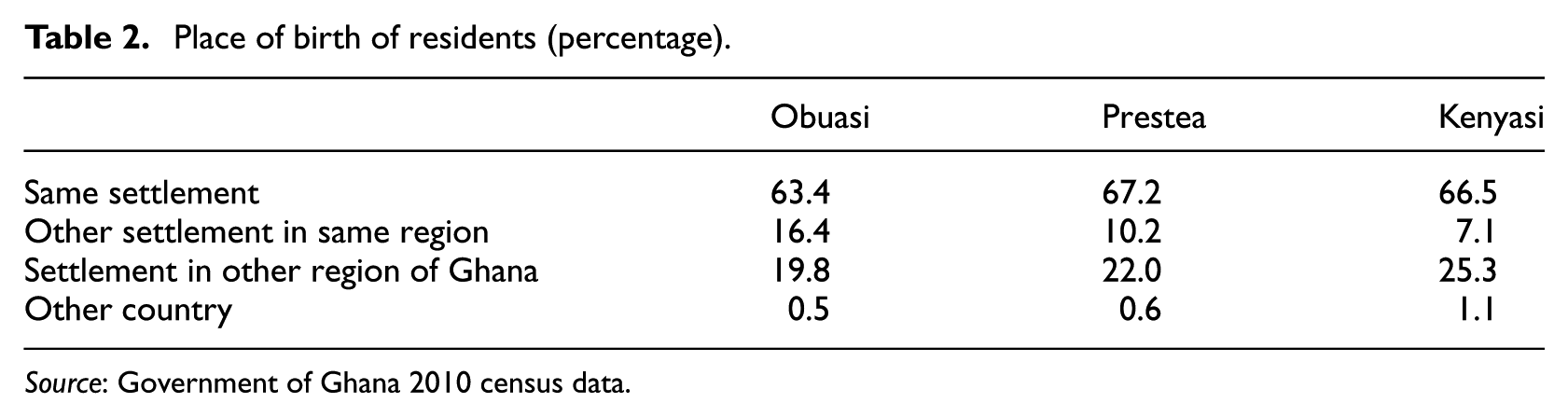
Source: Government of Ghana 2010 census data.
According to the interviewees, movement into mining settlements is due not only to new migrants but also to the return of indigenes to their hometowns attracted back by new opportunities in the mining sector. Especially in the case of Kenyasi, many indigenes who had left the town in search of better opportunities elsewhere have returned to engage in galamsey or in the increased trading and retail opportunities that a growing population creates. It is important to recognise, however, that the residents interviewed in the mining settlements are inevitably those who have stayed or returned; the indigenes and migrants who have left the mining settlements are not present to tell their stories.
Migration in relation to mining settlements is thus complex, with people moving in and out in relation to changing perceived opportunities. Such migration is especially well highlighted by the following statement from a young man in a focus group discussion in Obuasi, which is worth quoting in full because of its complexity: What we are saying is that Obuasi is like a toll. While some are coming in, others are going out. This man went to do a practical with AGC and has finished but they didn’t employ him. So if he goes to a place like Dunkwa and they give him a license for small-scale mining over there he will stay and do it. Somebody else would leave Dunkwa for Obuasi to come and do galamsey work. It is just like farming, someone from here would like to go and farm somewhere else, whereas someone from there would also like to come here and do galamsey. I am from Obuasi but I left here for Diaso-Denkyira to do galamsey there but I have told my landlord that if I get land I will stop the galamsey and cultivate cocoa. As a result, I have used a portion of the land that I bought for the galamsey work to cultivate maize so I will go there next week. This notwithstanding, someone else also wants me to bring him to Obuasi to do galamsey.
This quote highlights how there is movement in and out of mining settlements to other mining towns to work or to rural areas to engage in agriculture (see also Yaro et al., 2011). Consequently, there are numerous cases of multi-spatial households where family members are living in different localities to maximise incomes and minimise risk. This type of mobility is commonplace in Ghana where mobility has been shown to be the norm rather than the exception (Awumbila et al., 2011; Olwig and Gough, 2013; Yaro et al., 2011), and individuals often combine a variety of occupations simultaneously (Esson et al., 2016). The interview data support claims that such mobility is closely linked to people’s life stage and is especially common amongst young unmarried miners who are freer to move from place to place as word spreads regarding which are the most lucrative mines (Jønsson and Fold, 2011). A male teacher living in Prestea explained how he saw the migration of galamseyor as follows: Those galamseyor who came here after the mine collapsed, their intention was not to raise their family here. Their intention was to come here to work so that in a few months or few weeks they will go back. In those days the galamsey was a bit illegal. They were afraid that their work could be terminated at any time but now some of them are permanently stationed here, some of them have married here, some of them have brought their wives so they are raising their family here. … Those who have not married they move from one galamsey community to the other. When they hear that galamsey has proved good in an area they will go there.
Similar views were expressed by other respondents, highlighting not only how mobility is linked to a miner’s stage of life but also how, despite galamsey being viewed by the government as an illegal activity, miners now feel secure enough in their source of livelihood to bring their families to live with them. Significantly, this further illustrates why the narrative of mining towns being populated primarily by male migrants, who live dangerously and develop little attachment to the places where they reside, implicitly overlooks the complex array of motivations in different contexts for specific individuals, and how this in turn can influence the dynamics occurring in mining settlements.
Interestingly, all three settlements have a slightly higher proportion of women (Government of Ghana 2010 census), illustrating how not only does the presence of women in mining activities tend to get overlooked, especially in small-scale mining (Lahiri-Dutt, 2012), but a wide range of other activities also take place in mining settlements, including trading and farming, which women are heavily engaged in (Kala, 2016). Youth in the focus group discussions highlighted how galamsey creates income-generating opportunities for women, with one young man from Prestea saying, ‘[galamsey] gives work to the women who didn’t have work to do. Some sell water to us, some sell iced-kenkey, some sell various items to us and we also buy the items.’ The role of women in maintaining the household and wider economy is particularly evident during periods of high male unemployment, which in the case of Prestea was caused by the shift from labour intensive underground mining to more machine reliant surface mining. As a 60-year-old female provision storeowner in Prestea observed, ‘Because the men were not working, all the economic burdens came unto us the ladies. If you don’t sit up [to work and support the family], your child or grandchild will be wayward.’
Many young people now see their future being in their hometown, rather than migrating elsewhere, as was commonplace before the advent of mining. Young indigenes growing up in Obuasi, Prestea and Kenyasi expressed a strong attachment to their hometowns. As a young male participant in the focus group discussion in Obuasi explained, ‘I was born in Obuasi here. Even if I travel outside of this town I always return.’ And another added, ‘Those who emigrate later on regret leaving Obuasi because some of them don’t even get places to sleep, especially in Accra.’ Since the expansion of galamsey, many of the young people believe that their employment prospects are greater in their hometown than elsewhere. As a young woman from Kenyasi explained in a focus group discussion, ‘Those of us [who stay] here are more because if you travel it is because of work that is why you are travelling. Because the galamsey is here, young people stay here and work.’ Those who have migrated within Ghana or abroad maintain strong ties with their hometown and often invest there; as a former large-scale miner from Prestea explained, ‘Some leave here to work at Kenyasi, Konongo and other places and the money that they get they come and invest it back here.’ These investments are often in rental properties, though owning a house subsequently acts as a draw for returning to their hometown in old age.
In view of the ebb and flow of migrants in and out of the three study settlements, we now turn to the nature of housing provision and use home ownership as a lens to explore how and why some people establish roots in mining settlements.
Housing in mining settlements
The most common form of housing in Obuasi, Prestea and Kenyasi is compound housing inhabited by multiple households, which constitutes the ‘traditional’ form of housing in Ghana and is still the most common housing inhabited by low-income groups (Ardayfio-Schandorf et al., 2012; Korboe, 1992). A compound housing unit consists of a number of (sleeping) rooms that usually open to an interior courtyard and where the space and that of other facilities, for instance for bathing, cooking, storage, are shared by the resident households. Where demand for accommodation is high, compound houses have been extended to enable the renting out of additional rooms (Yankson and Gough, 2014). Renting is the most common form of tenure, accounting for almost 60% of accommodation in Obuasi and Prestea and roughly 40% in Kenyasi, reflecting the lower proportion of the non-indigenous population in the latter, who are more likely to rent. In all three settlements, the houses are remarkably similar in construction, built predominantly of cement blocks with a metal roof and concrete floor, though there are slightly more houses in Kenyasi with mud walls and floors, reflecting its more rural nature (Table 3). The type of housing found in the case study settlements thus does not fit the classic picture of either bungalows built for large-scale mining employees or makeshift shelters built by transient miners (cf. Bryceson and MacKinnon, 2012), but rather is similar in terms of structure, building materials and tenancy to the type of housing found in non-mining settlements in Ghana.
Housing type, tenancy and building materials (percentage).
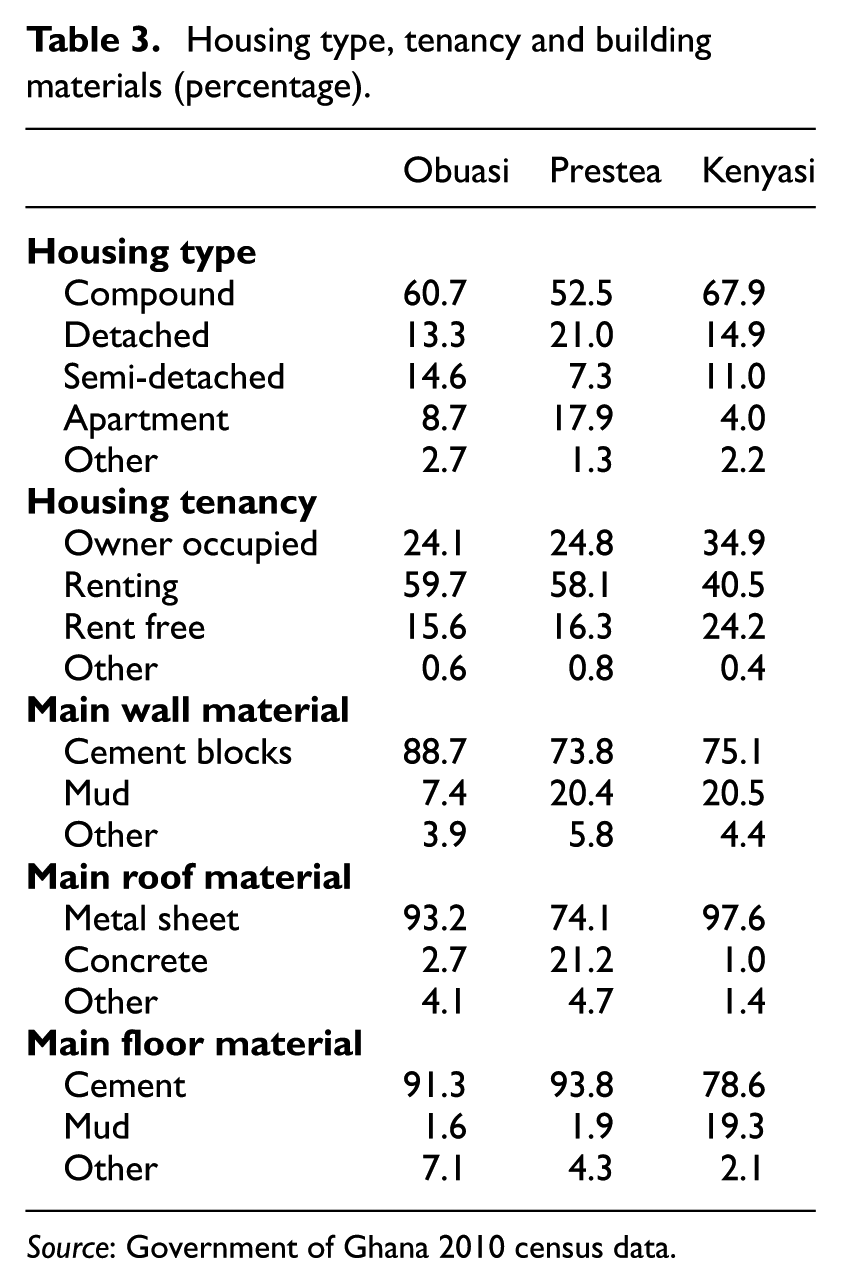
Source: Government of Ghana 2010 census data.
As large-scale mining and galamsey impact on house construction in mining settlements in differing ways, they will be discussed separately here.
Large-scale mining and housing
The first miners who moved to Obuasi and Prestea to work in large-scale mining faced significant problems finding a place to stay given that the numbers of migrants far outweighed the availability of accommodation. A 51-year-old miner who had lived in Obuasi for 30 years, described how there was an immediate influx of people as soon as the mine was set up: People started trooping into the town after we finished sinking the shaft. As a result, people started looking for a place to lodge. When I came here securing a job wasn’t difficult but where to lay your head was the problem because all of us were in that small place, where could one live?
The mining company established staff quarters elsewhere and put on transport to the mine for the workers, though this was not popular. Subsequently, the company built quarters close to the mine itself, which the miners initially occupied in shifts during the 24 hour working day. Later more substantial estate houses were built to house some miners, the size of the housing allocated depending on the rank (and hence race) of the miner. In the words of the Obuasi Municipal Chief Executive, the first housing was built for ‘the whites who were living in bungalows which were within the mines setup … The first buildings which were built for the blacks were called Seven African Bungalow and were designated for the black senior officers.’ The mines quarters were well serviced in comparison with the rest of the town, which had inadequate water and electricity supplies.
Similar to Obuasi, the AGC in Prestea built bungalows for senior staff located next to the mine on a hill overlooking the town, and constructed compound houses for the workers. The level of subsidy for housing and services is illustrated by a former miner who, after explaining that he did not have to pay rent, went on to say that, ‘even your electricity bill was borne by the company. I can remember when I came here in 1962 even your bulb when it spoils, the company has some electricians who will come and change it for you. You won’t pay anything.’ In Kenyasi, however, the provision of housing linked to Newmont has differed, not only because large-scale mining started at a much later date but also because of the company’s policy of bussing employees from Sunyani to the mine on a daily basis. Hence, in Kenyasi, Newmont is notable for both its concurrent presence and absence. Its arrival has greatly affected the town both directly in terms of compensation paid to inhabitants (see below) and indirectly in terms of the subsequent influx of galamsey miners. But at the same time there is a sense of ‘absence’ because the development the inhabitants had expected would accompany the arrival of Newmont, in the form of housing and infrastructure, has not occurred.
In Prestea, some of the miners who still reside in the former company housing are disputing whether they should pay rent and the case is currently with the courts. Meanwhile, GSR has gained a large concession that includes part of the town of Prestea and the former bungalows. Some of these, including the former Club House, have been demolished because of surface mining. As a male teacher and long-time resident of Prestea bemoaned, ‘When this company took over they bulldozed all those structures so now those of us who are from this place we cannot tell somebody who is not from here the legacy the old mine left.’ This quote reveals how mining activities are literally eating into Prestea town as government concession allocations do not protect or even take into account already existing settlements.
In the early days, although the large-scale mining companies were not able to house all their employees, miners did not venture into building houses in Obuasi and Prestea for fear of being suspected of gaining wealth for house-building by stealing gold from the company. A teacher and long-term resident of Prestea explained why miners did not construct housing: ‘There was a fear that you would be sacked. The workers were closely monitored so if you tried to put up a building or if you tried to decorate your rooms sometimes you will be sacked.’ These claims were substantiated by the Municipal Chief Executive for Obuasi, who summarised the challenges miners faced as follows: They [mining officials] would sit in the committee and the question they will ask you is, what is your source of income? If you are not able to convince them, they will not give you the land. What this meant was that those who even had the money to develop the local economy and build mansions and houses, on suspicion of being gold dealers were not given access to land here. The smartest ones who had money moved to either Kumasi or elsewhere but they were few. So social life in Obuasi was very high. If you came around over the weekend, you would see a lot of partying, dances here and there because people had a lot of money to spend.
Although building a house does not tie an individual to a place, by preventing workers, especially migrants, from building their own houses, the mining company removed one of the key means for miners to solidify attachment to the town and hence indirectly encouraged carefree ways of spending earnings. The prevention of miners in Obuasi and Prestea from building homes and other physical infrastructure thus offers an example of how inhabitants of colonial and post-colonial African towns were prevented from defining and developing urban locales on their own terms, and prohibited from making use of the urban space in ways they deemed appropriate (see Simone, 1998). An additional factor related to the early lack of housing investment was miners’ belief that their wealth would continue indefinitely. According to a former mining employee in Prestea: When the mines were vibrant we didn’t think so much about the future because we thought the mines would always be there so we didn’t use the money for something good but when the mines collapsed and the galamsey took over everybody is now using the money to do something to develop the town and the people are building houses so this has made the town expand in size.
As the mining companies became increasingly unable to provide enough housing for all the miners, and miners were restricted from building their own homes, many had to resort to renting. Most only rented a single room but even these were hard to come by, especially since landlords often charged several years’ rent in advance in line with rental housing practices throughout Ghana (Arku et al., 2012). Given the difficulty of raising such large sums of money, a former miner claimed that the situation of fearing to build and having to rent on such terms, ‘went on until we could no longer bear it. It got to a time we were not able to pay the rent advance so the workers started to build their own houses even if it was just a one room building.’ Obuasi’s Municipal Chief Executive explained how in the central part of Obuasi the buildings put up by the workers were ‘very, very small and became shanty in character.’ Yet not all housing built by miners is of poor quality. With the growth of Obuasi into an important intermediate-sized city, a range of banks and lending institutions opened up branches, enabling miners with salaries to obtain loans to build. As a miner in Obuasi explained: If you go to a place like Gausa Extension [on the outskirts of Obuasi] it is mostly the miners who through loans and other sources like Christmas bonus have been able to put up houses there and as a result, even if you give him one of the flats by the mines to rent, he would not accept it.
This points to miners’ changing preference for owning rather than renting property, even if it is on relatively favourable terms from the mining company. Whereas miners used to return to their hometowns after their work ceased, given that was where they had access to rent-free housing in their family homes or where they had constructed housing for themselves, nowadays, miners are increasingly investing in houses in situ and are more likely to remain in the mining settlement. This was highlighted by an assemblyman in Obuasi, who noted that the change in attitude towards miners’ building activities has influenced their decisions on where to live after retirement: ‘Before when they [miners] retired they used to go back to their hometowns but now that it is allowed for them to build here, they don’t leave here when they retire.’ This new attitude has been propelled by improved access to mortgages, which previously were unavailable in Ghana (Abdulai and Hammond, 2010). This option, however, is only accessible to miners working in large-scale mines with regular and verifiable salaries, showing how most are excluded from such financial opportunities.
The mining companies also indirectly affected house construction in mining settlements through the payment of compensation to former miners and farmers who had their land taken. Following the closure of the underground mines in Prestea, some miners used their severance pay to build homes in the town. More recently Kenyasi has seen an influx of compensation paid by Newmont to farmers who have lost their land to the mining concession, many of whom have subsequently invested this money in house construction. A male youth in the Kenyasi focus group noted that ‘People just go and plant things on their lands but will not attend to it expecting that Newmont will come for it and pay compensation on it. They call it “mehuri so” (I jump to catch it). They use the money to build houses and rent them out [to migrants].’ In the eyes of an indigenous female trader in Kenyasi: If your land is affected and you are compensated you will never be poor again. One of my father’s sons whose land the gold was first discovered on, the compensation that was given to him, he has used it to buy a lot of houses in Accra, Berekum and even here.
These insights show how investments made with compensation from mining companies are not restricted to the local area and economic ties are also forged with other, often urban, areas. A play, entitled ‘The first payment’, presented by school children in Kenyasi, reflected the positive aspects of compensation but also a more problematic side. The children enacted how families had used their first tranche of compensation from Newmont in differing ways. Whilst some became rich from investing the compensation money in businesses, one family decided to send their son abroad to earn money. He decided to travel with a friend through the desert but died on the journey, and his friend returned home to break the sad news to the parents of the deceased. The fact that the children chose to tell this story indicates that aspirations and investment strategies linked to compensation payments from mining companies must be managed carefully because the outcomes are far from certain.
Galamsey and housing
Contrary to what might be expected, in recent years it is galamsey rather than large-scale mining that has stimulated house building in the mining settlements. As there is no housing provision for galamsey miners, their arrival in an area results in a sudden and cumulative increase in demand for accommodation. Whilst some of this demand is satisfied by renting out existing rooms, it also stimulates construction of additional rental accommodation. Interviews in Kenyasi revealed that before galamsey started, the indigenes were investing in construction elsewhere, such as in Kumasi. Now they are concentrating their building investment in Kenyasi as they can rent out houses/rooms to the migrant miners. In Prestea and Obuasi many householders are also building additional rooms onto their existing homes to rent out and some are building entire new houses for rent. Thus, many houses in the mining settlements have shifted from being primarily housing for family occupation to also being a source of income through renting. Whilst this occurs in other urban centres in Ghana (Yankson and Gough, 2014; Yankson et al., 2017), the rapid rate at which rooms are being converted/built for renting is linked to the influx of miners to work in galamsey. This in turn has a pervasive multiplier effect in the local economy, encouraging housing construction by both the miners and other residents who have benefited from the miners’ everyday purchases. The Municipal Chief Executive of Obuasi explained how: There is capital injection in the galamsey business. They are also building. They are buying cement and the market is also doing very well. You will see stores are opening by the day, motorbikes are being sold, so the market is good now. Now unlike before traders are putting up houses.
The interviews reveal how galamsey miners are not able to access formal bank loans as they do not have a reliable income yet; contrary to popular perception promoted by the media, they are not just eking out a living or squandering their money but are managing to invest in housing construction. According to members of a male focus group discussion in Prestea, ‘When the galamsey came to this town there has been a lot of buildings put up,’ and in Obuasi an assemblyman explained how ‘Our brothers in the small-scale mining industry, by dint of their hard work, are putting up buildings. If you see the kind of buildings they are putting up they are not small buildings.’ There also appears to have been a cultural change in attitudes towards building linked to a previous unwillingness by miners to demonstrate their wealth. Discussions with the Obuasi Small Scale Miners Association highlighted how in the past when those engaged in small-scale mining made major investments they disguised their name because they did not want to be victimised, but now anyone can do what they want with their money without worrying about public opinion.
Today, even though galamsey is a far more unstable occupation than large-scale mining was in the ‘golden days’, miners are moving to Obuasi, Prestea and Kenyasi on a more permanent basis and creating attachments to the towns that are more enduring than in the past. In Obuasi, for example, the Small-Scale Miners Association has invested in the provision of public toilets for the community, which they are paying people to manage and maintain. This sort of investment in community development projects and job creation activities points towards a long-term commitment to the town. The embeddedness of galamsey migrants in Prestea is reflected in their efforts to build houses, open shops, marry locals and put their children in school. This attachment to settlements, perhaps because of narratives of migrants in mining towns as nomadic opportunists, was overlooked by the authorities when they tried, unsuccessfully, to remove miners in the 2006 so-called ‘Fight against illegal mining’ (Hilson et al., 2007).
The data highlight how the looming spectre of being forced to move, alongside economic precarity, means that it is not uncommon for migrants to build multiple houses, finances permitting. This is illustrated well by Kwesi, a 24-year-old miner from Abura-Dunkwa who was a galamsey miner in Prestea. Kwesi’s experiences not only show how attachments to mining settlements are closely linked to material and social relations, but also illustrate how dynamics occurring in mining towns speak to broader urban processes taking place, particularly the ‘greater diffusion of household livelihoods geographically as a means of accessing and protecting against oscillating employment opportunities and sources of income’ (Simone, 2014: 223). Kwesi’s original decision to move to Prestea was influenced by the fact that he has an aunt resident there, with whom he stayed when he first arrived. Any money he was making above immediate living expenses was being put aside to buy a plot of land and put up a structure ‘even if it is only one bedroom.’ In addition, he had been joined by his wife who established a store in front of the home to bolster the household’s finances, and his younger brother had subsequently joined him thus further consolidating his embeddedness in Prestea. Kwesi explained, however, how his attachment to Prestea is accompanied by a desire to also build a house in his hometown, which he was in the process of doing. Like many of his peers, Kwesi is aware of the potential instability of galamsey, hence he has acquired land in his hometown where he is cultivating oil palm. By creating income-generating opportunities in two separate locations he is devising a long-term strategy to overcome economic uncertainty that might arise in either location.
Kwesi’s example illustrates how migrants’ development of attachment to place in mining settlements includes but goes beyond house-building; they forge long-term attachments to the area by bringing their families with them and placing their children in schools or by marrying locally and raising families in situ. Attachment to mining settlements emerges out of social processes and relationships (cf. Ralph and Staeheli, 2011), as well as material ones such as house building, though the two are clearly interlinked. This is illustrated well by an elderly former miner who had been living in Prestea since 1962, who explained how, ‘There are so many tribes in Prestea. So evening time when you go to the streets we have Dagomba people, Sissala people, Dagarti, Senya, Fante, all with their traditional dances.’ It is through these everyday experiences and the forging of social relations that migrants develop a sense of attachment to mining settlements. This serves to confirm our broader argument that contrary to popular understandings of incomers to mining settlements as opportunists, these migrants often aspire to build their own houses, which – alongside a range of social relations – contributes to their attachment to the mining settlements and desire to remain.
Conclusions
As indicated at the start of this paper, little is known about migration and settlement processes in urban mining settlements and whether and how residents develop attachment to such places. Drawing on research conducted in the mining settlements of Obuasi, Prestea and Kenyasi, three key findings are highlighted here.
First, we have revealed how mining settlements experience considerable in-migration coinciding with the discovery of gold but how their evolution varies depending on the type of mining and the length of time the mines have been in operation. The two older mining settlements (Obuasi and Prestea) experienced a number of waves of migrants associated initially with large-scale mining and subsequently with galamsey, whereas the younger settlement (Kenyasi) has only experienced in-migration in relation to galamsey. Yet mobility in all three mining settlements is more nuanced and complex than typically found in understandings of mining settlements, with migrants and indigenes moving in and out, at times establishing multi-spatial households, and often combining a variety of occupations simultaneously.
A second key finding emerging from this paper is that housing construction in urban mining settlements is closely linked to mining types as well as migrant waves. In the early days, large-scale mining companies provided housing for some of their workers; those who were ineligible for company housing rented rooms. Mining employees did not invest in housing construction for fear of losing their jobs because of company policy of suspecting any miner who was building of having stolen gold from the company. Ironically, contrary to what might be expected, it has been the influx of galamsey miners, most of whom are working informally in insecure conditions, that has led to increased investment in house construction in mining settlements. The switch to open-cast mining has also affected house construction as the compensation paid to those who have lost their land to the new concessions is often invested in house building for habitation and for rent, often to galamsey miners. Importantly, the paper shows how the impacts of large-scale mining and galamsey on settlement development differ but are closely interlinked.
Third, although having a reliable income-generating activity is paramount in the decisions of migrants living in the mining settlements to stay, many develop a close attachment to these places via social and cultural processes. These include their families joining them or new families being established in situ, as well as engaging in activities associated with their hometown or region. Such social factors are buttressed by material considerations, in particular building a house, hence, importantly, the security of having one’s own dwelling is shown to increase migrants’ sense of attachment to a settlement. When migrants become embedded in a locale, both physically through a property and socially through kinship and friendships, they are much more likely to remain. Moreover, their purchasing power greatly increases trading and the demand for services in the settlements. This benefits indigenes and migrants alike who set up a wide range of primarily retail and service businesses to meet this demand.
Overall, the paper shows how migrants living in mining settlements should not be viewed as temporary residents, as many endeavour to and succeed in establishing roots in such towns, contributing to the settlements’ social and economic vibrancy. It is vital that policy makers attempting to address the negative side effects of informal mining recognise these trends and do not repeat mistakes of the past, such as in Prestea (Hilson and Yakovleva, 2007; Hilson et al., 2007), where trying to remove galamsey miners caused considerable social unrest. Moreover, these findings reinforce claims regarding the importance of small and intermediate urban settlements as places that migrants move and become attached to, highlighting how such settlements are part of wider economic processes that are shaping and shaped by national legislation.
Footnotes
Acknowledgements
The constructive comments, initially from Deborah Bryceson and subsequently from three anonymous reviewers, helped improve the paper considerably.
Declaration of conflicting interests
The author(s) declared no potential conflicts of interest with respect to the research, authorship, and/or publication of this article.
Funding
The author(s) disclosed receipt of the following financial support for the research, authorship, and/or publication of this article: We are grateful to the Department for International Development (DfID) and the Economic and Social Research Council (ESRC RES-167-25-0488) for their financial support of the Urban Growth and Poverty in Mining Africa (UPIMA) research programme.
