




Abstract
Experiences of apartheid in South Africa have resulted in the association of shelter with citizenship, adding significance to the concept of “home”. This paper reviews experiences with grassroots efforts to make the government’s housing policy and programme more effective in addressing the needs of the urban poor. The experiences offer lessons relevant within and beyond South Africa. First, collaboration between state and civil society has been possible and has added substantively to the effectiveness of state programming. But, with a multiplicity of government agencies, the context is difficult. Housing construction has been constrained by delayed subsidy payments, and by a professionalization that limits opportunities for low-income residents. Second, community initiatives have had multiple incremental and positive influences on state policy and programmes, but substantive progress requires government adopting a more inclusive policy. Civil society agencies remain ambitious about the potential for securing substantive transformation, but this remains a work in progress.
I. Introduction
On taking up office in 1994, the newly democratic government of South Africa made a substantive commitment to addressing the need for housing with a large-scale capital subsidy programme. This programme has been important for multiple reasons, including poverty reduction, particularly in urban areas. A sub-programme, the People’s Housing Process (PHP), was launched in 1998. A response to self-build initiatives across the nation, the PHP sought to support co-production between the state and civil society by providing funds to groups that wanted to self-organize and develop their own housing. The many acknowledged merits of this sub-programme included the strengthening of civil society and empowerment of the urban poor.(1) In 2004, the government added a programme to upgrade informal settlements. Overall, the impact of these efforts to improve housing has been mixed. By 2015, over 3.2 million dwellings (including new builds, individual tenure titles, and transfer of housing stock) had been provided to low-income households. Despite these advances, a 2013 enquiry by an independent parliamentary advisory found the housing backlog to have increased from 1.5 million to 2.1 million housing units needed between 1996 and 2013, accounting for some 15 per cent of the population.
This paper examines the outcomes of the government’s commitment to address housing need through the lens of one group of civil society organizations integrally involved in the formation and ongoing implementation of the PHP, and engaged in pro-active informal settlement upgrading. This group, the South African Shack/Slum Dwellers International Alliance (SA SDI Alliance), includes an NGO (the Community Organization Resource Centre), two social movements (the Federation of the Urban and Rural Poor and the Informal Settlement Network) and a finance facility (the uTshani Fund). This Alliance started work in the years prior to democratization in 1994, and it directly involves tens of thousands of informal residents in upgrading activities and the improvement of housing. There have been multiple activities and associated agreements with national, provincial and city governments. The Alliance is currently providing support both to housing construction through the enhanced People’s Housing Process (ePHP) and to informal settlement upgrading. The Alliance draws directly on government funding, blending this with support from a number of development assistance entities to create opportunities for learning and citizen empowerment.
The paper draws in part on data collected through an action research project (2012–2015) supported by the British donor Comic Relief and undertaken with the Alliance and the International Institute for Environment and Development. Sources of information include project reports; supplementary interviews with community members, NGO staff, local government officials and others involved in the process; and a mid-term and final evaluation. In addition, both authors draw on the knowledge gained through a long-term engagement with Alliance partners.
Efforts made by the SA SDI Alliance have sought to address the recognized weaknesses in global approaches to addressing at scale the housing needs of the lowest-income groups. Government shelter policy and programming for low-income households across the global South acknowledge the contribution of shelter to poverty reduction and wellbeing. Urban poverty is much more than just a lack of income.(2) Urban poverty is linked to insecure incomes, a lack of safety nets, and the voicelessness associated with the state failure to provide for rights and entitlements. It is also linked to lack of tenure security, inadequate access to the full range of basic services and infrastructure, and a limited ability to accumulate assets. The demands of urban social movements have long reflected the importance of improved access to collective consumption goods (for example, piped water) for wellbeing.(3)
Governments in the global South have struggled to introduce effective interventions. The South African government’s approach of providing a full capital subsidy is unusual. In general, public house building programmes across the global South are associated with high unit costs and limited scale, and in the absence of alternatives, have been occupied by lower-middle and middle-income households. Consistent with a broadly neo-liberal and pro-market approach, from the 1990s, increasing emphasis has been placed globally on shelter finance rather than construction.(4) Measures have included state-subsidized loans, improved access to commercial finance, and savings contributions. In many Asian and Latin American programmes, the emphasis is now on supplying housing through contractor-driven greenfield developments, financed by a mix of sources of money. One consequence has been a shift of low-income populations from inner-city locations to less favourable and lower-cost peripheral settlements. However, the high social and public costs of the shift to these locations are increasingly recognized.
The search for alternatives has led to an interest in upgrading informal settlements.(5) In these locations, residents build shacks that they improve, while they obtain access to infrastructure and services and negotiate for tenure. State resources are secured wherever possible and include councillor grants, utility finance, development assistance, philanthropic donations and municipal funds.(6) Government programmes for comprehensive upgrading have been introduced but there have been problems of scale and affordability.(7) Innovative approaches in informal settlement upgrading include the Community Mortgage Programme (the Philippines) and the work of the Community Organization Development Institute (CODI, Thailand). Both programmes emphasize the collective nature of shelter development and facilitate group ownership and related activities.(8) Another example is the grouping of Central American projects that has supported the participatory planning of informal barrios, with provision for additional household investments in housing and enterprise development through micro-finance.(9)
In summary, there is widespread recognition of the need for state support to ensure that households secure adequate access to shelter. However, there is something of a lacuna in shelter programming. Governments recognize the need to address housing needs but are struggling to put in place programmes at an appropriate scale that include the most low-income and vulnerable households. Civil society has sought to engage them in these efforts and to ensure that shelter programming focuses on addressing the needs of the most disadvantaged households.
This paper engages with that challenge through an examination of the ways in which organized low-income communities are seeking to improve government approaches to shelter in South Africa. Section II offers a critical reflection on housing policy and programming in South Africa from 1994 to 2010 and describes the involvement of the Alliance. Sub-sections describe and analyse the ways civil society has sought to add to these programmes. Section III focuses on the more recent policy of informal settlement upgrading, following a similar structure to Section II. Section IV reflects on what these experiences mean for both government and civil society efforts to address housing need in South Africa. Section V concludes.
II. Housing Construction for Low-Income Households in South Africa
a. Early roots of the capital subsidy scheme
The South African government’s commitment to improving access to housing in the years following 1994 was significant and substantive. When the African National Congress (ANC) government took up office in 1994, more than 15 million people were living in informal urban settlements and the probability of increased urbanization was recognized. A progressive approach recognizing the right to housing was inscribed in Section 26 of the Bill of Rights in the 1996 Constitution; and a target of one million dwellings built within five years was agreed, in line with the ANC party’s election manifesto, the Reconstruction and Development Programme (RDP). Following the deliberations of a multi-stakeholder National Housing Forum, a capital subsidy programme was introduced.(10) Nine of the Forum’s 16 founding members represented business or pro-business interests.(11) This approach appears to have been attractive to the ANC government, with a promised “triple-win” that would simultaneously address the needs of low-income households without adequate housing, catalyse a struggling construction sector, and lead to economic regeneration.
The programme(12) has been amended but its structural design remains broadly unchanged. The primary form of delivery(13) is project-linked subsidies that provide for home ownership; funds are released to a developer (either a private contractor and/or, after 2000, a municipality). When the programme was first introduced, the maximum value was ZAR 15,000 (then worth about US$ 2,150) per household for those households with monthly incomes below ZAR 1,500.(14) To be eligible, households had to include adults with legal South African residency, be without formal housing, meet specified income criteria (under ZAR 3,500 or US$ 500 a month for major beneficiaries of the programme), have not previously received state housing assistance, and have dependents. The Minister of Human Settlements announced in 2014 that beneficiaries under the age of 40 would not be prioritized.(15)
The government recognized the need to support community-driven, self-build activities when the People’s Housing Process (PHP) was launched in 1998; this offered greater scope for communities to make decisions for themselves, provide voluntary labour and manage project activities.(16) One civil society group that had lobbied for such provision was the South African Homeless People’s Federation (also known as uMfelandaWonye WaBantu BaseMjondolo, or “we will die together”). The Federation with its support NGO, then called People’s Dialogue, had emerged from a five-day conference of informal settlement residents in 1991 and, drawing on innovative approaches to social mobilization, had decided to challenge the existing housing policy paradigm due to its inability to meet their needs.(17) People’s Dialogue argued that the set of rules associated with the capital subsidy as originally drafted “…directly and simultaneously undermines the creation of an enabling environment”.(18) These two organizations and the uTshani Fund at that point made up the South African Alliance. The Alliance was committed to women’s-led saving-based organizing rooted in shack settlements, backyard shacks and hostels.(19) Members were involved in struggles to secure land tenure and affordable housing. They actively engaged the state, arguing for more inclusive financing instruments to co-produce self-build housing.
Frustrated by the slow pace of subsidy disbursement and the lack of appreciation of community approaches, a group of local Federation members, the Victoria Mxenge Housing Savings Scheme in Cape Town, acquired land from the Catholic Church Archdiocese, renegotiated building standards (for example, foundations), and began the spontaneous installation of an alternative design.(20) This group began its neighbourhood development in 1995 and completed more than 150 houses, which received widespread attention. Sanke Mthembi-Mahanyele, Housing Minister from 1995 to 2002, acknowledged the Federation’s contribution in numerous public speeches.(21) The People’s Housing Process emerged in part because of the activities of the Federation and its demands for a more community-driven collectivized process.(22)
b. Criticisms of the housing subsidy programme
Both the design and implementation of the housing subsidy programme have been criticized for resulting in housing on peripheral land far from economic opportunities, reinforcing the spatial and racial distortions of apartheid and entrenching poverty.(23) Due to both poor location and poor construction quality, some families even left their new subsidy homes. Building regulations in the low-income market were poorly defined, and provincial governments had to introduce extensive checklists to improve quality. An ongoing issue was the size of the unit,(24) and by the late 1990s, minimum house sizes were introduced. While the initial design of project-linked subsidies assumed active community participation, developers sought exemption from these requirements, arguing that they delayed housing delivery.(25) Residents were unable to insist on their right to be included in decision-making.(26) Despite its emphasis on improved opportunities for residents’ involvement, the PHP failed to gain momentum and scale.(27) Baumann and Mitlin(28) estimated that only 3 per cent of the government’s housing subsidies were being allocated to the PHP.
In 2004, the Minister of Housing responded to concerns with a revised national housing strategy, Breaking New Ground (BNG), which sought to address the housing backlog through multiple measures, including the upgrading of informal settlements.(29) This document also called for new funding mechanisms for capacity building and organizational development when “adopting an area-wide or community, as opposed to individual approach”, and for the formation of “locally-constructed social compacts” between government and NGOs and CBOs in the delivery of human settlements projects.(30)
The interest in informal settlement upgrading emerged because of the need to increase residential densities, improve locations, and challenge apartheid-style towns and cities with detached single-storey housing. Also recognized was the value in making cities more “compact” and “integrated”.(31) However, little progress followed the launch of the new strategy, perhaps due to its lack of fit within traditional approaches to urban planning in South Africa.(32) By 2010, the policy and programme contradictions were evident, with 2,700+ recognized informal settlements – 2,400 more than the 300 that existed in 1994.(33) As will be discussed in Section IV, the implementation of effective informal settlement upgrading projects has proved more challenging than originally anticipated, requiring substantive participation and capacity building in project planning and implementation, and strong community coalitions – a missing component.
c. Alliance engagement with the capital housing subsidy programme up to 2006
Despite the evident programmatic failings, the Alliance sought to ensure that the capital subsidy programme addressed the needs of its members and other low-income households. The Federation lobbied the first minister of the newly-democratic Department of Housing, Joe Slovo, to secure government support to build capacity for people-led housing development. This led to the establishment of the uTshani Fund (meaning “grassroots fund”) as a Section 21 (not-for-profit) company in 1996; the Fund was capitalized with donor contributions and a grant of ZAR 10 million from the Department of Housing. Through a legal agreement with the National Housing Board, the uTshani Fund became a conduit for housing subsidies.(34) Provincial housing boards – at that time the “developer” of housing projects – were to pay the beneficiary’s subsidy into the uTshani Fund, allowing the member to self-build as part of a community project. The uTshani Fund became an accredited financial intermediary of the housing subsidy system, able to finance its operations in part through PHP facilitation and establishment grants to support community-led projects.
Between 1996 and 2001, the Federation constructed more than 7,000 dwellings and the uTshani Fund administered 4,500 subsidy applications to the value of ZAR 60 million (US$ 8.5 million) in loans and subsidies. The Fund offered bridging loans to beneficiaries while the housing subsidy was being secured. Unfortunately, short-term bridging loans often became long-term debts,(35) largely due to the poor repayment rates of government agencies to the uTshani Fund, which had been pre-financing subsidies. By 2000, the uTshani Fund was under serious financial constraints. The debt was so considerable that construction was stalled. At the same time, concerns about the poor construction quality of subsidy houses delivered by the commercial developers resulted in provincial government departments introducing higher standards and extensive quality control. uTshani faced an additional problem; some of its existing dwellings did not comply with these standards and it was unable to claim the “pre-financed” subsidies. Because of its financial constraints, the Fund only constructed 300 houses between 2004 and 2007.(36) This caused considerable tension in the Federation. In 2006 a Western Cape Province faction broke away from the other members and the Alliance. The majority of the ex-Federation members formed FedUP. The breakaway group carried on under its previous name, the South African Homeless People’s Federation, constructing housing projects, albeit at a smaller scale.
During this period, the Federation was able to demonstrate to government a compelling argument: low-income households, organized into neighbourhood associations, were able to build larger and better-quality houses with the same capital subsidy than those built with private sector housing contracts.(37)
d. Alliance engagement with the capital housing subsidy programme after 2006
Following a conference between FedUP and the National Department of Housing, the 2006 Pledge Agreement/Memorandum of Understanding (hereafter “the Pledge”) was signed by FedUP, the Department and SDI(38) to guide a new relationship. uTshani was unable to sign because of its legal status as a Section 21 not-for-profit company, but was involved as account administrator and offered support services to organized communities. The Pledge, still ongoing, is coordinated by a National Joint Working Group responsible for oversight and strategy, and nine Provincial Joint Working Groups responsible for practical and project-level activities.
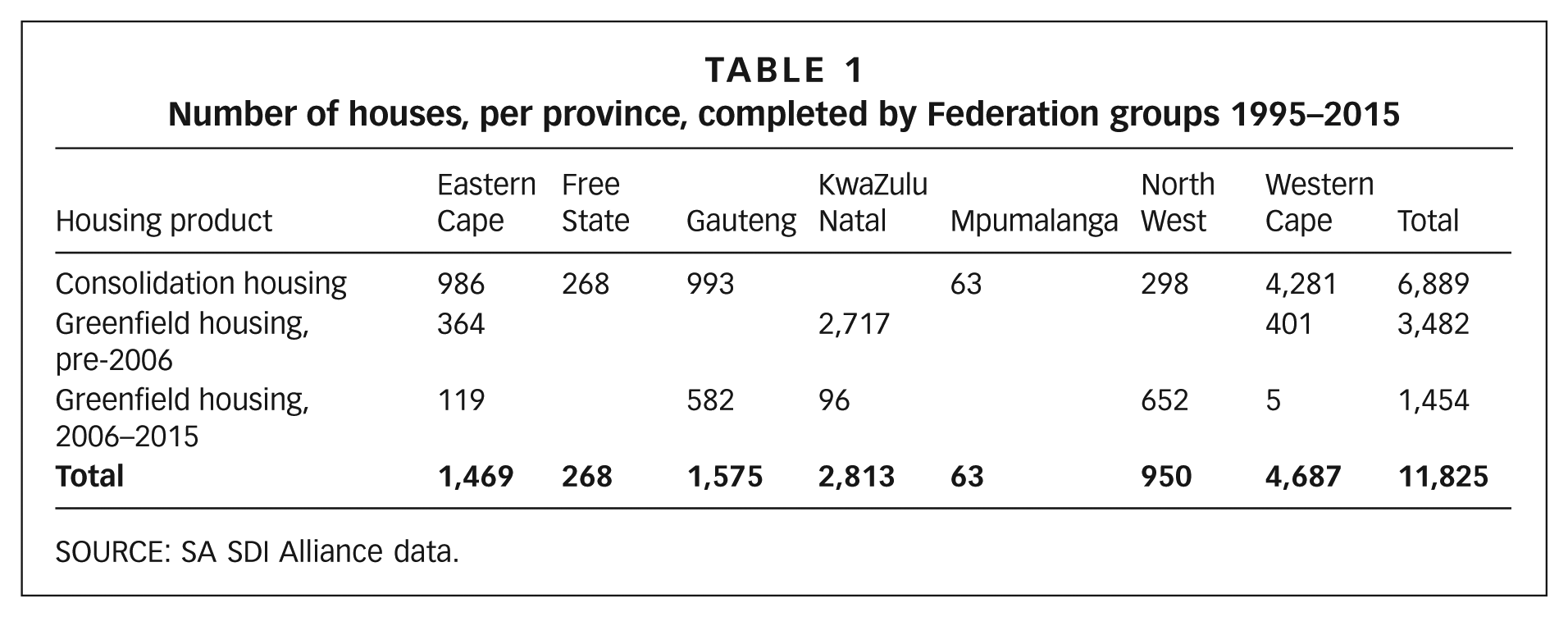
Six provinces signed the Pledge with the Federation: Gauteng, Western Cape, KwaZulu-Natal, North West, Limpopo and Free State. Each agreed to ring-fence subsidies for 1,000 residences for FedUP groups. The agreement stipulated that provinces would pay subsidies for house construction upfront and provide serviced greenfield plots. However, this agreement of upfront payment has only been realized in the Free State, and elsewhere the uTshani Fund continues to pre-finance and retrospectively claim back subsidies, working with FedUP in these activities. Table 1 summarizes the construction achievements of the Alliance.
Number of houses, per province, completed by Federation groups 1995–2015
SOURCE: SA SDI Alliance data.
Federation leaders maintain that FedUP houses are of significantly better quality than conventional contractor-built houses and are larger (50 square metres compared to 35 square metres), have better finishes, and generally have higher market value. Although this not been formally verified, the government has acknowledged the quality. For instance, in 2012, the Namibia Stop 8 project in Durban, KwaZulu-Natal won the prestigious Govan Mbeki award for excellence in housing construction. A comparison of housing through the two routes in Fisantekraal, Western Cape, found FedUP dwellings bigger, in better condition, and with more satisfied residents.(39)
Further benefits have been realized through livelihood opportunities related to construction. The Federation organizes building through community construction management teams and provides training, in most cases to female members. In the North West province, the National Home Builders Registration Council (NHBRC) accredits this training. However, this is not the case in other provinces and few trained members find jobs in the construction sector. One reason is discrimination against older women workers. Responding to a lack of employment opportunities, six Federation builders have set up their own construction companies, one headed by a woman. Alternative opportunities for income generation are found in Cape Town through informal settlement upgrading; some residents have been offered access to the Expanded Public Works Programme, which involves short-term employment for a period not exceeding six months.
More generally, a distinction between “true” community-led development and contractor-driven PHP housing emerged in the early 2000s. The latter is referred to as “managed PHP”, denoting largely private sector oversight of the core managerial, procurement and construction processes. Private sector interests started overshadowing the potentially empowering elements of the PHP, and the programme became increasingly and narrowly equated with “sweat equity”, individualism and cost reduction rather than collective beneficiary involvement in planning and decision making.(40) Greater state control of PHP has led to public concern that the programme is being derailed from its initial objective of empowerment and beneficiary participation.(41)
There were cabinet-approved policy changes in July 2008, and the programme was renamed the enhanced People’s Housing Process (ePHP). The ePHP refocuses on empowered communities, social capital and integrated human settlements, with greater state investment in organizational development, support for partnership formation, and alignment with other state programmes, such as local economic development, planning and public works, and social development. The government recognized, furthermore, that more than housing construction was needed, and by 2010 it renewed its earlier commitment to in-situ upgrading.
III. Informal Settlement Upgrading
a. Informal settlement upgrading in South Africa from 2004
With the launch in 2004 of the housing strategy Breaking New Ground, new subsidy instruments were created. The Upgrading of Informal Settlement Programme (UISP) adopts a “structured approach”, with three initial phases followed by housing consolidation subsidies in Phase 4.(42) The programme aims for comprehensive improvement with tenure security, a secure and healthy living environment, and measures to address social and economic exclusion. It recognizes and seeks to incorporate community knowledge within the design process.(43) Three per cent of the project budget is reserved for social facilitation costs, and 8 per cent for project management. These financial allocations provide necessary capacity-building grants premised on the complex nature of social facilitation processes involved in informal settlement upgrading.
The political commitment to upgrading was renewed when the Office of the President signed a performance agreement with the Minister of Human Settlements in 2010 to upgrade 400,000 informal settlement dwellings by 2014, and new targets were set to upgrade 750,000 dwellings between 2014 and 2019.(44) These commitments are reflected in the government’s National Development Plan (also referred to as Vision 2030), which crucially acknowledged the “ambivalence across government towards how to address the upgrading of informal settlements”, and which argues for greater “institutional capabilities to manage processes … in a participatory and empowering way”.(45)
The National Upgrading Support Programme (NUSP) was initiated through a grant by Cities Alliance and the World Bank, and it became a capacity-building programme of the Department of Human Settlements,(46) a role the Department recognized as important.(47) The NUSP provides dedicated technical support to 53 participating municipalities by procuring professional services via conventional supply-chain procedures. Such services, typically rendered by engineering, consulting and development support companies, include the rapid assessment and categorization of informal settlements, and formulation and planning of municipal informal settlement strategies. In a few sites, this has included detailed settlement-level plans, informal economy and livelihood strategies, and protocols for engaging communities.(48)
The adoption and implementation of informal settlement upgrading plans were slow and ineffective following the 2004 launch of Breaking New Ground. This has been attributed to the dominance of the capital subsidy system for house building, the failure to create participation and governance structures at the project level, municipal officials’ lack of experience in upgrading projects, and complex engineering and geotechnical conditions.(49) While government promotional materials have celebrated the achievement of upgrading targets set in 2010, researchers have pointed to the flawed methodologies in reporting on these goals.(50)
Fieuw(51) elaborates three concerns: first, a tendency by local and provincial governments to “repackage” conventional housing projects and report these as “upgrading” projects. For example, a peripheral greenfield housing project is reported as brownfield in-situ upgrading, with the justification that informal settlement dwellers are beneficiaries. In fact, settlements remain poorly serviced, and only a few beneficiaries experience improved living conditions. Second, few independent impact evaluations have been commissioned. Third, the arrangements showcased by Govan Mbeki as prize-winning projects in 2013 and 2014 point to an over-reliance on large engineering and construction companies to implement projects, starting from pre-planning, extending through facilitating community engagement, all the way through to construction. This procurement strategy does not translate into longer-term capacitation of either government departments or community organizations.
b. The view from below: the case of the Alliance’s Informal Settlement Network
The government’s interest in informal settlement upgrading coincided with a shift in the Alliance’s strategy towards broad-based social movements to supplement the membership-based FedUP. At the same time, support for the Federation continued with a strong focus on women-led savings-based organizing, re-energized by the 2006 ministerial pledge of housing subsidies to the Federation.
During this period, the formation of the Informal Settlement Network (ISN) aimed to create a social movement of mainly existing settlement-level residents’ organizations, such as street, crisis and leadership committees. Patrick Magebhula, a community leader from the Inanda township in Durban and a long-term stalwart of FedUP, was appointed as the national coordinator of the new social movement. By 2010/11, the ISN had networked 600 settlements in the five major cities of South Africa: Johannesburg, Ekurhuleni (East Rand mining belt), eThekwini (Durban), Nelson Mandela Bay Metro (Port Elizabeth) and Cape Town. It was also active in smaller towns such as Stellenbosch and Midvaal. “We recommitted ourselves to a broad agenda of working with local communities in planning their own development”, said Magebhula(52) in a press statement.
Supported by the NGO Community Organization Resource Centre (CORC) and the uTshani Fund, which continued to play the role of a finance facility, the ISN places pressure on local government for settlement upgrading, improved governance, and networked structures of decision-making,(53) promoting broad-based community participation in the preparation of government-financed upgrading schemes. One tactic was to create alternative databases and registers of informal settlements within municipal boundaries, used to advocate for more responsive upgrading strategies and approaches at the city scale, which centrally incorporated residents’ experience and knowledge. In both Johannesburg and Cape Town, the Coalition of the Urban Poor (the forerunner of the Informal Settlement Network), profiled almost all informal settlements.(54) Results showed the deep ambivalence of authorities towards these informal areas. In Cape Town city profiles, for example, 21 settlements identified in official city government registers no longer existed, since their residents had been relocated and/or evicted. Conversely, 45 of the informal settlements profiled by ISN were not recorded by the city government.(55)
These data collection and networking strategies were used to enter into a partnership with local governments. This did not always work since local governments disputed the scientific validity of data findings. By 2010, with the establishment of the Community Upgrading Finance Facility (CUFF), the Alliance shifted focus to demonstrate community-based settlement upgrading through exemplar actions. This approach has been particularly effective in Cape Town, the second largest city in South Africa, and in Stellenbosch, a secondary city in the rural hinterlands of the greater Cape Town region. The Alliance adopted a “re-blocking” strategy, upgrading and rearranging shacks according to a community-designed layout pattern to allow for access streets, services, and safe public spaces. To date, six re-blocking projects have been completed: Joe Slovo (181 households), Sheffield Road (167 households), Mtshini Wam (250 households), Flamingo Crescent (107 households), and Kuku Town (22 households) in Cape Town; and Ruimsig (137 households) in Johannesburg. The upgrading project at Mtshini Wam particularly drew the attention of local and national policymakers following media attention when the community won awards.(56) To support the upgrading, Cape Town officials found it necessary to develop and adopt a by-law on re-blocking informal settlements in Cape Town, allowing the Council to budget, allocate engineering and planning support, and ensure alignment with other public works initiatives. The re-blocking of Flamingo Crescent, initiated in 2014 after the adoption of the by-law, received state finance and has a higher quality of construction and layout than Mtshini Wam.
The difference in quality demonstrates the benefits for organized communities of co-producing upgrading projects in partnership with city governments, as city governments have greater access to technical, infrastructure and planning support. In Flamingo Crescent, for example, streets are recognized by the post office, administrative tenure rights have been issued, and each household has a pre-paid electricity meter, along with water taps and toilets. Residents have attributed their subsequent investments in internal renovations, such as fitted kitchens, bathrooms and bedrooms, to increased tenure security.(57) The Flamingo Crescent experience has led the SDI SA Alliance to explore housing consolidation with more permanent materials. A professional team (architect, urban designer and property economist) has been examining the feasibility of consolidating the re-blocked Mtshini Wam settlement to form medium-density walk-up apartments. The team found that such incremental neighbourhood formalization is possible and falls within the stipulated housing and infrastructure subsidy allocations of the government.(58)
In Stellenbosch, sustained in-migration from rural areas has led to the formation of two large and many smaller informal settlements. The ISN supported residents in Langrug, a large informal settlement of 2,118 households on the slopes of the Mont Rochelle nature reserve, to collect data, set up block committees and initiate upgrading. Relations between the community and the municipality were tense after years of neglect, and the municipality only initiated upgrading following a court order.(59) In November 2011, a partnership was brokered by the ISN between the community and the local municipality, and a community task team was established. The memorandum of understanding included a schedule of projects and programmes overseen by the task team. The partnership also drew on the support of local and international universities(60) and development agencies(61) during spatial planning and project implementation stages. Activities have included internal relocations of households from environmentally sensitive areas; public placemaking; improved drainage, water and sanitation facilities; and better road access. The municipality formally registered the project as a UISP project, which released further funding for increased water and sanitation, roads, formalized tenure and housing subsidies. The Langrug partnership was voted the best community project by the South African Planning Institute in September 2012.(62) Politicians, policymakers and researchers have lauded Langrug as an exemplary model for partnership-based upgrading in South Africa, where practice still lags behind policy intentions.(63)
The partnerships in Cape Town and Stellenbosch developed further with improved legal agreements, scheduled activities, budgetary allocations, and detailed roles and responsibilities. These agreements between shack dweller organizations and local governments, supported by NGOs, are significant in three ways. First, they are “social compacts” as envisaged by the Breaking New Ground policy, otherwise largely ignored in favour of large-scale construction contracts that lack community participation. Second, partnerships have recognized that a socio-technical approach to upgrading is required, and there have been dedicated capacity-building funds to support activities such as data collection, community-based planning, and co-production in implementation. Last, community participation ensured that project designs reflected beneficiary preferences. In some cases, these smaller-scale projects have served as an impetus for larger-state investments in service delivery and administrative recognition of tenure rights.
IV. What Have We Learnt About Housing Policy and Programming That Addresses The Needs of The Lowest-Income and More Vulnerable Groups?
This section considers what we have learnt about the contribution that governments can make to address housing needs of low-income households, when organizations of low-income residents and support NGOs seek to influence the strategic direction and implementation of programmes and policies.
As much responsibility for housing sits at the provincial and city levels of government in South Africa, civil society efforts to improve outcomes depend on managing political relations at this scale to create positive openings, and then using these openings to advance state policy, programming and/or practices. National government agencies have been willing to engage with the Alliance, but there have been consistent problems in using national agreements to change local outcomes at a substantive scale. For example, between May 2013 and April 2014, the Alliance participated in 57 joint working group meetings with seven different provincial governments, but only one of 12 ePHP projects between 2012 to 2014 secured funds upfront. In all other cases, uTshani had to pre-finance, constraining its contribution.
As described above, the Alliance has used multiple tactics to extend its influence. Advancing citizen-led exemplar projects in locations where there is political interest has made it possible to challenge less positive outcomes in other locations, but subsequent take-up of the projects has been slow. Community networks have negotiated and secured improved community participation at the project scale; but in many localities participation is still inadequate. The Alliance continues to use its own finance to incentivize partnerships with the state. In the absence of a financial commitment from government, this constrains the scope of replication. A further difficulty is that the default option of the state in response to delivery problems and associated criticisms is to intensify professional standards. This reduces the potential of community involvement. The willingness of the government to use commercial construction companies to accelerate progress towards output targets further reduces community participation. The following sub-sections analyse reasons for a lack of progress in housing construction and upgrading.
a. Co-production of shelter – getting beyond local success
In localities where it has taken place, collaboration between state and civil society has added substantively to the effectiveness of state programming. The government’s willingness to enter into the pledge project in 2006 suggests that it recognizes the merits of the Federation’s approach to self-building subsidy-financed units. The Alliance has also demonstrated how informal settlement upgrading can be community driven, and evidenced the resultant benefits. By November 2010, the Alliance had shown how community-led re-blocking allows subsequent improvement to access, safety, placemaking, and infrastructure development, resulting in improved access to essential services. This challenged existing practices of informal settlement development in South Africa, which entailed the removal of all informal settlement residents to create a greenfield site, followed by housing construction. The Alliance has provided much of the capital for initial improvements, with residents contributing between 10 per cent (new infrastructure) and 20 per cent (new shacks) of the costs, and this catalysed state investment. In each re-blocking project, the Alliance estimates that it has secured state funds equal to four times its initial investment.(64) Alliance projects led to a new City of Cape Town “re-blocking by-law”.
However, collaboration with authorities has been limited. Housing construction has been constrained by reluctance to offer new contracts and delayed payments on existing contracts. Despite pledging to ring-fence 8,000 subsidies for Federation groups, the government has only signed agreements for 18 per cent of this total (1,454 houses). The requirement to pre-finance and claim back subsidy monies has been problematic. In August 2015, the government owed the Fund ZAR 15.4 million (approximately US$ 1.3 million) for completed housing construction work; 46 per cent of this debt had been outstanding for over three years.
The national government recognizes, in the National Development Plan (or Vision 2030), that “the institutional capabilities to manage processes such as incremental tenure, infrastructure and shelter upgrade and the development of appropriate regulations, in a participative and empowering way have yet to be developed”.(65) Yet the innovative work undertaken by the Alliance has not scaled up beyond the Western Cape. Indeed, much of the success reported by the national government under the upgrading process has been a continuation of the contractor-led construction process.(66) And, as Hendler(67) explains, even in Western Cape there have been problems, particularly related to party-political friction and subsequent delays.
b. The politics of development is unstable and unpredictable
The diverse political climates in which the Alliance operates should have offered an equally diverse set of opportunities. However, the political opportunities have been relatively limited, and many commentators are pointing to the narrowing of democratic and deliberative political spaces in South African cities.(68)
In Cape Town and Stellenbosch, the ISN has secured formal partnerships with councils and has had some progress towards city-wide impact. Despite strong NGO support and organized community networks, such partnerships have not been secured in other major cities such as Johannesburg, Ekurhuleni and Durban. Numerous attempts have met with resistance from councillors and officials, and have not secured executive-level (e.g. mayoral) endorsement. ISN organized large-scale (5,000–8,000 people) protest marches in Johannesburg in 2012 and in Durban in 2014. A memorandum of demands was handed over to the city mayor in Durban and to the provincial premier in Johannesburg. Compared to Cape Town and Stellenbosch, where regional dialogues between informal settlement residents and city council officials were the foundation stones of an eventual legal partnership, deliberative democratic processes have been largely absent in Johannesburg, Ekurhuleni and Durban.
The locations where community-led in-situ upgrading have been well received are in the Western Cape, where there is greater political competition. The nature of party-political contestation between the national-ruling African National Congress (ANC) and the major opposition Democratic Alliance (DA), which rules Cape Town and other Western Cape Province municipalities, is multifaceted and complex.(69) Experiences of the Alliance suggest that the DA-led City of Cape Town has been willing to support community-led upgrading in informal settlements. In Stellenbosch, there have also been high levels of political competition, and this may have inclined city politicians towards the Alliance.(70) Greater support for informal settlement upgrading in Stellenbosch is associated with efforts to reduce service delivery protests, i.e. to achieve greater resident satisfaction with municipal policies.(71) These governments are concerned with gaining legitimacy, and hence votes, through delivering improvements in informal settlements.
c. Issues in institutionalizing community-driven development at scale
Why have successful innovative projects not scaled up? Individuals in government are willing to engage with a community-driven process, but reluctant to institutionalize these processes and embed them in government delivery. Ten years ago, Khan and Pieterse(72) argued that with the PHP the state co-opted the Federation’s core methodologies, and this “tension overshadowed the movement’s growth, organisational identity, developmental impact and political practice”.(73) More recently, Pieterse(74) suggests that a shortcoming of civil society in urban South Africa is the scale of its operation. Despite considerable devolution of powers (and hence decisions) to the metropolitan scale, “…civil society organisations across class and interest lines seem intent to restrict their activism to the neighbourhood level. As a result these formations seldom reflect the capacity or language to connect local problems to broader, city-wide issues of resource allocation and structural inequality.”
We argue that there is little evidence that the state has co-opted Federation (Alliance) strategies. The Alliance has put pressure on local authorities to upgrade informal settlements at the city scale. However, government shelter programmes have not supported the extension and institutionalization of community-led urban development. Two factors may help us understand the lack of success.
First, professional approaches continue to dominate urban development. Both civil society and academia have made telling critiques of housing policy and programming outcomes, but the frequent response on the part of government is to raise standards in the belief that this will address problems; and this increases the role and therefore power of professionals. The Alliance has sought to broaden the understanding of what constitutes “a professional”, with, for example, the development of community construction management teams (CCMTs), which ensure that local community members gain in capacity through training to provide the skilled labour for uTshani-funded housing developments. Over 700 members have been capacitated through CCMT training in the last three years alone. However, formal accreditation, as noted, has only been achieved in the North West. And even here, few accredited women have been offered jobs in the male-dominated construction sector.
Second, the emphasis on standards makes it difficult to achieve success through Alliance strategies that combine self-help with political activism, with engagement in the materiality of shelter providing the basis for political mobilization. Community members trained in the teams appear to invest in their own income-generation activities rather than supporting a more politicized approach to scaling up housing interventions.(75) Trained members who do not get jobs build additional rooms for rent rather than mobilizing to address collective neighbourhood needs.(76) Faced with a social context in which the multiple benefits of community construction go unrecognized, leaders prefer to increase their own assets rather than contest these values.
Looking forward, there is a need for a stronger articulation of the failure of professional approaches to address housing needs, as well as a demand for an approach that recognizes the essential contribution of low-income communities and the value of neighbourhood development for empowerment. However, this appears unlikely in a context where commercial interests continue to be recognized over the interests of low-income households and community-driven developments. Whatever the rhetoric of state discourse, in practice there has been no substantive shift to community approaches. Indeed, evidence suggests that the reverse may be true. Of the 12 ePHP projects that the Alliance has completed in the last three years, only in one has payment been provided upfront. The pre-financing of projects is not difficult for large commercial entities, but it prevents the scaling up of not-for-profit initiatives. In addition, initial expectations that informal settlement upgrading would be community driven have not been realized.
V. Conclusions
While individuals in government agencies have been willing to engage with grassroots organizations and to support their involvement in state programmes, to date there has been no substantive modification of programming, in either housing construction or informal settlement upgrading, to reflect this involvement. Housing construction programming has maintained a primary focus on contractor-delivered development and, while upgrading began with a different orientation, it has reverted to contractor delivery. The higher quality of community-led housing development and upgrading remains insufficiently recognized. At the same time, the housing backlog remains substantive; and the policy imperative to address these needs remains.
The Alliance’s work in specific projects has received government recognition, but it has not been able to challenge an understanding of what constitutes substantive progress towards shelter goals. The Alliance has been unable to shift the continuing widespread frustration around housing needs from protest to consistent support for community-led housing development. The social movements have re-strategized. Their responses are iterative and complementary.
One direction is to work within the current models of delivery. Bradlow(77) argues that the “quiet conflict” between the social organizing of the ISN and the institutional organization of the city government has produced opportunities for joint learning and planning. Significant grassroots mobilization combined with a willingness to engage the state has produced spaces for innovation.
A second direction is to demonstrate the potential of community-driven alternatives, and seek to build support by articulating the value of outcomes. Experiences to date suggest that this scaling requires more substantive grassroots mobilization to attract political support to community-led development. Significant changes in government policy are only likely to occur with such mobilization.
A third direction is to continue to expose the contradictions on the ground and the lack of progress in informal settlement upgrading and housing delivery; this requires alliances with academics and advocacy NGOs willing to intensify constructive critique. Changing the terms of the debate may require such critical analysis to be presented alongside examples of alternative approaches that have been successful in other contexts, such as the work of the Community Organization Development Institute in Thailand.
Within civil society, the political agency of FedUP and ISN has sought to transform organizational capabilities. Communities are striving for the right to the city – land, basic services and de jure security of tenure. The last 21 years of democracy have shown that progress is likely to be slow. Gaining ground requires a change in both official attitudes and political realities. Gains are incremental, shifting the processes of policy implementation, as well as engaging those responsible for drafting policies and programmes. The Alliance remains ambitious about the potential for substantive transformation, and undertakes both social organizing and projects to realize its goals, but this remains a work in progress.
As cities strive for global and regional competitiveness, communities are increasingly dislocated. South Africa’s highly inefficient and fragmented post-apartheid urban spatial structure has not been redeveloped and is now being reinforced by new dynamics shaping cities. Governance practices have been influenced, especially at local level, by the global drive for democratization and decentralization of power and decision-making.(78) Moving beyond the conception of “government” as the focal point for provision of goods and services, public participation, budgeting and joint planning has put the spotlight on “good governance”. But government has been unable to work in partnership with civil society to achieve its shelter goals.
It is evident that the South African experiences have not addressed the present lacuna in delivery strategies for shelter improvement. However, some insights emerge. In terms of governance, progress requires a degree of alignment and collaboration between local and central government. In particular, there is a need to build support for community-led development within local authorities. Democracy matters, and in South Africa, political competition has furthered state support for grassroots endeavours and state–civil society partnerships because partnership formation requires policies to be relevant to grassroots needs. There is a need to embrace the informal and resist the emphasis on standards and professionalism that results in a mindset that favours commercial contractors at the expense of local community enterprise. Professionally determined standards, whatever the intention, are once more exclusionary. Finally, there appears to be merit in broad civil society alliances able to contest anti-poor urban visions and willing to craft alternative discourses and practices.