




Abstract
The land claims of urban-dwelling communities are inextricably intertwined with livelihood and dwelling issues. These are critical, multi-layered issues in cities of the global South, given the variety of ideas of ownership prevailing and the vast array of institutions with relevant roles. This field note discusses the situation of a fishing hamlet in coastal Chennai, India which is jeopardized by a judicial intervention ordaining the relocation of its fish vendors away from their current location to a designated market yet to be constructed, purportedly in the interest of beautification and to decongest the city’s traffic. It provides context for this situation, describing the prior process of the hamlet being subsumed into expanding urban infrastructure and how this fragmentation challenges the community’s socio-spatial life and practices. Through interviews and observation, the field note explores how this fishing community has preserved its sense of belonging and negotiated with the state to affirm its territorial claims.
I. Introduction
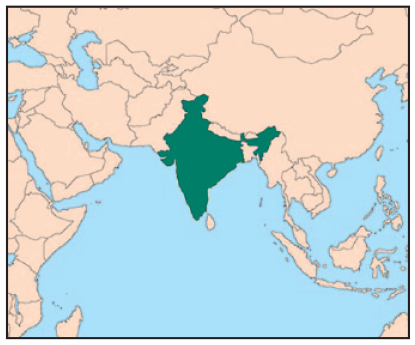
Fishing hamlets in the coastal belt of Chennai city have been sites of contestation and resistance for several decades. Chennai is an important coastal city in Tamil Nadu in India, located on the Coromandel Coast of the Bay of Bengal. According to the Government of India’s fisheries statistics,(1) marine fishing is a significant source of livelihood for 1.047 million people living in 608 fishing villages in Tamil Nadu. Nearly half of those actively engaged in this livelihood are women. The 13 kilometre-long Marina Beach on the east coast of Chennai, the capital city of the state, is the longest beach in India and the world’s second-longest urban beach (Figure 1). The coast of Chennai is occupied by several kuppams (meaning places of human dwelling), the villages of fisherfolk and lower caste settlements. These localities have become urbanized over the years with Chennai’s expansion and at present accommodate people who in recent years have gained economic mobility from employment in the IT sector. Nochikuppam is one such fishing hamlet on Marina Beach, housing more than a thousand fisherfolk families from among the most socially disadvantaged groups in the caste hierarchy. Fishers from Nochikuppam claim to be the Poorvakudi, or some of the earliest inhabitants of Chennai. The chapter ‘Forgotten Fathers’ in historian S Muthiah’s book Tales of Old and New Madras mentions the fishing community and fishing villages as part of the land granted to the British to set up an East India Company factory in 1639.(2)
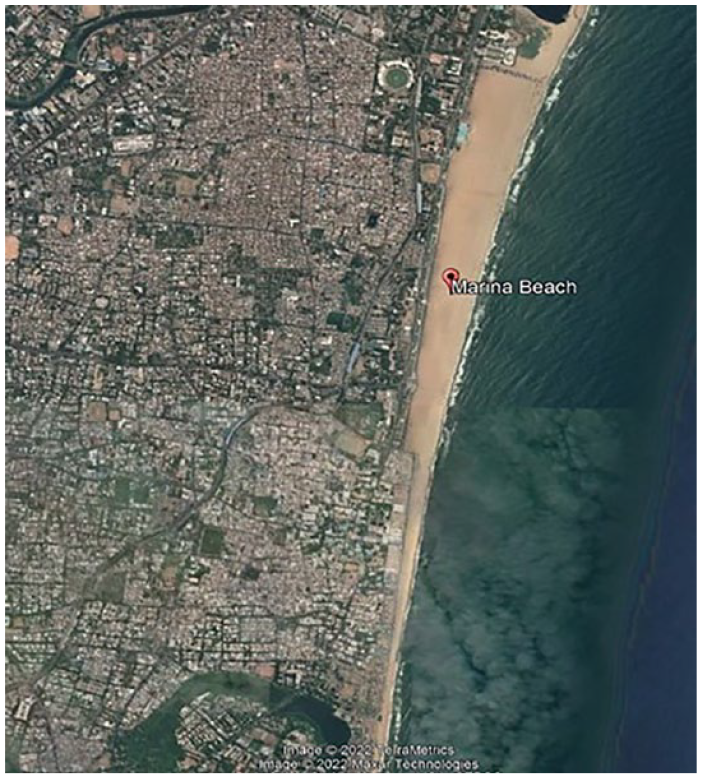
Map showing Marina Beach in Chennai
The fisher community of Nochikuppam is physically challenged by extreme events such as cyclones and tsunamis, and politically challenged by their precarious characterization by the state as “mobile” and “displaceable” populations in urban expansion processes. Kumar et al. argue that “Poromboke land” (common land not listed in revenue land records), once used for parking boats and operating shore seines by the fishing community, is shrinking along the Tamil Nadu coast due to privatization and land grabbing.(3)
Nochikuppam Ooru, the hamlet, has also undergone a drastic spatial transformation over recent years, with vertical housing complexes for the fisherfolk, separated from the beach by a main road. The land expropriated from the hamlet, now formally known as the Marina Loop Road, remains “Nochikuppam Ooru” for the fishing community. Despite the urbanized nature of the current settlement, the fisherfolk still call their locality Ooru, which means “village” in the Tamil language. The word evokes a sense of nativity, ancestral affiliation and sentimental connection with the land or place. The community exhibits a strong sense of place, belonging and solidarity as they resist displacement threats to their fish market along the Marina Beach shoreline. This field note discusses how they negotiate and resist challenges posed by urban redevelopment and preserve their sense of belonging as they affirm their territorial claims.
II. Functioning of Nochikuppam Fish Market
Nochikuppam residents run a local fish market along the Marina foreshore, in proximity to their residential spaces (Figure 2). Nochikuppam fish market includes Nochi Nagar fish market and Pattinapaakam fish market, and spans a distance of 2.5 km from Marina lighthouse to the Foreshore Estate bus stand. On a pretext of decongesting traffic and beautifying Marina Beach, the Madras High Court, on 6 February 2020, directed the Greater Chennai Corporation and the city police to evict the fish market and clear the landward side of Marina Beach along the Loop Road of squatters. The judge ordered a police vigil to keep the landward side of the beach free of “encroachments” (a word used by the judge) and to facilitate the construction of a footpath along the Loop Road.(4) The judicial order, which aims to displace the fish market, threatens the sustenance of the local economy and further challenges the community’s sense of place.
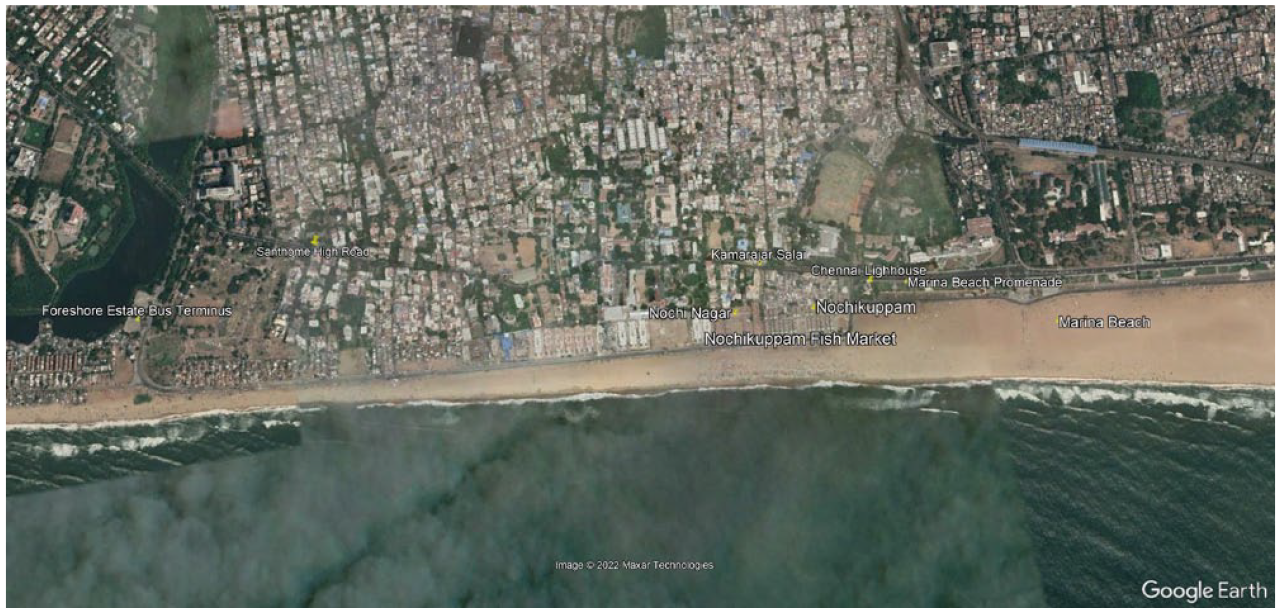
Map showing the location of Nochikuppam fish market and the hamlets
According to a local fisherman, over 5,000 families and 50,000 people live in 11 kuppams between Nochikuppam and the Foreshore Estate. Over 1,000 of these fisher families in Nochikuppam and Nochi Nagar live, as noted, in high-rise public housing complexes (known as the Pink and Green apartments) and in temporary settlements near these apartments. The Pink apartments were constructed under the Tamil Nadu Emergency Tsunami Rehabilitation Programme (ERTP).(5) The fish market that is currently threatened with displacement is active across the Marina Loop Road from these apartments, with over 300 fish vending stalls providing a living for nearly 1,000 fisherwomen.(6)
The market is a significant source of livelihood for the women in the neighbourhood, especially older women who find it more convenient than walking miles to vend fish in the streets of Chennai, given the usually hot and humid weather. Although women from the hamlet run the stalls, men occasionally step in to help during weekends. The fish stalls are open structures assembled from plastic, wood planks, thermocol boxes, portable plastic crates and aluminium sheets (Figure 3). Tables and stools made of these materials are used to display a variety of fish. The fish market is crowded on weekends as people arrive in their private vehicles to buy fresh fish. It is mainly household consumers who purchase fish from here. One of the hamlet’s older women thinks that the availability of fresh catch and the credibility of vendors attract buyers to the Nochikuppam fish market. The vendors who have traditionally run the market are unlicensed, with no formal management committee. The hamlet council, also known as the Ooru Panchayat, is the authority these vendors trust in all matters related to the fish market.
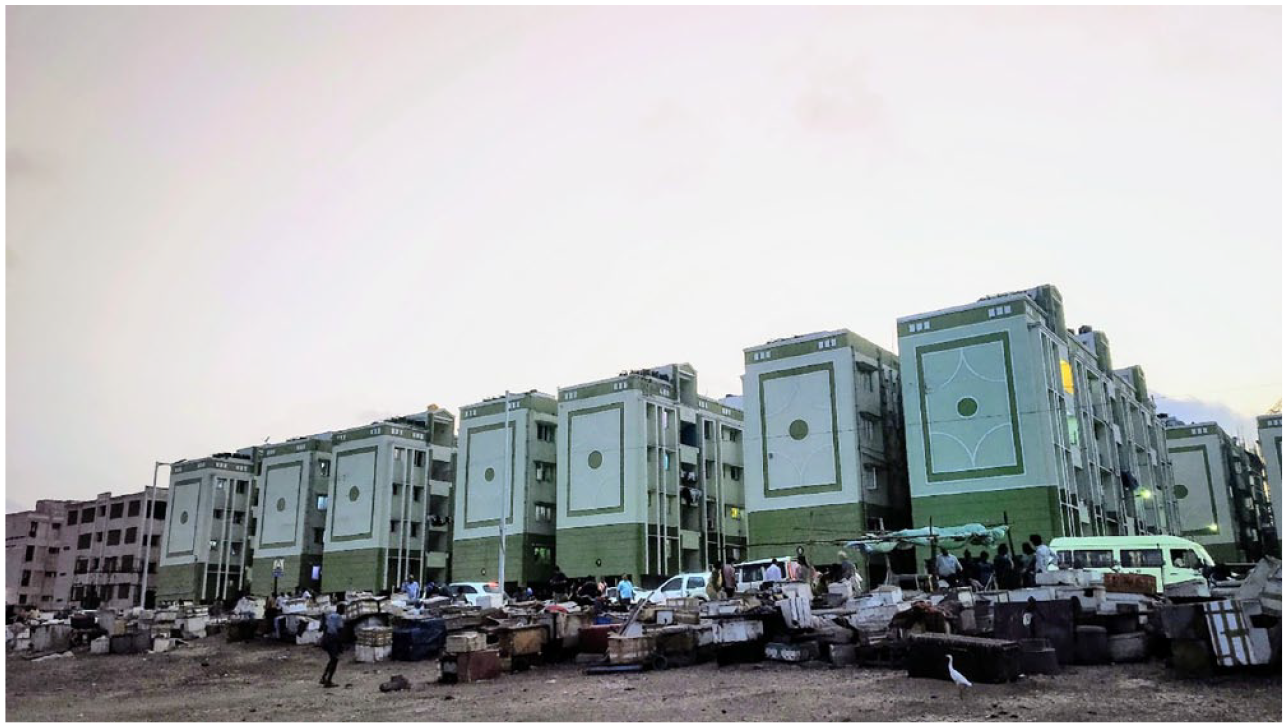
Picture of the Nochikuppam fish market and housing complexes of fisherfolk
The Nochikuppam fishers mostly use traditional/artisanal fishing boats, small fibre boats and small motorized boats for catching fish. The traditional catamarans, also known locally as Kattumaram, are made of timber logs lashed together, and are still popular among fishing communities on the east coast of India.(7) Indigenous gear, including the single-layer gillnet (Pannu valai) and three-layer trammel net (Disco valai/Mani valai) are mainly used to catch prawns. They catch a variety of shrimp, locally known as eral. Some of these varieties of shrimps are Vella eral (Indian white shrimp), Sunnambu eral (banana shrimp), and occasionally the fishers also catch tiger prawns.(8) Shore seines are also operated seasonally when conditions are favourable, and more labourers are required for this than for other types of fishing. Inshore drag nets or shore seine made of hemp or coir require 10–15 men to drag the net up the beach. Over the past years, traditional fishing nets have been modified with synthetic materials such as nylon and polypropylene. Other types of fishing gear are: bag nets (Thoori valai), trammel nets (Mani valai), rectangular mouthed bag net (Madai valai), drift gillnets (Vala valai), bottom gill nets (Adi valai), midwater gill nets (Eda tanni valai) and crab traps (Koodu).(9)
The market sells two kinds of catch – big fish from trawling boats at Kasimedu fishing harbour and live catch (Valai meenu) caught by traditional fishermen in their small boats from Marina Beach. Some of the local varieties sold in the fish market, in addition to the shrimp, include sardines, anchovies, mackerel, barracuda, sharks, kingfish (Vanjaram), crabs, seer, squid (Kanava), white and black pomfret (Vavval), red snapper, seabass, threadfin beam (Sankara), as well as dried fish prepared locally at the beach.
The fisher community is resisting the proposed relocation of the local market to a designated market yet to be constructed on land identified by the Tamil Nadu Slum Clearance Board as Open Space Reserve (OSR) land in Santhome, near the Loop Road. OSR land is reserved for recreational purposes to build parks, children’s play areas or libraries. The fisherfolk of Nochikuppam argue that the Chennai Corporation is thus violating its own law by providing land meant for recreation activities as an alternative market space. They also argue that the threatened eviction violates rule one of the Coastal Regulation Zone (CRZ) rules.(10)
The community is concerned that moving elsewhere will jeopardize the traditional rights of fishers to access sea land, and that they will lose their claim to the original market land. Since 2018, fisherwomen of Nochikuppam have held a series of protests against the eviction notices, with the support of the other 11 villages along the Marina shoreline. Their struggle must be understood alongside ongoing issues related to land and housing that we will discuss below.
III. Locating Nochikuppam Ooru in the Ongoing Struggles at Marina Beach
Both governments that have ruled Tamil Nadu over past decades, All India Anna Dravida Munnetra Kazhagam (AIADMK) and Dravida Munnetra Kazhagam (DMK), envisioned the transformation of Chennai into a “world-class city” through their Madras Vision 2000 and Singara Chennai initiatives, each of which emphasized city beautification to attract transnational investment. Marina Beach became the centre of this transnationalized bourgeois imagery with the collaboration of the J Jayalalithaa government with the Malaysian government, which in 2003 announced a mega project, the Marina Beautification Plan. These plans resonated with the visions of certain civil society organizations, like the Citizens Rights Action Group (CRAG), which had rallied for the city’s beautification and beachfront transformation for leisure activities. Ellis argues that elites in Chennai took public consultation as a participative tool in civic governance to push through their desires for a world-class city and exerted influence in city planning. These proposals and processes conflicted with the interests of many non-elite social groups in the city, especially the fisher communities, which faced the risk of relocation.(11)
Subsequently, many conflicts between these fishing communities and the state have occurred in response to beautification projects. The state envisions redevelopment of the marketplace as a part of the Marina beautification project, which includes plans for creating walkways, parks and play areas for children, smart kiosks for vendors, landscaping, a joggers’ track, a cafeteria, viewing galleries and a cycling track. Over the years, the fisher community in Nochikuppam has staged several protests to resist eviction. The community has successfully thwarted several attempts by the ruling government and the Chennai Corporation to displace them. In 1962 and 1985, they resisted intense pressure to move to another location from their existing hamlet. During one such protest against relocation in 1985, five fishermen from the hamlet were killed by shots fired by the police.
Apart from city beautification projects, public housing projects have also had a bearing on the fishers’ lives along the Chennai coast. Housing was a politicized issue that the Tamil Nadu government began to take seriously in the 1970s. Strong policies provided for the in situ regularization of several squatter settlements in the city. As per the Tamil Nadu Slum Clearance Act of 1971, the settlements of fisherfolk at Nochikuppam were classified as a slum, which in effect passed the control of this land over to the Tamil Nadu Slum Clearance Board (TNSCB). In 1972, after intervention by the board (currently the Tamil Nadu Urban Habitat Development Board [TNUDB]), tenements were built for the fishing community in Nochikuppam, replacing thatched houses and tents. In the 2000s, these by-now dilapidated tenements with the support of the World Bank were demolished to construct the new apartment complexes for fishers in Nochikuppam. In 2014, as part of the Tamil Nadu government’s slum redevelopment plan, the TNSCB relocated the Nochikuppam fisher community to temporary shelters for apartment reconstruction. The board began the project in 2015 by demolishing old tenements on the same site. Two apartment complexes were handed over to the fisher community between 2009 and 2015. The green-coloured apartment complex at the Loop Road entrance in Nochikuppam houses 628 flats, and the pink-coloured apartment complex in Nochi Nagar houses 536 flats (see Figure 5). The naming of the area “Nagar” (which means “city” or “town” in Tamil) reflected the intended change in the character of the hamlet as a constituency of the “city”.
Many Nochikuppam families who lost houses during the 2004 tsunami have been living in temporary housing in recent years in anticipation of being allocated housing in the public apartments under construction. Fishing communities from other parts of the city have sought temporary abode in Nochikuppam Ooru during other such crises as the 2015 floods, the 2016 Vardah cyclone and the 2017 Ockhi cyclone. In 2018, the temporary housing of nearly 200 families was demolished for a road widening project. According to the Housing and Land Rights Network (HLRN), these dislocated families were not provided with resettlement housing.(12) Currently, the Nochikuppam fishers are demanding that housing be allotted to 216 fishers from the community, who have been homeless for more than 10 years after losing their houses due to the tsunami. Upcoming public housing projects consist of 1,188 new flats being constructed by Tamil Nadu Habitat Development. Young people and women in the community complain about problems with the existing apartments, such as the lack of children’s play areas, a health centre and library.
Nevertheless, the community sees advantages in accepting this low-cost public housing in order to retain their claim to the land/place and their proximity to their sea-based livelihood. It is also a central city neighbourhood, and finding individual housing anywhere nearby or even further away is out of reach for many community members. The Nochikuppam fisher community, which gave up land for public housing to accommodate disaster survivors from other villages, is now demanding housing for their extended families, as promised by the government. The Nochikuppam hamlet council and the residents of Nochikuppam Ooru organised an indefinite hunger strike in 2022, demanding that their children be allocated housing in their own right in the new apartment buildings under construction.
IV. Objectives and Research Questions
The land claims of urban-dwelling communities are inextricably intertwined with livelihood and dwelling issues. These are critical, multi-layered issues in the cities of the global South, given the variety of ideas of ownership prevailing and the vast array of institutions that have a role in shaping urban dwellings and livelihoods. Studies on fishing communities in India are mainly focused on small-scale fisheries in rural areas. Recent studies, for instance, discuss the impact of wetland transformation on aquatic species and fishers’ livelihood vulnerability.(13) There is a dearth of research, however, on urban coastal spaces, particularly ethnographic studies on fishing communities and their habitat. What scholarship there is on such communities argues that many rural coastal habitats are subjected to urban expansion processes.(14) Ecologically and socially, many fisherfolk and their settlements suffer from the privatization of coastal commons.(15) Particularly in developing countries, the heavy industrialization of coastal areas affects small-scale fishing communities. It can leave water polluted and transform coastlines into industrial corridors for coal power plants, fertiliser manufacturing and ports for transporting cargo – all of which have repercussions on the lives, livelihoods and habitat of fishing communities.(16) Studies like that of Fabinyi(17) reveal that unregulated aquaculture in the Philippines, for instance, resulted in the displacement and marginalization of small fishing and farming communities, and further degraded several coastal zone areas.
Similarly, Chouhan et al. argue that large-scale commercial fishing, the use of destructive technologies and the lack of CRZ implementation have destroyed the coastal ecosystem and turned the artisanal fishing communities along the Mumbai coast into “ecological refugees”.(18) Usurping customarily held land has deprived Indigenous fishing communities worldwide and exacerbated their vulnerability.(19) Urban fishing communities are also increasingly choosing livelihood diversification, opting for urban jobs.(20) Vulnerability assessments of marine fishing villages in Tamil Nadu argue for needs-based, location-specific interventions for building resilience.(21) These studies primarily emphasize the increasing precariousness of fishing communities in global South cities, while only a few studies focus on the political organization of these communities and their ability to stake their claim over coastal spaces and resources.(22) We aim to contribute to this literature on the fisher communities’ resistance by focusing on how they exercise their agency, negotiate to claim land and contest urban redevelopment processes that are detrimental to their dwellings and their livelihoods.
Within this context, the struggles of the Nochikuppam fishing hamlet are intriguing to consider, allowing us to understand the centrality of land and a sense of place in the claim-making processes. In analysing the struggle of Nochikuppam’s fishers, this field note explores the effect of “global city” aspirations and urban aestheticization discourses on the life and livelihood of a coastal fishing community in India. It enables us to consider how a place can become reduced to “urban infrastructure” and to explore the consequent negotiations that communities must undertake to claim their space. How do the activities of the fish market and the contestations around it shape and reshape this place? How does the fragmentation of place resulting from infrastructure development transform this community’s land claims and sense of belonging? How does the fishing community of Nochikuppam assemble resistance and solidarity in response to practices of the state and of elements within civil society that ignore the links between their economies and dwellings and their socio-spatial life and practices? In the context of this hamlet “becoming” urban infrastructure, this field note enquires how fisherfolk organise themselves to preserve their sense of belonging and negotiate with the relevant institutions as they affirm their territorial claims.
V. Materials and Methods
Massey’s conceptualization of space(23) is useful in helping us understand space as a product of interrelations, constituted through interactions, and as a sphere of multiplicity, complexity, heterogeneity and the continual processes of becoming that space embodies. Ethnographic methods were used in this study to understand the Nochikuppam fisher community’s sense of place and their everyday engagements. Semi-structured interviews and participant observation were the primary data sources we used to understand the community’s sense of place and how they articulate their resistance. We conducted field observation and 16 open-ended interviews with fishermen, women fish vendors, youth and Ooru Panchayat leaders over two periods: January–March 2020 and April–July 2022. Fieldwork had to be conducted intermittently due to COVID-19 lockdown and curfews imposed in India after March 2020. A purposive sampling technique was employed to select participants. The interviews were carried out to understand, in the words of Faraday and Plummer, “the inner experience of individuals, how they interpret, understand and define the world around them”.(24) In this context, these interviews helped us access the narratives and articulation of claims over the place made by the fisher community.
Apart from interviews, participant observation was a useful tool to get a sense of the place, everyday practices and the organization of the marketplace. This helped us to understand the activities associated with the fish market and its interconnection with dwelling, fishing activities, allied occupations and other socio-spatial practices of this community. Our initial entry to the field was as customers in the market. As we engaged with the vendors while buying the fish, we observed the organization of stalls and the functioning of the market. As we waited for the fish to be cleaned, we struck a chord with the vendor women as we asked them about the displacement threat. This eventually led to more extended conversations during which they shared their stories about the hamlet and the market. During our fieldwork, we took strolls on the beach, engaging in conversation with fisherfolk as we observed the leisure activities of men and youth on the beach. We also regularly attended their protests and sat beside them as a protest participant. This provided insight into their issues, demands and the modalities of their negotiation with the government, as we got the opportunity to listen and talk to leaders of the Ooru Panchayat. In the sections that follow, we explore a hunger protest for housing, held on 18 April 2022, which we also observed as participants.
Government reports, blogs, news articles and reports about the Nochikuppam were other significant data sources for understanding public opinions and perceptions about the fisher community and their struggles for coastal space. These documents allowed us to critically analyse various perspectives on the Madras High Court order on the eviction of the fish market, and thereby also understand media, state and civil society’s visions for the city’s development. Various regional and national dailies in English, such as Times of India, DT Next, The Hindu, Mylapore Times, Newsminute, Indian Express and online opinion pieces about the Nochikuppam fish market were juxtaposed with the fishers’ narratives. Newspaper reports and articles offered a prism through which to understand the city’s urban fragmentation politics. These methods together enabled us to take account of the situated histories and embedded practices around the sea–land interface and to recognize the fisher community’s affective and agential potentials that emerged from the complex spatio-political relations and contestations in the city regarding coastal space.
VI. Fisher Hamlets as Fragments and Their Politics
First, we ask: can we look at the fishing hamlet of Nochikuppam as an urban fragment? We use fragments as a concept because, as McFarlane argues, urbanization proceeds through fragmentation.(25) We agree that even though the process of fragmentation has been much discussed, “the products of [this] fragmentation – the fragments themselves – tend to receive less attention”.(26) Looking at the hamlet and the market as an urban fragment implicitly means attending to the nuances of the place – its politics, socio-spatiality and material realities. McFarlane states:
“By understanding fragments, we could also attend to the ways fragments of the material city not only serve as products of capitalist urbanisation but as elements differently composed through diverse political relations. When we focus on fragments, the prospects of the city, its policies, political economies, socialities, tensions, and territories come directly into view . . . We can ask how inadequate and broken material fragments in the economic margins of the Global South become differently politicised in cities.”(27)
Marina Beach, with its boulevard, public offices and universities on the east side, and the fisher hamlets with markets on the west side, presents a contrasting spatiality, as seen in Figures 4 and 5. Fragmentation processes of the coastal space began with colonial urban renewal projects in the 1880s. Sir Elphinstone, a British officer, gave the beach a facelift by building a promenade. It is an important site for tourist recreational activities, a popular space for joggers, and the site of numerous memorials and statues of political leaders and reformers. Because of Nochikuppam Ooru’s location in a strategic area (near the main road, which houses several public offices), the community has been under constant threat of eviction because the main road is frequently used for commuting by high-status government officials, judges and ministers. The Loop Road was constructed in 2014 to divert traffic away from the arterial main road, the Kamaraj Salai/Santhome High Road. The Loop Road cuts through the original dwelling spaces of the fishers and the beach and inhibits the community’s access to the sea.
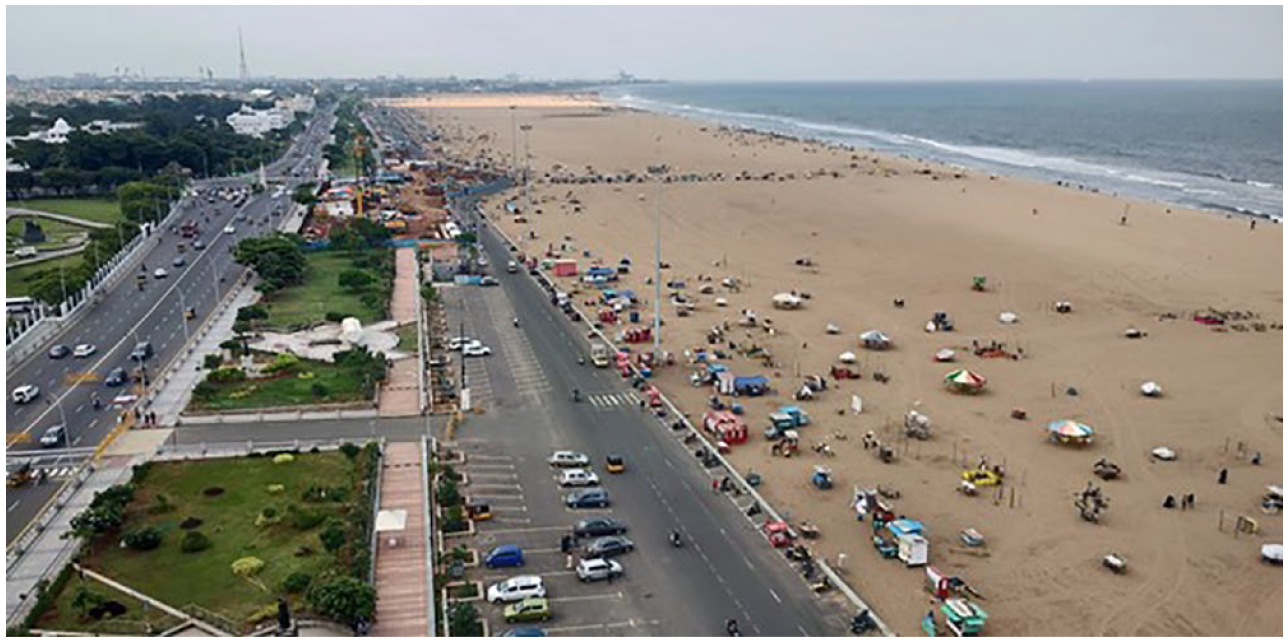
The Marina Beach Promenade, Chennai, adjacent to Nochikuppam hamlet
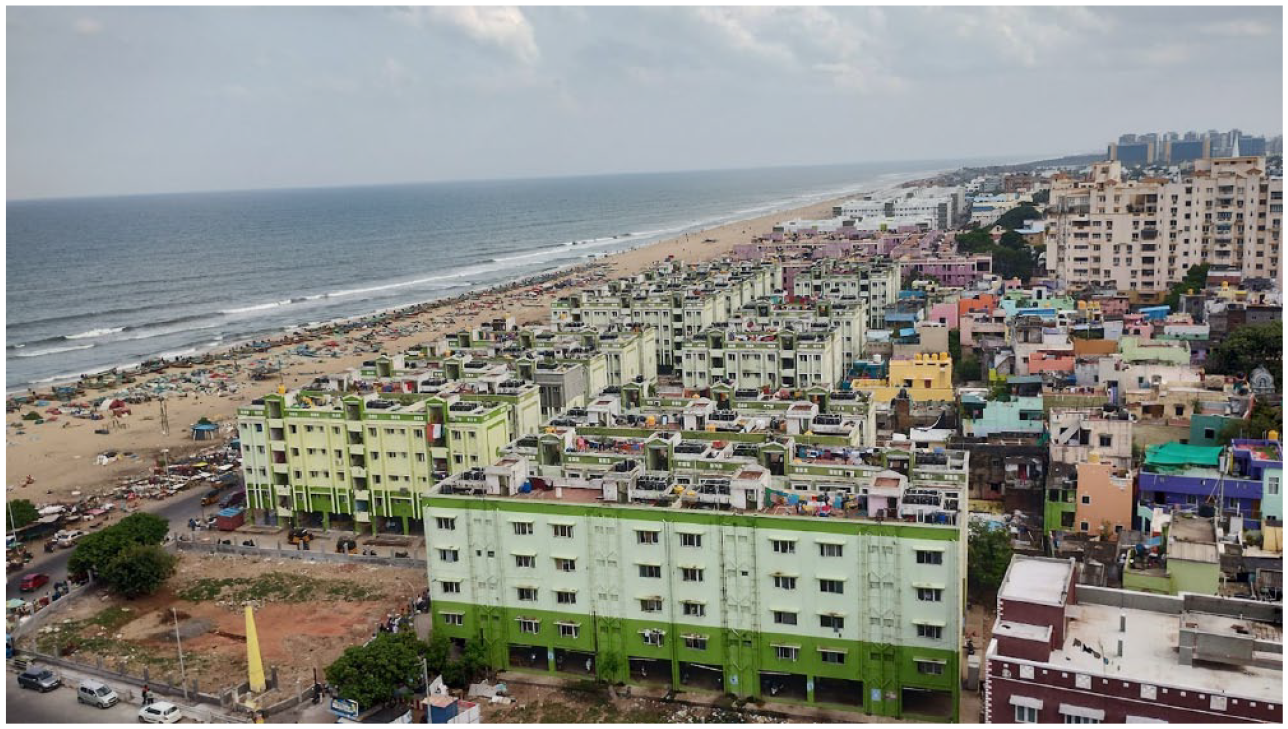
Housing complex of fisher community at Nochikuppam, Chennai
Laying the road through their already congested dwelling places placed the fishers in a precarious position.(28) Ravi, a middle-aged fisherman, argued, “If the judge finds traffic on the road to his office as a problem, can’t they block the traffic when the judge comes for 10 minutes? Why should the entire road be blocked and reserved for VIPs [very important people] and traffic diverted to the Loop Road?” The Marina Loop Road had been a mud road; it was not open to public transport initially due to an assessment of the potential environmental impacts and livelihood threats to fisherfolk. In its original state, it was exclusively used by the fisher community to access the sea and was open to private transport for just two hours daily during peak traffic. In 2016 the road was widened further towards the sea and opened to private vehicles with no time restrictions. It was also transformed into a public route for state transport cooperation buses operating between Kovalam and Thiruvottiyur. The Marina Loop Road has essentially transformed the neighbourhood by serving as a public infrastructure facility open to all users. The amount of traffic caused by the commuting vehicles was daunting and unsafe for locals and prevented them from freely accessing the shore. The evolution of Nochikuppam Ooru over time is consistent with McFarlane’s argument that urban capitalist growth necessitates the fragmentation of urban spaces and sociality.(29)
Newspapers and opinion pieces describe the fishing hamlet as a space intended for city beautification and development as a recreational area. In debating the legitimacy of the fisher settlements, these media narratives use the language of encroachment, invalidating the existence of the Ooru people’s lives anywhere beyond the public housing complexes. A newspaper article about the Marina Loop Road portrays it as a yet-to-be-realised leisure destination that the city rightfully owns.(30) Another article on the High Court’s decision to evict fish market vendors was titled “Chennai: Now walk/jog along Marina Loop Road”.(31) In this case, eviction of the fish market was justified to support the proposed plan to build pavements on the seaward side of the Loop Road. Only passing reference is made to the fishing community, who are portrayed as encroachers who have to be relocated so that “Chennai citizens” can walk or jog along the beach side of Marina Loop Road. Another newspaper reported that the civic body plans to create a park on the eviction site.(32) These reports conceive of the Nochikuppam fish market only as land meant for the city’s aestheticization. These narratives nullify the existence of the Ooru beyond the housing complexes, reflecting the dominant visions of a civil society that rallies for causes that are not in the interest of the fishing community. These reports also contribute to fragmenting the identity of the place (Nochikuppam Ooru) by decoupling the fishers’ dwellings from their livelihood.
The concept of the fragment also introduces the possibility of exploring difference.(33) Conceptualizing a fisher hamlet as an urban fragment enables us to understand the different languages and narratives of negotiation and politics articulated by the fisherfolk. Considering the fisher hamlet as a fragment promotes an understanding of the place beyond seeing it essentially as a part of built urban infrastructure. It makes us attend to the organization of the materialities of the place and to how differently these are politicized. Urban materialities can also act as urban resistance. In Nochikuppam, the sea–land interface is not only a space for livelihood-associated practices like fishing and selling fish but also for interaction with the fishers’ material world. It is a space for parking their boats, and mending fishing nets, a location for makeshift stalls for vending, and for huts where fishermen spend their leisure time playing cards.
Understanding the role of materialities gives us insight into how urban inequality is produced.(34) Socio-material practices in contested places are shaped by the nature of the relationship with the state and by ecological conditions, which can determine even such everyday material practices as whether to invest in upgrading a business or improve the structure of the stalls. Through constant interventions such as giving or denying the licence to sell, terming people encroachers and forbidding them to use the land, the state plays a significant role in producing materiality of the place. The fish vending strip along the Loop Road houses makeshift stalls made of wood and cardboard, with tarpaulin roofs, and thermocol iceboxes are heaped behind these stalls (see Figure 3). Fishermen park their boats and catamarans, and keep their fishing nets and fresh catches on the beach. The beach is also used for allied activities such as dry fish making. Iceboxes, trays and other materials are kept at the stalls given the lack of space in people’s apartments, and the shrinking of their access to the commons by the construction of the road between the sea and their dwelling spaces. One of the fishermen pointed out that they are not like street vendors in Parrys, Chennai, who can pack their goods and leave after the day’s business. They are not transitory vendors, he emphasized, but inhabitants of their Ooru who have no plan to leave the place. Here the sense of place does not draw on a romanticized narrative. The land is central to their living and dwelling as fishers.
Nevertheless, despite being marginalized by urban expansion processes and court verdicts, the fisher hamlet continues to function as a place of dwelling and livelihood for the community. This is largely a function of the community’s active internal governance structure, the Ooru Panchayat, the 45 members of which are selected equally from each of the Ooru’s three sections. Traditional panchayats hold a vital role in managing common resources along the Tamil Nadu coast.(35) The Ooru Panchayat serves as the internal governance system of the Ooru, which Nochikuppam and Nochi Nagar constitute. The democratically elected Ooru Panchayat handles a range of responsibilities, from conducting the Ooru thiruvizha (village festival) to heading up negotiations with the state agencies. The community does not elicit support from other urban groups, whether NGOs or civil society organizations, as they are wary of organisations with vested interests.
The Ooru Panchayat manages disputes and works towards the common good of the village. Its members also regulate fishing activities by restricting or prohibiting the use of harmful types of gear.(36) It also conducts activities for social cohesion, such as organizing religious festivals, the Ooru thiruvizha and protecting the village temple. In one such attempt to protect the village temple from land usurpation by private builders, the council filed a representation under the name of Meenavar Grama Sabha (Fishers’ Self-Governing Body) and petitioned the Madras High Court and the religious endowments department to prevent the demolition of the temple and to restore the land of the Ellaiamman Pazhandi Amman, the deity of fisherfolk.(37) The council argued that the land was granted to them by the British before Independence, and that 50 grounds of land(38) had been given to the temple.(39) For the last five years, the struggles have been led by this elected panchayat and the Ooru Thalaivar (headman or the leader of the hamlet council). Having a self-governance structure like the Ooru Panchayat, which is constantly engaged in issues pertaining to the community, strengthens the community in its struggles. In this context, it is essential to look at the language of claim-making and modalities of negotiations deployed by the fishers to defend their hamlet. A member of the Ooru Panchayat, in an interview with us, said, “We are like fish; there is no life for fish outside water. We do not ask for housing in Perambur or Vilivakkam [places in north Chennai with huge housing complexes built by TNUDB]. Our livelihood is here, and we cannot move out.” We will fail to understand the intricacies of this case if we see the fish market and Nochikuppam Ooru as separate entities.
The Ooru Panchayat spearheads the protests and negotiations, and its members decided to fight in court against the proposed displacement of the market. In December 2018, the Madras High Court justices Vineet Kothari and Anita Sumanth had demanded that the commissioner of Greater Chennai City Corporation, D Karthikeyan IAS, devise a comprehensive action plan for cleaning up the beach, including the Loop Road, with the support of NGOs, with a deadline of 1 January 2019.(40) The city corporation commissioner and police commissioner called up the representatives of Nochikuppam’s Ooru Panchayat and the South Indian Fishermen Association’s President, K Bharathi, for a discussion at the Ripon Building, the headquarters of the city corporation office. They were told to move the market to a new location behind Santhome Church, where new markets would be constructed. The Ooru Panchayat did not accept the proposal. They sensed deception, as buildings cannot legally be built on OSR land. Once more in 2020, Madras High Court ordered the eviction of the fish market; again the Ooru Panchayat thwarted a number of attempts to evict the fish market by filing appeals and counter-petitions and by resistance and protests. Tamil Nadu Meenavar Makkal Sangam (Fishermen’s Association) took the matter to the National Green Tribunal, alleging violation of the CRZ notification of 2011 and 2018, which recognizes the traditional rights of fisher communities to use the beach. As per the notification, the National Green Tribunal directs nodal agencies to prepare cadastral maps towards the Coastal Zone Management Plan (CZMP) of Tamil Nadu. The maps are supposed to mark and show houses of fisherfolk, common properties belonging to the fishing communities, fishing grounds, fish drying spaces, boat landing centres and any other social infrastructures such as traditional temples. In July 2022, the fishermen of Nochikuppam protested against the exclusion of such details in the CZMP.(41)
In addition to resisting the move to shift the market, since April 2021 the Ooru Panchayat has been protesting for the allocation of housing for their children, as noted above, as younger families are currently forced after marriage to live with their parents in congested flats (Figure 6). One of the hunger protests for housing we observed during a field visit was organized by the Ooru Panchayat, and loudspeaker announcements were made requesting the presence of fishers, autorickshaw drivers and those engaged in cattle rearing to extend solidarity to the protest. The protests included both men and women from the hamlet. The hoardings in the protest bore photographs of Singaravelar, a freedom fighter and working-class leader who hails from the fisher community. It was done symbolically to contest their representation as “encroachers” in the narratives of the state and media and to assert their role in progressive social movements and the history of the city’s making.
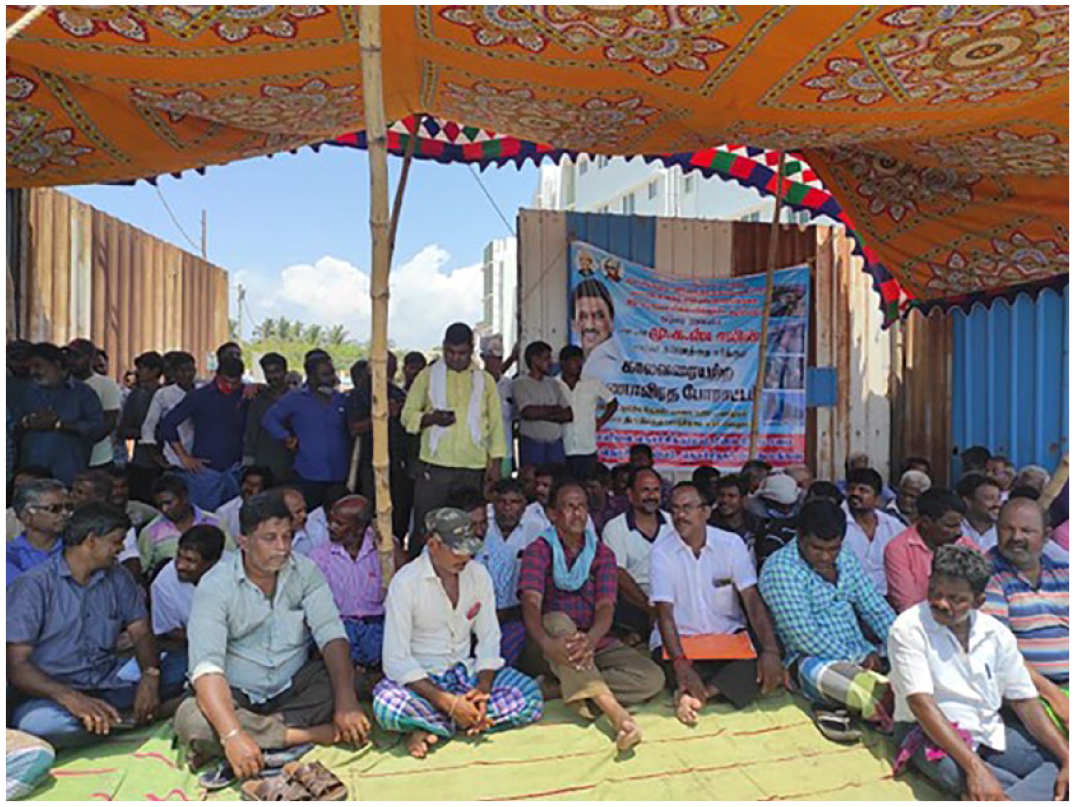
Hunger protest demanding allocation of houses for the extended families of fisherfolk of Nochikuppam
Fish vending is a significant livelihood for the community. However, our attempt to argue against the decoupling of livelihood and dwelling for fishers is not to essentialize the community’s identity in terms of their traditional occupation. Many of the younger generation do not rely on fishing for a living, but work in various occupations in the city, including in the service sector, especially the IT sector. At the same time, this does not dissuade them from standing for the cause of the Ooru, as they have a strong sense of place, rooted in ancestral connections to the land. Their claim over the place emanates from the presence of their Ooru as the place of dwelling long before the Marina Loop Road came into existence. A local youth group member argued thus:
“To give up their land for housing board buildings was a mistake our forebears committed. They could not negotiate well as they were in a disadvantageous position owing to their lack of education. There is a lack of amenities such as a playground, gym and library. We are not allowed to have those amenities which are quite universal in current urban public housing.”
During our fieldwork, the youth group was at the forefront of organizing protests for the allocation of new housing for extended families still living with their parents in cramped apartments of only 300 square feet. Although children of original allottees, by the time they were allotted flats, had already grown up and had families of their own, they were still counted along with their parents as a single family unit and provided with only one flat. These younger people believe, as indicated above, that this situation results from shortcomings in their forebears’ engagement with the state during the intervention of the TNSCB. They are better educated now and are prepared not to repeat similar mistakes. They provided examples to illustrate this, explaining how they had negotiated during the construction of the apartments to ensure that certain amenities were incorporated into the building complex, such as speed breakers and proper waste collection points. Their dissatisfaction with the design of the buildings and the lack of amenities like libraries and recreation centres, despite being a public housing structure inside the city, reflects their aspiration to live an urban life. These aspirations on the part of the younger generation do not conflict with community interests. While sharing their thoughts, one of the young men, who was employed in an office, emphasized the need to talk to the Ooru Thaliavar and Ooru Panchayat as community leaders.
Fish vending in Nochikuppam has transformed over the years, and it has become a significant activity, especially for older women, to make a living from the markets. One of the dry fish vendors in the market used to sell fresh catch by carrying it in a basket over her head to places as far away as Velachery. She began selling dry fish at Nochikuppam as age-related infirmities made it difficult to carry fish and sell it at a distance. Gokila, a 70-year-old woman who had been running a stall for the last 30 years, underlines the importance of seeing the place as a fisher hamlet. Disapproving of the market’s relocation, she said: “We will not move away from this place. This is convenient for us. If we move away, we will miss the buyers and the space to function properly. Look at those people [pointing at men unloading their catch next to the vendor]. Is it possible to do that in a market?” Women showed faith in the Ooru Panchayat’s leadership in challenging the eviction.
The fisher community of Nochikuppam also draws on broader support from fisher collectives across the region. Previously, when served with an eviction notice in 2018, the community fought it by drawing solidarity from fisher communities residing along the Tamil Nadu coast. If the government decides to go ahead with the threatened eviction, the fisher community of Nochikuppam look forward to mobilizing the support of fishers across the state. Nochikuppam Ooru relies in its struggles on this horizontal solidarity of fisherfolk’s collectives. The current Ooru Panchayat leader emphasized the importance of this horizontal solidarity and said that other sources of help are unnecessary: “No outside organization is associated with us. It is enough to have our people. We are aware that our demands are just, and so is the government. We will not let other organizations gain the limelight at our cost. We will get help from our people!” When issues escalate, they can expect help from Meenavar Nala Sangam (Fishers’ Welfare Association). The fisher community exhibits mobility of various sorts. It reaches from the seas of Chennai to the IT sector in which some of the community, notably younger people, find their livelihood. The horizontal solidarity with fellow fishers makes it possible to go beyond a dispute over a place to sell fish and to articulate it with broader issues of livelihood and dwelling, part of the politics of fragmentation. The Ooru as a whole has to be considered the fragment, not just the market.
VII. Conclusion: For a Progressive Sense of Place
Nochikuppam residents do not only generate criticism about the plans being made for their community, they also continue to organize and generate spaces of potentiality – not only material space to creatively occupy and claim land, but spaces of resilience evident in fisherfolk narratives, and of collective resistance against their essentialization and displacement. Without the support of any political party or civil society organization, the fishers are organizing and asserting their agency through their Ooru Panchayat/hamlet council and fishers’ collectives.
Fish vending on the Loop Road is a space for collaboration and symbiotic practices. For example, within that strip of land parallel to the road, fish merchants function alongside fishers and women supported by the vendors, who make a living by cleaning the fish. They have their territorial practices and arrangements, which may be disturbed if they are forced to move away from the sea. They share a history that comes from living together and sharing struggles, knowledge and resources. It is not a struggle for vendors only but also for fishers who use the beach for work and leisure, and those who do allied work such as drying and cleaning the fish. These practices intricately link neighbours, families and communities to make the urban common. The fisher community challenges accusations that they are encroaching on this land and creating traffic congestion. They point out that the presence of state-built infrastructure around the beach, including parks and recreation spots, along with the presence of government offices, invites more traffic than the fisher community generates.
Despite an unfavourable latest court decision, the community look forward to continuing their fish vending without moving to the proposed market. They are unwilling to move from their current location, but if pressure persists, they say they would consider moving their businesses further towards the sea from the road. The community have a strong sense of agency, as is evident in lines of livelihood-based community solidarity, extended by Meenavar Nala Sangam arguing their case and the leadership of the Ooru Panchayat in negotiating with the state. The sense of ownership over coastal land and the solidarity they can draw on from the fishing community across the Tamil Nadu coast strengthens their struggle.
Doreen Massey has offered a way to bring out a progressive sense of place in the politics of the urban.(42) Even as they assert roots in Nochikuppam, the fishers of Marina Beach offer a progressive sense of place − an idea that challenges the essentialization of place. This progressive perspective views place as processual, a site of multiple histories and identities. The place is not a bounded entity but is interrelated to places and processes beyond it. Just as Massey envisaged a global sense of place, these fishers build trans-local connections and fisher networks, in the sense that events adversely affecting one fisher hamlet bring in other hamlets outside the city to extend solidarity and protest. Fishers exhibit a strong sense of place and of belonging to their Ooru. Land and place are central in their narratives. Their sense of belonging enables them to argue for their right as a community to continue dwelling on land converted into a road and its premises, designed for Chennai’s leisure activities. As Pugalis and Giddings contemplate,(43) theirs is a struggle not only for the right to the city but also a renewed right to urban life − to be in the city, access urban spaces and participate in the production of spaces different from imageries that exclude them.
Footnotes
Acknowledgements
We express gratitude to Professor Solomon J Benjamin for offering us the course ‘Infrastructure and Housing in Developing Countries: Emerging Challenges and Opportunities’, which gave us valuable insights to conduct fieldwork and thus reflect upon critical issues affecting coastal communities of cities in the global South. We are thankful to the fisher community of Nochikuppam and the Ooru Panchayat for their generosity in sharing their experiences. We thank the two anonymous reviewers for their invaluable feedback on the initial draft.
11.
Ellis (2012); also  .
.
15.
Cabral and Aliño (2011); also .
22.
Budhya and Benjamin (2000); also .
38.
A ground is a traditional land measurement unit, equal to about 203 square metres.