




Abstract
A new era of global interventionism in African cities is emerging, the implications of which for existing claims to urban space are poorly understood. This is particularly true for the claims of farmers. Despite being a ubiquitous feature of many African cities, urban agriculture broadly exists in a conceptual limbo between rurality and urbanity, largely invisible to urban governance and substantive scholarship. Based on the case of Beira, Mozambique, in this article we make urban agriculture empirically and conceptually visible within the context of emerging debates on the urban land question in Africa. Through a historical–political analysis, we demonstrate how urban farming has constituted a distinct feature of Beira’s urbanism, which has evolved amidst successive and contradictory state-land regimes. Moving to the present day, we demonstrate how a new urban regime has emerged out of a coalition of municipal leaders and international donors with the aim of erasing all traces of urban agriculture from the city through urban ‘development’. The findings demonstrate that there is a need for a better understanding of the manifold claims to urban space, outside of slum urbanism alone, in contemporary land rights debates. We conclude by arguing that there is a need for a substantive land rights agenda that transcends the prescriptive categories of urbanism and rurality by focusing instead on the universal land question.
Introduction
A new era of urban governance and interventionism has emerged for African cities, manifested in global policy agendas, competing epistemologies and utopian masterplans, each promising a better urban future for the continent (Barnett and Parnell, 2016; Brenner and Schmid, 2014; Noorloos and Kloosterboer, 2018; Parnell, 2016; Watson, 2014). With the eyes of policymakers and scholars currently fixed on an imaginary horizon, however, little is known about the manner in which urban transitions will relate to existing claims to urban space. At the same time, debates on urban land rights in Africa have remained largely speculative and poorly developed (Parnell and Pieterse, 2010; Zoomers et al., 2017). Thus, the urban land question has emerged as an issue of urgent analytical and political consideration, starting with the need for grounded accounts of urban transition and the manifold claims to urban land they imply (Parnell and Pieterse, 2010; Roy, 2015; Steel et al., 2017; Zoomers et al., 2017).
In Beira city – Mozambique’s fourth largest municipality – the urban land question reveals a set of claims to urban space that are not commonly understood to be urban. Here, amidst the informal bairros and colonial relics, we find a city whose built environment is punctuated by agricultural land use. Neither peripheral nor rural, agriculture is practised both at home and in centrally located wetlands, typically by women alongside other livelihood activities. Urban agriculture has been a historical feature of Beira since its establishment in the late 19th century, initially practised under the radar of the racist colonial planning apparatus (Sheldon, 1999). After Mozambique’s independence in 1975, the state’s stance was drastically reformulated bringing urban agriculture to the foreground of the country’s socialist liberation ideology. As a result, nearly 9000 ha of land were formally demarcated as urban green zones and the government introduced support programmes for urban farmers (Sheldon, 1999). After the abandonment of Mozambique’s socialist experiment in the late 1980s and the dawn of the neoliberal era, the green zone support programmes continued.
Urban green zones were part of a nationwide strategy implemented in other major cities throughout Mozambique, allowing urban agriculture to become an inherent feature of the country’s post-colonial urban ideology (Marshall and Roesch, 1993; Roth et al., 1995; Sheldon, 1999). However, Beira has a history of political contention vis-à-vis the central state, which sets it apart from other Mozambican cities. Since the introduction of decentralisation reforms in the late 1990s, the city’s unique political culture has given rise to successive city governments seeking to break free from the ideological and political control of the central state. Thanks to the city’s strategic relevance and the charismatic leadership of the current mayor, who has been in power since 2003, international donors have been lining up to support the municipality’s development efforts, forming a new urban regime comprised of local and international actors (Shannon, 2019). Breaking with Mozambique’s post-colonial ideology, Beira’s regime has drastically reformulated the place of urban agriculture in the city, seeking its systematic erasure from within the city limits.
The new ideology has been elaborated in a masterplan designed by Dutch engineering firms and funded by the Netherlands. Under the slogan ‘A safe prosperous and beautiful Beira’, the Beira Masterplan (BM) reflects many of the modernist aesthetics of colonial Beira. Aided by Dutch technologies, the BM details a future of orderly middle-class urbanism premised on the engineering of wetland agricultural green zones into prime real estate areas. Despite being premised on the wholesale displacement of historical urban agents, the BM makes no reference to these existing claims to urban space, simply depicting an urban future free of agriculture. Farmers, who are neither part of this vision nor financially eligible to inhabit it, have effectively been reduced to a class of ‘always necessarily dispossessed’ within the context of the city’s development vision (Roy, 2017: A3).
Beira’s current urban development policy towards urban agriculture is illustrative of a broader antagonism towards urban agriculture shared by many African governments and international donors, making urban farmers a distinctly vulnerable category of urban land user (Halloran and Magid, 2013; Shillington, 2009). Despite its vulnerable and ubiquitous nature, urban agriculture has been largely overlooked in contemporary debates on urban land rights. While urban and rural scholars have championed the rights of slum dwellers and peasants (Claeys, 2018; Pieterse, 2016), urban agriculture has been lacking in substantive deliberations, reduced instead to developmentalist concerns about urban food security (Crush and Frayne, 2014; Frayne et al., 2016). The political and theoretical marginalisation of urban agriculture has therefore rendered urban farmers largely invisible amidst the growing global competition for Africa’s urban land.
In this paper, we argue that the case of urban agriculture in Beira shows how agricultural land in African cities deserves more attention in order to address the process by which the current donor–city government coalition and the master planning systematically and yet tacitly displace vulnerable populations in the name of building a new, sustainable and resilient city. Below, we first review major debates that address urban land in Africa. We then introduce the case of the Maraza New Town initiative, planned through the BM. By making visible the often-overlooked category of urban agricultural land, we seek to contribute to a more holistic understanding of the urban land question in Africa within the context of changing urban land regimes and the new interventionism.
Land and farmers in African cities
Africa’s urban land question
Since the global urban age was declared by the United Nations in 2008, urbanisation has become an organising principle of contemporary development debates. Although this declaration was soon proven to be methodologically unfounded, it has nonetheless taken on a reality of its own in the political economy of global development (Brenner and Schmid, 2014). A new era of global urban governance has emerged, culminating in global agendas such as the New Urban Agenda (NUA) and Sustainable Development Goals (SDGs). For many cities in Africa, this urban era is expected to bring new resources, claims and epistemologies, which will fundamentally change the nature of African urbanism (Barnett and Parnell, 2016; Parnell, 2016; Steel et al., 2017; Zoomers et al., 2017).
Debates on the urban era and its implications for African cities are still in their infancy, with the views of scholars ranging from concern to cautious optimism. On the one hand, scholars have observed the emergence of numerous ‘nightmare’ plans throughout the African continent, where utopian futures have sought to erase all traces of the real city (Noorloos and Kloosterboer, 2018; Watson, 2014). Behind these plans are a range of urban epistemologies that have similarly been critiqued for their techno-rationalist and market-based understandings of urbanism and urban change (Brenner and Schmid, 2015; Parnell, 2016). On the other hand, scholars have seized upon the momentum behind Africa’s urban development as an opportunity for progressive policy innovation, calling for a closer engagement of urban scholarship with real-world urban politics (Parnell and Pieterse, 2015; Parnell and Robinson, 2012; Pieterse et al., 2017).
Amidst debates on global institutions, epistemology and nightmare visions, it has become increasingly clear that the urban land question is both urgent and largely overlooked. For if one thing is inevitable within the context of urban transition, it is the fact that established claims to land will not go unmodified. This holds true regardless of the transition in question, be it smart, sustainable or resilient. Urban development is always premised on land, which in the context of African cities is owned, governed and toiled over by a variety of urban denizens. How these established claims will relate to the new claims associated with urban development is unclear, while it will no doubt be a crucial determinant of Africa’s urban future. This insight requires a complementary line of urban research in Africa, focusing on the claims-making and displacement inherent in urban transitions (Steel et al., 2017; Zoomers et al., 2017).
For example, Roy (2015: 817) argues that ‘the urban question is a land question’ and goes on to ask ‘who can count as the subject that can claim home and land?’ (Roy, 2017: A3). According to Roy, the urban land question requires an analytical understanding of ‘the urban’ as a distinct mode of territorial governance. It shapes urban subjecthood by creating distinct benefactors of urban land, while displacing those who fall outside the delineations of urban subjecthood. Thus, in contrast to current debates in urban theory, this perspective is not concerned with the ontological nature of the urban, but is instead focused on the techniques of governance associated with urban territories (Roy, 2015).
In debates on African urbanism, Parnell and Pieterse (2010) argue that land rights constitute the foundation upon which understandings of the right to the city should be built, while noting that substantive deliberations of urban land rights are poorly developed in comparison with rural land rights. In a similar vein, recent work on urban land grabbing has led scholars to observe that land rights debates have evolved in separate containers pertaining to the rural and urban spheres (Zoomers et al., 2017). The majority of global policy mechanisms regulating land grabbing have been developed for the rural container, making such mechanisms poorly suited to the specific circumstances of urban land acquisitions. These contributions have pointed to the conceptual and political limitations of rural/urban dichotomies within the context of substantive land rights agendas (Steel et al., 2017).
Locating the farmer in African urbanism
Agricultural land use is a ubiquitous feature of urbanism in many African countries (Redwood, 2009). In some of those countries, urban agriculture has historically been sanctioned and supported by the state. One such country is Mozambique, where according to the World Bank (2009: 142) more than 50% of the urban population derive their main source of income from the agricultural sector. However, more often than not, African urban governments do not recognise urban agriculture as a legitimate claim to urban space. Informed by modernist conceptions of urbanism, urban agriculture is often considered inherently rural and antithetic to urban progress. For many planners and administrators in Africa, urban farming appears to be a contradiction in terms and whose very existence serves to undermine urban development (Halloran and Magid, 2013; Shillington, 2009). In practice, this means that the millions of urban farmers throughout Africa have found themselves systematically marginalised and without a legal basis to negotiate their claims.
The plight of informal African denizens has recently been the subject of burgeoning debates on African urbanism. Yet, urban farmers appear to occupy a somewhat ambiguous position with regard to associated concepts of urban subjecthood. Amidst the frequent references to slum urbanism and informal entrepreneurship, urban agriculture has rarely appeared as a signifier of African urbanism. This omission is illustrated in Pieterse’s evocative call for a new paradigm of African urban change: At the heart of this new paradigm is the subversive idea that our greatest resource and opportunity to solve the African urban crisis lies with the people who effectively build the cities through their tenacious efforts to retain a foothold there – the agents of slum urbanism. In other words, instead of regarding the urban poor and excluded urbanites as the problem, we should recognise the energies and ingenuity that they marshal to retain their place in the city, despite the odds against them. (Pieterse, 2016: 204–205)
This is a powerful statement, particularly because it is part of a broader academic agenda seeking to redefine the role of urban scholars by engaging in real-world urban politics (Parnell and Robinson, 2012; Parnell and Pieterse, 2015). However, bottom-up city-making is equated here with slum urbanism. While it is perhaps presumptive to assume that such a statement excludes urban agriculture, as urban farmers are also the agents of slum urbanism, it nevertheless reflects a broader ambiguity in contemporary debates on African urbanism. Exceptions aside (De Boeck, 2011; Sheldon, 1999), one is hard pressed to find any references to urban agriculture as an expression of urban agency and city-making. Thus, not only do we know very little about the specificities of urban agriculture in relation to African urbanism, but also there is little understanding of how, or even whether, it is to be positioned within substantive frameworks of urban justice and land rights (Parnell and Pieterse, 2010).
There is, of course, an extensive body of literature specifically focused on urban agriculture. Despite providing crucial insights into urban livelihoods, these debates have been centred on issues of food security, evaluating agriculture in terms of yields and hunger (Crush and Frayne, 2014; Drechsel and Dongus, 2010; Frayne et al., 2016; Redwood, 2009; Simatele and Binns, 2008). On its own, this developmentalist perspective is not useful for a substantive agenda regarding the urban land question, as it is akin to debating slum urbanism solely in terms of structural integrity. One needs only to shift the geographical focus northwards to see that a completely different framing of urban agriculture is possible. There, amidst the garden plots of industrialised countries, urban agriculture is routinely debated as an expression of the right to the city (Cabannes and Raposo, 2013; Pierce et al., 2016; Purcell and Tyman, 2015; Saed, 2012). Thus, while urban agriculture in Africa is reduced to a function of poverty alleviation and food security, its Northern manifestation appears as an expression of urban agency and rights. The ‘impressively separated’ nature of these debates has recently been the focus of efforts to develop a global framework of urban agriculture, centred on the role of urban agriculture in producing social capital (Winklerprins, 2017: 2). As yet, however, this perspective is largely absent from debates on African urbanism.
Methodology
The case study of Beira is based on data collected by the lead author during his PhD research and a separate research project commissioned by the Netherlands Ministry of Foreign Affairs on the politics of urban development interventions, especially with regard to the Dutch cooperation in Beira. The analysis of the history of Beira below draws on both document analyses and field research undertaken intermittently between 2015 and 2017 over three separate periods of 5.5 months, 5 months and 5 weeks, respectively. Additional research was conducted in the Netherlands. Throughout the various periods of the research, data collection was facilitated by Centro Terra Viva (CTV; a Maputo-based environmental rights organisation), the Catholic University of Mozambique in Beira (UCM) and the Netherlands Ministry of Foreign Affairs.
Qualitative interviews were the primary method of data collection, encompassing open, semi-structured and, to a lesser extent, informal interviews. The main respondent categories consisted of institutional stakeholders (donors, consultants, government) and members of households displaced by development projects in various locations throughout Beira. These qualitative methods were complemented by observations in Beira and attendance at various stakeholder events in Mozambique (Beira and Maputo), the Netherlands (The Hague and Rotterdam) and Ecuador (Quito) for the HABITAT 3 conferences. The research was broadly informed by an iterative, grounded approach based on the principles of constant comparison and theoretical sampling. The qualitative data were continuously analysed through open and axial coding. In this article they are presented in a synthesised form.
In the process of the field research in Mozambique, the author encountered the case of Maraza, a new town development project promoted by the Netherlands together with the Beira municipal government. The project was preceded by a World Bank-financed drainage development, which led to the displacement of farmers from the wetland rice-growing zones of Maraza. Below, we show the process and experience of this displacement, drawing on interviews with institutional stakeholders and 22 displaced farmers. In addition, the general characteristics of urban agriculture in Beira are discussed, based on a survey conducted with 60 farmers in the Maraza area over a period of three days in December 2016. The respondents were recruited through convenience sampling while working on their plots. The empirical findings were further complemented by extensive analysis of documentation pertaining to specific programmes, projects and legal frameworks.
The history of city-making and urban agriculture in Beira
Beira is a coastal port city, the regional capital of the central Sofala province and a key logistical hub in the broader Beira corridor. Because it is located in low-lying marshlands between the Pungwe river estuary and the Indian Ocean, urban flooding is a recurrent feature, brought on by tropical storms and seasonal inundation during the rainy season, and turning vast sections of the municipality’s territory into wetlands. Urban agriculture is widely practised throughout the city. It is heavily concentrated in several wetland green zones within the city that have been naturally protected from competing land uses by frequent inundation. Urban agriculture is by and large a women-led institution and is generally practised in addition to other livelihood activities, such as informal entrepreneurship and domestic work. Rice is the primary crop grown in these agricultural green zones, sometimes rotated with sweet potatoes during the dry season.
Urban agriculture can be traced back to the initial establishment of Beira city in the late 19th century under the rule of the Mozambique Company (MC), a private charter company that had concessions to central Mozambique under Portuguese colonial occupation. Known as Beira District at the time, central Mozambique under the MC was notorious for its plantation economy and forced labour policies. Promising higher salaries and better working conditions, Beira’s port and railway served as major destinations for internal migrants fleeing the harsh conditions of the rural plantations (Newitt and Tornimbeni, 2008). As formal employment opportunities were generally only available for men, women adapted their rural sensibilities to the emerging urban context. Thus, a distinctly gendered socio-spatial practice came to shape Beira’s trajectory, alongside the city’s residential and commercial expansion in the form of urban agriculture (Sheldon, 1999).
From the perspective of the colonial state, agriculture simply did not exist in the city. Like other cities in Mozambique at the time, urban governance consisted of a racist dual governance regime, which translated into two distinct socio-spatial categories known as the cement city and the cane city (Sidaway and Power, 1995). The cement city was the city of colonial settlers, built on reclaimed marshland and planned as a Portuguese resort town that fell under the colonial administration. The cane city, on the other hand, was the city of indigenous Mozambicans, comprised of settlements governed by customary chiefs and without any access to colonial infrastructures. The cane city appeared on colonial plans simply under the generic term of ‘indigenous settlements’, making no further distinction in land use categories. Moreover, the extent of these expanding settlements was vastly underestimated, as the majority of indigenous residents were assumed to be transient male workers on short-term contracts (Sheldon, 1999). Thus, women’s contribution to the emerging city was largely invisible to the colonial administration. This continued after the cement city’s administration was handed over to Portugal’s fascist New State in the 1940s. During this period, Beira’s cement city emerged as the crown jewel of Portuguese imperial aspirations, expressed through a range of grandiose art deco developments and a vibrant tourism industry for white settlers (Sarmento and Linehan, 2019). Little changed for the cane city, however, and it continued to evolve outside the gaze of the colonial planning apparatus.
After independence in 1975, Mozambique became a socialist state under the Mozambique Liberation Front (FRELIMO), which put agriculture at the forefront of its national liberation ideology. Alongside the nationalisation of land, which formally ended the dual governance regime, 9000 ha of urban land were demarcated as agricultural green zones in Beira, complemented by the establishment of green zone offices to support the women’s productive activities (Sheldon, 1999). Beira’s green zone programme was part of a national strategy implemented in other major cities. In contrast with cities such as Maputo and Nampula (Marshall and Roesch, 1993; Roth et al., 1995), where green zones served as the basis for Mozambique’s present-day cooperative movement, urban agriculture in Beira was largely based on unorganised household production (Sheldon, 1999). As a consequence, Beira came to lack the presence of farmers’ advocacy groups seen in other cities. A major reason for this was that Beira became a focal point in the 1977–1992 civil war between RENAMO (the Mozambican National Resistance, which was backed by the Rhodesian government) and FRELIMO, which plunged Beira into economic decline and instability.
Towards the end of the war, FRELIMO abandoned the socialist experiment in a turn to the West that ushered in a new market-centric regime. International donors began to play a leading role in the green zone programmes of Beira and elsewhere (Marshall and Roesch, 1993; Sheldon, 1999). However, the legal context of urban agriculture became highly uncertain under the new regime. Although the celebrated land law of 1998 granted legal parity to customary land, it did not specifically address urban land. More problematic still, when urban land regulations were finally adopted in 2008, urban land rights were made contingent upon the existence of urban plans and thus government interests, contradicting the progressive tenets of the legally superior land law (Anderson et al., 2015). Consequentially, Mozambique’s turn to the West ushered in a new era of legal ambiguity with regard to the customary claims of Beira’s urban farmers.
Legal vagaries aside, formal laws and institutions have had little purchase in Beira’s post-socialist urban trajectory. During the war, urban planning had come to a standstill and it remained defunct after the war. This had everything to do with the city’s political orientation: it emerged from the war as a major RENAMO support base. Continuing as the main contender to FRELIMO under multi-party politics, RENAMO lost all subsequent national elections to FRELIMO. Beira’s notoriety as Mozambique’s opposition stronghold led to systematic fiscal neglect by the central government. In the absence of state capacity, Beira continued to expand outside the realm of formality (Shannon, 2019). Local competition and dispossession notwithstanding, Beira’s green zone agriculture remained a major feature of the city’s socio-spatial composition. Since the 2000s, however, decentralisation reforms have ushered in a new era of urban governance at the hands of the Democratic Movement of Mozambique (MDM) party, which started to pursue a policy of unparalleled hostility towards urban agriculture.
Remaking the city through agricultural displacement in Beira
Beira’s contemporary urban development regime
Under MDM Beira has emerged as a focal point of international donor interest (Shankland and Chambote, 2011), with donors praising the city’s mayor for his charismatic leadership and hands-on approach. The World Bank and various Chinese, German, English and Swedish institutions have been among those supporting Beira, investing heavily in infrastructure development and urban planning (Shannon, 2019). Of all the donors present in Beira, the Netherlands has been by far the most ambitious and controversial. In 2011, the Netherlands embarked on a novel country–city partnership with the municipality of Beira, based on a 10- to 15-year commitment to restructure the city. Two years later, Dutch engineering firms developed the BM, the flagship project of the Netherlands–Beira partnership. Under the slogan ‘A safe, prosperous and beautiful Beira’, the BM details an urban vision of orderly formal urban expansion, industrial economic growth and climate resilience. The Netherlands has explicitly sought to tie planning to implementation, following up the launch of the BM with the development of various projects detailed in the plan.
The Netherlands–Beira partnership is modelled on the Netherlands ‘retroliberal’ aid policy – a private-sector-oriented policy that explicitly seeks to leverage aid relations to advance Dutch business interests (Murray and Overton, 2016), which has resulted in the involvement of numerous Dutch engineering and consultancy firms through a variety of funding arrangements that are strongly biased towards Dutch actors. At the time of the present research, 25 Dutch public, private and semi-private entities had been involved either formally or informally in negotiating the Beira partnership process, coordinated through a specially appointed steering group in the Netherlands. Among the actors engaged in the partnership, there has been a notable absence of civil society organisations and public participation. The BM, for instance, while being presented as a notable feat of stakeholder participation in various national and international fora, was based only on the input from a handful of preselected government, business and university institutions.
The absence of civic input into the BM is most notable with regard to urban agriculture. Although the BM document was accompanied by a map of current land use, depicting several agricultural green zones throughout the city, the BM itself contained no reference to agricultural land use in the future it described. Instead, the city’s historical agricultural zones have been coloured over by residential and commercial land use categories. Moreover, no explicit mention is made in the BM of the systematic displacement it proposes, nor have any of the follow-up projects detailed in the BM been aimed at mitigating these displacement impacts. Thus, Beira’s agricultural green zones have effectively erased agriculture from the city’s planned future, along with the livelihoods dependent on them.
The erasure of urban agriculture is premised on the engineering of wetland green zones into elevated and flood-resilient real estate areas with the aid of Dutch technologies. This process is expected to be financed and overseen by a land development company (LDC). The LDC model – a new municipality-level institution – is based on the conversion and elevation of agricultural land into improved real estate plots that will be sold on to private property developers. Through the sale of improvements, as opposed to land, the LDC is supposed to generate revenues from the city’s land while bypassing the Mozambican constitution, which prohibits the sale of land. In 2015, a Memorandum of Understanding (MoU) was signed between the Netherlands Entrepreneurial Company (FMO; a Dutch development bank) and the municipality of Beira to develop the LDC based on a 50/50 shareholder agreement.
The aggressive policy towards urban agriculture is illustrative of a new development ideology brought to Beira by the MDM government, an ideology that depicts urban farming as a backward practice that is antithetical to a modern city. Interviews with municipality staff revealed a framing of urban farmers as temporary caretakers of land, as opposed to rights holders with legitimate claims. Compensation provided by the municipality for the loss of agricultural land is around MZN3000 per plot (approximately US$50 at the time of writing), although the exact amount is prone to fluctuation. When asked, farmers and municipality leaders alike stated that this compensation was well below the actual value of the land. As land users are not considered to be rights holders, however, compensation is framed by the municipality as a charitable act of goodwill, without any pretence of being value-based. During interviews with municipality respondents, no reference was made to legal distinctions such as customary tenure or good-faith occupation which are at the basis of Mozambique’s national land law.
MDM’s ideology is sharply at odds with that of FRELIMO, which has historically supported urban agriculture. Interestingly, there is still a functional green zone office within Beira district, a centrally controlled administrative unit that largely overlaps with the municipality. During interviews, district respondents rejected the municipality’s policy towards urban agriculture, arguing that it is an illegitimate practice that endangers urban food security. Moreover, they expressed their intention to facilitate cooperative farming and tenure formalisation for farmers in Beira, in direct contradiction to the municipality’s development agenda. It is worth noting that such declarations should always be understood in light of the factionist interests dividing Beira’s political landscape, since Beira district is itself widely considered to be an institutional tool aimed at undermining the municipality’s power. Notwithstanding, they are illustrative of a deeply contentious political economy and symbolism surrounding urban agriculture in contemporary Beira.
There is no doubt that the BM has emboldened MDM’s ideology thanks to the financial and political clout of Dutch institutions. Despite the fact that some Dutch respondents expressed concerns about the impacts of farmer displacement, the vision of a farmer-free city remains intact. This ideology has been further enabled by the general lack of civil society oversight that characterises Beira’s urban governance. What is perhaps most striking is the enduring state of the legal ambiguity that has emerged amidst these skewed interests. The BM, for instance, is not actually a legal planning tool according to Mozambican planning regulations and thus formally serves an advisory purpose only. In the day-to-day politics of Beira’s development, however, and in the absence of impartial oversight, the BM has been wielded as an authoritative claims-making tool over the city’s green zones by both Dutch institutions and their municipal counterparts.
Displacement of urban farmers in the Maraza green zone
In recent years, the neighbourhood of Maraza has emerged at the forefront of Beira’s new regime. Encompassing a seasonal wetland of 500 ha, Maraza is among Beira’s green zones and a historical focus area of agricultural support programmes. As is the case throughout Beira, agriculture in Maraza is a women-led practice, with women accounting for 58 of the 60 farmers surveyed during the research. The vast majority of these respondents stated that they had owned their plots for more than 10 years, qualifying them as formal rights holders under Mozambican land law. However, none of the respondents surveyed held registered land titles. The long-term agricultural plot owners (i.e. those who had owned their plots for over 30 years) – a category that included a majority of the respondents – had acquired their plots through free occupation. More recent owners had acquired their land through inheritance and a minority through sale or rental. All respondents used their plots to grow rice, with only a minority rotating rice with sweet potatoes. At the last harvest (in 2015), the respondents’ median yield of raw rice was calculated at 600 kg, although plot sizes differed considerably. It was widely recognised that the farmers of Maraza are among the city’s poorest demographic groups.
In 2016, Maraza was targeted for the development of a 25-ha retention basin within the context of a World Bank-funded drainage rehabilitation and extension project, as depicted in Figure 1. The total area impacted by the project comprised 610 agricultural plots, occupied by 490 households, which were evicted. An analysis of impact assessments and resettlement plans associated with the project revealed that the households were to receive replacement agricultural land in two neighbourhoods, Inhamizua and Mungassa. In reference to the World Bank’s social standards, this strategy was formulated in an explicit rejection of financial compensation, which was deemed to be an inadequate livelihood rehabilitation strategy.
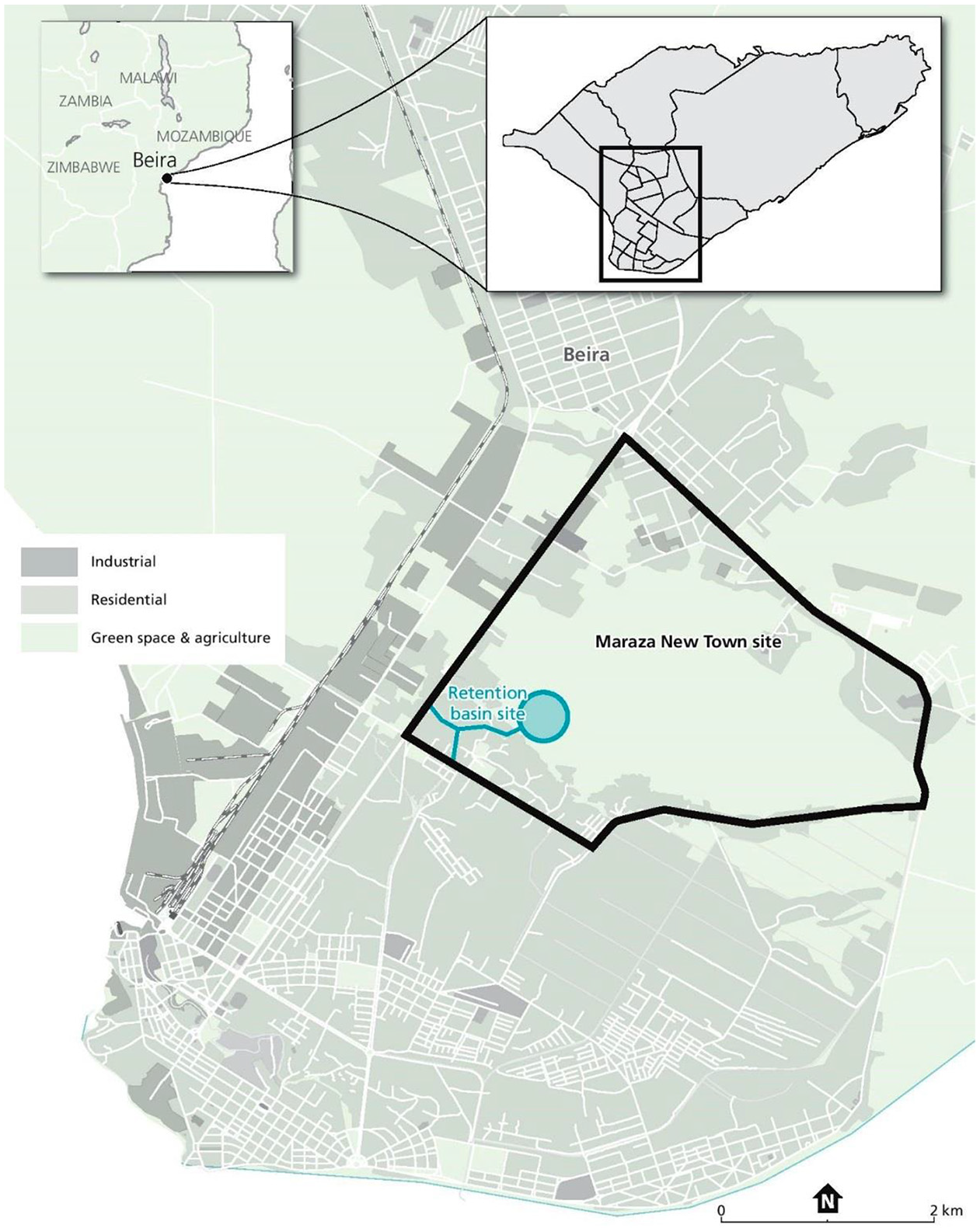
Location of the retention basin and Maraza New Town developments in Beira city. Green space and agriculture refer here to a generic category of undeveloped land, which includes but is not limited to areas used for agriculture.
By providing replacement agricultural land, the World Bank’s compensation strategy contradicted the municipality’s policy of total displacement. In fact, and apparently unbeknownst to the World Bank consultants, both Inhamizua and Mungassa had been designated as urban expansion zones by the municipality. Thus, under the radar of the project’s formal documentation, the vast majority of farmers were instead provided with financial compensation of MZN5000 per household (c. US$70 at the time of intervention), contrary to the project plans. Interviews with displaced farmers six months after their displacement revealed widespread accounts of increased livelihood insecurity as a result of the intervention.
The drainage rehabilitation project constituted the first large-scale displacement of farmers resulting from a donor intervention in Maraza. Then came the new intervention, which evolved out of the BM designed by the Dutch engineering firms. Referred to as ‘Maraza New Town’, the Maraza area became targeted for the development of a 500-ha residential zone (see Figure 1). Maraza New Town was designed by a Dutch firm based on the principle of ‘building with the landscape’, depicting elevated residential zones amidst a network of canals, parks and ponds acting as a green flood-management infrastructure. Although less ostentatious than the colonial era architecture, the New Town vision was no less alien to the urban majority, depicting a distinctly Dutch vision of middle-class suburbia and environmental engineering. With the New Town initiative, Maraza was to become the first wetland green zone to be transformed from agricultural land into real estate through the LDC. In order to realise this transition, the Netherlands funded a slew of projects in the realm of urban planning and design, cadastral reform, municipality capacity development, impact assessments and real-estate business development.
The New Town initiative was heavily narrated as being accessible to all of Beira’s income groups. During various presentations at national and international fora, this statement was made alongside an income pyramid that placed the majority of Beira’s households in the lowest income category of MZN2000–5000 per month. Reaching this extremely poor demographic group was premised on the inclusion of a low-cost housing component and mortgage facilities, for which a specialist housing enterprise was contracted. The low-cost housing project was the only intervention within the broader Netherlands–Beira partnership that specifically targeted poor households. During public presentations it was frequently referenced by Netherlands and municipality counterparts to support the developmental claim of the partnership. It also served implicitly to legitimise the displacement of poor farmers, by suggesting that poor demographic groups would be eligible to occupy the new residential zone.
However, upon closer inspection, the so-called low-cost housing component did not target the lowest income groups at all. After the initial idea had matured into a concrete strategy, it became apparent that the lowest demographic group was not considered viable for commercial loans, thus requiring a fully subsidised programme. As argued by a key respondent involved in the low-cost housing initiative, however, such a subsidised programme would contradict the private-sector approach of Dutch development policy and was therefore not feasible. In response to these insights the project came to focus on an income bracket of MZN4000–15,000, whereby the lower end would only be targeted after the demonstrated success of the project in the higher income groups. As a result, only the top end of the majority category of MZN2000–5000 was deemed eligible, and only under ideal and hypothesised circumstances. Thus, despite alluding to a vision of inclusive urbanism, the so-called low-cost housing component and the New Town development more generally were in fact not accessible to the urban poor.
The Maraza New Town project was initially planned to be implemented through the LDC in early 2016, beginning with a pilot project of 50 ha. Owing to the unexpected withdrawal of FMO from the LDC project, the initiative suffered considerable delays. Yet, the lack of funding for the LDC did not prevent the Maraza project from continuing and, in mid-2018, the 400 farmers occupying the 50 ha were informed that they would be evicted. Compensation was set at MZN5000 per household, a strategy modelled on the unregulated displacement associated with the earlier World Bank project. The most vulnerable of these households were also allowed to choose replacement land that, in accordance with the municipality’s anti-agriculture policy, was to be used only for residential purposes, thus defeating any aims of livelihood rehabilitation for the farmers. Facing further setbacks, the project had still not been implemented by the end of 2018, leaving farmers in an indefinite state of uncertainty.
Notably, the New Town initiative had been developed without any systematic study into Beira’s housing demand. During interviews, various respondents began to quietly question whether there was actually any demand for the proposed development among Beira’s residents. In the outward communications, however, the initiative continued to serve as a centrepiece of the Netherlands–Beira partnership, tied into the political aspirations of the municipality and the Netherlands. As a result of the vested interests associated with it, the New Town initiative took on a political life of its own. More concerning still was the fact that these political interests outweighed even the most basic compliance with Mozambican planning law, which states (among other things) that impact assessment must be undertaken before any large-scale developments or evictions can take place. By the end of 2018, however, long after the farmers had been informed of their pending eviction, no such assessments had been made. Thus, it was not only the historical claimants of Maraza’s green zone that emerged as the weakest link but also the law.
Discussion and conclusion
Urban agriculture has been an intrinsic part of Beira’s socio-spatial makeup since the late 19th century. Invisible during colonialism and celebrated in the post-colonial era, its position vis-à-vis the state has changed through time. In its support of green zone agriculture in the socialist and neoliberal eras, Mozambique was among a progressive minority of post-colonial African states with regard to urban agriculture.
Based on extensive empirical data and document analysis, this article has demonstrated how a new regime of intervention has recently emerged in Beira that is seeking to erase urban agriculture from the city’s future. Facilitated by Beira’s oppositional politics and relative weakness of urban land rights movements, the new regime draws heavily from modernist aesthetics which call to mind the exclusionary urbanism of the colonial city. Instead of race, however, it is now class which forms the primary basis for segregation. What is particularly notable about this new regime is the crucial role played by international donors. Thus, the BM is not simply another urban fantasy driven by speculative capital (Noorloos and Kloosterboer, 2018; Watson, 2014), but an initiative that exists by the grace of Dutch public aid resources. This points to a novel modality of urban governance that has emerged out of the global urban agenda (Parnell, 2016).
A salient feature of Beira’s new regime is the apparent effortlessness with which it is pursuing an agenda of systematic displacement under the banner of development. In the present era of land-grab controversies and global peasant movements, it is unfathomable that a Western donor would support such an agenda without even paying lip service to inclusive development and benefit sharing, were the subjects in question rural denizens (Claeys, 2018; Zoomers et al., 2017). In fact, simultaneously with its engagements in Beira, the Netherlands has positioned itself as a champion of women’s smallholder rights within the context of its rural development policy (Netherlands Ministry of Foreign Affairs, 2016). This contradictory stance towards farmers cannot be explained simply in terms of ignorance, indifference or opportunism towards vulnerable land users, but points to distinct ideologies pertaining to the urban and rural spheres, respectively.
The ideology observed here depicts farmers and agricultural zones as inherently un-urban. In this way, farmers as urban denizens and urban agriculture as a historical socio-spatial practice are redefined as transient and illegitimate. This discursive shift allows farmers and agricultural zones to be freely displaced and converted, without following the usual procedures and implementing the compensation measures afforded to those considered legitimate urban subjects. It is in this regard that urban agriculture bears many similarities to the discourse of underutilised land, which has been leveraged to delegitimise the claims of indigenous land users within the context of rural land grabbing (Zoomers et al., 2017). Moreover, this ideology is firmly oriented towards an abstract future of sustainability and resilience, which places the moral reference point of development outside the realm of everyday politics. Thus, as long as governance actors profess to be acting in the service of this abstract future, their daily conduct is left unscrutinised, however legally ambiguous and informal it may be. The future-oriented master planning is the most powerful expression of this ideology, by rationalising dispossession and placing visions of tomorrow above the politics of today.
The current orientation of critical scholarship and activism has been of limited use for countering this ideology. Contemporary land rights movements have been overwhelmingly centred on slum dwellers and rural peasants (Claeys, 2018; Pieterse, 2016), collectively overlooking the particularities and vulnerabilities of urban farmers. Indeed, the unabashed manner in which agricultural spaces are being planned away is evidence that there exists very little in terms of a language or movement with which to articulate and enforce the rights of urban farmers in African cities. As a result, urban agriculture is emerging as the weakest link amidst growing global competition for Africa’s urban land.
The current experience of Beira in general and the empirical case of the Maraza development process in particular raise the question whether a substantive land rights agenda should be framed within the rubrics of urbanism at all, or of rurality for that matter. For all their innovation and conceptual eloquence, urban and rural studies have led to disjointed knowledge and political action, which are poorly suited to address the hybridity of land use in African contexts such as Beira. Fundamentally, the urban land question is no different from the rural one, as both are focused on the ability of denizens to establish a claim to land in a changing world. From here, we argue that the way forward is to propose an agenda that transcends both urban and rural categories and their prescriptive legacies and is instead centred on the universal land question.
Footnotes
Acknowledgements
We would like to acknowledge Amilton Cesar and Pedro Zacharias for their tireless assistance during the research, as well as Dr Sérgio Niquisse at the Catholic University of Beira for his support. We would also like to acknowledge Alda Salomão for her continued support and knowledge, as well as Alberto Magaia for providing an introduction to the city of Beira. We thank the anonymous reviewers for their insightful feedback.
Declaration of conflicting interests
The authors declared no potential conflicts of interest with respect to the research, authorship, and/or publication of this article.
Funding
The authors disclosed receipt of the following financial support for the research, authorship, and/or publication of this article: Complementary data collection was undertaken and financed through a project commissioned by the Netherlands Ministry of Foreign Affairs in the context of the Beira partnership. Publishing rights to the data acquired during this project were secured contractually by the author. The funders had no role in the design of the study; in the collection, analyses or interpretation of data; in the writing of the manuscript or in the decision to publish the results.
