



Abstract
The delivery of houses for homeownership to low-income urban dwellers has been a cornerstone of post-apartheid policies fighting both land and socioeconomic inequalities in South Africa. In this context, policy stakeholders and scholars have been puzzled by housing beneficiaries who leave their state houses, either selling or letting them. On the one hand, this might signal upward mobility where “leavers” successfully integrate into the housing market, climbing the next rung of the “property ladder”. On the other, it could indicate that “leavers” cannot afford to stay in their state houses and are consequently displaced to worse living conditions. However, due to methodological challenges, research on the experiences and perspectives of “leavers” is scarce. Based on narrative interviews with “leavers”, this article questions the progress/failure dichotomy. Instead, it argues that “leaving” could be construed as people-led reconfigurations of pro-poor housing policy – representing alternative, individually adapted but partly constrained pathways towards inclusion, 25 years after the end of apartheid.
Keywords
I. Introduction
Since 1994, South Africa’s national housing programme has been central to post-apartheid social policy fighting the country’s fundamental inequalities – expressed economically by the world’s highest GINI coefficient(1) and socio-spatially by the disastrous legacy of apartheid segregation. State-supplied “free” housing(2) was intended to overcome apartheid injustices by facilitating access to urban land, homeownership and citizenship for low-income, mostly “non-white” people.(3) Moreover, homeownership was expected to reduce economic inequalities by enabling low-income people to use the house as a platform for asset accumulation, eventually leading to their economic integration and social advancement.(4)
Against this background, people who sell or let their state houses are of special interest. I define them here as “leavers”, referring to entire households that decide to move out of the house.(5) On the one hand, “leaving” could be an expression of policy failure, whereby people would be forced to leave because of poor location impeding access to employment, high costs for services and maintenance, badly constructed and inflexible structures and so on. Conceptually, this displacement is commonly framed in terms of downward-raiding or gentrification.(6) Politically, it connects to fears of persisting inequalities, with low-income people moving (back) to undesired types of housing such as informal settlements. On the other hand, it could also be a sign of success, with people choosing to leave their house in order ultimately to move up the rungs of the housing ladder. This connects to the policy assumption that subsidized housing may function as a financial asset, fostering poverty alleviation through enhanced market integration.(7)
Most authors have questioned the latter proposition, commonly assuming displacement to worse conditions.(8) Paradoxically, literature on departures from state houses has been silent on the personal experiences and choice-making of leavers due to methodological challenges in tracing these people.(9) However, Charlton’s exceptional work on non-resident beneficiaries(10) of state housing puts into question assumptions of both failure and success, emphasizing a more complex spectrum of house–beneficiary relationships, with some non-residents retaining some attachment to their state houses.(11)
Following this, the article aims to fill an empirical gap in the literature by conceptualizing “leaving state housing” as people-led reconfigurations of pro-poor housing policy. I suggest that decisions to leave are individually shaped, cognisant, yet partially constrained residential strategies showing that normative understandings of how housing policy should reduce urban poverty and inequality are too simplistic. While using the normative dualism of success (climbing the housing ladder) and failure (being displaced to worse conditions) as an analytical anchor, the article employs an alternative theoretical concept of housing pathways(12) to support a time-sensitive, in-depth understanding of people’s own conceptions and lived experience of progress, and how “leaving” may or may not contribute to that. The study is qualitative and exploratory, building on 27 biographical interviews with “leavers” identified in multiple locations in the Gauteng City Region (GCR), South Africa’s economic powerhouse.
I continue with a brief summary of the predominant housing policies in South Africa and their underlying political ambitions (section II) and how they have contributed to contradictory narratives and assumptions regarding people’s reasons for leaving state housing (section III). The methodology (section IV) is followed by detailed empirical analysis of the housing pathways of people who left state housing in various ways (section V). In conclusion, I reflect on the act of leaving as people-led reconfigurations of standardized housing policies.
II. Housing Policy, Poverty and Inequality in South Africa
a. South Africa’s housing policy and the notion of “delivery”
With the end of apartheid in 1994, housing for previously oppressed urban low-income people became a policy priority in South Africa and a central element of the new government’s Reconstruction and Development Programme (RDP) to address socioeconomic inequality and unequal access to land. Under apartheid, households classified as African had no right to settle permanently in urban areas. They were conditionally tolerated in racially segregated townships and systematically excluded from the opportunity to own housing. The post-apartheid government in 1994 set up a large-scale housing subsidy scheme, focusing on the rapid delivery of houses for ownership to urban low-income people. Currently, people qualify if they have not owned property before, earn no more than ZAR 3,500 (ca. US$ 200) per month, and have dependants. Although the scheme goes back to the National Housing Forum and its White Paper on Housing,(13) its physical outcomes – typically small, uniform, free-standing houses on serviced plots in low-rise, monofunctional settlements – became associated with the African National Congress’s (ANC) RDP and its post-apartheid justice and welfare agenda. Since 1994, more than five million of such colloquially called “RDP houses” have been built, providing shelter to more than 20 million South Africans.(14)
Despite international recognition for these numbers, the initial focus on quantity over quality has provoked important critiques.(15) According to Wilkinson, the concern with simplistic “delivery” has “sidelin[ed] other issues such as the role of housing provision in addressing apartheid’s legacy of socially and spatially divided cities”.(16) In fact, many low-income housing settlements were developed at the urban edges close to former townships, keeping spatial segregation intact or even further disconnecting low-income people from urban economic opportunities.(17) Such critique, supported by jurisprudence on the state’s obligation to progressively realise the constitutional right to adequate housing, was one of several triggers for housing policy reform in 2004. Under the name Breaking New Ground (BNG), the reform called for the development of integrated human settlements and in situ upgrading of informal settlements. Yet, the emphasis on quantitative delivery has remained striking in the shape of practical implementation of gazetted housing policy – influenced by technocratic administration and shifting, partially contradictory ministerial statements, outlined below. The strong post-apartheid emphasis on the delivery of RDP houses has also shaped residents’ expectations regarding the state’s duty in relation to the constitutional right to adequate housing. For many on long waiting lists for a house,(18) homeownership – as a political promise through the delivery of an RDP house – connects to notions of proper citizenship.(19)
Against this backdrop, I focus on two state expectations, which are central to the discussion of “leaving state housing” and are, to some extent, contradictory. On the one hand, the state expects housing to be an inclusive anti-poverty strategy. On the other, it sees the delivery of state houses as a way to fight informality and to promote a formal urban order.
b. Expectations towards housing as an inclusive pro-poor policy
Despite its focus on quantitative delivery, the South African state expects the housing programme to go beyond providing shelter. Already in 1999, then housing minister Sankie Mthembi-Mahanyele emphasized the policy’s redistributive element, declaring that housing should address “the legacy of poverty and inequality left by apartheid”.(20) However, housing delivery has hardly challenged apartheid’s spatial segregation, which hampers poverty alleviation and economic integration due to, for example, high transport costs.(21) In the context of BNG, South African housing policy has further stressed a pro-poor narrative tied to homeownership and the idea of the house as an asset. Although BNG alludes to a multidimensional notion of housing assets, underlining the role of multifunctional, well-located human settlements,(22) policymakers have tended to overemphasize the financial dimension. Partly inspired by de Soto’s neoliberal theory, homeownership is expected to allow low-income people to access credit and invest in a potentially tradeable asset,(23) reducing socioeconomic inequality by “bring[ing] the excluded urban poor into the economic mainstream”.(24) In 2005, then housing minister Lindiwe Sisulu outlined how precisely this should work: “We are moving towards the concept of a house as an asset. You have to give people title deeds to give them complete ownership of the house. Then they can rebond a house and have access to more money . . . or they can improve the house and sell it a few years down the line and make a profit.”(25)
Thus, “leaving the house” may comply with how policymakers imagined successful market integration – with “leavers” climbing the rungs of the so-called housing ladder, a normative hierarchy of housing types.(26) However, partly because of methodological challenges in tracing resellers,(27) there is little reliable evidence of people successfully climbing the ladder after selling their RDP house.(28) In contrast, there are several reasons why state houses might not work in such preconceived ways. First, a significant number of state houses have never received formal title deeds, which leads to informal transactions at lower prices.(29) Second, many banks remain reluctant to offer credit to owners of RDP houses.(30) Third, house prices, although modestly rising in some locations, have often remained too low for sellers to bridge the gap to the next higher housing segment.(31) Moreover, framing houses primarily as financial assets tends to disregard the multidimensional nature of the asset. In fact, many homeowners would never give away their RDP house, as shown by very low overall numbers of transactions.(32) Instead, they emphasize the possibility of passing houses on to their children (social asset) and using the house and/or yard to generate income, increasing their resilience against poverty shocks (economic asset).(33)
c. State housing and expected formalization
Besides asset creation and the fight against the apartheid legacy of inequality and poverty, the South African housing programme aims at reducing the number of people living in informal settlements. Although related objectives are largely backed by statements of people in power rather than being codified in policies, they have had remarkable influence on the ground. Since the mid-2000s, initially driven by international development targets and the preparations for hosting the 2010 FIFA World Cup, the ANC government has repeatedly declared its goal of eradicating the country’s informal settlements and building a “shack-free society”, as the then housing minister Lindiwe Sisulu formulated in 2004.(34) The “war on shacks”(35) has led to a preference for projects relocating people to ready-made top structures – notwithstanding occasional in situ upgrading supported by progressive policy documents at the same time. According to Meth, a denigrating rhetoric around informality has helped to justify eradication objectives(36) and simultaneously exaggerated expectations for “decent”, formal housing.(37) The latter is expected to provide a dignified, stable environment promoting a lifestyle that corresponds to the state’s imaginations of “good” citizenship,(38) tied to appearances of order, modernity and decency.(39) Reflecting on one of Cape Town’s early RDP housing projects, Robins remarked on a planning obsession with an ideal of a “suburban bliss”, culminating in “the desire to replace shantytowns, shebeens and spazas with a new socio-spatial order consisting of neat brick houses, fenced lawns and virtuous consumer citizens”.(40) Thus, orderly built and planned RDP settlements should visibly oppose the “anarchic” and “chaotic” shack neighbourhoods they replace.
Following such objectives and imaginations of good citizenship, state representatives – but also sections of society – expect beneficiaries to be thankful, to actually reside in the house, and not to make profit from it.(41) Most importantly, beneficiaries should not again become a burden on the state. Considering state housing as a one-off service provision, the state fears a degradation and congestion of RDP neighbourhoods as well as “leavers” returning to informal settlements.(42) However, as Lemanski notes, the planning of strictly residential suburban settlements, rather than leading to a “shack-free” South Africa, has in fact provoked the opposite: an “augmented informality”, expressed by the multiplication of backyard developments that serve as house extensions, business premises and/or rented property in most RDP neighbourhoods.(43) According to Charlton, state actors acknowledge the role of such alternative uses for poverty alleviation but stress conformity with tight building norms to prevent “RDP areas” from becoming a burden on the state (for example through overuse of public infrastructure and services by multiple backyard room users).(44) To some extent, this has led to state action (e.g. sanctioning and morally blaming “inappropriate” usage) that conflicts with its own housing policy objectives of fighting poverty and inequality.(45) As I will show in the next section, this is particularly relevant in the context of people leaving state houses.
III. Leaving State Housing – Perspectives and Assumptions
The phenomenon of people leaving state houses is not unique to South Africa but has been widely observed in countries that include Ethiopia, India and Morocco.(46) Often, scholars consider this an unfortunate sign of policy failure and rejection, signalling unaffordability and inadequacy of new housing.(47) In the context of South Africa, for example, Fieuw and Mitlin write that “due to both poor location and poor construction quality, some families
However, as in steps taken in other countries, South Africa tried to restrict resales of state housing by adding a clause to the National Housing Act, in 2001. It states that people who receive housing subsidies “shall not sell or otherwise alienate his or her dwelling or site within a period of eight years”. Yet, even more significant and contradictory to the idea of sale-induced upward mobility, state representatives have actively blamed (and even criminalized)(52) citizens who do not occupy their RDP houses, extending their moral claims for appropriate residency far beyond the reach of the law.(53) For instance, former housing minister Lindiwe Sisulu referred to housing sales as a problem signalling that their owners neither “need” nor “deserve” RDP houses.(54) She expressed her willingness not only to evict illegitimate occupants but also to “force” absent beneficiaries to move back to their houses if they were found living in informal settlements.(55) She further announced special tribunals that would prosecute people who sold or rented out subsidized houses.(56) Moreover, different state institutions conducted door-to-door audits to determine whether original beneficiaries actually occupied their houses.(57)
Together with significant media attention, such statements and actions have delegitimized housing sales and lettings, creating significant legal insecurity. This is further enhanced by the occasional incidence and anecdotal evidence of sanctions, whereby authorities evicted people from their RDP houses if they did not use them in the intended way.(58) This made non-occupying RDP owners afraid of losing their property. Many homeowners also believe that letting or selling the house, even after eight years of occupation, is illegal – although these have always been lawful practices.(59) Such perceived legal insecurity could also facilitate fraud(60) and even provoke xenophobic violence.(61)
From a political perspective, disapproval of non-occupation links to fears of a double process of informalization, whereby residents sell or let their houses informally just to return to informal settlements or backyard shacks. This not only threatens the state goal of eradicating shacks but also leads to worries about people once more trying to claim infrastructure and housing benefits.(62) Also from an academic, more conceptual perspective, the direction of departure matters and is tied to questions relating to potential constraints around leaving. Following Lemanski, resales can be seen as part of “hybrid gentrification” that (re-)displaces former beneficiaries of housing subsidies to inadequate accommodation.(63) She argues that low-income homeowners would probably sacrifice their houses only as a last resort, as the houses represent an important social, intergenerational asset and security – and probably “their only chance for decent housing and wealth creation through property”.(64) Moreover, departure may also provoke questions on the effectiveness of housing subsidies.(65) Charlton indeed found evidence of people who (temporarily) left their RDP houses as a result of inadequate location or the nature of the dwelling. At the same time, some beneficiaries seemed to keep a strong attachment to their RDP houses even when they lived under more precarious conditions elsewhere. Consequently, Charlton argues that a dualistic logic of occupying/leaving is possibly insufficient to account for the complex relationship between beneficiaries and their RDP houses.(66)
To conclude the literature review, one can note that common conceptual understandings of “leaving state houses” are strongly tied to two opposed directions. The first – climbing the housing ladder into a higher-quality home – is commonly framed as policy success; the second – being forced/displaced to move (back) to shacks – as failure. In the latter case, this does not account for the possibility of return, however.(67) There are also at least two further problems with such dualism: both options are normative and they lack a dynamic lens. They neither account for time nor for the person’s own perspective on leaving, as shaped by both lived experience and strategic aspiration. This conceptual concern is in line with recent research emphasizing the significance of post-displacement perspectives and subjective, experience-based valuations of potentially constrained moving.(68)
In this context, how does a person assess a particular dwelling in relation to his/her RDP house, the places s/he lived before, and his/her plans for the future? Does a temporary move to a backyard shack have to be understood ultimately as failure – both personally and in terms of policy? How do “leavers” themselves understand progress – detached from normative ideals of “suburban bliss” and sale-induced upward mobility? The following empirical section aims to provide answers by explicitly stressing people’s agency and choice in contrast to policy norms that reduce people to passive consumers and deserving citizens. To assess people’s choice-making in relation to their understandings of “progress”, I make use of a time-sensitive analysis of “housing pathways”. Unlike the more quantitative concept of housing careers, housing pathways emphasize the meanings people themselves attach to their past, current and future homes.(69) Such information is crucial to understanding whether “leaving” is part of descending or ascending pathways. Moreover, stressing the biographic experiences of “leavers” may disclose alternative, people-centred perspectives to state housing and its linkages to post-apartheid redistribution, poverty alleviation and urban integration.
IV. Methodology
This article builds on qualitative research exploring the experiences and rationales of beneficiaries who either sold, let or planned to sell or let their RDP houses in the GCR – including people who moved from their RDP house to another dwelling in the same yard. Striving for in-depth analyses of case-specific rationales behind such “leaving”, the research was open to people who obtained RDP houses in different ways (through resettlement, waiting lists and in situ provision) and in different years (mostly between 2005 and 2010, although including four in the mid-2010s). I interviewed “leavers” in 13 different locations, all next to or in former GCR townships, ranging from Soshanguve, north of Tshwane, to Orange Farm, south of Johannesburg (see Table 1). This inclusion of different contexts allowed for an analytical breadth regarding reasons for and practices and experiences of leaving. To ensure balanced sampling it was additionally important to focus on one particular RDP area to gain access to leavers who could only be identified and approached by insiders. Thanks to the help of a local resident, I focused on Braamfischerville Phase 4, an RDP area from the mid-2000s in the northwest of Soweto, where nine respondents each had an RDP house. I was assisted by a female research assistant who is fluent in a number of African languages and experienced with conducting fieldwork in township settings and with in-depth interviewing.
Overview of interview partners
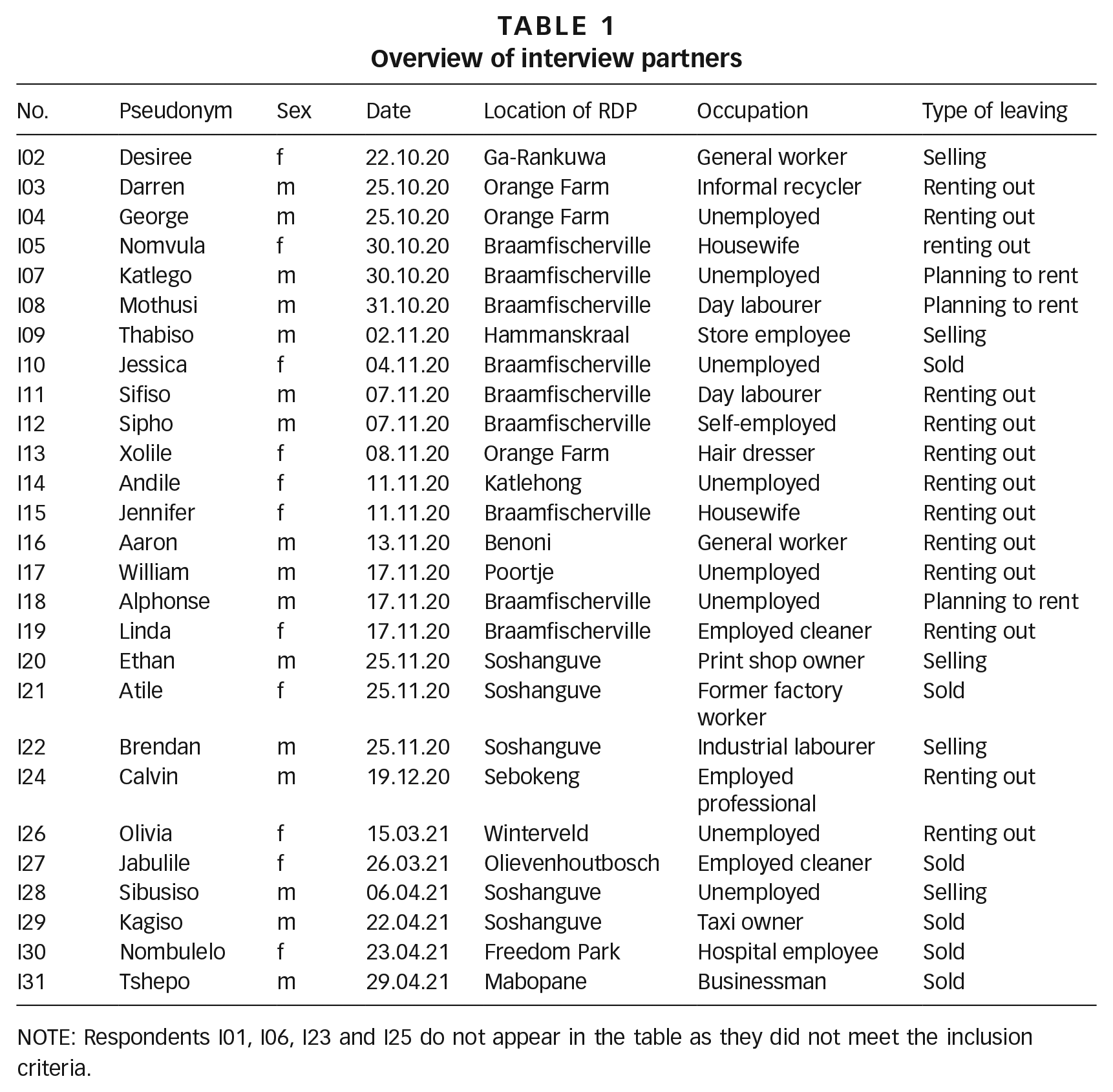
NOTE: Respondents I01, I06, I23 and I25 do not appear in the table as they did not meet the inclusion criteria.
Between October 2020 and April 2021, we conducted 31 in-person qualitative interviews, with the research assistant conducting the last seven alone. Four of the 31 interviews were conducted with respondents who turned out not to comply with our definition of leavers (including, for instance, people who resold an RDP that they had previously bought). The respondents were diverse in terms of gender (11 females, 16 males), age (ranging from about 20 to 70 years old), and employment (eight being unemployed), and included six people who had sold, five who were currently selling, 13 who were letting, and three who were planning to let their state house (Table 1). Cognisant of the methodological challenge of locating people living in unknown, dispersed locations,(70) we applied multiple sampling strategies: snowball sampling through local residents and estate agents in areas with a high share of state housing such as Braamfischerville Phase 4 (13); contacting people who advertised their state houses on online platforms (e.g. Facebook) and blackboards (11); and contacting people in the streets of RDP areas and other low-income neighbourhoods (3). Most people we contacted – whether in the street, online or via phone – were unwilling to be interviewed or to share contacts of people who had left.(71) Although we assured people that full anonymity would be preserved, many were frightened that they (or their contacts) could lose their house, reflecting uncertainty and confusion about the legality of non-occupation (see section III). Even among those who accepted interviews, some remained hesitant to talk freely, at least in the beginning. However, given the variety of sampling strategies (e.g. distant contacting as well as focusing on one site through insiders), we may assume rather good, qualitative representation of realities and limited selection bias beyond personal inclination to talk.
The interviews followed a flexible biographic structure that encouraged people to narrate their housing pathway and clarify their rationales for moving – from birth to where they would like to live in the future. Interviews lasted from 30 minutes to over an hour. Some respondents invited us into their homes; others preferred to speak in a public space or parked car. They were free to speak their preferred language (including isiZulu, isiXhosa, English, seSotho and sePedi). The field research assistant transcribed the interviews and a third person translated them into English where necessary. The transcripts were analysed using MAXQDA.
V. Experiences of and Strategies Behind Leaving State Housing in Gauteng
a. “Leaving” – progress, failure or ordinary fluctuation?
Regarding the directions of people who leave/left RDP houses in Gauteng, it was no surprise that only one respondent had moved “upwards” to a bigger house in the classic sense of the property ladder (I31; see Table 1). Two were scammed when they wanted to buy new property (I10; I27). All other sellers were unable to immediately move into better-quality housing, seemingly confirming the problem of a market gap. However, for some respondents, leaving the RDP was part of a wider savings strategy to afford and own a better-quality house in the long run. For example, general worker Desiree (Figure 1) had a clear plan for upward mobility: she decided to sell her small RDP, which was far from work opportunities, and to temporarily rent a small garage closer to her workplace, where she had already been renting for weekdays to shorten her travel time. The sale would not only generate money but also allow her to save on municipal service charges and the costs of weekend commuting. With this money, she was determined to buy a better located piece of land where she could build a bigger house: “a place, where I can say, ‘this is my home!’”(I02, f, Ga-Rankuwa)
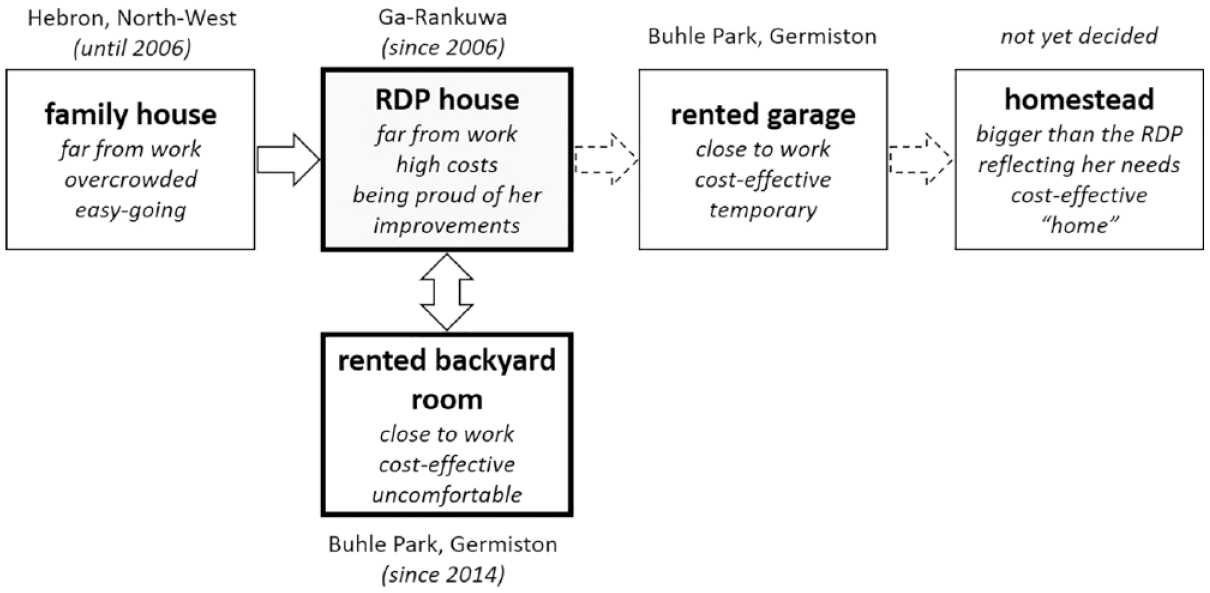
Desiree’s housing biography
In contrast, descending housing pathways were more common in the sample. The three quotes below seem to confirm displacement logics, with people feeling forced to leave and accept worse living conditions, as well as policy-related fears of “leaving” as a sign of policy failure, where people move back to shacks and become a burden on the state again. One respondent (I28) even admits that he would try for another state house after moving back to an informal settlement: “When I left the squatter camp I got a house, but things were not going so well and I didn’t have work. So I rented the house out and went to live in a shack so that I can still put bread on the table . . . The [squatter camp] is rough, there are illegal miners and they fight a lot. We stay with children here and you would hear that children are being raped, people are being killed.” (I16, Aaron, m, Benoni Chief A Luthuli Park) “This is a family house . . . This is where we do our rituals. We are cultural(72) people you know, just that now things are not looking good financially . . . You see if there was money we were not going to put the house up for renting. So we are doing this to have a source of income. So that I can leave the children with some money.” (I03, Darren, m, Orange Farm) “The problem is that I am unemployed. The thing is that if I get the money from [selling] that RDP, I am going to get myself a stand, where maybe the government will give me another RDP house.” (I28, Sibusiso, m, Soshanguve)
In all these cases, a lack of money forced people to leave and move “downwards” to worse housing conditions. The allocation of state housing did not lift them out of poverty, but merely offered an option for coping with poverty shocks such as the loss of a job. In these cases, South Africa’s structural inequality, which is marked by high unemployment, may force owners for financial reasons to choose between either shelter or economic housing functions. In our sample, most departures were at least partially motivated by financial reasons, including poverty, unemployment and unfortunate personal decisions that led to financial distress (see below).
However, there are also more personal reasons why people leave their RDP houses and these sometimes overlap with financial motives. In our sample, these included insecurity (I10), community problems (I13; I22; I29), family obligations or inheritances (I12; I13; I15), and distance to family (I18; I26). As these cases might reflect rather common neighbourhood fluctuation, progress and failure here are less adequate categories for analysis. Interestingly, Kagiso (I29) mentioned that he sold his RDP because so many neighbours were renting out their RDP houses and backyard shacks which, according to him, led to informalization and degradation of the area; his concerns mirror state fears of an unhealthy densification. Others left mainly because of the poor quality of the RDP house (I29; I30); relocation to peripheral places far from work and familiar environments motivated others to do so (I02; I11; I17; I18; I24). However, because of Gauteng’s history of spatial inequality and its sprawling, low-density character, several respondents seemed used to long commutes and spatially stretched households. Indeed, locational disadvantage tends to be less obvious from a household perspective than from the bird’s-eye view.(73) Many prefer locational challenges to selling the house – in part because of financial constraints and low-paid, insecure employment. For Linda, who rented out her RDP in Braamfischerville while living in another house in the same yard, it was not an option to sell her RDP to move closer to her workplace in Centurion, a two-hour commute each way: “No, there is no money, there is no way because Centurion is too expensive” (I19, f, Braamfischerville).
b. “Leaving” – temporary setback and alternative forms of progress
Narrow conceptual understandings of progress (climbing the property ladder) and failure (forced to live under worse conditions) tend to vanish when looking at individual cases and accounting for time. On the one side, Tshepo (I31), the single respondent who had climbed the property ladder as politically desired, could only afford a better house through illicit business activities (loan sharking(74) and fraudulent gambling [mChina]) – certainly not reflecting public policy objectives. Desiree (see Figure 1), who followed a clear plan to move upwards, might be counted among those with descending pathways if considering only her current place of residence, an unsanitary backyard room. On the other side, for Aaron (see Figure 2), who moved from his RDP house to an unserviced informal settlement, renting out was an opportunity to pursue an intergenerational strategy of asset accumulation. He and his wife only decided to move when they received a lucrative offer from his current tenant, who turned the well-located corner house into a business site. The money enabled Aaron to build a modest retirement home in a rural area and to extend his RDP house to accommodate his children when he retires. Moving temporarily to the informal settlement would thus ensure a more comfortable future for his family(75) – a successful generational struggle against inequality. From a conceptual perspective, the case shows how well-located state houses may provide “leavers” with more options to secure adequate housing in the future.
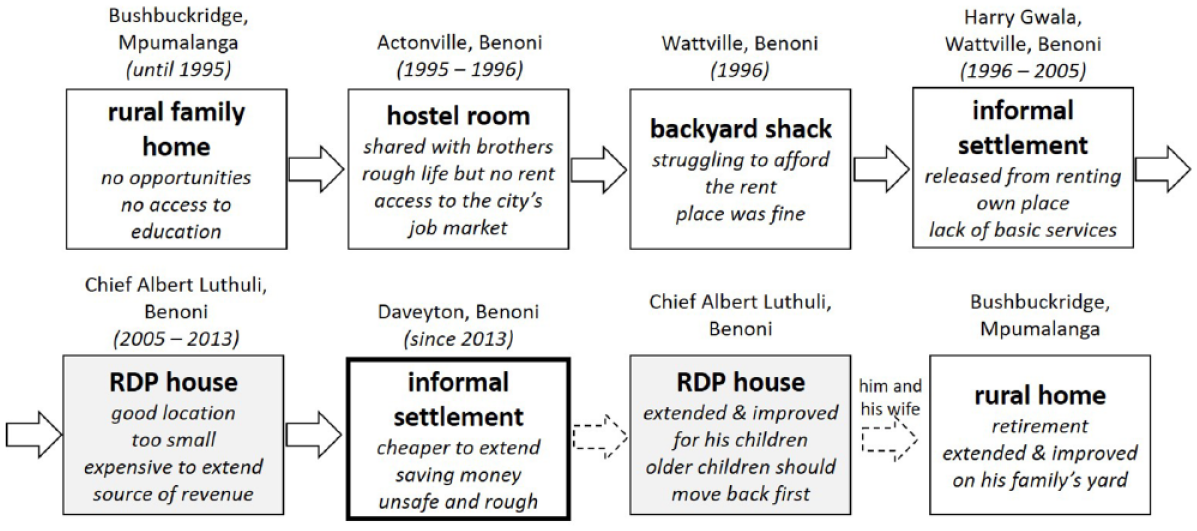
Aaron’s housing biography
There are many similar cases, where “leaving” may best be described as a temporary setback – containing both progress (potential and strategic) and failure (financial distress and worse living conditions).(76) Another example is Katlego, who thought about renting out his RDP house after his mother, the household’s sole breadwinner, passed away: “Cause like currently I am not employed . . . If your parent is not alive, things get very hard. Now I’m struggling with many things . . . So now the idea of renting is to go out and stay with them [distant family in Tshwane] . . . Maybe this house will be generating some money . . . The plan is to save all that money . . . maybe a year or two . . . Then, I’ll be able to move, to get my licence and to get a job . . . My only source of income was my mum.” (I07, m, Braamfischerville)
Such examples illustrate the strategic and difficult decisions behind leaving state housing and accepting temporary setbacks. Respondents carefully balanced the pros and cons. At the same time, these examples further underline the value of choices that exist despite constraints, including the impossibility of trading up the property ladder. This entanglement of choice and constraint sits uncomfortably with theories of gentrification that consider descending housing pathways as direct and inevitable consequences of displacement.(77) For some low-income people, moving to a partially serviced, informal plot of land must be seen not as a descending housing pathway but a step towards long-term housing objectives. The basic original RDP house thus presents a temporary housing condition that supports the owner’s progress towards a house that better reflects his or her personal goals (which could also be the extended RDP house). Ethan’s case (see Figure 3) is typical of this entanglement of aspiration and constraint:

Ethan’s housing biography
“I want to start buying new property. You know like something that will suit me and my needs. This one [his RDP house] is a gift. It won’t really suit you . . . you just get it, because you don’t pay anything . . . A place that is not ready or not good for you. It actually stops you from doing what you want.” (I20, m, Soshanguve)
Besides providing more space for his family, he hoped that a new house would help him grow his business, a small print shop in his yard. Because of the area’s bad reputation, some potential customers wanted pictures of his shop before ordering. If his house were more impressive, customers would trust his business more. However, his decision to sell also reflected constraints. High municipal service fees were a burden, especially after he lost his salaried employment during the COVID-19 pandemic. Relative to his more general progress in life (see Figure 3), he now felt stuck: “Whatever we saved in our banks we cleared, consumed completely, so we are at zero . . . We can’t maintain the property, can’t pay [service fees]. We can’t buy electricity . . . You go back to the life that you don’t want. By force, you cook on the ground with wood and whatever, because you can’t pay [service fees]. Now if you sell this property you go buy something lower, little bit lower to this one. You are able to plan your things right. At least there I can pay [service fees], I can push my business, my kids can survive. Unlike here, we’re stuck.” (I20, m, Soshanguve)
Ethan’s financial situation and the modest value of his property would not allow him to move to another decent and serviced property. His experience might be read as a displacement to a “lower place” without adequate services. However, given his positive experiences with incremental construction in the past, moving back to a site for self-building was also desired. For many respondents, it was not the physical dwelling but access to land ownership that meant freedom and was the most important feature of post-apartheid struggles for equality. In fact, Ethan felt his inadequately structured RDP house and its high municipal charges relegated him back to a life characterized by inequality rather than supporting his personal post-apartheid progress. For him, selling felt like a liberation and incremental construction a desire, notwithstanding policy deficiencies and macroeconomic conditions and shocks pressured him to restart “a little bit lower”.
For many low-income people, incremental housing options may be more desirable: “I was building and destroying, building and destroying. I ended up spending a lot of money [on renovating the RDP], like wishing I had been given land instead . . . Right now, I have the privilege to get a stand, ‘This is what I am going to do, like this and that.’” (I27, Jabulile, f, Olievenhoutbosch)
For others, progress could also mean moving from one RDP to another – an aspect hardly considered in literature and public discourses. Another RDP might be closer to work (I24), located in a better area (I21; I29), of better structural quality (I30), or be free of ancestral curses (I26).(78) These findings suggest that “leaving state houses”, even though marked by constraints, can be a feature of more progressive housing biographies than is assumed by gentrification and displacement theory. It seems indeed inappropriate and simplistic to argue that the inability of “leavers” to climb the property ladder in the short term will necessarily result in worse living conditions in the long term. Such a perspective ignores the time dimension and underestimates the agency and strategic reflection of “leavers”.
c. “Leaving” – an alternative strategy to fight poverty and inequality?
On the level of implementation, provincial and local housing departments neglect the socioeconomic dimension of housing policy by pursuing a technocratic focus on housing delivery.(79) Many respondents, however, underlined the significance of decent employment to sustain a living in adequate housing. Decent shelter is important, but in the context of mass unemployment and sharp socioeconomic inequality it might not be people’s most urgent need. Thabiso (I09, m, Hammanskraal) asked, “How are you gonna maintain the house while you don’t have the money? How are you going to survive when I give you [a house] but you don’t have something to eat?” “Leaving” could result from pressure to prioritize socioeconomic over physical shelter functions of the RDP house. Low-income people may consider state houses to be a form of social protection that functions like insurance against unemployment, sickness, price increases, etc. During the time of research, the COVID-19 pandemic and its related restrictions had a significant impact: “I want to try to move to that zozo [ready-built shack] so that I can rent out the house because I am currently unemployed. I lost my job due to the virus.” (I18, Alphonse, m, Braamfischerville) “[My children are] eating too much. I must buy big mealie meal . . . Fish oil is expensive, food now is expensive. Yes, since this Covid, it’s worse. So, I said to [my boys], “Let’s try to do this [letting the RDP house]!” As time goes on, maybe if you can get a job, then we’ll tell that person, ‘Okay thank you for being with us!’” (I19, Linda, f, Braamfischerville)
For several respondents, being able to use the houses according to their own priorities felt like the freedom linked to ownership. For some this meant briefly renting out the state house to earn money for an upcoming festive season (I04). For others, it meant the freedom to sell and to use the money as seed capital, because there was no other way to access credit: “They should give [RDP houses to] everyone who is not working and anytime anyone feels to sell his house, must feel so, because you don’t know his situation. Maybe the person sleeps without food, but he stays in the house. Maybe he can sell the house, go back to the squatter camp, make a small business and then, eventually, he will come back, he will pick up.” (I28, Sibusiso, m, Soshanguve)
Letting the RDP house could also be the only way to earn a living for some of the least privileged respondents (I04; I05; I11). This is the same rationale as that of people who rent out backyard rooms,(80) but in this case, leavers regard the house primarily as an economic asset. After the death of Andile’s mother, who was a single parent, Andile’s aunt forced her orphaned niece (I14, f, Katlehong) to rent out her mother’s RDP house and move to her rural family home, where she was abused and dropped out of school. Only after taking legal action against her aunt (who had kept the rent money for herself), did Andile manage to move back into a shack in the yard of her inherited RDP house. The modest property ensured peace of mind and a regular income, allowing her to survive and support her younger siblings. For her, living in the shack was no different than living inside the RDP house – but the latter generated more income from rent than a shack.(81) Another respondent financed his youngest brother’s education by renting out his RDP house: “Why should I rush to stay in the house when I can make a plan outside, you see?” (I11). In these cases, the allocation (or inheritance) of basic state-subsidized houses helped people to mitigate acute poverty. Rental incomes alone, however, are insufficient to overcome poverty and to access or build adequate housing outside their RDPs.
Overall, the phenomenon of leaving state housing cannot be analysed apart from two of South Africa’s most pressing macroeconomic and sociopolitical challenges: the need to fight massive un-/underemployment and persistent land inequality. Concerning the first, the interviews underline a striking relationship between decent work and decent housing. This is a crucial aspect of housing affordability, as recently stressed by Potts.(82) Thabiso even perceived the housing programme as a waste of public money: “For me it’s not a good idea . . . The good idea is to try to make sure that most people are employed to be able to generate their own income and survive . . . To create more jobs is better than to invest in housing” (I09). Indeed, progressive housing pathways in our sample strongly depended on the respondent’s ability to secure regular employment. Darren (I03), for example, experienced a vicious cycle. Unable to find regular employment and afford the construction of backyard shacks for rent, he was forced to rent out his RDP house. At the same time, he felt that poverty left him no choice other than building a future in his RDP – a future that required money to extend and improve the low-quality house. Each month without work further distanced him from this goal. In contrast, leaving may show a modest level of economic control. Nombulelo, a hospital employee, emphasized, “At least I was registered at work. I have the power to go and buy a house. I will add money to what I got when I sold the house” (I30). If she had no decent work, she would be forced to stay in an undesired, inadequate RDP house. Decent employment (like higher house value) enlarges the capacity to find alternative accommodation.
Concerning land inequality, it is again important to highlight that for most respondents, better shelter was not RDP’s most significant benefit. Instead, it was landownership that mattered most: “If you don’t have [land], you don’t have life!” (I12, Sipho, m, Braamfischerville). Respondents were aware of the wider objectives of an ownership-centred post-apartheid housing policy, yet were not necessarily convinced that state house construction was the preferred way to achieve them: “We’re asking for an improvement . . . so that a black person’s life can improve . . . We’re not saying we want big houses, we never said that . . . Let them give us the land . . . so that we build the houses ourselves, do something better than what they are doing through these RDP houses.” (I24, Calvin, m, Sebokeng)
Landownership can be a catalyst for a more general notion of “improvement” linked to equality. Housing (as shelter) may come second: “I’ve always wanted a better life for my children, what I did, I did it for them! Why stay in an RDP when you are not earning anything if you can make so much money outside and then actually buy back your house?” (I27, Jabulile, f, Olievenhoutbosch) This can explain why some people prefer to leave state housing and move to self-building (I02; I12; I20; I22; I28), and why some respondents like Calvin (I24) and Jabulile (I27) were generally positive about a recently announced shift in housing policy away from housing delivery to a stronger emphasis on the rapid land release programme.(83),(84)
VI. Conclusion
The delivery of “free” housing to disadvantaged urban low-income people in South Africa is closely linked to political ambitions to fight the apartheid legacy of extreme socioeconomic and spatial inequality. In this context, beneficiaries who leave their state houses have provoked political irritation as well as conceptual uncertainty. Before attempting a more general conclusion, it is important to stress some key findings:
1) In line with previous research, leaving does not equal ingratitude for state benefits and may not last forever.(85) The findings suggest that leavers – whether they rent out or resell the house – are conscious of their multidimensional housing asset. Carefully balancing the pros and cons of leaving, respondents were not throwing their asset away.
2) Although most respondents felt compelled to leave their house (financial distress, bad location, etc.), agency and choice still matter. Decision-making across my sample tended to be more strategic and future-oriented than assumed by displacement theory.(86)
3) Except in one case, no respondent used the house as a financial asset in order to climb the property ladder in the short term, as suggested by neoliberal theory. Nonetheless, it would not be accurate to associate leaving unilaterally with descending housing pathways, nor to deny any positive contribution of homeownership to long-term and alternative ascending pathways (e.g. incremental construction). The findings underline the significance of people-centred and time-sensitive research.(87)
Aware of the limited generalizability of the findings, I suggest that the phenomenon of leaving state housing can be understood as people-led reconfigurations of pro-poor housing policy. Though this article focuses on “leaving”, it resonates with analyses of people’s alternative practices around state housing in South Africa as necessary adaptations of policy under contextual constraints.(88) Conscious of the government’s general post-apartheid policy objectives, individuals resort to selling and letting to adapt pro-poor, but ill-designed and inflexible policies in the way best suited to their own needs and priorities. Leaving may be a tool to tackle deficiencies of state housing such as inadequate location, poor structural quality and high service fees, but it also makes active use of the social and economic functions of housing (e.g. to generate income, to become more resilient, to ensure better futures for the children). Yet, people’s demand-driven reconfigurations of pro-poor policy are not free of constraint. Leaving for most respondents is the outcome of an enforced weighing of different housing functions against each other – under pressure from financial distress, inadequate state housing and family conflict, among others. The low value of their RDP houses also limits leavers’ alternative housing options, forcing many to accept temporary setbacks.
Nonetheless and against this background of constraints, the time-sensitive analysis of housing pathways demonstrates that leaving can still be considered an individual choice to maximize utility value, mitigate poverty and reduce inequality over the long run. If housing policy has failed to ensure respondents’ inclusion on the property ladder, a focus on housing pathways shows that state housing and especially land ownership have made them more resilient to shocks (e.g. job loss) and given them greater potential to realise progress in the face of structural constraints – inside or outside the house. Although the supply-driven, shelter-centric approach to housing delivery has certainly contributed to leaving, the findings also urge us to emphasize the societal and economic embeddedness of housing policy.(89) The factor that most determines an ascending housing pathway is stable income resulting from decent employment – a function of macroeconomic conditions underlying mass unemployment and structural inequality. Even if a state house is well built and located (I16; I27), households with unstable and low incomes may prefer to leave (temporarily) and make use of other housing functions. More research may be needed to understand the links between leaving and certain features of housing policy. But I can confidently argue that it would be wrong to discourage people from leaving and reconfiguring pro-poor policies in their own rational, conscious ways.
Footnotes
Acknowledgements
I would like to express my gratitude to Sarah Charlton, Marie Huchzermeyer and two anonymous reviewers for their critical and constructive comments on earlier drafts. Moreover, I thank Ntombizawo Qina and Melisa Dlamini for their field research assistance as well as transcription and translation.
Funding
This research was funded by the Deutsche Forschungsgemeinschaft (DFG, German Research Foundation) – grant number 456455682 – and supported by the Ruhr University Bochum Research School PLUS.
1.
2.
In practice, “free housing” means that qualifying citizens do not have to pay anything when receiving a state-subsidised house.
3.
4.
Charlton (2010); also  .
.
5.
This includes people who continue to stay in the yard and those for whom staying outside the house is merely a time-limited option.
7.
For a discussion of this theoretical dualism with regard to “leaving”, please refer to Lemanski (2011); also Lemanski (2022); .
8.
Lemanski (2011); also .
10.
The author is aware of the normative connotations the term “beneficiary” may convey and would like to stress that, in this article, the term refers in a strictly technical way to a person that received a house from the state – without indicating that the person has benefited from the house.
15.
17.
Huchzermeyer (2001); also .
21.
Culwick and Patel (2020); also see .
23.
Charlton (2010), page 5; also , page 58.
25.
Quoted in Lemanski (2011), page 58; also , page 6.
28.
Cirolia and Berrisford (2016), page 21; also , page 855.
31.
Cross (2013), page 244; also Lemanski (2011), page 65; Gordon et al. (2011), pages 42–43; , pages 8–9.
32.
Gordon et al. (2011), page 34; , page 166.
33.
Lemanski (2011); also Charlton (2018b); .
36.
41.
Charlton (2018a), page 2168; , pages 946–947.
45.
Lemanski (2020); also Charlton (2018a); .
46.
47.
Coelho (2016), pages 123–124; , page 170.
51.
Charlton (2018a), page 2177; also Gordon et al. (2011), pages 34, 68; and , pages 132–133.
53.
Mbatha (2022), page 139; also .
57.
Charlton (2018a); , page 946.
58.
Charlton (2018a); also Mbatha (2022); .
60.
Cirolia and Scheba (2019), page 605; also .
62.
Lemanski (2020); also Lemanski (2011); , pages 131, 221.
68.
Beier et al. (2022); also .
70.
Lemanski (2011); also .
71.
Compare Lemanski (2011); also .
72.
By “cultural”, Darren would like to express that his family esteems and practises African culture – in particular the aspect that ancestors live with them together in their family house (which makes it even more painful for him to rent it out).
74.
A loan shark lends small sums to people who cannot access formal bank loans, demanding very high interest rates in return.
75.
A similar reasoning was also behind Darren’s (I03) above-recounted decision to rent out his RDP house.
77.
Wang (2020); also .
78.
In South Africa, it is a widespread belief that people live together with their ancestors’ spirits at home. If someone moves onto formerly occupied land, it can happen that the person feels disturbed by the ancestors of the previous landowner, who might not have undertaken necessary rituals to move the family’s ancestral spirits.
81.
At least three other respondents (I04; I11; I21) felt that there was no difference between staying inside their RDP house and living inside a shack in their own yard.
84.
85.
Lemanski (2014); also .
88.
Charlton (2018a); also .