




Abstract
This article explores the potential of ‘Co-Creation’ to develop new understandings of neighbourhood disadvantage in collaboration with civil society partners. It argues that there is a growing need for collaborative knowledge production with communities carrying vernacular knowledges previously invalidated by dominant epistemologies. The first part of the article undertakes a reconceptualisation of ‘co-creation’, a term usually associated with citizen involvement in neoliberal contexts, redeveloping it as a ‘critical artistic practice’ (Mouffe, 2013) in which new ways of imagining the city can be articulated. The second part of the article examines the practice of Co-Creation as a participatory methodology involving artists, researchers and stakeholders in developing ‘agonistic spaces’ by scrutinising a five-day workshop conducted in the Rio de Janeiro favela of Santa Marta to explore multiple understandings and meanings of this neighbourhood. Through an analysis of creative workshop activities such as photovoice and mapping exercises, the authors explore the potential of the Co-Creation approach to construct new subjectivities that can help subvert existing configurations of power. The conclusion formulates some recommendations about future strategies to maximise Co-Creation’s potential to engage communities in collaborative knowledge production about their neighbourhoods and bring about positive change.
Introduction
Since the neoliberal turn of the 1980s, cities across the globe have been facing increasingly complex challenges. One of these is a radical concentration of wealth and power in certain parts of the city, deepening the divide between urban elites and subaltern communities living in marginalised neighbourhoods. Whereas sharp socio-spatial polarisation has long been a characteristic of cities in the Global South where urbanisation followed predominantly colonial models, more recent market-dominated processes of neoliberalism and globalisation have also accentuated urban fragmentation in the Global North and across the globe. The expansion of the urban lifestyle has turned cities into commodities for those with money (Harvey, 2012: 14), while the ideal of the ‘right to the city’ (Lefebvre, 1968) is increasingly threatened by market forces and commercial interests (King, 2019: 3).
In the 1960s, Lefebvre formulated a progressive vision of the city in which citizens manage urban spaces for themselves, outside the control of both the state and capitalism. Harvey (2003: 941) developed this thesis further, positing that the right to the city is ‘not merely a right of access to what the property speculators and state planners define, but an active right to make the city different, to shape it more in accord with our heart’s desire’. This article aims to explore how Harvey’s suggestion of citizens’ rights to transform the city could be taken up by re-shaping common understandings of a neighbourhood that can lead to collective transformative actions of place-making. We examine this through the process of ‘Co-Creation’, understood here as the practice of bringing together diverse actors including researchers, local community members and socially committed artists in ‘agonistic encounters’. The aim is to explore how Co-Creation could be tailored to become a methodology of collaborative knowledge production on urban disadvantage through arts-based methods, leading to a deeper self-understanding of communities living at the edge of the city, as well as a reinterpretation of urban place and space that could bring about transformational change.
This article is based on the premise that social in/justice in the city cannot be challenged without developing new ways of knowledge production involving communities with first-hand experience of struggle for emancipation and resistance to oppression. As Santos suggests, an ‘epistemological shift is necessary’ (de Sousa Santos, 2018: viii) to change the world by collectively reinterpreting it through a dialogue between the producers of different types of knowledge, including non-academic collaborators from civil society and communities carrying knowledges that have previously been passed over, including from outside the Global North, increasingly validated as examples of the ‘epistemologies of the South’ (de Sousa Santos, 2018). To contribute to this shift, we have engaged in a four-year collaborative research project with seven academic and non-academic partners in both the Global North and South. This article will analyse one initiative from that project, a five-day Co-Creation workshop that was co-organised through the academic partners in Rio de Janeiro with the Eco group, an experienced activist group based in the favela Santa Marta, in August 2018 (Eco meaning ‘echo’ in Portuguese, which reflects the origins of the group as an alternative media outlet for news related to the favela).
The ‘fuzzy concepts’ of ‘co-creation’ and its close counterpart ‘co-production’ have entered the lexicon over the last decades, serving in a range of contexts with a wide variety of meanings (Voorberg et al., 2015). A key aim of our approach is to reconceptualise Co-Creation as a method of knowledge production that involves creativity to engage in a collaborative knowledge production process through arts-based methods with communities that experience marginalisation. The process seeks to develop ‘thickened narratives’ to further our understanding of spatial justice and social inclusion. This creative production is linked with Chantal Mouffe’s notion of ‘agonism’ (2007, 2013), according to which socially engaged artistic and cultural practices can provide communities with opportunities for self-understanding and resistance to the dominant social imaginary.
We therefore apprehend workshops related to the method of Co-Creation as agonistic interventions which have the potential to open ‘cracks in the system’ and ‘allow us, through imagination and the emotions they evoke, to participate in new experiences and to establish forms of relationships that are different from the ones we are used to’ (Mouffe, 2013: 97). Our hypothesis is that through understanding differing viewpoints and ‘ways of knowing’, from both academic and non-academic perspectives through artistic practice, an agonistic understanding can be developed that has the potential to lead to more socially inclusive cities by challenging dominant biases against disadvantaged communities.
While mindful of the limitations of the Co-Creation process, in particular in relation to embedded hierarchies of power, this article will explore (1) how Co-Creation can achieve collective knowledge production through arts-based methods and (2) to what extent it can contribute to building opportunities for change at the neighbourhood level.
The article will begin by exploring Co-Creation as a process that involves artistic practice as a key contributor to knowledge generation within an agonism framework. The subsequent sections analyse the five-day Co-Creation workshop, with specific focus on the photovoice and mapping exercises as well as a critical assessment of the underlying principles and outcomes. We conclude by analysing the potential of Co-Creation as a tool for communities within an agonistic framework to develop their voice, express their multiple knowledges, share their different understandings and ultimately contribute to action and change.
Re/defining Co-Creation
The overlapping concepts of ‘co-production’ and ‘co-creation’ have been employed in recent years in many contexts, and with multiple meanings. ‘Co-production’ emerged in the 1990s in public management, referring to the involvement of end-users in the provision of public services (Pestoff et al., 2012). Associated with communities of users instrumentalised to fill gaps in public service provision (Fotaki, 2015), the term has also been adopted in the academic literature to refer to collaborative knowledge generation involving academic and non-academic partners (Campbell and Vanderhoven, 2016). The notion of ‘co-creation’ on the other hand, originated in the business world in the 1990s, in relation to customers’ involvement in product development (Vargo and Lusch, 2004). Both terms tend to be used interchangeably, without clear distinction (Voorberg et al., 2015).
One central aim of this article is to redefine co-creation as a knowledge-generating process, drawing on different research practices, in particular those developed through ‘participatory action research’ (PAR) (Whyte, 1991) and through arts-based research. PAR approaches emphasise the importance of research ‘with’, rather than ‘on’ or ‘for’, people and have a long-established tradition in social science enquiry breaking down hierarchies in order to encourage mutual learning (Beebeejaun et al., 2014). Our approach to co-creation develops these guiding principles further by systematically engaging with non-academic communities, in particular with ‘subaltern communities’ whose knowledge of urban disadvantage emerges directly from ‘resistance against oppression’ (de Sousa Santos, 2018).
Our use of the term Co-Creation also implies the involvement of arts-based approaches as triggers to elicit emotions or responses. There is a growing body of literature on arts-based methods in research (Leavy, 2015). Blodgett et al. (2013: 313) suggest that these can be used not only by professional artists but also by ‘researchers and professionals to assist people in expressing feelings and thoughts that […] are difficult to articulate in words’. In these projects, arts-based researchers remain purposely outside the creative process, seeking to understand participants’ views without reproducing them as their own (Bryant and Charmaz, 2007). Other approaches, however, ally arts-based and participatory methods to use the productive tension during the collaborative process of knowledge production to help multiple and conflicting perspectives emerge. Gallagher (2008) uses arts methods to build a shared place in which ‘polivocality’ helps resist ‘closed interpretations’ (2008: 71). Similarly, in our methodological approach, we propose that all participants including researchers engage in the creative process as a way of Co-Creating knowledge together and deepening understanding from different perspectives.
Thus, a key innovation of our approach to Co-Creation (with initial capitals, to distinguish it from the conventional definitions of co-creation) is the active engagement of all participants, both academic researchers and members of the non-academic community, in an arts-based practice of knowledge production using creative methods. By challenging the hierarchy between researcher/‘researched’, as well as the rigid binaries between academic/non-academic and artist/non-artist, this approach acknowledges and seeks to balance the inherent power dynamics that are present in knowledge-sharing. In this sense, Co-Creation refers to collective creative processes resulting in tangible or intangible outputs in the form of artwork or artefacts, and knowledge generated by multiple partners that feeds into shared understandings of more socially just cities (Horvath and Carpenter, 2020).
This is not to deny that there may be deep-rooted power asymmetries embedded within society that need to be acknowledged and mitigated. Even if Co-Creation is underpinned by notions of equality and inclusivity, its practice inevitably unfolds within an arena of diverse and at times conflicting interests. One way to address potential conflicts between participants about how new knowledge should be applied and who is best positioned to develop the emerging narratives, is the conceptual tool of ‘political listening’. Alexandra (2015: 43) suggests that ‘within this nexus of interdependent yet unequal relationships, a methodological attention to the politics of listening offers conceptual inroads into addressing the power asymmetries inherent in participatory knowledge projection’. The concept of political listening highlights the presence of conflict and difference and makes communicative interaction necessary. Conflicts are not necessarily resolved, but through listening and speaking, actors can decide democratically how to deal with conflict. Co-Creation involves political listening and complex negotiations to address hierarchies and disagreements during the co-creative process.
A further issue for Co-Creation is the need for all participants to consider positionality, as well as ‘reflexivity, the production of knowledge and the power relations that are inherent in research processes’ (Sultana, 2007: 382). If successfully executed, this approach to Co-Creation acknowledges the tensions and power relations that are likely to exist between participants and can create an environment of mutual trust.
Finally, incorporating arts-based practice within the Co-Creation methodology has its own challenges. In recent years, arts projects in cities have been associated with urban renewal leading to gentrification (Ley, 2003; Pradel-Miquel, 2017). Others have highlighted the process of ‘artwashing’ through which developers, often in consort with city councils, align with artists through, for example, appropriating decaying urban industrial architecture, commissioning public art or under the auspices of artist-led community engagement (Sheldon, 2015). Bishop (2012) draws attention to the instrumentalisation of participatory arts practices, while other critics argue that, in reality, artist involvement serves to support the neoliberal reshaping of the city through urban investment and redevelopment, processes which ultimately displace the very communities with which they are engaging (Bain and Landau, 2019; O’Sullivan, 2014). Others suggest that in certain circumstances, artists can engage collaboratively with communities in artist-led regeneration initiatives to make space for ‘radical social praxis’ (Kwon, 2004), addressing conflict and critiquing hegemonic politics, through which novel community engagement can take shape (McLean, 2014: 2157).
Being critically mindful of the links between socially engaged collaborative practice, artistic presence, urban displacement, and aware of potential tensions between artistic and academic ways of producing knowledge, we propose here to analyse, through an engagement with issues of power relations and hierarchies, the potential of Co-Creation to offer an alternative lens, to expand the possibilities of knowing and communicating in marginalised urban neighbourhoods.
Co-Creation as agonistic practice
The reconceptualisation of Co-Creation as a method that brings together researchers, residents, artists and stakeholders cannot be complete without critically questioning Co-Creation’s original neoliberal associations, exploring it as an eminently political practice of place-making. We therefore argue, in line with Chantal Mouffe, that the ultimate aim of Co-Creation is to foster ‘agonistic spaces’, that is, public spaces where ‘conflicting points of view are confronted without any possibility of final reconciliation’ (Mouffe, 2013: 92). In ‘agonistic spaces’ actors’ different perspectives are brought to the fore and contested, not with the aim of an ‘antagonistic clash between enemies’ but rather of an ‘agonistic encounter’, a struggle between adversaries, in respectful conflict with one another (Landau, 2019: 16).
According to Mouffe, art and politics are two inextricably interconnected areas. Artistic practices participate in the constitution and maintenance of a given symbolic order or in its challenging, and therefore they ‘can play a critical role by fostering agonistic public places where counter-hegemonic struggles could be launched against neo-liberal hegemony’ (Mouffe, 2013: XVII). In accordance with Mouffe, we believe that art’s critical potential consists of revealing the existence of alternatives to the current political order, ‘making visible what the dominant consensus tends to obscure and obliterate, in giving a voice to all those who are silenced within the framework of the existing hegemony’ (Mouffe, 2013: 93).
Co-Creation draws on art’s capacity to promote the transformation of political identities not through a rationalist appeal but by mobilising affects ‘in a way that disarticulates the framework in which the dominant process of identification takes place’ (Mouffe, 2013: 93). By encouraging people to question their unexamined beliefs, socially critical art can move them to act ‘by awakening consciousness of what is missing in their lives and by bringing them to feel that things could be different’ (Mouffe, 2013: 95). These unexamined beliefs include ‘territorial stigmatisation’, the negative associations attached to a locality (Wacquant, 2007).
While researchers have explored territorial stigmatisation from the perspective of devaluation and revaluation in the context of legitimising state-led market-based urban development (Kallin and Slater, 2014), to date there has been little work taking the perspective of citizens to explore local understandings of neighbourhood that can challenge stigma. The agonistic place-making approach advocated by Co-Creation is therefore an innovative way of addressing territorial stigma by engaging local residents and stakeholders in creative activities that foreground alternative representations of stigmatised places and communities. We argue that such agonistic and disrupting place-making practices can be important components of action and political change as they generate a deeper understanding of different perspectives on the neighbourhood, the city and social justice.
We suggest that by furthering participants’‘spatial imagination – seeing connections, establishing new relations and gatherings, envisaging new forms and configurations’ (Dikeç, 2015: 4), Co-Creation can develop political thinking. The aesthetic dimension of Co-Creation is key in this process since it facilitates a disruption of the established ways of perceiving the world by creating dissensus. Political philosopher Jacques Rancière (2004: 304) highlights the political importance of the aesthetic experience as emanating from the dissensus it engenders, the debate between the known and the imaginary, which ‘makes the aesthetic experience politically significant’ (Dikeç, 2015: 113). We suggest that the value of Co-Creation lies in its embedded aesthetic dimension, which provides an outlet for resistance to dominant imagery and potential as a political process to challenge existing hierarchies.
Co-Creation in Santa Marta
In the summer of 2018, the Co-Creation methodology was applied during a five-day workshop organised in the Rio de Janeiro neighbourhood of Santa Marta. This case study location was selected for several reasons. First, Santa Marta, like other favelas in Brazil, has been affected by ‘a long process of production and diffusion of representations […] by the media, policy makers, experts, social scientists, and community and non-governmental organisation activists’ (de Prado Valladares, 2019: XV). This process has given rise to the dualistic notion of the ‘divided city’ (2019: 11), leading to a dominant perception of ‘the favela’ as opposite to ‘the formal city’ and its systematic association with illegality, poverty and violent criminality. This generalisation has not only denied the great diversity of different favelas, it has justified the discrimination and use of violence against favela residents since the 1930s up to the present day. The residents of Santa Marta, who have experienced struggle and resistance to forced removals in the 1960s and 1970s during the dictatorship, urbanisation programmes after the return to democracy in the 1980s and 1990s and ‘police pacification’ since 2008, were therefore well placed to contribute to a Co-Creation workshop with their understandings of disadvantaged neighbourhoods.
Second, Santa Marta has distinguished itself from other Rio de Janeiro favelas through its long and ‘valiant history of independent community organising going back several generations’ (Perlman, 2010: 168). Various studies have highlighted the important presence of ‘organic intellectuals’ in the favela (Pandolfi and Grynszpan, 2003: 300–359; Perlman, 2010: 328; Rocha, 2012: 50–54). It is well established in literature that favelas have played a crucial role in developing popular cultural expressions such as samba, carnival and funk but have also participated in avant-garde art movements closely linked with activism, from the so-called ‘marginal-peripheral literature’ (Faria et al., 2015) to hip-hop and the AfroReggae movement (Jovchelovitch and Priego-Hernandez, 2013; Maddox, 2014). An example of social mobilisation through culture in Santa Marta is the Eco group, founded in 1977, that has been instrumental in the elaboration and dissemination of an alternative social imaginary through the use of journalism, culture and theatre. This builds on a long tradition in Brazil dating back to Paulo Freire’s (1970) and Augusto Boal’s (1979) popular methodologies for social mobilisation. Eco has a longstanding partnership with the research project’s Rio-based academic partners and Eco’s openness to experimentation with various art forms to create ‘agonistic spaces’ facilitated their engagement with Co-Creation methodologies. Members of Eco acted as intermediaries, connecting researchers and NGOs (‘outsiders’) with Santa Marta-based residents and stakeholders, including two local tourism companies, the Residents’ Association, the youth football association and the samba association (‘insiders’). While the longstanding relations between Eco and the local researchers raises questions about potential biases in the NGOs selected to participate, the trust and understanding that had been built up between the two groups over a number of years was instrumental in providing access to communities in the favela who otherwise would not necessarily have participated in the project.
Santa Marta is a centrally located favela in Rio de Janeiro’s South Zone, in the predominantly middle-class neighbourhood of Botafogo (Figure 1). It is one of around 600 favelas in the city that together are home to some 1.5 million people, about one-quarter of Rio’s population (Pandolfi and Grynszpan, 2003). Santa Marta was originally settled from 1939 and, with successive waves of rural exodus, it has grown to its current population of around 5000 residents (Figure 2). In 2008, in order to address the power of drug traffickers in favelas, the State of Rio de Janeiro set up a series of ‘Police Pacification Units’ with Santa Marta selected as the city’s first ‘pacified’ favela. The neighbourhood has also been the focus of a number of urban development projects, including the construction of housing projects and a cable car, but many sites are in stasis because of funding and governance issues. While most housing is now made of brick and almost all residents have running water and electricity, daily challenges include garbage collection, open sewers, tensions with the police, the scarcity of public space, exclusion from the formal city and enduring stigmatisation (Perlman, 2010). Challenges of urban governance and democratic planning are significant (Caldeira and Holston, 2016). The Co-Creation workshop was designed with Eco to address some of these challenges as well as opportunities for the future, the workshop title ‘Santa Marta Without Borders’ being chosen by Eco to emphasise their mission to ‘disenclave’ the neighbourhood.
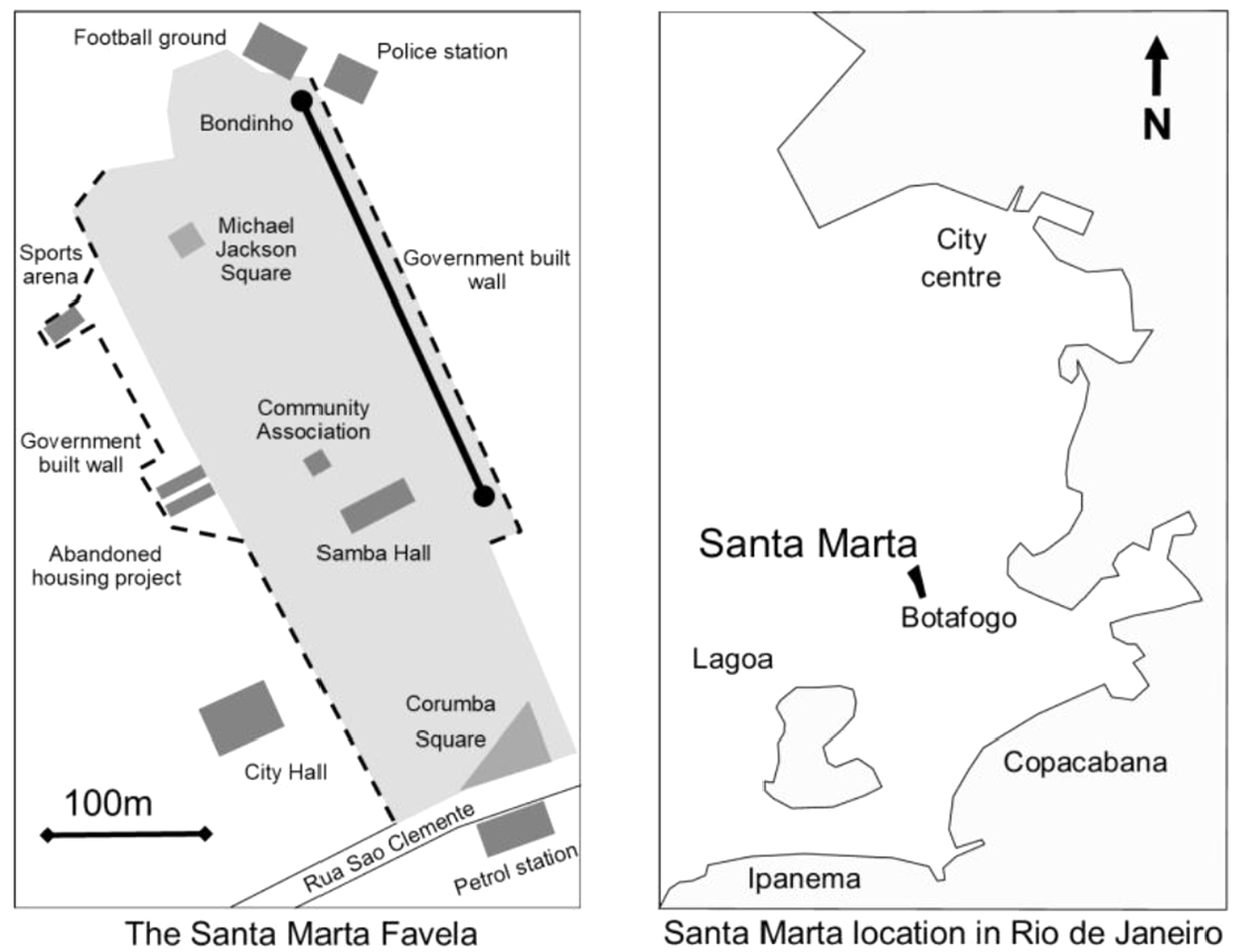
Map of Santa Marta and its location in central Rio de Janeiro, showing the government-built walls on the east and west, and the location of the City Hall (Palácio da Cidade).
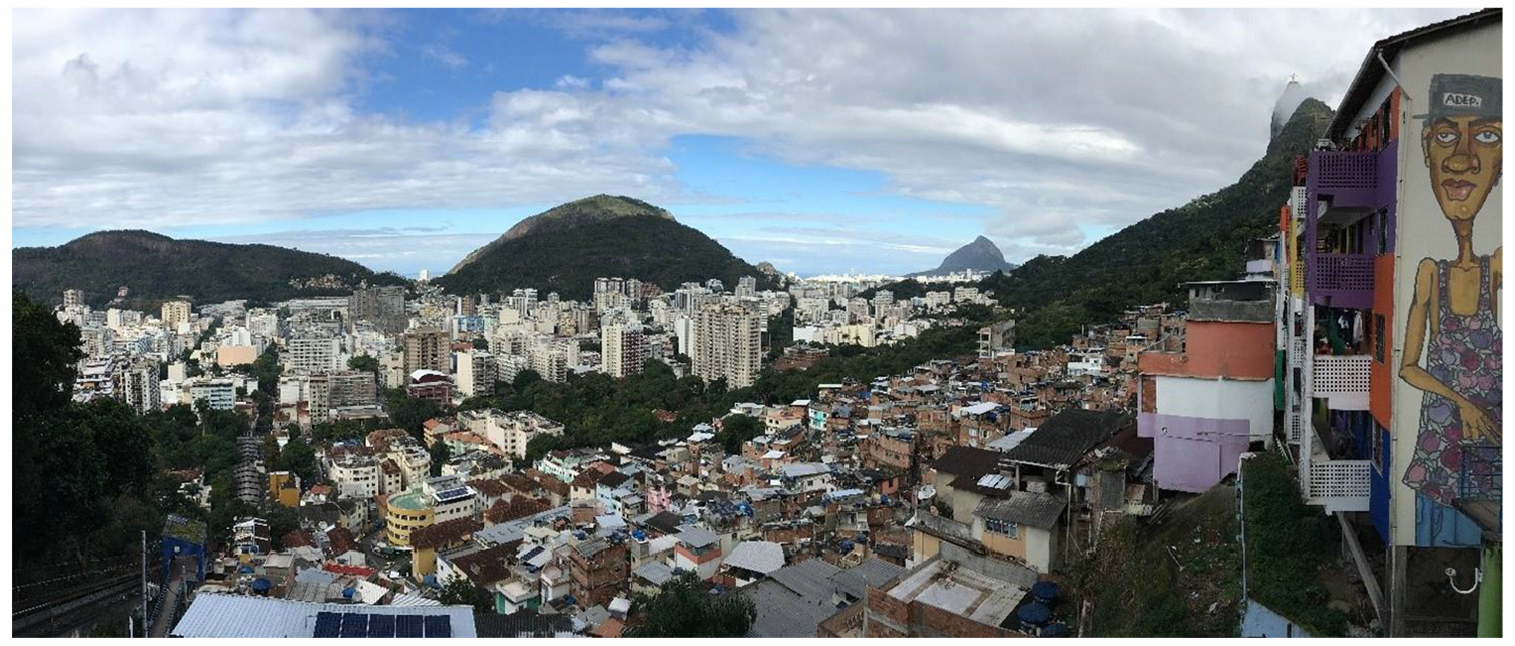
View of Santa Marta, showing the boundary of the favela where it abuts the forest on the east and west, and the adjoining neighbourhood of Botafogo to the south, in the middle distance, characterised by middle-income residential housing.
The workshop in Santa Marta was preceded by a year-long stakeholder consultation process. This consisted of a series of meetings between the Rio-based academic partner, the Eco group and members of the international research team, with the local academic partner acting as a mediator. De Prado Valladares (2019) suggests that many researchers who focus on favelas, whether Brazilian or from elsewhere, tend to ignore previous research and existing knowledge. To address this, we undertook a mapping of pre-existing scholarly and local knowledge in collaboration with the Brazilian research partners. The aim was to identify community concerns that Eco members wanted to explore through Co-Creation, giving residents the opportunity to shape the proposed workshop programme. The themes included segregation, symbolic exclusion from the formal city, scarcity of educational opportunities, stigmatisation and the lack of public space. By the end of the year-long planning process, conducted face-to-face and by email and WhatsApp, a five-day programme had been co-designed and distilled into a participant guide in both English and Portuguese.
During this preparatory phase, through discussions informed by previous research and stakeholders’ on-the-ground experience, the partners developed a set of ten principles to guide the organisers and participants through the process of setting up and running the workshop (Figure 3). The first five of these reflect Co-Creation’s inclusive ethos which encourages participants to build strong, trust-based relationships, commit to mutual respect and address issues related to traditional hierarchies. The other five principles anticipate potential challenges and conflicts which might arise and provide practical guidelines throughout the process. Their application throughout the workshop will be discussed in the following section.
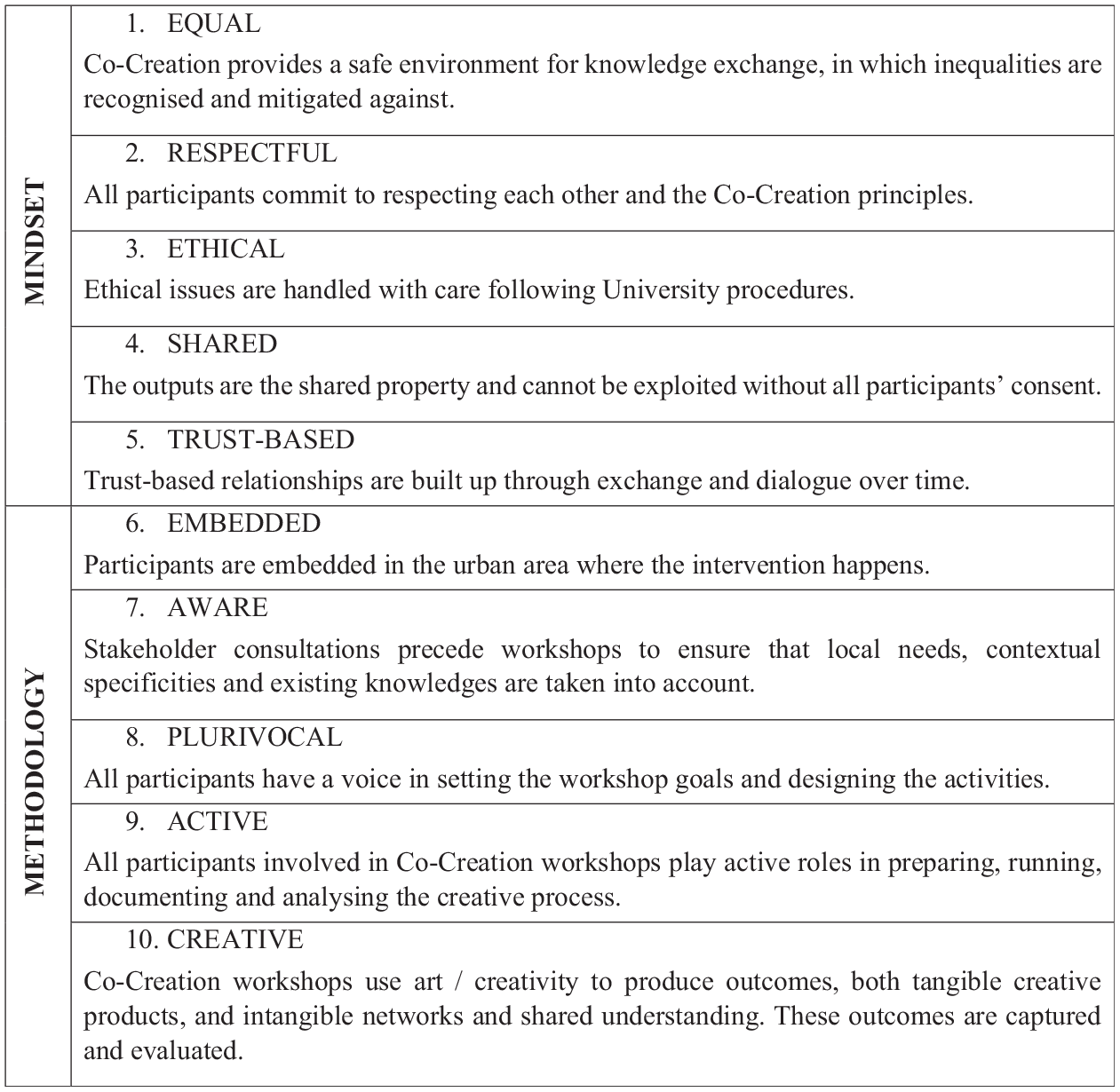
Co-Creation principles.
The resulting Co-Creation workshop was attended by a wide mix of participants. Twenty-two residents took part in the activities, mostly members of the Eco group, as well as 21 ‘outsiders’, including scholars and students from local and international universities, and practitioners from European and Brazilian NGOs. The five-day workshop was structured around a programme of activities for each day. The first day involved a tour of Santa Marta led by two local tourism companies, followed by an exchange on the role of tourism in the favela. On the second day, an initial discussion with the local Residents’ Association was followed by a photovoice workshop led by a local researcher. Mixed groups of participants captured what they perceived as challenges and opportunities through photographic images. These images were later shared and discussed together (Neves, 2013). The third day involved a mix of interactions with graffiti artists and poets, while the fourth day focused on the favela’s youth football team and their families, investigating issues around mobility, leisure spaces and the right to the city, which culminated in a mapping activity. Discussions of the photovoice workshop were then combined with mapping to explore spaces in the favela and the wider city and their meanings for residents. On the final day, the outcomes of the photovoice and mapping activities were exhibited in the favela’s samba building, where graffiti artists worked alongside local musicians and samba dancers in a closing embodied event for all workshop participants.
Co-Creation outcomes
The five-day workshop produced two main sets of outcomes. First, the collaborative art-based practices generated a series of photographs, maps and spray-painted canvases. Here we focus on the outcomes of the photovoice and mapping exercise (Figure 4), which resulted in a creative assemblage of 17 photovoice photographs around a map of Santa Marta annotated to highlight places associated with different affects and neighbourhood challenges.
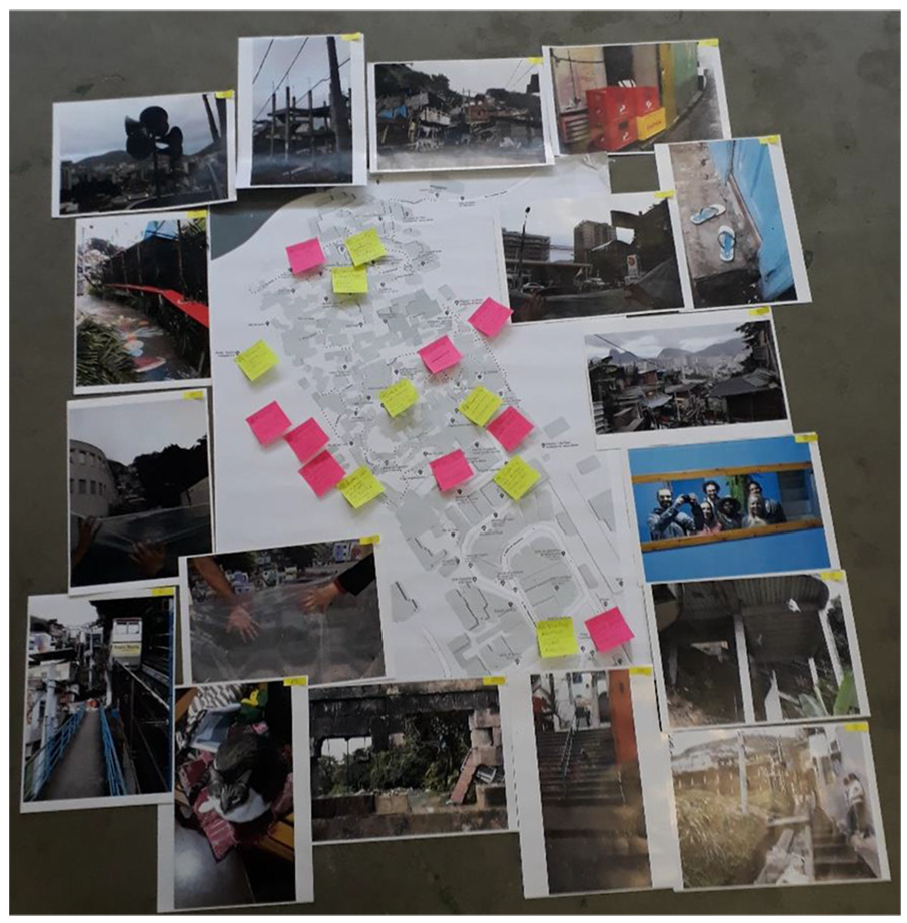
Creative outcomes of Co-Creation workshop (on the map, dark pink highlighting perceived issues and light yellow highlighting opportunities).
In line with the workshop’s title, almost half the images focused on Santa Marta’s physical borders, including the petrol station on Corumba Square and the stairs at the southern entrance of the favela, the cable car forming the eastern border, the northern hilltop area with the last remaining wooden shacks, the fence around the City Hall, and a half-completed and abandoned housing project on the western edge. In two further images, participants playfully explored the idea of invisible borders between Santa Marta and the city by holding up transparent rain ponchos against the favela landscapes they sought to disrupt. Four other photographs included close-ups of objects or animals: a pile of red and yellow beer cases; a pair of blue flip-flops on a doorstep; a set of megaphones on a roof terrace and a tabby cat curled up on a cushion. The images of the cable car, the mirror portrait of the mixed participant group and the megaphones emphasised connections and communication between favela residents and the outside world while the animal pictures, the colourful close-ups and the photograph of a square decorated with green plants, multi-coloured flags and paintings on the pavement conjured up hopeful perceptions of the favela as a liveable, everyday location and a home. While several images identified issues linked with the exclusion of Santa Marta from the formal city, its abandonment by policy makers and its precariousness, others evoked positive affects by focusing on colourfulness, interconnectedness and belonging. These diverse representations enabled the participants through the discussions to question dominant narratives about the favela and envision Santa Marta in new ways.
The images were combined on a map with information collected through mapping the mobility of young footballers’ families between spaces inside and outside the favela. They included interpretations of photographs and annotations of the affects they triggered. The narrative emerging from the discussion highlighted the simultaneous belonging to, and being excluded from, the neighbouring Botafogo district, with Santa Marta distanced from the ‘formal’ city through both visible and invisible borders. It reflects local activists’ and residents’ aspirations to ‘unbuild’ the barriers that exist, both material and immaterial, between Santa Marta and the rest of the city. Participants felt that there were a number of inclusive spaces in the favela, such as the Residents’ Association, the local tourist office and the sports ground, where residents considered that they were most likely to break down borders, disrupt received narratives and have their voices heard. In contrast, places such as the pacification building, governed by the state, were perceived as more ambiguous, conflicted spaces, associated with both opportunities and dangers.
The second set of outcomes produced during the workshop aimed to evaluate the Co-Creation process itself. These consisted of a series of field notes, photographs, audio recordings and qualitative interviews assembled by the participants, and photographs and videos recorded by the organisers. The review meeting after the workshop and a follow-up online evaluation survey allowed participants to reflect on the workings of Co-Creation in practice.
Comments on the Co-Creation mindset principles (as set out in Figure 3) confirmed that providing an [1. EQUAL] environment for knowledge production, in which inequalities are recognised and mitigated, is an important challenge, in particular in a large group with complex stratifications of power. One ‘insider’ commented on ‘the difficulty to apply Co-Creation principles within big groups that do not share consolidated practice and approaches’. However, Co-Creation’s [2. RESPECTFUL] ethos resonated with most participants. In the words of an Eco member, what makes Co-Creation particular is the fact that ‘it sees local actors as autonomous and creative subjects and proposes the encounter as a possibility of new creations’. Yes, some participants regretted the absence of decision-makers whose involvement would have been ‘a means of feeding back into potential change for the neighbourhood’ (International Researcher). However, such involvement would be complex given the ambiguous power relations between favela residents and the local authorities. Other comments acknowledged that all participants were subject to hierarchies within the group resulting from differences in age, gender, language competence, professional experience and the depth of their involvement in the project. [3. ETHICAL] issues were handled in line with the partner Universities’ ethics policies. In addition, project funding was used to pay local costs, such as the meals prepared by favela residents and artists’ honoraria. The research outcomes were [4. SHARED] among the participants using online communication tools while the creative outcomes remained the property of Eco. They will be exhibited in a show in the UK and then returned to Eco to hang in three local venues. In relation to [5. TRUST-BASED], participants highlighted the importance of both formally planned and spontaneously arising opportunities for exchange and trust-building. Participants emphasised the importance of the existing networks of trust in the neighbourhood: ‘Speaking directly with inhabitants on the streets of Santa Marta and being invited into their homes was something I found powerful [which] would not have been possible without the trust the Eco group has built up in the community’ (International Researcher). One international participant also highlighted the effectiveness of ‘informal social and cultural activities to develop empathy and mutual trust, much better than any academic/research activities planned’. However, other participants highlighted ‘the challenges of delivering a truly Co-Creative process with many participants working between continents, in different languages, with limited time and with different agendas’ (International Researcher).
Comments on the five methodological principles were more polemical. Working with Eco, a well-respected and [6. EMBEDDED] local organisation was seen as both an asset and a source of dissensus which required negotiation. Because of their anchoring in, and situated knowledge of, the neighbourhood, Eco played a central role in shaping the workshop. As the hosts of the event, it was their task to select the stakeholders to be included, the places to be visited and the themes to be addressed. While they were instrumental in opening up the agonistic space of the workshop, they were also influential in shaping the emerging narratives. However, the risk of generating a single story was avoided by acknowledging conflicting views and dissonance. As a local participant summarised it: ‘I was glad that by the end of the workshop some distinct voices and diverging opinions emerged from Santa Marta’ (Eco Member).
Several international participants, who joined the project not long before the workshop took place, felt to some extent left out of the planning process and less [7. AWARE] than others of contextual specificities and knowledge available about and in the community. Questions were posed about how the planning could have been made more collaborative, but given the key role of Eco in mobilising local residents and stakeholders, and the importance of responding to issues raised in the neighbourhood, the primary role that Eco took was understandable. There was consensus about the workshop being [8. PLURIVOCAL], although power structures and language barriers meant that some voices were more audible than others. The [9. ACTIVE] participation of all group members in the creative process and its evaluation triggered mixed comments. Some participants regretted not being given more opportunity for creative involvement, for instance in the graffiti painting which involved participants’ ideas, but which was actually completed by the street artists themselves. Others expressed the need to be given better-defined tasks or more time for making sense of the experience as a group. Finally, the [10. CREATIVE] process itself came under scrutiny for not offering enough opportunities for collaboration between ‘insider’/‘outsider’ participants and between artists/non-artists. For one Eco member, the most successful part of the workshop was ‘the activity that combined the production of photos and dialogue with residents and the work on the map’, as this gave the possibility for a Co-Created vision of the neighbourhood to be explored across cultures and experiences.
In addition to their evaluation of the Co-Creation principles, participants also reflected on their own positionality and affect, for example by identifying moments of ‘break in’ which temporarily disrupted the Co-Creation process. Depper (2019: 97) notes that such incidents can stir up strong feelings such as ‘fear, anxiety, embarrassment’ but also tend to give researchers a sudden insight into the challenges experienced by the local community. Such moments in Santa Marta included difficulties in communication because of language barriers, armed gang presence and the sound of police gunshots near the workshop site, which were considered as significant challenges by participants. The tension between Eco’s interpretations of safety issues as everyday realities, in contrast to the participants’ feelings of insecurity, highlighted the presence of dissensus in the agonistic space created by the workshop, bringing together different perspectives on what residents interpreted as a scene of everyday actuality in the favela, while the ‘outsiders’ saw them as stressful situations. This contributed to both parties’ deeper understanding of these everyday experiences, helping the ‘outsiders’ to learn from the residents’ situated knowledges and enabling the ‘insiders’‘to hear the provocations and different ways of thinking about what we live here on a daily basis. This external regard helps us to see ourselves in other ways’ (Eco member).
Underpinning the Co-Creation workshop were the inherent power relations that played out in the run-up to, during and after the workshop. Their complexity stemmed from the fact that academics from the Global North had acquired the research funding that supported the work financially and broadly suggested the approach to be tested through the workshop, while the Eco group had the local, situated knowledge and therefore the unique ability to connect residents and stakeholders with the project and design day-to-day activities suitable to involve them in the event. Different actors had particular roles in the Co-Creation process, and the challenge was to respect those differences while collaborating in a common agonistic space. While all participants agreed about the Co-Creation principles in general, ideas about how to translate these into a series of activities around agonistic encounters were different and remained subject to continuous negotiations in which spontaneity also had a role to play. For example, the photovoice exercise was led by a local Rio scholar, and there was no prior plan to link it with the mapping exercise, initiated by scholars from the Global North, until participants asked for this modification. Overall, academic approaches employed to pre-structure the Co-Creation process were progressively disrupted by more fluid methods of knowledge production giving room for residents’‘ways of seeing’. Similarly, it could be argued that even after the Co-Creation workshop, residents continued to influence the resulting narratives and their dissemination. For example, the conference held in 2019 at PUC-Rio University involved Eco members both in the organising committee and as delegates, and an academic article assessing the workshop was co-authored by the leader of Eco together with scholars from Britain and Brazil. Thus, despite their lesser familiarity with scholarly formats that continue to dominate academic knowledge production and act as a prerequisite for recognition, because of their confidence acquired through decades of agonistic practice and the motivation from the project leaders to engage them, residents from Santa Marta succeeded in influencing the overall narrative and contributed their own views to the debate.
In addition to the on-going ‘politics of listening’ during the activities, project partners were given the opportunity to feed back through a post-workshop discussion and online evaluation to make sense of what had been achieved. As one ‘insider’ participant commented in the evaluation: ‘The success of Co-Creation processes should be evaluated in terms of what remains in the local communities, and not what the researcher/artist brings back home from their surveys’. In relation to ‘what remains’, comments from a number of ‘insider’ participants suggest that their involvement in the workshop has impacted on understandings of Santa Marta, has spurred them to think more broadly about their positionality and has facilitated exchanges between local stakeholders who had previously rarely come into contact. As one ‘insider’ highlighted, ‘I learned many things, such as the excellent possibility of discussing urban inequality through art: through photos and conversations about photos, for example, we were discussing inequalities in the favela’. Thus the Co-Creation workshop offered possibilities for both insiders and outsiders to explore the multiple meanings of the neighbourhood and to deepen their insights into the daily lived experiences of life in the favela.
Conclusion
The Santa Marta case study analysed the potential of the Co-Creation method as a tool for communities to express their multiple knowledges, reflect on their experience of neighbourhood disadvantage and engage in agonistic dialogue where dissensus is not suppressed but, on the contrary, used to develop new understanding. The experience suggests that, through the use of arts-based methods, Co-Creation can help build trust between researchers and non-academic communities. It encourages participants to find alternative ways to express their experiences related to exclusion and stigmatisation, which can be difficult to articulate in purely rational terms and verbal forms. The combination of verbal methods with creative and embodied ways of knowledge production such as mapping or photovoice exercises, produces an added value by making space for different voices in agonistic space, where tensions and conflicts can be accepted and negotiated, and channelled positively into political action. The construction of an agonistic space in Santa Marta during the workshop was facilitated by the Eco group’s longstanding experience in arts-based activism which played a crucial role in the achievements of this event.
Mouffe (2007: 2) recommends using critical art to create dissensus to reveal what the dominant consensus tends to obfuscate and thereby open up avenues for new thinking and political action. As an agonistic and disrupting place-making practice which elaborates alternative visions of disadvantaged neighbourhoods, Co-Creation can be seen as an important tool to influence public perceptions of disadvantaged neighbourhoods such as Santa Marta and build action for change. While this case study validated some of our initial hypotheses about the value of arts methods to engage different audiences in collective knowledge generation, it also revealed challenges that need to be addressed for Co-Creation to fulfil its potential. The workshop illustrated the importance of negotiation to address issues of contradiction and tension, particularly in situations involving complex power relations between participants. On a practical level, participants were faced with the time-intensity and unpredictability of the Co-Creation process and the difficulty of evaluating its creative outputs. From the case study, evidence suggests that building trust-based relationships between participants, which is a sine qua non condition for effective Co-Creation, requires time and flexibility and is easier to achieve in small groups. The workshop also revealed that only truly collaborative planning can minimise shortcomings in relation to participants’ engagement and understandings of their roles. In a future iteration of the workshop, involving all participants in the preparatory discussions about the overall objectives, the programme and the procedures in the event of concerns, would help overcome this weakness.
The workshop also highlighted that the efficacy of creative methods does not depend on whether these methods are employed by artists, residents or researchers, but that participants should follow clearly defined strategies, in this case based on Co-Creation principles, throughout the planning, documentation and analysis of the process. It also demonstrated that the political potential of Co-Creation is inherently linked with the affects it mobilises through its aesthetic dimensions. These affects triggered by Co-Creation are vital to its societal impact since, as Mouffe suggests, ‘the transformation of political identities can never result from a rationalist appeal to the true interest of the subject, but rather from the inscription of the social agent in a set of practices that will mobilise its affect in a way that disarticulates the framework in which the dominant process of identification takes place’ (Mouffe, 2013: 93).
In relation to Co-Creation’s contribution to building opportunities for change, benefits were identified at both the individual and collective levels. These include the creation of new networks which de-segregate Santa Marta by connecting residents both with the formal city and globally, and the dissemination of alternative representations of Santa Marta as a place where, despite hardship, new possibilities can be imagined. According to Mouffe (2007), artistic interventions alone cannot bring about the transformations needed to address urban inequalities and structural injustices. While we agree with this, we would argue that, by providing an outlet for resistance to dominant imagery through artistic activities, discussions and dissemination, Co-Creation has the potential to encourage political processes challenging existing hierarchies, either by promoting links with traditional forms of political activism through trades-union and political-party engagement (Laclau and Mouffe, 1985) or by encouraging grass-roots community development and political advocacy.
Mouffe (2007) states, ‘critical art is art that foments dissensus, that makes visible what the dominant consensus tends to obscure and obliterate’. Ultimately, Co-Creation’s political potential lies in its ability as an aesthetic process to move participants and allow them to negotiate tensions and conflicts and channel them positively into political action. This is in line with recent calls in geo-humanities literature to embrace critical perspectives through creative practice to address current global injustices (Hawkins, 2019). While the reality of key voices coalescing in such agonistic spaces as the Rio favelas is challenging, the Co-Creation workshop helped participants of different backgrounds to contribute to building collaborative knowledge and understanding about Santa Marta. We see this as a vital first step to a more comprehensive and inclusive Co-Creation process.
Footnotes
Acknowledgements
The authors would like to thank Itamar Silva (Eco group), Sarah de Silva Telles and Gianne Neves (PUC-Rio University), and Sue Brownill and Oscar Natividad Puig (Oxford Brookes University) for their contributions, and all participants involved in the Santa Marta workshop, including residents and members of associations and NGOs in Santa Marta. The authors would also like to express their gratitude to the three anonymous reviewers for their helpful comments.
Funding
The author(s) disclosed receipt of the following financial support for the research, authorship, and/or publication of this article: This project has received funding from the European Union’s Horizon 2020 research and innovation programme under the Marie Skłodowska-Curie grant agreement No 749154 (SURGE), the Marie Skłodowska-Curie grant agreement No 734770 (Co-Creation) and the University of Bath sabbatical scheme. Further details of the project and partners are at  .
.