



Abstract
This article explores the extent to which urban planning professionals in Iran are prepared to facilitate children’s inclusion in city decision-making. What do Iranian planners believe about the potential effectiveness of children’s inclusion? Evidence from research in Mashhad elicited ambivalent reactions on the part of planners. They held conflicting viewpoints on children’s involvement from various perspectives, including its feasibility, its value to children and to the planning system, and its implications for their own roles. There was evidence, however, that planners’ current purpose could change from passively instrumental roles to advocacy, partnership and communication. The paper considers how the functioning of the larger planning system might incorporate child-participation initiatives, facilitating a more democratic approach to planning and citizen participation in urban environments.
Keywords
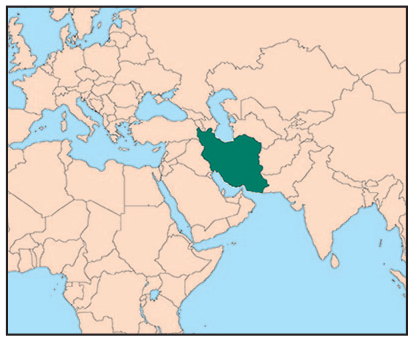
I. Introduction
Urban planning is ideally a forum for dialogue(1) and over time, the role of planners has evolved in many places from that of technocrats to that of facilitators, negotiators and mediators.(2) Planners are expected to listen to the voices of all city dwellers, and the Convention on the Rights of the Child makes it clear that this includes children.(3)
Examples of children’s participation in urban decision-making are found all over the world, in places as diverse as New Zealand, Izmir in Turkey, Mexico City, Kirtipur in Nepal, Boulder in the USA, Victoria in Canada, London in the UK, Saida and Beirut in Lebanon, and Johannesburg in South Africa. These examples include documentation of children’s engagement as urban researchers and advisors, as designers, as collaborators and decision-makers on policy, as effective presenters of their perspectives, and as advocates for the particular needs of citizens at their stage in life.(4) This is a representative sample but is far from comprehensive.
Despite the many positive examples, however, children’s participation in urban planning processes is still poorly understood, and for the most part, they remain marginalised in this field.(5) Children in most societies, according to McAllister, “are not in a position to clearly articulate their needs or desires, so it is necessary to involve advocates to speak on their behalf”.(6) Planning professionals can play a crucial role in this regard, representing children in urban planning decisions, as well as actively involving them in this process and facilitating children’s meaningful participation.(7) Acting as a supporter and mediator for children in any context requires planners to modify more traditional approaches to give children stronger voices for their planning needs,(8) applying a needs-oriented urban planning approach.(9) Understanding about how children’s insights into urban planning processes can be effective, however, varies by context and planners’ beliefs. This study sets out to clarify these beliefs in Iran specifically.
Iran’s largely top-down urban planning practices are typified by the involvement of technocratic elites, especially engineers, architects and planners.(10) Although considerably more attention has been focused in recent decades on strategic rather than synoptic planning, community participation (regardless of age) is still not typically included here in meaningful ways.(11)
There are, however, some interesting examples in Iran of children’s voices being integrated into planning discourse, including the Bam Child Friendly City Initiative,(12) the School Mayor,(13) the participation of children and youth in informal settlement upgrading programmes in Tehran,(14) and the 2020 UNICEF programme in which 12 Iranian cities were considered as pilots for the Child-Friendly Cities Initiative.(15)
This article contends that present conditions offer an opportunity to reform Iran’s more generally non-participatory planning culture so that decision-makers can listen to and value the voices of less privileged groups, including children. Planners could play a vital role in this transition.(16) Understanding the likelihood of such a shift in Iran, however, presupposes an understanding of planners’ views about the value of children’s participation. Despite many studies about urban planning in Iranian planning literature, research on the role and perceptions of planners is lacking.(17) This study contributes to filling that gap by interviewing planners from various parts of Iran’s larger planning system.
To get beyond the tendency for generic responses by planners during interviews, for the first stage of this study(18) we invited children to express their views about the city they lived in. We then presented the results to urban planning professionals. This allowed us to explore their responses to the children’s viewpoints, and to gain insights into their beliefs and expectations about children’s inclusion. This knowledge was helpful in developing strategies for integrating children’s perspectives into planning debates.
II. Theoretical Background
a. The role of urban planners in child participation
Late twentieth-century planning discourse changed from embracing simple top-down decision-making to affirming the importance of bottom-up approaches emphasising all stakeholder voices. This new perspective repositioned planners. Rather than being cast as authoritarian experts, they are increasingly seen as planner advocates, facilitators, mediators, activists or investigators.(19) Obviously, the context within which planners work substantially shapes their engagement with various stakeholders, including children, in the multiple planning processes. Foley points to the value of acting outside the institutional setting,(20) while Connelly emphasises that even when the context is not supportive, committed urban professionals can include some measure of public consultation.(21)
This changing planning discourse can be undermined by planning professionals whose focus is on technical knowledge and formal analytical techniques – what Sanyal calls “bureaucratic planners”.(22) Despite the language of inclusion, this type of planning often reflects only the perspective of the state, with planners’ de facto function being to neutralise political opposition by citizen groups.(23) Thus, there may be little effectual change in the historically deep-seated planning elitism.
A long time has passed since Davidoff first introduced the “advocacy role of planners” in 1965.(24) More recently, Tayebi described the benefits of this approach in providing more transparent relationships between client and planner.(25) Tayebi argued for the equal opportunity of all clients to defend their interests and rights. Some less able to defend their rights, however, may require support from professionals who are familiar with the game’s rules and guidelines and who possess relevant bargaining skills to advocate for their rights through negotiation with institutional players.
The attitudes and roles of planners can make planning either child centred or child blind.(26) Given the conflicts of interest between communities and state, bureaucratic planners infrequently address children’s needs(27) and have been largely unsuccessful in involving children and youth in formal planning processes.(28) This leads to child-blind planning, resulting in urban processes that leave little room for incorporating youth concerns(29) and urban settings where children may feel alienated and rejected.(30) Planners, however, can also act as advocates for socially disenfranchised groups, and can direct planning towards creating child-centred spaces.
Rafferty’s concept of a dialogic space for interaction refers to public lines of communication among members of the public, professionals and government agencies.(31) This dialogic space in so-called communicative planning involves consensus building between various viewpoints based on what Hiller called a “negotiated win-win agreement”.(32) This permits stakeholders to express different points of view and brings together different needs and forms of knowledge.(33) Authoritarian systems and contexts, however, provide little opportunity for people’s inclusion in decision-making, and, as described by Connelly, offer a very “limited range of possible actions”.(34)
Planners’ attitudes and actions are guided by their recognition of the context they plan for, their beliefs and approaches towards that setting,(35) and their cultural and personal beliefs.(36) These beliefs and values, together with the role planners have in different contexts, generate what Sanyal identified as “planning culture”: the “collective ethos and dominant attitudes of planners regarding the appropriate role of the state, market forces and civil society in influencing social outcomes”.(37) Connelly describes planning culture as “a set of norms and expectations of what kinds of political interactions between state and citizens are appropriate and possible”.(38) This culture of engagement shapes the type and degree of community inclusion possible in the planning process, including that of children.
b. Communicative approaches and planners’ position
Many planners consider Habermas’s theory(39) of communicative action to be useful in providing an alternative to modernist rationality.(40) Consensus seeking, collaboration and participation are key concepts here.(41)
Consensus seeking occurs through rational arguments between different interest groups(42) and has played an important role in planning discourse over the past three decades. Its focus on the democratic and deliberative process has generated a progressive body of planning literature, which theoretically includes citizens in the decision-making process.(43) Communicative-action theorists do not limit themselves to studies of planners but have an eye on all actors, including non-governmental organisations (NGOs), that collectively constitute the internal interactions of the planning system.(44)
From this vantage point, planning policymakers are actors, not merely observers or neutral specialists.(45) Their primary role in the communicative approach is as a mediator to create consensus. Innes and Booher explain consensus building as a means for planners to “search for feasible strategies to deal with uncertain, complex, and controversial planning and policy tasks”.(46) Although this process does not transform the whole structure of power, its purpose is to better equalise power in policymaking by requiring engagement with the majority and groups or their representatives before decisions are made.(47)
c. Urban professionals and the challenges of child inclusion
To include children in the planning process, planners face various challenges described in the planning literature. First, urban experts often lack the knowledge on how to design programmes for children, how to work with them, or how to make their inclusion meaningful.(48) Participatory planning methods may be at odds with the socio-cultural assumptions underpinning their previous approaches, making it difficult to apply these ideas, and restricting young people’s capacity to influence urban planning.(49)
Second, planners face conflicts between state and community interests. State officials and even citizens may view planners’ initiatives with animosity. This pressures them to make difficult choices: do they represent the government on behalf of whom they are hired(50) or function as intermediaries between public and state, standing with the public to support their interests?
The third barrier planners face regards their own beliefs about children’s participation. Criticisms suggest that planners mostly privilege adult concerns and marginalise the concerns of children and young people.(51) They may also assume they can speak on behalf of children. Even when children’s own ideas are accepted in theory, participation is not always meaningful, and is often directed inappropriately(52) because planners do not accept children’s competency.
Fourth, Nordström and Wales argue that involving children in urban planning challenges existing power relations – the new adult–child relationships involved in turn change relationships between these adults and other actors or organisations.(53) The privileged position of experts tends to discourage their inclusion of children’s views.(54) Incorporating children’s insights into the planning debate thus remains a dilemma for planning professionals(55) and commonly results in restricting the inclusion of children and young people.(56)
d. Background on the Iranian planning system
In urban decision-making, different actors play various roles in Iran, which we term intra-system interaction in this paper. Barati sees the current basis of urban development in Iran as a triangle of state–planner–city.(57) In this triangle, the term “state” refers to urban management, and “city” can be interpreted as the level of community involvement, with planners as intermediaries. In the hierarchy of participation in planning processes, urban managers stand at the top, planners are in the middle, and the market and local communities are at the base.(58) Actual entities reveal the complexities within the interacting elements of Iranian city planning as follows.
Primary decision-making organisations
Primary decision-making organisations are city councils and provincial offices, including the Organisation of Urban Development Plans, the Roads and Urban Development Office and local municipalities. The process of plan preparation is conducted by planners (consulting engineering companies), but is controlled and guided by government agencies.(59) Meanwhile, the public sector, councils and municipalities have a horizontally elected system, to some extent independent of multi-sectoral performance, but essentially under the direct control of central government. Management perspectives assign low value to non-technical experts,(60) NGOs, or the public.
Urban planners
Urban planners play an important role, positioned in the middle of the planning hierarchy. Urban management controls planners’ decisions and their expert input is relied upon for complex technical decisions. As in other countries, planners in Iran can be differentiated by their roles. Some planners work in government sectors, such as those in the Roads and Urban Development Office. In this group, planners work as part of a centralised structure and are usually responsible for plan-approval processes. A second group comprises those planners working outside the government system, for example the consulting engineers responsible for preparing urban development plans, who are not part of the formal bureaucratic apparatus. The planning modus operandi is still scientific and technical; public participation consists only of quantitative questionnaires. Municipalities, meanwhile, are entities within state ownership but with local independence, responsible for implementing plans prepared by the private sector that have been approved by the government sector.(61)
Planners in different sectors play the role of scientific advisors, tasked with finding the best solutions for realising managers’ goals through urban development plans. It is the manager who pays them and whose control they are under. Consequently, the planning process tends to disregard public opinion and prioritises the views of those who hold power. Nevertheless, not all planners agree with this process. Evidence shows that the political reality of Iranian society can compromise planners and that their personal beliefs should be understood within the formal planning process as separate from political and organisational demands.(62) Although planners prioritise the requirements of their state employer, they are aware that they should also respect the public interest, since public legitimacy is ultimately more important than simple compliance to gain urban managers’ approval. Planners are frequently torn by the conflicting interests of their employer, their personal beliefs and the public interest.
Despite many studies about planning processes, few independent studies exist concerning the role and effectiveness of planners in Iran.(63) To understand Iranian planners’ attitudes towards public participation, we refer to Nodehi and Fouladinasab, one of the few studies of Iranian planners’ attitudes and beliefs about “public participation in planning, design and implementation of urban development plan”.(64) Their Tehran research showed 95 per cent of participants believed that urban planners could play an active role in increasing the amount and quality of public participation. Despite this positive approach, questions persist about the current position of planners regarding participation.
The public
The public stands at the bottom of this hierarchy with its intra-system conflicts and pressures. City residents are largely ignored and lack the ability to express their collective needs.(65) The mindset of urban managers leaves little space for attention to and belief in public engagement.(66) From decision-makers’ perspectives, the dominance of centralised processes, the absence of community advocacy and the time consumed by participatory approaches are all reasons to draw back from community involvement. Taking account of these factors may also push plans and projects in directions not consistent with government goals since the outcomes of public participation in the urban planning process may diverge from urban management policies. Specialists in the field of urban planning, including geographers, sociologists or environmental planners, have at best a secondary role.(67)
III. Methods and Materials
Despite the handful of positive examples cited above, there are few opportunities for Iranian planners to hear children’s voices. The present study offers an innovative approach on this front. The study aimed to hear first-hand a variety of Iranian planning professionals’ thoughts about children’s participation in planning. However, we posited that introducing planners to what children had actually said and done could generate more grounded responses, shifting them from generic occupational and administrative reflexes. The plan, then, was first to involve children in a participatory exercise. Whether planners were approving, dismissive or uncertain in their reactions, our approach aimed to narrow the gap between them and children in the urban environment (Figure 1).

Research process
a. Stage one: Collecting evidence from children for interviewing planners
This preparatory stage was part of a wider research programme under university ethics approval reported elsewhere.(68) In December 2018, we collected evidence of children’s perceptions of Mashhad, Iran’s second-largest city. Researchers visited schools with the approval of principals and children participated in planning exercises, sharing their ideas about the city.
Sixty children were involved, an equal number of boys and girls aged 10–12 years from a middle-income neighbourhood. Activities included written, visual and verbal methods: interviews, focus group discussions, children’s drawn images of their ideal city, and an essay about what they would like to change in the city if they were the mayor of Mashhad (Photos 1 and 2). Children were asked to describe their favourite or least-favourite places in their neighbourhoods and in the city of Mashhad, and to reveal their perceptions of urban spaces, their ideal city, and their potential role in creating urban environments. A thematic content analysis synthesised the main themes in their essays and other responses.
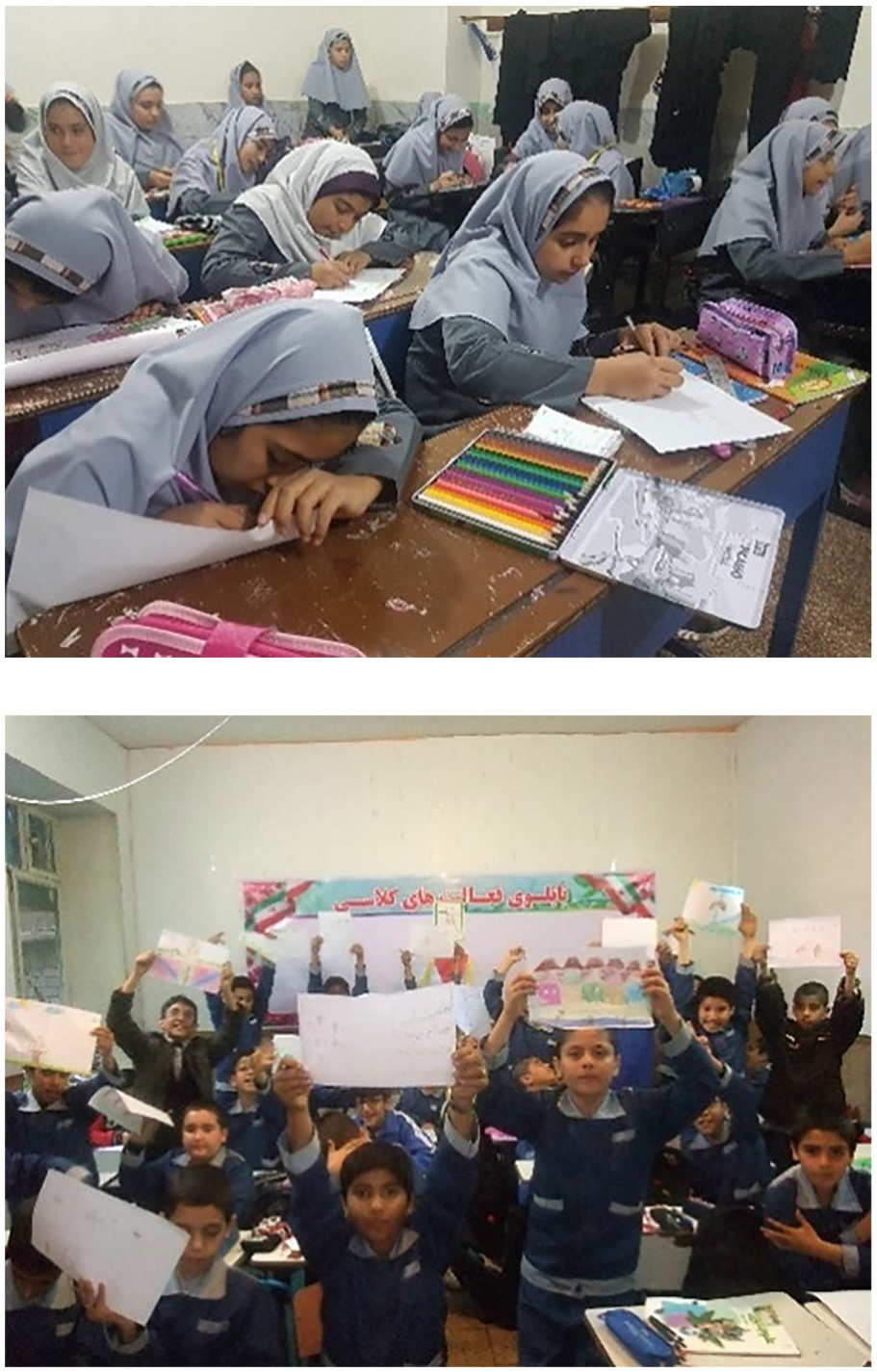
Children’s engagement using a visual method
b. Stage two: Sharing children’s ideas with urban professionals
The results of Stage One provided the platform for interviews with 32 urban planners responsible for different sectors in the urban decision-making system. This grounded the interview conversations, eliciting experts’ reactions and responses to the children’s views and contributions. Our intention was that this evidence of children’s participation could show planners that children are indeed aware of their urban environment; how they think about the city and its neighbourhoods; their sensitivity to their living areas; and finally, the potential of their responses to contribute to planning outcomes. Each interview started with a short slide presentation of the consolidated Stage One data, to establish the focus on the place and potential of children in Iranian planning.
Planner participants
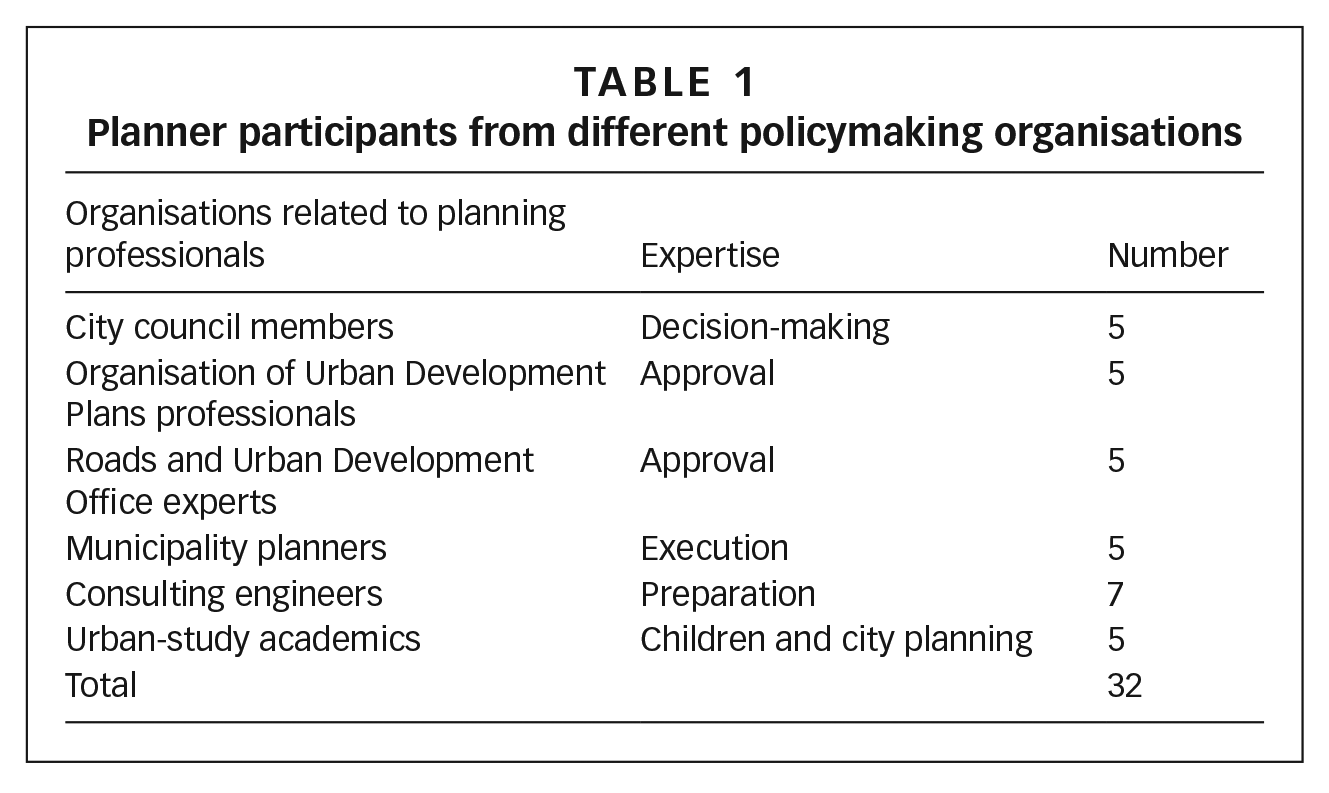
We selected participants using purposive sampling to yield cases that are “information rich”(69) and participants were selected to represent the range of work roles in the planning sector. Decisions about development plans in Iran involve the joint effort of six main organisation-sector clusters – the city council, the Organisation of Urban Development Plans, the Roads and Urban Development Office, the municipalities, the consulting engineers and the academic sector (including universities and others whose fields of study or area of interest is about children in the Iranian planning system, since planning educators have an impact as theorists in the planning system). Five experts were interviewed from each cluster except the consulting engineers. Since the city is divided into seven regions, we instead selected project managers from companies involved in the master-plan preparation for each of the seven regions. As shown in Table 1, 32 urban policymakers in total were invited.
Planner participants from different policymaking organisations
Data-collection method and analysis
The interviews with planners, mainly in their offices, were discussion-based with an open-ended format, and conversations flowed as a dialogue except when discussion went off topic or if topics had not yet been raised. The flexible character of semi-structured interviews(70) allowed us to ask more questions when unanticipated but interesting points were raised by interviewees. Urban planners and decision-makers were asked a series of questions concerning their ideas about children’s inclusion in city planning in the context of Iran. Planners were asked about the extent to which children could be meaningfully engaged in the process of city planning and possible ways of facilitating their integration.
We also asked specifically about children’s involvement in city planning processes and whether planners thought this was important. We explored planners’ opinions about children’s desire to have their views voiced, the extent to which they could effectively influence decisions about their city, and with what ramifications for Iran’s planning system. Planners were also asked about their roles and responsibilities in this regard. At the end of the interviews, we explored planners’ suggestions for child participation, including possible opportunities for children to take part in the planning process, and what barriers might prevent it.
All planner interviews were audio recorded, transcribed verbatim and translated from Farsi to English. We used qualitative content analysis, drawing out themes and the frequency with which they emerged.(71)
It was evident in the interviews that, aside from the academic planners, many participants simply reflected the functional demands of their location within the planning system, yielding to the strongest top-down pressures towards project completion, cost minimisation and government or commercial interests. Participants did not describe themselves as bureaucratic, but some applied the concept to the complexity of their work environments, mostly not using the term itself, but stressing the rules and procedures they had to follow.
IV. Results
a. Children’s views and participation
The primary school students’ participation indicated that:
Children are capable of understanding their living environment, its characteristics and deficiencies. Their concerns included the lack of green space, their need for safe, clean, unpolluted and lively public spaces, for accessible recreational spaces, and available sanitation. They stressed their desire to walk safely on the streets on their own, and to move around freely to play and meet friends.
Children demonstrated a sense of belonging and attachment to their neighbourhood spaces and were enthusiastic about contributing to those spaces.
b. Planners’ responses to children’s views and participation
Based on planners’ responses, it was clear that the presentation of the children’s ideas created a space for discussing their opinions and beliefs about children’s capacity for participation.
In the interviews, about 80 per cent of these experts demonstrated a broad enthusiasm for children’s inclusion, although some had concerns. Planners had a rich range of views and responses, but their generally positive views towards child involvement suggests new potential for their role in the realisation of these ideas.
The role and position of the participants in the planning system had little obvious effect on their views regarding children’s participation. Despite our initial assumption of a likely variation by sector, there were no significant differences between academics and hands-on planners, for instance, or between government employees and private consultants in terms of their interest in children’s involvement. Other more personal factors are clearly at play here. Further research to cross-check this finding appears desirable, and could also investigate whether, despite the range of roles, there are common pressures of cost, time, lines of authority and planning frameworks that homogenise views and suppress potential variation.
The effects of participation on children
Among those planners who were positive about children’s inclusion in the planning process, the great majority mentioned the associated pedagogical and socialising benefits. They observed for instance that participation could contribute to children’s self-confidence and their development as responsible adult citizens. One municipal planner argued that children’s participation is valuable not so much for its benefits to cities and planning areas, but for the valuable learning involved, and for encouraging children to think. Half the planners linked children’s participation to an improvement in their sense of belonging, as was evident in this comment from a municipal planner: “Children’s participation can help [them] to understand the city better and experience a sense of belonging to the society and the city they live in.”
The practical impact of children’s involvement
Although experience indicates that children can bring a practical perspective to planning, this was not a point that the respondents chose to emphasise. Despite their broad positivity about children’s involvement, this appeared to centre more around the educational benefits for children and for their later civic participation. Planners implied but stopped short of articulating a deeper recognition of children’s potential contribution. This is not unusual. Although there are fine examples, as noted in the introduction, of children’s active engagement, assessments of the practical outcome of these engagements are far less common. While the social and pedagogic value for children is widely claimed, not as many studies have considered how seriously children’s views are taken and whether or not they are acted on. The Clements paper from Johannesburg, for instance, is unusual in analysing carefully why an otherwise successful engagement yielded no practical results.(72)
Around half of planners, however, did see the benefits going beyond the pedagogic impact for children, even if not in terms of specific planning outcomes. They saw children’s presence in the planning space as a potential opportunity for professional planners and more generally for what they termed Iran’s “culture of urbanisation” because of their “pure” perspectives, unsullied by financial or political agendas in planning and design, with which planners were all too familiar. These planners believed that children’s involvement could stimulate a more participatory culture generally – the lack of which has long resulted in dissatisfaction with planning outcomes on the part of citizens. They argued that ideas from children and youth could help motivate other sidelined groups to collaborate in decision-making, including the disabled, the elderly and women, energising a change within planning. One municipal planner took a longer-term view of this, remarking that “If the sense of participation is enhanced from childhood, citizens will regard themselves as part of the community and cooperate more.”
These planners were motivated by the fact that children’s needs and desires in urban spaces differ from those of adults. They felt it was important for authorities to ask children what they need, like, or dislike in the city. Planners who were comfortable talking about this recognised that children’s views and needs were different from adults’, and they respected this rather than dismissing children’s views. They also observed that these needs vary in different parts of the city, and require consultation with children from these different areas. A planner from the Organisation of Urban Development Plans identified this issue, for instance, in discussing differences between low-income and high-income neighbourhoods in Mashhad City.
Children as democratic subjects
About a quarter of the positive planners stressed the importance of hearing children’s voices, basing this view on the argument that children are part of society and as urban space users, have a natural right to participate regardless of age. Their view was that children are active agents and their relationship with their urban environments needs to be considered. One planner from the municipality said quite simply, “Children are also space users in the city; that is why their ideas must be heard.”
This group of planners also emphasised that children connect with urban spaces more than adults do and that they, the urban planners, have a key role in managing these spaces for children. These participants focused attention on the relationship between children and the city: this greater connection between children and public areas, they said, is why children’s insights need to be brought into the planning process. This reasoning led these experts to affirm the importance of their role in supporting this relationship between space and children.
Many than 80 per cent of the planners acknowledged that children’s imaginations, beliefs and decisions are pure, without ulterior motives related to politics, hierarchies or commercial interests. Children’s ideas about the city are in this sense real, and hence their engagement in planning is an important contribution. Since the child’s mind is free from political conservatism, profit or self-interest, children can express their ideas more honestly than adults.
These professional planners accepted children as influential members of society because of this honesty and their connections with urban spaces. They viewed children as having the right to participate in the creation of urban spaces, claiming that this is not merely the domain of experts. In responding to the evidence presented to them at the beginning of the interviews, only about 20 per cent of the planner participants agreed with the dominant cultural perspective in Iran that considers children to be merely the possessions of parents, their youthfulness excluding them from urban affairs. Most were against the restriction of children’s rights in this regard, saying that children as members of society deserve to have their say in urban affairs. This group of planners saw cities more generally, not as the domain of adult male experts, but as the arena in which the presence of all inhabitants, including children, should find expression.
c. Ways of hearing children’s voices
Many of the planners held the view, with individual variations, that several elements were necessary to effectively “hear” children’s voices in Iran.
Creating safer spaces for children
One of the themes emerging from the experts’ responses was the need for cities to have appropriate spaces for child activities. Typically, planners believed that urban spaces on the whole were not actually safe for children’s activities, a reality that has led many risk-averse parents to limit their children’s mobility in this regard. These restrictions on children’s presence in urban spaces can also extend to assumptions about the value of children’s participation in creating these same spaces. As an academic planner noted:
In the past, our urban structure, especially in the neighbourhoods, was different from now, and it was safer for children’s presence in public spaces. Insufficient safety in cities leads to a lack of children’s activities in the city. This lack of safety is apparent with regard to children’s mobility between home and school. That is why many parents these days use school buses for children’s transportation. This is something that we did not have in the past.
In discussing the issue of safety, several planners noted the lack of children’s legislation and legal protection, contributing to children’s isolation.
Training and research
For children’s participation to be accepted and facilitated in urban planning in Iran and to be included in planning and design guidelines, planners felt the need for comprehensive investigation to clarify the meaning of genuine participation for children in society and in the planning system. Participatory and democratic tools were poorly understood in the planning system and there were no standards on how child participation should take place. This concern extended to children themselves: about a quarter of the planners believed more research and training for children on participatory approaches were necessary. They often emphasised the role of schools and teachers in this regard to ensure sure that children know how to express their views rationally.
A planner from a major consulting engineering company, for instance, mentioned children’s training in the context of student school council elections as a good example of educating children about the notion of participation and their rights to express their views. He argued that the first thing needed is for children to be trained through such events in schools, which little by little teach them how to express their opinions on subjects related to themselves. As children see how their decisions can affect their lives, they learn how to express their ideas on other issues and grow in their understanding of their rights to the city. An important contribution for children would be the provision of education in school about urban structure and facilities in cities. This would broaden their perspective on potential ways to change the situation.
Beyond formal change: NGOs and CBOs
While some planners argued about the link between legal protection and child participation, other participants referred to a lack of intervention by NGOs and community-based organisations (CBOs) in the planning process to activate children’s involvement. Participants felt NGOs should be advocating with planning offices to include the participation of children. This attention on NGOs is part of the strategic planning approach and relevant to the concept of civic society. It means dealing with social relations beyond the scope of state interference by political power and includes private and public institutions as well as NGOs.
Inclusive planning for all
About half of the planners related poor child engagement to the more general lack of citizen participation and a flawed democratic system that does not adequately consider even adults in decision-making. This group of planners believed that the dominant system of decision-making was authoritarian, rather than being based on democratic principles and public participation. This meant a de facto exclusion from collective decision-making processes for citizens generally.
The lack of democratic practices and the relationship of this to public exclusion is a concern in communicative planning, which should support the foundations and principles of democracy generally in decision-making processes and foster pluralism in society. These structural limitations in the intra-system planning connections imply that professional planners and urban researchers with some power to influence government need to serve as intermediaries to ensure the inclusion of the marginalised. The empowerment of children within the urban planning process requires that they be connected to the system and supported as a group. Before this can happen, however, children’s interests need to be aligned with the way planners see their own role.
Changing the perspective of professionals
The need to transform professional planners’ orientation in this regard was frequently identified by interviewees. Their personal beliefs regarding child participation typically reflected their own assumptions about children rather than the imperative of letting children speak for themselves.(73) About 70 per cent of the participant planners believed that to satisfactorily incorporate children’s views, planners must shift their professional attitudes away from a top-down authoritarian orientation and towards one that endorses universal participation. They argued this shift towards a more communicative approach would improve plan outcomes and include the diversity of voices in planning processes and outcomes.
V. Discussion
The findings of this study show that planners have different views about children’s participation in Iran. Their dilemmas clustered around themes of pedagogical benefits, creation of an atmosphere of inclusion, training, and finally perspectives on inclusive planning approaches and expert status. Even among planning professionals who accepted children as active citizens with much to contribute, opinions varied, with most, for instance, supporting participation primarily for its pedagogical benefits. They saw children as members of tomorrow’s society but had little to say about the practical value of their involvement or the way the existing system arrangements constrain this involvement.
The analysis of planners’ perspectives suggests that they face a fundamental challenge in Iran’s planning environment. Connelly describes this as participation in a hostile state, where planners’ support for participatory planning occurs within a problematic and restrictive milieu.(74) Since influencing top-down and centralised urban decision-making structures is difficult in some societies, there is a need to engage advocates to speak on children’s behalf.(75) Many planners in Iran remain positioned within a bureaucratic planning mindset, focused on technical knowledge and formal analytical techniques.(76) From their expert point of view, this focus may appear non-judgemental and non-exclusive, but in fact it allows existing economic and cultural drivers to continue to co-opt Iranian planning.
The presentation of children’s opinions at the start of this study’s interviews demonstrated children’s competency and desire to participate. This shifted the view of planners who held these bureaucratic expert-elite approaches towards an awareness of the positive features of children’s inclusion, at least in principle. About half the planners had relatively unreflectively adjusted themselves to their work-employment world, yet responded positively when the example of children’s agency was presented to them. Their statements evolved as the interview progressed. It remains a question, however, whether their appreciation for or recognition of new ideas about children’s participation would make any difference to their practice, given their bureaucratic constraints.
These findings show a tentative awareness among planning professionals of their own role as more than simply government instruments. This suggests at least some potential for them to adopt an advocacy role, acting as mediators to enable children’s voices to be better heard in order to create liveable urban environments. This supports the findings of Nodehi and Fouladinasab’s Tehran study,(77) where almost all participants believed that urban planners could play an active role in increasing the quantity and quality of public participation. As Cruz argues, planners hold a unique level of power and privilege within the wider-linked planning system, even when they feel constrained.(78) Incorporating children’s insights into planning is intrinsically related to shifting or softening the expert model from an emphasis on bureaucratic practice and towards alternative professional conventions.
In considering the role of planners in supporting children’s inclusion in the planning process, communicative planning approaches reorientate attention to the more general role of planners. This is consistent with the critique by those planning participants who objected to the narrow technical focus of Iranian urban planning. Excluding participation generally, and children in particular, has, in Friedmann’s words, “failed to acknowledge this lack of consensus and the existence of fundamental inequality of opportunity in society”.(79)
The communicative planning approach emphasises the role of planners in listening to people and facilitating interaction. In Iran, however, there is little of this interaction between planners and users of urban spaces. City residents – the main users of planning products – are largely ignored by planners, who focus rather on their public-sector employers. The impact is usually borne by those groups most subject to economic and social discrimination, including children. Planning theorists adopting Habermas’s work are part of an effort to create an alternative to what Harris called a “clean, calculating and homogenising” instrumental rationality.(80) Hillier explained that in communicative planning, “communicative rationality” replaces scientific rationality, so that “knowledge is used communicatively for purposes of understanding and discussion of issues”.(81) Rather than objective control, which is the purpose of scientific rationality, communicative rationality aims at consensus building. In the context of this approach, Habermas argues that through discourse, participants make the best decisions.(82) In the realm of planning, however, children, like other marginalised groups, are seldom able to participate and communicate directly with decision-makers and policymakers. Planners, as intermediaries, can potentially communicate children’s views and, importantly, their mediation can be effective in shaping a framework of interaction between urban planners and children.
In this way, an interactive dialogic space could be created where children’s voices, feelings, needs and understanding of urban spaces could be heard.(83) This interaction between children and urban planners could be considered part of the intra-system interaction, a term that refers to the fact that in Iran’s decision-making system, control and decision-making take place beyond the technical scope of planning and specialised expertise. Further, since decision-making concerning cities occurs in the context of existing power structures (that is, governments, politicians and owners of capital who influence government agencies) these ultimate decision-makers and directors influence planners’ practices. Currently, communication, interaction and discourse, if they occur at all in the urban planning system, are merely a discourse between planners and those controlling the levers of power.
To redress this situation, an internal layer of communication between planners and community stakeholders is required before any confrontation between planners and urban managers occurs at the level of intra-system interaction. Participation occurs within this subtle layer that Foley recognised as partly outside the institutional setting and then penetrates deeper structural layers.(84)
According to Habermas,(85) within this inner layer, participation can use critical discourse, which in Fainstein’s view, includes representatives of target groups, in the present case children.(86) The planner interviews from this study build on the children’s suggestions in Stage One: student representatives on school councils, for instance, could serve as a useful layer within which children could interact with planners. The dialogue could take place among children in schools and representatives of student councils could then enter negotiations with planners. Table 2 summarises the challenges, impacts and priorities for including children in planning debates.
Challenges, impacts and priority actions for child inclusion
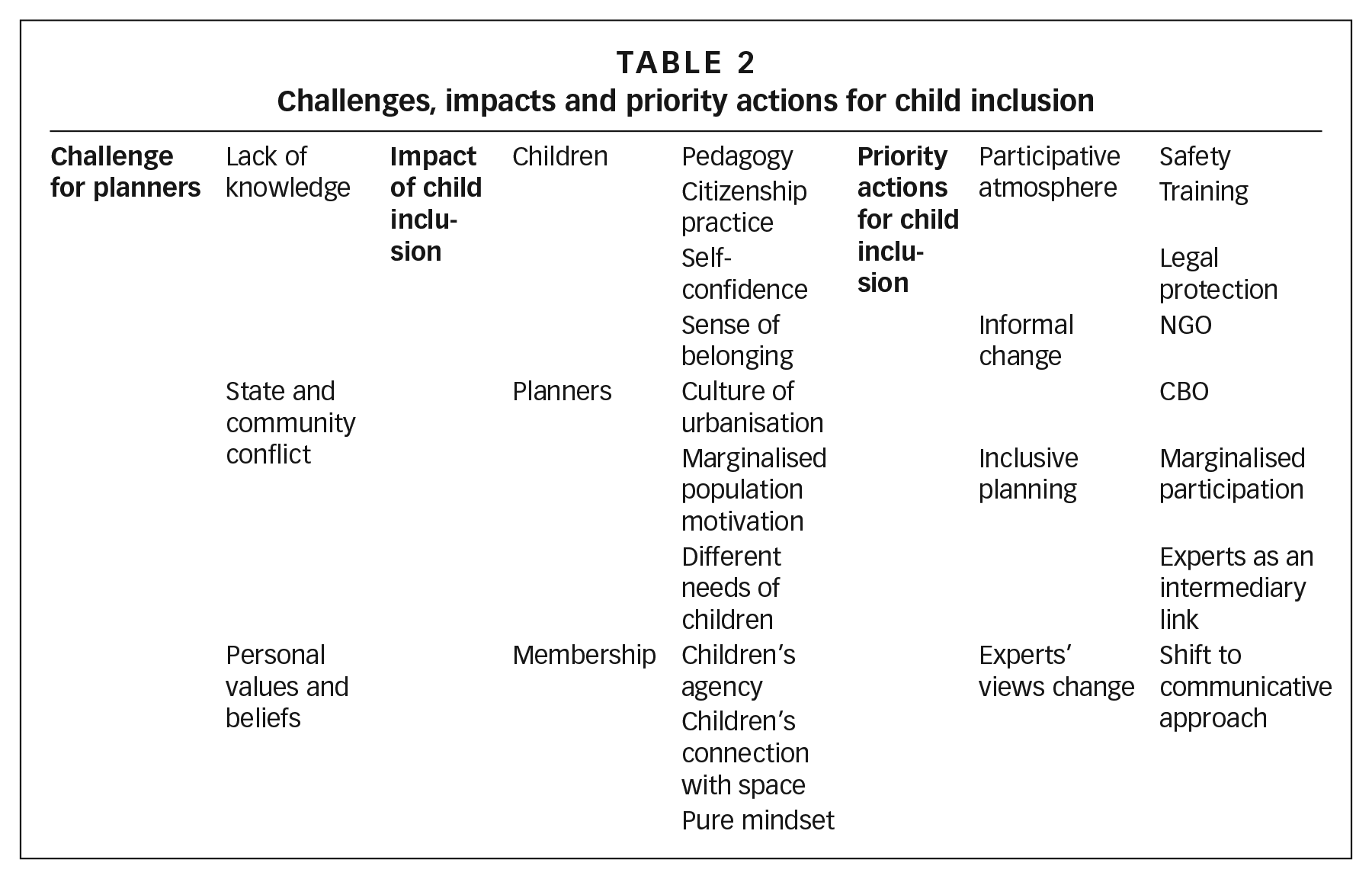
In summary, children in Iran, despite their awareness of urban spaces and their competencies, are not in a position to express their desires and needs clearly due to the structures of the urban planning system in their society. Communication, interaction and discourse within the urban planning system remain limited to interaction between planners and powerful stakeholders. Forming an inner layer of interaction, based on planners’ acceptance of children’s planning effectiveness, could allow planners to communicate with children before confronting powerholders, a more calibrated intra-system interaction. Making space for children’s insights into planning processes within the Iranian theocratic state requires the support of these urban professionals. This transformation of the restricted spaces within which planners currently work could open the way to child-centred spaces as an alternative to child-blind spaces.
Digging more deeply means addressing a paradox revealed by the present research. On the one hand, participants expressed knowledge, interest and even sympathy with the idea of a more citizen- and child-centric planning practice. On the other hand, the contemporary intra-system drivers are characterised by more traditional, top-down, formalist expert practice. The puzzle is that the positive participatory ideas expressed by these planners seem to have little influence on what actually happens and little effect in moving towards more inclusivity.
VI. Conclusion
Interpreting Iranian planners’ responses to children’s perspectives and active involvement in decision-making had two dimensions. First, it involved reflection on the impact of the child participation exercise, as planners explained their views. Second, it raised questions about the potential for shifts in the way planners viewed their role, reflecting a range of interest, resistance and willingness to consider the option of incorporating children’s insights. Emergent ideas from planners described positive impacts for children and reflected on the benefits and doubts this raised for planners within the planning system. Some participants mentioned the importance of children’s participation because children are part of society; others believed children were not yet citizens and there was no need for their engagement. Others believed planning decisions were the expert’s domain. Those participants with positive views towards children had practical ideas about how child participation could be included in the discourse of urban planning. Examples included the need for a safe environment for children, the potential role of NGOs, the need for research and training concerning child participation, the challenges in hearing all voices in planning, including those of children, and finally, the need for planner education to change planners’ preconceptions concerning the effectiveness of child involvement in planning.
Those planners with positive views also mentioned the difference between children’s and adults’ views of the city, repeating the idea that children were not biased by economic or political considerations in speaking about their actual needs. The analysis of planners’ positive and negative reactions and responses to children’s ideas demonstrated a need to shift their professional orientation away from elite positioning in an instrumental, rigid, top-down system. Instead, as communicative planning theory suggests, the role of experts is that of information givers and advocates rather than supposedly neutral experts. That is, they need to be individuals who listen to people and work towards a consensus among different viewpoints. An analysis of the responses of planners to the experience of child participation that was presented to them showed the value of engaging planners as advocates to speak on children’s behalf within the larger planning system. By enacting the role that communicative planning theory advocates for urban experts, planners can provide an intermediary link between powerholders and marginalised groups. Changing planners’ roles in this way could revitalise citizen cooperation and incorporate the participation of many marginalised groups to exercise their rights to the city – a move towards inclusive planning and community benefit in Iran.
Providing some successful examples, including children’s insights into participatory activities, can help to reveal the capacity and potential of children and, in turn, the capacity of Iranian society to be child inclusive. The main takeaway message for urban policymakers is the need to institutionalise child participation during the preparation of major urban development plans, including comprehensive and master plans. Integrating children’s insights into plan outcomes can begin from schools’ participative institutions such as student councils, and expand into the creation of children and youth councils, forums and parliaments in local municipalities. It could also start from planners’ data gathering in generating communicative activity, even within the pressures of current roles. This research in Iran gives voice to planning professionals willing to engage with some part of the need to include planning for and with urban Iranian children. The beliefs of those who continue to oppose this route or who are disinterested were not amplified. The interest here was in elucidating evidence of the potential for change in the Mashhad city planning system. Assisting children to claim and practise their rights of participation could well become more than merely a pedagogical device but rather something that enables them to exercise their citizenship positively, and to see the practical results of their contributions.
Footnotes
2.
3.
Article 1 of the Convention on the Rights of the Child describes children as any person under the age of 18 unless the domestic law of countries defines another age (United Nations, 1989).
4.
5.
16.
18.
This article is based on the findings of a PhD thesis about the positioning of children in contemporary Iranian urban planning systems (Manouchehri, 2019).
19.
30.
47.
48.
49.
Frank (2006);  .
.