




Abstract
This paper considers the very large differences in adaptive capacity among the world’s urban centres. It then discusses how risk levels may change for a range of climatic drivers of impacts in the near term (2030–2040) and the long term (2080–2100) with a 2°C and a 4°C warming for Dar es Salaam, Durban, London and New York City. The paper is drawn directly from Chapter 8 of Climate Change 2014: Impacts, Adaptation and Vulnerability, the IPCC Working Group II contribution to the Fifth Assessment Report. It includes the complete text of this chapter’s Executive Summary. The paper highlights the limits to what adaptation can do to protect urban areas and their economies and populations without the needed global agreement and action on mitigation; this is the case even for cities with high adaptive capacities. It ends with a discussion of transformative adaptation and where learning on how to achieve this needs to come from.
I. Introduction
The text of Climate Change 2014: Impacts, Adaptation and Vulnerability, the IPCC Working Group II contribution to the Fifth Assessment Report was released recently. The chapter on urban areas includes: an Executive Summary; an introduction that highlights key issues and outlines the scale and scope of urbanization; a section on climate change risks and their impacts on urbanization (and urban centres); a section on adapting urban areas (and different sectors) to the direct and indirect impacts of climate change, which includes a discussion of where this is or can be integrated with disaster risk reduction; and a section on the governance, planning and management framework for adaptation that includes a discussion of the role of citizens, civil society, the private sector and finance for urban adaptation. In this paper, based on extracts from this chapter, we reproduce the Executive Summary and choose to highlight three of the most important issues: the very large differences between cities around the world in adaptive capacity and the factors that influence this; the limits that even high levels of adaptation face without mitigation; and the need for transformative adaptation that also addresses issues of development and mitigation.
II. The executive summary
1. Urban climate adaptation can build resilience and enable sustainable development (8.1, 8.2, 8.3)(1)
2. Urban climate change risks, vulnerabilities and impacts are increasing across the world in urban centres of all sizes, economic conditions and site characteristics (8.2)
3. Urban climate adaptation provides opportunities for both incremental and transformative development (8.3, 8.4)
4. Implementing effective urban adaptation is possible and can be accelerated (8.4)
III. Building City Profiles of Current and Indicative Future Risks
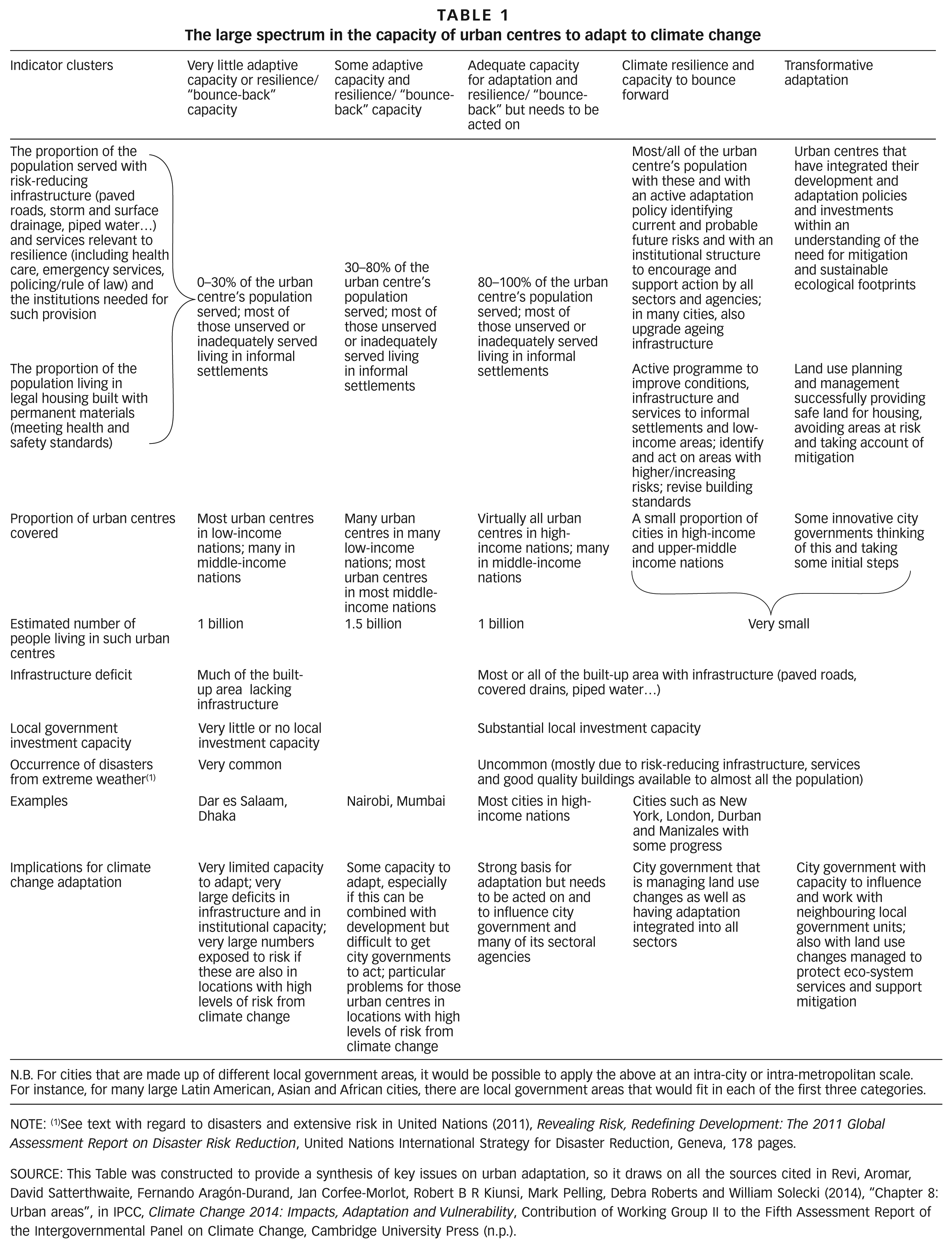
Table 1 shows how each urban centre can be located in a broad spectrum with regard to at least four key factors that influence adaptation: the proportion of residents served with risk-reducing infrastructure and services; the proportion living in housing built to appropriate health and safety standards; local government capacity; and the levels of risk from climate change’s direct and indirect impacts.
The large spectrum in the capacity of urban centres to adapt to climate change
NOTE: (1)See text with regard to disasters and extensive risk in United Nations (2011), Revealing Risk, Redefining Development: The 2011 Global Assessment Report on Disaster Risk Reduction, United Nations International Strategy for Disaster Reduction, Geneva, 178 pages.
SOURCE: This Table was constructed to provide a synthesis of key issues on urban adaptation, so it draws on all the sources cited in Revi, Aromar, David Satterthwaite, Fernando Aragón-Durand, Jan Corfee-Morlot, Robert B R Kiunsi, Mark Pelling, Debra Roberts and William Solecki (2014), “Chapter 8: Urban areas”, in IPCC, Climate Change 2014: Impacts, Adaptation and Vulnerability, Contribution of Working Group II to the Fifth Assessment Report of the Intergovernmental Panel on Climate Change, Cambridge University Press (n.p.).
This Table reproduces Table 8-2 from Chapter 8 of Climate Change 2014: Impacts, Adaptation and Vulnerability, the IPCC Working Group II contribution to the Fifth Assessment Report. One of the challenges for the IPCC chapter from which this Table is drawn is to convey the very large differences in adaptive capacity between urban centres. The Table seeks to illustrate differences in adaptive capacity and the factors that influence it. For a more detailed assessment of adaptation potentials and challenges for urban centres and for Dar es Salaam, Durban, London and New York, see Figures 1 and 2.
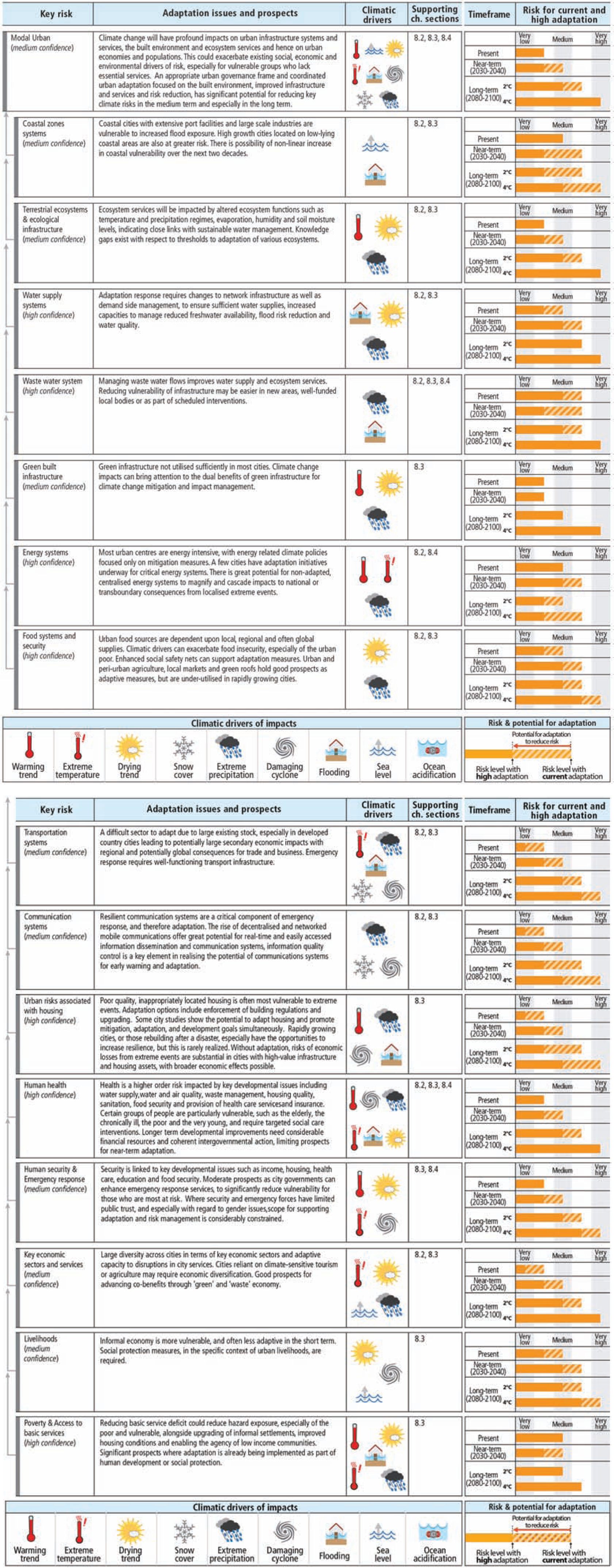
Urban areas: current and indicative future climate risks

Current and indicative future climate risks for Dar es Salaam, Durban, London and New York City
In Table 1, at one extreme are urban centres with very little adaptive capacity or resilience and this includes most urban centres in low-income nations and many in middle-income nations. Much of their population lacks risk-reducing infrastructure (including piped water, provision for sanitation and drainage and all-weather roads) and services (including health care and emergency services) and their governments lack the technical and financial capacity to act on adaptation. At the other extreme are urban centres where most or all of their population has risk-reducing infrastructure and there is a competence, capacity and willingness within local government to act on adaptation. This also includes urban centres that are beginning to move to what is termed “transformative adaptation”, where adaptation is recognized for its potential to address root causes of poverty and failures in sustainable development, including the need for rapid progress on mitigation.
Figure 1(3) shows the risk levels for a range of sectors or categories (that are listed in the first column) to different climatic drivers of impacts for urban areas in general. Figure 2 shows these risk levels for four cities (Dar es Salaam, Durban, London and New York City(4)). The climatic drivers of impacts considered include: warming; extreme temperature; precipitation; extreme precipitation; damaging cyclone; drying trend; flooding; snow cover; sea level rise; storm surge; and ocean acidification. The Figures show risk levels with current adaptation and with a high level of adaptation – for the present, for the near term of committed climate change (2030–2040) and for the longer-term era of climate options (2080–2100) for global mean temperature increases of 2°C and 4°C above pre-industrial levels. For each time frame, risk levels are estimated for a continuation of current adaptation and for a hypothetical highly adapted state. The risk levels were identified based on an assessment of the literature and on expert judgments. They are only indicative. It is important to provide a high level summary for urban areas as in Figure 1 but such a summary can obscure the great diversity in the risks, exposure and vulnerabilities between urban areas and often within them. We hope that Figures 1 and 2 help stimulate more attention to mapping current and indicative future climate risks for many other urban centres. Consideration should also be given to how risks from different climate drivers of impacts may differ within urban centres – for instance, between different local government units within metropolitan areas.
Figure 2 shows where there are already medium level risks – for instance in Dar es Salaam for housing and human health and, without high adaptation, water supply, energy and food systems. For this city, in the near term, risks increase in most sectors or categories and with high adaptation needed to keep down risk levels especially in water, energy and food systems and in housing. What is also noticeable is how in the long term, risk levels are high or very high for some climatic drivers of impacts in most categories even with high adaptation. This is especially so with a global mean temperature increase of 4°C.
Durban already faces medium level risk for energy and wastewater systems and for water supply, without high adaptation. Risk levels in the near term can be kept down by high adaptation (for instance in water supply and energy systems, food and transport, housing and human health) but less so in the long term, especially with a global mean temperature increase of 4°C.
London currently has low levels of risk for most sectors or categories – although with high adaptation needed to keep these low for water supply, wastewater, energy and food. There are some worries about heat stress. In the long term, risk levels from some climatic drivers are very high for many categories, especially in a 4°C world, and even with high adaption. New York City currently has low risk levels for most categories. In the near term, high levels of adaptation help keep down risk levels in most categories but in the long term it is less effective. One of the key messages is that with high levels of adaptation, risk can be much reduced in the near term but much less so in the long term, especially with a global mean temperature increase of 4°C.
We know that Figures 1 and 2 are speculative and need improvements in the detail but we felt it worth developing them as a contribution to the thinking about adaptation issues in urban areas and their prospects – and how these issues change as we shift from a focus on the near term (2030–2040) to the long term (2080–2100). The key point here is how, without mitigation, risk levels become very high even with high adaptation. In effect, to go back to Table 1, urban centres need to shift through adaptation and resilience to climate change to transformative adaptation that includes keeping down or reducing greenhouse gas emissions. We hope that the current and indicative future risk profiles for these four cities will stimulate more work and thinking both about how good practice in adaptation does reduce risks and also how, without the needed global agreements on mitigation, its capacity to do so is increasingly limited as we look to the long term.
IV. Towards Transformative Adaptation
The term “transformative adaptation” is used to highlight non-linear change to systems and is contrasted with incremental adaptation, which seeks to maintain existing systems – i.e. development pathways and practices – as part of adaptation.(5) Where systems are manifestly on the point of collapse, or where they are primary drivers for risk and loss, transformative adaptation opens policy choices. It brings an ethical and practical requirement to consider social justice as well as risk management concerns – including climate mitigation. In short, to consider the root and proximate causes of risk that lie within and are reproduced by dominant development practices and pathways. Also, to emphasize adaptations that engage with reducing the climate change-associated impacts on human well-being and ecological sustainability.(6) Existing urban work on transformation finds it to be most visible when set in contrast to dominant development paradigms and technology. In cities, this has been documented most clearly in the vision, organizational forms and actions of community, citizen or alternative economic development groups and networks.(7) City government has yet to be fully studied through this lens and it is too early to be able to claim that transformative adaptation is strongly evident at the city level. The challenge here is to determine how best to promote pro-poor and sustainable models of development that are living alternatives, without their being coopted into the dominant models of development for which they offer an alternative. This includes prioritization of ecological infrastructure as an urban asset that maximizes adaptive capacity and that is sustainable and cost-effective.
Thus, care should be taken in interpreting Table 1. There is not necessarily a linear relationship between adaptation and local government capacity, including capacity to provide risk-reducing infrastructure and services. Nor does increasing local government capacity and resources necessarily contribute to poverty reduction. Transformation where it has been observed is driven by dissatisfaction with the status quo, as well as being able to generate or tap some resource base. It is also driven by living examples of transformative urbanization, which includes initiatives in many low-income settlements by their inhabitants and their organizations and federations. Table 1 notes that there are very few examples of transformative adaptation at a city scale but there are pockets of activity and innovation within many cities, often those in low- and middle-income countries. Much alternative development falls into this category. This is an important point to stress – those cities where there is evident failure in development have alternatives. It may be difficult to find a city where transformative adaptation is fully in place, but there are many examples of lived alternatives within wider urban forms – as in the initiatives supported by the Orangi Pilot Project–Research and Training Institute,(8) the hundreds of initiatives by federations of slum/shack dwellers that are members of Slum/Shack Dwellers International,(9) the many community-based housing cooperatives and local alternative development schemes, the networks of informal waste recyclers,(10) and the support for community initiatives and citizen engagement with local governments within the Asian Coalition for Community Action.(11) Perhaps as important as what these do is how they also establish links with local governments and help define and then drive alternative forms of risk reduction, including adaptation. So this depends on city governments that can listen to citizen movements and see the validity of the living alternatives they offer. There also needs to be care from governments and potential funders in supporting such initiatives, as this very support can co-opt and destroy the alternative ethos, governance form and pro-poor adaptation movement that is important for transformative adaptation.
So to return to Table 1, examples of transformative adaptation include urban centres that have targeted development failure and established trajectories for reform as part of an adaptation agenda that can tackle poverty, inequality and environmental justice – including mitigation. The Table’s stress on the importance of land use planning and management has to include the provision of safe land for housing that also enhances livelihoods and well-being as well as avoiding areas at risk and taking account of mitigation.
Footnotes
Acknowledgements
The authors of this chapter are the authors of Chapter 8 in Climate Change 2014: Impacts, Adaptation and Vulnerability, Contribution of Working Group II to the Fifth Assessment Report of the Intergovernmental Panel on Climate Change, published by Cambridge University Press. We are very grateful to John Balbus and Omar-Dario Cardona who as review editors helped improve the chapter, and to the Working Group II co-chairs Chris Field and Vicente Barros and to the staff of the Technical Support Unit for all their help and encouragement. We are also grateful to all those who reviewed and commented on earlier drafts and to Cambridge University Press for permission to publish these extracts from our Chapter.
1.
The numbers in the text refer to the sections in the original chapter; this text is drawn from the final draft submitted by the chapter authors in October 2013 and the final published version may have some minor changes. For each key point in the Executive Summary, there is a note giving confidence levels for that point based on the degree of scientific agreement and the evidence.
2.
What are titled Table 1 and  in this extract.
3.
This is Table 8-3 in the IPCC report.
4.
Figure 2 in this extract is Table 8-6 in the IPCC report. The information draws on detailed case studies of New York, Durban and Dar es Salaam to illustrate this diversity – see Solecki, William (2012), “Urban environmental challenges and climate change action in New York City”, Environment and Urbanization Vol 24, No 2, pages 557–573; also Kiunsi, Robert (2013), “The constraints on climate change adaptation in a city with large development deficits: the case of Dar es Salaam City”, Environment and Urbanization Vol 25, No 2, pages 321–337; and Roberts, Debra and Sean O’Donoghue (2013), “Urban environmental challenges and climate change action in Durban, South Africa”, Environment and Urbanization Vol 25, No 2, pages 299–319.
5.
, Managing the Risks of Extreme Events and Disasters to Advance Climate Change Adaptation. A Special Report of Working Groups I and II of the Intergovernmental Panel on Climate Change, Field, C B, V Barros, T F Stocker, D Qin, D J Dokken, K L Ebi, M D Mastrandrea, K J Mach, G-K Plattner, S K Allen, M Tignor and P M Midgley (editors), Cambridge University Press, Cambridge, UK, and New York, USA, 582 pages.
6.
Pelling, Mark (2010), Adaptation to Climate Change: From Resilience to Transformation, Routledge, London, 224 pages.
7.
Pelling, Mark and David Manuel-Navarrete (2011), “From resilience to transformation: exploring the adaptive cycle in two Mexican urban centres”, Ecology and Society Vol 16, No 2, 11 pages, available at http://www.ecologyandsociety.org/vol16/iss2/art11/; also Mitlin, Diana (2012), “Lessons from the urban poor: collective action and the rethinking of development”, in Mark Pelling, David Manuel-Navarrete and Michael Redclift (editors), Climate Change and the Crisis of Capitalism: A Chance to Reclaim Self, Society and Nature, Routledge Series in Human Geography, Routledge, London, pages 85−98.
8.
Hasan, Arif (2006), “Orangi Pilot Project; the expansion of work beyond Orangi and the mapping of informal settlements and infrastructure”, Environment and Urbanization Vol 18, No 2, pages 451–480; also Hasan, Arif (2010), Participatory Development: The Story of the Orangi Pilot Project–Research and Training Institute and the Urban Resource Centre, Karachi, Oxford University Press, Oxford, 325 pages; and Hasan, Arif and Mansoor Raza (2011), “The evolution of the microcredit programme of the OPP’s Orangi Charitable Trust, Karachi”, Environment and Urbanization Vol 23, No 2, pages 517–538.
10.
Fergutz, Oscar, Sonia Dias and Diana Mitlin (2011), “Developing urban waste management in Brazil with waste picker organizations”, Environment and Urbanization Vol 23, No 2, pages 597–608; also .
11.
Boonyabancha, Somsook and Diana Mitlin (2012), “Urban poverty reduction: learning by doing in Asia”, Environment and Urbanization Vol 24, No 2, pages 403–422; also , 165 Cities in Asia; Third Yearly Report of the Asian Coalition for Community Action, Asian Coalition for Housing Rights (ACHR), Bangkok, 28 pages.