




Abstract
While the risk of fires in informal settlements has received attention in the literature, as has the longer-term community response to the resulting destruction, there is limited knowledge of how communities in informal settlements respond during fire disasters. This paper examines the role of community actors in fire response, using a case study of a group of informal settlements collectively called Mukuru Fuata Nyayo in Nairobi, Kenya. In earlier years, residents simply stayed put and watched properties get destroyed, and then waited for landlords to rebuild the houses. There is an emerging change in community fire response in these settlements, from a hands-off to a more hands-on approach in fire response. The paper examines the factors contributing to the change and draws conclusions about the strategies needed to build resilience in community fire response in informal settlements.
I. Introduction
Nairobi’s informal settlements experience frequent fire outbreaks leading to loss of life, serious injury, and loss of assets and livelihoods.(1) The combination of poverty, marginality, overcrowding and limited service provision exposes residents of informal settlements to a wide range of hazards, particularly fires and disease.(2) A report by the UN Development Programme (UNDP) highlights the factors that contribute to residential fires in informal settlements. These include, but are not limited to, improper use of electrical appliances, faulty electricity connections, drunkenness, domestic violence and improper disposal of wood ashes.(3)
Response to fires in these settings continues to be a daunting task due to the high density of settlement structures, coupled with combustibility of construction materials and the lack of publicly provided firefighting systems.(4) Informal settlements are generally characterized by poor infrastructural development, including a lack of access roads. And in the majority of cases, local communities face fire disasters without support or assistance.(5) Even where some assistance is provided, firefighting equipment generally arrives too late, after the fire has consumed multiple structures or wiped out whole neighbourhoods.(6)
This paper examines the role of community actors in fire response, using a case study of a group of informal settlements called Mukuru Fuata Nyayo in Nairobi, Kenya. Section II begins with a short review of available literature on fires in informal settlements in sub-Saharan Africa, with a focus on fire occurrence (IIa), fire management (IIb), and community fire response mechanisms (IIc). In Section III, an interactional approach to community development theory is reviewed to provide a framework for the analysis of community fire response mechanisms in the study settlements. This is followed by an account of the study methodology (Section IV), a background to the study area (Section V), and findings and discussion (Section VI). In the findings section, the paper examines the dynamics of community fire response mechanisms, including the mobilization of residents, division of labour, tools and equipment used, the strategies for fire response, and the roles of external actors. The paper concludes (Section VII) by proposing measures needed to build community resilience and strengthen community fire response mechanisms in informal settlements.
II. Fires in Sub-Saharan Africa’s Informal Settlements
There is little official documentation of fire incidence in informal settlements in sub-Saharan Africa, largely because to government officials these settlements are invisible and what goes on in these enclaves of the poor is not considered important.(7) The available literature comes from accounts by non-governmental organizations, emergent volunteer/humanitarian relief agencies and university researchers.(8) The literature covers three broad areas of interest: fire incidence, with a focus on occurrence, risk and vulnerability of the communities in informal settlements; fire management, with a focus on policy, infrastructure and equipment in place to combat fire outbreaks; and fire response, which mainly examines the nature of responses by affected communities and others.
a. Fire incidence: occurrence, risk and vulnerability
Despite the frequency of fire outbreaks in informal settlements and the resulting large-scale devastation, they remain largely undocumented, and actions to reduce them are largely uncoordinated, in sub-Saharan Africa. There is hardly any systematic recordkeeping on the part of governments and city fire departments, other than in South Africa(9) and to some extent in Ghana.(10) The City of Cape Town makes reference to detailed records of fire incidents in the city, covering most informal settlements. A report by Pillay(11) indicates that in the city around 18,504 fire incidents occurred between January 1995 and the end of 2004, 8,554 of which were in informal settlements. Most were localized and relatively small, but cumulatively they affected more than 40,000 people. A study by Morrissey and Taylor(12) explores how factors such as overpopulation and a lack of secure tenure and formal housing have contributed immensely to fire risk in the Imizamo Yethu settlement in Cape Town.
In Ghana, there is some systematic recording of fires in informal settlements by the national government. Norman and coauthors report on the incidence of catastrophic fire outbreaks in Ghana between 2004 and 2012.(13) The study adopted the annual statistical data on the incidence of fire nationwide compiled by the National Fire Service, based on the Service’s field reports at the time of fire interventions and on key informant interviews. The results of the study showed that catastrophic fire outbreaks in Ghana occurred at least once a month, at a cost of US$ 16 million per year, between 2004 and 2012. A study by Akwasi(14) reports on fire incidence and risk in Ghana, exploring the level of vulnerability in the town of Ashaiman, and identifying some coping strategies employed by the residents to mitigate this vulnerability.
In Kenya, there is no systematic record by government and city authorities on fires in informal settlements, but there are sporadic and often conflicting reports on fire occurrence by diverse organizations and agencies, including the Kenya Red Cross Society (KRCS), the United Nations Office for the Coordination of Humanitarian Affairs (UN OCHA) and the Kenya National Disaster Operations Centre (NDOC). For example, for the period between January and March 2011, the KRCS Emergency Operation Centre reported that approximately 42 fire incidents occurred, resulting in at least 11 fatalities and about 472 casualties in Nairobi’s informal settlements.(15) For the same period UN OCHA reported that 71 fires occurred in the whole of Nairobi, resulting in loss of 2,016 jobs, 376 houses, 2 deaths, 11 casualties and asset loss in excess of US$ 1 million.(16)
b. Fire management to combat outbreaks and the spread of fire in informal settlements
Informal settlement fires are by nature associated with considerable loss, shock and human suffering. Building on the concepts of hazard, vulnerability, risk and resilience, the UN and member countries have in recent years developed policies and operational frameworks for responding to disasters, including fire outbreaks.(17) These include the Hyogo Framework (2005–2015) and its successor, the Sendai Framework (2015–2030). However, compliance varies across countries. South Africa developed a Disaster Management Act in 2002 and a Disaster Management Framework in 2004. In this country, there seems to be considerable effort on the part of local governments and the national government to address informal settlement fires. Du Toit states that local governments play a vital role in awareness raising, education and training of residents on disaster management.(18)
However, South Africa is an unusual case in Africa. In Kenya, while a draft National Disaster Management Policy (NDMP) exists, it has not yet been reviewed and finalized to reflect the requirements of the constitution adopted in 2010.(19) According to Menya and K’Akumu,(20) the Nairobi county government lacks a fire disaster management policy. There exist only fire safety by-laws, adopted from the previous City Council(21) to guide enforcement of fire safety regulations in the city. In the absence of a comprehensive fire disaster policy and management framework, fire disasters in Nairobi have been handled in an ad-hoc manner, as manifested by delayed and uncoordinated fire disaster response.(22) Firefighting equipment in informal settlements in Kenya is commonly nonexistent. Nairobi has only three operational fire stations, located in the city centre, Industrial Area (Enterprise Road), and a substation in Gigiri Area. The city fire brigade is inadequately staffed, with a workforce of 152 staff members against the ideal of 3,200 firefighters. This is based on the recommendation of the National Fire Protection Association (NFPA), which sets the city standard of one fire station for a population of no more than 200,000 people and one firefighter for every 1,000 people. The few fire engines that exist in Nairobi often lack the essential equipment and water needed to fight fires in the informal settlements.(23)
c. Community response to fires in informal settlements
There are two aspects of community fire disaster response in informal settlements. The first concerns how communities react during the fire incident, while the second concerns the way they cope after the fire. There is limited knowledge of the first aspect, but a substantial literature on the second, with reports on various community coping approaches after a fire. In Accra’s largest informal settlement, Old Fadama, a 2012 account indicates that residents received no official support for reconstruction after a fire outbreak, and instead organized to rebuild using permanent material. This reduced fire risk and also demonstrated their capacity to city authorities.(24) In Ashaiman, Ghana, Akwasi observes that the residents had to rely on the benevolence of their relatives, friends, the community and ethnic associations to cope with the hardship resulting from incessant fire incidents.(25) Imizamo Yethu, an informal settlement in Cape Town, experienced a major fire on 8 February 2004 that caused significant damage to housing and infrastructure, and resulted in widespread homelessness and the loss of personal possessions.(26) Despite this, there was minimal loss of life and few major injuries. The community regrouped and rebuilt after the fire, and Imizamo Yethu has remained viable as a community.
Few studies have reported on responses to fire during the disaster occurrence. In Nairobi, Koitamet(27) notes that the response to fires in informal settlements was hindered by the lack of public awareness of fire policy and standard operating procedures during fire outbreaks. In the case of the 12 September 2011 fire disaster in Sinai Village, Nairobi, the fire department arrived two hours after the fire outbreak instead of the five minutes that were standard in the city. Other challenges in Sinai included the inaccessibility of the area due to the lack of access roads and lack of water hydrants. A total of 89 people burned to death while 40 more died later while undergoing treatment in hospital. Mohamed has also examined the capacity of the community and other support systems to respond to fires in Nairobi’s informal settlements.(28) He notes that the response by the fire department was untimely and inadequate and the community’s response to these incidents was more effective, although the residents’ knowledge of standard operating procedures was limited. In his Nairobi study, Kamau(29) establishes that the residents of informal settlements had no fire prevention or response equipment because of their low income level. He also noted that only 17 per cent of his respondents had attended any fire drills and 97 per cent of the respondents did not consider fire prevention a priority.
III. Community Development Theories and Community Disaster Response
While disaster management policies and frameworks draw from theories of disaster management, the community disaster response literature reviewed above draws from a variety of community development theories. These seek to go beyond macro-level growth models to take a micro-development approach with an emphasis on people-centred development, emphasizing community development for the fulfilment of the basic needs of the poor.(30) Bhattacharyya defines community development as a process aimed at building solidarity and agency.(31) Defining members of informal settlements as a community may appear problematic from the perspective of classical sociology,(32) given that these are often fragmented groups lacking in social cohesion and organic solidarity due to the constant influx of newcomers and great cultural and identity differences. However, Du Toit points out that the interactional approach to community development addresses this problem by focusing on the community not as a body reliant on cohesion or solidarity but as a dynamic field of interaction.
According to Du Toit, interactional theories focus on relationships that can stimulate community capacity and strengthen the community potential for self-governance and social action.(33) The concept of community as a dynamic field of interaction is imperative in understanding informal settlements’ response to disasters such as fires. Informal settlement dwellers as a group share physical threats and risks to their shelter and wellbeing, and many are vulnerable to the daily threat of fire. This vulnerability is perpetuated and aggravated by social, economic and political vulnerabilities that have contributed to their current living conditions. According to this approach, members of informal settlements, linked by their shared vulnerability, are capable of self-organizing and mobilizing local and extra-local resources to effectively act and overcome such adversities as fire disaster.
IV. Study Methodology
This study aimed to examine the role and nature of community fire response mechanisms in informal settlements using a case study of Mukuru Fuata Nyayo, a constellation of informal settlements lying on the southern side of Nairobi. The settlements were chosen because they had been associated in the media and literature with frequent fire outbreaks in Nairobi. The focus of the case study was on community response during a fire, based on accounts of the victims and external actors. The study was part of a larger baseline study conducted between October 2015 and March 2016 by the Centre for Urban Research and Innovations (CURI), University of Nairobi, in collaboration with the Kenya Red Cross Society (KRCS) and the American Red Cross Society.(34)
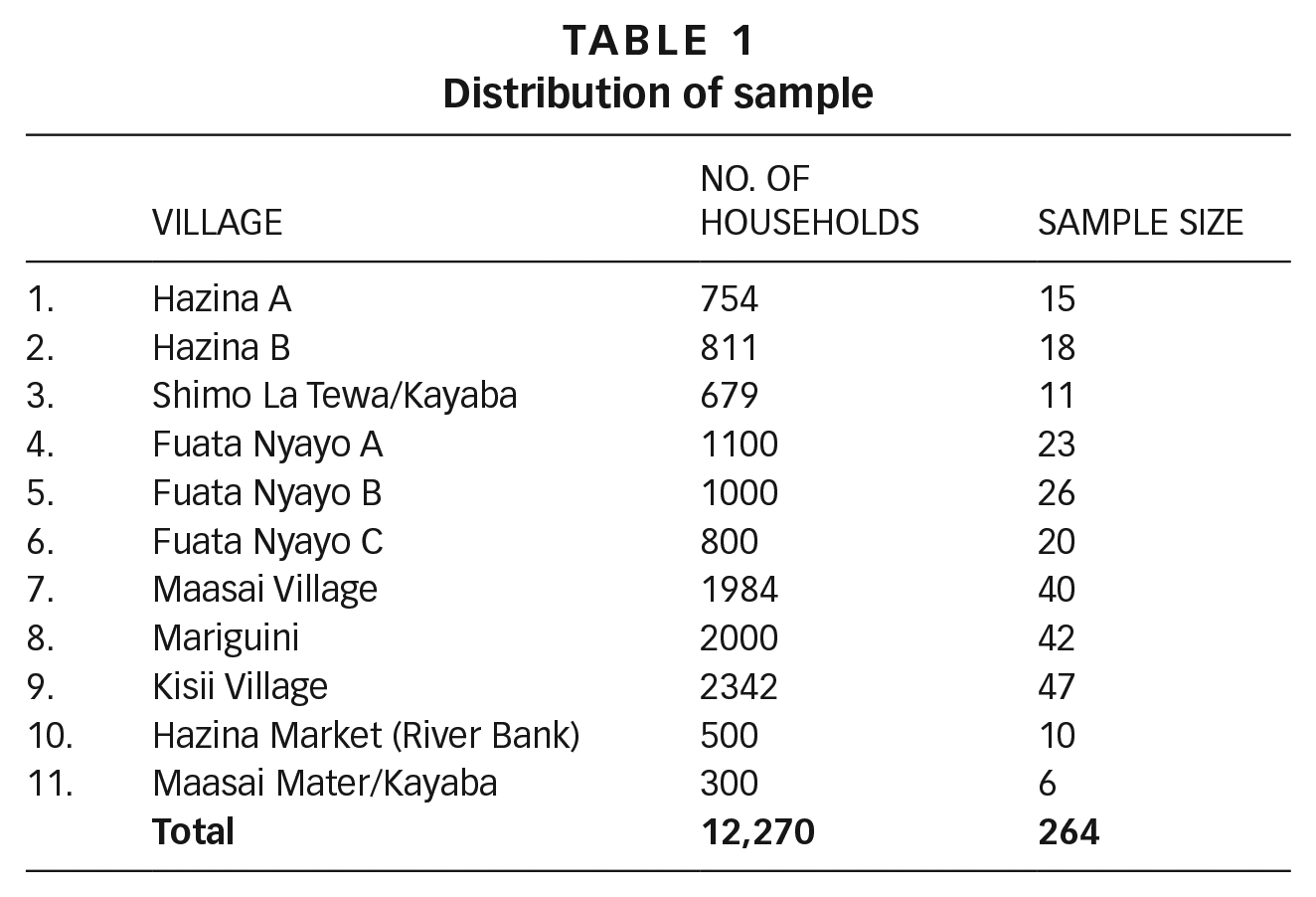
The study utilized a three-step methodology to gain an understanding of the context of the informal settlements, their residents, and fire response mechanisms of diverse actors in the community. First, a GIS-based mapping exercise was conducted to generate an overview of the area, to map the settlement’s infrastructural services and facilities, and to examine the link between settlements’ spatial features and fire vulnerability. Second, a survey was conducted with 264 respondents to generate data on their tenancy status, gender, age, education, occupation and experience with fire. The respondents were representatives of households drawn from all 11 villages,(35) each sample size being around 2 per cent of the number of households in the village (Table 1). The samples for Mukuru Fuata Nyayo A, B, and C villages were weighted slightly, proportionate to the frequency of fire outbreaks. Survey respondents were selected through systematic random sampling of the structure units based on GIS mapping.
Distribution of sample
Third, three focus group discussions (FGDs) and 11 key informant interviews were conducted to gain in-depth information on community fire response mechanisms. The FGDs were organized with village leaders (chairpersons), youth and women representatives. Each of these groups sought to bring together representatives of the 11 villages to compare the dynamics of community fire response. The participants were people who had actively participated in community fire response. The FGDs were also attended by representatives of local and national NGOs, including the Kenya Red Cross Society, by religious leaders and by the area chief. Each group discussed matters pertaining to causes of fire outbreak, fire disaster vulnerability, community fire response and effectiveness, actors’ roles, challenges and mitigation factors. For key informant interviews, we identified people with relevant knowledge, experience and authority on fire response and disaster management from across the settlements.
V. Background on Mukuru Fuata Nyayo Settlements
a. Location and setting
Mukuru Fuato Nyayo is a group of informal settlements lying on the southern inner (old) side of the city in Makadara Constituency, Nairobi South Ward. It consists of 11 villages lying alongside the Ngong River. The villages are Mariguini, Fuata Nyayo A, Fuata Nyayo B, Fuata Nyayo C, Kisii Village, Hazina Market (River Bank), Hazina A & B, Maasai Village, and Mukuru Kayaba (consisting of Shimo La Tewa/Kayaba and Maasai Mater/Kayaba) (Map 1). The settlements cover approximately 91 acres in all, and are home to an estimated 12,270 households and 36,810 people.(36)
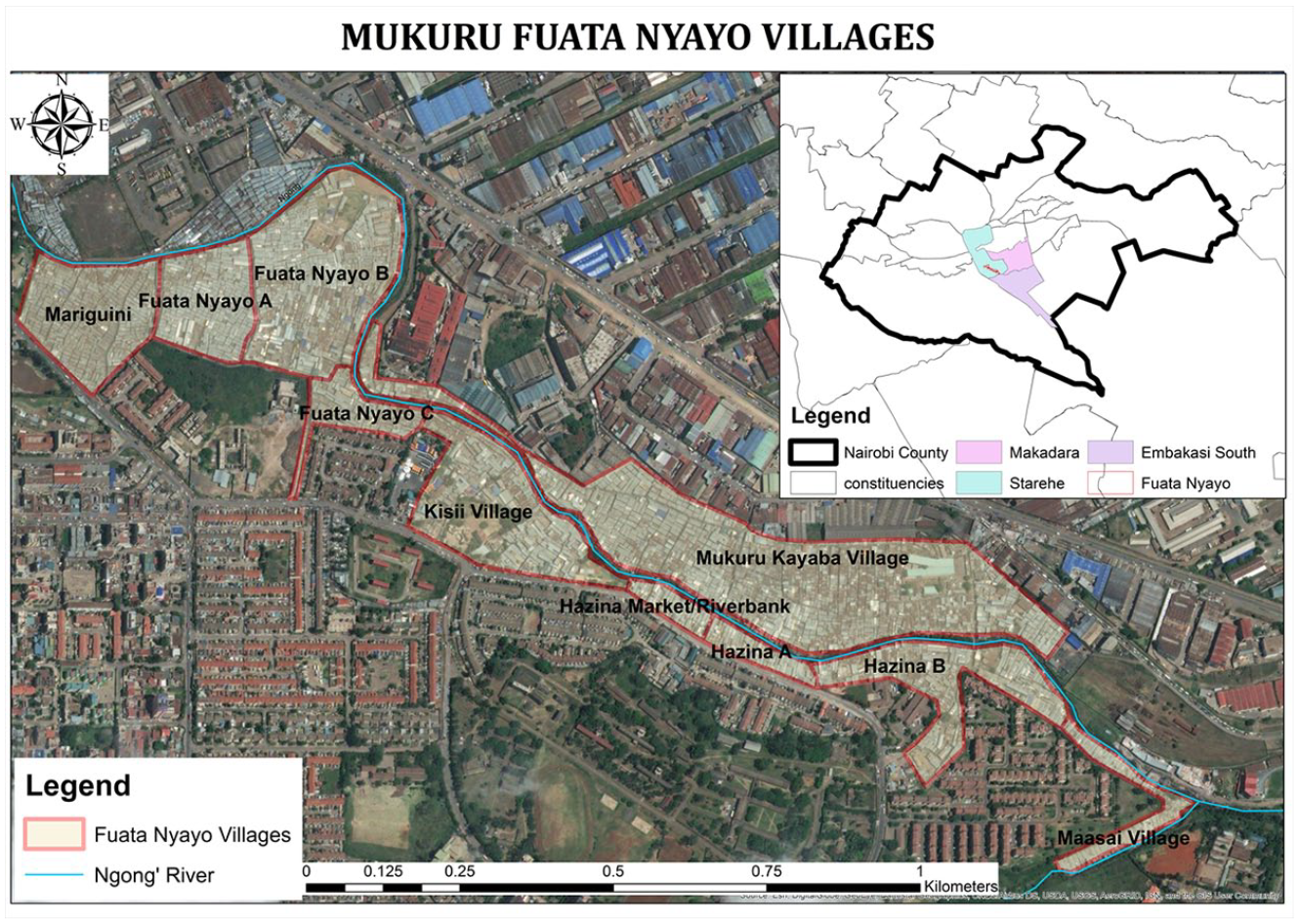
Mukuru Fuata Nyayo informal settlements in Nairobi
b. Historical background
The name Mukuru means “dumping site” in Kikuyu. Initially the area consisted of numerous quarries along Ngong River that supplied building stone. Later the abandoned quarries were converted into a dumping site for the city’s garbage. As the holes were filled with garbage, the poor population of the city started building houses in the area made of cardboard and wood. With time, many more people seeking employment in the city joined the initial settlers and eventually the Mukuru informal settlements were formed. The Mukuru Fuata Nyayo informal settlements are located on the upper side of the Ngong River. Kenya’s second president, Daniel Arap Moi, allocated the land in 1980s to a group of squatters who were moved from Nairobi West.(37)
c. Spatial features of the settlements
The Mukuru Fuata Nyayo informal settlements are tightly packed neighbourhoods varying in design and typology. Newer settlements, such as Mariguini, tend to have a more orderly layout with access routes, as the residents and local leaders are more sensitive to their importance. They are characterized by structures oriented towards well-defined paths and routes. Older settlements, such as Mukuru Fuata Nyayo A and B, follow a more organic pattern; structures are more tightly packed and are more or less haphazardly oriented around narrow footpaths (Map 2). The high density leaves them more prone to the rapid spread of fire, and the preponderance of narrow paths and dead ends makes it difficult to access the areas and put out the fires quickly.
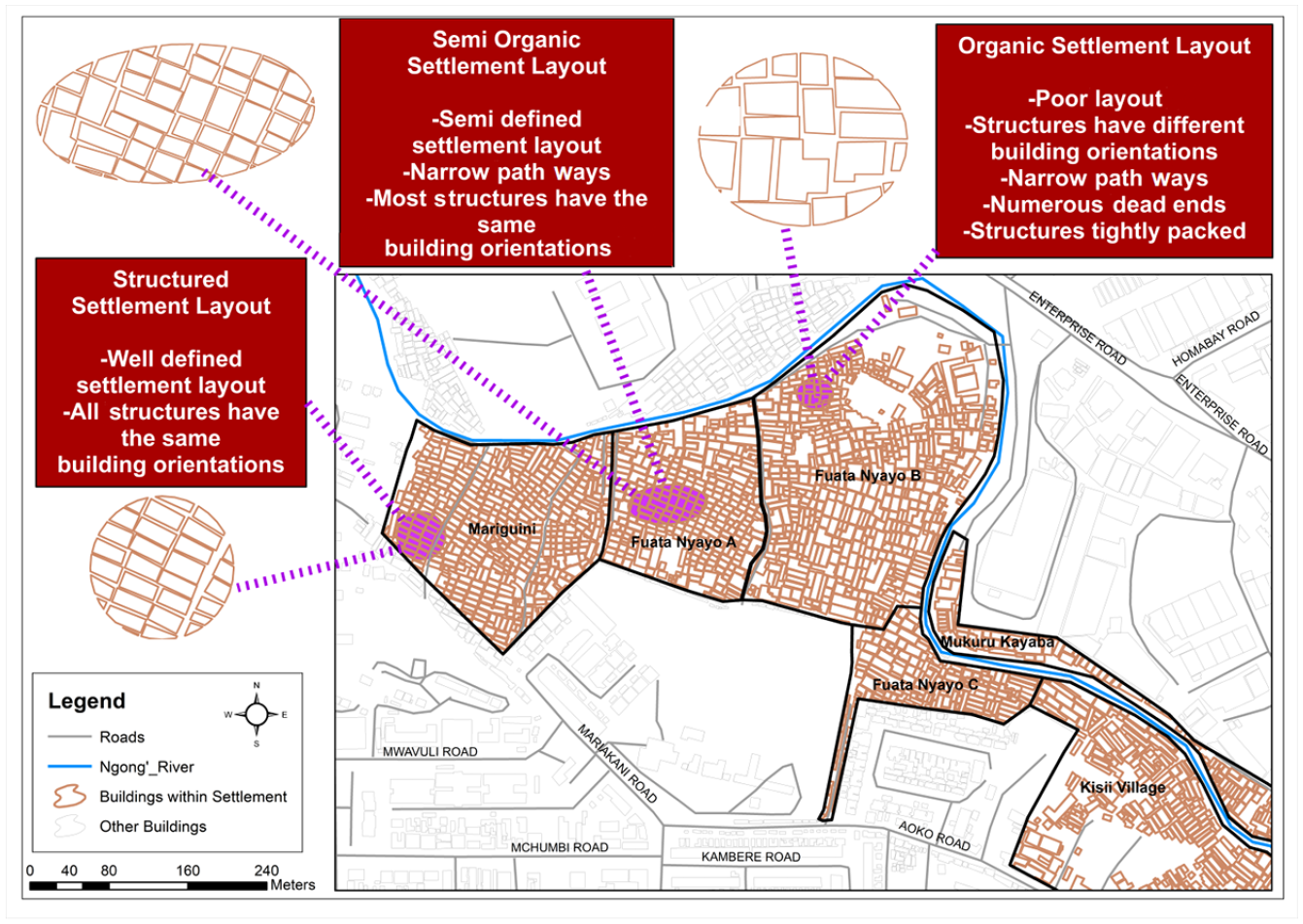
Village layouts in Mukuru Fuata Nyayo
Two main city streets, Enterprise Road and Aoko Road, run along the outer edges of the Mukuru Fuata Nyayo villages. The few access roads into the villages from the main streets are lined with informal commercial activities and diverse services, leaving little space for passage. Inside the villages, the narrower footpaths become extensions of the households, with outdoor cooking taking place there as well as children playing.
d. Community profile
The survey provided an overview of residents’ length of residence, tenancy status, age, occupation, and education level. Most of the respondents were women (62 per cent) since data collection happened during the day, when most adult male members were at work. This also reflected the need for a gendered perspective in all policies and measures implemented for the management of disasters such as fires.(38)
A similar proportion of the respondents (63 per cent) was between the ages of 19 and 35, reflecting the youthfulness of Mukuru Fuata Nyayo’s population. This demographic situation is an asset during emergencies, when quick action is required to save lives and salvage property.
Literacy levels were high, with over 88 per cent of respondents having attained some formal education. Of those surveyed, 35 per cent had primary education, 39 per cent had attained a secondary level of education, and 14 per cent had tertiary education. The high literacy level is an asset for community training in disaster prevention and mitigation.
Approximately 96 per cent of the household respondents were tenants. Over half (51 per cent) had lived in the settlements under five years and only 23 per cent had been there for more than 10 years. This was a short time compared to the length of residence in other Nairobi informal settlements such as Mathare and Mukuru Kwa Njenga.(39) According to the residents, the brief duration was attributed to the frequency of fire outbreaks and flooding. Most tenants tended to leave after these disasters, leaving it to structure owners to rebuild and rent to new tenants.
Mukuru Fuata Nyayo continues to attract residents and businesses for various reasons, however. The settlements are centrally located, not far from Nairobi’s central business district, and quite close to the industrial area. More than a third of residents (38 per cent) stated that proximity to these work opportunities was their most significant reason for choosing to live here. Affordable rent and security accounted for 33 per cent and 10 per cent, respectively. The majority (78 per cent) of the household heads who were surveyed were in informal employment; 12 per cent were in formal employment and fewer than 10 per cent were unemployed. Of those employed, 62 per cent were working within the settlement while 29 per cent worked outside. Working within the settlement is an asset given that the proximity can facilitate quick response during fire incidences in the settlement. The settlement’s informality is characterized by a wide mixture of social activities and economic pursuits.
e. Fire vulnerability
Of the 264 respondents interviewed, nearly all (91 per cent) had experienced fire incidents within their neighbourhoods over their time in Mukuru Fuata Nyayo. A significant proportion, 54 per cent of the respondents, had experienced fires within their own households. Frequent fires, some minor and occasionally major, occur in the informal settlement but often go unreported and undocumented. The area chief and the Kenya Red Cross Society reported an average of two fire incidents every week for the period between June and December 2015.(40) The types of fire experienced in the villages vary by season. Fires are most commonly experienced in the dry months of January/February and August/September when strong winds are prevalent, and also during the rainy seasons in April/May and October/November, when live wires are more likely to come into contact with water.
One of the main causes of fire in the area was illegal electricity connections (43 per cent), known as sambaza, which are common in informal settlements in Nairobi.(41) The mesh of live electric wires over the structures is striking. This informal “grid” is connected to the National Grid by an invisible cartel consisting of complicit staff of Kenya Power and village artisans referred to as “electrical engineers”, facilitated by youth groups acting as middlemen. The danger is that this tangle of live wires, when blown by the wind and rubbing on the iron sheets, or when in contact with rainwater, can easily set the structures on fire and often electrocute residents, especially children playing nearby. The other causes of fire were careless use of electrical appliances (30 per cent), use of kerosene stoves (13 per cent), domestic violence (6 per cent) and gas cylinders (3 per cent).
Once a fire has started, it can spread easily. Mukuru Fuata Nyayo’s buildings are constructed primarily from timber and iron sheets for walls, roofing and the supporting structure. The combination of timber, which is highly flammable, and iron sheets, which are good conductors of heat and electricity, intensifies heat during fire outbreaks. Outbreaks are common in places where food is prepared. The main sources of cooking energy are paraffin and charcoal, for 46 per cent and 33 per cent of users, respectively. Gas and electricity were used by 14 per cent and 5 per cent, respectively.
The respondents were asked to rate the villages according to how prone they were to fire per month. Mukuru Kayaba Village and Mukuru Fuata Nyayo A and B were rated high (Map 3), while Kisii Village and Hazina A and B were rated low. Those villages rated high are typically the old, dense neighbourhoods with narrow walkways and buildings constructed from highly flammable material, where fire tends to spread very quickly.
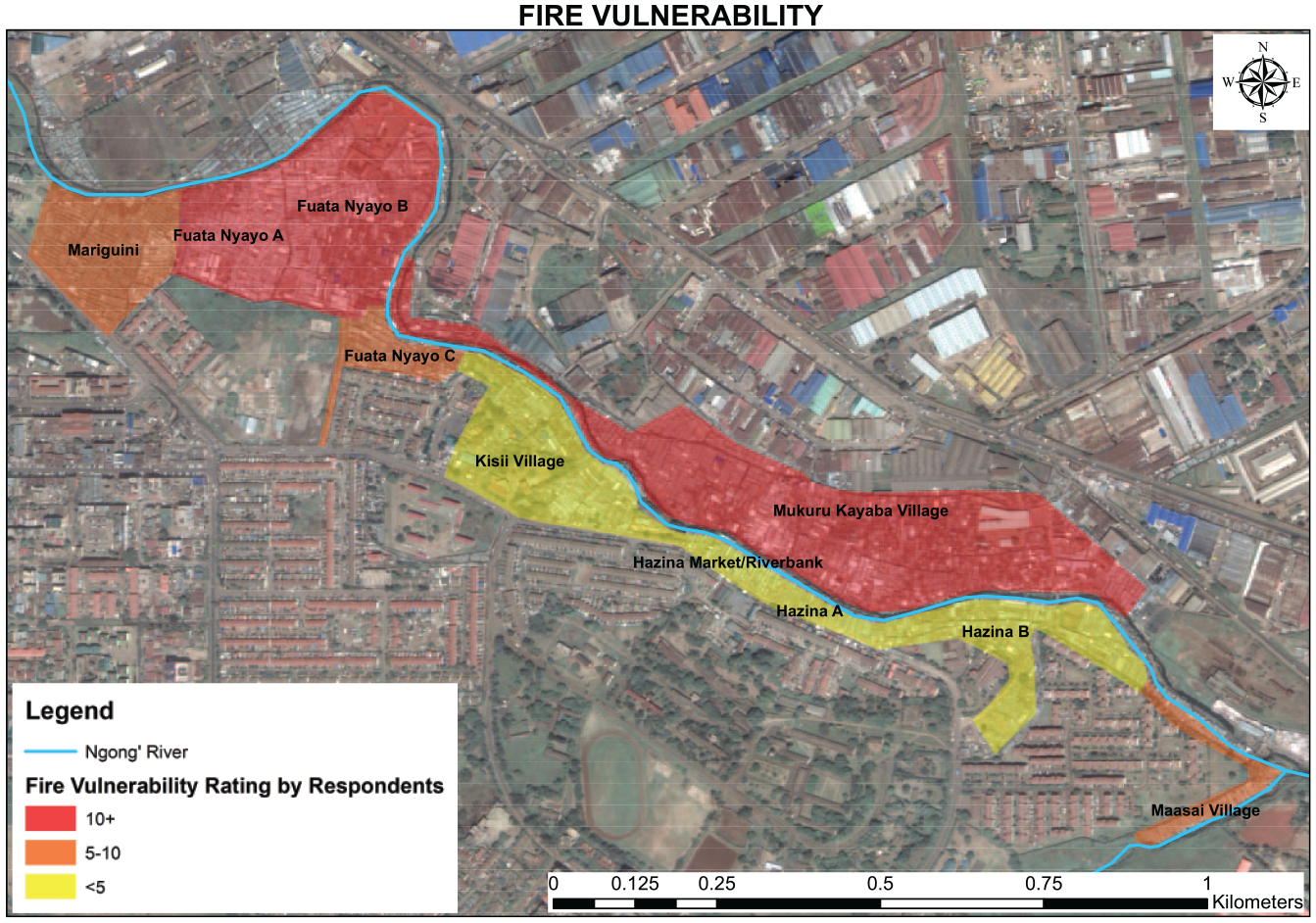
Vulnerability to fire (rating by respondents)
VI. Findings and Discussion on Community Fire Response
a. Change from a hands-off to a more hands-on approach
Through focus group discussions (FGDs), members of the community provided accounts of community responses to fires in Mukuru Fuata Nyayo. According to Cyrus Wandeto from Mariguini Village, “In earlier years, the residents simply stayed put and watched properties get destroyed and then waited for landlords to rebuild the houses.” An example was given of an experience in 2011, when a fire broke out in Mariguini. People salvaged property and then stood by watching the fire burn everything in the village.(42) Today, there is a greater sense of unity and residents are more inclined to respond collectively to fire outbreaks. The goal is to try to put out the fire before it spreads.
This change from a hands-off to a more hands-on approach in fire response is due to a number of factors. It was reported that a great deal is owed to the training and support given by KRCS in recent years. Under the Urban Disaster Risk Reduction Program, KRCS and its partners have trained informal settlement communities on fire prevention and basic fire response skills since early 2015. In Mukuru Fuata Nyayo, KRCS set up a unit in the chief’s camp in Mariguini Village, consisting of a chairman and a number of volunteers. These volunteers were then trained under various themes, including community health, gender-based violence and disaster response. The volunteers included 65 youth members – approximately five from each village selected by the area chief to be representative as to gender.
The disaster response unit has been undertaking awareness campaigns and education of residents in all the constituent villages of Mukuru Fuata Nyayo on how to promote fire safety at the household level, as well as how to respond during fire incidents so as to save lives and property. Fire safety training at the household level covered housing arrangements, building materials, and avoiding the spread of fire to nearby buildings. First aid encompassed both the type of aid to give a victim of fire and the determination of appropriate referral depending on the severity of the burns experienced. The first responder (commander) system aims to educate selected youth on the chain of fire response: for instance, the first person onsite would guide the communication channel and plan how the rest of the team would assist to handle the crisis. The training was later rolled out to schools in the area, where pupils were trained on fire response, what to do in case of fire, and basic first aid skills. With these skills, communities are able to take charge of minor incidents and summon specialized assistance in good time.
The programme has been in place since early 2015, initially with a focus on fire safety, but moving towards more of a multi-hazard approach. Currently this project is being implemented in seven informal settlements (among them Mukuru Fuata Nyayo) in Nairobi, targeting approximately 1 million beneficiaries. On its website, KRCS observes that, while the fires have not completely been eradicated, beneficiary communities have acknowledged a significant reduction in the number of fire incidents in the informal settlements, as well as quick response from the fire brigade and other stakeholders during emergencies. According to KRCS field staff, training in community fire response mechanisms seems to be working well for the community, but this is not enough for larger fires or for the general magnitude of the problem. There is a need for a more institutionalized and effective community fire response, adaptable to its situations and needs. In this regard, KRCS invited the University of Nairobi to carry out action research to better understand the dynamics of fire hazards, including the causes, responses and roles of the different actors; to develop and design community-level fire response stations, with an emphasis on low-tech, simple and sustainable solutions; and to provide detailed specifications of prototype options for future piloting along with the anticipated coverage radius.
A city fire station lies on the other side of the Ngong River on Enterprise Road, but the informal settlements receive minimal response from the fire brigade during emergencies. It is staffed with 50 firefighters working on a shift basis and has 18 fire engines, consisting of rapid intervention vehicles (RIVs) for accident response, ladder-equipped vehicles for rescue operations in tall buildings, fire-extinguishing engines, ambulances, and small bikes designed to penetrate within informal settlements. However, the bikes have not been functional in the informal settlements due to their small capacity for carrying water and the lack of hydrants within the settlements to refill them. The fire station faces other operational challenges in serving the informal settlements. They reported delays in getting calls about fires and poor accessibility, especially in narrow road spaces within the informal settlements. The illegal electricity connections in the informal settlements also hinder the movement of fire engines during operations. Nevertheless, they have a fire safety week each year in September, when they sensitize the community through fire drills and train pupils at schools and those visiting the station on fire response and safety.
Another factor is improved community organization through social interaction and empowerment. Through their self-organization, the community is able to mobilize local and extra-local resources to effectively act in the face of adversities such as fire disasters. The settlement leadership includes the area chief as the representative of the national administration, the village chairmen, and women and youth leaders, who actively represent their villages. The role of these leaders entails promoting social cohesion and ensuring that various issues and challenges are solved amicably.
At first glance, the community of Mukuru Fuata Nyayo does not exhibit a strong social structure. There are loose social groupings formed from shifting elements such as ethnicity, family, shared space, voluntary groups and political affiliation, an expression of the physical mobility of the population. Indeed, the apparent state of free choice and individualistic lifestyles within the informal settlement does not appear conducive to the mobilization of the community for any social action or social control.
However, the local leaders appear well able to focus on issues of community interest. They referred to it as the community learning to solve its problems by its own efforts. According to Grace Nyawira, a female leader in Mariguini Village, community action is triggered by issues that convey a perception of community interest or challenge, such as fire, water, drainage and crime. Projects carried out by the community also include those that fill the sort of practical gap that is left by the inadequacies of local and national administrative action. Fire safety is one such challenge, and the leaders take an active role in ensuring safety and collective effort in fire response. More than 60 per cent of those interviewed reported participating in responses to save lives and property during fires, whether through actual firefighting or various support activities, as described below.
Discussion with village leaders and a Red Cross Society representative established that not all villages are equally well organized; some villages are more prepared and responsive to fire disasters management than others, depending on their experience and level of community organization. Mukuru Kayaba was identified as an insecure place, lacking in social organization. It has a lot of social problems including drug abuse and alcoholism, and community members who are idle and who steal from the neighbouring villages. They tend to go looting wherever they hear there is a fire outbreak. Mukuru Fuata Nyayo A, B and C experience similar problems, though at a lower scale than Mukuru Kayaba.
b. Roles of actors in fire response
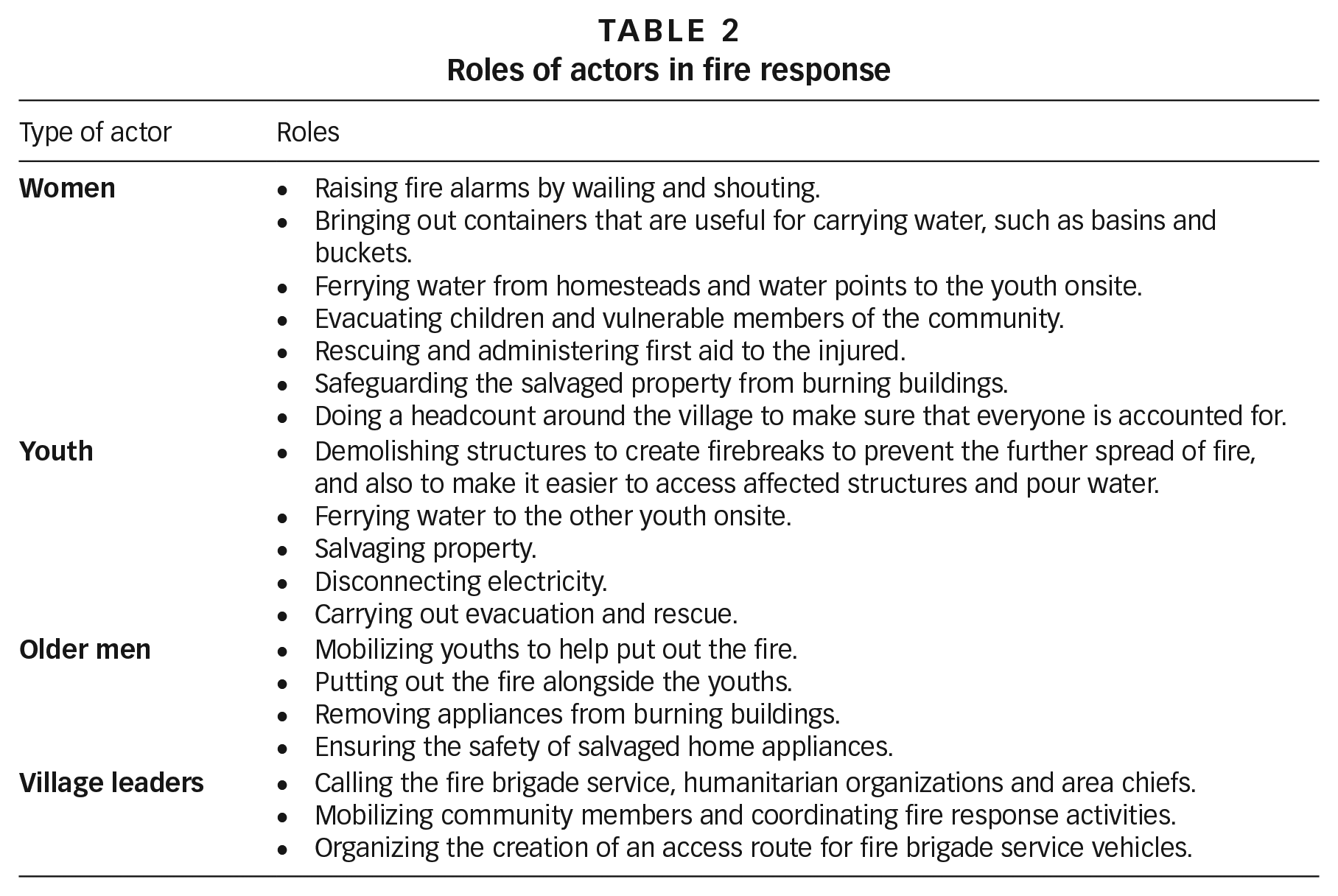
Participants in the FGDs described the roles and actors in community fire response. Upon the outbreak of a fire, some members are mobilized to rescue people, raise the alarm and create firebreaks, while others are tasked with maintaining security and order. As Gachago notes with reference to other settlements in Nairobi, communities continually adapt to crisis, coming up with creative solutions.(43) In Mukuru Fuata Nyayo, the roles are well defined and are broken down by gender. Table 2 draws on findings from the FGDs on the roles of actors in fire response in Mukuru Fuata Nyayo.
Roles of actors in fire response
The role of external actors is to support the community in fire response. They include NGOs, religious and humanitarian organizations, and the city fire brigade. Their roles include setting up evacuation centres, providing necessities for affected families, setting up information desks, and conducting search and rescue exercises, among other tasks, as also noted by other Nairobi accounts.(44) In addition to providing response training and equipment, the Kenya Red Cross Society has been providing recovery assistance in the form of clothing, food and shelter to fire disaster victims in Mukuru Fuata Nyayo. Chiefs represent the government administration in the local area and usually coordinate local community activities along with community leaders. City officials and the fire department are usually slow to respond to fire disasters in these informal settlements (and others) due to their limited capacities.
c. Effectiveness of community fire response
Presently a large number of community members in Mukuru Fuata Nyayo are proud of the firefighting system they are involved in. Over 64 per cent of the respondents concurred as to the effectiveness of community fire response. The settlement has generally been successful at putting out fires prior to the arrival of the fire brigade. Community members remain sceptical about the role of the county fire brigade, however. About 60 per cent of those surveyed observed that it takes the fire brigade more than an hour to respond to fire, if it comes at all.
There are challenges within the community as well. Only 36 per cent of the respondents have some form of training in firefighting. In this regard, they support the efforts of KRCS to continue with training and capacity building. In the household survey, a lack of firefighting equipment was noted as a major factor hindering firefighting in the settlement. Other challenges listed were the narrow roads, which make it hard to access the settlement during fire outbreaks and the inadequate water supply.
d. Strategies needed to strengthen community fire response
Community members noted several key requirements to improve the current fire response mechanisms. They include facilitation and provision of equipment and tools, and continuous training. Equipment and tools should be user-friendly, cost-effective, easy to maintain and accessible. Tools that are not accessible end up being forgotten, lost or vandalized. Among the simple equipment and tools identified by the community are firefighting boxes in each village with such basic equipment such as whistles, fire detectors, fire extinguishers and demolition tools. They should be stored in or close to community utilities such as toilets and water points, and to the chief’s centre. There is a need to form first responder teams and an alert system based on bulk messaging.
The current informal provision of electricity in the settlements is hazardous as it is a cause of fire. Electricity provision in informal settlements should be taken over from cartels and formally supplied at a low tariff, as provided for in policy. The settlements also require upgrading with improved layouts where structures follow set building lines and plot coverage, tailored to low-income settlements. In addition, the study findings point to the value of community fire response stations, based within informal settlements, at strategic locations and integrated into the larger firefighting system. These strategic locations would be based on an optimal catchment (about 2,700 households) within a range of about 150 metres, with priority given to fire-prone areas. They would be linked up to the city-wide fire stations. The fire response stations should be owned, managed, safeguarded and maintained by the community, and incorporated into daily use so as to make them vibrant. The location of stations would be identified by the community and could potentially include open spaces, community halls, school and church compounds.
VII. Conclusions
In Mukuru Fuata Nyayo, Nairobi, local communities are no longer passive in the face of local fires. In former years, the residents, largely tenants, simply stayed put and watched properties get destroyed and then waited for landlords to rebuild the houses. With the support of training and mobilization, the current response is changing to a more hands-on approach to fires. The paper has highlighted the factors contributing to the change and the strategies needed to further strengthen community fire response mechanisms and build resilience in community fire response in the informal settlements.
Footnotes
Acknowledgements
We acknowledge the contribution of the rest of the research team from University of Nairobi, including the research assistants, the community respondents and the staff from the Kenya Red Cross Society involved in the community fire response baseline survey.
Funding
The authors disclosed financial support for the research, authorship, and/or publication of this article: We would like to thank the Kenya Red Cross Society and the American Red Cross Society for funding the main baseline survey upon which this paper is based.
1.
2.
Ogajo, N J (2013), Influence of Fire Disasters on Mitigation and Preparedness in Commercial Premises in Kenya: A Survey Study of Kisumu CBD, unpublished research project thesis, University of Nairobi, Nairobi.
3.
4.
Victoria, L P (2002), “Community based approaches to disaster mitigation”, Regional Workshop on Best Practices in Disaster Mitigation.
5.
6.
See reference 1.
7.
8.
See reference 2; also see reference 5; IFRC (2011), Kenya Fires, 2011 – Newsletter, Internationational Federation of Red Cross and Red Crescent Societies, Nairobi; Harte, E W, I R W Childs and P A Hastings (2009), “Imizamo Yethu: a case study of community resilience to fire hazard in an informal settlement Cape Town, South Africa”, Geographical Research Vol 47, No 2, pages 142–154; Morrissey, J and A Taylor (2006), “Fire risk in informal settlements: a South African case study”, Open House International Vol 31, No 1, pages 98–105; Du Toit, N (2009), Informal Settlement Fires: Addressing the Issue in Kayamandi, MPhil thesis, Stellenbosch University, Cape Town; Rosenberg, M (2013), Community Based Fire Risk Reduction: Case Study of Imizamo Yethu, Hout Bay, University of Cape Town, Cape Town; Gachago, J (2013), An Investigation of Fire Risks in Kiandutu Slums in Thika Municipality, unpublished master’s thesis, Kenyatta University, Nairobi; Koitamet, W O (2013), Challenges of Dealing with Fire Outbreaks in Informal Settlements: The Case of the 12th September 2011 Sinai Fire in Nairobi, Kenyatta University, Nairobi; Mbugua, B N (2016), Socio-economic Impact of Fire Disasters in Nairobi County: A Case Study of the Fire Accident in Sinai Slum, Viwandani Ward, Makadara Constituency in Nairobi County, Nairobi; Akwasi, O S (2013), Fire Risk Vulnerability in Informal Settlements: The Case of Ashaiman, MPhil thesis, University of Ghana, Legon; Owusu, M (2012), “Community-managed reconstruction after the 2012 fire in Old Fadama, Ghana”, Environment and Urbanization Vol 25, No 1, pages 243–248; and Norman, I D, B M Awiah, M K Aikins and F N Binka (2015), “Review of catastrophic fires and risk communication, Ghana”, Advances in Applied Sociology Vol 5, pages 167–177.
9.
Strydom, S (2016), “A spatio-temporal analysis of fires in South Africa”, South African Journal of Science Vol 112, Nos 11–12.
11.
Pillay, G (2012), “Informal settlements fire and flooding risk reduction strategy”, DMISA Western Cape Provincial Workshop, July 2005, Cape Town.
15.
See reference 5.
16.
17.
UN (2005), Hyogo Framework for Action 2005-2015: Building Resilience of Nations and Communities to Disaster, United Nations, New York; also  , Sendai Framework for Disaster Risk Reduction 2015-2030, United Nations, New York.
19.
Nabutola, W (2013), Integrated Disaster and Risk Management Policy, Legislation and Regulations,Nairobi, available at .
20.
Menya, A A and O A K’Akumu (2016), “Inter-agency collaboration for fire disaster management in Nairobi City”, Journal of Urban Management Vol 5, No 1, pages 32–38.
21.
The City Council was abolished after the 2010 Constitution, and replaced with the Nairobi City County Government.
22.
Mworoa, F N (2012), Fire Management in Nairobi’s Informal Settlements, Nairobi.
28.
Mohamed, A K (2010), Adherence to Standard Operational Procedures for Fire Mitigation and Response in Informal Settlements: The Case of Mathare and Sinai Slums, Nairobi.
29.
Kamau, A W (2007), The Challenges in Preventing and Fighting Structural Fires in Nairobi’s Informal Settlements, unpublished master’s thesis, University of Nairobi, Nairobi.
30.
See reference 8, Du Toit (2009); also Peattie, L R (1970), The View from the Barrio, University of Michigan Press, Ann Arbor; and Bhattacharyya, J (2004), “Theorizing community development”, Journal of the Community Development Society Vol 34, No 2, pages 5–35.
32.
Tonnies, F (1887), “Community and society”, The Urban Sociology Reader, page 13; also Durkheim, E (1893), The Division of Labour in Society.
34.
35.
Villages in Nairobi and other Kenyan towns refer to clusters within informal settlements bearing distinct names. Initially, they were self-help settlements built by Africans on the outskirts of the new town, hence villages. These early settlements have evolved over time and are now part of the inner-city informal settlements, still called villages. New informal settlements continue to emerge on the city outskirts.
36.
See reference 34.
37.
38.
ISDR (2002), Women, Disaster Reduction and Sustainable Development, United Nations Office for Disaster Risk Reduction, Geneva; also Ginige, K A (2009), “Gender mainstreaming in disaster reduction; why and how?”, Disaster Prevention and Management Vol 18, No 1, pages 23–24.
39.
40.
See reference 34, pages 2–3.
41.
See reference 34, page 24.
42.
Mutambo, A (2011), “Fire has burnt more than 5,000 homes”, Daily Nation, 28 March.
44.
Herd, C (2013), Nairobi Hub Brief, Concern Worldwide, Nairobi.