




Abstract
Informal rental housing remains a hidden – yet central – pillar of low-cost shelter markets across the global South. The large informal settlement of Mathare Valley illustrates Nairobi’s rapidly changing informal rental housing markets, with the ongoing rise of tenements alongside metal shacks. Informal single-room rental units (shacks and tenements) already house most Nairobi residents in low-quality but highly profitable shelter. This case study describes how multiple exclusions can shape access to rental housing and examines the politics of shelter delivery. We underscore the importance of private rental markets and offer recommendations for inclusive, multi-pronged interventions combining support for rental housing, land governance and infrastructure delivery. Through a better understanding of the myriad actors and dynamics of informal rental housing, it may be possible to develop strategies that serve low-income tenants for whom renting is often the only viable option.
I. Introduction: Nairobi’s Low-Quality Informal Rental Housing
Nairobi is well-known for its informal rental shacks in informal settlements(1) and, more recently, its poor-quality tenements, which are imperilling the lives of low-income tenants.(2) In both shacks and tenements, highly inadequate single-room rental units have helped to accommodate Nairobi’s low-income majority. Nearly 70 per cent of Nairobi’s 4.4 million residents are tenants renting single-room units, about half of them in shacks in informal settlements and another half in tenements.(3) Several poorly constructed tenements have collapsed recently in Nairobi, resulting in multiple fatalities.(4) But the official stance toward Nairobi’s informal rental housing has typically been neglect or ad hoc reactive strategies, rather than a recognition of the need for rental units and a deliberate attempt to enhance their quality.
Past research in Nairobi has focused on dense informal settlements (“slums”),(5) yet its housing options for low-income residents are increasingly heterogeneous. Shacks in informal settlements are usually made of iron sheets; structures are typically one storey or sometimes two storeys. Meanwhile, tenements are five to ten storeys (walk-up) built of quarry stone, steel and/or concrete with shared access to utilities (especially water and sanitation).(6) Nairobi also has ageing public housing units with informal extensions and areas with mixed shelter types.(7)
To help reveal the dynamics of informal rental housing, we offer a case study of Mathare Valley. One of Nairobi’s largest informal settlements, Mathare has a patchwork of rental housing types, and an estimated 40 per cent of its structures are tenements.(8) After reviewing key literature on rental housing, we discuss Nairobi’s exclusionary planning, lack of affordable housing, and limited policy consideration of renting. Our case study examines the barriers that tenants face (based on gender, income, migration status and other factors) when they seek to access Mathare’s shacks and tenements. We also describe the heightened pressures on infrastructure, informal land grabs, and related governance challenges that all contribute, along with high densities and low-quality shelter, to Mathare’s poor living conditions. In closing, we propose a research agenda and provide recommendations to enhance access to affordable, decent rental units.
II. Methods
This case study was part of a broader study on Nairobi’s rental housing markets, including a field survey of land and housing markets in 37 localities across Nairobi and select satellite towns.(9) This research, part of the East Africa Research Fund (EARF) funded by the UK Department for International Development (DFID), benefitted from well-established links with Kenya’s slum-dweller federation Muungano wa Wanavijiji and its support organizations Slum Dwellers International Kenya (SDI Kenya) and Akiba Mashinani Trust (AMT).(10) Throughout this research, the EARF Kenya project partners held workshops with government officials, civil society representatives, academics and residents to deepen the analysis.
Primary data collection for the Mathare case study included 20 key informant interviews (KIIs) with residents, community leaders, land brokers, caretakers, structure owners and landlords.(11) For their selection, we relied on knowledgeable local community leaders. We held six focus group discussions (FGDs) with Mathare youth, women and male/female elders, as well as making use of participatory mapping and photography. This was combined with spatial analysis of georeferenced imagery and spatial data for buildings, water, sewerage and road networks using geographic information system (GIS) software. Aerial Landsat images from 2003, 2010 and 2019 were used to analyse Mathare’s spatial changes, in addition to Google Earth data.
III. Informal Rental Housing in African Cities: Pervasive, Dynamic and Poorly Understood
Although rental housing is widespread in African cities, it is typically overlooked in government policy, and only paltry data are available on informal rental units. While governments across the global North and South have actively supported homeownership, rental housing is, according to UN-Habitat, “neglected, even disparaged”.(12) “Informal” (i.e. unregulated) rentals are common in African cities for several reasons, including inappropriate building standards, landlords’ desire to avoid costly or burdensome laws, and tenants’ inability to afford high-cost formal units.(13) Research in Hawassa (Ethiopia) and Mogadishu (Somalia) found a wide variety of rental markets, but limited government regulation has contributed there to low-quality rental units and tenant exploitation.(14) Many residents in African cities rent informally, and over 50 per cent of households rent in some cities, including Kampala, Dar es Salaam and Abidjan.(15) Even in South African cities with relatively high rates of homeownership, informal rental housing is a dynamic subsector, although often neglected in policy.(16) More generally, online databases and official statistics from African cities have, according to Melzer and colleagues, “limited or no coverage of rentals in informal dwellings”, as they are biased towards higher-cost formal residential or commercial units.(17)
Recent studies have uncovered rental markets’ transformations and densification in Africa (as well as Asian cities), and rental shelter may offer key advantages to low-income tenants, whose access and barriers to housing remain poorly understood. Past literature suggests that low-cost rental housing can be vital for youth, smaller households, migrants, and other groups that value the flexibility and affordability of such units.(18) What is less clear are the challenges facing low-income residents seeking to access rental housing, particularly as multiple exclusions may shape tenants’ relations with informal landlords, as described in Section VI. Furthermore, it is essential to recognize the flux and incipient transformations within informal rental markets. For instance, Cape Town’s backyard shacks are increasingly densifying and commercialized, producing higher-quality but more expensive units.(19) Accra’s informal rental housing is essential not merely for low-income households but for households at all income levels, as a result of the city’s constrained housing supply.(20) Studies have also suggested complex transformations within a single city’s informal rentals: in Kisumu (Kenya), some plots have both self-contained apartment blocks and low-quality, mud-brick rental units with shared services.(21) Although there is extensive literature on Nairobi’s informal settlements, where tenants comprise over 90 per cent of residents,(22) there is more limited discussion of tenements. Meanwhile, many South Asian cities, including Delhi and Karachi, have a similar proliferation of multi-storey informal apartments with meagre sanitation, minimal ventilation and poor building design.(23)
Despite a burgeoning literature on housing “financialization”, shelter financialization is rarely studied in the global South, with especially limited consideration of low-income rental housing.(24) Housing financialization explores the rising dominance of financial actors and markets, with a focus on the roles of banks, lenders, private equity and hedge funds; past research typically centres on mortgages, but is beginning to examine former social housing and rent-stabilized units.(25) In African cities, for instance, studies have analysed the recent emergence of high-income apartments and commercial buildings in Luanda and Nairobi, with participation by both Chinese and domestic investors.(26) Speculative building is also common in Addis Ababa and Kigali, where high-rise buildings are rapidly constructed for high-income residential or commercial use, but often lie underutilized.(27) Such research has typically focused on high-end housing and commercial units, but as noted in Section VII, Nairobi’s tenements can also prove lucrative and add nuance to housing financialization research. Given the ubiquity of rental housing but its limited policy recognition, there is an urgent need to continue analysing informal rental markets, including low-end rental units, which play a poorly documented but still central role in African cities.
IV. Urbanization Trends, Planning Challenges and Shelter Delivery in Nairobi
Failures in city planning, infrastructure delivery and land governance have together created a vacuum that has encouraged the proliferation of Nairobi’s inadequate low-cost rental housing. Currently, 28 per cent of Kenya’s population live in urban centres, and by 2050, half will be urban.(28) Nationally, 244,000 housing units are needed annually, but formal housing production is currently below 50,000 units per year and biased towards middle- and high-income households.(29) Nairobi’s low-income majority rely overwhelmingly on informal, low-quality rental housing. The city’s rapid expansion (and concomitant housing pressures) will likely continue: Nairobi’s annual average rate of population growth was as high as 3.81 per cent from 2015 to 2020 and may reach 3.94 per cent from 2020 to 2025.(30)
Established in 1899 as a transport and administrative centre for the Kenya–Uganda Railway, which then became a settler capital, Nairobi still grapples with its colonial planning legacies and paltry shelter for low-income residents. Since its founding, it has experienced the following phases of planning and spatial growth:(31)
While updated figures on informal settlements are still scarce, official statistics indicate that as many as 69.5 per cent of Nairobi’s households reside in a single-roomed unit,(34) mainly informal rentals located in shacks and tenements.(35) According to UN data, the proportion of Kenya’s urban population living in “slums” declined from 54.9 per cent in 1990 to 46.5 per cent in 2016.(36) But such statistics are contested, and even official reports suggest that in 2012, 60 per cent of Kenya’s urban residents lived in “slums”.(37) The 2019 Census indicates that Nairobi City County has a population of 4.397 million but lacks detailed data on its informal settlements.(38)
Alongside an ongoing shift to high-rise tenements, there are strong continuities in Nairobi, including the persistence of rental housing and colonial-era patterns of segregation. Many informal settlements and other substandard, low-income neighbourhoods are located in the same low-lying eastern areas where British colonial authorities confined African residents.(39) Kenyan policymakers have continued favouring homeownership, despite the widespread prevalence of renting in Nairobi and other cities. As Andreasen observed over 30 years ago, “there are good reasons to believe that renting will continue to dominate [Kenyan] housing markets, as it has remained the main form of tenure for urban residents since before independence”.(40) Currently, Nairobi’s predominant low-cost rental housing options are: 1) shacks in informal settlements, 2) tenements, 3) ageing low-cost public housing and 4) mixed shelter typologies, the first two of which are described in Table 1.
Shelter typology for Nairobi’s low-income households
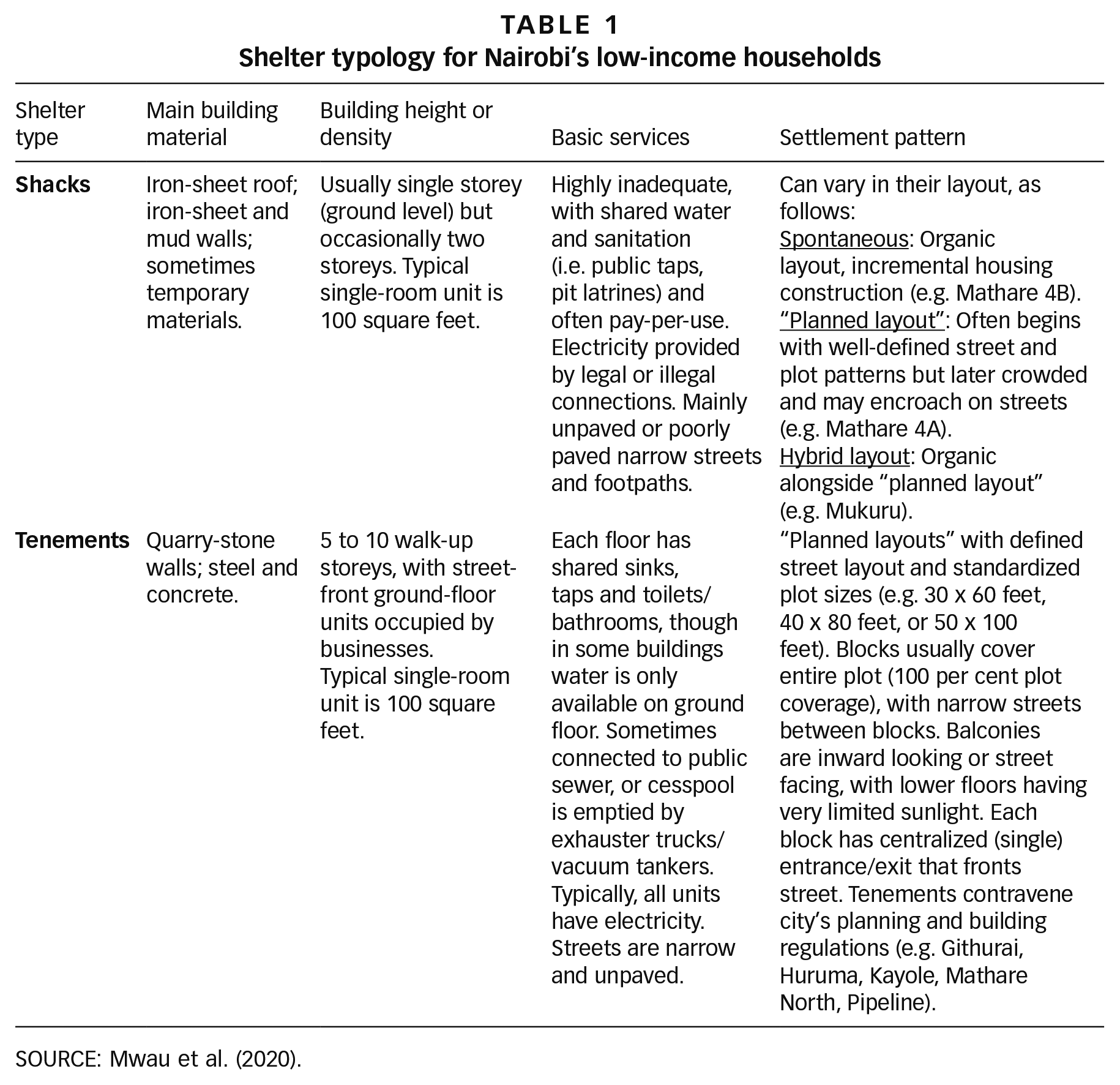
SOURCE: Mwau et al. (2020).
a. Affordable housing policy: recent openings and continued challenges
As noted, government officials and aid agencies have tended to favour market solutions while overlooking Nairobi’s low-income housing and infrastructure provision, particularly after SAPs. Similarly to other nations in the global South, Kenya’s SAPs resulted in the privatization of public goods like housing and utilities.(41) These reforms contributed to private-sector dominance of Nairobi’s housing provision and state withdrawal, in favour of “enablement”.(42) A retired official noted that Kenya’s government “lost [its] way” during the SAPs, resulting in nonexistent quality control for low- and middle-income housing (KII, former local official). In the 1980s, Nairobi’s tenements began emerging at scale, partly due to the loosened regulatory environment.(43) The rise of tenements “was a perfect response to housing scarcity amid a lack of standards for housing. It became a big problem not only because of the units that are provided, but also because [of] inadequate infrastructure, services and amenities. . .” (KII, senior planner). Infrastructure and services in Nairobi’s tenements and shacks are typically provided by fragmented state agencies and informal actors, with major shortfalls for household-level connectivity.(44)
Recently, as part of his “Big 4” Agenda launched in late 2017,(45) President Kenyatta promised to build 500,000 affordable homes by 2022, but critics note that low-income tenants are unlikely to benefit. The Affordable Housing Programme (AHP) seeks to create 350,000 jobs in the construction sector – along with providing tax incentives, improving the mortgage market, and offering bulk infrastructure and land to enhance housing delivery.(46) However, it is largely incumbent on developers to reduce housing costs, and the AHP has been criticized for its market-based approaches and support for homeownership, which disadvantage the poorest.(47) The programme will require 60 per cent private-sector funding, but it is unclear how upgrading and low-cost social housing will be funded. Omenya(48) argues for focusing instead on affordable rental units. Meanwhile, the new units’ locations might not suit Nairobi’s low-income households, who often live in settlements with vibrant informal economies and social networks that they may wish to maintain.
b. Inadequate city planning, minimal local governance and poor land administration
Combined with inadequate housing policy frameworks, key drivers for Nairobi’s deficient shelter are shortfalls in land administration, city planning and multilevel governance. Concerns at the institutional level include siloed departments, limited technical capacity and inadequate policy implementation. An official criticized the national department for housing(49) for rarely developing a housing policy, and when one is developed, not implementing it; the department operates “as a closed cell” rather than collaborating with other actors (KII, national government official). He argued that the ministry lacks technical capacity, while municipal leaders do not believe it is their duty to house residents. Further governance challenges stem from Nairobi’s excessive bureaucracy, difficulties in complying with the law, and bribery of construction inspectors (KII, academic/architect). Nairobi also has a long history of concentrated landownership, politicized land deals and irregular land allocations, which are frequently intertwined with Kenya’s ethnic politics and serve to marginalize low-income households.(50)
For decades, Nairobi has grown without a development plan, adequate land-use management or local/neighbourhood plans, with city planning largely reduced to attempted development controls. Nairobi’s land markets are often infiltrated by influential private interests and corrupt politicians: “Land investment [is left to] the private sector, and the private sector is so poorly regulated such that they push for more profits every year[…] Land was used as a tool to control the city politics” (KII, county government official). Kenya’s challenges in land administration are linked not only to patronage politics, weakened state capacity and powerful private interests, but also to the practices of corrupt professionals.(51) In Nairobi, planning approvals are only granted to developers with proof of legal landownership and exclude developers operating in the informal system, where “approvals” are typically granted by local administration (e.g. area chief) or community leaders. Informal dwellings are usually built by informal contractors,(52) sometimes protected by local gangs or corrupt enforcement officers (bribed to turn a “blind eye”).(53) Although Kenya has recently attempted land reform, this provides, according to Bassett, “a cautionary tale to land reformers showing how difficult it can be to dislodge entrenched interests and promote social justice through formal institutional change”.(54) In sum, Nairobi’s exclusionary formal city planning and highly opaque, corrupt land governance have stimulated a parallel informal planning process, with the majority of the city’s residents accommodated in low-quality rental shacks and tenements.
c. Low incomes, insecure livelihoods and inaccessible housing finance
Further barriers to decent shelter provision are Nairobi residents’ low incomes and insecure informal livelihoods (such as vending, construction or other casual jobs). Kenyan economic surveys indicate that most new jobs are in the informal economy, while formal job creation is extremely scarce.(55) Conventional mortgages and bank loans for housing – ill suited to informal workers’ low, erratic incomes(56) – are available only to a handful of wealthy households: as of December 2017, Kenya had just 26,187 mortgages, with a total value of KSh 223.2 million (US$ 2.2 million).(57) A mere 10 per cent of Kenya’s population can afford a formal house costing US$ 10,000 (without subsidy) and a monthly mortgage repayment of US$ 174.(58) As discussed in Section VI, social factors like gender, migration status and ethnicity may interact with financial constraints in shaping residents’ access to shelter.
d. Informal rental providers’ profitability
Hazardous informal shelter in Nairobi can be highly lucrative. Our findings indicate that investors in Nairobi’s low-cost rental housing market can realize up to
Comparing rental unit payback periods in Mukuru and Kilimani
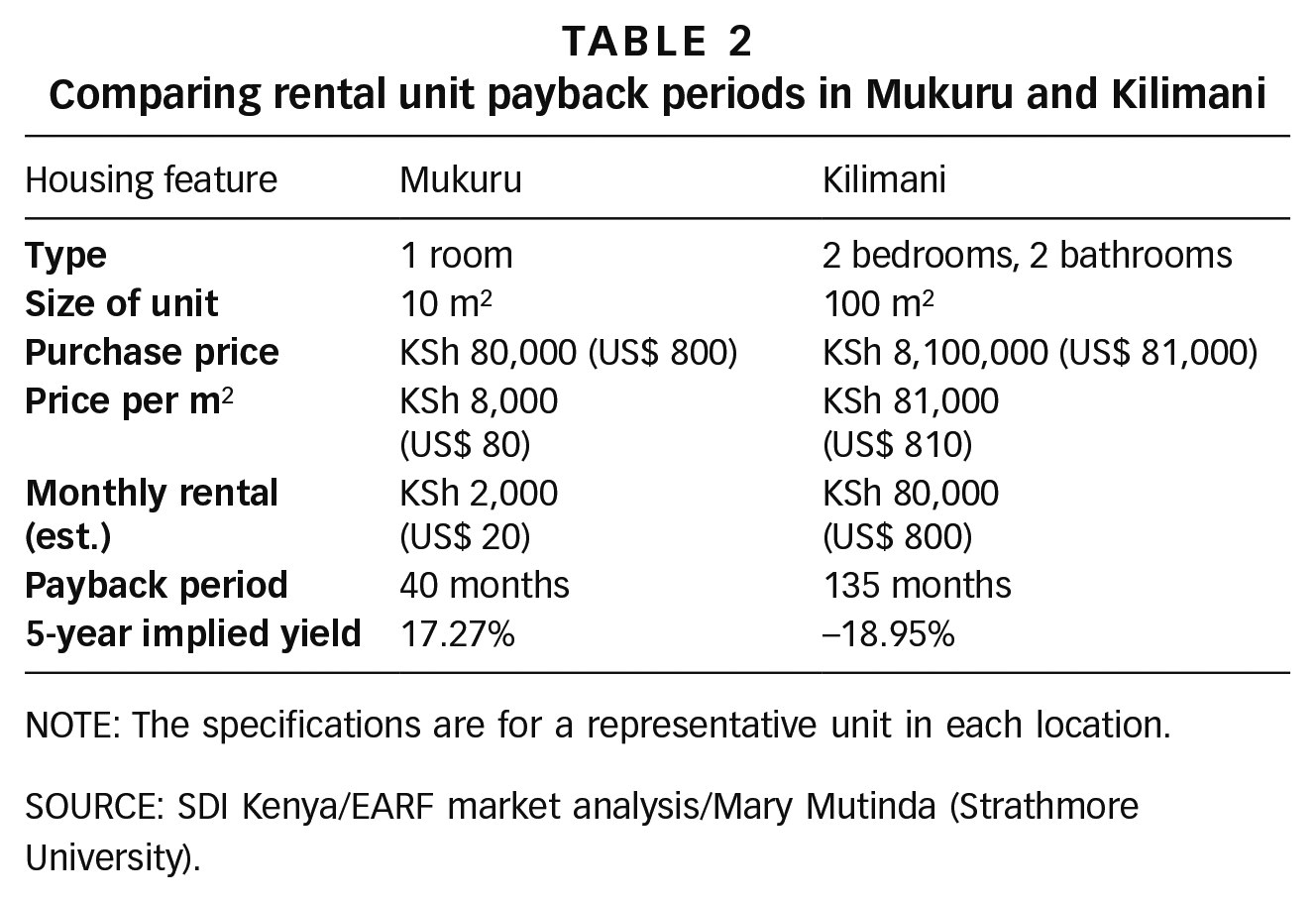
NOTE: The specifications are for a representative unit in each location.
SOURCE: SDI Kenya/EARF market analysis/Mary Mutinda (Strathmore University).
V. Low-Income Shelter Transformations in Mathare Valley
a. Study setting: history, poverty and informal livelihoods in Mathare
Mathare Valley, located on 0.89 square kilometres of land about 6 kilometres northeast of Nairobi’s central business district (CBD), is one of Nairobi’s oldest informal settlements. It dates back to the 1920s, but still has extremely low-quality shelter. Initially a stone quarry, Mathare’s first settlement was razed by the British in the 1950s, when many residents were active in Kenya’s nationalist movement.(61)After 1963, Mathare grew rapidly and had an estimated 30,000 residents in 1969.(62) Most homes then were built from mud and wattle (woven strips of wood), and strong local leaders and organizations had advocated successfully to halt demolitions.(63) In the late 1960s, Mathare already had large-scale land-buying companies and housing cooperatives that engaged in speculative construction.(64) A resident who arrived in 1975 recalls the lack of water (still a major concern) and the poor roads that contributed to their son’s death in 1986 by preventing access to a hospital (Kosovo mixed-gender FGD). A woman remembered houses built of mud in the 1990s, with only polythene bags for roofing. Today’s units are typically made of iron sheets or concrete (Mathare women’s FGD).
Mathare Valley’s physical form has changed significantly. Its built-up area increased from 76 per cent in 2009 to 82 per cent today, and over the same period, the population increased from 80,300 to 114,259,(65) with rising demand for land and construction of high-density housing (Map 1). Its landscape is increasingly comprised of multilevel structures, most prominently high-rise tenements. To maximize incomes, shelter suppliers increasingly opt for vertical densification of Mathare’s shacks. The most lucrative option is the construction of tenements, which require higher capital investment but offer greater returns than shacks. Mathare Valley’s sub-locations with the highest population densities (Table 3) are those dominated by tenements.(66)
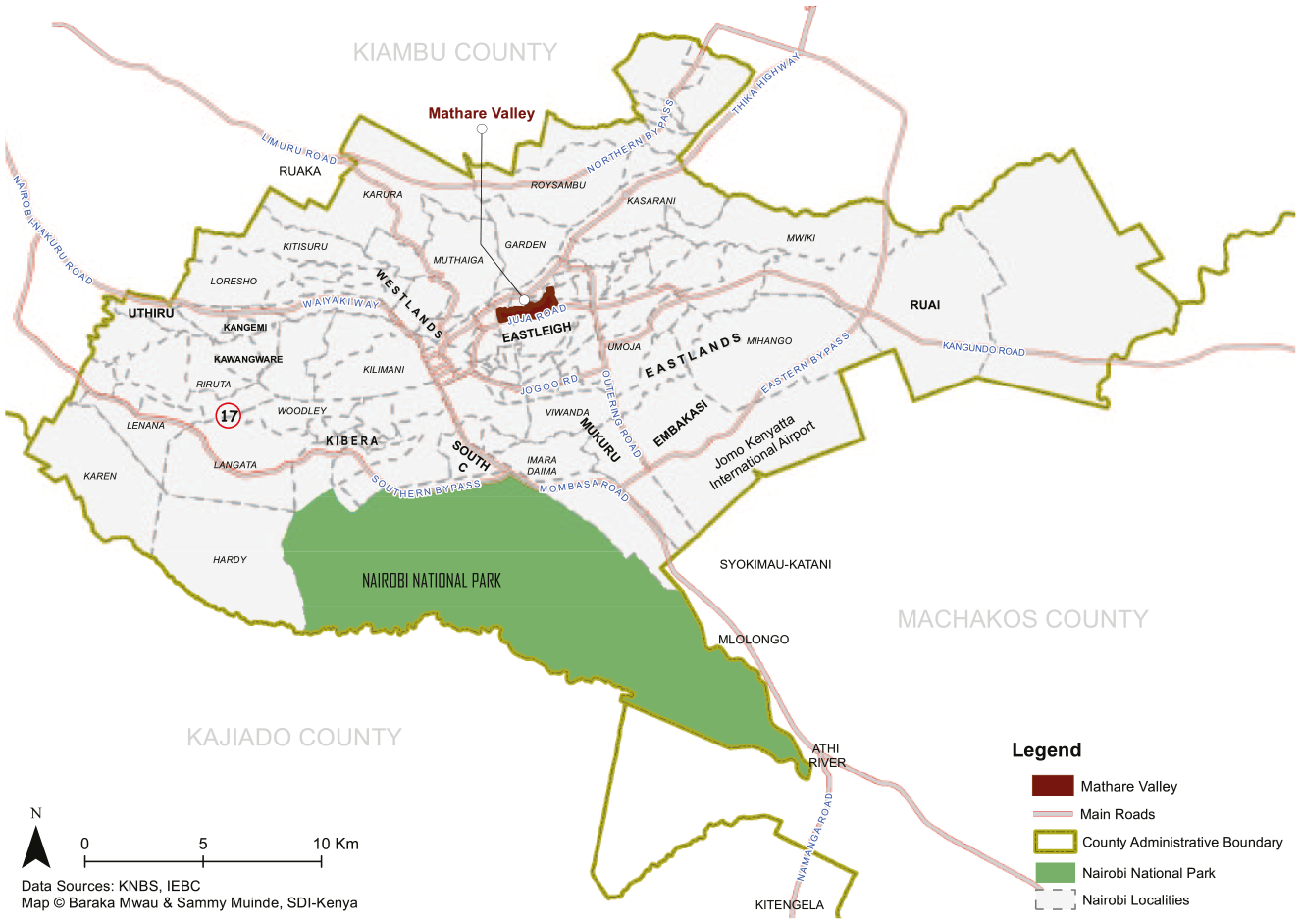
Mathare Valley location and context
Population of Mathare Valley
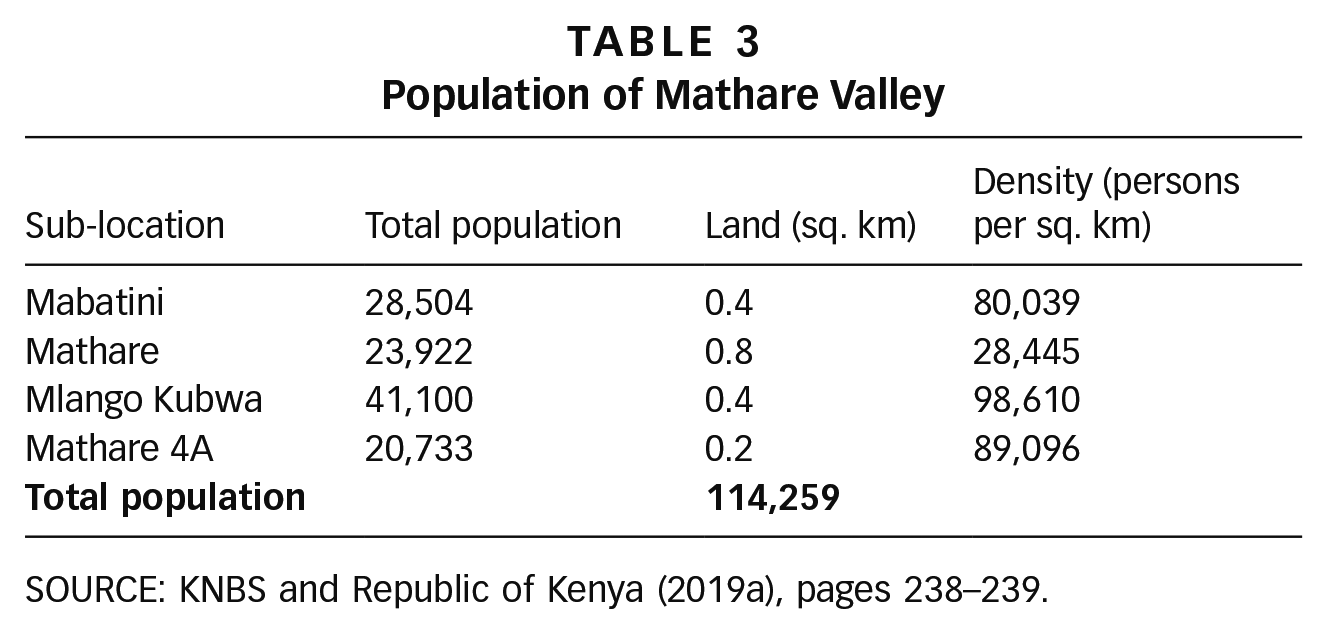
SOURCE: KNBS and Republic of Kenya (2019a), pages 238–239.
Mathare’s flourishing informal economy is often segmented by gender, and although housing costs are relatively low, many residents struggle to afford their other basic needs. A recent survey with 100 Mathare residents found that 30 per cent of households are female headed; 69 per cent of women respondents work inside the settlement (largely in informal livelihoods), as compared to 31 per cent of male respondents.(67) Leading occupations include small businesses and salons (especially for women) and construction and casual jobs, particularly for men. Meanwhile, our FGDs indicate that the rent for a single room ranges from KSh 1,800 to 3,000 (US$ 18–30). Monthly household expenditures on food, rent and utilities are approximately KSh 22,800 (US$ 200); this excludes healthcare, school fees and other vital costs (Table 4). For many low-income households with precarious livelihoods, it remains difficult to cover these costs, and many have resorted to borrowing from friends/family or other informal sources.
Typical household expenditures, daily and monthly, in Mathare Valley
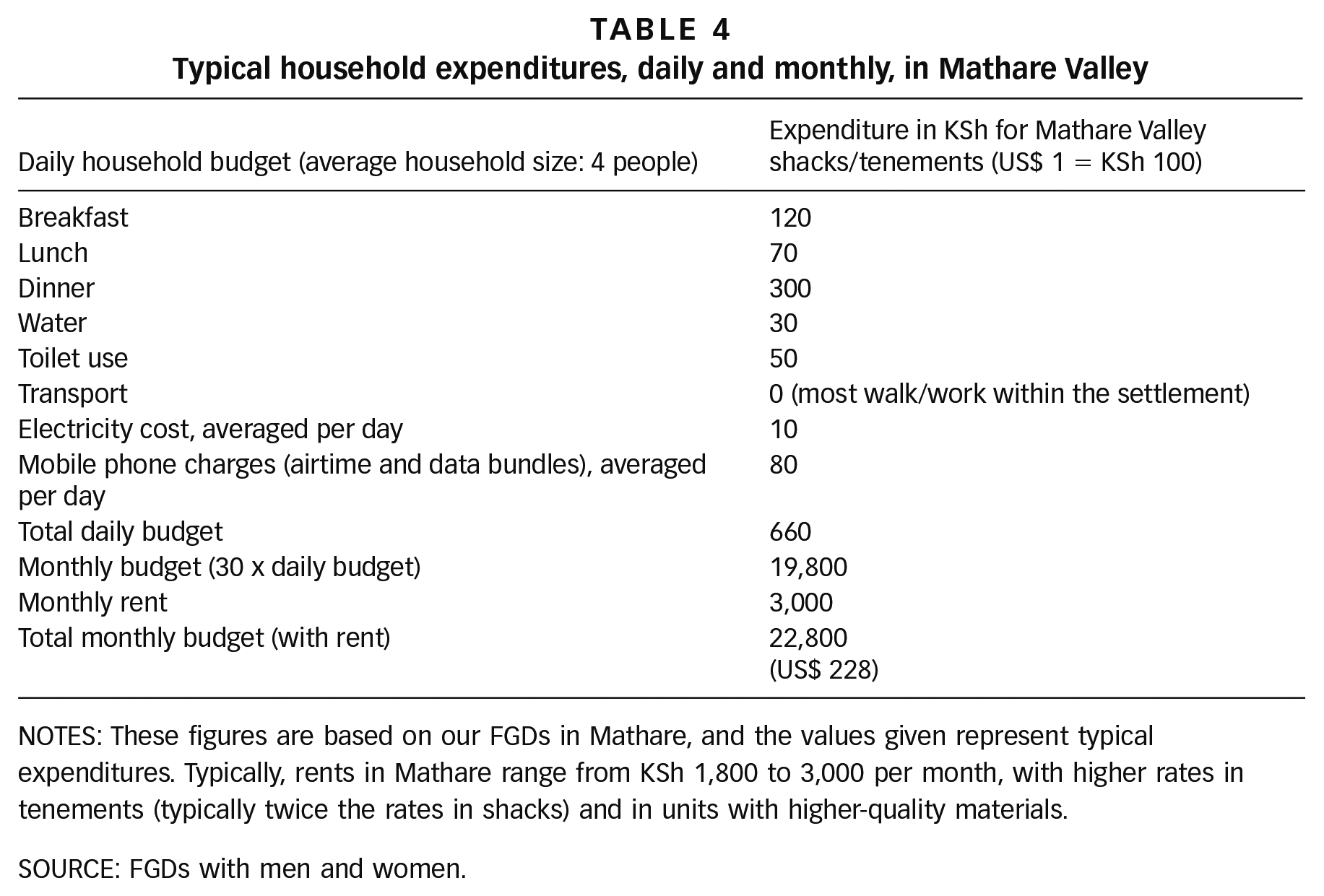
NOTES: These figures are based on our FGDs in Mathare, and the values given represent typical expenditures. Typically, rents in Mathare range from KSh 1,800 to 3,000 per month, with higher rates in tenements (typically twice the rates in shacks) and in units with higher-quality materials.
SOURCE: FGDs with men and women.
b. Intra-settlement variations in housing, infrastructure and service access
Land tenure is diverse, as Mathare’s 13 villages(68) are located on both public and private land, some with title deeds (which can facilitate access to a housing loan) but others still lacking titles. Mathare’s tenure mix differs between villages: those with de facto tenure are increasingly transitioning to tenements (e.g. Kosovo, Gitathuru), while areas dominated by shacks tend to have highly contested ownership (e.g. Kiamutisya) or are located on public land with strict controls regarding construction (e.g. Mathare 4B). Mathare’s land costs decrease near the river, where there is greater risk of flooding and demolitions. Despite the persistent tenure challenges, land transactions in Mathare have continued unabated and have facilitated the ongoing shift from shacks to tenements.
Recent trends include the rise of: 1) tenements made of stone, steel and/or concrete; and 2) multi-storey iron-sheet buildings erected by outside investors on land purchased from the original owners. In Kosovo, the emergence of tenements is linked to rising demand for single-roomed housing by new migrants and graduates,(69) who appreciate the area’s proximity to schools and the city centre (Kosovo mixed-gender FGD). But this may entail displacement of low-income residents, as tenement rents are usually double those for shack units. Demand for low-cost shelter also helps explain the construction of multilevel shacks where owners are unwilling to sell to tenement developers, or where local administration has prohibited construction of concrete structures (e.g. in Kiamutisya).
Meanwhile, Mathare’s infrastructure varies, but is often highly inadequate, despite recent efforts to formalize provision. Electrification has been largely unsuccessful, due to Kenya Power’s poor implementation of prepaid meters and residents’ continued use of informal providers that are more flexible and affordable but also highly fire-prone (Mathare FGDs).(70) Access to services and infrastructure can vary markedly, depending on political patronage and local governance arrangements (villages perceived as favourable environments for project implementation benefit more often).
High-density tenements are further straining Mathare’s infrastructure. Tenements mostly rely on wet-sanitation systems, entailing greater water consumption and wastewater production compared to shacks. But Mathare overwhelmingly lacks adequate sewer systems, and residents instead utilize informal sewers that drain raw sewage into the Mathare River. There is also growing pressure on Mathare’s schools and healthcare, whose supply remains largely unchanged, save for a few informal facilities.
VI. An Intersectional Analysis of Barriers to Rental Shelter in Mathare
Here we delve further into variations in Mathare’s rental housing by analysing barriers at the neighbourhood, household and individual levels.
a. Ethnicity, violence, and access to housing and infrastructure
Mathare’s neighbourhoods often attract members of the same tribe, and people may struggle to find housing in areas where their ethnic group is less dominant. According to one resident, Mathare “is segregated on tribal basis. One may find it hard finding a house in a region dominated by another tribe, out of fear.” Certain villages are more ethnically mixed than others, with different risks of violence or forced evictions. In the Number 10 village, a Luhya resident explained that their old home was burnt down by Luos (“Luos had an issue with other tribes, including Luhyas”), but their current village is tribally mixed and safer than before (Mathare FGD with recent migrants).
Landlords may prefer tenants from their own tribe, particularly in election periods, when tensions can run high. Violence can occasionally erupt along tribal lines, especially between Kikuyus and Luos: “During the elections, no one is supposed to cross each other’s territory” (young woman in a Mathare tenement). Following Kenya’s 2007 post-election violence, several structure owners in Mathare were forcefully displaced. In the 2017 elections, violence and multiple deaths were reported in Mathare, some linked to opposing tribal factions.(71) In Kosovo, elderly structure owners “inquire the tribe to which one belongs to before one is given a house to rent, and especially during the election period, it is harder for a Luo to get a house” (Mathare FGD with recent migrants).
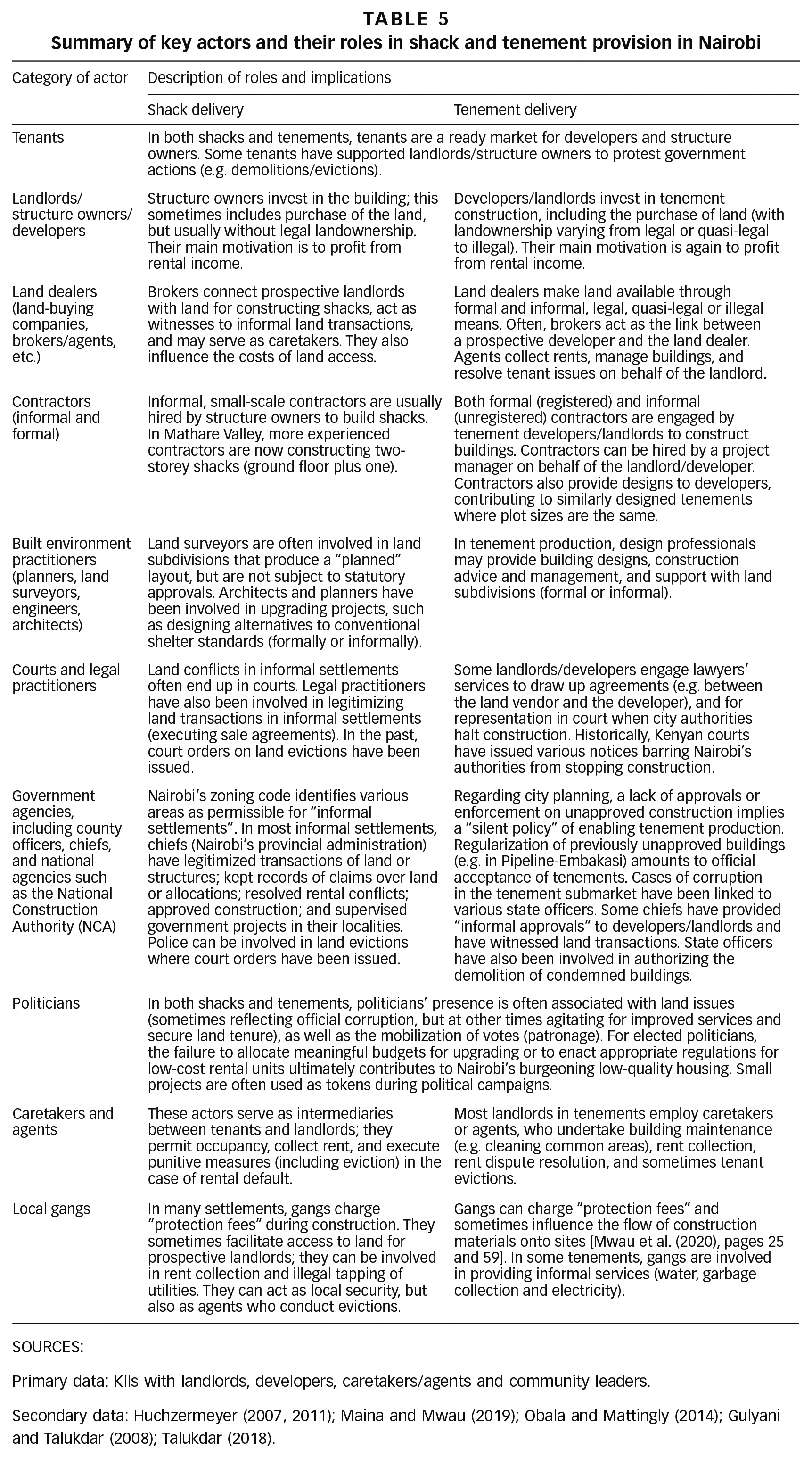
Violence can also be a more chronic concern, frequently associated with Mathare’s contested landownership and utilities provision. Forced evictions are common in the governance of Mathare’s informal land markets,(72) and external actors (with the help of local agents) have regularly used violence to evict Mathare tenants, in order to pave the way for redevelopment. There can be threats and intimidation, or sometimes court eviction orders that the police forcibly execute (Table 5). Many Mathare residents are suspicious of fire outbreaks, which have served as a key tactic to facilitate evictions and land grabbing. A resident explained, “most of the early tenements can be linked to evictions. ‘Fire outbreaks’ were used to clear sites for construction. After a fire incident, it couldn’t take long to see a perimeter fence around the site and then construction follows” (FGD with youth leaders). The threat of violence may cause women and girls in Mathare to fear going outside to access toilets at night; they may instead resort to makeshift solutions that make them feel humiliated or helpless.(73) In Mathare, many women use public toilets during the day, but at night often use bags or containers (Mathare FGD with women) – especially mortifying when sharing a single room with other relatives.(74)
Summary of key actors and their roles in shack and tenement provision in Nairobi
SOURCES:
Primary data: KIIs with landlords, developers, caretakers/agents and community leaders.
Secondary data: Huchzermeyer (2007, 2011); Maina and Mwau (2019); Obala and Mattingly (2014); Gulyani and Talukdar (2008); Talukdar (2018).
b. Gender, age, income and household size
A constellation of barriers has left many Mathare residents struggling to find shelter; such obstacles often reflect their gender, age, income and household size as well as the biases of private landlords. For instance, some structure owners reject single mothers (seen as incapable of paying rent), or large families because children may damage the plot’s facilities: “some landlords do not want children in their plots therefore, if you have [many] children, you may have a challenge getting a place to rent” (Mathare women’s FGD). Meanwhile, it seems rare for widows to face additional barriers in accessing shelter. A widow living in a one-room shack with her son and three grandchildren, for instance, did not face prejudice as a widow, but rather struggled to access a unit able to accommodate her large household (widow in Mathare 3B). Larger households may face difficult trade-offs regarding privacy and crowding when they settle for smaller, less costly units.
Although norms of Kenyan ethnic groups often dictate that teenage boys occupy their own units when they reach adulthood, landlords sometimes deny them housing, regarding them as too noisy or prone to criminality. As one youth explained, “When you are a single man, [the landlord] first of all considers you to be a thief” (Mathare youth FGD). The pervasive lack of jobs only heightens the difficulties for young men seeking rental housing. Residence in Mathare can also be stigmatizing and hamper young men’s job searches: “When you go for a job interview with youth from other [middle- and upper-income] areas or those whose parents are known, they are the ones given the opportunity. . .” (Mathare youth FGD). Furthermore, young men in Mathare (as in Nairobi’s other informal settlements) are regularly exposed to violence, including gang violence and extrajudicial killings often linked to Kenyan police officers.(75)
The impossibility of living alone as a young woman (due to poverty and prevailing gender norms), as well as the desire to escape family homes with their limited privacy, may all contribute to girls’ early marriages. Many young women encounter discrimination when trying to rent alone and might be pressured into early marriage to find their own accommodation. An unmarried single woman is often seen as promiscuous and likely to “steal others’ husbands on the plot” (Mathare mixed-gender FGD). Furthermore, spatial constraints in single rooms and cultural sensitivities of shared accommodation (teenagers are not allowed to share a bed with their parents) can act as a key driver unwanted separation of faily members (e.g. children sent to rural areas or boarding schools outside Nairobi) and a key driver of early (unwanted) marriages, as teenage girls may seek alternative shelter with men: “It was such a shame living with my parents as an adult. I ran away from that house and to stay with a certain man. This leads to young girls going into early marriages” (Mathare women’s FGD).
c. Elderly and people living with disabilities (PLWDs)
In addition to the challenges of shacks’ minimal infrastructure and high-rise buildings with imposing stairs, elderly and disabled tenants may face widespread discrimination. An able-bodied community health worker noted that when she tries helping PLWDs to access water, she is regularly insulted by fellow residents: “Sometimes when I am at the water point, I see some people who are physically challenged coming for water [. . .] When I intervene, insults are hurled at me. . .” (Mathare 3B widow in a single-room shack). Efforts to tackle stigma and transform negative community attitudes about PLWDs are crucial, particularly around competition for scarce resources like water.
d. International migrants
Although further research is needed, anti-foreigner attitudes seem pervasive in Mathare: immigrants have been accused of undercutting wages or threatening morality, and may be charged higher rents than Kenyans. A landlord claimed that Baganda immigrants (from Uganda) are immoral and criminal, and cause congestion: “We have very many immigrants [the Baganda]. . .We are calling upon the government to intervene in order for us to get more space [. . .] [New migrants’ arrival] makes us feel not so safe because there could be thieves among them” (Mathare landlord in a four-room shack). Migrants in Mathare do in fact increase local demand for housing, contributing to higher rental prices in parts of the settlement.(76) These new residents’ social networks and informal side payments can help them access shelter, but they can still regularly encounter xenophobic sentiments.(77) They typically work at lower daily rates than Kenyans, which can lead to heightened competition with local labourers (e.g. female domestic workers).
VII. Political Economy of Mathare’s Shelter and Land Transformations
Mathare’s rental housing transactions and transformations are rooted in processes involving an array of actors, interests and complex power relations (Table 5). On one side are the interests of landlords/structure owners and external developers, who aim to profit from rental housing; on the other side are residents seeking to access units. In between are multiple actors who either facilitate or constrain key processes in Mathare’s informal shelter markets. This results in informal planning and an extremely speculative shelter market with high demand for land, insecure tenure and increased conflict. In turn, Mathare’s built environment is now characterized by densification (vertical and horizontal) and extreme population densities.(78)
Governance in Mathare also presents challenges, particularly given the increasing influence of external developers who are reconfiguring power relations. Ongoing densification, linked to Mathare’s tenement construction, reduces tenants’ face-to-face interactions with landlords. External developers typically focus on rental income and rarely reside in Mathare; relations are becoming more formal, often brokered through agents (who serve as building caretakers, local leaders, or other actors on the ground).(79)
Although Mathare has had various shelter interventions,(80) their success is often limited by financial constraints; limited understanding of beneficiaries; or elite capture by local leaders, NGOs or state officers. In Mathare 4A, infrastructure was upgraded with support from Germany’s development bank KfW, the Government of Kenya and the Catholic Archdiocese, but the project failed to meet the target beneficiaries’ expectations and overlooked key differences amongst residents. According to Diang’a,(81) “The assumption that the Mathare 4A was a homogenous group was wrong. The differences between the former dwelling owners, the tenants, and the large ethnic groups [resulted] in frequent conflicts of interest, which impacted negatively on the implementation.” Additionally, past interventions have sought to provide individual land titles, rather than potentially more appropriate alternatives such as community titles.(82)
After Kenya Power’s recent attempt to formalize electricity in Nairobi’s informal settlements, many households still use unregulated providers, reflecting official providers’ poor understanding of informal providers and intended beneficiaries.(83) Residents attribute this failure of formalization to: 1) lack of consultation with targeted households about their preferred electricity connection (postpaid or prepaid); 2) lack of consultation with tenants and structure owners; and 3) failure to involve informal service providers (Mathare FGDs).
VIII. Conclusions and Recommendations
Nairobi’s low-income majority relies overwhelmingly on informal, low-quality single-room rental units, yet this housing market is scarcely recognized in urban policy or past research. Rising demand for low-cost rental housing, alongside entrenched city planning failures and the lucrative potential of Nairobi’s informal shelter, helps to explain an ongoing transformation from shacks to tenements. In Mathare and Nairobi’s other low-income areas, single-room rental units with deficient construction, services, infrastructure and amenities have contributed to health risks such as recurrent cholera outbreaks, and led to collapsed tenements.(84) We analysed the array of actors shaping Mathare’s informal rental markets, and identified key barriers to shelter access at the neighbourhood, household and individual levels. The findings can potentially inform multifaceted interventions befitting the complexity and ongoing changes in rental markets. Our policy recommendations, below, may also have relevance for other cities in the global South where informal rental housing is a vital but often neglected option for low-income residents.(85)
We recommend more integrated shelter policies and greater recognition of rental housing; the city also needs to reform its spatial planning and land governance systems. Holistic, forward-looking shelter interventions could more effectively accommodate Nairobi’s rapid growth, complemented by strategies to improve infrastructure delivery and land management.(86) It is also important to address multiple exclusions in informal rental housing markets and partner with low-income residents to design equitable shelter strategies. Mathare residents can struggle to access decent housing because of low incomes, as well as based on age, gender, ethnicity, migration status, disability, and other axes of difference. Partnering with communities and informal housing providers could create key opportunities for co-produced shelter solutions,(87) reducing the risk of displacement while fostering local ownership and a sense of place. To address low and erratic earnings in Nairobi’s informal economy, policymakers should foster job creation and the upgrading of workers’ skills; improve worksites (e.g. well-designed and -located markets); and enhance access to capital.(88) Adequate housing and infrastructure can themselves foster inclusive growth, particularly for women whose livelihoods are often centred on their homes or settlements.(89)
Improve access to safe, affordable and decent rental housing
Homeownership is not the solution to the city’s shelter deficits. Nairobi needs multiple tenure arrangements, with an emphasis on affordable, decent rental housing. Policymakers must recognize the essential role of rental housing, rather than prioritizing only homeownership.(90)
Working with informal rental housing providers and developing an enabling approach to low-cost rental markets will be critical: future interventions can leverage providers’ much-needed private capital and knowledge, but redirect it to better-quality shelter.(91)
Appropriate, well-enforced policies on rental housing could significantly improve tenants’ health and living conditions, while also curtailing abuses like rent hikes or arbitrary terminations.(92) Nairobi’s tenements need updated planning, design and health regulations; they also require initiatives to improve infrastructure and uphold minimum housing standards.
Reform land governance and urban planning
Nairobi’s city planning strategies will need to provide a more proactive, holistic framework for low-cost housing investment. Planners’ focus on development control in Nairobi has been largely ineffective and exclusionary. Instead, officials should reduce key constraints and incentivize the private sector to provide additional low-cost rental units (e.g. offering tax breaks, lower borrowing rates and subsidized building materials).(93)
Planning strategies will also need to promote the positive qualities that informal developments have produced, such as mixed-use development.
An updated, transparent land information system will reduce the risks of mismanagement and corruption, thereby lowering transaction costs of land.
Better integration of land-use and infrastructure planning can provide a strategic framework for shelter delivery, resolve land conflicts and facilitate future interventions.
Promote equity and participation in shelter and service provision
A redistributive strategy to provide roads, water and sewerage (at minimum) should be prioritized in Nairobi’s development expenditure, as well as by its public utilities and development partners.
To foster gender-equitable service delivery, utilities should work with women and girls to design appropriate water and sanitation facilities (e.g. adequate lighting, menstrual hygiene facilities, and gender-segregated doors for public toilets). It will also be crucial to work with PLWDs to design appropriate services and facilities.
Develop multi-pronged housing strategies
Kenya’s government and development partners should promote access to affordable construction finance; enhance the capacities of built environment professionals and other stakeholders in housing; and improve the supply of land and bulk infrastructure to reduce developers’ costs.(94)
The city needs to combine strategies for new housing developments with interventions for existing shacks and tenements, using approaches such as settlement upgrading, redevelopment and land readjustment linked to developers’ commitment to create low-cost housing.
Further research can continue exploring the diverse rental markets that serve low-income residents, with attention to ongoing transformations, the politics of provision and the quality of living conditions. Our study underscores the diversity and rapid densification of Nairobi’s informal rental housing, similar to Karachi’s proliferation of high-rise, low-quality, informal rented apartments.(95) With a fuller picture of informal rental housing (including its political underpinnings and the array of actors in different submarkets), future studies can help to develop contextually rooted interventions. City-wide research is needed to examine a range of informal arrangements, such as sharing, petty landlords, and small- or large-scale commercial landlords (as in Accra(96)). Studies of “housing financialization” may also benefit from examining informal rental housing: past financialization research typically focuses on high-income units for sale or rent,(97) rather than down-market (but still profitable) informal rentals like Nairobi’s tenements. Equipped with a better understanding of rental housing in all its dynamism, challenges and contributions, policymakers can take long-overdue steps to improve shelter for informal tenants. Informal rental housing remains a hidden – yet central – pillar of shelter markets across the global South. By continuing to reveal the myriad actors and varieties of informal rental housing, future research can promote strategies that better serve low-income tenants for whom renting is often the only viable option.
Footnotes
Acknowledgements
The authors would like to thank the following researchers and SDI Kenya staff for their valuable contributions during the research: Jack Makau, Sammy Muinde, Mary Mutinda-Kipkemoi, Dennis Mwaniki, Smith Otieno, Jason Waweru, Francis Kivuva, Stephen Mutungi, Lilian Odongo, Naomi Ng’ang’a, Ivy Gichuki and Jackline Wanyonyi. We also deeply appreciate the participation and insights of residents and community leaders across Nairobi.
Funding
The research was funded by the UK Department for International Development’s East Africa Research Fund (EARF) and contributed to EARF’s programme of research: Shaping East African Cities as Systems to Work Better for All. This material has been funded by UK aid from the UK government. However, the views expressed do not necessarily reflect the UK government’s official policies.
4.
5.
For instance, Amis (1984); Schramm (2017); Gulyani and Talukdar (2008); and  .
.
6.
9.
The land and housing markets survey covered several satellite towns in the Nairobi Metro Region: Athi River, Kamulu, Kitengela, Mlolongo, Ruiru and Uthiru.
10.
Weru (2004); .
11.
“Mathare” and “Mathare Valley” are used interchangeably in the following text.
12.
UN-Habitat (2017). See also Gilbert (2008); and .
18.
23.
Hasan and Arif (2018); , page 29.
29.
31.
Hake (1977); .
32.
37.
41.
For more on SAPs and housing in the global South, see Pugh (1994a); and .
42.
For earlier discussion of private landlords in Nairobi’s informal settlements, see Amis (1984). For more on “enablement” see Chiodelli (2016); and .
43.
45.
47.
49.
Part of the Ministry of Transport, Infrastructure, Housing, Urban Development and Public Works.
52.
This entails contractors undertaking construction for unapproved development and unregistered construction projects.
59.
66.
67.
Kovacic et al. (2019). For Mathare youths’ livelihoods in waste collection, see .
68.
“Villages in Nairobi and other Kenyan towns refer to clusters within informal settlements bearing distinct names. Initially, they were self-help settlements built by Africans on the outskirts of the new town, hence villages. These early settlements have evolved over time and are now part of the inner-city informal settlements, still called villages.” [, pages 5–6.]
69.
“Some students from the nearby college [Kenya Medical Training College-Mathare] now live in Kosovo, and recently we are noticing more and more college students or graduates coming to seek housing” (KII with a Kosovo community leader).
77.
See Mwau et al. (2020) for further discussion. And for similar findings in Kampala, see .
80.
85.
Gilbert (2008); also .
90.
91.
94.
97.
Goodfellow (2017); ; Rolnik (2018).