




Abstract
Urban food security, or its lack, is attracting growing interest in global policy debates. Glaringly missing in these conversations, however, are the voices of the urban poor. To fill this gap, grassroots community organizations, with decades-long experience collecting data on their own communities and taking action to improve conditions, decided to ask the urban poor in Cambodia and Nepal how they define and measure food security, what key challenges they face in the daily struggle to put food on the table and what actions might help. Their findings show that access to adequate diets is a major challenge for low-income communities in Asia, and that hunger is widespread, although with great variations and fluctuations between and within households. They also highlight the extraordinary resilience of urban poor women and their multiple strategies to stretch meagre budgets and make sure there is something to eat, even though sometimes this is not enough.
Keywords
I. Introduction
In recent decades, policy debates on food security have shifted from a predominant concern with production to a growing attention to consumption, including access, affordability and utilization. In part, this is because urban residents, now the majority of the world’s population, depend primarily on purchases to feed themselves. There are also emerging concerns related to the nutrition transition whereby the proportion of overweight and obese people is increasing, while undernourishment – especially among children – persists. Research shows that the most pernicious forms of nutrition transition are common among the residents of low-income settlements, where obesity and undernutrition often occur within the same household.(1) There is also growing interest in better understanding how urbanization affects food security, with an emphasis on how the changing diets of more affluent urban residents affect natural resources beyond urban boundaries. This is an especially critical issue in the context of climate change.(2)
While these shifts in emphasis are welcome, there is still a tendency at the policy level to treat urban consumers as a homogenous group and to assume that ensuring access to markets is enough to guarantee everyone’s food security. People’s ability to feed themselves, however, is inextricably linked to a host of factors at the individual, household and community levels, as well as to broader structural determinants. A holistic understanding of urban food security needs to be embedded in an understanding of urban poverty and the complex survival strategies and systems of the urban poor. And no one is more knowledgeable about those strategies than the urban poor themselves.
In 2014, members of urban poor community networks in six countries (Cambodia, Nepal, the Philippines, Sri Lanka, Thailand and Vietnam) took part in a study in which they discussed and analysed their poverty and set their own methodologies for how to define, measure and address it.(3) The study was organized by the Asian Coalition for Housing Rights (ACHR), a regional coalition of housing professionals, NGOs and grassroots community organizations working on issues of housing, land and urban poverty in 20 countries. The collective work of these groups represents a huge amount of understanding, experience and innovation – Asia’s home-grown housing development wisdom. Since ACHR was formed in 1989, these groups have been joining forces, supporting and learning from each other through such joint initiatives as housing rights campaigns, fact-finding missions, training and advisory programmes, workshops and study tours, community exchanges, and projects to promote community-managed finance systems and citywide slum upgrading.(4) Through this collaborative work, the coalition partners have found they have something crucial in common: a belief that the key resource to solve Asia’s enormous problems of poverty and housing is the people who experience those problems, who most urgently want change and are most vitally motivated to resolve those problems.
The 2014 poverty study built on this work. Unlike other participatory poverty assessments, the ACHR poverty study was designed and conducted by organized groups of urban poor communities with years of experience surveying and mapping their settlements, running community savings and loan schemes, and carrying out development activities on many fronts. A striking finding was the importance of food – its quality, quantity, affordability and availability – in how community people defined their poverty. Many of the groups observed that the poorer a family is, the higher the proportion of their income spent on food. Some of the poorest families spend more than half their earnings on food, and their nourishment is still often inadequate.
With this finding in mind, a follow-up study was organized in 2017 in which poor communities in Cambodia and Nepal discussed similar topics, but with a closer focus on the issue of food and food security. This paper describes that second study.
In both countries, the study was carried out by community organizations and their local support NGOs.(5) The authors of this paper and their organizations – ACHR, Lumanti and the International Institute for Environment and Development (IIED) – worked in close collaboration with the national teams to provide overall support.
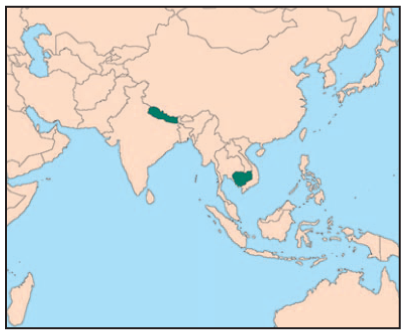
In Section II, we summarize what is known about the centrality of food insecurity for the urban poor. We then describe the approach and methods used in the Cambodia and Nepal study (Section III), as well as the study locations (Section IV). The key findings cover the study participants’ definitions of food insecurity (Section V) and the challenges of obtaining sufficient high-quality food (Section VI). We conclude by highlighting how the ways the urban poor themselves define and measure food insecurity contribute to mainstream debates on urban poverty and urban food insecurity.
II. Urban Poverty and Food (In)Security
Lack of sufficient and regular income is a root cause of urban food insecurity. In cities in low- and middle-income countries, food accounts for an extremely large proportion of low-income households’ total expenditure. In Mathare, one of Nairobi’s largest low-income settlements, food accounts for nearly half of household expenses.(6) In low-income neighbourhoods of Colombo, Sri Lanka and Kitwe, Zambia, 30 and 20 per cent of households respectively report spending almost all their available income on food.(7) Research in 11 southern African cities shows that food is the most important expenditure for most households, especially among poorer households.(8) With such stretched budgets, any decline in incomes or increase in food prices can have devastating consequences: for low-income groups, food insecurity was the most severe cumulative impact of the global food, fuel and financial shocks of 2008–2011.(9)
Financial insecurity is compounded by the fact that the majority of urban workers in low-income countries work in the informal sector, which accounts for between half and three-quarters of all non-agricultural employment.(10) An even larger majority of the urban poor rely on informal, casual labour that only provides low and irregular earnings, resulting in generalized food insecurity and high levels of indebtedness.(11) The urban poor rely on several strategies to ensure that there is some food on the table, as described in more detail in Section VI. Borrowing money is one such strategy. In the long term, however, it becomes very difficult to escape debt, especially for poorer people as they incur new debts to pay the interest on older ones.
Another widely used strategy is to reduce the quality, quantity and diversity of food consumed, while also reducing non-food expenditure, including on health and education, and working longer hours. This has long-term consequences; reduced calorie intake and micronutrient deficiency increase the incidence of disease and affect school performance. In the short term, weakened workers are less productive, and for those working in the informal sector, any lost workday has substantial implications for earnings and the ability to secure a nutritious diet, locking them in a cycle of poverty and food insecurity.
An additional driver of urban food insecurity is the poverty penalty, whereby the urban poor pay more for the same products than their wealthier counterparts. In some cases, this is due to lack of access to cheaper retail outlets located far from low-income settlements. Moreover, lack of money and storage space forces low-income consumers to buy small amounts of food daily rather than in bulk. This can make a substantial difference: in Cape Town and in Greater Cairo, prices in small local shops are typically 20–26 per cent higher than in supermarkets.(12) However, small local shops located within low-income settlements, while selling at higher prices, also often offer short-term credit to their regular customers and represent an essential lifeline for many if not most residents.(13)
Income poverty, key to food insecurity among the urban poor, overlaps with non-income dimensions of poverty. Inadequate access to housing and basic services, including water and sanitation, has an impact on health and the ability to engage in income generation. Access to social welfare benefits and financial services is restricted for people in informal settlements without a legal address.(14) Disproportionate exposure to environmental hazards affects nutrition through higher incidence of water-borne, food-borne and vector-borne diseases. These factors, together with loss of assets, are intensified by the impacts of climate change, including increased frequency and severity of extreme weather events such as floods and heatwaves.(15)
As the primary carers for their families, women bear the brunt of the stress of putting food on the table in difficult circumstances. They are also often the last to eat, after men and children. From its inception, the study in Cambodia and Nepal identified women as those most knowledgeable about the strategies to ensure there is something to eat for the whole family, but also those with the least voice. While no efforts were made to exclude men from the discussions, and initially men did participate, most of them soon lost interest. Women, on the other hand, were keen to discuss this central part of their lives, and the group discussions were invariably lively, convivial and detailed.
III. How the Study was Organized
Collecting data has long been an important part of the work of the networks and federations of urban poor grassroots organizations.(16) Accurate data are both a starting point for community-led actions and a useful way to engage with local governments in developing dialogue and eventually the co-production of sustainable solutions to the provision of housing, basic infrastructure and services. The ACHR poverty study built on this experience. The food study, in turn, draws on the findings of the poverty study and follows a similar approach and organization. However, since food security is a relatively new topic for the community networks, this second study is smaller in scale and intended as a pilot to explore whether this issue should be developed further.
As a first step, ACHR invited community groups in Cambodia and Nepal to discuss food security, see whether it was of interest to their networks and identify the key issues. These national meetings were held in both countries in November 2017, and were followed by a regional meeting in Bangkok in December to agree on a plan of action for the study. Although Thailand is not officially included in the study, it was felt that Thailand’s experienced senior community leaders could advise and support the Cambodian and Nepali community teams. It was also felt that a regional dimension would be important to share learning and facilitate exchanges. As part of that first regional meeting, participants visited community-based food production initiatives in Thailand and were invited to an exhibition of the national Green Community Healthy Food Production Programme, in which urban poor communities around the country are finding innovative ways to improve their diets and increase their control over what they eat by growing and producing their own healthy food.(17)
The community teams returned to their countries to implement the plans developed in Bangkok. At this first regional meeting, it had been agreed that size and location of urban centres are important factors in shaping food security, and so two distinct study locations were included in each country: the capital city (Phnom Penh and Kathmandu) and a secondary urban centre (Neak Loeung in Cambodia and the twin towns of Birgunj and Kalaiya in Nepal). The initial phase of fieldwork consisted of group discussions with women and men from women’s savings cooperatives (in Nepal) and the Community Savings Network of Cambodia (CSNC). Six group discussions were held in Phnom Penh, six in Neak Loeung, six in Kathmandu and ten in Birgunj–Kalaiya. As the study teams included members of the same community networks, the meetings were more like joint explorations of challenges and possible actions than formal interviews. The discussions examined household-level issues of diet, access to and expenditure on food, nutrition and strategies to feed families, and wider issues of food-related policy, the impact of disasters on access to food, and solutions to food-related problems.
These group discussions lasted on average half a day and took place in the communities where participants lived, in the markets where they worked or in the offices of the study partners. The communities were selected to reflect a range of locations, livelihoods, tenure status and infrastructure conditions, to ensure that different levels of deprivation were included. The meetings usually attracted between 10 and 20 people. Whenever possible these meetings were followed by visits to the houses of some participants, where more detailed, less formal discussions often took place about their lives, houses, cooking arrangements, and the constant challenge of non-income constraints such as access to clean water or the lack of space to cook and store food.
The discussions were supplemented with information from a variety of retailers, from fresh markets to provision shops and small corner shops, to get a better sense of food markets in the city, who buys what where, and how much things cost. Meetings with local government officials, NGO representatives and other policymakers included them in the shared learning. In Neak Loeung, this strategy proved successful when staff from the newly elected commune government quickly became enthusiastic supporters and active participants in learning trips and green food production projects.
Once all the information was gathered, it was discussed in a second round of national workshops (Nepal in August 2018 and Cambodia in September 2018). These brought together the project partners, community leaders and some of the community women who had participated in the group discussions. Besides discussing and summarizing the study findings, one aim of these workshops was to agree on a detailed description of different levels of food poverty that represents how the communities define food security – or the lack of it – in each country.
To validate these definitions and get a measure of the extent of food insecurity and hunger, the teams developed two context-specific short questionnaires – one for Cambodia and one for Nepal – for the same community women who had participated in the group discussions. The survey did not aim to be representative and drew on small purposive samples of 108 women (in Kathmandu and Kalaiya–Birgunj in Nepal) and 80 women (in Phnom Penh and Neak Loeung in Cambodia).
A final regional workshop was held in Bangkok in January 2019 to review key findings of the study, and plan the pilot “food action research” projects. The teams in Nepal and Cambodia have begun to carry these out as a follow-up, to see how to bring the food security issue into the work of their community networks.
IV. The Case Study Locations
a. Cambodia
In Cambodia, the study began in Phnom Penh, the commercial and political capital. Since the fall of the Khmer Rouge regime in 1979, Phnom Penh has gone from being a battered and abandoned shell of a French colonial town, where every resident was a traumatized, war-weary squatter, to a bursting metropolis of nearly two million people, with skyscrapers, shopping malls and luxury condos alongside some of Asia’s most squalid slums. Despite these stark inequalities, Phnom Penh continues to attract poor migrants looking for work in garment factories, on construction sites, in the service sector and in the city’s thriving informal sector. The clash between market development forces and the shelter needs of the city’s working poor has led to wave after wave of eviction and displacement – only a fraction with any compensation or resettlement. The Community Savings Network’s last citywide survey of slums in Phnom Penh in 2003 found that nearly a third of the city’s population (66,000 households) was living in squalor and insecurity in some 570 slums.
The communities taking part in the study in Phnom Penh included four long-established squatter settlements: one on low-lying flood land in the city centre, one behind one of the city’s main wholesale fresh markets, one packed into a warren of partitioned rooms within an eight-story former hotel, and one built over a municipal drainage canal in a bustling factory area in the city’s periphery. Two better-off communities on the southern edge of the city were also included, where the residents have negotiated more secure tenure and some municipal improvements and built better-quality houses. Jobs of the women taking part in the discussions covered the whole range of typical employment options for the urban poor: vendors, piece workers, waste pickers, motorcycle taxi drivers, factory workers, construction labourers, and low-level wage earners in shops and restaurants.
The second location, Neak Loeung, is a riverside district town of about 12,000 people in Prey Veng Province, on the national highway connecting Phnom Penh to Ho Chi Minh City in Vietnam. Until recently, the ferry that carried vehicles across the Mekong River made Neak Loeung an important stop along the highway. It was a magnet for vendors from poor settlements in the city, who could make a good living selling food to ferry passengers. But when a new bridge was completed in 2015, the ferries were discontinued, vehicles could speed through town without stopping, and the city’s largest employment opportunity for the poor vanished. Six informal communities took part in the study, and many of the women who joined the discussions there still earn their meagre living as food vendors. Another crucial problem for poor communities in Neak Loeung is regular flooding from the Mekong River. Several communities that took part in the study are on low-lying land and were flooded during the first study visit. In one of them, people had to wade through thigh-high dirty water full of floating garbage to get to their houses, where they carried out their daily activities on raised platforms or second floors.
b. Nepal
In Nepal, the study began with discussions in several communities in Kathmandu, Nepal’s political and commercial capital. Just a few decades ago, the Kathmandu Valley’s three cities and myriad villages were distinct urban centres, separated by terraced rice paddies and mustard fields. But Nepal’s long civil war sent thousands of rural families to cities in search of safety. The 2015 earthquake, which levelled many villages in and around the valley, disrupted already precarious farming patterns and again sent newly impoverished migrants into the city. Now the valley is an almost continuous, dusty blanket of unplanned and densely packed urban fabric, with just a few traditional Newari farming communities trying to hold back the bulldozers.
The communities taking part in the study were chosen to include poor families in a variety of circumstances and facing a variety of food poverty problems. On the list were two inner-city squatter settlements – one built by families fleeing the Maoist insurgency a decade ago and now facing eviction for a riverside development project, and another long-established, more secure settlement where many earthquake victims from nearby districts have come to work in the carpet factories, to earn enough to rebuild their houses, while living in small rented rooms. One very old community of Dalits (untouchables) in central Kathmandu, who traditionally worked as butchers, leather workers and sweepers, was also included, as well as a group of wholesale and retail vendors in Kathmandu’s main wholesale vegetable market. Three centuries-old traditional Newari farming towns on the upper slopes of the Kathmandu Valley also took part in the study, all badly affected by the 2015 earthquake, which levelled many old brick and wood houses. Since then, the local women’s savings cooperatives, ward officials and Lumanti – the national NGO also involved in this project – have collaborated in rebuilding efforts. All three communities have been made administratively part of the Kathmandu Metropolitan Region, and local residents will lose their farmland to several major infrastructure projects being promoted by the national government.
The second urban centre consists of the twin towns of Kalaiya and Birgunj on the Nepal-India border, in the lowland (terai) area of southern Nepal, in Parsa District. Ten poor communities were involved in the study – seven in Kalaiya and three in Birgunj. The population of Kalaiya is about 130,000. This includes a large proportion of historically very poor lower-caste communities, many of whose residents work as farm labourers in this semi-rural pair of towns. Birgunj is a bustling trading town on the border with India’s Bihar state, with a population of about 140,000, where residents of many of the poor communities are considered to be migrants from India. As a result, until the recent pro-democracy movement, they did not receive much support, and many did not have Nepali identity cards. The town earns customs duties on goods crossing the Indian border, but little of those revenues has been invested in improving the town’s poor settlements.
In Kalaiya and Birgunj, people are much poorer than in the Kathmandu Valley, and although most communities have secure tenure, they do not have running water or toilets, and living conditions are primitive. Many people live in bamboo and mud houses with few belongings. In some communities, most residents eat only once or twice a day. In all the Kalaiya communities, farm labour is the main source of income for both men and women, sometimes supplemented with construction work and seasonal work in brick kilns. Pay is low and irregular, and job opportunities are constrained by caste. Working abroad has been an attractive option for some young men and women. In one community, about a third of households have a son working in Malaysia, Saudi Arabia or the United Arab Emirates. The cost of getting these overseas jobs is high, often requiring families to borrow from informal money lenders, and most remittances sent home go into repaying the loans. The three communities in Birgunj are more urban, and their low-caste residents have jobs in construction, rag picking, breaking coal in coal depots and some agricultural work – all irregular occupations paid on a daily basis. In one community, many residents follow their caste-based occupation as municipal sweepers, supplemented by house cleaning and other jobs.
V. How the Urban Poor Define Food (In)Security
The food study confirmed and expanded on some points that had come out of the earlier poverty study: that food is the most crucial aspect of poverty, and that food accounts for the highest portion of most poor households’ expenditure, and most of poor women’s time and energy. But what the earlier study did not show was how hungry people in urban poor communities actually are, or how their lives, health and ability to develop themselves (and escape poverty) are being quietly blighted by the lack of adequate, nutritious, affordable food. Food is the need that cannot wait. As Somsak Phonphakdee, a community organizer who assisted the Cambodia study, put it, “Eviction can’t kill us, but hunger can. Food security is a bigger challenge for the poor than housing.”
One key finding that emerged from discussions in both countries was that while hunger and insufficient nutrition are everywhere, levels of food poverty vary between and within communities. And for many poor families, the quality and quantity of food vary from day to day, depending on daily earnings and other factors.
a. Three categories of food insecurity in Nepal
In Nepal, community women and members of support organizations participated in the second national workshop. They drew on the group discussions to define both food sufficiency and two categories of “food poverty” in their country (Table 1).
Food poverty as defined by Nepali participants
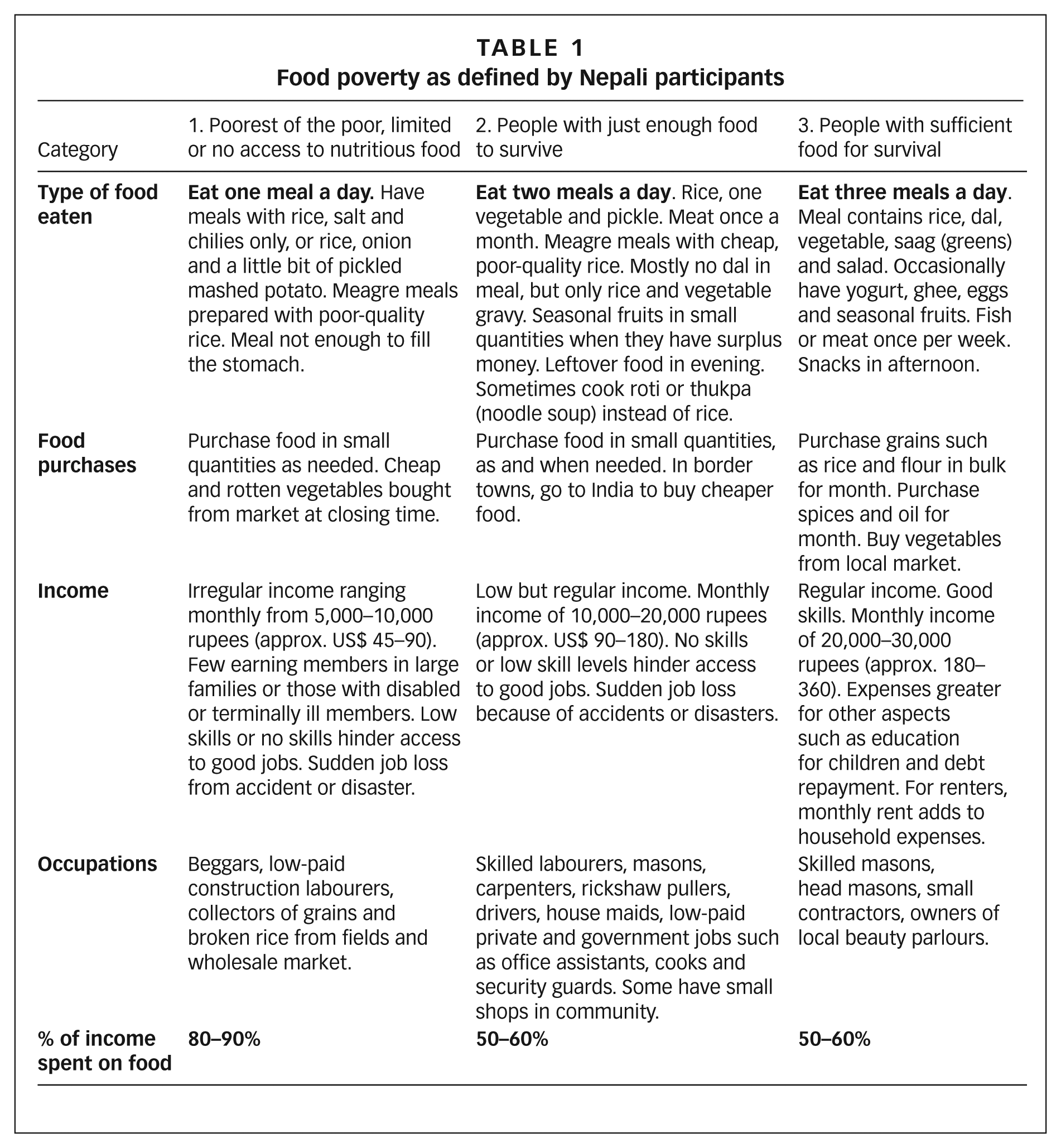
In all three categories, food is overwhelmingly the most substantial household expenditure, even with differences in the overall proportions. If there is a drop in income, people just go hungry. Such drops could be caused by factors within the household (the main earner falls ill, has an accident or cannot find work), or by external factors (disasters like the 2015 earthquake, or food cost increases). The poorest people are most heavily affected, but even people who are slightly more food secure are vulnerable to these shocks and stresses. Data from the small follow-up survey showed that all 28 respondents in Kalaiya regularly resort to lower-quality food. Perhaps more concerning is that in all but two of those households, women skip meals to feed their families, and even then, in all but four households, the whole family still goes hungry. For five of the families, this was a regular occurrence. In Birgunj, women in 10 of the 25 households interviewed regularly skip meals, and in 11 of them, the whole family frequently skips meals. In the Kathmandu Valley, 36 of 50 respondents reported eating lower-quality food as a regular strategy, and women in 17 households often skip meals, but the whole family goes hungry in only 11 of the households.
b. Day-to-day fluctuations in food poverty in Cambodia
Discussions at the second national workshop in Cambodia also highlighted a key finding from the group meetings: most urban poor people do not fall into a single category of food poverty but move between categories, depending on fluctuating incomes and family circumstances. It was agreed that describing three types of “menus” – what people eat in one day – would be the best way to capture these variations. The menus are described in Box 1. Menu A describes days when people go hungry; Menu B describes days when people manage to fill their stomachs, but the quality of the food is not good; and Menu C describes good days when both quantity and quality are sufficient. It is important to note that all three menus are modest. For the Cambodian urban poor, even the best menu is quite basic, inexpensive and nutritionally minimal, but even so, it is a menu that few can afford to eat every day.
The three Cambodian menus
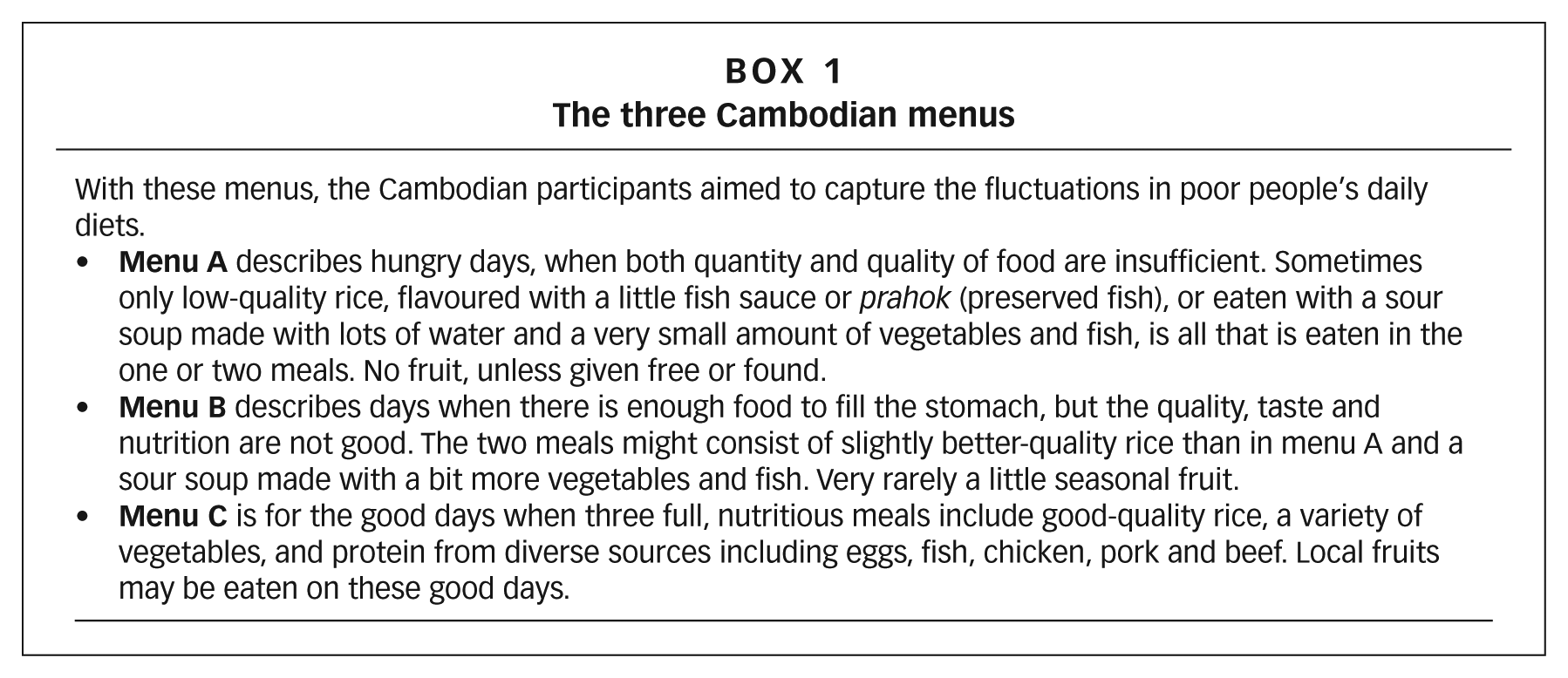
The small follow-up survey asked people how often in the last 30 days they had eaten each of the three menus. Of the 80 respondents, 32 ate reasonably well; 12 had Menu C more than 15 days and no days with Menu A. Another 20 ate fairly well – fewer than 15 days on Menu C but no days on Menu A. The remaining 48 ate poorly or were hungry: 18 people had Menu A up to 7 days out of 30, 12 had Menu A up to 15 days and 18 went hungry on a regular basis, eating Menu A for 15 to 30 days. In the secondary town, Neak Loeung, 28 respondents out of 40 (70 per cent) ate poorly or went hungry, compared to 20 respondents out of 40 (50 per cent) in Phnom Penh.
As mentioned earlier, the small survey sample was not meant to be representative, but to validate findings from the group discussions. It confirms that food poverty is a crucial challenge in Cambodia’s urban centres and perhaps especially in smaller ones.
VI. Why is it so Hard for the Urban Poor to Eat Well, and How do they Respond?
Low and irregular incomes, combined with high food costs, are among the root causes of food poverty. But other causes, touching on different dimensions of urban poverty, include food safety; insufficient public safety nets; the impacts of human-made and natural disasters; and the burden of indebtedness. These factors put additional pressure on the already stretched lives, energies and economies of the urban poor. At the same time, enormous creativity and solidarity in poor families and communities underpin the numerous, diverse strategies that even the poorest rely on to ensure there is something to eat.
a. Cost and quality of food
In Nepal, the high cost of food was bemoaned in all group discussions. In Birgunj and Kalaiya, people often cross the border to buy cheaper food in India, and for some young people, smuggling food has become a job. In Kathmandu, descriptions of a decline in the country’s agricultural production were widespread. One woman with a stall in the wholesale vegetable market works closely with farmers. She attributes this decline to the high cost of agricultural inputs, water shortages and changes in land use, with agricultural land being sold and held for speculation or developed for residential and infrastructure uses. In both Nepal and Cambodia, cheap food imported from larger neighbouring countries undermines local farming and food production.
One consequence of the transformations in food production is food safety. In almost every discussion, participants mentioned the toxic levels of chemicals in most of the fresh produce they buy – a major worry and a source of illness and poor health in their communities. In Cambodia, where flooding was severe during the fieldwork, several people prefer to forage for vegetables growing in areas flooded with polluted water rather than buy pesticide-laced vegetables in the market. Food safety is an increasingly hot issue in Asia, but for the urban poor, who have little land to grow their own and cannot afford organic produce, there is little choice. The main strategy to mitigate the possible harm is to soak and wash vegetables several times in clean water, sometimes adding salt, bicarbonate of soda or vinegar. This puts even more demands on the time and energy of women who cook the meals, especially where access to clean water means carrying buckets from a communal water pump.
“We are all worried about chemicals on the vegetables and in meat. We know they are in everything and that there is danger for us. But what can we do? We can’t live without food. We have no space for growing our own vegetables. So we have to buy from the market, and clean everything as best we can.” (Menuka, Jagritinagar community, Kathmandu, Nepal)
b. Insufficient public safety nets
In Nepal, the government provides a monthly pension of 2,000 rupees (US$ 20) to elderly citizens. But several women who receive this complained that it is not sufficient to cover health costs and ensure a good diet at the same time. In Cambodia there is no welfare safety net, but the government’s “Poor ID” programme gives a limited number of poor people access to free or discounted medical treatment. In many cases, though, the benefit is left unused because the poor cannot afford the cost of transport to far-away hospitals and health centres or sacrifice a day’s earnings to wait to see doctors. In households with already stretched budgets, meagre earnings can make a difference between eating and going hungry. Lack of food means that family members – especially the most vulnerable children and the elderly – are more likely to suffer from ill health. This creates a vicious circle that highlights how ignoring the links between nutrition and health can undermine efforts to design or improve public safety nets.
“Our families here are quite big, and many have only one member working. That means most of our earnings go to food – there’s nothing left for health care or other things. We sometimes joke that if somebody gets sick and has no money to buy medicines, they just go straight to heaven.” (Kamala Devi, Shanti Tole community, Birgunj, Nepal)
c. The impact of natural and human-made disasters on food
In both countries, communities were experiencing the immediate or after-effects of disasters such as the 2015 earthquake in the Kathmandu Valley and floods in Phnom Penh and Neak Loeung. In almost all these communities the crises had made people poorer and compromised their ability to eat well. The semi-rural Newari communities hit by the earthquake had for centuries produced almost everything they needed, including food. After the quake, for lack of cash or access to loans, many families had to sell farmland to raise money to rebuild their houses. More farmland is in danger of being expropriated for government transport projects or swallowed up by urbanization in the Kathmandu Valley. Floods in Phnom Penh and Neak Loeung are becoming more frequent and more severe. People take them in their stride, moving to second floors or cooking on raised platforms in their flooded rooms. But their ability to earn drops drastically, food prices soar, the scope for foraging for free food is curtailed, water-borne illnesses become endemic, and hunger swells.
“This year the house was flooded inside for two months, and we had to sleep, cook and eat on the krey [elevated wooden platform] to stay out of the water. Cooking was difficult in that small space, but we had no choice, and the kids helped. The flood didn’t really change what we cook, but it did lower our incomes, so we couldn’t buy such good food – sometimes only a little dried fish and rice.” (Roky, Nesarth riverside community, Phnom Penh, Cambodia)
d. The pervasive impact of debt
Almost everyone in the group discussions in both countries is deeply in debt. After food, the largest portion of household income goes into repaying multiple debts from different credit sources – community savings groups, informal money lenders and microfinance companies that are now big business in both countries. Because repayment terms and interest rates on loans are all different, many of the women have become adept at juggling debts, taking a loan from one source to repay another. But between the high cost of borrowing and the fundamental fact of incomes being lower than expenditure, the debts only keep mounting. Sometimes these are passed on, like a form of perpetual bondage, to daughters or daughters-in-law when someone stops earning or dies. For the poorest women who do not qualify for loans from the microfinance companies (at 24–30 per cent interest), or who have borrowed the maximum from their savings groups or cooperatives (at 8–18 per cent interest), the informal money lenders (who charge 70–200 per cent interest) are the only option, and many described using them frequently. Often this is to borrow very small amounts frequently, to meet daily needs or buy food on days when they cannot earn.
“I borrowed 100,000 rupees from the cooperative for my son’s education and marriage, 100,000 rupees from the money lender in many small loans to buy food and 70,000 rupees from a microcredit company when my husband got sick. I have been repaying these loans for years, and expect I will keep paying them as long as I’m alive. Then my daughter-in-law will have to take over the debts.” (Nagiya Devi, Bhagwati Tole community, Birgunj, Nepal)
e. Accessing affordable food: Poverty penalty or a food-on-credit support system?
For the majority of the urban poor in both Nepal and Cambodia, the main source of cooking ingredients is small shops located within or nearby the settlements. In Cambodia, “500-riel” shops package and sell most Khmer cooking essentials in quantities small enough to be affordable to poor daily earners. Almost everything in the little packets of cooking oil, peanuts, salt, tamarind, sugar and fish sauce – even shampoo and washing powder – costs 500 riels (US$ 0.13). This can be significantly higher than the per-unit cost of larger quantities sold in markets and grocery stores. For example, sugar costs twice as much and MSG, an essential ingredient, costs 60 per cent more; other ingredients, however, have lower markups. In Nepal, small local shops, also the main source of food, typically charge 5–10 rupees (US$ 0.10) more per kilo than larger shops. These shops, often run by residents of the low-income settlements they serve, are easily accessible and offer credit to regular customers with repayment delays ranging from three–five days (in Cambodia) to monthly (in Nepal). Without these shops, it is likely that the poorest would go hungry much more often. Some of the head basket vendors and bicycle vendors in Cambodia also give credit to their poorest customers, even though their margins are so small that late repayments could quickly compromise their own survival.
“All the women here buy all their cooking essentials in 500-riel packets from the local shops or buy a little fish or pork from the moto-seller who comes to the community every day. I never go to the main market because I have to pay to take a moto there and back.” (Ngung Yong, Poi Chai School community, Neak Loeung, Cambodia)
f. The multiple strategies the urban poor use to feed themselves
While borrowing and buying on credit are common ways to keep eating during hard times, the poor also employ a variety of cooking strategies to stretch meagre ingredients and make poor-quality food more tasty. When they cannot afford dal or more varied vegetables and protein, women in the Kathmandu Valley prepare bhyata ken – cheap vegetables stewed with lots of water and a little cornflour – to accompany rice. In Cambodia, when earnings are low, the staple rice is eaten with a traditional sour soup that can be tasty even with more water and less protein and vegetables. And when even a watery soup is out of reach, a little fish sauce or prahok (preserved fish) can do. In both countries, cooking in situations of extreme insufficiency draws on traditions steeped in a long history of poverty and scarcity. But there are also innovations, such as the use of pressure cookers to cut cooking time and save on fuel, found in even the poorest kitchens in the Kathmandu Valley.
Sharing is another crucial strategy for stretching what is never enough food. In Cambodia, the poorest people are often helped by neighbours who invite them to share their meal, or send them bowls of rice, extra soup or fruits. In Nepal, religious festivals are frequent. These can be a strain on family resources and the women who must cook special dishes for large numbers of relatives and visitors. But those who are visited also pay visits, and the burdens are reciprocal. And when there is not enough food in the house, people can go and visit relatives and be assured of being well fed. Such systems of reciprocity are important for sharing what little food is available. Sharing can also work as a rationing system, in cultures where the customs call upon people to look out for each other and take only their rightful share from the common dishes. As Mary, a poor fisherwoman in Phnom Penh, poignantly observed, “It’s funny, if we all eat together, the amount I cook is always enough. But if we eat separately, it’s never enough!”
In Nepal, mothers often eat only after serving their families, to make sure everyone eats well. When food is scarce, women make do with paltry leftovers or skip meals entirely, especially in the poorer terai settlements, where traditional caste-driven gender roles are stricter than in Kathmandu.
VII. Conclusions
This study contributes to mainstream debates on urban poverty and food security by highlighting the extraordinary resilience of urban poor women and their ability to stretch meagre budgets to make sure there is something to eat – even though sometimes this is not enough. The poverty study that preceded this food study indicated that access to adequate diets is a major challenge for low-income communities in Asia. What this study has made clear is how hungry the urban poor are, especially in the smaller urban centres where incomes are lower and opportunities fewer than in the capital cities. But as with poverty, there are also great variations and fluctuations in the levels and frequency of food insecurity and hunger that can only be understood by taking into account circumstances at the household and community levels, as well as the larger city and national contexts. This includes the growing concern around food safety, which, together with ever-increasing prices, puts additional pressure on the ability of the urban poor to properly feed themselves.
This food study was planned as an action research project, with the idea that the knowledge it produces will enable urban poor community networks in Cambodia and Nepal to sharpen their understanding of their food security problems and plan their own collective initiatives to address them, at community and city levels. The community networks in these countries have a history spanning three decades of understanding problems by taking action to make things better. Their response to a lack of money has been to set up collective savings groups and establish their own cooperatives and city funds. Their response to problems of squatting in bad and insecure conditions has been to form networks in their cities, survey their housing problems, identify possible land, cultivate partnerships with helpers, and start negotiating for land and finance to build their own secure housing. In the same way, their problems with food and nutrition have made many of the community leaders itch to take some kind of action to make things better.
Across Thailand, community-driven food production has become a major agenda of urban poor community networks. After the groups from Cambodia and Nepal visited the “Green Community Healthy Food Production” projects in Thailand, several went back home and encouraged their communities to start planting vegetable gardens on small pieces of land in and around their communities – even in recycled water bottles and tyres. Herbs and vegetables from these micro-gardens are already going into soups and curries. In the Pro Lay Toek community in Neak Loeung, eight families have joined together to make a community garden on a patch of vacant land, which is already yielding chemical-free leafy green vegetables and bitter gourds. Several other families have started “condo-style” vegetable gardens in pots and recycled water bottles on makeshift shelves in the small spaces in front of their houses. In Kathmandu and Kalaiya, several communities are working with a local NGO to learn how to cultivate organic vegetables in roof gardens and in small spaces within communities. As Mae Sanong, one of the senior community leaders in Thailand, told a group from Cambodia: “We poor people may feel that there is little we can do to eat better, except to make more money to buy better food. But that’s not true. There is a lot we can do to produce our own healthy food, even in crowded urban communities. And food is another issue – like housing or land or finance – that we can use to make ourselves, our communities and our networks stronger.”
Footnotes
Funding
This article is part of the research project “How the urban poor define and measure food security in Cambodia and Nepal”, funded by the UK Economic and Social Research Council-Department for International Development (ESRC-DFID) Development Frontiers Research Fund 2016-17, Research Grant Proposal: ES/R002592/1. The support of the ESRC is gratefully acknowledged.
1.
Kimani-Murage, E W, S K Muthuri, S O Oti, M K Mutua, S van de Vijver and C Kyobutungi (2015), “Evidence of a double burden of malnutrition in urban poor settings in Nairobi, Kenya”, PLOS One Vol 10, No 6, 17 pages.
2.
Ruel, M T, J Garrett, S Yosef and M Olivier (2017), “Urbanization, food security and nutrition”, in Nutrition and Health in a Developing World, Humana Press, Cham, pages 705–735.
3.
Boonyabancha, S and T Kerr (2015), “How urban community leaders define and measure poverty”, Environment and Urbanization Vol 27, No 2, pages 605–620; also  , Housing by People in Asia: Special Issue on How Poor People Set Their Own Poverty Lines, Asian Coalition for Housing Rights, Bangkok.
4.
The term “slum” usually has derogatory connotations and can suggest that a settlement needs replacement or can legitimate the eviction of its residents. However, it is a difficult term to avoid for at least three reasons. First, some networks of neighbourhood organizations choose to identify themselves with a positive use of the term, partly to neutralize these negative connotations; one of the most successful is the National Slum Dwellers Federation in India. Second, the only global estimates for housing deficiencies, collected by the United Nations, are for what they term “slums”. And third, in some nations, there are advantages for residents of informal settlements if their settlement is recognized officially as a “slum”; indeed, the residents may lobby to get their settlement classified as a “notified slum”. Where the term is used in this journal, it refers to settlements characterized by at least some of the following features: a lack of formal recognition on the part of local government of the settlement and its residents; the absence of secure tenure for residents; inadequacies in provision for infrastructure and services; overcrowded and sub-standard dwellings; and location on land less than suitable for occupation. For a discussion of more precise ways to classify the range of housing sub-markets through which those with limited incomes buy, rent or build accommodation, see Environment and Urbanization Vol 1, No 2 (1989), available at .
5.
In Cambodia, the food study was carried out by the Community Savings Network Cambodia (CSNC), a national network of community-based savings and credit groups in 40 cities, and its support NGO, the Community Development Foundation (CDF). In Nepal, the study was carried out by a team that included Lumanti, a Kathmandu-based NGO; the Community Women’s Forum (CWF), a national network of city-based women’s savings cooperatives; Mahila Ekta Samaj, a national federation of urban poor women working on savings and credit, water and sanitation, land tenure and income generation; and the Urban Poor Empowerment Society (UPES), a group of educated youth from the local poor communities in Birgunj and Kalaiya who have formed their own organization to support the community processes there, in close collaboration with Lumanti and CWF.
6.
Muungano Support Trust, SDI, University of Nairobi, Dept of Urban and Regional Planning, University of California, Berkeley and Dept of City and Regional Planning (2012), Mathare Zonal Plan, Nairobi, Kenya: Collaborative Plan for Informal Settlement Upgrading, Nairobi.
7.
Prain, G (2010), “Effects of the global financial crisis on the food security of poor urban households: synthesis report on 5 city case studies”, RUAF Foundation, Leusden.
8.
Crush, J and B Frayne (2010), “Pathways to insecurity: food supply and access in Southern African cities”, Urban Food Security Series 3, Queen’s University and African Food Security Network, Kingston and Cape Town.
9.
Heltberg, R, N Hossain and A Reva (2012), Living Through Crises: How the Food, Fuel, and Financial Shocks Affect the Poor, World Bank, Washington, DC.
10.
Chen, M, S Roever and C Skinner (2016), “Editorial: Urban livelihoods: reframing theory and policy”, Environment and Urbanization Vol 28, No 2, pages 331–342.
11.
Cohen, M and J L Garrett (2010), “The food price crisis and urban food (in)security”, Environment and Urbanization Vol 22, No 2, pages 467–482.
12.
Battersby, J (2012), “Urban food security and climate change: a system of flows”, in B Frayne, C Moser and G Ziervogel (editors), Climate Change, Assets and Food Security in Southern Africa, Earthscan, London and Sterling; also Sabry, S (2009), “Poverty lines in Greater Cairo: underestimating and misrepresenting poverty”, Poverty Reduction in Urban Areas Working Paper 21, International Institute for Environment and Development, London.
13.
Rengasamy, S, J Devavaram, T Marirajan, N Ramavel, K Rajadurai, M Karuranidhi and N Rajendra Prasad (2001), “Farmers’ markets in Tamil Nadu: increasing options for rural producers, improving access for urban consumers”, Working Paper on Rural-Urban Interactions and Livelihood Strategies 8, International Institute for Environment and Development, London.
14.
Tacoli, C, G McGranahan and D Satterthwaite (2015), “Urbanisation, rural-urban migration and urban poverty”, International Institute for Environment and Development and International Organization for Migration, London and Geneva.
15.
Tacoli, C with B Bukhari and S Fisher (2013), “Urban poverty, food security and climate change”, Rural-Urban Interactions and Livelihood Strategies working paper, International Institute for Environment and Development, London.
16.
Beukes, A (2015), “Making the invisible visible: generating data on ‘slums’ at local, city and global scales”, Human Settlements working paper, International Institute for Environment and Development, London.
17.
Since 2013, the Green Community Healthy Food Production Programme has provided small grants, training and support to urban poor communities in Thailand to grow safe, healthy, organic vegetables and fruits in the small spaces and common land around their houses. The programme is managed entirely by the national network of urban poor communities, with modest grant support from the Thai Health Promotion Foundation and the Community Organizations Development Institute (CODI). Over 700 poor communities, in 70 cities (and a few rural areas also), are now working with their community networks and local governments to survey local food security problems and needs, develop citywide strategies to incorporate the growing of healthy fruits, vegetables and other foods in poor communities, and promote greater self-sufficiency in food production.