




Abstract
This paper describes how urban poor community leaders in six nations (Cambodia, Nepal, the Philippines, Sri Lanka, Thailand and Vietnam) worked together to define poverty, assess its causes, and suggest how best to measure it and address it. Their work drew on over a thousand detailed household expenditure surveys from different settlements in a range of cities in the six nations. Five distinct groups could be distinguished among these urban poor households, and the work suggested that two poverty lines were needed. The community leaders also reviewed national and international poverty lines and found these to be incompatible with reality, especially the US$ 1.25/person/day poverty line. The paper draws some conclusions and describes plans for the country teams to further this work, including engaging with their national governments over the definition and measurement of urban poverty.
Keywords
I. Introduction
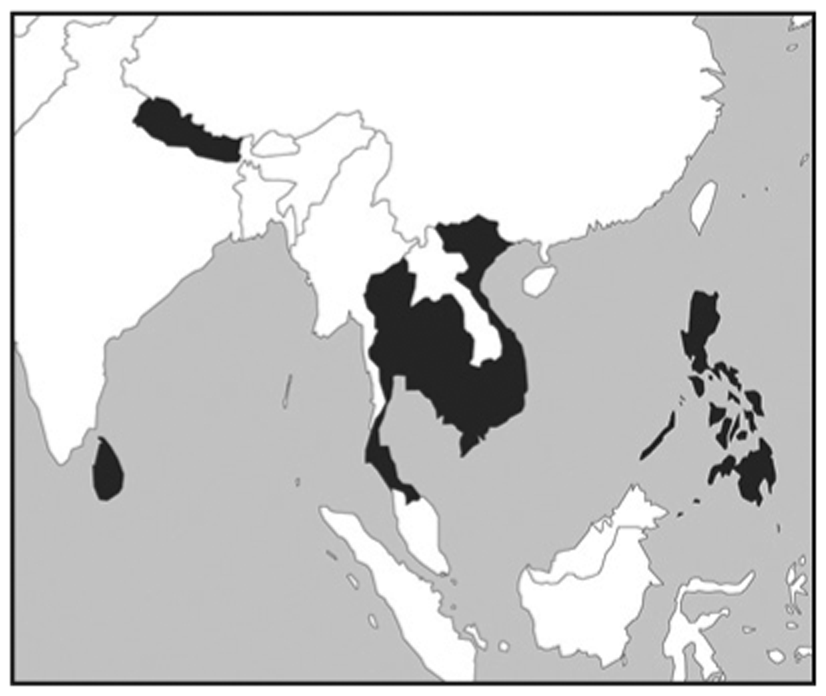
This paper presents an unconventional way of defining and measuring urban poverty – by engaging with the urban poor themselves on their perceptions of poverty and its causes, and how to measure and address it. It draws on the work of six country teams from Cambodia, Nepal, the Philippines, Sri Lanka, Thailand and Vietnam, made up of active leaders in their community movements. Many of these community leaders are veterans of bitter struggles against eviction and difficult negotiations for land or land tenure. Many have also been engaged in complex housing projects that transformed their settlements from illegal slums(1) to healthy and secure neighbourhoods whose residents now enjoy full citizenship.(2) This initiative was organized by the Asian Coalition for Housing Rights (ACHR), building on its work over the last 28 years, and on the networks or federations of slum/shack/urban poor groups across Asia with which they work. Some of their methods were conventional – for instance, interviewing a range of low-income households from different cities and different types of settlements about their expenditures. But this was supplemented and supported by intense group discussions within each nation and at two regional workshops. This may not sound so different from the participatory assessments that are frequently a component within national and World Bank poverty assessments. But what is different is that each national process was designed by organized groups of urban poor with years of experience in data collection.
The following sections describe the study, the many dimensions of urban poverty that the country teams identified, and the agreement that two poverty lines were needed and how they were set. The paper then goes on to discuss what makes people poor, how the country teams chose to define and set poverty lines, how they assessed the validity of the US$ 1.25-a-day poverty line, why they feel that the poor should be engaged in defining and measuring poverty, and what they prioritize for poverty reduction. It closes with some conclusions and discussion of the further work planned.
II. How the Study was Organized
Collecting data has been an important part of ACHR’s work with the networks and federations of urban poor grassroots organizations in different Asian nations – both as the basis for action and to draw in local government.(3) From this came the idea of asking these organizations to consider how poverty should be measured.
The first step was to circulate a note within the ACHR network asking who was interested and whether they would like to join the poverty study. Community networks in six countries agreed to take part and the ACHR secretariat sent them some key questions to guide their discussions and catalyse their planning process:
How do you define poverty and decide who is poor in your cities and country?
What are the different aspects of poverty, besides inadequate income and nutrition?
What are the different levels of poverty and how do you characterize those levels?
How do people in these various categories of poverty survive?
What does a person need to live a sufficient life, and how much does this cost?
How can the problems of poverty in your country be solved?
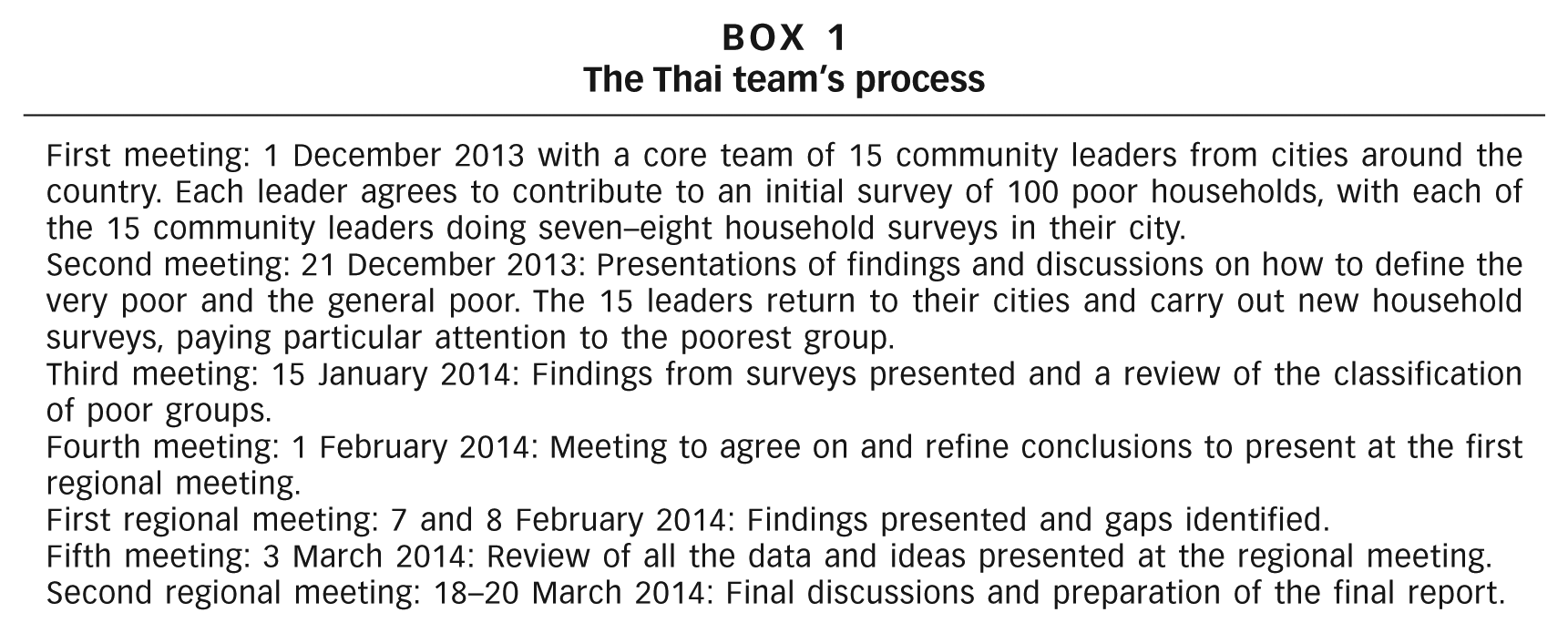
Each country team, made up of community leaders who knew from experience what it meant to survive with very little money or security, began with meetings and group discussions at city and national levels and then undertook household surveys to test the validity of the conclusions from the group discussions. Box 1 gives an example of this in outlining the Thai team’s process.
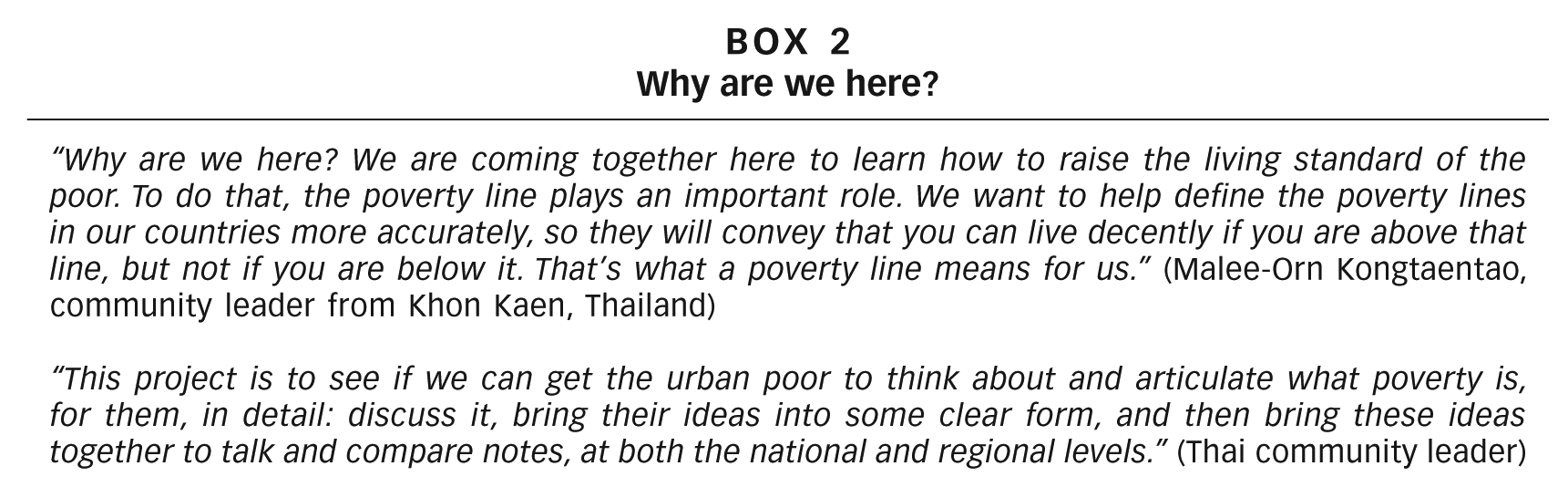
All six teams came to the first regional workshop in Khon Kaen, Thailand in February 2014 to present their initial findings, discuss the definition and measurement of poverty, and clarify the information they would need to gather (Box 2). This gave everyone a clearer sense of the study’s objectives, and how they could use the poverty line issue to strengthen their work and secure a larger and more significant political space for their role in reducing poverty. At this workshop, the teams emphasized how much the actual expenses of poor people varied between households but also that many people were barely surviving. Everyone agreed they should calculate separate poverty lines for the extremely poor and the “ordinary” poor.
The plan was to base this on detailed data from household interviews on expenditures, income, housing conditions, access to basic services, legal status, social characteristics, and health and living conditions. A review of the data, especially on expenditures, would allow country teams to determine a reasonable minimum level of income and to assess the adequacy of national and international poverty lines against this. It would also allow them to specify poverty lines for the poor and the very poor for different household sizes. Since each team was undertaking surveys in different cities, this showed the differences between cities in incomes needed to avoid poverty.
The teams focused on expenditures rather than income in part because poor people’s income is irregular and expenditures can be more easily specified. As is widely recognized, households may be reluctant to answer questions on income. Moreover, expenditure is actual money spent while income indicates only the ability to spend. Expenditure is more regular, and can offer more detailed and specific descriptions of degrees of poverty and quality of life.
At first, all groups compiled their own list of common household expenses. But since many items were common to all the lists (like housing, food, water and basic services), they agreed during the Khon Kaen meeting to standardize the lists, allowing for comparisons between cities and nations.
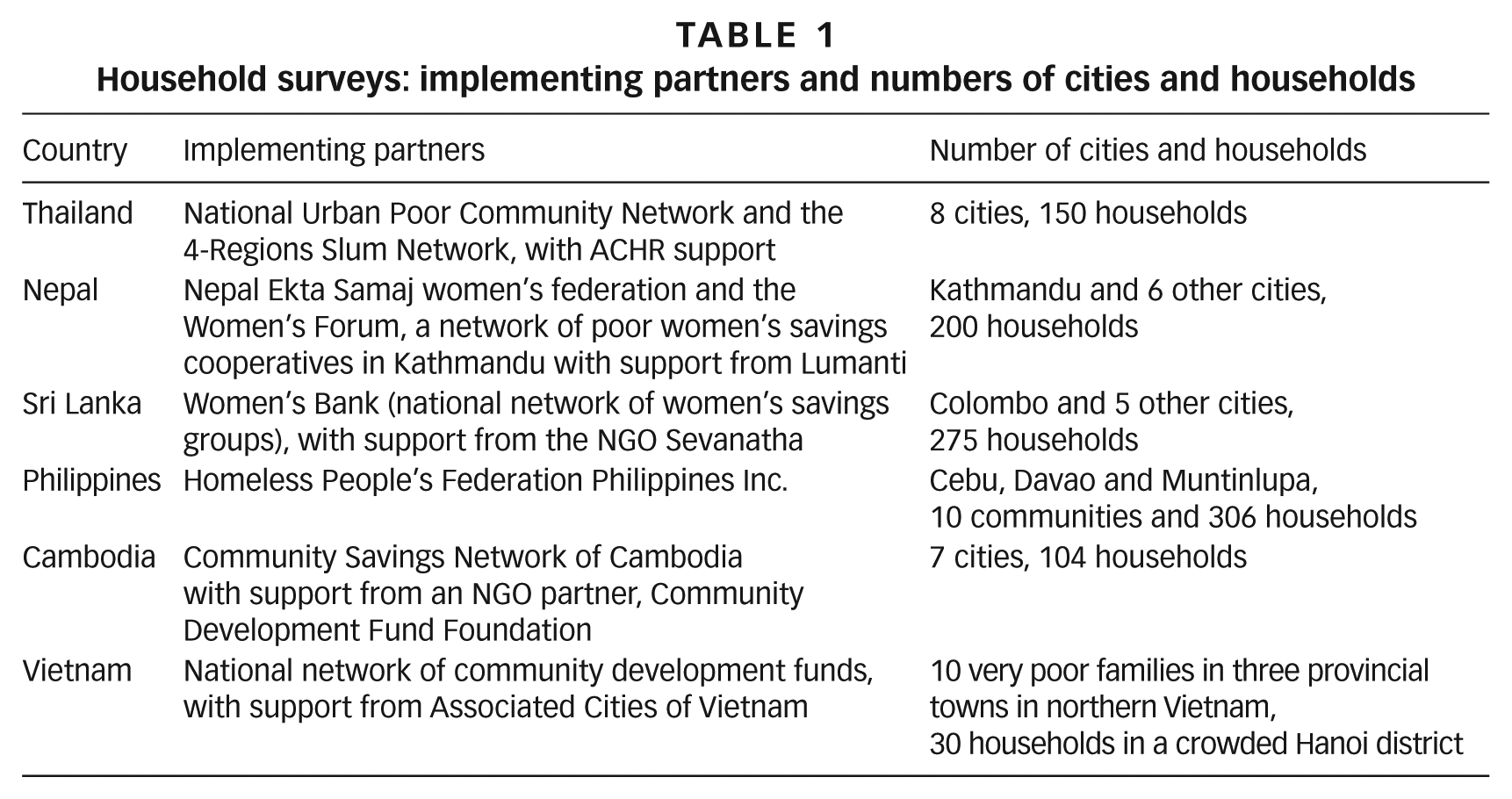
After the Khon Kaen meeting, the teams returned to their countries and organized more household interviews, group discussions and meetings (Table 1). Two women’s savings group leaders from the Sri Lanka team, for instance, organized a national meeting of Women’s Bank leaders to discuss the purpose of the study and how to conduct it. Workshops were held in the six countries to initiate the work and then household surveys were undertaken. Results were discussed at further city workshops and data gaps were identified and then filled, and each city prepared a summary of its findings, which were presented at a national meeting. The teams met again at the second regional workshop in Bangkok in March 2014, along with some ACHR professionals who had long worked on this issue. Discussions of findings and conclusions highlighted where data was lacking or incomplete, and on their return home, most teams carried out a last round of data gathering and discussions to finalize their conclusions.
Household surveys: implementing partners and numbers of cities and households
III. Urban Poverty has Many Dimensions
All six groups agreed that income is not the only way to define poverty. Deprivation takes many different forms; and different forms of disadvantage, often in combination, can cause people to become poor or poorer. According to Malee-Orn Kongtaentao, a community leader from a railway squatter settlement in Thailand:
“I don’t agree that poverty can only be judged by how much money a person earns or spends each day. Otherwise, why do so many people earn good money but continue to be poor? We have to think what causes poverty. It comes from many causes, not just one. We have to look at all those different factors and consider what effect they may have on how the poor live. The way governments draw the poverty line only by money is too narrow.”
However, work and income were at the top of all six groups’ concerns.
a. Work
The Thais noted that the poorest groups lack the education and skills essential for finding good work. They can find only irregular, insecure and low-paying jobs, and they fall deeper into the cycle of poverty. The Cambodians noted the lack of tools, equipment or credit to start small businesses. Poor-quality, overcrowded, dangerous living environments were highlighted by all groups. The Philippines study focused on the vulnerabilities of families living in “danger zones” along shorelines and roadsides, on steep hills, under traffic bridges and in flood-prone lowlands, where they face disasters both natural (like typhoons) and man-made (like pollution and eviction).
b. Living conditions
The Cambodians described the very poor living conditions in so many informal settlements. Clean drinking water is an expensive burden that the poor in all six countries have to bear. In Thailand, the poorest families depend on dirty canal or well water for bathing and washing their clothes. The Vietnamese team described families without legal access to metered electricity paying three or four times the municipal rates. The teams from the Philippines, Cambodia and Nepal listed problems from inadequate sanitation: open defecation, urinary tract and digestive diseases, and dangers of harassment or assault of women. Many teams highlighted the lack of drainage and garbage collection as sources of disease and pest infestations. The Thais held that the poor are less healthy, more prone to illness and more likely to die young. Almost every poor family has at least one member who is chronically sick or disabled and unable to work. In the Philippines, many of the poor cannot afford to buy medicines or bring their sick to the hospital. Some of the countries have subsidized or free government health care programmes, but for different reasons, many poor people cannot or do not access them.
c. Nutrition
The Cambodian team mentioned that food sold in informal and other low-income settlements is of much lower quality than in the higher-income areas of town, and when people do not get enough to eat, they are less able to work and earn. In Nepal, even the poorest in rural areas can grow some food to survive, but in the city, people have to buy everything.
d. Children and youth
In all six countries, public schools are officially free, but all the groups spoke about the hidden education costs: transport, informal payments to schools, uniforms, books and lunch money. Lacking money for these means many children cannot go to school, or only finish primary education.
e. Legal status
The teams confirmed that almost every aspect of poor people’s lives is illegal. Many squat illegally on someone else’s land; their houses, their service connections and their livelihoods are all illegal and substandard. In Thailand, many poor people have no ID cards, and so cannot access the public health care system or welfare programmes for the elderly or for people with disabilities. Without a legal address, they cannot register houses, which would allow them to vote, access municipal water and electricity, and enrol their children in public schools. Many teams described harassment of the poor in informal settlements by the police, coercion to pay bribes and denial of the protection of the law.
f. Transport
The Filipinos and the Cambodians highlighted the high costs of transport and the lack of attention to providing good-quality, low-cost public transport.
g. Insecure land and housing
The teams agreed that this is what most clearly separates the poor from the non-poor. Once even the poorest community gets secure land and decent housing, then health, income, jobs, education and status tend to improve. But even the most active, well-organized community cannot address its poverty without land security. Rupa Manel from Sri Lanka noted that the very poor have no land and have to rent a room in a slum or construct shelter on land belonging to someone else. They can be evicted anytime and their houses demolished by the police, so they have to start all over again. Kan Bolin from Cambodia noted that they can never dream of buying even a square inch in the city, and have to squat on vacant land along railway tracks, beside roads, or on the banks of rivers and canals. Janeth Bascon from the Philippines noted that the urban poor have to squat in all kinds of dangerous places, along shorelines and canals, under bridges and on steep slopes where they face the danger of floods and landslides. Paa Chan (Thailand) noted that very poor people who cannot afford a house of their own have to live with others, crowded into rented rooms, or squat under bridges or in the narrow space between buildings.
h. Political voice
All six teams spoke about the lack of political voice as a factor. Individuals and communities have no power to determine anything, to ask for anything or to change anything. Many described a strong, collective, proactive political voice for the poor as a key part of their solutions to poverty.
IV. Different Levels of Poverty
One of the most powerful findings came from the question: Who are the poor? In a world where poverty is often defined only by monetary poverty lines, the subtle and pragmatic ways in which poor people have begun to classify poverty and understand its gradations are a valuable contribution to our understanding. They also help us understand community organizations that need to find ways to bring everyone into their citywide development process. Even progressive formal housing and slum upgrading programmes have been unable to reach all the urban poor, especially those living outside established slum communities or too poor to take on housing or land loans. Likewise, community-based savings groups and microcredit programmes often fail to reach the poorest.
The poverty levels identified by the different teams were not the same, but there was enough common ground to suggest five levels (Figure 1).
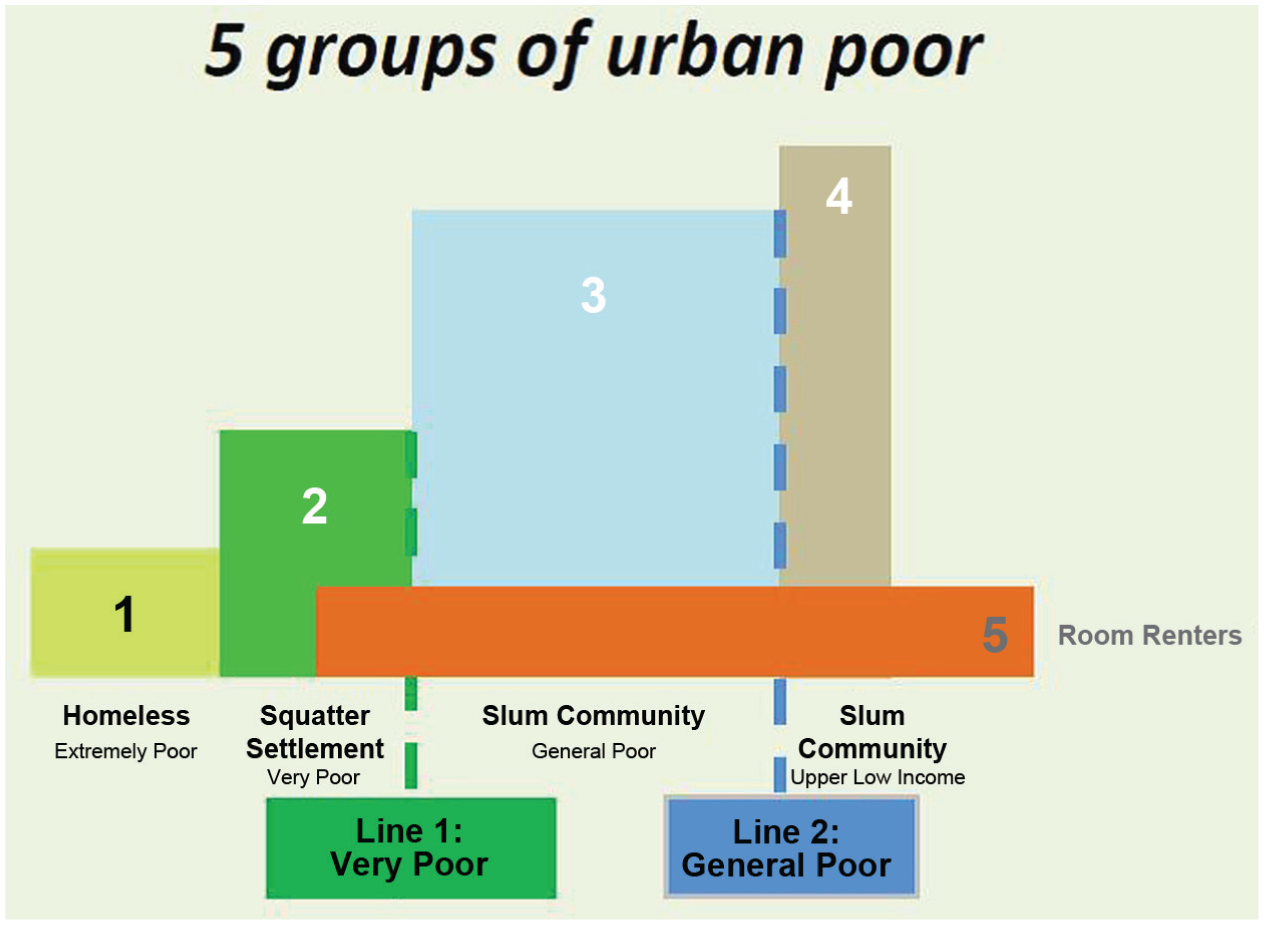
The five categories of “urban poor”
In Nepal, slums and squatter settlements used to be the main housing options for the urban poor, but as open space has undergone development, more and more poor migrants, vendors, daily wage labourers and scrap collectors have no choice but to move into cheap rental rooms. Urban growth makes it difficult to live in neighbourhoods on the urban periphery. Conditions are often much worse than in squatter settlements – with five to eight people sharing a single room with low-quality shared services and exploitative landlords, and without light, ventilation, privacy or the support systems of communities. About a third of the urban poor in the Kathmandu Valley are room renters.
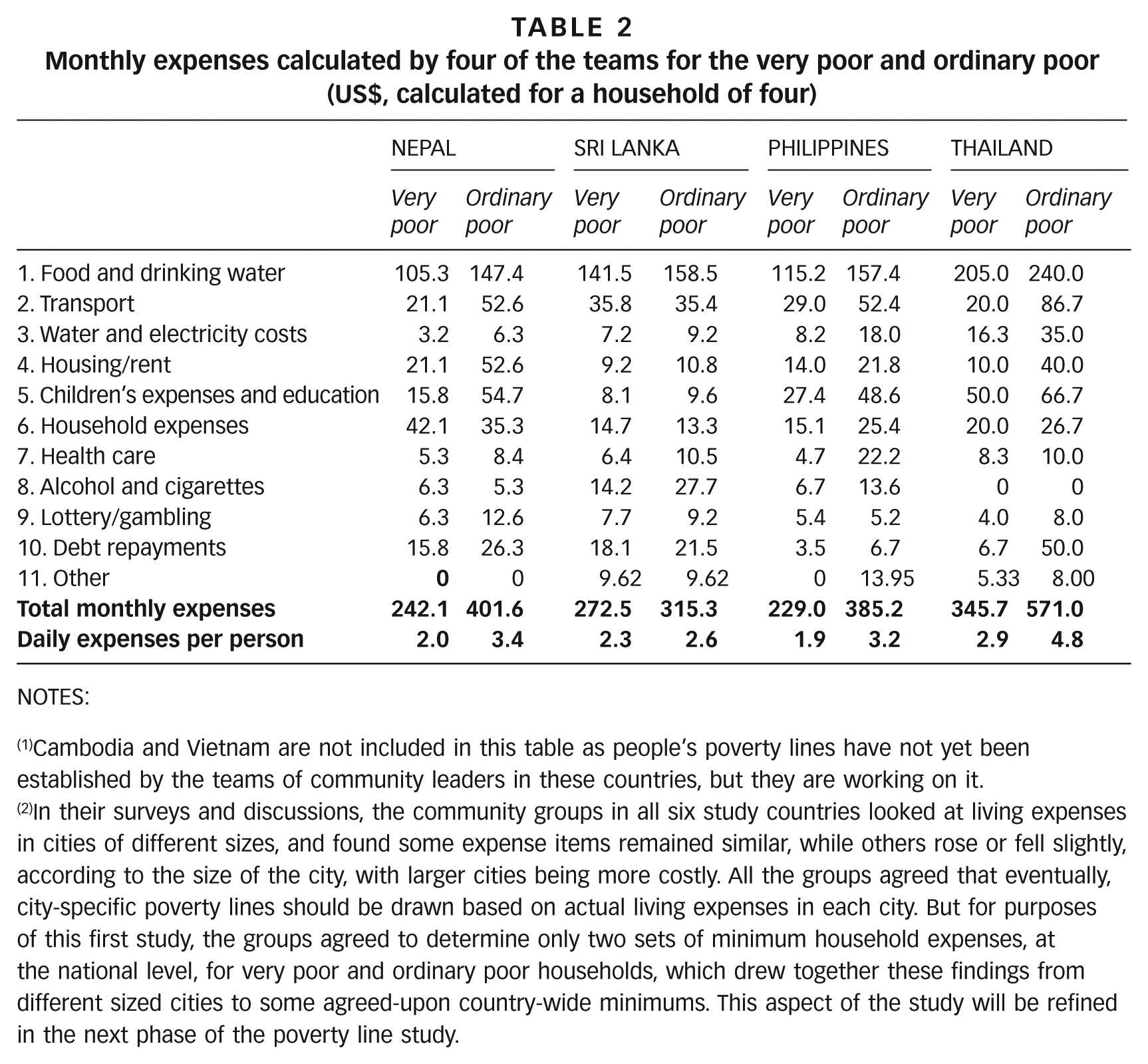
For all six country teams, the type of house (including both quality and level of security) was the most important factor in defining the level of a person’s poverty. The surveys reveal different expenditure patterns between the poorest two groups and the rest. The homeless have no housing expenditure, and the poor living under a bridge or in a small squatter settlement may sometimes make house repairs or pay to be allowed to stay where they are. Those living in a community need to pay a land lease or room rental or the cost of housing construction. So expenditure on housing varies from nothing to a significant proportion of a household’s expenditure. The costs of water and electricity also vary a lot. The poorest may depend on canal or well water. Those with secure tenure often get official connections that are cheaper than illegal connections or sharing with neighbours. In the Thai cities, costs for water and electricity can vary from 100 to 2,300 baht (US$ 3.1 to 71.3) per month (Table 2).
Monthly expenses calculated by four of the teams for the very poor and ordinary poor (US$, calculated for a household of four)
NOTES:
Cambodia and Vietnam are not included in this table as people’s poverty lines have not yet been established by the teams of community leaders in these countries, but they are working on it.
In their surveys and discussions, the community groups in all six study countries looked at living expenses in cities of different sizes, and found some expense items remained similar, while others rose or fell slightly, according to the size of the city, with larger cities being more costly. All the groups agreed that eventually, city-specific poverty lines should be drawn based on actual living expenses in each city. But for purposes of this first study, the groups agreed to determine only two sets of minimum household expenses, at the national level, for very poor and ordinary poor households, which drew together these findings from different sized cities to some agreed-upon country-wide minimums. This aspect of the study will be refined in the next phase of the poverty line study.
V. What Makes People Poor?
“Nobody in the world is born poor. Poverty is not something you are, but something that happens to you, because of certain factors or circumstances. Every human being is born full of possibilities, with their own uniqueness and brightness, and should be able to grow and find happiness. But those things can get blocked by causes that may be beyond a person’s control. That’s why we have also considered it important to discuss the causes of poverty in our study. What makes people poor? Why do some people become homeless? Why do others earn well, but remain poor and continue to live in bad conditions and insecurity? And what factors cause so many poor people to get caught in the cycle of poverty and be unable to escape?” (Malee-Orn Kongkaentao during the first regional workshop in Khon Kaen)
Discussions about the reasons for being disadvantaged highlighted nine factors.
a. Being born into a poor household
This bears disadvantages in relation to nutrition, health, education and opportunity.
b. Debt
The Thai team members emphasized how when they do not earn enough to meet their daily needs, they have to borrow. But with their irregular incomes and address in a slum, they cannot get a loan from a bank, so the only choice is moneylenders and borrowing at high interest. They noted how almost all poor people are in debt, and the poorer they are, the more likely they are to fall deeper into debt. Many who invest in trying different kinds of occupations find their debts accumulating if their businesses fail. Once in debt, it is very hard to escape this. Many take new loans from other informal sources to pay off older debts, while struggling to continue to make a living and support their families. In Thailand and the Philippines, many inherit their parents’ debts; they get caught in a cycle of debt and poverty that crosses generations, and they can never free themselves.
c. Ill health and accidents
The Vietnamese team noted how most poor families have at least one member who is sick or who has disabilities and can no longer earn. The Thais added that when the poor fall ill, they usually do not get proper treatment. So their health worsens, and soon they have to depend on their family and/or get into debt, which means the whole family gets poorer.
d. Large families
According to the Sri Lankan team, poor families are often larger than average and have fewer income earners but more dependents (including children, elderly and the disabled). The Thais gave the example of one family living in a squatter settlement in Nakhon Sawan, in which an elderly husband and wife earned their living by making flower garlands and selling them to passing cars. They were looking after the two grandchildren their daughter had left with them when she went to work in another city. The couple also had to feed their unemployed son-in-law, as well as a friend of their daughter’s who lived with them. The daughter sends home 1,000 baht (US$ 31) a month, to partly cover the children’s expenses. But even with that, they cannot feed everyone. They had to ask for food donations from the temple, and try growing some vegetables on vacant land nearby.
e. Disasters
These are becoming major causes of urban poverty in Asia – perhaps nowhere more so than in the Philippines through earthquakes, typhoons, floods, landslides and volcano eruptions. These disasters destroy people’s houses and livelihoods and have become very common. The impact is particularly felt by the poorest, who live in the most vulnerable and dangerous spots and cannot count on the government or charities for much help. But Thailand, Sri Lanka, Vietnam and Nepal are also countries with a long history of vulnerable communities being impoverished because of floods, storms, earthquakes, droughts, landslides and, for the first three countries, tsunamis. If the disaster itself does not make them poorer, the government policies to relocate them afterwards or take away their land often does.
f. Migration from rural poverty
Migration occurs for instance as growing numbers of farmers fall deeper into debt, because of high-input farming methods, fluctuating crop prices and unreliable weather. The Thai team noted how family-owned farms were getting smaller and fewer, as more land is owned by rich people, agribusinesses and speculators. Without land, rural people have to work as farm labourers, and as Malee-Orn described, “When you do that kind of work for years and years, your health goes down, you get old early and soon you can’t work anymore, but have no money to look after yourself.”
g. Evictions
The discussions emphasized how much evictions figure as a cause of poverty. As many Asian cities continue to grow rapidly, rapid development, real estate speculation, rapidly rising land values and urban infrastructure projects cause very large-scale displacement of poor people. It is now more common for evictions in Asia to be associated with some kind of resettlement, but there are still a few cases of brutal, old-style demolitions, where houses are bulldozed and families are left camping on the rubble, having lost everything. Even with resettlement, people have to start their lives again and often in worse circumstances than their original site as they are relocated far from their livelihoods and their social networks.
h. Laziness
During the meeting in Khon Kaen, the Vietnamese team included laziness as the last reason that people are poor. This provoked a lively debate including the following responses:
“I don’t agree with this word lazy. That is not our word. That is the word the authorities use when they look down on us and call us lazy and incapable of being helped. That’s their excuse for giving no support to the poor. The poor are not lazy! Hopelessness is not the same as laziness.” (Paa Chan Kaupijit) “Poor people are not lazy. But the formal system often makes poor people become passive…We believe that when people have hope and believe in themselves, they cannot be lazy.” (Paa Sanong Ruaisungnoen) “Most people in our societies do not have a positive view of our communities. They look at slums as warrens of drug dealers and users, criminals, thieves – and lazy people…But they take this view wrongly. People living in slums are just like other human beings, and all of them have the potential to change and progress. We have to believe that. When communities develop themselves, with certain practices and regulations, even the desperate and forgotten can change and can be among those becoming more secure, better off, with a bright future.” (Malee-Orn Kongkaentao)
i. Structural injustice
In their conclusions, the Thai team argued that poverty was rooted not in individual misfortune, but in deeply rooted social and structural injustices. Among the issues the team raised:
entitlements: Many poor people are denied the documents every citizen should receive, which allow them to access public entitlements like government health care, free education and access to basic services. Without these, the poor end up paying more for worse services.
budget allocations: Most government allocations are invested in promoting industry, business, tourism and economic development, which means their benefits go to the rich minority, not to the poor majority. When a few subsidies do reach the poor, these are said to be “Populist policies!”, “Vote buying!” or “A waste of taxpayers’ funds!”
education: Social, economic and bureaucratic obstacles restrict poor people’s access to education – even “free” public education. Only 2.3 per cent of Thailand’s urban poor complete high school, and fewer than 1 per cent complete a university degree.
jobs: Without education, skills or connections, the poor are closed out of well-paid jobs (in banking, finance management, hotels, tourism and electronics). Their only options are insecure, badly paid jobs at the bottom of the labour market (cleaning, daily wage labour, food vending, rickshaw pulling and trash recycling).
finance: Bank loans that allow middle-class families to educate their children, buy their houses and cars, and expand their businesses are closed to the poor, who are just as enterprising, but who do not have access to credit to improve their livelihoods and housing.
politics: As the Thai team put it, “Having no money means having no power. And having no power means having no say in anything and being unable to negotiate for the things we need.” Old systems of patronage politics also ensure the poor remain isolated and dependent petitioners and prevent them from organizing and participating in politics in any significant way.
legality: When the rich and powerful commit their crimes, they are seldom punished; when the poor, in their frustration and hopelessness, fall into gambling or addiction, society judges them harshly. Thai jails are mostly full of poor people.
VI. Defining and Setting Poverty Lines
A poverty line represents the income a person or household needs to meet minimum daily nutritional requirements and other basic human needs. If a person’s daily income (or share of the household’s income) is less than that amount, that person is considered to be below the poverty line and officially “poor”. Poverty lines are the main means by which governments and international agencies measure poverty and identify who is “poor”. They are also a potentially valuable tool for monitoring change in the proportion of a population that is “poor”. In almost all nations, poverty lines are used, influencing resource allocation. There are also global figures based on applying an identical poverty line to all locations in all nations that claim to show poverty trends.
But are poverty lines accurate? Set a poverty line low enough and no one is poor. Many studies show that the international US$ 1.25/person/day poverty line (intended to measure “extreme” poverty) and national poverty lines have been set unrealistically low for urban contexts. The lack of data on the cost of food and non-food needs, especially for those living in informal settlements, means that the poverty line may be inaccurate. The assumption that poverty lines are best defined and measured by experts, with no consultation with poor groups, is one reason why many poverty lines underestimate costs. Apparently low levels of urban poverty help explain the low priority given by governments and most international agencies to addressing urban poverty. Most governments in Asia still have few policies, programmes or mechanisms to deal with slums or urban poverty alleviation, and budget only meagre resources for these problems.
The appropriateness of these official poverty lines to urban contexts was raised in the 1990s, along with the importance of seeing and understanding the many dimensions of urban poverty.(4) The validity of the World Bank’s international poverty line, set at a dollar per person per day (later raised to US$ 1.25 a day) was questioned. So too were national poverty lines based primarily on food costs with crude adjustments for the non-food component of the line. The next step was to move into a real assessment of the costs of food eaten by the urban poor and also their non-food needs such as rent, transport, water, toilet use, health care, clothing and keeping children at school. This is still rare, however. Yet this need was identified by the six country teams. They chose to calculate more realistic poverty lines based on the actual costs poor people experience every day, in meeting their food and non-food needs. The teams also recognized the importance of having two poverty lines – one for the poorest (or those in extreme poverty) and one for what they termed the “ordinary” poor. The teams also highlighted the need for poverty lines to be set for each city since the costs of rent, food and transport in a mega-city like Bangkok are not the same as in a small town like Nakhon Sawan, also in Thailand.
VII. The US$ 1.25-A-Day Poverty Line
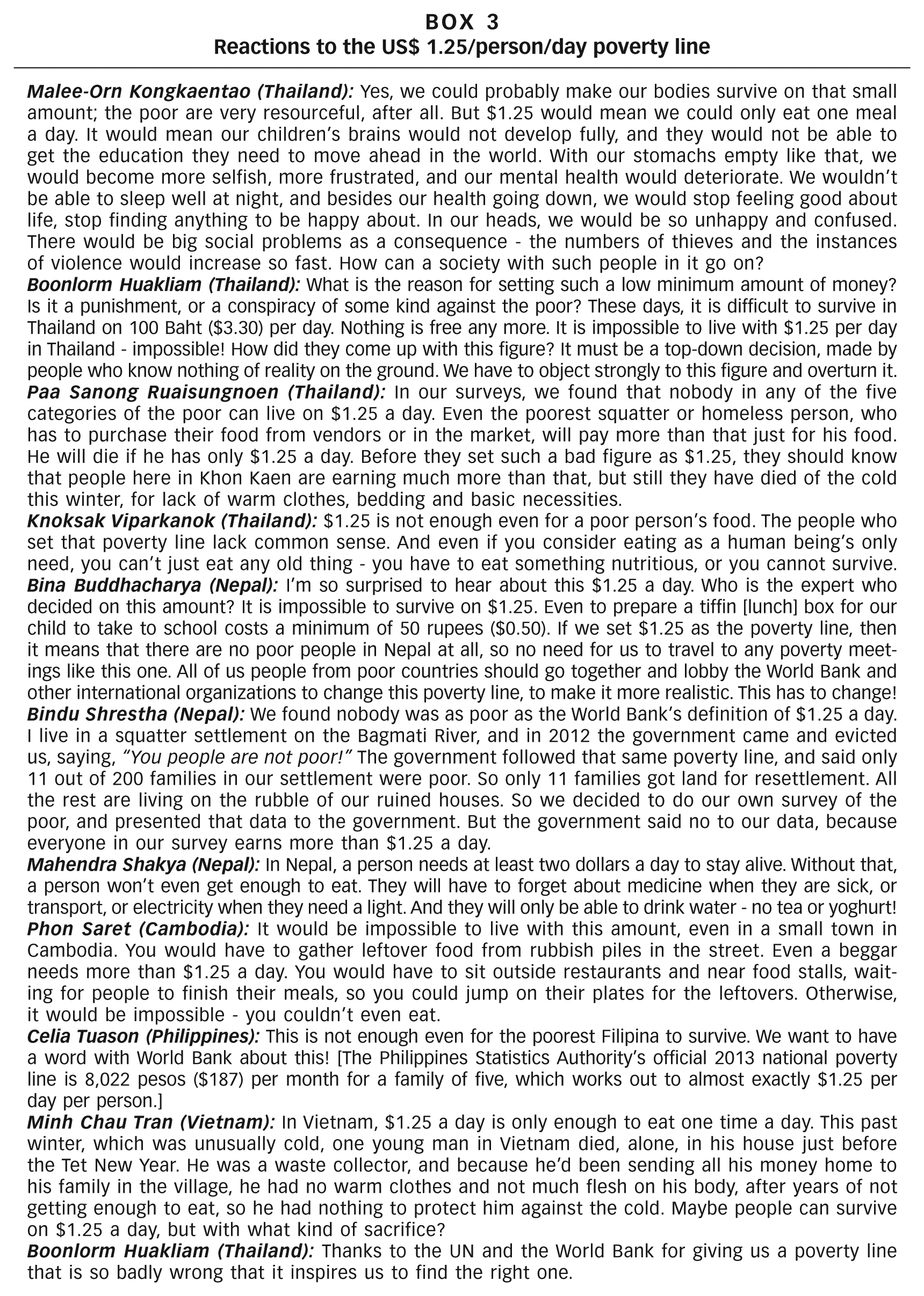
One of the liveliest discussions in Khon Kaen took place when the community leaders were asked, “What do you think of the World Bank’s standard US$ 1.25 a-day poverty line?” None of the groups taking part had ever heard of this poverty line, or knew it was being used in poverty policies and programmes around the world.
Everyone was shocked and angered when they learned of this figure and they could see no basis for it in relation to urban populations in the six countries. Box 3 gives their reactions to the US$ 1.25/day poverty line as it applies in their context.
VIII. Engaging Urban Poor Organizations in the Definition and Measurement of Urban Poverty
The urban poor are quite capable of reflecting on how to assess and measure poverty. Because their understanding of poverty is so detailed and so grounded in actual experience, their data and conclusions can be more accurate than those of outside experts who have never experienced poverty personally.
Paa Sanong Ruaisungnoen, a community network leader from Chum Phae in Thailand, put the challenge to her colleagues during the Khon Kaen workshop:
“We feel very discouraged when we learn about this US$ 1.25-a-day figure. Poverty should be defined by the poor themselves. We don’t want the World Bank telling us where our own poverty stops and starts. So I’d like to ask all of you to go back, survey, discuss and get all the figures so that you can determine the real poverty lines in your cities and countries. Try to get the best, most accurate data, so the evidence we show them is backed up with the truth on the ground. If we put the data from all of our countries together, we can make our case very strong for changing those wrong poverty figures. We’re not doing this work just to show the World Bank we know better. We believe the government should use our definition of poverty and our poverty line when they formulate their national policies and budgets.”
Some strong reasons that the urban poor should be involved in defining poverty lines were made clear in the discussions:
The poor know the truth about poverty best
“So many poverty studies are being done everywhere, all the time, but by people who have never been poor, never been evicted, never had to survive on earnings that are never enough. We have experienced all those things, and we know what poverty really means. We hope this study, by poor people themselves, comes closer to the truth. We can make our own poverty lines and set our minimum expenditure required to meet our various basic needs.” (Ruby Papeleras, Philippines)
It comes from reality
“We have come here to learn about the reality of poverty and describe it clearly. Whenever you learn about any issue from reality, that’s the best way to really understand it - better than all the books and all the theories. That’s the way to really touch the reality and to walk along that road towards solving these big problems.” (Malee-Orn Kongkaentao, Thailand)
The poor can get better-quality information
“We have been trusted to do this poverty study. When researchers do this kind of study, they look only at quantitative aspects. But community people can get the quality and the details. We know who the real poor are. In the Philippines, the numbers all show we have good economic development, but how is that growth being measured and defined? Most of it comes from infrastructure development, not from any social development, and poverty is not part of the picture at all. We can show clearly that we don’t have development on the ground, and we feel no improvement in our lives, even though we keep being told that our economic position is improving.” (Ruby Papeleras, Philippines)
The poor can pick up on cultural differences of poverty
“We cannot make a single definition of poverty - it will be different in each country, because those societies are different. So when we draw a poverty line, we have to consider the different ways people live, the different ways they relate to each other in different countries also. These are all things only those of us who live in those cultures can understand. We can’t draw one poverty line for every country - that is not possible and would not be sound.” (Thongmuan Pak-Kaete, Thailand)
Community-led understandings and definitions of poverty can strengthen communities
“We cannot wait for the government to understand what we need and help us. The poor have to start with ourselves. But we can show them clearly how the poor survive every day. When we study our own poverty, we have much clearer information when we go to negotiate with the government for anything.” (Phon Saret, Cambodia) “The poverty study has helped us expand membership in Women’s Bank savings groups and understand better how to bring more of the very poorest community members into the savings process.” (Rupa Manel, Sri Lanka) “Can we poor people define our own poverty and evaluate ourselves? Can we understand the reasons why we are poor? These facts have to come from us, and we have to study them together. If we have our own information about our basic needs and expenditure, we can respond to that US$ 1.25-a-day nonsense and say, here are the correct figures! We want to show the correct figures, and we are proud that we make these figures ourselves, from the reality of our lives.” (Paa Chan Kaupijit, Thailand)
Section II described how each country team interviewed a range of households in different cities in regard to their actual living expenses and agreed to apply the same list of expenditure categories. Table 2 shows their calculations, based on expenditures of an extreme poverty line of between US$ 1.91 (the Philippines) and US$ 2.88 (Thailand) per person per day. For Vietnam, the actual expenditures of the very poor were US$ 2.26–3.13, depending on the size of the household.
What is worth noting is that poverty lines based on the expenditure needed to avoid poverty for the four countries covered by Table 2 are well above US$ 1.25/day, even for the “very poor”. They are also well above the official poverty lines for their nations (Table 3).
Official vs. people’s poverty lines (US$/person/day) in six Asian countries
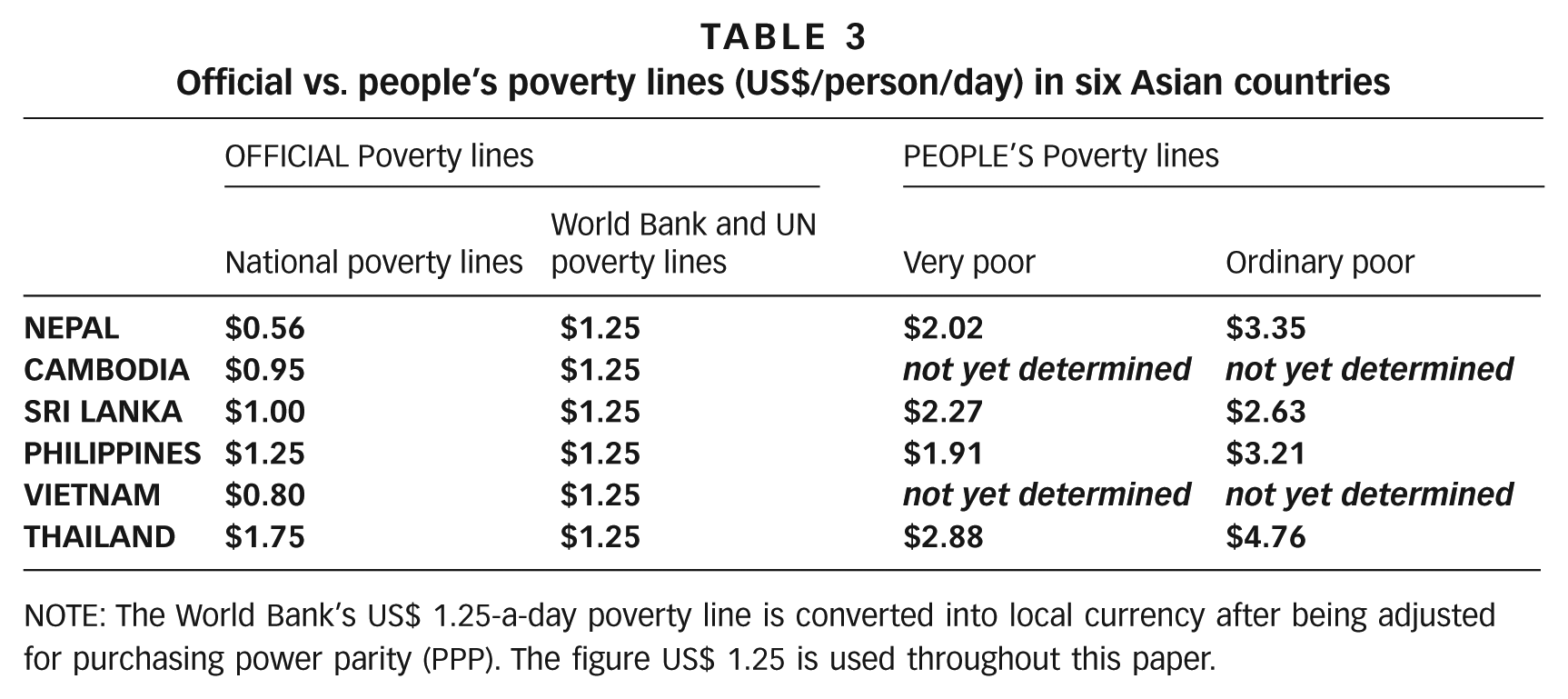
NOTE: The World Bank’s US$ 1.25-a-day poverty line is converted into local currency after being adjusted for purchasing power parity (PPP). The figure US$ 1.25 is used throughout this paper.
The teams also prepared detailed expenditure patterns for different cities that highlighted that the same poverty lines cannot be applied across a country. For instance, in Nepal, the living costs in Kathmandu and in tourist towns like Pokhara were much higher than in the smaller towns such as Birgunj or Dharan. Daily expenses per person varied from a high of US$ 2.12 in Kathmandu to a low of US$ 1.15 in Ratnanagar.
IX. Seven Ways to Address Poverty
After describing and discussing the problems of poverty, the teams started suggesting solutions. At the two regional meetings, the following approaches were highlighted.
a. Doing things ourselves
All six teams agreed that the greatest force to reduce poverty is the poor themselves. They have to become active and tackle their own problems. The teams described the people’s processes they were supporting, making citywide surveys and maps of informal settlements, setting up and supporting savings groups, building networks, identifying vacant land for housing, carrying out upgrading and housing projects, managing their own funds, and negotiating with the local authorities for land. So let the poor craft solutions themselves; do not disempower them with handouts. Their solutions resolve specific problems, but also have a political dimension: they bring the poor together, make them active, make them visible, and unlock their collective strength. They help create layers of political space for working with their cities and demonstrating their viability as development partners.
b. Collective community savings
This was a top priority for all six teams. Savings allow the poor to put their money together. They bring people in a community together, and build capital that allow them to decide things themselves, as a group. They allow poor communities to manage their money in flexible ways to address immediate needs, whether housing repairs, school fees, emergencies, health care, repayment of high-interest informal debts or loans to support small businesses. Savings also develop discipline in savings members and collective financial management skills, while building a collective financial resource for the poor, which they own and control themselves. They also establish a community’s “bankability” when larger amounts of credit are needed from formal institutions, for housing and land acquisition.
c. Information
Having accurate information about who the poor are and where they live is essential to solving poverty. Citywide surveys and slum mapping make the invisible visible; they link all poor groups in a city together and bring them into an active process of finding solutions to their housing and land problems – not just scattered individual projects. Surveys stimulate discussions among poor people from different parts of the city, and the data they collect becomes a common point for negotiations with their local authorities, who usually have no accurate information about the poor in the city.
d. Networks
Community networks are key to solving problems of poverty. As individuals, the poor have no power. Linked within their communities and citywide networks, they can do things they could never do alone. As Paa Sanong Ruaisungnoen put it, “We link with other communities to learn from each other, to strengthen ourselves, to organize ourselves and to move ahead together. If we don’t learn this basic lesson, the poor can never stand up and make our lives better. Once we know how to organize and to give to others, a new perspective opens up that will show us how to solve poverty.” Networks also broaden options by allowing poor people to learn from their peers through exchange visits to successful projects in other places. Community networks can also set up task forces to work on different city issues: housing, savings, welfare, infrastructure and land acquisition.
e. Land and housing
Secure land and housing is the main thing that separates the poor and the non-poor. All the groups agreed that planning for this is a crucial way out of poverty – searching and negotiating for vacant government land, saving for housing, developing their own affordable housing solutions, stockpiling building materials, and working with community architects to develop new housing layouts and on-site upgrading plans.
f. Negotiation
Having their own information, networks, savings and solutions strengthens the case of the poor when they negotiate with the government and the formal system for things like land, housing, access to public services, credit and other entitlements. They are also more likely to be taken seriously as viable development partners and to be successful in negotiating for what help they need to solve their poverty.
g. Partnerships
The factors that create poverty and keep people poor are embedded in larger political, economic and governance structures. So it is crucial that the poor carve out political space to negotiate with those structures. They can never develop lasting and large-scale solutions on their own. But if they can demonstrate to their local authorities and other key stakeholders what they are capable of, and can nurture working partnerships, it becomes more possible to negotiate for land, housing, and access to services, and to win support for their community-driven solutions. Cities are increasingly recognizing the poor as a problem-solving asset, not as a liability. From participation in solving problems of housing and poverty, the next step for the poor is participation in the larger city planning issues like climate change adaptation.
X. Conclusions and Next Steps
This is perhaps the first study conducted by the poor themselves on how poverty should be defined and measured, and it adds to the list of other poverty issues they have studied themselves. Besides generating clear definitions of poverty and detailed urban poverty lines, the study opened up a new area of exploration for these urban poor organizations, and a new focus of negotiation with their governments and local institutions.
This study, with over a thousand household surveys, has some characteristics of a conventional research study. The methodology was designed to be informative and to highlight a diversity of circumstances – with no concerns about a random sample. These urban poor grassroots leaders of urban poor drew on their own experiences and those of households they already knew. As Arif Hasan noted at the second regional meeting, this is what gives this study its great power and authority. “Students can’t do this. Researchers and statisticians can’t do this. If you entrusted the survey to a professional or academic institute, it would change the nature of the study entirely. This kind of survey of poverty can only be carried out by those who live it.”
The choice of the six teams to record the many dimensions of poverty and their underlying causes is also important because it opens up other avenues for action. If poverty is measured only by income or expenditure, it tends to be the case that adding to the income or financial assets of those below the poverty line is the way to reduce poverty. If poverty is recognized to include many dimensions including the lack of social action and an inadequate quality of public services, there are many more entry points to reduce it – for instance strengthened local organizations, increased tenure security, and improved access to health care, education and citizenship.
At the second regional workshop in Bangkok, all six teams presented their plans for completing their reports and taking the poverty line issue forward, both within their community movements and with their local and national governments. This included using the poverty study to initiate discussions with national statistical offices or other institutions responsible for defining and measuring poverty in their countries. All the teams are committed to refining their studies and further developing their understanding of the poorest and most isolated – to help governments and international agencies include these in development programmes.
At the final regional meeting, Arif Hasan noted the following:
“Your work has challenged a very important aspect of what the international community thinks is poverty. And it points to a new definition. You have identified poverty conditions, recorded how poor people live, detailed what they actually spend and begun to understand what is required for a reasonable, sufficient life. All this is primary material which comes from what you know about your own lives, and you have documented it very well…I see this as the first step in a long journey. If we want to change the way governments understand and measure urban poverty, this is a very powerful first step. But it’s going to take a lot of persuasion and push and support. I hope that some of your groups will have success with your government officials, or with your statisticians. And that example of some of you having success will then encourage other government agencies and officials to make the jump, to understand the difference between your methods and the conventional methods for measuring poverty, and the difference in your findings from conventional findings.”
Footnotes
Acknowledgements
This paper draws on reports prepared by six country teams, discussions at two regional workshops and a special issue of Housing by People in Asia (No 19, September 2014). Thus, authorship of this paper also belongs to the many urban poor leaders who undertook the research on which it is based and who developed the findings; see  for details of their organizations.
1.
The term “slum” usually has derogatory connotations and can suggest that a settlement needs replacement or can legitimate the eviction of its residents. However, it is a difficult term to avoid for at least three reasons. First, some networks of neighbourhood organizations choose to identify themselves with a positive use of the term, partly to neutralize these negative connotations; one of the most successful is the National Slum Dwellers Federation in India. Second, the only global estimates for housing deficiencies, collected by the United Nations, are for what they term “slums”. And third, in some nations, there are advantages for residents of informal settlements if their settlement is recognized officially as a “slum”; indeed, the residents may lobby to get their settlement classified as a “notified slum”. Where the term is used in this journal, it refers to settlements characterized by at least some of the following features: a lack of formal recognition on the part of local government of the settlement and its residents; the absence of secure tenure for residents; inadequacies in provision for infrastructure and services; overcrowded and sub-standard dwellings; and location on land less than suitable for occupation. For a discussion of more precise ways to classify the range of housing sub-markets through which those with limited incomes buy, rent or build accommodation, see Environment and Urbanization Vol 1, No 2 (1989), available at .
2.
CODI (2014), CODI Update 4, June, Community Organizations Development Institute, Bangkok, 32 pages; also Boonyabancha, Somsook (2005), “Baan Mankong; going to scale with ‘slum’ and squatter upgrading in Thailand”, Environment and Urbanization Vol 17, No 1, pages 21–46; and Boonyabancha, Somsook (2009), “Land for housing the poor by the poor: experiences from the Baan Mankong nationwide slum upgrading programme in Thailand”, Environment and Urbanization Vol 21, No 2, pages 309–330.
3.
ACHR also has a range of initiatives with Asian nations including the Asian Coalition for Community Action. See ACHR (2015), 215 Cities in Asia: Fifth yearly report of the Asian Coalition for Community Action Programme, Asian Coalition for Housing Rights, Bangkok, 75 pages; also Boonyabancha, Somsook, Fr. Norberto Carcellar and Thomas Kerr (2013), “How poor communities are paving their own pathways to freedom”, Environment and Urbanization, Vol 24, No 2, pages 441–462.
4.
See for instance Wratten, Ellen (1995), “Conceptualizing urban poverty”, Environment and Urbanization Vol 7, No 1, pages 11–38.