




Abstract
Urban agriculture continues to gain traction in cities across North America. Many such efforts pursue social justice objectives with mixed success. This paper examines two urban agriculture projects in Toronto, Canada, to demonstrate the challenges of pursuing social justice goals via urban agriculture. Despite a long history of municipal and civil society support for urban agriculture in Toronto, stakeholders continually face bureaucratic obstacles that make growing food on public land inaccessible for groups without significant resources. Relying on Swyngedouw’s theories of the post-political condition, this paper finds that a seemingly depoliticized food governance focusing exclusively on processes of urban agriculture obscures questions about who benefits from such processes, which can pave the way for uneven development. This research contributes to literature on environmental justice and food governance by attending to municipal challenges to achieving social justice goals in urban agriculture projects.
I. Introduction
In 2017, Toronto Mayor John Tory proclaimed 15 September Urban Agriculture Day in recognition of the city’s support of urban agriculture (UA). In the proclamation he referenced UA as contributing to Toronto’s image as “one of the most livable, sustainable and resilient cities in North America”.(1) Similar to the case in other cities in North America,(2) this proclamation was supported by the local food policy council and civil society stakeholders that advocate for UA as a strategy for addressing environmental and social concerns in the city’s food system. City municipalities and food policy councils are uniquely positioned to impact UA through ordinances on land use, water use and public health. Yet a focus on such techno-managerial approaches to governing UA produces a seemingly post-political environment driven by consensual policymaking and a narrowing of political possibilities.(3)
Investigating two illustrative UA initiatives in Toronto, this paper discusses how a depoliticized focus on processes of UA overlooks the social and political implications of such projects.(4) Both of these projects pursued community and economic development in historically marginalized communities, yet encountered limited access to land and challenges navigating municipal policies that reduced the potential benefits. Relying on Swyngedouw(5) and other post-political theorizing, this research seeks to understand why attempts to achieve social justice goals struggled to produce desired results. Post-political approaches are concerned with the ways in which environmental decision-making is relegated to techno-managerial, bureaucratic decision-making (both within and outside of state institutions) from which political contestations are absent.(6) However, (and as found by others(7)), while this environment appeared to be managed by apolitical bureaucratic decision-making, these seemingly post-political processes instead required political capital to succeed. In a seemingly post-political environment, a singular focus on administrative processes for making certain spaces available for UA (which Stehlin and Tarr(8) identify as a low-hanging fruit in spatial terms), without addressing what those spaces would produce and for whom, risks reproducing uneven development in the city. While it is important to engage in planning and policy processes to achieve support for UA, this paper demonstrates that a singular focus on those processes can limit accessibility for those with fewer resources. This research contributes to literature on food governance and environmental justice by attending to constraints placed on the transformative potential of UA when techno-managerial processes do not consider the role of social asymmetries in producing uneven access to urban nature amenities.
I begin in Section II with a summary of my research methods. This is followed by a brief history of the expanding UA movement both generally (Section III) and in Toronto (Section IV). Section V describes the social origins of two projects and the challenges encountered for achieving social justice goals. Then in Section VI I discuss how the solutions to changing land access for UA were managed in a seemingly depoliticized process that reproduced uneven development. Finally, the paper concludes (Section VII) by suggesting a need for food policy to better attend to who benefits from its implications, in addition to the what (i.e., types of urban agriculture or specific projects) and where of implementing UA projects.
II. Research Methods
This paper draws from semi-structured interviews, participant observation, and discourse analysis of public documents during 2016–2018. I interviewed 22 key informants in Toronto’s UA movement via purposive and snowball sampling strategies. These stakeholders included long-time garden managers and staff of commercial enterprises (n=5), nonprofit advocates and supporters (n=10), and current and former municipal government officials engaged in UA decision-making (n=7). The informants provided insight on the historical context, contemporary movement, and role of UA in Toronto’s foodscape.
I also participated in public meetings related to food policy, hunger and urban agriculture organizing at the neighbourhood level, and public tours of urban gardens. Finally, I analysed public documents relating to UA. This included official reports produced by the Toronto Food Policy Council (TFPC), City of Toronto, and Province of Ontario. I also analysed publicly available materials (e.g., reports, press releases and blogs) from the TFPC, City of Toronto, and prominent civil society organizations, such as Sustain Ontario and Toronto Urban Growers.
All interview transcripts, participant observation field notes, and public documents were analysed using qualitative data analysis software. The two projects discussed in this paper emerged as key focus areas in the UA community during the time of this research and provide important insights into the obstacles for pursuing social equity in UA policy and programmes. In order to preserve informant confidentiality, direct quotes indicate an informant’s sphere of work, but not direct identifiers.
III. Pursuing Social Equity Through Urban Agriculture
UA continues to gain traction in cities throughout North America for meeting a variety of goals. UA is broadly understood in this paper as any practice of growing crops or livestock within an urbanized area. This includes backyard gardens and hoop houses (polytunnels), collectively organized community gardens, individual allotment gardens, rooftop gardens, greenhouses, beekeeping, and other innovations in urban growing practices. UA is pursued as a strategy by many different types of stakeholders for achieving many potential benefits, including increasing social capital, social cohesion, food security and community resilience; supporting nutrition education, public health, economic development and sustainability; and contesting the industrial food system.(9) As Santo et al.(10) indicate: “While urban agriculture alone will not solve the many dilemmas of our food system, from ecological collapse to inequitable access to healthy food, it can be part of a constellation of interventions needed to reform the food system into one that is more socially just, ecologically sound, and economically viable.”
As evident in this quote, many (although not all) UA advocates point out the possibilities for enhancing social equity through UA projects. The alternative food movement frequently includes UA projects as one component of efforts to counter the negative impacts of the industrial food system, address urban blight, and increase accessibility to fresh and local produce.(11) Much UA rhetoric supports such radical goals as transforming existing political–economic and social engagements with the dominant food system and laying the groundwork for advancing social justice.(12) Eleven of the 22 key informants interviewed for this research explicitly discussed such implications of their work and the broader UA movement.
Yet UA in cities worldwide faces numerous obstacles in this regard. This is in part because not enough attention is given to how best to incorporate racial and economic equity concerns,(13) or to which active agents are driving the work.(14) UA projects operated by outsiders in low-income communities of colour with histories of systemic racial and socioeconomic marginalization encounter distrust from residents. At the same time, UA projects founded by historically marginalized residents face exclusion in accessing land, resources and political support.(15) Key obstacles faced by marginalized UA practitioners are limited access to land and financial capital(16) and municipal barriers.(17) While many UA practitioners across socioeconomic positions may encounter these challenges, they are particularly salient for those in traditionally marginalized communities. As a result, it is important to identify (as Allen(18) similarly suggests with regard to food system localization) which objectives are achievable with UA and which are not, while attending to conditions that UA discourse reifies or exacerbates.
UA is frequently governed by disconnected and contested municipal planning and policymaking efforts.(19) It stands out as a topic in which a majority of food policy councils (FPCs) in North America are engaged.(20) In many cities, UA competes for land with other, more high-value, uses (e.g., housing or commercial development) or for other public uses (e.g., sports and recreation).(21) FPCs, especially those located within government, can be well positioned to manage these competing needs, address zoning regulations, and engage diverse stakeholders in order to better meet the needs of UA practitioners.(22) Municipal policy often proceeds from seemingly depoliticized processes focused on which UA forms, where, and under what conditions, can occur via zoning laws and commercial permitting.(23) But this techno-managerial approach can lose sight of embedded social and political considerations, especially questions about who benefits from UA. In this way, this approach is emblematic of Swyngedouw’s(24) post-political condition that mobilizes experts, civil society and bureaucrats while narrowing the demands of marginalized groups.
IV. A History of Municipal Support for Urban Agriculture in Toronto
Toronto, the largest economy and city in Canada, has a sprawling landscape. There are more than 200 documented growing spaces, including allotment gardens on Parks, Forestry & Recreation land; collectively managed garden spaces on land owned by the City, nonprofits and private landlords; community gardens in public housing projects; school gardens; rooftop gardens; and larger-scale commercial urban farms, among others. The vast majority of growers in these spaces lease the land. There are years-long waitlists for many of the gardens and every person interviewed for this research indicated that gaining access to land is a salient challenge.
UA was an early and prominent focus of the Toronto Food Policy Council (TFPC), which was critical in bolstering municipal support.(25) The TFPC has been recognized as a leader for FPCs in North America since its founding more than 25 years ago. As a government-based council, it addresses food-related concerns across sectors of government in collaboration with nonprofit and private stakeholders. It is a subcommittee of the Toronto Board of Health, holds monthly meetings among a diverse constituency, and is staffed by one coordinator and one assistant. At its founding, the TFPC’s objectives included pursuing long-term solutions to hunger and building a more sustainable food system.(26) It advocates for food system concerns within various city departments and policies and supports community–city initiatives to strengthen the impact of diverse stakeholders.(27) The TFPC has been able to reach across city government silos to identify ways for different departments to integrate food systems into their policies.(28)
The TFPC supported the writing and passage of the Toronto Food Strategy in 2010, which sought to engage food system actors in creating a livable city, reducing environmental impacts, bolstering the economy, and addressing health inequalities.(29) In addition, Toronto Urban Growers (TUG), a network of advocates for UA across the city, makes available many resources for growing food for those interested in urban agriculture. The TFPC commissioned TUG to produce several reports addressing UA indicators(30) and barriers to accessing resources for growing food. In collaboration with community stakeholders, the TFPC also supported several policy briefs and efforts seeking to free up city land for growing food, including the GrowTO Urban Agriculture Action Plan in 2012, which set forth goals to scale up UA.(31) The TFPC also supported establishment of the Toronto Agriculture Program, which periodically convenes actors from various government agencies to discuss UA interests. Despite these achievements, many informants in this research lamented the challenges of bringing together stakeholders throughout the city bureaucracy to understand how their work is impacted by food systems. As one research informant from a commercial enterprise indicated: “The TFPC is doing a lot of stuff and [TUG] is doing a lot of stuff to make [UA] more mainstream… but it doesn’t exist in the bureaucracy yet. The bylaws are not amended to that effect and so when you’re trying to build something, you will get all the support from your Councillor and the manager of the planning division. But when it comes to pushing it through… you either have to get a variance or you have to do a rezoning application, which costs a lot of money. Rezoning costs C$ 16,000 [approx. US$ 11,800]. No community organization that wants to put a greenhouse on the roof is going to pay C$ 16,000 to get it rezoned.”
As this quotation indicates, despite the ongoing efforts of TFPC and UA advocates, there is still work to be done to make navigating the bureaucracy feasible for groups and organizations with few resources. The following two examples demonstrate those bureaucratic obstacles and the challenges of incorporating food system and social justice concerns into everyday municipal land use decisions.
V. Growing and Stifling Urban Agriculture in Toronto
This section describes two urban agriculture initiatives in Toronto to demonstrate the challenges that arise to supporting UA in an equitable manner when there are diverse stakeholder priorities, resource dichotomies, and competition for land. These illustrative projects are: 1) a transition of ground-level allotment-style gardens into communal rooftop gardens in a social housing revitalization project; and 2) an effort to establish market gardens as small economic enterprises on public utility land. They make clear that seemingly post-political projects couched in the technical what and where of UA still require political and economic power to succeed. To be clear, in both examples, the projects’ proponents pursued social justice goals of ensuring greater access to land for traditionally marginalized residents seeking to grow food. However, both projects struggled to achieve that goal and thus demonstrate the challenges to enhancing access to growing spaces on city land for traditionally marginalized residents.
a. Diverging interests in supporting UA in social housing revitalization
Regent Park, in the downtown east side of Toronto, is a sprawling social housing project covering 69 acres that are home to approximately 7,500 low-income residents, the majority of whom are immigrants.(32) It was redeveloped from “slum” to public housing in the 1940s and 1950s and is in the midst of a revitalization that will take 15–20 years and cost CA$ 1 billion (approx. US$ 750 million).(33) The revitalization project, a public–private partnership between Toronto Community Housing (TCH) and a private developer, the Daniels Corporation, is replacing older, disinvested buildings with new, mixed-income, high- and low-rise buildings that will eventually house 17,500 residents.(34) The new residential buildings include ground-floor businesses, provide modern amenities, and seek to entice new market-rate renters and condominium buyers in addition to attracting the return of low-income, subsidized renters. The revitalization seeks to be a model of integration between community housing and market-rate residents.(35)
Regent Park has long been known as a place with vibrant growing spaces. Design plans in the 1940s and 1950s built on Ebenezer Howard’s “garden city” ideas such that the area would have a park-like setting where gardens could flourish. Residents planted gardens near their homes(36) and the landowners (including TCH and the Parks Department) generally looked the other way when a family began growing plants on otherwise unused land. Some report that the first community garden in Toronto was built by Chinese immigrants in the Regent Park neighbourhood. According to a nonprofit advocate of UA, not long ago as many as one in ten families tended gardens surrounding most of the old low-rise buildings. These gardens supplemented food budgets, connected immigrants to the land and each other, and enhanced health outcomes. These gardens were established through ad-hoc resident actions, in response to resident requests for garden space instead of landscaping during participatory budgeting exercises, and through the work of churches, health centres, and nonprofit organizations in the neighbourhood.
Despite this long history of UA, as plans for the Regent Park revitalization came together, very little space was set aside for gardens. One goal of the revitalization was to increase residential density, which necessitates a loss of green space. A former government official reported: “There was a lot of vacant land and the idea of the revitalization was to make it more efficient. So you are automatically going to lose ground if you can’t come up with something creative.” As municipal and private planners engaged residents and civil society in consultations, many expressed concern (and anger) about the potential loss of garden space. Residents continuously asked for the new buildings to include growing space and emphasized the importance of UA to their lives. Despite these demands, plans went forward with limited provisions for gardens. The Parks Department was given the authority to determine the fate of the gardens, instead of relying on existing civil society and resident expertise. Additionally, while there was positive media attention to gardens in the neighbourhood, there were no city staff with sufficient power to ensure the gardens’ sustainability in the face of demands for increasing residential density from other sectors of government. Many key informants reflected on the importance of having the right people in positions of power and in the administration in order to achieve UA objectives. This was clear in Regent Park, as those who supported maintaining garden spaces throughout the revitalization – the TFPC, residents and several community organizations – did not have the resources or power to fight their demolition or relocation.
The Daniels Corporation responded to requests from residents, government, and philanthropic interests with recognition of “food as the glue” for fostering social cohesion, and decided to incorporate garden plots into the design of each new building.(37) One former government official reflected: “Daniels deserves a lot of credit. It has the green thing and the social equity thing.” On the roof of its OneCole Condominiums, a 20,000-square foot manicured park was installed. A new Regent Park building, DuEast, boasts community garden plots on the roof. In its promotional materials, Daniels Corporation highlights that it has been a “trailblazer” in incorporating UA into its residences, which it views as beneficial for bringing residents together, establishing community, and connecting to the earth.(38) These efforts were important for enabling inclusion of some garden spaces in the revitalization plans and demonstrate the ability of a corporate stakeholder to create growing spaces. TCH materials also indicate the inclusion of rooftop gardens/plantings as building features for the TCH buildings in Regent Park, but at the time of this research many of those buildings remained under construction. None of the garden managers or UA advocates I interviewed had accessed the rooftop spaces in TCH buildings and several expressed reservations about the ability of these spaces to meet the needs of low-income, immigrant residents.
After much negotiation, more gardens were added in park space. First, in a 6-acre park space in the centre of the neighbourhood, a community oven, a greenhouse and garden plots were built. Mitchell Cohen, president of Daniels Corporation, reported that the original plans were to keep that space as only a grassy play area, but the community requested instead that it be a space to bring people together, thus incentivizing creation of the food-focused gathering spaces.(39) The Christian Resource Center (CRC) also manages several community gardening spaces at its Community Food Centre (CFC) in Regent Park and throughout the neighbourhood. These include raised bed plots and pop-up container gardening managed by nonprofits and allotment gardens. CRC is also trying to find new growing spaces through additional containers, school gardens, and a Yes In My Backyard programme.
While these gardens make more space available than was conceived in the original revitalization plans, they still do not provide the full extent of the amenities requested by residents. Instead, indications are that the end result may be a significant reduction in the amount and quality of gardening space, reduced gardener autonomy and the reinforcement of social hierarchies that exclude traditionally marginalized individuals. First, there will be fewer allotment gardens available once the revitalization is complete. Before the revitalization, there were more than 500 plots in Regent Park. According to a garden manager interviewed in spring 2017, at that point there were fewer than 200, and that number was expected to decline as construction continued. The CRC also reports being unable to meet the demand of residents for gardening spaces as it manages a years-long waiting list.
Additionally, the quality of the available growing spaces has declined. Many new plots will be containers on rooftops or raised beds in collectively managed gardens. Stakeholders recognize that a container on a roof is not the equivalent of a garden on the ground. One stakeholder described the difference: “Some new buildings, they have a rooftop garden. But even that rooftop is not enough. It’s a container … people had a 10 by 10 or 10 by 12 feet [garden plot] – And now it’s like an 8 by 8 and maybe smaller than that … it’s like a container size. So you can’t grow that much veggies… that’s not the solution. The solution is we need more space for gardening.”
In addition, the community gardens and greenhouse established in the big central park were designed contrary to the advice of UA experts. The gardens are prone to flooding and the greenhouse does not have functioning heat or water in the winter (Photos 1A and 1B). According to one UA advocate, these gardens are regarded by many as an example of what not to do.
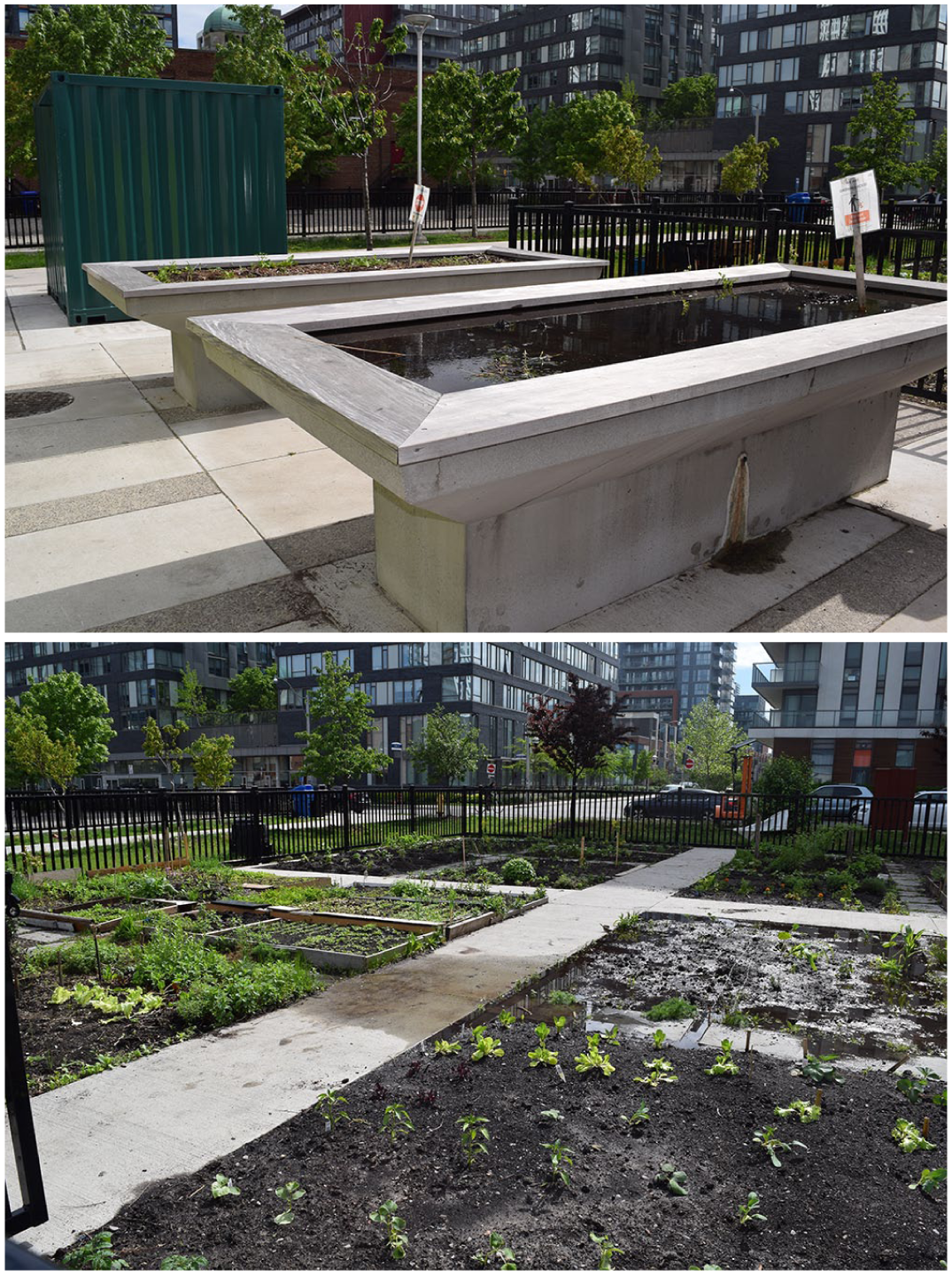
Flooded community gardens in Regent Park
Finally, there is a sense that gardener autonomy is being lost and that the emphasis on collective management of growing spaces may reinforce exclusionary social hierarchies.(40) The community garden spaces on the ground are largely managed by nonprofit organizations, which limits the ownership of individual gardeners over their garden spaces. Time, resources, language and social barriers may also prevent individuals from engaging with those service providers.(41) This collective model also constrains the individual family’s ability to choose what is grown to meet its needs, and limits the participation of those with other household responsibilities. While nonprofit organizations also managed growing spaces before the Regent Park redevelopment, several informants lamented the loss of individual allotment spaces in favour of collective gardens for these reasons. Further, collective rooftop spaces may be less inviting to residents with family care responsibilities and those who see them as dangerous places, according to one nonprofit advocate.
The challenges experienced in Regent Park demonstrate how hard it is to address the needs of traditionally marginalized residents when UA is narrowly pursued with a techno-managerial approach. While recognizing the important contributions from advocates, municipal actors, and the Daniels Corporation in retaining some growing spaces, however limited and transformed, this research seeks to understand the obstacles that prevented the needs of marginalized residents from being more sufficiently met. Stakeholders interviewed for this research lamented the failure of individuals within the bureaucracy to rely on expertise in building community garden spaces that would work for Regent Park’s residents. One UA advocate reflected: “It’s frustrating because you had years of community consultations and reports by folks in the urban agriculture field saying, ‘Yeah, this is great. Do this. Have a Regent Park brand. Have growing spaces. Build this up. This is important for smoothing the transition between TCH and mixed-income housing.’ It’s just not happening.”
The focus on achieving bureaucratic support for gardens of any kind (collective vs. allotments, ground-level vs. rooftop containers) obscures the uneven access to nature throughout the city. Instead, it appears that those most able to access growing space have financial resources (for instance, commercial farms or development corporations that can afford the necessary fees and navigate the complex bureaucracy) or a long history of growing (such as those already paying a fee and maintaining space in one of the city’s 11 allotment gardens, which have years-long waiting lists). In the cases presented here, while marginalized residents requested more garden spaces, the revitalization plan was unable to sufficiently incorporate those requests.
In the end, these shortcomings point to a need to address the political nature of such projects by designing these spaces with better attention to who is empowered to participate in the UA movement, instead of focusing narrowly on bureaucratic decisions about what and where.
b. Reaching for the “low-hanging fruit” of public land
In response to challenges of limited access to growing spaces (including the loss of land in Regent Park), two priorities in the GrowTO Action Plan focused on linking growers to land and cultivating partnerships to increase access to land. The plan recognized that institutional landowners (including TCH) had historically partnered with interested groups and individuals for food-growing projects and suggested a need for an in-depth inventory of such potentially “untapped opportunities” for growing spaces. Next steps then focused on working with such institutional partners to develop site assessments, lease negotiations, and other resources needed to make the land available to prospective growers.(42)
One institutional partner identified was Hydro One, the provincial electricity company. Hydro One owns approximately 50,000 acres of land in transmission corridors (or rights-of-way, ROWs) that were transferred to the Government of Ontario for potential secondary uses in 2002.(43) It was reported in public meetings that Hydro corridors were viewed as “low-hanging fruit” for accessing new land for UA. Hydro and the City have a master lease agreement through which the City can lease ROWs (paying rent and/or property taxes) and then sub-lease to other users. Licences are issued for secondary land uses that do not interfere with Hydro operations and pass approved environmental site assessments. Hydro had approved a few small community gardens in the past, but the process was expensive and onerous.(44)
Five nonprofit organizations, the TFPC and TUG planned the Community Engagement and Entrepreneurial Development (CEED) Gardens project in 2012 to create four small-scale market gardens in Hydro corridors. The nonprofit organizations would be responsible for organizing the market gardens, while the TFPC and TUG supported envisioning the work and navigating bureaucratic processes. The objectives were multi-fold. First was economic development, building on successes in immigrant community gardens. As one nonprofit UA advocate said: “When we realized that quite a few people in the [community garden are gaining] skills and [there are] some folks who come from a farming background, we’re obviously looking … the spaces where people are growing to say, ‘How can we add? Are we looking at food growing and production from an economic standpoint as well to support people in the community?’”
While this organization already supported three successful community gardens, they were prohibited from selling the produce from gardens on the Parks Department’s land. But given the growing rates of food insecurity among the low-income community where they were situated, the organizers and gardeners sought to turn their efforts into small enterprises. In this way, the CEED gardens pursued social equity goals through UA by promoting community resilience and economic development.
Additionally, with several city government champions and private foundation support, this project would, it was hoped, serve as a model for making more public land available for small entrepreneurship projects that would bring a range of benefits to communities.(45) However, various delays and nearly insurmountable bureaucratic, resource and expertise obstacles delayed finalization of the first lease agreements until at least autumn 2018 (when this research was completed).
The City’s Social Development and Finance Administration Department, in partnership with Toronto Public Health, entered into conversations with Hydro One to determine what each site needed to secure a lease. With City champions, the project partners were able to gain access to meetings and be heard as a priority in ways that many interviewed for this research felt would not have been possible otherwise. One nonprofit advocate reflected, “I think that the fact the City was involved made a huge difference because otherwise I think it could have taken a lot longer to reach the stage that we are in.”
Despite these champions, community stakeholders found it difficult to navigate changing expectations. The negotiations for approval were slow – taking at least six years – which created challenges in continuing partnerships with gardeners and funders. Throughout the negotiations, Hydro requested various environmental tests, professional drawings and other items that proved to be beyond the capabilities of many community organizations. For example, professional plans had to be drawn up for the sites that would indicate how far the gardens would be from the transmission space and how Hydro utility vehicles would be able to access the spaces to make repairs if needed. One organization was able to work with an architectural firm that assisted it, pro bono, in drawing these official plans. The organizations involved also had to conduct extensive soil testing at potential sites, not all of which was initially foreseen. City officials and Hydro decision-makers disagreed on which tests would be acceptable, resulting in the need to repeat an entire round of tests in order to be accepted by both parties. It is estimated that organizations involved spent more than C$ 100,000 (approx. US$ 74,000) on site-assessment processes.(46)
These obstacles demonstrate the challenges encountered in the pursuit of social objectives via UA, even by well-supported organizations in partnership with city champions. In particular, this project makes clear the slow timeline by which governance occurs and the necessity of resources and specialized expertise, all of which can reduce the benefits of such projects for traditionally marginalized, low-income communities. One nonprofit advocate indicated: “So, it’s still in the process and it’s almost been like a political nightmare, but hopefully this year – I mean every year we’re crossing our fingers for this year, but this year it actually comes to fruition.” More than six years into the planning process, no new market gardens had broken ground in Hydro corridors. Roberts describes the work of FPCs as research development efforts for government in which FPCs “can take a seemingly crazy idea and put it through its paces until it becomes official policy”.(47) This was a goal of the CEED gardens in which a three-year pilot project would support the implementation of policy that would allow more sales of food grown on public land. But this policymaking strategy takes time (as has also been found in other cities,(48) and in the 15-year timeline to create policy enabling green roofs in Toronto). One consequence of the delays is that the excitement about the market gardens in initial consultations can diminish as people move on with meeting their daily needs and as residents move in and out of neighbourhoods. In addition, the organizations involved raised funds from private foundations to create the gardens. But as the planning phase for the project extended beyond funding cycles, there were increasing risks of losing those grants.
The goal of this project was to free up city land for traditionally marginalized communities to participate in UA. However, according to several key stakeholders in the negotiation, this project demonstrated how challenging it is to navigate requirements for creating innovative garden spaces on public land. The costs and level of expertise necessary to navigate the lease negotiation represent a formidable impediment. As one commercial enterprise employee said: “So, right now the way things are, a lot of the existing city processes, from what we’ve seen of [UA] projects starting up, a lot of those processes are really geared towards people who have the money and the time to invest in them to show developers, larger enterprises, but for [UA] projects that are just starting up they see what the costs of these things are and go, ‘Whoa, no, no, this isn’t even possible.’”
As a result, these sorts of environmental initiatives, which are promoted as common goods with potential to provide benefits to all gardeners, mirror exclusions that have consistently marginalized communities. In the end, less well-resourced residents and civil society organizations in Regent Park did not have the power to ensure the sustainability of meaningful garden space, while the CEED gardens demonstrated how difficult it is for those without economic resources to participate in building such spaces.
VI. Discussion
In the examples provided, traditionally marginalized residents and their allies advocated for UA projects to address economic inequities and limited food access. Instead, smaller, poorer-quality and more exclusive garden spaces were provided in Regent Park, and the CEED gardens still hold the promise, but not the certainty, of breaking ground. Both projects demonstrate the inaccessibility of public land as growing space for those without economic resources, scientific expertise and political influence, thus reproducing uneven development in the city.
The projects also call attention to challenges encountered in pursuing social justice when municipal actions operate within a seemingly post-political environment. Swyngedouw and others theorize the post-political condition as one in which urban politics are reduced to management and consensual policymaking.(49) In this environment, “techno-managerial planning and intervention, expert management, and bio-political administration displace ideological or dissensual contestation and struggles” in ways that narrow the potential struggle for the creation of urban socio-ecological life.(50) Administrative decisions made by networks of actors (both within and outside of government) transform politics into technical decision-making without questioning potential impacts on different groups.(51) In this post-political condition, questions about the where and what of garden projects exclude attention to the political implications for those claiming a right to the city.
This seemingly post-political environment is demonstrated in these two projects in Toronto, given that decision-making focused on the types and amount of growing spaces available (e.g. addressing the reduction in ground-level growing space in Regent Park through adding rooftop gardens and building new market gardens in Hydro corridors), without sufficient attention to the uneven access to nature produced throughout the city by those administrative decisions. As also found by others,(52) these seemingly depoliticized projects limit the radical potential of this work by making invisible the social and economic consequences of techno-managerial processes. Opportunities for transforming political, economic and social interactions through the dominant food system can be limited to decisions focusing on the where and what of urban growing, as depicted in these cases. Working within the constraints of existing institutions is an important avenue for pursuing change. Yet it may be less influential when pursued without greater attention to who is empowered through such processes.
Additionally, as Swyngedouw(53) points out in his calls for repoliticizing urban socio-ecological relations, everyday technical and managerial decisions about urban infrastructure occur within relations of power through which social actors claim territory, and must be understood as part of a political and social struggle. For example, the leases that gained traction for the CEED gardens required input from two Members of Provincial Parliament to spur Hydro One into action, which demonstrates, as one nonprofit advocate reflected, that “politics really matters”. As such, it must be recognized that techno-managerial interventions – such as revitalizing public housing and constructing market gardens – are political acts that “produce particular socio-ecological arrangements and milieus and, in doing so, foreclose the possibility of others emerging”.(54) The post-political condition is evident in Toronto’s UA landscape through the focus on bureaucratic decisions about which UA projects to pursue, and where, while obscuring the politics in such efforts that produce asymmetrical beneficiaries.
VII. Conclusions
This paper seeks to highlight the challenges to pursuing social justice objectives via urban agriculture projects. While not all UA initiatives pursue such objectives, that rhetoric is evident throughout many UA movements. The two projects depicted here were supported by advocates, practitioners and government officials seeking to increase access to land so that those in traditionally marginalized communities could grow food. This research does not discount the importance of pursuing such work but instead seeks to understand the constraints that prevented the achievement of those goals.
In responding to the calls of critical urban theorists to not only pay attention to injustices and exclusions such as these, but also to “politicize, empower, and identify alternatives”,(55) this research also asks what can be done to foster food governance and UA projects that contribute to systemic improvements in social equity. The suggestions in the literature, and among stakeholders interviewed for this research, call for refocusing attention on the social and political implications of these processes. It requires asking who will be impacted by different projects once they are completed, and who will reap the benefits. For example, if the CEED gardens are to be demonstration projects for writing policy that reduces barriers to selling food grown on city land, what else will be needed for small-scale growers with limited resources to navigate that policy and access institutional land? In answering these questions, the geographies and voices of traditionally marginalized groups must be forefronted in decision-making.(56) That includes attending to who is impacted by the types of UA spaces created. Interrogating such issues might reveal that a rooftop garden or collectively run container garden does not include the same people in the same way as allotment gardens outside their doorsteps.
One step in this direction, as suggested by many others, is engaging in more inclusive decision-making processes. But that has not proven to be sufficient in this case. The TFPC prioritizes dialogue and consensus in its meetings(57) and TCH and Daniels Corporation engaged in significant community consultations. But the interests expressed in these meetings by traditionally marginalized residents and civil society organizations did not produce sufficient concrete gains. As those interests were translated into projects, they were interpreted by the discursive power, priorities and actions of more influential local stakeholders in ways that reduced their transformative potential.
Certain social norms and assumptions are embedded in local governance and replicated in our food systems in ways that limit progress toward social equity.(58) In order to achieve such equity goals, we must be intentional in not replicating injustices. As one nonprofit UA supporter said: “[We sometimes argue that UA] can accomplish everything under the sun. We can do environmental issues. We can do social. We can do economic. We can grow fresh produce. But we have to be careful also. Individual urban agriculture projects are not going to accomplish all of that. Urban agriculture as a movement can do that but each project needs to be structured very carefully and thoughtfully according to what it is you want to accomplish and you’re not going to accomplish everything.”
The work of FPCs in North America frequently supports UA within a discourse of increasing economic opportunities for traditionally marginalized groups. However, the focus instead often turns to seemingly post-political questions about what kinds of UA should be pursued in what spaces in the city, thereby losing sight of who can benefit from these projects. Instead, by foregrounding questions about who is empowered through such projects, I believe there is the potential, in Ramírez’s words, to “imagine a more-just future”.(59) More inclusive and participatory decision-making is important, but the questions asked in those processes and the way the results are ultimately interpreted are just as important.
Footnotes
Acknowledgements
The author is very grateful to everyone that shared their knowledge and welcomed me into their meetings and gardens during this research. Thank you also to Charles Levkoe and two anonymous reviewers for their helpful comments.
Funding
The author received no financial support for the research, authorship, and/or publication of this article.
1.
City of Toronto (2017), Proclamation: Urban Agriculture Day, City of Toronto Proclamations, accessed 29 May 2019 at  .
.
2.
Thibert, T (2012), “Making local planning work for urban agriculture in the North American context: a view from the ground”, Journal of Planning Education and Research Vol 32, No 3, pages 349–357.
3.
Swyngedouw, E (2015), “Urbanization and environmental futures: politicizing urban political ecologies”, in T Perreault, G Bridge and J McCarthy (editors), The Routledge Handbook of Political Ecology, Routledge, New York, pages 609–619.
4.
Anguelovski, I (2016), “From toxic sites to parks as (green) lulus? New challenges of inequity, privilege, gentrification, and exclusion for urban environmental justice”, Journal of Planning Literature Vol 31, No 1, pages 23–36; also Swyngedouw, E (2007), “Impossible sustainability and the postpolitical condition”, in R Krueger and D Gibbs (editors), The Sustainable Development Paradox: Urban Political Economy in the United States and Europe, Guilford Press, New York, pages 13–40.
6.
McCarthy, J (2013), “We have never been “post-political””, Capitalism Nature Socialism Vol 24, No 1, pages 19–25.
7.
See reference 6.
8.
Stehlin, J G and A R Tarr (2017), “Think regionally, act locally?: Gardening, cycling, and the horizon of urban spatial politics”, Urban Geography Vol 38, No 9, pages 1329–1351.
9.
See reference 2; also Certomà, C and C Tornaghi (2015), “Political gardening: transforming cities and political agency”, Local Environment Vol 20, No 10, pages 1123–1131; Cohen, N and K Reynolds (2014), “Urban agriculture policy making in New York’s ‘new political spaces’: strategizing for a participatory and representative system”, Journal of Planning Education and Research Vol 34, No 2, pages 221–234; Hoover, B (2013), “White spaces in black and Latino places: urban agriculture and food sovereignty”, Journal of Agriculture, Food Systems, and Community Development Vol 3, No 4, pages 109–115; and Wakefield, S, F Yeudall, C Taron, J Reynolds and A Skinner (2007), “Growing urban health: community gardening in South-East Toronto”, Health Promotion International Vol 22, No 2, pages 92–101.
10.
Santo, R, A Palmer and B Kim (2016), Vacant Lots to Vibrant Plots: A Review of the Benefits and Limitations of Urban Agriculture, Johns Hopkins Center for a Livable Future, Baltimore, page 3.
12.
Alkon, A H and J Guthman (editors) (2017), The New Food Activism: Opposition, Cooperation, and Collective Action, University of California Press; also Lawson, V and S Elwood (editors) (2018), Relational Poverty Politics: Forms, Struggles, and Possibilities, University of Georgia Press; and Sbicca, J (2013), “The need to feed: urban metabolic struggles of actually existing radical projects”, Critical Sociology Vol 40, No 6, pages 817–834.
13.
Sbicca, J (2012), “Growing food justice by planting an anti-oppression foundation: opportunities and obstacles for a budding social movement”, Agriculture and Human Values Vol 29, No 4, pages 455–466.
15.
See reference 8; also Draus, P J, J Roddy and A McDuffie (2014), “‘We don’t have no neighbourhood’: advanced marginality and urban agriculture in Detroit”, Urban Studies Vol 51, No 12, pages 2523–2538; and Hu, A, A Acosta, A McDaniel and J Gittelsohn (2013), “Community perspectives on barriers and strategies for promoting locally grown produce from an urban agriculture farm”, Health Promotion Practice Vol 14, No1, pages 69–74.
16.
Cabannes, Y (2012), “Financing urban agriculture”, Environment and Urbanization Vol 24, No 2, pages 665–683; also Daftary-Steel, S, H Herrera and C Porter (2015), “The unattainable trifecta of urban agriculture”, Journal of Agriculture, Food Systems, and Community Development Vol 6, No 1, pages 19–32.
17.
See reference 2; also see reference 9, Cohen and Reynolds (2014); and Glasser, R (2018), “The farm in the city in the recent past: thoughts on a more inclusive urban historiography”, Journal of Urban History Vol 44, No 3, pages 501–518.
18.
Allen, P (2010), “Realizing justice in local food systems”, Cambridge Journal of Regions, Economy and Society Vol 3, pages 295–308.
19.
See reference 2.
20.
Scherb, A, A Palmer, S Frattaroli and K Pollack (2012), “Exploring food system policy: a survey of food policy councils in the United States”, Journal of Agriculture, Food Systems, and Community Development Vol 2, No 4, pages 3–14.
21.
See reference 2.
22.
See reference 20.
23.
McClintock, N, H Wooten and A Brown (2012), “Toward a food policy “first step” in Oakland, California: a food policy council’s efforts to promote urban agriculture zoning”, Journal of Agriculture, Food Systems, and Community Development Vol 2, No 4, pages 15–42.
24.
Swyngedouw, E (2009), “The antinomies of the postpolitical city: in search of a democratic politics of environmental production”, International Journal of Urban and Regional Research Vol 33, No 3, pages 601–620.
25.
MacRae, R and K Donahue (2013), Municipal Food Policy Entrepreneurs: A Preliminary Analysis of How Canadian Cities and Regional Districts Are Involved in Food System Change, Toronto Food Policy Council, Vancouver Food Policy Council and Canadian Agri-Food Policy Institute.
26.
Welsh, J and R MacRae (1998), “Food citizenship and community food security: lessons from Toronto, Canada”, Canadian Journal of Development Studies/Revue canadienne d'études du développement Vol 19, No 4, pages 237–255.
27.
Roberts, W (2010), “Food policy encounters of a third kind: how the Toronto Food Policy Council socializes for sustainability”, in A Blay-Palmer (editor), Imagining Sustainable Food Systems: Theory and Practice, Taylor and Francis; also Wekerle, G (2004), “Food justice movements: policy, planning and networks”, Journal of Planning Education and Research Vol 23, pages 378–386.
28.
Mah, C and H Thang (2013), “Cultivating food connections: the Toronto Food Strategy and municipal deliberation on food”, International Planning Studies Vol 18, No 1, pages 96–110.
29.
Halliday, J and C Hawkes (2017), What Makes Urban Food Policy Happen? Insights from Five Case Studies, International Panel of Experts on Sustainable Food Systems.
30.
Teitel-Payne, R, J Kuhns and J Nasr (2016), Indicators for Urban Agriculture in Toronto: A Scoping Analysis, Toronto Urban Growers.
32.
James, R (2010), “From ‘slum clearance’ to ‘revitalization’: planning, expertise and moral regulation in Toronto’s Regent Park”, Planning Perspectives Vol 25, No 1, pages 69–86; also Laughlin, D L and L C Johnson (2007), “Defining and exploring public space: perspectives of young people from Regent Park, Toronto”, Children’s Geographies Vol 9, Nos 3–4, pages 439–456.
33.
Augsten, T, M Babin, M Bennington, M Kelling and A Procopio (2017), Social Cohesion in Contested Space: A Neighborhood Integration Framework for Regent Park, University of Toronto and Toronto Community Housing.
35.
Starr, R (2016), “5 ways Regent Park’s revitalization is a game-changer”, The Toronto Star, 9 May; also Levin, D (2016), “In Toronto, a neighborhood in despair transforms into a model of inclusion”, New York Times, 28 February.
36.
37.
Cohen, M (2015), “The Regent Park revitalization: growing a healthy community”, Centre for Social Innovation blog, 15 September, accessed 31 May 2019 at .
38.
Daniels DuEast (2018), Urban Living Reimagined: Urban Agriculture, Daniels Corporation, accessed 31 May 2019 at .
39.
See reference 36.
40.
For a discussion of democratic engagement of food-focused nonprofit organizations, see Loh, P and J Agyeman (2017), “Boston’s emerging food solidarity economy”, in A H Alkon and J Guthman (editors), The New Food Activism: Opposition, Cooperation, and Collective Action, University of California Press.
41.
See, for example, Sundeen, R A, S A Raskoff and M Cristina Garcia (2007), “Differences in perceived barriers to volunteering to formal organizations: lack of time versus lack of interest”, Nonprofit Management & Leadership Vol 17, No 3, pages 279–300.
42.
See reference 31.
43.
Infrastructure Ontario (2018), PSLUP – Frequently Asked Questions, accessed 31 May 2019 at .
44.
Teitel-Payne, R (2017), CEED Gardens: Laying the Groundwork for Growing and Selling Food in Toronto’s Hydro Corridors, Toronto Urban Growers, Toronto.
45.
See reference 44.
46.
Friedmann, C (2017), “Toronto has become a leader in urban agriculture, but new projects struggle to take root”, The Global and Mail, 3 November.
48.
See reference 20.
49.
See reference 3; also see reference 4, Swyngedouw (2007); reference 24; and Beveridge, R and P Koch (2017), “The post-political trap? Reflections on politics, agency and the city”, Urban Studies Vol 54, No 1, pages 31–43.
50.
See reference 3, page 615; also see reference 24.
53.
See reference 3.
54.
55.
Tornaghi, C (2014), “Critical geography of urban agriculture”, Progress in Human Geography Vol 38, No 4, pages 551–567, page 564; also Marcuse, P (2009), “From critical urban theory to the right to the city”, City: Analysis of Urban Trends, Culture, Theory, Policy, Action Vol 13, pages 185–197.
56.
Ramírez, M M (2015), “The elusive inclusive: black food geographies and racialized food spaces”, Antipode Vol 47, No 3, pages 748–769.
57.
See reference 29.
59.
See reference 56, page 751.