




Abstract
Over the last decade, urban philanthropic giving has acquired an increased significance for cities, shaping urban agendas and affecting local decision-making. Contributing to the emerging geographical literature on the impact of philanthropy on urban governance as well as to scholarship on post-foundational geographies, I argue that urban philanthropic giving is related to a post-political regime of multi-stakeholder urban governance. Contrary to being a linear process of managerial consensus politics, the post-politicisation of urban governance emerges as a multidimensional and variegated process of mutations and adaptations. Drawing from Athens, Greece, in the austerity period, I trace the emergence of a new donor-based philanthrocapitalist regime of urban governance and I demonstrate that post-political governance can take diverse forms: from the well-described in existing literature inclusive partnership-based approach to more authoritarian consensus-based governance processes. The aim of the paper is not just to answer if philanthrocapitalism gives rise to a post-political condition or not, but to explore how it is making and remaking (post-political) urban governance of public spaces, urban politics and urban everyday life. In doing so, the paper focuses on Athens Partnership, an intermediate governance organisation that was established to manage and support donations from the private sector to local governments in Athens and explores the ways urban philanthropy impacts on urban governance. Overall, the paper brings forward a renewed, more enmeshed understanding of post-political urban governance through an analysis of the novel philanthrocapitalist regime that emerged in European cities in the context of the recent intersecting crises.
Introduction
Over the last decade, it has become increasingly common to see headlines in Greek media recording donations for public spaces by private companies, corporations or cultural and philanthropic foundations.
Lampsa’s donation for the lighting of Syntagma Square. (Kathimerini, 2017) The second pocket park sponsored by Iraklis Group is ready. (Ethnos, 2021a) The new Omonia Square was illuminated in blue and white colours after a donation by Ellaktor Group. (CNNGreece, 2020) Anti-graffiti campaign in Patision Str with Karcher’s support. (FortuneGreece, 2020)
The increased involvement of philanthropic actors in cities is not only a Greek phenomenon. Moments of crisis – like the 2010 financial crisis or the 2020 pandemic crisis – instigate novel urban governance processes wherein philanthropic institutions and high net worth individuals (HNWIs) become stable partners of local governments, seeking to address major urban challenges and shape urban agendas and local decision-making (Fuentenebro and Acuto, 2022). While the role of philanthropy in fields such as education, culture, global health governance and international development (Harman, 2016; Thomson, 2019; Youde, 2013) has been widely discussed over the past decades, it has been only recently that the relationship between philanthropy and cities has entered urban studies and geographical debates.
Against this background, this paper responds to recent calls made by urban scholars to explore the relationship between philanthropy and urban governance. In a 2022 paper, Fuentenebro and Acuto (2022: 1944), argue that it is important to understand ‘the impact of philanthropic institutions not just generally on cities but specifically on urban governance’. Similarly, Hay and Muller (2014) point out that understanding how urban philanthropy works in different cities around the world provides important insights on the nuances of urban neoliberalisation. So, what is the impact of philanthropic giving on urban governance amidst austerity? How is philanthrocapitalism (re-)making post-political urban governance? Seeking to contribute to this emerging geographical debate and answer these questions, I argue that urban philanthropic giving is related to a post-political regime of multi-stakeholder urban governance consisting mainly, but not solely, of donors and local governments. The post-politicisation of urban governance is often related to an inclusive outward-looking governance regime where governmental and non-governmental actors collaborate in a seemingly equal way. However, I argue that contrary to being a linear process, the post-politicisation of urban governance is a multidimensional and variegated process of mutations and adaptations. Drawing from Greece in the austerity period, I trace the emergence of a new donor-based philanthrocapitalist governance regime and I demonstrate that post-politicisation is expressed as an inclusive partnership-based governance approach on the one hand and as an authoritarian governance process on the other.
In doing so, I draw on the case of Athens Partnership, a non-governmental organisation that ‘promotes partnerships between the private and public sector and leverages donations to support local governments’ (Athens Partnership, 2021). The paper draws on empirical research conducted between May 2020 and June 2021 based on three research methods. First, I collected and analysed all donation acceptance decisions from the Municipality of Athens through the ‘Diavgeia’ Transparency Programme of the Greek government (Diavgeia, 2022). Second, I collected and analysed data from websites and social media platforms of actors related to issues under scrutiny, such as the Municipality of Athens, Athens Partnership, philanthropic and cultural foundations and private companies. I also collected Athens City Council meetings’ minutes and Athens Partnership’s Annual Reports. Finally, given that the aim of the research was to understand Athens Partnership’s operation and relation to the municipality, I conducted a dozen semi-structured in-depth interviews 1 with representatives of Athens’ Municipality and Athens Partnership. Interviews revolved around four key themes: motivations, framework of collaboration, impact and expected results, and specific actions, programmes and projects. These general themes were amended when necessary in order to capture specific details of each actor’s involvement in the new donors-based governance scheme. Research was conducted during the COVID-19 pandemic, when travel was restricted. While this did not affect interviews, as all participants were happy to participate in online interviews, it did limit my ability to travel to Athens and enrich my analysis with in-place observations. However, this was not a considerable drawback, as I am familiar with the spaces and interventions discussed in the research.
The rest of the paper is organised as follows. I begin by engaging with theoretical debates on emerging scholarship on urban philanthropy and the post-politicisation of urban governance. A second section situates the creation of Athens Partnership in the midst of a broader turn of the municipality of Athens to collaborative governance schemes amidst austerity. A third section analyses Athens Partnership’s first period of operation detailing the emergence of multi-stakeholder networks through participatory projects. Finally, a fourth section focuses on Athens Partnership’s second period unwrapping the turn towards more linear governance arrangements and the emergence of a model of public space adoption.
Urban philanthropy and the post-politicisation of urban governance
While philanthropy is not something new, the unprecedented scale of philanthropic spending differentiates contemporary forms of philanthropy from older ones (McGoey, 2012), in terms of scale, motivations and impact of gift-giving. In 2008, Bishop and Green (2008) introduce the term philanthrocapitalism through their book Philanthrocapitalism: How the Rich Can Save the World. Unlike traditional philanthropism, philanthrocapitalism is seen by the authors as a response to state retrenchment and a practice through which philanthrocapitalists seek to replace the social functions of the state. According to Bishop (2009: 1), ‘philanthrocapitalism is about combining the head and the heart, by bringing a business-like approach to solving society’s problems … Old-fashioned capitalism is dead. Long live philanthrocapitalism’. Philanthropic donors focus on various domains from education and health to policy-making and urban development, using a variety of leveraging practices. Some of them, like Michael Bloomberg, approach donor-giving as a way to support governments to surpass political constrains or scarce public funds (Allen, 2015). Others focus their efforts on building networks and alliances to tackle a single issue, such as poverty, education or migration in specific geographical areas (Freeland, 2012). Philanthrocapitalism has been conceptualised as a new paradigm in international development and has been widely researched through cases on cities of the Global South. Philanthrocapitalists, including Bill and Melinda Gates, George Soros, and Eli Broad, are often based on large-scale metrics-driven programmes to promote their practices as efforts to ‘save the world’ (Eikenberry and Mirabella, 2018) and as a way to surpass the highly fractured and bureaucratic structures of the traditional development industry (Edwards, 2008a). Based on research in the Millennium Villages Project in Ghana, Wilson (2016: 4) argues that philanthrocapitalism as ‘a nexus of billionaire philanthropy, corporate social responsibility, cause-related marketing and celebrity humanitarianism has become increasingly influential in the financing, promotion and implementation of development programmes around the world’.
Key questions with which scholarship on philanthrocapitalism engages are: ‘who are they [philanthrocapitalists], what are they funding and what strategies they are using’ (Goss, 2016: 443). In addition to this and more important, however, is to question the politicising dynamics of philanthrocapitalism, in terms of accountability and democratic decision-making. Critical scholarship on philanthrocapitalism criticises it as a depoliticised process through which unelected foundations and individuals promote their technocratic, top-down forms of intervention, prioritising market solutions and ignoring the geographical, political and economic dynamics of each context (Wilson, 2014). Wilson argues that philanthrocapitalism is a form of class struggle and ‘an ideological formation, which projects a profoundly conservative semblance of natural order and shared purpose onto the increasingly diffuse and unequal societies of contemporary capitalism’ (Wilson, 2014: 113). Edwards (2008b: 2) maintains that philanthrocapitalism is ‘insufficient to lever deeper changes in the distribution of power and resources across the world’ and is not interested in challenging, or even examining and acknowledging, the structural causes of inequality and injustice. Philanthropy is seen as an ‘act of giving to good causes’; a practice that ‘legitimi[s]es the activities and relationships involved in capitalism’, making capitalism look good and ‘asserting a hegemonic vision of capitalism as a positive force’ (Holmes, 2012: 189). Moreover, philanthrocapitalism reproduces a colonial vision of ‘“we” know what is best for “you”’ (Ramdas, 2011: 395), where ‘we’ denotes the rich, white and in their majority men philanthrocapitalists, while ‘you’ often means communities of the so-called ‘developing countries’.
Although most of the existing scholarship on philanthrocapitalism focuses on international development in cities of the Global South, the term has been connected with the recent intersecting crises, such as the 2010 financial crisis and the 2020 COVID-19 pandemic and their impact on urban governance and development in cities of the Global North. Indeed, cities and urban policy-making have become increasingly important for philanthropic institutions, and in turn philanthropic giving has acquired a greater role in urban issues (Montero, 2020). The rising inequalities and exclusions in terms of housing, public space, health access and education created in the midst of austerity have given rise to a new wave of philanthrocapitalism in European cities, which have sought to cover the gaps of the state and support market interests (Dowling, 2017; Nowski et al., 2020). The financial crisis marked ‘the deepening of an “entrepreneurial” or “creative” capitalism’ (Thorup, 2013: 558), wherein global philanthropic institutions like the Rockefeller Foundation, Bloomberg Philanthropists and the Gates Foundation as well as individual philanthropists play an always-greater role. Reckhow et al. (2020) coin the term ‘noprofit governance’ to refer to the rising involvement of nonprofit organisations in urban politics while Pill (2020) builds on the case of Baltimore to argue that under austerity, the local state is absent and various actors, including private philanthropies and corporate developers, play a significant role in local governance at various tiers. The involvement of private actors in urban governance alters local democracy and introduces new mechanisms of inequality. Although there is a more diverse set of players gathered around the table, such systems of urban governance remain unequal, lack public transparency and fail to empower urban residents (Levine, 2021).
I argue that philanthropic giving amidst austerity requires a renewed, more enmeshed (Blakey et al., 2022), understanding of post-political urban governance. Similarly to the current conjuncture wherein philanthropic giving is seen as a way to solve social problems, in the 1990s and early 2000s, partnerships between governmental and non-governmental actors were privileged as a way to solve ‘wicked problems’ in the context of the ‘global capitalist renaissance’ (Davies, 2021). Collaborative governance schemes are linked to the marginalisation of democratic politics and what has been discussed as the post-politicisation of urban governance.
The key proposition of the post-political city debate is that ‘debate, disagreement and dissensus [is replaced] with a series of technologies of governing that fuse around consensus, agreement, accountancy metrics and technocratic management’ (Swyngedouw, 2007: 58). As such, doing politics is reduced to a form of consensual management evacuating the urban and urban policy-making of its properly political and democratic dimension. Post-politicisation relies on both the inclusion of everyone in a consensual order and at the same time the exclusion of those who disagree with this (Swyngedouw, 2011). Swyngedouw (2009: 611) highlights that the construction of a post-political order relies on a populist discourse that ‘invokes “THE” city and “THE” people’ as a unified entity, silencing ‘ideological and other constitutive social differences’. In this way, the community remains empty and unnamed; collaboration is reduced into a de-politicised techno-managerial process; and politics are reduced to policy-making (Swyngedouw, 2009).
Recent research on post-politicisation tends to relate post-politicisation to multi-stakeholder governance structures based on consensus, all of which are considered as supposedly equals, a harmonious community, where dissensus does not exist and political difference is naturalised. However, the post-politicisation of urban governance is neither a one-size fits all process nor a linear condition. Following Blakey et al.’s (2022) urge to develop a more enmeshed understanding of post-foundational theory, in what follows, I focus on Athens amidst austerity to argue that post-politicisation can take diverse forms. My aim is not just to answer if philanthrocapitalism gives rise to a post-political condition or not, but to explore how it is making and remaking (post-political) urban governance of public spaces, urban politics and urban everyday life.
Creating Athens Partnership amidst austerity-driven Athens’ collaborative turn
Public space in Greece is produced through long-term solely state-driven processes. As Athanassiou et al. (2018: 252) write ‘all types of public space … are generated through state-driven obligatory processes of distribution of private and public property’. In other words, national and local authorities are the official and main actors for the development of public space. Despite a series of state spatial restructuring attempts over the last decades, local authorities’ synergies with the private sector were not widely activated. For example, the act enabling municipalities to engage in public–private partnerships was introduced in 2005 (Chorianopoulos and Tselepi, 2020), without yet being implemented by Greek municipalities. However, since the beginning of the financial crisis, public property and public space have been managed as the main vehicles for the promotion of development and as a means to deal with the debt through private investments.
In this context, post-political urban governance emerged through different modalities over the years. While its current form arises, as analysed below, through the involvement of private actors as donors for public space production, management and development, post-political urban governance was linked to different modes of depoliticisation in the previous years. For example, examining the privatisation policies around Thessaloniki’s port, Karaliotas (2017: 1556) argues that the successive rounds of neoliberalisation were consolidated around ‘failing-forward forms of governance beyond democratic accountability geared around consensus formation’. In his analysis, post-political governance in Greece is related to the emergence of urban infrastructure governance beyond democratic accountability and the foreclosure of spaces of democratic disagreement. In what follows, post-politics is analysed as a specific form of depoliticisation, one that emerges through the involvement of private actors in public issues, such as the management of public space and the alliance and cooperation of these actors with local governments through various formations.
Local governments in Greece are traditionally weak in terms of their metropolitan governing and policy-making powers, as Greece is one of the most centralised fiscal systems in the world (Chorianopoulos, 2012). Since 2008, and in the context of the Greek debt crisis, successive Memoranda of Understanding were imposed by the troika 2 in collaboration with Greek governments, aiming at ‘raising revenue for paying the national debt and creating a favourable “business climate”’ and shrinking ‘the public’ in multiple scales (Athanassiou, 2017: 786). Local governments were squeezed by a combination of factors, one of the most important of which was the 2010 Kallikratis Reform. 3 Drawing on similar policies of spatial and administrative restructuring in EU countries over the past two decades (Pagonis and Chorianopoulos, 2015), the Kallikratis Reform came as a result of the first Memorandum and was the driving force of a fiscal and territorial restructuring, introducing two contradictory elements. On the one hand, it increased the responsibilities of local governments which, since then, have been responsible for the governance of environment, social protection, education and culture, among others. Notwithstanding the new responsibilities, local governments do not still have policy-making powers, as the devolution of policy-making powers to local governments would have potentially created obstacles to privatisation plans, driven by the central government. On the other hand, the Kallikratis reform introduced caps on municipal borrowing which led to the suspension of all investment in physical infrastructure and reduced the number of municipal employees by 50%. For example, while the Department of Urban Green of the Municipality of Athens had 650 positions in the past, it now only has 370 employees (I7, 2021).
In this context of decreased budget and understaffing, the municipality of Athens turned its interest in opening decision-making structures to state, business and privileged civil society actors by introducing new flexible forms of collaborative governance based on public–private partnerships and philanthropic donations (Athanassiou, 2017; Chorianopoulos and Tselepi, 2020). Following austerity-ridden cities around Europe and the US, Athens turned to ‘hybridi[s]ed and associational governance forms’ (Chorianopoulos and Tselepi, 2020: 45) instigating partnerships in the fields of urban regeneration, economic development and social policy with various partners, including local authorities, NGOs, transnational corporations and third-sector multi-nationals. In addition, during austerity, Athens’ municipality accepted several donations not related to Athens Partnership. Between 2011 and 2020, 410 donations were accepted by the municipality mainly in the form of ‘Material-Equipment’ (40.2%), ‘Consumables’ (19.5%) and ‘Services’ (9.2%) that were provided by companies (44%), NGOs (14.6%) and individuals (10.9%).
Between 2010 and 2019, Athens’ municipality was led by Mayor Kaminis, an independent candidate supported by the centre-left and social democratic party. As Davies (2021: 55) argues, ‘Kaminis embraced the letter and the spirit of austerity’ as his central goal was ‘administrative and fiscal self-reliance’. Adopting an entrepreneurial model of urban governance, in 2011, Kaminis focussed on the ‘re-appropriation’ of public space (Maloutas et al., 2013) and on multilevel cooperation with international and national bodies to achieve the goal. One striking example of this ‘elite pluralism’ regime (Chorianopoulos and Tselepi, 2020) is the establishment of a new intermediate governing body, Athens Partnership. Two processes acted drastically in its creation: the municipality’s collaboration with Bloomberg Associates in 2014, and a big donation by the Stavros Niarchos Foundation in 2015.
In 2014, the municipality of Athens won the 2014 Bloomberg Philanthropies Mayors Challenge Award for the creation of the online platform SynAthina 4 (Bloomberg Philanthropies, 2014). It is since then that Bloomberg Associates have become consultants for and close partners of the municipality. Bloomberg Associates is an international charitable advisory group created in 2014 by former New York Mayor Michael Bloomberg aimed at working with municipalities around the world to ‘solve complex municipal challenges [and] make cities safer, stronger, fairer and more efficient’ (Bloomberg Associates, 2020: 1). This partnership was considered a big win for the municipality of Athens. The interviewees who were cooperating with the municipality at that time emphasised the high level of the consulting services and the zero cost of services for the municipality (I1, I2, 2021).
Since 2014, Bloomberg Associates have played a key role in the governance approach and urban policy-making in Athens and Mayor Kaminis himself adopted, like many other mayors worldwide (Brash, 2011), the Bloomberg governance approach. Despite the ‘success story’ that accompanies Michael Bloomberg, critical urban studies highlight the deeply neoliberal nature of Bloomberg’s seemingly realistic and apolitical corporate approach during his tenure as mayor of New York. Brash (2011: 130) characterises the way Bloomberg governed NY as the Bloomberg Way, arguing that it promoted a corporate vision of the city: ‘the mayor as CEO, the city government as a corporation, valued businesses as clients, citizens as customers, and the city itself as a product’.
In parallel, in 2015, the Municipality of Athens received a 10 million Euro donation from Stavros Niarchos Foundation (henceforth SNF). The donation was part of an emergency grant initiative, ‘Initiative against the crisis’, that aimed to ‘assist in mitigating the worst effects of the crisis by helping the organisations that help those most in need’ (SNF, 2021: 1). However, as my interviewees claimed, the municipality was unable to manage the money of the donation as there were no appropriate mechanisms and procedures in the public governance structure that would enable the usage of the money (I1, I2, 2021). Being directed by Bloomberg Associates, the Municipality of Athens decided to create a non-profit organisation, which could manage the donation funding.
Athens Partnership was established as a non-profit organisation, according to standards of similar organisations in the United States, the so-called funds (I1, 2021). Indicative of the logic behind its creation and operation is the following excerpt.
No matter how well organised a municipality is, there are certain issues that need to be solved in cooperation with the private sector. That is why they [the City of NY] created the fund and that is why we are also creating Athens Partnership … And this is done with a much more flexible way than the one allowed by the public sector mechanism. (I1, 2021)
However, SNF’s donation as well as the creation of the organisation took place in 2015, a period during which capital controls were applied in Greece and at the same time the public debate revolved around Greece’s exit from the Eurozone. 2015 can be considered a ‘conjunctural tipping point’ for Greece, as it is the year when ‘the politics of austere neoliberalism became dominant (if not hegemonic) in Greek society’ (Davies, 2021: 55). Since then, austerity has been normalised in the Athenian local state apparatus (Davies, 2021). As Athens Partnership’s then General Director notes:
That is why we directly suggested […] that if we can, this money should not be in Greece. Because this money will be spent in Greece but if we exit Eurozone and the euro becomes drachmas, we will have the following problems: first, it will lose their value and second, we will not be able to move it. What will we buy with drachmas to help people? But if the money is abroad, it will not lose its value and we will be able to use it. (I1, 2021)
As such, Athens Partnership operated initially as a US-based non-profit organisation, incorporated as a project of a fiscal sponsor, an organisation that would manage the money on behalf of Athens Partnership, called New Venture Fund. Athens Partnership operated in this way from 2015 to 2017, when it became a Greece-based organisation.
First period (2015–2018): Multi-stakeholder consensual networks and participatory projects
Governance structure and operation
Since its establishment, Athens Partnership’s key aims were ‘the optimal organisation of the mechanism for attracting sponsors, the transparency of philanthropic-giving process, the bypassing of the bureaucracy of the public sector and the transfer of responsibilities away from the public sector’ (Athens Partnership, 2021). In doing so, it created a network-based form of governance and new modes of ‘governance-beyond-the-state’ (Swyngedouw, 2005) in order to handle donations of philanthropic institutions and individuals. In what follows, I unwrap Athens Partnership’s urban politics by drawing on the ‘Pilot upgrade of the Commercial Triangle’, 5 one of the most large-scale and indicative projects of the period (see Figure 1). The project managed by Athens Partnership included participatory urbanism interventions and complemented a larger urban regeneration project for the same area that included pedestrianisations, upgrading of urban infrastructure, greenery and accessibility enhancing interventions. Its management and structure were similar to those of most of the projects for public spaces managed by Athens Partnership during this period, such as the ‘Open Schools’ and the ‘This is how I learn better’ ones.
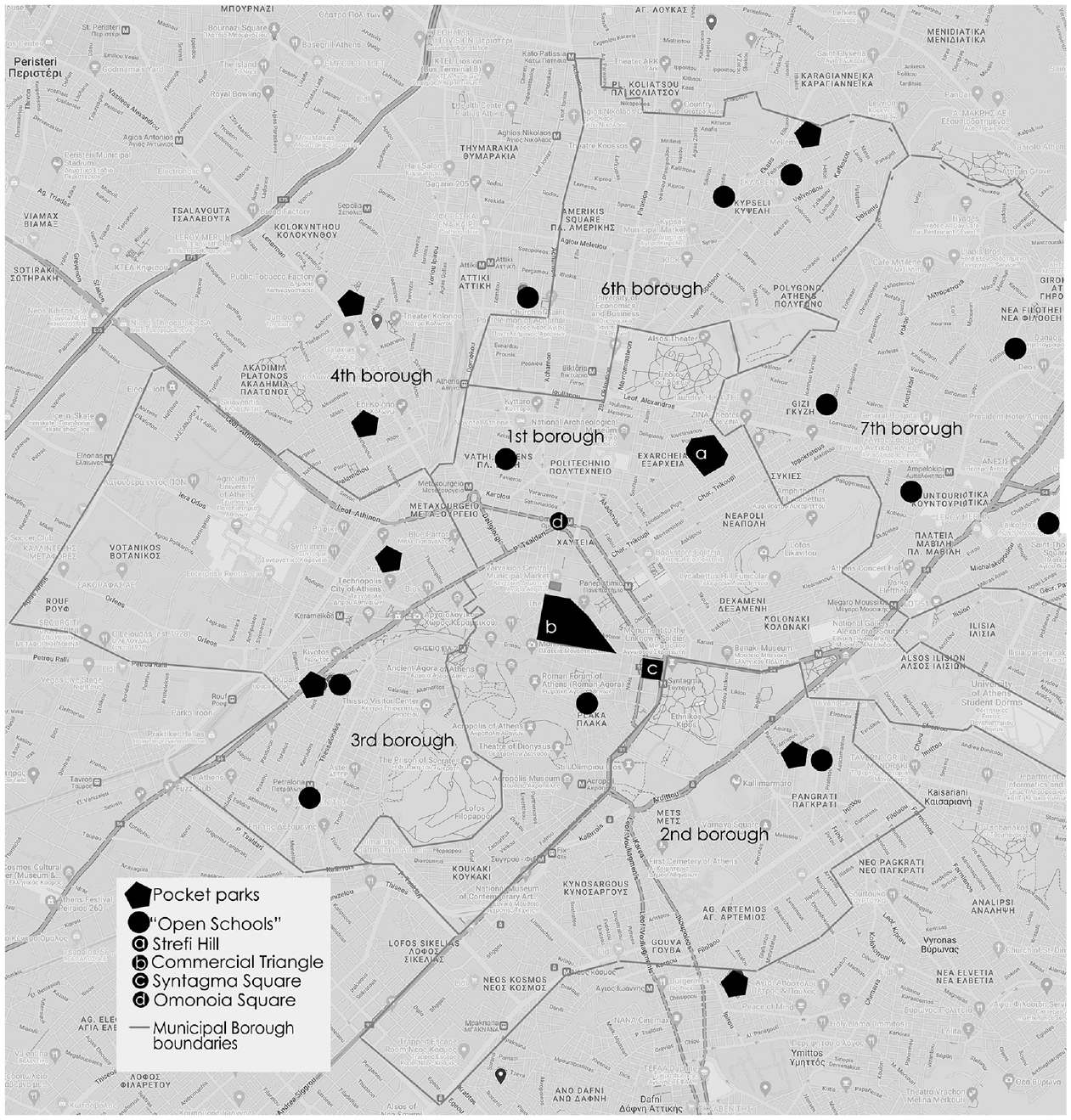
Athens Partnership’s public space related key projects and their location within the city of Athens.
According to Athens Partnership’s 2015–2018 General Manager, Athens Partnership’s operation was based on two key pillars. First, it was established as an organisation that would be independent from the municipality in terms of staff, funding and operation. Highlighting the importance of building a transparent and independent organisation, the General Director mentioned ‘When we talk about money, politicians and the public space, the public interest, it is obviously necessary to have transparency and it is very dangerous to establish relations of dependence [with the municipality]’ (I1, 2021). Second, Athens Partnership aimed to engage in projects that would be prioritised by the municipality itself; projects ‘commonly accepted […] things on which more or less everyone agrees’ (I1, 2021) or ‘structures with a large impact that will remain in the city in the long-term and procedures that can be used in the future’ (I3, 2021). The vision was, thus, the creation of an organisation that will cooperate with public and private bodies in a consensual framework for the achievement of the ‘common good’, which, however, remains unclear. Through the collaboration of supposedly independent but greatly interdependent actors, Athens Partnership has built a post-political common framework of joint action and shared values (Swyngedouw, 2005) through which private and non-governmental organisations will act as sponsors or donors and intervene and influence urban governance and planning processes.
Building on these two pillars, Athens Partnership’s key decision-making body was the Administrative Council. The Administrative Council consisted of five people but ruled out the possible participation of the mayor of Athens, even ex officio, to ensure the independence of the organisation from any political actor (I1, 2021). Each of the projects supported by Athens Partnership at this time had a separate project team, whose members were selected according to specific rules by Athens Partnership (I1, I2). Aiming to avoid the risk of personal choices, the choice was not made by the municipality. As Athens Partnership’s then General Director mentioned: ‘the municipality should feel okay with the people it works with but it should not be able to select them, because we could not be sure that there will be no political choices’ (I1, 2021). However, the municipality had the right to pose a veto during the selection process of the project manager of each project. Following proposals made by the municipality and other stakeholders, three nominations were put forward and after an evaluation process, the appropriate project manager was selected (I1, 2021).
Focussing on the ‘Pilot upgrade of the Commercial Triangle’, the multi-stakeholder governance structure included two set of actors. The first comprised those who funded the project: the project was mainly funded by the Stavros Niarchos Foundation, while individual donors were also involved for funding aspects of the project, such as the cleaning of graffiti and the organisation of cultural events. A second set of actors, the project management team, consisted of the local project team (project manager, operations manager, communications manager, etc.) as well as the global project team, which comprised four members of Bloomberg Associates who acted as consultants. These members visited Athens approximately every two months and had regular online communication with the local project manager once a week (I2, 2022).
Overall, during this first period, Athens Partnership functioned independently from the municipal authority but at the same time it built a network of highly interdependent actors: Bloomberg Associates as urban policy-making consultants, SNF as the main donor of projects, private actors as donors for specific parts of the projects, the municipal services which collaborate with local project groups for each of the projects (in which private individuals, universities, etc. participate), and Athens Partnership as the body that coordinates the collaboration of public and private bodies.
Projects
In the period 2015–2018, the main sponsor of Athens Partnership’s programmes and projects was SNF and most of the projects were supported by other private bodies. According to the analysis of data of Athens Partnership’s 2015–2018 Annual Reports, 6 most of the donors are companies and institutions based abroad with the following areas of activity: charity (e.g. The Hellenic Initiative, Open Society Foundations), consulting services (e.g. Bloomberg Associates, Accenture), telecommunications (e.g. Cosmote, Vodafone) and technology (e.g. Microsoft, Oracle). In terms of the type of programmes, most of them belong to the areas of social policy (e.g. Kypseli Municipal Clinic, Disaster Relief), technology (e.g. Athens Digital Lab) and public space (e.g. Open Schools, This is how I learn better, Commercial Triangle Pilot Upgrade).
Focussing on the last category, public space projects, the key approach embraced in the majority of the project, in the years 2015–2018, was that of participatory planning and/or tactical urbanism. Drawing on the ‘Pilot upgrade of the Commercial Triangle’, the approach introduced by the Bloomberg Associates team and adopted by the local team was that of participatory planning through tactical urbanism actions (Lydon and Garcia, 2015; Tonkiss, 2013). In particular, the local project manager worked closely with Bloomberg’s former New York City borough commissioner, Janette Sadik-Khan, to promote tactical urbanism projects, similar to the tactical urbanism interventions in Times Square (Bloomberg Philanthropies, 2019; Sadik-Khan and Solomonow, 2017). The main axis of the whole project was the implementation of a series of participatory interventions which would be based on the systematic involvement of users in the design process (Athens Trigono, 2019). Adopting the motto ‘The Municipality of Athens together with you changes the commercial triangle’, the project team organised a series of participatory actions, such as questionnaires for shopkeepers and visitors, art activities in collaboration with young artists and the involvement of shopkeepers in the ‘adoption’ of temporary equipment (I2, 2021). Moreover, the local project team organised and implemented several temporary urbanism interventions, such as street painting and the installation of wooden urban equipment, cultural events, and the cleaning of graffiti and street art interventions.
The integration of participatory planning into multi-level governance schemes has significant advantages over hierarchical decision-making and urban planning models, such as empowering local communities, strengthening the voice and demands of residents, and integrating local knowledge into formal policies (Innes and Booher, 2004; Newman, 2005). However, it has also been criticised as a tool for legitimising already decided urban policies, which are determined by local or global ‘experts’ (Ghose, 2005; Lombard, 2013). As Taylor (2003: 13) argues, citizen participation in such schemes can be understood as ‘a cost-cutting and legitimising strategy by the state that gives market-based structural adjustment policies a “human face” but still construct the terms of participation in the language of the possible’. In the case of the ‘Pilot Upgrade of the Commercial Triangle’ as well as similar projects of the period like the ‘This is how I learn better’, participatory urbanism constitutes yet another trait of the post-political urban governance of the period: a policy and practice that is transferred from city to city around the world like a ‘one-size-fits-all, ready-for-wear template’ (Carr and Hesse, 2020). Residents’ participation is used as a pretext of democracy to provide consensus to already-taken decisions and directions given by local and global stakeholders.
Second period (2019–today): Linear governance arrangements and public space adoptions
Governance structure and operation
In 2019, immediately after the municipal elections and the change of municipal authority, Athens Partnership’s structure, organisation and operation changed. Since 2019, Athens’ municipality has been led by Mayor Bakoyiannis, supported by the conservative right New Democracy party. Drawing on Poulantzas, scholars argue that Greece has experienced the development of neoliberal authoritarianism or ‘peripheral authoritarian neoliberalism’ (Kouvélakis, 2018) during the crisis and especially with the New Democracy (ND) government. This was characterised by ‘an autocratic form of executive governance that is based on legislating class-related reforms, propaganda and effective control of the mainstream media, and coercive force’ (Mylonas, 2021: 181). As Mylonas (2021: 204) states, ‘the ND administration unfolds an executive form of governance, which reflects neoliberal authoritarian trajectories as they occur elsewhere’. Moreover, Bruff (2014: 115) argues that authoritarianism should not be viewed as ‘merely the exercise of brute coercive force (for instance policing of demonstrations, racist political rhetoric, etc)’. Rather, it is also rooted ‘in the reconfiguring of the state into a less democratic entity through constitutional and legal changes that seek to insulate it from social and political conflict’ (Bruff, 2014: 113).
ND’s authoritarian neoliberal governance approach was adopted and translated at the local level by Bakoyiannis’ government. For instance, prioritising a ‘safe Athens’, Bakoyiannis supported the eviction of migrant solidarity and other squats and the placement of riot police in specific neighbourhoods of the city like Exarcheia (e.g. King and Manoussaki-Adamopoulou, 2019). In parallel, instead of investing in public space projects in the Athenian neighbourhoods, he promoted public–private partnerships for public space regeneration, aiming to strengthen the tourist character of Athens’ city centre and to attract tourists and investors. As analysed below with a focus on the municipality’s collaboration with Athens Partnership, the emerging authoritarian neoliberal consensus-oriented form of governance was based on the concentration of power in few people and the surpassing of existing accountability processes.
While Athens Partnership’s members argued that their intention was to continue their cooperation with the municipality under the framework of the previous period (I1, I2, 2021), significant changes occurred in terms of its independence from the municipal authority. Since 2019, the Athens Partnership is considered a municipal body. As the Deputy Mayor of Urban Infrastructure and Urban Planning mentioned: ‘the municipality has Athens Partnership, which is a municipal company’ (I5, 2021). Moreover, while the key governing bodies remained the same, their decision-making power and dynamics changed significantly. Most of the previous members of the Administrative Council withdrew while new members – less in number – got involved. The complex network of people with different responsibilities involved in the management of the organisation and of individual projects has been replaced by a narrow structure consisting mainly of four members of the Administrative Council and the General Director, who is now considered as the one ‘who runs essentially the entire project’ (I4, 2021).
In parallel, the decision-making processes of the previous period changed significantly. According to a member of the Administrative Council (S3), the latter’s collective procedures are not carried out regularly. Indicative is the process regarding a donation by the real-estate investment company Prodea Investments for the regeneration of Strefi Hill (Ethnos, 2021b). Two members of the Administrative Council highlighted the lack of information-sharing and collective decision-making, even by e-mail, as was often the case due to COVID-19 restrictions. As they write in the letter published on social media in January 2021:
The Administrative Council has not met (for a long time) and we were never asked to discuss the proposal of the donation for the regeneration of the Strefi Hill, as the Municipal Authority claimed in order to give a picture of order in terms of a non-existent institutional process. This proposal is problematic in many ways, first of all in terms of the process that moves outside Athens Partnership’s character since not even a consultation process happened.
As can be seen from the above, the fairly compact and complex multi-stakeholder operating system of the organisation that was established in the period 2015–2018 to ensure Athens Partnership’s transparency and independence from the municipality and other stakeholders, was transformed into a simplistic and centralised operating framework. Rather than suggesting that the consensual arrangement of the first period is more democratic than the centralised one of the second period, I argue that both of them are linked to the emergence of a post-political configuration which takes numerous different forms over time. On the one hand, post-political governance emerges when consensus is being built around expert knowledge and a seemingly more just, participatory and inclusive condition – which however eludes contestation and disagreement. On the other hand, post-politics emerges with the foreclosing of dissensus and real politics by omitting or ignoring institutionalised decision-making and accountability procedures and developing more direct and less transparent relations between involved actors.
Projects
During this second period, Athens Partnership created a new umbrella project, called Adopt your City (2022) which includes interventions of all scales for the ‘protection, upgrading and maintenance of public spaces’ in domains such as cleanliness, lighting, green, sustainable development, homelessness, culture, social solidarity, etc. (Adopt Athens, 2021). The project was inaugurated in December 2019, right after the election of the new municipal government, with a big scale donation programme called ‘Adopt Christmas’ and continued with a first large-scale set of donations in March 2019 including donations of material and equipment related to the COVID-19 pandemic.
A key set of donations under the ‘Adopt your City’ programme refers to donations for public space regeneration and can be divided into two sub-groups. The first one includes donations for small-scale public space upgrading interventions, which the municipality is not able to financially support, such as the Anti-graffiti project. According to the Deputy Mayor of Cleaning and Recycling (I6, 2021), the Cleaning Department is unable to financially support the programme and donations are used to clean main streets and squares, covering the gaps of the under-funded and understaffed municipal department. Moreover, this first sub-group includes donations for larger-scale upgrading interventions. Although these would require complex planning and approval processes, they are presented as upgrading projects to achieve a fast-track process. Moreover, specific public spaces are ‘adopted’ by private actors who have private interests over certain areas. Indicative is the case of Laskarides family which has been involved, since 2013, in urban space regeneration through donations for Syntagma Square on the perimeter of which three hotels belonging to the family are located (Municipality of Athens, 2018). Speaking about Omonia square, the Deputy Mayor of Urban Infrastructure and Urban Planning stated,
If we wanted to regenerate the square in the same way within the existing legal planning framework, the plans would have not been completed even in one and a half years and then, we would have needed two more years for the construction process. So, four years would have passed until Omonia Square would be regenerated. While in this way, in four months the Omonia square will be transformed quickly through a donation. (I5, 2021)
The second sub-group includes donations for planning studies of public space regeneration, such as the regeneration of Strefi Hill by Prodea Developments and donations for pocket park construction studies. Regarding the first case, Prodea Investments is one of the biggest real estate companies in Greece, with many properties in Athens’ city centre and the area of Exarcheia. Prodea’s proposal to adopt and redevelop Strefi Hill was accepted by the municipality without the necessary, for such kinds of projects, consultation with residents. Major contestations against the project have been voiced by residents and organisations that planned interventions will have irreversible environmental damage and that free public access at the hill will be restricted. Regarding the pocket parks, since July 2020, nine pocket parks have been created through donations from private organisations, like Deloitte Foundation or Heraklis Cement Corporation. While small-scale green spaces have significant public health, social, economic and environmental benefits, the governance and planning process that underpins their creation is also an important element. In this case, the donations were utilised by Athens Partnership and the municipality as a way to introduce more flexible and fast-track planning process that surpass existing legal frameworks and formal procedures. The words of the Deputy Mayor of Green and Electricity are indicative:
You tell them [to the company] ‘it’s my property, come and fix it’. They do a rough planning study and you say ‘we’re okay, go ahead’. […] The gain for the city is that spaces are rendered immediately ready. Imagine if you had to prepare a proper planning study that, coupled with the construction, it would take approximately two years. Our way, you have a new green space ready in just two months. (I7, 2021)
In conclusion, regarding Athens Partnership’s projects and interventions in the period 2019–2021, the emphasis was placed on the speed of completion of projects and the achievement of the desired result, bypassing formal planning procedures. As the Deputy Mayor of Urban Infrastructure and Urban Planning mentioned: ‘Participation of the private initiative does not stem from the lack of resources, but comes to solve the problem of speed’ (I5, 2021). The flexible governance structure introduced by Athens Partnership thus provides the framework for bypassing public planning and accountability processes, and now even large-scale public space regeneration projects are understood as simple procedures for accepting, or not, a philanthropic donation.
Conclusion
This paper contributes to both the emerging geographical literature on the impact of philanthropy on urban governance and the post-foundational geographies of post-politicisation. In this respect, drawing from Athens amidst austerity, I explored philanthropic investment in public space governance and planning, the relation of philanthropic donors with municipal actors and the impact these new governance structures have on urban politics. I argued that the turn towards philanthropic giving gave birth to a new donor-based philanthrocapitalistic regime of post-political urban governance which was transformed, over the years, as a result of the changing directions, priorities and aims of both the local government and the intermediate governance body that manages philanthropic giving, that is, Athens Partnership.
In specific, the post-politicisation of urban governance was materialised differently in two different periods. Over the years, Athens Partnership turned from multi-stakeholder consensual networks to a more linear governance model. The relationship between Athens Partnership and Athens’ municipal authority becomes more linear and direct. In parallel, it shifted from participatory urban planning and governance approaches to a model of public space adoption which prioritises fast-track processes that often bypass institutionalised planning, transparency and consultation procedures. The common element in both approaches is the essence of post-political urban governance: governance approaches through which ‘democratic debate and disagreement are institutionally and discursively silenced and marginali[s]ed’ (Karaliotas, 2020: 252). However, departing from one-size-fits-all analyses of post-political governance, I argued that the post-politicisation of urban governance through philanthropic giving should be understood as not just a condition that we are living in but as a multidimensional process that changes and mutates across times and spaces. Political disagreement is not only foreclosed through techno-managerial approaches where horizontal networks of experts, consultants and accountancy metrics define governance processes but it is also silenced through authoritarian neoliberal consensus-oriented approaches based on the concentration of power in few people and the surpassing of existing accountability processes.
Building on this, more empirical work is needed on the multiple mutations of the post-political condition through on the ground empirical analysis. Additionally, future work could further elaborate on grassroots political contestation of this philanthrocapitalist shift in local governance. As literature has already emphasised, the post-political condition is not a universal and irreversible condition; rather de-politicisation and re-politicisation should be seen as interrelated processes (Swyngedouw, 2011). In the case of Athens, the novel philanthrocapitalist governance has been contested by one of the larger public space-related movements of recent years reclaiming public spaces as spaces of everyday life, multi-ethnic encounters and democracy. Indicative of this is the ongoing mobilisation against Strefi Hill’s ‘adoption’ by Prodea Investments, through which Exarcheia’s residents collectively claim public space through weekly assemblies and protest marches and rallies.
Footnotes
Acknowledgements
I wish to thank the editor and the three anonymous reviewers for their constructive comments that helped sharpen the argument and improve the quality of the paper. I also thank Evangelia Athanassiou, Lazaros Karaliotas and Maria Karagianni as well as the members of the Cities, Politics and Economies Group (University of Manchester) for their valuable comments on previous versions of this paper.
Declaration of conflicting interests
The author declared no potential conflicts of interest with respect to the research, authorship, and/or publication of this article.
Funding
The author disclosed receipt of the following financial support for the research, authorship, and/or publication of this article: This research is co-financed by Greece and the European Union (European Social Fund- ESF) through the Operational Programme ‘Human Resources Development, Education and Lifelong Learning’ in the context of the project ‘Reinforcement of Postdoctoral Researchers – 2nd Cycle’ (MIS-5033021), implemented by the State Scholarships Foundation (IKY).
