




Abstract
This paper draws together issues of urban development-induced displacement and resettlement and the quality of life of the affected population over the longer term. It reviews settlement strategies related to the Kolkata Environmental Improvement Project, exploring residents’ recollection of the relocation process and comparing and contrasting the situation over time of two groups of low-income households: those who refused a resettlement package and chose to continue to reside in their canalside huts; and those who accepted the package and moved into new flats provided by the government. The paper highlights issues of livelihoods, social cohesion and sanitation among both sets of households to find out whether those who were resettled experienced improvement in these aspects of their lives. Findings point to resettled households’ overall satisfaction with sanitation despite periodic lapses in functioning, and a modicum of social support, but significant livelihood problems among the poorest households, and dissatisfaction with the small size of units.
Keywords
I. Introduction
Urban development-induced displacement (UDID) has a long history in post-independence India but has only received attention from scholars, multilateral agencies, nongovernment organizations and the press in the last two decades.(1) The frequency of displacement has greatly increased since 1991 as Indian cities have responded to demands for more land for infrastructure, economic activities and residential accommodation following the opening up of the economy. In the process, land occupied by the poor in informal settlements and along the sides of roads, canals and railways has become highly vulnerable to repossession by public authorities for real estate development and infrastructure projects.(2)
The lack of a national law on rehabilitation and resettlement in India as a whole until 2003, and the law’s silence over the rights of squatters, has given rise to varied responses by state and city administrations to the occupation of public land in urban areas.(3) The Indian judiciary, since the 1990s, has taken the hard line that squatters on land not belonging to them need not be compensated or resettled in the event of displacement, as they are illegal occupants.(4) However, there have been increasingly strident protests over the takeover of land in rural and peri-urban areas and involuntary displacement arising out of redevelopment and infrastructure upgrading in built-up urban areas. This has slowed down many projects and has finally resulted in involuntary displacement being part of the Right to Fair Compensation and Transparency in Land Acquisition, Rehabilitation and Resettlement Act, 2013.(5)
Along with the growing literature on urban development-induced displacement and resettlement (UDIDR) planned and implemented from above, and its more general impacts on the affected population, there has been increasing interest in what happens on the ground at the micro level where these processes unfold. This includes, for instance, the reactions of the affected population, the extent of their acquiescence/resistance to these plans, and the strategies they use to hold on to their homes or to bargain for better compensation/resettlement deals.(6) Micro-level studies have generally revealed the adverse situation of the resettled population. This is characterized by multiple losses, including loss of homes, livelihoods and community resources, leading to even greater impoverishment after resettlement.(7) Case studies from different parts of the country have also pointed to the poor quality of resettled housing units, their small size, and their distance from existing employment sources and schools.(8) Resettlement has been particularly hard on women due to greater job losses.(9)
Most of these studies have been based on cross-sectional data gathered at one point in time, with residents asked to recall life before and after relocation. Studies based on data on the same households over more than one point in time are infrequent. More detailed attention is needed on what happens over time in these relocation projects. Are all the resettled households equally disadvantaged? And how does life in the resettled housing complex compare with that in their old homes? This paper highlights the importance of looking at UDIDR issues across a time span of several years, particularly in expanding cities with a growing population and changing aspirations. As Rittel and Webber explain, the full consequences of major public policy intervention “cannot be appraised until the waves of repercussions have completely run out”.(10)
The situation described in this paper took place in the context of displacement and resettlement resulting from an Asian Development Bank (ADB)-funded programme to improve Kolkata’s environment. Called the Kolkata Environmental Improvement Project (KEIP), it was started in 2000 and completed in 2014. The paper reviews KEIP’s resettlement strategies in light of it being labelled a “successful” programme, by comparing and contrasting the life situations of two groups of low-income households.(11) One of these groups was comprised of those who refused the resettlement package offered by the government and chose to continue to reside in their canalside huts. Those in the second group accepted the package and moved into new flats provided by the government in 2010. Households in both groups were surveyed in 2013 and again contacted in 2017 and 2018. Particular attention is given in this paper to the impacts over time on livelihoods, sanitation and general wellbeing in both sets of households, to determine whether these aspects improved or worsened for those who were resettled after they moved to government-built flats.
II. Urban Growth and Governance in West Bengal and Kolkata
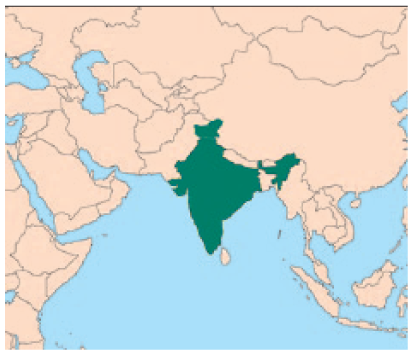
Within India there are differences in the process of UDID and its implementation at ground level, reflecting the economic and political exigencies of the sub-national state, its dominant political parties and their competing visions of development. West Bengal, the state where Kolkata is located, is particularly interesting as it has had a post-independence history of left-leaning politics that spans three decades, followed by the ascendancy of a populist party that came to power in 2011 on a stand of strong opposition to land acquisition. West Bengal is a middle-level state in terms of key social and economic indicators,(12) and its primary urban region, Kolkata Metropolitan Area (KMA), is India’s third largest in terms of population (14.1 million in 2011), after Mumbai and Delhi (Map 1). Within KMA, Kolkata Municipal Corporation (KMC) is the largest urban body, with an area of 200.71 square kilometres as of September 2012 and 4.49 million people in 2011, or around 30 per cent of the KMA’s population.(13) Over the years, the geographical area of the city has steadily increased, with higher population growth in the outer wards.(14) The latest addition to its area occurred in 2012, when the outgrowth of Joka was added to the southwestern edge of the city, bringing the total number of KMC wards from 141 to 144.
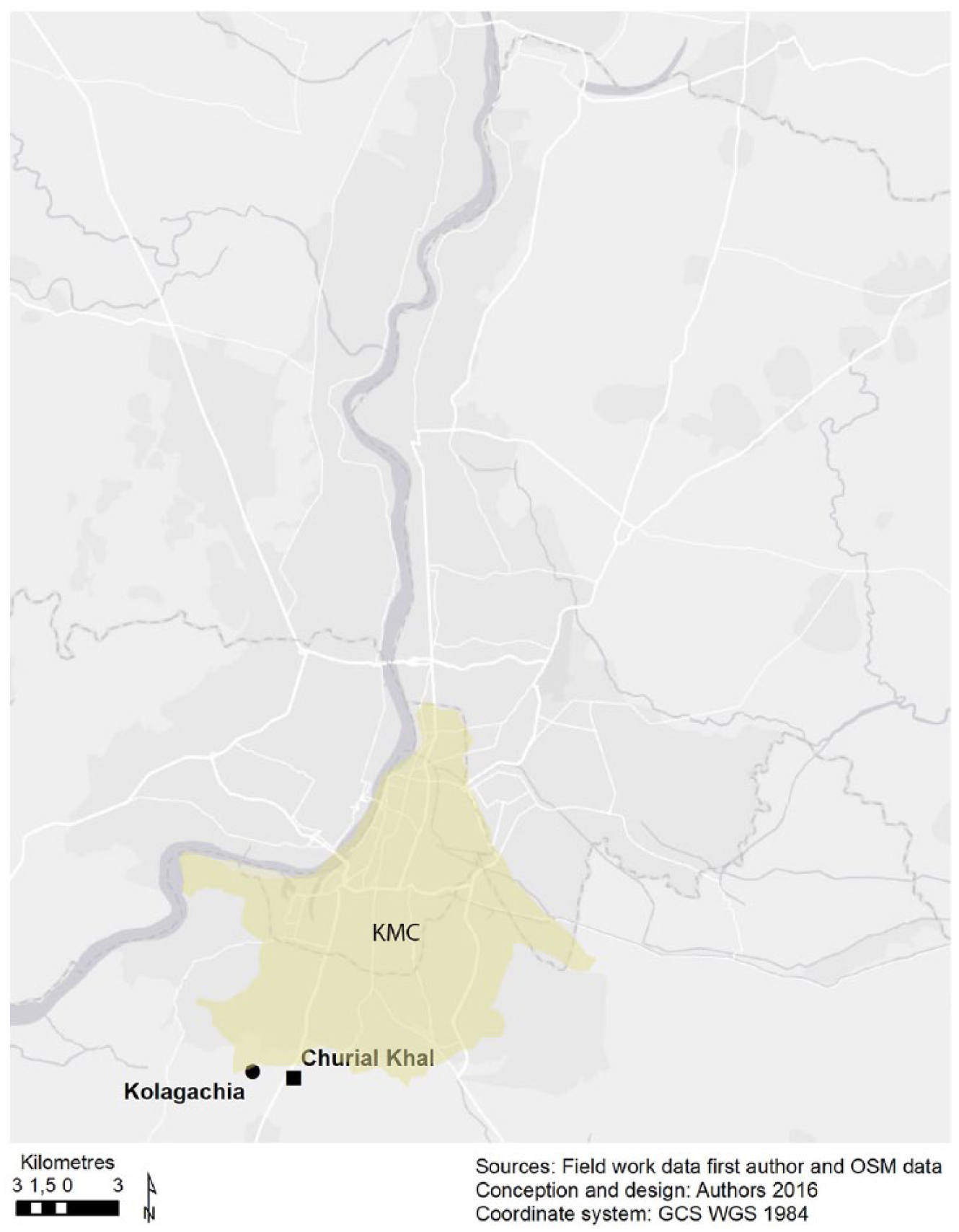
Kolkata Metropolitan Area map
Important for understanding the present situation of West Bengal and the Kolkata metropolitan region is the state’s political history. This was marked, following the partition of the country in 1947 and its turbulent aftermath, by the loss of critical economic resources (fertile rice and jute-growing areas) to East Pakistan, and by an influx of over 3 million refugees.(15) This influx resulted, according to Chatterji, in a “rapid, unplanned and unprecedented explosion in the rate of Bengal’s urbanisation”,(16) with profound consequences for its economy and society. An official failure to adequately address refugee needs and the state’s shattered economy created a groundswell of support for left-leaning parties. And in 1977, a coalition of leftist parties dominated by the Communist Party of India (Marxist) came to power.(17) Following major protests over this government’s attempt at land acquisition to facilitate large-scale industrialization, an anti-land acquisition movement led by the Trinamul Congress, the leading opposition party, won a resounding electoral victory in 2011, and formed the present government.
This government has avoided large-scale land acquisition and its consequent displacement. But without the subsidy of cheaply available land provided by the government, big industry has continued to avoid the state. However, there has been considerable public investment in infrastructure improvements in Kolkata, including the expansion of the underground metro system, new flyovers, new hospitals, upgrading of the Hugli riverfront, and widening of the Eastern Metropolitan (EM) Bypass, an important traffic artery. Encroachment by squatters on public land and the government’s reluctance to remove them has delayed several of these projects. The logjams over encroachment have been settled after protracted negotiation, with either monetary compensation or housing provided by the government. In the case of the removal of hawkers along sections of the EM Bypass, small kiosks have been provided along the highway for the continuation of their livelihoods.(18) While these measures have helped to keep the social peace during the upgrading of the city’s infrastructure, and have improved the bargaining position of those who might have been ousted by UDID, the state government is not following a binding, consistent policy on these concerns. Official responses to UDID issues are still on a case-by-case basis.(19) Thus, individual cases of UDID are significant as they shed light on the varied outcomes and long-term impacts. The Kolkata Environmental Improvement Project’s canal improvement programme, which involved the displacement and resettlement of around 3,000 households, is one such case.
III. Methodology
This study utilized a mixed-methods design, with data from household surveys, interviews and focus group discussions. The survey involved the purposive sampling of 97 households, some still living along the Churial Khal canal and some that had accepted the government’s offer of alternate housing and moved to Kolagachia. Those displaced from the other canals – in particular, Keorapukur and Tollygunge-Panchanan (TP) Basin – have been studied by other researchers.(20) We chose this canalside primarily because it was still understudied, given the relatively remote location of Kolagachia, where most of the displaced Churial households were resettled. This canalside is also an interesting case as a multiplicity of outcomes reveals not only the differences within the affected population, but also the presence of grassroots action in response to misgivings about KEIP’s resettlement plan.(21)
The Churial Khal survey (near Eni Sarani-Lohar Pole) included 74 households and took place during May and September 2013. In Kolagachia, the resettlement site, 23 households were surveyed in October (Map 2).(22) The comparatively small sample size in Kolagachia is one of the limitations of this research and was mainly due to the lack of public transport to the area (a serious problem also for local residents). We realized this only after the survey of Churial Khal had been completed and this survey had started. However, of the 55 families from Churial Khal living in Kolagachia (out of a total of 157 households), 41 per cent were covered by this small sample.(23) In the final analysis, we felt the limitations imposed by this site were outweighed by the advantages and we chose to go ahead.
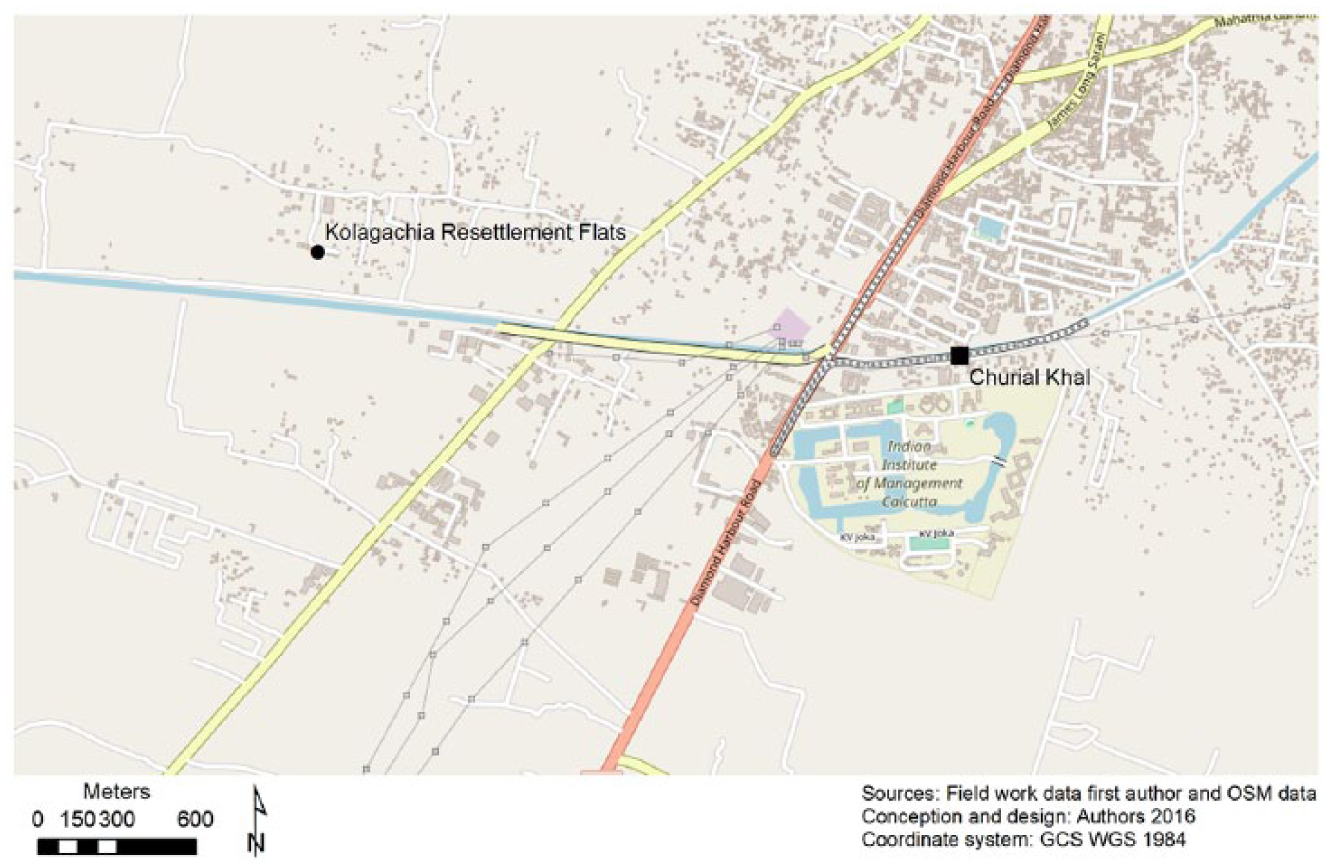
Local area map showing the two settlements
In addition to the survey, a one-hour focus group discussion with 30 to 35 people was conducted in Churial Khal and another one-hour discussion with 10–12 women in Kolagachia, to understand the motivations behind the decision to stay or move, and for information on the relocation process. In both places, a smaller group then took us around their settlement to show us some of the specific problems they were facing.
In November 2017, follow-up visits were made to both settlements. This time a two-hour focus group discussion was conducted with 20 to 30 people in Churial Khal and a one-hour discussion with two people in Kolagachia. We also had one-on-one discussions with two community leaders in the canal settlement, and with the president and two board members of the residents’ housing society in Kolagachia, in order to explore livelihood dynamics, housing conditions and the level of satisfaction/dissatisfaction with the current situation. The focus group discussions in both places and in both years were set up and attended by a social worker well known to the two communities. We also had meetings with officials from KEIP, KMC and the Block Development Office in their city offices.
Given the weak response to the November 2017 focus group discussion in Kolagachia, a resurvey of the 23 households surveyed in 2013 was done in July 2018, to allow for a more systematic understanding of the changes in that settlement as well as to elicit the viewpoints of ordinary residents. It entailed spending an hour or more with each household, gathering information on their present socioeconomic condition with several open-ended questions on their sense of wellbeing. Ideally, for comparison purposes, we would have carried out the same additional survey with the canal group, but time and resources were short, and did not permit this. Given the disparate nature of the methods and sample sizes for the two groups of households, our findings are suggestive rather than definitive. However, although practical realities were not conducive to a systematic comparison, they have created the basis for a good understanding of local perceptions of the relocation and its consequences.
IV. Kolkata Environmental Improvement Project (KEIP): Changing Resettlement Policy
Kolkata Environmental Improvement Project (KEIP), a multi-agency organization, was set up in the late 1990s to “arrest environmental degradation and improve the quality of life in Kolkata”.(24) One of its major objectives was to improve environmental conditions in the outer areas of Kolkata, primarily wards added to the city after 1984. In December 2000, the Asian Development Bank (ADB) approved a loan of US$ 250 million to the government of West Bengal for this purpose. ADB would finance 69 per cent of total project costs, with the balance from the state and KMC.(25) The project was to be completed by 2007. Its two executing agencies were KMC and the state government’s Irrigation and Waterways Department.
The project had the following six components: a stakeholder consultation process, sewerage and drainage improvements, solid waste management, slum improvements, canal improvements, and implementation assistance together with capacity building. Most of the displacement of squatter households was anticipated to come from the canal improvements (desilting and lining) proposed for sections of canals in TP Basin, Keorapukur, Monikhali and Churial. Removal of squatters living along the sides of these canals was regarded as necessary, and an initial resettlement plan was prepared in 2000, based on ADB’s involuntary resettlement policy and India’s 1894 Land Acquisition Act. The affected population, 3,626 households, could move to a place of their choice with compensation for the replacement value of their existing dwelling, or be given a plot at a relocation site.(26) Where relocation was unavoidable, people were to be moved to sites as close as possible to their existing homes – ideally within 800 metres but up to 2 kilometres where this could not be avoided. The plan was drawn up after discussions with “key people and stakeholders” including women, who were consulted on site selection, livelihood, civic and housing issues. Each household was given an identity card after a house-to-house survey by an NGO. Implementation was slow. “Start-up delays”, mostly due to land issues, led to rethinking about resettlement entitlements and to design changes in the programme to reduce the number of affected households.(27)
Despite another KEIP census in 2005, confirming the exact number of affected households to be 3,626, project design changes reduced this to 3,365. The official plan also changed from the provision of land plots to the provision of 17.65-square metre flats under the central government’s VAMBY/BSUP programme, with connections to basic services, allotted on a 99-year non-resalable lease.(28) According to KEIP, this change was “not imposed by the Project, but was discussed with APs [affected persons]” and “APs took their own decisions, all opting for the scheme based on their individual assessments”.(29) But in fact not “all” did opt for this scheme. By 2011, 298 households had refused to move and the number of affected households was further reduced to 3,067.(30) A still further reduction of 187 took place by 2012 and ultimately, 2,880 households were provided with one-room flats on land purchased by the government.(31)
KEIP’s official documents suggest an almost 100 per cent relocation and resettlement of affected households, with a few having opted to stay along the canalsides for reasons such as ongoing regularization of their settlement and the nearby locations of their shops. The fieldwork along the Churial canal in 2013 and 2017 reveals another story, one not mentioned in the KEIP reports – namely, dissatisfaction with KEIP’s compensation. According to members of affected households, the first resettlement plan was broadly accepted as it entailed the provision of plots of land where people could build their own houses. Later changes to this plan, made without consultation, left them feeling betrayed, and the numbers willing to relocate fell sharply, as noted.
ADB’s Social Monitoring Report(32) notes, “the significance of change in resettlement plan cannot be denied and the time available for stakeholder consultation was not adequate since the approved revised RP had to be implemented without further delay”. It is generally not publicly acknowledged that there were households that refused to move because of their dissatisfaction with KEIP’s compensation. A senior officer recently claimed, “I am 100% sure that all the households were shifted. 2002 was decided as the cutoff date and all the households that were identified as affected population from Churial Khal were relocated to Kolagachia.”(33) This makes the entire process of resettlement look conflict free and well managed. Our study findings, based on discussions and a household survey of 74 of the 85 families in the Eni Sarani-Lohar Pole settlement that refused to move, show otherwise.(34)
V. Moving or Staying: Triggers and Effects on Churial Canal Households 2013
a. Those who stayed
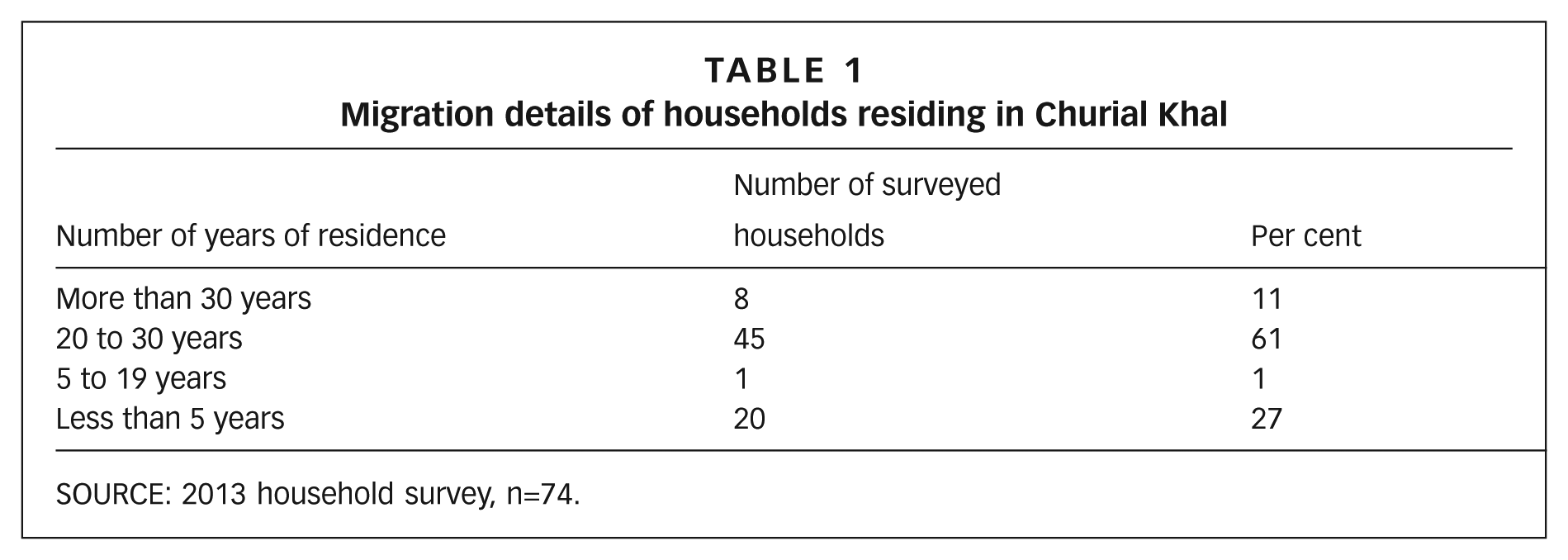
The Churial Khal settlement near Eni Sarani-Lohar Pole has existed for almost four decades (Photo 1). Original settlers recalled that dense vegetation and the presence of snakes made the land initially unfit for human habitation. Political patronage by the erstwhile Communist Party, then in power, encouraged households to settle along the canal. They served as a vote bank in the electoral process and in return got a rent-free place of residence. Most were migrants from other districts in West Bengal, a large number of them refugees from the 1971 Bangladesh liberation war. Of the 74 households surveyed on the canalside in 2013, 53 or 71 per cent had been living there over 20 years (Table 1).
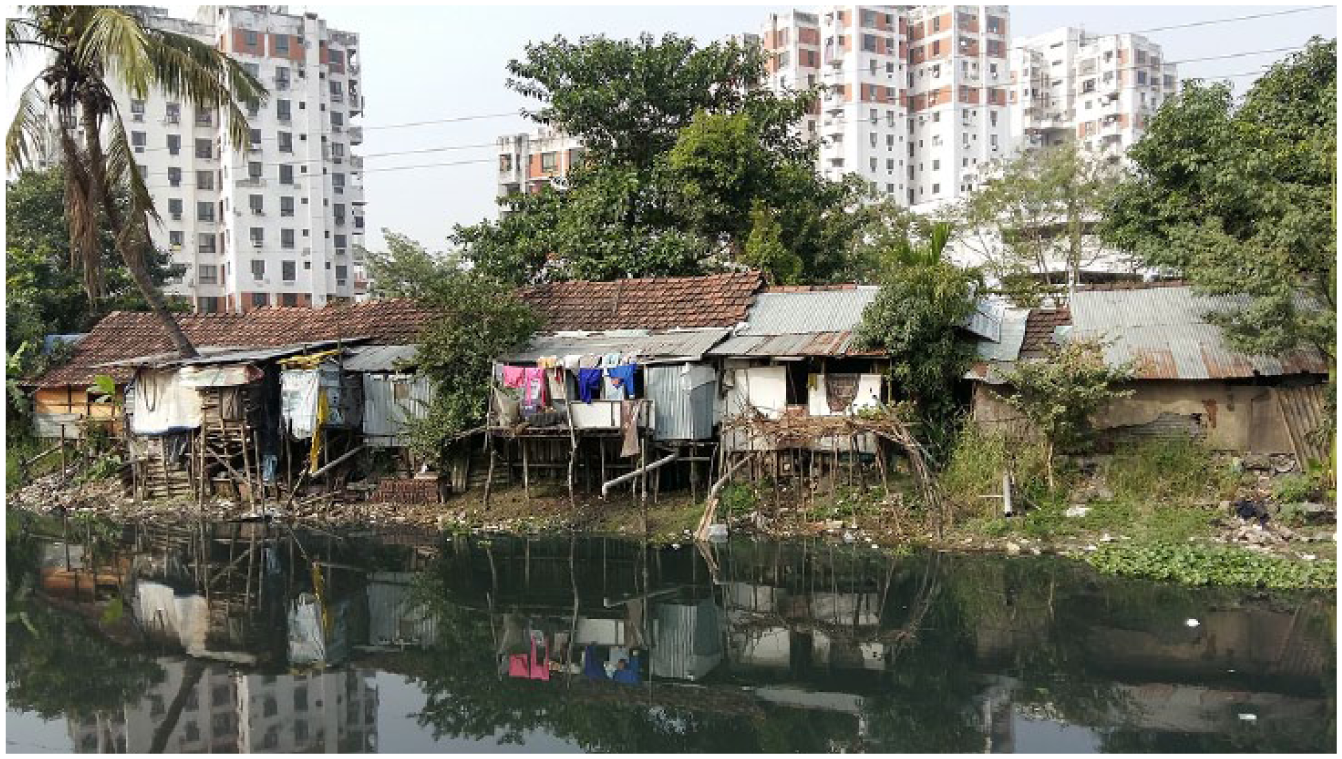
Churial Khal
Migration details of households residing in Churial Khal
SOURCE: 2013 household survey, n=74.
After the first KEIP household survey in 1999, when the plan still involved the allocation of replacement plots of land where they could have legal title and build their own houses, the residents of Churial Khal accepted the relocation offer. Community leaders were even involved in the attempts to find suitable land nearby. When such a piece of privately owned agricultural land was found just opposite their settlement in Kalua Mouza, South 24-Parganas, it was brought to the notice of the government, which did not buy it, however.(35)
Instead, another plot (2.035 acres) was purchased about 6 kilometres away in a rural, undeveloped area of panchayat(36) land in Kolagachia, outside the boundaries of the Kolkata Municipal Corporation. The canal residents were told that they would be provided with one-room flats in three-storey buildings in that location, and not the plots of land earlier promised.(37) They quickly realized that this was a poor deal, and felt betrayed by the change in resettlement plan, made without consulting them. Under the leadership of a local carpenter, around half of the identified Churial canal households chose not to accept the government’s offer and to remain where they were. For those with large families, the small size of the proposed units, which had no potential for incremental expansion, was another negative feature. On the canalside, settlers just added rooms as their families grew, and families with multiple adults occupied several units. There was no scope for this in the government’s plan for resettlement. Thus the number of affected households on the Churial Main canal to be provided flats also declined in the KEIP’s estimates from 327 to 211 by 2013.(38)
While the KEIP Project had planned to develop the vacated canal banks as green walkways, ensuring they were not encroached again, this never happened. Soon the vacated land was thriving again, with both new settlers and the extended families of the multigenerational households who had initially moved to the relocation flats but found living there difficult because of space and privacy constraints. This new wave of migration to the settlement in the last five years represents 27 per cent of the sampled households as shown in Table 1.
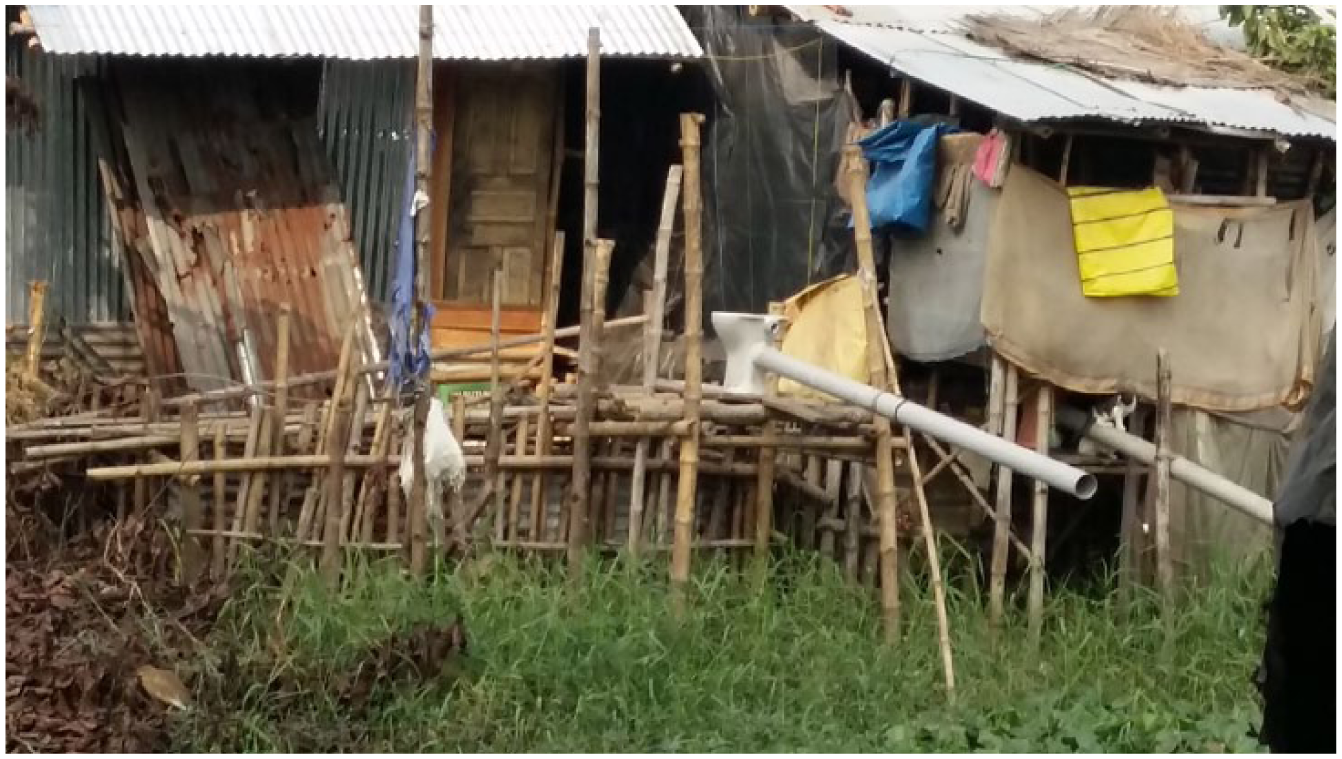
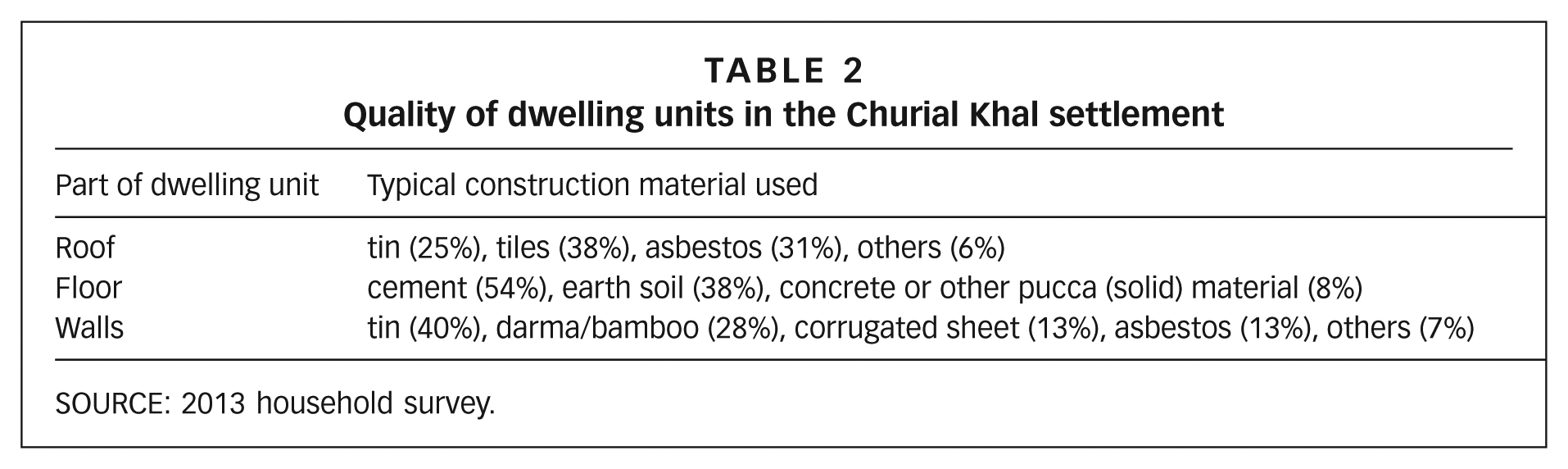
Hidden from the main thoroughfare, Diamond Harbour Road, by a curve in the canal, this linear informal settlement provides a convenient home to around 200 households. A wooden footbridge (Kather Pole) connects their huts to a narrow connector road on the other side of the canal, dividing the settlement into the “right side” and “left side” of Kather Pole. The eastern end of the settlement is bound by an iron bridge (Lohar Pole). The semi-permanent houses of the residents, mostly 9.29 to 13.94 square metres in size, overlook the canal where toilet wastes are deposited via tiny toilets on stilts (Photo 2). Table 2 provides more details on housing quality.
Churial Khal toilet
Quality of dwelling units in the Churial Khal settlement
SOURCE: 2013 household survey.
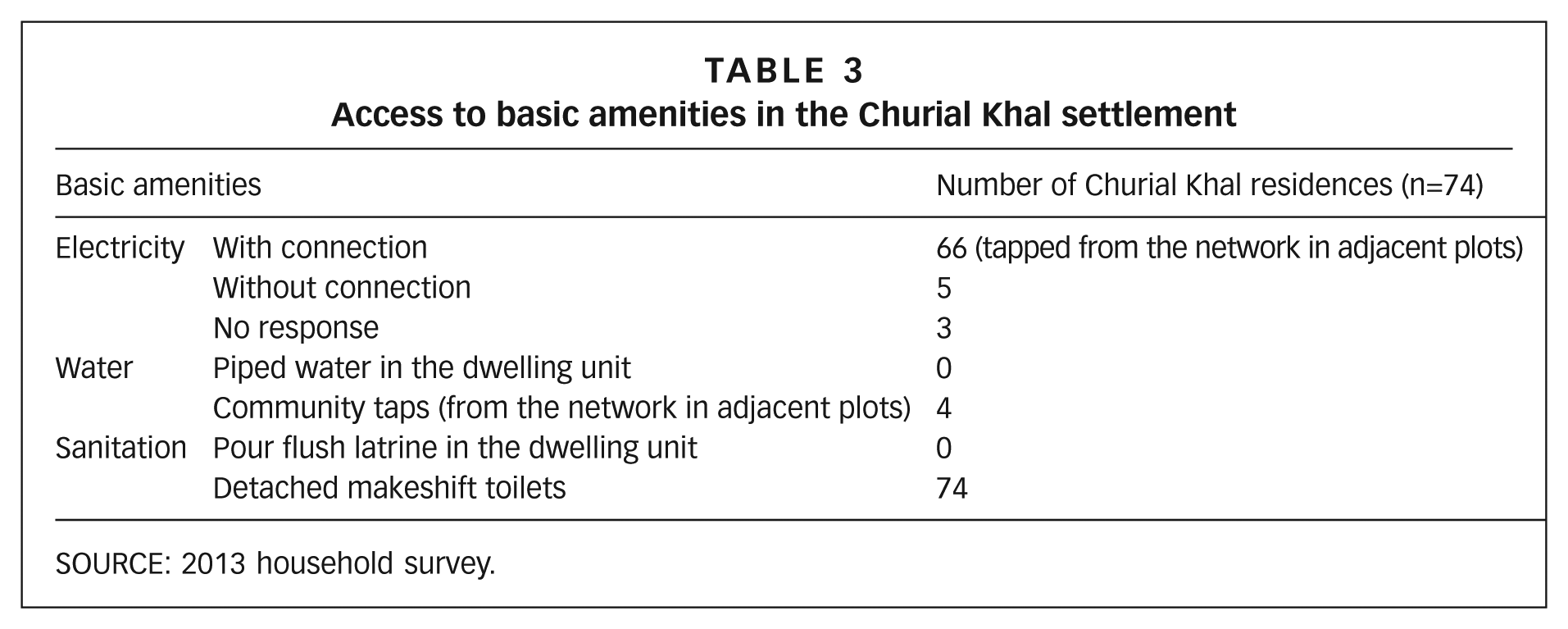
When the canal waters overflow during heavy monsoons, living conditions become unhygienic and unsafe. Wastes float into people’s homes, and cleanliness is a challenge throughout the year. Only 34 per cent of the houses surveyed had clean surroundings, 41 per cent were at a tolerable level and 26 per cent in bad condition. Basic amenities accessible to these households are shown in Table 3.
Access to basic amenities in the Churial Khal settlement
SOURCE: 2013 household survey.
The canalside settlement also has appealing features. The pathways created by the residents are lined with fruit trees and vegetation, goats and hens are raised in small enclosures, community spaces such as temples are interspersed between the huts, and the settlement is a liveable rent-free place for the poor.
An added advantage of this location is the proximity of a major transport hub and several large middle-class residential complexes, where women from Churial Khal readily find work as maids (Tables S1 and S2 in the online supplement). There are also customers for services such as rickshaw taxis, house painting and fixing, and furniture-making in the area. Several schools are also located nearby and school enrolment is high among the households.
b. Those who relocated
If the government’s offer was so unattractive, why did 114 families in this area accept it and move? Interviews with relocated households reveal that their choice was largely related to their hopes for proper housing, to not having to deal with floating waste during heavy monsoon rains, and to the possibility of some kind of legality. Family size was also a factor. Those who moved tended to have smaller families and the small flat sizes would have affected them less. Among those households that stayed in the old settlement, 45 per cent had five or more family members, with over 11 per cent having more than eight members. The relocated households were far smaller. Only 9 per cent (two households) had more than four members, and none had more than seven (Table S3 in the online supplement). In some cases this smaller household size resulted from the separation of family members; for instance, a father and mother moved to the flat while their son and his family continued to live on the canalside, or rented a place nearby. As a result of this separation, several of the relocated families remained dissatisfied with the small flat size (Photo 3).
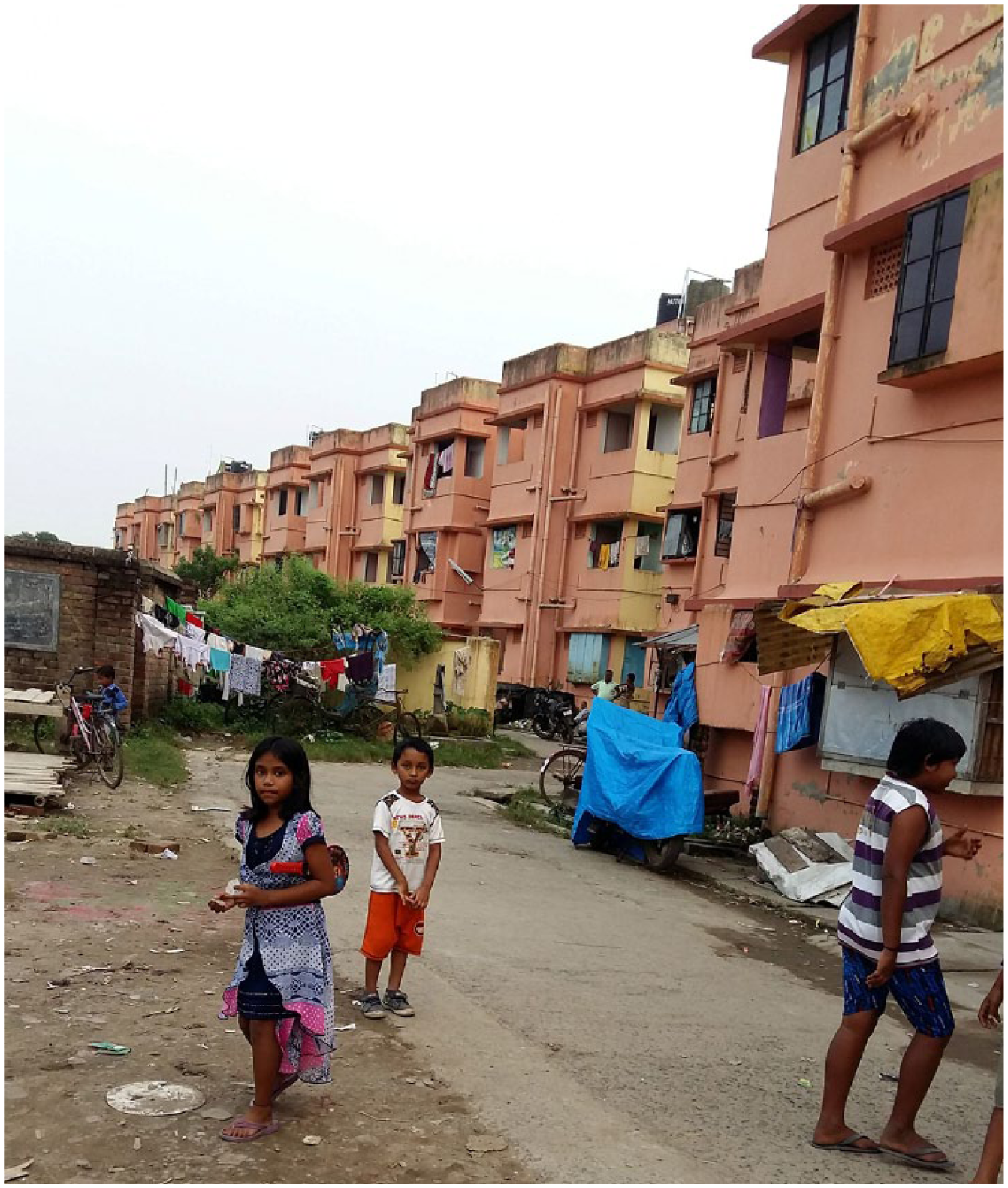
Kolagachia resettlement flats
Interviews with relocated households also indicated that there had been issues of trust and caution around unquestioningly accepting the urging of the local leader and his associates that families not move. Would they regret this in the long run? A few even said that they felt let down by their own leaders who had been unable to secure the first land deal. They wondered whether these leaders had benefitted monetarily by agreeing to the government’s choice of a more distant resettlement site.
The relocated families agreed that Kolagachia was a cleaner home environment with no problems regarding the piped water supply, electricity or toilet facilities, which came in the form of a pour flush latrine inside each flat. This represented a major improvement in living conditions over the conditions along the canal (Table 3). However, even when the buildings were relatively new, there were already signs of cracks along walls and chipping of the edges of stairs, while the grounds of the complex had uncollected litter and some of the drains were over-full. The housing cooperative for overseeing maintenance of the complex was just getting established during the survey in 2013, and its founding members hoped that when it was fully functioning, some of these problems would be sorted out.
There were already financial problems as well. Living in a resettlement flat meant a recurring maintenance cost of Rs. 40 (approx. US$ 0.69) a month for water supply and general upkeep. Electricity bills also had to be paid. At the same time, residents’ location in semi-rural Kolagachia had resulted in a depletion of their economic assets, as many women had discontinued their earlier jobs because of limited and expensive transport. Table S4 in the online supplement shows the significantly lower labour force participation of women in Kolagachia in 2013 than before relocation in 2010. The remote location also made schooling for children more expensive and reduced access to medical facilities that had been readily available before relocation. Buying food and vegetables had also become expensive because there was no affordable market nearby. Meanwhile, legal title to the flats – in the form of a 99-year non-resalable lease in the name of the female head of the family – had been promised but not yet received as of 2013.
VI. The Situation of Churial Khal and Kolagachia Residents in 2017
In November 2017, both the Churial canalside settlement and Kolagachia were revisited. A focus group discussion with the canalside residents took place in front of the main temple of the settlement, where the embankment was wide enough for an informal gathering. On our arrival with their leader, the residents quickly brought out plastic chairs. Between 20 and 30 residents, men and women, sat around for almost two hours talking.
They were still shaken by the recent death of a 12-year-old boy who had fallen into the canal and drowned while going to use a toilet. Although this was a rare occurrence, it highlighted the constant dangers at the site: the risk of flooding during the monsoon, the health hazards from floating waste in their homes, and the daily peril of traversing rickety bamboo tracks to use their tiny toilets built on stilts above the canal. There was also a feeling of uncertainty about the future and how long they would be able to continue living there. They had heard that a future extension of the Joka-BBD Bag metro line might be built through the site.
Despite these serious concerns, however, the residents and their leaders were confident that they had made the right decision in declining the government’s offer of flats. They pointed to several cases of flat owners returning to the canalside and/or selling their flats. There were still feelings of resentment that they had not been given the promised plots of land. Some of the older settlers recounted the haphazard and non-transparent way the flats had been allocated. But most were scornful of the flat size, which was totally inadequate for their larger families.
The settlement showed signs of incremental improvement over the last few years to housing and temples, indicating that economically, the canalside residents had not been doing too badly. Because of the incorporation of the local area into the Kolkata Municipal Corporation in 2011, they were getting electricity legally.(39) But water was still accessed illegally via four community taps connected to the piped network that served bordering residential plots. Sanitation was a continuing problem. The residents still lacked proper toilets, and despite KEIP’s claims of having cleaned and upgraded the canalsides, there continued to be considerable accumulated and floating wastes along the canalsides and near their makeshift toilets, in addition to the waste they themselves were producing.(40)
Our visit to Kolagachia involved a much smaller group discussion, held standing outside the building complex with two persons for an hour. It included an inspection of the building and its surrounding areas. There was an array of problems, some new and some that had been present earlier. The most urgent, at the time, was a breakdown of the sanitation system. Septic tanks were overflowing and drains were clogged with toilet wastes. Most of our discussion focused on why this happened periodically and how it might be solved. The lack of garbage pickup, litter on the premises and poor maintenance of the buildings were mentioned along with the continued absence of a direct bus service to the city, despite some improvement in the roads. One-on-one meetings with the secretary and two board members of the housing society in the society’s office reinforced these concerns and provided some explanation for the periodic sanitation system breakdowns. Although the monthly maintenance cost for each household had been increased to Rs. 60 (US$ 0.93), it was still insufficient to cover all the expenses for proper building upkeep and regular cleaning of the septic tanks and drains.
VII. Resurvey of Kolagachia Households, July 2018
While the information from Kolgachia was useful, it involved only a few residents, several of whom were office bearers of the housing cooperative society, and it addressed only the maintenance concerns. For a fuller, more representative picture, a resurvey of the 23 households interviewed in 2013 was undertaken in July 2018, covering their current socioeconomic conditions with specific questions on livelihoods, social cohesion and sanitation.
Starting with living conditions, the resurvey indicates continuing dissatisfaction with the small size of the housing units. This issue was ranked the biggest challenge post-relocation by 8 of the 23 households and the second biggest challenge by the rest of the households. With the expansion of family size, in the last five years, due to marriages, births and older offspring returning, the population in these 23 households has increased from 75 in 2013 to 91 in 2018. This does not sound like much, yet it is about double the overall urban growth rate in India. Today, 91 per cent of Kolagachia’s surveyed households have three members or more, and 30 per cent have five to six members. The one-room unit, which was tight even when the family was smaller, has become more crowded. Six higher-income households have managed to buy or rent a second flat in the resettlement complex in the last five years. The rent paid is around Rs. 2,000 to 2,500 (US$ 29 to 36) a month. Another three households have held on to their canalside homes, where other family members continue to reside. These means of extending their family’s living space have not gone down well with other residents or with the authorities, who regard these as illegal practices and have withheld the registration of 72 flats in the complex.(41)
A major disadvantage of remaining in the canal settlement has been the lack of access to proper toilets. In this respect, the quality of life of those in Kolagachia remains significantly improved. The resurvey indicates that 19 of the 23 households (82 per cent) still find sanitation is better here, despite its shortcomings. However, households living on the ground floor near the overflowing septic tanks and clogged drains mentioned in the 2017 focus group discussion find that the resulting stench and filth have made their lives unbearable at least two to three times a year. The stench is a problem even on the upper floors. According to a resident plumber, toilets are flooding because “septic tank levels in blocks A, B, and C are higher than the toilet pan”. The seven households in the sample that experienced flooding of their toilets all continued to use the toilet, some placing bricks on the footrest to keep their feet above the water. The situation generally improves after two to three days and even with this problem, four of these households still find the sanitary situation here better than that along the canal.
Faulty sanitation in housing built under the KEIP project has been mentioned in other studies too. In Nonadanga, people frequently complained about “the lack of facilities”.(42) There is a shortage of drinking water and “drainage is another problem. During monsoon season, pipes break and drains get clogged, which causes water to stand still.”(43)
Notwithstanding these problems, government-built housing is still considered better than semi-permanent structures without access to basic amenities. When asked how they would compare their lives now, eight years after relocation, to their previous lives along the canal, a majority (15 households or 65 per cent) stated that it was better here. Common refrains were “we suffered a lot living by the canal” and “every year we don’t have to fix our homes”. Many of the elderly, however, and those who had lost out on earnings due to distance felt differently. To them, “in every way, Khal par was better”. The latter are mostly the poorest households in the sample.
The resurvey has indicated that 74 per cent of these 23 households currently fall under the category of “poor” (earning up to Rs. 120,000 a year or Rs. 10,000 a month [US$ 1,747 a year or 146 a month]). While there is no single formal poverty line, this is the cutoff used by the West Bengal government to determine eligibility for a major state welfare scheme, Kanyashree, targeting economically disadvantaged households.(44) The remainder of the households (26 per cent) are above this cutoff, with annual incomes between Rs. 120,000 and Rs. 300,000 [US$ 1,747 and 4,367], as shown in Table S5 in the online supplement.
However, even among the poor, there is considerable economic variation, with monthly household income ranging from Rs. 1,200 to Rs. 9,000 (US$ 18 to 131). The latter represents either double-earner households or sole earners with higher-paying jobs, more education, better-furnished rooms, and more business assets such as bicycles, rickshaws and rickshaw vans. The poorest, by contrast, remain tied to manual labour and daily wages; they have little or no education and no business assets. In these households, the absence of a second earner can mean very low monthly earnings and a hand-to-mouth existence. Over the long term, the economic differentiation is likely to sharpen, with higher returns to those who have completed 10 years of schooling or acquired a marketable skill. Their better-paying jobs make the transport cost affordable, and two or more such earners in a family can raise household income significantly. The highest earner among the 23 households is an engineer whose father, a rickshaw driver, saved and managed to send him to an engineering college.
For a majority of the resettled households, however, the inadequacy and cost of public transport mean walking to work.(45) Reaching the nearest middle-class residential area for work as domestic workers, maids and cooks can take an hour each way. Some women cycle to work but those who cannot ride a bicycle have mostly dropped out of the labour force. As shown in Table S4 in the online supplement, post-relocation, the number of women workers has fallen from 21 to just 12. The further decline of women’s workforce participation in percentage terms, from 40 per cent to 30 per cent in the last five years, is explained by an increase in the numbers of adult women in several households due to the marriage of sons.
Table S6 in the online supplement shows the monthly household incomes of 17 poor households before they relocated and eight years after resettlement. The income data for 2010 was collected through recall by household members. Even in nominal terms, the average income of the group has declined from Rs. 5,591 in 2010 to Rs. 5,429 (US$ 126 to 79) today, or by 2.89 per cent in nominal rupee terms, with six households experiencing absolute declines and four a marginal increase of Rs. 500 to 600 (US$ 7 to 9) a month. This is happening in a context of a 21 per cent increase in family size in the last five years. As in the case of women earners, distance has hastened the retirement of elderly male earners, who had earned a full income before relocation. The low income of Rs. 1,200 a month (US$ 18) in Household #4 is because the male earner, a raj mistri (skilled mason), retired after moving to Kolagachia and his wife now supports the household as a maid, walking one hour each way to work. Her income and that of the household has fallen since 2013, when it was Rs. 2,500 a month (US$ 41).
Eight years after relocation, the difficulty of earning a livelihood due to distance from old job sites and major markets of the city continues to be a major problem for most Kolagachia households. Twelve households identify it as their most severe challenge post-relocation. Distance from hospitals and schools and the difficulty of finding an affordable means of transport after dark were also mentioned by many households. Several young mothers stated that they faced a tough choice between making it in time for work and dropping their children off at school. These dilemmas are more easily resolved in multigenerational households, which comprise a majority of this sample (there are only seven nuclear households presently). Interestingly, rather than the presence of older women in the household leading to the release of younger women to work in the labour market, as found in urban South India,(46) here it is the older generation of women who have continued to work while their daughters-in-law remain at home. Multigenerational households, on the other hand, face greater financial difficulties. While a majority of households in the sample (65 per cent) have either turned to relatives or solved financial problems on their own, 35 per cent or eight families have borrowed small sums from neighbours. These households, mostly multigenerational, were among the poorest.
Despite their reluctance to turn to neighbours in times of financial difficulty, our findings indicate that help is more readily sought and received in times of illness, especially that of children and the elderly. Given the distance factor and lack of transport after dark, over half the households (56 per cent) have turned to neighbours for help in this situation. This is facilitated by the fact that most families know other families from before, one even claiming to know 48 of the 55 families resettled from the Eni Sarani settlement of Churial Khal. Several families are also related to each other by blood or marriage. Around 70 per cent of the sample households said they interacted with neighbours and other households residing mostly in the E, G and H Blocks of the complex. (The A, B C, and D blocks have households resettled from the Hanshpukur section of Churial Khal and interact with them less.) Only seven households, or 30 per cent of the sample, reported keeping to themselves and not mixing with anyone. Despite the familiarity among the resettled households of Eni Sarani, cooperation for the upkeep of common public goods is very weak.(47)
VIII. Conclusions
In this paper, we have explored an important issue in the context of a lower-middle income country undergoing fairly rapid urban transition – namely, urban development-induced displacement and resettlement, and its impact on the quality of life of the affected population over the longer term. Other research has also explored this issue. The paper, however, has highlighted the need to look at both the households that have been uprooted and resettled as well as households that remained in place, in order to understand the consequences of the impacts more fully. It has also highlighted the need for assessment over more than one point in time. Through surveys and fieldwork conducted in 2013, 2017 and 2018, our findings point in a nuanced way to both drawbacks and advantages for those who stayed and those who left. This is not a simple decision, and the impacts vary according to individual family realities.
Within this particular sample of relocated households, living conditions are better overall, especially with regard to sanitation. There are significant problems with the quality of the sanitation provided, yet it is still an improvement over the absence of any provision. More of an issue for most relocated residents is the small size of the living unit, which does not allow for incremental expansion and has been inadequate for coping with growing families. Livelihoods, however, have been the most serious problem. The location of the resettlement site has made it difficult for women in particular to access employment, and household incomes have dropped overall – a serious concern in the context of expanding household size.
It is important to note, however, that the experience, overall, has been different depending on household income. Among the better-off residents, which include the six non-poor families, a government-provided flat has been beneficial and has allowed them to get ahead without housing worries. For the poorer households, while a flat has been satisfactory from a shelter point of view, its location has meant lower earnings, continued economic hardship and more uncertainties. Its small size has also meant the separation of families. Households do experience support from their neighbours, especially around medical emergencies, but family separations have certainly meant a decline in support systems. It is not surprising that those who chose to stay in the old settlement feel on the whole that their choice was a wise one. While there are ongoing problems there with sanitation and long-term security, this community has tended to experience more flexibility, stability, social cohesion, and gradual improvement in the quality of their living conditions.
Resettlement, however, is often unavoidable, and the findings of this study indicate the need for much more attention to livelihood issues when that is the case. A stronger safety net to take care of shortfalls in monthly incomes among the most vulnerable post-relocation, such as women-headed households and the elderly, must be considered. Location is a critical factor here. A second issue that needs serious attention is the size of the housing unit provided by the government. Clearly, one-room flats for multigenerational families are inadequate, leading to all kinds of illegal transactions on the part of the relocated in order to increase housing space to keep their households from breaking up. Third, there is a clear need for some government oversight/assistance to help tackle the recurrent problems of building upkeep and solid and liquid waste management.
Supplemental Material
shaw-supplement – Supplemental material for Urban development-induced displacement and quality of life in Kolkata
Supplemental material, shaw-supplement for Urban development-induced displacement and quality of life in Kolkata by Annapurna Shaw and Tara Saharan in Environment & Urbanization
Footnotes
Acknowledgements
We thank Mamata Dutta for assistance in the 2013 household survey, Priyanshu Gupta for arranging and collating the 2013 data and Shyamalendu Das for organizing the focus group discussions. We are grateful to Marit de Vries for cartographic work. We also thank the two anonymous referees of the paper and the journal editors for their helpful comments and suggestions.
Supplemental Material
Supplemental material for this article is available online.
1.
Fernandes, Walter (2008), “Sixty years of development-induced displacement in India: scale, impacts and search for alternatives,” in Hari Mohan Mathur (editor), Social Development Report 2008: Development and Displacement, Oxford University Press, New Delhi, pages 89–102.
2.
Roy, Dunnu (2008), “Urban development projects and displacement of the poor”, in Hari Mohan Mathur (editor), Social Development Report 2008: Development and Displacement, Oxford University Press, New Delhi, pages 141–154.
3.
Singh, Shekhar (2008), “Towards a just resettlement and rehabilitation policy for India,” in Hari Mohan Mathur (editor), Social Development Report 2008: Development and Displacement, Oxford University Press, New Delhi, pages 39–49; also Koenig, Dolores (2014), “Reconstructing and improving livelihoods among the urban displaced: lessons from Mumbai, India”, in Jayantha Perera (editor), Lose to Gain: Is Involuntary Resettlement a Development Opportunity?, Asian Development Bank, Mandaluyong City.
4.
Dupont, Veronique and Usha Ramanathan (2008), “The courts and the squatter settlements in Delhi – or the intervention of the judiciary in urban ‘governance’”, in Isa Baud and Joop de Wit (editors), New Forms of Urban Governance in India: Shifts, Models, Networks, and Contestations, SAGE, New Delhi, pages 312–343.
5.
But this law was amended by the present National Democratic Alliance government via the Right to Fair Compensation and Transparency in Land Acquisition, Rehabilitation and Resettlement (Amendment) Bill 2015, which removed or diluted several important clauses from the 2013 law. The controversial bill could not pass through the Rajya Sabha, the upper house of parliament, and was promulgated through an ordinance. Lacking national political consensus, the amendment bill has been unable to provide a common acceptable framework for all the states, and a Joint Parliamentary Committee has been given the task of finding a “middle ground” to enable its passage as national law. [Singh, Ram and Deepa A Panwar (2016), “Subverting a progressive law,” The Hindu, 3 April.] Under this impasse, the actual experience of urban development-induced displacement and resettlement (UDIDR) has continued to be ad hoc, with the right to resettlement following displacement not yet explicitly recognized.
6.
Chakrabarty, Antarin (2016), “Of slime moulds and smart slums: Kolkata informal settlements and the tale of a failed canal reclamation project”, Environment and Urbanization Vol 28, No 2, pages 553–568.
7.
Patel, Sejal, Richard Sliuzas and Navdeep Mathur (2015), “The risk of impoverishment in urban development-induced displacement and resettlement in Ahmedabad”, Environment and Urbanization Vol 27, No 1, pages 231–256.
8.
Mahadevia, Darshini (2015), Shelter Security in Urban India: Pathways, Barriers and Outcomes, Concept Publishing Co, New Delhi.
9.
Smitha, K C and Dev Pal Barun (2018), “Spatial reproduction of urban poverty in global city: gender, informality and mobility in Bengaluru”, Economic and Political Weekly Vol 53, No 3, pages 67–76.
10.
Rittel, Horst W J and Melvin M Webber (1973), “Dilemmas in a general theory of planning”, Policy Sciences Vol 4, pages 155–169, page 163.
12.
World Bank (2018), India States Briefs, available at  .
.
14.
Shaw, Annapurna (2015), “Inner-city and outer-city neighborhoods in Kolkata: their changing dynamics post liberalization”, Environment and Urbanization Asia Vol 6, No 2, pages 139–153.
15.
Chatterji, Joya (2007), The Spoils of Partition: Bengal and India, 1947-1967, Cambridge University Press, Cambridge.
16.
See reference 15, page 154.
17.
See reference 15. There was another massive refugee influx in 1971 during the Bangladesh war of liberation.
19.
For instance, in the case of the Under-19 World Cup football matches at Salt Lake Stadium in Kolkata in November 2017, around 3,000 hawkers were removed from walkways and pavements. They demanded to be reinstated, and some have come back but have been evicted again. [Sengupta, Snehal (2017), “Sidewalk stalls in Salt Lake razed”, The Telegraph (Kolkata), 14 December.]
20.
There are five resettlement sites for project-affected households: Nonadanga, Kasba, Purba Putiary, Sampa Mirza Nagar and Kolagachia. [Asian Development Bank (2012), Social Monitoring Report, India: Kolkata Environmental Improvement Project, Prepared and submitted to ADB by KMC.] People displaced from TP Basin were mainly relocated to Nonadanga; the displaced from both Keorapukur and TP Basin were in Kasba and Purba Putiary; and the displaced from Monikhal were in Sampa Mirza Nagar. In particular, displacement from Keorapukar and TP Basin has been studied by Nagarik Mancha (undated), Canal Bank Dwellers: Displacement in the Name of Development, 13 pages, Kolkata, available at http://nagarikmancha.org/images/1405-CANAL%20BANK%20DWELLERS.pdf; Van Doninck, Nele (2013), “‘We live like birds in a cage’: negotiating forced inclusion in a resettlement colony in Kolkata, India”, Master’s thesis, Master of Science in Social and Cultural Anthropology, KU Leuven, Leuven, available at http://www.scriptiebank.be/sites/default/files/THESIS%20(nvd).pdf; and Askari, M H and K Gupta (2016), “Changes in socio-economic and health condition of rehabilitated slum dwellers in Kolkata, West Bengal”, International Journal of Human Capital in Urban Management Vol 1, No 2, pages 117–122.
21.
22.
The survey started in May in Churial Khal but was discontinued during June to August due to the monsoons. In September the survey was completed in Churial Khal. Kolagachia was surveyed in October minus the week of the Hindu festival Durga Puja, from the 9th to the 14th. Only one field assistant was used.
23.
This information was provided by both the housing cooperative’s secretary and its president. KEIP’s official figures are 156 allotted (KEIP, 2013). Of the 157 flats, 12 have been sold illegally and 30 rented to outsiders [personal communication, Secretary, Kolagachia Abasan Samabaya Samity (KASS), 22 May 2018].
25.
27.
See reference 26.
28.
See reference 26, page 3. VAMBY (Valmiki Ambedkar Awas Yojna) was launched by the central government in December 2001 for urban slum dwellers living below the poverty line without adequate shelter. Its objective was facilitating the construction and upgrading of dwelling units and providing a healthy and enabling urban environment through community toilets. In 2005, VAMBY was replaced by BSUP (Basic Services for the Urban Poor), a component of JNNURM (Jawaharlal Nehru National Urban Mission). Here a separate toilet was provided for each unit. In the KEIP resettlement complexes, each flat has a toilet.
29.
See reference 26, page 17.
30.
31.
See reference 11.
33.
Interview, 15 November 2017.
34.
The canal residents were unable to provide exact numbers of those who moved and those who stayed. Our source has been the ADB’s Social Monitoring Report of 2012, according to which 85 families are still residing alongside the canal while 114 families have been relocated. [See reference 20, , page 6.] While 55 of the latter were resettled in Kolagachia, the rest were resettled in Purba Putiary.
35.
KEIP offered Rs. 36,81,000 (US$ 93,760) for the plot (R.S. Dag no. 1080 of Kalua Mouza, J.L. no. 22, P.S. Behala), which was 5 Bighas, 1 Katha, 6 Chattak in size (1.67 acres) (letter to the plot owner dated 11 October 2007 from the KEIP Administrative Officer). The owner was willing to sell. But cheaper land in Kolagachia was chosen. (Personal communication, Churial spokesperson, 29 May 2018. He was present at that tripartite meeting.)
36.
Panchayat refers to an elected rural local body.
37.
Complaint letter dated 12 March 2009 faxed to the ADB director by Bimal Sikder, Chairman, Eni Sarani and Diamond Park area of the Churial Khal Banks Village Development and Protection Committee. ADB referred the matter to KEIP in a reply to Sikder dated 17 March 2009. On 7 April 2009, another letter was sent to ADB complaining that KEIP had done nothing. A letter was also sent to the Project Director. No reply was received.
39.
In 2011 this area, which had been under a rural local body (Joka Panchayat 2), was made a part of the KMC. Electricity is now provided here.
40.
Initial dredging was done but the banks remain unlined and in poor condition over much of the canal’s length of 17.59 kilometres.
41.
Personal communication, Secretary of KASS, 22 May and 26 July 2018. Without registration, flat owners cannot get their title deeds to the flat.
45.
This is more the case for women than men. Men who work in the city walk 30 minutes to the nearest bus stop at Hanshpukur More. Most of the men, who own rickshaws or rickshaw vans or are hired drivers of cars, park their vehicles in the common area outside the building complex and use them to go to work.
46.
Vera-Sanso, Penny (2014), “Reconceiving the impact of population change: a class and gender-based analysis of ageing in poverty in urban South India”, in Nandini Gooptu and Jonathan Parry (editors), Persistence of Poverty in India, Social Science Press, New Delhi, pages 99–126.
47.
Personal communication, secretary of KASS, 15 November 2017, 22 May 2018 and 11 July 2018.
References
Supplementary Material
Please find the following supplemental material available below.
For Open Access articles published under a Creative Commons License, all supplemental material carries the same license as the article it is associated with.
For non-Open Access articles published, all supplemental material carries a non-exclusive license, and permission requests for re-use of supplemental material or any part of supplemental material shall be sent directly to the copyright owner as specified in the copyright notice associated with the article.
