




Abstract
This paper examines the capacity of community-based planning to address two aspects of urban poverty in Southeast Asia: first, the local, material manifestations of household poverty, including inadequate housing and lack of access to infrastructure and services; and second, the structures and forces that create and sustain poverty, including the state’s land management systems and the actions of powerful political and economic elites. Building on literature about collective action and social movements, the article presents case studies of informal settlements in Chiang Mai, Thailand; Phnom Penh, Cambodia; and Yogyakarta, Indonesia. Each case study considers the organizational setting, the nature of the community’s housing and built environment, and community-level collective action. The article finds that, under optimal conditions, communities use collective action to address their material poverty, but not the broader social, political and economic forces that create and sustain poverty.
Keywords
I. Introduction
Two of the greatest challenges for cities in the global South are the expansion of informal settlements and the “urbanization of poverty”.(1) Watson draws our attention to the “inadequacy” and “inappropriateness” of current planning systems to address poverty and informal settlements in cities of the global South.(2) In addition to these inadequacies, municipal governments simply do not have the fiscal resources to ensure that residents have access to basic services such as water, sanitation and energy.(3) In this context, community-based planning built on collective action helps residents meet their basic daily needs. However, we are still learning about the capacity of such action to challenge the broader forces that create and sustain poverty.
International development organizations have sought to harness the power of community self-organizing through strategies variously termed community-driven development, participatory development, participatory planning, and bottom-up or grassroots development – here referred to as community-based planning.(4) Those who favour community-based planning contend that it results in more contextually appropriate solutions, democratizes the development process, and empowers the poor; moreover, it is fiscally prudent because it makes use of local residents’ time and resources.(5) More critical observers contend that community-based planning allows the state to relinquish its responsibility by placing unjust demands on the scarce resources of the poor, and the community-based planning process is vulnerable to capture by local elites.(6) Community-based planning is also said to have the potential to placate residents by meeting their most immediate material needs.(7) More specifically, when solutions are local and short-term, the larger structural factors that cause and perpetuate poverty remain unchallenged.
Arguments about the appropriate scale at which to address poverty can be polemical and unproductive. Urban poverty must be addressed with a range of reforms and interventions at every scale: community, city, national and regional.(8) This article examines community capacity to address two aspects of poverty. The first is households’ immediate material manifestations of poverty, including the absence of basic infrastructure and services, inadequate housing conditions, the unavailability of financial services, and the lack of a clean and secure environment. The second is the broader structures, systems and forces that create and sustain poverty. These include the state, private developers, corporations, and other economic elites whose interests are served by the “commodification of urban space”, and who have the power to shape social and economic opportunities, as well as the form the built environment takes.(9)
What is the capacity of community-based planning to address these two aspects of poverty? This article addresses that question by examining three urban community-level case studies in Southeast Asia. It reviews the literature on collective action and social movements to identify the relationship among variables that highlight the capacity of community-based planning. Case study research methods and data are presented, and each community is analysed from the perspectives of its institutional and organizational setting, the nature of its housing and built environment, and its community-level trust and collective action.
II. Community-Based Planning, Collective Action and Social Movements
Many urban communities in Southeast Asia are engaged in community-based planning. And it is this capacity that international development organizations are trying to capitalize on through their community-driven development initiatives. Community-based planning is not limited to actions that involve the international development organizations, the state or civil society. However, community-based planning always involves collective action; without collective action community-based planning cannot happen. In the case study communities, the citizen planner is transferring the community’s collective knowledge into collective action in the public domain.(10)
Some readers might consider that the examples in the case studies stretch the understanding of community-based planning. For example, in the Thai community, community-based planning focuses on flooding, pollution of the canal, and waste disposal. In Cambodia, examples include installing wastewater and sewer pipes and widening the paved roads. Other examples, like taking up a collection when a community member dies, and organizing around cultural and religious ceremonies, stretch a more mainstream understanding of community-based planning. In Indonesia, the examples of community-based planning are numerous and diverse: organizing the community-level healthcare clinics, improving local infrastructure, and collectively attempting to obtain formal land tenure recognition. However, if planning is broadly understood as the transfer of knowledge to action in the public domain, these are forms of community-based planning.(11)
If collective action is the mechanism by which community-based planning happens, some of the richest and most sophisticated theoretical and empirical insights come from literature on common-pool resources and social movements.(12) The literature on collective action from the common-pool resource perspective provides a useful set of variables for understanding the relationship between community-based planning and alleviating the material manifestations of poverty, such as access to basic infrastructure and services.(13) A limitation of this literature, however, is that it draws many of its empirical examples from rural areas. For this reason, the geography, housing, and built environment in each urban community are described in detail. Another limitation of this literature is the lack of critical consideration of power relationships and politics. For this reason, the paper examines a subset of the collective action literature that focuses on oppositional movements or social movements. This section highlights theoretical aspects of these literatures that are useful for understanding the case studies.
Collective action can be defined as a “…broad range of social phenomena in which social actors engage in common activities for demanding and/or providing collective goods”.(14) Early work on collective action was based on the assumptions that economists had used to formulate the rational-choice paradigm – that is, the expectation that individuals act rationally and that their decisions are based on a cost–benefit analysis of alternative actions. It was assumed that social dilemmas plague collective action in the same way they plague individual decisions in “free” market contexts.
Building on a rational-choice paradigm, Olson argues that self-interested individuals will not act to achieve a common interest unless a system of coercion or incentives is in place to ensure that all members of the group share the cost of providing for the collective good.(15) Although all group members might agree on their common interest, that alone will not ensure they will work collectively to achieve it.
Ostrom’s work on collective action breaks away from earlier rational-choice assumptions.(16) She asks how “a group of principals who are in an interdependent situation can organize and govern themselves to obtain continuing and joint benefits when all face temptations to free-ride, shirk, or otherwise act opportunistically”.(17) Ostrom’s work identifies underlying design principles that support institutions of common property: clearly defined boundaries of the resource system; proportional equivalence between benefits and costs of collective-choice arrangements; accountable monitoring of biophysical conditions and user behaviour; graduated sanctions; conflict resolution mechanisms; recognition of rights to organize; and governance activities organized in multiple nested layers.(18)
Ostrom also identifies several limitations for common-pool resources in highly localized governance systems.(19) Limitations most relevant to the case studies analysed here include domination by a local power elite; discrimination; conflict, with no access to external conflict resolution mechanisms; and inability to cope with common-pool resources on a larger scale (in this case, issues beyond the community’s jurisdiction). The research presented here aims to carry Ostrom’s insights further in terms of community-based planning and collective action in urban areas.
Some of the limitations identified above are addressed in the study of social movements, which examines sustained campaigns that make collective claims on authorities, power brokers and elites to achieve broad social and political transformation. Since the 1970s, social movement theorists have sought to analyse the context, process, organizational structures, and environments where social movements emerge and are maintained.(20)
Social movement scholars have tended to focus on three factors.(21) First is the significance of political opportunities for the emergence of a social movement.(22) These theorists have argued that when changes occur on a broad societal scale (for example, an economic crisis, regime change, rapid urbanization), the new political opportunities created generate cycles of contention that facilitate the emergence of social movements.(23) Second, theorists have focused on mobilizing structures: the meso-level groups, organizations and networks through which collective action occurs.(24) Another group of theorists have focused on framing processes: the more cognitive, sentimental and ideational dimensions of social movements.(25)
A more comparative approach to social movements focuses on relationships among the broad categories of mechanisms, processes and episodes.(26) Here, mechanisms facilitate the interaction of elements and a change in their relationship. Mechanisms are embedded in broader processes: “frequently occurring causal chains, sequences, and combinations of mechanisms”. (27) Mechanisms and processes are situated in macro episodes of contention.
In the Southeast Asian context, a number of scholars have analysed the relationship between urban politics and poverty. Glassman questions the political motivations of the Bangkok-based, middle-class social movements in Thailand that have consistently helped to oust leaders whose spending policies were popular among the “less privileged” electorate in the north.(28) In Phnom Penh, Paling describes political power at the national level in Cambodia as highly centralized and opaque, in contrast to the disjointed politics at the municipal level, which are dominated by allegiances between the state and the private sector – which commonly engineer widespread forced evictions.(29) In Indonesia, Yogyakarta has been an important site of progressive political activism since the late 1990s; however, that activism is largely associated with university students rather than the urban poor per se.
III. Methods and Data
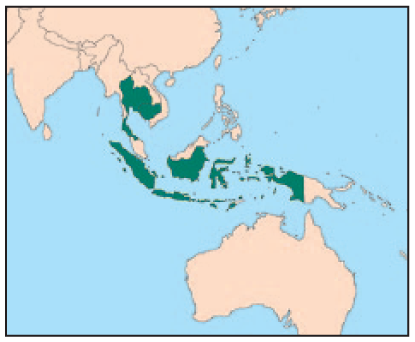
The analysis is based on data collected in urban settlements in Chiang Mai in northern Thailand; Phnom Penh, Cambodia’s capital; and Yogyakarta, in Central Java, Indonesia. To select the case study communities, I consulted with academics, non-governmental organizations (NGOs), and representatives from local government. Each of the three settlements is in close proximity to the city’s centre and has existed for at least 30 years, thus giving residents ample time to know their neighbours and establish a basis for collective action.
Based on a preliminary assessment, the settlements share similar physical, socioeconomic and political characteristics. Each has clear physical boundaries, a mix of self-built and more formal housing, and a mix of land tenure status. Each is predominantly occupied by low-income households, and while some residents have access to formal infrastructure services, others rely on various collective arrangements or self-provision their infrastructure and services. Because of their physical proximity to the city’s centre, all three settlements have a formal political–administrative designation that shapes decision-making and the relationship between the settlement and the local government. It should be noted that identifying and defining “community” in the diverse and complex urban contexts is imperfect.(30) For the purposes of this study, a community refers to a bound territorial unit whose residents make decisions jointly and share common problems and concerns, and whose political–administrative designation shapes how they engage with the state.
Research methods consisted of direct observation, attendance at community-level meetings and events, interviews and mapping. In each community, between 30 and 50 in-depth interviews were conducted with residents, community activists and leaders, community elders, local government officials, representatives from civil society and the development community, and academics. In addition, administrative records were analysed, and in each case a community history and inventory of collective action was constructed to provide context for analysing changes over time.
IV. Findings
To contextualize the noteworthy findings, the analysis begins with a description of the setting, institutional and organizational structure, housing, and built environment for each settlement, whose names have been changed to protect confidentiality.
a. Pan-num in Chiang Mai, Thailand
Pan-num is a chumchon or urban neighbourhood in Chiang Mai. Administratively, Chiang Mai has four municipal districts (khwaeng). In 1984 the city assigned the formal administrative designation of chumchon to some neighbourhoods within the municipal boundaries as a way to combat problems related to squatting. At first the chumchon designation was considered undesirable because it connoted informality, illegality and poverty. However, since the designation has drawn funding to those neighbourhoods, it has gradually acquired a more neutral connotation. There are now 85 chumchon in Chiang Mai, each represented by a locally elected, unpaid leader. The municipal administration holds monthly meetings about development programmes, public health concerns, and safety campaigns. These meetings also give neighbourhood leaders a chance to voice their needs and concerns.
Pan-num lies southeast of the old city, adjacent to the Mae Kah canal. The community of approximately 1,435 individuals is diverse. In addition to the primarily Buddhist population, it includes Muslims as well as small groups of hill tribe households (Lisu, Akha, Lahu), who are mostly Christians.
Early in the community’s history, before Pan-num was designated a chumchon, residents built their houses around the Buddhist temple complex, Wat Pan-num, which was regarded as the community’s centre. Long-time residents still live adjacent to the temple complex, and many community meetings and events are still held there.
The formally designated chumchon now includes a much larger area. This boundary shift has affected the community in two senses. The northern portion of the community, never identified with the temple, is now considered administratively part of the chumchon. At the same time, some individuals who had been considered members of Pan-num because of involvement with the temple are now identified as members of adjacent neighbourhoods.
More recent arrivals to the area live along the canal that is Pan-num’s western border, and they are building houses in the remaining pockets of open space (Map 1). Many homes, especially along the canal, are accessible only by small footpaths. Near major roads and commercial areas are new multi-storey apartment buildings and townhouses housing more affluent residents. The hill tribe households are concentrated behind the khwaeng office. Muslims live mostly near the mosque in the north, where there is a crematorium. Outside of these particular groups are households interspersed among various commercial uses, which represent an array of socioeconomic backgrounds. Some, particularly those farthest from the temple compound in the north, do not even think of themselves as living in Pan-num.
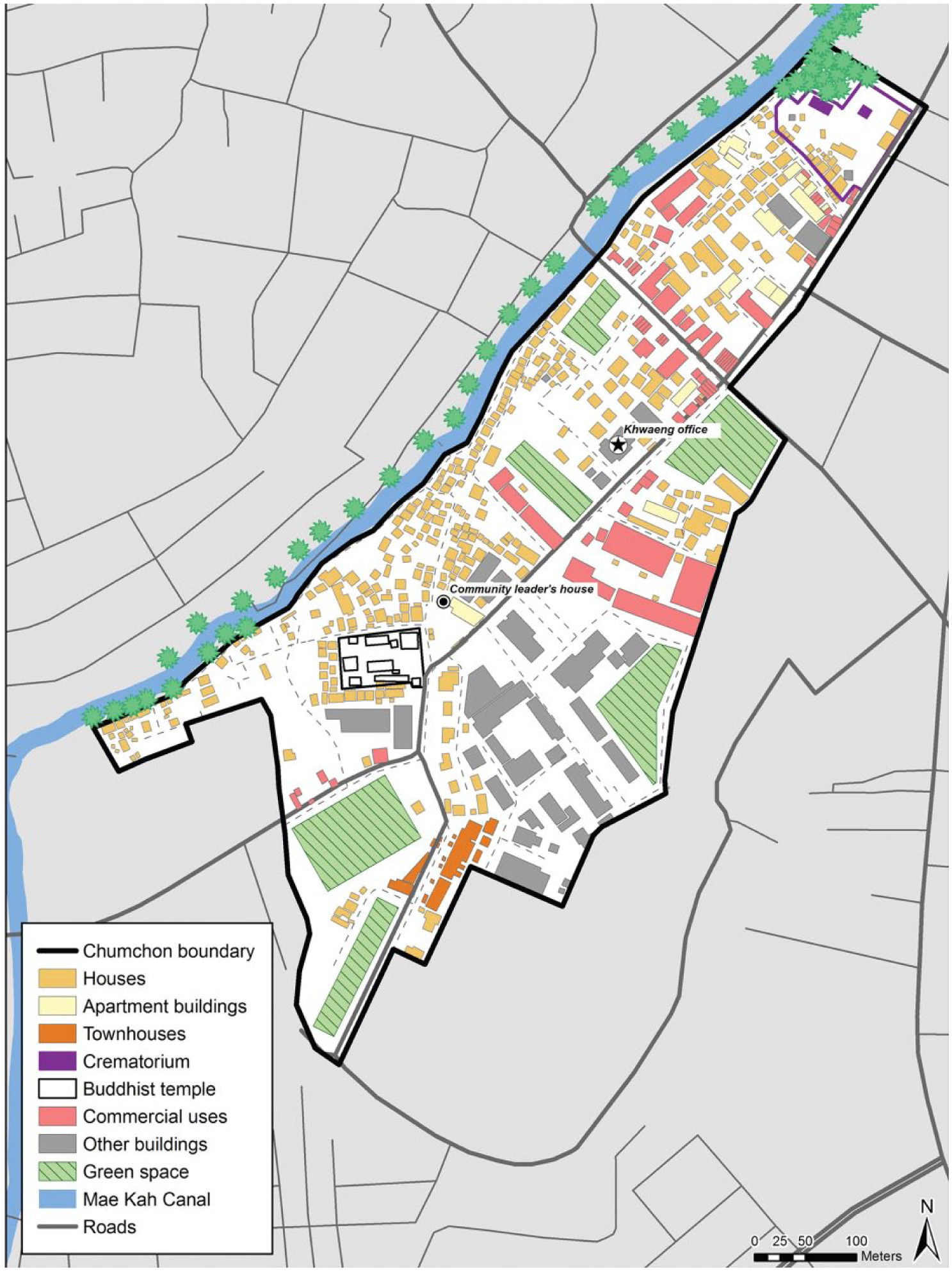
Pan-num neighbourhood in Chiang Mai, Thailand
The geography of Pan-num, along with the differing housing arrangements, contributes to the sense that the community comprises several sub-communities, with some shared as well as some unique pressures and concerns.
Housing, community and the built environment
While most residents live in single-family homes (often occupied by multiple generations), some now live in townhouses or multi-storey apartment buildings, a change that has altered social relations as well. Townhouse residents, usually of higher socioeconomic status, have formal land tenure and access to infrastructure and services, so they stand to benefit less from participating in community-based delivery of basic services. They rarely participate in any community-level collective action, and in fact are viewed as transitory because they rent.
The houses in the crematorium compound and the hill tribe homes behind the khwaeng office are on land owned by the municipality and have contentious land tenure security. Some are registered and some are not. They are physically somewhat isolated from the core of the community, around the temple complex. The small group of Muslim households in the north is subdivided into households inside the crematorium compound, those along the outside of the compound wall, and those in more formal single-family housing. The crematorium compound is surrounded by a high wall, and entry and exit points to the dwellings there are limited. Some residents use ladders to small doors at the top of the wall where they can more conveniently enter and leave their homes (Photo 1). The hill tribe houses are enclosed on one side by a dirt berm and on the other by the khwaeng office wall.
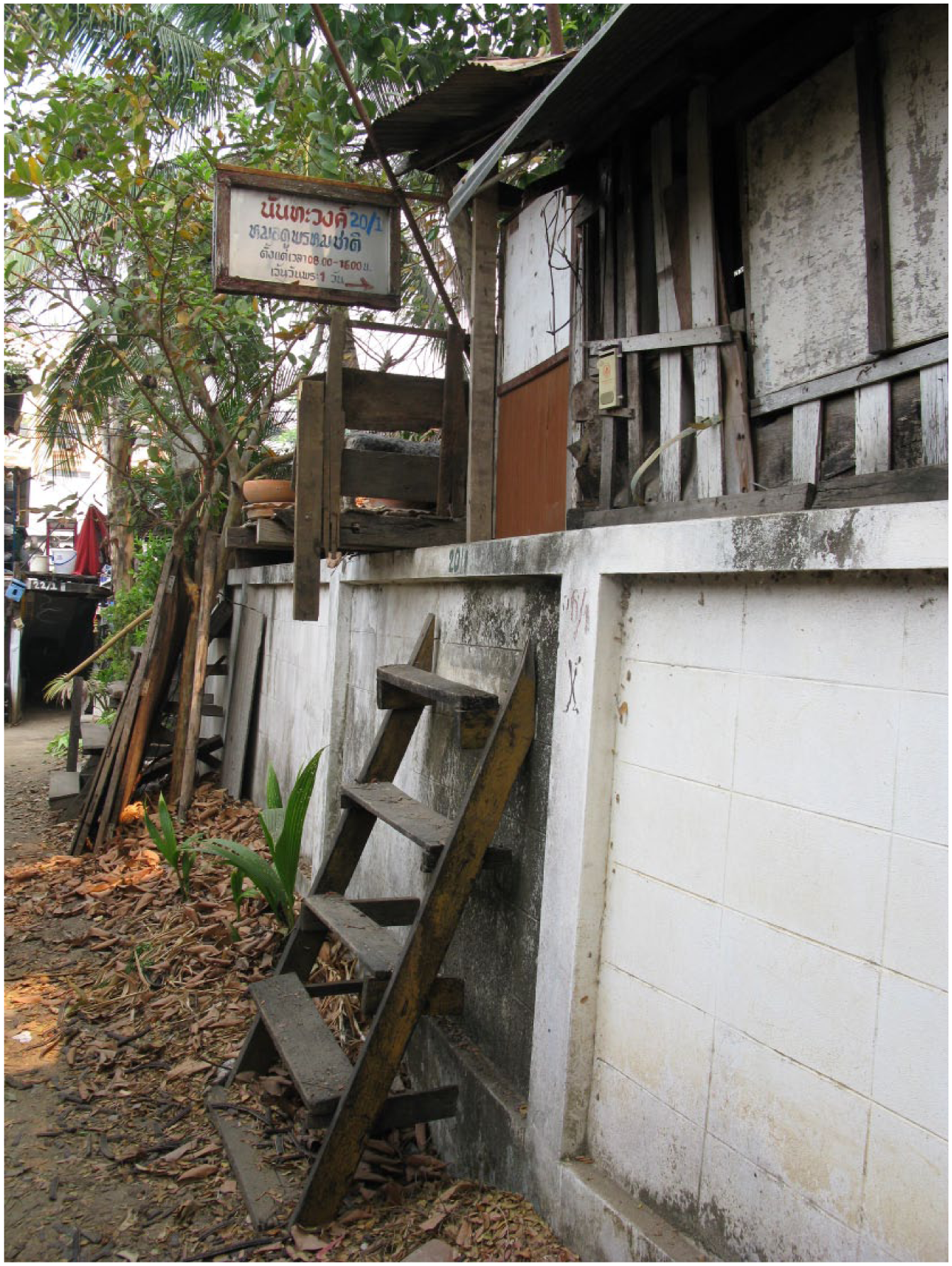
House entrance in the crematorium compound, Pan-num
Houses along the canal and behind the slaughterhouse are also built on land without clear title, although most of them are registered. These houses are built with low-grade, semi-permanent materials. The group living next to the canal is for obvious reasons very concerned about the pollution of the canal.
The segments of the community that occupy informal housing contend with uncertain land tenure and tenuous access to infrastructure and services. Beyond these groups, there are households interspersed among various commercial uses, representing an array of socioeconomic backgrounds.
Community collective action in Pan-num
Residents’ sense of shared history and community dates back to at least the 1930s, and community collective action efforts to the 1960s, when residents started a funeral group and a dance group, both of which are still active. During the 1980s an array of social welfare programmes emerged, and their activity levels fluctuated over the years until the present. Few have lasted more than several years. The community has had difficulty sustaining collective efforts for social welfare without support from either the state or an NGO.
Collective action efforts have ended for various reasons: in one case, a community member borrowed materials for an activity and did not return them; another could not repay loans; corruption undermined another; in other cases, the illness or death of key activists weakened collective efforts. While Pan-num is considered to be more active than other nearby communities, it remains challenging to sustain collective action to deal with poverty, uncertain land tenure, flooding and pollution.
In Pan-num, social relations based on trust develop through daily face-to-face interactions and longstanding relations. Many residents spend the day out in the community, where they interact while eating and drinking in open food stalls, shopping in small stores with open seating areas, and spending time in the open spaces of the temple compound, in front of one’s house or on the street. Many of Pan-num’s long-time residents have known each other’s families for generations. To the extent that such regular interactions are positive, they are a basic way to develop trust.
Now, however, more and more residents work outside the home and outside the community. While time spent outside the community extends an individual’s social networks, it can also weaken social relationships among community members.
The strength of residents’ connections to their community influences their willingness to engage and invest their time and resources in collective action. For example, a pressing community problem is the pollution and flooding of the canal. Residents are willing to attend community meetings about this problem and engage in participatory planning where they suggest rules about waste disposal, monitoring, and a system of fines for polluters. They realize, however, that the community is not the only or even the principal source of pollution. A large hospital and large hotels upstream dispose of waste into the canal. Yet residents have not articulated this awareness publicly, or considered collective action against the major polluters outside their community.
Residents are willing to collectively clean the canal several times a year. Over the past few years a local NGO has organized large-scale efforts to clean the canal before each national holiday. Using a loudspeaker system and a local radio programme, the NGO advertises these clean-ups, and community participation is strong – long-time residents and the newer hill tribe residents work collaboratively, which has not always been the case.(31) In association with the canal cleaning project, the NGO holds seminars about pollution attended by members of government organizations and NGOs, academics, and community leaders. Participation has been stronger in the southern area near the temple, Pan-num’s historic centre, than in the north near the newly incorporated crematorium compound.
Ethnic differentiation from time to time has been a barrier to collective action in Pan-num, particularly between ethnic minorities (hill tribes) and long-time residents. Their differing cultural expectations are exacerbated by religious differences and linguistic barriers: for example, most hill tribe migrants did not speak Thai before moving to the city. Sociocultural diversity, combined with dissimilar housing arrangements, hampers the collective action needed to address material manifestations of poverty. Given these challenges, collectively framing them in terms of broader political and economic forces – for example, the pollution resulting from upstream sources and the state’s role in not granting formal land tenure status to residents – seems all the more abstract and unlikely an undertaking.
b. Phsar Tomneup in Phnom Penh, Cambodia
Phsar Tomneup is a sangkat, the lowest level of Cambodia’s political–administrative structure, comprising approximately 1,000 households and 6,000 individuals. The local population is mostly Cambodian, with some immigrants from Vietnam, China, Bangladesh, India and Europe.
The socioeconomic status of the sangkat is mixed. Some blocks have mostly wealthy households whose members work as business owners, civil servants, or private sector employees. Other blocks have mostly poor households whose members work as manual labourers, petty traders or prostitutes, or in a wide array of other informal economic activities. None of the respondents identified a “middle-income” block. However, blocks are not socioeconomically homogenous; each is mixed to a greater or lesser degree.
This sangkat is adjacent to the central market and a bus terminal, so it is busy with people coming and going (Map 2). The area has a mix of commercial and residential uses. Most buildings have multiple storeys, with commercial uses (for example, restaurants, hotels, jewelry shops, convenience stores, mechanical garages) on the ground floor and residents occupying the upper floors. Many community members work in the central market; others are drivers, construction workers or civil servants. One block had a concentration of coin massage parlors and prostitution.
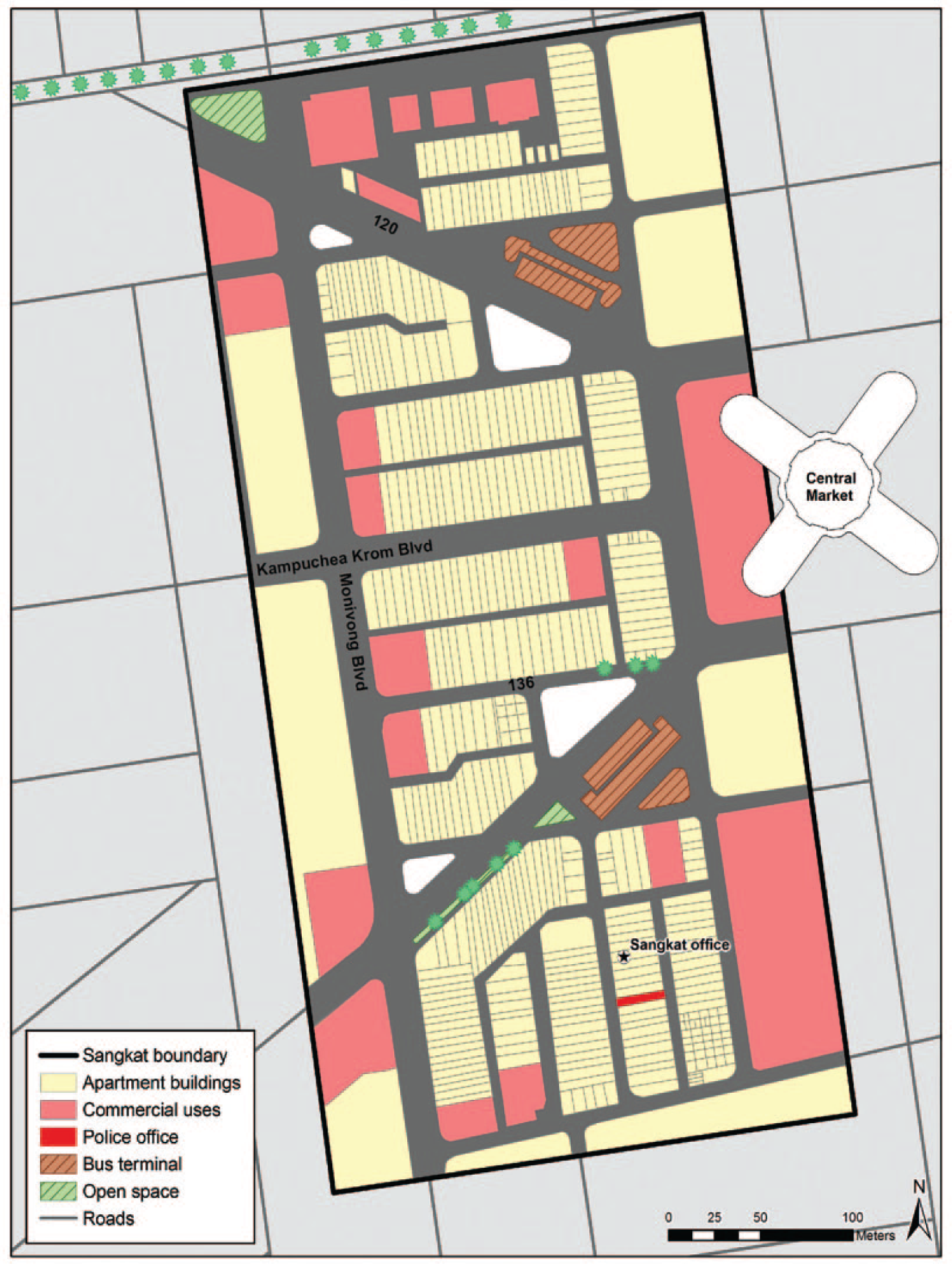
Phsar Tomneup in Phnom Penh, Cambodia
Phsar Tomneup is organized into nine smaller phum, each of which has a leader who mediates conflicts between households and is responsible for helping poor households. In general, respondents reserved the status of “poor” for households or individuals who did not have enough to eat and would be considered extremely poor by Thai or Indonesian urban standards.
Each sangkat is managed by a commune council, which is supposed to have elections every five years. Phsar Tomneup’s commune council has seven members; the sangkat leader and three council members are from the Cambodian People’s Party (CPP), and the remaining three members are from the leading opposition party, Sam Rainsy Party (SRP). About 50 civil servants work for the sangkat office. Since the council members are beholden to the political parties that put them in power, they distribute social safety net benefits and infrastructure projects according to political party affiliation.
The sangkat’s main activities are undertaking infrastructure projects, maintaining security and order, resolving conflicts between households, and engaging in public administration. In terms of infrastructure, the sangkat office was handling road repair and installing drainage pipes. The budget for these projects came partly from the government, and local residents provided between 10 and 50 per cent of the total project costs. In interviews, some residents who worked for the sangkat office criticized its use of development funds.
In terms of security, the sangkat office polices drug addicts, prohibits large gambling operations, intervenes in conflicts, and brings beggars and orphans to the attention of the district office. Most local residents were appreciative of the improved security because prior to 2007, when those functions were undertaken, certain blocks were considered unsafe, there were frequent conflicts between local youth, and personal property theft was rife.
Housing, community and the built environment
Housing in Phsar Tomneup mostly consists of high-density, multi-storey apartment buildings organized around a narrow internal road. In recent years, many first-floor residents have added or expanded their front rooms or built stalls that encroach onto the road. Interestingly, however, the newest residents of these buildings have extended them upwards by building an additional living area on the roof. The roof is typically occupied by the community’s poorest residents, who squat on the roof and are largely invisible from the street (Photo 2). Building residents are aware of roof squatters, many of whom are related to the building’s occupants.
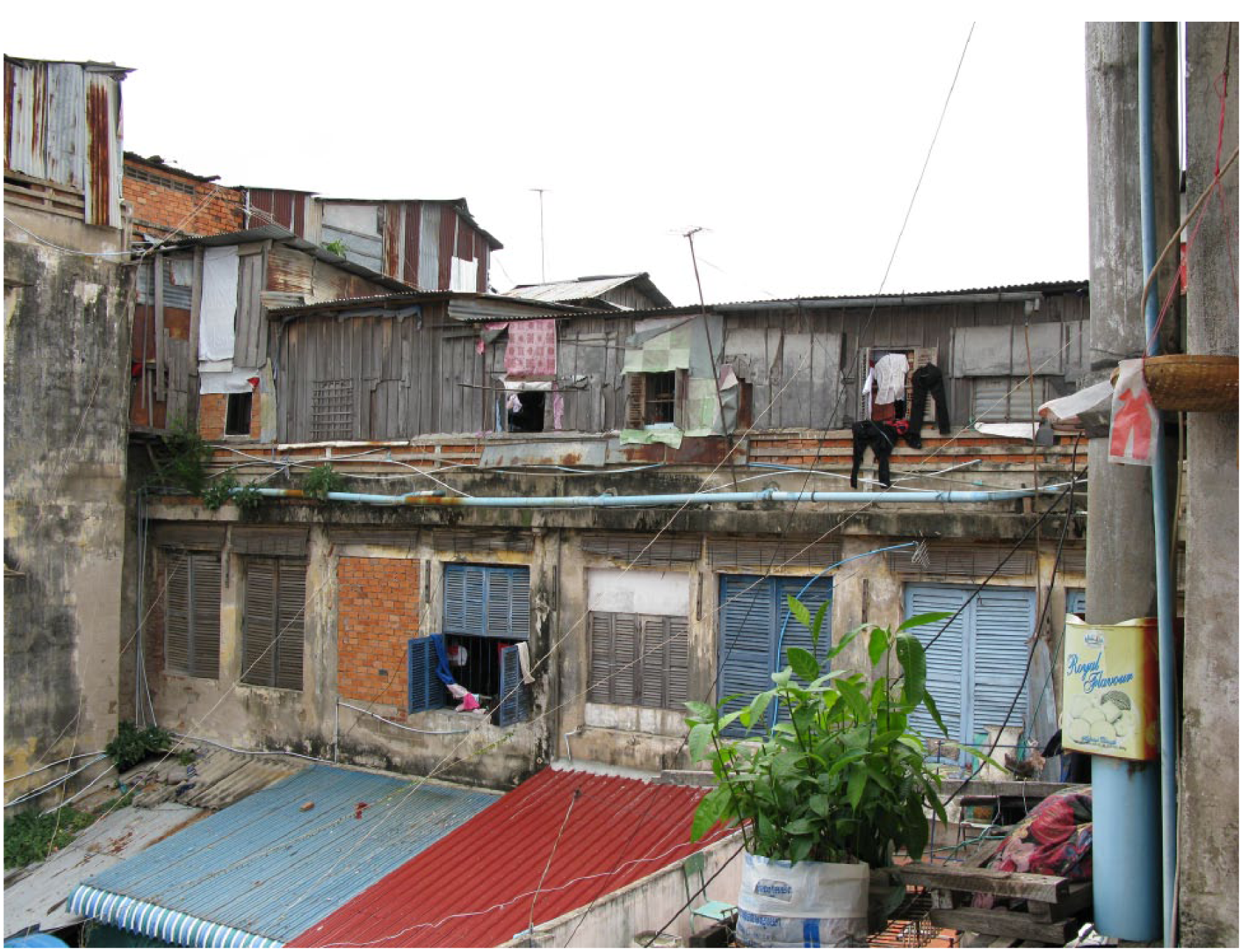
Squatting on roofs, Phsar Tomneup
Expanding a building upwards compromises its water and wastewater systems because the new households on the roof add piping along the outside of the walls to dispose of their wastewater, and when this system leaks it floods the lower units. In particular, household wastewater disposal is the source of many conflicts between neighbours. Inside buildings, stairwells are kept dark to save money, and are often poorly maintained, resulting in accumulated trash, dripping pipes, exposed electrical wires, and damage to the floors and stairs. Consequently, there are limited spaces for residents to have casual interactions.
Community collective action in Phsar Tomneup
There was a noticeable absence of community-initiated collective action in Phsar Tomneup. A number of factors can explain this, the most obvious being Cambodia’s history of conflict. Phnom Penh was evacuated when the Khmer Rouge came to power in 1975. In 1979, after the Vietnamese captured Phnom Penh, the central market and government printing press in Phsar Tomneup reopened. Three households settled in the area to operate the press, followed by groups of families that began to move there. People slowly started to reoccupy the area. Significantly, however, very few of these households had previously resided in Phsar Tomneup.
A second factor that contributes to the lack of collective action is respondents’ concept of community. The term is typically used in the Cambodian urban context to signify one of three situations: (1) an NGO has organized households for a project or programme; (2) the state has identified a particular group of people as a community to implement a project; or (3) residents have self-organized, usually in response to an immediate threat (for example, forced eviction, the need for infrastructure). Furthermore, collective action often centres around a pagoda since monks are usually trusted figures, but Phsar Tomneup does not have its own pagoda.(32)
As noted, Phsar Tomneup has a limited history of collective action. Between 1979 and 1981, residents worked together to remove trash and trees from the sangkat. Since 2003 the sangkat office has worked with residents to raise funds to improve local infrastructure, mainly by installing sewage pipes and widening and paving roads. For most infrastructure projects, local residents have contributed about 10 per cent of the cost, but with decentralization, their contribution is expected to increase.
As in many Southeast Asian communities, collective action can be seen in the tradition of taking up a collection for households that have lost a family member. Another example is how residents have started to organize cultural and religious ceremonies, such as bringing gifts to the monks at nearby pagodas and celebrating the harvest to bring good luck and prosperity to the sangkat.
Among the most advanced but risky forms of collective action are the self-organized savings and credit schemes referred to as tong tin. This phenomenon was investigated in four blocks in Phsar Tomneup that have active tong tin schemes, two of which have existed since 1986. Each group creates its own rules and regulations, and participation simply entails a verbal agreement between members. Each tong tin has a mechanism for selecting members and develops criteria to minimize the risk of defection. Members are usually required to be permanent residents of the block, have a regular source of income or employment, and have social or familial relations with other residents; sometimes they also have to be approved by existing members. Each tong tin has a leader who is responsible for the scheme’s financial solvency, and for collecting and distributing its money.
As one tong tin leader observed, these schemes can build trust among residents, but these schemes also have the potential to destroy trust. From time to time there have been problems, usually related to defection or delinquency in repayment. For example, one member, who appeared to be an upstanding citizen, disappeared after receiving the loan. The loan was never recovered and the leader had to repay the debt. Other members are often late or refuse to repay their loans.
Sometimes the tong tin leader brings problems to the attention of block leaders for conflict mediation. In one case, a meeting was arranged with a delinquent member and the block leader, and an agreement was reached by which the delinquent member agreed to repay the loan in monthly instalments. The leader was surprised by the member’s behaviour because she lived on the block, dressed nicely, and was believed to own her house. Later the leader discovered that she had sold her house and was renting it back from the new owner. Many residents asked about tong tin expressed their reluctance to participate because of the financial and social risks.
c. Ambarsawa Lor in Yogyakarta, Indonesia
The Yogyakarta case study focused on one RW (Rukun Warga), a political–administrative unit of approximately 250 households and 634 individuals (Map 3). The population consists of mostly ethnically Javanese residents, but is diverse in terms of religious affiliation, socioeconomic status, and rural village of origin.
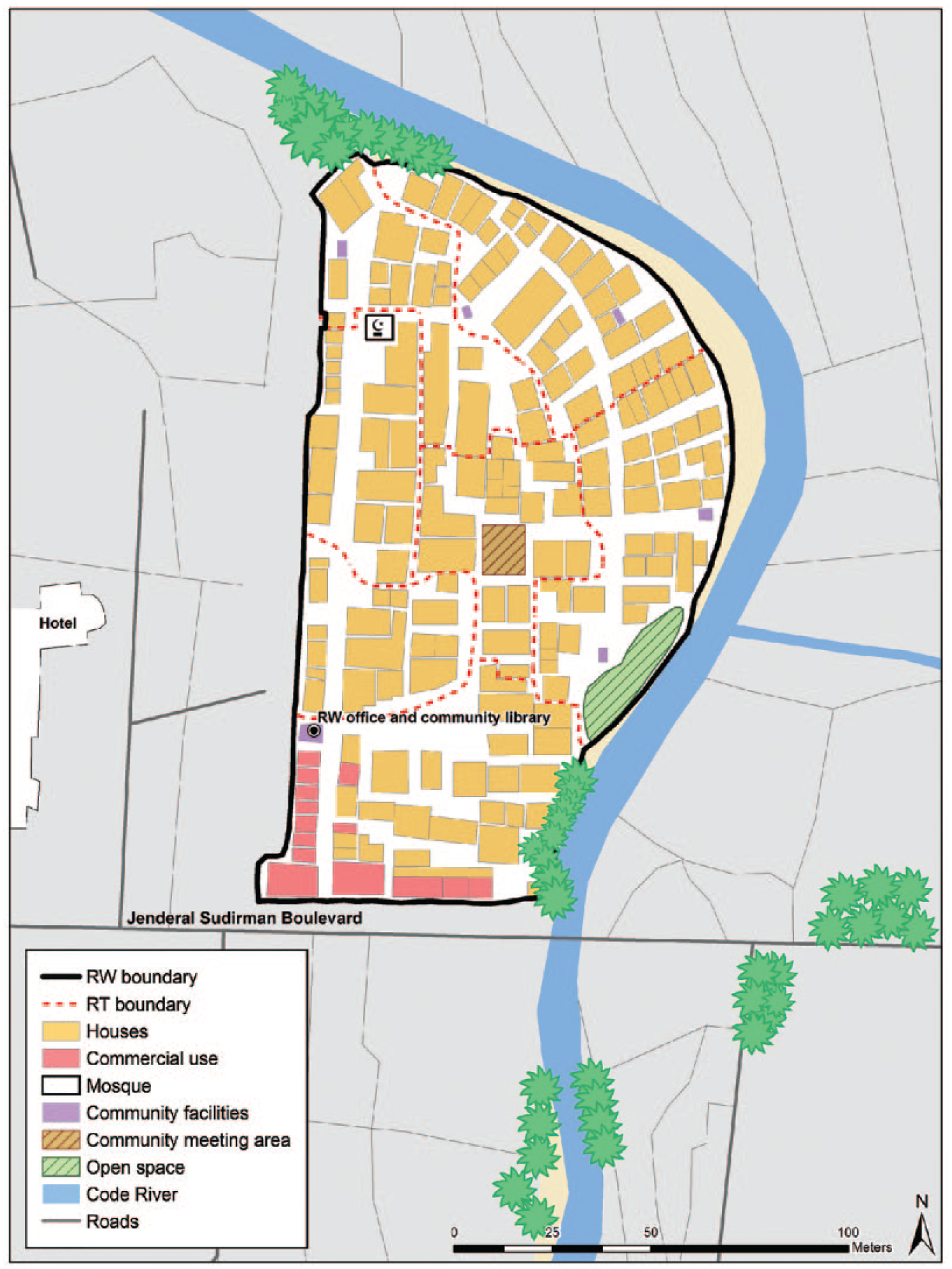
Ambarsawa Lor in Yogyakarta, Indonesia
The case study neighbourhood is located on the edge of the Code River, which cuts through the middle of the city. Few roads are wide enough for cars and many are just small footpaths. Although the community is in part a squatter settlement, its roads, footpaths and communal spaces are well maintained by local residents.
The settlement is densely built, mostly single-storey residences with a few small commercial enterprises – some food stalls and stores near the community’s main gate, and small businesses that operate out of people’s homes and employ family members or neighbours.
In the RW system, residents elect local leaders and organize households into consecutively smaller groupings of households. For example, the RT (Rukun Tetangga), smaller than the RW, is between 20 and 50 households and a dasa wisma is about 10 households. While the larger subdistrict, or Kelurahan, is led by a salaried civil servant, RW and RT leaders are elected volunteers.
Housing, community and the built environment
The RW land slopes towards the river. The earliest residents built on the highest ground, and newer, less affluent residents build closer to the river (Photo 3). That area is now densely populated, and some residents complain that encroaching residential development is narrowing the river channel and exacerbating the effects of seasonal flooding.
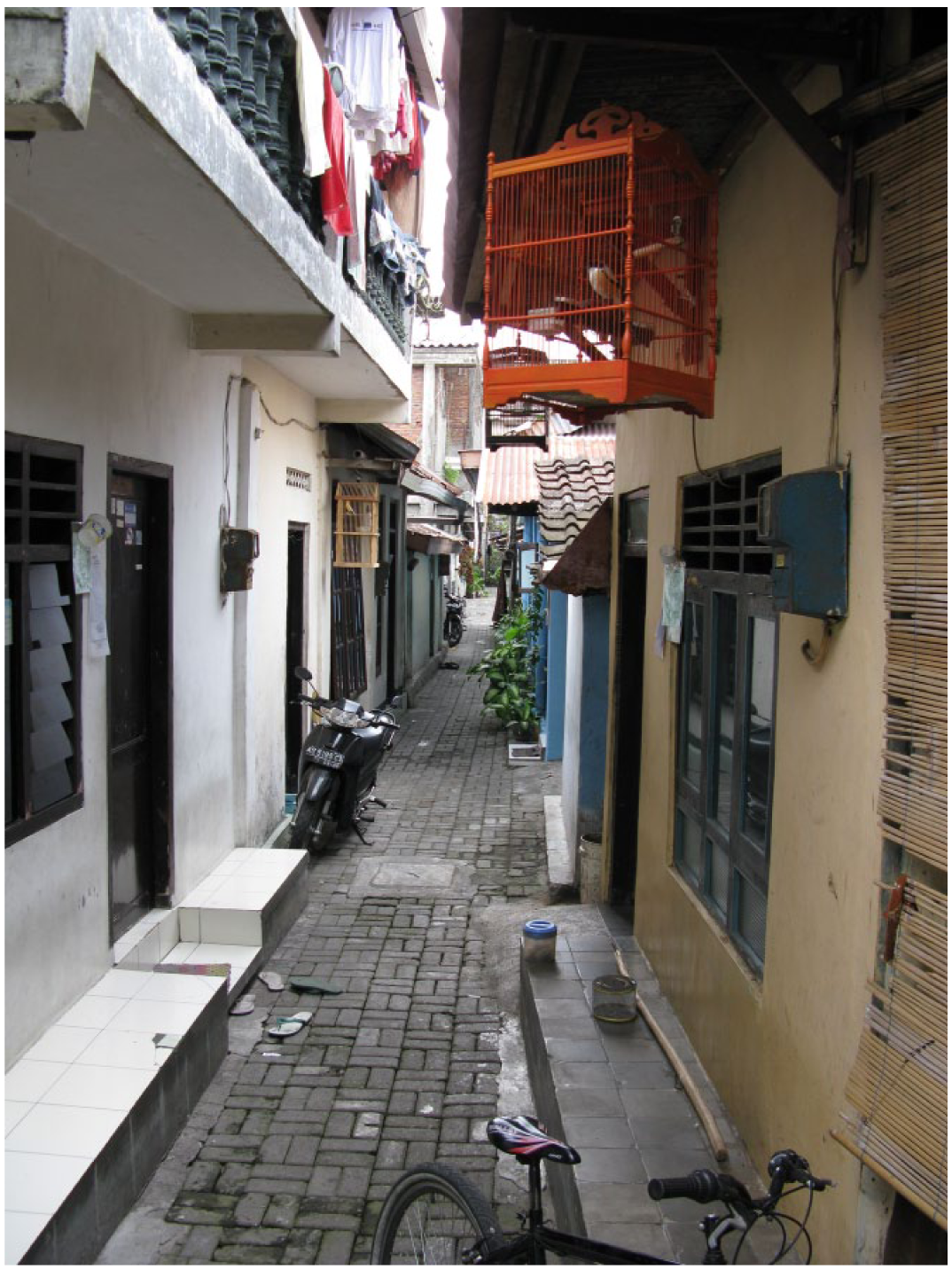
Housing along the river’s edge, Ambarsawa Lor
The municipal government has built a retaining wall and pedestrian path along most of the riverbank to control flooding and prevent further construction. The project began in the city’s south in the 1990s and took more than 10 years to complete. A communal bathroom and wastewater treatment facility were also built with partial support from an international donor, and are now administered and maintained by the community. Pollution of the Code River is a serious threat to residents – many of whom, particularly those closest to the river, obtain their drinking water from shallow wells. The problem is insurmountably difficult for community-level action to address because much of the pollution originates upstream beyond the RW and even the larger Kelurahan boundaries.
The community is divided geographically and socioeconomically. Those newer residents who live closer to the river are poorer, less likely to have legal land tenure status or access to municipal infrastructure, and more affected by flooding and pollution. Many of these “newer” residents have lived here for 20 to 30 years. Indeed, because of the area’s physical boundaries (the river, road, and close proximity to neighbouring communities), its high population density, and the compact nature of its housing, few truly “new” residents are able to move into Ambarsawa Lor.
In 1982 the Kelurahan office gave about 100 households in the upper segment of the community a formal right to use the land they occupied (hak pakai). While this right does not give them ownership rights (hak milik), having the legal right to occupy and use the land opens the possibility of later applying for full ownership rights.
In 1997, a group of 11 households in the segment close to the river started to self-organize to apply for hak pakai. The group met regularly and collected money to process their request. However, after a year of meetings and no change in their land tenure status, members became disheartened and suspicious of the resident who was leading the meetings and collecting their money. Soon after the economic crisis started in 1998, they backed off on their collective efforts. But since then, they have tried again to move their land tenure claim forward, without success.
Recently, residents along the river’s edge have contended with a new threat. In neighbouring communities, the city has forcibly relocated households from the river’s edge to allow the construction of four high-rise apartment buildings, in one instance dislocating 150 households. As one resident put it, “It is frustrating to apply for and be denied formal land tenure status for more than 20 years because you are told that your house is in an area not suitable for development [too close to the river], only to have a developer obtain permission to build an apartment in the same place in only five minutes.”
Local residents complain that the apartment buildings were poorly designed, constructed and maintained. Some upper-storey units on the upper floors were reportedly occupied before a proper sewage disposal system had been installed. Residents also feel that the buildings’ design is insensitive to the river’s edge culture. For example, rules limit the number of years that residents can occupy an apartment unit, and this works against the development of trust and reciprocity.
Community collective action in Ambarsawa Lor
Community-level collective activities in Ambarsawa Lor are diverse. Some began as state programmes, while local residents initiated others. Many projects focus on discrete aspects of poverty: household consumption, health and wellbeing, and infrastructure and the environment. Planning and governance of collective action groups are organized by both men and women. Female activists typically focus on household consumption, health and wellbeing, including the monthly healthcare clinic for children under age five, child development, the healthcare clinic for the elderly, and a plethora of savings and credit schemes. Men organize most of the collective action focused on infrastructure and environmental problems. Some of these projects have always been managed by the same activists, or now by their children and grandchildren. Youth group activists from 15 to 20 years ago are now household heads and community activists – for example, the head of the women’s organization and the RT leaders.
In addition to activities that address poverty alleviation and development, two groups of residents function in social and political ways – organizing and mobilizing residents about shared concerns. The first group, which represents the residents who live in the two RTs along the river, has its own rotating credit scheme and provides information to riverbank households about their common concerns related to tenure, flooding and sanitation. A second group organizes the 60 or so families that migrated from the village of Boyolali to the city of Yogyakarta, 14 of which live in Ambarsawa Lor. They raise money for infrastructure improvements in Boyolali.
Since the economic crisis and subsequent political reform movement (reformasi), collective action in Ambarsawa Lor has increased and diversified, and has particularly intensified through the local mosque. A small place for Muslim prayer, a moshola, was first established in 1980, when a local family contributed part of its residential land for that purpose. In 2009, local residents contributed the money and materials to expand and renovate the moshola, which was then formally recognized as a mosque with regular prayer services, including Friday prayers. Since then, membership and activities have increased. The mosque is currently used by approximately 300 residents for prayer and study.
Reformasi has changed collective action in Ambarsawa Lor. Political parties now play a larger role in community politics, and some residents have started to participate in broader organizations that represent multiple communities. For example, a few participate in larger groups that seek to represent the informal settlements along all three main rivers in Yogyakarta. This broader form of collective action – outside the political–administrative system that has long structured citizen participation in Indonesia – is still new. It is difficult for residents to work with others whose personal histories and reputations are unfamiliar. In the new organizations, residents lack the ability to evaluate individual motivations. For example, are the leaders sincere in their desire to help households with similar problems or are they active for their personal gain?
V. Conclusions
International development scholars and practitioners are well aware of the power of collective action to help meet basic human needs and mitigate poverty. There is less evidence and agreement about the capacity of community-based planning to address the powerful forces that cause and sustain poverty.(33) Questions also persist as to the effectiveness of community-based planning across different historical, political and sociocultural contexts. To address those questions, this article examines community-based planning in three urban communities in Southeast Asia.
A powerful factor shaping community-level collective action in each of the case studies was the political and organizational environment, particularly how their official, political–administrative status shaped the community’s interactions with the state. In Thailand and Indonesia, where the state’s capacity to drive development was stronger, the community had a better foundation for community-based planning. In Thailand the designation of chumchon and the associated resources helped facilitate community-level collective action.
In Indonesia the state has a long history of supporting community-based planning, so long as projects are viewed as consistent with the state’s national development agenda. The skills and experience that community activists gained by implementing these programmes over the past several decades, combined with Indonesia’s cultural ethic of cooperation (gotong royong and other similar traditions), creates an environment well suited to alleviating the material manifestations of poverty. However, because of Indonesia’s history with a vertically organized political–administrative structure, residents had less experience forging relationships horizontally with neighbouring communities and mobilizing to challenge more powerful political and economic forces.
In Cambodia the sangkat is a government office and the block leaders are relatively weak, lacking real power or authority to carry out a local initiative or represent the interests of residents on their block. As a result, block leaders are largely viewed as an extension of the eyes and ears of the sangkat office and the CPP.
In each case study, the geography and the built environment, particularly housing and the configuration of public space, significantly shaped community-level collective action. In Thailand the presence of the temple compound and well-maintained public spaces created a supportive environment. However, those residents who were physically separated from these spaces – for example, those who were squatting in the crematorium compound or the more affluent, in the townhouses – had limited opportunities to engage in collective action.
In Indonesia, the community’s geography facilitated collective action. The community was enclosed by the presence of the river, road, hotel and retaining wall. Also, the way residents organized the entry points through a main gate and road meant that most people entering the community were observed by the local residents managing the food stalls and small shops. The well-maintained footpaths and communal spaces throughout the community and the housing density encouraged daily interaction, resulting in close social relations among neighbours.
In Cambodia the built environment – particularly the multi-storey housing and the lack of public or communal space – also inhibited opportunities for residents to engage with one another. The organization of housing into separate blocks and the presence of large commercial uses (such as the bus terminal) also hampered residents from connecting.
The Thai community had the longest history of collective action, dating back to the 1930s, but residents had difficulty sustaining their efforts, which were overly dependent on single individuals and vulnerable to human foibles. Ethnic diversity and its associated language differences, as well as economic inequality, strained social relations at the local level.
The capacity for community-level collective action was the weakest in Cambodia. As touched upon earlier, this finding cannot be separated from the history of conflict in one of the world’s most violent attempts to force collective behaviour into every aspect of society. A major trauma in that history was the evacuation and resettling of Phnom Penh. Present relations in Phnom Penh built on trust and shared mutual interests were further strained by transience, socioeconomic inequality, and pervasive poverty.
The capacity for collective action was strongest in the Indonesian case compared to the other case studies, in part because residents there were the most socioeconomically homogenous. Additionally, the Indonesian community was the smallest (both geographically and in terms of number of residents), and had the least residential mobility. However, even in the context of having a long history of strong collective action, residents were not using their collective capacity to frame grievances against the structures that kept them impoverished. Nor were they seeking to create new mobilizing structures, or tap into existing ones, that would challenge, for example, the land tenure system that repeatedly denied them security while allowing more powerful economic and political actors to build large developments along the river.
In the three case study communities, the factors typically associated with the emergence of incipient social movements were not observed in a significant way. Residents rarely connected the various manifestations of poverty they experienced to broader structural forces, associated with powerful actors, politics, or the forces driving economic development. One exception was in the Indonesian case where residents were starting to speak critically about large developers building on the edge of the river, and limited numbers of residents were starting to engage new forums that represented the broader interests of informal communities along the river beyond the confines of the case study community. The limited examples of collective action moving in an oppositional direction is in and of itself a finding. To summarize, community-based planning, especially when not linked to civil society and/or the state, while inspiring and impressive, has limits to challenging the structural causes of poverty.
There are a few possible explanations for why none of the three communities used its collective capacities to challenge the forces that created and sustained poverty. One key layer missing from each of the three cities was progressive city leadership. In addition, in many Southeast Asian cities, the political–administrative structure is vertical, and in the three cities studied, public participation in urban affairs is still a relatively new phenomenon. Furthermore, NGOs did not have a strong organizational presence in any of the three communities. When comparing these cases to other examples of radical action in cities, there are missing organizational layers that can help communities join forces to build coalitions with the power to frame and articulate their collective needs and demands. Since the work and organizational success of federations of slum/shack dwellers and their networks, such as SDI (formerly Slum/Shack Dwellers International)(34) and the Asian Coalition for Housing Rights(35), are well known in South and Southeast Asia, the research raises the question: What happens to communities not connected to such networks, federations, and advocacy organizations?
Given the sustained popularity of community-based approaches to development in the global South, it is important to understand the conditions under which such efforts have the potential to reduce urban poverty. The political–administrative structure, built environment, housing arrangements, public spaces, community size, and socioeconomic inequality are all significant factors. Also important are the historical patterns of cooperation and conflict as well as the trust and distrust created by these histories. Community-based planning must have mechanisms for overcoming conflict, and rules that protect participants from the negative consequences of defection. Broader civil society organizations, like NGOs and federations, need to work with communities to build coalitions, help advocate on their behalf, amplify needs and demands, and function as trusted intermediaries between communities and the government and powerful economic actors. Poor and informal communities fare best when they (and their advocates) have the opportunity to work with progressive city leadership.
In the absence of civil society and progressive city leaders, doubts remain about residents’ ability to channel their collective capacity to frame poverty and tap into mechanisms that have the potential to challenge powerful state and market forces. For example, forced relocations to make room for large-scale developments, or pollution created by larger, more powerful economic actors, threatens the security and livelihoods of the urban poor. In the absence of strong networks, federations and coalitions to frame concerns and to amplify a community’s collective capacity, and in the absence of progressive leadership in Southeast Asian cities, community-based planning alone is unlikely to alleviate the factors that create and sustain urban poverty.