




Abstract
Many cities have bye-laws that require landlords to provide acceptable sanitation for tenants. Yet landlords fail to provide these facilities and the bye-laws are seldom enforced. This paper provides evidence from low-income urban communities in the Ga West Municipality of Accra, Ghana on the barriers to both toilet provision and bye-law enforcement, drawing on household surveys with landlords and tenants, focus group discussions, and key informant interviews. The key constraints to household toilet construction were found to be the lack of capital, limited space, and availability of nearby public toilets. Barriers to bye-law enforcement included the lack of both financial resources and incentives for the regulator. A simple negotiation game involving landlords, tenants and the regulator was organized, and the agreements reached were used to design a cooperative approach to bye-law enforcement for toilet construction.
I. Introduction
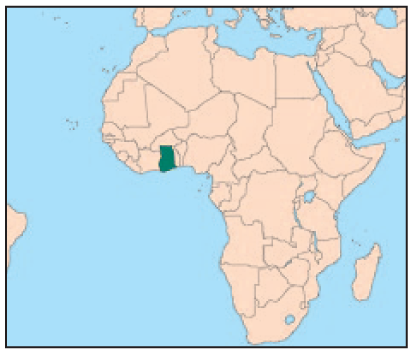
Ghana relies heavily on shared sanitation in urban areas: only 15 per cent of people have their own private household sanitation facilities, and two out of three urban dwellers rely on shared facilities.(1) Ga West Municipality, one of the 10 districts in the Greater Accra Region of Ghana, is a high-density low-income area. Most residents live in informal rental housing where few landlords provide household toilets.(2) The Municipality estimates that only 35 per cent of its population has access to household toilets, with the rest making use of fee-charging public toilets or unimproved facilities that do not meet basic standards.(3) Over a quarter still rely on open defecation and “flying toilets” (faeces placed in plastic bags and then discarded). These methods involve indiscriminate dumping of faecal waste that contaminates the urban environment, and puts people at risk.(4)
The National Environmental Sanitation Policy(5) and the Local Government Act (Act 462) mandates the local authorities to develop bye-laws that require landlords to provide household toilets and penalties are imposed for defaulters. Yet these relevant bye-laws are seldom enforced. Some limited work has been undertaken exploring the reasons for this.(6) But a more complete and in-depth understanding of why landlords do not provide toilets to tenants and why these bye-laws are unenforced is critical to finding appropriate solutions. This paper reports on a study that aimed to contribute to this understanding and that explored one possible cooperative solution.
II. Background
In the Ga West Municipality, the NGO Water & Sanitation for Urban Poor (WSUP), together with the Municipality, introduced a “Compound Sanitation Strategy” that aims to assist households in compound houses (houses with more than two households sharing basic amenities such as bathroom and toilet) to build better shared latrines.(7) Landlords are offered positive incentives to improve sanitation, and if they fail to comply, prosecution warnings are given. If they still do not comply, they are prosecuted and fined. The Municipal Court has set aside one day each month specifically for adjudicating sanitation cases. However, to date, prosecutions have rarely occurred.
The national policies and regulations that govern the delivery of sanitation services are expressed locally in the Ga West Municipal Assembly Environmental Sanitation Bye-Laws.
Although the enforcement process is not documented, Prosecutors and Field Officers describe the enforcement chain as having three stages (based on the Expanded Sanitary Inspections and Compliance Enforcement [ESICOME] field manual):
1) The pre-arraignment stage, which includes all the activities undertaken prior to prosecuting a culprit in court
2) The arraignment stage, at which a culprit is prosecuted through a jail term or fine
3) The post-arraignment phase, when follow-up inspection is carried out to ensure that the culprit constructs the toilet facility
These stages are illustrated in Figure 1.
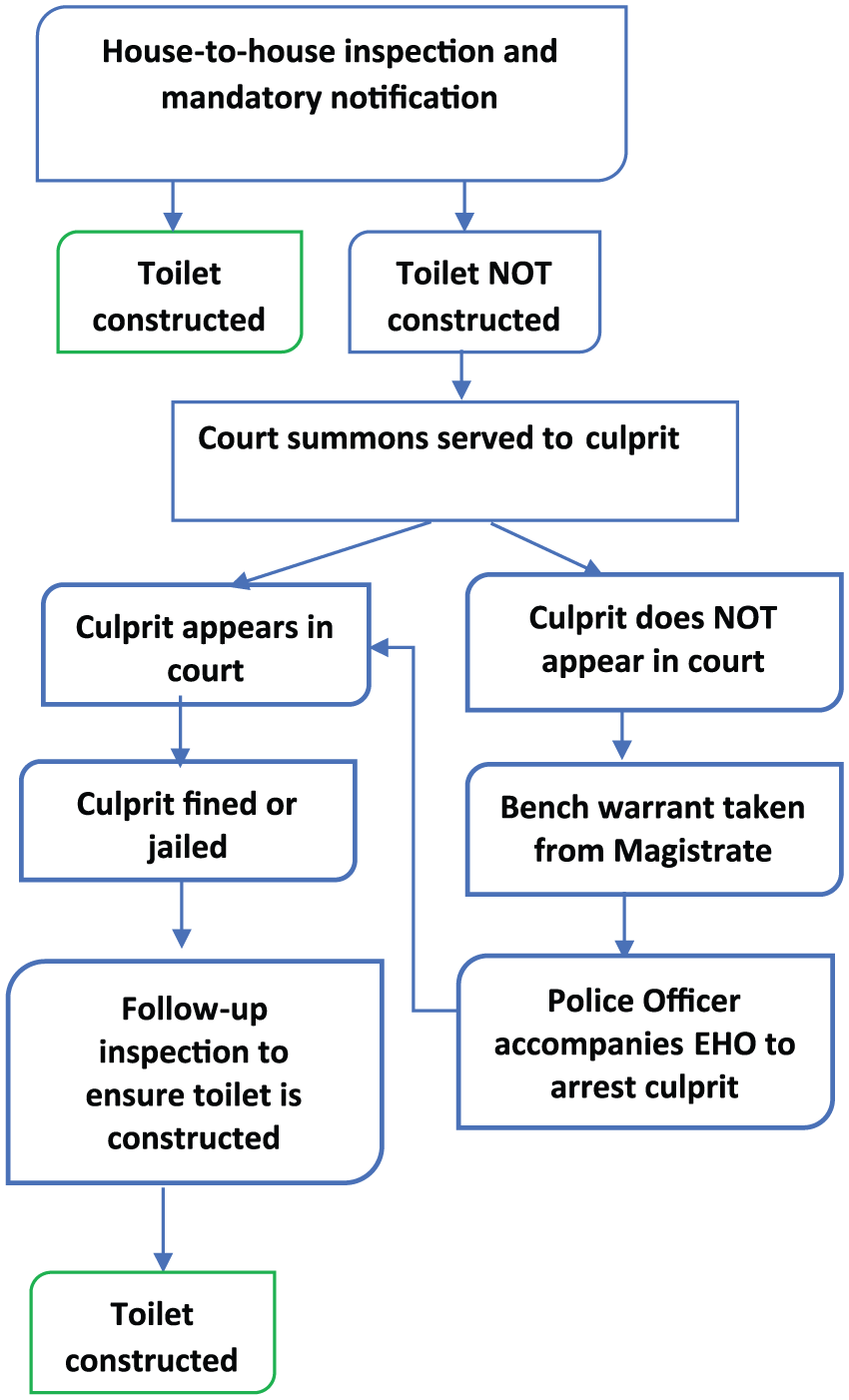
The current sanitation enforcement process chain
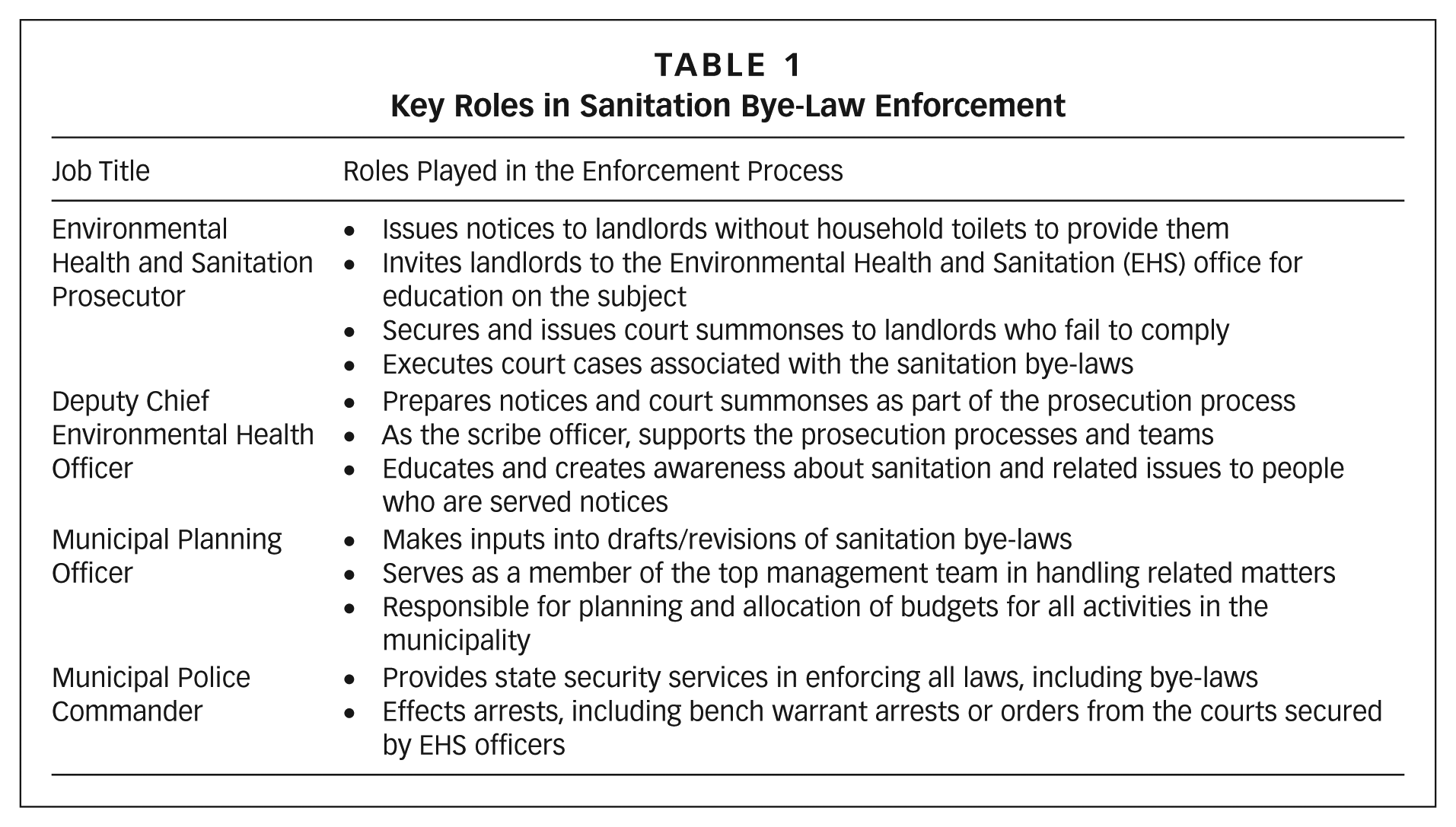
Key players in the bye-law enforcement chain include the Chief Prosecutor, the Deputy Head of the Environmental Health and Sanitation Department (EHSD), the Municipal Planning Officer, and the Municipal Police Commander. Their specific roles are presented in Table 1.
Key Roles in Sanitation Bye-Law Enforcement
Burby and Paterson(8) identified two main approaches to influence target populations to obey state regulations and laws and ensure compliance: a deterrence approach where the enforcing authority detect and correct violations, emphasizing strict enforcement of rules and regulations; and a cooperative approach based on working cooperatively with the target population to motivate them to comply willingly. Building commitment and capacity to obey the law through a cooperative approach to enforcement is likely to have a greater impact on the degree of compliance attained.(9) However, there is limited evidence on the use of the cooperative approach in the sanitation sector to improve household toilet installation. This paper contributes to that evidence base.
The study comprises the following steps:
Understanding the barriers to toilet construction by landlords
Determining the factors influencing non-enforcement of bye-laws by the regulator Ga West Municipality
Proposing an approach that landlords and regulators agree on for compliance with bye-laws and prosecution
III. Methods
a. Study design and data collection
The data were collected using a mixed-methods approach between January and May 2017 in three low-income urban communities in the Ga West Municipality. These communities were selected for their high levels of poverty and poor access to household sanitation. They were also within the catchment area of WSUP’s Compound Sanitation Project in the municipality. The research problems were answered using the following data collection approach.
Three categories of respondents were purposively selected for the household surveys in the study areas: landlords providing household toilets; landlords not providing household toilets; and tenants without household toilets. Overall, 200 respondents in the three communities comprising an equal proportion of landlords and tenants, were selected through a purposive sampling technique from a total of 11,622 compound houses, targeted for compound sanitation by the end of the WSUP project. Only compound houses were involved in the study. For landlords, the questionnaires captured information on awareness of bye-laws, barriers, and willingness to install household toilets. Tenant surveys collected data on factors influencing decisions to rent a house, monthly rent, perceived benefits of household toilets, awareness of the bye-law requiring landlords to install toilets, and efforts to get their landlords to install toilets.
Separate focus group discussions (FGDs) were organized in each study community for opinion leaders (N=12), landlords with household toilets (N=18), landlords without household toilets (N=20) and tenants without household toilets (N=18). Opinion leaders included representatives from traditional authorities, women’s groups, water and sanitation committees, and the Local Assembly.
Overall, 75 participants (47 males, 28 females) took part in the FGDs. Each FGD lasted for between 30 and 60 minutes.
A FGD was also used to obtain information from seven Environmental Health Officers selected across all the Zonal Councils in the municipality. Through routine house-to-house inspections, these officers are responsible for identifying those failing to comply with sanitation bye-laws. They also serve as prosecution witnesses during court proceedings.
At the municipal (regulator) level, key informant interviews (KIIs) were held with the Chief Prosecutor, the Deputy Head of the Environmental Health and Sanitation Department (EHSD), the Municipal Planning Officer, and the Municipal Police Commander.
Household survey data were coded into a Microsoft Excel spreadsheet and exported to Stata version 13 for statistical analysis. Thematic content analysis was used to analyse data from KIIs and FGDs.
Field permit and access to study communities were granted by the Ga West Municipal Assembly and the Local Assembly representatives. At the community level, the team explained the study to local leaders and other respondents before data collection, after which informed consent (written or verbal) was obtained from participants and respondents. All respondents were assured of confidentiality and security of the information they provided. Quotes attributed to respondents have been anonymized.
b. The negotiation game
Following the basic data collection, a negotiation game involving “regulators” and “users” (landlords and tenants without household toilet and opinion leaders) was played to reach a cooperative or optimum solution for household sanitation enforcement and compliance. The aim was to develop a practical enforcement (intervention) model, not to assess its effectiveness in practice.
The game follows these stages:
1) The research team presented a summary of the study findings to all participants.
2) Different enforcement models (deterrence versus voluntary compliance), including their associated risks and benefits, were explained using simple terms.(10) The existing enforcement model was also discussed.
3) The regulator and users chose their preferred enforcement model (maximal enforcement or flexible enforcement for regulators and minimal compliance or flexible compliance for users), and each party presented its proposals. Common expectations and disagreements were identified by the facilitators and presented to participants.
4) All parties then proposed what should be done to overcome the disagreements or differing expectations or proposals on the enforcement process.
5) Based on the agreements and compromises, the research team then developed a viable enforcement model to be adopted by all parties.
The negotiation game workshop involved 22 participants. The regulators all had key roles in the enforcement of sanitation bye-laws or wielded some management or political influence that could affect the enforcement process. The users (landlords, tenants and opinion leaders) were participants who had already been interviewed in the course of the fieldwork; they either owned or lived in a compound house with no household toilet. Assembly persons of the participating communities were also included in the game, acting as both a mouthpiece for users and a link between the regulators and users. Three members of the research team facilitated the sessions.
IV. Findings
a. Characteristics of household survey respondents
A total of 200 participants, landlords and tenants, were included in the household surveys. Landlords were, on average, about 10 years older than tenants and had larger households. Females constitutes nearly two-thirds (62 per cent) of tenant respondents and close to half (45 per cent) of landlords interviewed. About two out of five (42 per cent) tenants had completed basic education, while a similar proportion (39 per cent) of landlords had completed secondary education. More than half of both categories of respondents were self-employed, and about 13 per cent of landlords were unemployed. None of the tenants involved in the study had a household toilet. More than half of the tenants lived with their landlords, and one in three of the compound houses included in the study had absentee landlords.
Generally, tenants rented two categories of rooms in a compound house: (1) single room and (2) chamber and hall type (a bedroom with living room). The average monthly rent of the chamber and hall type (US$ 25) was about twice that of a single room (US$ 13). Landlords rented out an average of five rooms, and just over half (57 per cent) rented out only single rooms. Commonly, tenants are required to pay rent in advance covering a period of two years (24 months). Five single rooms rented out for two years could conservatively provide a landlord with an income of GH¢ 6,840 (US$ 1,600).
b. Barriers to toilet construction by landlords
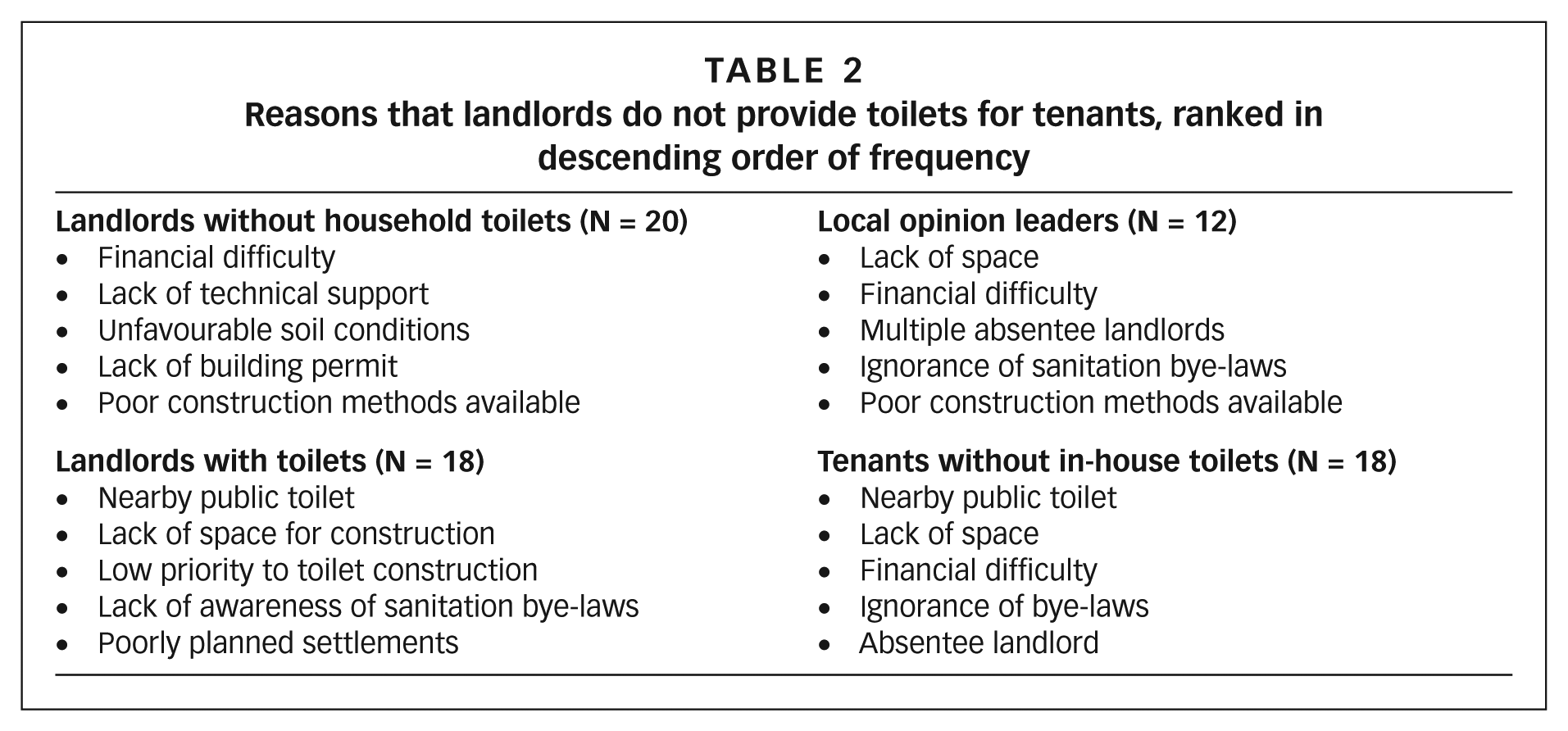
Results from the household survey showed that only 38 per cent of landlords have provided household toilets. FGD participants pointed to a number of reasons why landlords are unable to provide toilets for tenants.These are ranked in descending order by different FGD respondent groups in Table 2, and then discussed in the following section.
Reasons that landlords do not provide toilets for tenants, ranked in descending order of frequency
Despite the difficulty in raising the needed capital, two out of three landlords indicated in the surveys that they were unwilling to take out loans to construct toilets.
Nine out of 10 landlords with toilets (91 per cent) had constructed a toilet with their personal funds and received no support from government or NGOs. Moreover, three-quarters of them had done so out of their own volition without being compelled by the Municipal Assembly.
To support toilet construction, the Municipal Assembly is implementing a World Bank-funded project that provides half of the construction cost, with landlords paying the remaining half. This subsidy programme requires landlords to spend a minimum of US$ 300 for a household toilet. Sanitation technologies promoted through this project are mostly bio-digesters costing GH¢ 3,000–5,000 (US$ 679–1,132). Although Local Assembly representatives are paid a commission to persuade landlords to sign up for the package, only a quarter (28 per cent) of the landlords interviewed were aware of this initiative.
More than half (57 per cent) of the tenants were unaware of the bye-law requiring landlords to provide household toilets. For those who knew, fear of eviction from their rented houses (39 per cent) and the inconvenient reporting mechanism (23 per cent) prevented them from complaining to the local authorities about the lack of household toilets. Close to two-thirds (62 per cent) of tenants had taken no action to make their landlords provide a toilet. More than half (54 per cent) were willing to pay a higher rent for provision of a toilet.
c. Factors influencing non-enforcement of bye-laws by the regulator
The second stage of the research was to determine the factors influencing non-enforcement of bye-laws by the regulator (local authority).
Fifteen factors influencing enforcement were identified, either from the literature or from stakeholder interviews. These were then ranked by four individual key informants at the Local Assembly on a scale of 0 to 3 in order of increasing impact: 0- not applicable; 1- low impact; 2-medium impact; 3- high impact. The highest-impact factors influencing the non-enforcement of bye-laws were considered to be: limited funding, lack of incentives and logistical constraints, lack of incentives for EHOs, and delays in the enforcement process (Table 3). EHOs reported that certain cases can drag on over extended periods, requiring the case officer to appear in court each time the case is called, which discourages them from initiating steps to enforce the law.
Factors influencing the non-enforcement of bye-laws at each stage of the enforcement process and their level of impact
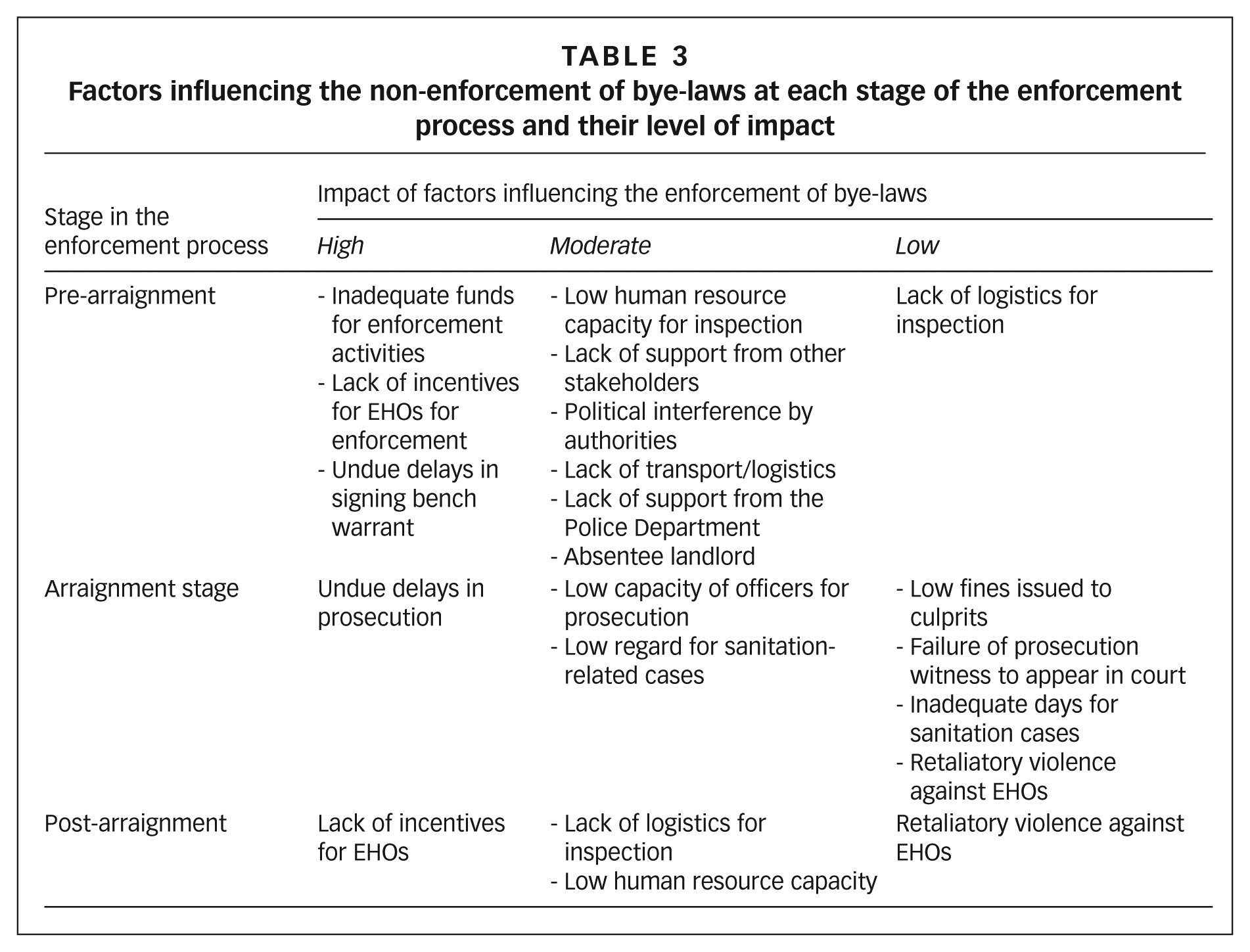
Of the factors that have a moderate impact on enforcement, political interference in sanitation-related cases is notable and includes requests for cases to be shelved without any prosecution (Table S1 in the online supplement). Respondents at the Assembly level described political interference as complex and highly problematic. Assembly members and management do not tend to directly instruct officers to discontinue a case but rather intimidate officers or warn them of potential repercussions. Respondents acknowledged that there are times when residents threaten to use political votes to extort Assembly members and other political figures into intervening in sanitation cases. Politicians demonstrate some enthusiasm for toilets, but this wanes once political terms of office are up, or whenever contentious or unpopular issues arise such as enforcing bye-laws.
V. A Consensus Model for Compliance with Bye-Laws and Prosecution: The Negotiation Game
Non-enforcement and non-compliance with bye-laws is the status quo in Ga West. Landlords and regulators have potentially conflicting interests: the regulator wants to maximize compliance with the bye-laws and can achieve this through cooperative persuasion or deterrent enforcement. Landlords can either comply or evade the bye-laws, but if they comply, they want to minimize the cost of compliance.(11) Solving this conflict of interest requires cooperation. Stage 3 of the research was a face-to-face negotiation game for landlords and regulators (with the participation of tenants and opinion leaders). This was designed to explore ways to resolve the current impasse so that cooperative outcomes can be more easily achieved and sanitation improved.
Recognizing that existing enforcement strategies and practices were developed by the regulator, without the active participation of user groups, the aim of the negotiation game was to increase the participation of tenants and landlords and to jointly develop and identify an effective enforcement and compliance model and practices. A simple negotiation game was designed with the following stages:
Stage 1: Presentation of study findings and the enforcement dilemma model
Stage 2: Roundtable dialogue on the existing enforcement process
Stage 3: Negotiation – participants put forward their expectations and proposals for the selected options
Stage 4: Voting on the enforcement approach by all parties
Stage 5: Presentation of results and discussion of the outcome
The negotiation game brought together 22 participants, comprising landlords and regulators, represented by EHOs, the Chief Prosecutor, the Deputy Head of the EHSD, the Municipal Planning Officer and the Municipal Coordinating Director. Tenants and opinion leaders were included as bystanders as they play a crucial role in the bye-law enforcement chain (Table S1 in the online supplement).
The study findings on the barriers to toilet construction by landlords and the factors influencing non-enforcement of bye-laws were presented to the participants. The customized negotiation game was explained to participants along with the risks and benefits of the enforcement options, as compared to the status quo of non-enforcement and non-compliance.(12)
Based on the information provided, participants discussed and agreed on their preferred enforcement and compliance approach. They were then categorized into three groups, comprising: (1) landlords only, (2) tenants and opinion leaders, and (3) regulators. Table S2 in the online supplement presents a summary of the dialogue on the existing enforcement approach and initial suggestions from parties on how to improve it.
Following the discussion, the groups of participants were asked to select their preferred enforcement and compliance approach.
Landlords were asked to choose between minimal compliance and flexible compliance
Regulators were asked to choose between maximum enforcement and flexible enforcement
If landlords chose minimal compliance and the regulator chose maximum enforcement, then the resulting state was known as “deterrence equilibrium”. If landlords chose flexible compliance and the regulator chose flexible enforcement, then the resulting state was known as “voluntary compliance equilibrium”. On the other hand, if landlords chose flexible compliance and the regulator chose maximum enforcement, then the resulting state was known as “harassment”. Capture or corruption refers to the case when the landlords chose minimal compliance and the regulator chose flexible enforcement. Both the “capture” and “harassment” outcomes are associated with high social costs, and are therefore less efficient and less socially desirable than voluntary compliance; yet both present temptation payoffs attractive to either the regulator or landlord.
After selecting their preferred approach, each group (1- landlords only; 2- tenants and opinion leaders; and 3- regulator) presented the arguments for its selected enforcement and compliance approach. The areas of consensus were agreed, and disagreements were negotiated until consensus was reached.
The regulator and landlords agreed on the flexible enforcement/voluntary compliance approach to bye-law enforcement. For the regulator, the advantage of “flexible enforcement” is that it entails less regulatory supervision and monitoring. Tenants and landlords also opted for “flexible compliance” as this provides them with sufficient time (especially to mobilize for money) to adequately prepare for household toilet provision. Scholz(13) suggests that voluntary cooperation might improve compliance with regulations. In this case, both the landlord and the regulator would be better off with voluntary compliance (e.g. in terms of cost of compliance and enforcement). The landlord would like the regulator to overlook minor technical violations and help the landlord comply with the bye-law at minimal cost and effort. Maximum enforcement and minimal compliance (deterrence) is not satisfactory to either the landlord or the regulator.
Participants agreed that flexible compliance combined with flexible enforcement is mutually beneficial to the landlord and regulator. Next, the researchers facilitated a group discussion between the regulator and users (landlords, tenants, opinion leaders, Assembly members) to seek an agreed way forward on a number of the key challenges to the enforcement process (finance, awareness of bye-laws, timelines). Table 4 presents the list of mutually agreed strategies by both the regulator and users to overcome each of the four main bottlenecks to effective enforcement of the bye-laws.
Key challenges to bye-law enforcement and agreements through negotiation
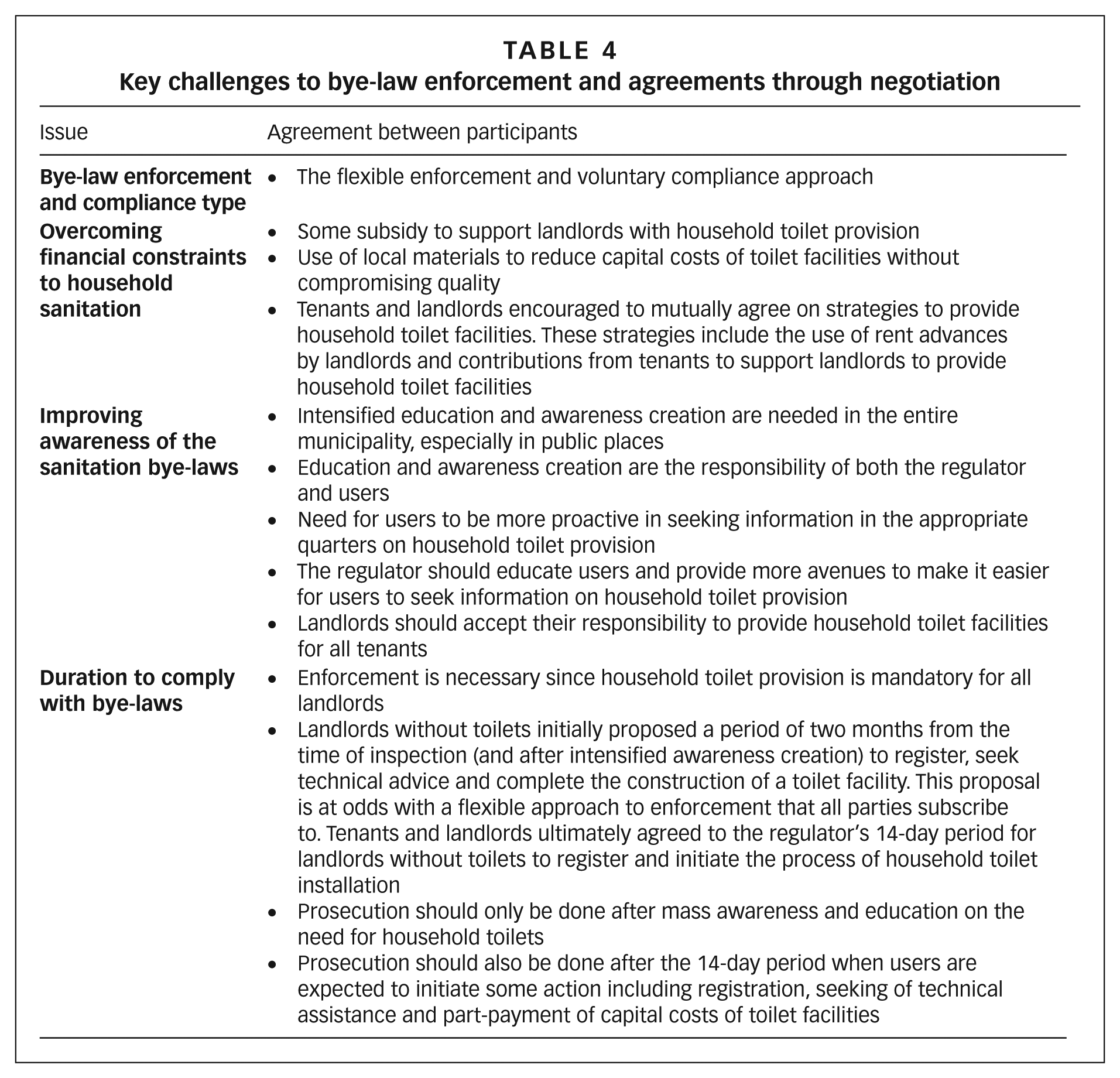
Based on the outcome of the negotiation game workshop, the research team revised the current enforcement model (Figure 1) based on the participants’ recommendations and in conjunction with the Enforcement Team. It is also important to note that unlike the existing enforcement model, which was solely developed and owned by the regulator, the proposed enforcement model involved the active participation of landlords, tenants and opinion leaders, and the model has been accepted by all (the regulator and users) as a cooperative solution and a working document. The key differences between the current arrangement and the proposed approach include: the identification and education of landlords whose properties do not have toilets; the issuance of a mandatory notice together with the mutually agreed 14-day period for landlords to initiate registration/construction; and the follow-up inspection before the summons. In the existing enforcement model, the timeline for abatement was unknown to users and was also not agreed to by users.
The proposed approach to enforcement contains some critical steps for the Municipal Assembly to take. The process begins with identification (to confirm that the house has a toilet for use by tenants) and awareness raising by the Local Assembly, with technical support for getting a toilet and financial information. If the toilet is lacking, the landlord will be issued a mandatory notice. If the landlord fails to take action after the mandatory period, confirmed by a follow-up inspection, they will be given a summons, and finally prosecuted if they remain non-compliant. The enforcement process allows for a period of 14 days from the time of first inspection to identify a landlord without a toilet to the time to initiate action to provide a toilet facility (including processes like registration and part-payment for a household toilet facility).
VI. Discussion
Confirming findings of other research,(14) this study found that the barriers to toilet construction by landlords include lack of money, space, and the availability of nearby public toilets.
Landlords without toilets reported a lack of capital for construction as a major barrier. Yet an analysis of incomes from rents shows that landlords make enough income to install a toilet (typically at least GH¢ 6,840 [US$ 1,600] every two years). Also, the local authority offers a 50 per cent subsidy for toilet installation, where landlords are required to cover half (GH¢ 2,000 [US$ 459]) of the total cost. Awareness of the sanitation subsidy available to landlords could be intensified through the mainstream media as well as door-to-door promotion by EHOs. Mobile money was reported to be a more convenient way to access the subsidy.
Lack of land/conversion of all available space into rental housing units is another major barrier.(15) Technical options are required to overcome the challenge of limited space.(16) Landlords would also be more willing to build toilets if the toilets were less prone to collapse. The Municipal Assembly has developed a compendium of appropriate low-cost sanitation options, but landlords reported that they needed technical support to make an informed choice. The availability of public toilets allows some landlords to abdicate their legal responsibility of providing acceptable toilets for tenants. There is a need for the Assembly to intensify its education on the bye-law requiring landlords to install household toilets even when public toilets are available. Public toilets are meant only to serve the transient population and people in commercial places like markets and lorry parks.
Tenants typically lack information on their right to sanitation and how their accommodation deviates from/complies with the bye-laws. Low-income tenants tend to opt for rental units without toilets if they are cheaper, although in this study, half of the tenants without toilets indicated they were willing to pay a monthly rent increase of GH¢ 10–15 in order to have a toilet. There is a role for the media/awareness campaigns in providing information on sanitation and informing a public debate about the bye-laws. Currently, tenants wield little power to call their landlord to account for the lack of a toilet. They fear eviction, and mechanisms for reporting are inaccessible and inconvenient. Regulators could ensure that tenants have more options for (anonymously and conveniently) reporting landlords, and could guarantee a speedy response to their complaints.
A variety of factors were found to influence non-enforcement of bye-laws. Financing for local-level sanitation-related activities is generally sourced from the internally generated funds accrued from taxes, fees, licences, and investment incomes. Yet in Ga West, only around 45 per cent of potential revenue is currently collected.(17) Scarce resources make allocation for sanitation and enforcement of sanitation bye-laws a low priority. A dedicated stream of funding and more political commitment would ensure better support to enforcement activities.
Field Officers did not generally feel empowered to enforce the bye-law, could not act under their own initiative, and had little discretion or flexibility in their roles. Inspection is the core role of these officers. However, most lack a means of transportation for conducting inspections or attending prosecutions. Most landlords are absent from their houses during normal working hours, and officers report working evenings or weekends to achieve their work objectives, with no overtime pay. If the law courts accorded priority to sanitation cases, promptly prosecuting sanitation offenders, this might motivate field officers to enforce the sanitation bye-law. Field Officers recommended a practice whereby officers and/or their department receive a proportion of prosecution fines from successfully prosecuted sanitation cases. Finally, the capacity to issue a summons is an effective tool for promoting compliance with bye-laws due to the social humiliation associated with going to court.(18)
The proposed improved enforcement model and the additional steps derived through the negotiation game could promote effective enforcement of the sanitation bye-laws in Ga West Municipality if well implemented. Resources need to be devoted to follow-up after the 14-day “grace period” before initiating the prosecution process. Technical support is needed, tailored to suit the specific needs of landlords. Manuals and design guidelines exist for challenging contexts such as limited space or unstable soil conditions; however, adoption of these technologies is a key challenge. The Assembly and regulators need both to facilitate financial support through targeted subsidies and affordable loans, and to create an enabling environment to improve access to affordable sanitation products and services. Shaping a diverse sustainable market in terms of good-quality technology and service options like pit emptying and the types of provider organizations are critical. So is government funding and targeted support for the poorest landlords to ensure the resources (including human resources) to deliver and support sustained improvements in urban sanitation. Together, these measures can help accelerate the pace of change.
VII. Conclusions
This study examined the barriers to household toilet installation, as well as bottlenecks to sanitation bye-law enforcement by the local authority. It used a simple negotiation game to develop a win-win sanitation bye-law enforcement model for regulators and landlords. Confirming the findings of other research, this study found that a lack of money, limited land space, and the availability of nearby public toilets were the main reasons that prevent landlords from constructing latrines for tenants. However, a lack of funds was given as the reason for not installing household toilets. At the same time, a lack of financial resources and difficulties with logistics around enforcement activities, a lack of incentives for staff, and long delays in the prosecution of culprits made enforcement of bye-laws rare. The enforcement model currently used by authorities does not incorporate stakeholder input. A simple negotiation game was held to facilitate new agreements for bye-law sanitation enforcement. Several additional steps in the enforcement process were proposed by landlords, tenants, regulators and opinion leaders during the negotiation game. In the overall context of weak governance, modifying the current approach to include such considerations could inform a more evidence-driven process. If operationalized, cooperative enforcement of bye-laws has the potential to address the status quo of non-enforcement and non-compliance in Ga West and ensure the construction of toilets for tenants.
Supplemental Material
antwi-agyei-supplement – Supplemental material for Toilets for tenants: a cooperative approach to sanitation bye-law enforcement in Ga West, Accra
Supplemental material, antwi-agyei-supplement for Toilets for tenants: a cooperative approach to sanitation bye-law enforcement in Ga West, Accra by Prince Antwi-Agyei, Isaac Monney, Bismark Dwumfour-Asare and Sue Cavill in Environment & Urbanization
Footnotes
Acknowledgements
The authors wish to thank the staff of the Ga West Municipal Assembly and the Local Assembly representatives (assembly persons) of the study communities for granting access and facilitating the fieldwork. We are also indebted to all study participants and respondents who provided invaluable information during the field data collection.
Funding

Notes
References
Supplementary Material
Please find the following supplemental material available below.
For Open Access articles published under a Creative Commons License, all supplemental material carries the same license as the article it is associated with.
For non-Open Access articles published, all supplemental material carries a non-exclusive license, and permission requests for re-use of supplemental material or any part of supplemental material shall be sent directly to the copyright owner as specified in the copyright notice associated with the article.
