




Abstract
This paper describes the community-driven enumerations undertaken in Old Fadama, the largest informal settlement in Accra, which has long been threatened with eviction. After meeting with members of shack dweller federations from other nations, residents formed the Ghana Homeless People’s Federation in 2003 (now known as the Ghana Federation of the Urban Poor (GHAFUP). Together with the NGO People’s Dialogue on Human Settlements, they supported the first community-driven enumeration in Old Fadama in 2004 to counter the threat of eviction, by showing the large scale of economic activities in the community and the gap in accurate population data. This was followed by further enumerations, in 2006–2007 and in 2009, to counter new eviction threats from new city governments. These enumerations increased the residents’ confidence, empowering them in terms of engagement with city government. They also changed government’s perspective on informal settlements and helped shape policy away from forced evictions towards participatory relocations or rehabilitation.
Keywords
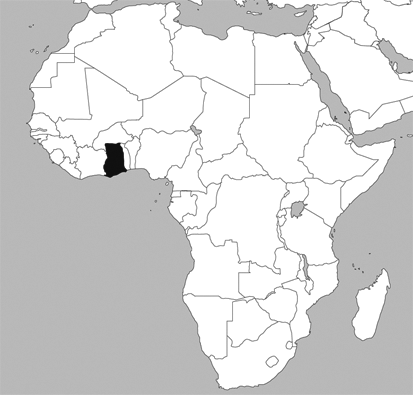
I. Introduction
Old Fadama, one of the largest informal settlements in Ghana, has long been under threat of eviction. It occupies 31 hectares of government-owned land beside the Odaw River and near the Korle Lagoon. It is situated across from one of Accra’s most important markets, the Agbogbloshie market, on land that was largely a lagoon (Figure 1). Much of this land has been reclaimed from the lagoon and river and has slowly been filled in by residents using whatever materials came to hand, including sawdust from the timber market across the road. One outcome of this reclamation is that the area is prone to flooding, making the lack of provision for drainage a continuing issue.
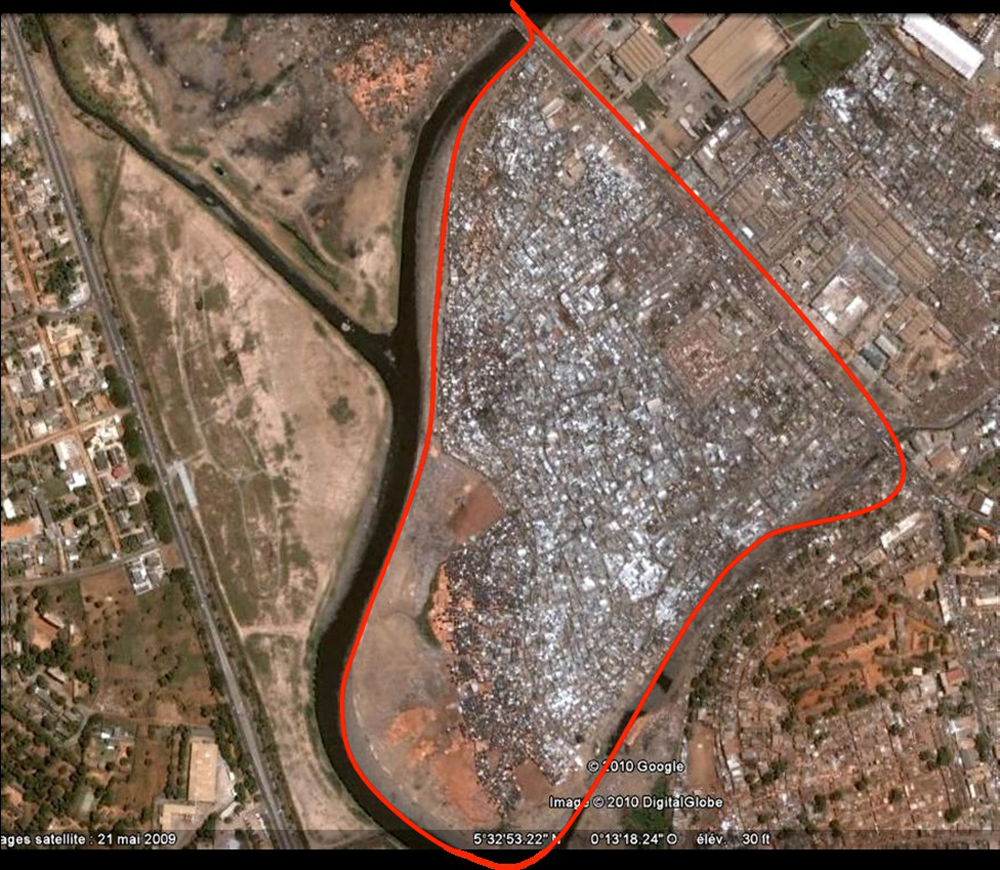
Old Fadama (outlined)
Old Fadama was first settled in 1981 by new migrants to Accra. The settlement grew steadily, with a particular influx of traders who were relocated to the site by city authorities around 1990 who settled there after the Non-Aligned Movement conference. Later, the community expanded to absorb migrants fleeing the 1994 Konkomba-Nanumba war (or “Guinea Fowl” war) in northern Ghana. In recent years, new residents have primarily been economic migrants coming from various parts of the country in search of better employment. This includes a large population of female workers who are employed as head-porters (kayayei) and who use head pans to cart foodstuffs for shoppers in the market, and live in dormitory-style rooms of 8−20 people per room.
In 2002, representatives from Shack/Slum Dwellers International (SDI)(1) came to Old Fadama at the invitation of its residents, who had heard about SDI’s work elsewhere in Africa and were curious to learn more, particularly with regard to countering forced evictions. Calls for the clearance of Old Fadama were (and are) common, especially from newly elected city Mayors, not just because of its environmentally sensitive location but also due to the reputation and stigma that have developed around it; locally, it is often referred to as “Sodom and Gomorrah”. The residents of Old Fadama faced uncertainty about whether they could continue to live there, but also had to deal with the frequent floods, poor quality housing and lack of infrastructure. They were looking for new ways to address these challenges as a community.
The residents responded positively to the initial exchanges with SDI and to the suggestion that they start savings groups as the basis for organizing the community against possible forced eviction. As a result of these discussions, the first savings group(2) was started in Old Fadama in September 2003; and the Ghana Federation of the Urban Poor (at the time known as the Ghana Homeless People’s Federation) and the support NGO People’s Dialogue on Human Settlements were both founded in the same year. The Ghana Federation of the Urban Poor (GHAFUP) was founded as a membership-based organization of the poor, made up of daily savings groups in various informal settlements. People’s Dialogue was founded as a registered non-profit organization, tasked with supporting GHAFUP in terms of documentation and advocacy. Other savings groups soon followed, and by early 2005 there were savings groups in six out of the 10 regions of Ghana.
II. The First Enumeration: 2004
From the time of their establishment, the work of the GHAFUP and People’s Dialogue was based in the issues faced by the residents of Old Fadama. It followed, then, that Old Fadama would be the site of GHAFUP’s first survey, an enumeration(3) conducted in December 2004. The enumeration was completed with the support of teams from federations and support NGOs from South Africa and Zimbabwe. The purpose of the enumeration was to begin the process of documenting how many people lived in Old Fadama (at the time there were conflicting estimates; the government counted 10,000 people, while GHAFUP estimated the figure to be 20,000 and the community felt there were 30,000), but also to begin describing the economic activities taking place there and the livelihoods of the residents. At the time, and to this day, there was a strong stigma attached to those who lived in Old Fadama, and the economic contribution of the settlement’s residents and enterprises was not widely known or acknowledged. The residents were seen as a drain on the city’s resources. Furthermore, the area where the settlement was located had been identified as environmentally sensitive. The government of Ghana had begun planning a project known as the Korle Lagoon Ecological Restoration Project (KLERP), which would necessitate the resettlement of many of the residents of Old Fadama as the settlement was located on land that had once been part of the lagoon.(4) While community members considered KLERP to be an important initiative and were not opposed to the idea of relocation, they were concerned that there was inadequate provision for resettlement or upgrading. They feared that they would be resettled on the outskirts of the city, far from their places of employment, with inadequate provision of basic infrastructure and services, including schools and transportation. They wanted to be included in the planning of the relocation so that they might benefit from it rather than possibly be harmed by it, as they would be if they were forced into a similarly under-resourced area on the periphery of the city, further away from employment. In addition to fighting for their own settlement and futures, the residents of Old Fadama were also aware of the broader needs of informal settlements in Ghana. They hoped that this enumeration would set a positive precedent and that, through witnessing the process, leaders from other informal settlements would decide to enumerate their own communities and spread the practice throughout the country.
A report of the first survey noted the following:
“Residents of Old Fadama were set for action and preparation was far advanced before the SDI team [from South Africa and Zimbabwe] arrived. The [enumeration] team was drawn from members from the Greater Accra Metropolitan Area. The inclusion of GHAFUP members from other parts of Accra was to ensure that the training and experience becomes a shared knowledge. Without any delay, the exercise started on 13 December [2004]. Amidst fun and anxiety, hundreds of residents poured into GHAFUP and offered themselves for the exercise.” “One significant thing about the exercise was the high level of interest and seriousness of purpose that the women showed throughout the period. Rose [Molokoane, from the South African federation] and the SDI team facilitated and took their Ghanaian counterparts through the process. Like a dream come true, at 10:45 a.m. on the morning of 13 December, the first structure was marked and counted in Old Fadama. By the close of the first day of the exercise, about 2,000 structures were counted. The counting and administering of questionnaires lasted 11 days and the compilation [of data] took an additional three days. Altogether, it took 14 days to complete the exercise.” “It is significant to note that in the few days before, during and after the exercise, a strong people’s process was seen building up in Old Fadama. The residents are confident that given the appropriate support and encouragement, they can themselves do many things. When asked to comment on the exercise, one woman who participated in the exercise had this to say: ‘Initially, I did not believe that I could play an active role in compiling and gathering information in my community since I had no formal education, but this exercise has been an eye-opener for me and a confidence booster for myself to come out of my shell to try and do other things that I thought I could never do.’ Her feelings typify the feelings of almost all who took part in the exercise.”(5)
The 2004 enumeration collected information about the number of inhabitants, the number and types of structures and the level of infrastructure provision in Old Fadama. To achieve this, each structure was numbered and the people living there were briefly surveyed. During the profiling, local government officials were extremely sceptical about the likelihood of success. They thought that it would be impossible for the community to complete an enumeration in Old Fadama. Officials adopted a “wait and see” attitude, sceptical about the capacity of unorganized, largely illiterate low-income residents to conduct a survey. This scepticism was heightened by the political context of the time, with ongoing threats of eviction and the urgency with which city officials wanted the group evicted. Local officials feared that the enumeration would generate some public sympathy for the residents of Old Fadama, particularly as the real numbers of residents were much higher than officials publicly acknowledged.
Regarding city government officials’ participation, when the five-member SDI team (including leaders from affiliates in South Africa and Zimbabwe and led by Rose Molokoane) initially met with city officials and officially announced the planned enumeration, their participation was solicited. The city could not refuse to join in a process that drew such international attention and participation, and so agreed to participate in the launching of the 2004 enumeration. The director and chair of the sub-metropolitan assembly attended the launch event and officially opened an office building in Old Fadama, as part of the process to create a community meeting and resource centre for the enumeration exercise. Beyond this largely symbolic participation, city officials did not take part in the actual enumeration. However, they were influenced by its results. When the enumeration data had been collected, the population figure for Old Fadama turned out to be more than twice that expected by the government. This result successfully discouraged the city from using old population figures for the area. The data were also often cited by academics, development partners and civil society for the purpose of advocacy.
There were many successful outcomes of the 2004 enumeration, both for the residents of Old Fadama and for GHAFUP. The enumeration of Old Fadama found that the population consisted of about 24,000 people living in about 11,000 shacks. In addition to clarifying the question of how many people were living in Old Fadama, it also helped to postpone temporarily any possible forced eviction as the community suddenly had a face; there was now some data about it, some public recognition of its existence and some organizational capacity that gave residents a new voice in civic affairs. Having successfully completed the first ever community-led enumeration in Old Fadama, residents (particularly the enumerators) were proud of their achievements. They felt that they had proved to city officials that with the right support and space, they could contribute to development. Furthermore, the organizing of the enumeration helped to strengthen the organization of residents around the issues of the eviction, as they realized their potential strength in working together towards a common goal. Finally, public support for their cause was heightened, as the total population of Old Fadama turned out to be much higher than expected and as the number of vulnerable groups within the settlement was identified. For example, it was found that children under the age of 15 made up more than 20 per cent of the settlement’s population. The enumeration accomplished its initial goal of helping to mobilize the community against forced eviction, providing them with data that were valuable for discussions about the issue. It also strengthened the capacity of GHAFUP to conduct these types of operation in the future.
The enumeration gave visibility to GHAFUP and the daily savings groups, increasing their confidence in their own agency and abilities. It also acted as a catalyst for the community to start seeing itself in a new way, shedding some of the old stigmas and demonstrating the extent of its resources and businesses. The enumeration showed that there were a large number of mosques or religious centres in the settlement, as well as a large number of entertainment centres, water taps and toilets. It encouraged the residents to recognize their own asset base, community assets that they did not talk about previously. Residents started saying: “We have 500 sanitation points! There are toilets here!” For a community that previously had a fairly negative view of itself, these were major revelations. It also presented Old Fadama in a new light to outsiders. Before the enumeration, the residents were seen as a problem, people squatting on public land. The enumeration showed 3,000 water points, 500 sanitation points and predominantly legal electricity connections. This challenged the view of city officials that the community was using illegal water, illegal electricity and were defecating in the open. It challenged city officials to invest in infrastructure in the settlement − they couldn’t use accusations of illegality as a justification for inaction.
The enumeration of Old Fadama also provided inspiration to other communities in informal settlements: that the residents could undertake this kind of work themselves, that the ability to undertake enumerations wasn’t limited to college graduates or trained statisticians. Prior to this, it had been assumed that enumerations had to be undertaken by professionals; the community had only ever seen college graduates coming in and collecting data, as if it was a very complicated scientific process that ordinary people could not engage in. The experience of undertaking the enumeration showed that a fairly limited amount of training was necessary in order for residents to conduct an accurate enumeration. The community felt proud that it was able to achieve such standards itself and was empowered by the process.
Previously, the residents of Old Fadama had experienced feelings of isolation and marginalization, and the enumeration helped reduce these concerns. Before 2004, it seemed that there was no one who understood their stance or who was willing to hear their side of the story. Now, they were part of an international network; they were being visited by teams from other parts of Africa who faced comparable problems, and who came to listen to their experiences, discuss their work and work with them in their own settlement. This instilled a new sense of community pride and identity; people began to feel that volunteering, giving their time to build their community was worthwhile.
The enumeration provided a new basis for engagement with local government authorities. Previously, none of the local officials would visit the settlement or have discussions with local residents because the plan for demolition had already been set and the area was viewed as being “black listed”. The launch of the enumeration provided a way of getting some local officials to visit the settlement, and from there GHAFUP was able to start building relationships with local policy makers and begin a dialogue with the city government. The results of this dialogue were significant: as the government had witnessed the enumeration and the manner in which it was carried out, they were more inclined to accept the legitimacy of its findings. The much larger than anticipated population also meant a reconsideration of eviction plans, given the number of people who would need to be re-housed.
Through the process of enumeration, GHAFUP became more relevant and useful with respect to addressing the needs of residents, both in terms of being able to identify needs and in terms of having legitimacy and influence within the community. GHAFUP was formed in Old Fadama in September 2003 and by 2004 membership stood at around 600; by the end of the enumeration, there were some 2,000 members.
There were no immediate benefits in terms of policy change, but the enumeration contributed to a gradual shift in position in the national government. This culminated in 2005 with an invitation to the UN−Habitat’s Action Group on Forced Eviction (AGFE) by the government of Ghana, to undertake a fact-finding mission and to assist the government in finding lasting solutions to the problem.
III. The Second Enumeration: 2006−2007
The second survey of Old Fadama was a more detailed enumeration to provide a more comprehensive set of data about the settlement, for the community to use in its advocacy and in continuing to make the case to government not to demolish the settlement. The second enumeration counted the number of residents and structures, as well as the types of structure and services present, including toilet blocks, schools, clinics and religious spaces. It also detailed the variety of businesses present, from hairdressers, charcoal dealers, tailors and lottery vendors to fishmongers, mechanics, cassette sellers, tea sellers, drugstores and refrigerator repair shops.
Initially, the 2006−2007 enumeration encountered some resistance from the community, as there was a misunderstanding about the aims of GHAFUP. Some residents thought that they were simply representing the interests of local government and preparing the community for resettlement. This was in some sense the case, as the national government had requested GHAFUP to support it with data via enumeration to assist in the relocation plans for Old Fadama. So the exercise was undertaken with official backing, and the results were meant to be used by the city, the national government and the community for a relocation programme. From the perspective of GHAFUP, this was an opportunity to engage with government about these issues of relocation and to have community data and community participation as the basis of these discussions. Given the environmentally sensitive condition of the land they were occupying, GHAFUP was petitioning for a participatory relocation rather than a forced eviction. As before, the government had no actual role in undertaking the enumeration, and the whole exercise was conducted by GHAFUP with support from People’s Dialogue. However, the city government was drawn into the process by being asked to review the data collection instruments and the questions asked. As the enumeration got underway and residents saw that it was being conducted as before, with the enumeration teams made up of residents of the community and the results returned to the community, their concerns were eased.
The results of the 2006−2007 enumeration were accepted by government as the official data on the community, and were used as the baseline for preparing the way for what turned out to be an abortive relocation plan for Old Fadama. The enumeration resulted in the design, development and adoption of a relocation plan, although eventually this plan was not used because of later political upheavals. The relocation was conceived of and planned with active community participation, beginning with community meetings, through the enumeration exercise, to the final data validation. When the data were submitted to the government in late 2007, preparations were underway for the 2008 national general election. No government would want to attempt such a large eviction around election time, so government eviction attempts were stalled until after the election.
The 2006−2007 enumeration put the population of Old Fadama at just over 48,000. This reflected the rapid growth of the settlement since the previous profile in 2004. The capacity and influence of GHAFUP had also grown, and partnerships had started to develop between GHAFUP and the city and central government.
At the community level, residents had become more confident and were more willing to cooperate with government to find a socially sound solution to the eviction threat. Residents were also less anxious, able to go about their normal business without intimidation and the fear of being evicted the following day.
The enumeration also influenced government policy on evictions. For the first time, relocation replaced eviction as the official government policy line after the enumeration and the development of the relocation plan that followed. This policy shift was publicized during the 2006 World Urban Forum held in Vancouver, where the government of Ghana did a joint presentation with GHAFUP on “Old Fadama: policy shift from eviction to relocation”.
IV. The Third Enumeration: 2009
After the 2008 general election, the new government wished to exert its political authority, which led to a new threat of forced eviction in Old Fadama. In 2008, as in 2004 and 2000, the new mayor stated that they wanted to evict Old Fadama. This undermined the progress that had been made with the previous government regarding relocation. In response, GHAFUP proposed another enumeration, again to show the government how many people lived in Old Fadama, what economic activities that took place there and what needs a proposed resettlement would have to address. The new mayor was using old and inaccurate statistics on the number of people living in Old Fadama to justify eviction. Members of GHAFUP and staff from People’s Dialogue challenged those numbers in a meeting with the mayor, stating that if the mayor wanted an eviction, he at least needed to know the correct population of the settlement: “If in doubt, count”. The mayor accepted this logic and agreed to another enumeration.
At the same time, a series of discussions were taking place in the Accra Metropolitan Assembly concerning the best way to address the issues in Old Fadama. As a result of these discussions, the community formally requested a baseline study to be conducted by GHAFUP and People’s Dialogue, which would inform their decision about the best way forward. In this way, the community of Old Fadama and GHAFUP were able to convince the local government to wait on evictions until another enumeration could take place, and to use the results in determining a plan for the area.
This enumeration was carried out in much the same way as the 2006−2007 enumeration. It was intended as an individual socioeconomic survey, collecting data about population, unemployment, education, income, place of origin, sex, ability to resettle elsewhere and the security and duration of their residence in the settlement. People’s Dialogue carried out the early stakeholder discussions, including those with the Accra Municipal Assembly and with traditional leaders within the community, and also general community consultations for the enumeration. It trained the surveying team and developed a questionnaire form and a data collection and verification process. It also carried out the data entry process after the enumeration was complete and wrote a report on the enumeration. For the survey itself, GHAFUP used the same boundaries and zones that had been determined for the 2006−2007 survey, in order to ensure continuity between the two enumerations. The enumeration took 38 days, including weekends when a higher number of residents were found to be at home.
It had been clear after the 2006−2007 enumeration that Old Fadama’s population was growing rapidly, and the 2009 survey confirmed this. Since the first profile conducted in 2004, the population of the settlement had increased almost four-fold, to reach some 79,684 individuals in 2009. Residents seemed to have adapted to the frequent flooding and unstable ground, and the economic base and size of the settlement had also been growing. The 2009 enumeration showed that densities had reached an average of 2,562 persons per hectare (or about 79,684 people on the 31.1 hectares of land that formed Old Fadama). In comparison, the density of skyscraper-laden Manhattan in 2010 was about 266 people per hectare (or 68,951 per square mile),(6) significantly lower than in Old Fadama. Part of the population growth recorded in the 2009 survey was because at the time, the surveyors were able to count a segment of the community that they had missed previously, namely head-porters (known as kayayo), who live in group rooms.(7) The 2009 enumeration provided a new level of detail about the origins of the residents of Old Fadama, their reasons for coming to the settlement and their current livelihoods. It found that most were economic migrants, and while the majority of residents originated in the northern regions of Ghana (65.9 per cent), few of them had migrated because of the conflict there. The second and third largest groups originated in the Volta and Eastern regions; most regions were represented in Old Fadama, as well as a few neighbouring countries.
Nearly everyone in the community was employed at the time of the enumeration, mainly in the informal sector; many worked in the nearby Agbogbloshie market or the lorry station. Employment was the main preoccupation of the community as a whole, as 65 per cent of those under the age of 18 did not attend school. During the enumeration, a substantial number of people said that they would not change their jobs if they were evicted, as their job at the market or lorry station was their main source of income. This indicated that resettlement would have a major impact on livelihoods in this community, increasing transport costs and making it more difficult for the households to maintain their major source of income unless the resettlement site was near these areas of employment.
Moreover, the enumeration found that a high percentage of the residents were also supporting family members in other parts of the country, in addition to their own children or other immediate dependents. Any disruption to the economic life of Old Fadama or to the market and lorry station on which it depends would clearly have ramifications for a network of households around Ghana.
After the enumeration was completed, a report on the survey was prepared for the Accra Municipal Assembly to provide the basis for a new round of discussions on the best way to address the needs of the community in Old Fadama and possible resettlement.
V. The Kayayo (head-porter) Enumeration
The enumeration process has also been used by GHAFUP to identify the needs of vulnerable groups within Accra, with the purpose of developing projects to support these groups. Over the past few years, there has been large-scale migration from communities in the north to Accra and other major cities such as Kumasi, Takoradi and Tema. Much of this has involved young men and women in search of jobs and other economic opportunities. These young migrants engage mostly in head-portage, popularly known as kayayo, and other menial jobs such as domestic service and street trade. The kayayo phenomenon and its allied street activities have grown rapidly, and this has been attributed to policy and system failures, including both pull and push factors for migrants. To address this challenge, the leadership of the Kayayo Youth Association (a constituent group of GHAFUP) together with People’s Dialogue engaged with the office of the vice-president of Ghana. Following this, they were tasked with conducting an enumeration to gather up-to-date information about the membership and the challenges confronting head-porters, and to establish a database for planning purposes. The enumeration was conducted in late 2010 and drew information from about 15,000 kayayos operating in different parts of Accra. One immediate outcome of the enumeration is that about 200 kayayos have been selected to undergo apprenticeship training in various vocations to boost their employment and business management skills. It is expected that this training will link the skills training options to the jobs that are available in the market. This is the first phase of the training programme, which plans to train more kayayos in its subsequent phases.
VI. Conclusions
The enumerations in Old Fadama illustrate the power of community-driven enumerations in helping prevent forced evictions and in changing the policies around evictions and relocations. Completing multiple enumerations in the same area has not only created a valuable timeline for the growth and development of Old Fadama but has also underlined the continuing challenges that federations of slum or shack dwellers face, both in terms of having to constantly fight for legitimacy within changing political landscapes and in terms of the difficulties in mobilizing communities of the urban poor trying to have their voice and needs taken seriously. Through their repeated willingness to engage with government and re-enumerate Old Fadama, GHAFUP and People’s Dialogue have created a detailed record of its growth and the changes that have taken place there. This includes the ways in which the settlement incorporates migrants from various parts of the country into the local economy, and the ways in which residents develop their own livelihoods. The interconnectedness between the residents as well as important economic activities within the city, the Agbogbloshie market in particular, are also of key importance when considering possible relocation plans. This case study further highlights some of the tensions between the realities of the urban poor and possible environmental concerns; while it is true that Old Fadama lies on environmentally sensitive land, this cannot be used as a justification for forced eviction. If relocation is needed, as it is in this instance, it has to be planned in a participatory and inclusive way. Fundamentally though, these enumerations have provided a voice to the residents of Old Fadama. The process has helped them to see themselves in a new light, giving them confidence and a strong information base when engaging with city officials about their needs and rights. It has also helped others to see them in a new light, including those in city and national government.(8) The informational power created by the enumerations, as well as the confidence and organizational capacity that they have supported within the community, has changed the balance of power, increasing the leverage of the residents of Old Fadama to have a say in planning their future.
Footnotes
1.
Shack/Slum Dwellers International is a network of federations of slum dwellers in more than 30 countries around the world. These federations are united in their commitment to organize around three basic processes: daily savings and loans; participatory enumerations; and peer learning exchanges. These processes, when used together, form a powerful foundation to support slum dwellers to undertake housing and infrastructure development in their settlements.
2.
“Savings group” here refers to an informal community daily savings and loan group formed by women in an informal settlement for the purpose of daily incremental savings, in a similar vein to credit unions.
3.
Enumerations are individual or household level surveys, where each shack in a settlement is numbered and the inhabitants are counted and asked a series of questions about their socioeconomic situation and access to basic infrastructure and amenities. The level of detail of data gathered in enumerations can vary according to the capacity and needs of the federation. In this case, the 2004 enumeration was quite limited in terms of depth − counting the population and the number and type of structures and completing the exercise successfully were the top priorities.
4.
Note that this was also the motive for the enumeration that was organized in the early 1970s in Janata Colony as it was under threat of eviction – see the paper by Jockin Arputham in this issue.
5.
Farouk, Braimah R (2005), People’s Dialogue on Human Settlements and the Ghana Homeless People’s Federation: Brief History, People’s Dialogue on Human Settlements internal report (unpublished), page 4.
6.
US Census Bureau (n.d.), “Quick facts: New York County (Manhattan), New York”, accessed 25 October 2011 at  .
.
7.
“Group rooms” are shared group shacks in which as many as 10−15 women live. They are not dormitories in the sense that they are not provided by employers nor are they purpose built to accommodate this number of people. These are simply shacks, usually built of wood, which the women rent together as they are unable to live with their families since they are generally economic migrants from elsewhere.
8.
This has translated into significant action and partnership; as this goes to press, GHAFUP is developing a project with the City of Accra and Greater Accra Region to support a citywide federation that will partner with city authorities to develop inclusive citywide upgrading plans.