




Abstract
The co-production of urban services, such as water, energy or sanitation, is a vital tool to advance service delivery and to challenge socioeconomic structures that reproduce urban inequalities. This article examines the crossovers between debates on intersectionality and the co-production of urban services. Intersectionality is a critical lens for an engaged critique of the dynamics of exclusion that may challenge service co-production. The paper draws attention to three key insights: 1) the need for an explicit questioning of processes to define vulnerability, particularly when they rely on bounded, fixed identity categories; 2) a recognition of the complex and multiple lived experiences of inequality and marginalization in any given context; and 3) a conceptualization of social identity as constituted through dynamic processes and always open to revision.

I. Introduction
Expanding access in urban areas to safe and affordable services such as energy, water and sanitation is a critical challenge faced by local governments, NGOs, and communities in urban areas. This is also a prominent theme in international urban agendas, as defined in the 2015 Sustainable Development Goals (SDGs) and the 2016 New Urban Agenda. Slogans such as “leave no one behind” recognize the connections between systems of oppression and exclusion that reproduce and perpetuate urban inequality and the delivery of urban services. Intersectionality theories examine the multiplicity and interconnected nature of such systems of oppression and exclusion.(1) Therefore, the question of intersectionality is inherent to the equitable delivery of urban services as anticipated in the SDGs.(2)
In this article, co-production refers to an array of strategies initiated by community-based organizations or grassroots groups to access public services, and is often presented as a practical approach to deliver services in challenging contexts.(3) Co-production links efforts to claim, and sometimes deliver, services that are fundamental for life in urban areas.(4) Co-production is also a tool to advance urban sustainability and social justice. Thus, co-production strategies have a pivotal role to play in achieving the SDGs.(5) Challenging the socioeconomic and political structures that reproduce inequalities is a central part of the delivery of co-produced services. Even these varied attempts at definition fail to adequately capture the richness of debates on the co-production of urban services (see the discussion below). For this paper, these features constitute a starting point to characterize co-production initiatives in relation to intersectionality challenges.
Questions of intersectionality increasingly permeate, explicitly or implicitly, debates about the co-production of urban services. This is in line with a growing interest in intersectional questions within the fields of urban and development planning.(6) This interest goes hand in hand with the implicit assumption that co-production processes and their outcomes relate to the same structures of oppression and exclusion that produce urban inequality.(7) In this context, the objective of this paper is to examine the connections between debates on intersectionality and the co-production of urban services.
The focus of this paper is, therefore, the study of this crossover to deepen and systematize existing dialogues within both fields. The paper takes its cue from the work of Walker et al.,(8) who adopt a gender analysis lens to examine urban change in Mumbai from the perspective of less-able children. They argue that “…because urban form and urban relations are both demonstrably gendered, urban change will interact with gender norms and practices in ways that can be emancipatory or that can consolidate existing gender inequalities”.(9) The authors depart from a gender perspective, but extend their analysis to other dimensions that limit the rights of vulnerable groups in urban space, such as disability or age. In this vein, they argue for a focus on the relations and discourses that enact specific forms of exclusionary practices (masculinity/femininity, age, ability), rather than for an understanding of multiple social groups in precisely demarcated, static categories (women vs. men; old vs. young). As Bastia(10) argues, intersectionality theory defies – instead of reinforcing – the compartmentalized approach to “difference” that permeates debates on identity politics: it is a means to claim multiple sources of oppression that affect vulnerable communities and that are not always represented in feminist analyses of urban inequality.
Intersectionality is a critical lens that enables more profound analyses of social relations of exclusion. However, in practical terms, intersectionality theory does not offer a ready-made methodology to advance the co-production of urban services. Instead, this theoretical framework supports a critical appraisal of existing co-production practices.
First, adopting an intersectionality lens means recognizing the specific lived experiences of marginalization and inequality of different social groups. Such experiences are not reflected in generalizations that follow an analysis of identity in separate categories. There are no universal understandings of what it means to be a woman, man, child, less abled, queer, non-binary, a member of an ethnic minority or member of an excluded caste, just to mention some apparent forms of oppression. Making increasingly complex lists of categories or matrix-based comparisons of such categories is, in the best of cases, a futile exercise.(11) An intersectionality focus provides an antidote to attempts to universalize contingent experiences of exclusion.
Second, intersectionality scholars assume that identity is not a permanent category. Instead, different forms of identification may be adopted through the life course, in relation to different experiences and situations. Intersectionality is a critical lens for perceiving social life in the city not as depending on congealed structures, but as consisting of dynamic processes that require constant negotiation. Co-production is one such means of negotiating both identities and the rights and obligations associated with those identities.
We argue that an intersectionality lens invites scholars and activists to reformulate the assumptions at the core of co-production processes. An intersectionality lens brings principles into focus that can help to check the effectiveness of service co-production in advancing people’s freedom and well-being. Do co-production processes offer opportunities for sharing multiple experiences or do they close the arena for dialogue? Can co-production processes address the lived experience of inequality, as it happens in each place? To what extent can co-production processes incorporate an acknowledgement of people’s life histories and experiences and support critical analyses that recognize the multiple levels at which social exclusion happens? Intersectionality theory calls for scholars and activists working on service co-production to remain attentive to the production of new and unexpected forms of exclusion in a dynamic context.
The paper is divided into five sections. Section II turns attention to service co-production, to demonstrate the relevance of intersectionality questions in co-production. Section III explores debates on intersectionality within feminist theory and its significance in an urban context. Section IV focuses on one aspect of intersectionality regarding the recognition of lived experiences, to systematically tease out the different elements that may be relevant in a co-production context. The conclusion in Section V examines the opportunities to adopt intersectionality analysis as a critical tool in urban development.(12) Rather than systematizing knowledge, co-production efforts should be directed towards the integration of intersectionality vocabularies and methodologies as part of mainstream approaches to the co-production of urban services.
II. Intersectionality And The Varieties Of Service Co-Production
Co-production is an umbrella term that brings together insights from a range of experiences and social theories. Service co-production entails forms of urban service provision that rely on an array of actors, beyond state institutions and service companies. This section teases out some of those debates around the co-production of urban services where intersectionality is relevant.
Three approaches dominate understandings of service co-production. First, foundational debates around the notion took place in the 1970s and 1980s. These debates were dominated by scholars of public administration, especially in North America. Second, the adoption of the co-production terminology has helped to describe the experiences of service provision in low-income countries, where actors beyond the state – especially community groups and civil society organizations – have played a role in the delivery of urban services where the state and the private sector are insufficiently present. Third, ideas of co-production have become increasingly important in the generation of alternative ways of knowing the city and the participation of citizens at the intersection of knowledge production and policy formulation.
Co-production ideas rooted in public administration theory initially developed with reference to the context of municipal governance in the United States.(13) In this version, the analysis focuses on how co-production can improve service management. This is a deliberately utilitarian approach to service co-production. Percy,(14) for example, summarizes the co-production of urban services in a series of propositions that have to be tested to demonstrate the positive impact of co-production in public administration:
Citizen co-production leads to higher levels of urban services in the community.
Citizen co-production is associated with lower budgetary costs for the same level of service provision.
Service co-production enhances the responsiveness of the concerned institutions to the community’s needs and preferences.
Co-production improves citizens’ knowledgeability and understanding of constraints in service provision.
Service co-production increases levels of participation overall, contributing to the democratization of governance.
These public administration scholars reflected upon the moral consequences of service co-production and what co-production means for broader trends in their field. One criticism was that service co-production in this context seemed equivalent to a “transfer” of part of the costs for service provision to individual citizens or citizen groups, thus raising equity challenges.(15) In other cases, attempts to shift the costs for public services to developers raised the question of who would actually benefit from those services when developers sought to recoup their costs.(16) In most cases, there is a tacit assumption that service co-production occurs alongside state efforts to provide public services. In this context, the central question about making co-production possible is: Why would citizens engage in service co-production?(17) The implication is that citizens would need specific incentives to participate actively in co-production processes. While this is an important question in higher-income countries, it is secondary in lower-income countries, where citizens participate in service co-production in the absence of either state-led public services or market-led service provision.
Debates on service co-production have been enriched through experiences in cooperative governance,(18) in which different actors establish relations of mutual assistance to deliver a common goal, i.e. service provision. Such cooperative governance models have been particularly important to foster institutional innovation and facilitate a transition towards decentralized models of provision.(19) Cooperative governance models provide insights for the design of forms of participatory and collaborative planning through which communities and state actors can identify concrete actions and available resources to improve services and mitigate structural vulnerabilities to disasters.(20) Much of the energy revolution towards renewables, for example, has followed experiences of grassroots groups working together to deliver new projects or challenge dominant business models.(21) Unfortunately, the potential for social and technological innovation to be found in initiatives from within communities is most often overlooked.
While initial debates on service co-production took place in the context of public administration in the United States, the influence of figures like Elinor Ostrom, and the discussions at the Workshop in Political Theory and Policy Analysis in Bloomington, Indiana, situated this work in an international context. In the mid-1990s, Ostrom published one of the most influential articles on service co-production, a comparative analysis of institutions in two countries where, according to her, co-production processes were apparent (Brazil) or not (Nigeria).(22) The paper suggested that structural political factors have a determining influence on whether or not service co-production is possible.
On the whole, however, it is fair to say that scholars of public administration and cooperative governance have not always recognized the specific dynamics of service co-production in urban areas in lower-income countries. Recognizing that service co-production works differently in different institutional contexts, as argued by Ostrom,(23) is not sufficient. Co-production processes must respond to the needs of those who are purported to benefit, recognizing them as active subjects who shape every step of the process.(24) Moreover, there are specific justice questions that emerge in relation to a global history of development, with its legacy of colonialism and exploitation. Moreover, particularly in lower-income countries, service co-production may be the only means for communities to both have a service and claim their right to such service (with all the implications that such a claim may have).(25) In that context, co-production is more than a theory of public administration. It is a practice that has emerged from the bottom up as a response to the multiple forms of exclusion and deprivation that the most vulnerable groups face in contemporary cities.
Alternatives emerge from a long history of engagement with community or locally driven development in the global South, already well-developed at the time of the development of the institutional approach explained above.(26) Taking stock of this body of work, Mitlin and McGranahan have studied paradigmatic examples of the co-production of sanitation services to show how co-production may improve outcomes, in the style of public administration research, while at the same time opening up avenues for grassroots organizations to claim political influence.(27) Clearly, co-production can be a means to destabilize existing structures of service provision. However, co-production can also work to redefine existing institutions to legitimate external interventions.(28) For instance, in the context of an increasing retreat of the state, co-production has been identified as a potential tool for the enclosure of public services for the benefit of middle-income people who can more easily capitalize on co-production processes.(29) While public administration studies have sought to investigate the incentives for citizens who participate in service co-production, in lower-income countries the question is how structural factors may exclude specific groups from the co-production process, and what burdens it adds to their already constrained lives. Which social groups will be able to take advantage of the new spaces of opportunity? If a group is deprived of access to services within a traditional model of state-led provision, they may also be deprived in the context of co-production, which may require an investment of personal resources and time.
The potential of the co-production of urban services depends on the history from which co-production emerges, and whether co-production practices have evolved organically in relation to the possibilities and aspirations of grassroots groups.(30) The risk lies within the very dynamics that make co-production an instrument to gain political legitimization in a given institutional context. Co-production works politically both by building institutions that recognize local needs and by challenging existing institutions that ignore them. For example, co-production is often associated with forms of institutional innovation that improve the accountability of existing institutions to grassroots groups.(31) The process of gathering information about existing systems of service provision, for example, may empower grassroots groups to take into account existing service providers. Co-production may also be associated with a redefinition of the roles of civil servants and technicians in charge of service provision, who may then be in a better position to attend to the needs of disadvantaged groups.(32)
Simultaneously, the diversification of actors intervening in service provision prevents the concentration of power in a reduced group of individuals.(33) However, the diversification of providers does not always work for the benefit of the urban poor. For example, informal settlement dwellers in urban areas in India may be forced to buy water from more expensive private providers, while middle-income residents may have access to cheaper forms of provision from municipal bodies.(34) Overall, service co-production cannot be understood without reference to the processes of resignification that emerge from grassroots’ groups involvement in the actual provision of services.
What happens if the knowledge base that underpins the provision of urban services is itself under question? This process of resignification should move away from understanding poverty towards challenging the structures of knowledge production that shape processes of urban development and planning. Jasanoff speaks of co-production as a means to reflect upon how the social and political order emerges hand in hand with dominant ways of understanding reality.(35) This is a crucial insight to engage with service provision questions, as ways of understanding and delivering service provision reflect the collective negotiations that enable intervention in urban environments. Corburn and coauthors, for example, have shown how stakeholders and policymakers can engage collectively in producing knowledge to challenge existing paradigms for the provision of urban health.(36) Producing knowledge is inherent to urban planning, but rather than uniform knowledge, planning is informed by multiple knowledge claims that inform the content, process, and normative objectives of urban development practices.(37)
Processes of co-production also shape discourses of development and poverty reduction.(38) In lower-income countries, particularly those whose practices are burdened by colonial and post-colonial legacies, the challenge is how to account for multiple knowledges that generate context-specific planning challenges, such as recognizing and addressing the conditions of informality (rather than thinking of informal settlements as relics to be eradicated).(39) The integration of the urban poor into processes of decision-making, through the institutional processes that result from service co-production, is one means through which alternative forms of knowledge can be accounted for and produced.(40) Another is recognizing the value of contextual knowledge and the ability to navigate daily challenges beyond informal and formal distinctions.
To what extent is it possible to foster mechanisms to co-produce urban services that not only enable delivery but also challenge dominant models of provision and visions of the city? Is service co-production a means to claim the right to the city, by fostering new views of the city from those who inhabit it? For example, the involvement of the urban poor in environmental planning and activism tests and challenges general assumptions that dominate planning discourses in a given city.(41) Co-production may open the door to both social and technological innovation, although finding routes to negotiate appropriate technologies that work in context is one of the most significant challenges for co-producing services.(42)
In each case, the potential for service co-production to transform existing systems of service provision and, alongside those, the socio-political context of inequality depends on its ability to question accepted assumptions about what constitutes good service delivery. From a public administration perspective, proponents of co-production argue that it leads to efficiency improvements by adjusting service provision to the needs of the urban poor.(43) From the perspective of social movements, particularly in urban areas of low-income countries, co-production is seen differently.(44) Its potential lies in the extent to which service co-production processes can diversify the actors governing the city and create instability in the dominant structures of power. Knowledge perspectives look at co-production as a means to challenge dominant paradigms of service provision and work towards place-specific innovations.
Co-production is not merely a tool to deliver efficiency gains. When co-production is approached as a mere means to improve efficiency in service provision, equity questions are displaced. Instead, co-production starts from a recognition that the process of service delivery has to be open to negotiation, including negotiating the very assumptions that enable intervention.(45)
Given the justifiable concerns about the displacement of costs for public services to citizens, the central question is who is bearing those costs. Thinking about the management of urban services may not be an option for disadvantaged families in urban areas in higher-income countries, if thinking about additional questions of resource management, conservation or risk poses more problems than it solves. In lower-income countries, however, people may not have the choice: service co-production may be the only means for them to access specific services. A focus on intersectionality points to the complexity of the burden on those who are affected by planning or urban regeneration decisions and who may find themselves with responsibilities for service co-production in addition to the complications of their everyday lives.
Hence, in the case of co-production as a grassroots response to the lack of provision in urban areas in lower-income countries, the question is not only who is burdened with additional co-production responsibilities, but also who has the opportunity to participate in the co-production process and who benefits from these services. Here the main concerns tend to relate to questions of elite capture, and to why some actors may have less of a voice in the co-production process. Intersectionality theory points towards drawing the social boundaries that prioritize the participation of some groups of people over others. These are two extreme challenges that emerge in service co-production, but they are not necessarily mutually exclusive. Thus, it is possible to find cases in which the co-production process both excludes some groups of people and poses additional burdens to others. As identities are not fixed categories, but rather are negotiated alongside other social relations in a given set of circumstances, processes of co-production need to address the changing power relations that shape the eventual outcomes.
In the case of knowledge co-production processes, however, the perspective shifts a little. There are questions of identity and marginalized groups, mainly when specific groups of people feel they lack relevant knowledge, and when this self-perception becomes an obstacle for meaningful participation in co-production processes.(46) However, an intersectionality focus forces an analysis of the actual assumptions embedded in such knowledge and how they reproduce structures of exclusion and oppression. The intersectionality challenge is not one of claiming specific rights. Instead, intersectionality theory calls for the recognition of multiple forms of urban living, even those that are not normalized within existing processes of urban management. At its most basic level, recognition means acknowledging the existence and validity of many forms of living in urban areas. For example, the call for attention to queer perspectives on cities in the global South highlights that recognition is the most immediate intersectionality challenge faced by scholars of urban change.(47) The feminist critique that has generated intersectionality perspectives is an excellent point of departure to examine such recognition challenges.
III. Intersectionality As A Recognition Challenge
Intersectionality theory first emerged out of concern with universalist tendencies in emancipatory movements in the United States in the 1970s and 1980s.(48) Black women found themselves misrepresented in both white feminist movements that claimed to speak for all women and black emancipatory movements that claimed to speak for all black people. Crenshaw(49) has been credited with coining the word intersectionality. Experiences shaped by overlapping patterns of racism and sexism were not represented within discourses of either antiracism or feminism, she argued. These concerns, however, permeate multiple languages of exclusion that extend beyond the experiences of black women. Yuval-Davis, for example, reflects upon the inescapable use of the “etc.” abbreviation at the end of a long list of exclusions that oppress countless of people.(50) She argues for an understanding of those categories in context. For example, in Walker et al.’s example mentioned in Section I, the study of disadvantaged children in itself demonstrated not overlapping categories but multiple experiences that shaped their opportunities within a changing urban context. Yuval-Davis adopts a similar perspective when she argues that intersectionality relates to a recognition challenge. Thus, she calls for examining the particular conditions of exclusion and oppression alongside an open, non-deterministic approach to understanding how such categories are enacted in particular situations. Recognition emerges as a central concern in intersectionality theory.
There is a wide-ranging body of research focusing not only on theorizing intersectionality, but also on thinking about the practical implications of intersectionality concerns for legal debates, policy and activism (following Crenshaw’s groundbreaking work). The challenges faced by queer groups(51) and migrants(52) have dominated debates on intersectionality in urban environments. However, the idea of multiple deprivations has already been prominent in studies of access to services (from sanitation to health and education) and exposure to environmental risks.(53) For example, Thara’s(54) study of fisherwomen on the western coast of India shows the complex arrangement of relationships around categories of class, caste and gender that shapes the possibilities for fisherwomen to draw on political resources to maintain their livelihoods. The deliberate use of intersectionality theory has drawn attention to the complex social structures that citizens navigate in changing urban contexts.
Intersectionality analyses do not only look at people’s experiences themselves. They also reflect upon changing international development discourses and how these are translated into specific practices of intervention. Essex,(55) for example, explains that international institutions seeking to reach the urban poor in Jakarta are acutely aware of the need to understand a diversity of conditions in urban living, which underscores the relevance of an intersectionality lens to their work. Intersectional debates have also emerged as equity concerns have supported the development of feminist agendas for climate change action.(56)
There are particularly relevant insights emerging from the field of feminist political ecology and urban political ecology. If the use and control of infrastructure and resources in urban areas are linked to the reproduction of hegemonic structures of power, this often translates into the delineation of social categories that enable exclusion and result in multiple forms of symbolic violence – that is, violence related to the lack of recognition of people’s lives and problems.(57) One key contribution from this body of work is that it highlights that situated power relations need to be understood in context and their analysis cannot be easily generalized across contexts of service provision.(58) One key insight from the political ecology tradition is that dominant knowledge structures, mostly developed in the West, fail to capture the complexity of delivery systems already in place. Those knowledge systems thus preclude emancipatory strategies of urban development in lower-income countries. Equally, notions of intersectionality concerning the experiences of feminist and antiracist activists in the US may not be entirely appropriate in lower-income countries. The approach is one of caution, while celebrating the emancipatory and reflexive intent that permeates intersectionality scholarship.
Work on intersectionality has direct implications for understandings of service co-production. A fundamental question relates to the definition of the vulnerable groups: demarcating them, determining which groups are more or less desirable, and making visible some social conditions and not others. In an analysis of rural water supply in Bangladesh, Sultana(59) demonstrates that women’s ability to influence and participate in water resources management is related to their subject positions with regard to age, marital status, education and socioeconomic class. However, it is at the intersection of such subject positions that power inequalities emerge. For example, she argues that more senior and wealthy women can have more influence than poor young men. Thus, she concludes, “different women in different social locations” can have very different experiences in the access, use and control of urban infrastructure.(60) The ultimate results depend on people’s networks of support, which may be configured in relation to the adoption of specific forms of identity.(61)
Another insight relates to the way specific situations and spaces foster inclusion or reinforce social differences. This has direct implications for the design of mechanisms of collaboration. As argued by Sultana,(62) “gendered subjectivities are socially and discursively constructed but also materially constituted; subjectivities are produced through practices and discourses and involve the production of subject-positions (which are usually unstable and shifting)”. For example, in a study of oyster harvesting in Gambia, Lau and Scales(63) explain how subjectivities are formed in everyday harvesting practices within specific spatial settings. Those material practices of harvesting shape relations of social difference and the politics of access and use of natural resources. For Nightingale,(64) embodied practices shape socio-ecological relations and hence the ways those practices happen shape marginalized groups’ opportunities to operate in a given space. She argues that the locations of social encounters ultimately determine who can attend certain events and who can work in specific areas. In particular, practices of space occupation open the potential to contest social hierarchies. However, the ambiguity of this potential means that even actions to transgress spaces may serve to reinforce those social hierarchies. For example, she notes a case of a relatively wealthy contractor. He was a member of a lower caste (Dalit) and who was able to enter, uninvited, the house of a member of a higher caste (Bahun). To the researcher, this act appeared as an act of transgression, which demonstrated changing class boundaries. However, entering the house meant that the man presented himself as a “cleaned Dalit”, in contrast with other members of his caste who had to wait outside as “uncleaned”. In doing so, the Dalit man was both claiming his position and reinforcing the caste hierarchy through an action to distinguish himself from other members of his caste.
Even sensitive analyses of diversity that pay explicit attention to vulnerable and marginalized groups may be opened for criticism from the perspective of intersectional analysis. Overall, intersectionality theory offers three key insights. First, intersectionality challenges the idea of independent, fixed social categories, highlighting instead how the intersections between those categories – and their dynamic evolution – are themselves constitutive of social life.(65) Second, intersectionality points towards the production of exclusion and oppression within a system of multi-level, dynamic interactions that include power structures and symbolic representations of identity.(66) As communicable depictions or signifiers of identity, symbolic representations will determine how that identity is experienced in a given social context. Third, those systems of oppression operate differently in each context, in ambiguous and sometimes unpredictable ways.(67) Social categories, identities, power structures and symbolic representations are all highly abstract ideas that may mean little in the practical contexts in which service co-production occurs. Simultaneously, identities may also be apparent in settings where they help to make everyday struggles visible.
These discussions, however abstract, have enormous importance for understanding the development and impact of service co-production. The intersectionality lens is a call for caution, for reexamining the terms of reference that stir or guide processes of service co-production. These debates pose fundamental questions, from attending to the manner in which different groups are demarcated to understanding how the settings where co-production occurs may reproduce oppressive structures. Intersectionality has direct implications for the development of practical methodological recommendations in the context of service co-production. However, one of the limitations of using an intersectionality lens is that new language seems to be needed to explain the dynamics of complex social processes. The language of intersectionality is not always attuned to extract practical implications.
Some implications are clear. An immediate insight is the need to avoid uni-dimensional analyses of inequality in urban practice. For example, the fact that Gender in Development (GAD) protocols(68) have become de rigeur in urban development practice is a testimony to decades of work by gender scholars.(69) However, scholars need to remain vigilant to the possibility that these protocols may contribute to advancing heteronormative models of gender relations to the detriment of queer perspectives on urban development.(70) Overall, streamlined arguments about identity do not reflect the challenges faced by vulnerable populations in urban areas and tend to reinforce inequality.(71) Where gender scholars have made substantial contributions to the understanding of how to challenge existing inequalities, an intersectionality lens may help to strengthen those contributions.
One confusion emerges from the interpretation of intersectionality as a call for the compilation of social “intersections” as a checklist of categories that need to be understood, or even worse, as variables in a matrix-based representation of interactions between social categories.(72) Despite attempts to quantify intersectionality, the most persuasive intersectionality analyses derive from personal engagements with the field, whether this is through auto-ethnography and activists’ experiences, detailed case studies of specific situations and events, ethnographic life stories, or discursive analyses of qualitative interviews, building upon the experiences and understandings of those whose lives are under scrutiny.(73) The intersectionality lens highlights that identity experiences are unique to specific situations and places and cannot be universalized beyond their context of occurrence. Hence, the conceptualization of intersectionality as “lived experience”(74) directs attention to the deployment of categories in specific situations and focuses on the changing dynamics of intersectionality. How feasible is it to adopt this kind of approach for incorporating intersectionality concerns into processes of service co-production? What are the practical lessons for grassroots activists? This is an agenda for research that will grow in the coming years.
IV. Methodological implications of intersectionality as a “lived experience”
Service co-production initiatives led by grassroots movements depart from a profound concern with the experiences of service users. Recognition of these experiences within and beyond participating social groups may be a stated purpose of co-production processes. Outlining the possible outcomes of service co-production helps us to reflect on the implications of intersectionality as a lived experience:
1) Context-specific technological innovations and co-produced design;
2) Co-production of institutional innovation and systems of provision within a collective space, such as a neighbourhood;
3) Co-production of planning processes, rules and regulations that may establish new frameworks for existing systems of service provision; and
4) Co-production of new systems of signification, new principles of practice, or even a change of paradigm, such as the recognition of informal processes as part of the urban condition.
While this is a simplistic analysis, it provides an idea of the range of co-production processes and how they may work at different levels of social interaction. Grassroots groups may play an active role in leading co-production processes or may collaborate in top-down or externally designed processes of participation that may foster such co-production processes. In each case, different representation questions emerge. Systematic engagement with such issues suggests that there are multiple ways that an intersectionality lens can help in understanding various aspects of co-production in practice. Table 1 summarizes the insights from previous sections.
Intersectionality dimensions in service co-production
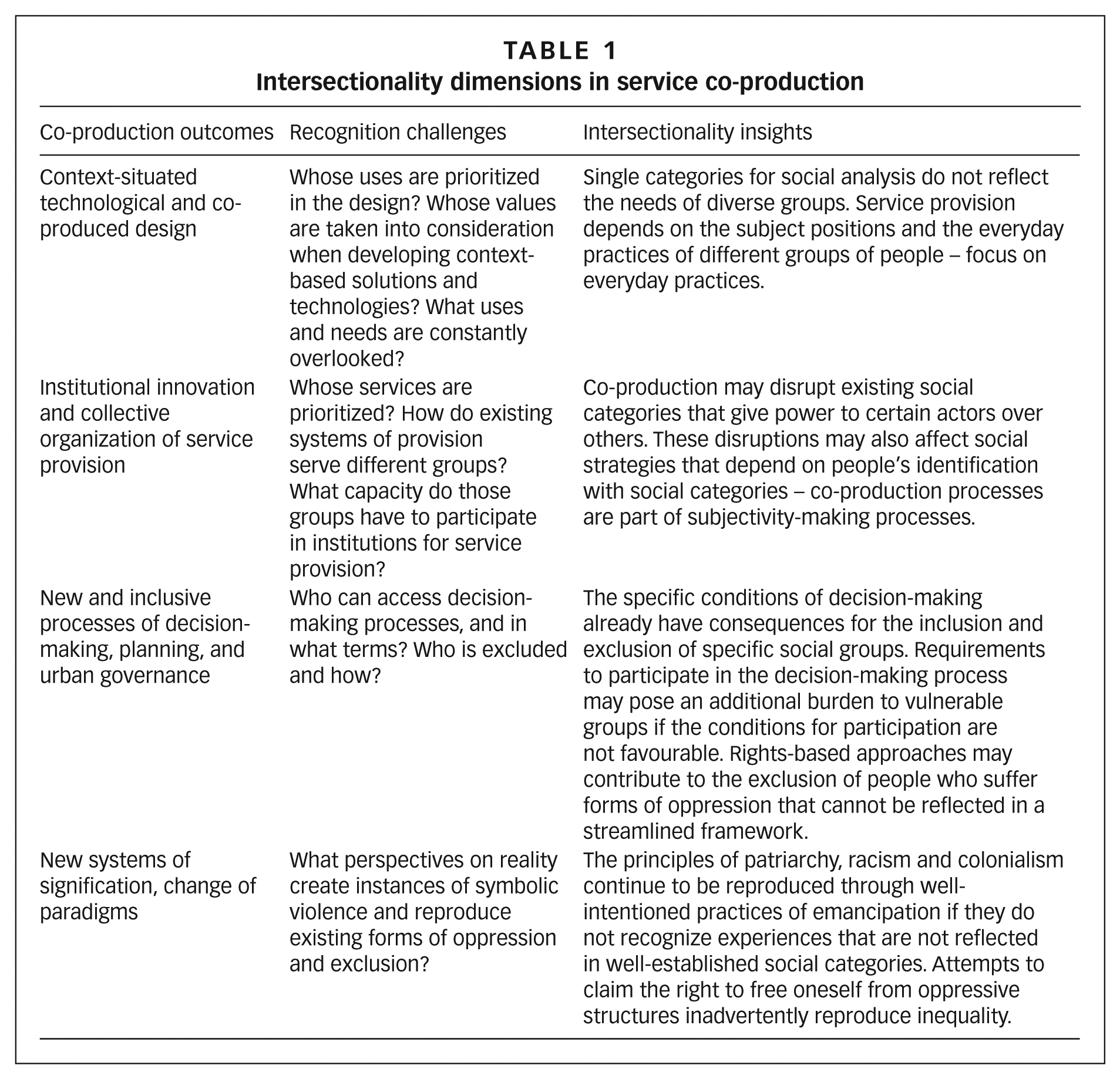
The central question is how these reflections translate into specific insights for grassroots activists and development practitioners in their efforts to support the co-production of urban services as an emancipatory practice that enables disadvantaged groups to gain freedom and independence. The first insight is that ambiguity is inherent to emancipatory efforts to create more sustainable and just cities. The disruptions that create opportunities for political influence also constitute moments in which structures of power can be reinforced. Academic–activist Beth Perry has asked whether co-production processes risk “propping up existing elites under a veneer of democracy”.(75) For that reason, intersectionality theory emerges as a means to engage with lived experiences of service provision, from within the forms of social organization of grassroots groups, rather than as a set of categories that only requires increasingly complex sets of data.
In summary, intersectionality raises four sets of concerns around co-production processes.
First, at the base of ideas of service provision is the actual service provided. What is the outcome? As explained above, understanding the ultimate material results of the service is a crucial aspect of the outcomes of service co-production. For example, the choice of sanitation technologies has been central to sanitary improvements achieved by organizations such as the Orangi Pilot Project in Pakistan.(76) In contrast, a study of housing provision in Australia explained that Western models of provision of services in a house were inappropriate to address homelessness among Aboriginal people living in remote mining towns.(77) Previous experiences suggest that co-production requires a flexible approach if it is to recognize that there are not predetermined solutions to urban problems and the process needs to be revisable.
Second, when service co-production depends on the capacity of a community to engage as a collective, questions emerge about the new forms of representation that are established to support such collective institutions. For example, the dynamics of elite capture, whereby certain powerful individuals can appropriate collective resources, have been documented in top-down development programmes.(78) A more worrying question emerges when parallel processes of elite capture are identified within local governance efforts for service provision.(79) This is a growing concern in analyses of service co-production(80) that intersectionality analyses may help address. In summary, intersectionality theory calls for the consideration of alternative struggles that may not be shared collectively.(81) This consideration contributes to an ongoing debate about the heterogeneity of communities, while simultaneously recognizing their potential in service co-production.
Third, questions of representation and inclusion in planning and decision-making processes cut across current debates on the possibilities of transforming planning to work for the disadvantaged and excluded.(82) Intersectionality questions are central to any efforts at delivering inclusive, deliberative governance.(83) An example shows the importance of adopting an intersectionality lens. Starting in 2011, one of the authors of this paper led a team to deliver an experiment in participatory planning for climate change in Maputo.(84) Without adopting an explicitly intersectional approach, the project sought to understand vulnerabilities to climate change impacts from within people’s own experience of urban risk. The research team convened a meeting to define the terms of the participatory process and citizens’ engagement. One of the objectives of the first meeting was to collectively define groups of people with shared vulnerabilities. Each group would develop a diagnosis based on the common experiences of its members and each group would then negotiate a menu of interventions for climate planning with the other groups. Five groups were formed: young people experiencing unemployment, old people with mobility constraints, women who stayed in the house for most of the day, local business owners (mostly women), and salaried workers who had to travel away from the neighbourhood daily. In sum, groups were defined in relation to the differentiation of risks and the tasks they had in that neighbourhood. Some of these definitions loosely matched preconceived social categories such as “age” or “gender”, but such social categories did not apply in practice when the groups were formed. Moreover, over the course of the following months, some participants chose groups based upon the perceived relevance of the discussions. The strategy was effective to identify diverse perceptions of local risk and strategies for action that matched local priorities. However, the team adopted these locally defined categories uncritically. Some potential consequences of this strategy are still unknown. For example, did the team miss vulnerabilities experienced by people who were not integrated into the structures of local governance, maybe because they were not affiliated to the party in government, Frelimo, or because they did not belong to the dominant ethnic group, Shangaan? An intersectionality lens could have added a layer of critique to further expose vulnerabilities to climate change to which researchers remain blind.
Fourth, intersectionality raises fundamental questions regarding knowledge production: not only whose knowledge counts, but also how forms of cultural hegemony may be limiting analyses of future urban possibilities. Sometimes those questions relate to specific claims about reality and how resources should be managed.(85) Other times, intersectionality critiques point towards the appropriation of images and discourses of vulnerable groups in development narratives, in a manner that disempowers them.(86)
In every case, addressing intersectionality requires a recognition of the existing strategies through which identity relationships are negotiated(87) to ensure that co-production processes do not reinforce existing inequalities. In conclusion, intersectionality analyses must go beyond a recognition of the positionality of the researcher or the activist(88) and include multiple stakeholder perspectives relevant to the co-production effort.
Ultimately, paradigm changes require the transformation of one’s system of beliefs. Such transformation always comes at a price. For example, in tracking the porous forms of governance that shape the urban environment in Bangalore, India, Benjamin and Bhuvaneswari(89) provide a compelling account of how they experienced such a paradigm change. Their auto-ethnographic report explores the case of a researcher–activist who worked to support the rights of disempowered groups – in this case, in an informal settlement called the Nehru Colony. The authors were not explicitly concerned with intersectionality. However, their account shows how they encountered intersectionality as a lived experience in research and planning.
In one example, they explain how the efforts of one of the authors to use the planning process to support the family of an extremely poor, lower-caste woman backfired and created further hardship for that family. The author had not fully understood the implications of these actions at the outset. This experience catalysed a moment of reexamination that challenged their positionality. This change included the recognition of the contingent experiences of deprivation and the complex ways in which disadvantaged families negotiated access to decision-making. The account concludes with a reflection on the transformation fostered by this traumatic experience: “Despite the professed ideologies of community participation and empowerment, many of my actions were driven by an academic view that attempted to be complete and definitive but in reality did not provide a complete explanation for the processes at work.”
Intersectionality theory embraces the idea of an incomplete reality, in which dynamic processes of urban change are better defined by the experiences of those who live through them. However, attention to intersectionality requires a continuous examination of both the challenge at hand and the positionality of the researcher. The full integration of the intersectionality critique into co-production processes requires a firm commitment from researchers and activists.
V. Conclusions
This paper presents an analysis of the salient theoretical and methodological questions that intersectionality raises for service co-production. Intersectionality emerges as a lens to reformulate old and new questions about the recognition of service needs, the dynamics of participation and inclusion, the manner and forms of deliberation processes, and the conceptual basis for understanding urban realities.
Intersectionality has practical implications for rethinking notions of co-production. On the one hand, understanding the needs and positions of vulnerable groups requires a careful understanding of social structures beyond fixed identity categories. Such an analysis should reflect how different forms of identity are negotiated and performed within given locations. On the other hand, co-production processes need to incorporate strategies to reflect how materiality, space and place shape subjectivities in an attempt to identify context-specific practices that reproduce inequality. Co-production processes should start from broader questions about the functioning of power structures and how they are reproduced through forms of symbolic violence. In some ways, intersectionality is not something unique and entirely new: instead, intersectionality is about delivering on a commitment to a constant reexamination of the context of service co-production, the dynamics of reproduction of power relations, and the positionality of researchers and activists who may be reproducing relationships of domination and exclusion beyond their intentions.
Two additional corollaries emerge that will require further discussion and empirical evidence: first, intersectionality adds to previous evidence on co-production in practice, which warns against developing ready-to-apply models of service co-production that can be translated across contexts without careful attention to the production of socio-spatial inequality. The best models of service co-production are those that emerge from within existing communities, motivated by contextual challenges and building on the experiences of those who are actively involved in service co-production. Interventions take place in the context of incomplete realities, and hence, positive outcomes require the commitment of participants to just processes that prioritize locally defined problems.
Second, intersectionality theory approaches service co-production as a live social process that should always remain under critical examination. Recognizing when co-production processes contribute to the reproduction of inequality is the first step towards putting intersectionality questions at the core of service co-production.
