




Abstract
We investigate the impact of criminal violence on the delivery of an urban basic service, electricity, through a comparison of international experiences. We find that the structure of criminal violence matters more than its level. If the violence is of an unorganized nature, or if local criminal organizations take no interest in electricity theft, service providers may be able to deliver electricity through regulated commercial relationships with local residents, even in areas of high violence. Where criminal organizations seek to profit from electricity theft, regulated commercial delivery of electricity will be extremely limited or impossible, even when those organizations maintain overt violence at low levels. Successful experiences of regulated commercial delivery involve using technology to reduce opportunities for theft as well as practices to improve customer relationships, sometimes supplemented by community engagement. But a necessary condition for success remains physical access to the area by the service provider’s personnel.
I. Introduction
The delivery of electricity is subject around the world to regulations concerning the quality and price at which it is provided to consumers. Yet in many countries it is affected by significant losses. Estimates of overall losses range from 19 per cent of all electricity generated for the Middle East and North Africa, and for South Asia, to 16 per cent for Latin America and the Caribbean, and 12 per cent for sub-Saharan Africa, contrasting with typical levels of 6 per cent in North America, Western Europe and East Asia.(1) Some of this consists of commercial losses, related to the failure of some consumers to pay for their electricity; and some represents technical losses, i.e. energy that does not reach consumers due to various physical phenomena as it travels from the source to the consumer. For example, electrical energy is partly dissipated through the heating of conductor cables. Since commercial losses are minimal in high-income countries,(2) we can take the above figure of a 6 per cent loss in these countries as a benchmark for such technical losses.(3) The implication is that up to 13 per cent of electricity output in major regions of the world represents commercial, or simply “non-technical”, losses (NTL).
High NTL are usually indicative of deficient access to and delivery of electricity.(4) They typically involve bypassing safety regulations to access electricity networks, which leads to numerous accidental deaths and fires, and compromises the quality of electricity service. The monetary cost of NTL to service providers threatens their financial viability and their capacity to expand access to electricity on a safer, more reliable, and more affordable basis.(5) Since similar situations often arise for other basic services, such as water and sanitation, understanding the factors that impact service delivery for electricity may have broader implications for basic services more generally.
Considering that some low- and middle-income regions are already highly urbanized, and that electricity use in rural areas is quite low, it follows that a significant proportion of NTL must occur in cities.(6) In addition, a growing literature on electricity theft points to the importance of criminal activity for NTL.(7) Together, these two considerations point to a direct relationship between NTL and urban criminal activity in the global South. By extension, they suggest a relationship between NTL and the significant levels of criminal violence reported in many cities in the global South, given the correlation that has been established between criminal violence and more general criminal activity.(8)
However, this relationship has received limited research attention. On one hand, the literature on electricity theft has paid little heed to the impact of criminal violence. On the other hand, although the question of urban violence has gained high prominence,(9) its impact on basic service delivery has only been examined by a few scholars, notably Ranganathan,(10) and for water rather than electricity. Hence, in this article we ask: How does criminal violence affect the delivery of electricity in urban areas?
We approach this question through a comparison of international experiences in a variety of cities across the world. Our results contribute meaningfully to the understanding of electricity losses, and more generally of the challenges of access to basic urban services, in two specific ways. First, we find that the structure of criminal violence matters more than the level of criminal violence in a given area. Service providers may be able to deliver electricity through regulated commercial relationships with local residents in areas with high levels of criminal violence, if the criminal violence is the result of individual, uncoordinated acts (“anomic violence”), or if it is unleashed by criminal organizations with no interest in electricity theft. By contrast, regulated commercial delivery of electricity will be very difficult, if not impossible, where those organizations take an interest in electricity theft, even when they maintain criminal violence at low levels.
Second, we find that successful experiences of regulated commercial delivery of electricity involve the use of technology to reduce opportunities for theft, which may be supplemented by community engagement to increase the legitimacy of the commercial relationship sought with electricity consumers. But a necessary condition for success is physical access to the area by the service provider’s personnel, which can pose difficult ethical questions if that access can only be granted by local criminal organizations.
The remainder of the article is organized as follows: in Section II we place our work in the context of existing research relevant to the impact of criminal violence on service delivery; in Section III we describe our methodology, followed in Section IV by the findings from the 11 case studies and the analysis of these findings. Section V concludes with a discussion of our contributions, the limitations of our research, and the implications for research and practice.
II. Existing Research
Although, as shown below, the impact of criminal violence on service delivery in urban areas has so far received limited attention in practice and in scholarship, two areas of research bear a strong relationship to this issue. One is the literature on urban informality, since inadequate access to services is a defining characteristic of informality.(11) The other is the literature on urban criminal violence in low- and middle-income countries, given the plausible relationship between criminal violence and limited service delivery pointed to above.
Access to basic services, including energy, has long been a topic of great concern to development practitioners, given the potential for these services to improve wellbeing significantly, for example through the reduced incidence of waterborne or respiratory diseases.(12) The United Nations’ Sustainable Development Goals explicitly address access to water and electricity in Goals 6 and 7, respectively.(13) Furthermore, the ongoing transformation of the world’s population from rural to urban, and particularly the relentless growth of urban communities lacking access to adequate basic services,(14) has given new urgency to the question of access in urban areas. In this regard, much of the recent focus of the development community has been on overcoming the limitations posed by low incomes,(15) governance(16) and informality.(17) But the impact of crime, and specifically criminal violence, on the ability to deliver basic services and the form of delivery,(18) if any, has received little attention in development practice.
Academic researchers have also taken a strong interest in the question of access to basic services (see, for example, the meta-analysis of service delivery approaches of Narayanan et al.(19)). Governance, and particularly the impact of various forms of ownership (private, public, nonprofit and community-based) on service delivery, has been a major concern,(20) paralleling the concerns among practitioners. However, the debate on ownership remains inconclusive, at least for electricity. Of even greater relevance to our research question is the very definition of informality. The extensive literature on this topic (e.g. Ahlers et al.(21) and other articles in the same special issue of Water Alternatives) merits more detailed review. Although informality is most commonly associated with the construction of housing on land without tenure security,(22) it is more broadly identified with the lack of or limited access to basic services,(23) due to the strong association between these conditions found in practice (for example, service access and delivery regulations often require legally recognized land tenure).(24) In the case of electricity, limited access is commonly associated with NTL. For example, connections to electricity delivery networks that are made outside regulated commercial conditions often use poorly insulated cables that reduce the quality and safety of electricity supply.(25)
The most relevant aspect of the research on informality concerns the link between the extent of informality and the high incidence of crime and criminal violence in many cities of low- and middle-income countries.(26) The urban spaces where the state exercises little or no control with regard to property rights over land often exhibit the same absence of state control over crime and violence. This situation leads to “fractured cities” or “urban divides” between areas under the rule of law and those under “unrule of law”.(27) Unsurprisingly, violence becomes endemic in these spaces,(28) particularly what Beall et al.(29) call “civic conflict” and what Fox and Goodfellow(30) describe as “the reactive expression of grievances vis-à-vis the state or other actors”, including criminal violence.
Criminal violence in these spaces takes a variety of forms. In addition to individual, uncoordinated acts of violence (“anomic violence”), researchers have extensively documented the occupation of these spaces by non-state actors that institute parallel systems of social order based on the organized use of violence and coercion,(31) and more specifically violence of a criminal nature.(32) These criminal organizations – such as Central American maras, Brazilian “factions” and “militias”, and Kenyan cartels – exert territorial control over the spaces neglected by the state, engaging in drug trafficking, prostitution, and extortion rackets, among other activities.(33) Among the extortion rackets, there is anecdotal evidence of control over the delivery of basic services to earn profits from the sale of these services, such as electricity or water, to the local population.(34) Moreover, the involvement of these organizations in extortion rackets points to a key aspect of the criminal violence they inflict: it is not only organized, i.e. coordinated across individuals in order to achieve some common objective; but it can also be latent as well as overt, i.e. it can express itself both through the threat of violence and through actual violent acts such as intentional homicides.
However, despite such anecdotal evidence, the implications of criminal violence for access to, and delivery of, basic services have so far remained largely ignored by formal scholarship. The growing literature on electricity theft focuses on other aspects: broad macro-social determinants of theft(35); political cycles(36); economic incentives and utility employee corruption(37); sectoral policies to reduce theft(38); and theft prevention methods.(39) “Political instability and violence” was considered by Smith in his analysis of theft, but only in the political sense of “[t]he likelihood that the government may be overthrown by violent means”,(40) which is clearly different from criminal violence. A recent book by Brisman et al.(41) focuses squarely on the relationship between water and crime, but with a much broader scope than the impact of criminal violence on the delivery of potable water in urban areas.
Ranganathan(42) is an important exception. By examining the role of “mafias” in the delivery of potable water in Bangalore, she questions the characterization of informality as a passive and clearly demarcated “absence of the state”. Other scholars have raised similar concerns in related contexts,(43) arguing that informality can be seen as the outcome of a bargaining process among different actors – urban residents, criminal organizations, businesses, service providers and public officials – that results in varying degrees of adherence to laws and regulations across the urban space, and not just in informal settlements. The implication is that the relationship among informality, criminal violence, and delivery of basic services may be more complex than is commonly understood.
The preceding review of the current state of knowledge about the impact of criminal violence on the delivery of basic services thus suggests that in many cities of low- and middle-income countries, criminal organizations such as mafias or drug cartels institute separate social orders by means of the local exercise of violence and coercion. Informal settlements are likely to be the primary spaces where these orders emerge, although recent critiques of the literature on informality raise questions about a sharp formal–informal distinction in this regard. These separate social orders can affect access to and delivery of basic services, including electricity. For example, they can secure access to these services outside regulated commercial terms (e.g. through unmetered connections to the electricity grid). A corollary is that unorganized criminal violence, by being less likely to lead to the emergence of separate social orders, can be expected to have a lesser impact than organized violence on access to and delivery of basic services. These statements inform our collection of information through various case studies, as we explain in the next section. And they are examined in our comparative review of the cases in the fourth section of the paper.
III. Methodology
Following an inductive approach, our empirical goal in considering our 11 cases is the identification of potential patterns, with the existing research analysed above as a starting point to direct our attention. Our overarching case selection criterion was that the service provider should pay explicit attention to NTL, since only in this way would we gain insight into the factors affecting NTL and specifically the impact of criminal violence on theft and NTL, from managers and other stakeholders preoccupied with NTL. This criterion excluded service providers in the global North (North America, Western Europe and East Asia). There, the incidence of criminal violence is generally low and so is the level of NTL, which means that service providers pay very little attention to NTL.(44) Still, these cases provide a benchmark for the minimum level of losses that can be attained – about 0 per cent for NTL and up to 6 per cent for technical losses.
The criterion that the service provider should pay explicit attention to NTL also excluded many service providers for which high NTL reflects a disregard for commercial principles (i.e., customer payment for electricity supply) on the part of the service provider and thus lack of attention to NTL, whether the provider is public or private. This is the situation in many government-owned utilities in low- and middle-income countries, such as South Africa, but there is not necessarily a relationship between ownership and a commercial focus. To use examples from our cases in Colombia, Empresas Públicas de Medellín (EPM), the municipality-owned company that serves Medellín, operates on a commercial basis and has successfully reduced NTL. On the other hand, government subsidies have arguably diluted a commercial focus at Electricaribe, the private service provider in Barranquilla and Cartagena.
As a result of applying the criterion of explicit attention to NTL, even though we did not explicitly set out to choose cases from countries that had introduced reforms in the electricity sector since 1990, all the cases we were able to find happened to come from such countries. Most typically, the reforms involved full or partial privatization, together with the implementation of a regulatory framework that relies on economic incentives to induce the service providers to follow regulatory objectives. Only in some cases do these incentives include extending access or delivery under regulated commercial terms as an explicit objective; but as a norm, they limit the service provider’s ability to get financial compensation for NTL by charging higher prices to paying customers. Thus, high NTL levels can create financial stress for the service provider, because it has to bear the cost of the electricity that it has purchased and delivered, but for which it is not getting paid. Such a change in incentives led, in turn, to a variety of outcomes across service providers that created crucial variation across cases for our comparisons.
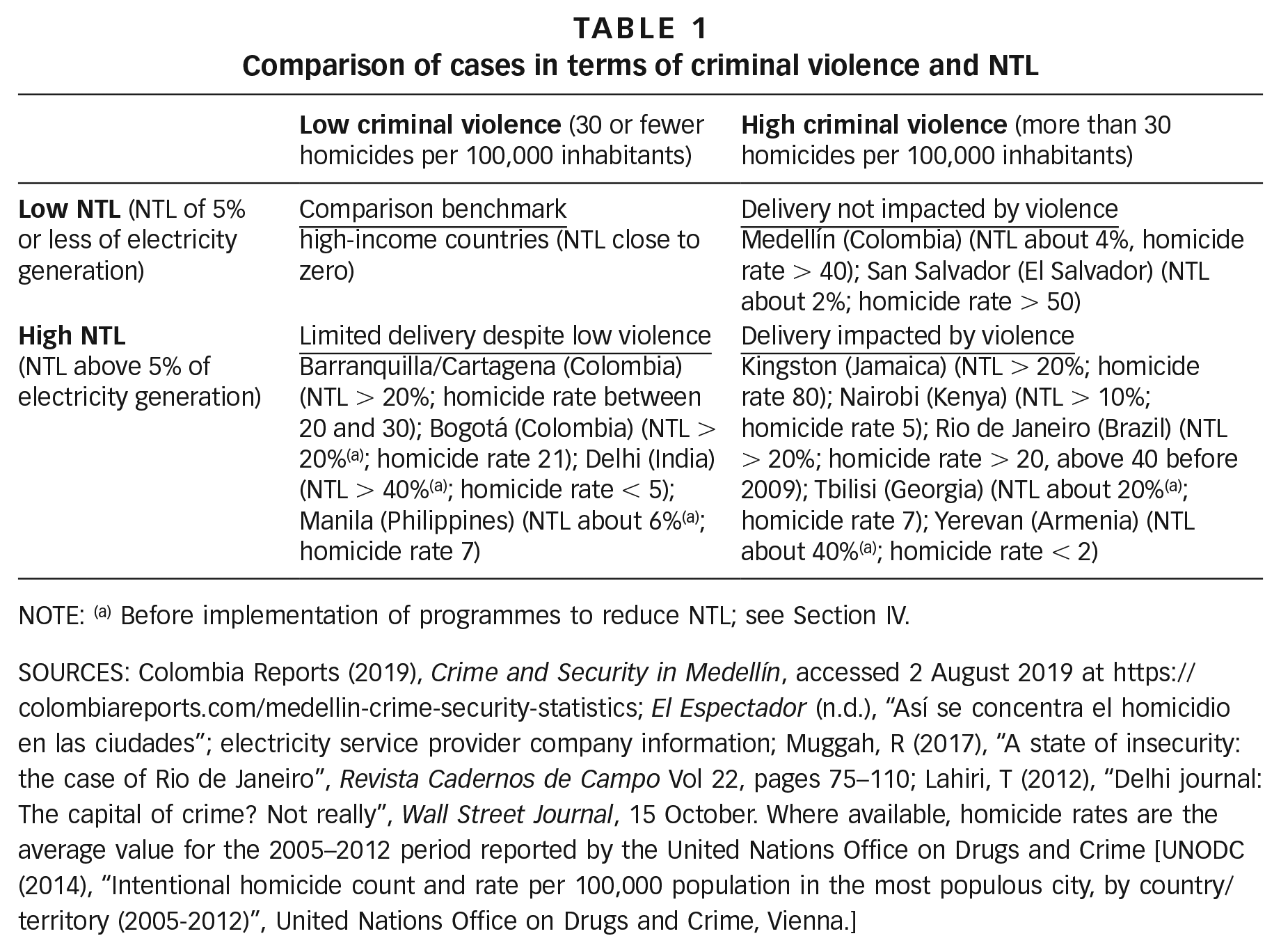
Table 1 shows that our cases vary from reported NTL levels exceeding 40 per cent (Delhi) to just 2 per cent (San Salvador). For illustrative purposes, we show cases above and below 5 per cent NTL. We chose 5 per cent as an arbitrary threshold between high and low NTL that can account for minor inefficiencies in metering and billing. This figure still shows a better than average performance relative to the regional averages of losses reported above for lower-income countries. There, assuming up to 6 per cent for technical losses, total losses exceed 11 per cent in all regions.(45)
Comparison of cases in terms of criminal violence and NTL
NOTE: (a) Before implementation of programmes to reduce NTL; see Section IV.
SOURCES: Colombia Reports (2019), Crime and Security in Medellín, accessed 2 August 2019 at https://colombiareports.com/medellin-crime-security-statistics; El Espectador (n.d.), “Así se concentra el homicidio en las ciudades”; electricity service provider company information; Muggah, R (2017), “A state of insecurity: the case of Rio de Janeiro”, Revista Cadernos de Campo Vol 22, pages 75–110; Lahiri, T (2012), “Delhi journal: The capital of crime? Not really”, Wall Street Journal, 15 October. Where available, homicide rates are the average value for the 2005–2012 period reported by the United Nations Office on Drugs and Crime [UNODC (2014), “Intentional homicide count and rate per 100,000 population in the most populous city, by country/territory (2005-2012)”, United Nations Office on Drugs and Crime, Vienna.]
Identifying variation in cases with regard to criminal violence proved to be more complex, given the many different forms of criminal violence. This is not only in terms of the kinds of violent acts (such as homicide, theft or extortion), but also in terms of the difference between anomic and organized criminal violence mentioned in Section II’s literature review. Since homicide rates are perhaps the most widely used indicator of criminal violence,(46) we looked for cases from cities displaying wide variation in homicide rates. Table 1 shows that our cases vary from cities with a homicide rate of 80 per 100,000 inhabitants (Kingston, Jamaica) to ones with a rate below 2 per 100,000 (Yerevan, Armenia). For illustrative purposes, we show cases above and below 30 homicides per 100,000 inhabitants, using this as the arbitrary dividing line between high and low levels of criminal violence.(47)
But as our review of existing research showed, overt manifestations of criminal violence provide an incomplete picture where organized crime is present, since organized crime can exert a high degree of violence of a latent nature, i.e. through threats and coercion rather than attacks against persons and objects. Thus, to make this point more explicit, in Table 1 we also included under the category High criminal violence three cases of cities where organized crime was reported to be a significant factor in criminal violence but, unlike in San Salvador or Rio de Janeiro, this did not result in high homicide rates: Nairobi, Tbilisi and Yerevan. Table 1 shows how our cases varied in terms of NTL and criminal violence.
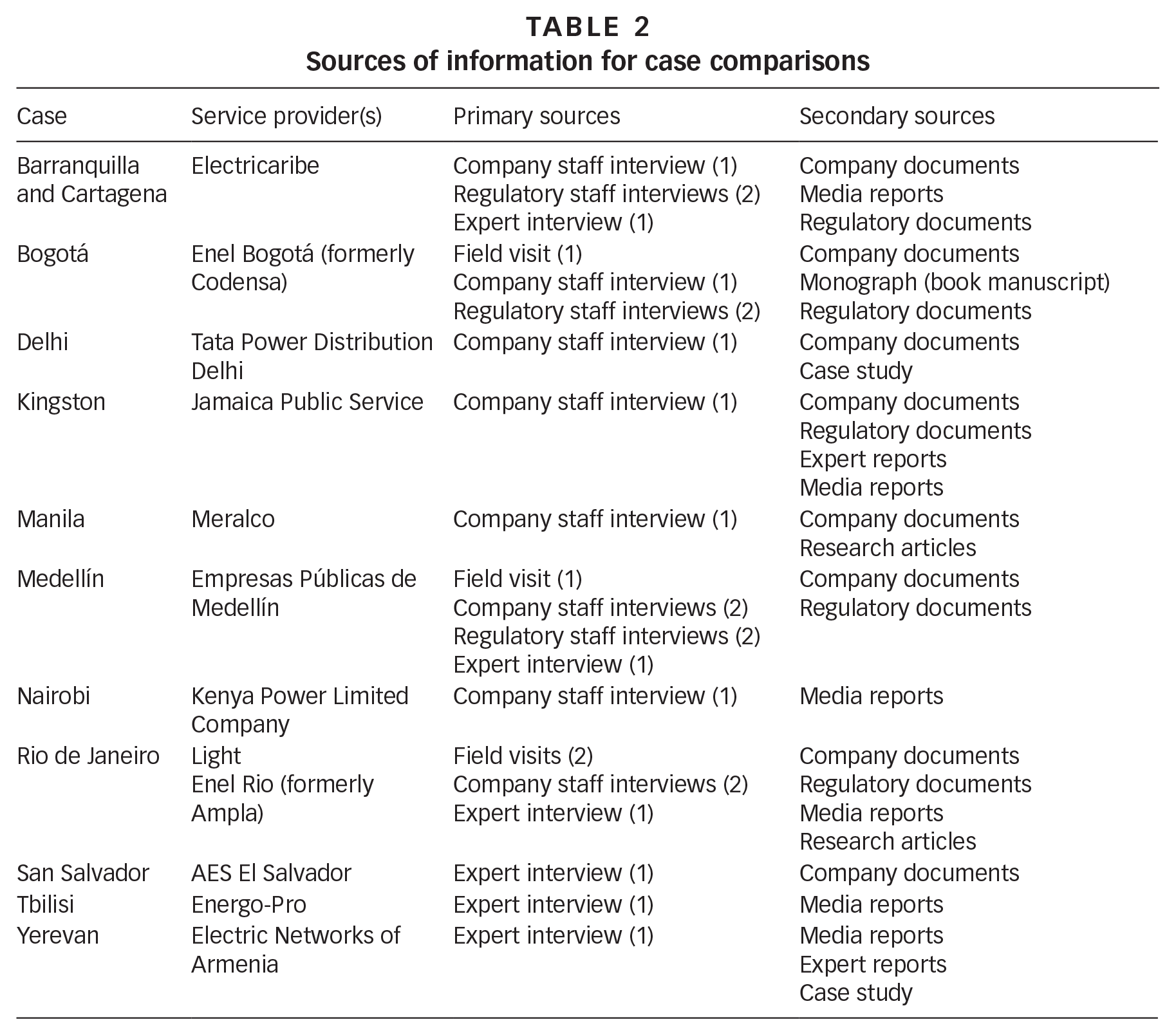
We collected information on the selected cases through the review of primary and secondary reports available in the online public domain, and particularly through semi-structured interviews, conducted in person, via telephone or teleconference, and in some instances in writing (Table 2).
Sources of information for case comparisons
In Colombia, we selected three different cases (Barranquilla and Cartagena, Bogotá, and Medellín) to take advantage of the great diversity of conditions facing electricity service providers in the country, even under a common regulatory framework. Barranquilla and Cartagena are large cities located on the Caribbean coast of Colombia, which has some of the highest poverty rates in the country. The region is served by Electricaribe, a Spanish-owned company. Bogotá, the national capital, is also served by the private sector, in this case a subsidiary of the Italian company Enel. By contrast, Medellín’s service provider is the local municipal utility, Empresas Públicas de Medellín (EPM), which also provides water and sanitation, natural gas, fixed-line communications, and public transport. EPM has a strong focus on public service, but its profit distributions are a significant element of the municipal budget, so it must also respond to criteria of economic efficiency.
In India, Tata Power Delhi Distribution Ltd. is one of several urban electricity companies created in recent years as part of the reform of the country’s electricity industry. It serves the capital, New Delhi, under a concession agreement awarded to the Tata Group, one of India’s largest diversified business groups. In Jamaica, Jamaica Public Service (JPS), by contrast, serves the entire island, including its capital, Kingston. Like most of the service providers in our cases, it is under private ownership, specifically that of Korea East West Power.(48) In the Philippines, Meralco is the privately owned provider of electricity service to the metropolitan area of the capital, Manila. Its equivalent in Kenya is Kenya Power Limited Co. (KPLC), although KPLC serves the whole country and not just Nairobi, Kenya’s capital. In Brazil, we examined both of the service providers for Rio de Janeiro’s metropolitan area: Light (which serves the municipality of Rio and some surrounding towns), and Enel Rio (which serves Niterói, the area’s second-largest city, and other parts of the metropolitan area). Enel Rio is also part of the same corporate entity as its counterpart in Bogotá, while Light’s main shareholders are actually the state-owned electricity company of Minas Gerais in Brazil, and Brazil’s national development bank. In El Salvador, the metropolitan area of the capital, San Salvador, is partly served by a subsidiary of the US company AES. Lastly, foreign companies are the service providers for the capital cities of Georgia (Tbilisi) and Armenia (Yerevan): respectively, Energo-Pro, based in the Czech Republic, and Electric Networks of Armenia (ENA), owned by Russia’s Tashir Group.(49)
IV. Findings and Analysis
The case studies revealed, first and foremost, that a context of high levels of criminal violence need not mean high levels of access to electricity outside of regulated commercial channels (i.e. high NTL levels). This is the case of the cities in the top-right quadrant of Table 1, labelled Delivery not impacted by violence. The city of San Salvador, in El Salvador, has one of the highest homicide rates in the world.(50) However, NTL levels for the utilities that operate here are quite low. For 2013, the electricity distribution company AES El Salvador estimated NTL at less than 2 per cent of the electricity input into its network.(51) Likewise, in Medellín, Colombia, total losses for the local utility EPM were below 8 per cent before it extended its concession area to other regions with slightly higher losses.(52) Although Medellín’s homicide rate declined precipitously from 2002 to 2013, by 2013 it still had a relatively high rate of nearly 40 murders per 100,000 inhabitants, higher than Rio de Janeiro’s at the time and about the same as Kingston’s.(53) Yet utilities in Rio de Janeiro and Kingston reported great difficulties in reducing NTL below 20 per cent of total energy input.
By contrast, high levels of theft and hence NTL can occur even in less violent environments, as is the case in many lower-income countries. This applies specifically to the cities in the bottom-left quadrant of Table 1, labelled Limited delivery despite low violence. In some instances, this may be due to the lack of incentive for service providers to reduce theft. Under public ownership, the financial problems created by the delivery of electricity without payment can be absorbed by the government, encouraging tolerance of theft as a tool to curry votes, or allowing inefficiency, fraud and corruption in situations of limited accountability. But this can also happen under private ownership, if the service provider is able to obtain subsidies from the government to cover financial losses from theft. In the cities of Cartagena and Barranquilla in Colombia, the service provider Electricaribe experienced electricity losses of up to 23 per cent, but it successfully negotiated new subsidy programmes with the government to reduce the negative financial impact of the losses.(54) Electricaribe did not encounter threats to its personnel from criminal organizations, and relative to Medellín, the main cities it served (Barranquilla and Cartagena) had significantly lower homicide rates. Instead, in its attempts to replace theft with a commercial relationship, it faced demonstrations and other forms of political resistance in the communities it served.
The contrast between these two situations – high criminal violence, but low NTL; and low criminal violence, but high NTL – thus make it clear that there is no univocal relationship between criminal violence and the delivery of electricity. But as the bottom-right quadrant of Table 1, labelled Delivery impacted by violence, shows when compared to the top-right one (Delivery not impacted by violence), contexts of high criminal violence may or may not affect delivery. Fortunately, the comparison between these two situations, i.e. between high and low NTL cases under high levels of criminal violence, does give us insights into the factors that can make a difference in the delivery of electricity.
One element of criminal violence that appears in several cases across these two High criminal violence quadrants is the existence of criminal organizations of the kinds mentioned in Section II’s literature review. In fact, all the cases in the Delivery impacted by violence quadrant are characterized by the presence of criminal organizations that resulted in high levels of violence, whether overt (Kingston), latent (i.e., in the form of threats, as in Yerevan), or both (Rio de Janeiro).
And yet, we also find the case of San Salvador, where the extremely high levels of criminal violence are linked to the prevalence of maras, criminal organizations that exercise strict territorial control.(55) But NTL levels are low there. Therefore, the existence of criminal organizations per se cannot explain the outcomes for the delivery of electricity. This means that delivery under commercially regulated conditions in the context of high criminal violence appears to be constrained only where criminal organizations prevail and those organizations have a motivation to limit the delivery of electricity under regulated commercial conditions. One such motivation is the extortion of profits from the delivery of electricity. For example, in Nairobi’s informal settlements, armed criminal organizations control residents’ access to utility services. In the Kibera settlement, parallel illegal electricity distributors known collectively as “Kibera Power” extend electricity supply from a formally connected property nearby. They make money from the resale of electricity at higher prices than those charged by the electricity distribution company, Kenya Power, whose prices are regulated by the government. Not surprisingly, the “Kibera Power” organizations prevent the company from dismantling this illegal activity. Another motivation is intense competition for territorial control among criminal organizations, inducing them to deny access to service providers as a means of monitoring the territory more easily, even if they take no economic interest in electricity delivery. Rio de Janeiro is an example of this situation, where four major criminal organizations compete fiercely for the lucrative sale of drugs throughout the metropolitan area, leading to strict prohibitions on any “outsiders” entering areas under the control of one of the organizations.(56)
Although our research question concerns only the relationship between criminal violence and the delivery of electricity, our research also revealed that it is possible to reduce theft in situations of high criminal violence, even where criminal organizations act to constrain regulated commercial delivery. In Yerevan and Tbilisi, after the dismantling of the communist system and the breakup of the Soviet Union, criminal groups took to controlling access to electricity in some areas, charging residents for stolen electricity. In these two cases, electricity theft was reduced when the utilities began cutting off these areas for nonpayment, which made the illegal reselling business unviable and forced the criminal organizations to give it up. In Yerevan, losses went from 40 per cent in 1994 to less than 15 per cent by 2013.(57) In Tbilisi, where the anti-theft measures also included the ones described in the next paragraph, the drop was less dramatic, from nearly 20 per cent to 8 per cent.(58) In both cases, territorial control by criminal organizations could be overcome through the separation of the affected areas from other parts of the distribution grid. Once separated, the supply of electricity to the section of the network serving the area under criminal control could be cut off from the outside by the service provider.
The preceding approach requires, however, that it be politically and legally possible to carry out threats of disconnection of entire areas, even if they contain some customers who do not engage in theft. In Nairobi, the parallel illegal networks built by criminal organizations cannot be disconnected because they are structured by “villages” with different ethnic affiliations. Disconnecting a village could be interpreted as an attack on a specific tribal group and could lead to ethnic conflict. In Kingston, a proposal by the service provider to cut off areas with NTL exceeding 70 per cent was met with widespread opposition from the residents of these areas, amid fears that without street lighting, crime would increase there. Aware of this kind of constraint, the utility Meralco in Manila chose instead to place all meters at the entrances of violent areas, often at the top of poles 10 meters above ground, to prevent tampering. Individual cables then connect each individual meter to the customer’s residence. Since customers are responsible for any electricity that is used behind the meter, they have a strong incentive to monitor any pilferage of their connection cable.(59)
These approaches are not, however, the only ways open to service providers to enable access under adverse conditions. Technical measures include protecting distribution networks from theft (since electricity theft occurs through unmetered connections to cables and transformers that direct electrical energy to nonpaying consumers). Theft can be reduced by placing meters on poles and through remote metering; this was one component of the successful approaches followed in Bogotá, Manila and Medellín. Remote metering can be supplemented by remote disconnection. And other equipment, particularly transformers, can be protected against theft or even disconnected automatically when tampered with, as done in Bogotá.
Commercial measures involve detecting and punishing theft, and more generally creating a strong customer relationship that discourages consumers from engaging in theft. In Bogotá, Delhi and Yerevan (this last one in combination with the actions described in the preceding paragraph), service providers successfully reduced losses on a stable basis through a mixture of technical and commercial measures. Commercial initiatives include monitoring of electricity flows throughout the distribution network, in order to identify the location of electricity theft (Bogotá, Medellín, Tbilisi, Yerevan); improving service quality to increase willingness to pay for service (Bogotá, Tbilisi, Yerevan); enabling customers to pay in small increments and thus adjust consumption to their income stream (Medellín); and “naming and shaming” electricity thieves in the media (Yerevan). These initiatives have been supported in Bogotá, Delhi and Medellín by offering a subsidized price to low-income consumers, who then have a lower incentive to avoid paying for electricity. Funding for the subsidy has been provided by the government by charging higher prices to other customers (cross-subsidy), or even by the service provider if it is a cost-effective measure against theft (i.e., if the amount of the subsidy turns out to be less than the saving from lower NTL).
In some cases, commercial measures have gone further, and have sought to promote the social development of informal settlements and other areas of widespread poverty where NTL are high. This increases the legitimacy of the service provider and the commercial relationship that it seeks to have with local residents. In Medellín, EPM has developed a comprehensive social programme for informal communities to help them meet their needs, including accessing energy on a commercial basis. Bogotá’s service provider offered home improvement loans to households that lacked access to formal credit, using their payment records to determine creditworthiness. In Delhi, the service provider Tata Power Delhi Distribution Limited implemented a variety of such measures, particularly favouring the creation of economic opportunities for women, that contributed to its success in significantly reducing theft. Women from the community, many of them unable to work outside the area due to conservative social customs, were trained to read meters and collect payments, activities that they managed very effectively because of their experience managing household budgets and paying bills. While company personnel initially had to venture into these communities under police escort, gaining local legitimacy has meant that they can now do so without any security measures.
A crucial requirement for these technical and commercial measures to be effective, however, is physical access to the distribution network. As the service providers in Rio de Janeiro have found, anti-theft equipment can eventually be bypassed if the service provider is unable to keep it protected from manipulation or breach. Building a customer relationship requires constant and responsive contact with the consumer, in order to solve any technical problems quickly, collect bill payments, and attend to other needs of the consumer in a satisfactory way for the consumer. Social measures also require a strong local presence, in order to establish positive interactions with the community on an ongoing basis. Hence, although the approaches identified above were tried in different combinations (i.e. not uniformly across all three cases) in Kingston, Nairobi and Rio, the limitations to physical access created by local criminal organizations led to the frustration of these efforts.
V. Conclusions and Recommendations
This research effort sought to investigate how criminal violence affects the delivery of electricity in urban areas. Our answer to this question is that there is no simple correspondence between the two. High levels of criminal violence do not necessarily disrupt the delivery of electricity under regulated commercial conditions. Instead, the effect of criminal violence depends on its structure, and more specifically works through two factors.
The first is whether criminal violence in an urban area is primarily of an individual, unstructured nature, or organized. As the Medellín case shows, unstructured violence is much less likely to facilitate NTL. Unless they carry valuable items such as money from collections, personnel from the service provider are unlikely to be specific targets of criminal violence, and in any case regular security protection can deter criminal actions against utility personnel. By contrast, criminal organizations can more easily develop the capacity to deny access to a territory not just to the service provider’s personnel, but also to security agents, and even police, through such tactics as the deployment of armed persons for territorial control, intelligence gathering, and other activities, as happens with the drug-trafficking organizations in Rio or with cartels in Nairobi. Importantly, in such instances levels of overt criminal violence can be low, as the organizations manage to credibly threaten anyone who defies their local “monopoly of violence”. Hence, latent violence is an important way in which criminal violence can disrupt the delivery of urban basic services.
The second factor is whether organized groups have the motivation to interfere with the delivery of electricity. Groups can be motivated by financial gain (extortion) from service sales, or intense competition for territorial control, leading them to limit access to the territory by service provider personnel. Where these groups lack such motivation, as is the case in San Salvador, service providers can still conduct commercial operations even in areas controlled by the criminal groups. But when the motivation is there, as in Nairobi, service providers will not be able to carry out commercial operations unless they reach an agreement with the locally dominant groups, perhaps to share revenues with them.
Our analysis also indicates that where violence is unstructured or where criminal organizations do not take a financial interest in electricity delivery, it is possible to reduce NTL and deliver electricity through regulated commercial relations. We propose that such approaches include two necessary components: technological elements to deter theft and fraud, such as remote metering and disconnection; and commercial or social elements that increase the legitimacy of the commercial relationship with the service provider. Such elements include employment or subcontracting of certain activities at the local level to create local economic opportunity, and the adaptation of the commercial relationship to the needs of the local population, for instance through the use of prepayment meters that allow consumers to manage their electricity consumption in accordance with their income level and structure. A necessary condition for these approaches, however, is that they not be opposed by criminal groups controlling local territory. Overcoming such situations is unlikely to be possible without major improvements in the legitimation and enforcement of the law, for example through effective social inclusion programmes for local youths. These sorts of improvements lie beyond the resources and legal capacities of service providers and call for public interventions.
We make two contributions to the extant scholarship on electricity losses and access to basic services. First, we offer a nuanced understanding of the impact of criminal violence on access to basic services. The regulated commercial delivery of basic services like electricity may be significantly constrained in many lower-income cities, due to high levels of criminal violence; we suggest the specific conditions under which criminal violence limits delivery. Our second contribution is to propose empirically derived actions that service providers need to take in order to deliver electricity through regulated commercial relationships, as well as the limitations of such actions.
Our research also suggests other implications for practice. Above all, it underscores the importance of the rule of law for the provision of basic services in urban areas. Without an effective “monopoly of violence” by the state that can prevent the control over territory by criminal organizations, the threat of criminal violence can prevent formal access to services and even involve theft of services, threatening the viability and safety of city-wide service supply networks. It is remarkable that, as shown by the research on urban crime and informality mentioned earlier, law enforcement is very limited or even nonexistent across extensive areas of many lower-income cities. Service providers lack the power and mandate to replace law enforcement organizations like the police or to provide better educational programmes. Hence, governments seeking to increase access to basic services must begin by ensuring that service providers can function safely throughout the urban space.
Our work also documents practices that appear to significantly limit theft in places where hostile territorial control is not a problem. These practices combine technical solutions to monitor and deter theft, with commercial initiatives that can convince residents with very limited incomes to spend some of their meagre income to pay for electricity. Other industries, like telecommunications (mobile phones) and those selling so-called “aspirational goods” that enhance self-esteem (such as certain fashion items), have developed successful value propositions for the urban poor. Regulators, governments and service providers may also consider offering lower prices to these consumers in response to their limited ability to pay, and the significant improvement in their welfare that can take place though better access to basic services. Moreover, utility services offer excellent opportunities for social responsibility programmes that increase the legitimacy of the service providers in underserved communities, complementing very closely the commercial side of the relationships.
Naturally, these results are subject to some limitations. Our approach is mainly based on case studies and remains inductive at this stage. In addition, although we highlight the impact of criminal violence on NTL, we do not consider broader factors that may in turn shape the level and structure of criminal violence in a community. Lastly, we do not consider the specific kinds of incentives that may encourage service providers to operate according to commercial principles. The research described here shows that these factors related to criminal violence deserve further attention in the effort to improve access to basic services and to encourage more efficient use of their components, particularly energy and water.
These limitations suggest valuable potential extensions to the research presented in this paper. A first extension would be the statistical testing of our propositions. A second extension would expand the analysis to consider other services, such as water and sanitation, trash collection, transport, and so forth. Anecdotal evidence from Rio de Janeiro collected in the course of the present project from suppliers of potable water, mail and cable television strongly suggests that criminal violence affects them in similar ways, indicating that a cross-industry comparison could yield additional evidence. Lastly, our focus here has been on electricity service, not on criminal violence per se. It will be important to consider how well our results match extant research on other aspects of urban criminal violence and informality. We hope that our work will encourage further research into these and other possibilities regarding the relationship between criminal violence and access to urban basic services.
Footnotes
Funding
The authors disclosed receipt of the following financial support for the research, authorship, and/or publication of this article: The research reflected in this paper was supported by Light Serviços de Eletricidade, S.A. (Light SESA), under the Research & Development Program of the Agência Nacional da Energia Elétrica (ANEEL) of Brazil. All views and opinions expressed herein are the authors’ and do not necessarily reflect those of Light SESA or ANEEL. There are no conflicts of interest among Light, ANEEL, and any of the authors regarding the research in this paper.
1.
World Bank (2014), “Electric power transmission and distribution losses (% of output)”, World Development Indicators, accessed 9 March 2020 at  .
.
2.
Smith, T B (2004), “Electricity theft: a comparative analysis”, Energy Policy Vol 32, pages 2067–2076.
3.
Many service providers and governments report total losses only, since these are much easier to measure as a simple difference between electricity purchases (or generation) and electricity sales (i.e., amounts metered and billed). Distinguishing between technical and non-technical losses necessitates careful measurement of electricity flows at various points in the distribution network, and estimation of heat dissipation, transformer losses, and other physical forms of loss, which can be expensive and demanding.
4.
We define access as including not only physical access (connectivity) but also affordability, adequacy (quality), and effort and time to access. Narayanan, S, A T Rajan, P Jebaraj and M S Elayaraja (2017), “Delivering basic infrastructure services to the urban poor: a meta-analysis of the effectiveness of bottom-up approaches”, Utilities Policy Vol 44, Iss C, pages 50–62.
5.
Márquez, P and C Rufín (editors) (2011), Private Utilities and Poverty Alleviation: Market Initiatives at the Base of the Pyramid, Edward Elgar Publishing, Cheltenham and Northampton.
6.
The important exception is South Asia, which in 2017 was still 66 per cent rural, but had an 85 per cent rural electrification rate. See World Bank (2019a), World Development Indicators, accessed 19 January 2020 at .
7.
See reference 2; also Depuru, Soma Shekara Sreenadh Reddy, Lingfeng Wang and Vijay Devabhaktuni (2011), “Electricity theft: overview, issues, prevention and a smart meter based approach to control theft”, Energy Policy Vol 39, No 2, pages 1007–1015; Gaur, V and E Gupta (2016), “The determinants of electricity theft: an empirical analysis of Indian states”, Energy Policy Vol 93, pages 127–136; Jamil, F (2018), “Electricity theft among residential consumers in Rawalpindi and Islamabad”, Energy Policy Vol 123, pages 147–154; Jamil, F and E Ahmad (2019), “Policy considerations for limiting electricity theft in the developing countries”, Energy Policy Vol 129, pages 452–458; Mimmi, L M and S Ecer (2010), “An econometric study of illegal electricity connections in the urban favelas of Belo Horizonte, Brazil”, Energy Policy Vol 38, No 9, pages 5081–5097; Min, B and M Golden (2014), “Electoral cycles in electricity losses in India”, Energy Policy Vol 65, pages 619–625; Tasdoven, H, B A Fiedler and V Garayev (2012), “Improving electricity efficiency in Turkey by addressing illegal electricity consumption: a governance approach”, Energy Policy Vol 43, pages 226–234; Yakubu, O, C Narendra Babu and O Adjei (2018), “Electricity theft: analysis of the underlying contributory factors in Ghana”, Energy Policy Vol 123, pages 611–618; and Yurtseven, Ç (2015), “The causes of electricity theft: an econometric analysis of the case of Turkey”, Utilities Policy Vol 37, pages 70–78.
8.
Muggah, R (2014), “Deconstructing the fragile city: exploring insecurity, violence and resilience”, Environment and Urbanization Vol 26, No 2, pages 345–358; also , Governing Safer Cities: Strategies for a Globalised World, United Nations Office on Drugs and Crime, Vienna.
9.
See reference 8, Muggah (2014); also Beall, J, T Goodfellow and D Rodgers (2013), “Cities and conflict in fragile states in the developing world”, Urban Studies Vol 50, No 15, pages 3065–3083.
10.
Ranganathan, M (2014), “ ‘Mafias’ in the waterscape: urban informality and everyday public authority in Bangalore”, Water Alternatives Vol 7, No 1, pages 89–105.
12.
E.g. Phadke, S (1970), “Children in urban areas of India”, Les Carnets de l’enfance / Assignment Children II, pages 109–116.
13.
14.
World Bank (2019b), Global Program for Resilient Housing, brief, accessed 11 November 2019 at .
15.
17.
E.g. see reference 5.
18.
“Form of delivery” refers to the physical means through which access is provided, e.g. trucked vs. piped water.
20.
E.g. John, P, A Mahalingam, A Deep and A Thillairajan (2015), “Impact of private sector participation on access and quality of services: systematic review of evidence from the electricity, telecommunications and water supply sectors”, Journal of Development Effectiveness Vol 7, No 1, pages 64–89.
21.
Ahlers, R, F Cleaver, M Rusca and K Schwartz (2014), “Informal space in the urban waterscape: disaggregation and co-production of water services”, Water Alternatives Vol 7, No 1, pages 1–14.
22.
See reference 4, Narayanan et al. (2017); also Stacey, P and C Lund (2016), “In a state of slum: governance in an informal urban settlement in Ghana”, Journal of Modern African Studies Vol 54, No 4, pages 591–615.
23.
See reference 11.
24.
25.
See reference 5.
26.
See reference 8, UNODC (2016); also see reference 9, .
27.
Koonings, K and D Kruijt (2007), “Fractured cities, second-class citizenship and urban violence”, in K Koonings and D Kruijt (editors), Fractured Cities: Social Exclusion, Urban Violence and Contested Spaces in Latin America, Zed, London, pages 7–22; also Méndez, J E, G A O’Donnell and P S Pinheiro (1999), “The (un)rule of law and the underprivileged in Latin America”, University of Notre Dame Press, Notre Dame.
28.
We follow the definition of violence as the “use or threat of physical force to inflict bodily or psychological harm against an individual, community, or social group”. [Moncada, E (2013), “The politics of urban violence: challenges for development in the global South”, Studies in Comparative International Development Vol 48, No 3, pages 217–239, page 219, based on WHO (2002), World Report on Violence and Health, World Health Organization, Geneva.] Our view of violence thus differs from the concept of “infrastructural violence,” which refers to how “structural forms of violence often flow through material infrastructural forms”. [Rodgers, D and B O’Neill (2012), “Infrastructural violence: introduction to the special issue”, Ethnography Vol 13, No 4, pages 401–412, page 405.] Still, as our results show, the kind of violence we refer to in this article can limit the delivery of basic services, resulting in a form of structural violence [a “splintering urbanism”, to borrow from Graham, S and S Marvin (2001), Splintering Urbanism: Networked Infrastructures, Technological Mobilities and the Urban Condition, Routledge, London], because it limits opportunities for those affected by it.
30.
Fox, S and T Goodfellow (2016), Cities and Development, 2nd edition, Routledge, London, page 215.
32.
See reference 8, Muggah (2014); also see reference 28, Moncada (2013); Arias, E D (2006), Drugs and Democracy in Rio de Janeiro: Trafficking, Social Networks, and Public Security, University of North Carolina Press, Chapel Hill; Arias, E D (2013), “The impacts of differential armed dominance of politics in Rio de Janeiro, Brazil”, Studies in Comparative International Development Vol 48, No 3, pages 263–284; Gazdar, H and H B Mallah (2013), “Informality and political violence in Karachi”, Urban Studies Vol 15, pages 3099–3115; LeBas, A (2013), “Violence and urban order in Nairobi, Kenya, and Lagos, Nigeria”, Studies in Comparative International Development Vol 48, No 3, pages 240–262; and Rodgers, D (2006), “Living in the shadow of death: gangs, violence and social order in urban Nicaragua, 1996–2002”, Journal of Latin American Studies Vol 38, pages 267–292.
33.
Willis, G D (2015), The Killing Consensus: Police, Organized Crime, and the Regulation of Life and Death in Urban Brazil, University of California Press, Berkeley.
34.
Bergen, M (2013), “Parched empire: the water mafia in a booming Bangalore”, Forefront Vol 2, No 39, pages 1–16; also Langat, Anthony (2019), “In Kenya’s largest slum, the World Bank battles cartels for control of electricity”, Devex, accessed 22 February 2019 at https://www.devex.com/news/in-kenya-s-largest-slum-the-world-bank-battles-cartels-for-control-of-electricity-93878?mkt_tok=eyJpIjoiTmpZeU5tVTFN%E2%80%A6; and Soares, Rafael (2015), “Tráfico cobra R$ 180 para instalar ‘gatos’ em conjunto do ‘Minha casa, minha vida’ onde a Light não chega”, Extra, 1 July 2015, accessed 1 July 2015 at .
35.
None of the references that follow include any measures of criminal activity in their analysis of electricity theft, other than corruption. See reference 2; also see reference 7, Gaur and Gupta (2016); and reference 7, .
37.
See reference 7, Jamil (2018); Jamil and Ahmad (2019); Mimmi and Ecer (2010); and .
40.
See reference 2, page 2071.
41.
Brisman, A, B McClanahan, N South and R Walters (2018), Water, Crime and Security in the Twenty-First Century: Too Dirty, Too Little, Too Much, Palgrave Macmillan, London.
42.
See reference 10.
43.
See reference 21; also Roy, A (2005), “Urban informality: toward an epistemology of planning”, Journal of the American Planning Association Vol 71, No 2, pages 147–158; and Roy, A (2009), “Why India cannot plan its cities: informality, insurgence and the idiom of urbanization”, Planning Theory Vol 8, No 1, pages 76–87.
44.
Interview with Ken Quesnelle, Ontario Energy Board, Toronto, 6 November 2018; interview with Jane Scott, Ontario Energy Board, Toronto, 27 December 2018; interview with Frank D’Andrea, Vice President for Regulatory Affairs, Hendry Andre, Director of Rates and Pricing, and Ryan Boudreau, Manager of Protection and Automation, Hydro One, Toronto, 30 November 2018; interview with Daniel Ghebre, Assistant Director, Electric Power Division, and Sean Hanley, Assistant Director, Rates and Revenue Requirements Division, Department of Public Utilities, Boston, 29 November 2018; interview with James Hunt, Senior Vice President for Regulatory Affairs, Eversource Energy, Boston, 30 November 2018.
45.
See reference 1.
46.
47.
UNODC’s intentional homicide data for cities for the 2005–2012 period show a clear break in the distribution of homicide rates across major cities globally at a level of about 30 homicides per 100,000 inhabitants. Rates show a continuous dispersion below this level, covering 96 per cent of the 253 cities in the set; above 32, the rate jumps to 57 for the next observation. [, “Intentional homicide count and rate per 100,000 population in the most populous city, by country/territory (2005-2012)”, United Nations Office on Drugs and Crime, Vienna.]
49.
Asbarez (2016), “Armenian government ends energy subsidy”, accessed 23 May 2017 at .
51.
AES ES (2014), Corporate Information, AES El Salvador, accessed 9 March 2020 at .
53.
Colombia Reports (2019), Crime and Security in Medellín, accessed 2 August 2019 at https://colombiareports.com/medellin-crime-security-statistics; also Muggah, R (2017), “A state of insecurity: the case of Rio de Janeiro”, Revista Cadernos de Campo Vol 22, pages 75–110; and , “Intentional homicide count and rate per 100,000 population in the most populous city, by country/territory (2005-2012)”, United Nations Office on Drugs and Crime, Vienna.
54.
Electricaribe (2016), Informe Anual 2015, Barranquilla; also Rosario, M (2017), Debate Electricaribe, accessed 16 My 2017 at .
55.
See reference 50.
57.
Avanesov, Alexandr (2017), “ENA: In 2016, the profit of Electric Networks of Armenia JSC formed AMD 23,2 bln”, Finport, accessed 22 May 2017 at http://www.finport.am/full_news.php?id=29758&lang=3; also News Am (2017), “Electric Networks of Armenia reduced electricity loss by over 3% in 2 years”, accessed 22 May 2017 at https://news.am/eng/news/390667.html; and , From Crisis to Stability in the Armenian Power Sector: Lessons Learned from Armenia’s Energy Reform Experience, World Bank, Washington, DC.
58.
See reference 1.
59.
Mouton, M (2015), “The Philippine electricity sector reform and the urban question: how metro Manila’s utility is tackling urban poverty”, Energy Policy Vol 78, No 1, pages 225–234.