




Abstract
In India, a new approach to finance has been transforming shelter options for low-income households and supporting community-led development over recent decades. This paper examines the financial architecture developed to support hundreds of community-driven efforts by grassroots groups working in alliance with the Mumbai-based NGO SPARC. Much has been written about this Alliance’s work, but its financial architecture has had little attention. This paper seeks to explain how grants given for grassroots community development in urban areas can produce new forms of entrepreneurial behaviour among the urban poor, showing how they can design and execute large projects with the expertise gained from more modest efforts. It also shows how this Alliance has managed, invested and revolved these grants and other sources of funding, including its own savings, to leverage resources and opportunities for inclusive city development.
Keywords
I. Introduction
This paper examines the finances and associated processes and structures that have evolved within the Indian Alliance (two community-based networks and their support NGO, SPARC). Their innovative use of funding has built strong local ownership and accountability, secured a good return on investments, and helped to leverage state funds. Its financial architecture has made it possible to realize effective development interventions, but has also ensured that these interventions can go to scale and produce pro-poor government policies.
Over the last three decades the Alliance’s innovative finance system has used almost US$ 18 million of foreign donor finance to leverage additional funds, resulting in a total expenditure of almost US$ 100 million, of which US$ 56 million has been financed by government and market subsidies. This money has been used effectively, addressing sanitation for more than 163,000 households, shelter for over 86,000 households and income generation loans for almost 8,500 households.
These achievements have depended on three distinct strategies that together have maximized the impact of the funds obtained. First, investments have been made in generating new knowledge. The initial grant funds were used to create and sustain the large network of the urban poor that became the Alliance, whose reflections, grounded in practical experience, made it possible to develop new, cost-effective approaches to urban upgrading and redevelopment. Second, funds, all of which were treated as belonging to the federations, have been revolved wherever possible and used to good effect, helping to ensure the ongoing availability of resources. Community capacity to manage these revolving funds was built up first using communities’ own savings, then with larger external funds added later. Third, funds have been used to leverage other sources of finance – in particular, the market subsidies available through transferable development rights (TDRs), and the state subsidies made available through policy reforms to construct community toilets. These strategies will all be more fully explained in the course of this paper, which describes how Alliance members have used their own savings (plus development intelligence and financial capabilities), together with external funds, to design solutions and leverage access to further resources. The financial and administrative procedures that have emerged over time come for the most part from intuitive choices that have been gradually refined by the collective values of the Alliance.
Within the Alliance, SPARC is the legal, financial and professional partner, registered as a charitable trust in India. The other partners, the National Slum Dwellers Federation (NSDF) and Mahila Milan (“women together”), are community-based networks whose members live in informal settlements. Project proposals are written by SPARC in collaboration with NSDF and Mahila Milan, which primarily identify the work that needs funding. These community networks execute the projects themselves with support and assistance from SPARC.
Over the years, the Alliance has collectively produced a range of innovative strategies that deepen and strengthen the repertoire of what people themselves can initiate as community federations. Although the Alliance has written a great deal about its work,(1) little has been shared about its financial processes, financing systems and finance itself. These have only been reviewed within statutory or grant makers’ audits. Looking at the financial architecture that the Alliance has developed clarifies how this process evolved as it did. It explains the pressures faced by this community-led development process, specifically the pressure to conform to the conventional expectations and conditionalities related to grant finance, describing how these pressures were addressed, and how the solutions were legitimated.
From the beginning of its work, SPARC has drawn on donor finance, primarily from overseas in the early years. Grant makers have struggled to understand the Alliance’s unusual organizational form, with unregistered networks of federated communities creating the agenda and having a major voice in managing the funds. Donors often express concern about the risks SPARC faces as the legal holder of the Alliance’s contracts with donors. Many have urged that NSDF and Mahila Milan be registered and take on the legal responsibility for their work, and for SPARC to have at least memorandums of understanding with the federations. However, the federations feel strongly that informality is essential to their character as social movements, and SPARC, on its side, sees the reduction of risks for the federations and creation of opportunities to explore collective solutions as fundamental to its role. Joint processes are seen as worthwhile and constructive only as long as there is complete trust in each partner’s commitment to their shared values, and there is a shared acceptance that the Alliance would shut down if this trust broke down.
Despite the Alliance’s conviction about the process, however, differing values and expectations can produce challenging situations. Grant makers, whether bilateral, multilateral or philanthropic, make investments with the intention of improving the lives of low-income, vulnerable households. But their decisions, made far away from the location of the “spend”, can end up influencing the Alliance’s internal arrangements, defining the opportunities for its activities. Despite their rhetoric on the importance of locally driven development assistance, donors have rigid criteria on how projects are designed, who can deliver them, and how delivery is monitored and evaluated. Of particular significance are the often inflexible “upward” accountability requirements of donors, which can clash with the tentative explorations and emerging accountability frameworks of these community networks, as well as accountabilities internal to the Alliance.
The risk is that the practices associated with upward accountability can challenge relationships and constrain outcomes. These requirements inevitably produce a top-down process, which seldom works well for the poor. It tends to be financially wasteful, and it often delivers outputs that low-income communities cannot use. Wherever the federations are empowered to do so, they challenge design and delivery protocols, and seek changes in strategy that allow resources to be used with fewer constraints, and hence more effectively. The Alliance has been fortunate as most of its donors have accepted this emerging process. But it is also important for those receiving funds to communicate with grant makers and engage them in reflection about these issues, so as to minimize adverse consequences.
This paper is an opportunity to explore the Alliance’s commitment to a transformative financial architecture, and its navigation of the various challenges. It draws on the Alliance’s historical financial data, regularly collected and shared in annual reports(2) since its inception. Initially, accounts were managed manually. Accounting data software was introduced in 1997, and this, together with procedural mechanisms introduced and refined over the last decade, made it possible to review and clean up older data to produce clear evidence for the claims made in this paper. Staff, federation leaders, trustees and auditors have all contributed to this review.
There are multiple reasons for taking on this exploration. The people who manage the Alliance’s accounts and finance have generally not been part of the processes through which the Alliance has documented its work. This is a chance for them to elaborate how choices are made, how systems are developed, and how we collectively design, fund and execute projects and programmes. It is also an opportunity to document the trusteeship values held by NSDF and Mahila Milan and the evolution of both human and financial resources, and to describe how strategy is put into practice and ownership is devolved.
Another important reason for this study is that development assistance trends and priorities shift and change, with profound impact for Alliance arrangements. In the last few years, civil society organizations and NGOs have been receiving less and less funding to take up their own work, as agencies are sub-contracted to deliver global and national agendas. It has been a challenge for the Alliance to cover core budgets and the increasing demands for project finance from its growing constituency. There are also new funding opportunities, however. The government of India is requiring all public and private-sector companies to put aside 2 per cent of before-tax profits for corporate social responsibility, which should in theory make trillions of dollars available for development. These are early days though, and funding still tends to go primarily to rural development. At the international level there are also emerging possibilities that the Alliance is exploring, such as access to climate change funds.
The reasons for this study go well beyond the Alliance too. What started in 1984 as a partnership among SPARC, NSDF and Mahila Milan has been replicated in its organizational form in over 30 countries in Asia, Africa and Latin America. These federations, with their support organizations, make up a transnational organization of the urban poor called Shack/Slum Dwellers International or SDI. Sharing knowledge about the Alliance’s financial history and arrangements is important to both SDI and its affiliates, which have agreed to be part of a study looking at these same issues on a global scale.(3)
The following section identifies seven phases in the financial development of the Alliance to date, and reports on key events. Section III goes into more detail on the form that the funding flows have taken, as well as the formation and use of revolving funds, and reports on outcomes thus far. Section IV concludes, reflecting on what has been learned in the process.
II. Developing the Financing Strategy
The Alliance’s financial history can be broken down easily into seven five-year phases. These are listed in Table 1 with the financial flows from international development assistance that accompanied each phase, and further explanations are provided below.(4) It is evident how steadily the Alliance grew through to 2004. Since then, the process has continued to mature and to gain increased recognition from local and national government.
Seven five-year phases and the funds received from all sources (‘000 rupees)
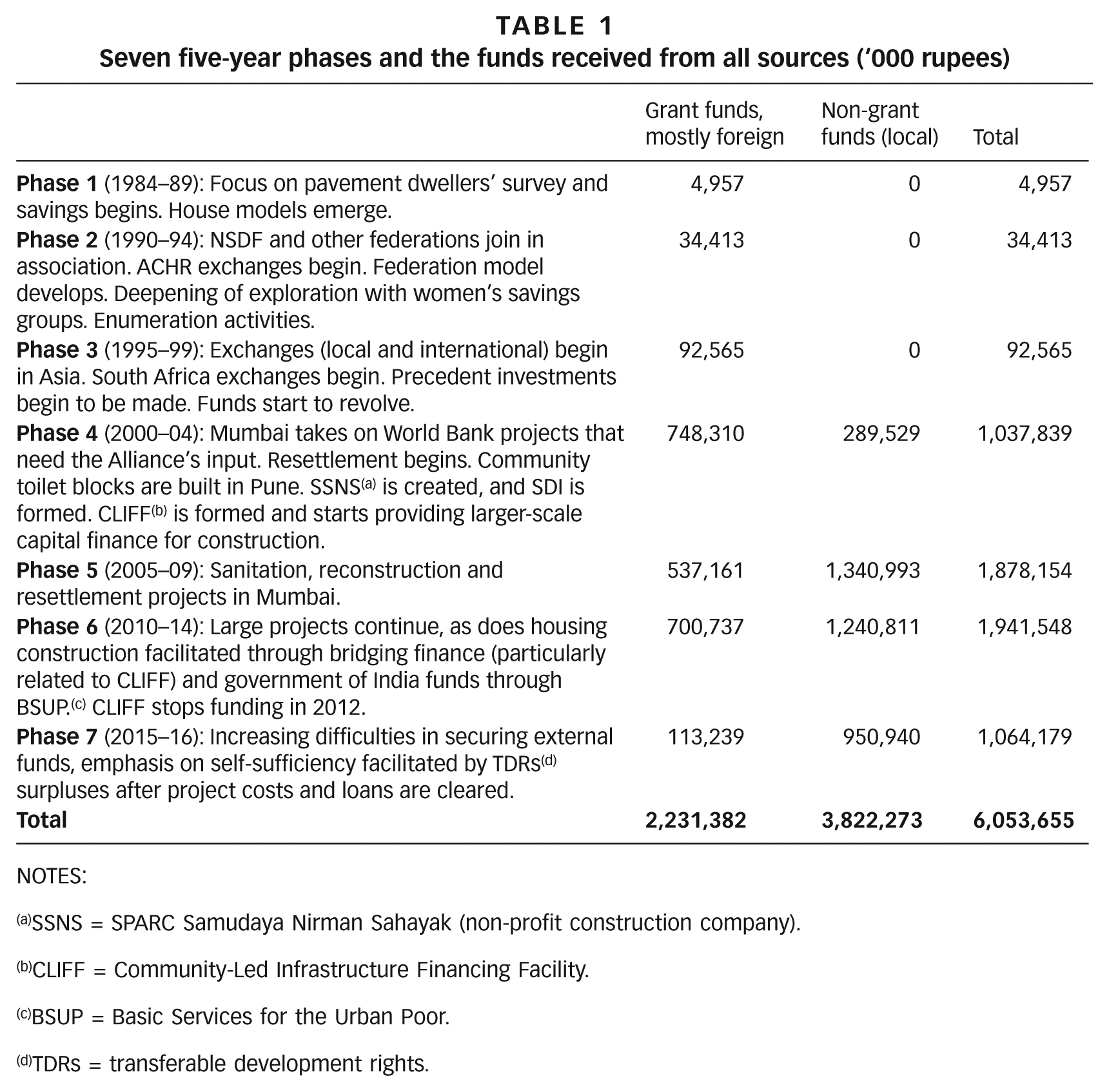
NOTES:
SSNS = SPARC Samudaya Nirman Sahayak (non-profit construction company).
CLIFF = Community-Led Infrastructure Financing Facility.
BSUP = Basic Services for the Urban Poor.
TDRs = transferable development rights.
Priorities could not always be addressed, however, given policy or programming constraints. This is where “precedent setting” came in, a critical feature of Alliance practice, which evolved over time. This is the demonstration of alternative, more effective solutions – whether innovative floor plans, building materials or toilet designs. Communities experimented with housing and sanitation solutions and showcased their strategies to other federation members, other community residents, politicians and officials.(8) In some cases, these sensible precedents led to policy reforms or changes in regulations, and they have routinely been significant contributions to addressing the needs of larger numbers, as has been well documented.(9) These innovations served people beyond the federations. For example, of the 30,000 households surveyed by the pavement dwellers federation in 1998, only about 25 per cent were federation members; but all benefitted from the policy decision to stop evictions and relocate pavement dwellers.(10)
As demands from the various federations emerged, additional capital was needed to explore possibilities and test solutions, and money was passed on to communities for experimenting with new solutions. By now it was evident that all the funding the Alliance received was treated as an investment, and the use of revolving funds was introduced to make capital available for further projects and precedents. When funding was received for projects, capital funds were created. These funds, along with interest accumulated, were used to make loans to the federation groups. As the capital and interest were repaid, these monies were redeemed as required. And as the federations grew, the demand for trying new solutions became hard to anticipate. In collaboration with funders, a precedent-setting budget line was included in grant budgets to underwrite projects that were exploratory in nature.
There were at this point six distinct areas of recurring expenses:
The rental of area resource centres where Mahila Milan members met, managed savings, and agreed on loans and document transactions. Costs included rent, phone and electricity, and tea at meetings.
Minimal payments for tabulation and analysis of data from enumerations at these centres, and stipends and travel for data collectors.
Travel costs for horizontal peer exchanges within and between cities, and costs of training and mentorship of emerging leaders.
Travel costs for meetings and advocacy with city, state and central government officials.
SPARC professional, administrative and accounting staff costs, including audits and other administrative requirements, office rent and expenses, and data digitization.
Precedent setting – capital for experimentation and scaling up of construction efforts.
By the early 1990s, city authorities and government departments began to request the Alliance to take on government-funded projects. These commissions offered substantial opportunities, but also new challenges. The terms of procurement and tendering to bid for projects required rapid learning, as did the design of finances and guarantees to execute the projects. Municipal and government projects required pre-financing to cover initial costs until tender-related funds could be accessed, so revolving funds were used both for bridge financing and for training NSDF, Mahila Milan and SPARC staff to manage projects.
In 1998, Homeless International, a UK-based charity and grant provider, explored some of these complexities in a research project funded by the UK development agency DFID. The findings confirmed the Alliance’s understanding of its challenges:
Low-income households only obtain tenure at the end of a project. But formal institutions require uncontested tenure documents from the beginning. Without tenure, the risk for lenders is high.
Going to scale is only possible with a wide range of financial tools for project financing, including start-up capital, loans secured through guarantees, and finance to change procurement frameworks.
Many bilateral institutions give finance to banks to on-lend to the poor, but these funds are not available to the urban sector.
These findings, published in Bridging the Finance Gap in Housing and Infrastructure,(11) helped to secure DFID support for the development of the Community-Led Infrastructure Financing Facility (CLIFF), an innovative institutional arrangement for handling funding. In its first phase, funds were routed through Cities Alliance, with the involvement of a committee with members from Homeless International (rebranded as Reall in 2014), SDI, the US development agency USAID, the Swedish development agency SIDA, DFID and the World Bank. Community federations within the Indian Alliance were the first recipients. Later, SDI affiliates in Kenya and the Philippines also joined the committee and received funds.
Subsequently, various regulatory complexities in India complicated the terms of these funds, and more recently DFID stopped its programmes in India. CLIFF also moved to a focus on Southern shelter agencies interested in securing financial self-sufficiency. This led to an emphasis on private-sector and market investment and equity, and reduced CLIFF’s direct delivery to informal and low-income communities. Nonetheless, CLIFF remains the most ambitious, pathbreaking institutional arrangement that the Alliance has been involved in. Its conceptual framework continues to be relevant to governments and private-sector “angel” investors who value delivery to low-income groups and who are interested in financial innovation.
Shifting from managing small local precedents to securing state tenders raised a number of issues for the Alliance. Some projects involved budgets far larger than SPARC’s annual budget, and even at this stage the leadership recognized that investment was likely to expand exponentially. Different kinds of professional expertise were needed, and some transactions required permission from the charity commissioner, since SPARC was registered as a charitable trust. A practical approach was establishing a sister organization with a company registration to handle community-driven construction. And so SSNS (SPARC Samudaya Nirman Sahayak – referring to SPARC’s support to community construction) was formed as a non-profit construction company with any surpluses available for the federations to use for more projects. SSNS is jointly owned and managed by SPARC, NSDF and Mahila Milan. To ensure continuity in values and practice, the director of SPARC is the secretary of SSNS (and a co-author of this paper), and the organizations work out of the same space with shared accounts and administrative staff. SPARC and SSNS function at different ends of a continuum – with federation building, empowerment and learning at one end, assisted by SPARC, and the negotiation of deals leading to construction then taken over by SSNS.
SSNS formalizes the trusteeship role that NSDF and Mahila Milan have played for local communities, making their involvement possible in a context where they would otherwise be marginalized by banks, city governments and technical professionals. SSNS has sought to maximize the return on investment while reducing risks and managing losses for local communities. It makes formal finance and legal requirements accessible to the urban poor – ensuring that local communities are not burdened by formalities and denied control over developments.
Donors and external experts have questioned SSNS’s not-for-profit status, spurring deep reflection and growing confidence in the arrangement. The transfer of capital from SPARC to SSNS would not be possible if SSNS were “for profit”, and the tax concessions associated with a not-for-profit status make it easier to manage regulatory requirements. Being “not for profit” does not mean that SSNS does not generate profits or surpluses. But rather than distributing profits to outside investors, it makes these available to the federations that are its real shareholders. The Alliance also argues that development finance never trickles down to serve the lowest-income groups. Many organizations began by building small affordable houses for low-income groups, and constructing a few larger, more expensive units for sale to the middle- and higher-income markets with a view to subsidizing the lower-income units. But with time, profitability and sustainability become driving forces and the higher-income houses start to take precedence.
Once SSNS was set up, all donors that had capitalized the formation of revolving funds gave permission to transfer these funds to SSNS. Funds for smaller and more exploratory precedent projects continued to be managed by SPARC. Once the Alliance had secured project capital (in part through CLIFF), this facilitated negotiations for additional finance and permissions to begin projects. Banks were ready to discuss loans, and the combination of CLIFF guarantee funds and bridging capital led to loan finance for projects. Access to start-up capital (from CLIFF and other sources) ensured that communities could take on these projects, using bridge finance to complete the first phase, prior to government finance being available.
In
This market-financed subsidy allowed developers and others to build tenements of 25 square metres to house all residents of a slum, with additional storeys on buildings on a given plot of land, which could be sold to cross-subsidize the units for rehousing the residents. The additional FSI could be used on the plot; the developers could convert this additional allowance to “transferable development rights” (TDRs), which could be sold on the market to provide additional construction space elsewhere; or a combination of the two approaches could be taken. All Alliance projects used all FSI on the plot to rehouse slum dwellers and sold TDR to cover costs.
SSNS undertook two kinds of housing projects under the Slum Rehabilitation Act – joint ventures with slum dwellers who wanted to take on development themselves, and joint ventures with landowners who had slums on their land. The Act allowed for private landowners to give land to the state if it was needed to relocate slums or for public infrastructure. In this case, the landowner received an FSI of 1 for the land, while SSNS received the FSI to finance the rest of the project. Bridge funds and technical assistance grants helped design projects under the Act and covered 25 per cent of costs; guarantees were used to secure loans from Indian banks for additional capital. As in the case of grant income, when TDR sales and other subsidies were recovered, all internal and external borrowings were repaid, surpluses were invested, and income earned on them was used for core programme activities.
As the Alliance negotiated new projects that challenged existing development modalities and opened up the possibility of further scaling up, the need for additional capital funds was clear, in part to provide the necessary bridge financing that neither the state nor banks would provide. Funding for construction activities has not increased smoothly, but the growth in activities is evident (Tables 1 and 5).
In
By now both SPARC and SSNS had operational revolving funds capitalized by multiple sources (donor grants for projects, specific grants to create capital funds, and surpluses from various projects). Any donor whose grants were revolved could see the full financial documentation. In some cases, funds would shrink when repayments were not made, but as a portfolio of revolving funds, the surpluses (TDR-linked) ensured that the total capital in the aggregated funds maintained its value.
At this point, CLIFF was one of the few sources of funding for operational technical assistance and non-capital construction costs. When CLIFF moved into the for-profit affordable housing framework in 2012, SSNS was left without grant support to cover technical assistance and train communities to take on construction. This did not mean a decline in project activities, however. Rather, this funding has been replaced more recently by the use of funds from TDR sales and government subsidies.
During
Recognizing the need for self-sufficiency, the agencies making up the Alliance agreed to draw on TDR surpluses for multiple purposes. The first priority is replenishing deficits of the portfolio of revolving funds, the second is supporting federation running costs, and the third is contributing to the development of SDI national funds. (Like the Alliance, other SDI affiliates are under increasing pressure from donors to be self-sufficient, and SDI’s Urban Poor Fund International (UPFI), which helps to guarantee bank loans and provide bridge funding to finance affiliates’ projects, is exploring multiple avenues to build up capital.)
III. The Form and use of Funds
Figure 1 provides an overview of the Alliance’s financial flows. Funds are received from various sources (in lilac), and then allocated for various uses. In some cases the “flow” ends there and the funds are not further recycled – for instance in the case of administrative expenses and salaries, or such core activities as advocacy with the state or enumerations. But in most cases funds are recycled – invested and accumulated for further use. All cells with arrows represent recycled funds, which in most cases earn interest.
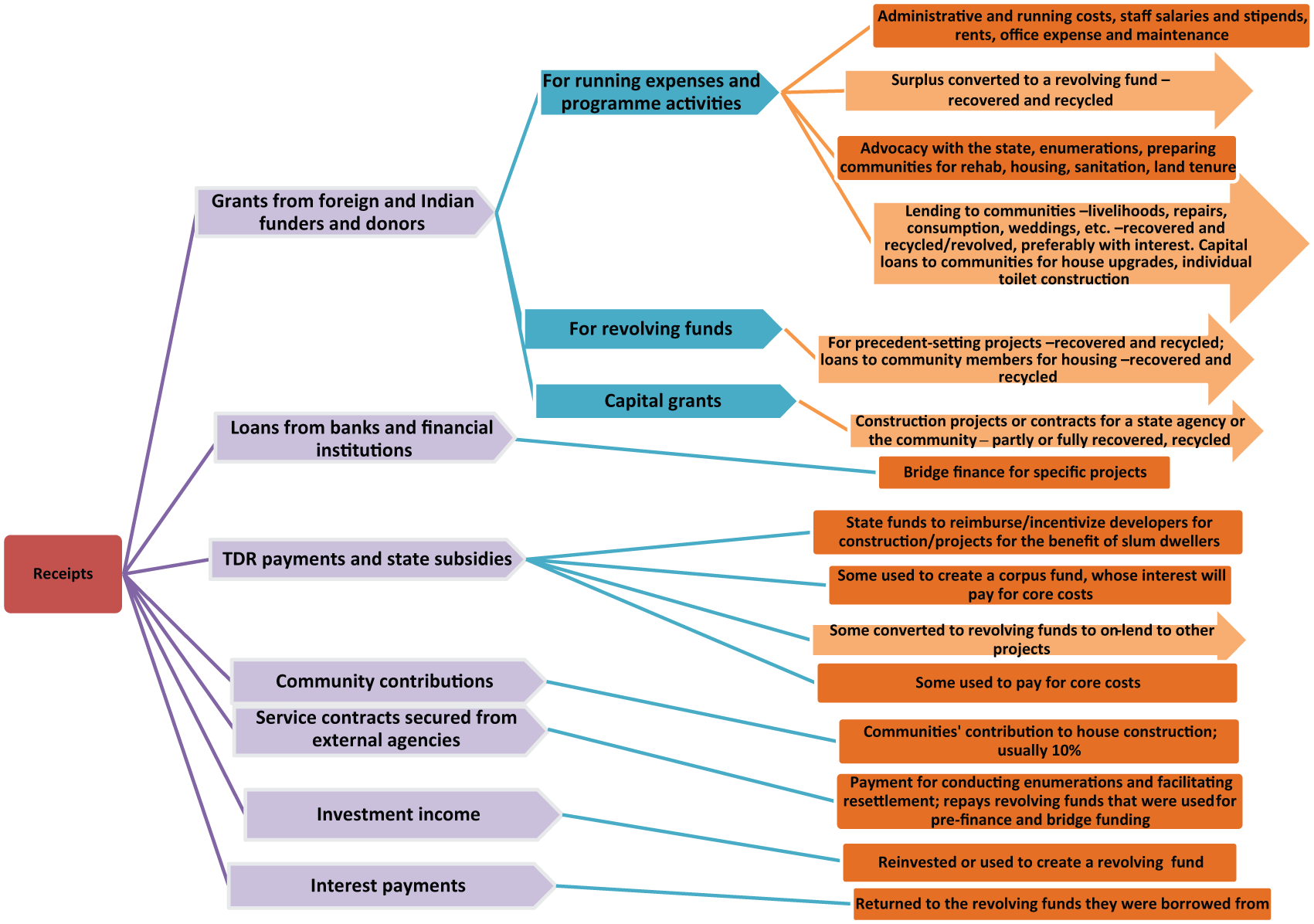
The Alliance’s financial flows
a. Where funds came from
The total income received over the years by the Alliance falls into two main categories: grant and non-grant income (Table 2). Non-grant income includes community contributions (a small share, but disproportionately important for what it represents), and TDR payments and state subsidies (which include the contracted services shown in the flow chart). In addition, there has been interest income from the investment of capital funds and loans.
Total income, 1985 to 2016, by category and phase (‘000 rupees)
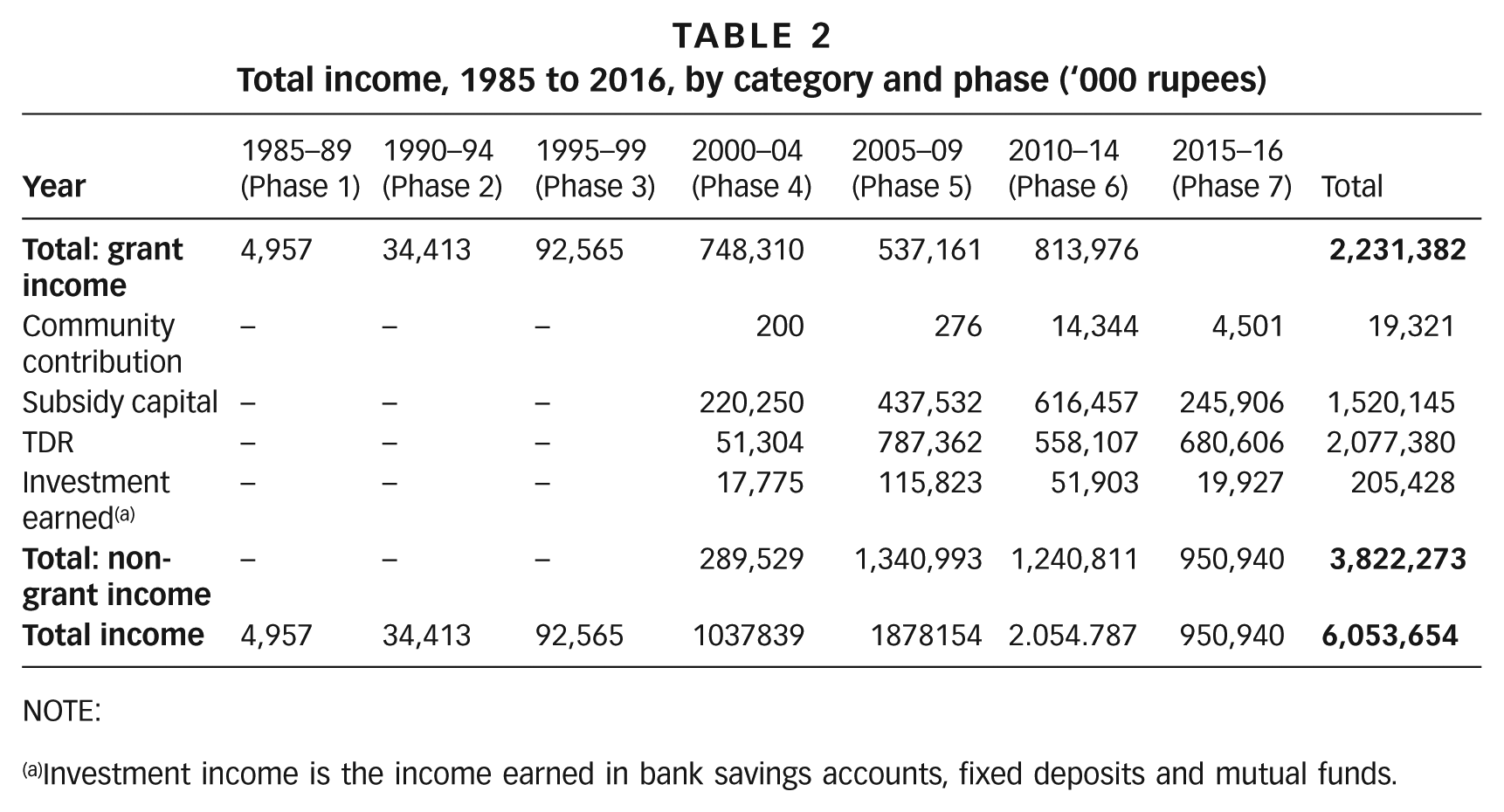
NOTE:
Investment income is the income earned in bank savings accounts, fixed deposits and mutual funds.
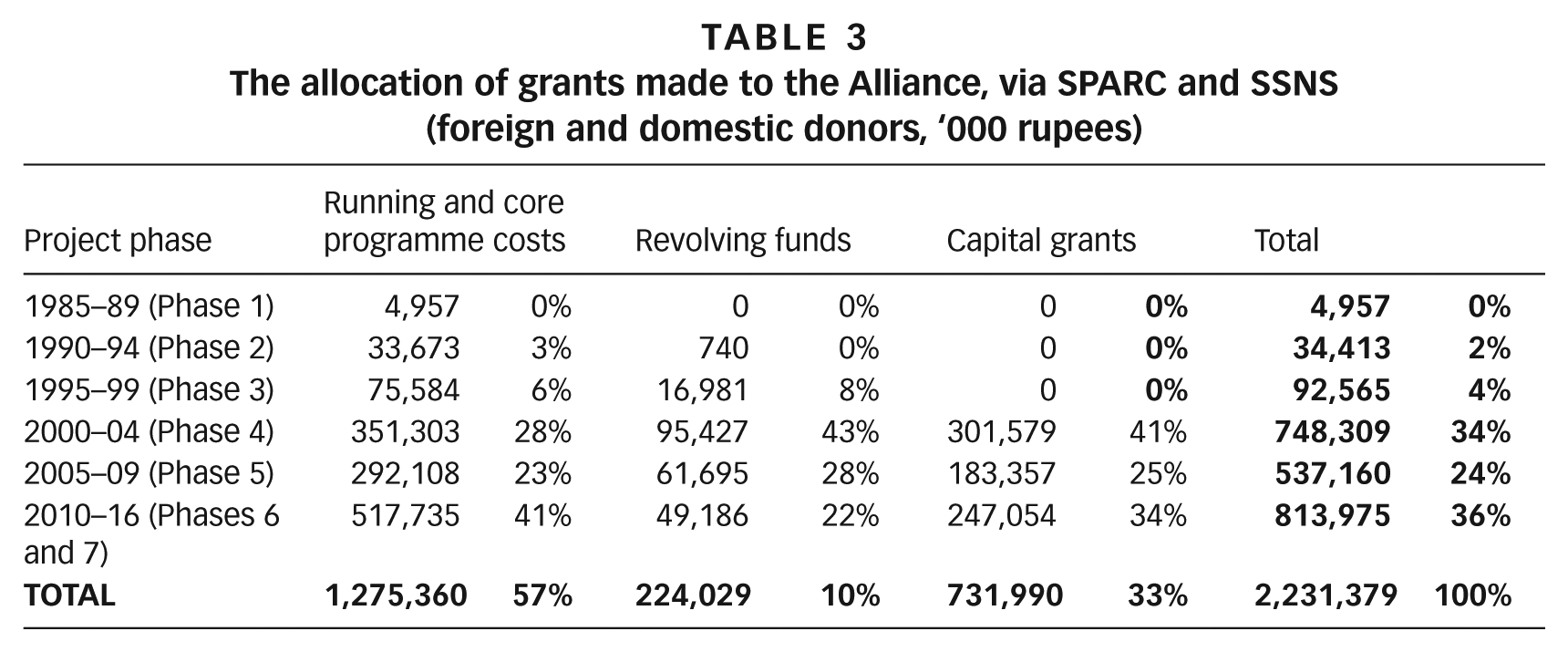
The allocation of grants made to the Alliance, via SPARC and SSNS (foreign and domestic donors, ‘000 rupees)
b. How money has been recycled, accumulated or capitalized
As noted in Table 3, less than 60 per cent of the grant money that came to the Alliance has been spent to cover running costs and core programme activities. The remainder has been treated as investment capital, placed either in revolving funds that are used for precedent setting and then repaid, or in capital grant funds invested in construction projects and then repaid to be available for relending.
As the first round of precedent-setting projects in Phases 1 and 2 began to generate a flow of funds for the Alliance, the money was returned to the revolving funds. Expenditure on these first projects often exceeded the initial budget, but knowledge and experience were created, providing the basis for the expanded financial architecture that characterized the subsequent work of the Alliance. Interest earned on these revolving funds was also used to cover the riskier elements of projects, especially evident in the early stages, and also to help complete activities at the end of projects.
As time went on, foreign grant money and related interest were supplemented, and to some extent replaced, by TDR funds. This money was generated through housing construction for informal settlement residents, sold on the TDR market to enable developers to construct at higher densities. TDR projects, however, take time to complete, and often the TDR income is only available many years later. When it does come in, it is used, first, to repay what was borrowed against it, and the balance is contributed to a specific Alliance revolving fund for on-lending to new projects. To date 75,438,097 rupees have been used in this way.
Table 4 shows how the initial capital from these sources has grown and how it is expected to continue growing.
Current and future value of all recycled funds held by SPARC and SSNS (current ‘000 rupees)
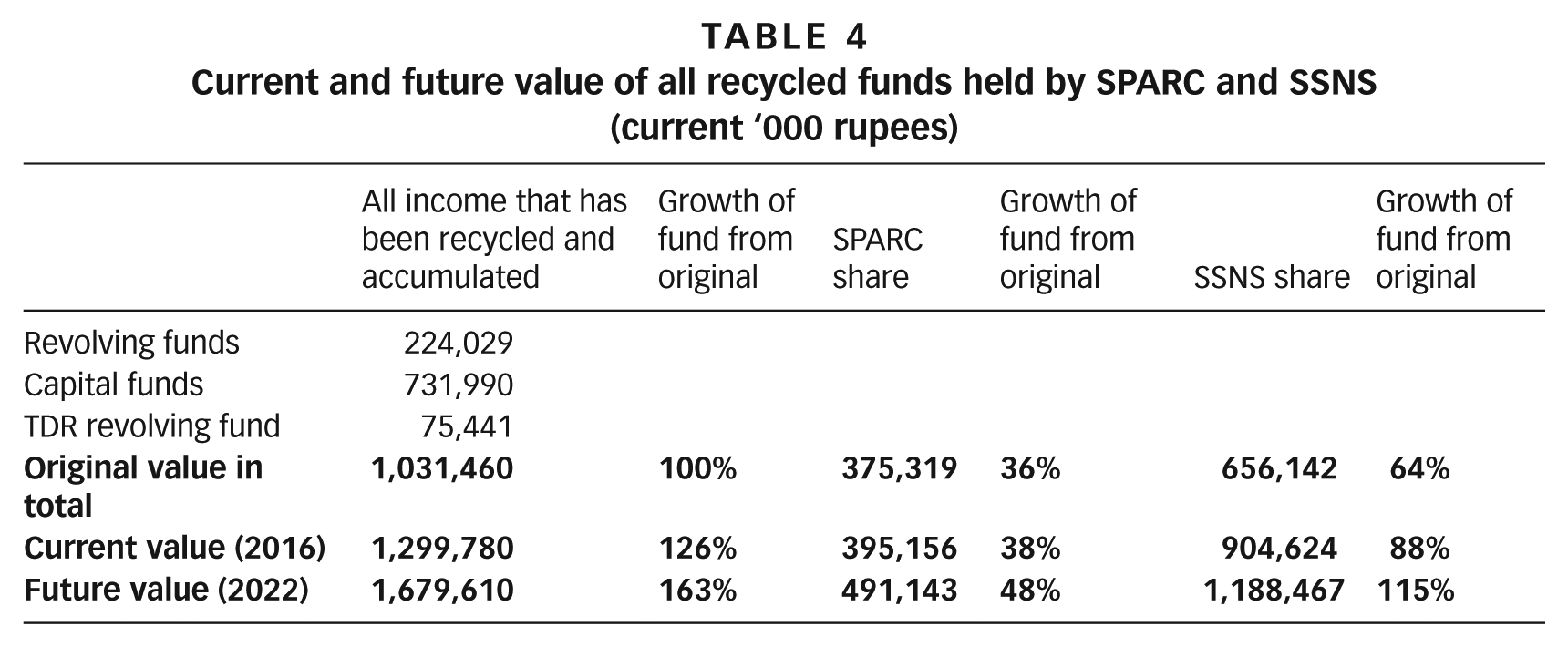
The current value is based on the amount that has been returned to date (some of which has been loaned out again), added to the original capital. Future value has been estimated, looking at expected repayment of current loans and anticipated interest earnings. No adjustment has been made for inflation.
c. How the funds have produced development returns
Table 5 summarizes the projects that emerged from the precedents and subsequent negotiations with government agencies, detailing the division among housing (64 per cent), sanitation (34 per cent) and services (just 2 per cent). Total project finance equals just over 4.5 billion rupees. It does not include ongoing administration and small-project expense, managed by SPARC, and reported in Table 3 as part of the Alliance’s running costs. Table 5 shows the growing significance of two capital flows: support to community sanitation block construction (particularly in Mumbai and Pune) starting in Phase 3; and the TDR housing in Phase 4 onward, which accounts for 71 percent of all housing funds. Services are primarily relocation processes and surveys that the Alliance has been contracted to take on by the government for federation constituencies.
Investments in project activities, SPARC and SSNS (‘000 rupees)
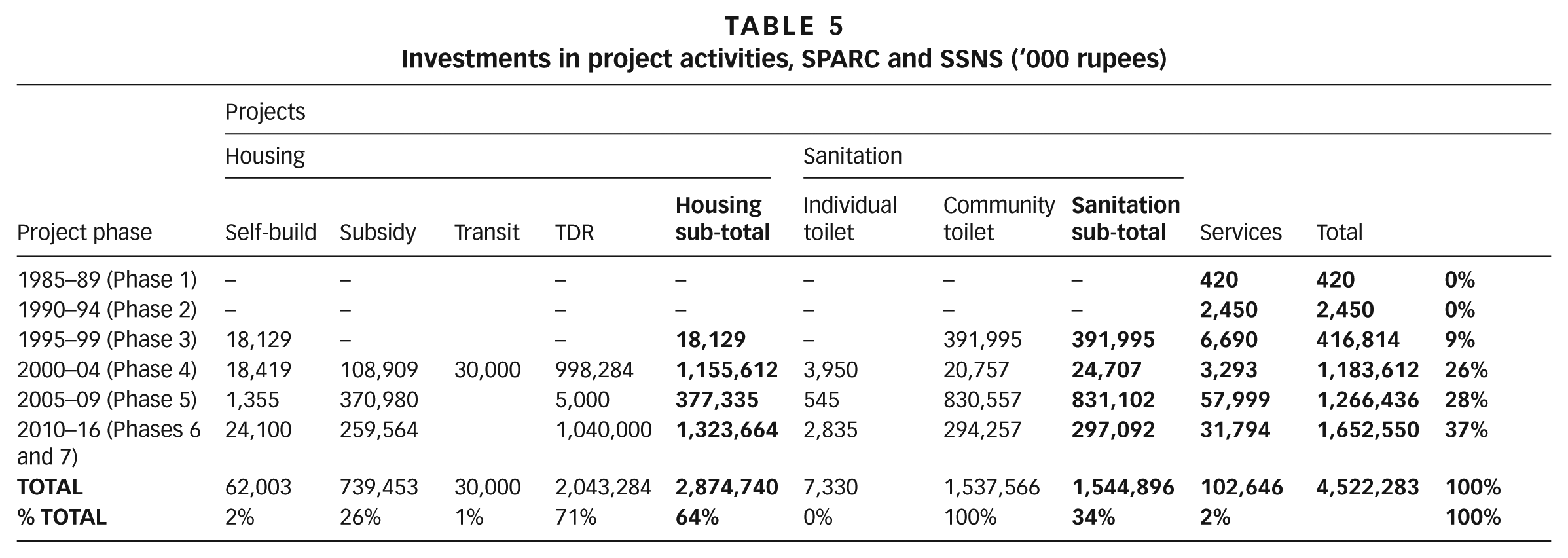
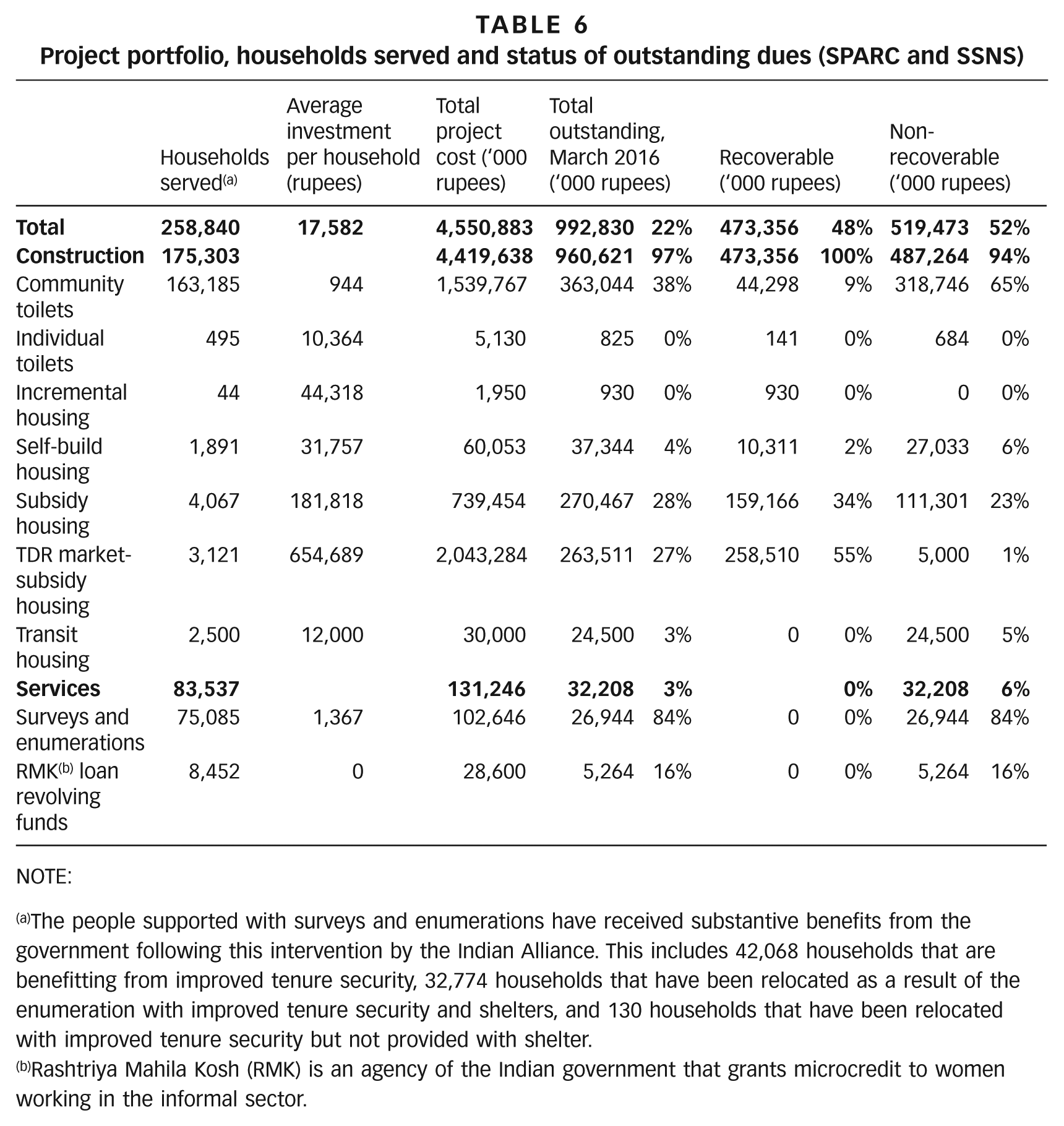
Table 6 details the number of households that have benefitted from these activities, and the value of these investments. Almost 260,000 households have been directly served: over two-thirds with construction activities (either housing or toilets) and almost a third with services. Of the more than 75,000 households benefitting from surveys and enumerations, 44 per cent have been both enumerated and relocated with Alliance support to government-provided resettlement housing; the remainder were enumerated to facilitate sanitation provision or improved tenure. The community toilets and surveys reached maximum numbers at the least cost; TDR unit costs incurred the greatest expenditure per household.
Project portfolio, households served and status of outstanding dues (SPARC and SSNS)
NOTE:
The people supported with surveys and enumerations have received substantive benefits from the government following this intervention by the Indian Alliance. This includes 42,068 households that are benefitting from improved tenure security, 32,774 households that have been relocated as a result of the enumeration with improved tenure security and shelters, and 130 households that have been relocated with improved tenure security but not provided with shelter.
Rashtriya Mahila Kosh (RMK) is an agency of the Indian government that grants microcredit to women working in the informal sector.
Table 6 also indicates what is still owing. Of 4.52 billion rupees in loan finance advanced for projects, nearly a billion has not been recovered, and it is anticipated that only half of this (48 per cent or about 0.5 billion) will be recovered. Community toilets have had the highest non-recoverable funding. This is because the Alliance began this work with little experience in sanitation construction. When commercial contractors did not respond to tenders, funds were spent on the capacity building of 150 community contractors in Mumbai and Pune. Initial mistakes were treated as learning costs and repair costs were also absorbed; the city governments made no funds available for this. However, the investment led to policy reforms and further government investments, and although not fully recoverable, the Alliance considers the expenditures to have been worthwhile. Income gains from future TDR projects will compensate for these losses. Typically, initial projects incur higher losses – many lessons are learned from mistakes made through inexperience. Over time, capacity is built and effective systems emerge. Grant finance covered much of this cost in the early days. Increasingly, projects either break even or learning costs are covered by grant finance. As grants become harder to obtain, federations will need to balance lesson-learning, loss-making projects with those that make a surplus.
The state’s contribution to achieving these outcomes has been twofold: first, through pro-poor policies that reform urban development practices, and second, through financial transfers. Through TDRs, state policymaking is responsible for drawing in market subsidies to low-income housing, showing that the state can help in ways beyond the provision of subsidies. Community contributions provide benefits that exceed the direct provision of funds. Strong local ownership ensures that the interventions address local needs and manage the complexities involved in making transitions from slums to medium- and high-rises in all construction projects.
It should be noted that the Alliance is one of the few agencies using TDRs to undertake community-driven construction projects that design and deliver houses for slum dwellers under the Slum Rehabilitation Act schemes in Mumbai. Most real estate-driven projects take on this construction to secure TDR benefits in terms of additional building rights and to access high-value land currently occupied by slums. Lack of capital finance is the major reason that the Alliance and other NGOs have not been able to reach as many households as initially envisaged. Due to the lengthy duration of these projects, bank finance is very expensive and banks are reluctant to take the long view on community projects. Since the land lease is transferred after construction, banks do not get lease mortgages to give loans.
IV. Conclusions
This paper demonstrates the evolution of the Alliance’s collective trusteeship of financial resources, and of a strong financial process that has been able to multiply donor funds by investing and revolving them, and by leveraging additional funds through securing state policy reforms. The numbers tell part of the story. Between 1984 and 2015, the Alliance received 6.1 billion rupees, of which 2.2 billion rupees have been from grants, both foreign and domestic (Table 1). Over this same period, 4.5 billion has been spent on project activities (Table 5) and over 1.27 billion has gone to running expenses (Table 3). The current value of its revolving funds and capital grant funds is almost 1.3 billion. In other words, the 6.1 billion of income, through investing and recycling of funds, has accumulated to the equivalent of 7.1 billion in completed projects and available resources. This does not include the amount still outstanding from unrecovered TDR funds – almost half a billion (Table 6).
But this is not the whole story. Crucially, these numbers fail to reveal the value of the learning and the leveraging that have taken place. Reflections on the Alliance’s underlying process highlight three essential outcomes, which have been essential to its success in financial terms.
There is much discussion about the scale of funding needed to deliver on today’s ambitious global agendas, and the institutional structures through which this can be delivered. Existing financial architectures facilitate the vertical flow of global development finance (be it multilateral, bilateral or other), with top-down decisions far removed from messy day-to-day realities. This shapes design, delivery, execution and assessment, and what happens to the finance when the project is complete.
In the Alliance’s experience, the effectiveness of global finance depends on the quality and capacity of the (mostly local) intermediaries that implement the funded initiatives. And these intermediaries, generally civil servants and professional consultants, are rarely accountable to local populations whose needs they are meant to address. Pressures to spend lead to rapid distribution of project money, often with little planning and little involvement of target communities in design, course corrections or subsequent evaluation.
These are familiar problems. This paper has demonstrated how different it can be when local organized communities have some control of financial decision-making. This transformation can address the risks linked to development investment, its absorption and its use. Four related dynamics help to ensure change at scale:
Problem solving and coproduction in one focus area – be it shelter, healthcare or education – can create the foundation for addressing other priorities.
The consistent use of revolving funds ensures that funds are used effectively and dependency is reduced.
The integration of financial support alongside the building of social and political capital enables the required reforms to take place.
Networks allow experiences to be shared and help in problem solving, resulting in processes that can be replicated and adapted to other localities. SDI and other global networks of the urban poor, regardless of their focus, have – in their own modest way – demonstrated a capacity to work effectively with other city-based, national or international organizations and put resources to their best use.
The Alliance’s experiences demonstrate the value of allowing external money to revolve locally and assessing this process by considering what these funds leverage, what they produce as assets for the poor, and what policy reforms they catalyse. When community networks own and manage local funds, they develop the financial capability to take on projects, obtain bank loans and leverage subsidies. They have the basis for long-term partnerships with the technical and professional world, ensuring that design and delivery are effective and accountable. The revolving of money helps to maintain a capital base, ensuring a legacy from the initial funds. In addition to capitalizing funds, the process capitalizes on the experiences and memory of the urban poor themselves. The Alliance demonstrates that what people do for themselves transforms their capabilities and their sense of themselves, and this is more valuable than any external funding given to the process.
Footnotes
Acknowledgements
Sheela Patel would like to acknowledge the hospitality and creative culture of the Rockefeller Foundation’s Bellagio Center, which contributed to the conceptualization and drafting of this paper.