




Abstract
Mumbai is well-known for the scale of the community toilet programme supported by local government, much of it undertaken in partnership with community-based organizations, including the National Slum Dwellers Federation, Mahila Milan (a federation of women’s savings groups) and SPARC (a local NGO), together known as the Alliance. After describing how this community toilet programme developed over the last 20 years and sought city-wide scale, this paper focuses on the Alliance’s co-development with the municipal corporation of a system to monitor conditions in the hundreds of community toilet blocks built. This monitoring system supports government officials in each ward and the communities served by the toilet blocks in identifying and addressing faults. It also helps develop good working relationships between communities and ward and municipal officials, which can allow other key issues to be addressed.
Keywords
Introduction
Twelve years ago, this journal included a paper on the work of the Alliance in India and its community-designed, built and managed toilet blocks.(1) These toilet blocks, which at that point served more than half a million people in eight cities in India, were part of a much larger programme of community-managed slum(2) upgrading and resettlement by the three organizations that make up the Alliance – the National Slum Dwellers Federation (NSDF), its partner organization Mahila Milan (Women Together), and their support NGO, SPARC. The focus on sanitation has been in many cases the entry point for engagement with city governments. Access to safe sanitation is of course a vital objective in itself, but the opportunity that sanitation work has provided for the self-organization of these slum dwellers and for their dialogue and negotiation with city governments has also been critical. It is often easier to address sanitation than land tenure, and through these interactions, representatives of cities and municipalities have begun to change their views of slums and slum residents, opening the way for more extensive engagement. City officials have been trained to focus on the demands and expectations of the formal city – the Alliance’s work on sanitation creates a path for connecting informal settlements to the city administration, aiming to establish that same responsive attitude with regard to slums.
For 25 years now the Alliance has committed itself to involving municipalities as active partners in their sanitation solutions. This paper focuses specifically on the ongoing engagement in Mumbai, providing more detail on this partnership in the years prior to 2003, and then picking up the narrative where the earlier paper left off. The partnership with the Municipal Corporation of Greater Mumbai (MCGM), with all its struggles and achievements, exemplifies the efforts of the Alliance to ensure that solutions to the problems of the urban poor become integrated into city-wide systems. This paper looks not only at the continued production of toilet blocks in Mumbai, but also at the current effort to develop a municipal system for continuously monitoring and assessing the status of the city’s community toilets.
II. How It All Began
In 1993, a group of pavement dweller women in Mumbai, members of Mahila Milan, built a community toilet block on P D’Mello Road, a busy thoroughfare in the heart of the city. This simple building, constructed in a matter of weeks, contained four pour flush latrines, a water tank and a caretaker’s room, and it made history. Not only was it the first time that the city had ever awarded a contract for building a public toilet to the users themselves; it was also the precedent for the thousands of toilets that would be built in subsequent years by a growing national and then international network of slum dwellers (Photo 1).
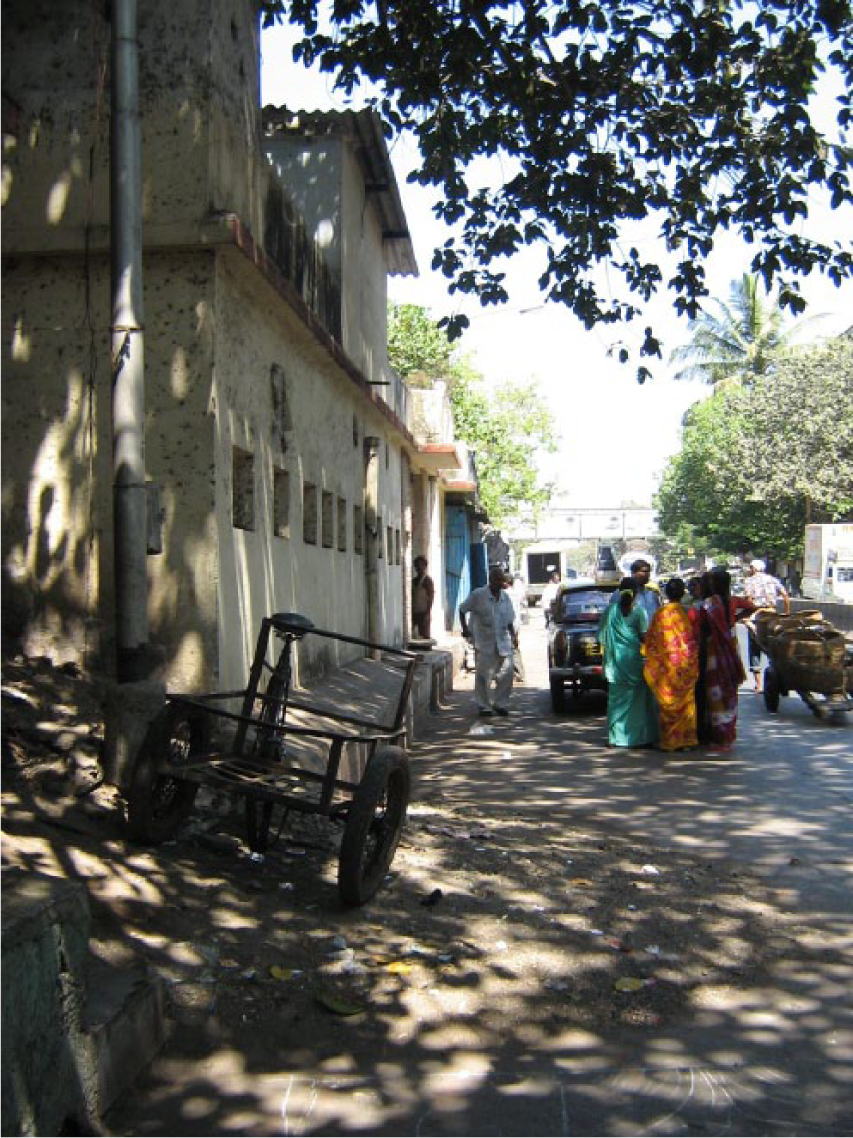
The first precedent-setting community toilet block to be constructed by the pavement dwellers in Mumbai on P D’Mello Road
This early achievement was itself the culmination of years of discussion and effort on the part of these women pavement dwellers. Sanitation had emerged as a critical issue when they began their efforts in the late 1980s, in collaboration with NSDF and SPARC, to work towards planning permanent secure housing for themselves. For reasons of cost and space, it was clear that aiming for toilets in their houses was unrealistic. But communal toilet blocks did not appear initially to be a good alternative either. Most government-built shared toilet blocks in the city were very poorly maintained and many did not even work. Municipal commissioners frankly admitted that they had money to construct toilets but not enough to pay for their maintenance. The World Bank and other global agencies had long decided that community toilets were a bad idea because of these maintenance issues. And even where toilet blocks were functional, women hesitated to use facilities shared with men, and children always ended up squatting outside – they could not compete with adults over the use of the toilets, nor did they really want to use these dark smelly places with their large adult-sized seat openings. Out of the women’s assessment of the possibilities and realities came their concept of city-financed, but community-managed, toilet blocks with separate seats for men and women, separate spaces for children and provision for maintenance.
They were initially confounded by the cool reception when they presented their plan. Elected representatives said things like “No sanitation for the poor, it will make more people migrate and come to the cities.” The question of what city residents needed to live a decent life was of very secondary interest. No one seemed aware or concerned that open defecation was the only option for many people. There is an ironic joke that still makes the rounds of Mumbai’s pavement settlements, that the poor are the only ones who can’t afford to get diarrhoea.
Between 1987 and 1993, when the P D’Mello Road toilet was finally built, the pavement dwellers continued to transform themselves from helpless individuals to organized communities. Their Mahila Milan networks were spreading to other communities in Mumbai and other Indian cities, encouraging greater acceptance of the value of women’s knowledge and participation. The exchanges that resulted stimulated their tentative but developing capacities to undertake surveys, design homes, establish savings groups and initiate dialogue with the state.
In the years before and after this first municipally contracted toilet was built, the ideas developed on the pavements of Mumbai were being explored by others in India through peer exchanges. Part of the Alliance’s mode of operation has always involved exchanges among federation members – whether between communities, between cities or even between countries. When slum dwellers visit one another, the learning is intense. Behind this process of exchange is the belief that communities of the poor can and must be centrally involved in improving their own lives and the general conditions of the city in which they live (Photo 2A and Photo 2B).
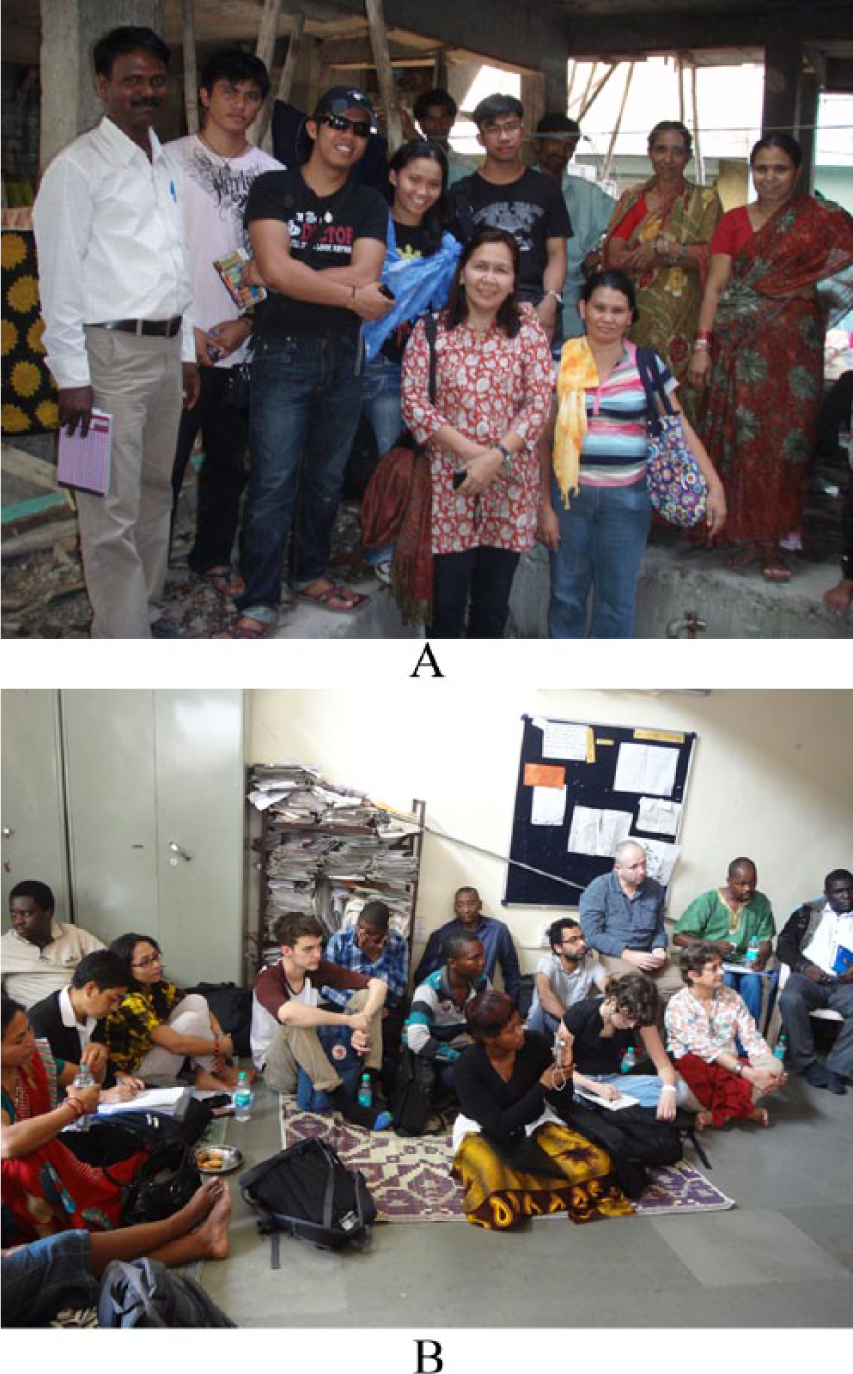
SDI visits
As this process spread to other cities in India, it was not just about building toilets. It was about building organized communities. These toilets provided an important practical focus for the federating principles of the Alliance. A community toilet-building programme gives a big push to communities to undertake projects. It creates the space for experimentation and allows for mistakes to be made and learning to happen. When poor communities in Mumbai and other cities around India undertook the process of designing, building and managing their own toilets, it was a change in roles. They were no longer supplicants, begging the city for services. They were able to invite city officials to come and inspect what they had done. They owned the process, and they were the ones telling the city how they would like it to move.
These toilets were not theoretical ideas on paper, but real buildings in real slum settlements. They were all much visited, much talked about and much analysed, both within the Alliance network and beyond it. Their mistakes and successes provided the startup fuel for the projects that followed. The people who built them took their experiences to other settlements and cities, and became trainers themselves. The evolution and refinement of ideas occurred in practice in different situations. Each new toilet that was built was better than the last one, and each time it got easier and smoother. As the expertise grew, so did the awareness about the toilets.
III. Exploring a City-Wide Process in Mumbai
The Alliance’s early experiences with community-designed and managed toilets in Mumbai and four other cities were largely donor-funded examples of what organized communities could do to solve their own sanitation needs. To take this to a larger scale meant moving from grant-supported precedents to involving municipalities as active partners, with slum sanitation actually figuring in their budgets. In 1994, an extraordinary opportunity presented itself right in Mumbai. The World Bank had begun negotiations with the MCGM to lend money for a large sewerage and sanitation project involving massive improvements to Mumbai’s undersized and overtaxed sanitation system. There was one condition for the loan – that the project also address the needs of the poor and include the building of community toilets in a selected group of slums.
This led the municipal corporation to invite SPARC to join the tendering process for the construction of 320 toilet blocks. Initially, this did not work out well. The Alliance’s proposal was for a community-led project with federation support; based on careful community-managed surveys, needs would be determined and communities selected for the toilet blocks. The city would pay for capital construction, while communities managed and maintained their own toilets. The World Bank also wanted community involvement, but as part of a competitive bidding process that would pit one community against another to be chosen for demo projects, and with NGOs, also bidding against one another, subcontracted to do the actual work.
This ran counter to the Alliance’s accustomed mode of operation. It did not like the implications of slums bidding against one another. And instead of allowing many organizations to develop a range of solutions to Mumbai’s staggering sanitation problems, the process would pit different organizations and approaches competitively against each other, and reduce community participation to a spectator sport. The Alliance had even greater reservations about the Bank’s proposed three-part procurement strategy, which separated out mobilization, design and construction, with different NGOs submitting bids to take on just one part of the process. Separating activities this way might be useful for large engineering projects, ensuring technical and financial transparency and oversight, but the Alliance found it a cumbersome approach for individual community toilet blocks, regardless of the large number to be constructed. It would mean that each slum community had to have separate transactions with three different organizations. The Alliance wanted to undertake all three parts of the process in as many toilet blocks as possible, optimizing local involvement and ownership. It felt it would be far better to identify specific localities and have organizations take on all three aspects of the process in these locations. In the face of these World Bank requirements, it decided not to enter the bidding process.
A few years later, in 1998, with the track record of having in the meantime constructed 114 toilet blocks in Pune according to its principles, the Alliance was invited back to the project in Mumbai. The Bank approach had not worked out – not a single toilet had been built in the interim. This time the design specifications and the procurements had been reformulated according to suggestions from the Alliance, and based on its existing work. As described in the 2003 paper,(3) SPARC won the contract in Mumbai to construct 320 toilet blocks with 6,400 seats in 20 wards. Other NGOs had decided they did not want to attempt this scale of work, and they also lacked the financial resources to get the necessary bank guarantees.
Having awarded the contract, the municipal project staff, who were quite unprepared themselves, demanded that everything be done as quickly as possible. The MCGM hurriedly put together a slum sanitation unit (called the Slum Sanitation Programme or SSP) within its administration; later SPARC found that this was a “punishment posting” for middle-level engineers and administrators, who were transferred to this unit while some wrongdoing was pending inquiries.
The Alliance was also unprepared for the complexity of this process and struggled on many fronts to manage the requirements that were heaped on it. To start the project, it had to provide one bank guarantee for project performance and completion and another to get project advances. This was clearly non-negotiable. But neither the Alliance nor the municipality, nor the Bank, for that matter, knew how to enact the bank guarantees. AXIS Bank (then UTI) and its amazing chairman and CEO Dr Naik actually found ways to get the World Bank, the municipality and his bank board to agree to devise the documentation that provided this guarantee.
There were clear expectations that as many toilets as possible should be started. But there were preliminaries that were not taken into account in the contract provided, such as the need to come up with advances to contractors and the resources necessary for building the capacity of newly developed contractors and organizing communities. There were 126 sets of contractors, several of them women leaders from Mahila Milan who in the past had learned construction and trained many others. Every contractor needed to open a bank account to get money; the Alliance needed to introduce each one of them to the banks; and they also needed a PAN card (the identification for Indian income tax payers). All of this was facilitated by a company newly established by the Alliance, called SPARC Samudaya Nirman Sahayak (SSNS).
Every toilet project went through a set of steps:
Locating areas suitable for exploration.
Discussing with communities whether they wanted a toilet, had space to construct one or had an old dilapidated toilet they wanted to reconstruct.
Checking with the SSP (the unit within the municipality) whether that location was acceptable to it.
Surveying the slum, estimating how many seats were needed, and checking how many people were willing to participate in the scheme, which would involve paying Indian rupees (Rs.) 100 (US$ 1.58) per adult and forming their own startup capital for maintaining the toilet.
Physically clearing the location and planning for a general layout as the basis of the work order.
Submitting the detailed architectural and structural drawings, leading to the work order being confirmed, and drawing up estimates.
Appointing a contractor for the project. If this was a Mahila Milan or NSDF member, they got 10 per cent of the budgeted cost to start the project; other contractors had to put in their own 15 per cent before they began.
Preparing bills after joint assessments of the construction undertaken.
Providing all households with a family pass; arranging for them to make monthly payments of between Rs. 30 and 60 (US$ 0.47–0.95) for use of the facility; and registering their society.
Appointing caretakers by the committee and paying them from the maintenance budget.
Once the toilet was completed, inaugurating it by a local elected representative of the community’s choice.
Retaining 5 per cent of the contract funds in case of defects, and paying the balance due to the contractor.
It was always clear that the solutions would in many cases be less than perfect. Some slip-ups would happen, some contractors might do a sloppy job, some communities would promise to maintain their toilet blocks and then not follow through. But the leadership of NSDF was clear. Everyone was learning, however superior the city’s technical people might feel, and that was the important thing. Taking the risk of exploring a less than perfect solution, while always keeping the ideal in front of them, was the real vision of the NSDF and Mahila Milan leadership. Fear of failure, fear of criticism never stopped them; it only showed what new skills they needed to improve the situation.
In the earlier sanitation work in Pune, the commissioner had personally held weekly meetings and listened to his officials and NSDF/Mahila Milan. In Mumbai, by contrast, the process faced many challenges when senior officials who were committed to the project were transferred. Of great value, however, was the fact that the process in Mumbai was ongoing and toilets in slums continued to be constructed. Each subsequent tender built on the experience of previous ones, the children’s toilets continued to be improved, costs were better estimated, and gradually the funding for community capacity building was also included. While the Alliance developed and tested the concept, other commercial contractors and NGOs were also involved in construction. In all, the Alliance was involved in the construction of 366 toilet blocks in Mumbai, with 6,952 seats, out of a total of 72,000 seats constructed in the city since 1999.
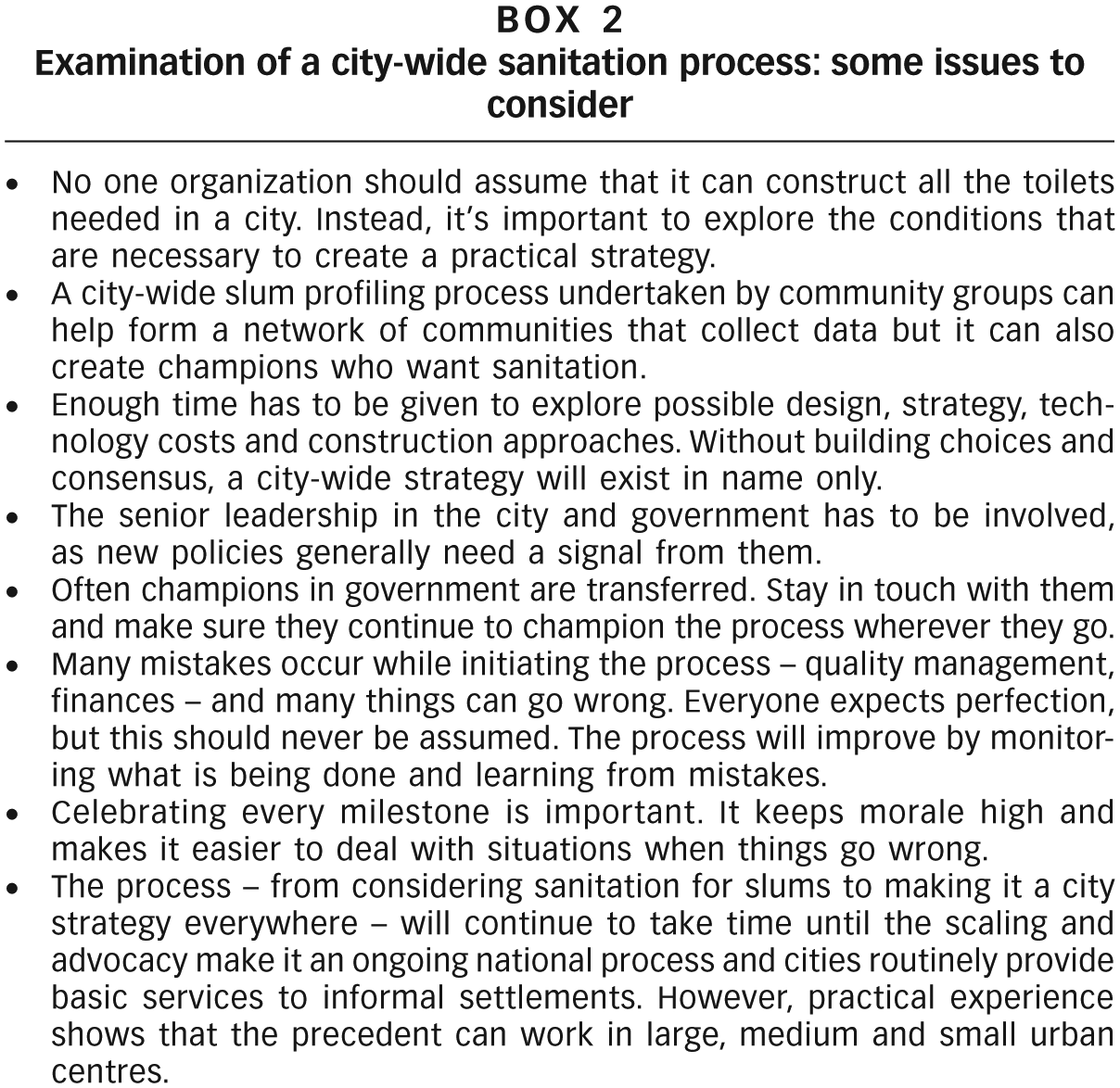
The challenge that remains is the full coverage of all slum locations in the city. What has been constructed to date meets approximately half of the actual need. The process is “city-wide” in the sense that it is institutionalized within the city’s systems, but not yet in the sense that everyone is reached. In many Mumbai slums there is no space for community toilets. If toilets were to be built in those areas, some huts would have to be removed to create space. The challenge in these situations is developing a policy to relocate households that agree to move into tenements located nearby. The Alliance is involved in developing formats for these negotiations and exploring possibilities, but to date this process has not begun. Bringing all the pieces of the process together and executing this strategy will be a crucial precedent in the last phase of creating truly city-wide slum sanitation provision. Box 2 outlines some of the understandings that have evolved over time in thinking about a city-wide process.
a. Work within the wider metropolitan region
In 2007, the work expanded to include the wider Mumbai Metropolitan Region (MMR). This region includes Mumbai as well as 16 other municipalities. Each is a municipal corporation or council, depending on its size, and all are provided with infrastructure and planning support by the Mumbai Metropolitan Regional Development Authority (MMRDA). The commissioner of this wider region initiated a project called Nirmal MMR Abhiyan (Campaign for a Clean MMR), and a strategy was designed to finance community toilets in slums in 13 of these municipalities. Under this scheme, NSDF and Mahila Milan undertook a survey of all 13 cities and towns to establish the number of seats and toilet blocks needed for complete coverage. It also designed a tender to call for other NGOs to undertake construction. In all, 373 toilet blocks were to be constructed with 8,473 seats for 423,650 people.
Often it is assumed that the federations’ work is only for members of their organizations. But in reality, much of their work involves encouraging the city to accept their strategies and ensure that they are available to all, even those who don’t want to be part of their federations. Nonetheless, it can complicate the process when the initial groundwork has not been done with communities and the authorities that represent them. In towns where there were no federations, the Alliance had a hard time dealing with politicians who were more accustomed to doling out construction contracts themselves. In some instances, the contractors they favoured had to be accepted because of the lack of other options. This resulted in abandoned work in some cases, blamed on cost escalations. In a few cases, the quality of construction was so bad that toilet blocks had to be structurally retrofitted at the Alliance’s expense in order to be certified by a structural engineering firm. While some other NGOs abandoned their work because of harassment by the municipal staff and local politicians, NSDF and Mahila Milan stayed on to complete the job. But it was a long, hard task. The toughest issue was cash flow, with municipalities not releasing money on time. This project could not have been completed without the support of funding accessed through the Alliance’s larger international network.(4) The financing of this project was more complicated than the earlier direct interactions with the city. In this instance, the resources were from MMRDA but were routed through each municipality. In almost every municipality, there was some hostility toward the federations for undertaking this project, as no benefits flowed back to the municipal departments. These delays impeded the flow of funds, when in fact MMRDA was ready and willing to reimburse each city.
This effort was the largest on which NSDF had worked with communities that were not part of its own network. The challenges multiplied. Municipalities gave work orders to construct projects on land that often did not belong to them, and MMRDA, the city and the Alliance all got dragged into court cases. In other instances, the work order pushed for fast construction, and halfway through the construction process the required permissions had still not been produced by the municipality. This meant considerable arbitration in order to be compensated for work the Alliance had already done. SPARC had to set up a separate team to search out documentation from each municipality, proving that the payments had not been made. This documentation also showed some of the arbitrary changes made to contracts after they were signed, in order to evade payment obligations. On many occasions, MMRDA senior staff had to facilitate dialogue with the municipalities within its jurisdiction. Now, over 2012–2014, these dues have finally begun to come in. The project went on for four years, and in all 312 toilet blocks were built in the 10 cities and towns, while another 61 in the pipeline could not be completed for various reasons.
IV. Monitoring and Building Capacity for Slum Sanitation With the Mumbai Municipality
Exploring new solutions and designing and constructing toilets has been an ongoing process in the Alliance for over two decades now, with more cities over time financing the capital costs of construction. The current Mumbai contract for toilet construction is now in its fourth phase. Table 1 shows the progress of the contracted work.
Contracted toilet construction between 1999 and 2011
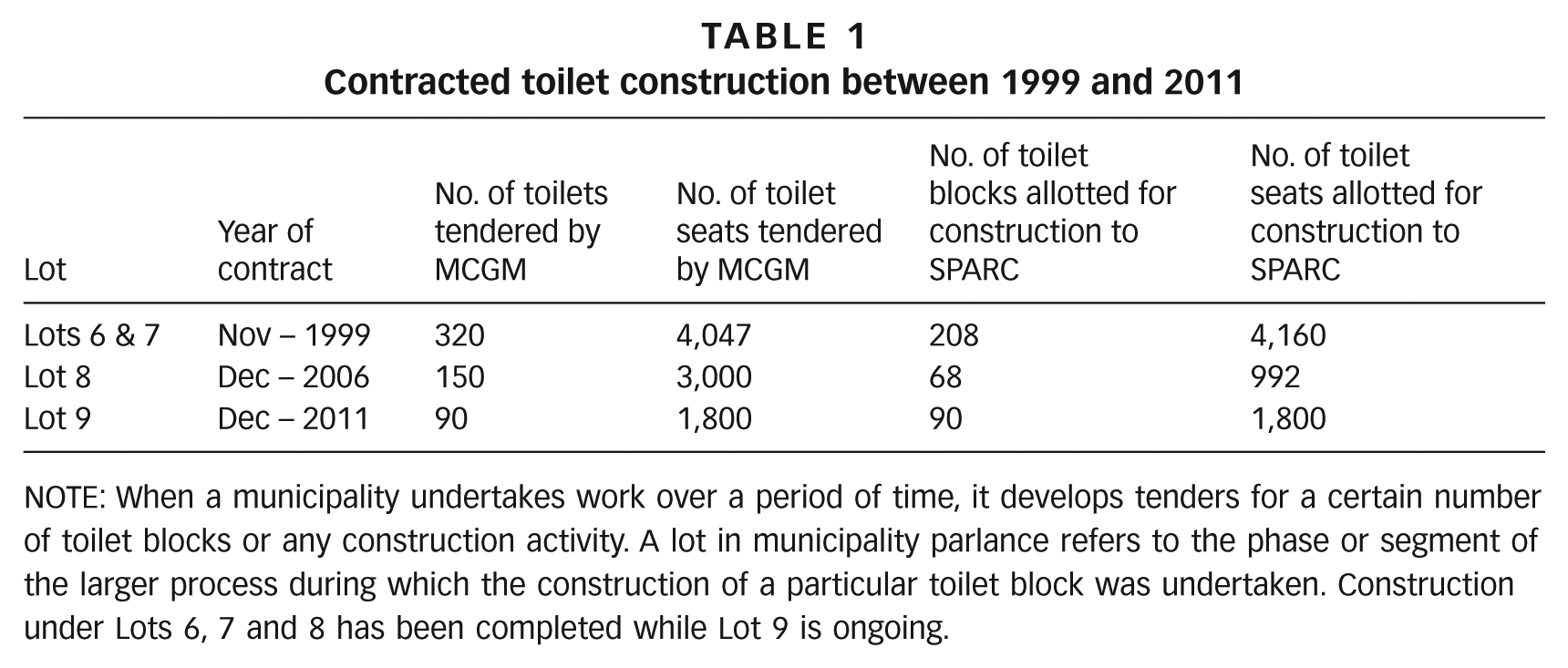
NOTE: When a municipality undertakes work over a period of time, it develops tenders for a certain number of toilet blocks or any construction activity. A lot in municipality parlance refers to the phase or segment of the larger process during which the construction of a particular toilet block was undertaken. Construction under Lots 6, 7 and 8 has been completed while Lot 9 is ongoing.
Although this city-wide scaling up of sanitation in slums through community sanitation facilities has been undertaken in many cities, the process of reviewing what has been done and what can be learnt from it has been followed only in Mumbai. This review process could have been undertaken through a grant from a donor, but that would have limited its institutionalization within the municipality as a learning instrument to support and strengthen the process.
It has generally not been within the purview of most municipalities to undertake formal, institutionalized monitoring of these “assets” that they have created. It takes real institutional commitment and a regular monitoring system to determine what aspect of the toilet blocks’ functioning needs maintenance. There has always been a presumption that the Alliance would “do the needful”. And in fact, NSDF and Mahila Milan have always maintained informal oversight on what happens in these facilities. Their ongoing organizational review and monitoring of what happens once toilets are constructed and communities are managing them have produced a range of refinements and changes in design and the management of construction. For instance, the separate facility for children was an innovation that had to be demonstrated and constructed before the city could accept it in the design. These separate facilities, built to meet a very specific set of needs, were used less and less over a period of time, as caretakers did not like having to clean them constantly. Then, through discussions with city, communities and technical professionals, smaller toilets for girls and boys were built within the main blocks (Photo 3A, Photo 3B and Photo 3C).
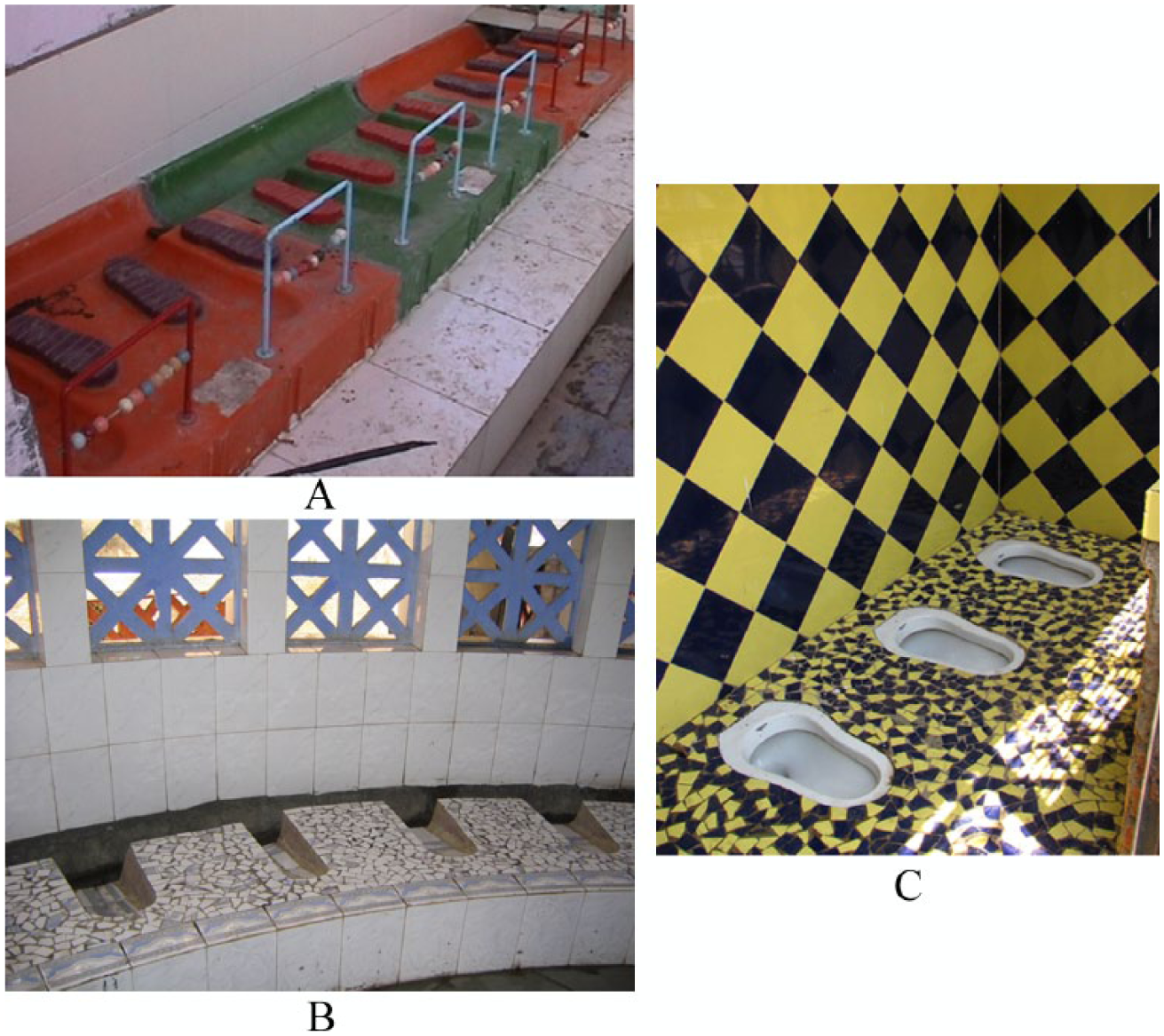
Children’s toilets that evolved over time
However, although there were many good outcomes, the toilets were also the location of a range of contestations that needed resolution. Since the scale of the projects has expanded, however, the Alliance has been overstretched in sustaining this monitoring. Besides, the feedback it provides to the municipality about what needs to be done has never been taken seriously – the city’s officials tend to feel that they have already done their share by paying for the toilets to be built.
Not until 2012 did an enlightened senior administrator in Mumbai, Rajiv Jalota, the Additional Municipal Commissioner for Projects, see the need to create a database of existing sanitation facilities. It was clear to him that, apart from funding and supervising the construction of the slum toilet blocks, the city needed a system to monitor toilets once built, and to liaise with the community co-operatives. This official argued that the monitoring effort needed to be financed by the municipality. The Alliance and other NGOs were invited to bid for the contract to study about 500 existing toilet blocks and to work with the city’s SSP to systematize this new element of their work. The contract was for two years, and the toilet blocks to be surveyed were in 19 of the 26 wards of the city; 10 of these wards were contracted to SPARC and nine to another organization by the name of Pratha. The SSP would work with the contracted NGOs to assist the effort, monitor all constructed toilets and develop a protocol on how to build and strengthen both city and community capacity to manage these assets. The process, just recently begun, is still being crafted through discussions, reviews and explorations jointly by the city, the federations and SPARC. But some systematic data collection, clarity of roles and responsibilities and data management have already indicated the value of this process.
The contract required all the settlements to be visited for a review of concerns linked to communities’ level of organization, their knowledge of the programme, the status of the toilets and their management. Among other things, it addressed the following specific objectives:
The present legitimate office bearer of CBO, their accounts, audit reports, user charges fixed by the CBOs, and monthly passes or fees charged for use. Details of the caretaker and use of various services provided within the toilet block and in the vicinity of the toilet block by the CBO. Information on legal disputes and community conflicts between one or more CBOs. Feedback on user satisfaction, with a complaint redressal mechanism that includes disqualifying the CBOs in the case of misuse of the public utility. Other necessary information based on the needs and requirement of specific facilities.
Over time, many more activities have been added to this list and many more are still being explored. In a sense, the important issue to flag here is that this is not only a contract but also an exploration of designing the process through co-creation, as this has not been done before by the municipality or the Alliance. Having signed a formal contract does not stop either party from exploring additional issues or eliminating what does not work.
The monitoring project was to take place in two phases:
Developing a questionnaire to document what was actually happening in each community toilet block: its physical status, its structural integrity and its management.
Exploring the issues and challenges that require the city and communities to interact so as to address the challenges that emerge.
The Alliance also had in mind a very important third phase – looking beyond sanitation maintenance to see how the engagement between the city and community could be applied to other issues such as solid waste, education, health, locality management and so on. Although this objective is unstated in the contract and has yet to be formally accepted by the municipality, it is also the expectation of the municipal leadership that the process would involve various other municipal departments, and that sanitation was just the start of working with slums.
Government officials tend often to be quite officious when they give contracts to NGOs; they want to make sure they behave like subcontractors, and they push to have everything done quickly. However, in a departure from the frenzy with which they undertook the earlier construction contracts in Mumbai, the Alliance chose to do this monitoring project at a pace that ensured high-quality results that could be confidently acted upon. As the Alliance sought to establish the value of its strategy both with the municipality and with Pratha, it found that if it demonstrated value and logic, and helped train others to explore what it had developed, there would be buy-in.
Initially SSP officials expected that staff “hired” for the programme would be based in their office. By and large, when that actually occurs in any government office, the contracted staff become appendages of the unit and end up doing its clerical work. Instead, the Alliance decided to work from the SPARC office and hold weekly meetings with Pratha and the SSP. These meetings have helped develop a positive alliance among all parties so that when they meet the additional commissioner together, they go with clear documentation of what has been done collectively, a strategy, and plans that require his agreement on policy issues; they also raise issues that require his input. These discussions are very stimulating and have a real impact for SSP staff, who see the signals given by their senior official through the value he places on this process. Increasingly, these partners have begun to link to other projects that the city has commissioned.
At the heart of the monitoring process was the creation and testing of a survey format that would form the basis of monitoring. The initial questionnaire was designed by the SPARC team in discussion with NSDF. Rather than seek consensus immediately, the Alliance wanted to test a survey based on its extensive experience. Many of the questions, in fact, were part of the slum profile survey routinely used by the Alliance and more broadly by Shack/Slum Dwellers International (SDI), the international umbrella organization of urban poor federations of which the Alliance is a member. In this instance, other details specifically related to sanitation were added on. All parameters that related to and affected the quality of maintenance were considered. The Alliance tested this survey, made changes, tested it again, tabulated the results, and shared them with the municipality and the NGO staff from Pratha in brainstorming sessions. Once the additional commissioner and other officials saw its value, it became the standard format. Although the contract did not specify it, SPARC decided to digitally map the toilet blocks and also to digitalize the data. Subsequently, it helped Pratha to also learn to do this.
In the first phase, the SPARC team took up the study of 104 toilet blocks. Teams visited each community block, administered the survey, saw the issues, identified the problems and made commitments to return with solutions or at least strategies for exploring possibilities for a solution. All toilet blocks were located on a Google Earth image and sanitation data were made available on a drop down note for each, which included the details of local committee members. The database that emerged created the architecture for the interventions. Converting the data into simple Excel sheet tables allowed for easy creation of lists by ward and by problems, so they could be prioritized. Next, the team devised indicators for various issues, and ward- and issue-specific lists were produced very quickly. The real “aha” moment was simply the ability to make lists. It was a very powerful experience to be able to cross-link these with the wide range of departments in the municipality that needed to be engaged to address the issues raised.
The information about each toilet was also summarized on one page, and both a digital and a hard copy were given to the SSP as well as to each ward office. Though all ward and municipal officials have computers, they all use hard copies of the report.
The survey was intended to be an instrument that could and would be administered by the community leadership for review among communities. But when the collected data were available, it was also important to contrast and compare the factors not just between toilet blocks, but also between wards and the city as a whole. By undertaking this process with the municipality, the survey data become legitimized as information that the city and community use jointly to manage slum sanitation. When results of each segment of the survey were discussed, the issues raised led either to more inquiry or to action that explored ways to address the challenges. Observations made during the survey also raised issues that were then reflected in additional indicators. The most significant outcome has been that the data have produced discussion and reflection on the relationship between slums and the city, and about expanding this interaction.
Initially it was assumed that most of the problems lay in the internal relationships and modes of functioning of the committees, and that the NGOs involved in each case would solve the problems they were facing. It became clear, however, that this was a problematic assumption. There were, in fact, many issues that individual organizations could not handle. For instance, when septic tanks overflow or burst, communities on their own cannot afford to remedy the situation. Dealing with many issues also involved clear roles and responsibilities for the municipality, the contractors and the NGOs. These aspects were gradually discussed, and finally there was a list of activities and obligations that the municipality had to agree to, which were also to be monitored. It was also important to acknowledge the capacity of municipal politics to complicate situations. There were two politicians, for example, who constantly pitted one set of community leaders against the other in order to promote their own agendas, making the CBOs dysfunctional. This list of the responsibilities of the city in monitoring and maintenance keeps gradually growing.
Central to the success of this whole process was the creation of a relationship between ward administrations and the community organizations. Slum dwellers rarely meet their ward officials, so the first step was to invite all the committees managing toilets to meetings in the ward offices. This helped committee members to understand how the ward functioned and to meet the people in charge of water, waste management and so on. The first real surprise was when ward officers claimed that they had nothing to do with the toilets constructed under the slum sanitation project, since these were to be managed and maintained by the communities themselves. It was clear that communication flows had to improve; senior leadership in the municipality needed to intervene both to clarify roles and responsibilities and to explore policy matters on issues that the survey had revealed. The most urgent issues initially discussed were the water and electricity charges. Individual community committees or ward officials could not have handled this on their own. Clearly, this was an issue calling for intervention from senior officials, with documentation sent to the regulators of electricity and water to change the tariff.
For the engineers and staff in the sanitation division, these processes are often alien. Often the reaction is, “Oh God. One more additional responsibility!” However, when lists emerge, solutions are devised, and the community’s response and reaction make things work, the cycle of negativity transforms into positive relationships. The issues to be raised and things to be studied and explored will continue. But even in the early stages of this collaboration, much has been learned.
V. Conclusions
a. The city-wide slum sanitation process needs to be seen in a new light
Constructing and then commissioning a community toilet block has a sense of finality about it. So does completing a contract with a city for a certain number of toilet blocks. The job is done. This is at odds with the realities of the task, however. There are so many non-construction issues that make this in effect an ongoing process. They ultimately determine whether the sanitation facility is just an end in itself, or the means to an end, driving the capacity of a community for engagement. Sanitation is distinctive in this regard. No other activity within slums is so necessary for itself, while also being a means for linking the city and slum communities to each other.
City-wide coverage of slum sanitation has somehow been predicated on completing the construction of a certain number of toilet blocks or getting everyone access to a toilet. It is assumed that this can be done in an urgent “mission” mode and that “completion” is an imminent possibility. In reality, this commitment in almost all cases is a multi-decade commitment to sustaining and improving sanitation conditions in slums. Inevitably it includes not only their construction and then their maintenance, but also better access to water and energy, and through these an engagement with improved health and hygiene.
b. The ongoing engagement with informal settlements can produce other important outcomes
City-wide coverage of all slums for universal sanitation is an important milestone in itself, but it also reflects the active engagement of the city with its informal citizens. This is important for the residents of the slum but also essential to the city. The challenge in this process is how to push that engagement to explore other aspects of this relationship, ensuring that every child receives an education and does not drop out, as well as ensuring that everyone gets immunized and that preventive and promotional health practices are communicated to residents. Insight and knowledge are essential to the choices that individuals, households and neighbourhoods make, and these choices impact the whole city.
The most valuable outcome of a good sanitation project is the relationship that links communities and their leadership to the city and to other communities. Cities need an ongoing deepening engagement with their more vulnerable population. No administration can reach every household, so organized settlements with their leadership structure, familiar and comfortable with rituals of engagement and action, are invaluable to the city. These values develop during the process of dealing with sanitation, and then become very useful in addressing issues of safety, managing disasters, and undertaking all the other development challenges the city and its citizens have to address.
c. Converting a precedent into a national or even a state policy remains a challenge in practice
Sanitation is an increasingly important subject in development. India’s newly elected prime minister champions the cause. But the reality is that, although many cities may have started this process, it has not moved to the next level. Strong leadership, ongoing and sustained, is critical to maintain the process. In most instances, the Alliance has been able to initiate an interest within cities, but cities tend not to retain their commitment to the process once leaders and administrations move on. When a cause has no champions, it dies. Most initiatives start with many challenges; achieving perfection remains the biggest challenge and this is even more the case when informal settlements are the arena within which solutions are explored. Unless improvements are continually explored, people stop learning from what goes wrong, and the project loses energy and can rarely be resuscitated.
d. Facilitation of action on sanitation is a major challenge
The even greater problem in sanitation is that there are very few off-the-shelf solutions and even fewer catalysts or facilitators. In the case of the Alliance, an unusual history pushed the process and communities championed it. But beyond the first phase, this could not be sustained without a partnership with the larger city. Our challenge remains embedding this process within institutional systems. It is not that difficult to demonstrate deficits and explore alternative solutions. Turning them into a real programme for action is the challenge.
Construction businesses can build toilets (although most don’t like to build toilets in slums) and can fulfil a contract, but the real challenge here is to organize communities that will partner with the city to manage and maintain what has been built. We have a long way to go in India, as well as internationally, to keep exploring this process together.
e. Sanitation is a challenge to organizations and networks of cities, to social movements and to development interveners at national and international levels
Increasingly cities are seeking to be technology “smart”, a way to attract national and global investments. But somehow the smart city criteria don’t address such fundamentals such as universal sanitation, education and livelihood training for all, and health and peace in the city. These are the rudiments of a good, safe, liveable city. This calls for ongoing commitment from such bodies as Shack/Slum Dwellers International and United Cities and Local Governments (UCLG), the international association of mayors.
Footnotes
Acknowledgements
1.
Burra, Sundar, Sheela Patel and Thomas Kerr (2003), “Community-designed, built and managed toilet blocks in Indian cities”, Environment and Urbanization Vol 15, No 2, pages 11–32.
2.
The term “slum” usually has derogatory connotations and can suggest that a settlement needs replacement or can legitimate the eviction of its residents. However, it is a difficult term to avoid for at least three reasons. First, some networks of neighbourhood organizations choose to identify themselves with a positive use of the term, partly to neutralize these negative connotations; one of the most successful is the National Slum Dwellers Federation in India. Second, the only global estimates for housing deficiencies, collected by the United Nations, are for what they term “slums”. And third, in some nations, there are advantages for residents of informal settlements if their settlement is recognized officially as a “slum”; indeed, the residents may lobby to get their settlement classified as a “notified slum”. Where the term is used in this journal, it refers to settlements characterized by at least some of the following features: a lack of formal recognition on the part of local government of the settlement and its residents; the absence of secure tenure for residents; inadequacies in provision for infrastructure and services; overcrowded and sub-standard dwellings; and location on land less than suitable for occupation. For a discussion of more precise ways to classify the range of housing sub-markets through which those with limited incomes buy, rent or build accommodation, see Environment and Urbanization Vol 1, No 2 (1989), available at  .
.
3.
See reference 1.
4.
The sanitation projects required an advance of almost 35–45 per cent. Since the Alliance has no capital assets to mortgage against these bank guarantees, Homeless International, a UK-based charity now called Reall (or Real Equity for All), set up the Community Led Infrastructure Financing Facility (CLIFF) to support initiatives like this sanitation activity, in order to demonstrate how communities could design and execute major scalable projects if the finance were available. See http://reall.xyz and for more details.