




Abstract
While considerable existing literature has focused on the lack of sanitation services in informal settlements, this paper argues for the need for well-maintained sanitation services in city public spaces. Specifically, the paper describes the impact of a lack of sanitation facilities in public spaces and its linkages to waste picker women’s sense of safety and security. Drawing on the experiences of waste picker women residing in an informal settlement in Pune, it focuses on women’s everyday improvisations and negotiations to cope with the unavailability or inaccessibility of sanitation facilities while they traverse the city, picking and segregating waste, and the impact on their income, health and psychological well-being. The findings show that the policy discourse on sanitation needs to be expanded beyond a focus on informal settlements to include a public sanitation component.
I. Introduction
While the Indian government is undertaking numerous aspirational programmes, such as the Smart City Mission and Swachh Bharat,(1) vast marginalized populations continue to face major problems, including slum(2) evictions, unaffordable housing and the diminishing public commons. Policymaking is unduly led by middle-class aesthetics and conceptions of cleanliness, which often clash with the rights of the poor.(3) India faces tremendous challenges in ensuring adequate housing and urban infrastructure (especially water and sanitation) for its urban inhabitants.(4) Surviving in a city depends on tapping into the circuits of minimal available resources (food, water, sanitation, electricity), and poor women suffer particular marginalization in terms of access to these resources, often on account of deep-rooted patriarchy. Inadequate sanitation facilities in informal settlements are one of the key drivers of violence against women and lead to several kinds of deprivation that perpetuate gender disempowerment.(5) A growing body of literature also points to the difficulties low-income women face around the unavailability or inaccessibility of sanitation services at their workplaces.(6) This paper, which draws on qualitative research conducted with waste picker women in Pune, describes the negotiations and improvisations these women make in order to cope with the effects of unavailable, inadequate or inaccessible sanitation facilities as they traverse the city for work.
The Indian discourse on sanitation has long focused on open defecation and the need to build adequate toilets in urban informal settlements, whether individual or shared. Public toilets tend to be either dysfunctional or wholly absent in these settlements, but also in the public spaces of the city, which this paper focuses on. The policy discourse on sanitation needs to be enhanced by focusing also on sanitation in public space, rather than assuming that the poor are present only in informal settlements. For waste picker women, public spaces – including markets, transport hubs, large streets, parks, plazas and shopping areas – are workplaces where the absence of sanitation services is a longstanding concern. These women also work in affluent middle/upper-class residential spaces, which are entirely overlooked in discussions of safe, inclusive public space. This paper argues that these affluent residential spaces are also “public spaces” and that a lack of amenities in these areas has adverse implications for those who provide services here. The paper highlights a paradox, whereby women who provide sanitation services to the city have no access to sanitation facilities for themselves.
Given the shrinking public commons and the lack of public amenities accessible to the poor, it is necessary to study low-income women and their sanitation needs.(7) While middle-/upper-class women have options for accessing toilets in restaurants, cinemas and malls, there is an unspoken barrier for low-income women. There is substantial scholarship on this issue in the US, which observes that urban public space has historically been coded as masculine while private space has been coded as appropriate for women.(8) In similar ways in other settings, sanitation, especially for women, is viewed as a private act that cannot or should not occur in public. Hence, we see huge disparities between the numbers of male urinals and public toilets for females. For example, a notice at the Bandra suburban railway station in Mumbai, India reads: “Men’s toilets to be 2, women’s to be 2 and men’s urinals to be 24.”(9) Thus, women’s sanitation needs remain an important component in ensuring equity.
This paper aims to contribute to the existing literature on the topic by reporting on the findings of a study in Pune, India, exploring the sanitation conditions faced by waste picker women in the course of their work lives.
II. Background
UN-Habitat’s 2008 report on women’s safety pointed out that the world’s population growth over the next 30 years will be concentrated in urban areas.(10) In the global South, where most urbanization will occur,(11) urban violence is increasing and its effects will be borne disproportionately by the poor, who have little social protection or economic means to cope.(12) Scholars have noted that the poor experience both active and passive violence, underpinned by the uneven distribution of state resources, inequitable urban planning and governance, and unequal infrastructure development.(13) In this context, public sanitation is a crucial infrastructural inadequacy for the urban poor in India.(14) This section examines sanitation in India and its effects on women, especially those belonging to the lower socioeconomic strata of society.
a. Sanitation and the city
Sanitation has played a crucial role in the imagination of the modern city. During the 19th and early 20th centuries, unsanitary conditions were associated with poverty, crime and immorality in American and European cities. Subsequently, these conditions gave way to the imposition of sanitary reforms in the daily lives of the poor and working classes.(15) In the case of colonies as well, unsanitary conditions and disease were associated with spaces of the “native”,(16) and clean and sanitary European space was seen as separate from the unclean spaces of the colonized, leading to official interventions involving demolition, policing and coercion.(17) Sanitized, spacious residential quarters were built for Europeans and Indian elites, while “native” areas remained devoid of sanitary improvements, giving rise to fragmented and polarized cities.(18) Indian elites, even when involved in local governance, failed to prioritize the city-wide provisioning of public sanitation.(19) Post-independence modernist projects further fragmented the cities, and sanitation divides became more entrenched.(20)
According to the 2011 census, 13 per cent of households (10 million) in India resort to open defecation. In addition, another 3 per cent or 1.8 million households access unimproved sanitation (unimproved pit latrines with removal of night soil by humans, animals or direct flow into drainage).(21) The World Bank estimates that inadequate sanitation has an economic impact of INR 2.44 trillion (US$ 54 billion) annually, equivalent to 6.4 per cent of India’s GDP in 2006.(22) A recent mandate of the Pune Municipal Corporation requires various wards in the city to achieve freedom from open defecation by March 2017.(23) Adequate sanitation services in informal settlements and city public spaces remain an unachieved objective in Indian cities.
b. Sanitation, cities and women
According to a recent report by WaterAid, 2.5 billion people around the world lack access to a toilet, and this disproportionately affects women.(24) Inadequate sanitation is one of the major challenges faced in overcoming gender inequality. The lack of access to safe and hygienic sanitation facilities has led to discomfort and insecurity among women across the world. Women who have no access to sanitation facilities are compelled to wait until dark to defecate and urinate in the open, leading to such health problems as urinary tract infection.(25) Additionally, while accessing sanitation facilities or in the process of finding alternatives, they often face the risk of gender-based violence, which in turn impacts their access. Women face sexual violence (rape, assault, molestation, and inappropriate touching); psychological violence (harassment, bullying, or other actions that may cause fear, stress or shame); physical violence (beating or fighting leading to injury or death); and socio-cultural violence (social ostracism, discrimination, or social norms that have negative impacts).(26) Research carried out in New Delhi points to women’s fear, anger, disgust and anxiety while accessing public toilets or going for open defecation. Often, the routes through which women accessed toilets were poorly lit, adding to their fear and insecurity.(27) In the case of inadequate sanitation facilities at workplaces, low-income women face shame and fear related to urination and defecation in open areas. They have to hold back the urge to relieve themselves or walk for long distances during work hours to use a toilet or find alternatives.(28) Water and sanitation-related barriers can lead to loss of pay as a result of missing work.(29) A study on seasonal migrant women workers in India points out that women also perceived the lack of privacy as a significant source of psychosocial stress.(30)
While the waste picker women described in this paper are affected by inadequate sanitation services in the informal settlement where they reside, they also experience problems in the public spaces where they work, including markets, streets, shopping areas and affluent residential spaces (gated communities along public roads).
This paper briefly describes the condition of sanitation infrastructure in Patil Estate, where the waste picker women live. It goes on to elaborate on how they are affected by inaccessible or unavailable sanitation facilities in city public spaces.
III. The Study
a. Location and socioeconomic profile of Patil Estate
Patil Estate is an informal settlement in a bustling area of Wakdewadi, Shivajinagar in Pune. It falls under the Ghole Road ward of the Pune Municipal Corporation (PMC). The slum is adjacent to the old Mumbai–Pune expressway and consists of structures on 10 connected parallel lanes. Two more lanes of houses have started to take form towards the back of the settlement, which is adjacent to the Mula River. According to a 2007 survey by Shelter Associates, the population of the slum was then approximately 6,093. The ward in charge reports that this has now increased to approximately 30,000.(31) People belonging to both Hindu and Muslim communities reside here, having migrated from less developed districts of Maharashtra such as Usmanabad, Latur, Akluj and Solapur. The female residents work mainly as waste pickers, collecting waste from public spaces, apartments and hotels, and assisting the PMC Ghanta Gaadi (waste pickup truck) in collecting and sorting waste. Most of the women are associated with Kagad Kaach Patraa Kashtakari Panchayat (KKPKP), a non-profit organization.(32)
b. The respondents
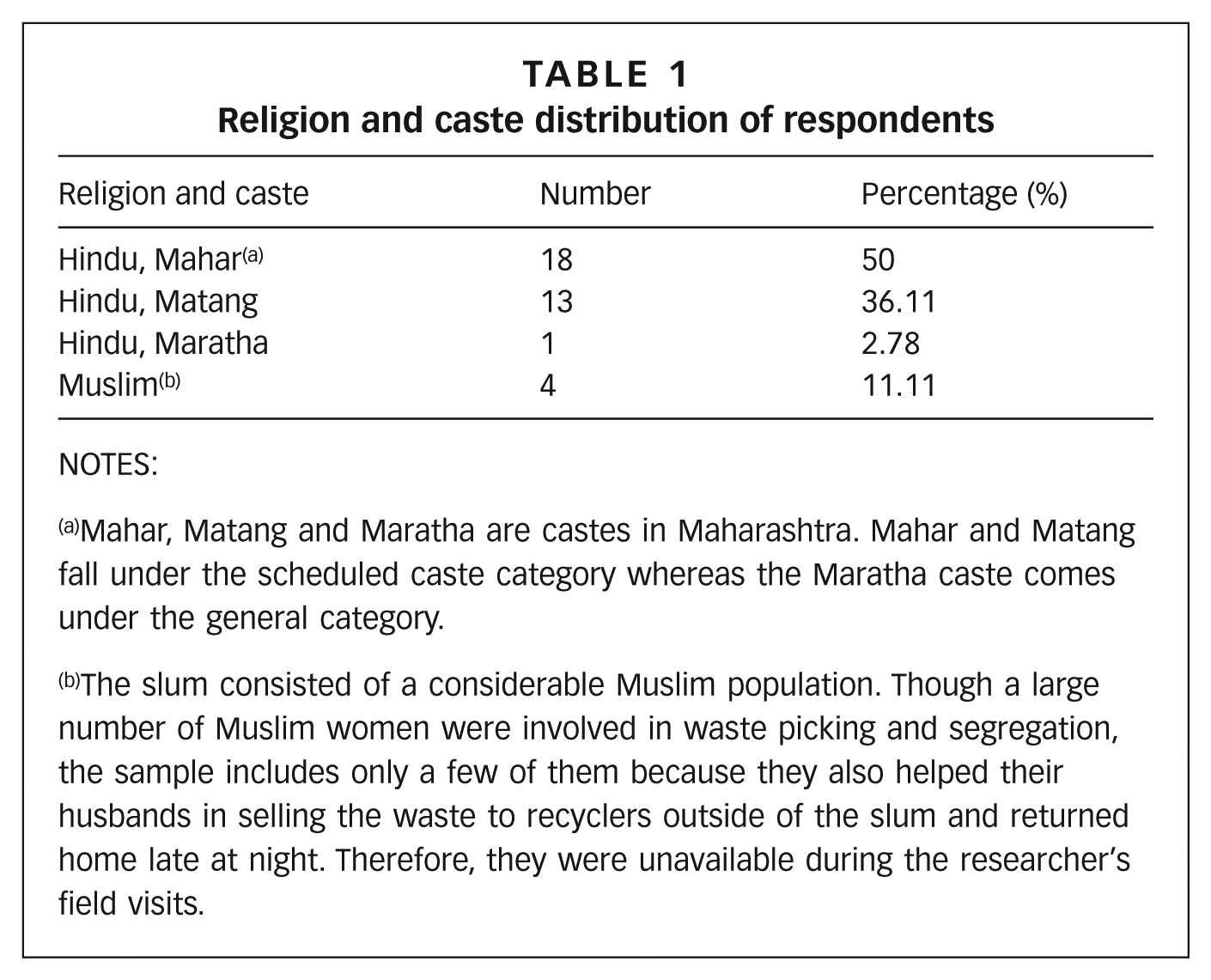
Demographic details about the waste picker women from Patil Estate who participated in focus group discussions (FGDs) and semi-structured interviews are presented in Figure 1 and Table 1. These show their age distribution, caste, religion and years in service.
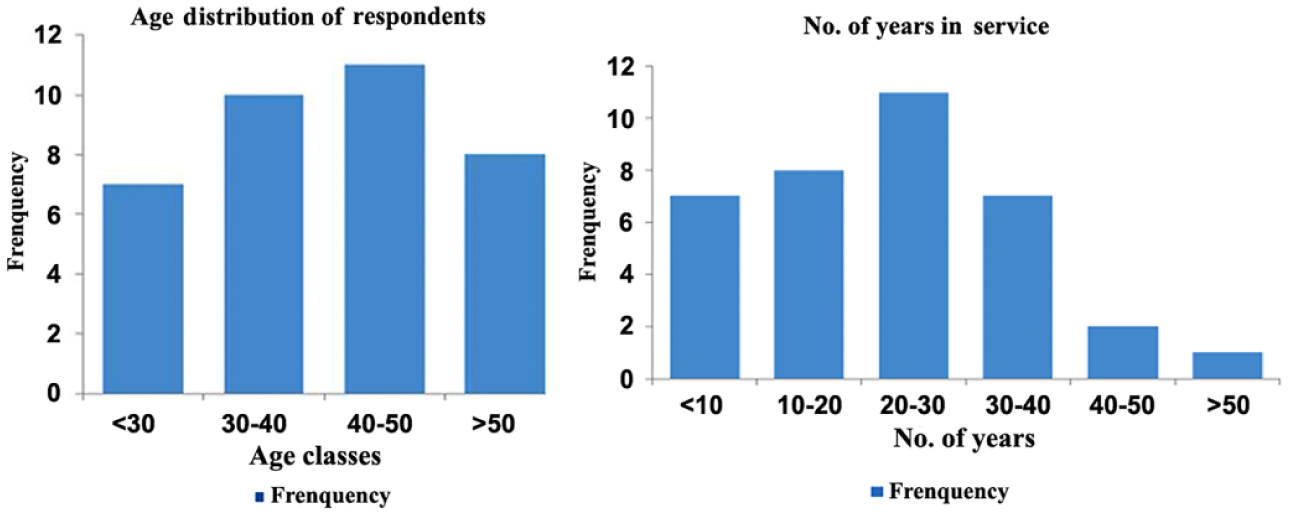
Respondents’ age distribution and number of years in service
Religion and caste distribution of respondents
NOTES:
Mahar, Matang and Maratha are castes in Maharashtra. Mahar and Matang fall under the scheduled caste category whereas the Maratha caste comes under the general category.
The slum consisted of a considerable Muslim population. Though a large number of Muslim women were involved in waste picking and segregation, the sample includes only a few of them because they also helped their husbands in selling the waste to recyclers outside of the slum and returned home late at night. Therefore, they were unavailable during the researcher’s field visits.
c. The methods
This paper draws on the author’s master’s thesis research in Patil Estate. Qualitative tools, including participant observation, FGDs and semi-structured interviews, contributed to an understanding of the negotiations and improvisations these women make in their daily lives and the coping mechanisms they employ. Five FGDs were conducted with 31 women. Semi-structured interviews were conducted with another five women, different from those who participated in the FGDs. Participants were selected using a snowball sampling method whereby the author sought referrals from respondents, to recruit new participants.
Focus group discussions
Focus group discussions, following a basic discussion guide, were audio-recorded with the consent of the respondents, and detailed written notes were also taken over the course of the discussions. These discussions took place in any house where it was convenient for all the participants to assemble. Typically, six to seven women formed one FGD, which took between an hour and an hour and a half to complete. Women were asked to describe their experiences in accessing toilets or alternatives while picking waste in their respective areas. They described the difficulties they faced due to the unavailability of toilets at their workplaces, and explained how they negotiated these difficulties. The discussions revealed the complexity of the issue – each individual had her own narrative and her own way of negotiating the difficulties.
Semi-structured interviews
The interviews, typically lasting up to two hours, were conducted in women’s houses or outside while they segregated waste. The purpose of these interviews was to get a close view into the daily schedules these women followed for work. This allowed for a fuller understanding of how their daily schedules and health were affected by the unavailability of toilets, and the strategies they had to employ to protect their incomes and livelihoods and continue running their daily lives smoothly.
Participant observation
During my field visits, which typically lasted for four to five hours at a time over a three-month period, I would often sit in the homes of the respondents and converse with them as they went about their daily duties. I also accompanied women to their work, as they walked and picked waste beginning at 4:00 in the morning. This activity provided insight into aspects of their lives that were not discussed or were just mentioned in passing during the FGDs and interviews – for instance, the ways they dealt with danger from stray dogs, avoided going to certain areas, or adopted bold language around strangers. While some held back in responding to the need to eliminate waste, others took turns hiding each other from view with their own bodies or pieces of cloth while they urinated. Participant observation thus provided an understanding of concerns that women sometimes had trouble mentioning aloud.
Interviews with administrative officials
Interviews with officials were more impromptu. When a municipal officer agreed to give me required data, such as the number of public toilets in the city or slum sanitation plans, I would, in the course of conversation, ask if they would agree to an interview. The purpose of these interviews was to explore how they understood their position within the state mechanism, what importance they gave the issue of sanitation, and their views regarding the current state of sanitation infrastructure in the city. I interviewed zonal medical officers from Pune Municipal Corporation and a health inspector responsible for the Ghole Road ward, where Patil Estate is located.
d. Strengths and limitations
This study, as noted, adds to a limited but growing body of literature on sanitation needs in the workplaces of low-income women, pointing to the need for planners and policymakers to consider the needs of poor women in exclusionary “public” spaces. The study also links this concern with an assessment of sanitation services in their home settlement, Patil Estate, thus shedding light on the struggle of low-income women in accessing safe, hygienic facilities. However, the paper has its limitations, as it draws from the views of the respondents residing in only one slum and employed in only one livelihood. In order to look more comprehensively at sanitation in public spaces, other women apart from waste pickers, such as hawkers, domestic helpers and vegetable sellers, should also be the focus of research. In addition, this study may be limited by the interlocutor’s bias in the framing of the questions asked. However, an effort was made to listen to the women over an extended period and to represent their voices as fully as possible.
IV. Research Findings
a. Sanitation services in Patil Estate
Households in Patil Estate do not have individual toilets. There are three public toilets and one “pay and use” toilet, with seven or eight seats in each. The “pay and use” toilet charges INR 2 (approximately US$ 0.03) for access. The public toilet is poorly maintained by the PMC. Women complained that all the toilets were extremely dirty and clogged with waste that did not drain properly. They also complained that sanitary napkins were not properly disposed of by the younger generation, which added to the smell. The settlement is located on low-lying land beside the river, and the toilets were flooded with dirty water during the monsoon season. Poor as the toilet conditions were, they were still overcrowded, and long queues in the morning meant that women often had to leave for work without relieving themselves. As Surekha tai,(33) a 24-year-old woman, stated in an FGD: “Morning queues disrupt the routine of the whole day. The other day, all the toilet seats were clogged with only one functioning. There was a long queue. I had to cook, clean, get my children ready for school and then leave for work. When I saw the queue, I just decided to skip using the toilet and leave for work. I came home later in the evening and relieved myself. Since then I’ve been having a weird pain in my abdomen, but don’t have the time to go to the doctor.”
Women reported that inadequate sanitation services in the settlement affected their health and daily routine, but they had to continue to work as their incomes were meagre.
b. Women’s livelihoods
Some of these women collect waste from streets and stadiums, markets, transport hubs, parks, plazas and shopping areas, earning INR 100–200 (approximately US$ 1.5–3) for a workday of approximately 9 to 10 hours. This waste includes plastic articles (bottles, wrappers, household utilities) disposed of on footpaths or in public dustbins. Most commonly women leave the house early in the morning, around 4 am, while it is dark and before the streets get busy. Their fear of road accidents and the stigma associated with their livelihoods leads these women to leave early. This also makes it possible to collect the best possible waste, which can be sold for a higher price.
Other women from Patil Estate work in middle-/upper-class residential areas collecting waste from every house and assisting the Pune Municipal Corporation in the sorting of waste. They are contractual workers with the PMC and are paid INR 2,000/month (approximately US$ 30/month). House owners also give them INR 20–30 (approximately US$ 0.50 or less) per month for their services. Many of these women leave in the morning at 7 am and come back by 6 pm. On the way to and from their assigned residential workplaces, these women also collect waste from streets, markets, transport hubs, parks and plazas to help meet their daily expenses and transport costs. Work sites are shown on Map 1.
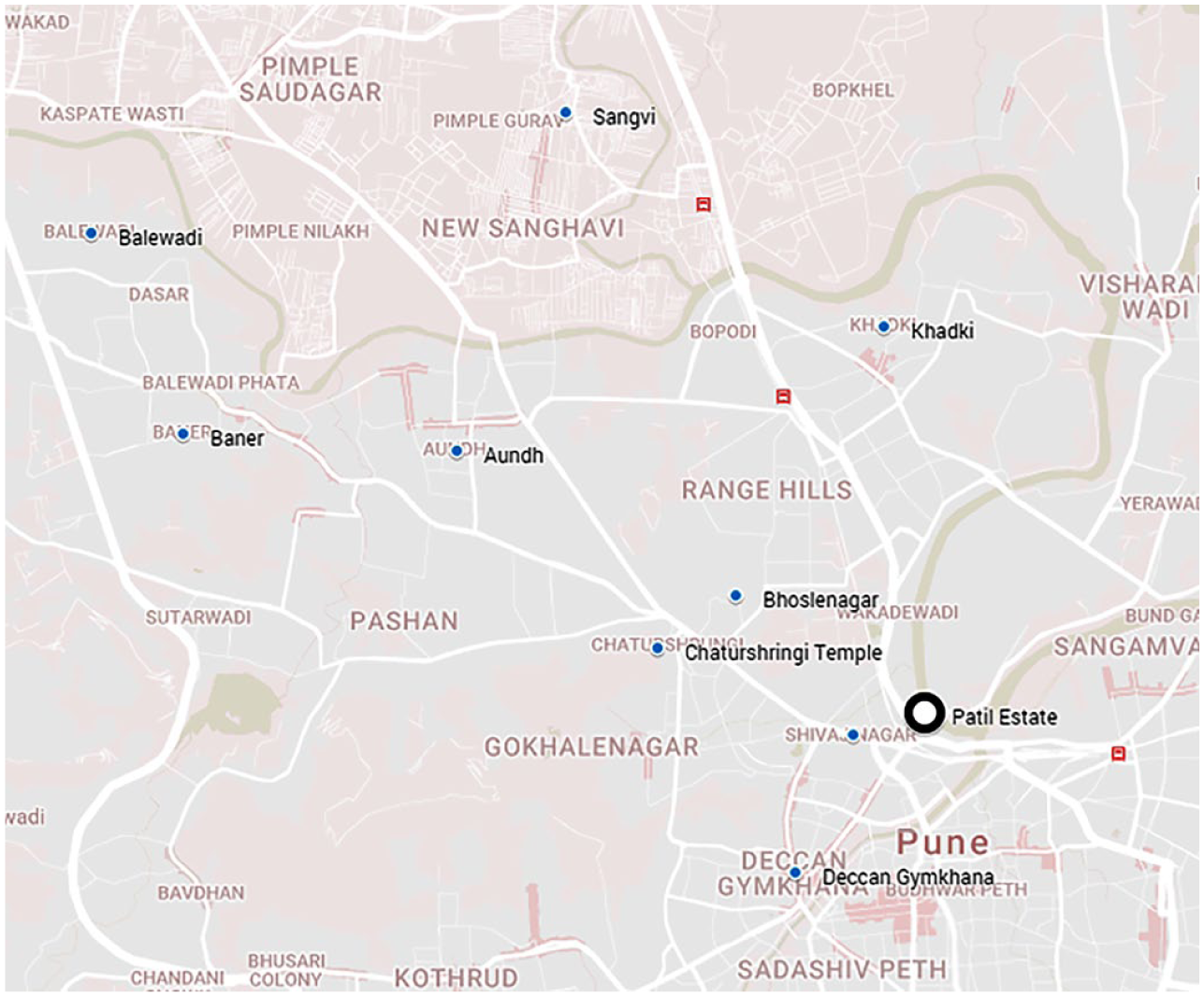
Work sites of respondent waste picker women around Pune
c. Sanitation-related problems in public work spaces
These women worked for long hours, whether in roads, lanes, parks and stadiums or in affluent residential spaces, and they had little or no access to toilets while they picked and segregated waste. Women working in the city’s public spaces often relieved themselves behind a tree or a dustbin due to the unavailability of public toilets or their lack of access to these toilets when they were available.
Although one might think that working in these residential areas would be more convenient, waste picker women faced sanitation problems even there. Some had access to toilets in common areas (parking area, garden or community hall) of the apartment buildings where they worked. But often, they were told to clean the toilet in exchange for using it. These toilets often lacked door latches, and some lacked adequate water. Some were extremely unhygienic and were in no condition to be used. Munni, who worked with her husband in the Balewadi area, stated: “I thank Allah that my husband works with me. There is a common toilet for men and women in the hotel that we work in. The latch of the door is broken. Whenever I go I take my husband with me and he holds the door for me.”
Other women reported that they had no access to toilets, and thus had no choice but to relieve themselves in the open, an act that was associated with fear and shame for most. As Archana mavshi(34) stated: “We are the ones who clean their garbage. But they don’t let us use their toilets. We fought with the society chairman and then the people agreed to let us use the parking toilets(35) but only if we clean it by turns.”
Menstruation
During menstruation, women often were unable to change their menstrual cloths for more than eight hours, leading to leaking and discomfort. Aarti tai, a 22-year-old married woman who had started waste picking four years earlier, said: “I feel very shy. I just can’t squat outside. During menstruation, I take a pad in the morning and keep it on till I come home from work. After I come home, only then do I take a clean bath and change it.”
While many women reported keeping pads on for long hours, until they were no longer able to absorb anything, others just removed the cloth and threw it in the dustbin while working and didn’t wear another, as they had no secure place to manage this.
Getting older
Some women confessed that because of their old age, they couldn’t hold back and hence urinated/defecated in the open with help from their peers. A group of women in an FGD, who had worked as waste pickers for 20 years in the Chatushringi area, stated: “It is not possible for us to hold back when we need to go. We are old now. We accompany each other behind a tree or a bush and relieve ourselves. We get scared of dogs or men watching us, but we stand along with each other to complete the act.”
A 52-year-old woman, Zahira, stated in an interview: “I had a bad stomach and started suffering from loose motions while I was waste picking. I was inside the public dustbin to collect waste, when I started getting cramps in my stomach, and I couldn’t help but defecate in the dustbin.”
Zahira, being older, was perhaps unable to control the urge to defecate in the dustbin. However, most younger women refused to risk their dignity by relieving themselves in this way.
Fear of sexual harassment and molestation
Younger women, especially, talked about their reluctance to urinate in the open, fearing sexual harassment, molestation and shaming. Archana, a newly married woman, said: “I don’t go to the military area near Sangvi. Those men stare at us. I just cannot convince myself to squat in the open. I hold back and suffer from tremendous white discharge, but have to carry on. Sometimes, when I come back to the slum to sell the waste, I feel as if I have to leave everything and run to the toilet. But the toilets here are also very unclean.”
Even older women found this a problem. Ganita mavshi, an interviewee who had been a waste picker for 40 years, stated: “In earlier times we never faced any sexual harassment, it is more recently that men misbehave. Earlier, we used to fear the police, because they accused us of theft. They used to make us show our waste bags and unnecessarily interrogate us. Since we are a part of KKPKP, we have some protection. But who will protect us from sexual harassment?”
While most women had not personally experienced molestation, some spoke in their interviews about their own rare incidents of sexual assault or accounts of it happening to other women. The increased insecurity led to them making several adaptations to their lives and to their navigation through the city.
Fear of dogs
Many women reported that they feared dog bites, especially during menstruation. Some women reported multiple dog bites that had meant visits to doctors and the loss of a day’s income. Women felt unsafe, insecure, anxious, and constantly preoccupied with seeking opportunities to relieve themselves.
d. Strategies for coping and their impact
The most common compromises that women made were to eat and drink less, and to hold back nature’s call for many hours, waiting until they were at home to relieve themselves, and thus avoiding negotiations with the home owners where they worked. Indu mavshi, who was a part of an FGD, said: “I leave in the morning at 6 am to go to Sangvi. By the time I reach the society [the term for middle-class gated communities] it is 8 am. Before leaving home, I have tea and some food and then go to the toilet just before I leave. I avoid drinking water during work so that I don’t have to use a toilet. It feels shameful when people don’t allow us to access their toilet. It is better to not talk to such people. Just do work and come back. While walking to the bus stop, all of us women sit behind a bush and relieve ourselves.”
Young women who had just started work went to various middle-class residential areas and collected waste from people’s houses, sorted it and gave it to the municipal corporation vehicle. Some accompanied the vehicle to the garbage dump, sorted waste, kept some waste that would earn good money, and then came back. During this time, the women either attended nature’s call behind bigger garbage dumps or held back.
Strategies for coping with fear often varied by age. While older women were bold in their conduct, young women were careful not to talk to anyone. 45-year-old Dhrupada mavshi and 28-year-old Priya tai – both part of an FGD – showed how their responses to fear were different. While Dhrupada mavshi preferred to combat men and dogs with a stick and abusive language, Priya tai preferred to not access the areas frequented by such elements. And while Priya tai preferred to hold back and relieve herself at home, the older woman fought back, as she could not afford to hold back nature’s call. Describing a specific incident, Dhrupada mavshi laughingly narrated: “It was when I was collecting waste at a dustbin, a man came and stood there. I just looked at him and continued to work. He stood there and urinated without any shame. At first, I got scared but then I shouted at him. Men can urinate anywhere, but that is also the reason for our insecurity.”
The various coping mechanisms employed by women – whether compromising on the intake of food and water, carrying sticks to shoo away dogs, using abusive language to avoid sexual harassment, avoiding access to certain places, and holding back nature’s call for long periods – all have an impact and come with a price, whether physical, psychological or economic.
Many women reported that they suffered from headaches, stomach upsets and body aches. Women described experiencing a white discharge and feeling extremely weak at times, both of which they related to irregular eating. Urinary tract infections and abdominal pains were also common and were related to holding back when they needed to urinate. Jyoti mavshi, during an interview, shared her experience: “One day I just could not control the urge and I urinated near a heap of garbage. From that day onwards I noticed that I had an uneasy feeling and I could not urinate properly. The doctor confirmed that there was an infection.”
Treatment of these various health issues depleted their income, which had an impact on their households. One woman stated: “Going to a doctor is what I avoid. First of all, I have to spend a lot of money on transport, pay the doctor, buy medicines and have to stop work for a day. Taking a day off from work eats into the money I need to fulfil everyday necessities of my household.”
All these problems affected women’s psychological well-being, leading to depression and anger. Towards the end of an FGD, a woman stated: “I feel really very angry. Constant health issues make me feel depressed. And no one around understands. Whom will I even talk to? You go to the toilets here, even they are unclean. No one in the house understands what I am going through. The only purpose of all this is for my children to be educated. I am ready to face anything for this.”
Women viewed their children’s access to education as a step towards upward social mobility, which would consequently change their situation. For them income was a pathway to achieving a better life for their children, for which they willingly made sacrifices.
V. Understanding The Research Findings
After multiple conversations with women, many additional issues surfaced. Women’s lives were governed by the space they lived in, their daily struggle for resources and livelihoods, the ways they managed with the bare minimum of resources and the meanings they associated with their work. In this context, to study sanitation and its linkages to their sense of safety and security meant looking at everything in their lives. For instance, the lack of adequate sanitation might cause them to be late for work, thus affecting their income. This shaped women’s inclination to hold back when they needed to eliminate in order to prevent their income from being affected. In the race to manage several other inadequacies, women had no option but to ignore problems related to sanitation. On the first day of my fieldwork, a woman in Patil Estate said: “Toilets? Why would I think I could get to access a toilet while I pick waste? It is natural that there is no access. My main concern is to earn INR 100–150/day. Many times I am not even able to earn half of it. That is the day when the house turns upside down. I have to sleep with my stomach half full.”
Despite its impact on every aspect of their lives, these women take the difficulties around sanitation as a given, and think of adequate services as a utopian dream rather than as a right. In answer to my questions, they glossed over their experiences as a natural part of their work and their lives. Only gradually did they reveal issues that they had made peace with over time. These issues are discussed in the following subsections.
a. Health and fear of losing livelihoods
Women had no choice but to ignore several health issues caused by unhygienic and inadequate sanitation. Research shows that reproductive tract infections (RTIs) and urinary tract infections (UTIs) are commonly linked to a lack of sanitation facilities.(36) While women suffered from UTIs and RTIs, they talked more about headaches, body aches, stomach cramps and white discharge due to holding back nature’s call and compromising on the intake of food and water. It is important to note that even stomachaches and body aches are a crucial aspect of women’s health. These health problems affect women’s lives on a daily basis and lead to a cyclical process of disempowerment. Along with working outside of home, women bear additional responsibilities in the household that are affected by health problems. Long-term health issues often lead to insecurity about losing livelihoods and become a hindrance in accessing opportunities for economic growth. Women were especially concerned about the impact on their children’s education.
b. Fear, insecurity and sanitation
Women’s fears were focused not only on sexual harassment, but also on how such incidents might affect their income and access to work. They said that they feared losing their dignity and the respect of others. Women are often blamed for inviting rape or harassment due to their “provocative” clothing or to being out in the city at late hours. A woman’s safety is thus seen as being ensured by dressing “decently”, not going out at night, and adhering to other “respectable” behaviours. These beliefs are often also internalized by women themselves, who then regulate their own behaviour along these lines of morality and respectability. Waste picker women thus feared that accessing secluded spaces for relieving themselves would lead to harassment and that they would then be blamed for “inviting” such incidents.(37) The fear of losing livelihoods or respect was tremendous and led women to hold back, drinking less water and keeping menstrual pads on for long periods. Women also feared that they would be blamed by their families, which would lead to conflict at home and restrictions on their access to the city for work, which would consequently affect their income and their children’s education. Women’s need for sanitation is wrapped in narratives of taboo and the respectability of the family, which adds to their fear and insecurity.
A study in Kerala by an NGO found that living in an informal settlement or resettlement area poses very different challenges to safety than living in a middle-class residential area.(38) Waste picker women avoided certain areas out of a constant fear of abuse that they could not report. Ali argues that low-income women are more vulnerable as they are subject to constant “fear of poverty, fear of unemployment, fear of domestic violence, fear of work-space abuse”.(39) As a result, most of the abuse perpetrated against them, including in public spaces, goes unreported.
Women’s safety and security go well beyond just addressing sexual harassment and abuse, however. While many combatted their fears of sexual harassment, other concerns were beyond their control. Dog bites, shaming, and loss of livelihoods were some of the other major anxieties faced by women. They also feared that their presence in affluent residential areas would lead to people accusing them of theft, which affected their sense of dignity.
c. The exclusionary city: failure to respond to a fundamental need
This paper describes the various insecurities faced by waste picker women as a result of inadequate and unavailable sanitation facilities. In the public space of the city, toilets for women are few at best, and those that are available are poorly maintained and unhygienic, since the imagination of the city does not extend to a consideration of the poor. Officials interviewed in Pune, for instance, were of the opinion that public toilets on roads, transport hubs, etc. were an unnecessary investment as they were very difficult to maintain. On questions about affluent residential spaces, a health inspector responded that they are public spaces, but that building toilets there for the poor is out of the question since “poor people will dirty them”.
Even the initiatives undertaken by UN agencies are limited to achieving infrastructural targets in informal settlements. Waste picker women typically work for 9 or 10 hours a day with virtually no access to toilets. The city that survives on their labour fails to cater to one of their most basic needs – a safe toilet. If these women draw attention to their need for sanitation, they risk losing their livelihoods. This is not simply an infrastructural inadequacy – it has implications for livelihoods, health and family well-being. The study also reveals the extent to which inadequate provision for sanitation in public space drives violence against women, with implications for their physical and psychological health. These findings are an indictment of the kind of exclusionary urban planning that focuses on middle-class ideas of city beautification, with the needs of the poor going unnoticed.
VI. Conclusions
The development discourse on sanitation has focused on building adequate individual or community toilets in informal settlements. However, it is necessary to recognize the dire need for amenities in public spaces as well. For waste picker women, public spaces such as markets, transport hubs, large streets, parks, plazas and shopping areas are workplaces where the absence of sanitation services is a longstanding concern. Many of the urban poor also work in middle- and upper-class residential spaces. From that perspective, these are also “public spaces” and the lack of amenities in these areas has adverse implications for those who provide services here. Yet these residential spaces are rarely taken into account in discussion of the need for safe, inclusive public space.
The experiences of low-income women in public spaces are different from those of women belonging to higher socioeconomic social strata.(40) Low-income women must access public spaces for work, transport and fulfilling household responsibilities and they need to be provided with equal access to basic amenities if cities are to be more inclusive. This paper shows that women’s income, health, family well-being and dignity are at stake, intrinsically linked to their access to safe and clean sanitation services.
The state needs to consider the needs of the poor beyond the geographic locations where they reside, and to address their needs when they are at work. There is a need for far better and more nuanced attention to the diversity of needs in the diversity of public spaces. It is thus recommended that policies such as Swachh Bharat include a public sanitation component with a special emphasis on accessible and adequate sanitation services for women in city public spaces. In addition, it should be ensured that these facilities are maintained regularly and provided with adequate infrastructure such as doors, latches, waste disposal bins and running water. Planners and policymakers should also design regulations requiring affluent areas to cater to the basic needs of their service providers in their area. The provision of adequate facilities to serve this fundamental need would be a step towards achieving equity and justice and making public spaces more inclusive.
Footnotes
Acknowledgements
I owe my gratitude to all the waste picker women who participated in this research. I thank Dr Malavika Subramanyam, Yogi Joseph and Neha Bhatia for their valuable inputs. I am also grateful to Arpit Kumar for helping in mapping the work sites of the respondent women.
1.
Recently various projects were inaugurated in Pune under the Smart City Mission, which comes under the ambit of the Ministry of Urban Development (MoUD). For details see http://smartcities.gov.in. Swachh Bharat (Urban) also comes under the MoUD. Swachh Bharat is a mission started by the Government of India, to build individual toilets in every low-income household living in urban and rural areas. It follows the guidelines of the Sustainable Development Goals. For details see  .
.
2.
The term “slum” usually has derogatory connotations and can suggest that a settlement needs replacement or can legitimate the eviction of its residents. However, it is a difficult term to avoid for at least three reasons. First, some networks of neighbourhood organizations choose to identify themselves with a positive use of the term, partly to neutralize these negative connotations; one of the most successful is the National Slum Dwellers Federation in India. Second, the only global estimates for housing deficiencies, collected by the United Nations, are for what they term “slums”. And third, in some nations, there are advantages for residents of informal settlements if their settlement is recognized officially as a “slum”; indeed, the residents may lobby to get their settlement classified as a “notified slum”. Where the term is used in this journal, it refers to settlements characterized by at least some of the following features: a lack of formal recognition on the part of local government of the settlement and its residents; the absence of secure tenure for residents; inadequacies in provision for infrastructure and services; overcrowded and sub-standard dwellings; and location on land less than suitable for occupation. For a discussion of more precise ways to classify the range of housing sub-markets through which those with limited incomes buy, rent or build accommodation, see Environment and Urbanization Vol 1, No 2 (1989), available at .
3.
Desai, Renu, Colin McFarlane and Graham Steven (2014), “The politics of open defecation: Informality, Body, and Infrastructure in Mumbai”, Antipode Vol 47, No 1, pages 98–120.
4.
Desai, Renu and Romola Sanyal (2012), Urbanizing Citizenship: Contested Spaces in Indian Cities, SAGE Publications, New Delhi, 268 pages.
5.
Sommer, Marni, Suzanne Ferron, Sue Cavill and Sarah House (2014), “Violence, gender and WASH: spurring action on a complex, under-documented and sensitive topic”, Environment and Urbanization Vol 27, No 1, pages 105–116; also Nallari, Anupama (2015), “ ‘All we want are toilets inside our homes!’: The critical role of sanitation in the lives of urban poor adolescent girls in Bengaluru, India”, Environment and Urbanization Vol 27, No 1, pages 73–88.
6.
Rajaraman, Divya, Sandra M Travasso and S Jody Heymann (2013), “A qualitative study of access to sanitation amongst low-income working women in Bangalore, India”, Journal of Water Sanitation and Hygiene for Development Vol 3, No 3, pages 432–440; also Sommer, Marni, Chandraratna Sahani, Sue Cavill, Therese Mahon and Penelope Phillips-Howard (2016), “Managing menstruation in the workplace: an overlooked issue in low- and middle-income countries”, International Journal for Equity in Health Vol 15, No 86, 5 pages.
7.
Ali, Kamran Asdar (2010), “Voicing Difference: Gender and Civic Engagement among Karachi’s Poor”, Current Anthropology Vol 51, No S2, pages S313–S320.
8.
For example, see Bondi, Liz (1998), “Sexing the City”, in Ruth Fincher and Jane Margaret Jacobs (editors), Cities of Difference, Guilford, New York, pages 177–200; also Bondi, Liz and Rose Damaris (2003), “Constructing Gender, Constructing the Urban: A Review of Anglo-American Urban Geography”, Gender, Place and Culture: A Journal of Feminist Geography Vol 10, No 3, pages 229–245.
9.
Parke, Shilpa, Sameera Khan and Shilpa Ranade (2011), Why loiter?: Women and risk on Mumbai streets, Penguin Books, New Delhi, 200 pages.
12.
Muggah, Robert (2012), Researching the Urban Dilemma: Urbanization, Poverty and Violence, International Development Research Centre, Ottawa.
13.
Rodgers, Dennis and Bruce O’Neill (2012), “Infrastructural violence: Introduction to the special issue”, Ethnography Vol 13, No 4, pages 401–412.
14.
See reference 5, Sommer et al. (2014) and .
15.
See reference 4.
16.
Chakrabarty, Dipesh (1992), “Of garbage, modernity and the citizen’s gaze”, Economic and Political Weekly Vol 27, Nos 10/11, pages 541–547.
17.
Hosagrahar, Jyoti (2005), Indigenous Modernities: Negotiating Architecture and Urbanism, Psychology Press; also McFarlane, Colin (2008), “Governing the Contaminated City: Infrastructure and Sanitation in Colonial and Post-Colonial Bombay”, International Journal of Urban and Regional Research Vol 32, No 2, pages 415–435.
18.
Chaplin, Susan E (2011), The Politics of Sanitation in India: Cities, Services, and the State, Orient Black Swan, 344 pages; also Glover, William J (2008), Making Lahore Modern: Constructing and Imagining a Colonial City, University of Minnesota Press, 258 pages; also see reference 17, Hosagrahar (2005) and .
19.
See reference 17, Hosagrahar (2005) and .
20.
See reference 4.
21.
Wankhade, Kavita (2015), “Urban sanitation in India: key shifts in the national policy frame”, Environment and Urbanization Vol 27, No 2, pages 555–572.
22.
Vedachalam, Shridhar and Susan J Riha (2015), “Who’s the cleanest of them all? Sanitation scores in Indian cities”, Environment and Urbanization Vol 27, No 1, pages 117–136.
23.
There is no formal information available on how this is going to be achieved, what the types of toilets are (public, individual, pay and use), and where they need to be built. The copy of the mandate was given to the author during her visit to the PMC. The person in charge of Pune City for Swachh Bharat Mission, Mr Suresh Jagtap, was unavailable to provide any details.
24.
25.
26.
See reference 5, Sommer et al. (2014); also , Safe Cities Free of Violence against Women and Girls Initiative – Report of the Baseline Study, Delhi 2010, New Delhi, 64 pages.
27.
See reference 26, Jagori and UN Women (2011); also Lennon, Shirley (2011), Fear and Anger: Perceptions of Risks Related to Sexual Violence against Women Linked to Water and Sanitation in Delhi, India, WaterAid, London, 13 pages.
30.
Hirve, Siddhivinayak, Pallavi Lele, Neisha Sundaram, Uddhavi Chavan, Mitchell Weiss, Peter Steinmann and Sanjay Juvekar (2015), “Psychosocial stress associated with sanitation practices: experiences of women in a rural community in India”, Journal of Water Sanitation and Hygiene for Development Vol 5, No 1, pages 115–126.
31.
Health Inspector Mr Laxmikant Kulkarni is the person in charge of Ghole Road Ward.
32.
33.
In Marathi, the word tai means elder sister. This pronoun is used for interviewees aged between their early 20s and 40. It is used with acquaintances and strangers, not just with actual family members, indicating respect.
34.
In Marathi, the word mavshi means maternal aunt. This pronoun is used for women over the age 40. It is used with acquaintances and strangers, not just with actual family members, indicating respect.
35.
A parking toilet is a toilet (which can only be used by apartment residents) built in the parking area of an apartment building.
37.
See reference 9.
38.
SAKHI Women’s Resource Centre, Anweshi, UN Women and Jagori (2011), Are Cities in Kerala Safe for Women? Research Findings of the Study Conducted in Thiruvananthapuram and Kozhikode Cities, Kerala, 2009-11, SAKHI Women’s Resource Centre, Thiruvananthapuram.
39.
See reference 7, page S317.
40.
See reference 9.