



Abstract
Cities and towns are critical geographies of refuge for a globally unprecedented number of forcibly displaced people. Yet urban processes also expose these groups and the local urban poor to recurrent displacements. While such experiences are shared, studies often treat these populations as distinct. Drawing on Yiftachel’s notion of displaceability, this paper systematically reviews and synthesizes a global literature on diversely displaced people’s placemaking in urban public space. Observing a significant analytical gap regarding cities of the so-called global South, the paper identifies a heuristic, and key analytical dimensions shaping divergent access and uses of public space by variously displaced populations. These concern: temporal patterns; powerful meta-narratives of people and place; and complex multi-scalar and multi-actor configurations of regulatory regimes governing public space. Simultaneously, acquisition and deployment of urban knowledge and a practice of (in)visibility enable differentially displaced populations’ everyday claims to public space for wellbeing.
“What kinds of being-in-the-world are formed by having no place in which you have a right to spend time? Of having to keep moving? Of having to use the edges of public space and remain unnoticed?”(1)
I. Introduction
Globally, 117 million people are forcibly displaced because of conflict, war, climate change, poverty, agrarian crises and other reasons. This figure includes both refugees and internally displaced persons (IDPs), and their displacement lasts over two decades, on average. By 2019, over half of all 26 million refugees and 70 million IDPs were estimated to live in urban areas.(2) This urbanization of refuge(3) coalesces with the urbanization of poverty and the growing global incidence of poverty in urban areas.(4)
Accordingly, a maturing body of literature explores convergences, cleavages and connections between the circumstances of living for the extant urban poor and forcibly displaced populations settling into towns and cities. Huq and Miraftab(5) suggest that globally, the volume of people displaced by development interventions within cities may be of a similar scale to international displacements. As forced migrants rehome in affordable low-income neighbourhoods, they share an exposure to overlapping and repeating displacement cycles with the urban poor, including through evictions and dispossession.(6) Yet, important divergences also remain. Structural factors governing mobility, residential status and labour market access predispose forced migrants settling in cities to declining standards of living and “decremental” housing pathways, in contrast to the incremental upward housing trajectories historically experienced by the urban poor.(7)
Promisingly, such investigations are bridging approaches, concepts and tools common within particular academic disciplines, to respond to calls for a new theorization that connects and unifies what Kreichauf and Glorius refer to as “separate frameworks, scales and forms of displacement” present in more narrow disciplinary enquiries, with a view to overcoming their limitations.(8) For instance, within urban studies, work on displacement typically references the commodification and financialization of land and housing. In this body of work, development initiatives such as slum resettlement schemes,(9) evictions or loosely defined gentrification processes are seen to cause the displacement and further impoverishment of poor (and racialized) people by wealthier people.(10) Yet, urban studies have long neglected internationally, forcibly displaced people moving into urban areas, with the result that their “intimate and everyday spatialities remain underexplored”.(11) Migration and forced displacement studies in turn often emphasize the unboundedness(12) and physical aspects of cross-border or regional movement.(13) This tradition, despite growing recent engagement with “the urban”(14) has downplayed displaced people’s everyday lived experience and their ability to be a force for cultural change as city-makers who act on the materiality of urban environments through settlement and migrant integration processes.(15)
Yiftachel’s conceptualization of “displaceability”(16) perceptively redirects analytical focus from the event(s) occasioning human displacement to the condition of being displaceable. It hence encourages consideration of those structural factors that (partially) enable or deny the poor, homeless, forced migrants and other displaced people social, economic and political entitlements and rights in and to the city.
In this paper, we seek to bring new insights to these issues by turning our attention to urban public spaces as prospective sites for placemaking for diversely displaced populations. We seek to answer the following research questions: through what kinds of placemaking efforts in public space do variously displaced people seek to achieve urban wellbeing? And what governance arrangements structure displaced populations’ abilities to access, use and enjoy urban public spaces?
Public space is acknowledged as key to sustainable and liveable cities in UN-Habitat’s New Urban Agenda.(17) Moreover, a focus on public space offers a fruitful entry point to understand urbanization and emerging complex challenges for cities.(18) Material effects of displacement may be especially visible in public space.(19) At the city scale, public spaces range from grand civic realms to parks, street corners and somewhere to rest or play, thus holding a central role as the perceived focus for everyday life, activities and events.(20) Because public space is expected to be as freely open and unrestricted as possible, regardless of ownership,(21) it carries a promise of equality to all city dwellers. Public space enables serendipitous and open encounters, in which, according to Glick Schiller and Çağlar, “one acts as though all were equal”, to foster sociability amongst newcomers and existing residents.(22) However, concerns have arisen about what Haas and Mehaffy call the “alarming decline in quantity and quality of public spaces in many cities around the world”.(23) Our paper presents an original systematic review of global knowledge, capturing insights from small, medium and large cities across the world. Placemaking entails the process of acting in and on space to imbue it with meaning and value, to create place.(24) By considering public spaces as prospective sites for placemaking, we shine light on the spatial-material, social, temporal and governance dimensions that pertain to the incorporation of differently displaced people into urban life.(25) The paper thus contributes to current debates about the urbanization of refuge, displacement urbanisms and emergent public space agendas.
Overall, we show that there is currently a severe geographic imbalance between where research takes place and where most displaced populations are located. Studies demonstrate the importance of urban public space for wellbeing, as localized placemaking enables diversely displaced people to spatially organize, build, attach meaning, derive feelings of belonging and regenerate identity and community. However, we argue that such wellbeing-related outcomes are uncertain and not universal because placemaking opportunities and practices are subject to significant contestation, involving complex sets of actors operating across scales and domains of urban and migration governance. Placemaking often exhibits distinct temporal patterns and is significantly shaped by what we refer to as meta-narratives of people and place, i.e. those (extra-)legal discursive and design efforts that emphasize for whom and for what purposes public spaces are meant to be used. Additionally, displaced people’s pursuit of wellbeing in public space is aided by urban knowledge and by spatial-material practices of (in)visibility, further shaping uneven wellbeing outcomes.
The following section briefly discusses key concepts and a conceptual framework. This is followed by the systematic review methodology, a synthesis of findings and conclusions.
II. Place and Relational Placemaking
The concept of place is complex and has multiple definitions. Here, we distinguish between space as a quantitative dimension of our world and place as space where people have ascribed meaning and created attachments.(26) In everyday language, place can refer to anything from the local (street, neighbourhood, city) to the global scale.(27) While it is intuitively related to a physical locale (site), the concept of place carries other important dimensions, such as location (or situational context) and sense of place (or affect).(28) Social constructivist understandings of place underline its assembled, negotiated and processual nature to highlight both objective physical and imagined features. Places are embedded in natural and built environments, but are negotiated, performed and constituted through iterative social practice.(29)
Although placemaking can be understood as the process by which spaces become places,(30) contradictory definitions and disciplinary conceptualizations of placemaking abound.(31) Approaches influential within architecture, urban design and planning go back to the 1970s, tending to privilege expert knowledge and definitions of quality(32) and a teleological desire to shape cities’ form and image. Simultaneously, a more experiential, bottom-up orientation to placemaking common in geography,(33) environmental psychology and urban studies foregrounds user rather than expert perspectives. It thus asks how spaces are invested with a sense of place and are “made and remade on a daily basis” by ordinary people.(34) In practice, bottom-up and top-down placemaking interact significantly.
This paper is inspired by Pierce et al.’s(35) relational placemaking framework, because it offers substantial scope for interrogating both bottom-up and top-down placemaking processes. It acknowledges that people experience the material dimension of space affectively and cognitively, while also viewing their understandings of place as socially constructed, negotiated and shaped by political networks of urban actors. Communities may wilfully construct collective memories and myths for particular urban (public) spaces through events such as festivals, celebrating heroes and the use of particular aesthetics in the urban built environment.(36) Other efforts at place-framings, such as those of urban planners or capitalist developers, may also discursively delineate, negotiate, represent and articulate places at specific scales, shape people’s wants, aspirations and valuations of place and define the networks that determine who participates in places.(37) A relational placemaking framework hence points less towards answering the question of what place is, and more towards how place gets constructed, by whom, in what ways and why.
III. Methodology
This paper is an outcome of a multi-year, cross-disciplinary project into displacement, placemaking and wellbeing (DWELL) co-funded by Indian, UK, Norwegian and Finnish research councils. The review aimed to collect and synthesize the global body of knowledge/evidence relevant to investigate the relation between displacement and placemaking in urban public spaces. Because disciplinary lenses can create blind spots, we sought to minimize bias by including three review team members who together represented key disciplines: migration studies, development studies, architecture, urban planning and anthropology. Bringing various disciplinary traditions to work on a single review is difficult because each is familiar with different literatures, different notions of research quality and different methodological approaches. This is why a robust review methodology was essential. The systematic review (SR) approach provides this structure even though the approach presents peculiar challenges for social scientists conducting multidisciplinary reviews.(38) Oakley et al.(39) describe SR as consisting of exercises that “bring together the findings of many different research studies in a way that is explicit, transparent, replicable, accountable and updateable”. We adopt Konnerup and Kongsted’s approach,(40) which deliberately creates room to capture a wide range of study designs, including qualitative observational studies.
a. Defining relevant studies
The studies in the review satisfied a PICOS model (population, intervention, comparison, outcome and study design; see Annex A in supplementary material) to give operational clarity and structure to the concepts.(41) The displaced population of focus lives in urban areas spanning the globe. This wide framing was deliberate to capture dynamics across low-, middle- and high-income countries witnessing divergently displaced populations. Side-stepping the trap of methodological nationalism,(42) the study included people displaced into and within urban settings within a single frame of analysis. However, studies that focused only on voluntary migrants were excluded as outside the remit of the study. The PICOS-based inclusion and exclusion criteria are summarized in Annex A (supplementary material).
The next condition was related to intervention, and only those studies that covered placemaking in relation to displaced populations were included. Importantly, placemaking was considered only in public and pseudo public spaces, including digital spaces, looking at different conditions, scales and temporal realities in settlement processes.(43) Studies of placemaking in private spaces, such as reception centres, transit centres, detention facilities and homes, were excluded as these are as a rule not freely accessible to the public.
By design, the next PICOS condition on comparators was not binding here. This was because the review focused more on documenting placemaking efforts than on determining or measuring the effectiveness of any interventions. We included studies both with and without a comparison group vis-à-vis the target population.
The review only included studies that presented empirically grounded wellbeing-related outcomes of placemaking by the reference population and excluded studies that only postulated or theorized these.
With regard to study design, the review included only those studies that presented primary data or generated other forms of new evidence. Studies that reported secondary evidence were excluded.
Finally, this study included works published up to 2019. All studies published before 2000 were excluded from the review, as the core theme of multidimensional wellbeing has only gained prominence in the international development and displacement literature since the 2000s. We also applied a language restriction to reflect the shared language capabilities in the research team, and thus included only studies in English.
The electronic searches used seven different sets of Boolean search terms, aligned with the PICOS model (Table 1). A filter including all sets of search terms was applied to the following databases:(44)
Scopus (https://www.scopus.com)
Web of Science (https://www.webofknowledge.com)
Avery Index to Architectural Periodicals(45)
Search terms used with electronic databases.
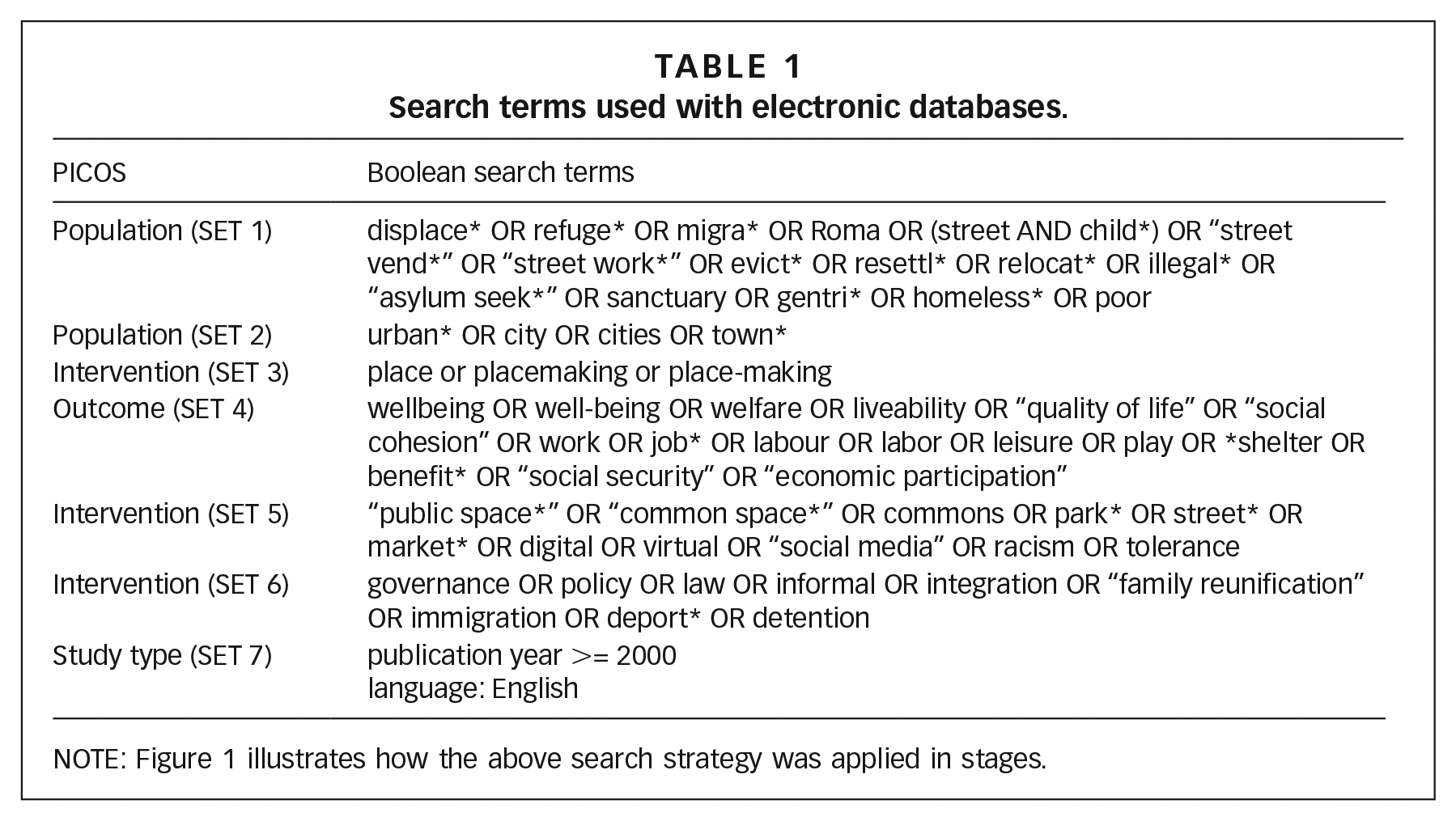
Note: Figure 1 illustrates how the above search strategy was applied in stages.
In the first stage, we identified 807 citations through electronic searches of the three databases. Of these 141 were duplicate studies and were removed, leaving 666 unique citations for the first stage of the review. Independently of one another, two experienced researchers assessed titles and abstracts for the first stage screening and excluded 604 studies for failing one or more PICOS criteria. The remaining 62 papers were read in full in the second stage to confirm their PICOS compatibility. At this stage, a third reviewer joined to screen the abstracts for PICOS and cross-check a sample of excluded studies. There were very few discrepancies (fewer than 5 per cent) between this and the earlier screening decisions, which were extensively discussed by the team and reconciled. Overall, inter-coder reliability was very high.
The remaining 62 studies progressed to the next stage. Concurrently, 10 other studies were added to the review using snowballing search methods. As illustrated in Figure 1, these snowballed studies bypassed the systematic stages of the review. Through this route, a handful of studies were included covering poor migrant populations’ placemaking in public space, even though their forced displacement status was less clearcut. After a full-text reading, 36 studies progressed to the synthesis stage, which was conducted by the three reviewers.
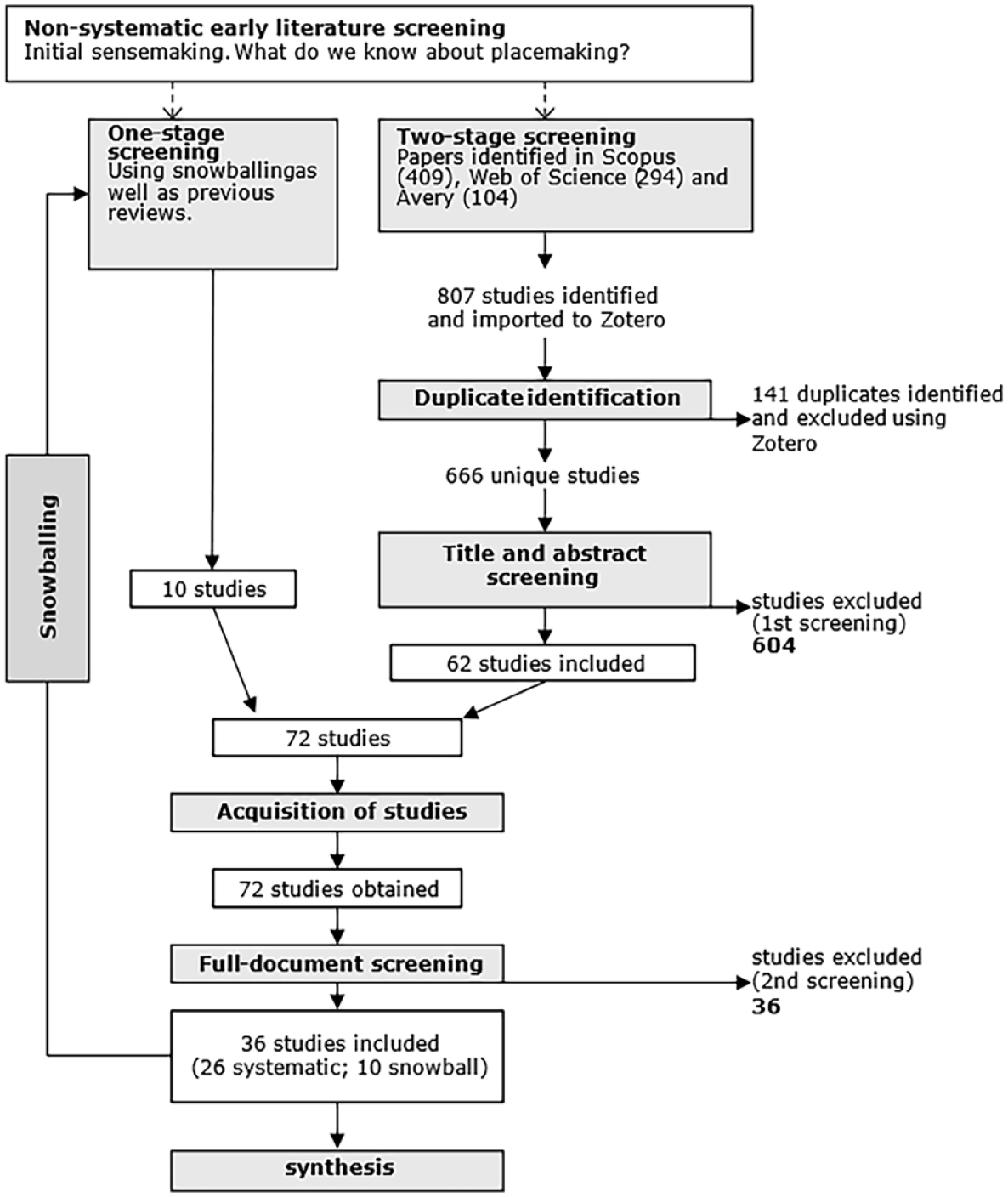
The approach towards the qualitative systematic review
IV. Findings
We commence by describing how the reviewed studies frame displaced populations and by mapping where and at what scale these studies were conducted. We then proceed to analyse the relation between public spaces and placemaking for wellbeing on the part of these populations.
a. Framing displacement in urban geographies
The limited number of studies included in the SR shows that enquiries combining displacement, placemaking in public space and wellbeing are relatively novel. These studies are orientated towards distinct scales of analysis. Some focus on neighbourhoods,(46) peripheral areas and informal settlements(47) or particular localities within these, including community gardens or city parks(48) but also interstitial spaces such as under flyovers,(49) highway ramps and industrial parking lots.(50) Others focus on the city scale.(51)
Geographically, the studies reviewed covered 54 research locations/host cities, with displaced people from 111 locations of origin (Figure 2). Strikingly, though not surprisingly, these studies are strongly concentrated in North America and Western Europe and – less pronouncedly – South Asia and typically were conducted by research institutions based there. Moreover, existing studies are located primarily outside those regions harbouring the greatest volumes of forcibly displaced populations, such as Syrian refugees in Turkey, Lebanon and Jordan, or Venezuelan refugees in Colombia.
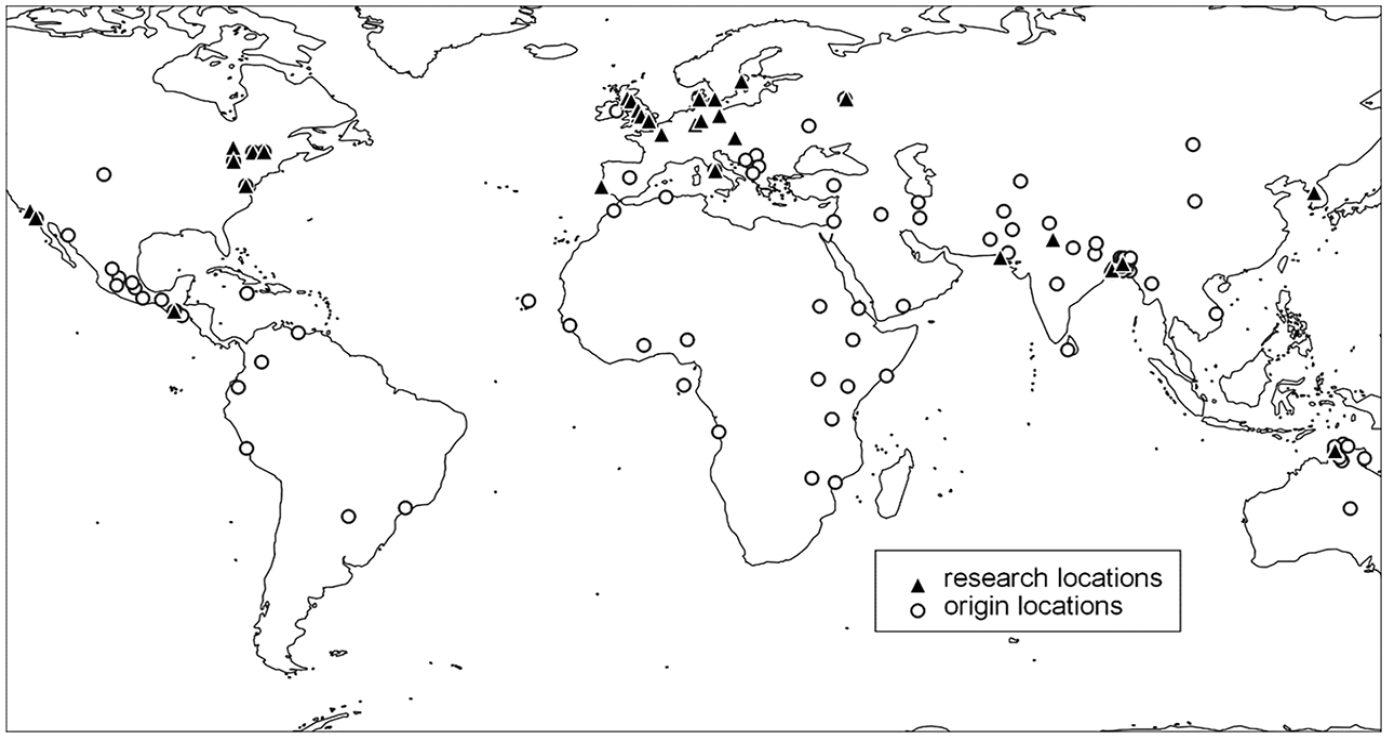
Research locations/host cities (54) and locations of origin (111 places) in reviewed studies
The reviewed articles frame displaced populations along partially overlapping dimensions: by mobilities; socioeconomic status or identity; across a spectrum of legal rights. Studies often take a broad approach, including not only migrant populations that have moved from low-income to high-income countries or from rural areas to cities, but also those displaced within cities because of developmental activities, such as in Karachi,(52) Kolkata,(53) Gurgaon(54) and Dhaka.(55) Others focus on the relationships between migrants and host communities, e.g. in Darwin,(56) Toronto and Ottawa,(57) Copenhagen,(58) London, Birmingham and other cities in the UK,(59) Germany(60) and Sweden.(61)
Elsewhere, displaced populations are framed in terms of socioeconomic or racial marginalization. These include indigenous populations in Antigua(62) and Darwin;(63) precarious workers in Vancouver(64) or Kolkata;(65) or homeless people in the United States(66) and Canada.(67) A few studies explicitly analyse displaced populations’ gendered and racial experiences of placemaking.(68) A final set of studies framed displaced populations regarding their documented legal status and associated formal rights. These include investigations on refugees and asylum seekers in Vienna, Traiskirchen(69) and Glasgow,(70) Roma citizens and non-citizens in Italy,(71) or on migrant labour, such as by Nepalis in Seoul,(72) Kyrgyz in Moscow(73) and Latin Americans in San Diego and Los Angeles.(74)
b. Types of public spaces and their wellbeing functions
Wellbeing can be understood both as a process and as an outcome, achieved when a person’s human needs are met, when that person can act meaningfully to pursue their own goals, and when they are experiencing a satisfactory quality of life.(75) People define wellbeing in relation to particular physical, economic and cultural contexts and as a state of being with others.(76) Such a conception considers dynamic interactions between material, relational and subjective dimensions of human wellbeing. The failure of wellbeing in relation to displacement thus encompasses not only material aspects such as income poverty or unhealthy housing. It also extends to the relational dimension of wellbeing, such as social and political exclusion, and to the subjective dimension of wellbeing, such as the lived experience of marginalization, indignity and lack of belonging.
Although few of the reviewed studies explicitly employ the concept of wellbeing, reviewed materials indicate that public spaces provide an essential social, material and political resource for displaced people. They support livelihoods,(77) leisure, home-making, social reproduction, conviviality, identity formation,(78) shelter(79) and finally, political mobilization.(80)
A limited set of studies grants attention to the materiality of urban space in relation to wellbeing. Some note the way in which people project a common identity through shop signage, ethnic restaurants and markets or through a repurposing of public space.(81) In Los Angeles’ parks, workers cultivate soil and plants to establish a physical and metaphysical connection to the earth in Mexico, and to generate feelings of comfort and being “at home”.(82) However, the availability of green space where displaced populations live is often limited as compared with that in other parts of the city(83) and the spaces in question are perceived as being of lower quality and harder to access.(84) Significantly, other studies underline the need to look beyond green public space to quasi-public space, as shopping malls, bars and fast-food outlets perform critical wellbeing roles for homeless people, refugees or low-income migrants.(85)
c. Access and use of public space: a relational placemaking analysis
What then shapes displaced populations’ opportunities and constraints for placemaking in public space? Looking across the reviewed papers, four aspects stand out: temporal patterns; complex governance arrangements; meta-narratives of people and place; and the spatial-material practice of (in)visibility.
Temporal patterns
Natural, socially and legally constructed seasonalities shape access to and desired use of public space by the urban poor and displaced populations. Depending on the context, climatic conditions can play a significant role. In Kolkata or Karachi, the ability to use public space for livelihood purposes – for instance, the storing or sorting of waste by the urban poor – is constrained by monsoon rain waterlogging streets.(86) Likewise, rough-living Aborigines in Darwin, Australia, increasingly seek shelter in bus transit centres during the rainy season,(87) while homeless people in Montréal seek shelter in underground shopping centres during cold winters.(88) Yet, where quasi-public places such as shopping malls, food courts and churches are critical for finding shelter, anti-rough-sleeping measures and nightly closures by the owners force people to find alternatives.(89) Turning this on its head, homeless people in Canadian cities must set up camp anew each evening and pack up every morning, as the law enshrines shelter as a human right, but only at night in public places.(90) Such uses of public space hence are conditional and temporary yet patterned. As Amin notes, “Every public space has its own rhythms of use and regulation, frequently changing on a daily or seasonal basis.”(91)
Displacement, governance and public space
The second factor emerging from our review that shapes placemaking in public space relates to the complex, multi-actor and multi-layered configuration of governance of displaced populations, and an associated fragmentation of their legal status and protection.
Further to international rules that shape the global circulation of stateless people,(92) national government policies on borders, immigration, dispersal and employment purposefully constrain mobility.(93) Moreover, such governance arrangements have scaled upwards from national governments towards international agreements and downwards to city governments. Simultaneously, these constraints have seen lateral movement, with the state’s previous roles outsourced to private companies and civil society organizations.(94)
These actors produce, oversee and police classificatory schemes that splinter and restrict the legal status and socioeconomic rights of forcibly displaced populations.(95) Such policies are subject to frequent change, and are codified in increasingly complex language, to gradually become unfathomable to social workers, advocacy groups and even legal experts.(96) At their worst, they create “legal illegibility” enabling the cheap extraction of labour.(97) Significantly, this legal fragmentation is not limited to non-citizens. European Union citizens of Roma background experience degraded legal protections in many cities, such as Rome, as well as in their home countries.(98) Poor, illiterate Indians lacking proof of identity are often treated as second class citizens by the Indian state,(99) while in neighbouring Pakistan, citizens of Burmese and Bangladeshi descent were ruthlessly stripped of citizenship in the wake of 9/11.(100)
At the city scale, national arrangements intersect with municipal bylaws, programmes and mayoral decrees addressing permitted uses and functions of public space. These may, for instance, allow the soliciting of funds for charities in public space but prohibit begging(101) or target and forcibly remove “public disorder” in city streets, including homelessness, panhandling and informal recycling.(102) While judiciaries occasionally resolve conflicts about the contested boundaries of public space access, use and function,(103) the police do so on an everyday basis for the homeless(104) and for migrants.(105) Hence, having passed national borders, they face further bordering at the street level.(106)
Beyond the state, our review notes the importance of a range of private actors who accord themselves a role in the regulation of public space. Representatives of Business Improvement Districts use urban design to monitor, control and inhibit homeless people’s street presence, but can also act as mediators with support services.(107) In Montréal, private security guards and shop floor staff set the terms under which street people are tolerated in malls and fast-food outlets. These semi-public spaces are cheap, anonymous and, according to Knowles, “as important as day centres” for the wellbeing of homeless people.(108) Managers of sports organizations act as gatekeepers for migrants’ sports participation in public space,(109) while landlords in Indian informal settlements impose codes of conduct on women renters’ presence in public space.(110) In other instances, private actors survey, securitize and ultimately enclose previously accessible public spaces, such as bus transit centres, malls and back streets used for earning income and obtaining shelter.(111) Moreover, there are important self-regulatory efforts. From Vancouver to Kolkata, street vendors, panhandlers and waste pickers undertake informal demarcations of territory; assert hierarchies of access based on longevity of presence; and cooperate with but also deploy violence towards invaders to protect their use of the street.(112) To conclude, access to and use of public space is subject to significant regulatory efforts by state as well as non-state actors, collectives and individuals.
Meta-narratives of people and place
In addition to the temporal patterns and (self-)regulatory efforts outlined in the previous paragraphs, the third factor that shapes placemaking in public space concerns what we call “meta-narratives of people and place”. These comprise (extra-)legal discursive and design efforts that emphasize for whom and for what purposes public spaces are meant to be used. They normatively and materially direct legitimate uses of public space and identify those people who can and cannot rightfully enjoy it. They can work to stimulate self-improvement, and discipline or exclude particular populations.
Buffeted by law, planners, architects and urban designers adopt explicit and implicit discourses that authorize the material form, texture and functions of public space, transforming it into “patterned ground” directing its users.(113) City squares and pavements are often designed for temporary use, movement and traversing, and condemn non-mobile activities such as putting up a stall to sell goods.(114) Likewise, “defensive architecture” such as park benches that allow seated rest but inhibit sleeping, works to deter homeless people. Local bylaws in Vancouver thus seek to keep public spaces clean and orderly, and prioritize urban aesthetics over the inclusion of homeless people.(115) More subtly, Knowles’ research in Montréal(116) notes how private-public spaces such as malls stimulate people to contemplate and validate private consumption, fit for the consuming classes but excluding the indigent.
Alternatively, the functions and utility of urban public spaces can be directed towards self-improvement, sometimes explicitly in relation to displaced populations. In the US, public parks are viewed as providing opportunities for exercise and recreation towards managing health risks, while community gardens can improve food security in low-income “food desert” neighbourhoods.(117) In Germany, intercultural community gardens promote opportunities for dialogue and collaboration between migrant newcomers and existing residents.(118) In Canadian cities, the prolific availability of communal leisure facilities in public space is undergirded by what Nadeau and colleagues call “a constant philosophy of open access programs for the entire community and not one particular group” to direct migrants’ assimilation into dominant culture.(119) Elsewhere, opportunities for self-improvement are constrained by urban morphology, as the spatial positioning of people, amenities and common resources in relation to one another affects the potential shared use of public space for integration.(120)
In contrast to the promotion of self-improvement, meta-narratives of people and place can seek to improve and discipline the “abject bodies” of the displaced, the homeless or the indigent. Business Improvement Districts in Washington, DC act on homeless people in public space to alleviate customers’ concerns about safety and sanitation.(121) In Vancouver, informal recyclers are viewed as synonymous with disorder and poverty to justify their containment, policing and displacement in gentrifying neighbourhoods.(122) Authorities in Bangladeshi and Guatemalan cities also routinely evict street traders on the grounds of creating a clean and orderly city.(123)
Finally, racialized meta-narratives of people and place shape the access, use and policing of public space. In Seoul, Nepali migrants’ visible presence in public space challenges notions of social order, as most Koreans believe Korea is ethnically homogeneous.(124) Media and political rhetoric invoke stereotypical, stigmatized and racial images of the asylum seeker(125) that in Moscow, for instance, lead to Kyrgyz migrants being portrayed as illegal and a public menace.(126) Similarly, Roma minorities in Rome’s peripheries are commonly framed as a security threat.(127) State authorities significantly adopt racial profiling in the policing of public space, for instance towards Aborigines in Australia.(128) In Moscow, pervasive uncertainty over whether visibly non-Russian migrants such as Kyrgyz labourers are legally present or not renders racially selective document checks in public space routine.(129) In San Diego, deportations of undocumented Mexican migrants are usually the consequence of detention and processing of individuals in public spaces, such as streets, parks and highways.(130)
Accordingly, meta-narratives of people and place seek to justify and structure opportunities and constraints for placemaking in public space for certain people, and certain purposes. As we will see in the next section, while powerful, they are not hegemonic and access and use of public space is subject to significant contestation and negotiation.
Spatial-material practices of (in)visibility
For displaced people, urban experience and knowledge is essential for acquiring a capacity to practise urban life and to “become local”.(131) This is done through movement in the city, market exchanges, engagement in online digital spaces and by drawing on information circulated in social and kinship networks that span countries, cities and countryside.(132) Establishing and maintaining a presence requires people to discern how public space works, the flows of people through it, and how and when to work around regulatory restrictions.(133) It entails an active maintenance of the relations with gatekeepers and authorities through deference, greasing palms or presenting gifts.(134)
Moreover, through quiet encroachments,(135) a careful practice of (in)visibility, the routine performance of temporariness and discreet enactments of belonging, people seek to avoid unwelcome scrutiny.(136) For instance, self-built settlements of Roma communities under flyovers and in industrial derelict lands in Italy must be visually unobtrusive, as “any attempt at permanence is quashed through arrest, eviction or demolition”.(137) While allowing for an uncertain presence, such practices cannot overcome marginalization and enduring infrastructural disadvantage.(138) Indeed, for many displaced people, Knowles asserts that “remaining invisible is the price for using public space”.(139)
And yet, parks, gardens and street markets can also be places to be seen, to display, restore pride and to claim belonging.(140) The act of congregating in public space forges a sense of community, revitalizes social networks and can engender solidarity with local religious and social organizations.(141) Everyday visibility entails what Hall calls a “mode of participation” in the generation of urban spaces and city life(142) and can lend a destigmatizing aspect to shared public space, even if it does not involve active interaction with other groupings.(143) Furthermore, making a social cause visible in public space can be symbolically and politically powerful. Public parks for instance offer important stages for refugee activism and mobilizations. By literally moving out from peripheries to protest and encamp in city centre localities, asylum seekers challenge exclusionist policies while transforming themselves into visible political subjects.(144) So too, encampment in public space challenges societal norms regarding the appropriate use of public space, notably the perceived unacceptability of an incursion of domesticity into public life. Accordingly, by acting socially and materially in and on public space, people can challenge meta-narratives of people and place, and, as Bermann and Clough Marinaro put it, “question, redefine and expand the possibilities of what conduct is ‘appropriate’ or ‘proper’ to public space, and what ‘public’ means”.(145)
V. Discussion and Conclusions
This study systematically reviewed academic literature to analyse the relation between placemaking, public space and diversely displaced populations. It aims to answer the following research questions: through what kinds of placemaking efforts in public space do variously displaced people seek to achieve urban wellbeing? And what governance arrangements structure displaced populations’ abilities to access, use and enjoy urban public spaces?
The paper contributes to an emerging field of enquiry that bridges investigations across urban studies and refugee/migration studies, into the nature of displaceability(146) and the processes and dynamics that shape if and how displaced populations can remake urban lives. By bringing the urban dispossessed and forcibly displaced into a common analytical framework, the study helps to better account for a blurring of their lived experiences.(147) Moreover, it contributes to studies of wellbeing, because, as White says, “space and place constitute critical dimensions . . . that deserve much greater attention”.(148)
The study extends analyses of displacement beyond their common orientation towards reception, home and workspaces, to find that investigations of displacement, placemaking in public space and wellbeing are relatively scarce. While a first of its kind, the study has several limitations. It focused on English-language peer-reviewed articles only and did not screen for book materials; this may have meant omitting some important studies within the field as a whole.
Overall, our analysis underlines the importance of public space as a resource and a locus for the pursuit of wellbeing. Though this resource is often of unsatisfactory quality and quantity and restricted in terms of access/use, forcibly displaced populations and the urban dispossessed imaginatively utilize a wide set of public, semi-public and quasi-public spaces for livelihoods, shelter (material wellbeing), leisure, home-making and identity formation (subjective wellbeing), conviviality, sociability, political mobilization and social reproduction (relational wellbeing). While such uses and functions accord with existing literature on public space,(149) the review newly highlights that displaced populations make themselves “at home” and anchor themselves in cities by socially and materially acting in and on public space. It is here that displacement materializes into place, prospectively transforming the urban built environment.
Having reviewed literatures covering urban settings across low-, middle- and high-income countries, we find significant geographic bias in scholarship towards large cities of the “global North”, resonating with Collins’ observation regarding migrant spatial practice.(150) Research hence must better target those regions and urban geographies in the “global South”, where vulnerable displaced populations are largely located. In this respect, it is encouraging to now see a literature emerging for such under-researched urban settings,(151) touching on practices of visibility, temporality and mediated access/use of public space expressing broader societal relations of power.(152)
However, this is not a call for ignoring displacement in the “global North”. To the contrary, analyses within and across global urban settings may productively consider four key factors that shape displaced populations’ spatial-material practice and experiences in public space: temporalities; a complex, multi-scalar and cross-sectoral set of governance actors; meta-narratives of people and place; and spatial practices of (in)visibility. Table 2 synthesizes insights from the studies reviewed, to offer an initial, intuitive heuristic indicating how displaced populations with particular ascribed or embodied characteristics are diversely affected by such factors.
Urban public space access and use: the relative importance of factors structuring placemaking by diverse displaced populations.
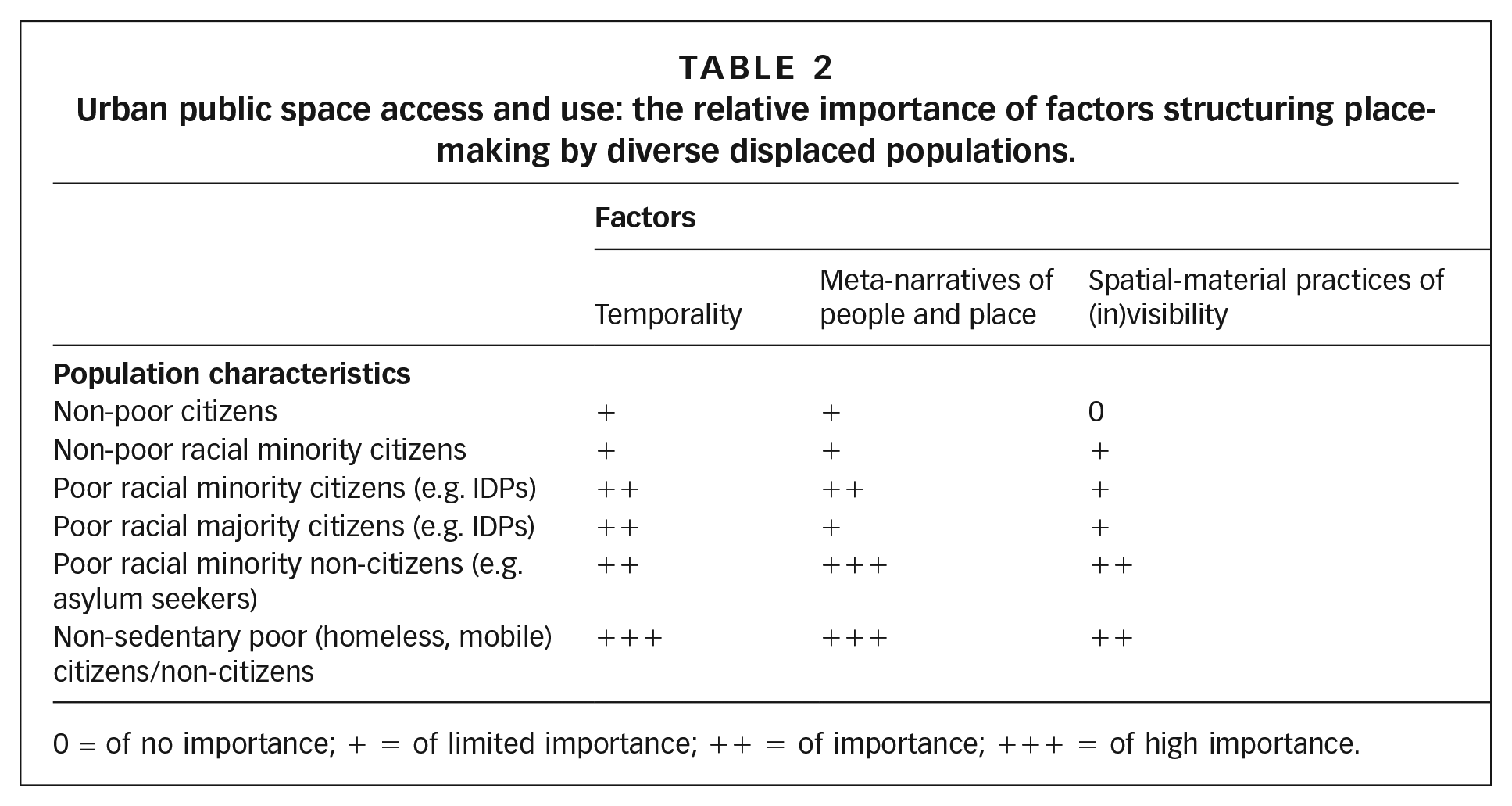
0= of no importance; + = of limited importance; ++ = of importance; +++ = of high importance.
Table 2 shows that citizens generally have an advantageous position in accessing and using public space as compared to non-citizens, with race, nationality (and other) ascriptions a further mediating factor. For example, the break-up of the Soviet Union degraded Kyrgyz workers’ legal status, affecting their ability to have a presence in Moscow’s public spaces, even for those legally in Russia.(153) And in Beirut, restrictions for Syrian refugees’ access to public spaces coincided with growing freedoms on that front for Palestinian refugees.(154) We further find that groups of non-sedentary urban poor, such as the homeless or mobile Roma communities, may be most affected by temporalities, meta-narratives of place and people, and depend most on spatial-material practices of (in)visibility to enable their access to and use of public space.(155)
Despite this table’s heuristic value, it is not possible to identify clearcut, one-size-fits-all typologies for displaced populations in relation to public space access and use across urban geographies, globally. Leaving aside the fact that the articles reviewed use different ways to define populations studied, people’s access to and use of public space may be enabled/hindered by multiple ascribed identities (of class, race, citizenship status, etc.); by the nature of the activities they seek to undertake; by type and locality of public space (compare a market square to a back alley); as well as by the dynamics of regulatory regimes, amongst others. No such factor can be easily isolated as being generally of more/less importance, and we suggest that they are considered in their particular configurations, within historically and locally specific governance contexts. (156)
Some of the public space literature references temporal patterns or the meta-narratives of people and place,(157) and highlights that different rules, regulations and governance arrangements pertain to public, semi-public and pseudo public spaces to put restrictions on their physical, legal and social access and use.(158) Hence, though notionally freely-accessible-to-all, public space must be understood in degrees of publicness, raising questions about who defines access and usage rules, for whom, to operationalize conditions of displaceability.(159)
Our review highlights that this “who” comprises a wide range of individual and collective actors, including public and private sectors operating at different global, national, city, neighbourhood and sub-neighbourhood scales. Findings thus support recent calls for analysis to refocus on the diversifying roles of city governments, private companies and civil society organizations in aiding, advocating for or controlling displaced people.(160)
Furthermore, we argue that the central state requires continued analytical attention. Forced migration scholarship has noted that restrictive migration policies and classification schemes mean the proliferation of legal “in-between-ness” and they underpin differential inclusion and active everyday bordering, directed towards those seen as “unwanted”.(161) A growing fragmentation and fluidity of legal status for displaced non-citizens and “citizens-to-be” underline the importance of a notion of graded citizenship.(162) Further, even where rights are granted, their consumption is not assured. Subtleties in policy classifications can be overridden by potent meta-narratives of people and place that inform the policing of public space, to exclude or discipline access and uses.
To conclude, we highlight three pervasive, interrelated but underlit phenomena requiring greater attention in future research. The first is the surreptitious or overt privatization of public spaces by powerful social groups and their effects on access and use by differently displaced urban populations. Second, we underline the broad diversity of actors that de facto (self-)regulate, mediate or gatekeep access to and use of urban public space. Our third and final point concerns the importance of mediation, in relation to discretionary behaviours and practices by implementers of policy and the law. While the urban poor in the so-called global South often depend on political society to mediate relations with the bureaucratic state, in order to (partially) realize their rights,(163) limited political franchise restrains the possibility of such mediation routes for forcibly displaced populations. Nevertheless, the fragmentations of legal status, the growing complexity of regulatory landscapes concerning migration and labour market participation and the underexplored intersections of these factors with city specific policies (such as those on urban planning and housing) all suggest that alternative forms and practices of mediation may be essential for placemaking and wellbeing.
Supplemental Material
sj-docx-1-eau-10.1177_09562478241277085 – Supplemental material for Urban displacement and placemaking in public space for wellbeing: a systematic review of global literature
Supplemental material, sj-docx-1-eau-10.1177_09562478241277085 for Urban displacement and placemaking in public space for wellbeing: a systematic review of global literature by Dolf J H te Lintelo, Morgan Alexander Ip, Tiina Riitta Lappi, Rajith Weligamage Don Lakshman, Peter Hemmersam, Anandini Dar and Miika Tervonen in Environment & Urbanization
Footnotes
Acknowledgements
We would like to warmly thank two anonymous reviewers for incisive, substantive and constructive comments that have significantly strengthened the paper. The authors are also thankful to the two research frameworks of the Global Challenges Research Fund and the EU-India Platform for the Social Sciences and Humanities (EqUIP) for their arrangement and support.
Funding
The author(s) disclosed receipt of the following financial support for the research, authorship, and/or publication of this article: The support of the UK Economic and Social Research Council (ESRC) (Grant Ref ES/R011125/1), Finnish Academy of Sciences (326234), Indian Social Science Research Council (JRP-2/2019-IC) and the Norwegian Research Council (299037) are gratefully accepted.
Supplemental material
Supplemental material for this article is available online.
10.
31.
Lew (2017);  .
.
32.
Such “quality places” are characterized by predefined characteristics (e.g. active, unique locations, interesting, visually attractive, quality façades, etc.).
44.
(SET 1) AND (SET 2) AND (SET 3) AND (SET 4) AND (SET 5) AND (SET 6) AND (SET 7).
45.
51.
56.
Lobo (2016, ).
57.
63.
Lobo (2016, ).
74.
78.
81.
Gill (2010); .
83.
86.
89.
93.
95.
103.
105.
106.
Hall (2015); .
111.
Lobo (2016); .
123.
133.
134.
136.
141.
144.
Ataç (2016); .
145.
Bermann and Clough Marinaro (2014), page 400; .
149.
151.
E.g. Landman and Mady (2022); .
155.
E.g. Por (2016); Knowles (2000); .
156.
157.
E.g. Purcell (2002); .
158.
Ruppert (2006), page 272; .
161.
References
Supplementary Material
Please find the following supplemental material available below.
For Open Access articles published under a Creative Commons License, all supplemental material carries the same license as the article it is associated with.
For non-Open Access articles published, all supplemental material carries a non-exclusive license, and permission requests for re-use of supplemental material or any part of supplemental material shall be sent directly to the copyright owner as specified in the copyright notice associated with the article.
