




Abstract
Global discussions of risk in the disaster risk reduction literature do not necessarily reflect the range of risk as understood by residents in the urban South. This intra-urban comparison from Bharatpur, Nepal, where the Gorkha earthquake struck in 2015, shows how residents in two different wards perceive risks related to themselves, their families and their urban environment. The continuum of perceived urban risk includes events such as the Gorkha earthquake and the administrative change, as well as everyday concerns such as poor quality of infrastructure provision and economic insecurity. By contrasting the views of these residents of an “ordinary” city in the urban South, and comparing them also with the views of the local authority, this paper allows for an enriched understanding of how risk is understood, highlighting the breadth of concerns involved, and the tensions in understandings of the full spectrum of urban risk. Understandings and definitions of risk matter. If perceptions of risk from the local level are not included within the broader disaster risk reduction discourse, this shapes and in effect limits the risks that are actually managed through policy and practice.
Keywords
I. Introduction
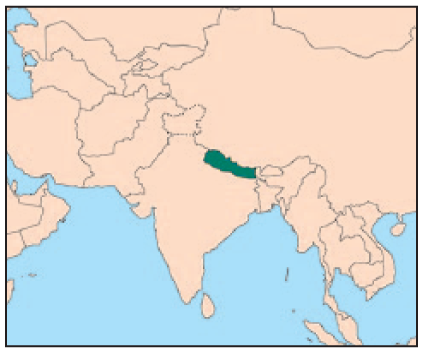
On 25 April 2015, the Gorkha earthquake struck Nepal, causing 8,896 fatalities, 22,303 injuries, and US$ 7 billion worth of damage and losses.(1) Overnight, questions of “risk” were on the agendas of the government of Nepal and many international agencies. But risk did not begin – or end – with the Gorkha earthquake. Disaster risk reduction (DRR) – in policy, experiential and scholarly terms – sits within a continuum of risks, spread over different timescales and modes of risk production, each risk with its own quite discrete spatial footprint and social texture. New insights into the scale and nature of urban risk are needed if we are to unpack and make sense of the range of urban risk.(2)
Global discussions of risk in the disaster risk reduction literature(3) do not necessarily reflect the range of risks as understood by residents in the urban South. Urban residents face a continuum of risks that cannot and should not be analyzed as separate and distinct. In this paper, a continuum of perceived urban risk is explored based on the views of residents through an intra-urban comparison. Drawing on a case study from Bharatpur, Nepal, this paper demonstrates how residents’ perceptions of hazard (including the Gorkha earthquake of 2015) and risk may differ based on their location in the city and their income levels. Interpretations of risk in the city are also explored from the viewpoint of the local authority in Bharatpur.
In the global South, urban residents often live in conditions where state provision is relatively absent, including for basic welfare, social services and infrastructure.(4) Bharatpur, Nepal is an “ordinary” medium-sized city of approx. 200,000(5) with no particular claim to fame, which may appear to be globally, economically, politically and spatially irrelevant. In reality, this type of “ordinary” city is where most of the world’s urban residents live today.(6) Cities like Bharatpur are also where most of the projected global population growth will occur over coming decades, in urban centres with fewer than half a million inhabitants.(7) Many of these small and medium-sized cities face a number of challenges, including: significant inward migration, resulting in rapid urbanization; limited, if any, urban planning; insecure livelihoods; rapidly reconfiguring social networks; and a lack of regular or adequate provision for electricity, solid waste management, water and sanitation.(8)
This paper complements the urban risk literature from Environment and Urbanization’s April 2017 issue, on “Understanding the full spectrum of risk in urban areas”.(9) In the context of rapidly evolving urban risk in Nepal, this paper provides a contribution to understanding the continuum of risk that encompasses not only vulnerability to natural hazards but also such everyday concerns as economic hardship. Generally speaking, national governments and international agencies are improving their DRR policies. The level of preparation for and response to events such as the Gorkha earthquake, notwithstanding the loss of life, reflects such improvements. Where matters have not progressed to an equivalent degree, it is argued here, is in the placement of such events within the wider evolving risk context.
II. Conceptual Framework
There is a significant body of research on large-scale, rapid-onset and high-impact natural hazard events(10) such as earthquakes or volcanic eruptions, often referred to in terms of “intensive risk”.(11) In recent years, a number of researchers have also explored smaller-scale, but more chronically recurring, events that cumulatively can have a significant impact at the individual, household and community levels – everyday or “extensive risk”.(12) The research presented here sits between these two bodies of work. A large-scale, rapid-onset hazard event (Gorkha earthquake) is discussed in this paper, but only as part of a broader understanding of risk from the perspective of urban residents and local authorities.
A social constructivist lens is utilized in the effort to understand people’s perceptions of risk. According to Pidgeon et al., this perspective “involves people’s beliefs, attitudes, judgements and feelings, as well as the wider social or cultural values and dispositions that people adopt, towards hazards and their benefits”.(13) Risk perception is multidimensional, whereas a particular hazard can signify “different things to different people”.(14) The starting point for considering the everyday involves “ordinary people, everyday actions and commonplace events”.( 15 ) With a focus on normal living rather than abnormal events, a concern with the everyday acknowledges the necessity to consider ordinary people who live and conduct their lives in the best way they can. What can be considered risk from the perspective of urban residents differs from ideas of risk calculation and the management of risk(16) as understood by governments, the international aid community and the academic community.
UNISDR’s(17) definition of hazard is utilized in this research: “A potentially damaging physical event, phenomenon or human activity that may cause the loss of life or injury, property damage, social and economic disruption or environmental degradation. Hazards can include latent conditions that may represent future threats and can have different origins: natural (geological, hydro meteorological and biological) or induced by human processes (environmental degradation and technological hazards).”
The interlinkages between disasters and risk highlight the need to pay “more attention to people’s own priorities, perceptions and belief systems” in relation to everyday risks and hazard events, according to Bankoff et al.(18)
The way we conceive of the “urban” needs increasingly to be based on the reality of cities and towns in the global South. In this context, there is an intersection of different forms of risk that render urban existence itself a risky undertaking for many residents. It is increasingly difficult for urban residents to avoid or resist political instability, conflict, economic precarity, health crises, and ecological disaster, all of which can occur at different scales with an impact on everyday urban lives. As Dodman and colleagues argue, “The scale and nature of urban risk depends on how risk is conceived”.(19) There is a pressing need to understand the full spectrum of risks in urban areas. In order to do so, it is worth extending consideration beyond disasters and disaster risk mitigation to, as Pieterse et al.(20) suggest, “imagine and develop a more credible account of everyday urbanism”, which will broaden and deepen an understanding of urban risk in ordinary urban cities such as Bharatpur, Nepal.
Bull-Kamanga et al.’s(21) seminal paper suggests there is a relationship between disasters and an increase in risk from poorly managed urban development. They also propose that there is a need to understand how local governments and community organizations identify and act on processes that cause the accumulation of risk in urban areas. Dodman et al.(22) expand on concepts of intensive risk and extensive risk based on frequency, scale and impact. They propose that for the urban poor, the highest levels of risk from everyday hazards are usually associated with poor-quality housing and lack of infrastructure and services. They also stress the importance of relationships between low-income communities and the local government, as well as the importance of mainstreaming disaster risk reduction into development policies and urban planning. A 2016 report of the UN Development Programme (UNDP) and the Overseas Development Institute (ODI),(23) focusing on the critical role of risk and resilience in addressing the financing of sustainable development, uses the slightly different language of stresses and shocks to convey the relevance of including not only environmental occurrences (drought, flood, earthquake, tsunami, hurricane or cyclone) in the range of risks, but also health shocks, conflict and economic shocks.
Stressing the importance of context, the 2014 World Disasters Report(24) discusses the concept of risk: “Risk is itself culturally-defined… [resulting in] the problem that DRR organizations sometimes have a different definition of risk from those of the people affected”. This can lead to situations where the risk perceptions and needs of urban residents are not acknowledged or are even ignored when urban risk is explored and debated on global levels. To address this gap, Wamsler and Brink(25) provide an overview of urban residents’ coping and adaptive practices in several countries, with an emphasis on disaster risk reduction and climate change. They also present insights regarding residents’ risk-reducing effects. These bodies of literature collectively suggest the importance of considering a range of risks and different urban contexts.
This paper contributes to the expanding body of research on the scale and nature of urban risk in two ways. First, it provides insight into what residents view as hazards and risks in the everyday, as well as how residents view – and therefore prepare for and respond to – less frequent events such as the Gorkha earthquake. And second, it contributes to an understanding of how changing municipal structures and policies ameliorate, create and reshape risks. These insights can expand knowledge in a fruitful way to contribute to a richer understanding of the continuum of urban risks. This paper also opens a space to highlight the tensions in understandings of the full spectrum of urban risk, and their evolving intersections on a local level and on a global policy level.
III. Learning about Bharatpur, Nepal
This paper is informed by empirical work in Bharatpur. Bharatpur is the type of city that researchers have not investigated empirically to any significant degree in Nepal, where urban research has primarily focused on the Kathmandu Valley, until recently the main urban hub of Nepal.(26) This is now changing in the context of the country’s rapid urbanization.
a. Description of the study area
Bharatpur is the fifth largest city in Nepal and has a population of 200,000. It is located on the plains of Nepal, in Chitwan District (Map 1). Bharatpur is a young municipality, established in 1979, which emerged from a small market town. The municipality had 14 wards when the fieldwork began in 2014. It was then designated a sub-metropolitan city, encompassing 29 wards, in December 2014. Today, Bharatpur is a heterogeneous city; the main caste and ethnic groups are Brahmin, Chhetri, Newari, Tamang and Gurung.(27) Internal migration continues and includes new, affluent high-caste migrants, migrants who are fleeing conflict in their villages and towns, and economic migrants from the neighbouring Indian state of Bihar.
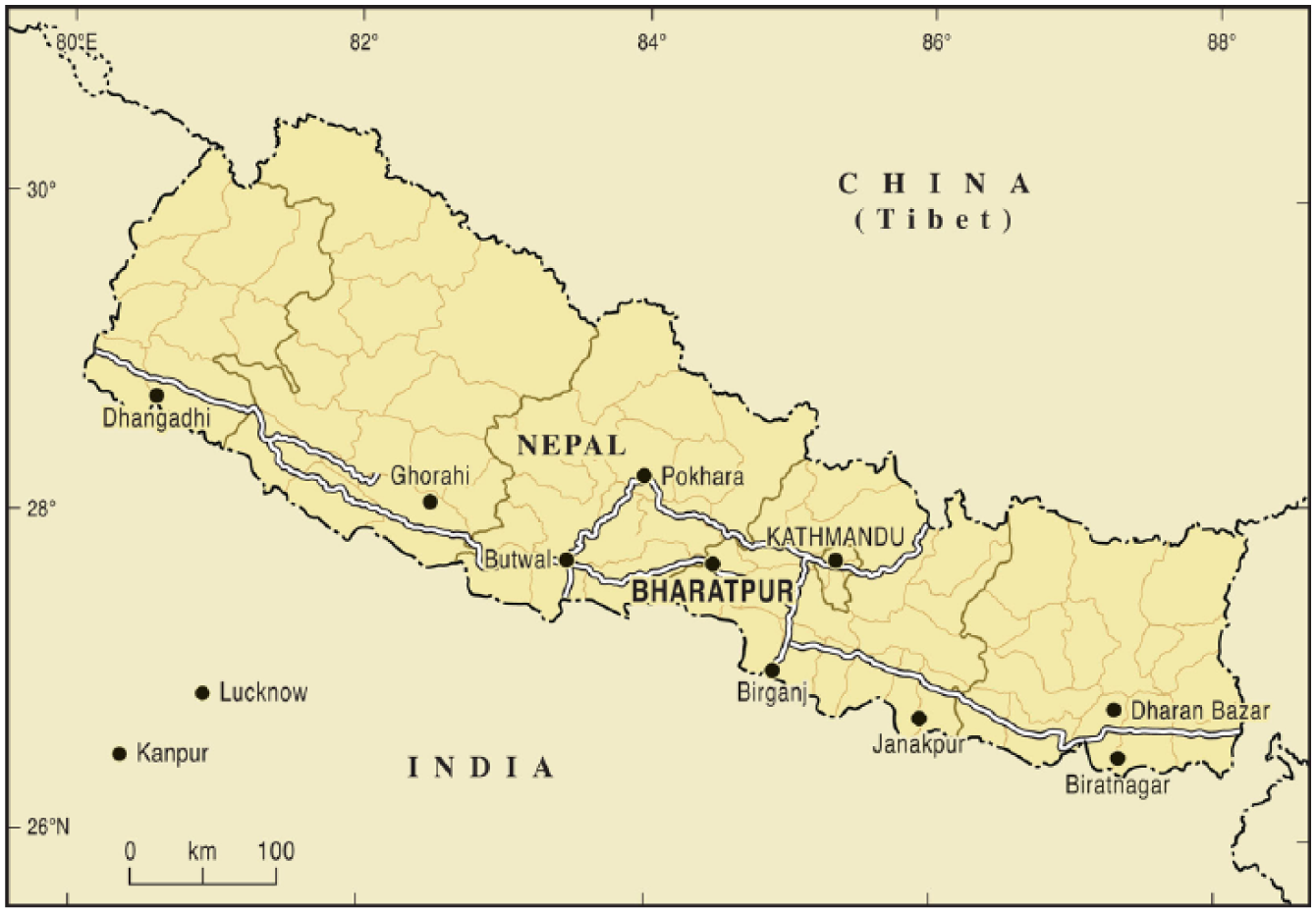
Nepal road network
Bharatpur’s residents have different connections to each other, to the local authority and to the urban environment. The way they live in the everyday and what they consider relevant provides an opportunity to know and learn about Bharatpur.(28) There is not a strong economic base in the city. The local economy is largely financed by remittances from young men working in the Gulf countries and Malaysia. According to the World Bank,(29) Chitwan District is the third highest remittance-receiving district in Nepal (out of 75 districts). The trend of international migration and remittances has increased dramatically since 2000. In 2000, remittances were 14 per cent of GDP; in 2010 they were 22 per cent; and most recently, in 2015, remittances contributed 32 per cent of GDP. The national economy is increasingly dependent on labour moving abroad. This is due in part to the 10-year internal conflict, during which 13,000 people died in Nepal. This research shows that reliance on international remittances accounted for a significant source of household income in Bharatpur, similar to more general figures for Nepal.(30)
For this research, two wards were chosen based on their physical differences, rates of urbanization and resident profiles. Ward 4, bordering the Narayani River, is located in the eastern part of Bharatpur. It is the oldest part of the city – the commercial, retail and financial hub as well as the transportation intersection between two national highways (Photo 1). Ward 4, with its 15,000 residents, is a dense part of the city that sustains many elements of urban life. The population is diverse: there are Muslims, the business-oriented Newari ethnic group, and Brahmin and Chhetri groups. In Ward 4, tenants, aspiring middle-class home owners, informal settlement dwellers, and transient Indian migrant workers live in a diverse, fragmented setting, often socially separate from each other. This ward has many types of industries, some of which emit pollutants into the air or the river network.
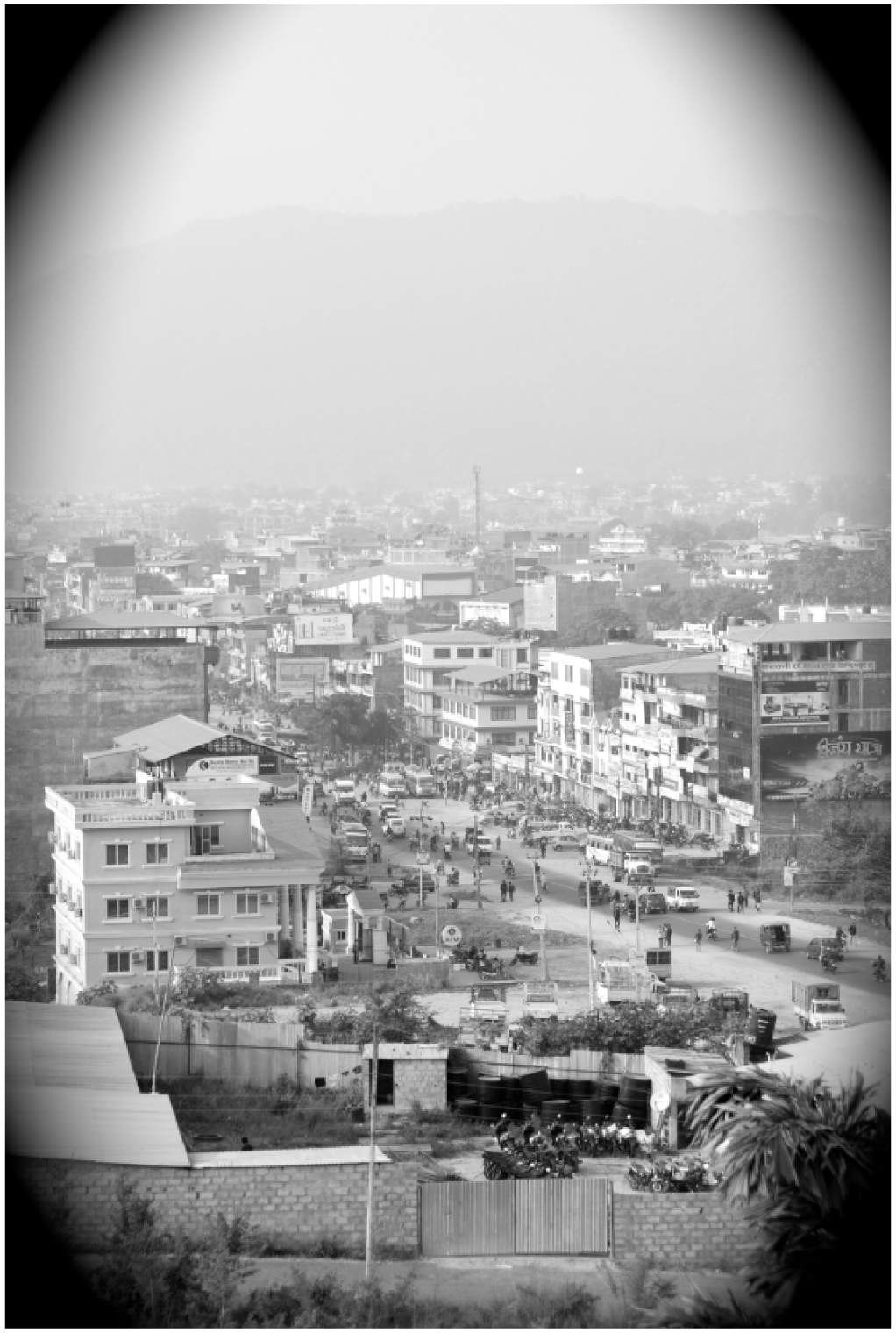
Nepal’s east–west motorway bisects Bharatpur
Ward 11, bordering the forest in a central part of Bharatpur (Figure 1), was historically agricultural land inhabited by the indigenous Kumal population. Thirty years ago, people from the Lama and Tamang ethnic groups in Nepal’s hill country arrived and settled in the centre of Ward 11, at times in conflict with the indigenous population over land. Twenty years ago, high-caste Brahmins from the hills of Nepal were encouraged by the central government to settle in the Terai region; some settled on the outskirts of Ward 11 near the forest. Over time, these residents have received land ownership rights from the central government for their homes, but they do not own agricultural land. The residents – consisting of the indigenous Kumal group, the Lama and Tamang ethnic groups, and the high-caste but poorer Brahmin and Chhetri residents – are marginalized, with scarce opportunities for employment, poor road networks and poor access to water. Housing 21,000 residents, Ward 11 can be described as a “patchwork combination of formal and informal infrastructures”.(31) This is evident in the road network, which is intermittently paved and unpaved.
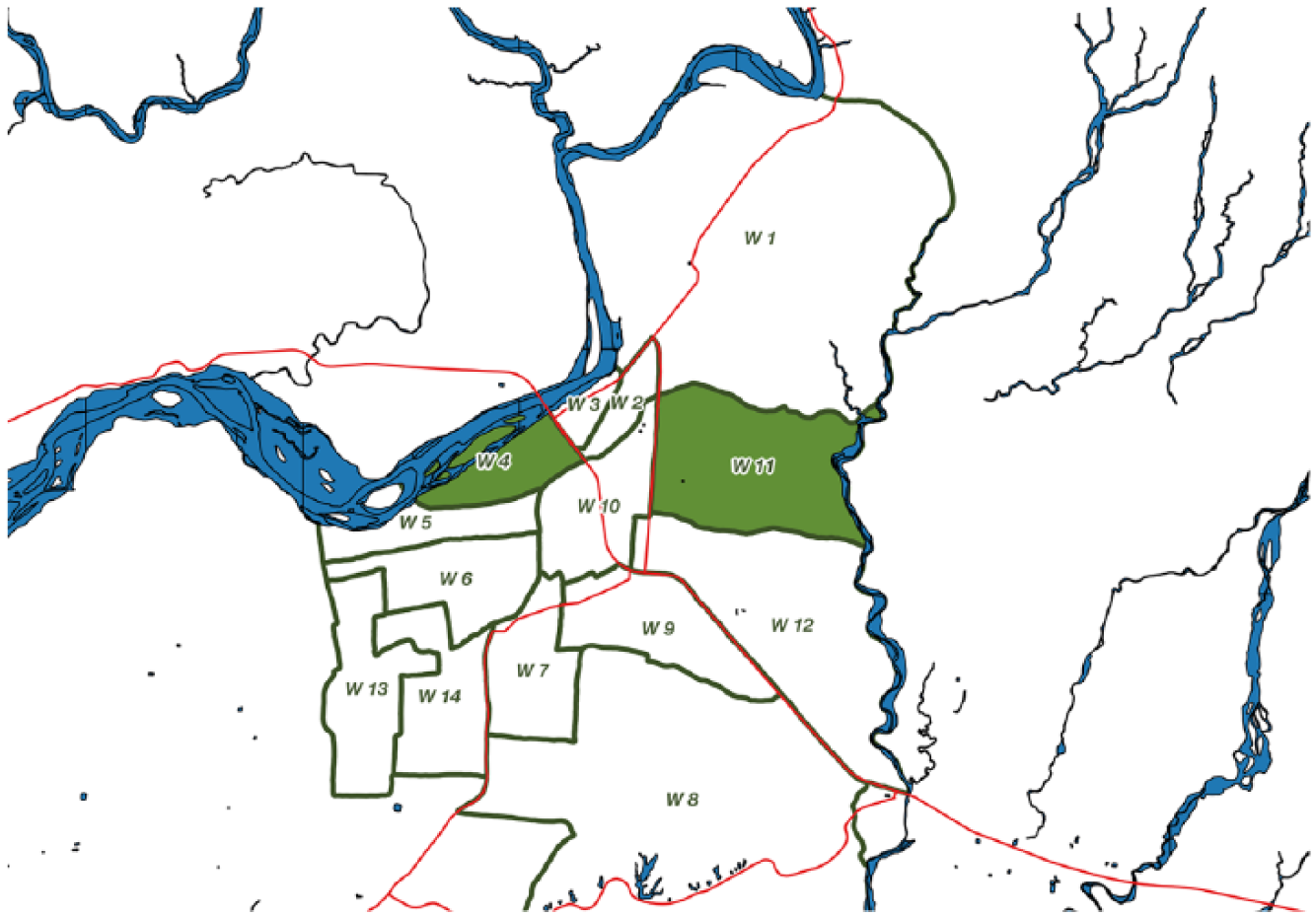
Bharatpur Wards 1–14
Most of the more affluent Brahmin and Chhetri newcomers (most of whom have arrived since the early 2000s) have settled on the southern border of Ward 11, near the city centre, where the good-quality facilities (hospitals and schools) are located. These home-owning newcomers have tenuous relationships with the inhabitants who have been here for decades. Due to their affluence and high caste, the Brahmin and Chhetri newcomers in Ward 11 have political access to the local authorities and are able to bring local government resources to their fragment of Ward 11 in order to build infrastructure, including paved roads, where needed.
b. Methodological approach
This research utilized a qualitative approach(32) in this intra-urban comparison, investigating changes in risk perception and resilience strategies among different resident groups in Bharatpur. Research methods included semi-structured interviews, focus group discussions, photography, and observation of the daily flow of life. The questions were developed in English and subsequently translated by the research project’s Nepali partner, the National Society for Earthquake Technology (NSET). The interviews and focus group discussions were conducted in the Nepali language through the support of a research assistant, or in English where appropriate. The research took a multi-scale perspective, exploring how different scales(33) impact each other and how power and influence flow between the scales (household, community, local authority, national and international levels). This research was carried out in an iterative manner over one year (November 2014 – October 2015), during which I conducted three fieldwork trips to Bharatpur as well as interviews in Nepal and the US.
I observed a number of changes over the period of this study. As part of the political changes on a national level, the national constituent assembly promulgated a new constitution after deliberating for seven years, and the number of municipalities in Nepal was increased by 275 per cent, creating a nominally more urban country. During this same year, the devastating Gorkha earthquake struck. The three fieldwork trips coincided with the phases referred to by the international aid community: “before, during and after” the high intensity earthquake of April 2015(34) that killed almost 9,000 people.
Respondents from Wards 4 and 11
During the fieldwork trips in Bharatpur, semi-structured interviews were conducted with 42 residents from Wards 4 and 11. Twenty-three of these residents answered questions regarding their everyday worries and views of natural hazards. The other 19 residents, along with participants in seven focus group discussions (with neighbourhood groups and women’s groups), provided additional empirical data for this study.
These respondents were selected from a pre-existing dataset. In 2013, NSET had chosen Bharatpur as the pilot city to conduct a baseline survey on earthquake risk perception and preparedness. This survey of 2,000 residents from all 14 wards was an entry point for NSET to understand people’s risk perception of natural hazards, including epidemics and fires. No dataset of this size and scope existed in Nepal at the time. NSET allowed me to access the dataset for my research project. In preparation for my second fieldwork trip to Bharatpur in April 2015, I used NSET’s dataset to select respondents, based on the criteria of gender, age, education levels and income levels, for my semi-structured interviews in both wards I was investigating. I was interested in interviewing residents with a range of profiles in order to gain a broader understanding of the risk perceptions and resilience mechanisms of urban residents.
The questions that were asked focused first on understanding the range of natural hazards that residents perceive as risks in Bharatpur that could cause them harm (drawing on NSET’s baseline survey questions regarding hazards). Subsequently, questions were posed regarding what people viewed as everyday risks, if these differed from natural hazards. Lastly, questions were asked about residents’ coping strategies and what would keep them safe for the future. The words “risk perceptions” were not used with respondents. Instead the Nepali word for “worries” was chosen. NSET used the word “worries” in its research as well.(35) The word “resilience” was also not used with Bharatpur respondents, since it does not translate directly into Nepali.(36) Instead, the word “safety” was chosen after consultation with NSET, the Ministry of Federal Affairs and Local Development and my Nepali research assistant.
Other respondents
In addition to semi-structured interviews with residents, I conducted 39 semi-structured interviews with local, district and national-level government officials, as well as key stakeholders on a municipal level. These stakeholders include a politician, a radio station owner, a head teacher at a private school, teachers, nurses, and representatives from a housing NGO, business associations and the construction sector (masons, business owners and engineers). Information from these interviews set the context for understanding urbanization, risk perceptions and governance structures, changing urban relationships and earthquake-resistant construction initiatives. Interviews also explored the evolving urban governance relationships between local authorities and groups of residents, as well as the relationship between government and businesses.
In addition, 15 semi-structured interviews were organized with members of the international aid community in Bharatpur, Kathmandu and the US in order to understand how urban disaster resilience projects were being structured. In total, over 96 semi-structured interviews were conducted as part of this research project. Interviews were transcribed, and data were coded into emerging themes and analyzed.
In addition to the interviews, a desk review of national government reports and international aid reports was carried out, as well as an analysis of my photographs and the photographs taken by residents using disposable cameras. Triangulating findings among the different research methods provided a more detailed and nuanced appreciation of the complexity of urban life and understandings of perceived risk.
IV. Perceptions of Risk
In the following discussion, two main arguments are made. First, I point to a significant gap both in how different Bharatpur residents define and perceive risk, and between the perceptions of these residents and other groups, including the Nepalese government, local authorities, scholars, and multilateral agencies. And second, I argue that this gap in understanding matters. Defining risk according to different criteria creates a context where only some concerns matter and have policy traction, while other concerns do not matter and are not reflected in policy.
a. The Gorkha earthquake
On 25 April 2015 at 11:56 am, the first jolts of a major earthquake were felt in the small town of Gorkha in central Nepal. The earthquake, with a magnitude of 7.8,(37) was Nepal’s largest earthquake since 1934. Along with the subsequent magnitude 7.3 aftershock in Sindhupalchok District on 12 May, it was the worst natural disaster to strike the country since 1934. When the earthquake struck, I was conducting my long-term research on community resilience to urban disasters in Bharatpur, only 38 miles south of the 25 April epicentre. These excerpts are from my research blog:(38) “The earthquake started at 11:56 a.m. on the day of rest (Saturday), therefore there were few vehicles traveling, the shops were still closed and few people were out in Bharatpur. My research assistant and I were walking on New Road in the industrial area of town where the India bound trucks get serviced, where buses are made etc. The metal was shaking on the commercial building near me. I asked R what he thought was going on. He said, ‘earthquake’. … The city’s infrastructure was intact and only a few buildings were damaged. In the first 72 hours, we experienced 68 aftershocks. It was, quite simply, terrifying.”
For international disaster risk reduction experts, earthquakes are an infrequent but highly dangerous hazard event for Nepal, and are viewed as particularly risky. For example, the UNDP(39) ranks Nepal as one of the world’s hotspots for disasters.(40) Most residents and the local authority in Bharatpur, however, do not share this view, despite the intensity of the earthquake sequence of 2015. No one died in Bharatpur due to the earthquake, although the built infrastructure was damaged. One hundred buildings were destroyed and 300 buildings partially collapsed. A further 3,000 buildings needed to be assessed for structural integrity due to damage caused by the 12 May aftershock. The local authority was responsible for this task of assessing 7.5 per cent of the building stock in the summer of 2015, with support from trained volunteer engineers.
When asked about hazards, all respondents interviewed in Wards 4 and 11 mentioned infrequent fires, infrequent floods and infrequent earthquakes. However, it is worth noting here that even after the Gorkha earthquake occurred, earthquakes were not ranked as the most important hazard. Respondents in Ward 11 were more worried about attacks from tigers and rhinoceroses from the adjoining community forest. In Ward 4, residents were more worried about electrical fires and flooding from the adjoining Narayani River. Even after the hundreds of aftershocks in the first five months, many respondents in Wards 4 and 11 continued to assert, “Chitwan (District) is safe, Bharatpur is safe”.
For most respondents, attitudes towards earthquake risk were similar whether they were interviewed before or after the high magnitude earthquake of April 2015. Nor did Ward 4 respondents change their minds in terms of the priority they gave to earthquake hazard, relative to the everyday risks they perceived (the quality of physical infrastructure or the lack of economic security, explored in IVc and IVd). Earthquakes did not rank high as a source of concern because residents felt they were aware of how to respond during the seismic activity.
One group was an exception on this front. These were the poor ethnic-minority residents in Ward 11 whom the local authority ignored in the aftermath of the earthquake. These residents had not viewed earthquakes as especially risky before the 2015 earthquake, but their views changed afterward. Several residents explained that they had requested structural integrity assessments of their homes after the May aftershock because their homes had cracks. The local authority did not provide this service. The Ward 11 residents were unsure whether their homes were safe, and had to live in fear of another quake. The poor, who could not ignore the earthquake risk, felt exposed and vulnerable. In contrast, the wealthier residents and high-caste groups, who were able to get their homes assessed by the local authority, felt some control over the effects of the earthquake and could afford to discount its impact. The experience of the earthquake reinforced everyday forms of marginalization of the poor and those without political connections to the local authority. Residents who were marginalized in everyday life were also marginalized after the earthquake.
b. Administrative change
Another infrequent event was perceived as a risk by some residents in both Wards 4 and 11, but for different reasons in each ward. In December 2014, the municipality of Bharatpur became a sub-metropolitan city (SMCB), and 15 new wards were added to the existing 14 wards. The city’s physical area increased by 50 per cent and its population increased by 50 per cent to 200,000 people. The five amalgamated villages in the southeast and southwest of the city brought their poverty and the specific hazards they faced (river flooding and attacks of wild animals coming from the jungle) to the newly created SMCB. The sub-metropolitan city status was given to local government units that had a population larger than 100,000 and a minimum level of physical infrastructure, and which the central government wanted to support politically. Four months after the creation of the SMCB, the earthquake struck.
For some residents, this administrative change emerged as a more critical risk than the Gorkha earthquake. This perception was due to either the potential introduction of new taxes or the possibility of the loss of political influence. These concerns would not be seen as risks by the international aid community, but ignoring these administrative changes in the risk equation is a failure to appreciate the understanding of risk on the part of residents. Considering their perceptions means in effect extending the range of risk. Residents in both Wards 4 and 11 explained that the SMCB would need to honour its political commitments in the form of physical infrastructure provision to the amalgamated rural areas. This would have to occur without additional funding from the central government.(41) The two routes through which the local authority can potentially raise the required funding to meet the physical infrastructural requirements of the new wards are: i) raising new local taxes; and ii) diverting resources away from the original 14 wards of the city – hence the concerns of the longer-term residents.
Most respondents who lived in agriculture-based Ward 11 (the poor ethnic-minority and indigenous populations) stressed the financial risk associated with the administrative change. For example, after the earthquake, respondents from the Kumal indigenous group did not view floods, earthquakes or fires as a cause for concern, but did fear the possibility of increased municipal taxes in the near future. These residents, who were landless labourers or survived on subsistence agriculture, possessed little in the way of cash-based financial resources. If the local authority introduced new taxes, the Kumal community feared they would be forced to sell their agricultural land and move away from Bharatpur. This economic stress was significant.
In the city centre, Ward 4, the administrative change was seen as a significant risk for a different reason. Some Ward 4 homeowners were organized into neighbourhood groups and they feared an erosion of their fledging political influence over the local authority. Until recently, the neighbourhood groups had provided co-financing for the provision of paved roads and drainage pipes to their neighbourhoods. Historically, the neighbourhood groups in Ward 4 were not particularly powerful in comparison to those from other wards, but from time to time they had been able to get some infrastructure into their neighbourhoods. These residents feared that their nascent ability to influence infrastructure provision in the city would diminish to the benefit of the new wards, which had extremely poor provision of infrastructure. The administrative change presented a perceived risk whose manifestation was unclear and uncertain, and residents did not know how to respond.
The local authority was also concerned by the administrative change, the associated growth in population and the accompanying responsibilities. The decision to make Bharatpur a sub-metropolitan city was made at the central government level(42) in consultation with local politicians. According to Bharatpur’s new chief executive officer (CEO),(43) the centrally appointed leader of the sub-metropolitan city of Bharatpur, there are five important challenges facing the city post-earthquake and post-administrative change:
Urbanization (in the form of expanded boundaries for the city and the incorporation of new villages)
The lack of solid waste management facilities for the city
The need to introduce street lighting throughout the city
The need to increase the local authority’s tax base
The implementation of the national building code, with an emphasis on earthquake-resistant construction for all new construction
Urbanization is considered the most important challenge because “cities are no longer just upper-middle class places, now cities have lower-middle classes and renters as well”, according to the CEO. Until recently, Nepal was a rural country; people have been migrating to the cities with aspirations for a better quality of life and better education opportunities for their children. Many newcomers have also had financial resources to build homes in the cities. The local authority has generally ignored the poor, the landless, tenants or informal settlement dwellers in its vision for Bharatpur, an oversight that is likely to cause tensions in the future. These residents express a desire to be “in the light” of the local authority and to have a relationship where they can influence the local authority to provide needed physical infrastructure.
According to the city’s leader, disaster risk reduction in the form of an enforceable building code is at the bottom on the list of challenges Bharatpur faces. From the perspective of the local authority, DRR is important, but is only one of the many more pressing issues facing this rapidly changing city. This is at odds with the perception of the international DRR community, which emphasizes the importance of DRR to the central government without fully appreciating the complexity of urban challenges on a local level. Understandings and definitions of risk matter. It is imperative to acknowledge the tensions between local risk perceptions and what is considered relevant within the broader DRR discourse, which shapes how we think about and address risk. The impact of the administrative change on the precariously positioned poor and the politically ineffectual neighbourhood groups may in fact turn out to be more devastating in the long term than natural hazards in Bharatpur. This is certainly the view of respondents in Wards 4 and 11 as well as the local authority. And this finding – that everyday worries take precedence – is internationally supported by research.(44)
c. Poor quality of infrastructure provision
Everyday life in Bharatpur is difficult for most residents due in part to fragmented physical infrastructure: daily 12-hour electrical power outages, a lack of solid waste management for the city and poor-quality roads. Respondents’ location in the city influenced which elements of physical infrastructure they perceived as a risk.
In the densely populated city centre of Ward 4, the relationship between poor-quality infrastructure and the close proximity of industry and neighbourhoods was an issue. Residents here were concerned about poor air quality due to international road traffic on the east–west motorway that borders their community. Ward 4 residents also highlighted the degradation of the natural environment by the industrial waste entering the tributary of the Narayani River. There was also the ongoing lack of proper solid waste management. Solid waste was being temporarily stored in Ward 4 and the residents living near the area expressed concern about the quality of water they were drinking. Lastly, the poor quality of the road network was mentioned by neighbourhood groups aspiring to paved roads in the centre of the city.
In the rapidly urbanizing Ward 11, residents were concerned about different risks related to physical infrastructure of the city. They worried about the poor-quality dirt roads that were difficult to use during monsoon season as well as a lack of access to piped municipal water. They were also concerned about the lack of accessible public transport given their distance from the city centre. This meant limited mobility for many people who did not have sufficient funds to purchase a bicycle or a motorbike. These poor residents needed to walk over an hour to access health facilities and other services, the office of the local authority, or possible job opportunities in the city centre. The poor-quality dirt roads and lack of transport made everyday life more difficult than the earthquake, according to these respondents.
In Bharatpur, the only physical infrastructure that residents had any control over was the road network. If residents organized themselves into informal neighbourhood groups and provided the 30 per cent co-financing required by the local authority, then some roads were paved. The local authority decided which roads, after consultation with local politicians. Unless residents organized, they had little chance to engage with the local authority and influence the city’s infrastructure provision. Understanding how to influence the local authority was a frequently voiced concern in both wards, another reason that the administrative change was perceived as such a significant risk for residents in Ward 4 as well. The change in administrative status influenced some residents’ opinion of everyday risks associated with the provision of physical infrastructure.
d. Economic insecurity
In contrast with the international aid community, which views natural hazards such as earthquakes as an overriding risk for Nepal, all the residents interviewed perceived economic insecurity as the overriding urban risk. Without economic security, residents were not able to focus on other aspects of their lives in the city. The significance of striving for economic security and income generation cannot be overstated here – all respondents discussed economic hardship and their lack of economic security, and often it was the most significant stressor in their lives.
In the city centre, many respondents earn at least a portion of their meagre income from the local economy. Many respondents self-identify as businessmen. This loose term includes a range of income generation strategies focused on the retail sector. Those respondents who rented work premises and accommodation for their families were also concerned about their lack of house ownership. The tenants, all of whom were in the city centre (Ward 11 did not have any tenants) were less worried about the long term than about the present and the next 12 months.(45) Their concern regarding not owning a house was in part related to being excluded from access to emerging forms of social support networks (the neighbourhood groups), which were based on home ownership. This issue is not explored further in this paper, but gaining access to social networks in the city was an important concern for respondents who had recently migrated to the city.
Ward 11 is primarily agricultural land, and most farming there is focused on subsistence, so there were few opportunities to engage in the local economy. Residents who had lived in this ward for decades gained income through the sale of fertile agricultural land on which they had been historically dependent. This change from agricultural subsistence with some income generation from the sale of land for survival may introduce a new set of tensions in the long term related to food and economic security in rapidly urbanizing Bharatpur. For most residents in rapidly urbanizing Ward 11, employment and securing income for everyday living was most widely perceived as the primary source of urban risk. Most respondents in Ward 11 explained that income from agriculture was meagre and men were forced to migrate internationally for income generation.
Residents in both wards stressed their desire for more stable livelihood opportunities in Bharatpur, a route they preferred to having their male family members or themselves travel internationally to generate income. Over half of the residents interviewed (in both wards) received international remittances and/or had family living abroad permanently. This is similar to research findings for the nation.(46) The dependence for local economic security on the global movements of some residents has created a precarious situation in Bharatpur, where many residents do not have direct control in managing their perceived economic risk.
V. Conclusions
This empirically grounded research contributes conceptually to debates within the field of urban risk perception and governance by arguing for the necessity of incorporating the risk perceptions of residents of complex urban environments. The continuum of perceived risk from the perspective of urban residents is centred on a range of events and realities that directly impact them in their immediate lives, challenging their capacity to manage and thrive. The four perceived risks described in this paper include the kind of infrequent and intensive event, such as the Gorkha earthquake, that would of course rank high in the traditional understanding of hazard and risk. But they also include changes to Bharatpur’s administrative boundaries, as well as more everyday concerns such as the lack of physical infrastructure and challenges to economic security. The perceived continuum of risk differs based on the residents’ location in the city and their level of affluence. For many of the risks described above (the Gorkha earthquake, change in administrative status of the local authority and poor quality of physical infrastructure), the quality of the relationship with the local authority is key to people’s perception and mitigation of urban risk.
Nepal is transforming from a rural to an urban-based country(47) within a dramatically changing social, economic, political and environmental landscape. Within this context, the central government and the international aid community are increasingly pressuring local authorities to implement both development and disaster risk reduction efforts in simultaneous and integrated ways.(48) This is occurring in an environment where local authorities have received little training and few additional financial or human resources from the central government they represent in implementing these duties. This integrated focus on development and DRR is appropriate but implementation is likely to be a source of tension among the residents, local authorities, and other levels of power that will be influencing the urban risk governance framework in the future. The potential to continue to ignore or discount residents’ perceptions of risk is high but the need to include them is significant. Reflecting upon a range of interpretations of hazards and risks can allow for an enriched understanding of how risk is experienced and understood in an ordinary city in the global context. Positioning a multi-perspective approach to risk at the centre of urban discussions is warranted in any consideration of mechanisms to support resilience, preparation, and response to a continuum of urban risk.
This paper highlights the breadth of the spectrum of urban risk, and the tensions in understanding this breadth. It makes two contributions to the literature describing the spectrum of risk in urban areas: First, it points to a significant divergence in the perception and definition of risk among different groups of residents. Second, it indicates the way this divergence in understanding matters to the global discourse framing understandings of urban risk. Definitions of risk matter. If perceptions of risk from the local level are not included, this shapes and in effect limits the risks that are actually managed through policy and practice.
Footnotes
Acknowledgements
I wish to thank Jonathan Rigg, Colin McFarlane, Katie Oven and Emma Ormerod for commenting on drafts of this paper. The comments and advice from the two anonymous reviewers are greatly appreciated.
1.
Government of Nepal, Ministry of Home Affairs and Disaster Preparedness Network-Nepal (2015),
Nepal Disaster Report 2015
; and Disaster Preparedness Network-Nepal (DPNet-Nepal), available at  .
.
2.
Manda, M and E Wanda (2017), “Understanding the natural and scale of risks in Karonga, Malawi”, Environment and Urbanization Vol 29, No 1, pages 15–32, available at http://journals.sagepub.com/doi/abs/10.1177/0956247817692200; also Satterthwaite, D and S Bartlett (2017), “Editorial: The full spectrum of risk in urban centres: changing perceptions, changing priorities”, Environment and Urbanization Vol 29, No 1, pages 3–14, available at http://journals.sagepub.com/doi/full/10.1177/0956247817691921; Ziervogel, G, M Pelling, A Cartwright, E Chu, T Deshpande, L Harris, K Hyams, J Kaunda, B Klaus, K Michael, L Pasquini, R Pharoah, L Rodina, D Scott and P Zweig (2017), “Inserting rights and justice into urban resilience: a focus on everyday risk”, Environment and Urbanization Vol 29, No 1, pages 123–138, available at http://journals.sagepub.com/doi/full/10.1177/0956247816686905; and Bull-Kamanga, L, K Diagne, A Lavell, E Leon, F Lerise, H MacGregor, A Maskrey, M Meshack, M Pelling, H Reid, D Satterthwaite, J Songsore, K Westgate and A Yitambe (2003), “From everyday hazards to disasters: the accumulation of risk in urban areas”, Environment and Urbanization Vol 15, No 1, pages 193–204, available at .
4.
Mitlin, D and D Satterthwaite (2013), Urban Poverty in the Global South Scale and Nature, Routledge, London.
5.
Robinson, J (2006), Ordinary cities: between modernity and development, Routledge, London and New York.
6.
United Nations, Department of Economic and Social Affairs and Population Division (2014), World urbanization prospects: the 2014 revision: highlights.
7.
Dodman, D, D Brown, K Francis, J Hardoy, C Johnson and D Satterthwaite (2013), “Understanding the nature and scale of urban risk in low- and middle-income countries and its implications for humanitarian preparedness, planning and response”, International Institute for Environment and Development, London, page 1.
8.
See reference 4.
9.
Environment and Urbanization (2017), “Understanding the full spectrum of risk in urban areas”, Vol 29, No 1, available at .
10.
Wisner, B, J C Gaillard and I Kelman (editors) (2012), The Routledge handbook of hazards and disaster risk reduction, Routledge, London and New York; also Wisner, B, P M Blaikie, T Cannon and I Davis (2004), At risk: natural hazards, people’s vulnerability, and disasters, 2nd edition, Routledge, London and New York.
11.
See reference 7, page 5.
12.
See reference 2, Bull-Kamanga et al. (2003); also Wamsler, C and E Brink (2014), “Moving beyond short-term coping and adaptation”, Environment and Urbanization Vol 26, No 1, pages 86–111, available at http://journals.sagepub.com/doi/abs/10.1177/0956247813516061; also Sou, G (2014), Risk Perceptions and responses in disaster-prone cities of the Global South, University of Manchester.
13.
Pidgeon, N F, C Hood, D Jones, B Turner and R Gibson (1992), “Risk Perception”, in Risk: analysis, perception and management, Royal Society, London, page 89.
14.
See reference 13.
15.
Rigg, J (2007), An everyday geography of the global south, Routledge, London and New York, page 16.
16.
For a short comprehensive literature review of the three major theoretical perspectives on risk, see Lupton, D (1999), “Introduction”, in D Lupton (editor), Risk and sociocultural theory: new directions and perspectives, Cambridge University Press, Cambridge and New York, pages 1–6.
17.
See reference 3, page 9.
18.
Bankoff, G, T Cannon, F Krüger and E L F Schipper (2015), “Introduction: exploring the links between cultures and disasters”, in F Krüger, G Bankoff, T Cannon, B Orlowski and E L F Schipper (editors), Cultures and disasters: understanding cultural framings in disaster risk reduction, 1st edition, Routledge, London and New York, page 11.
19.
See reference 7, page 1.
20.
Pieterse, E and A M Simone (editors) (2013), Rogue urbanism: emergent African cities, Jacana Media and ACC, Auckland Park, page 12.
22.
See reference 7, page 5. Intensive risk is the risk from major disasters with the potential for 25 or more deaths and/or 600 or more houses destroyed or seriously damaged in one municipality/local government area. Extensive risk is the risk of premature death, injury/illness and impoverishment from all events whose impact is too small to be classified as major disasters (or intensive disasters).
23.
Watson, C and J Kellett (2016), Financing sustainable development: The critical role of risk and resilience, ODI and UNDP.
26.
Muzzini, E and G Aparicio (2013), Urban growth and spatial transition: an initial assessment, World Bank, Washington, DC.
28.
McFarlane, C (2010), “The Comparative City: Knowledge, Learning, Urbanism: The comparative city: knowledge, learning, urbanism”, International Journal of Urban and Regional Research Vol 34, No 4, pages 725–742, available at .
29.
31.
McFarlane, C and J Silver (2017), “Navigating the city: dialectics of everyday urbanism”, Transactions of the Institute of British Geographers Vol 42, No 3, pages 458–471, page 464, available at .
32.
McFarlane, C, J Silver and Y Truelove (2016), “Cities within cities: intra-urban comparison of infrastructure in Mumbai, Delhi and Cape Town”, Urban Geography Vol 30, No 9, pages 1393–1417, available at .
33.
For a detailed explanation of scales, see Swyngedouw, E (1997), “Neither Global nor Local: ‘Glocalization’ and the Politics of Scale”, in K R Cox (editor), Spaces of globalization: reasserting the power of the local, Guilford Press, New York, pages 137–166.
34.
Government of Nepal, Ministry of Home Affairs, International Centre for Integrated Mountain Development and Esri (2015), Nepal Earthquake 2015: Disaster Recovery and Reconstruction Information Platform (NDRRIP), available at
35.
In Barheri et al.’s (2008) research on volcanic risk perception, the authors also used the word “worry” in their interview questions to represent risk perception. Barberi, F, M S Davis, R Isaia, R Nave and T Ricci (2008), “Volcanic risk perception in the Vesuvius population”, Journal of Volcanology and Geothermal Research Vol 172, Nos 3–4, pages 244–258, available at .
36.
Ruszczyk, H A (2014), Local understandings of community resilience in earthquake prone Nepal, Master of Arts by Research, Durham University.
37.
United States Geological Survey (2015), USGS Earthquake Hazards Program: Magnitude 7.8 - 36 km E of Khudi, Nepal April 25, 2015, available at .
40.
Nepal is also ranked 11th in the world in terms of vulnerability to earthquakes. See reference 39.
41.
42.
The rapid change Nepal is undergoing to be become an urban country is led by the Ministry of Federal Affairs and Local Development.
43.
The Ministry of Federal Affairs and Local Development designated employees to manage and to work in the local authority; these individuals were not elected by residents. The title of Chief Executive Officer was given to the most senior government official located in the municipality or the sub-metropolitan city.
44.
See references 4 and 7; also see Satterthwaite, D and D Dodman (2013), “Towards resilience and transformation for cities within a finite planet”, Environment and Urbanization Vol 25, No 2, pages 291–298, available at .
45.
Douglas and Wildavsky expand on this temporal focus. Douglas, M and A B Wildavsky (1982), Risk and culture: an essay on the selection of technical and environmental dangers, University of California Press, Berkeley.
46.
See reference 29, page 26.
47.
See reference 26.
48.
Jones, S, K J Oven, S B Manyena and K Aryal (2014), “Governance struggles and policy processes in disaster risk reduction: A case study from Nepal”, Geoforum Vol 57, pages 78–90, available at .