




Abstract
A 7.8-magnitude earthquake struck Nepal on 25 April 2015, killing nearly 9,000 people and destroying half a million homes. This paper analyses the effectiveness of Nepali government institutions managing the reconstruction. Using institutional ethnography, we analyse how the post-earthquake governance framework has incorporated the flexibility and decentralization outlined in pre-earthquake plans. We balance this with observations from five case study urban settlements in the Kathmandu Valley to provide a “bottom-up” perspective on how local stakeholders are engaged in rebuilding their communities. The creation of ad hoc national-level disaster management agencies can weaken already under-resourced local governance structures. The Nepal case study reveals that national disaster management plans drafted after the Hyogo and Sendai frameworks, which promote the decentralization of disaster governance, are not necessarily followed up with practical steps to empower local stakeholders and facilitate decentralization – and are readily dismissed in the face of a real emergency.
I. Introduction
A combination of rapid urbanization and increasing concentrations of vulnerability has made urban disaster management an important topic within academic and policy circles.(1) Over the past three decades, a succession of devastating earthquakes, floods, storms and tsunamis have killed hundreds of thousands of people and caused extensive damage in cities around the world.(2) The aftermath of these events demonstrates that the density and complexity of urban environments make post-disaster reconstruction logistically and politically challenging, and highly expensive. Urban inhabitants rely on complex webs of infrastructure and interlinked social, political and economic systems for accessing basic service needs and ensuring livable conditions. Therefore, responding to urban disasters requires coordination across multiple sectors and scales of governance, and engagement with a wide range of stakeholders from government, civil society and the private sector.(3) How well cities are prepared to manage complex emergencies, and how quickly they adapt in the face of often overwhelming challenges, can determine the efficiency and effectiveness of post-disaster response. Central to this is disaster governance.
The April 2015 earthquake in Nepal resulted in over 8,790 dead, 498,852 houses destroyed, and severe disruption of livelihoods. The damage was most acute in remote rural areas, but also impacted historic urban settlements in the Kathmandu Valley. The earthquake triggered a major humanitarian response, including support from international emergency response teams, relief and reconstruction advisors, and over US$ 4.1 billion pledged by international donors.(4) In May 2016, the Government of Nepal (GoN) issued a master plan for rebuilding that advocated vulnerability reduction, fair and equitable distribution of aid, and owner-driven housing reconstruction.(5)
In this paper we evaluate how well the national disaster governance framework established following the 2015 earthquake was able to coordinate diverse stakeholders and provide for an efficient, inclusive reconstruction. We begin with a brief discussion of disaster governance and decentralization. We then outline the institutional framework established by the GoN to manage the reconstruction. Drawing on qualitative data from field visits to five historic urban settlements in the Kathmandu Valley, we argue that the centralized disaster governance structure created in Nepal hindered housing reconstruction within urban areas. As discussed in Section II, this reflects a global pattern of centralized disaster response and the creation of ad hoc national reconstruction agencies, which eclipse local actors in post-disaster situations – in spite of widespread calls for decentralization.
II. Disaster Governance and Decentralization
“To define the term more specifically, disaster governance consists of the interrelated sets of norms, organizational and institutional actors, and practices (spanning predisaster, transdisaster, and postdisaster periods) that are designed to reduce the impacts and losses associated with disasters arising from natural and technological agents and from intentional acts of terrorism. Norms include laws and regulations at multiple scales, informal norms, consensus-based standards and frameworks, and other mechanisms that encourage collective action…”(6)
Disaster governance encompasses the laws, regulations, practices and policies that guide hazard mitigation and post-disaster response.(7) As discussed by Tierney, this shift from government to governance is an acknowledgement of the complex networks of actors needed to successfully implement disaster risk reduction programmes and respond to complex emergencies.(8) This includes national and local government institutions, non-governmental organizations, civil society and the private sector.(9) There is an emerging consensus amongst governments and the international humanitarian sector that effective disaster management requires inclusive stakeholder involvement,(10) cooperation and collaboration,(11) transparency and clear flows of information, and administrative and financial flexibility(12) – i.e. good governance.
To achieve good disaster governance, it is essential to balance centralized government control (which is commonly required following destructive events that exceed the capacities of local governments to manage) with political and fiscal decentralization to better include local levels of government and community-based institutions.(13) The 2005–2015 Hyogo Framework for Action (HFA) promotes decentralization and encourages governments to “recognize the importance and specificity of local risk patterns and trends, [and] decentralize responsibilities and resources for disaster risk reduction to relevant sub-national or local authorities, as appropriate”.(14) This was re-affirmed in the 2015–2030 Sendai Framework for Disaster Risk Reduction, which encourages the empowerment of local-level government institutions to better cope with disasters.(15)
There is considerable research suggesting that centralized governance systems are not adaptive and flexible enough to respond to complex emergencies because of their rigid bureaucratic frameworks, organizational hierarchies, and politicized budget and accountability mechanisms.(16) A number of compelling arguments have been made that decentralizing disaster governance is especially necessary in urban environments to account for the complex social, political and economic dynamics common in cites, the multitude of overlapping stakeholders involved, and the potential lack of alignment between disaster-affected areas and political/administrative boundaries.(17) As proposed by Douglass, “the task at hand is to begin to build new types of disaster governance capacities into local institutions. This would require a fundamental shift in urban governance at the city level along with substantial transfers of power and financial capacities from central to local governments.”(18)
While we agree in theory with the value of decentralizing disaster governance in urban areas, we note that much of the relevant literature fails to discuss how this shift can occur in a practical sense. In this paper, we add to this discussion by arguing that the success of urban post-disaster reconstruction is contingent upon the involvement, capabilities and adaptability of municipal and lower-level governments, and contributions from civil society and community-driven initiatives.(19) Importantly, many of the pragmatic and mundane processes essential for building in urban areas (and thus rebuilding following a disaster), such as conducting safety inspections, issuing building permits and managing infrastructure (i.e. transportation, communication, sanitation, utilities, etc.), are core parts of the administrative portfolios of local government offices. Local levels of government and community-based organizations have more intimate connections with the people they serve, and are well positioned as an interface among national government institutions, NGOs, international donors and disaster-affected persons.
This paper questions why, in spite of extensive rhetoric about decentralized and bottom-up disaster management, it is standard practice for large-scale post-disaster reconstruction efforts to be coordinated “top-down” by national and supra-national governance structures (i.e. the UN Office for the Coordination of Humanitarian Affairs [OCHA], the UN cluster system, multi-donor trust funds, and national agencies created in response to specific events). We argue that the hesitation to decentralize disaster management can result in disjunctures, for as noted by Marks and Lebel, “once decentralization reforms are undertaken, this often creates pushback over the ‘right’ level for decisions, money allocations, and accountability, and about who should be responsible for what and who should do the work”.(20) In practical terms this can lead to unclear allocation of responsibilities, overlapping rules and regulations, and weak communication between the central government and other stakeholders. The end result is a “power–participation gap”,(21) in which the lack of authority, funding and access to vital information can stunt the decision-making and implementing capacity in municipal and local levels of government.
The continued reliance upon centralized disaster management is justified in part by concerns about aid accountability and scepticism about the capacities of local government actors to manage reconstruction.(22) These are both legitimate issues, and there are aspects of major post-disaster responses that arguably require centralized oversight (i.e. emergency response, raising funding, coordinating with international actors, mobilizing non-local resources and personnel, etc.).
However, arguments for decentralization were borne out of the failures of centralized disaster response mechanisms. It is not clear from the literature that centralized disaster response leads to better outcomes, and two commonly cited examples of effective post-disaster reconstruction – following the 2001 Gujarat earthquake and 2008 Sichuan earthquake – were both decentralized responses.(23) A cynical interpretation is that the political economy of reconstruction encourages the consolidation and centralization of disaster governance. The introduction of potentially massive amounts of funding, and possibilities to craft new realities seductively offered by large-scale reconstruction projects, creates a power vortex that funnels authority to higher and higher levels.
It would be naïve to think that officials within higher levels of government and NGOs are eager to turn over major spending decisions to local actors, regardless of their support in principle for the Hyogo and Sendai frameworks and lip service to bottom-up approaches. For international NGOs, true bottom-up approaches make external actors unnecessary and would cost many highly coveted (and well compensated) jobs in the aid industry.(24) Similarly, national government officials generally resist delegating control over major initiatives and yielding the spotlight to local levels of government. Large-scale reconstruction efforts are highly political processes in which national and institutional reputations are on display. The “opportunity” offered by a major disaster for political self-promotion, to exercise power and expand the reach of the state,(25) to implement “wish list” projects not feasible under normal circumstances,(26) and to make money(27) are rarely missed by members of the economic and political elite.
Ironically, some of the same global institutions that endorse the decentralization enshrined in the Hyogo and Sendai frameworks encourage countries to establish ad hoc national-level disaster management agencies in response to specific disasters, often at the expense of previous disaster response plans (which some of these international organizations helped draft). Important examples of this include the creation of the Badan Rehabilitasi dan Rekonstruksi (BRR) in Indonesia after the 2004 Indian Ocean tsunami, the Earthquake Reconstruction and Rehabilitation Authority (ERRA) in Pakistan after the 2005 earthquake, and now the National Reconstruction Authority (NRA) in Nepal, established after the 2015 earthquake.
While such new disaster governance agencies have been presented as a solution to limited governance infrastructure, capacity and accountability, it is not clear how much such frameworks: 1) successfully incorporate local stakeholders in a meaningful way to empower bottom-up efforts; and 2) whether such new national governance structures perform better than the national and local governance structures that they effectively replace or duplicate. In this paper we use data from urban settlements in the Kathmandu Valley to inquire into these issues.
III. Research Context and Methods
In this paper we draw upon data collected from local stakeholders in five historic urban settlements in the Kathmandu Valley, Nepal: Pilachhen, Bungmati, Harisiddhi, Thecho and Machhegaun. These settlements were selected because they represent different types of reconstruction partnerships that have developed among community groups, local NGOs and international NGOs.
Research was conducted during two field mobilizations in April and June 2016, and through ongoing monitoring by Nepal-based researchers. We reviewed documentation related to the GoN’s reconstruction plans, the NRA framework, and plans drafted by community reconstruction committees (CRCs) and NGOs.(28) We analysed the responsibilities and capacities of the government agencies at all levels that are involved in the reconstruction of urban areas, drawing on interviews with members of the National Reconstruction Authority, municipal and ward-level civil servants, and staff from local and international NGOs. We used a combination of formal and informal semi-structured interviews. For each settlement we reviewed damage assessments and reconstruction plans, and conducted semi-structured interviews with local stakeholders. In each settlement we identified a number of reconstruction initiatives, and monitored their progress through June 2017, with repeated field visits to map out changing rebuilding strategies.(29)
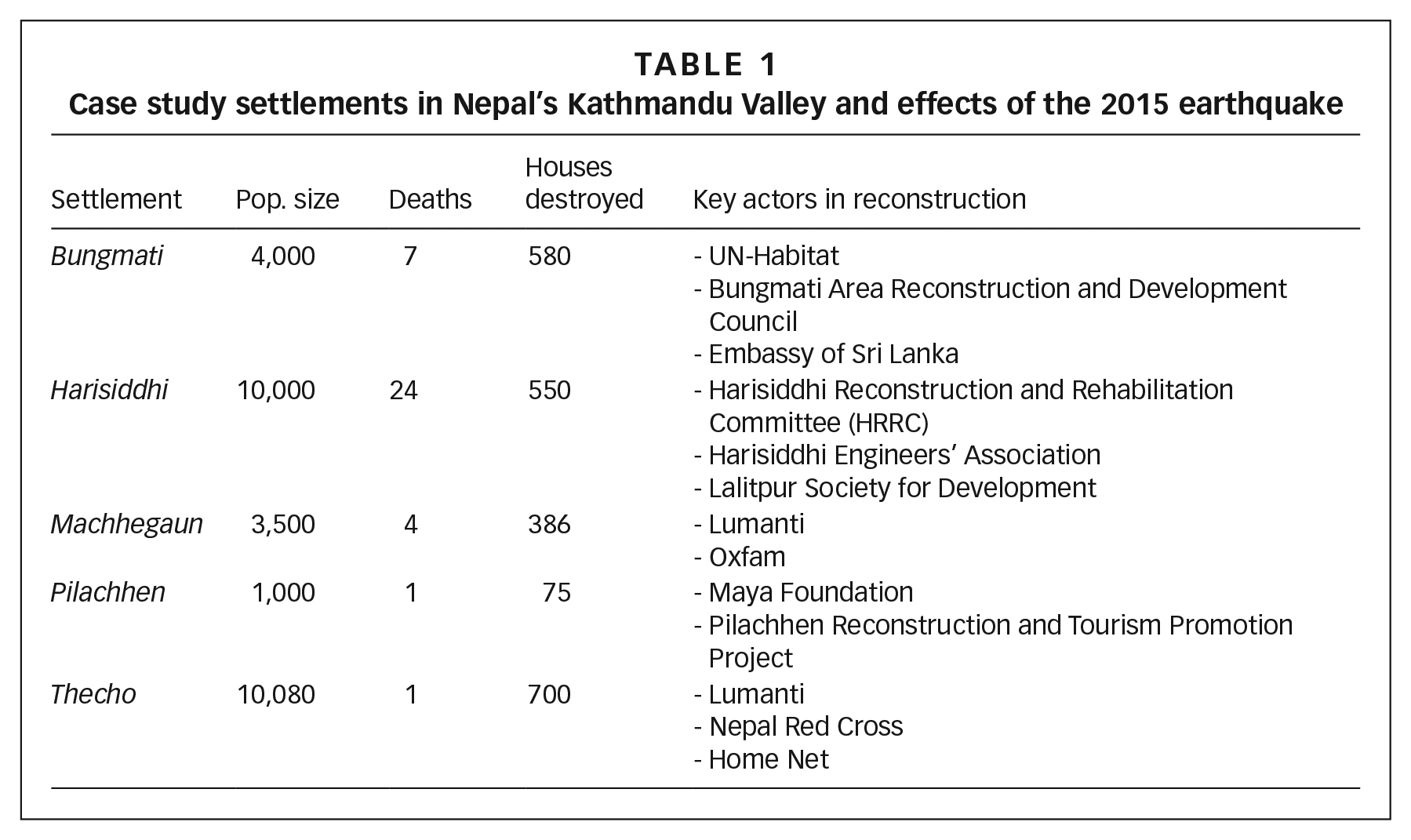
All five of our case study settlements suffered significant structural damage, livelihood disruptions and loss of life (Table 1). The extent of the structural damage caused by the earthquake varied significantly within each settlement, with some buildings collapsed, some moderately damaged, and some not affected. Structural assessments conducted after the earthquake suggest that multi-storey traditional buildings were especially vulnerable to collapse if they had not been well-maintained, in part because many historic buildings had been used for low-income rental housing. This suggests that resident affluence may have been a contributing factor to structural vulnerability.
Case study settlements in Nepal’s Kathmandu Valley and effects of the 2015 earthquake
These settlements are mainly occupied by Newars, an ethnic community indigenous to the Kathmandu Valley. The physical structure of Newari settlements is the result of several centuries of construction, and reflects their social organization, cultural practices and aesthetics. The Newars have historically been artisans, traders, potters, weavers and farmers. Newar settlements are compact, with interconnected buildings framing courtyards and narrow alleyways. Houses commonly have commercial space on the ground floor, topped by residential units. The exceptional architectural style and embedded cultural characteristics of Newari settlements have been recognized by the UN Educational, Social and Cultural Organization (UNESCO) as the collective Kathmandu Valley World Heritage Site.
Important to our study is the socially cohesive nature of the settlements, and the informal governance mechanisms within Newar communities that influence decision-making, labour mobilization, and access to various forms of capital. The socio-cultural life of the Newar was historically governed by a guthi, an endogenous organization consisting of senior members of the settlement and representatives of households. The chairman and senior residents decide through consensus who occupies leadership positions. Guthis mostly oversee mortuary rituals and religious and cultural festivals, including maintenance of traditional structures such as temples, rest houses, and waterspouts.
While guthis reflect the Newars’ strong organizational capacity and inclination towards collective action, they are less involved in functional issues related to urbanization and modernization, such as upgrading and maintaining physical infrastructure. These domains are more the concern of neighbourhood associations or neighbourhood improvement committees, which assume considerable responsibility for practical administrative matters. However, membership in such associations is only open to landowners. Property ownership, based on historical practice and mandated by the Local Self-Governance Act 1999, is a necessary legal condition for residents to formally participate in the processes of local governance.
IV. Disaster Governance in Nepal
In 1990, the centralized control of the Nepal monarchy was replaced by a multiparty democratic system.(30) This was followed by a series of institutional measures geared toward decentralizing governance and liberalizing the economy. The Local Self-Governance Act 1999 (LSGA), focused on the devolution of governmental authority from the national to district, municipal and ward offices, was a critical step towards this decentralization, which has important implications for disaster governance in Nepal.(31)
Several provisions in the LSGA invite citizens’ active participation in local development processes in collaboration with government bodies under the rubric of “public–private partnership”, “users’ committee”, or “self-help” – terms that have become catchphrases in the context of local development and governance in the post-1990 period in Nepal.(32) These discourses were meant to instil a sense of ownership and encourage community mobilization among people as they carry out local development projects, such as laying down water pipes, black-topping roads, etc.
The LSGA mandated that official planning processes solicit proposals for local community development projects from users’ committees. Under such formal arrangements, citizens, as part of a user committee, provide part of the funds necessary to implement a development project. The municipality provides matching funds. While this push towards local self-governance has faced major challenges, it is relevant to point out that there was momentum to decentralize governance before the 2015 earthquake.
a. Disaster governance before the 2015 earthquake
Following the Hyogo Framework, the GoN developed a National Strategy for Disaster Risk Management (NSDRM) in 2009 with support from the UN Development Programme (UNDP) and the European Commission.(33) This document provided a comprehensive blueprint for Nepal to mitigate hazard risk and manage disaster responses. The proposed institutional structure called for the creation of a National Disaster Management Authority to oversee all facets of disaster management and post-disaster response. The plan allocated significant authority for hazard mitigation and disaster response to sub-national officials, in an explicit decentralization of governance. The plan anticipated building capacity at district, municipal and ward levels, and recommended that national plans such as bylaws and building codes be flexible so they could be modified by lower levels of government to better suit local contexts. The organizational structure in the NSDRM resulted from the assignment of new responsibilities to existing government agencies (Table 2).
Disaster management implementation structures as proposed in the 2009 National Disaster Management Strategy, and created in response to the 2015 earthquake
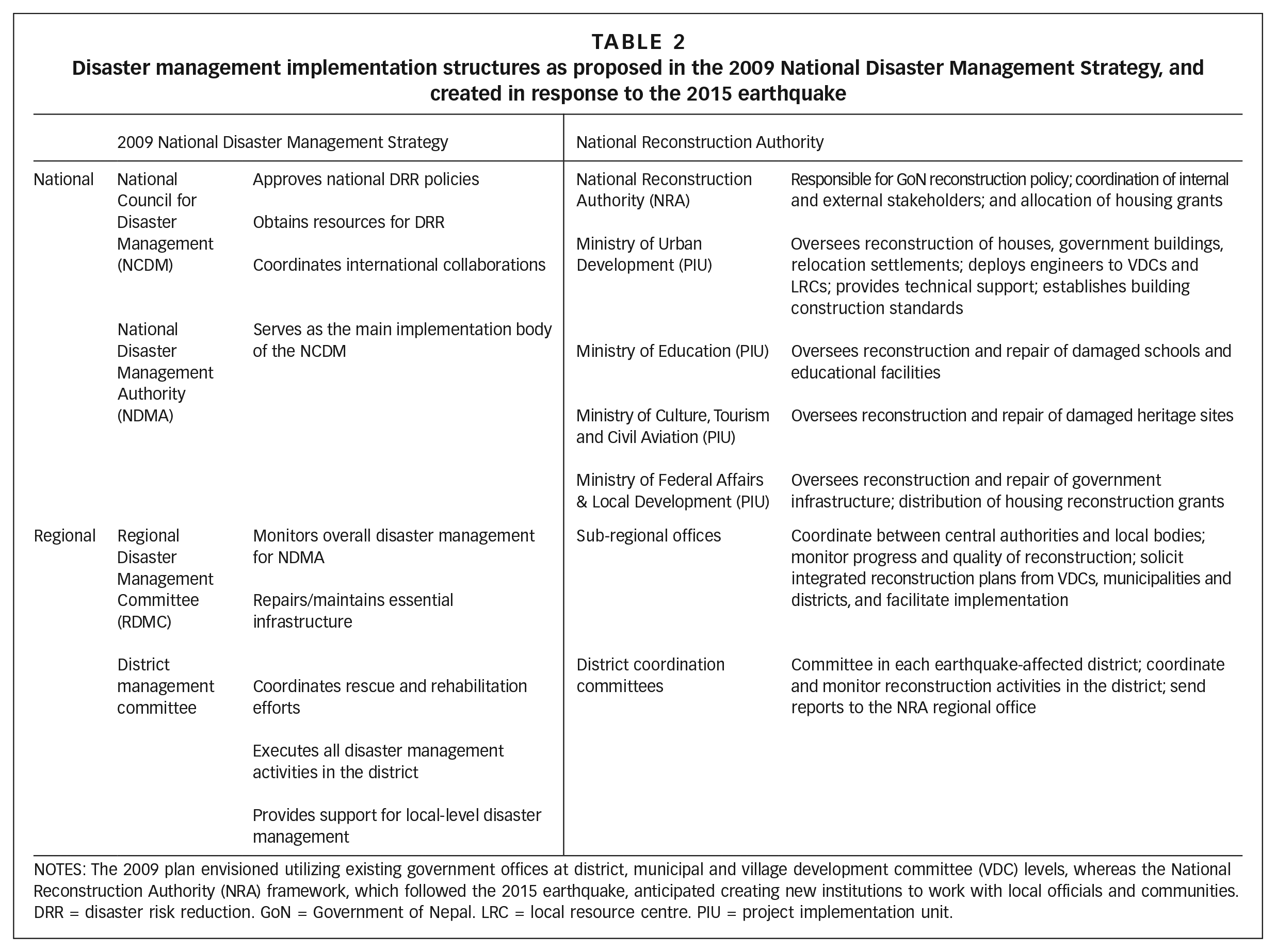
NOTES: The 2009 plan envisioned utilizing existing government offices at district, municipal and village development committee (VDC) levels, whereas the National Reconstruction Authority (NRA) framework, which followed the 2015 earthquake, anticipated creating new institutions to work with local officials and communities.
DRR = disaster risk reduction. GoN = Government of Nepal. LRC = local resource centre. PIU = project implementation unit.
The 2009 strategy was not formally implemented. However, together with the Hyogo Framework, it provided the basis for the Nepal Risk Reduction Consortium (NRRC), a coalition of government, NGO and private sector stakeholders to “reduce Nepal’s vulnerability of natural disasters”.(34) One of the five “flagship” priorities of the NRRC was policy/institutional strengthening, which focused on building the practical capacities of local government officials with regard to implementing the National Building Code. This involved projects to provide technical expertise to government officials at the district, municipal and ward levels; to masons and contractors; and to residents to ensure adherence to earthquake-resistant construction – with a particular focus on urban areas. While an assessment in 2014 reported significant deficiences in the technical and administrative capacity of municipal and ward offices to properly inspect buildings and issue building permits, a number of projects were being carried out by donors and NGOs to reinforce these capacities at the time of the earthquake. In short, district, municipal and ward offices were all expected to play important roles in disaster response, and efforts were underway to build their respective capacities to do so at the time of the earthquake.
b. Disaster governance after the 2015 earthquake
Immediately following the earthquake, numerous government agencies at all levels participated in relief efforts. At the local level, ward offices played a significant role as a conduit for distributing relief materials and conducting preliminary damage assessments. An initial beneficiary list was sent to the Disaster Management Division within the Home Ministry, which allocated up to US$ 150 per beneficiary as a “relief fund”, and an additional US$ 100 as a “winter relief fund” to earthquake “victims”. This flow of information, money and decision-making was replaced when the NRA was formed.
The NRA, which initially lacked formal legal status, was led by the prime minister until August 2015, when a new CEO was appointed. The CEO had previously served as the vice chairman of the National Planning Commission, which led the Post-Disaster Needs Assessment (PDNA) in 2015 – a two-volume document that provided a comprehensive account of the earthquake-induced damage, and identified subsequent needs.(35) The PDNA was prepared in collaboration with a consortium of the EU, World Bank, UNDP, Asian Development Bank, and Japan International Cooperation Agency, and focused mainly on policies for reconstruction in rural areas. However, less than a month after the appointment of the CEO, as part of a tussle between political parties vying for the NRA chairmanship, the GoN suspended the NRA, citing its lack of legal status.
Between September and December 2015, all reconstruction-related matters were overseen centrally by the Ministry of Federal Affairs and Local Development and the Ministry of Urban Development, and were carried out locally by the municipal and local government bodies, such as village development committees (VDCs) and ward offices. During this period, reconstruction largely stalled, as all stakeholders waited for an officially approved reconstruction policy, damage assessment, beneficiary list, and new bylaws and building codes – all of which were promised by the GoN. The NRA was revived in December 2015 with the appointment of a new CEO – this time as a formal legal body backed by legislation with a stated mission statement and organizational structure.
The NRA structure and mandate were influenced by reconstruction agencies established in Pakistan and the state of Gujarat in India.(36) This was done to ensure GoN control over the reconstruction as well as to eliminate the poor coordination of aid agencies and the inefficient use of resources widely reported in other post-disaster situations.(37)
The Reconstruction and Resettlement Policy 2072 (2016) acts as the main guide to all NRA activities. According to the NRA progress report in April 2016, rules and guidelines were approved for housing grant distribution; environmental impact assessment; land acquisition; public procurement; reconstruction regulation; land registration; and working with non-governmental organizations.(38) The key roles of the NRA are listed in Table 3.
Key roles of the NRA related to reconstruction
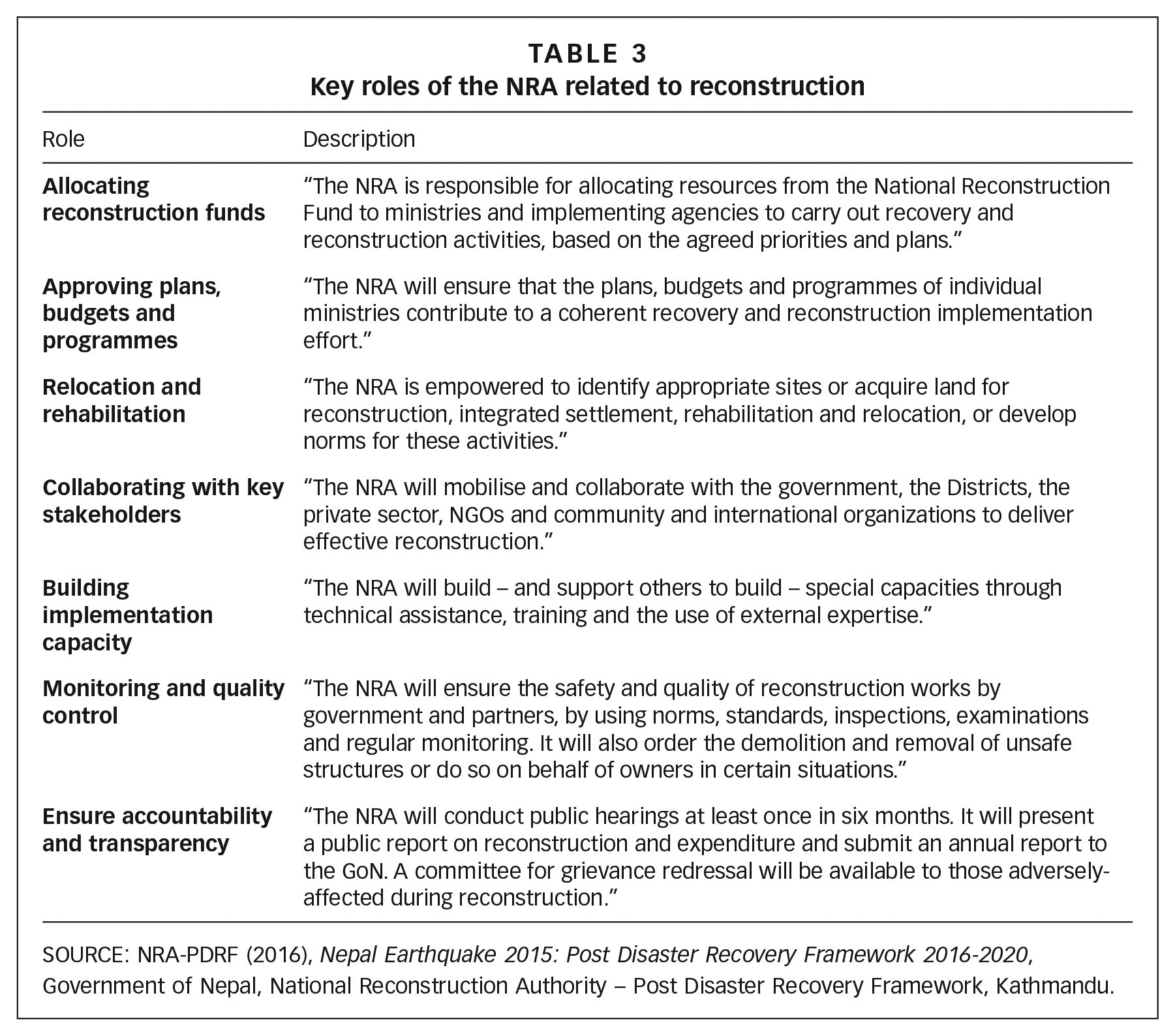
SOURCE: NRA-PDRF (2016), Nepal Earthquake 2015: Post Disaster Recovery Framework 2016-2020, Government of Nepal, National Reconstruction Authority – Post Disaster Recovery Framework, Kathmandu.
c. Structure of the NRA
The NRA consists of an advisory committee, a steering committee, and an executive committee. The advisory committee has two members: the prime minister and the leader of the main opposition party. The NRA partnered with four ministries that serve as “implementing agencies”: Ministry of Urban Development (MOULD), Ministry of Federal Affairs and Local Development (MoFALD), Ministry of Education, and Ministry of Culture, Tourism, and Civil Aviation. Within each ministry, the NRA established central project implementation units (CL-PIUs) to carry out practical tasks related to the reconstruction (summarized in Table 3). In theory, the CL-PIUs receive their budgets directly from the NRA and were granted the authority to approve reconstruction tasks and implement projects and programmes at the district level.
To incorporate local government and community-based organizations (CBOs), the NRA was charged with establishing seven “sub-regional offices” to coordinate between central and local authorities; 14 district-level project implementation units (DL-PIUs) to oversee coordination, implementation and monitoring of reconstruction-related activities at the district level; and 160 “local resource centres” (LRCs) to support community-based reconstruction efforts. These offices were intended to position the NRA closer to affected communities, and to provide training for local NGOs and CBOs to increase their capacity to rebuild. The LRCs were authorized to work with external donors and NGOs, as well as carry out field-level project activities with regard to beneficiary enrolment, training, communication and outreach, technical assistance, social mobilization, and reporting.
Perhaps the most important institutions for rebuilding houses are village development committees (VDCs) and local ward offices (WOs), which were authorized to oversee housing, infrastructure and community projects in their respective areas. Under the NRA guidelines, the VDC or the WO should work with a “mobile technical support team” provided by the LRC. These teams should consist of one engineer, one sub-engineer and one social mobilizer to assist with design approval, as well as the monitoring and evaluation of reconstruction projects. To be clear, this was the structure and the workflow as presented in the NRA guidelines, and as discussed below, does not necessarily reflect how things played out. In Section V we present data from our five case study settlements in the Kathmandu Valley to discuss how the NRA and the new institutional framework carried out their core functions and facilitated residential reconstruction.
V. Reconstruction of Historic Urban Settlements
All of our case study settlements were heavily damaged by the earthquake (Table 1). The five settlements share broadly consistent narratives for the emergency response in the first six months after the earthquake. The initial response was carried out by a mix of local residents, community-based organizations, international NGOs and local ward offices. This entailed provision of relief supplies (food, water, clothing, etc.) and medical assistance. Temporary shelter was provided by a more limited number of actors in coordination with local ward offices. This process varied among settlements, ranging from a Danish NGO providing over 200 complete prefabricated temporary shelters in Bungmati, to the distribution of corrugated tin sheets and tarps to residents in Pilachhen from small donors. Once temporary shelters were in place, local volunteer efforts were undertaken to clear rubble, stabilize damaged structures, and carry out basic repair of communal and religious infrastructure. This was largely conducted by local residents, with limited aid secured on an ad hoc basis. In all settlements, some semblance of functional routines was evident after four–six months; for instance, children were back in schools, and small business activities resumed.
In this section we evaluate how well the NRA carried out its main roles with regard to housing reconstruction following the emergency relief period within our case study settlements. We then discuss steps taken by each settlement to rebuild, and the extent to which local reconstruction initiatives were supported by the NRA.
a. Assessment of the NRA support in case study settlements
In this sub-section we assess five key roles of the NRA vital for rebuilding within urban areas (summarized in Table 4).
Overview assessment of the “key roles” the NRA has played within case study settlements
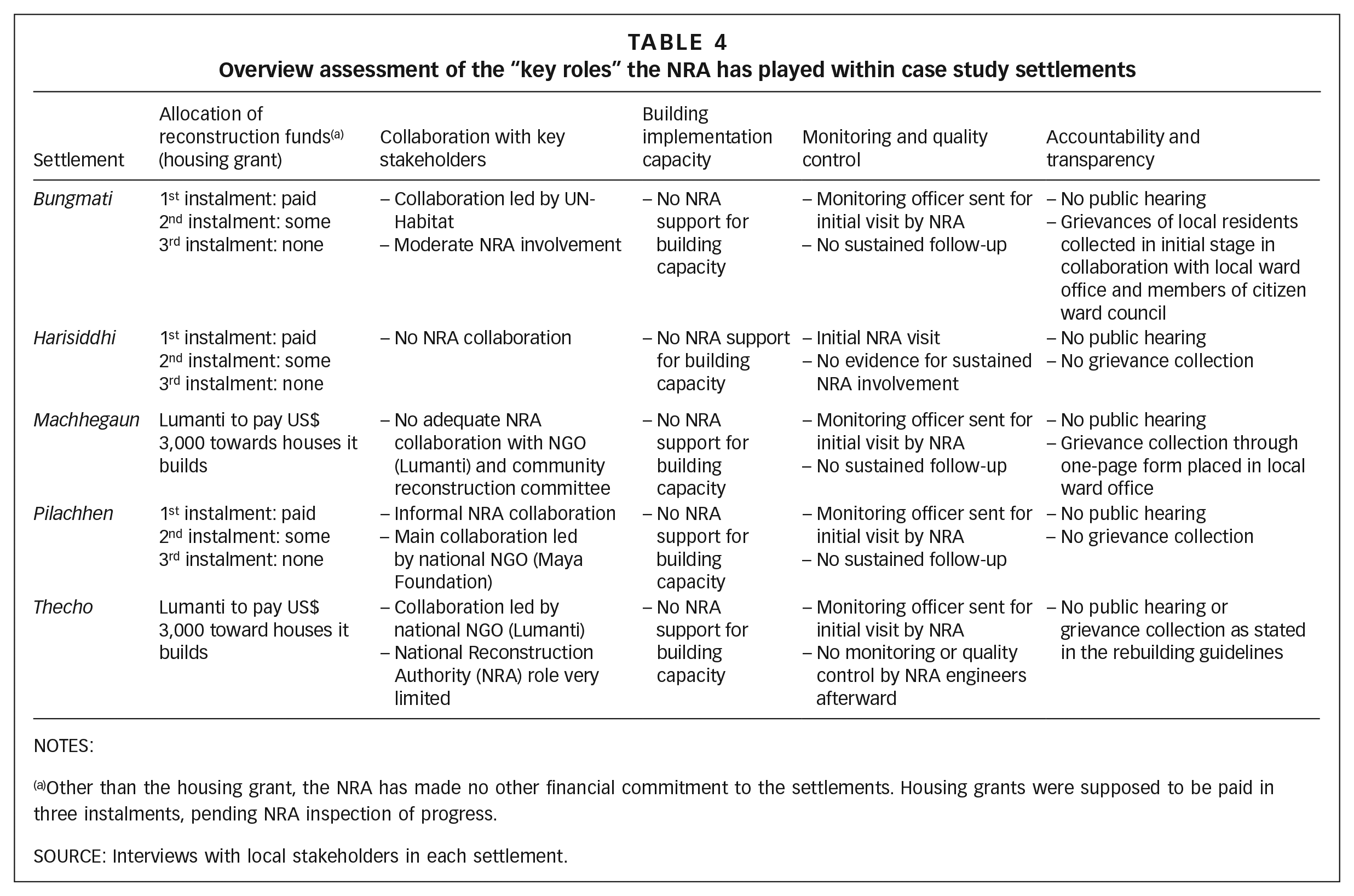
NOTES:
Other than the housing grant, the NRA has made no other financial commitment to the settlements. Housing grants were supposed to be paid in three instalments, pending NRA inspection of progress.
SOURCE: Interviews with local stakeholders in each settlement.
Allocation of housing grants was contingent upon the completion of the official damage assessment, carried out by Nepal’s Central Bureau of Statistics (CBS) with support from the United Nations Office of Project Services (UNOPS). The phase of the assessment that included the Kathmandu Valley and our case study settlements did not start until April 2016 (one year after the earthquake) and was completed in June 2016.(40) This delayed the drafting of lists of official beneficiaries and disbursement of housing grants by at least a year in all settlements. By the time this paper was written (June 2017), the majority of households listed as “beneficiaries” had either claimed the first tranche of funding, or had secured access to it (the government had deposited funds under the beneficiary’s name, which they can claim later). Many residents in these settlements are eligible to receive their second instalment, but funding has not been disbursed because NRA engineers have not provided a formal assessment to the NRA central office about the safety and integrity of housing plans. In Thecho and Machhegaun, a local NGO, Lumanti, has reached an agreement with the NRA, under which 115 households in each settlement from the government’s beneficiary list will receive the housing grant directly from Lumanti.
In Bungmati, local stakeholders and an architect working for UN-Habitat said there was very limited NRA coordination – they specifically cited the lack of coordination in rebuilding an important heritage temple site. In Machhegaun, residents hoped the NRA would help coordinate and resolve issues of land ownership, an NRA responsibility, but this never happened. In Harisiddhi, members of the community reconstruction committee reported that the NRA discouraged them from finding external partners to support locally designed rebuilding plans. The only evidence of significant NRA coordination is in Pilachhen, where there has been an informal working relationship between a local NGO, the Maya Foundation, and the NRA. The NRA has publicly made promises to the community that it would help provide funding, and mobilize donors to support the Pilachhen plan. The Pilachhen residents have also obtained promises from the executive officer of the Lalitpur sub-metropolitan city office to expedite approval of building designs. Our understanding is this was the result of the reconstruction committee in Pilachhen using connections to get the attention of the NRA.
Overall, we found that the NRA has provided little to no practical rebuilding guidance or assistance in our case study settlements, other than allotting the first tranche of the housing grants (which took a long time to arrive). Their slow formulation and dissemination of macro-level policy, and the failure to establish district implemention units and local resource centres to support local rebuilding has meant key governance functions were not effectively carried out. Local government officials from the municipal and ward levels have been left in an awkward position, as they lack the capacity and resources to deal with their core functions, and are uncertain about the roles they should be playing. We find that the failure of the NRA to work with and empower muncipalities and wards has been a major strategic mistake, and has led to significant delays, while failing to utilize existing government officials and infrastructure. Formal governance structures have made relatively small contributions to rebuilding houses in urban areas – and it can be argued that formal governance structures have impeded rebuilding. The absence of NRA support for reconstruction prompted all of the case study settlements to form community reconstruction committees that draw upon pre-earthquake informal governance structures and enter into opportunistic collaborations with NGOs and other organizations.
b. Community reconstruction committees
In three of the settlements (Pilachhen, Bungmati and Harisiddhi), rebuilding plans were coordinated by community reconstruction committees (Table 4). In all three settlements, the need for a cohesive community rebuilding plan was initially pushed by a small group of influential persons. In Pilacchen, the Maya Foundation, a local NGO run by a wealthly local businessman, proposed a rebuilding and redevelopment plan based upon leveraging cultural heritage to promote livelihoods through tourism (Pilachhen Reconstruction and Tourism Promotion Project – PRTPP). Reconstruction efforts are coordinated by a council of 13 influential local figures who serve as advisors, with the chairman of the Maya Foundation playing a central role. None of these members is elected, but community meetings have been held to obtain the consensus of residents for the plan, which aims to rebuild up to 100 houses and some communal infrastructure.
While efforts are loosely coordinated with ward and municipal offices, all operational aspects of the project are driven by the PRTPP and the Maya Foundation. This includes hiring an engineering company to design plans and build, and a financial structure through which homeowners contribute 25 per cent of the cost in cash and 25 per cent in labour. The Maya Foundation is working to secure the remaining 50 per cent through subsidized loans and donor support. As of June 2017, approximately 20 houses are under construction, with plans in place for the remaining structures. Following initial progress in Pilachhen, the NRA has touted the settlement as a model for rebuilding historic settlements, and has promised to facilitate rebuilding by expediting building permits and being flexible about the US$ 3,000 cap – in effect by cutting through red tape it created in the first place.
In Harisiddhi, a well-known social worker with political contacts helped form a reconstruction committee (Harisiddhi Reconstruction and Rehabilitation Committee – HRRC). The committee consists of local political leaders, senior residents, representatives of the guthi, and professionals with relevant expertise (architects and engineers). The reconstruction committee is not a formally registered body. The Harisiddhi plan was influenced by a rebuilding initiative in another settlement that had drawn the interest of the Indian embassy – and was based upon the somewhat misguided premise that the Indian embassy would sponsor reconstruction in Harisiddhi. The reconstruction proposal aims to rebuild communal infrastructure and private residences, using traditional Newari architecture modified to be earthquake resistant and to enhance commercial potential through home stays and facilities for tourism. The plan was prepared by a committee of approximately 20 local engineers, which obtained input through a series of community meetings open to all land-owning residents. The HRRC does not have any internal mechanisms to fund rebuilding – its plan is predicated upon securing external funds. To date, this has not been successful, and the plan has gained no traction. As of June 2017, approximately 30 households out of the more than 100 that lost their homes have moved on with rebuilding on their own without following the community plan. These individual initiatives, which are funded by residents, lack permits and are not based upon traditional Newari design.
Local leaders in Bungmati formed the Bungmati Area Reconstruction and Development Council (BARDC) on the advice of the local ward office to help plan rebuilding. The committee contains approximately 20 members, representing local youth clubs, the guthi, and different neighbourhood associations in Bungmati – with members serving two-year terms, and nominated by community consensus. In a high-profile collaboration with UN-Habitat, BARDC developed a comprehensive plan framed around the restoration of traditional Newari heritage and promoting tourism. The Bungmati reconstruction plan, called Revitalizing Bungmati: An Action Plan, was a highly touted model of how to rebuild historic urban settlements as part of a community-based development initiative. While the project had lots of exposure and high-profile endorsement, it did not have a clear plan for funding rebuilding. As of June 2017, little progress had been made implementing the plan. A small number of individual residents have begun rebuilding using their own resources through contractors, but unlike in Harisiddhi, they have adhered to the Newari design proposed in the rebuilding plan.
Two settlements (Machhegaun and Thecho) partnered with Lumanti to co-develop rebuilding proposals. Lumanti has a long history of working on issues related to urban poverty and housing, and had projects in both settlements before the earthquake. Lumanti’s plan in both settlements, according to its website, is to “facilitate and assist earthquake affected families and communities to plan and rebuild hopes, homes and basic infrastructure making communities better, safer, resilient, and sustainable for a dignified life of the people.” In Machhegaun, Lumanti asked residents to form a users’ committee to plan the reconstruction. Two users’ committees were formed, each with 15–20 members, with Lumanti insisting that the committes have at least one female member, who should serve as treasurer. Reconstruction plans are not driven by a common aesthetic or preservation of Newari heritage, but rather respond to the context of the house and the wishes of each homeowner. With the support of the Community Architect Networks of the Asian Coalition of Housing Rights, Lumanti has assisted the community to develop a master plan, and is providing a housing grant (up to US$ 3,000) to 115 households selected from the NRA’s list of “beneficiaries”. This support replaces the US$ 3,000 to be provided by the NRA. Residents need to obtain the balance of the funding on their own, and so priority was given to households that were able to obtain the necessary financing. As of June 2017, over 35 houses were under construction, and there were plans to finish all houses by February 2018.
In Thecho, Lumanti encouraged already existing neighbourhood committees to form a community-led reconstruction committee. This led to the formation of a number of users’ committees, with responsibilty for such issues as waste management and resolution of land disputes. Lumanti worked with the local community to design a plan that required land pooling to allow residents to adhere to new bylaws requiring a minimum plot area for new houses. Similar to Machhegaun, Lumanti is providing grants of US$ 3,000 to 115 households to support rebuilding, with the balance of the funds coming from residents. As of June 2017, approximately 50 houses have been completed or are under construction, with plans in place for the remaining structures.
VI. Discussion
Our data from the settlements in the Kathmandu Valley make a clear case for decentralized disaster governance in urban areas. The NRA has not effectively supported reconstruction in our case study settlements, or reinforced local government offices. This has forced communities to undertake their own reconstruction plans, which in turn are restricted by NRA policies and lack of local governance capacity. There is a consensus amongst local stakeholders that rebuilding has been limited by the lack of a coherent government reconstruction policy for urban areas – a key NRA responsibility. There is clear frustration about the wait for new building codes and bylaws that were supposed to be produced by the NRA in a timely manner. Additionally, some of the new building bylaws make it virtually impossible to rebuild historic urban settlements. Requirements about building height, minimum plot size, spacing between buildings and width of streets do not align with traditional styles, layouts and patterns of land ownership in the Newari settlements. Pegging the disbursal of housing grants to the NRA’s official damage assessment forced residents in urban areas to wait over a year to receive their first tranche of funding. The subsequent lack of follow-up evaluation by NRA engineers, which was supposed to be provided through local resource centres, has further delayed the second and third tranches of the housing grants. Finally, the NRA did not utilize local government and community governance structures to compensate for the NRA’s limited capacity on the ground.
In contrast, in all of our case study settlements, local groups designed comprehensive, integrated community development plans that emphasize physical, social and economic development; participatory and inclusive frameworks; special provisions for members of marginalized groups (such as poor households, widows, etc.); and inclusion of hazard mitigation features. All of the proposals we reviewed are aligned with the principles in the GoN master plan, as well as the general consensus promoted by international organizations for community-based reconstruction efforts. In short, what we have found in our case study settlements is what humanitarian actors hope to encounter in a post-crisis environment – well-thought-out, creative local initiatives.
However, there is an important cavaet – members and potential participants within rebuilding plans are restricted to landowners. This excludes pre-earthquake renters, tenants and squatters. While this is aligned with GoN policy in which users’ committees are composed of landowners, it means that potentially significant numbers of earthquake-affected persons are not factored into rebuilding plans. Given the high numbers of renters who populated urban settlements in the Kathmandu Valley before the earthquake, this has the potential to exclude large numbers of stakeholders from beneficiary entitlements.
As of June 2017, over two years after the earthquake, our case study settlements demonstrated varying levels of reconstruction progress. The settlements that have made the most progress rebuilding were strongly supported by local NGOs. The interventions of the Maya Foundation in Pilachhen and Lumanti in Machhegaun and Thecho to operationalize plans through securing funding, organizing land pooling and collective labour, and either securing or ignoring building permits, seem to account for most of the progress. In contrast, Harisiddhi and Bungmati have been let down by their reliance upon high-profile external actors, such as UN-Habitat and foreign donors, which never came through with anticipated funding. In these settlements, residents have begun to give up on community proposals and rebuild on an individual household basis.
While local stakeholders have played important roles in initiating reconstruction plans for their communities, is clear that they could have used considerable support from the GoN at all levels. The mechanisms in the NRA guidelines for supporting local reconstruction were not effective. In particular, the plan to create new local governance institutions in the form of district implemention units and local resource centres only served to marginalize and reduce the effectiveness of the municipal and ward offices already in place. The NRA did not draw upon disaster management frameworks spelled out in the 2009 National Disaster Management Strategy, which anticipated district, municipal and ward officials playing significant roles in disaster response. We suspect that reinforcing the capacity of local government offices through additional personnel and skills enhancement to deal with the demands of the reconstruction would have better served local reconstruction needs, and helped build long-term disaster governance capacity in the Kathmandu Valley.
VII. Conclusions
In an interview in March 2017, the CEO of the NRA, Govinda Pokharel, candidly stated that the NRA was not effective.(42) He cited three core reasons: the NRA lacks human resources with sufficient capacity; donor funding is often offered conditionally, which does not adhere to NRA guidelines; and new bylaws are too stringent and so it is almost impossible for many people in Nepal to conform to their provisions. This admission, which aligns with what we have presented in this paper, raises important questions about the utility of creating ad hoc disaster management agencies. One of the main arguments for establishing new centralized governance structures is the need to compensate for the limited capacity of sub-national levels of government, and to provide competent, effective and accountable disaster management.
It is clear that before the 2015 earthquake, governance capacity at all levels in Nepal faced challenges in terms of capacity, resources and political contestation. As mentioned by Jones et al.,(43) local stakeholders questioned the effectiveness of local government officials for disaster risk reduction (DRR) and development projects. However, our experiences studying the aftermath of the 2015 earthquake show that stakeholders also have doubts about the effectiveness of national-level officials, due to two years of frustration and disappointment with the pace of reconstruction. This brings us to the question of whether it is realistic to anticipate that designing a new “top-down” governance structure with a finite mandate will help post-disaster reconstruction efforts in a country that already has limited or strained governance capacity. A successful NRA would have required finding large numbers of available, qualified staff members who would be able to engage with various levels within the Nepal government, as well as citizens, external donors and NGOs. As we see in Nepal, critical time was lost establishing the NRA, and it was never able to build a suitable team to carry out its core mission.
Much of the focus on decentralization and community-based approaches common in DRR relates to hazard mitigation as promoted by Hyogo and Sendai. While not questioning the importance of mitigation programmes, the situation in Nepal shows that there are real differences between efforts to increase resilience before a disaster, and actually responding to one. Many of the core tasks needed to rebuild urban areas are deeply embedded within everyday governance structures. It is not realistic that such core local government responsibilities can be taken care of at the national level through “top-down” institutions or transferred to community-based organizations. Rather, it is important to work with existing local institutions and governance structures, and help build the needed capacities and knowledge to get things done in an urban environment. The GoN response was to reconfigure government roles by creating an entirely new structure of authority and governance that had no previous operational experience or working relationships with any of the key stakeholders involved in urban governance. This took the place of reinforcing the relevant existing governance capacity through support to district, municipal and ward officials. Finally, as demonstrated by the struggles of the community reconstruction committees to to carry out their plans, the NRA lacked the flexibility and mechanisms to support community-driven rebuilding initiatives.
In response to the Hyogo and Sendai frameworks, Nepal developed an elaborate set of disaster mitigation and management plans – earning it international applause for its efforts. However, following the 2015 earthquake, the GoN sidestepped the National Strategy for Disaster Risk Management, and opted to construct a new, centralized framework in which responsibility for disaster response was allocated to national-level authorities who were not equipped to respond effectively. The Nepal case should provide a cautionary tale about the dangers of celebrating on-paper disaster management plans, and serve as a reminder that decentralizing some aspects of disaster response is not just a nice ideal – but rather a practical necessity when rebuilding urban areas.
Footnotes
Funding
This paper is funded by the UK Department for International Development (DFID) through the Urban Crises Learning Fund. The fund is part of DFID’s Urban Crises Programme on the urban aspects of humanitarian action, which involves IIED and the International Rescue Committee (IRC). This work comprises Earth Observatory of Singapore contribution no. 159. This research is supported by the National Research Foundation Singapore and the Singapore Ministry of Education under the Research Centres of Excellence initiative.
1.
2.
4.
10.
13.
17.
23.
25.
Adams (2013);  .
.
26.
27.
28.
In this paper we use the term “community reconstruction committee” to refer to collective efforts based within the case study settlements to develop and implement reconstruction plans. As we discuss in more detail below, these are each unique collectives, and have varying levels of formality.
29.
In each settlement, we picked five interviewees from the list of earthquake victims provided by the ward office, based on caste, gender and income. The semi-structured questionnaire touched on initial responses following the earthquake; ongoing reconstruction plans and activities; and future plans related to rebuilding. At the community level, we interviewed either the chairperson or secretary of each community reconstruction committee, with several follow-up interviews, paired with participant observation of reconstruction activities. Interviews with ward secretaries were preceded by informal conversations about reconstruction, and followed up with periodic phone interviews to track progress. We also conducted interviews with the municipal head and the head of the Urban Housing and Heritage Conservation Division (UHHCD) of the National Reconstruction Authority (NRA), and with the staff of the Nepali NGOs involved in three of the case study settlements (Lumanti and the Maya Foundation).
31.
This tiered system of governance may undergo some changes under the new federal state structure. In this paper we refer to ward, municipal and district government offices. A ward office is the smallest administrative unit of the municipal government. A ward office is led by a locally elected ward chairperson, along with four other elected members. A ward council serves as a conduit between the municipal council and local community. A municipality oversees a wide range of development projects within the city related to road maintenance, waste management, infrastructure upgrading, etc. The municipal office coordinates its activities with agencies such as the Kathmandu Valley Development Authority, the Road Department, the Department of Urban Development and Building Construction, etc. Municipalities can collect local taxes to provide part of their revenue stream. District Coordination Committees – DCCs (formally District Development Committees) are responsible for coordinating and overseeing development and governance-related work within the municipal and local bodies. This includes allocating financial resources and staff members to the lower-tier governance structures where necessary.