




Abstract
This paper considers how to make pro-poor climate change adaptation more effective in the city of Chittagong. Drawing on discussions with residents in informal settlements and interviews with staff from government agencies, NGOs and donors, it shows the lack of connection between the formal institutional structure for disaster preparedness and the groups most at risk from extreme weather disasters and their community level actions. There is no clear definition of roles among local government agencies with regard to climate change adaptation. Although there is a donor-funded programme to reduce poverty and disaster risks, this is not being implemented in the settlements most at risk from landslides. Neither are there any measures underway to address the needs of the residents in these high risk settlements, in part because of the financial weakness of local government. Nor is there much support for this from national government – since national climate change adaptation policy does not consider urban adaptation and strengthening urban government capacity to reduce the vulnerability of the extreme poor as a priority. NGOs undertake programmes for community-based disaster risk reduction but their scale and scope are limited by not being integrated into local government.
I. Introduction
Rapid urbanization combined with the impacts of climate change is increasing human vulnerability in many cities in low-and middle-income nations.(1) Much of the physical expansion of housing in cities in these nations occurs on hazardous sites such as flood plains, coastal areas and unstable hill slopes. Most of the housing on such sites is of poor quality, built on land that is occupied illegally and that lacks the necessary infrastructure to protect inhabitants from flooding and landslides. Many case studies have shown that as a result of living in high risk locations with little or no protective infrastructure, a high proportion of urban dwellers in these settlements are severely affected by heavy rainfall.(2) The risks are increasing, as climate change brings rising temperatures and more intense and often erratic rainfall, as well as sea level rise in coastal cities.(3) Climate change can create or exacerbate risks for urban areas, and adaptation to climate change needs to address the risks faced by low-income groups in general and the poorest groups in particular.
Chittagong, the largest port and the second largest city in Bangladesh, has a population estimated at more than 4 million inhabitants.(4) The Karnafulhi River lies to the south, the coastal plain to the west and the flood plain of the Halda River to the east.(5) The core of the city is some 15 kilometres upstream of the river mouth where the Karnafulhi meets the Bay of Bengal. The city is formed of hilly land extending from the north, with lower elevations near the river. Given its favourable coastal location and easy accessibility for regional and international trade, the city has developed as an important commercial hub for the country. The coastal ecosystems in Bangladesh also provide livelihoods for millions of people.(6) Although the location has many economic advantages, the city is at risk from cyclones, waterlogging and landslides, and Chittagong and its adjacent coastal areas have experienced a number of cyclones over the last decades.(7) Most catastrophic was the tropical cyclone on 29 April 1991, which killed 150,000 people who were living closest to the city’s seashore and in other coastal districts of the country.(8) The cyclone caused not only a loss of life but also extensive damage to houses and food grains and the displacement of many people from their homes. Industrial losses were estimated at US$ 390 million at the time.(9) All kinds of commercial activities and port-dependent livelihoods in the city were disrupted for a month due to the cyclone.
Over the last few decades landslides have become an increasingly serious hazard, with much of the city’s expansion a result of hill-cutting for unplanned urban development. Since 1997, 15 landslides have killed nearly 400 people in the city and adjacent small urban centres;(10) for example, the landslide disaster in June 2007 that was triggered by intense rainfall killed 127 people and affected 2,072 families in five informal settlements.(11) The formation of informal settlements (generally termed “slums”) on hill slopes with unplanned hill-cutting is the main cause of vulnerability to landslides.(12) These have caused not only large numbers of deaths and physical injuries but have also swept away houses, caused damage to household goods and blocked road communication and utility lines in the affected settlements. Due to ineffective land use management in the hills and a lack of alternative housing sites for the growing low-income population, many informal settlements have developed along hill slopes, which are home to nearly 500,000 low-income people. The more concentrated and extreme rainfall patterns that have been related to climate change are likely to exacerbate the risks of landslides for the residents of these settlements.(13)
Although the risks of urban flooding and waterlogging, and the vulnerability of poorer groups to these, have been widely recognized and documented in Bangladesh, city and local governments all over the country face many barriers to taking the necessary actions towards long-term pro-poor adaptation. Poor communities, for the most part, are ill-prepared to cope with these shocks and to adapt to climate change. In Chittagong, there has been limited assessment of likely local climate change impacts, and there is little information available to either the government institutions with responsibility for adaptation or to poor communities in the city. Local government agencies and NGOs have particular initiatives for improving water and sanitation (as well as providing educational facilities), which may, to some extent, improve the environment in informal settlements. Yet there is no consideration given to climate change adaptation – for integrating measures to build resilience into urban settlements and governance. This paper focuses on institutional responses in Chittagong and considers whether and how these have addressed the climate-related vulnerability of the urban poor and the related adaptation issues. Particular attention is given to landslide-affected communities in the city.
II. Methodology
This paper draws on a review of existing literature as well as on focus group discussions and interviews in three informal settlements that were affected by the landslides in 2007, namely Matijarna, areas around Batali Hill and Lebubagan (Figure 1).(14) Each of four focus groups comprised 7–8 members and included people drawn from the settlement, professionals working there and the local ward commissioner. Care was taken to ensure that women were included. Each discussion lasted 80–100 minutes and explored the perceptions of local residents regarding vulnerability to climate-related hazards and their access to government institutions in Chittagong.
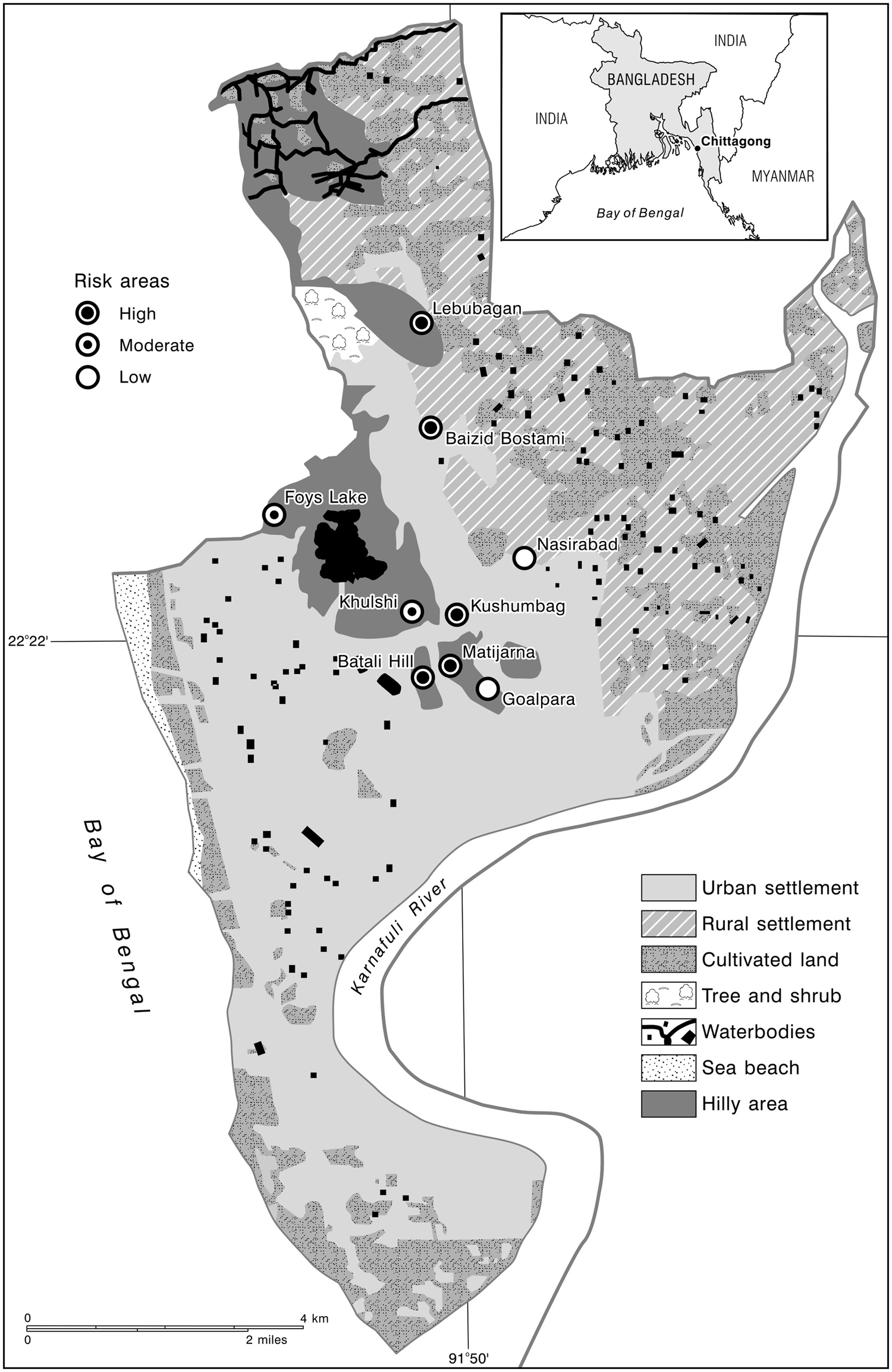
Landslide-prone areas in Chittagong city
Semi-structured individual interviews were conducted with 15 people drawn from government departments, NGOs and development agencies involved in urban planning and disaster management at urban and national levels. The focus of the interviews was the institutional response to addressing climate-related vulnerability among the poor in Chittagong.
In addition, secondary information sources such as the National Disaster Management Plan, the National Adaptation Programme of Action (NAPA) and other related literature were reviewed to gain a better understanding of the basis for intervention by urban government for pro-poor adaptation to climate change. The literature included government reports,(15) newspaper articles and other relevant publications.(16) All aspects of the research sought to examine the strengths and barriers affecting adaptation to climate change in Chittagong in four areas:
III. Disaster preparedness for urban adaptation
Bangladesh has a two-tier disaster management system in operation, at the national and local levels. The Standing Order on Disasters (SOD), the only disaster management Act, guides pre- and post-disaster management-related activities for all responsible agencies across both levels.(17) The national level, which may be called “policy level” or “ministerial level”, mainly focuses on the following:
coordination among ministries;
creating the National Disaster Management Plan;
reviewing disaster management actions; and
collaborating with international donors, NGOs and local disaster management committees.
The major disaster management strategies of Bangladesh currently follow the following steps:
risk reduction through preparedness among responsible agencies and target communities;
post-disaster emergency responses; and
development in affected areas.
In keeping with the National Disaster Management Plan, Chittagong has a disaster management committee. The mayor of Chittagong City Corporation chairs the committee that coordinates with local government departments such as the Chittagong Development Authority, the Bangladesh Water Development Board, the Meteorological Department, the defence authorities, the emergency authorities, ward representatives and NGOs. The committee usually sits during the pre-monsoon period to define roles and responsibilities regarding pre- and post-disaster activities, and can also call emergency meetings. However, in practice, these agencies are hardly coordinated regarding, for instance, risk assessment or disaster preparedness. One of the organizational respondents noted that:
“Landslide risks during heavy rainfall were not well addressed by the city disaster management committee. There was a lack of systematic communication between the Meteorological Department and the existing disaster management committees to work for emergency actions around the vulnerable slums along hill slopes.”
The local Meteorological Department usually provides forecasts for heavy rainfall and issues a pre-hazard warning to the departments or agencies with responsibility for disaster preparedness.(18) The highest rainfall (425.2 millimetres in 24 hours) was recorded on 11 June 2007 by the local Meteorological Department;(19) however no specific responses, either before or during the rainfall, were undertaken by any of the agencies in the local disaster management committee because of their undefined roles. Landslide-affected communities were also not aware of the measures they should take before and during heavy rainfall and were not supported by rescue teams to move to a safe location. A respondent in one of the focus groups noted:
“We presented the vulnerability issue to city corporation authorities, but they could not conduct any survey for landslide risk assessment along the informal settlement. If there were early warning and communication from government with other agencies and us, there would be fewer deaths from landslides.”
Disaster risk reduction among the low-income groups living in informal settlements is hindered by poorly defined roles for urban government agencies and little coordination between them. This is hardly unique to Chittagong. A comparative study in 10 Asian cities highlighted how undefined roles and responsibilities of urban government agencies obstructed integrated urban development in general and pro-poor climate change adaptation in particular.(20)
The National Disaster Management Plan has recognized a number of urban hazards, including waterlogging, fire, earthquakes and landslides, but no risk reduction policy for these has been developed through national and urban government agencies. Only Chittagong City Corporation, as a locally elected government agency, addresses its responsibilities for infrastructure development, for instance through repairing roads and drainage systems inside the informal settlements in order to avoid waterlogging. However, it faces serious financial constraints and is not incorporating adaptation to intense rainfall into its responses. To a question regarding waterlogging risks in the city, one of the organizational respondents noted:
“We propose that the drainage system must be regularly maintained to keep it clean, free of silt and in a state of good repair as a continuous process. But at present, the maintenance operation is limited by the inadequate budget and staff required for the expanded urban areas.”
The roles of urban government agencies in Chittagong have not evolved in relation to climate change adaptation. After the 2007 landslides, vigilance teams were formed under the city corporation to monitor informal settlements that were at risk and to create awareness among their residents of the need to move to temporary safe shelters during rainfall. But these vigilance teams only included city corporation staff, who lack training for disaster management responses and typically undertake only routine works. The teams have not proved able to encourage and support the engagement of residents in community-based disaster preparedness.
IV. Integrating adaptation in urban planning
Prior to 1953, urban planning in Bangladesh was developed without taking environmental considerations into account. The Town Improvement Act was first promulgated in 1953 to regulate land development in urban areas,(21) but only provided policy guidelines for municipal authorities to execute land use control and a building plan. It was the responsibility of the respective municipalities to develop these – and municipal authorities did not address the growing and emerging range of risks from land use patterns within the growing and expanding cities. Any measures to address these issues were constrained by the lack of legal frameworks for regulating urban land use – and so informal settlements grew rapidly with little or no provision to address climate-related risks.(22) The risk of landslides is one of the consequences of this inability to manage urban expansion. A respondent from the local office of the Bangladesh Railway Department explains:
“Some of the landslide-prone and risky informal settlements were built on the unused hills of the Railway Department. Over the last years, with the support of corrupt law makers, local politicians and fake land registration officials, local people occupied these unused hills and built sub-standard, risky housing through hill-cutting, and rented these to low-income people.”
A respondent from local government noted:
“Inappropriate land use policies and failure of local government agencies to arrange housing for low-income communities are underlying factors of increasing risks to slum dwellers in Chittagong city.”
To some extent, the adaptation capacity of low-income groups in Chittagong is linked to the quality of their housing and the sites on which it is located. Most available land for housing is either owned by government agencies or is privately owned, and is developed by housing companies. In the city’s current detailed area plan, the selection of suitable land sites for low-income communities has been identified as an important policy issue. The aim of the policy is to make the allocation of houses and jobs to lower- and middle-income groups more equitable. It recommends that new sites be developed by government and the private sector for relocation and that provision be made for a range of unit sizes that are accessible to low-income groups. However, the role of urban government organizations in implementing these measures is not clear at the moment.
According to government reports, after the landslides in 2007 the Chittagong Development Authority and Chittagong District Administration prepared a preliminary safe relocation plan for 200,000 residents of informal settlements at risk of landslides. Two sites were proposed but the plan was developed without a clear estimation of the land required for relocating the people or of the number of vulnerable people that might actually require relocation. It is not clear which urban government departments will have responsibility for allocating the land sites and what cost-effective housing schemes will be developed for those poor communities.
Urban government departments lack the capacity to take any initiative towards providing safe and well-located sites for relocating communities at risk. But they have also not engaged these communities in developing their capacity.(23) Local government agencies have not yet undertaken any survey to identify the target people for relocation, or considered key issues relating to the incomes and livelihoods of the poorest groups or their housing needs. Consequently, the risks facing the urban poor in their homes and neighbourhoods remain unattended by any government agency. A respondent from one of the informal settlements noted:
“My house was destroyed [by] river erosion in 2004, then we came to Chittagong city and settled in those cheap houses beneath these risky hill slopes. But I could not avoid my misfortunes and vulnerability to natural calamity even in the city.”
V. NGO Experience and Partnership
Some NGO initiatives are already in place, which provide education and health services and microfinancing at different scale in the city. Two examples of NGO action related to disaster risk reduction and poverty reduction are described below, namely PROMISE–Bangladesh and Urban Partnerships for Poverty Reduction.
a. PROMISE–Bangladesh
The first example, PROMISE–Bangladesh, is a pilot project under the Programme for Hydro-Meteorological Disaster Mitigation in Secondary Cities in Asia. Funded by the US Agency for International Development (USAID) and coordinated by the Asian Disaster Preparedness Centre, the Bangladesh Disaster Preparedness Centre has implemented the project with a focus on disaster preparedness through involving diverse stakeholders and strengthening partnerships in Chittagong.(24) Compared to the activities of other organizations in the area, this pilot project has significant relevance for disaster risk reduction, as found in the records of different organizational respondents in the city.
During 2008–2009, the project undertook some important activities around community-based disaster risk reduction promotion. With the active participation of residents, it set up ward disaster management committees, which included community members, school teachers, a local ward commissioner and local residents from higher-income groups. Authority for the committees’ formal roles regarding disaster risk reduction and work are as per the Standing Order on Disasters in the Bangladesh government’s disaster management plan. Each committee sits once a month to discuss disaster preparedness around such issues as emergency recovery during waterlogging hazards in their ward.
A number of “change agents” have been appointed in 10 wards to carry out voluntary tasks with the ward committees regarding disaster risk reduction. These change agents were selected during ward committee meetings, through consultation with local residents. They were then trained to help the ward committees in pre-disaster preparedness and post-disaster response. Among other things, the change agents help the elderly, pregnant women and children to move to safe places through knotting strong ropes along the damaged roads to aid their passage when there is water logging.
“Throughout the project, there is enormous potential for partnership among local institutes like Chittagong City Council, the ward disaster management committees, change agents and community-based organizations to work on pre-planned disaster preparedness activities in the city. After consultation with slum dwellers, community members decided on suitable places for the installation of a community water and sanitation system to reduce water-borne diseases during flood situations, waterlogging and blocked ill-managed drainage systems. Community members participate to excavate the canals for reducing waterlogging. Participation in the process of the project formulation, the willingness to help in the implementation, such as offering days of labour for the construction of the pond filter and re-excavation of the canal has shown ‘We care’.”(25)
This pilot project received greater attention at the community level, as local people willingly participated in disaster risk reduction activities. However, what is not clear are the future activities of the ward committees and the change agents, especially with regard to how their work can continue and be coordinated and integrated within government department activities. As noted earlier, urban government departments are not well coordinated for disaster risk reduction and disaster preparedness – but for these to be effective, they need the engagement of many different government organizations. These are not tasks that change agents and ward committees can undertake effectively by themselves.
The experiences gained from the ward committees and the change agents have not been shared with urban government agencies. So the work of this pilot project is limited to community awareness-raising. This and other NGO experiences need to get the engagement of government departments, for instance, in improving drainage networks and developing infrastructure. Chittagong City Corporation is responsible for cleaning the drainage channels at important locations in the pre-monsoon period, but this would be far more effective if the corporation worked with NGO and community-based interventions. Measures to relocate the communities most at risk have also been delayed because of financial constraints. So today, and at least for the foreseeable future, there is a large mismatch between the capacity of urban government structure and the need to reduce climate change risks and support adaptation practices for the most vulnerable poor communities. Here, partnerships with NGOs and the private sector can provide financial support to government departments for designing cost-effective housing for low-income communities and infrastructure development for urban adaptation.
b. Urban Partnerships for Poverty Reduction
The second case discussed here, Urban Partnerships for Poverty Reduction (UPPR), is being implemented in Chittagong (and other urban centres) and is funded by the UK government’s Department for International Development (DFID) along with the United Nations Development Programme (UNDP) and the government of Bangladesh. It seeks to improve the livelihoods and living conditions of 3 million poor and extremely poor urban people in Bangladesh for the period 2007–2015,(26) and to promote partnerships between urban poor communities, local government, civil society and the private sector. It also seeks to support urban poor families to increase their incomes and assets and participate in the creation of healthy and secure living environments, as well as enhance local government capacity for pro-poor development.
According to the programme’s 2008 Annual Report, UNDP acts as a facilitator and provides funds to Chittagong City Corporation to implement projects. It has undertaken programmes for community mobilization and empowerment through forming primary groups of 20–25 families based on tenure security (people who are assured that they can live there for the next 5–10 years). Each primary group is made up entirely of women members, who elect a leader, and all the group leaders and secretaries combine to form community development committees. But this initiative was restricted to informal settlements where no land tenure conflict existed in the first stage of beneficiary selection of the project. There are many landslide-affected informal settlements not included in the programme because of their insecure tenure, even though the official project document states that the first priority would be those communities “…who are facing an imminent threat of eviction for development or trunk infrastructure construction; living in danger zones such as on river banks, near railway tracks and main roads, [on] garbage dumps and [in] other polluted areas in the town and [with] a predominance of rental accommodation.”(27)
There is also the fact that in this programme, community development committees cannot ensure equal representation of the diverse stakeholders. The various groups of families are not always represented by someone who really holds their interests at heart. The voices of different interest groups and their perceptions regarding poverty and climatic risks to livelihoods, as well as possible options for adaptation for the extreme poor, are not well incorporated into the project. Although an organizational respondent from the project emphasized its community demand-driven nature and the absence of any external influence by local élites and politicians, the extent of internal participation is questionable. In particular, landless renters, who often live in the settlements most at risk, tend to lose their confidence in the committees.
The existing community development committees are working to develop their own savings in order to invest in improving water and sanitation conditions. However, at this stage, people would be more interested in securing tenure. Insecure tenure often results in mobility of the most vulnerable and landless, thereby undermining the efforts of community development committees to reach the majority of the poor.
VI. Adaptation Policy for Urban Areas
In response to climate-related impacts, in 2005 the government of Bangladesh prepared a National Adaptation Programme of Action (NAPA).(28) This focused on reducing poverty and securing livelihoods while also addressing gender aspects in the implementation of NAPA recommendations. The NAPA also emphasized engaging diverse stakeholders, including policy makers, research organizations and academics, and drawing on the local knowledge of residents. The cross-linkages between different development sectors were prioritized to integrate comprehensive goals such as water management for crop production, sustainable livelihoods for achieving poverty reduction, and improving structural and non-structural measures for adapting to climate change.
To implement the adaptation policy with its set goals, a list of projects was selected. “Enhancing Resilience of Urban Infrastructure and Industries to Impacts of Climate Change” is the only one of these projects proposed for urban adaptation. But no special provision for urban poor communities was mentioned in either the Bangladesh NAPA or the recently prepared Bangladesh Climate Change Strategy Action Plan (BCCSAP). Indeed, no explanation has been given of how to address climate change adaptation in ways that benefit urban poor groups in Chittagong.
Success in climate change adaptation depends on urban infrastructure development and thus on the capacity of urban government departments. But government agencies in Chittagong have very limited budgets and also lack the logistical support and skilled staff necessary to address adaptation. These agencies are also unaware of how climate-related risks are likely to impact the city, and they have given little consideration to the need for integrated action across all sectors for adaptation. In addition, the high risks that such a large proportion of the low-income population faces from extreme weather events have been largely ignored in the national policy implementation process and are thus missed in the NAPA. National development programmes such as cash-for-work projects for low-income groups are not undertaken in urban areas.
This is partly the result of a lack of any strong commitment by national policy makers to address urban poverty, and included in this is any concern to reduce climate-related risks. Even if local government agencies have some slum improvement programmes, in Chittagong these are not integrated with adaptation. They are also dependent on external finance. According to one assessment:
“Chittagong City Corporation raises 55 to 65 per cent of its revenue from its own sources [85 per cent comes from taxes] and a further 35 to 45 per cent is channelled to the corporation through line ministries.”(29)
Within the city, most of the infrastructure investment supported by funding raised by the city government goes to the wealthier areas. Very little goes to infrastructure development in the urban poor communities. Regarding initiatives in Chittagong that are funded by national governments or donors, there is little interest in addressing the urgent adaptation needs of those most at risk. After the landslides in 2007, walls should have been built to protect against hill slides, and suitable sites identified for re-housing those living on risky sites. Four years after the landslides, this has still not happened. The two examples given above show that there has been a focus on urban poverty reduction and disaster risk reduction in Chittagong, but these efforts have not been integrated with the programmatic interventions of urban government departments to ensure needed attention to climate change adaptation.
Based on the information gathered in the study, the proposed urban resilience project of the Bangladesh NAPA appears to place little emphasis on consulting urban stakeholders such as government departments, private business people and land developers, or on targeting vulnerable populations. The proposed project requires a focus on a multi-stakeholder nexus for interactive urban adaptation measures to be put in place. As it is, extremely poor urban communities are unlikely to be reached by the expected outcomes from the proposed project and to adapt to climate changes in the future.
VII. Conclusions
Climate change is likely to increase the already high levels of risk of landslides and waterlogging in informal settlements in Chittagong. Despite a disaster management committee working in the city on disaster risk reduction, there is little coordination among government agencies and little support from these agencies for community level actions. In Chittagong, urban government agencies lack adequate climate-related information, so have yet to assess risk levels and possible adaptation options that serve those most at risk (including those living in informal settlements). To some extent, formal governance structures and the lack of provision for participation by vulnerable poor people in decision-making creates barriers to pre-disaster risk assessment and to developing needed adaptation measures. For informal settlements, this also relates to the lack of specific roles and responsibilities within city government for providing them with infrastructure and services.
Measures to reduce climate-related risks need to be integrated into urban planning. In this regard, urban stakeholders, including government departments, private sector organizations and individuals, have particular roles for ensuring compliance with land use policy, so that landslide risks are addressed when housing structures are built on hillsides. Different studies recommend incorporating adaptation measures within existing planned urban development and through provision of safe housing for low-income groups; also improved infrastructure, including drainage channels and a sewerage system.(30) In other cities in Asia, there are examples of urban governments that have built partnerships with community-based organizations formed by residents of “slums” or informal settlements to reduce disaster risk. These include organizing relocation for vulnerable groups and involving them in designing their houses, thereby strengthening formal and informal institutional networks and reducing disaster risk.(31)
The disaster risk reduction activities of NGOs have helped improve drainage systems and have reduced waterlogging risks in some parts of the city. But to be more effective and to have a greater impact, these need to be integrated within the responsible government departments. The current slum improvement programmes undertaken by NGOs and urban government departments in the city need to identify the groups most at risk from extreme weather (and climate change more generally), and include measures to build resilience. Urban government agencies face considerable financial constraints around re-housing urban poor groups, but partnership with NGOs may create suitable and cost-effective housing.
Bangladesh’s NAPA and BCCSAP are focused on protecting livelihoods in ecologically fragile areas. It pays almost no attention to assessing the adaptation needs, resources and options of the vulnerable groups in urban areas. The development phase of the NAPA was centralized, and the knowledge and experience of government departments and other stakeholders in cities like Chittagong were overlooked. It is difficult to foresee a coherent pro-poor adaptation policy for cities without some decentralization of funding. Measures to provide safe housing for those most at risk or to make their existing housing more resilient is not addressed within the NAPA. In this regard, urban government should be acting as a “focal point” between the urban poor and the national government policy-making process. Through an open and participatory assessment of climate-related risks and the vulnerability of low-income groups in Chittagong, the city government could find effective adaptation measures to present to national government. Through this process in Chittagong and many other cities, the views and priorities of the poorest groups and most vulnerable people could be incorporated into the NAPA and more broadly within all the national government’s climate change adaptation measures.
Footnotes
The views expressed in this paper are those of the author and are not necessarily those of his employers.
1.
Moser, C and D Satterthwaite (2008), Towards Pro-poor Adaptation to Climate Change in the Urban Centres of Low- and Middle-income Countries, Human Settlements Discussion Paper Series – Climate Change and Cities 3, IIED, London, UK, 50 pages.
2.
USAID (2000), Venezuela Floods, Fact Sheet No 11, Office of US Foreign Disaster Assistance Online: http://www.usaid.gov/ofda/venezflfs11fy00.htm; also  , EM–DAT: the OFDA/CRED International Disaster Database, CRED, Université Catholique de Louvain (UCL), Brussels, Belgium.
3.
Satterthwaite, D (2008), “Climate change and urbanization: effects and implications for urban governance”, Paper presented at the United Nations Expert Group Meeting on Population Distribution, Urbanization, Internal Migration and Development, Population Division, Department of Economic and Social Affairs, United Nations Secretariat, New York, USA, 21–23 January 2008.
4.
Rahman, M Maksudur, Graham Haughton and Andrew E G Jonas (2010), “The challenges of local environmental problems facing the urban poor in Chittagong, Bangladesh: a scale-sensitive analysis”, Environment and Urbanization Vol 22, No 2, October, pages 561–578.
5.
6.
Shamsuddoha, M and R K Chowdhury (2007), “Climate change impact and disaster vulnerabilities in the coastal areas of Bangladesh”, COAST Trust, available at .
8.
See reference 7.
9.
Matsuda, I (1993), “Loss of human lives induced by the cyclone of 29–30 April 1991 in Bangladesh”, GeoJournal Vol 31, No 4, pages 319–325.
10.
Khan, I S (2008), “Hill-cutting in Chittagong City Corporation area: its causes and the consequences”, PhD Dissertation, Khulna University, Bangladesh.
11.
See reference 10.
12.
Ahammad, R (2009), “Understanding institutional changes for reducing social vulnerability to landslides: a case study in Chittagong city, Bangladesh”, MSc Thesis, Stockholm University, Sweden.
13.
See reference 10.
14.
Morgan, D L (1996), “Focus groups”, Annual Review of Sociology Vol 22, pages 129–152.
15.
16.
The Daily Star (2007), “Walls of mud turn Chittagong into city of death”, 12 June (The Daily Star is the most widely circulated English daily newspaper); also Mahmood, B A and M H Khan (2008), “Landslide vulnerability of Bangladesh hills and sustainable management options: a case study of the 2007 landslide in Chittagong city”, Paper presented at the International Seminar on Management and Mitigation of Water-induced Disaster, Kathmandu, Nepal, April 2008; and see reference 10.
17.
Khan, R M and M A Rahman (2007), “Partnership approach to disaster management in Bangladesh: a critical policy assessment”, Natural Hazards Vol 41, pages 359–378.
18.
Bangladesh Meteorological Department (2009), accessed 16 April 2009 at .
19.
See reference 15.
20.
Tanner, T, T Mitchell, E Polack and B Guenther (2009), “Urban governance for adaptation: assessing climate change resilience in 10 Asian cities”, IDS Working Paper WP–2009–315, Institute of Development Studies, University of Sussex, Brighton, UK.
21.
Begum, A (2007), “Urban housing as an issue of redistribution through planning? The case of Dhaka city”, Social Policy and Administration Vol 41, No 4, August, pages 410–418.
22.
Islam, N (1994), “Urban land management in Bangladesh: the status and issues”, Urban Management Programme–Asia Occasional Paper 12, Urban Management Programme Regional Office for Asia and Pacific, accessible at http://www.serd.ait.ac.th/ump/op12.pdf; also Rahman, M Maksudur (2005), “Participation by the NGOs in housing for the urban poor in Bangladesh”, BRAC University Journal Vol 2, No 1, pages 43–55; and Wood, G and S Salway (2000), “Policy arena. Introduction: securing livelihoods in Dhaka slums”, Journal of International Development Vol 12, pages 669–688.
23.
See reference 5.
24.
Kumar, A (2008), “Community empowerment and disaster risk reduction in Chittagong city”, Asian Disaster Preparedness Centre, Bangkok, Thailand, August, 8 pages.
25.
See reference 24.
27.
UNDP, DFID and Government of Bangladesh (2008), “The urban partnerships for poverty reduction (UPPR)”, Project Document accessible at , page 2.
29.
See reference 20.
30.
Bulkeley, H, H Schroeder, K Janda, J Zhao, A Armstrong, S Y Chu and S Ghosh (2009), “Cities and climate change: the role of institutions, governance and urban planning”, Paper presented at the 5th World Bank Urban Research Symposium: Cities and Climate Change, Marseilles, France, 28–30 June 2009, 92 pages; also Satterthwaite, D, S Huq, M Pelling, H Reid and P Romero Lankao (2007), Adapting to Climate Change in Urban Areas: The Possibilities and Constraints in Low- and Middle-income Countries, Human Settlements Discussion Paper Series – Climate Change and Cities 1, IIED, London, UK, 107 pages.
31.
Porio, E and C Crisol (2004), “Property rights, security of tenure and the urban poor in Metro Manila”, Habitat International Vol 28, No 2, pages 203–219; also Wakuru, M and B B K Majani (2006), “Community involvement in land regularization for informal settlements in Tanzania: a strategy for enhancing security of tenure in residential neighbourhoods”, Habitat International Vol 30, pages 1066–1081.