




Abstract
In 2011/12, the City of Cape Town announced that it would commence an on-site janitorial service for communal flush toilets in informal settlements throughout the metropolitan area. The dual objectives of the programme were to improve municipal sanitation services in informal settlements and to create new job opportunities in areas with high unemployment. This paper examines the janitorial programme’s development and administration in Cape Town’s largest township from 2011 to 2014, from the viewpoints of: (1) municipal sanitation officials; (2) civil society advocates; and (3) informal settlement residents employed as janitors. Interviews with key informants and observation of sanitation actors indicated that the implementation of the janitorial programme was mired in conflicting understandings of good governance and different prioritization of goals in multi-objective development initiatives. This case, in particular, points to a potential repercussion of including sanitation in multi-objective programming, for the administration of the job creation aspect took precedence and ultimately detracted from the janitorial programme’s servicing goal.
Keywords
I. Introduction
In 1994, policymakers in South Africa’s democratic government introduced a comprehensive capital subsidy programme(1) that aimed to provide housing and basic infrastructure to approximately one million households that had been disenfranchised by the preceding apartheid government.(2) The state reached its housing goal within seven years, but the operational cost of basic services – even when highly subsidized – presumably continued to restrict access of low-income households.(3) Concerns about the affordability of basic services contributed to the promulgation of an unprecedented policy: in January 2001, the state pledged limited water, sanitation,(4) refuse removal and electricity services at no cost to low-income households.(5) Water and sanitation policymakers notably did not set precise Free Basic Services (FBS) specifications, in recognition that their municipal counterparts should decide allocations based upon their available resources and local circumstances.(6)
Municipalities like the City of Cape Town (CoCT) recognized that non-payment would likely jeopardize their long-term financial viability.(7) Moreover, the FBS policy went into effect just as the state ended what one critic referred to as its “evasive” informal settlements discourse by promising to eradicate them by 2014.(8) Municipal officials hence faced conflicting mandates of having to sustainably provide basic services to informal settlements and concurrently evict households from them. Despite CoCT’s reservations and the conflicting mandates, it established a monthly tariff in 2001 that waived payment for the first six kilolitres of water and a corresponding sanitation surcharge,(9) and specially provided informal settlement households with access to communal water and un-sewered sanitation services until their relocation to permanent housing. CoCT stipulated that users were to take responsibility for above-ground operation and maintenance (O&M) costs, as per national guidance.(10) In 2007, the Water and Sanitation (W&S) Department further established an Informal Settlements Unit (WSISU) to provide new infrastructure alongside its extant O&M depot teams. Following precedent, WSISU officials decided to provide every five households with access to a communal un-sewered toilet that beneficiaries were to manage jointly.(11) This sanitation policy for informal settlements was to benefit approximately 13.5 per cent of households residing in Cape Town.(12)
CoCT officials explained that they prefer providing un-sewered sanitation because informal settlement ground conditions in Cape Town are not ideal for conventional gravity systems. Settlements tend to be densely packed and located in flood-prone sand dunes near wetlands. To construct conventional sewers in-situ in sandy soils with high water tables, trenches would need to be dug several metres deep in between people’s homes. Moreover, while residents generally demand waterborne services, they often refuse to relocate for construction, for fear of further marginalization.(13) In addition to these built, natural and social environment challenges, officials were reluctant to provide waterborne sanitation due to: (a) high capital costs for the construction of new sewer and treatment works, which translate into higher rates;(14) and (b) concerns that informal settlement occupants might interpret it as the granting of unofficial tenure rights.(15)
Residents, however, were largely unhappy with un-sewered sanitation, which some have called “glorified buckets” and likened to the preceding government’s black buckets.(16) Many have consequently rejected un-sewered sanitation as an undignified and unsatisfactory means of fulfilling their sanitation rights in a democratic South Africa, and demanded immediate sewerage connections. Social advocates like the Social Justice Coalition (SJC)(17) and national government officials also applied pressure for improved sanitation after images of unenclosed toilets from the Cape Town suburb of Makhaza(18) shocked the nation in the run-up to the 2010 FIFA World Cup.(19) The “open toilets” scandal spurred a national debate about dignified sanitation services and government priorities in modern South Africa, and increased pressure to provide waterborne services to fulfil municipal FBS obligations. This often resulted in reluctant municipal officials’ rushed installation of shallow sewers and communal flush toilets in open spaces between shacks, with minimal consultation.(20)
Additionally, floundering informal settlement eradication initiatives compelled CoCT officials to acknowledge that the communal infrastructure they had previously provided on a temporary basis was needed for an indeterminate amount of time. Many community-managed facilities had unfortunately fallen into disrepair due to a considerable conflict between the government’s and residents’ conceptions of FBS beneficiaries’ responsibilities.(21) National and local officials alike presumed that users would accept the on-site O&M tasks of FBS toilets. They did not, however, account for the complexity of managing hundreds of toilets among thousands of households. Most of these toilets functioned as public facilities, and complaints about cleanliness and CoCT’s inordinate expenditure for rehabilitating non-functional toilets indicated that the community O&M system was not working. CoCT considered alternative O&M arrangements and ultimately conceded in 2013 that
“shared toilet facilities requires special focus due to the lack of dedicated ownership [by communities] and high maintenance thereof. In response to this, it was decided that janitorial workers would be appointed on contract…to provide services to these shared toilet facilities.”(22)
The establishment of a janitorial service set a policy precedent whereby CoCT accepted full responsibility for the off-site and on-site duties related to FBS toilets in informal settlements. This paper examines the development and implementation of a municipal informal settlement janitorial programme in Khayelitsha, Cape Town’s largest township,(23) from 2011 to 2014. After describing the research methods, it discusses and reflects upon the positions and priorities of three key groups of sanitation actors involved in its implementation: municipal officials, SJC advocates, and informal settlement residents employed as janitors. It also considers the linking of the sanitation programme with another government-endorsed programme: temporary job creation amongst low-income populations (Expanded Public Works Programme or EPWP) in informal settlements. The paper ultimately contributes to the general debate on how potentially to improve municipal implementation of national policy. It works within the FBS framework, which is heralded as South Africa’s innovative and unique approach to providing basic amenities as a human right.(24)
II. Methods
The case study data largely derive from my experience as a participant observer(25) in municipal offices and informal settlements from 2010 to 2013. I obtained permission from CoCT in March 2010 to undertake research amongst staff in the informal settlement units of CoCT’s Water and Sanitation (W&S) Department and in the Housing/Human Settlements Directorate. This was for a Water Research Commission-funded study on the application of alternative sewerage for low-income areas.(26) I joined these units as a programmes intern for approximately nine months, primarily assisting municipal officials with coordination of informal settlement sanitation projects. I was originally situated in the W&S department, and later moved to two departments in the Housing/Human Settlements Directorate after W&S officials referred me to their colleagues.(27) In addition, I shadowed residents employed as janitors for on-site municipal sanitation programmes in the BM Section informal settlement in Khayelitsha from November 2012 to August 2013, for another Water Research Commission-funded study about social constraints in service delivery. I saved the bulk of my participant observation data in in-depth field notes(28) that detailed the complexity of service delivery from multiple viewpoints.
As a result of joining my subjects in their everyday routines, I established a close rapport(29) with individuals who subsequently became key informants in my study. For the BM case study, I reflected especially on the experiences and opinions of:
18 permanently employed municipal officials (3 W&S senior officials, 12 WSISU staff members, 1 EPWP senior official and 2 Human Settlements staff);
4 EPWP-contracted WSISU clerks; and
7 janitors in BM Section (2 permanently employed community workers and 5 EPWP-contracted workers).
Participant observation data were supplemented with semi-structured interview data from three social advocates and 21 BM residents. I also reviewed municipal documentation and media coverage about the programme, to triangulate information from multiple sources.(30) Additionally, to reflect my research subjects’ viewpoints accurately in this paper, I interpreted and analysed data in relation to the context in which they were collected.
Given the dynamic nature of participant observation research, it was not feasible to secure written consent from each individual I encountered. I hence secured verbal consent from subjects by making my identity and study aims known, and specified that they could ask me to leave at any time. To protect my subjects’ confidentiality and anonymity, I offer contextual information to situate individuals and do not use any personal identifiers (such as a person’s name, professional title, or a geographic reference like a physical address). The next sections examine the janitorial programme’s execution from various perspectives.
III. Municipal Janitorial Services
On 28 September 2011, CoCT Mayor Patricia de Lille launched the Mayor’s Special Job Creation Project.(31) The community-based O&M programme’s first phase provided “temporary relief” to 8,000 unemployed residents of historically neglected areas.(32) One job creation programme was the citywide informal settlement janitorial service. Calling the programme “a first in South Africa”, Mayor de Lille said CoCT would:
Hire informal settlement residents as janitors to clean water and sanitation facilities daily, fix minor faults, and report when major repairs were needed;
Fund new workers’ salaries from the national government’s EPWP grant; and
Collaborate with community organizations to work on civic solutions.(33)
What follows is a description of the initial implementation of what was called the “Mayor’s Project” by municipal officials, social advocates and janitors alike.
a. Municipal implementation
CoCT’s informal settlement janitorial service was said to be a first in the country, but, in actuality, Overstrand Municipality in Hermanus(34) and eThekwini Municipality in Durban(35) had implemented this service for informal settlements from 2007 to 2009. WSISU had likewise piloted a janitorial service for ablution blocks in Khayelitsha in 2009.(36) The municipalities purportedly undertook on-site responsibilities in each case because the costs of rehabilitating community-managed toilets were higher than those of administering a maintenance and cleaning service.
In general, the majority of WSISU officials were of the view that communal municipal facilities needed janitorial services. They said that there was a lack of political will, however, to establish such a service for flush facilities due to a lack of funds in an already overstretched operating budget. But comments from officials indicated that many wanted FBS beneficiaries to behave like ratepayers, by maintaining the toilets they used. Subsequently, a WSISU official highlighted in 2011 that flush toilets were the only informal settlement sanitation option that did not have a concomitant cleaning service.
In spite of this reluctance, a WSISU official obtained funding to employ community workers at ablution blocks in Khayelitsha after successfully arguing that the recently rehabilitated facilities had fallen into disrepair due to unreliable voluntary management. WSISU piloted the Community Workers programme in 2009, and awaited an opportunity to apply it throughout the municipality. The mayor’s realization that CoCT had underutilized its national EPWP grant eventually served as this political impetus: in early 2012, CoCT’s political leadership and senior management decided to implement a citywide janitorial programme. WSISU officials said their line management informed them of this decision in late March 2012, and directed them to set it up by the end of Cape Town’s financial year (i.e. 30 June 2012).
Given the limited timeframe, several officials said that the programme had been “dumped” on them. Nevertheless, they commenced planning, focusing particularly on administration. They immediately requested financial support to: (a) hire and support new workers; and (b) procure additional resources. The new programme was mainly set up “from scratch” during the 2012/2013 financial year with grants from the National Treasury (ZAR 2.3 million, or approx. US$ 232,000) and the Department of Water and Sanitation (ZAR 26 million, or approx. US$ 2.6 million).(37) WSISU officials said they used these funds to hire and train new personnel, rent vehicles, and purchase office items (including computers and desks), uniforms and cleaning equipment. However, they said that the municipality could ill-afford permanent salary packages for the hundreds (and eventually thousands) who would be employed as janitors. Hence, they staffed the Mayor’s Project with casual workers on non-standard(38) fixed-term contracts. WSISU’s permanent staff oversaw these temporary workers,(39) who were hired as:
Human resources (HR), procurement and operations clerks. WSISU initially retained them via labour brokers before employing them on fixed-term EPWP contracts.
Janitors in informal settlements on six-month contracts. CoCT funded their contracts from its EPWP grant.
Site supervisors to: (a) monitor janitors’ performance, completing and collecting inspection sheets to verify their physical presence at facilities throughout the day; (b) distribute clothing, tools and cleaning chemicals; and (c) report faults. As with the clerks, WSISU used labour brokers to hire these supervisors prior to their employment on EPWP-funded contracts.
In addition, EPWP operation assistants from O&M depots provided infrastructural support. Ultimately, WSISU’s experience from its Community Workers and Mayor’s Project programmes informed the municipality’s operational policy for informal settlement janitorial services. The System Procedure(40) covered the city’s service standard; janitors’ job description, selection,(41) employment, training, protective clothing, inoculations(42) and equipment; and the key roles of the municipality as the custodian of janitorial services and of civil society organizations as possible community liaisons or project facilitators. This operational policy eventually was at the centre of a dispute (discussed next) between the City and its community partner.
b. Social advocates’ concerns
SJC was CoCT’s leading community partner for the janitorial programme. The association between SJC and the mayor’s administration was initially positive. The mayor had participated in a previous SJC sanitation summit;(43) credited SJC for helping to advocate for and develop CoCT’s janitorial service;(44) and purportedly asked SJC to help formulate sanitation policy and assist with monitoring.(45) But their positive engagement seemed to be short-lived, as both SJC and CoCT publicly aired their differences regarding the janitorial programme by late 2012.(46) SJC advocates related that their biggest points of contention were CoCT officials’ refusal to share the System Procedure and the lack of an operational policy and implementation plan.(47)
SJC advocates expected CoCT to adopt a formal planning approach that involved the preparation of a written plan articulating objectives and methods, which SJC could appraise as part of a broader consultative process prior to implementation. Their emphasis on the need for formal planning was related to their assertion that the janitorial programme faced “numerous challenges” in implementation as a “direct result” of the City not having an operational plan and policy for it.(48) For example, SJC noted the following concerns:
It was unclear why janitors recruited between April and July 2013 were employed on one- to three-month contracts when their supervisors had long-term contracts. Moreover, the janitors reported chronic payment failures from January 2013 – they were overpaid, underpaid or paid late. SJC alleged that these problems, coupled with the municipality’s lack of transparency, fuelled janitors’ protests.
Many newly employed janitors had not received Hepatitis A and B inoculations, which meant they were either unable to work or did so at possible risk to their health. Janitors also often shared resources because there was a lack of equipment. With regard to uniforms, each janitor received one T-shirt, blue overalls, a cap and rubber boots, but had not received rain suits to work outdoors during rainfall. Lastly, deliveries of cleaning chemicals were irregular and inadequate, with some receiving them on a regular basis, and others not getting any for several months.(49)
My research in municipal offices and BM Section(50) also indicated that these problems were recognized. Officials explained that they struggled with:
Guaranteeing funding for contracts that spanned two financial years;
Training new supervisory staff every six months, which necessitated alternative contract arrangements for them;
Administering remuneration given the medley of issues that affected payment – such as having to adopt an inefficient process that followed EPWP protocols, a payroll provider’s accidental overpayment, some janitors not being present during inspections, and supervisors submitting timesheets late;
Determining the appropriate amount of clothing for short-term workers, given that contracts spanned different seasons and workers’ clothing items had to be collected and incinerated upon termination of their contracts due to hygiene-related concerns; and
Obtaining sufficient operational resources in light of a pre-approved annual budget, as well as procurement errors on the part of clerks who were unfamiliar with CoCT’s lengthy purchasing process.
These explanations suggest that the programmatic challenges that SJC highlighted were not the result of a lack of formal planning. Rather, the officials asserted, they could not have foreseen many of the implementation challenges they encountered due to the programme’s complexity. Moreover, the difficulty of planning for conditions that constantly changed, coupled with the pressure to rapidly provide services, generally resulted in their following the operational precedent of addressing day-to-day problems as they arose. They continued to firefight in the ad hoc manner that they (and organizations like SJC) detested.
I also suspect, based on my observations of municipal processes, that some of the municipality’s reluctance to further break projects down according to predetermined schedules was linked to the professional background and personal experience of its municipal policymakers. In general, desk-based officials from the offices of political leaders or planning units drafted written policies. These officials might be familiar with the municipality’s general concerns, but they were far removed from daily operations. This distance was problematic when they prepared operational policy. For example, Mayor de Lille(51) said the janitors would receive basic plumbing training, and the System Procedure(52) (which was drafted by a mid-level W&S manager) noted that they would undertake minor repairs. But implementing officials in the W&S Department actually hired EPWP operation assistants to support O&M depots with plumbing problems. WSISU officials said that they had structured operations to comply with their extant structure and protocols. WSISU thus supervised the EPWP janitors, and the O&M depots oversaw their assistants. This is an example of the consequences of operations policy written by desk-based officials who are detached from day-to-day processes.
Why could implementing officials not formulate task-based plans themselves? This might again be a problem of professional background and personal experience. Many of these officials seemed to have an aversion to writing, because they considered themselves to be hands-on “technical” staff who should be designing and constructing infrastructure, rather than sitting behind a computer or negotiating sanitation “politics”. They felt their technical training did not suit them to writing socially oriented policies, and English furthermore was their second or third language.
So why did implementing officials not simply explain their concerns around planning and policymaking to SJC? Several said that they wanted to work with SJC, but each was wary of interacting with the group, concerned that their comments would be leaked to the media and, if traced back to them, would lead to severe reprimands. After a year and a half of back-and-forth with the City, in August 2013 SJC appealed to religious leaders to facilitate an intervention.(53) The involvement of the Western Cape Religious Leaders Forum (WCRLF) resulted in a janitorial summit on 28 February 2014. Interested actors (such as researchers like myself) attended the proceedings, which the mayor opened by stressing the need for the City to “work together” with its partners “to find a solution to the challenges we are facing today”.
Finding a solution for moving forward that both SJC and CoCT agreed upon, however, proved to be far more difficult than organizers had anticipated because of different interpretations of what constituted an implementation plan. CoCT officials explained that they understood it as a statement of intent that ensures financing for a proposed project. In their minds, the Project Initiation Document (PID) – a funding application used internally at CoCT to justify financial resources in all EPWP programmes – was an implementation plan.(54)
SJC’s representatives challenged CoCT’s definition. One advocate stated explicitly that a financial document could not function as an implementation plan. The advocates tried to convey that the plan should specify: (a) the municipality’s operations process at its offices and informal settlements; (b) the precise number of actors involved and the tasks they were responsible for in a predetermined schedule; and (c) the exact resources the City would provide to its workers. A stalemate subsequently transpired between the two parties because:
CoCT officials did not fully comprehend how the PID differed from what SJC’s advocates had requested;
SJC advocates, in turn, were unable to articulate that they wanted an operations manual that could be used for monitoring purposes; and
WCRLF facilitators could not reconcile the different perspectives.
Frustrated after numerous rounds of circular argument, the senior municipal W&S official present suggested that they convene a separate committee to discuss their differences and devise a process for going forward. Her political counterpart, a councillor, suggested that the committee revise the existing PID by adding material that addressed operational gaps, and that this revision would also provide the rationale for additional funding. Several officials and the WCRLF facilitators voiced their support for the proposition by voluntarily joining the committee. SJC’s representatives, on the other hand, did not view it favourably, and one advocate stated:
“We didn’t agree that the PID would be updated. We agreed that an implementation plan would be produced – a separate document.”
In response, the senior W&S official stated:
“There is a confusion of language… I don’t think it is a problem to draw-up the implementation plan. We have the information but it is in a variety of different places… What we need to continue doing is to continue working in good faith. I think in the end we want the same thing.”
In hindsight, the janitorial summit’s circular debate indicated that the WCRLF had been unable to resolve conflict with its consensus building approach. South African urban planner Vanessa Watson similarly described how CoCT’s consensus building approach had failed for another informal settlement intervention in the township of Crossroads.(55) In that case, municipal officials had expected to work with citizens who would and could come to consensus with one another. This expectation, however, was incompatible with local politicians’ and residents’ ongoing use of intimidation to resolve conflicts, which municipal officials subsequently overlooked because it was inherently incompatible with consensus building. Similar to the shortcomings of CoCT’s participatory planning intervention in Crossroads, WCRLF’s platform was based on rationally overcoming differences by focusing upon shared aims. But consensus building did not address the conflicting parties’ distinctly different understandings of what constituted appropriate planning for informal settlements, what their respective roles should be as project partners, and what qualified as an acceptable standard of basic sanitation.
In general, CoCT officials regarded appropriate planning as being workable in terms of securing budgets for its foreseen implementation requirements. A good plan in their minds should also be broadly framed to give officials discretion to tailor on-the-ground operations to particular circumstances when necessary. In contrast, SJC advocates regarded good municipal design as the adoption of a precise implementation regimen that works towards specified goals. Both perceived planning in terms of effective public administration, but CoCT focused on the formulation of practicable and flexible policy for implementing officials, while SJC envisioned the development of a detailed plan that could be used as a regulatory tool.
The public exchanges that followed the janitorial summit also point to different expectations of the roles CoCT and SJC would undertake in their partnership. An SJC advocate explained that they wanted “CoCT to do its job” while they, in turn, would hold government accountable. They hence offered what they considered to be constructive criticism of municipal services, which they hoped would improve sanitation outcomes. For example, on 1 October 2014, SJC published a critique of the janitorial service, stating that “a proper plan” was still needed.(56) The publication of government critiques via the media is a common tactic used by non-governmental actors to influence policy in South Africa.(57) However, CoCT political leaders and officials tend to respond negatively to such reports, and become reluctant thereafter to share information and collaborate. It was hence unsurprising that Councillor Sonnenberg condemned SJC for its preference to “utilize social media platforms, and have lengthy report back sessions rather than work with the City to directly improve the lives of residents.”( 58 )
SJC’s modus operandi challenged CoCT officials, who said they had trouble establishing a relationship with an organization that only “criticizes the City”. Officials generally expected to engage with external partners in informal settlement projects through task sharing rather than debate.(59) But an SJC advocate said they had refused the municipality’s request to participate in the janitorial programme in the capacity of a project facilitator or community intermediary, as their skillset lies in political activism.
Another difference between the two project partners was their distinct understandings of what qualified as an acceptable basic sanitation service. SJC repeatedly claimed that the municipality’s basic sanitation provision in informal settlements did not meet national standards and was well below the quality of services offered in formal areas. CoCT officials, in contrast, argued that their communal services in informal settlements exceeded the national government’s minimum basic servicing requirements, and their ad hoc informal settlement measures were practical and context-appropriate, especially in light of various servicing constraints and limited resources.
In summary, SJC’s critique of the janitorial programme inferred that its objective was to realize “the right to basic sanitation” in Khayelitsha.(60) Councillor Sonnenberg countered that SJC’s critique showed a “fundamental lack of understanding of the program”, which had been implemented to improve services as well as create “much needed job opportunities”.(61) His response underscored the fact that the janitorial initiative had two policy objectives: a sanitation goal and a job creation aim. The second objective is significant to highlight, for my findings indicate that implementation of the janitorial services was affected by their inclusion in the Mayor’s Special Job Creation Project. The next subsection explores how the job creation aim detracted from the achievement of the sanitation-related objective in the BM Section informal settlement.
c. Janitors’ priorities
This subsection presents the findings on the priorities of the workers who supported the municipality’s janitorial programme in BM Section from November 2013 to August 2014. WSISU at that point supported two janitorial arrangements for full-flush facilities: temporarily employed Mayor’s Project workers tasked with cleaning hundreds of flush facilities at the back of the settlement, and permanently employed community workers at an ablution block (Photos 1A–1C).
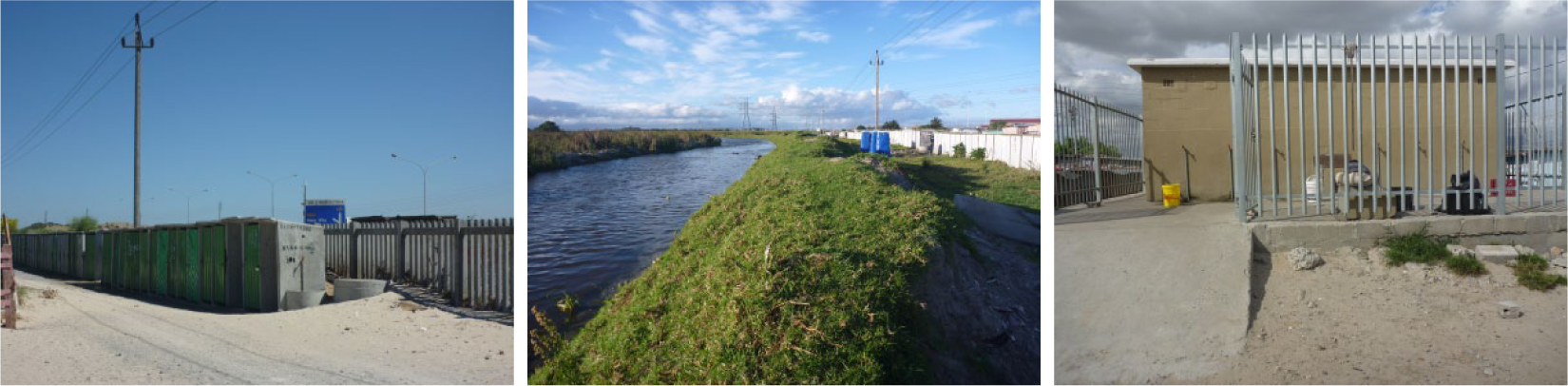
The City installed hundreds of flush toilets and approximately 30 chemical facilities along the back of BM Section near the N2 Highway reserve (A) and the Kuils River (B). Some residents also used an ablution block (C) located along Lansdowne Road.
In general, I observed that SJC’s aforesaid criticisms of the work conditions for the Mayor’s Project were true – janitors in BM Section had not received inoculations, uniforms, equipment or chemicals in a timely way at any point in their employment. Moreover, they had trouble gaining access to locked toilets that were “owned” by households. Many residents claimed that padlocked toilets were cleaner than those left unlocked, and they hence chose to maintain a localized community management system. The drawback, however, of having the two systems operate in tandem was that the latter restricted janitors’ access to locked facilities that residents still wanted to be cleaned.
The BM Section janitors I met had expressed their dissatisfaction with these problems, but for the most part, the janitors were primarily concerned with the terms of their employment. Of particular concern were the “peanuts” they earned at the EPWP rate of ZAR 120 per day (approx. US$ 12) in 2013 and their non-renewable six-month contracts, as most wanted permanent employment. SJC had also noted that payment failures had “resulted in protests by janitors”.(62) These sit-ins generally took place in the foyer adjacent to WSISU officials’ offices, lasting all day, with protestors singing songs that accused certain officials of either paying them late or denying them long-term stability.
I was warned about a protest that was to take place in late March 2013, shortly before the majority of contracts expired.(63) Many workers planned to participate in order to retain their jobs, although not all planned to join. I sat in a lounge one morning with four women who did not want to take part in the sit-in. They explained that they were hiding from their co-workers, who had allegedly threatened them with physical violence(64) if they continued to work while they planned the strike. One janitor, whose contract would not end for another three months, expressed her frustration as head of her household. Holding aloft her broom, she exclaimed, “I am the tata, I am the mama, of my house.” She needed to keep working to support her family.
Interestingly, the four women noted that their co-workers were fighting a lost cause, as municipal officials had explained when they signed their contracts (in both English and their mother tongue, isiXhosa) that it was a temporary six-month work opportunity, and that their contracts would not be renewed after it ended.
Officials said they had clearly outlined contract terms with each janitor because they could not create the expectation of permanent jobs. This precautionary measure was based upon the repercussions of a previous non-standard contracting experience. Fifty temporary W&S workers had successfully sued the City for long-term employment on the grounds that they had expected permanent positions after their fixed-term contracts were repeatedly renewed without interruption. The W&S Department thereafter set employment rules that limited temporary labourers’ contracts to six months, and specified that they could only be re-employed after three to six months. WSISU thus explicitly outlined the start and end dates in their contract workers’ six-month contracts, and emphasized that janitors (as casual labourers) could only undertake one EPWP opportunity over a 12-month period.
The women I spoke to said that they clearly understood their contract terms. They each noted that an official had read through every line with them, and their start and end dates were bolded in an all-caps typeface in their copies. They were also told that the City would provide a letter at the end of their contracts, which they could use to apply for an unemployment subsidy, and that they could seek another EPWP opportunity after a six-month contract lapse.
The janitors’ avowed complaints about payment problems and their desire for long-term employment indicated that many employed by the City had prioritized the job creation aspect of the janitorial initiative over the sanitation programme. One could argue that their lack of concern over their challenging work conditions was due to SJC’s advocacy work. But other discussions with former janitors have not suggested this. Rather, many workers in BM expressed their indifference about their work conditions and said that they would gladly continue working for the municipality. Three former RR Section janitors had similarly wanted to remain employed, in spite of being paid very little to work in difficult conditions.(65)
Municipal officials reported, furthermore, that from 2012 to 2014 they received contract extension requests on a weekly basis. The officials said they frequently dealt with intimidation from dissatisfied janitors who were upset that they personally could not change the municipality’s policy on short-term employment. One official said in frustration:
“We are at the face and get blamed. I don’t want to go to [settlements] because people think I am eating their money up… It’s intimidating for the staff.”
One official added that he was often asked by groups of janitors to meet to discuss contract extensions. He always requested that representatives meet at his office, but janitors generally demanded that he meet instead with the entire group in the settlement. He, in turn, refused to meet on-site, remembering an occasion when janitors held their supervisor hostage as leverage during a protest. To officials, the best recourse when intimidated was to keep managerial and supervisory staff off-site. Such steps unfortunately left janitors unsupported until they accepted their contract terms.
Officials felt conflicted about the contract situation, because most would actually have preferred administering yearlong contracts due to the administrative headache of managing a more frequent turnover of casual staff, which often disrupted services on the ground. In short, they intimated that the complexities of the job creation goal were detrimentally affecting their operations and service provision.
The national EPWP initiative does in fact allow local municipalities to employ temporary workers on contracts of up to 24 months. But CoCT’s HR had prohibited the use of longer-term contracts due to concerns about loopholes in national labour legislation. A municipal HR official said national policymakers admitted at a 2013 EPWP workshop that they were still undertaking legal measures to ensure that workers could not convert their fixed-term contracts into permanent posts. WSISU officials were thus fastidious in their contracts administration – paying special attention to ensure that workers would not become permanent employees due to an error on their part. WSISU’s message about rotating job opportunities was not lost on an older BM janitor I had met. Though visibly upset that his contract was coming to end, he was clear that “We have to share the slices of bread.”
Over time, the dissent around the municipality’s six-month employment rule seemed to subside – perhaps due to the consistent administration of the six-month policy that WSISU had developed. The diminishing dissent allowed officials to concentrate on other labour concerns in the janitorial initiative. One of these was implementing the Mayor’s Project janitorial programme alongside the community workers’ service in seven Khayelitsha settlements. One official explained that some of the Mayor’s Project workers were likely upset that they were doing the “same work” as the community workers, but for considerably less pay and benefits. Such concerns around labour arrangements have affected other South African public works programmes,(66) because workers employed by government and private contractors have, according to a labour law expert, “equivalent work” but are not “treated alike”.(67)
I observed that the relationship between janitors employed as part of the Mayor’s Project and the Community Workers programme in BM Section was in fact strained, with the former somewhat resentful of the latter’s permanent status. Due to this double standard, WSISU gave the community workers new O&M assignments in August 2014. Officials noted that one of their main priorities in closing that programme was to standardize its employment and on-the-ground practices, as well as to ensure that EPWP workers’ low morale did not affect sanitation services in informal settlements.
IV. Conclusions
This paper considers municipal informal settlement sanitation policy and service provision from multiple perspectives. It specifically explores how social advocates and residents in Khayelitsha engaged with local government in a municipal janitorial scheme from 2011 to 2014. The municipality, social advocates and users alike found that an alternative to voluntary community O&M was needed to improve cleanliness and reduce rehabilitation costs of shared flush facilities. Employing informal settlement residents to care for the toilets they used and shared seemed like such a simple solution to address these problems.
But, as the case shows, Cape Town’s implementation of a janitorial programme was mired in complex problems associated with conflicting understandings of good governance and conflicting prioritization of goals in multi-objective government initiatives. It shows, through the discussion of different points of view, the unanticipated operational and experiential difficulties of satisfactorily providing alternative modes of service delivery for various stakeholders, especially in light of initiatives with multiple objectives. The janitorial programme’s implementation ultimately touched upon broader concerns around collaborations, as well as significant administrative aspects of temporary job creation programmes and multi-objective government initiatives.
Guidance on partnerships tends to focus on mutual goal setting. As a result, partners often focus on the bigger picture of attaining these end goals through consensus building, rather than the complex details of implementation and negotiation – especially in instances of conflict. The latter were important in this South African case. Municipal officials and social advocates did not attain their shared FBS goal because they could not overcome their different approaches to planning for informal settlements, or their distinct understandings of their respective roles as project partners and what qualified as an acceptable standard of basic sanitation. These differences indicate the need to also focus upon shared methods and mutual understanding to facilitate municipal implementation and servicing partnerships.
While SJC and some residents would likely object to calling the municipality’s implementation a success, officials largely considered the job creation aspect to be well administered due to their special attention to labour legislation and contracts administration, as they had improved upon the municipality’s earlier temporary work programmes.(68) This conflict in actors’ perspectives is significant to consider, for the Mayor’s Project is part of a national trend in which non-standard entry-level workers have been temporarily hired to avoid the “fiscal implications” of employing them under collective agreements brokered by labour unions.(69)
Lastly, officials’ administrative priorities related to EPWP and janitors’ remunerative and income security priorities suggest that the job creation goal adversely affected the service aspect of the janitorial programme. While job creation served as a significant socioeconomic driver that mobilized and sustained support for the Mayor’s Project, it also detracted from sanitation delivery on the ground. Naidoo also previously noted the challenge of “competing policy priorities” in EPWP projects.(70) Given how common socioeconomic development programmes are, further implementation research is clearly needed on addressing policy conflict in these programmes, especially if countries in transition such as South Africa intend to implement social policies and programmes with multi-objective mandates.
Footnotes
Acknowledgements
Thank you to my former “co-workers” at the City of Cape Town and residents of the BM Section informal settlement, for sharing perceptive observations about municipal sanitation delivery in South Africa. I am also grateful to my colleagues at the Urban Water Management Research Unit, for providing technical support and camaraderie; and Sheridan Bartlett and two anonymous reviewers, for offering helpful comments that strengthened this paper.
Funding
This research was supported by two grants from South Africa’s Water Research Commission (WRC K5/1827 and K5/2120).