




Abstract
The occupation of waste picker has taken on new importance as a livelihood, especially since the last global economic downturn. Increasingly, waste pickers are being recognized for their valuable contributions to urban sustainability and development. Drawing from scholarship on waste pickers, and findings from a recent study conducted in five cities across three continents, this paper discusses the environmental and economic contributions of informal waste pickers to cities. This paper argues for the re-conceptualization of solid waste management systems that integrate waste pickers as partners, as key to building just, inclusive and livable cities for all. It also presents a specific model in which informal waste workers are integrated as key stakeholders as one example of best practice in this area, thus contributing to current discussions on integrated and inclusive solid waste models.
I. Introduction
The legal origins of modern public solid waste management can be traced to 19th-century English legislation, which introduced the concept of waste collection as a public service.(1) This legislation was prompted by the growth of the urban reform movement, which associated waste with the spread of disease. In this context, the modernization of waste management systems was driven by the objective to improve public health and promote social order. As new systems were put in place, informal collectors of waste who had previously performed waste collection services as a source of livelihood became increasingly stigmatized.(2) In this period, public authorities became responsible for waste collection and disposal, and the recuperation of the residual value from waste. These urban reforms left no room for the urban poor to earn a living from urban refuse.(3)
In the global South, however, rapid urbanization, coupled with insufficient governance structures and resources (both financial and technical), have led to a situation where waste collection services are seldom provided in an equitable, consistent way. In cities with no or irregular household waste collection coverage, informal workers continue to provide the sole source of waste collection, harvesting waste as a livelihood while providing a vital public service. In cities with no municipal recycling system, waste pickers fill a gap by reclaiming recyclables and providing inputs of raw material into the formal recycling chain.
Conventional approaches to urban solid waste management in the global South have been divorced from local realities, largely ignoring the contribution of waste pickers to formal solid waste systems. Waste pickers have been seen as a deviation in what has been conceptualized as a technical issue. Nevertheless, in the last few decades, waste pickers have drawn the attention of scholars within a range of academic fields, and scholarly work on the topic in different disciplines has increased considerably. Waste and waste picking have thus been interpreted under different corpora of the literature, including: social movements,(4) environmental and sanitation engineering,(5) political economy,(6) informal economy,(7) urban anthropology,(8) sustainability studies,(9) participatory governance,(10) ecological modernization theories,(11) urban geography(12) and gender.(13)
Particularly relevant to this study is the literature on waste that draws on the notion of the urban commons (defined as a resource that is not privately owned but rather is shared with society, like water and air). For example, scholars such as Cavé(14) have argued that clear property rights at the city scale cannot be defined for waste, but rather that “municipal authorities have the ‘responsibility’ to cope with garbage; they do not own garbage.” Further, Zapata and Campos(15) highlight the struggles of waste pickers at the La Chureca dump in Nicaragua, to argue that waste can be transformed into commons through practice (making its value visible) and political struggle. In line with these authors, this paper argues that waste pickers should be granted access to waste as a common-pool resource. Several cases where waste pickers have organized and laid claim to waste are highlighted in the sections below.
However, despite the growth in the literature on waste picking, there is still no consolidated body of methodologies, terms and conceptual frameworks in this area. Also, there is little attempt to integrate the different approaches listed above to reflect the multiple dimensions of waste picking – understanding waste pickers as service providers in socio-technical systems (collecting and recycling urban waste), as economic actors (critical to the value chain), as political actors (furthering social inclusion through collective action) and as drivers of social change (providing a source of income generation for less disadvantaged communities). This paper aims to contribute to a comprehensive conceptualization of waste picking by proposing a model for integrated and inclusive solid waste management in which waste pickers are key stakeholders.
The concept of livelihoods offers a promising lens for exploring the practice of waste picking, as livelihoods can be understood in broader terms than income generation alone. Specifically, earning a livelihood includes “gaining and retaining access to resources and opportunities, dealing with risk, negotiating social relationships and managing social networks and institutions within households, communities and the cities”. A focus on livelihoods also involves “highlighting the importance of human capabilities and agency.”(16) Finally, focusing on livelihoods enables the conceptualization of different urban solid waste models that are more in line with addressing critical dilemmas of our times: social inclusion and environmental protection.
The Informal Economy Monitoring Study (IEMS) is a study conducted by the WIEGO network,(17) which examined the driving forces that shape informal workers’ working conditions, their responses to these drivers, and the institutions that help or hinder their responses in 10 cities across three continents. Interviews were conducted with waste pickers in five of these cities: Bogotá (Colombia), Belo Horizonte (Brazil), Durban (South Africa), Nakuru (Kenya), and Pune (India). In total, 763 waste pickers (336 men and 427 women) took part in the research.
Apart from its mixed methods, a unique feature of the IEMS is its conceptual framework, which enables an assessment of key drivers – both positive and negative – that impact the lives, work conditions and coping strategies of waste pickers. Another unique feature is the fact that it was designed in conjunction with membership-based organizations of informal workers in direct collaboration with the technical advisory team. The analytic focus on livelihoods, along with macro-economic forces and the wider policy context for the five cities researched, has allowed for a deeper understanding of the multiple dimensions of waste picking activities, and the strategies of the working poor in improving their lives. This paper draws particularly from IEMS focus group discussions, with the objective of giving voice to waste pickers themselves.
This paper has three sections devoted to findings. Section II considers the contributions of waste pickers to cities. Section III focuses on the role of organizing in improving livelihoods and political visibility of waste pickers, and reviews some of the policy gains that waste pickers have achieved in three cities. And Section IV considers the need for alternative solid waste management systems and planning practices in order to fully acknowledge the contribution of waste pickers and build inclusive cities for all.
II. Waste Pickers’ Contributions to Urban Sustainability and Urban Economies
Despite their visibility in most cities of the global South, waste pickers’ contributions to the urban environment and economy are largely ignored and undervalued by city planners who privilege a rational-modernist model of urbanization based on the use of capital-intensive technologies imported from the global North.(18) However, in cities with no household collection or municipal recycling systems, waste pickers are important actors in addressing a key 21st-century challenge – the increasing quantity of solid waste.
A growing body of evidence outlines the contribution informal waste pickers are making to city solid waste systems, the environment, the economy, and the quality of public space. Informal waste pickers are creators of value for their cities – local authorities “reap benefits from informal sector activity without paying for them.”(19) Specifically, informal waste pickers contribute to increasing the lifespan of landfills by lowering the quantities of waste to be disposed of, and are key economic actors in providing inputs to the recycling market with materials that would otherwise be dumped. Waste pickers protect the environment by enabling materials to be reused or reprocessed, and by providing valuable materials for global recycling industries. For instance, in Tunisia, 8,000 Barbechas manage to recycle 5,000 out of the 8,400 tonnes annually of PET plastic.(20) In Brazil, informal recycling is responsible for the country’s high rates of cardboard (80 per cent) and aluminum (92 per cent) recycling.(21) Informal workers also contribute to material recovery. There is a growing consensus that informal recycling supplements formal solid waste management in varied ways.
Furthermore, informal workers enhance the quality of life in the areas where they work. As Duneier explains, “not only do the vendors and scavengers, often un-housed, abide by codes and norms; but mostly their presence on the street enhances the social order.”(22) In fact, informal waste pickers are an intrinsic part of urban economies and the urban social fabric in cities across the world. This is especially the case in the cities of the global South where waste pickers roam the streets gathering waste, making its value visible to citizens – they protect the streets while performing an important economic and environmental activity.
The IEMS focus group (FG) findings in all five cities revealed that waste pickers are well aware of the contributions they make. As they indicate, these contributions include reducing pollution, maintaining city cleanliness, and preventing the spread of diseases, even at a risk to themselves. A participant from Pune, India summed up their contribution to the city as follows: “So much difference we make! They get a clean city without paying us a paisa. The gutters would be blocked with their damn plastic bottles without us. Then everyone would come running to the corporation to shout and complain” (IEMS, Pune FG 13). And a waste picker in Bogotá, Colombia described waste pickers as the “lungs of the earth” (IEMS, Bogotá FG 10).
Waste pickers in these cities are also aware that they are critical economic agents, as they provide recyclable materials to formal enterprises and generate demand for service providers. For example, 76 per cent of waste pickers in the IEMS sample said their main buyers are formal businesses. Between one-quarter and one-half of waste pickers also supply recyclable materials to informal businesses, private individuals and the general public. As many authors have argued, the informal sector intersects with the formal economy at various points and is an integral part of modern economies. In fact, informal waste pickers are key actors in securing the secondary raw materials the global recycling industries depend on.(23)
Where waste segregation is not part of the culture, waste pickers are key economic actors whose materials translate into profits for scrap shops, recycling companies, producers of recycled materials such as craft paper, and artists. Waste is also often an input for other industries. In Pune, for example, waste pickers collect organic matter for composting and biogas. Recyclers report ingenious ways of marketing materials collected. In Belo Horizonte and Nakuru, waste becomes artistic material. As a focus group participant reports, “we sell egg shells, and bottle tops, bones, and cans to artists and designers” (IEMS, Nakuru FG 4).
Finally, waste pickers generate employment for themselves and others, creating opportunities where they might not exist otherwise. In the IEMS sample, income from waste pickers’ own informal activity was very important, as in Pune, where it was the main source of household income in 85 per cent of waste pickers’ households. This percentage was 80 per cent in Nakuru, 66 per cent in Belo Horizonte, 59 per cent in Durban and 34 per cent in Bogotá.(24) In Durban, some waste pickers use the income they earn from recycling to buy other goods to sell, generating more income for their families. In Belo Horizonte, waste picker cooperatives open doors for workers and create opportunities for marginalized groups, sometimes “taking them off the streets” by incorporating street dwellers as workers in their cooperatives. As one focus group participant explains, “this teaches ways of cooperating with one another” (IEMS, Belo Horizonte FG 11).
Waste pickers’ efforts reflect well on municipalities. Formally recognized or not, waste pickers play an important role in cities’ solid waste management systems. Waste pickers across the IEMS cities reported a range of services that vary city to city, from waste removal (in some of the cities this is the only such service available in particular areas) to transportation, recovery of recyclables, value aggregation, semi-processing, composting and biogas production.
III. Inclusive Public Policies and Waste Pickers’ Organizing
Waste pickers across the world have pursued a number of strategies in their struggle for inclusivity, such as mass mobilization, the forging of strategic alliances at local, national and international levels, and the struggle for integrative policy and legislation in order to gain recognition and secure their livelihoods.(25) Organizing may take the form of membership-based organizations (MBOs) such as cooperatives, associations, unions, community-based organizations or microenterprises.(26) The ways waste pickers organize, the types of demands that they make, and the extent to which they succeed in achieving their goals are shaped by a number of historical and political factors in any given context.
This section briefly highlights inclusive urban solid waste management systems in three cities – Belo Horizonte, Brazil; Bogotá, Colombia; and Pune, India – and the role of waste pickers’ organizing in shaping these. Globally these cities are considered among the most progressive in integrating waste pickers into urban plans.
a. Belo Horizonte, Brazil
Belo Horizonte started a programme of integrating informal recyclers into municipal waste management systems in 1993, making it a pioneer in Brazil. Local waste pickers’ cooperatives played an active role in shaping the new formal recycling system in a way that included them as formal partners together with the municipal public cleansing authority (SLU). Specifically, the model integrated two categories of waste pickers – collectors of recyclables (catadores) and of debris (carroceiros) – within an integrated solid waste management model in which integration of informal recyclers within the formal system was a key feature.(27) Organizations of these workers joined city representatives and civil society organizations to form the Municipal Waste and Citizenship Forum. Created in 2003, this forum is a platform for different stakeholders (cooperatives, NGOs, the municipal government and other actors) to work together on planning, implementation and monitoring of recycling schemes in partnership with waste pickers’ cooperatives. It holds regular meetings every other month and has a rotating coordination system.
The new, comprehensive model focused on promoting the segregation of waste at source, and involved waste pickers in both the collection and sorting processes. The system functions through three main channels: door-to-door collection of recyclables in designated areas, “drop-off points” where people can deposit recyclables, and the curbside collection of recyclables. Door-to-door collection is carried out by specific waste picker cooperatives using vehicles or manual push-carts. In turn, recyclables collected through the drop-off systems are sorted and processed by informal recyclers.
Informal workers acknowledge that their lives have changed for the better in the last 20 years due to the city’s approach to integration.(28) However, they are also critical about the need to upgrade and reformulate current programmes in the city in order to enable further improvements in their livelihoods and in the environmental performance of the recycling system.(29)
In this regard, recent progress has been made with the creation of the Recycling Bonus (Bolsa Reciclagem), which is a financial incentive for the work done by waste pickers. This incentive was implemented by the state government of Minas Gerais at the end of 2011 and passed into law in June of 2012. According to the law, the amount of money each waste picker cooperative will receive and subsequently distribute to individual members is defined by the quantity and kind of recyclables collected and sold.
The payment, which started in December 2012, is due at the end of a three-month period of work, and cooperatives are entitled to the benefit after proving the nature and quantity of materials they have collected. The funds for the payment come from the state treasury. The state government determines the total amount per year reserved for financing, based on its investment priorities and fiscal capacity. In addition to increasing the incomes of cooperative members, it is expected that the cooperatives will operate more efficiently based on the need to improve the quality of their service provision and keep better records about their operation.
b. Bogotá, Colombia
In Bogotá, the recognition and integration of waste pickers into the municipal waste management system has been the result of the ongoing struggle to defend waste pickers’ right to work, spearheaded by Bogotá’s Waste Pickers Association – the Asociación de Recicladores de Bogotá (ARB). The litigation ARB has pursued has led to a body of pronouncements by the highest judicial authority in Colombia – the Constitutional Court. Together these rulings grant waste pickers status as subjects of special protection in light of their vulnerability and the judicial call for affirmative action at governmental levels. This court ruling recognizes the contributions made by waste pickers to the city. It orders the municipality to include them in the municipal waste management system and to remunerate them for the services they provide in the collection and transportation of recyclable waste.
These pronouncements have also led to changes in the regulatory framework at the national level. They place greater emphasis on recycling and lay the foundation for the inclusion of waste pickers in waste management systems in other Colombian cities, through their participation in the design and implementation of integral solid waste management plans.
As documented by Parra,(30) in 2012, to comply with the court orders, the municipality launched a programme to include waste pickers in the implementation of a zero waste plan. An important part of the programme initiated by the municipal government under Mayor Gustavo Petro in 2012 was the creation of a public cleansing company to replace private contractors in collection, transportation and final disposal of waste. The programme is coordinated in collaboration with ARB and included a census of waste pickers, as well as incorporating waste pickers into the municipal waste management system in the components of collection, transportation and recuperation of recyclables. To complement the new system, a public awareness campaign was launched to promote segregation at the source and to raise awareness of contributions of waste pickers to the city. Finally, a programme was developed to replace the animal-pulled vehicles used by many waste pickers with motorized vehicles.
In March 2013, the municipality also launched a payment scheme, financed through the service fees, to remunerate both organized and non-organized waste pickers for the services they provide. Under this scheme, waste pickers are paid on an individual basis, every two months, 87,000 Colombian pesos (approx. US$ 28 as of June 2016) per tonne of recyclables collected and registered at authorized weighing centres. This income comes in addition to the sale of materials at market prices. To participate, waste pickers had to be included in the census, work full-time as waste pickers, obtain an identity card and open a bank account. Since then, waste pickers and their households have benefitted from the payment scheme and have reported that their incomes have doubled or tripled, allowing them to improve their living conditions.(31) According to Constitutional Court Order 587(32) of December 2015, 10,000 waste pickers had opened a bank account to have access to the payment system.
c. Pune, India
A waste pickers’ union in Pune, Kagad Kach Patra Kashkatari Panchayat (KKPKP), formed India’s first member-managed and -owned waste picker cooperative, Solid Waste Collection and Handling (SWaCH), which became operational in 2006.(33) In 2000, new municipal solid waste rules set out by the national government required municipalities, for the first time, to ensure waste segregation, door-to-door collection, and the processing of recyclable materials. The rules prompted the Pune Municipal Corporation (PMC) to engage with the city’s informal waste workers. Through a contractual agreement with the PMC, signed in 2008, SWaCH members provide door-to-door waste collection to city households.
The workers are paid through user fees and are accountable to the residents as well as the municipality, as SWaCH needs to issue reports to the municipality about its service provision and comply with the performance indicators laid out in the memorandum of understanding signed with the municipality. Waste is segregated into recyclables and compostables. (SWaCH has developed a significant operation to turn wet waste into natural fertilizer for public grounds.) These efforts mean that much less material makes its way to the city’s landfill. While the municipality covers administrative costs for SWaCH, purchases equipment (carts, gloves, etc.), and supports health insurance, its costs are far lower than if it had to pay for private collection and disposal.
As part of the integration process, waste pickers received equipment and working space, technical training, authorization to carry out door-to-door waste collection and reclaim the recyclables for commercialization, and the right to charge residents for collection. By 2008, SWaCH already had a presence in 127 of 144 sub-units in all 14 administrative wards of Pune, involving 1,500 informal workers and servicing 200,000 residents.(34)
Integration brings about challenges for waste pickers, including the need to create a new identity as workers, to become accountable to residents and to the municipality, and to respond to demands for efficiency.(35) Overall, integration of SWaCH into the city’s formal solid waste system has enabled significant improvements in the livelihoods of waste pickers, greater social recognition and improved working conditions.
d. Role of organizing
A crucial component of the success of inclusive programming in Belo Horizonte, Bogotá and Pune is the role of waste pickers in organizing to further their demands for integration into formal solid waste systems and for recognition as key economic actors. In all of these cases, membership-based organizations (MBOs) were important for facilitating the representation of workers’ interests with municipal governments. In the case of Bogotá, where progressive legislation had been passed, the waste picker association ARB played a critical role in monitoring implementation and assessing unexpected outcomes.
In addition to the role they play in increasing workers’ political power, MBOs improve workers’ quality of life in a number of ways. These benefits can include: improving incomes, facilitating better working conditions, contributing to improvements in health, raising social status and self-esteem, and facilitating the development of networks. MBOs also provide an institutional framework that facilitates the hiring of waste pickers as service providers, circumvents intermediaries, and prevents harassment and violence. Another common feature is the state responsiveness to informal workers’ demands. Deliberate policies that favour livelihoods protection from all levels of government can shape solid waste systems that address environmental, as well as social, concerns.
Organizing provides an avenue for political action that can lead to transformative changes at a national level as well. The cases of the national movement of waste pickers in Brazil(36) and in Colombia(37) are examples of strong movements of informal workers who secured influence in drafting legal frameworks that recognize waste pickers’ legitimate access to waste – in national solid waste policies and in constitutional laws, respectively.
The importance of MBOs in improving the lives and outcomes of informal workers is corroborated by findings from the IEMS. Asked which organizations were relevant to their lives, informal workers across different cities underscored the importance of MBOs. In Bogotá, over 94 per cent of respondents highlighted them as the most important organizations in the institutional mapping, followed by Belo Horizonte and Pune, with 78 per cent and 72 per cent, respectively. Even in Nakuru, where there is a nascent organization, 73 per cent of respondents highlighted the importance of their MBO.(38) Also, the IEMS shows how a shift in power dynamics through collective action can enhance waste pickers’ ability to influence governments and even, in some cases, markets. For example, cooperatives in Belo Horizonte have developed a bidding process whereby intermediaries compete to buy their recyclables.(39)
One participant described her MBO as “100 per cent important, because it has brought us together, it is the head, it is the core” (IEMS, Bogotá FG 7). MBOs also play a key role in challenging prevailing prejudice and harassment toward waste pickers, a problem identified by waste pickers (though to varying degrees) across the five cities. As one participant explained, “we have the backing of the organization so citizens respect us” (IEMS, Pune FGD 9).
Together, this evidence suggests that MBOs fulfil social, political and cultural functions, which are important given the instability of monetary gains derived from commercialization of recyclables, even in contexts where they are formally integrated into solid waste systems. The struggles of waste pickers challenge prevailing approaches to urban planning, exclusionary legal frameworks and exploitative business models. They provide alternative models that build on (and contribute to) ideal models of inclusivity, and they provide inspiration that fuels struggles in other countries and cities.(40) However, despite an increase in organizing among waste pickers around their collective demands in the last three decades, the majority of workers in the informal recycling sector throughout the world are still not organized.
The findings suggest that it would be valuable for donor agencies and non-governmental organizations to invest in encouraging organizing among waste pickers, specifically in contexts where MBOs do not exist or are weak. In addition, as in the examples provided above, governments have an important role in integrating MBOs as partners and key actors in solid waste management.
IV. Alternative Models for Solid Waste Management and Planning Practice
As described in Section II of this paper, waste pickers make important economic, social and environmental contributions to cities. This points to the value of alternative solid waste management models and planning practices in building more inclusive cities that accommodate and enable a range of livelihoods.
One of the biggest challenges faced by workers in the informal economy is the need for space. Informal work often takes place in cramped, crowded or hazardous conditions, and frequently spills over into the public realm.(41) Street trading, informal transport operation, waste picking and informal recycling are some of the most visible examples of informal work in public spaces. However, to urban planners, none of these activities is classified within pre-defined land-use classes and zoning regulations associated with modernist views of city planning. In the case of informal waste pickers, their activities do not fit the technical conceptual frames of modern urban solid waste systems.
As mentioned previously, waste pickers provide benefits to cities in a number of ways: as service providers of urban waste collection, as environmental agents who enable recycling, and as key economic actors who feed the market with secondary raw materials. Waste pickers pursue these activities in public space. However, in cities across the global South, public space is being increasingly homogenized based on a prioritization of high-end entrepreneurial activities in urban centres. In this context, informal activities such as street vending and the collection of recyclables are often banned and policed, exacerbating cultural and socio-economic segregation. Like hawkers, informal waste pickers are described as nuisances and as obstacles to public circulation. Anjaria writes in relation to hawkers that “orthodox modernist principles regarding the functioning of the city, most notably, the privileging of movement and flow over other concerns”(42) imposes a “mono-functional” use of a city’s public spaces. These observations have resonance for waste pickers as well.
Conventional views of solid waste systems have also been largely “mono-functional”, as they rely exclusively on the use of capital-intensive technology, and exclude customary practices such as waste picking.(43) In the cities of the global South, these customary practices are far more effective in reclaiming recyclables that feed recycling industries. Conventional models, however, penalize informal waste pickers by creating obstacles to their access to waste and criminalizing the activity,(44) rather than building off of these existing systems. In what follows, an alternative solid waste model is articulated that considers the need for access to public space by waste pickers and their right to waste as a common-pool resource.
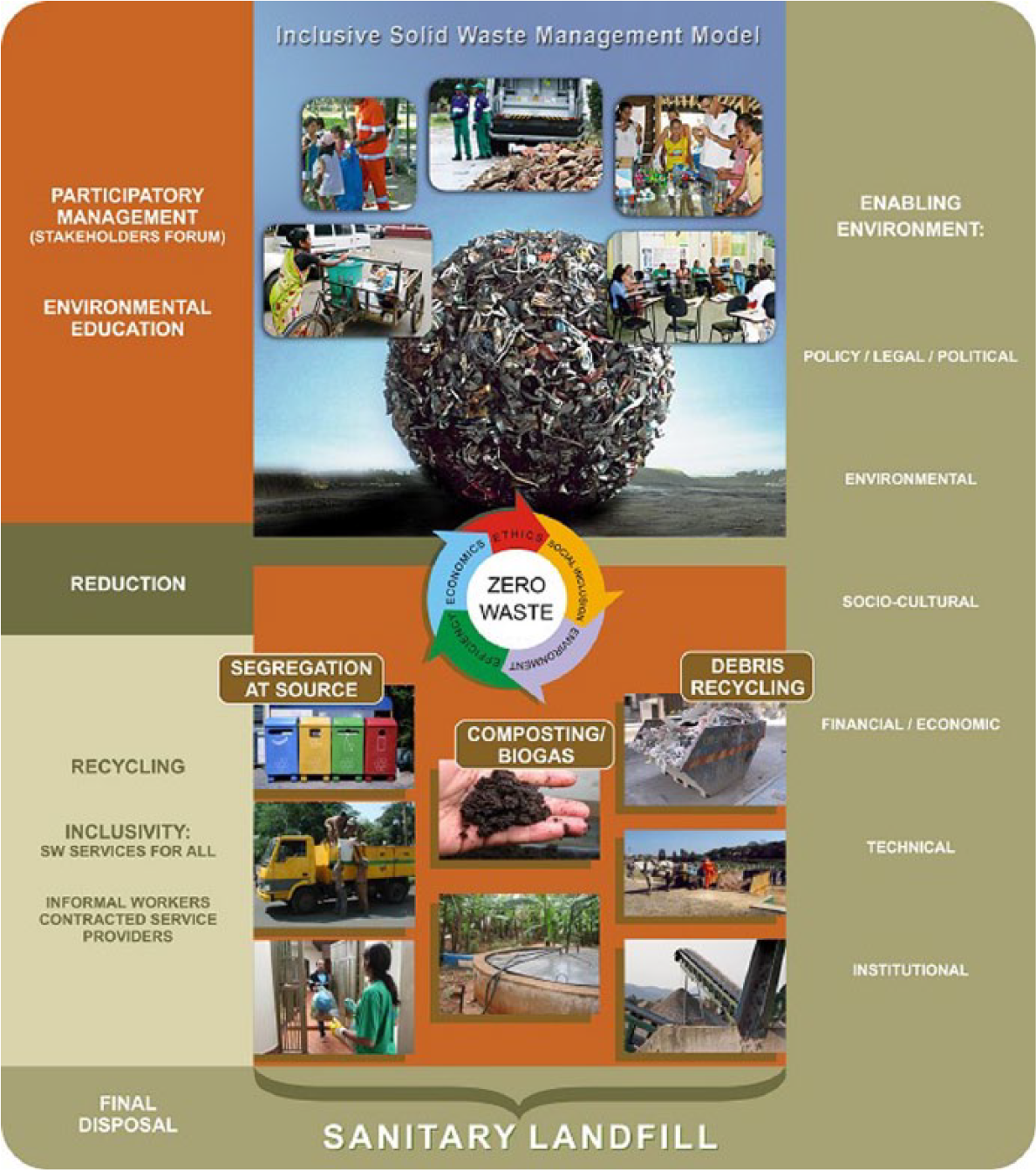
A tentative model of inclusive solid waste management is presented in Figure 1. This inclusive model draws from a number of key experiences of inclusivity in solid waste systems (highlighted by the cases in Section III), which are by no means fixed or final. Rather, the features described for the main components are meant to be flexible and adaptable to any given context.
Pro-poor modernization solid waste model
Figure 1 shows a model with three main components: participatory governance (participatory management and education), the enabling policy and legal environment, and the technical components of the waste system. One of the main features of this model is that membership-based organizations of waste pickers are integrated as part and parcel of the system. In this model, waste management is a municipal priority and concern, not only in terms of its technical dimensions but especially regarding the full, structural integration of waste pickers (those workers organized in cooperatives, unions, etc.). In this waste management model, the municipality ensures grassroots participation in decision-making around solid waste policies, programmes and projects. This places municipal authorities in the role of mediator in finding integrated solutions, through partnerships with various sectors of society, especially with membership-based organizations of workers.
As can be seen in Figure 1, proper participatory channels for joint planning and implementation of solid waste programmes promote universal access. Technologies and processes are discussed within this platform, and impacts on the livelihoods of the urban poor are weighed, as informal workers can be contracted for service provision. Rights of waste pickers to access waste are ensured by appropriate legal frameworks that can institute a number of mechanisms to support MBOs moving up in the recycling chain (semi-processing of wastes, recycling, etc.). Furthermore, the municipality ensures universal access to good-quality waste services across the city, as inclusivity is one of the key components of the model.
The enabling environment (shown on the right-hand side of the model) lays out the main dimensions of integrated solid waste management to ensure that there are adequate policy and legislative frameworks that are supported by institutional structures and capacity, and a level of technology that is affordable to citizens. The drive for modernization of solid waste is based on an approach respectful of the main dimensions of the Integrated and Sustainable Solid Waste Framework.(45) There is a special focus on waste minimization, reuse and reduce strategies (Zero Waste), implementation of shared/extended producers’ responsibility, and final disposal based on environmentally friendly technologies suited for local contexts (waste composition, livelihoods protection).
With the inclusion of informal waste workers in formal municipal systems, solid waste management constitutes an integrated mix of systems that complement each other rather than parallel systems operating independently of one another.(46) These systems can take the form of source segregation schemes, door-to-door collection schemes, or small- to medium-scale windrow composting schemes. These systems might comprise elements for recovering non-organic recyclable materials, construction and demolition waste, or other waste streams such as tyres or electronics. Informal workers can be integrated into these systems in many ways, as the examples of the IEMS cities of Pune, Belo Horizonte and Bogotá show.
In summary, full structural integration of workers starts with a legal framework recognizing access to waste as a livelihood resource. Other critical elements of integration include the provision of proper contracts (covenants, memoranda of understanding and other forms) with payment for collection services and for environmental services (“diversion rate”) stipulated, and provision of infrastructure for sorting and capacity-building. In this process, support to MBOs is critical to enable them to enter new niches and upgrade in the recycling chain. Finally, social protection schemes and proper programmes to address specific risks (child labour, childcare) should be in place to protect workers’ livelihoods.
This tentative model is convergent with insights from many researchers who have focused on the importance of engaging waste pickers as part of the solution to social-environmental problems.(47) It is also convergent with the IEMS findings about cities where formal integration happens (to introduce payments or subsidies to waste pickers in either refuse collection and/or resource recovery within source segregation schemes), as in Belo Horizonte, Bogotá and Pune. Thus, the IEMS study provides evidence to support the claim that formally integrating waste pickers makes sense and is feasible, as these three cities demonstrate.
The impacts of an inclusive model – one where formalization of the informal is coupled with rights to have access to waste – will include increased earnings of workers via stable monthly income; improved work conditions (uniforms, specially designed carts and buckets for collection of waste and sorting spaces, etc.), access to welfare (daycare for children, education scholarships, pension schemes), ensured voice and representation, and improved assets. This model leads to more secure livelihoods for workers. But it requires a broader understanding of solid waste systems, an understanding of the complexities of waste picking, and a willingness to think outside of the box in order to see waste management beyond conventional approaches.
V. Conclusions
The paper has argued that waste picking is a critical source of livelihood for the working poor and that informal waste pickers make relevant contributions to cities. Public policies and public perceptions are still based on misconceptions about waste pickers that largely ignore their contribution to the environment, to public health, and to urban economies. The IEMS findings clearly indicated the critical role performed by these workers.
The paper has also shown that waste pickers have contested orthodox, conventional approaches to urban planning. They have interacted with scholars, with the state and with other social movements in their efforts to propose alternative views about their work and the use of public space. By claiming waste as urban commons, they have contested the notion of waste as a mere technical fix and situated livelihoods as a key element of urban systems.
What this evidence suggests is that organizing is fundamental for improving waste pickers’ livelihoods and establishing their place in urban waste management systems. The examples from Belo Horizonte, Bogotá and Pune illustrate the role of organizations of waste pickers in the struggles for access and appropriation of waste as a legitimate resource for the livelihoods of the working poor. Moreover, it shows that waste pickers create value for their cities. In these cities waste pickers have successfully pushed for integration into laws and policies through continuous social mobilization and efforts to achieve efficient management of their service provision.
This paper has argued that waste pickers are key economic and environmental actors and should be granted access to waste as a common-pool resource. It has also made an attempt to provide a solid waste model in which waste pickers are deemed relevant actors within a system in which waste is seen as multidimensional, i.e. in its technical, social, institutional and environmental aspects. The model presented focuses on three main components – governance, physical elements and an enabling environment. The complexities of today’s social and environmental challenges require the existence of an institutional terrain “where collective actors negotiate actions and where questions under the perspective of citizenship can be raised – not only should we ask if actions resulting of participatory processes contribute to effective problem solving but also whether such actions expand or constrain citizenship rights (and in which ways it does so)”.(48) In this sense, two key features of this model vis-à-vis conventional models stand out: waste pickers are not at the margins of the model but are rather integrated as key actors; participation is not consultative but is rather built in as a critical dimension with the institution of a stakeholder forum in which the physical as well as governance aspects of solid waste, including livelihoods, can be discussed.
The IEMS cities featured in Section III, where waste pickers succeeded in being integrated into formal solid waste systems, are examples of the feasibility of such an inclusive model. In these cities there are agreements and contracts in place that guarantee access to and payment for waste. In Belo Horizonte, for instance, the existence of the Municipal Waste and Citizenship Forum has been fundamental in the 20-year integration process in that city.
In summary, this paper argues that the re-conceptualization and re-design of waste management systems to integrate livelihood activities by waste pickers and other informal workers is key to building just, inclusive and livable cities for all. To ignore the claims of informal waste pickers in the decisions that shape urban solid waste systems inhibits not only social inclusion but also environmental sustainability in cities that need to adopt new and innovative responses to the complex challenges of the 21st century.
Footnotes
Acknowledgements
I am indebted to Jenna Harvey and Caroline Skinner’s excellent contributions to earlier drafts of this paper. Many thanks also to Karen McCabe for her support. Last but not least I am very grateful to informal waste pickers with whom I learnt in the last 30 years what it takes to build inclusive solid waste systems.