




Abstract
The youth employment crisis in sub-Saharan Africa’s towns and cities is among the region’s top development priorities. High rates of youth under- and unemployment create significant obstacles to young people’s ability to become self-reliant, a crucial first step in the transition to adulthood. It is important to explore how local and global structures and processes create the hostile economic and social environment in which urban youth search for livelihoods. Only then can we identify the ways in which urban poverty brings insurmountable constraints on youth agency. We must understand the multitude of obstacles facing urban youth in their quest for decent work and secure livelihoods, how these differ by gender and educational status, and the implications of this for their longer-term social and economic development. This paper attempts such an exploration in the context of Arusha, Tanzania.
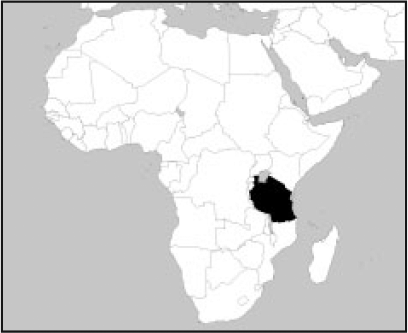
I. Introduction
Africa’s population is increasingly urban and increasingly young. This is evident in both striking demographic estimates(1) and rich ethnographic work that highlights towns and cities as “main stages” for young lives across the continent.(2) Yet young Africans are not finding that urban “promises” – of dynamism and modernity and better access to education, wages and services – are translating into better social and economic mobility for their generation. Increasing urban populations and shrinking formal employment opportunities have contributed to widespread urban poverty and insecurity across the continent.(3) Urban youth are hit particularly hard; they are expected to reach financial independence as a first step in the transition to adulthood, yet are overrepresented in under- and unemployment rates across the continent. Large unemployed youth populations – sometimes referred to as “youth bulges”(4) – are often stigmatized as a threat to peace and security.(5)
Understanding the realities and repercussions of youth under- and unemployment requires looking behind outcomes and indicators at the local and global structures and processes that create the hostile economic and social environment in which young people search for livelihoods. Key here, I argue, are the insurmountable constraints on young people’s agency imposed by urban poverty. Without understanding both the structural and experiential dimensions of urban poverty for youth, as I seek to do here in the context of Arusha, we fail to understand the multitude of obstacles facing young people in their quest for decent work.(6)
II. Background
a. Informality in an urbanizing Africa
By 2035 the majority of Africans are projected to be living in cities.(7) Since it is rarely driven or accompanied by economic growth founded in industrialization and urban-located investment,(8) urbanization has not been accompanied by sufficient job creation across the continent, leaving residents reliant upon their own devices to secure their livelihoods in oversaturated labour markets.(9) Informality characterizes all aspects of urban living across the continent, and is closely correlated with urban poverty.(10)
Despite widespread recognition of the dominance of informal employment in labour markets, recent and representative statistics are scarce. It is not uncommon to see figures from the 1990s – such as the fact that informal employment accounted for 60 per cent of urban jobs and 90 per cent of all jobs across sub-Saharan Africa in the 1990s(11) – still drawn upon in recent work. Many countries lack standardized data on informal employment, collect data through sector-specific surveys that do not accurately reflect household labour force contributions, or lack the technical skills to analyse available data.(12) In 2003 the International Labour Organization (ILO) helped to develop a conceptual framework to support national governments to incorporate informal employment into national census surveys.(13) This framework disaggregates informal employment within the informal sector from that outside the informal sector.(14) In 2011, the ILO compiled statistics on informal employment across 47 low- and medium-income countries across the globe, using the framework. These improvements offer the scope to analyse the size, breadth and composition of informal economies to an extent not previously possible.(15)
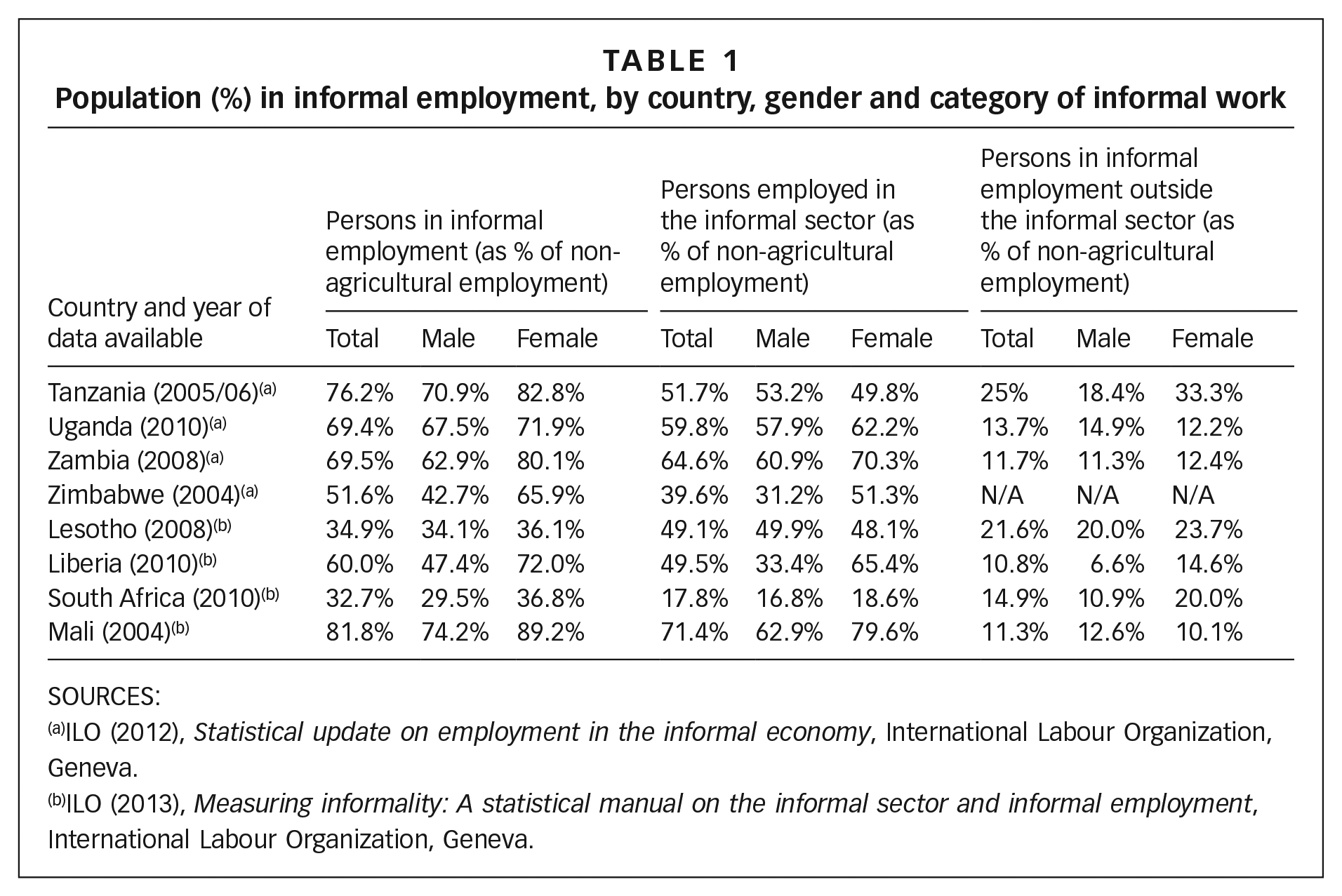
Vanek et al. compiled these data regionally, showing that between 2004 and 2010, informal employment accounted for 66 per cent of non-agricultural employment across sub-Saharan Africa, with rates particularly high for women.(16) Yet we have to be cautious about generalizing; the sample for this covers only 10 sub-Saharan African countries and 27.9 per cent of the continent’s working age population.(17) Country-level statistics show that regional estimates may mask as much as they reveal; informal employment ranges from 33 per cent in South Africa to 82 per cent in Mali, for example.(18) As Table 1 reveals, countries in Southern Africa have significantly lower rates of informal employment. The high percentage of women in informal employment also makes sub-Saharan Africa unique in comparison with other regions.(19)
Population (%) in informal employment, by country, gender and category of informal work
SOURCES:
ILO (2012), Statistical update on employment in the informal economy, International Labour Organization, Geneva.
ILO (2013), Measuring informality: A statistical manual on the informal sector and informal employment, International Labour Organization, Geneva.
Despite literature celebrating the dynamism of informal labour markets and urban residents’ ability to carve out space and opportunities in places lacking sufficient formal employment opportunities,(20) we also have to consider the fragility and insecurity of informal modes of urban living. Simone portrays a detailed picture of the “intensifying immiseration of African urban populations”(21) as a result of eking out livelihoods in local economies that offer little sense of long-term viability. Small businesses and informal enterprises offer critical income-generating opportunities, but limited investment capital, narrow product portfolios, oversaturated markets, and limited entrepreneurial skills and experience limit their profitability and potential.(22) This fragility is exacerbated by an increasingly negative trend in the way states across Africa respond to informal street trading.(23)
Research also explores the forms of social organization that urbanites have developed as a critical channel for dealing with informal urban living. Their collective organizational strategies help them to traverse and negotiate competition and labour market complexity to their advantage.(24) Age, relative standing and gender are all crucial determinants of entry into the associations that create personal networks of advantage.(25) Patrimonialist networks in urban Nigeria, for example, marginalize women, young people and those from less advantaged backgrounds.(26) In Guinea, too, exclusionist accumulation networks offer the only channels for social mobility among informal workers, with boundaries along the lines of gender, ethnicity and religion preventing outsiders from entry.(27)
Employment insecurity is not, of course, unique to young people, but as I explore next, it poses a serious threat to them since their future livelihoods and status as adults are dependent on their ability to secure decent work.
b. Youth in transition? Youth in Africa’s urban labour markets
Fourteen million jobs need to be created annually to meet the needs of Africa’s burgeoning youth populations.(28) Young people are particularly hard hit by unemployment.(29) In 2009, the latest census year, Nairobi’s overall unemployment rate of 21 per cent was much smaller than the 42 per cent unemployment rate for young people (15 to 24 years old).(30) In South Africa, youth unemployment (15 to 34 years old) was 37 per cent in 2015, in comparison with an adult rate of 17 per cent.(31) Differences in the age boundaries used to define “youth” make it difficult to compare statistics across countries, however.
The African Youth Charter defines “youth” as a social, as well as biological, construct – a process of “becoming”(32) as well as a category marked by the age boundaries of 15 to 35. In 2007, the World Bank popularized the “transitions” conceptualization of youth, highlighting the five “key transitions” young people must navigate: learning, work, health, family and citizenship.(33) But in difficult labour markets, youth find themselves in a “transitional limbo”, unable to meet the social roles, expectations and responsibilities that accompany adulthood across these five spheres.(34)
Thus, urban youth across the continent find themselves at a critical juncture, managing current lives and livelihoods while also trying to imagine and move towards their future selves. The contradiction between their increased potential for agency and their inability to act on it leads to anxiety and frustration.(35) The literature conceptualizes young people as “waiting”, a term encapsulating their physical, economic and social immobility and the uncertainty, boredom and frustrations that accompany it.(36) It is critical to take account of the psycho-social dimensions of long-term unemployment on youth and how it influences their subjective wellbeing today and into the future.(37)
Research on young people’s livelihoods emphasizes their need for ingenuity and resourcefulness as they try to make their way in economies and societies that offer little scope for their participation. In Nairobi, agency is characterized by “hustling”.(38) For youth in Addis Ababa, “street smartness” is one of the most valuable assets young people can have.(39) In Freetown, the concept of “straining” is invoked to represent young people’s constrained agency amidst persistent under- and unemployment.(40) These accounts highlight that agency alone cannot bring security to youth livelihoods. Some youth try to overcome and challenge this vulnerability by building networks and relationships.(41) Young people rarely establish an organized presence, however; many are focused on survival rather than longer-term improvements, and network-building tends to represent interdependency rather than individual action and autonomy.(42) With family networks and community institutions overloaded to breaking point by poverty and unemployment, many urban youth lack the supportive relationships they need.(43)
At the same time that it has exacerbated insecurity, urbanization has heightened young people’s expectations, connecting them to global ideas and practices of how modern urban lifestyles can be.(44) But these remain largely inaccessible. In Addis Ababa, few young people can afford such “benefits” of urban living as cafes, entertainment, transport or buying good clothes.(45) Young people in Lusaka describe the city as “a place where you do not need to be told whether you are poor or rich”, with only a small proportion of city residents benefitting from its very visible “luxuries”.(46)
We see, therefore, that traditional routes to adulthood rarely exist for sub-Saharan Africa’s urban youth. Work does not follow schooling, and livelihood insecurity blocks pathways to marriage, family formation and social recognition. We must recognize young people’s agency as they struggle to secure livelihoods within these environments, but also the way their lives and experiences are shaped by family and other relationships, and by shifting social, political and economic institutions and processes.(47) I now introduce the Tanzanian research context and the methodology before exploring these issues in Arusha.
III. The Research
Tanzania’s youth population is not expected to peak until 2030.(48) With half the population under the age of 25, it has the world’s 10th largest youth population.(49) Since 2012, one in every three children born will likely be living in Tanzania’s towns or cities by the time they are 20 years old.(50) Economic growth has been faster in urban areas,(51) but job creation has not kept pace with rapidly growing urban populations. In the 1980s Tanzania experienced an economic collapse; this, and the recovery programmes pursued in response, resulted in a radical drop in formal employment from 84 to 36 per cent between 1978 and 1991.(52) Recent statistics reveal that this trend has continued. Nearly 80 per cent of Tanzania’s working age population found employment informally in 2005–2006.(53)
Agriculture is the main source of livelihood for Tanzania’s youth, employing (though often as unpaid helpers) 65.2 per cent of its youth population. The informal sector, the second biggest employer, accounts for 23.3 per cent.(54) With an overall urban unemployment rate of 13.4 per cent (21.5 per cent in Dar es Salaam), unemployment is significantly higher than in rural areas (8.4 per cent).(55) At 18.2 per cent (32.3 per cent in Dar es Salaam), urban unemployment is particularly acute for women. Urban youth (15 to 35 years) are also overrepresented in unemployment rates (17.4 per cent overall, increasing to 28.8 per cent in Dar es Salaam).(56) These tough economic conditions have intensified the difficulties young people face in achieving social and economic independence.(57) This situation has been exacerbated by contradictions in the state’s politics of generation since independence, with youth celebrated on the public stage for their contributions to Tanzania’s development, yet simultaneously excluded from notions of citizenship.(58)
I use in-depth qualitative research in one low-income ward of Arusha (that I do not name here for reasons of anonymity) to explore the social and economic repercussions of navigating the transition to adulthood in these difficult circumstances. Arusha is Tanzania’s fifth largest city (with a population of 559,000 in 2012).(59) It is situated in northern Tanzania close to Mount Kilimanjaro and a variety of safari parks and natural wonders. Young people (15 to 35 years old) make up 46 per cent of city residents,(60) and are overrepresented in Arusha’s unemployment rate (8.4 per cent for youth aged 20 to 34, and 3.3 per cent for adults aged 35 to 64). The major employment sectors are manufacturing (12.6 per cent), raw food sales (14.6 per cent), and trade and commerce (10.9 per cent).(61) Other major employers include commercial agriculture (9.2 per cent), construction (7.2 per cent), food and hotel services (5.9 per cent), and domestic services (7.0 per cent).(62)
Industry brings much-needed employment to city residents, but Arusha was hit hard by Tanzania’s economic decline and the structural adjustment programmes that followed. Abandoned factories across the city starkly illustrate the collapse. A handful of large factories remain, but cannot meet the city’s employment needs. This makes various forms of self-employment central to urban livelihoods. Several large food and second-hand clothing markets in town offer space for business. People also set up small businesses and services on pavements or wander the streets selling their wares. Formal and informal transport options, including dala dalas and piki pikis,(63) are also a major employer, especially for young men. Section IV discusses employment opportunities for youth in greater detail.
One ward, known throughout the city for its troubled – and troublesome – youth, was selected for the research.(64) The research took place in one of the six “Streets” that comprise the ward, identified by focus groups as the one offering the fewest opportunities to young residents. The “Street” covers a large residential area as well as a forested area and banana plantation along a local river. It is primarily residential, with grocery shops and small businesses dotted throughout. Those living on the street’s outer edge are close to the main access road to Arusha’s town centre, a relatively short dala dala or piki piki trip away.
A simple profile of the Street’s youth was drawn from a short census covering 150 young men and 227 young women aged between 15 and 24. Three young enumerators collected data door to door on young people’s education level, employment status, and such social aspects as marital status and whether young people are living with parents or independently. Ten background focus groups (five each with young men and women) explored young people’s perceptions of poverty, the social and economic opportunities available to them, and the forms of institutional support that young people receive and require. Local representatives from five of the ward’s six streets mobilized young people for these discussions, which were organized with the help of the local group of the Tanzania Urban Poor Federation, an affiliate of Shack/Slum Dwellers International.
Twenty-four interviews with young men and 24 with young women then compared the experiences of employed and unemployed youth across three age groups (18 to 19; 20 to 22; 23 to 24)(65) and two educational levels (those completing Standard 7/primary school and those completing Form 4/lower secondary), capturing experiences by age, gender, educational level and employment status.(66) Interviews focused on school-to-work transitions, but also explored household and individual circumstances, happiness and wellbeing, and hopes and aspirations. We followed up with around half of the respondents six months later to see how things had changed. Two focus groups were also conducted with a mix of community elders and parents of young people. These explored the gender-differentiated challenges for young people, how things have changed for this generation, and the forms of support they felt they (as parents) and the broader community can – and cannot – give young people. Interviews with local leaders, including the Street’s chairperson and the male and female leaders of the local federation, traced the ward’s social and economic development and discussed the local “youth challenge”. These mixed methods allowed me to contextualize youth employment outcomes within the social, political, economic and cultural context, to explore and reconcile young people’s and parents’ perspectives, and give an impression of how things have changed for this generation.
The research reveals great diversity in young men and women’s experiences across the Street. Yet there is also a distinct shared story of struggle, regardless of employment status. “The city is driving youth crazy”, explained one focus group of young men. The next section explores the reasons for this.
IV. Findings
a. Education and the school-to-work transition in “the street”
An “urban advantage” in the number of and proximity to schools has not translated into improved social or economic outcomes for youth in this low-income ward. Young people and parents alike lament the poor-quality education received in Saint Kayumbas across the city.(67) Fathers described feeling let down by the education system that offered such potential for transforming their children’s lives, and discussed the changes that urbanization and changing education systems had brought to youth transitions. Previously, they said, “The farm was our school. We got given a farm and cattle when we were 18 and left to go and live on it with the farming skills we had learnt from our family”. They argued that in urban areas, education had promised to replace the critical role of the farm in this transition, with parents’ investments in education – at least in theory – assisting youth to achieve independence in a modern, non-subsistence-based world. Yet this does not occur, all agreed, because education does not equip youth with the skills and knowledge they need in the labour market, the jobs are not there when they finish school, and parents are too poor to provide enough education to help youth get those that are available.
The survey reveals that nearly all school leavers complete seven years of primary education but fewer than half continue on to secondary education. Completing lower secondary education (Form 4) is the most realistic aspiration for young people in this ward, although fewer than one-third reach this. An examination and school fees prevent progress into higher secondary education (Forms 5 and 6). Parents and young people complain that employers do not value lower secondary education any more than primary, and Form 4 graduates still struggle to find work.(68) Only 3 per cent enrol in college or vocational training institutes, despite additional qualifications being critical to securing “a good job”. Leaving school, therefore, is often followed by prolonged unemployment. As one young woman explained, “There are no opportunities. So for many, you finish school, you have bad luck, and then you don’t make it to the next stage [of employment].”
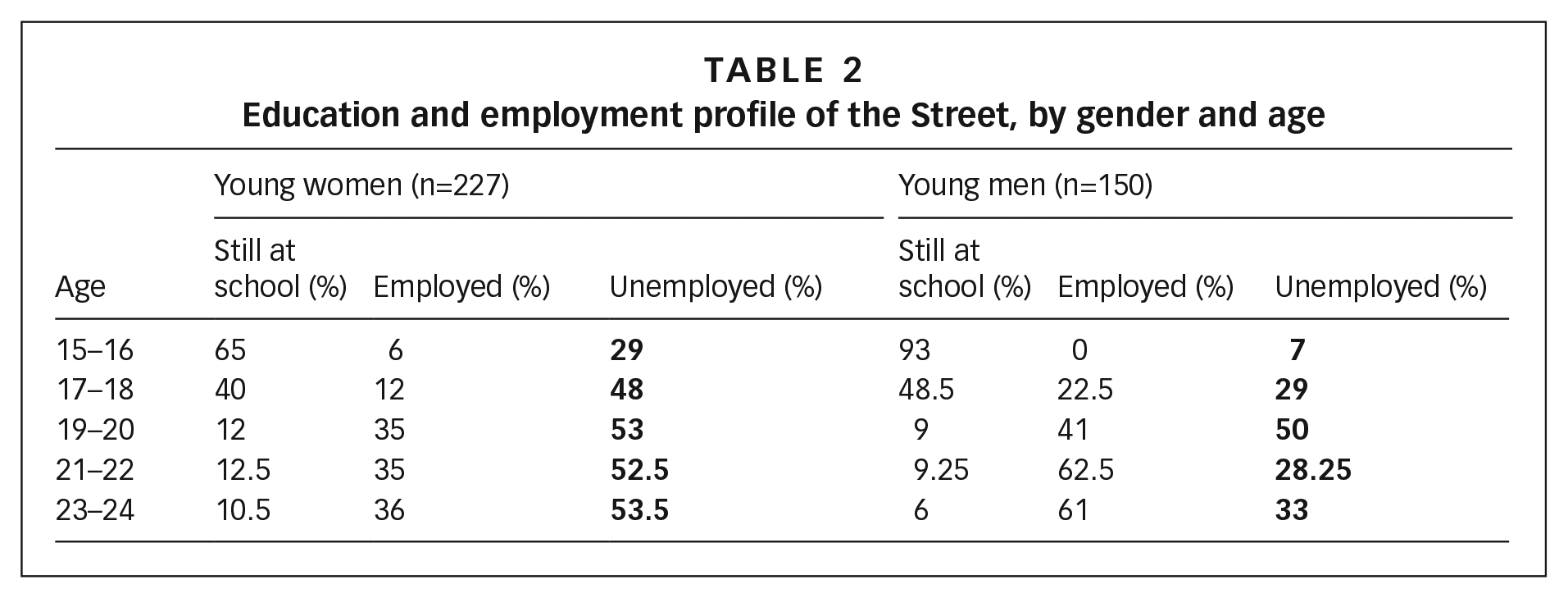
The survey reveals interesting gender differences in the school-to-work transition (Table 2). Young women leave school at an earlier age and remain unemployed for longer. This is not purely down to parental unwillingness to invest in their daughters’ education, but also to the pressures young women face around domestic responsibilities. “Boys are allowed to do everything and anything”, explained a group of fathers. “But girls have to squeeze all of these things around their responsibilities at home.” Young men enter the labour market more quickly after school dropout and display lower rates of unemployment across all ages. Pressures to be financially independent post-schooling are a considerable source of anxiety for young men. As one unemployed young man explained, “When I was at school I was provided with some level of support from my parents…But when I was finished, that was it, I was cut off. Now I don’t get any money at all.”
Education and employment profile of the Street, by gender and age
b. Difficulties securing work prevent progress in young people’s social, as well as economic, lives
Work is foundational to being seen, accepted and respected as an adult, making an income critical to young people’s broader social development. Parents unanimously emphasized “self-reliance” as a critical marker of young adulthood. Young men, in particular, are expected to become financially independent after school and to contribute to the household (including siblings’ education costs). Without regular work, young people, seen as consumers and dependents rather than contributors, are excluded from decision-making and participation in the household and wider community. Eighty-four per cent of respondents remain dependent on parents or other family members. If we exclude married youth, this dependence remains high across the entire age spectrum of 15 to 24 (Figure 1). This highlights the extremely narrow opportunity landscape for young people of all ages to attain respect and social recognition. Even where young people obtain employment, it does not pay enough, or regularly enough, to promote financial independence.
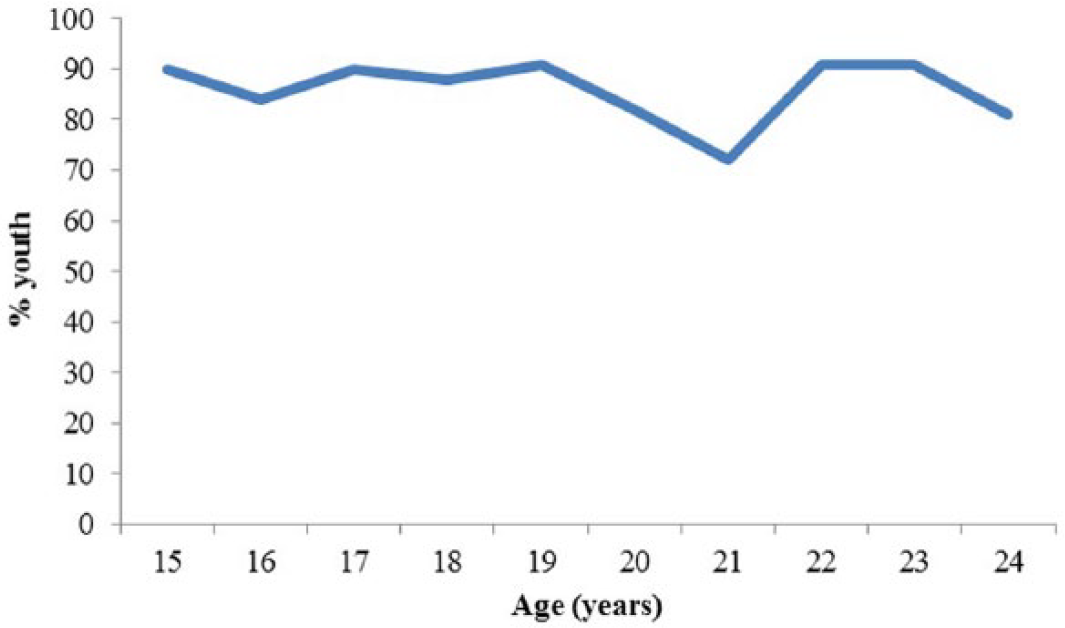
Percentage of unmarried youth remaining dependent on household
Work is a major prerequisite for marriage for young men, creating major obstacles in this critical step to adulthood. Of the respondents, only 4 per cent of young men between 15 and 24 years are married, compared to 19 per cent of young women.(69) Marriage marks the passage of moving into one’s own established household – only four of 326 unmarried youth lived outside their parents’ or other familial households. The qualitative research reveals a common practice among young men that the survey cannot capture. While still classifying themselves as living with their families, many young men spend their nights in various friends’ “ghettoes”. This enables them to achieve a minimal level of independence and escape the pressures they face at home. It is also driven in part by pressures from the household to leave when there are many young female siblings or relatives living there.
In contrast, households are more willing to support young women for longer. This stems from worries that they will resort to transactional sexual relationships if forced to meet their own needs. Despite these intentions, however, household poverty forces many parents to rely upon their daughters. Mothers agreed that “Girls have to take some of the burden of their family and to do this the only way is to endanger herself”. Fathers expressed their pain that household poverty means more cannot be done to protect their daughters. One man told this story:
“Parents are used to receiving small contributions from daughters without asking where they are getting it from. Once parents get used to this support it becomes chronic and they depend on it …Take one of my neighbours. He had a daughter who used to go out and when she came back she would have a bag of things for the household. The first day she brought it back the father asked where she got it from, and the daughter replied, ‘What, these things? I just found the bag at the side of the road and I picked it up.’ The second day she gives the same story and on the third day the father explodes and shouts, ‘You can’t be lucky every day, tell me where you got it!’ and beats her so badly when he hears the truth that the neighbours have to intervene.”
The difficulties in securing regular or decent work lead to negative stereotypes of youth, creating further obstacles to their social acceptance. Evident in discussions with parents, leaders and youth themselves were widely held presumptions that unemployed youth can meet their basic needs only through theft, crime or prostitution. Interviews also outlined the close linkage between jobs and respect for young people, with one young man arguing, “Most of them [the youth] are jobless so they can’t be respected”. Seventy and 40 per cent of young women and men, respectively, reported their belief that young people in the community are not respected. Positive responses were qualified – only those with jobs could gain respect.
c. Youth livelihoods: searching for security
Section III outlined how Arusha’s long-standing economic decline has led to a challenging and competitive labour market. “Young people here are facing a harder time than we were facing as youth”, argued mothers, highlighting large-scale factory closures and increased regulation of informal employment. Parents, leaders and young people all stressed that employment was the primary challenge facing youth. Few youth refer to themselves as “employed”, since their small, irregular economic activities do not constitute the “nice jobs” associated with the term “employed”. Forty-four and 68 per cent, respectively, of out-of-school young men and women sampled in the Street are unemployed. Unemployment rates are similarly high for both Standard 7 and Form 4 graduates at 61 and 60 per cent respectively, affirming fears that additional years of schooling do not pay off.
The most common occupation for employed young men (one-third of them) is as fundis, or technicians such as building assistants, electricians, or mechanics. However, at this stage, they tend to be poorly paid or unpaid assistants or apprentices. Twenty per cent are engaged in small business, 10 per cent in factories, and 12 per cent in irregular casual work.(70) As one casual worker explained, “I used to stay for three weeks or one month before getting another job”. Establishing relationships with businesses or building sites can bring greater work certainty, but work remains available only when the company has it. Young men said they may work all seven days, but then go without work for several weeks until more is available. There is less diversity in young women’s employment. Around 60 per cent of employed young women are doing some form of small business, 18 per cent work in factories and a further 10 per cent are domestic workers.
The “nice jobs” associated with stable and salaried work in offices, bars, shops or restaurants are uncommon in this ward. Interviews revealed that only a handful of young men and women were in stable employment they were happy with. Lacking contacts and qualifications, accessing these jobs requires bribes, or for young women acquiescence to employers’ demand for sex, a distressing reality that leads some to withdraw from the labour market. One young woman explained her experience: “Most challenges I get is being asked for bribes…The day I can’t forget was when a manager at a school wanted to have sex with me in order to get a chance [to work] as a teacher at his school. I refused it and came back home”.
Surveys cannot capture the volatility of young people’s labour market experiences or the relentlessness of long-term job searches. In the two months between the survey and interviews, most young people the research team followed up with had experienced change: they had been working but lost that job, moved from unemployment into work, changed jobs, or moved to Dar es Salaam or the mines in search of work. This volatility was also evident in follow-up interviews. One previously unemployed young man had switched jobs twice during those six months. He had done two months of factory work, earning 4,000 Tanzanian shillings a day (around US$ 1.80) moving mattresses around. After lunch and transport costs he took home less than 2,000 shillings (approx. US$ 0.90). He chose to leave that job and work in a friend’s shoe-shining business. He only earned 2,000 shillings a day for one or two days a week here, but there were no transport costs, it did not entail long hours and gruelling labour, and it offered him flexibility to look for alternative employment.
Factory work is not perceived well by young people. Low salaries, long hours and difficult work conditions mean few persist with it. Complaints of chest pains, difficulty breathing and other health problems were not uncommon. One young man had worked for a fibreboard company until a friend told him it would endanger his health. His friend had helped him get a job as a porter nearby, but most young people leave factory jobs before finding alternatives because long hours interfere with job searches. Only one young woman had stayed in her factory job for nearly five years, relying on this to put her sister through school and to save the money she needed to return for a diploma herself. This concrete future plan was central to her ability to endure a job she did not enjoy. “It’s because I have a plan”, she explained. “I have always planned to work there for five years and through this to save enough money for college or further schooling.”
Self-employment is more desirable, but also, often, the only option. As young women explained, “You cannot have a job unless you are known to [employers] or have a relative in that company. Our poor education is a barrier too. There are no opportunities here except for making your own.” Self-employment in a context of necessity and scarcity is challenging. A lack of innovation restricts chances of success. A young man gave this example: “If one person is seen to be successful selling bananas, another will start up next to them”. One banana seller was earning 7,000 shillings a day (around US$ 3.20), but six months later, her business had collapsed and she had returned to her village. There were too many women selling bananas, she explained, and insufficient customers. Her story was not uncommon. One local leader explained, “Starting with small capital is a problem; when the business goes bad they are unable to start again”. Run-ins with police are another source of anxiety for small businesses and piki piki drivers. Motorcycles are often pulled over for small infringements and rental bikes seized until sizable fines are paid. Street vendors risk losing goods and capital. Young men making handicrafts chose to sell them through intermediaries to reduce this risk, despite the lower profits.
Unemployed youth have two main job search strategies. Some wait while parents and relatives search for jobs for them (one-quarter of unemployed young men and women interviewed). Young men are particularly reliant upon networks, with most accessing their jobs through friends or relatives. Those without fathers or male relatives struggle to access male-oriented jobs or sectors. One young man wanted a mechanic’s apprenticeship, for example, but had only his mother to help. When family members do not work in desired sectors it is a problem. “I haven’t done any work since leaving school”, said one young woman. “I am trying to use my mum’s friends to help me search for a job. But I don’t want to do hairdressing like my mum does.”
The second strategy is to actively search for work. Only half of employed young women secured jobs through contacts, and more of them had monthly paid work (e.g. factory or domestic work), for which there are well-known job search channels. Factories have regular days when workers wait outside the gates to be selected. Many give up after repeated attempts, however, learning that it is futile without a contact or bribe. One unemployed young man explained:
“Every Wednesday I go to Factory X. If they have work available they may invite 3 or 4 or 5 people in. There may be 10 or 15 people getting in on a good day but there will be 70 people outside looking for work at the gate! I haven’t been able to go inside there yet…They tend to read names out of the people that know someone inside or have paid a small bribe.”
Walking around looking for work in construction sites, shops and restaurants or middle-class households is an option taken by one-third of unemployed young women and nearly half of unemployed young men. This time- and energy-consuming process may generate small pieces of work but is unlikely to secure regular work unless a good relationship can be established. One young man detailed his experiences:
“I wake early in the morning and I just walk around the city looking for work in construction, looking for places needing porters – anything. I spend 12 hours a day just walking. I might get some casual work three times a month. Construction work might last for two or three days; if it is work as a porter it will be only for one day. Regardless of what job I find, this isn’t enough to meet my living costs.”
Issues of personal safety arise in young men’s navigation of the city. Walking across the city can exacerbate their vulnerability in an environment where they are feared as criminals or troublemakers. Mothers claimed that if young men are seen in areas where they are not recognized, they will get “stoned away”. Young men, too, explained, “It is unsafe for young people to roam in town if you don’t have a job…Most people will accuse you of being thieves, even if you are out trying to find jobs.”
All the young respondents noted the huge pressure on them to be self-reliant, and the few opportunities providing this security. The livelihoods of unemployed and employed youth remain insecure and in constant flux, and the insecurity is interconnected with and exacerbates insecurity in other domains of their lives.(71)
d. Living with livelihood insecurity: implications for support, happiness and future aspirations
We have seen the multiple vulnerabilities that livelihood insecurity imposes on young people in this low-income ward. It creates difficulties meeting basic needs, means young people are viewed as dependent rather than self-reliant, and hence places often insurmountable obstacles in the transition to adulthood in the arenas of marriage, family and citizenship. Here I look more deeply at the implications of this livelihood insecurity for young people’s lives, focusing particularly on its repercussions for their ability to aspire to and envision a better future. We have to recognize the dampening impact that these compounding factors have on happiness and wellbeing. “I had a desire to have a good life”, explained one young man, “but life is kicking me out of the way”.
We have seen that school dropout marks the end of parental support. But emotional as well as material support can be limited. Young people expressed their reluctance to burden their parents with their worries when their own poverty weighed so heavily upon them. As one unemployed young man explained, “I can’t go to my parents. If I do, there will be no food and they will cry for me. I don’t want this, so I will go to bed hungry if I cannot pay for food myself.” While interviewees suggested that relationships with parents were largely positive in terms of being able to confide in them, focus groups highlighted alcoholism and domestic violence, a high prevalence of single-parent families, and “a lack of seriousness” about parenting. Parents also described how conflict between young people and parents had led many to “select globalization to be their parents”. This reflects frustrations at the insufficient education provided by parents as well as heightened global awareness. Connections with the modern world reveal other pathways that young people want to follow, not the ones outlined by their parents or offered within the narrow and restricted opportunity landscape of the ward and city.
Community support is also lacking due to perceptions of “youth” as a lumpen, homogenized, trouble-making category. Young people – especially young men – said that when they are seen as successful, people assume they have done something illegal. “There is nowhere that you can go to present your needs, your desires, your plans”, said one group of young men. “If you try to speak to people it will go badly. Someone will say ‘look at this boy, he thinks he knows each and every one – put him in a cell!’”
A lack of physical space where young people can come together is also detrimental. Young people and parents called for youth centres where young people can be mentored and develop their skills, talents and self-esteem. Young people’s space for socialization is limited to “the Street”, where they are often reluctant to socialize for fear of being stereotyped, accused of bad or criminal behaviours or dispersed by police. “People don’t like these young people sitting in the street near them all day”, explained young men. “If anything happens then straight away they will blame those sitting there.” This has implications for their ability to build support networks.
Young people also fear being drawn into bad groups. Negative stereotypes of youth extend to young people themselves. “It is hard to get good friends here”, explained one young woman. “They may be drunkards or hanging out with the wrong people. So you can’t just go and socialize in the Street or you might end up doing this too.” Young women also fear gossip and bad advice. As a member of one focus group explained, “For example, if I see my friend Flora and she is looking good in a nice pair of trousers I will ask what she has done to look nice like this. Rather than give me good advice she will tell me to sell myself and go to prostitution.” The interviews revealed a particularly acute shortage of trusted friends for Standard 7-educated young men and women. Form 4-educated young men and women reported a greater number of male and female friends and displayed less fear of being drawn into “bad groups”.
Emotional and material support are crucial to young people’s development, building the internal assets and competencies they need to survive, build resilience and flourish.(72) The experience of poverty prevents young people from developing self-confidence and the capacity to aspire, and their dampened hopes and aspirations were starkly visible across focus groups and interviews.
The idea of “a future” is critical in narratives of success. One unemployed young man, for example, said that he admired his friend’s success, “because he had a future and has fulfilled it”. Careful planning was part of this story – his friend had worked at a factory for four years until he had enough capital to buy a motorcycle and open a clothing business. But it was the ability to envision “a future” that was the critical first step on this journey – and this is outside the grasp of many. Young men’s and women’s capacity to envision “a future” was determined less by employment status than by education level. One unemployed Form 4-educated young woman, for example, said, “I would like to be a businesswoman with a big clothes shop, because I believe it is my future life to be a businesswoman.” Compare her beliefs with those of an employed Standard 7-educated young man who made cooking stoves. “What job do I want to do in the future?” he asked, shaking his head. “What future? I have no future because I haven’t prepared until now.”
Sixty-five and 60 per cent of young men and women respectively reported their lives as “worse than expected”, but also felt this was inevitable with earnings so low, pressures so high and opportunities so few. “Of course it is worse”, argued one young man, “because I have no job, little education. What else is there?” The dashing of past dreams and plans also contributes to these sentiments. “My life is worse because my dreams have ended”, said one young woman. “I had dreamed of becoming a lawyer.” Young men, in particular, found little reason for being happy. “I haven’t fulfilled my goals and have no money in my pocket”, explained one young man. “I don’t even have time to laugh, how can I be happy?” said another.
Both education and gender influence happiness and wellbeing. Standard 7-educated young men are worst off in measures of happiness. Five out of six employed young men at this education level reported being unhappy with their jobs and said their lives are “worse than expected”. They also reported the lowest average happiness rating (2.3) of employed youth.(73) In contrast, only one of six Form 4-educated employed young men are unhappy with their job; half reported their lives as “worse than expected” and this group also reported a higher average happiness rating (5.7). Employed young women display similar differences across education levels. Form 4-educated young women are happier in their jobs and less likely to report their lives as worse than expected. Young women are also more likely to report higher average happiness rates – of 6.3 for Standard 7 graduates and 4.75 for those completing Form 4. This increases to 6 if I remove an outlier from the average – a young teacher with the highest income in the sample, who gave the lowest happiness rating possible, saying “If someone else is sitting idle with nothing then I will have to take that person’s happiness.” Her score, then, reflected the general status of youth in the community more than her personal experience.
Greater happiness and satisfaction for young women reflects the fact that they face less pressure to be self-reliant and that many remain hopeful that marriage will offer them a route out of today’s difficulties (whether or not the realities of marriage live up to this). One young woman had been living a hard life as a cook at a mosque, for example. Her monthly salary paid her room rental and she could take food from work for herself and her son, but she had almost nothing left over for other basic needs. When I called six months later, she sounded transformed; she was engaged and her fiancé had sent her to live with his in-laws in their village. She no longer had to work hard for long hours and was looking forward to him sending some capital for her to start a business in the village.
V. Conclusions
Youth employment may be the most visible outward face of the “youth crisis” in urban Africa and draws attention to the immediate problems young people are facing. However, it is necessary to include the underlying roots of these problems in this analysis, paying attention to both the structural dimensions (those rooted in local and global political and economic processes) and experiential dimensions (those constructed by social and cultural processes) of urban poverty for young people.(74) In a city characterized by long-standing economic decline, both employed and unemployed youth face severe difficulties in achieving livelihood security and financial independence. In the low-income ward examined here, difficulties securing livelihoods are compounded by household poverty; a lack of community trust, cohesion and support; and social exclusion within and outside the ward as a result of negative stereotypes of young people. Our understanding of young people’s experiences of urban poverty must move away from a narrow focus on individual outcomes and pay greater attention to broader environmental influences on vulnerability and opportunity. Our analysis must be set against the background of the local cultures and traditions that so heavily shape the expectations, aspirations and trajectories of youth, as well as the implications of a dynamic city context for the process of young people’s development.
The social and the economic dimensions of young people’s lives cannot be viewed independently because they are so closely intertwined. Young people are living in material poverty and employment is at the centre of their concerns, but the experience of poverty has even further- reaching repercussions. This reduces the institutional support they receive at this critical life stage, constrains their capacity to aspire to a better future, and leaves them without the developmental assets and competencies they need to draw upon throughout their adult lives. Living with livelihood insecurity has severe implications for the support systems young people can generate, for their ability to envision “a future” to move towards, and for their happiness and self-esteem. Across these social dimensions, the additional four years of lower secondary schooling has a positive effect, despite complaints that it does not pay off in the labour market. Young women, who face less pressure to be self-reliant and hold some hope that futures may improve after marriage, also fare better in terms of happiness and self-esteem. But we cannot overlook their increased vulnerability to early pregnancy and motherhood where poverty leads them to risky sexual behaviours to meet their – and their households’ – basic needs.
Footnotes
Acknowledgements
The author would like to thank Fikiri Elias and Sadala Ismel for their invaluable research assistance, as well as Mahija Rajabu, Bariatu Hussein, Athanas Chenya, Richard Mabala and Tim Ndezi for their support and facilitation in the field. Lastly, her thanks go to participants of the Development Studies Association’s workshop on urbanization at the University of Sheffield in January 2016, where helpful comments and feedback were given on an earlier version of this paper.
Funding
Nicola Banks is an ESRC Future Research Leader funded under grant reference number ES/K009729/1.
1.
Guengant, J and J F May (2013), “African demography”, Global Journal of Emerging Market Economies Vol 5, No 3, pages 215–267.
2.
Hansen, K T (2015), “Cities of youth: Post-millennial cases of mobility and sociality”, in D Resnick and J Thurlow (editors), African Youth and the Persistence of Marginalization: Employment, Politics and Prospects for Change, Routledge, Abingdon and New York, pages 67–84; also Honwana, A (2012), The Time of Youth: Work, Social Change and Politics in Africa, Kumarian Press, Stirling, VA. See also an earlier special issue of
Environment and Urbanization
(Vol 22, No 2) on “Youth and the City” that provides a comprehensive overview of these issues, available at  .
.
3.
Potts, D (2013), “Urban economies, urban livelihoods and natural resource-based economic growth in sub-Saharan Africa: The constraints of a liberalized world economy”, Local Economy Vol 28, No 2, pages 170–187.
4.
Urdal, H (2006), “A clash of generations? Youth bulges and political violence”, International Studies Quarterly Vol 50, No 3, pages 607–629.
5.
Sommers, M (2006), “Urban youth in Africa”, Environment and Urbanization Vol 22, No 2, pages 317–322.
6.
Hansen, K T (2005), “Getting stuck in the compound: Some odds against social adulthood in Lusaka, Zambia”, Africa Today Vol 51, No 4, pages 3–16.
7.
This is forecast to increase to 60 per cent by 2050. See reference 1.
8.
Growth has largely depended on natural resource extraction, with many countries experiencing deindustrialization as a result of competition from liberalized imports. Other constraints that have increased the costs of service delivery and limited the competitiveness of African industry include low productivity, high transport costs and low population densities. See Turok, I (2013), “Securing the resurgence of African cities”, Local Economy Vol 28, No 2, pages 142–157; also Robbins, G (2013), “Mining FDI and urban economies in sub-Saharan Africa: Exploring the possible linkages”, Local Economy Vol 28, No 2, pages 158–169; and Kessides, C (2007), “The Urban Transition in Sub-Saharan Africa: Challenges and Opportunities”, Environment and Planning C: Government and Policy Vol 25, No 4, pages 466–485.
9.
Fay, M and C Opal (2000), “Urbanization without growth: A not so uncommon phenomenon”, World Bank Policy Research Working Paper No 2412; also Pieterse, E (2006), “Building with ruins and dreams: Some thoughts on realizing integrated urban development in South Africa through crisis”, Urban Studies Vol 43, No 2, pages 285–304.
10.
Beall, J, B Guha-Khasnobil and R Kanbur (2010), “Introduction: African development in an urban world: Beyond the tipping point”, Urban Forum Vol 21, No 3, pages 187–204.
11.
Brown, A, M Lyons and I Dankoco (2010), “Street traders and emerging spaces for urban voice and citizenship in African cities”, Urban Studies Vol 47, No 3, pages 666–683.
12.
13.
14.
See reference 13.
15.
See reference 12. Although only two countries in sub-Saharan Africa have time-series data, this progress also offers the potential to better track these aspects of informal employment over time. These two are South Africa and Zambia. Zambia’s share of informal employment increased to 59.4–69.5 per cent of non-agricultural employment between 2005 and 2009 (although there is no breakdown of this information by informal sector or informal employment outside the informal sector in the earlier 2005 data). In contrast, in South Africa, informal employment has decreased significantly between 2005 and 2010, from 39.1 per cent to 32.7 per cent of non-agricultural employment. As a middle-income country, it is noteworthy that South Africa displays considerably lower levels of informal employment than the other countries for which comparable data are available.
16.
Vanek, J, M A Chen, F Carré, J Heintz and R Hussmans (2014), “Statistics on the Informal Economy: Definitions, Regional Estimates and Challenges”, WIEGO Working Paper (Statistics) No 2, Cambridge, MA and Manchester, UK.
17.
This is significantly less representative of the region as a whole than the data available for Southern and Eastern Asia (covering 80 per cent of the working age population (WAP)), Latin America and the Caribbean (89.1 per cent of the WAP), North Africa (38.7 per cent of the WAP), and Western Asia (36.6 per cent of the WAP). See reference 13.
18.
See reference 12.
19.
See reference 12.
20.
See reference 11; also Simone, A (2001), “Straddling the divides: Remaking associational life in the informal African city”, International Journal of Urban and Regional Research Vol 25, No 1, pages 102–117.
21.
Simone, A (2004), “People as infrastructure: Intersecting fragments in Johannesburg”, Public Culture Vol 16, No 3, pages 407–429, page 428.
22.
Gindling, T H and D Newhouse (2014), “Self-employment in the developing world”, World Development Vol 56, pages 313–331.
23.
Potts, D (2008), “The urban informal sector in Africa: From bad to good (and back again?)”, Development Southern Africa Vol 25, No 2, pages 151–167. That urban governments face competing tensions of trying to keep cities global and competitive at the same time as meeting the needs of city residents means the latter often lose out through evictions, harassment, and increasing marginalization and inequality. See Watson, V (2014), “African urban fantasies: Dreams or nightmares?”, Environment and Urbanization Vol 26, No 1, pages 215–231.
24.
Lindell, I (2010a), “Informality and collective organizing: Identities, alliances and transnational activism in Africa”, Third World Quarterly Vol 31, No 2, pages 207–222; also Meagher, K (2010), “The tangled web of associational life: Urban governance and the politics of popular livelihoods in Nigeria”, Urban Forum Vol 21, No 3, pages 299–313; Lindell, I and M Utas (2012), “Networked city life in Africa: Introduction”, Urban Forum Vol 23, No 4, pages 409–414; and Bryceson, D F (2010), “Africa at work: Transforming occupational identity and morality”, in D F Bryceson (editor), Africa at Work: Occupational Change, Identity and Morality, Practical Action Publishing, Rugby, pages 3–26.
27.
Lindell, I (2010b), “Between family and market: Urban informal workers’ networks and identities in Bissau, Guinea-Bissau”, in, D F Bryceson (editors), Africa at Work: Occupational Change, Identity and Morality, Practical Action Publishing, Rugby, pages 149–164.
28.
See reference 1.
29.
Thurlow, J (2015), “Youth employment prospects in Africa”, in D Resnick and J Thurlow (editors), African Youth and the Persistence of Marginalization: Employment, Politics and Prospects for Change, Routledge, Abingdon, pages 23–46.
30.
Hendriks, B (2010), “Urban livelihoods and institutions: Towards matching institutions for the poor in Nairobi’s informal settlements”, International Development Planning Review Vol 33, No 2, pages 111–146.
31.
Statistics South Africa (2015), National and provincial labour market: Youth (Q1 2008 to Q1 2015), Pretoria, accessed 7 April 2016 at .
32.
Worth, N (2009), “Understanding youth transition as ‘Becoming’: Identity, time and futurity”, Geoforum Vol 40, No 6, pages 1050–1060.
34.
Burgess, G T and A Burton (2010), “Introduction”, in A Burton and H Charton-Bigot (editors), Generations Past: History of Youth in East Africa, Ohio University Press, pages 1–24.
35.
Gough, K, F Chigunta and T Langevang (2016), “Expanding the scales and domains of (in)security: Youth employment in urban Zambia”, Environment and Planning A Vol 48, No 2, pages 348–366.
36.
See reference 6; also Grant, M (2006), “ ‘I have been patient enough’: Gendered futures and mentors of female youth in urban Zimbabwe”, European Journal of Population Vol 23, pages 415–428; Mains, D (2007), “Neoliberal times: Progress, boredom and shame among young men in urban Ethiopia”, American Ethnologist Vol 34, No 4, pages 659–673; and Ralph, M (2008), “Killing time”, Social Text Vol 26, No 4 97, pages 1–29.
37.
Banks, N (2015a), “Understanding youth: Towards a psychology of youth poverty and development in sub-Saharan African cities”, Brooks World Poverty Institute Working Paper Series No 216, University of Manchester, Manchester; also Hossain, N and J A McGregor (2011), “A lost generation? Impacts of complex compound crises on children and young people”, Development Policy Review Vol 29, No 5, pages 565–584.
38.
Thieme, T A (2013), “The ‘hustle’ amongst youth entrepreneurs in Mathare’s informal waste economy”, Journal of Eastern African Studies Vol 7, No 3, pages 389–412.
39.
Di Nunzio, M (2012), “We are good at surviving: Street hustling in Addis Ababa’s inner city”, Urban Forum Vol 23, No 4, pages 443–447.
40.
Finn, B and S Oldfield (2015), “Straining: Young men working through waithood in Freetown, Sierra Leone”, Africa Spectrum Vol 50, No 3, pages 29–48.
41.
See reference 38; also see reference 39.
42.
See reference 2, Hansen (2015); also Jeffrey, C (2012), “Geographies of children and youth II: Global youth agency”, Progress in Human Geography Vol 36, No 2, pages 245–253; and Porter, G, K Hampshire, A Abane, E Robson, A Munthali, M Mashiri and A Tanle (2010), “Moving young lives: Mobility, immobility and inter-generational tensions in urban Africa”, Geoforum Vol 41, No 5, pages 796–804.
44.
Hahn, H P (2010), “Urban life-worlds in motion: In Africa and beyond”, Africa Spectrum Vol 45, No 3, pages 115–129; also Langevang, T and K V Gough (2009), “Surviving through movement: The mobility of urban youth in Ghana”, Social and Cultural Geography Vol 10, No 7, pages 741–756.
46.
See reference 6, page 3.
47.
Locke, C and P Lloyd-Sherlock (2011), “Qualitative life course methodologies: Critical reflections from development studies”, Development and Change Vol 42, No 5, pages 1131–1152; also Dewilde, C (2003), “A life-course perspective on social exclusion and poverty”, British Journal of Sociology Vol 54, No 1, pages 109–128.
48.
Lam, D (2006), “The demography of youth in developing countries and its economic implications”, World Bank Policy Research Working Paper 4022, Washington, DC.
49.
50.
Riggio, E (2012), Children in an urban Tanzania, UNICEF Tanzania.
51.
Arndt, C, L Demery, A McKay and F Tarp (2015), “Growth and poverty reduction in Tanzania”, UNU-WIDER Working Paper 2015/51.
52.
Tripp, A M (1997), Changing the Rules: The Politics of Liberalization and the Urban Informal Economy in Tanzania, University of California Press, Berkeley. This figure is based on Tanzania’s 1991 National Informal Sector Survey, which has not been repeated and remains the most recent source of data on the size of the informal economy. The number of people engaged in the informal sector in Dar es Salaam grew by 9.5 per cent between 1991 and 1995. , Roadmap Study of the Informal Sector in Mainland Tanzania, International Labour Organization, Dar es Salaam.
53.
See reference 13.
56.
If the 15-to-24 age criterion is used for youth, these unemployment rates increase to 20.0 per cent for all urban areas and 40.6 per cent in Dar es Salaam. See reference 54.
57.
Burgess, T (2010), “Raw youth, school leavers and the emergence of structural unemployment in late colonial urban Tanganyika”, in A Burgess and H Charton-Bigot (editors), Generations Past: A History of Youth in East Africa, Ohio University Press, pages 108–134.
58.
Burgess, T (2005), “Introduction to youth and citizenship in East Africa”, Africa Today Vol 51, No 3, pages vii–xxiv.
59.
60.
61.
See reference 60.
62.
See reference 60.
63.
Dala dalas are cheap forms of local minibus transport; piki pikis are motorcycle taxis, a popular form of employment for young men across the city.
64.
Young people here believe that if they even apply for a job outside the area their application will immediately be rejected because the employer will see their address and judge them a criminal or drunkard.
65.
In narrowing down the focus of the research, I focused only on young people between the ages of 18 and 24, rather than those up to the age of 35. This was in recognition of the school-to-work transition as a critical point in young people’s lives, and of this time period as of critical importance to that.
66.
One of the original intentions of the survey had been to help facilitate the selection process for these interviews, giving our research team access to the disaggregated data we would need to identify young people in each of these categories. However, this proved difficult. While some provided telephone numbers, many did not or their numbers were “unreachable” – often the case in a context where phones are lost or stolen regularly and in which many young people have SIM cards, but no phones. Of those we spoke to, many had experienced changes in circumstances in the two months between the survey and interviews. Unemployed youth had found jobs, employed youth had lost them, and some had moved to Dar es Salaam or mining regions in search of jobs. Finding respondents within each category, therefore, was time-consuming. We reached out to young people through the local federation and chairperson of the Street, as well as those we had already interviewed. Some categories were particularly difficult to find, such as 18-year-old Form 4 graduates who are employed. Their age at this qualification means they had only just completed schooling. It was also harder to find unemployed young men aged 23 or 24; necessity means they tend to have found some kind of employment by this age, even if temporary or casual. Employed young women were also more difficult to find. Section IV provides more detail on these issues.
67.
Saint Kayumba is a derogatory name given to state schools across the country, referring to an NGO educational campaign that featured a young man called Kayumba who was struggling to learn about computing through a teacher drawing a picture of a computer on the blackboard. The term refers to the poorly equipped schools young people must learn in and, more generally, to the poor-quality education they receive. For more detail see Banks, N (2015b), “Education and the Political Economy of Development: The ‘Learning Crisis’ in the Developing World?”, in C Death, D Hulme, N Banks, H Underhill, D Arubayi and P Skidmore (2015), “Is there a ‘learning crisis’ in Africa? Education and development post-2015”, The Davies Papers: Africa Series No 8, pages 8–9.
68.
These beliefs are also reflected in national statistics for 2014 that show youth unemployment to be highest among secondary (15.2 per cent) and university (12.0 per cent) graduates. These averages increase to 19.1 per cent and 14.1 per cent for young women. See reference 60.
69.
The survey captured a relatively even spread of young men and women across the 15-to-24 age range, so this does not indicate that young men were all of younger ages or that young women in older categories dominated.
70.
Interestingly, while 5 per cent of respondents were engaged in some form of transport, there were no piki piki drivers within the survey. This is perhaps indicative of the difficulties of accessing respondents with mobile jobs for which they are outside of the household for long periods of the day.
71.
See reference 38.
73.
Interview respondents were asked to rate how happy they were on a scale of 1 to 10, with 1 being “very unhappy” and 10 being “very happy”.