




Abstract
Despite the growth of adaptation plans and action by municipalities, there are limited examples of opportunities for effectively mainstreaming climate adaptation into policy and practice in local government. This paper uses the experiment of co-producing an adaptation plan for a small municipality in the Western Cape Province, South Africa, to illustrate how opportunities were leveraged. The findings suggest that a shift from strengthening the science–policy interface to the knowledge–policy interface might be more appropriate in the context of adaptation planning that requires an understanding of the local context as well as of global science. In order to align adaptation plans with developmental priorities and to secure support from actors at multiple levels, the integration of multiple knowledge forms, including climate science, should be prioritized. Such a task could be strengthened if co-production is prioritized. Building on these opportunities is critical to scaling up adaptation in local government and building on its transformative potential.
Keywords
I. Introduction
Adaptation to climate change is a concern for many cities, towns and local governments that have recognized the importance of reducing the multiple impacts of climate change.(1) At the local government level, adaptation planning is seen as an important step in establishing the governance framework through which to implement adaptation.(2) The alignment of climate adaptation with existing government priorities and policy, known as “mainstreaming”, can meet multiple objectives and increase the efficiency of human and financial resources.(3) Understanding the opportunities for developing adaptation plans that align with development priorities is particularly important in the global South, yet this has not been explored sufficiently in the literature.(4)
Developing adaptation plans and policies requires a robust but realistic understanding of climate change science, vulnerability to climate impacts, and the broader socioeconomic and governance context in which adaptation might occur. Local government decision-makers are likely to be familiar with the governance and socioeconomic context, but often lack an understanding of the climate science and vulnerability, which requires engagement with researchers and scientific literature.(5) Understanding how policy interfaces with these different knowledges in an iterative sense is thus critical in developing local adaptation plans.
Much research has highlighted the content of local adaptation plans.(6) Less has been written regarding the challenges and opportunities of integrating climate science and local knowledge into adaptation policy and planning.(7) Van den Hove defines science–policy interfaces as “social processes which encompass relations between scientists and other actors in the policy process, and which allow for exchanges, co-evolution, and joint construction of knowledge with the aim of enriching decision-making”.(8) Given the focus in this definition and in our case study on the importance of social processes and the co-production of knowledge from various actors, we argue that the term science–policy interface should be replaced with knowledge–policy interface. The concept of the knowledge–policy interface suggests that scientific knowledge needs to be placed alongside local knowledge and managerial–political knowledge, recognizing the importance of all of these for informing policy.
Adaptation plans and policies are formal institutions that support the governance of adaptation. The informal institutions that underpin the development of policy and plans, including the co-production of knowledge and social processes that lead to the development of plans and policies, are as important.(9) Core to these processes are the actors involved. There is growing importance placed on including both state and non-state actors in collaborative governance processes to ensure wide representation and support for policies.(10) In addition, multi-level governance is critical to building sustainable responses, yet is often missing in the development of local adaptation plans, where only one level of government and actors is included.
Using the case of the Bergrivier Municipality in the Western Cape Province of South Africa, this paper aims to 1) uncover the opportunities leveraged to develop a municipal adaptation plan; and 2) understand how the co-production of an adaptation plan can strengthen the knowledge–policy interface. We suggest that in this case multiple opportunities converged to enable a municipal plan to be rapidly developed through a collaborative process that aligned with existing policy at multiple levels. We explore how the social process built on existing successful partnerships among a range of academic, parastatal and government actors who worked together to co-produce a municipal adaptation plan. This process contributed to building the capacity of local actors to plan for adaptation and helped to create a strong foundation for implementing adaptation.
The paper begins by situating the research in the context of opportunities for adaptation planning, with a focus on how central the co-production of knowledge is to supporting the science–policy and knowledge–policy interface. It then provides context and details on the process of developing the Bergrivier Municipality Climate Adaptation Plan, highlighting how the opportunities converged to co-produce an adaptation plan. The paper concludes by discussing the contributions to practice-based adaptation planning and the theoretical importance of co-production for strengthening the knowledge–policy interface in climate change adaptation planning.
II. Understanding Opportunities for Co-Producing Adaptation Plans
a. Opportunities for adaptation planning
As planning and implementation of adaptation expands in municipalities, more familiarity is gained regarding what enables or constrains the process.(11) There is a growing literature examining the institutional barriers to adaptation,(12) but less of a focus on the opportunities and enablers for developing successful adaptation. These are important to characterize, given the applied climate adaptation agenda.(13)
Governments are responsible for many (although by no means all) of the barriers to adaptation.(14) Government actors are also central in terms of their ability and mandate to intervene and create opportunities – providing resources or changing legislation, for instance.(15) Despite the importance of identifying opportunities for adaptation, there are not many studies focusing on how local government has facilitated experimental adaptation specifically, in a developing country context.(16) Kumar and Geneletti, for example, highlight the limited integration of climate change issues into spatial planning at the city scale in India. They cite a range of obstacles, including lack of initiative by local government in exploring this.(17) However, examples are starting to emerge of how integrating community-based adaptation at the city scale can have wider transformative potential for urban governance.(18) In the case of Maputo, Mozambique, residents of a low-income settlement with frequent flooding were explicitly involved in shaping the city’s adaptation plan and were supported to develop their own Community Plan for Climate Adaptation.(19) Local government can be an important facilitator of climate adaptation because of its ability to plan and manage at the local scale and to connect to provincial and national government.(20) The growing focus on governance, which goes beyond government to the multi-level structures and processes by which government and other actors make decisions and share power, is critical.(21) Finding ways for local government’s role to be strengthened to include the facilitation of collaborative and multi-level adaptation planning is therefore a priority, and this paper aims to contribute to this.
Given the relatively recent focus on opportunities for and barriers to adaptation, it is not surprising that there is little consensus on how to classify them.(22) In pulling together the existing literature referred to in the Intergovernmental Panel on Climate Change (IPCC) report, Klein et al.(23) suggest six types of opportunities that can be built on to strengthen adaptation:
Awareness raising through communication and education;
Strengthening of human and institutional capacity;
Use of tools such as vulnerability and risk analysis, decision support and early warning tools;
Use of policy opportunities such as integration and mainstreaming of policy, governance and planning processes, including sustainable development, resource and infrastructure planning, and design standards;
Mutual experiential learning and knowledge management of climate vulnerability, adaptation options, disaster risk response, monitoring and evaluation; and
Innovation such as development and dissemination of new information and technology development.
These categories are broad, yet can be used as starting points for building adaptation knowledge and supporting plans, policies and processes to proceed effectively and efficiently.
b. Moving from the science–policy interface to the knowledge–policy interface through knowledge co-production
As defined by van den Hove above, the science–policy interface is effectively about scientists and other actors collaboratively finding ways to use scientific information in developing policy and plans. The social processes that underpin knowledge co-production allow for “exchanges, co-evolution, and joint construction of knowledge”.(24) This is important for climate change adaptation. Given the slow uptake of adaptation institutionally, as well as the incremental nature of many adaptation projects, it is important to focus on supporting successful social processes and to build capacity and knowledge for action.(25) Strong social capital and relationships between actors enable them to work collectively and to draw on multiple bodies of knowledge, which is important in the complex field of climate change adaptation.(26) Armitage et al. argue that the process of co-production of knowledge among different actors is a key type of adaptation itself, because it supports social learning.(27) We argue that the science component is just one type of knowledge and that other types of knowledge are as important for climate change adaptation and demand a focus on the knowledge–policy interface.
In 2007, Vogel et al. wrote about the growing importance of different actors being involved in co-producing knowledge and practice for reducing vulnerability, and facilitating adaptation and resilience, rather than the “usual one-way interaction between science and practice”.(28) The usual one-way interaction is no longer accepted, and growing importance is placed on academics working with practitioners to co-produce knowledge when finding solutions to complex problems, such as those within the environmental realm.(29) Engaged scholarship focuses on the role of academics in practice and policy, and has been defined by Van de Ven and Johnson as “a collaborative form of inquiry in which academics and practitioners leverage their different perspectives and competencies to coproduce knowledge about a complex problem or phenomenon that exists under conditions of uncertainty found in the world”.(30)
Science systems are, in certain cases, effectively in transition in an attempt to produce knowledge for such complex problems.(31) This transition involves a move from Mode 1 knowledge, focused on disciplinary perspectives with traditional quality control such as peer review, to Mode 2 knowledge, developed through applied work and transdisciplinary in nature.(32) Mode 2 knowledge is at the heart of engaged scholarship and is central to co-producing knowledge for climate adaptation policy, where climate science and climate vulnerability need to be understood in the local context and integrated into policies and plans of relevance to a wide actor group. This multi-stakeholder engagement, diversity of worldviews and sharing of perspectives enrich adaptation planning in particular and support the emergence of new adaptation possibilities.(33) Documented examples of the use of Mode 2 knowledge for effective climate change planning and adaptation are limited in the global South, and particularly in the local government context.(34)
Despite the potential of co-production to build networks and capacity related to climate change adaptation, it is accompanied by numerous challenges. Homsy and Warner,(35) while seeing co-production as essential for climate policy and knowledge creation, look at the potential dangers and limitations of a polycentric approach, including the tradeoffs between centralized and more autonomous decision-making (see also Polsky and Cash(36)). Another challenge is the well-documented, time-consuming nature of negotiating the science–practice interface.(37) Ansell identifies other challenges in the San Francisco Bay Area(38) – where social movements’ (and other stakeholders’) particular visions of what collaboration might comprise may change in practice, as local realities become clear and issues and debates evolve.
III. Context: Producing A Municipal Climate Change Adaptation Plan in the Bergrivier Municipality, South Africa
a. Study area
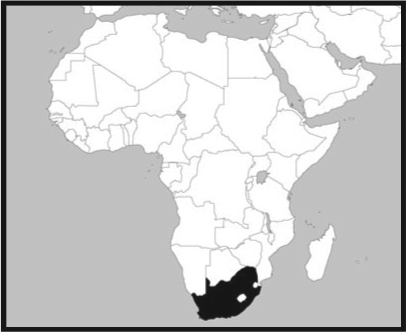
The study site, the Bergrivier Municipality, falls within the West Coast District Municipality of South Africa’s Western Cape Province and has an area of around 4,407 km2. The area includes nine urban settlements and 40 kilometres of coastline with active fishing and a vast rural, predominantly agricultural, area. The administrative seat is the town of Piketberg, where all the workshops were held. Poverty levels are high, with 25.2 per cent of households considered indigent according to the 2011 census (households where the combined monthly income is less than the equivalent of two state pensions plus 10 per cent).(39) Agriculture, traditionally the dominant employment sector, has seen a steady decline since 2001 and was overtaken as the dominant sector by the wholesale and retail trade, catering and accommodation sector in 2009.(40) This sectoral shift poses many new challenges in the area and indicates the rapid and fundamental changes taking place at the local scale.
The 2014 Integrated Development Plan (IDP) for the Municipality of Bergrivier highlighted the multiple socioeconomic development challenges in the area, including limited employment, state grant dependency, and limited basic services and municipal capacity.(41)
The area has experienced changes in climate risk over the past several decades (analysis conducted for multiple stations), including increased temperatures and days exceeding accepted heatwave thresholds,(42) with significant impacts experienced in the potato and rooibos industries, important agribusiness concerns in the area. Climate records show changes in rainfall intensity over the past few decades, with decreased precipitation during the winter season for the majority of stations surveyed.(43) Future projections indicate continued higher temperatures, as well as the possibility of increased incidence of heatwave days and continued increased frequency of extreme rainfall events.(44)
Research on climate risk and change has had a fairly longstanding history in the area. For example, a decade ago, a study was funded by a partnership of Cape Nature, Potato South Africa and the South African Rooibos Council to investigate implications of climate change for commercial agribusiness in the area.(45) Driving the commissioned work was the strong sense amongst commercial agribusiness, conservation managers and local government in the area that climate change was already evident, compounding existing stresses in an already extremely difficult environment for agriculture.
b. Climate change policy context in South Africa and the Western Cape Government
The effective implementation of the South African National Climate Change Response Policy (NCCRP)(46) is dependent on the combined efforts of national, provincial and local governments. In response to this, the Western Cape Government reviewed the 2008 Western Cape Climate Change Strategy, to bring it in line with the National Climate Change Response Policy. In this review, the role of provinces in supporting and implementing the NCCRP was explored and articulated as follows:
“There is very little capacity or budget to take on an additional portfolio such as climate change at the local level. The approach therefore is to mainstream and embed climate change into local and district level line functions and master planning, such as the Integrated Development Plans (IDPs), Spatial Development Frameworks (SDFs), and Disaster Management Plans (DMPs). In order to assist and support local and district municipalities in the identification and implementation of this approach, the Western Cape Government has set up a Climate Change Municipal Support Programme.”(47)
The adaptation component of the Western Cape Government’s Climate Change Municipal Support Programme (CCMSP) was driven by one person in particular, referred to hereafter as the “provincial initiator”. She was located in the province’s Climate Change Directorate within the Department of Environmental Affairs and Development Planning. The Western Cape Government is among leading provincial governments in South Africa with regard to having a dedicated climate change unit in its organizational design. The Climate Change Directorate works on both climate change adaptation and mitigation, working horizontally across sectors and relevant stakeholders at the provincial scale, as well as vertically. Vertical integration includes communicating the national government’s strategic intent to the local level and ensuring that the local voice is captured in national forums such as the Intergovernmental Committee on Climate Change, the National Climate Change Monitoring and Evaluation Task Team, and the National Climate Change Adaptation Task Team. In addition, the directorate assists local-level municipalities in the province to develop and implement climate adaptation and sustainable energy plans through the CCMSP mentioned above. Although the presence of the Climate Change Directorate is promising, there is still limited capacity (a small team of six) to cover the vast geographical scale and need of the province.
As the CCMSP was not a mandated process for either the province or local government, a letter of invitation and questionnaire was sent in May 2012 from the office of the Minister of Local Government, Environmental Affairs and Development Planning to all municipalities in the Western Cape Province to ascertain their interest in participating. Questionnaire responses were used to identify and select municipalities that had already exhibited some kind of initiative in the area of climate response. The rationale behind the use of this criterion was that it would enhance the programme’s chance of success and therefore increase motivation among municipalities for further uptake in subsequent years. This allowed the Climate Change Directorate, given its limited capacity, to choose three initial municipalities to work with. Bergrivier Municipality was one of them.
c. Climate change networks in the Western Cape
The Western Cape is rich in institutions undertaking climate change research, including climate science, impacts and adaptation research.(48) These networks were drawn on to support the CCMSP. In seeking robust climate information, the provincial initiator from the Climate Change Directorate was working with the Climate Systems Analysis Group from the University of Cape Town (UCT). Two of this paper’s authors, one a climate adaptation researcher at the Environmental and Geographical Science Department, UCT, and the other a climate and sustainable agriculture scientist at the Council for Industrial Research (CSIR), had a research project funded to engage with municipalities around climate adaptation planning in the Western Cape at the same time that the Bergrivier Municipality work started. Both researchers had strong links with the provincial initiator, and were asked to join the team rather than starting a separate project. The core team’s longstanding collaboration immediately facilitated a conducive research and planning environment.
Once the adaptation planning process was underway, the University of Cape Town’s African Climate and Development Initiative (ACDI), which was seeking opportunities to engage with local municipalities around transdisciplinary applied climate research, approached the provincial initiator. Following discussion, it was decided to include ACDI in supporting the Bergrivier CCMSP process, which facilitated regular meetings with the researchers, local government and provincial government actors.
It was therefore not by initial design, but rather through responding to policy and research opportunities, as well as the strong social networks of the provincial initiator, that a multi-disciplinary team grew around the Bergrivier Climate Change Municipal Support process.
d. Bergrivier adaptation planning process
In August 2012, the proposed approach to developing an adaptation plan was presented to the Bergrivier Council to secure buy-in from both the administrative and political spheres. Western Cape Government officials, two Climate Systems Analysis Group climate scientists, councillors and officials attended the inception meeting. The approach of including the extended team with specialists from UCT and CSIR was put forward and accepted. As part of its original expression of interest in the CCMSP, the municipality identified its strategic manager as the person to drive the municipal adaptation planning process so that it could align with the IDP process, for which she was responsible.
The strategic manager, described in this paper as the “municipal champion”, was tasked with setting up three workshops to inform the development of the adaptation plan. The workshop process is outlined in more detail in the methodology section.
The provincial initiator worked with the municipal champion to draft the first version of the adaptation plan, subsequently commented on by the researchers. The finalization of the draft plan in April 2013 coincided with the adoption of the Integrated Development Plan (IDP) in May 2013. This made it possible to include the development of the adaptation plan as well as some of the proposed adaptation strategies in the IDP. The Climate Adaptation Plan was adopted by the Bergrivier Council in March 2014, followed by the adoption of the IDP.
The Bergrivier Climate Adaptation Plan (2014) prioritized five areas, namely mainstreaming of climate change governance into municipal governance, development of climate-resilient low-cost housing, stormwater management, conservation of natural resources (with a focus on clearing alien invasive vegetation), and agriculture. One of the questions raised in the plan around mainstreaming climate change governance into municipal governance is “how to get increased political buy-in to the climate adaptation process to ensure that the identified adaptation interventions can be taken forward effectively?” Although the plan is in place, funding has not yet been allocated to the priority areas. Yet all the identified responses align with prioritized areas of intervention in the municipality and meet the goal of addressing climate risk as well as broader development objectives.(49) For example, current stormwater management is seen as insufficient, as the homes of low-income households are frequently flooded. Currently, sandbags are put in place by the municipality to divert heavy rain. Given expected rainfall intensification, the municipality would like to revise infrastructure plans and improve stormwater maintenance to meet future climate risks and development goals.
Although the adaptation plan was developed and integrated rapidly into the Bergrivier Municipality IDP, it is important to note that the plan was not seen as the final outcome but rather as part of the adaptation process.(50) As stated in the introduction of the Adaptation Plan,(51)
“The CCMSP is not approached as a discrete once-off engagement, but rather as an on-going series of partnerships between national, provincial, and local government, NGO’s, CBO’s and special interest groups, scientists, specialists and the private sector. It is envisaged that in this way, capacity can be developed amongst all involved, knowledge co-produced and shared, and valuable experience developed around successful climate adaptation.”
IV. Methodology
The methodology draws on participatory and social constructivist paradigms that value participation in collaborative action inquiry.(52) The practice of engaged scholarship is at the heart of this research, where researchers and practitioners leverage their competencies to reach a more holistic understanding of the problem than would be the case were the two groups to act on their own.(53) In this case, researchers worked with government officials to co-design and facilitate a government-led planning process. Engaging researchers in developing plans and policies is part of the shift to collaborative governance and transdisciplinary work, where the process of co-production and building of “Mode 2” knowledge is valued.(54) In the process documented here, an inductive approach was adopted and the empirical data gathered were jointly analysed. Qualitative methodology was used to document and reflect on the process of co-producing the adaptation plan. Throughout the adaptation planning, the researchers kept notes on the process to share with the group. Other primary documentation included meeting minutes, e-mail correspondence, workshop presentations and collation of documents, including policy drafts that form the basis of the data that were thematically analysed in this paper.
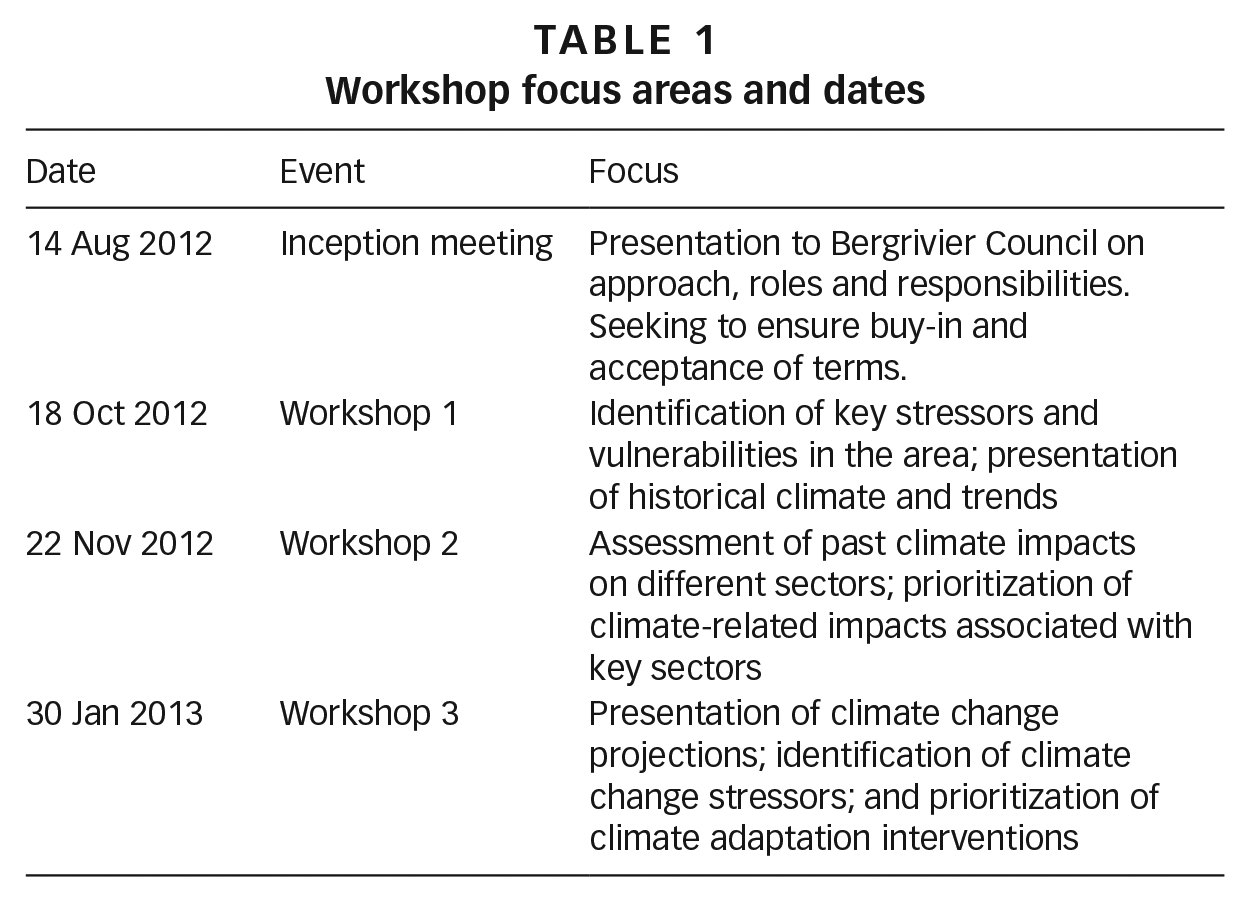
The process of stakeholder engagement, workshops and adaptation plan development is described here, as this is the context of the research. Three workshops were held in Piketberg, the seat of Bergrivier Municipality, and were attended by groups of 20 to 35 people. Participants included the mayor at one workshop, the municipal manager at another, a range of officials from the district and local municipalities, the local tourism director, residents, conservation officials, private sector representatives, farmers and the local disaster manager. Table 1 indicates the workshop dates and focus areas.
Workshop focus areas and dates
The local and provincial government officials and researchers collectively designed the methodology for the workshops. The researchers presented material on historical climate and trends, showing increases in temperature and frequency of heat stress days to date, and projections of further increased temperatures and evapotranspiration, with critical implications for a number of sectors. Material presented included work undertaken for the Sandveld area, focusing in particular on implications for commercial agribusiness. All three workshops were participatory, with some formal presentations and then group participation, discussion and feedback. The team’s combined capacity and experience provided flexibility, as workshop methodologies were altered in response to new information, participant needs and local context. This process is very different from workshops run by a single person or single discipline team, where capacity is more limited and where toolkits or rigid templates often allow for little or no context-dependent responsiveness.
These workshops were run on a minimal shared budget, with researchers covering their own travel and workshop-related costs, and Bergrivier Municipality supplying the venue and covering the catering. All processes were frugally resourced, a theme we consider below as it relates to flexibility.
V. Understanding Opportunities for Climate Adaptation Planning
Klein et al.(55) highlight that “adaptive capacity is influenced by actors’ abilities to capitalize on available opportunities that ease the planning and implementation of adaptation”. This section reflects on exactly that – how the actors involved in developing the Bergrivier Climate Adaptation Plan were able to capitalize on the available opportunities for planning adaptation. Specifically, we draw on two of Klein et al.’s six categories of opportunities, namely 1) policy, with a focus on mainstreaming and flexibility; and 2) capacity, focusing on leadership and diversity of stakeholders. We argue that in the case examined here, these opportunities supported co-production and enabled adaptive capacity to be built through a learning-by-doing approach that strengthened the scientific input into the adaptation plan.(56)
a. Policy opportunity: mainstreaming climate adaptation into development planning across levels
One challenge with mainstreaming climate change is confusion over what it means in practice.(57) In the case of the Bergrivier Climate Adaptation Plan, the planning process aligned with policy at the national, provincial and local levels as shown in Figure 1, illustrating the importance of understanding the multi-level governance context. At the national and provincial levels, it aligned with current policies (the National Climate Change Response Policy and the Western Cape Climate Change Strategy) that focus on integrating climate response into government activities. At the local municipal level, it should be noted that the adaptation planning process was specifically designed to feed directly into the IDP process, a legislated process required by the Municipal Systems Act (No 32 of 2000) that provides an overall framework for development. The IDP, reviewed annually, spells out the strategic direction for the municipality over a five-year period, detailing the implementation plan and budget to accompany this. The Bergrivier Climate Adaptation Plan, carefully timed, was ready the month before the IDP review was due, enabling a new section on climate change to be added to the IDP. Leveraging the IDP process was critical in ensuring that the climate adaptation priority areas were linked into the areas prioritized by the municipality. As Ziervogel and Parnell(58) highlight in their work assessing adaptation planning and implementation in two large metropolitan areas in South Africa, climate adaptation is not yet mandated at the local government level and therefore does not receive a budget. Officials are constrained in working on adaptation when it is not recognized as part of their key performance areas. If, however, the Climate Adaptation Plan aligns with the IDP, it can address key performance areas, effectively mainstreaming adaptation in a way that can make adaptation measures easier to resource.
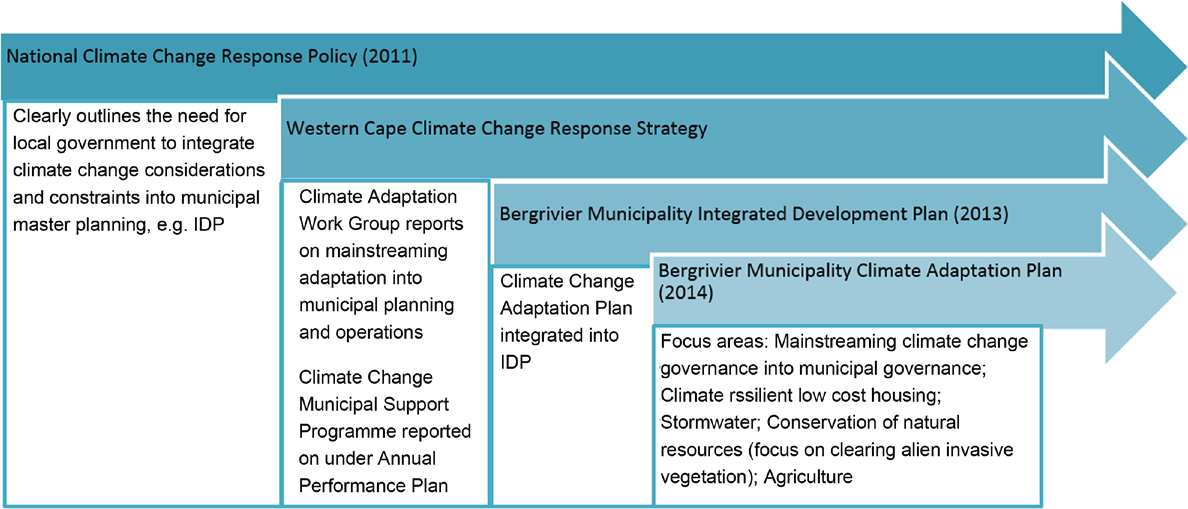
Alignment of the Bergrivier Climate Adaptation Plan with provincial and national policy processes
The Bergrivier Climate Adaptation Plan process illustrates how national and provincial policy that was not formally legislated was used to integrate climate adaptation into the legislated IDP. Part of the reason that these policy opportunities were maximized can be attributed to the fact that one member of the core team was from provincial government and one from local government. They were able to identify policy opportunities that might have been missed if researchers or consultants were developing the adaptation plan independently.
b. Policy opportunity: flexibility of the planning process
At times, government processes may be highly bureaucratic, which can undermine the ability to be flexible and agile.(59) If, however, they are engaged with in a certain way, processes can be flexible, as was the case in the development of the Bergrivier Climate Adaptation Plan. The process was initiated by the Western Cape Government through the realization of the policy directive outlined in the NCCRP and given priority through the Climate Adaptation Work Group established under one of the 12 Provincial Strategic Objectives. These work groups, due to their strategic nature, reported on identified outcomes directly to the provincial premier’s office, rather than going through the usual departmental reporting channels. The primary measurable outcome reported on for this activity was “Mainstreaming climate adaptation into provincial and municipal planning and operations”, with a secondary outcome being “Climate adaptation mainstreamed into local level municipal planning and operations”. Because the National Climate Change Monitoring and Evaluation System was not established at the time, and because this was the initial period of reporting on the programme at the provincial level, there was flexibility with regard to the selection of indicators and reporting frequency. The initial indicator used in 2012 was “the number of Municipal Adaptation Plans developed within a three year period”. After one year of implementation, this indicator shifted to “the number of municipalities supported over a five year period”, with “Municipal Adaptation Plans” being one of the measurable outputs. The change in the indicator reflects the move away from the development of adaptation plans as the ultimate goal, to a more extended goal of providing support to municipalities to mainstream climate change into their municipal master plans and develop capacity to implement the identified actions.
Limited resources may, counterintuitively, actually have further supported flexibility. This resonates with Anguelovski and Carmin’s work, which suggests that innovation in cities around the world has been driven in part by limited resources.(60) Effectively, Bergrivier Municipality owned and co-led the adaptation planning process (with acknowledged limitations), which produced a plan with a relatively small budget in a relatively short time. This is important in terms of remaining “under the radar” – an inconspicuous process may be less prone to interference and co-opting by political priorities that might slow down and disrupt the process. It also provides for increased flexibility and responsiveness when “learning by doing” if the reporting constraints do not tie the process in a linear manner to specific outputs, timeframes and preconceived ways of integrating science into policy. In this case, although reporting to the highest level, i.e. the premier’s office, and thus securing status, the reporting was focused primarily on one high-level indicator: at first the number of plans developed, and later the number of municipalities supported.
Another factor supporting experimentation was that both the Western Cape Government and the Bergrivier Municipality co-funded resources in the form of time and logistics, with relatively little bureaucratic involvement. None of the researchers were remunerated for their time on the project, although two of them needed to bring in funding to cover their salaries. However, it is recognized that not all policy processes can proceed without funding, and strategically deployed resources may be necessary in other contexts.
In summary, the provincial initiator’s familiarity with bureaucracy, the limited financial resources, and the strong human resources and social networks all contributed to flexibility and innovation.
c. Capacity opportunity: champions of co-production
The importance of leaders and champions has been widely cited as critical in driving urban adaptation responses.(61) Maiello et al.,(62) for example, observe that public managers in environmental policy have a critical role to play in acting as “catalysts” of knowledge production. Frequently, managers rely largely on so-called “technical” knowledge in isolation from other knowledge sources. We suggest that this case is different in that the municipal and provincial officials actively supported co-production of knowledge rather than isolating technical and scientific knowledge. In fact, we argue that the leadership was as much about supporting social processes and strengthening networks as it was about creating new knowledge. Different incentives help to support managers to act as catalysts or leaders. Termeer et al.(63) suggest that there are three different types of leaders who all have important roles to play in realizing adaptation strategies: namely visionary, entrepreneurial and collaborative leadership.
In the case of the Bergrivier Municipality, both entrepreneurial and collaborative leadership was evident. The municipal champion’s limited knowledge of climate change adaptation did not constrain the process of driving the adaptation plan forward. In fact, drawing on her passion for the topic, but recognizing her limited knowledge, enabled her to convene the process with the support of the Western Cape Government, rather than dominate it. This strong convening role illustrated her collaborative leadership style, which led to the mayor and municipal manager attending the workshops and increased the high-level support. This was significant given the more general lack of political or high-level support, which has been a barrier in other municipalities in South Africa.(64) Such collaborative leaders help to support the actual collaborative social process itself, which consists of trust building and the development of commitment and shared understanding.(65) These attributes are important for co-production that requires commitment to new processes and policies.(66)
Co-production can be a challenging process, particularly when different actors have different priorities.(67) The adaptation planning that has taken place in South African government structures has frequently been outsourced to consultants.(68) The Bergrivier Municipality was able to avoid consultants due to the support of the provincial government and researchers. This led to the municipality owning the process, hosting the workshops and remaining involved in the evolution of the process. We argue that it made a significant difference that the local government co-led the development of an adaptation plan, even if external researchers and government officials at different levels supported the process.
The Western Cape Government official, or provincial initiator, served as a collaborative as well as an entrepreneurial leader: collaborative in drawing on extensive networks to support knowledge co-production, and entrepreneurial in gaining the resources to realize the project.(69) Not only was she key in ensuring the CCMSP went ahead and that the project could operate with limited resources, but she was central to gathering a team of researchers and drawing on her strong social capital and existing social networks. The importance of social networks has been explored extensively in the natural resource sector.(70) However, the importance of social networks of government officials involved in climate change adaptation has garnered less attention, and was not mentioned as an opportunity in the latest IPCC chapter on “Adaptation opportunities, constraints, and limits”.(71) Yet this ability to draw on the expertise from existing social networks in the research field was in this case central to integrating science into the adaptation plan.
Opportunities that rely on social capital are hard to capture and recreate, yet their critical role should receive far more attention.(72) Social network analysis is a vibrant research field that has been able to illustrate the importance of informal social networks, and the fact that they are often more important than formal institutions in achieving natural resource management outcomes.(73) This should be explored further in relation to the opportunities for adaptation at the local government level.(74)
d. Capacity opportunity: co-producing knowledge to support the knowledge–policy interface
Involving different actors from different levels and sectors of the governance process helps to build institutional adaptive capacity and gain support for climate policy.(75) We would argue that co-producing knowledge that informs plans and policy is one focused way of building institutional adaptive capacity and creating an enabling environment for multi-level governance. In the case of the development of the Bergrivier Climate Adaptation Plan, the Western Cape Government initiated the process and then engaged a group of physical and social science researchers. Again, this team worked closely with the local government officials, who convened local actors to gather input into the policy development process.
Although significant co-production of knowledge happened with the core team, the workshop process engaged a broader group of actors to contribute practice-based local knowledge through the workshop process that fed into the Bergrivier Climate Adaptation Plan. The workshops focused on bi-directional learning between participants and facilitators, which sparked interest in the relevance of climate variability and change to the participants. It was stressed throughout the initial engagements that the CCMSP was not designed as a one-off engagement on the part of the Western Cape Government, but rather an investment in longer-term partnerships towards the realization of local municipalities’ optimal response to climate change. The process focused on capacitating a broad stakeholder group to understand that many of their day-to-day activities are currently exposed to climate risk and reducing this risk is what adaptation to climate change is about.
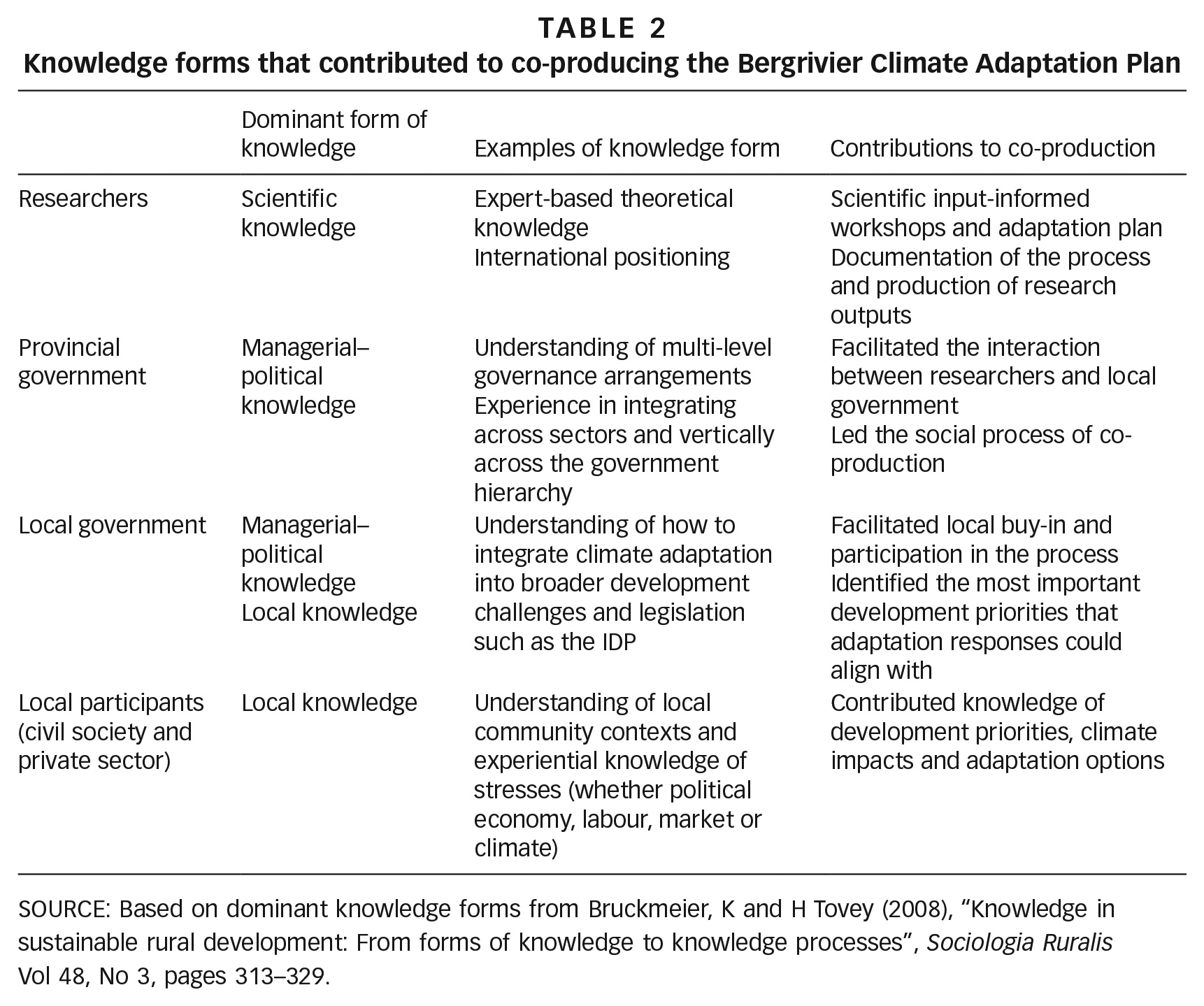
Bruckmeier and Tovey explore how knowledge has been used in sustainable resource management, and suggest that there are three dominant knowledge forms, namely scientific, managerial–political and local knowledge. Knowledge is generated through a larger social process.(76) This relational knowledge-building is particularly important for transdisciplinary research and contributing to the knowledge–policy interface. In the case of the development of the Bergrivier Climate Adaptation Plan, all three knowledge forms were drawn on and negotiated for joint purposes to inform policy, as illustrated in Table 2.
Knowledge forms that contributed to co-producing the Bergrivier Climate Adaptation Plan
SOURCE: Based on dominant knowledge forms from Bruckmeier, K and H Tovey (2008), “Knowledge in sustainable rural development: From forms of knowledge to knowledge processes”, Sociologia Ruralis Vol 48, No 3, pages 313–329.
What was important in our case is that development of the plan was not driven by centralized policy. Rather, it was informed by scientific knowledge as well as local knowledge and priorities. Due to local government and provincial leadership, the policy aligned with the managerial–political knowledge of the provincial and national priorities. The strong social relations of the provincial initiator with the researchers led to the inclusion of scientific knowledge, but this knowledge was not considered privileged knowledge, as is often the case. The climate scientists and adaptation researchers informed the process of assessing vulnerability and climate impacts and made presentations on these at the workshop. The number of participants at each workshop (between 20 and 35) was conducive to interacting and voicing different perspectives, although it only represents a limited number of voices from the region. Each of the different groups contributed different forms of knowledge. One of the limitations was the lack of diversity in civil society groups, with low-income groups being poorly represented in the policy design process, which might have limited the transformative potential of the adaptation plan.(77)
Table 2 outlines how the different groups contributed to the knowledge co-production process.
VI. Conclusions
Despite the growth in the number of adaptation plans and the extent of action by municipalities,(78) there are few cases of lessons learnt on effectively mainstreaming climate adaptation into policy and practice in local government. This paper uses the experiment of co-producing the Bergrivier Municipality’s Climate Adaptation Plan to illustrate how four opportunities were leveraged, particularly relating to policy and capacity. Two policy opportunities emerged. First, the national and provincial adaptation plans were used to rationalize support for local adaptation plans. In the case of the Bergrivier Municipality, its adaptation plan was mainstreamed by integrating it into the municipality’s required IDP. This was supported by the second policy opportunity of being flexible and agile, by remaining “under the radar” because of limited resources as well as by using indicators that allowed for experimentation rather than focusing on outputs. The two capacity opportunities were 1) having strong leaders who championed collaboration and co-production of the plan, and 2) a facilitated process that built Mode 2 knowledge that could be integrated into policy. It was not by initial design, but rather through responding to these policy and capacity opportunities, that a multi-disciplinary team grew and was able to undertake transdisciplinary engaged scholarship.
We argue that collectively these four opportunities helped to mainstream climate change adaptation into development policy and strengthened the knowledge–policy interface. The findings suggest that in order to align adaptation plans with development priorities and gain buy-in from a broad actor base, the integration of multiple knowledge forms, including climate science, managerial–political and local knowledge should be prioritized. This could be strengthened if co-production is given greater priority.
This research has implications for adaptation practice. The process of co-producing an adaptation plan and strengthening social networks should be viewed as an important component of adaptation.(79) A broad range of actors now have access to strengthened networks and the capacity to adapt to future climate risk and to imagine how reducing climate risk can be part of broader development objectives, which is critical in the developing country context.(80) As one of the government officials noted during the workshop process:
“We are missing something here when we say ‘but we haven’t done anything yet’. We have done a lot. We have built relationships, we have exchanged information, we have listened, we have heard, we have expressed, we have moved, we are more knowledgeable as a result. The process of adaptation is not just adapting in a physical sense, but building viable knowledge transfer/exchange/co-production hubs so that we can travel the adaptation process better together.”
Collaborative processes in climate adaptation are often underfunded in comparison to adaptation outputs, although this is changing with a growing focus on supporting social learning.(81) Resource constraints encouraged flexibility in this case, but might have negative effects in others. One challenge of this work, partly attributed to resource constraints, has been the limited rollout of adaptation planning support to other municipalities. We argue that more funding and support should be put towards collaborative processes that are viewed as adaptation, despite challenges with monitoring and evaluation. A recognition of the constraints that come with funding in terms of sticking to initial plans and contending with administrative hurdles should be anticipated. This is an exploratory field and it is not clear how to purposefully create social networks for knowledge co-production.(82) Experimentation is thus necessary. This process should be treated not as an end in itself, but as an ongoing learning process.
Opportunities and barriers or constraints to adaptation is an emerging theoretical focus. In the IPCC chapter on “Adaptation opportunities, constraints, and limits”, there are two pages on opportunities and ten pages on barriers.(83) Although capacity comprises one of six types of opportunities mentioned, there is very little written on how this has supported adaptation. This paper provides a contribution to this through the lens of co-production as a means of strengthening the knowledge–policy interface. This paper concludes by questioning the traditional framing of the science–policy interface as central to adaptation planning and asking whether it should be underpinned by a stronger knowledge–policy interface. Adaptation on the ground needs to be informed by climate science and research input. Yet managerial–political knowledge and local knowledge are as important when developing and implementing local adaptation plans.
This paper also contributes to a recognition of the importance of understanding social and institutional opportunities when developing adaptation plans.(84) Lessons could be taken from the natural resource management field, which has contributed significantly to the understanding of social networks and social capital in contributing to adaptive management.(85) The lack of research on social and institutional enablers or opportunities for climate adaptation in local municipalities results in a theoretical gap that should be addressed. Improved understanding of this would contribute to the development of applied networks, such as the Durban Adaptation Charter and the C40 Cities Climate Leadership Group, as well as to research and to other practitioner networks interested in understanding how co-production can help to strengthen adaptation planning and build capacity. This perspective is critical in international science–policy processes and not limited to the field of climate change.
Footnotes
Acknowledgements
The authors would like to thank the reviewers and Dianne Scott for their inputs and suggestions. The National Research Foundation (NRF) of South Africa is thanked for its research support. In addition, the authors would like to thank the CSIR for a universities co-operation grant, which supported a portion of the CSIR–UCT collaboration. The authors would also like to acknowledge the willingness of both the Western Cape Government and the Bergrivier Municipality to support and engage in the “business unusual” approach required to co-produce across the knowledge–policy interface.
1.
Revi, A, D Satterthwaite, F Aragón-Durand, J Corfee-Morlot, R B R Kiunsi, M Pelling, D Roberts, W Solecki, S Pahwa Gajjar and A Sverdlik (2014), “Towards transformative adaptation in cities: the IPCC’s Fifth Assessment”, Environment and Urbanization Vol 26, No 1, pages 11–28; also Anguelovski, I and J Carmin (2011), “Something borrowed, everything new: innovation and institutionalization in urban climate governance”, Current Opinion in Environmental Sustainability Vol 3, No 3, pages 169–175; Carmin, J, N Nadkarni and C Rhie (2012), “Progress and Challenges in Urban Climate Adaptation Planning: Results of a Global Survey”, Massachusetts Institute of Technology, Cambridge, MA; and Simon, D and H Leck (2015), “Understanding climate adaptation and transformation challenges in African cities”, Current Opinion in Environmental Sustainability Vol 13, pages 109–116.
2.
Hardoy, J and R Ruete (2013), “Incorporating climate change adaptation into planning for a liveable city in Rosario, Argentina”, Environment and Urbanization Vol 25, No 2, pages 339–360; also Webler, T, S Tuler, K Dow, J Whitehead and N Kettle (2014), “Design and evaluation of a local analytic-deliberative process for climate adaptation planning”, Local Environment, pages 1–23; Wamsler, C, C Luederitz and E Brink (2014), “Local levers for change: Mainstreaming ecosystem- based adaptation into municipal planning to foster sustainability transitions”, Global Environmental Change Vol 29, pages 189–201; and Castán Broto, V, E Boyd, J Ensor, D A Macucule and C Allen (2014), A local vision of climate adaptation: participatory urban planning in Mozambique, Climate & Development Knowledge Network.
3.
Brouwer, S, T Rayner and D Huitema (2013), “Mainstreaming climate policy: The case of climate adaptation and the implementation of EU water policy”, Environment and Planning C: Government and Policy Vol 31, No 1, pages 134–153; also Pasquini, L, G Ziervogel, R M Cowling and C Shearing (2014), “What enables local governments to mainstream climate change adaptation? Lessons learned from two municipal case studies in the Western Cape, South Africa”, Climate and Development Vol 7, No 1, pages 60–70; and Uittenbroek, C, L Janssen-Jansen and H Runhaar (2013), “Mainstreaming climate adaptation into urban planning: Overcoming barriers, seizing opportunities and evaluating the results in two Dutch case studies”, Regional Environmental Change Vol 13, No 2, pages 399–411.
4.
Satterthwaite, D (2011), “How can urban centers adapt to climate change with ineffective or unrepresentative local governments?”, WIREs Climate Change Vol 2, No 5, pages 767–776.
5.
Vogel, C, S C Moser, R E Kasperson and G D Dabelko (2007), “Linking vulnerability, adaptation, and resilience science to practice: Pathways, players, and partnerships”, Global Environmental Change Vol 17, pages 349–364.
7.
Ziervogel, G and F Zermoglio (2009), “Climate change scenarios and the development of adaptation strategies in Africa: challenges and opportunities”, Climate Research Vol 40, Nos 2–3, pages 133–146.
8.
van den Hove, S (2007) “A rationale for science–policy interfaces”, Futures Vol 39, No 7, pages 807–826, page 807.
9.
Armitage, D, F Berkes, A Dale, E Kocho-Schellenberg and E Patton (2011), “Co-management and the co-production of knowledge: Learning to adapt in Canada’s Arctic”, Global Environmental Change Vol 21, No 3, pages 995–1004.
10.
Homsy, G C and M E Warner (2013), “Climate change and the co-production of knowledge and policy in rural USA communities”, Sociologia Ruralis Vol 53, No 3, pages 291–310.
11.
See reference 1, Anguelovski and Carmin (2011); also see reference 1, Carmin et al. (2012); and reference 3,  .
.
12.
Biesbroek, R, J Klostermann, C Termeer and P Kabat (2013), “On the nature of barriers to climate change adaptation”, Regional Environmental Change Vol 13, No 5, pages 1119–1129; also Moser, S and J Ekstrom (2010), “A framework to diagnose barriers to climate change adaptation”, Proceedings of the National Academy of Sciences Vol 107, No 51, pages 22026–22031; Shackleton, S, G Ziervogel, S Sallu, T Gill and P Tschakert (2015), “Why is socially-just climate change adaptation in sub-Saharan Africa so challenging ? A review of barriers identified from empirical cases”, WIREs Climate Change Vol 6, No 3, pages 321–344; Oberlack, C and K Eisenack (2014), “Alleviating barriers to urban climate change adaptation through international cooperation”, Global Environmental Change Vol 24, pages 349–362; Termeer, C J (2009), “Barriers to New Modes of Horizontal Governance”, Public Management Review Vol 11, No 3, pages 299–316; Robinson, P J and C D Gore (2005), “Barriers to Canadian Municipal Response to Climate Change”, Canadian Journal of Urban Research Vol 14, No 1, pages 102–121; Burch, S, S R J Sheppard, A Shaw and D Flanders (2010), “Planning for climate change in a flood-prone community: municipal barriers to policy action and the use of visualizations as decision-support tools”, Journal of Flood Risk Management Vol 3, No 2, pages 126–139; Kolikow, S, M E Kragt and A W Mugera (2012), “An interdisciplinary framework of limits and barriers to climate change adaptation in agriculture”, Working Paper 1202, University of Western Australia, School of Agricultural and Resource Economics Industrial Research, Crawley; and Mukheibir, P and G Ziervogel (2007), “Developing a Municipal Adaptation Plan (MAP) for climate change: the city of Cape Town”, Environment and Urbanization Vol 19, No 1, pages 143–158.
13.
Opportunities are defined by Klein et al. as “factors that make it easier to plan and implement adaptation actions, that expand adaptation options, or that provide ancillary co-benefits”. The terms “opportunities” and “enablers” can be used interchangeably. Klein, R J T, G F Midgley, B L Preston, M Alam, F G H Berkhout, K Dow and M R Shaw (2014), “Adaptation opportunities, constraints, and limits”, in C B Field, V R Barros, D J Dokken, K J Mach, M D Mastrandrea, T E Bilir, M Chatterjee, K L Ebi, Y O Estrada, R C Genova, B Girma, E S Kissel, A N Levy, S MacCracken, P R Mastrandrea and L L White (editors), Climate Change 2014: Impacts, Adaptation, and Vulnerability. Part A: Global and Sectoral Aspects, Contribution of Working Group II to the Fifth Assessment Report of the Intergovernmental Panel on Climate Change, Cambridge University Press, Cambridge, UK and New York, NY, pages 899–943, page 907.
14.
See reference 3, Uittenbroek et al. (2013); also Measham, T G, B L Preston, T F Smith, C Brooke, R Gorddard, G Withycombe and C Morrison (2011), “Adapting to climate change through local municipal planning: barriers and challenges”, Mitigation and Adaptation Strategies for Global Change Vol 16, No 8, pages 889–909; Pasquini, L, R M Cowling and G Ziervogel (2013), “Facing the heat: Barriers to mainstreaming climate change adaptation in local government in the Western Cape Province, South Africa”, Habitat International Vol 40, pages 225–232; and Ziervogel, G, J Waddell, W Smit and A Taylor (2014), “Flooding in Cape Town’s informal settlements: barriers to collaborative urban risk governance”, South African Geographical Journal, pages 1–20.
15.
See reference 3, Pasquini et al. (2014); also see reference 12, Biesbroek et al. (2013); and reference 14, .
16.
Juhola, S and L Westerhoff (2011), “Challenges of adaptation to climate change across multiple scales: a case study of network governance in two European countries”, Environmental Science & Policy Vol 14, No 3, pages 239–247.
17.
Kumar, P and D Geneletti (2015), ”How are climate change concerns addressed by spatial plans? An evaluation framework, and an application to Indian cities”, Land Use Policy Vol 42, pages 210–226.
18.
Archer, D, F Almansi, M DiGregorio, D Roberts, D Sharma and D Syam (2014), “Moving towards inclusive urban adaptation: approaches to integrating community-based adaptation to climate change at city and national scale”, Climate and Development Vol 6, No 4, pages 345–356.
20.
See reference 3, Pasquini et al. (2014); also Bulkeley, H (2010), “Cities and the Governing of Climate Change”, Annual Review of Environmental Resources Vol 35, No 1, pages 229–253.
21.
Lebel, L, J M Anderies, B Campbell, C Folke, S Hatfield-Dodds, T P Hughes and J Wilson (2006), “Governance and the Capacity to Manage Resilience in Regional Social-Ecological Systems”, Ecology and Society Vol 11, No 1.
22.
See reference 12, Biesbroek et al. (2013); also see reference 12, Moser and Ekstrom (2010); and reference 3, .
24.
See reference 8, page 807.
25.
See reference 7; also Tompkins, E L, W N Adger, E Boyd, S Nicholson-Cole, K Weatherhead Kand N Arnell (2010), “Observed adaptation to climate change: UK evidence of transition to a well-adapting society”, Global Environmental Change Vol 20, No 4, pages 627–635; and Kates, R W, W R Travis and T J Wilbanks (2012), “Transformational adaptation when incremental adaptations to climate change are insufficient”, Proceedings of the National Academy of Sciences Vol 109, No 19, pages 7156–7161.
26.
Pelling, M and C High (2005), “Understanding adaptation: What can social capital offer assessments of adaptive capacity?”, Global Environmental Change Vol 15, pages 308–319; also Adger, N (2003), “Social Capital, Collective Action, and Adaptation to Climate Change”, Economic Geography Vol 79, No 4, pages 387–404.
27.
See reference 9.
28.
See reference 5, page 349.
29.
For example, see reference 9; also Pohl, C, S Rist, A Zimmermann, P Fry, G S Gurung, F Schneider, C I Speranza, B Kiteme, S Boillat, E Serrano, G H Hadorn and U Wiesmann (2010), “Researchers’ roles in knowledge co-production: experience from sustainability research in Kenya, Switzerland, Bolivia and Nepal”, Science and Public Policy Vol 37, No 4, pages 267–281; and Enengel, B, A Muhar, M Penker, B Freyer, S Drlik and F Ritter (2012), “Co-production of knowledge in transdisciplinary doctoral theses on landscape development—An analysis of actor roles and knowledge types in different research phases”, Landscape and Urban Planning Vol 105, Nos 1–2, pages 106–117.
30.
Van de Ven, A H and P E Johnson (2006), “Knowledge for theory and practice”, Academy of Management Review Vol 31, No 4, pages 802–821, page 803.
31.
Hessels, L K and H van Lente (2008), “Re-thinking new knowledge production: A literature review and a research agenda”, Research Policy Vol 37, No 4, pages 740–760.
32.
See reference 31.
33.
See reference 9; also Pelling, M (2011), Adaptation to Climate Change: From Resilience to Transformation, Routledge, Abingdon, 274 pages.
34.
Burch, S (2010), “Transforming barriers into enablers of action on climate change: Insights from three municipal case studies in British Columbia, Canada”, Global Environmental Change Vol 20, No 2, pages 287–297.
35.
See reference 10.
36.
Polsky, C and D W Cash (2005), “Drought, climate change, and vulnerability: the role of science and technology in a multi-scale, multi-stressor world”, in D Wilhite (editor), Drought and water crises: science, technology, and management issues, Marcel Dekker, New York, pages 215–245.
37.
See reference 5; also see reference 30.
38.
Ansell, C (2003), “Community Embeddedness and Collaborative Governance in the San Francisco Bay Area Environmental Movement”, in M Diani and D McAdam (editors), Social Movements and Networks: Relational Approaches to Collective Action, Oxford University Press, Oxford and New York, pages 123–144.
42.
Lötter, D and D Maitre (2014), “Modelling the distribution of Aspalathus linearis (Rooibos tea): implications of climate change for livelihoods dependent on both cultivation and harvesting from the wild”, Ecology and Evolution Vol 4, pages 1209–1221.
43.
See reference 42.
44.
Archer van Garderen, E, C L Davis and M Tadross (2015), “A changing environment for livestock in South Africa”, in Jody Emel and Harvey Neo (editors), The Political Ecologies of Meat, Routledge, 392 pages.
45.
Archer, E (2009), “Climate change, groundwater and intensive commercial farming in the semi-arid northern Sandveld, South Africa”, Journal of Integrative Environmental Sciences Vol 6, No 2, pages 139–155.
48.
Ziervogel, G, M New, E Archer van Garderen, G Midgley, A Taylor, R Hamann, S Stuart-Hill, J Myers and M Warburton (2014), “Climate change impacts and adaptation in South Africa”, WIRES Climate Change Vol 5, No 5, pages 605–620.
49.
Ziervogel, G, M Shale and M Du (2010), “Climate change adaptation in a developing country context: The case of urban water supply in Cape Town”, Climate and Development Vol 2, No 2, pages 94–110.
50.
Tschakert, P and K A Dietrich (2010), “Anticipatory learning for climate change adaptation and resilience”, Ecology and Society Vol 15, No 2, Article 11; also Tschakert, P, B van Oort, A L St Clair and A LaMadrid (2013), “Inequality and transformation analyses: a complementary lens for addressing vulnerability to climate change”, Climate and Development Vol 5, No 4, pages 340–350.
51.
See reference 41, page 4.
52.
Lincoln, Y S, S A Lyndham and E Guba (2011), “Paradigmatic Controversies, Contradictions, and Emerging Influences”, in N K Denzin and Y S Lincoln (editors), The SAGE Handbook of Qualitative Research, 3rd edition, pages 97–128; also Heron, J and P Reason (1997), “A Participatory Inquiry Paradigm”, Qualitative Inquiry Vol 3, No 3, pages 274–294.
53.
See reference 30.
54.
Swilling, M (2014), “Rethinking the science-policy interface in South Africa: Experiments in knowledge co-production”, South African Journal of Science Vol 110, Nos 5–6, pages 1–7.
58.
61.
See reference 3, Pasquini et al. (2014); also see reference 25, Tompkins et al. (2010); reference 58; Gupta, J, C Termeer, J Klostermann, S Meijerink, M van den Brink, P Jong, S Nooteboom and E Bergsma (2010), “The Adaptive Capacity Wheel: a method to assess the inherent characteristics of institutions to enable the adaptive capacity of society”, Environmental Science & Policy Vol 13, No 6, pages 459–471; and Termeer, C, R Biesbroek and M van den Brink (2012), “Institutions for Adaptation to Climate Change: Comparing National Adaptation Strategies in Europe”, European Political Science Vol 11, No 1, pages 41–53.
62.
Maiello, A, C V Viegas, M Frey and J L D Ribeiro (2013), ”Public managers as catalysts of knowledge co-production? Investigating knowledge dynamics in local environmental policy”, Environmental Science & Policy Vol 27, pages 141–150.
65.
Ansell, C and A Gash (2008), “Collaborative Governance in Theory and Practice”, Journal of Public Administration Research and Theory Vol 18, No 4, pages 543–571.
66.
See reference 9; also Corburn, J (2009), “Cities, Climate Change and Urban Heat Island Mitigation: Localising Global Environmental Science”, Urban Studies Vol 46, No 2, pages 413–427; and Scolobig, A, R Mechler, N Komendantova, W Liu, D Schröter and A Patt (2014), “Co-Production of Scientific Advice and Decision Making under Uncertainty: Lessons from the 2009 L’Aquila Earthquake, Italy”, Planet@risk Vol 2, No 2, pages 71–76.
68.
See reference 58; also see reference 12, Mukheibir and Ziervogel (2007); and Roberts, D (2010), “Prioritizing climate change adaptation and local level resilience in Durban, South Africa”, Environment and Urbanization Vol 22, No 2, pages 397–413.
70.
Bodin, Ö, B Crona and H Ernstson (2006), “Social networks in natural resource management: what is there to learn from a structural perspective?”, Ecology and Society Vol 11, No 2.
72.
Dowd, A-M, N Marshall, A Fleming, E Jakku, E Gaillard and M Howden (2014), “The role of networks in transforming Australian agriculture”, Nature Climate Change Vol 4, No 7, pages 558–563.
73.
Bodin, Ö and B Crona (2009), “The role of social networks in natural resource governance: What relational patterns make a difference?”, Global Environmental Change Vol 19, pages 366–374.
74.
Leck, H and D Roberts (2015), “What lies beneath: understanding the invisible aspects of municipal climate change governance”, Current Opinion in Environmental Sustainability Vol 13, pages 61–67.
76.
Bruckmeier, K and H Tovey (2008), “Knowledge in sustainable rural development: From forms of knowledge to knowledge processes”, Sociologia Ruralis Vol 48, No 3, pages 313–329.
77.
See reference 18.
80.
See reference 49; also Hetz, K and A Bruns (2014), “Urban planning lock-in: implications for the realization of adaptive options towards climate change risks”, Water International Vol 39, No 6, pages 884–900.
81.
Kristjanson, P, B Harvey, M Van Epp and P K Thornton (2014), “Social learning and sustainable development”, Nature Climate Change Vol 4, No 1, pages 5–7.
82.
Rydin, Y (2006), “Joined-up knowledge for the sustainable city?”, Environment and Planning A Vol 38, No 6, pages 1005–1007.
84.
See reference 74.
85.
See reference 66, Scolobig et al. (2014); also see reference 68, .